| Learning Objective | Essential Knowledge |
|---|---|
9.1.A |
|
Thermodynamics and Electrochemistry
AP Chemistry · Topic 9
 8:16
Thermodynamics and Electrochemistry
Two puzzles. Hold an ice cube: it melts in your hand, even though melting takes energy in. Now look at a diamond. Every diamond should slowly turn into…
English narration · English + 中文 subtitles burned in
9.1
Introduction to Entropy

Syllabus
Source: College Board AP Course and Exam Description
Put a glass of water in a freezer at −10 °C and it turns to ice. Leave ice on a table at +10 °C and it melts. It is the same change, run in opposite directions, and only the temperature decides which way it goes. Freezing gives out energy, which favours it; but it also locks the molecules into place, which works against it. This unit shows how to weigh those two effects against each other, and then how the same idea powers every battery.
Entropy 熵 $S$ measures the dispersal 分散 of energy and matter – loosely, the number of ways to arrange a system. Entropy usually increases on melting or vaporisation 汽化 and when accessible gas states increase. Dissolving a solid can increase or decrease the system entropy because solvation 溶剂化 also affects particle arrangements. Compare the actual states and conditions.
Entropy also rises when energy spreads out. Heating a gas widens the range of speeds its molecules have, so the energy is shared out in more ways and the entropy increases. A gas expanding into a larger volume and two gases mixing both increase entropy too, because each molecule has more places it could be.
Worked example (predict the sign). Decide whether $\Delta S$ is positive or negative for each process.
- $\text{H}_2\text{O}(s)\rightarrow\text{H}_2\text{O}(l)$: positive; the molecules become free to move.
- $2\text{SO}_2(g)+\text{O}_2(g)\rightarrow2\text{SO}_3(g)$: negative; 3 mol of gas become 2.
- $\text{CaCO}_3(s)\rightarrow\text{CaO}(s)+\text{CO}_2(g)$: positive; a gas forms from a solid.
- $\text{Ag}^+(aq)+\text{Cl}^-(aq)\rightarrow\text{AgCl}(s)$: negative; free ions lock into a solid.
Explore
More or less entropy?
Sort each by whether it has higher or lower entropy.
Vocabulary
Train
| English |
|---|
| Entropy/ˈentrəpi/ |
| dispersal |
| vaporisation/ˌveɪpəraɪˈzeɪʃn/ |
| solvation |
9.2
Absolute Entropy and Entropy Change
Syllabus
| Learning Objective | Essential Knowledge |
|---|---|
9.2.A |
|
Source: College Board AP Course and Exam Description
Every substance has a positive absolute entropy 绝对熵 $S^\circ$. For a reaction,
$$\Delta S^\circ = \sum S^\circ(\text{products}) - \sum S^\circ(\text{reactants}).$$
Predict its sign from the change in gas moles: making more gas raises entropy ($\Delta S>0$).
Worked example (calculate $\Delta S^\circ$). For $\text{N}_2(g)+3\text{H}_2(g)\rightarrow2\text{NH}_3(g)$, use $S^\circ$ values of 191.6 ($\text{N}_2$), 130.7 ($\text{H}_2$) and 192.5 ($\text{NH}_3$) J/(mol K):
$$\Delta S^\circ=2(192.5)-[191.6+3(130.7)]=385.0-583.7=-198.7\ \text{J/K}.$$
The sign agrees with the prediction: 4 mol of gas become 2. Unlike $\Delta H_f^\circ$, the $S^\circ$ of an element is not zero, so $\text{N}_2$ and $\text{H}_2$ must be included.
Explore
Sign of ΔS
Sort each reaction by the sign of its entropy change, using the change in moles of gas.
Vocabulary
Train
| English |
|---|
| absolute entropy |
9.3
Gibbs Free Energy and Thermodynamic Favorability

Syllabus
| Learning Objective | Essential Knowledge | ||||||||||||||||||||
|---|---|---|---|---|---|---|---|---|---|---|---|---|---|---|---|---|---|---|---|---|---|
9.3.A |
|
Source: College Board AP Course and Exam Description
Gibbs free energy 吉布斯自由能 combines enthalpy and entropy:
$$\Delta G = \Delta H - T\Delta S.$$
At constant temperature and pressure, a process is thermodynamically favorable 热力学有利 when $\Delta G<0$. So exothermic ($\Delta H<0$) and entropy-increasing ($\Delta S>0$) reactions are always favorable; when the two oppose, temperature decides.
Worked example. A reaction has $\Delta H=+40\ \text{kJ/mol}$ and $\Delta S=+120\ \text{J/(mol K)}$. It is endothermic (unfavorable enthalpy) but entropy-increasing, so it becomes favorable only when hot enough. Setting $\Delta G=\Delta H-T\Delta S<0$ and matching units ($\Delta S=0.120\ \text{kJ/(mol K)}$):
$$T>\frac{\Delta H}{\Delta S}=\frac{40}{0.120}=333\ \text{K}\;(60\,{}^{\circ}\text{C}).$$
The signs of $\Delta H$ and $\Delta S$ give four cases:
| $\Delta H$ | $\Delta S$ | Favored ($\Delta G<0$) at | Example |
|---|---|---|---|
| $-$ | $+$ | all temperatures | burning fuel |
| $+$ | $-$ | no temperature | the reverse of burning |
| $+$ | $+$ | high temperature | melting, dissolving $\text{NaNO}_3$ |
| $-$ | $-$ | low temperature | freezing, making $\text{NH}_3$ |
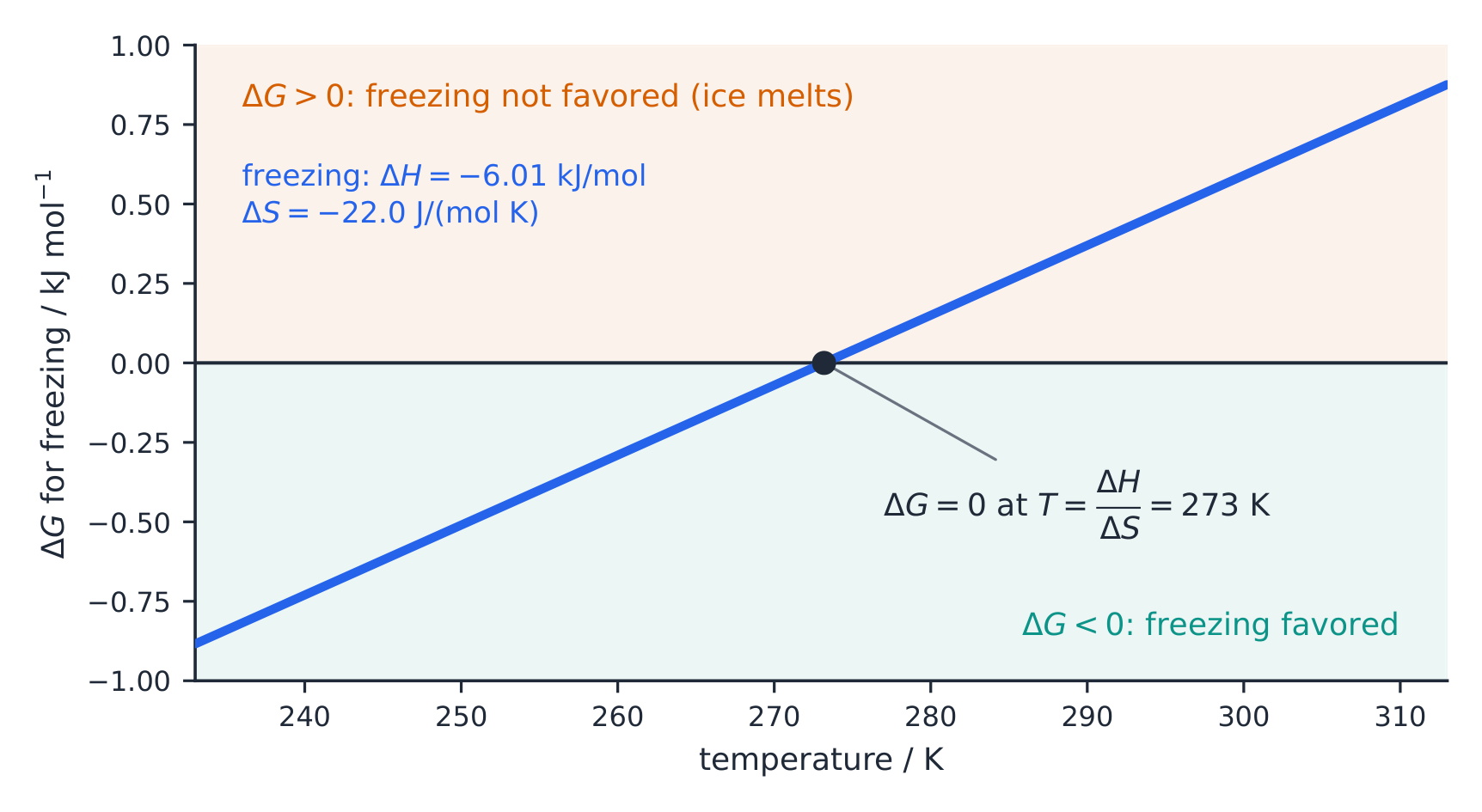
Worked example (the freezing point from thermodynamics). For freezing, $\Delta H=-6.01$ kJ/mol and $\Delta S=-22.0$ J/(mol K). Freezing is favored when $\Delta H-T\Delta S<0$, which is when $T<\Delta H/\Delta S=6010/22.0=273$ K. Thermodynamics predicts the freezing point of water, 0 °C.
$\Delta G^\circ$ can also come from tables of standard free energies of formation, in exactly the same way as $\Delta H^\circ$: products minus reactants, each multiplied by its coefficient.
Explore
Free energy versus temperature
ΔG = ΔH - TΔS is a straight line in temperature. Where it crosses zero, the reaction turns favourable.
Vocabulary
Train
| English |
|---|
| Gibbs free energy/ɡɪbz friː ˈenədʒi/ |
| thermodynamically favorable/ˌθɜːməʊdaɪˈnæmɪkli ˈfeɪvərəbl/ |
9.4
Thermodynamic and Kinetic Control
Syllabus
| Learning Objective | Essential Knowledge |
|---|---|
9.4.A |
|
Source: College Board AP Course and Exam Description
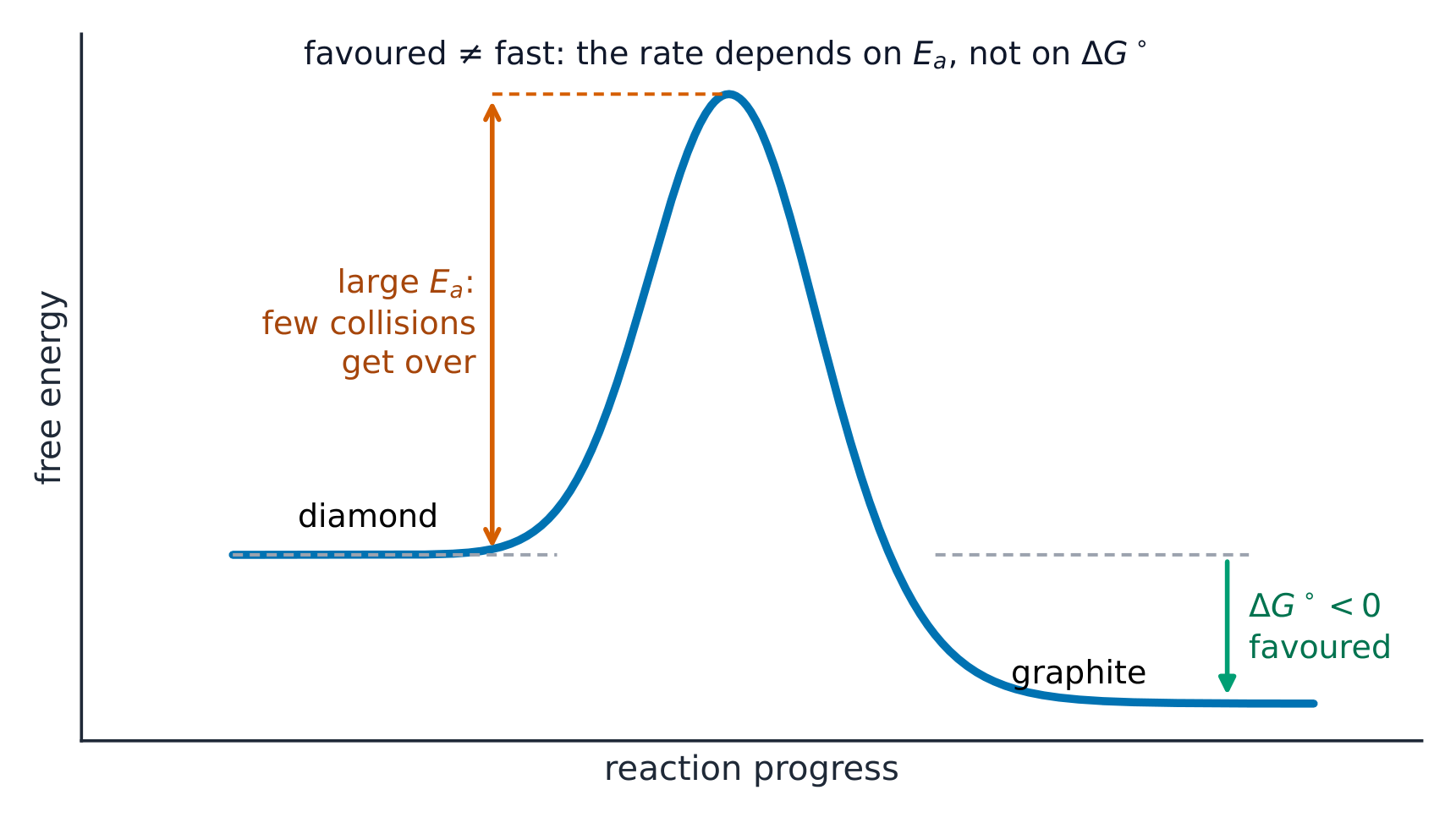
$\Delta G<0$ says a reaction can happen, not that it will happen fast. A reaction can be thermodynamically favorable yet kinetically slow because of a high activation energy 活化能 (diamond → graphite). Thermodynamics 热力学 gives the direction; kinetics 动力学 gives the speed.
Your own body is an example. Glucose burning in oxygen has $\Delta G^\circ\approx-2900$ kJ/mol, yet sugar in a bowl does not catch fire. Its activation energy is too high at room temperature. In cells, enzymes lower that barrier, so the same reaction runs steadily at 37 °C. Such a reaction is said to be under kinetic control 动力学控制. A slow reaction is not an unfavorable one.
Explore
Thermodynamics or kinetics?
Sort each idea by whether it is set by free energy or by rate.
Vocabulary
Train
| English |
|---|
| activation energy/ˌæktɪˈveɪʃn ˈenədʒi/ |
| Thermodynamics/ˌθɜːməʊdaɪˈnæmɪks/ |
| kinetics/kɪˈnetɪks/ |
| kinetic control |
9.5
Free Energy and Equilibrium
Syllabus
| Learning Objective | Essential Knowledge |
|---|---|
9.5.A |
|
Source: College Board AP Course and Exam Description
Free energy links to the equilibrium constant 平衡常数:
$$\Delta G^\circ = -RT\ln K.$$
So $\Delta G^\circ<0$ gives $K>1$ (products favored), and $\Delta G^\circ>0$ gives $K<1$. At equilibrium $\Delta G=0$.
The size of $K$ depends on how $\Delta G^\circ$ compares with $RT$, which is about 2.5 kJ/mol at 298 K. If $\Delta G^\circ$ is close to zero, $K$ is close to 1. If it is many times $RT$, $K$ is huge or tiny.
Worked example (K from $\Delta G^\circ$). A reaction has $\Delta G^\circ=-10.0$ kJ/mol at 298 K. Then
$$K=e^{-\Delta G^\circ/RT}=e^{10000/(8.314\times298)}=e^{4.04}=57.$$
A modest $-10$ kJ already gives products a clear advantage. For $\Delta G^\circ=-50$ kJ/mol, $K\approx6\times10^8$: the reaction effectively goes to completion. Use $R=8.314$ J/(mol K) and $\Delta G^\circ$ in joules.
Explore
Free energy and K
Link the sign of ΔG-standard to the size of K.
Vocabulary
Train
| English |
|---|
| equilibrium constant/ˌiːkwɪˈlɪbrɪəm ˈkɒnstənt/ |
9.6
Free Energy of Dissolution
Syllabus
| Learning Objective | Essential Knowledge |
|---|---|
9.6.A |
|
Source: College Board AP Course and Exam Description
Whether a salt dissolves depends on the free-energy change of dissolving 溶解. Dissolving often increases entropy (ordered solid → dispersed ions) but may cost enthalpy; the sign of $\Delta G$ (and thus $K_{sp}$) follows from $\Delta H - T\Delta S$.
Three steps contribute. Breaking the solid's lattice costs energy. The water molecules must move apart and rearrange around each ion. Then the ions are attracted to the water (hydration), which releases energy. Sodium nitrate dissolves well even though dissolving it is endothermic ($\Delta H\approx+20$ kJ/mol): the large entropy gain makes $\Delta G$ negative at room temperature. Some salts with small, highly charged ions, such as $\text{CaCO}_3$, barely dissolve. Their lattice is very strong, and the water ordered around $\text{Ca}^{2+}$ and $\text{CO}_3^{2-}$ makes $\Delta S$ unfavorable too.
Explore
Will it dissolve?
Sort each case by whether dissolving is thermodynamically favourable.
Vocabulary
Train
| English |
|---|
| dissolving |
9.7
Coupled Reactions

Syllabus
| Learning Objective | Essential Knowledge |
|---|---|
9.7.A |
|
Source: College Board AP Course and Exam Description
An unfavorable reaction ($\Delta G>0$) can be driven by coupling 偶联 it to a favorable one ($\Delta G<0$) that shares a common intermediate 中间体, as long as the sum has $\Delta G<0$. This is how cells use ATP to power otherwise unfavorable processes.
Worked example (driving a reaction with ATP). Cells make the amino acid glutamine from glutamate and ammonia:
$$\text{glutamate}+\text{NH}_3\rightarrow\text{glutamine}+\text{H}_2\text{O}\qquad\Delta G^\circ=+14.2\ \text{kJ}$$
$$\text{ATP}+\text{H}_2\text{O}\rightarrow\text{ADP}+\text{P}_i\qquad\Delta G^\circ=-30.5\ \text{kJ}$$
The two are coupled through a shared intermediate, so the overall $\Delta G^\circ=+14.2-30.5=-16.3$ kJ is favorable. An unfavorable process can also be driven by an outside source of energy: electricity charges a phone battery, and sunlight drives photosynthesis, turning carbon dioxide and water into glucose.
Vocabulary
Train
| English |
|---|
| coupling |
| intermediate/ˌɪntəˈmiːdɪət/ |
9.8
Galvanic and Electrolytic Cells

Syllabus
| Learning Objective | Essential Knowledge |
|---|---|
9.8.A |
|
Source: College Board AP Course and Exam Description
Redox reactions 氧化还原反应 can move electrons through a wire:
- A galvanic (voltaic) cell 原电池 uses a favorable reaction ($\Delta G<0$) to produce electricity – a battery.
- An electrolytic cell 电解池 uses electricity to force an unfavorable reaction ($\Delta G>0$).
In both, oxidation 氧化 happens at the anode 阳极 and reduction 还原 at the cathode 阴极.
Each part of a cell has a job:
| Part | Its job |
|---|---|
| Electrodes | conduct electrons; the anode may dissolve, the cathode may gain metal |
| Half-cell solutions | supply the ions that are reduced, or receive the ions that are formed |
| Wire | carries electrons from anode to cathode |
| Salt bridge 盐桥 | lets ions move so each half-cell stays neutral; without it the current stops at once |
| Voltmeter | measures the cell potential |
In the zinc–copper cell, zinc atoms lose electrons and enter the solution, so the zinc electrode loses mass. Copper ions gain electrons and plate out, so the copper electrode gains mass.
Exam skill (reading a cell diagram). Free-response questions often show a cell and ask four things. Draw the electron arrow along the wire, from the anode to the cathode. In the salt bridge, anions move toward the anode, where positive ions are being made, and cations move toward the cathode, where they are being used up. The electrode that loses mass is the anode: its atoms have become ions in the solution, so the mass has not disappeared. Observations identify the electrodes: an electrode that gets lighter, or a solution that gains colour from new ions, marks oxidation; metal plating out or a colour fading marks reduction.

Explore
Transfer electrons in a cell
In a galvanic cell a spontaneous redox reaction drives electrons through a wire, doing electrical work; oxidation at one electrode, reduction at the other.
Vocabulary
Train
| English |
|---|
| Redox reactions |
| galvanic (voltaic) cell/ɡælˈvænɪk sel/ |
| electrolytic cell/ɪˌlektrəˈlɪtɪk sel/ |
| oxidation/ˌɒksɪˈdeɪʃn/ |
| anode/ˈænəʊd/ |
| reduction/rɪˈdʌkʃn/ |
| cathode/ˈkæθəʊd/ |
| salt bridge/sɒlt brɪdʒ/ |
9.9
Cell Potential and Free Energy

Syllabus
| Learning Objective | Essential Knowledge |
|---|---|
9.9.A |
|
Source: College Board AP Course and Exam Description
The cell potential 电池电势 $E^\circ_{\text{cell}}$ measures the driving force in volts, found from standard reduction potentials 标准还原电势 ($E^\circ_{\text{cathode}}-E^\circ_{\text{anode}}$). It links to free energy by
$$\Delta G^\circ = -nFE^\circ_{\text{cell}},$$
where $n$ is moles of electrons and $F$ the Faraday constant 法拉第常数. A positive $E^\circ_{\text{cell}}$ means a favorable (galvanic) reaction under standard conditions.
Worked example. A cell pairs a copper cathode ($\text{Cu}^{2+}+2e^-\rightarrow\text{Cu}$, $E^\circ=+0.34\ \text{V}$) with a zinc anode ($\text{Zn}^{2+}+2e^-\rightarrow\text{Zn}$, $E^\circ=-0.76\ \text{V}$). The cell potential is
$$E^\circ_{\text{cell}}=E^\circ_{\text{cathode}}-E^\circ_{\text{anode}}=0.34-(-0.76)=1.10\ \text{V}.$$
It is positive, so the reaction is spontaneous 自发的 and the cell (a Daniell cell) acts as a battery.
Two electrons move per zinc atom, so $n=2$:
$$\Delta G^\circ=-nFE^\circ=-(2)(96485)(1.10)=-2.12\times10^5\ \text{J}=-212\ \text{kJ}.$$
The negative $\Delta G^\circ$ agrees with the positive $E^\circ$. Running the cell backwards, plating zinc and dissolving copper, has $E^\circ=-1.10$ V. It happens only if an outside power supply pushes with more than 1.10 V: that is an electrolytic cell.
Explore
Cell potential and free energy
A positive cell potential means a negative ΔG - a spontaneous cell. They are proportional.
Vocabulary
Train
| English |
|---|
| cell potential/sel pəˈtenʃl/ |
| standard reduction potentials |
| Faraday constant/ˈfærədeɪ ˈkɒnstənt/ |
| spontaneous/spɒnˈteɪnɪəs/ |
9.10
Cell Potential Under Nonstandard Conditions
Syllabus
| Learning Objective | Essential Knowledge |
|---|---|
9.10.A |
|
Source: College Board AP Course and Exam Description
Away from standard conditions, the potential shifts with concentration – the Nernst equation 能斯特方程 (qualitatively): as reactants are consumed, $Q$ rises and $E_{\text{cell}}$ falls, reaching zero at equilibrium (a dead battery). The cell potential is a driving force toward equilibrium: the further the cell is from equilibrium, the larger $|E|$. Compare $Q$ with $K$, using
$$E=E^\circ-\frac{RT}{nF}\ln Q.$$
AP asks you to reason with this, not to plug numbers in. When $Q<1$ (more reactant than at standard conditions), $\ln Q<0$ and $E>E^\circ$. When $Q>1$, $E<E^\circ$. When $Q=K$, $E=0$. AP notes that Le Chatelier's principle 勒夏特列原理 should not be used here, because a working cell is not at equilibrium; argue from $Q$ instead.
Worked example (a concentration change). In the zinc–copper cell, $Q=[\text{Zn}^{2+}]/[\text{Cu}^{2+}]$. If $[\text{Cu}^{2+}]$ is raised to 2.0 M while $[\text{Zn}^{2+}]$ stays at 1.0 M, then $Q=0.50<1$, and $E_{\text{cell}}$ is slightly greater than 1.10 V. As the cell runs, $[\text{Zn}^{2+}]$ rises and $[\text{Cu}^{2+}]$ falls, so $Q$ grows and $E$ drops until it reaches zero.
Explore
Nonstandard cell potential
Using the Nernst equation, sort each change by its effect on the cell potential.
Vocabulary
Train
| English |
|---|
| Nernst equation/nɜːnst ɪˈkweɪʒn/ |
| Le Chatelier's principle/lə ˈtʃeɪtlɪəz ˈprɪnsɪpl/ |
9.11
Electrolysis and Faraday's Law
Syllabus
| Learning Objective | Essential Knowledge |
|---|---|
9.11.A |
|
Source: College Board AP Course and Exam Description
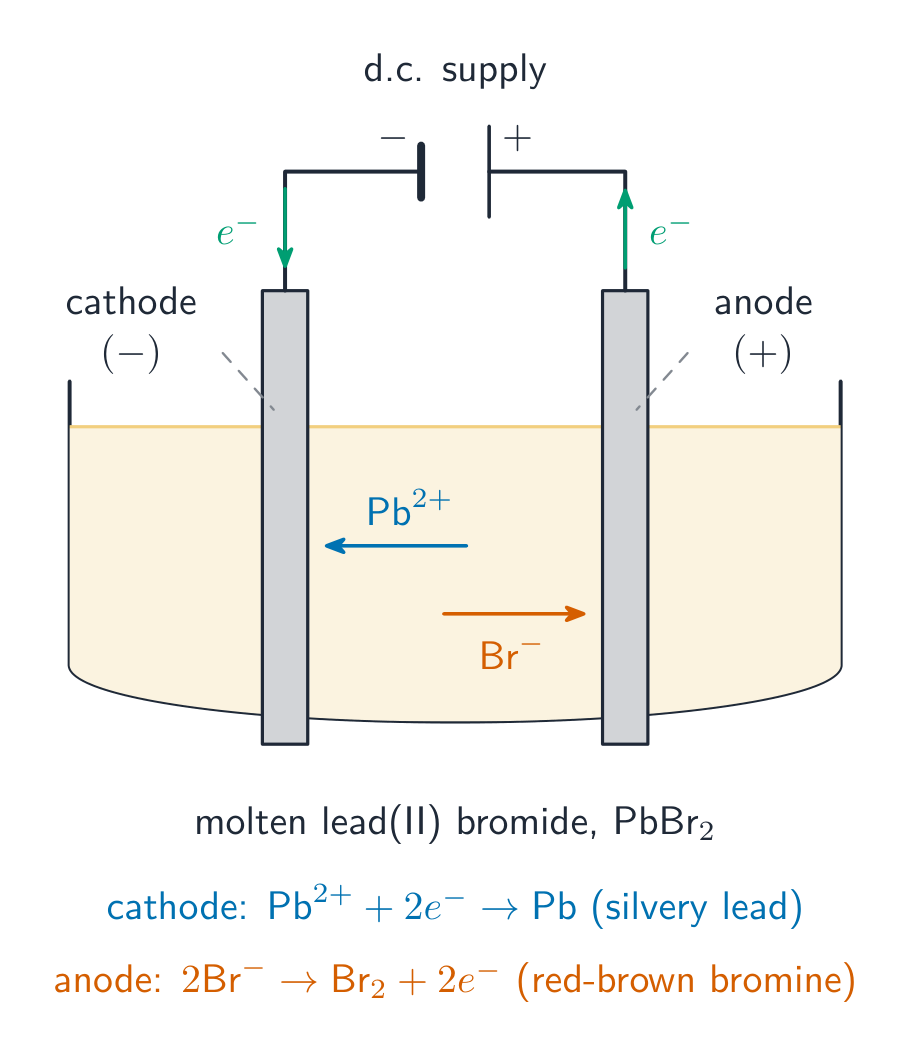
In electrolysis 电解, the charge passed determines how much substance is deposited or produced – Faraday's law 法拉第定律. Convert current × time to charge, charge to moles of electrons ($F=96{,}485$ C/mol), then use the electron ratio in the half-reaction 半反应 to get moles (and mass) of product.
Worked example. A current of $2.0\ \text{A}$ flows for $30\ \text{minutes}$ through copper(II) sulfate ($\text{Cu}^{2+}+2e^-\rightarrow\text{Cu}$). How much copper is deposited? The charge is $Q=It=2.0\times1800=3600\ \text{C}$, giving $3600/96485=0.0373\ \text{mol}$ of electrons. Since each Cu needs $2$ electrons, $0.0187\ \text{mol}$ of Cu forms, a mass of $0.0187\times63.5=1.2\ \text{g}$.
Worked example (silver plating, working backwards). A jeweller wants to plate 0.500 g of silver onto a ring with a current of 0.250 A. How long does it take? $\text{Ag}^++e^-\rightarrow\text{Ag}$ needs one electron per atom.
$$n(e^-)=n(\text{Ag})=\frac{0.500}{107.9}=4.63\times10^{-3}\ \text{mol},\qquad q=nF=(4.63\times10^{-3})(96485)=447\ \text{C}.$$
$$t=\frac{q}{I}=\frac{447}{0.250}=1790\ \text{s}\approx30\ \text{min}.$$
The same equations also find an ion's charge. If 0.0100 mol of electrons deposits 0.0050 mol of a metal, each ion needed 2 electrons, so the ion was $\text{M}^{2+}$.
Common mistakes.
- Mixing units in $\Delta G^\circ = \Delta H^\circ - T\Delta S^\circ$. $\Delta S^\circ$ is usually given in J/(mol K) and $\Delta H^\circ$ in kJ/mol: convert one of them before you subtract.
- Saying a thermodynamically favorable reaction is fast. $\Delta G^\circ < 0$ says nothing about the rate; a high activation energy can keep it under kinetic control.
- Multiplying a reduction potential by the coefficient in the balanced equation. $E^\circ$ is an intensive property, so it is not multiplied; only $n$ in $\Delta G^\circ = -nFE^\circ$ changes.
- Thinking the anode is always negative. Oxidation always happens at the anode; it is negative in a galvanic cell but positive in an electrolytic cell.
- Sending electrons through the salt bridge. Electrons move only through the external wire; ions move through the salt bridge to keep each half-cell neutral.
- Using Le Chatelier's principle for a working cell. Compare $Q$ with $K$ (or with 1) instead.
- Getting the sign link between $K$ and $\Delta G^\circ$ wrong. $\Delta G^\circ = -RT\ln K$: $K > 1$ goes with $\Delta G^\circ < 0$ and $E^\circ_\text{cell} > 0$.
Explore
Electrolyse a molten salt
Electrolysis uses current to force a non-spontaneous reaction: positive ions gain electrons at the cathode, negative ions lose them at the anode. Charge sets the amount deposited.
Vocabulary
Train
| English |
|---|
| electrolysis/ɪlekˈtrɒləsɪs/ |
| Faraday's law/ˈfærədeɪz lɔː/ |
| half-reaction |
9.11
Exam tips
- A process is thermodynamically favourable when $\Delta G<0$; combine enthalpy and entropy with $\Delta G=\Delta H-T\Delta S$ (match units — kJ vs J).
- Entropy increases solid→liquid→gas and when more gas moles are produced.
- Favourable does not mean fast — a high activation energy can make a $\Delta G<0$ reaction extremely slow (kinetic control).
- In electrochemistry a positive $E^\circ_{\text{cell}}=E^\circ_{\text{cathode}}-E^\circ_{\text{anode}}$ means a spontaneous (galvanic) cell; oxidation is at the anode, reduction at the cathode.
- In electrolysis the charge passed ($Q=It$) fixes the amount deposited (Faraday's law).
Interactive lessons on this topic
Work through it step by step, with instant-check exercises.
- Introduction to Entropy
- Absolute Entropy and Entropy Change
- Gibbs Free Energy and Thermodynamic Favorability
- Thermodynamic and Kinetic Control
- Free Energy and Equilibrium
- Free Energy of Dissolution
- Coupled Reactions
- Galvanic and Electrolytic Cells
- Cell Potential and Free Energy
- Cell Potential Under Nonstandard Conditions
- Electrolysis and Faraday's Law