| Learning Objective | Essential Knowledge |
|---|---|
5.1.A |
|
Kinetics
AP Chemistry · Topic 5
 8:00
Kinetics
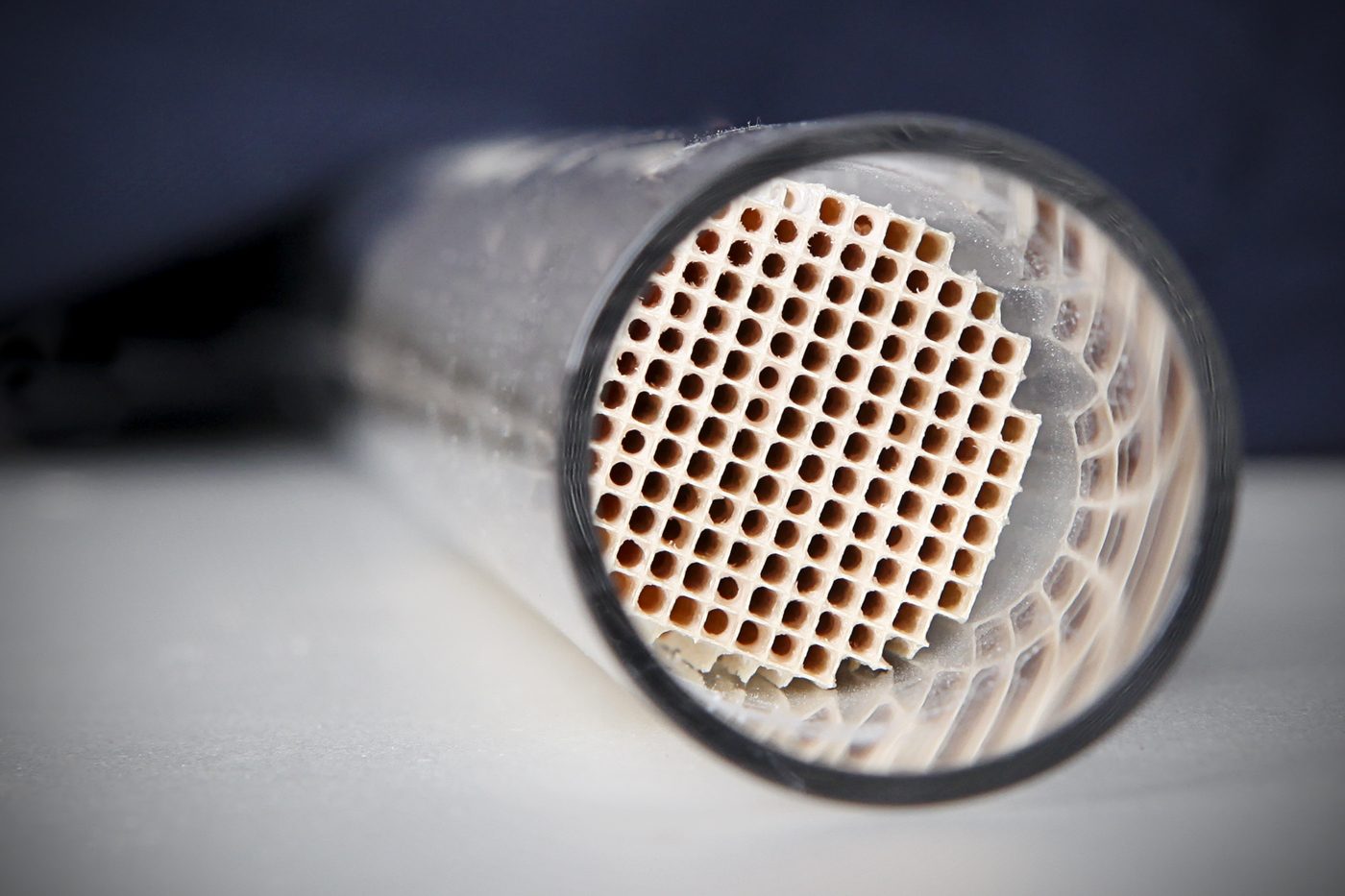
Look inside a car's exhaust pipe. This ceramic honeycomb is a catalytic converter. The gases rushing through it are poisonous. Left alone they would take years…
English narration · English + 中文 subtitles burned in
5.1
How Fast a Reaction Goes
Syllabus
Source: College Board AP Course and Exam Description
Snap a glow stick and drop it into hot water: it shines brightly but fades within an hour. Put an identical one in the freezer and it glows dimly, but for many hours. The same chemicals react in both, and only the speed differs. Food in a fridge, iron rusting and the engine of a car all depend on the same question: how fast? This unit measures reaction speed, explains it with colliding particles, and uses it to work out the steps a reaction really takes.
Kinetics 动力学 studies reaction rate 反应速率 – how fast reactants become products. Rate is the change in concentration 浓度 per unit time, and it typically decreases as reactants are used up. Higher temperature 温度 and a suitable catalyst usually increase rate. Concentration effects depend on the rate law; greater exposed surface area 表面积 matters for reactions involving a solid.
The balanced equation links the rates of the different species. For $2\text{N}_2\text{O}_5\rightarrow4\text{NO}_2+\text{O}_2$, for every 2 mol of $\text{N}_2\text{O}_5$ used, 4 mol of $\text{NO}_2$ and 1 mol of $\text{O}_2$ form. If $\text{N}_2\text{O}_5$ is used up at $0.010$ M/s, then $\text{NO}_2$ forms at $0.020$ M/s and $\text{O}_2$ at $0.0050$ M/s. Always say which species a rate refers to.
To measure a rate in the lab, follow something that changes as the reaction goes: the volume of gas given off, the mass lost as gas escapes, a colour (with a colorimeter), the pressure, or the pH.
Explore
Change conditions and watch the rate
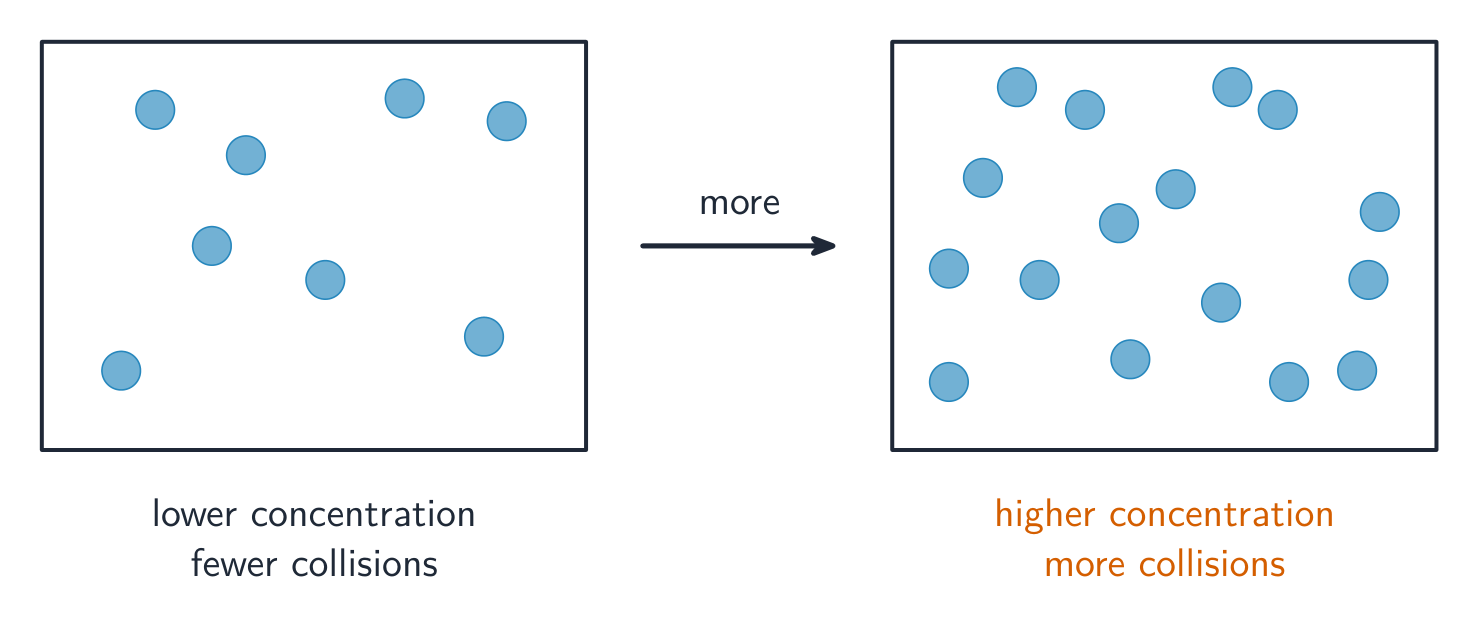
Reaction rate rises with temperature, concentration, and a catalyst — each gives more frequent or more successful collisions. Change each and watch the reaction speed up.
Vocabulary
Train
| English |
|---|
| Kinetics/kɪˈnetɪks/ |
| reaction rate/rɪˈækʃn reɪt/ |
| concentration/ˌkɒnsənˈtreɪʃn/ |
| temperature/ˈtemprɪtʃə/ |
| surface area/ˈsɜːfɪs ˈeərɪə/ |
5.2
Writing the Rate Law
Syllabus
| Learning Objective | Essential Knowledge |
|---|---|
5.2.A |
|
Source: College Board AP Course and Exam Description
The rate law 速率方程 relates rate to reactant concentrations:
$$\text{rate}=k[\text{A}]^m[\text{B}]^n,$$
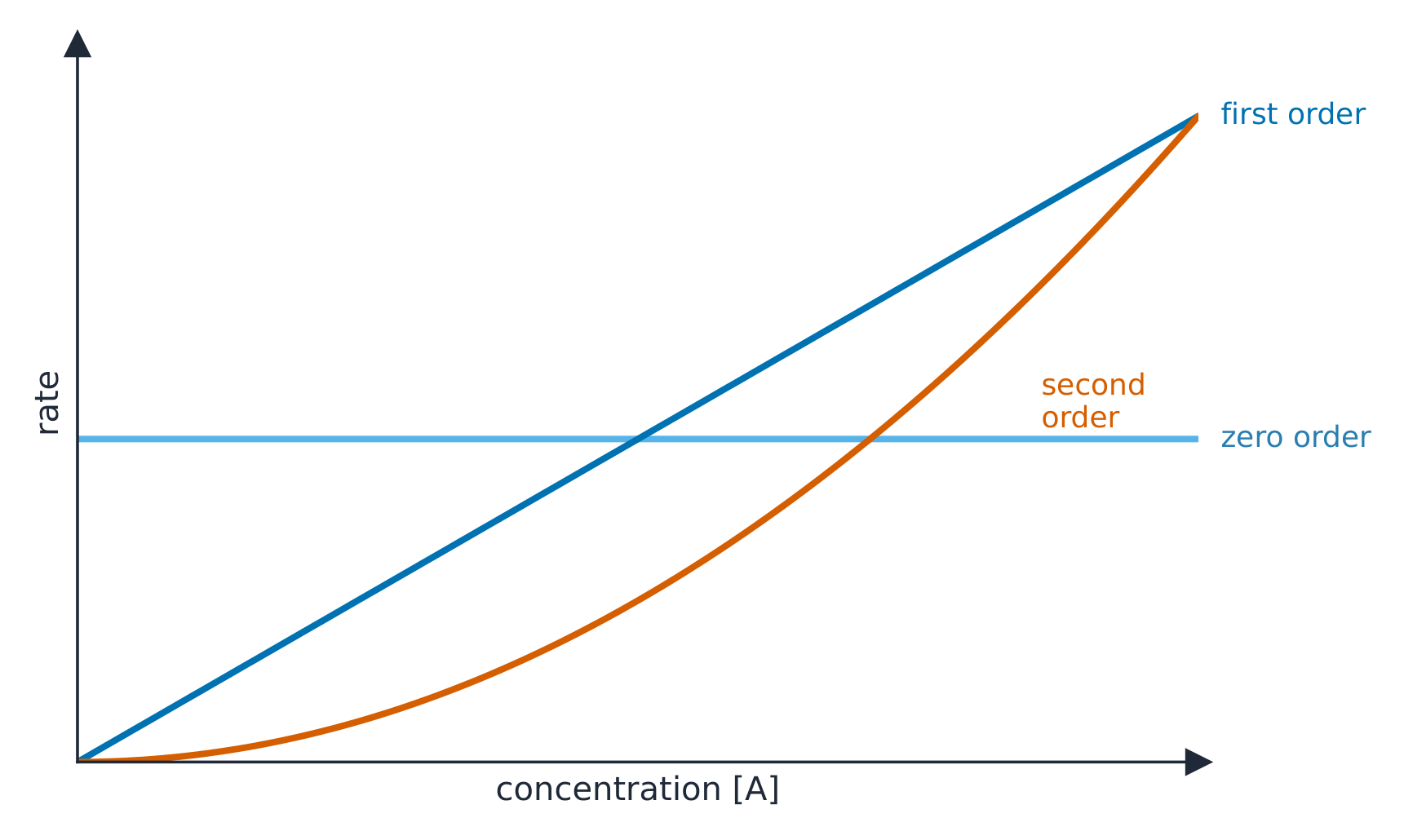
where $k$ is the rate constant 速率常数 and $m,n$ are the orders 级数. Orders are found experimentally (not from the balanced coefficients) by seeing how the rate changes when you change one concentration at a time.
Worked example. In experiments, doubling $[\text{A}]$ makes the rate four times larger, while doubling $[\text{B}]$ leaves the rate unchanged. So the reaction is second order 二级 in A ($2^2=4$) and zero order 零级 in B, giving $\text{rate}=k[\text{A}]^2$. The overall order 总级数 is $2+0=2$. Never read the orders off the balanced coefficients – only experiment gives them.
Worked example (method of initial rates). For $2\text{NO}+\text{O}_2\rightarrow2\text{NO}_2$:
| Experiment | $[\text{NO}]_0$ / M | $[\text{O}_2]_0$ / M | Initial rate / M s⁻¹ |
|---|---|---|---|
| 1 | 0.010 | 0.010 | $2.5\times10^{-5}$ |
| 2 | 0.020 | 0.010 | $1.0\times10^{-4}$ |
| 3 | 0.010 | 0.020 | $5.0\times10^{-5}$ |
From 1 to 2, $[\text{NO}]$ doubles and the rate goes up 4 times: second order in NO. From 1 to 3, $[\text{O}_2]$ doubles and the rate doubles: first order in $\text{O}_2$. So $\text{rate}=k[\text{NO}]^2[\text{O}_2]$, third order overall. Using experiment 1:
$$k=\frac{2.5\times10^{-5}}{(0.010)^2(0.010)}=25\ \text{M}^{-2}\,\text{s}^{-1}.$$
The units of $k$ depend on the overall order: $\text{M s}^{-1}$ for zero order, $\text{s}^{-1}$ for first, $\text{M}^{-1}\text{s}^{-1}$ for second, $\text{M}^{-2}\text{s}^{-1}$ for third. The value of $k$ changes with temperature, but not with concentration.
Explore
Find the reaction order
Use how the rate responds to concentration to find the order in A.
Vocabulary
Train
| English |
|---|
| rate law/reɪt lɔː/ |
| rate constant/reɪt ˈkɒnstənt/ |
| orders/ˈɔːdəz/ |
| second order |
| zero order |
| overall order/ˌəʊvəˈrɔːl ˈɔːdə/ |
5.3
Concentration Over Time

Syllabus
| Learning Objective | Essential Knowledge |
|---|---|
5.3.A |
|
Source: College Board AP Course and Exam Description
The integrated rate laws 积分速率方程 describe how concentration falls with time and give straight-line tests:
- Zero order: $[\text{A}]$ vs $t$ is linear.
- First order 一级: $\ln[\text{A}]$ vs $t$ is linear; constant half-life 半衰期.
- Second order: $\dfrac{1}{[\text{A}]}$ vs $t$ is linear.
Whichever plot is straight tells you the order and gives $k$ from its slope.
Worked example. A first-order reaction has rate constant $k=0.030\ \text{s}^{-1}$. Its half-life is
$$t_{1/2}=\frac{0.693}{k}=\frac{0.693}{0.030}=23\ \text{s},$$
and, being first order, that half-life stays the same no matter how much reactant remains – so after $46\ \text{s}$ ($2$ half-lives) one quarter is left.
For times that are not whole half-lives, use the integrated law, $\ln[\text{A}]_t-\ln[\text{A}]_0=-kt$. For this reaction, starting at 0.50 M, after 60 s:
$$\ln[\text{A}]_t=\ln(0.50)-(0.030)(60)=-0.693-1.80=-2.49,\qquad[\text{A}]_t=e^{-2.49}=0.083\ \text{M}.$$
Radioactive decay 放射性衰变 is always first order. Carbon-14 has a half-life of 5730 years. A piece of wood with one-eighth of the carbon-14 of living wood has passed through 3 half-lives ($\tfrac12\times\tfrac12\times\tfrac12=\tfrac18$), so it is about $3\times5730\approx17{,}000$ years old. That is how carbon dating works.
Worked example (which plot is straight?). A reactant is measured at 0, 10, 20 and 30 s: 0.80, 0.40, 0.20 and 0.10 M. The concentration halves every 10 s, which is a constant half-life, so the reaction is first order and a plot of $\ln[\text{A}]$ against $t$ is a straight line. Its slope is $-k$, with $k=0.693/10=0.069\ \text{s}^{-1}$. For a second-order reaction, each half-life is twice as long as the one before.
Explore
Track concentration as a reaction runs
As reactants are used up the rate slows, so a concentration-time curve is steep at first and flattens out. Raising temperature or adding a catalyst steepens it.
Vocabulary
Train
| English |
|---|
| integrated rate law |
| first order |
| half-life/hɑːf laɪf/ |
| radioactive decay/ˌreɪdɪəʊˈæktɪv dɪˈkeɪ/ |
5.4
The Steps a Reaction Really Takes
Syllabus
| Learning Objective | Essential Knowledge |
|---|---|
5.4.A |
|
Source: College Board AP Course and Exam Description
A reaction mechanism 反应机理 is the sequence of elementary steps 基元反应 that actually occur. Their molecularity 分子数 (how many particles collide in a step) sets that step's rate law directly. Species made in one step and used up in a later one are intermediates 中间体.
For an elementary step, and only for an elementary step, the rate law comes straight from the equation for that step:
| Elementary step | Molecularity | Rate law |
|---|---|---|
| $\text{A}\rightarrow\text{products}$ | unimolecular | $k[\text{A}]$ |
| $\text{A}+\text{B}\rightarrow\text{products}$ | bimolecular | $k[\text{A}][\text{B}]$ |
| $2\text{A}\rightarrow\text{products}$ | bimolecular | $k[\text{A}]^2$ |
A step in which three particles must collide at the same moment is very rare, because three particles almost never meet at one point at the same time.
Explore
Molecularity of a step
Classify each elementary step by how many particles must collide.
Vocabulary
Train
| English |
|---|
| reaction mechanism/rɪˈækʃn ˈmekənɪzəm/ |
| elementary steps/ˌelɪˈmentəri steps/ |
| molecularity |
| intermediates/ˌɪntəˈmiːdɪəts/ |
5.5
Why Collisions Do or Do Not React
Syllabus
| Learning Objective | Essential Knowledge |
|---|---|
5.5.A |
|
Source: College Board AP Course and Exam Description
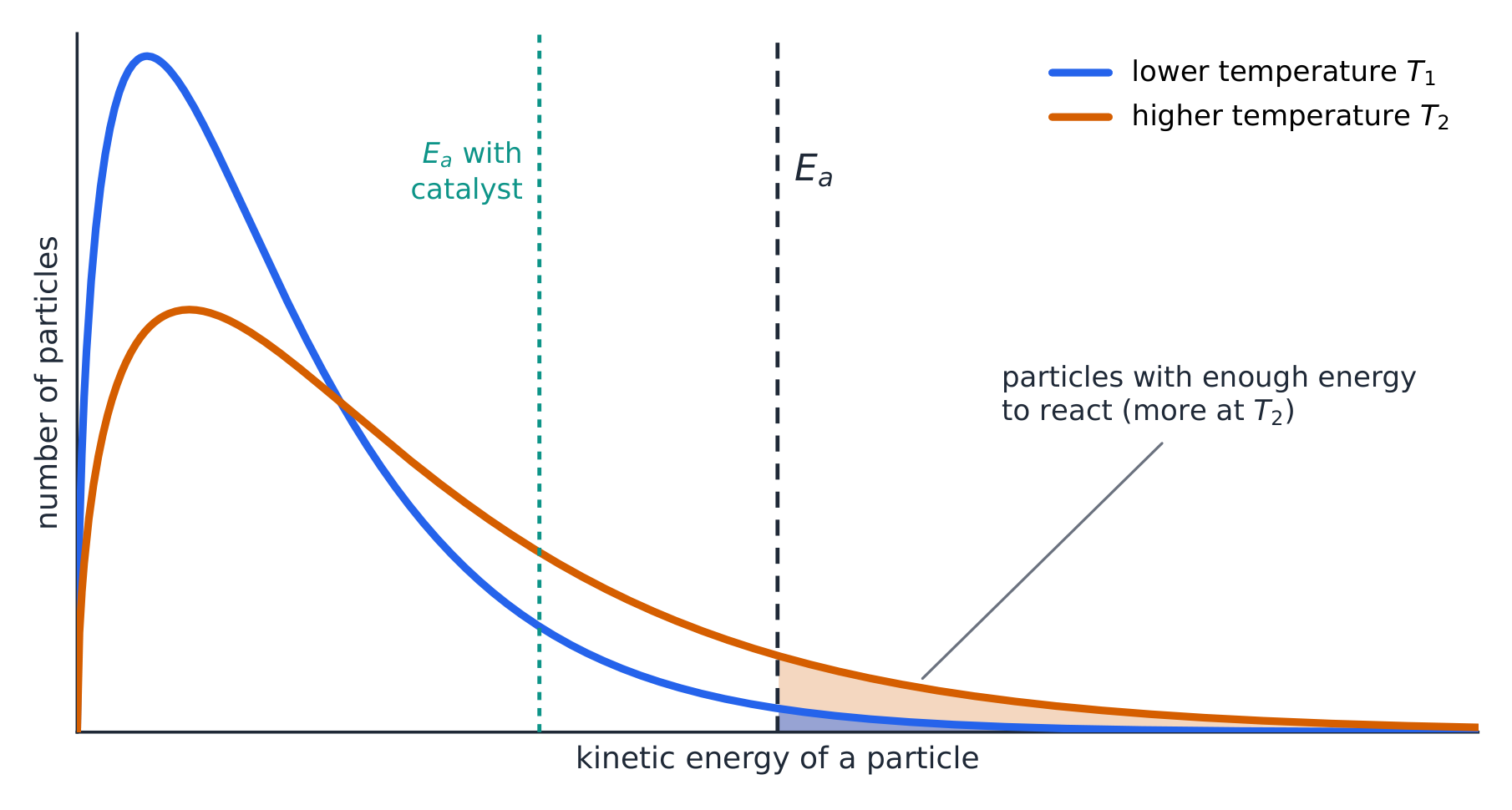
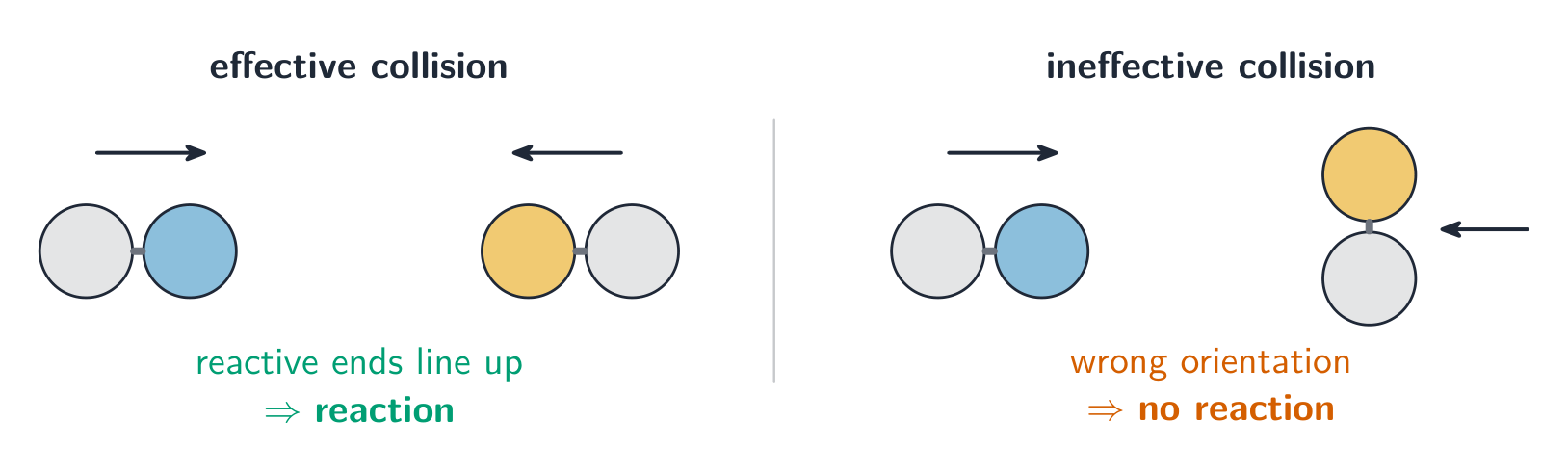
Collision theory 碰撞理论: molecules must collide with enough energy (the activation energy 活化能, $E_a$) and the correct orientation 取向 to react. Higher temperature means more molecules exceed $E_a$, so the reaction speeds up sharply.
Most collisions do not lead to a reaction. In a gas at room temperature each molecule collides billions of times per second, so if every collision worked, every reaction would be over almost instantly. The Maxwell-Boltzmann distribution 麦克斯韦-玻尔兹曼分布 shows the spread of particle energies.
Raising the temperature makes particles collide a little more often, but the main effect is that a much larger fraction of collisions now have energy above $E_a$. That is why, for many reactions near room temperature, a rise of just 10 °C roughly doubles the rate. The Arrhenius equation describes this link between $k$, $E_a$ and temperature; AP asks you to explain it, not to calculate with it.
Explore
Which molecules clear the activation energy
Only collisions with energy above the activation energy react. Heating shifts the speed distribution right, so a much larger fraction of molecules can react.
Vocabulary
Train
| English |
|---|
| Collision theory/kəˈlɪʒn ˈθɪəri/ |
| activation energy/ˌæktɪˈveɪʃn ˈenədʒi/ |
| orientation/ˌɔːrɪənˈteɪʃn/ |
| Maxwell-Boltzmann distribution |
5.6
Reading an Energy Profile

Syllabus
| Learning Objective | Essential Knowledge |
|---|---|
5.6.A |
|
Source: College Board AP Course and Exam Description
An energy profile 能量图 plots energy along the reaction path. The peak is the transition state 过渡态; the climb from reactants to the peak is $E_a$; the difference between reactant and product energies is the enthalpy change 焓变 $\Delta H$ (down for exothermic 放热).
Explore
Read activation energy off the profile
An energy profile plots energy along the reaction. The hump is the activation energy; the drop from reactants to products is $\Delta H$. A catalyst lowers the hump.
Vocabulary
Train
| English |
|---|
| energy profile/ˈenədʒi ˈprəʊfaɪl/ |
| transition state/trænˈsɪʃn steɪt/ |
| enthalpy change/enˈθælpi tʃeɪndʒ/ |
| exothermic/eɡzəˈðɜːmɪk/ |
5.7
The Sequence of Steps
Syllabus
| Learning Objective | Essential Knowledge |
|---|---|
5.7.A |
|
Source: College Board AP Course and Exam Description
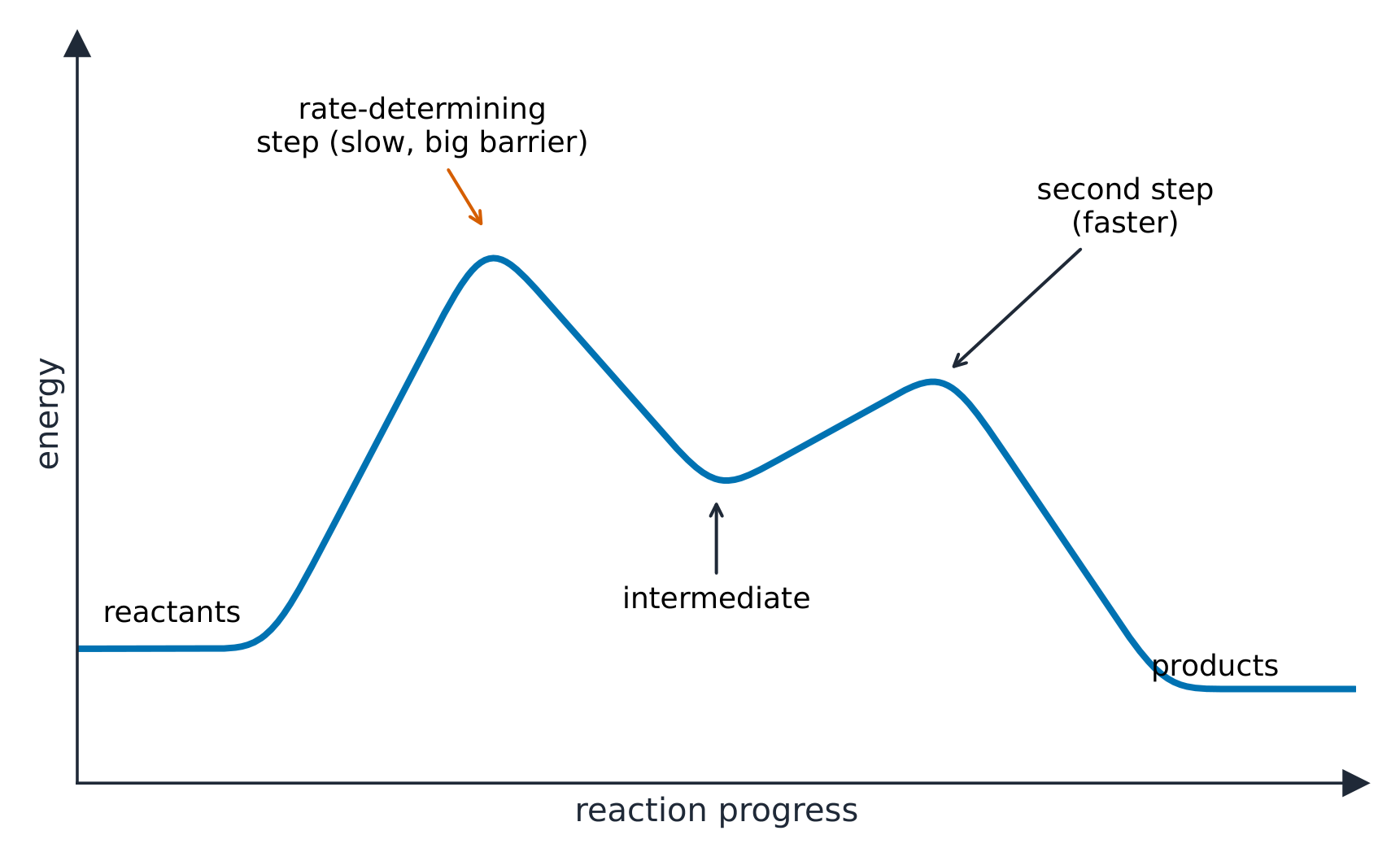
In a multi-step mechanism, the steps must add up to the overall balanced equation (intermediates cancel). Each step has its own energy barrier, measured from the preceding minimum. A diagram helps suggest a controlling step, but the full mechanism and concentrations determine the rate.
5.8
Finding the Rate Law From a Mechanism

Syllabus
| Learning Objective | Essential Knowledge |
|---|---|
5.8.A |
|
Source: College Board AP Course and Exam Description
The rate-determining step 决速步骤 is the slow step that controls rate in a suitable mechanism model. Its elementary rate law follows its molecularity. If this law contains an intermediate, use a justified relation, such as a fast pre-equilibrium, to express it in observable species before predicting the overall rate law. A valid mechanism must (1) add to the overall reaction and (2) predict the experimentally observed rate law.
Worked example. Suppose the slow (rate-determining) step is the bimolecular 双分子 collision $\text{NO}_2+\text{NO}_2\rightarrow\text{NO}_3+\text{NO}$. Its molecularity gives the rate law directly: $\text{rate}=k[\text{NO}_2]^2$. If experiment shows exactly this, the proposed mechanism is consistent; if experiment gave $\text{rate}=k[\text{NO}_2]$, the mechanism would be wrong.
Explore
Which step sets the rate law?
Sort the parts of a mechanism by whether they control the observed rate.
Vocabulary
Train
| English |
|---|
| rate-determining step/reɪt dɪˈtɜːmɪnɪŋ step/ |
| bimolecular |
5.9
When the First Step Is Fast
Syllabus
| Learning Objective | Essential Knowledge |
|---|---|
5.9.A |
|
Source: College Board AP Course and Exam Description
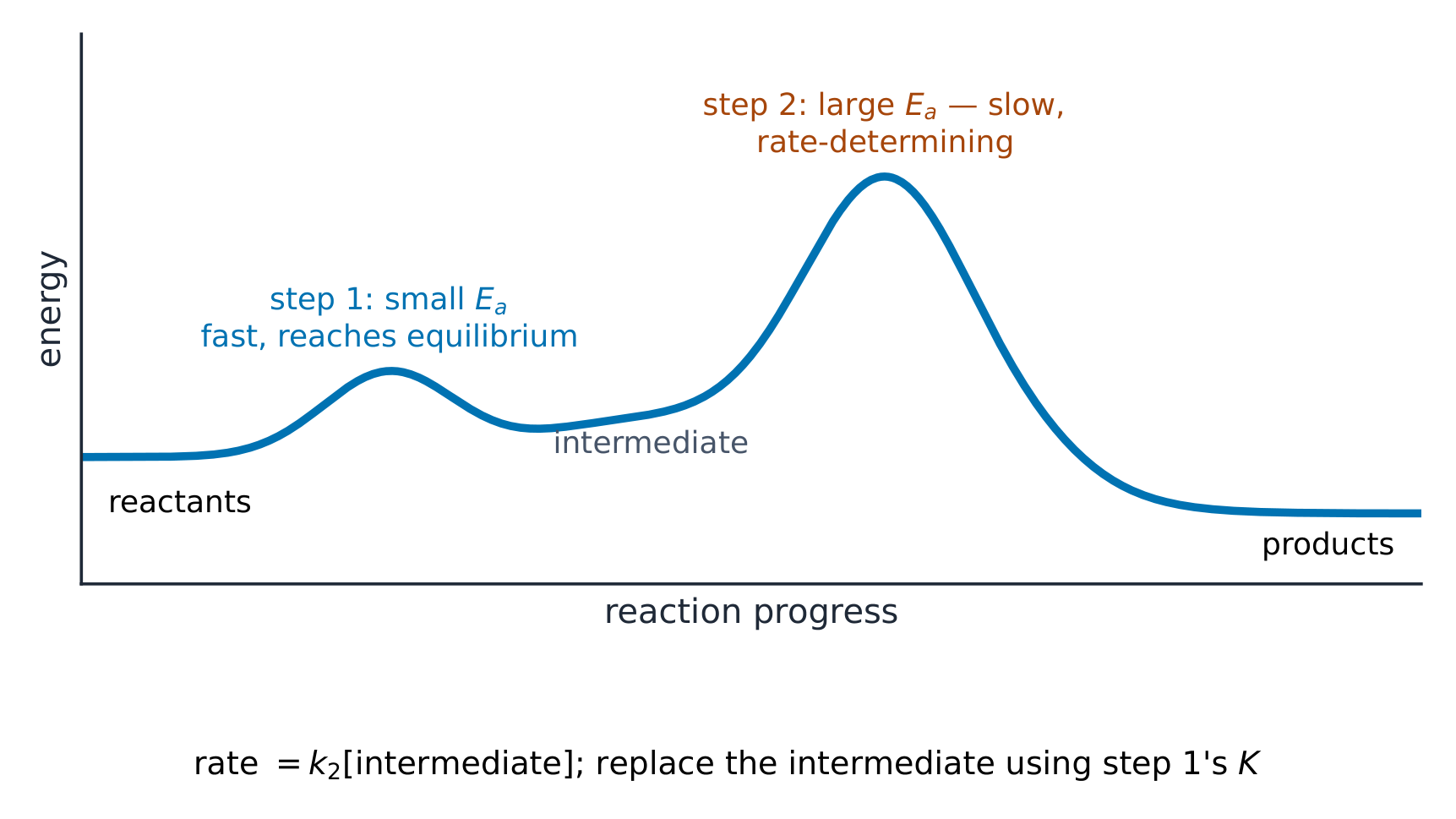
If a fast step precedes the slow one, an intermediate appears in the slow step's rate law. Use the fast pre-equilibrium 快速预平衡 to rewrite that intermediate in terms of reactants, so the final rate law contains only measurable species.
Worked example (a fast first step). For $2\text{NO} + \text{Br}_2 \rightarrow 2\text{NOBr}$, this mechanism is proposed:
- Step 1 (fast, reversible): $\text{NO} + \text{Br}_2 \rightleftharpoons \text{NOBr}_2$
- Step 2 (slow): $\text{NOBr}_2 + \text{NO} \rightarrow 2\text{NOBr}$
- Check the sum: $\text{NOBr}_2$ appears on both sides and cancels, leaving $2\text{NO} + \text{Br}_2 \rightarrow 2\text{NOBr}$. ✓
- Write the rate law of the slow step from its molecularity: $\text{rate} = k_2[\text{NOBr}_2][\text{NO}]$.
- $\text{NOBr}_2$ is an intermediate, so it cannot stay in the answer. Step 1 is at equilibrium, so $K_1 = \dfrac{[\text{NOBr}_2]}{[\text{NO}][\text{Br}_2]}$, which gives $[\text{NOBr}_2] = K_1[\text{NO}][\text{Br}_2]$.
- Substitute: $\text{rate} = k_2K_1[\text{NO}]^2[\text{Br}_2] = k[\text{NO}]^2[\text{Br}_2]$.
The predicted law is second order in NO and first order in $\text{Br}_2$, which matches experiment. Notice that it looks as if three particles collide at once, but no single step has three particles.
A quick check that always works: the rate law of a mechanism with a fast first step contains every reactant species that appears up to and including the slow step, counted as many times as it appears there.
Vocabulary
Train
| English |
|---|
| fast pre-equilibrium |
5.10
Energy Profiles for Many Steps
Syllabus
| Learning Objective | Essential Knowledge |
|---|---|
5.10.A |
|
Source: College Board AP Course and Exam Description
A multi-step reaction's profile shows several peaks (one per step) with valleys (intermediates) between them. Measure each barrier from its preceding minimum, and test any proposed controlling step against the observed rate law. The highest absolute peak alone does not establish the rate-determining step.
Explore
Read a two-hump energy profile
Identify each feature on the energy profile of a two-step reaction.
5.11
How Catalysts Speed Things Up

Syllabus
| Learning Objective | Essential Knowledge |
|---|---|
5.11.A |
|
Source: College Board AP Course and Exam Description
A catalyst 催化剂 speeds a reaction by providing a new pathway with a lower activation energy, without being consumed. It does not change $\Delta H$ or the equilibrium position 平衡位置 – only how fast equilibrium is reached. On an energy profile, a catalyst lowers the peak(s).
Catalysts work in different ways:
| Type | How it works | Example |
|---|---|---|
| Binding (enzyme) | holds reactants in the right orientation, lowering $E_a$ | enzymes in living cells |
| Acid–base | a reactant gains or loses a proton, giving a new, easier intermediate | $\text{H}^+$ speeding up the making of esters |
| Surface | reactants bond to a metal surface, which weakens their bonds | platinum in a car's catalytic converter; iron in the Haber process |
In each case the catalyst is used in one step, often the slow one, and made again in a later step, so its total amount does not change.
Catalyst or intermediate? Both cancel from the overall equation, so look at where each one first appears:
- an intermediate is made in an early step and used up in a later step.
- a catalyst is used up in an early step and made again in a later step, so it is there at the start.
Worked example. Iodide ions speed up the decomposition of hydrogen peroxide:
- Step 1 (slow): $\text{H}_2\text{O}_2 + \text{I}^- \rightarrow \text{H}_2\text{O} + \text{IO}^-$
- Step 2 (fast): $\text{H}_2\text{O}_2 + \text{IO}^- \rightarrow \text{H}_2\text{O} + \text{O}_2 + \text{I}^-$
Adding the steps gives $2\text{H}_2\text{O}_2 \rightarrow 2\text{H}_2\text{O} + \text{O}_2$. $\text{I}^-$ is used in step 1 and returned in step 2, so it is the catalyst. $\text{IO}^-$ is made in step 1 and used in step 2, so it is an intermediate. The slow step gives $\text{rate} = k[\text{H}_2\text{O}_2][\text{I}^-]$: a catalyst can appear in the rate law, even though it is not in the overall equation.
Common mistakes.
- Writing the rate law from the coefficients of the overall equation. Orders come from experiment, or from the slow step of a mechanism, never from the balanced equation.
- Leaving an intermediate in a final rate law. Replace it using the fast equilibrium.
- Using the orders of the slow step when a fast step comes before it, without substituting.
- Calling the highest point on the profile the "intermediate". Peaks are transition states; intermediates sit in the valleys between peaks.
- Saying a catalyst "lowers $\Delta H$" or "shifts the equilibrium". It only lowers $E_a$, for both directions equally.
Explore
How a catalyst helps
A catalyst opens a new pathway with a lower activation energy - the enthalpy change stays the same.
Vocabulary
Train
| English |
|---|
| catalyst/ˈkætəlɪst/ |
| equilibrium position |
5.11
Exam tips
- Use collision theory to explain temperature and suitable catalyst effects; check the rate law for concentration effects and whether a solid surface is involved.
- Temperature works mainly by getting more particles above the activation energy, not just more collisions.
- Reaction orders come from experiment, not the balanced coefficients — see how the rate changes when one concentration is varied.
- On an energy profile the hill height is the activation energy and the reactant–product gap is $\Delta H$.
- A catalyst lowers the activation energy (a new pathway) but leaves $\Delta H$ and the equilibrium position unchanged.
Interactive lessons on this topic
Work through it step by step, with instant-check exercises.
- How Fast a Reaction Goes
- Writing the Rate Law
- Concentration Over Time
- The Steps a Reaction Really Takes
- Why Collisions Do or Do Not React
- Reading an Energy Profile
- The Sequence of Steps
- Finding the Rate Law From a Mechanism
- When the First Step Is Fast
- Energy Profiles for Many Steps
- How Catalysts Speed Things Up