| Learning Objective | Essential Knowledge |
|---|---|
8.1.A |
|
Acids and Bases
AP Chemistry · Topic 8
 8:24
Acids and Bases
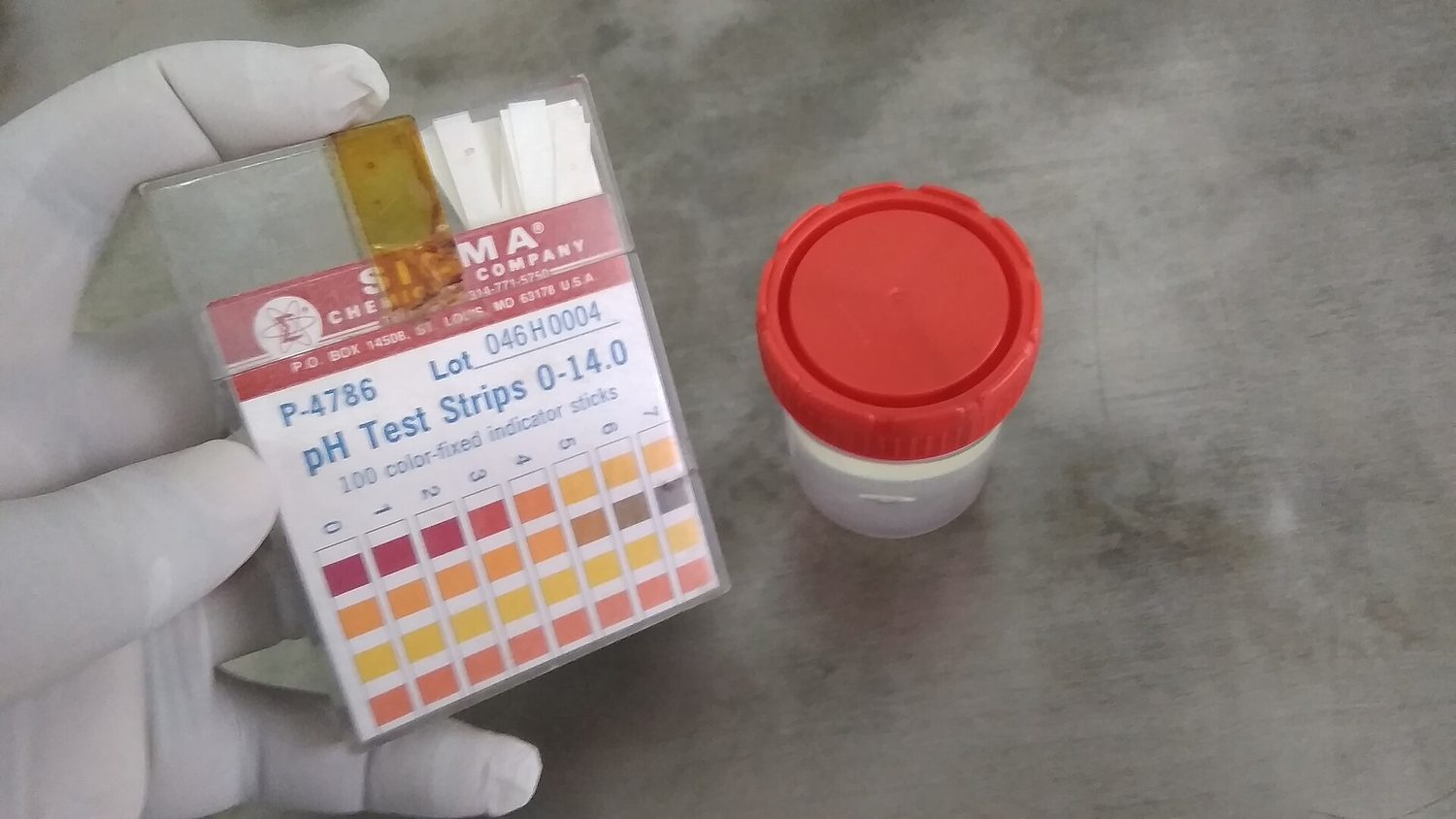
Two strips of paper — one red, one blue. Dip them in a liquid and the colour changes, and that colour tells you whether the liquid is an acid or a base.…
English narration · English + 中文 subtitles burned in
8.1
Introduction to Acids and Bases

Syllabus
Source: College Board AP Course and Exam Description
Your blood stays between pH 7.35 and 7.45. Below about 7.0 or above 7.8, cells stop working and a person can die. Yet every minute your muscles release acid and your lungs remove carbon dioxide, so the amount of acid in your blood is always changing. The pH stays steady because blood is a buffer, a mixture of carbonic acid and hydrogen carbonate ions. This unit builds up the ideas you need to understand it: pH, strong and weak acids, titrations and buffers.
By the Brønsted–Lowry definition, an acid 酸 is a proton ($\text{H}^+$) donor and a base 碱 is a proton acceptor. When an acid donates a proton it becomes its conjugate base 共轭碱; a base gaining a proton becomes its conjugate acid 共轭酸. Water is amphoteric – it can act as either.
Explore
Acid or base?
Sort each species by whether it donates or accepts a proton.
Vocabulary
Train
| English |
|---|
| acid/ˈæsɪd/ |
| base/beɪs/ |
| conjugate base/ˈkɒndʒuːɡeɪt beɪs/ |
| conjugate acid/ˈkɒndʒuːɡeɪt ˈæsɪd/ |
8.1
The Autoionization of Water

Syllabus
| Learning Objective | Essential Knowledge |
|---|---|
8.1.A |
|
Source: College Board AP Course and Exam Description
Even pure water conducts a tiny current, because water molecules react with each other in a reaction called autoionization 自偶电离:
$$2\text{H}_2\text{O} \rightleftharpoons \text{H}_3\text{O}^+ + \text{OH}^-.$$
One water molecule passes a proton to another, making a hydronium ion 水合氢离子 ($\text{H}_3\text{O}^+$, the ion we loosely write as $\text{H}^+$) and a hydroxide ion. This equilibrium has its own constant, the ion-product constant of water 水的离子积:
$$K_w = [\text{H}_3\text{O}^+][\text{OH}^-] = 1.0\times10^{-14}$$
at 25 °C. Defining $\text{pOH}=-\log[\text{OH}^-]$ and taking $-\log$ of the $K_w$ expression gives the rule the rest of this topic leans on:
$$\text{pH} + \text{pOH} = \text{p}K_w = 14.0$$
(again at 25 °C). Know one of pH or pOH and you get the other by subtracting from 14.
At 25 °C, in pure water the two ions form in equal numbers, so $[\text{H}_3\text{O}^+]=[\text{OH}^-]$ and $\text{pH}=\text{pOH}=7.0$. This is what neutral 中性 means. Acidic means $[\text{H}_3\text{O}^+]>[\text{OH}^-]$ (pH below 7); basic is the reverse.
Worked example. A solution has $[\text{H}_3\text{O}^+]=2.0\times10^{-3}\ \text{M}$. Find $[\text{OH}^-]$. Because $K_w$ always holds in water,
$$[\text{OH}^-]=\frac{K_w}{[\text{H}_3\text{O}^+]}=\frac{1.0\times10^{-14}}{2.0\times10^{-3}}=5.0\times10^{-12}\ \text{M}.$$
The hydroxide concentration is far smaller than the hydronium, confirming the solution is acidic.
$K_w$ is temperature dependent: autoionization is endothermic, so heating water shifts it forward and raises $K_w$. At 50 °C, $K_w>1.0\times10^{-14}$, so neutral water has $\text{pH}=\text{pOH}<7.0$. It is still neutral, because the ion concentrations are still equal – neutral means equal ions, not a pH of exactly 7.
Vocabulary
Train
| English |
|---|
| autoionization/ˌɔːtəʊˌaɪənaɪˈzeɪʃn/ |
| hydronium ion/haɪˈdrəʊnɪəm ˈaɪɒn/ |
| ion-product constant of water/ˈaɪɒn ˈprɒdʌkt ˈkɒnstənt ɒv ˈwɔːtə/ |
| neutral/ˈnjuːtrəl/ |
8.2
pH and pOH of Strong Acids and Bases

Syllabus
| Learning Objective | Essential Knowledge |
|---|---|
8.2.A |
|
Source: College Board AP Course and Exam Description
The pH pH值 scale measures acidity: $\text{pH}=-\log[\text{H}^+]$, with $\text{pH}+\text{pOH}=14$ at 25 °C. A strong acid 强酸 ionises essentially completely in dilute water; a soluble strong base 强碱 such as NaOH dissociates. For a monoprotic acid or a base supplying one hydroxide per formula unit, the ion concentration is approximately the analytical concentration when water autoionisation is negligible. Otherwise use the balanced stoichiometric ratio. Lower pH means more acidic.
Worked example. Find the pH of $0.010\ \text{M}$ HCl. Because HCl is a strong acid it is fully dissociated, so $[\text{H}^+]=0.010\ \text{M}$ and
$$\text{pH}=-\log(0.010)=2.0.$$
For a strong base like $0.010\ \text{M}$ NaOH, $\text{pOH}=2.0$, so $\text{pH}=14-2.0=12.0$.
Learn the six strong acids AP names: HCl, HBr, HI, $\text{HClO}_4$, $\text{H}_2\text{SO}_4$ and $\text{HNO}_3$. The strong bases are the group 1 and group 2 hydroxides. Watch the formula: $\text{Ba(OH)}_2$ gives two hydroxide ions per formula unit. In 0.0050 M $\text{Ba(OH)}_2$, $[\text{OH}^-]=0.010$ M, so $\text{pOH}=2.0$ and $\text{pH}=12.0$, the same as 0.010 M NaOH.
Explore
Move along the pH scale
pH measures hydrogen-ion concentration on a log scale: each unit is a tenfold change. Strong acids sit low, strong bases high, 7 is neutral.
Vocabulary
Train
| English |
|---|
| strong acid/strɒŋ ˈæsɪd/ |
| strong base/strɒŋ beɪs/ |
| pH/piː eɪtʃ/ |
8.3
Weak Acid and Base Equilibria
Syllabus
| Learning Objective | Essential Knowledge |
|---|---|
8.3.A |
|
Source: College Board AP Course and Exam Description
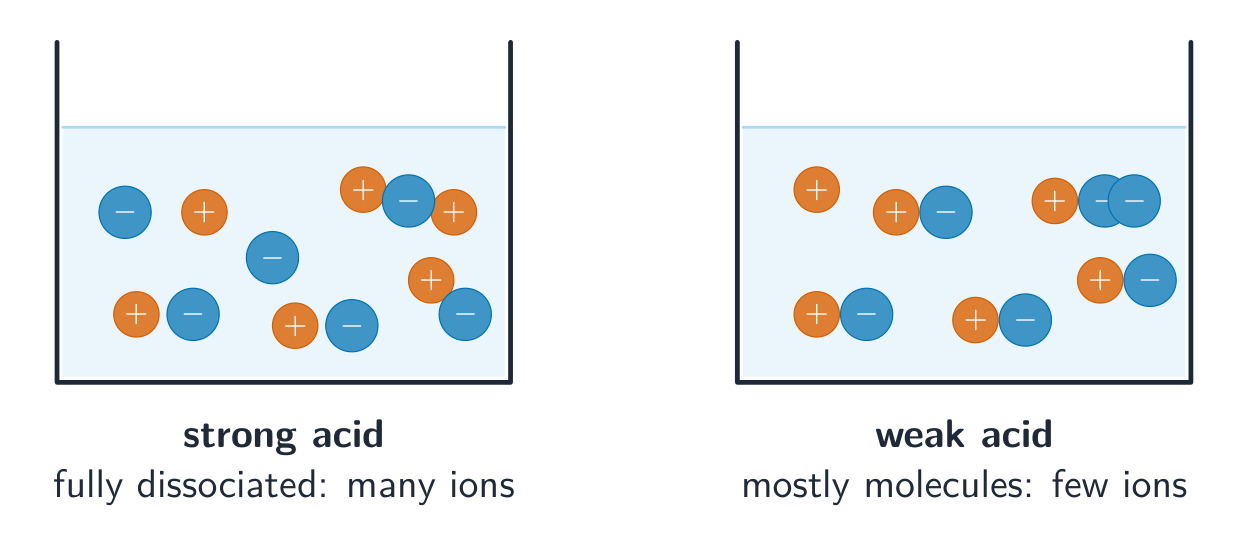
A weak acid 弱酸 only partly dissociates, described by an equilibrium constant $K_a$ (larger $K_a$ = stronger weak acid); a weak base has $K_b$. For any conjugate acid–base pair the two are linked through water, $K_a\times K_b = K_w$, so $\text{p}K_a+\text{p}K_b=14$ – a stronger acid always has a weaker conjugate base. Find $[\text{H}^+]$ with an ICE table and the $K_a$ expression. Use a small-$x$ approximation only after checking that the dissociated fraction is small.
Worked example. Find the pH of $0.10\ \text{M}$ acetic acid, $K_a=1.8\times10^{-5}$. Let $x=[\text{H}^+]$ at equilibrium; the ICE table gives $K_a=\dfrac{x^2}{0.10-x}\approx\dfrac{x^2}{0.10}$ (small-$x$ approximation), so
$$x=\sqrt{K_a\times0.10}=\sqrt{1.8\times10^{-6}}=1.3\times10^{-3}\ \text{M}\;\Rightarrow\;\text{pH}=-\log(1.3\times10^{-3})=2.9.$$
The weak acid is far less acidic than a strong acid of the same concentration (which would be pH $1.0$).
The percent ionization 电离百分比 shows how weak it is:
$$\frac{[\text{H}_3\text{O}^+]}{[\text{HA}]_0}\times100\%=\frac{1.3\times10^{-3}}{0.10}\times100\%=1.3\%.$$
Only about 1 molecule in 75 has given up its proton. The small-$x$ approximation was safe, because 1.3% is under 5%.
Exam skill (dilution and particle diagrams). Diluting a weak acid makes its percent ionization go up, even though $[\text{H}_3\text{O}^+]$ goes down. Adding water lowers every concentration, so $Q=\dfrac{[\text{H}_3\text{O}^+][\text{A}^-]}{[\text{HA}]}$ falls below $K_a$, and more HA ionizes to restore equilibrium. For 0.035 M HF diluted to 0.0175 M, the ionized fraction rises. In a particle diagram of a weak acid, most particles are intact HA, with only a few $\text{H}_3\text{O}^+$ and $\text{A}^-$. In a buffer drawing, compare HA with $\text{A}^-$: more HA means $\text{pH}<\text{p}K_a$, equal numbers mean $\text{pH}=\text{p}K_a$, and more $\text{A}^-$ means $\text{pH}>\text{p}K_a$.
Worked example (a weak base). Find the pH of 0.10 M ammonia, $K_b=1.8\times10^{-5}$:
$$\text{NH}_3+\text{H}_2\text{O}\rightleftharpoons\text{NH}_4^++\text{OH}^-,\qquad K_b=\frac{x^2}{0.10-x}\approx\frac{x^2}{0.10}.$$
So $x=[\text{OH}^-]=1.3\times10^{-3}$ M, $\text{pOH}=2.87$ and $\text{pH}=14.00-2.87=11.13$. A weak base gives you $[\text{OH}^-]$ first; remember to convert to pH at the end. The conjugate acid, $\text{NH}_4^+$, has $K_a=K_w/K_b=1.0\times10^{-14}/1.8\times10^{-5}=5.6\times10^{-10}$.
Explore
Strong or weak?
Sort each acid or base by whether it ionises fully or only partly.
Vocabulary
Train
| English |
|---|
| weak acid/wiːk ˈæsɪd/ |
| percent ionization |
8.4
Acid-Base Reactions and Buffers
Syllabus
| Learning Objective | Essential Knowledge |
|---|---|
8.4.A |
|
Source: College Board AP Course and Exam Description
A buffer 缓冲溶液 resists pH change. It contains a weak acid and its conjugate base (or a weak base and its conjugate acid) in comparable amounts. Added acid is neutralized by the conjugate base, and added base by the weak acid, so pH barely moves.
When you mix an acid and a base, first let them react completely, then look at what is left. Four cases come up:
| You mix | What happens | What sets the pH |
|---|---|---|
| strong acid + strong base | $\text{H}^++\text{OH}^-\rightarrow\text{H}_2\text{O}$ | whichever is in excess |
| weak acid + strong base | $\text{HA}+\text{OH}^-\rightarrow\text{A}^-+\text{H}_2\text{O}$ | excess HA with $\text{A}^-$: a buffer |
| weak base + strong acid | $\text{B}+\text{H}_3\text{O}^+\rightarrow\text{HB}^++\text{H}_2\text{O}$ | excess B with $\text{HB}^+$: a buffer |
| weak acid + weak base | an equilibrium, $\text{HA}+\text{B}\rightleftharpoons\text{A}^-+\text{HB}^+$ | the equilibrium mixture |
Worked example (strong + strong). Mix 25.0 mL of 0.100 M HCl with 15.0 mL of 0.100 M NaOH. Moles: $\text{H}^+$ $2.50\times10^{-3}$, $\text{OH}^-$ $1.50\times10^{-3}$. After reaction, $1.00\times10^{-3}$ mol of $\text{H}^+$ is left in 40.0 mL, so $[\text{H}^+]=0.0250$ M and $\text{pH}=1.60$. Do not forget the total volume.
Worked example (weak + strong makes a buffer). Add $2.0\times10^{-3}$ mol NaOH to $5.0\times10^{-3}$ mol acetic acid ($\text{p}K_a=4.74$). The hydroxide converts $2.0\times10^{-3}$ mol of HA into $\text{A}^-$, leaving $3.0\times10^{-3}$ mol HA. Both are in the same volume, so the mole ratio is the concentration ratio:
$$\text{pH}=4.74+\log\frac{2.0}{3.0}=4.74-0.18=4.56.$$
Explore
Is it a buffer?
Sort each mixture by whether it forms a buffer.
Vocabulary
Train
| English |
|---|
| buffer/ˈbʌfə/ |
8.5
Acid-Base Titrations
Syllabus
| Learning Objective | Essential Knowledge |
|---|---|
8.5.A |
|
Source: College Board AP Course and Exam Description
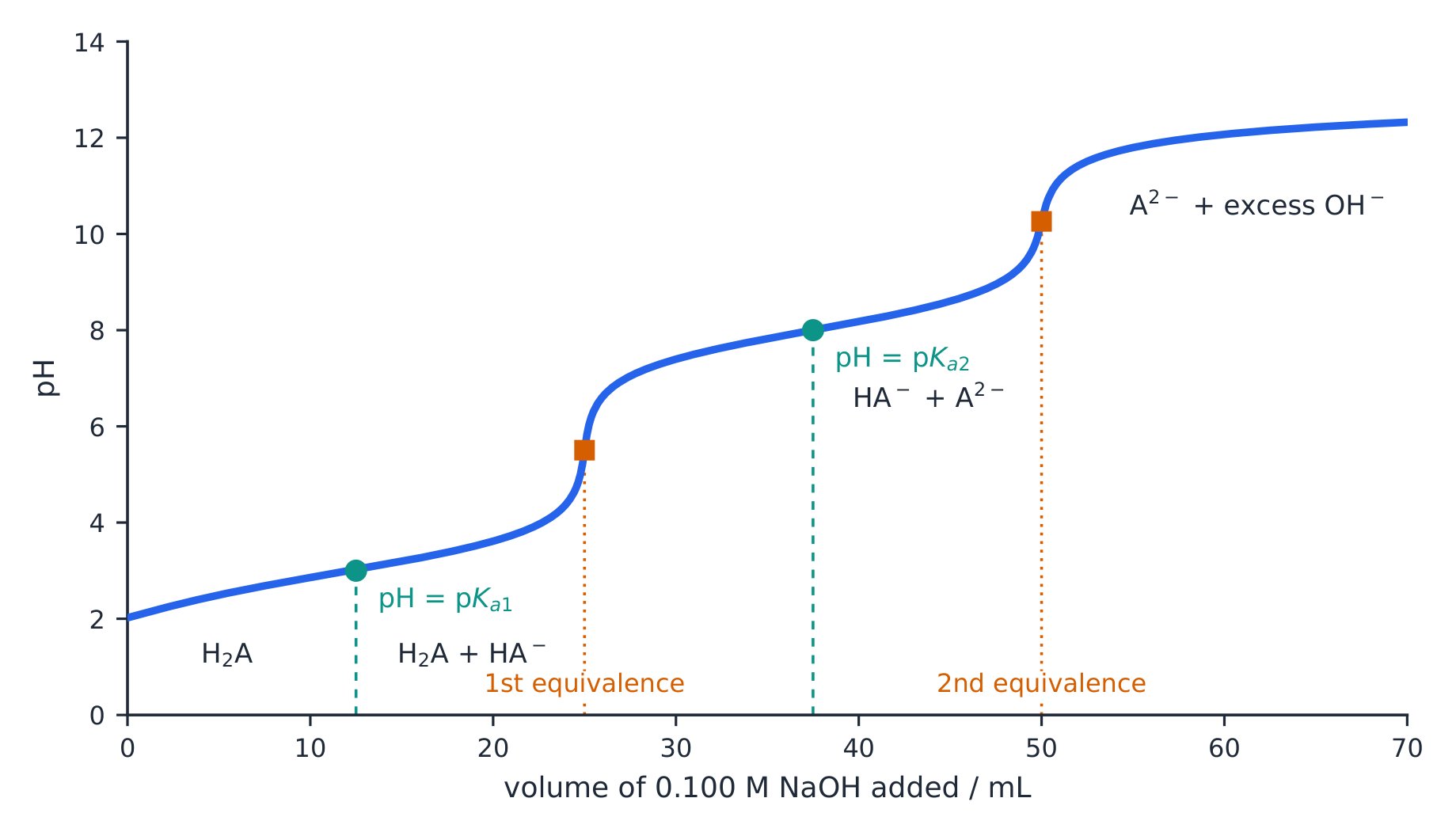
A titration curve 滴定曲线 plots pH as base (or acid) is added. Key points: the equivalence point 等当点 (acid and base mixed in their balanced stoichiometric ratio; equal moles only for a 1:1 reaction), and, for a single weak-acid titration stage, the half-equivalence point, where $\text{pH}=\text{p}K_a$ (half the weak acid is converted, so a buffer is at its center).
An acid-base indicator 酸碱指示剂 is itself a weak acid whose protonated and deprotonated forms have different colours, so its colour responds to pH. You pick an indicator whose colour change happens near the titration's equivalence-point pH, so the colour flips just as the reaction completes.
Why is the equivalence point of a weak acid titrated with NaOH basic? At that point all the HA has become $\text{A}^-$, and $\text{A}^-$ is a weak base that reacts with water to make $\text{OH}^-$. For acetic acid the equivalence pH is about 8.7, so phenolphthalein (colour change near pH 9) is a good choice. For a weak base titrated with a strong acid, the equivalence pH is below 7, so choose an indicator such as methyl red that changes near pH 5. In general, choose an indicator whose $\text{p}K_a$ is close to the equivalence-point pH.
A polyprotic acid 多元酸 has more than one acidic proton, and loses them one at a time. Its titration curve shows one jump for each proton, so you can count the protons from the curve.
Read the curve region by region. Before the first jump the main species are $\text{H}_2\text{A}$ and $\text{HA}^-$; halfway there, $\text{pH}=\text{p}K_{a1}$. Between the jumps they are $\text{HA}^-$ and $\text{A}^{2-}$; halfway between the two equivalence points, $\text{pH}=\text{p}K_{a2}$. After the second jump the solution holds $\text{A}^{2-}$ and excess $\text{OH}^-$. The second equivalence volume is twice the first, because each proton needs the same amount of base.

Explore
Titrate to the equivalence point
A titration curve rises gently, then sharply at the equivalence point where moles of acid and base match. The steep jump pinpoints that volume.
Vocabulary
Train
| English |
|---|
| titration curve/taɪˈtreɪʃn kɜːv/ |
| equivalence point/ɪˈkwɪvələns pɔɪnt/ |
| acid-base indicator/ˈæsɪd beɪs ˈɪndɪkeɪtə/ |
| polyprotic acid |
8.6
Molecular Structure of Acids and Bases
Syllabus
| Learning Objective | Essential Knowledge |
|---|---|
8.6.A |
|
Source: College Board AP Course and Exam Description
Strength has structural roots. An acid is stronger when its conjugate base is more stable – for example, more electronegative atoms or resonance spreading the negative charge stabilize it. For oxoacids, more oxygen atoms on the central atom means a stronger acid.
| Comparison | Stronger acid | Reason |
|---|---|---|
| $\text{HClO}$, $\text{HClO}_2$, $\text{HClO}_3$, $\text{HClO}_4$ | $\text{HClO}_4$ (strong) | each extra O pulls electron density away and spreads the negative charge of the conjugate base |
| acetic acid ($\text{p}K_a$ 4.76) vs chloroacetic acid ($\text{p}K_a$ 2.87) | chloroacetic acid | the electronegative Cl pulls charge away from the $\text{COO}^-$ (an inductive effect) |
| acetic acid vs ethanol ($\text{p}K_a\approx16$) | acetic acid | the acetate ion's charge is shared over two O atoms by resonance |
Carboxylic acids 羧酸, with the group –COOH, are the most common weak acids; only the H on the –COOH group is acidic, not the H atoms on carbon. Common weak bases contain a nitrogen atom with a lone pair, such as ammonia and amines, or are carboxylate ions such as acetate.
Explore
What makes an acid strong?
Sort each comparison by which structural feature gives the stronger acid.
Vocabulary
Train
| English |
|---|
| carboxylic acid/ˌkɑːbəkˈsɪlɪk ˈæsɪd/ |
8.7
pH and pKa
Syllabus
| Learning Objective | Essential Knowledge |
|---|---|
8.7.A |
|
Source: College Board AP Course and Exam Description
$\text{p}K_a=-\log K_a$: a smaller $\text{p}K_a$ means a stronger acid. Comparing pH to $\text{p}K_a$ tells you the dominant form: below $\text{p}K_a$ the acid form dominates; above it, the conjugate base form dominates.
Worked example (a drug in the body). Aspirin is a weak acid with $\text{p}K_a=3.5$. In the stomach, at pH 1.5, the pH is 2 units below the $\text{p}K_a$, so $[\text{A}^-]/[\text{HA}]=10^{1.5-3.5}=10^{-2}$: about 99% is the neutral acid form HA. In the small intestine, at pH 7.5, the ratio is $10^{4}$, and almost all of it is the ion $\text{A}^-$. The neutral form crosses cell membranes much more easily, so where a drug is absorbed depends on pH.
Explore
Read strength from pKa
Sort each acid by its pKa. A smaller pKa means a stronger acid.
8.8
Properties of Buffers

Syllabus
| Learning Objective | Essential Knowledge |
|---|---|
8.8.A |
|
Source: College Board AP Course and Exam Description
A buffer works best when the weak acid and conjugate base concentrations are similar (pH near $\text{p}K_a$). Choose a buffer whose $\text{p}K_a$ is close to the target pH. Diluting a buffer barely changes its pH, because the acid-to-base ratio stays the same.
Explore
How a buffer resists
In a CH3COOH / CH3COO- buffer, sort each addition by which component neutralises it.
8.9
The Henderson-Hasselbalch Equation
Syllabus
| Learning Objective | Essential Knowledge |
|---|---|
8.9.A |
|
Source: College Board AP Course and Exam Description
For a buffer, the pH follows from the acid-to-base ratio:
$$\text{pH}=\text{p}K_a+\log\frac{[\text{A}^-]}{[\text{HA}]}.$$
When the concentrations are equal, the log is zero and $\text{pH}=\text{p}K_a$. Use it to design a buffer or find its pH quickly.
Worked example. A buffer holds $0.20\ \text{M}$ acetic acid ($\text{p}K_a=4.74$) and $0.30\ \text{M}$ acetate. Its pH is
$$\text{pH}=4.74+\log\frac{0.30}{0.20}=4.74+\log(1.5)=4.74+0.18=4.92.$$
A little more conjugate base than acid pushes the pH just above $\text{p}K_a$, as the equation predicts.

Explore
Ratio sets the pH
Using pH = pKa + log([base]/[acid]), sort each buffer by its pH relative to pKa.
8.10
Buffer Capacity
Syllabus
| Learning Objective | Essential Knowledge |
|---|---|
8.10.A |
|
Source: College Board AP Course and Exam Description
Buffer capacity 缓冲容量 is how much acid or base a buffer can absorb before its pH changes sharply. It is greatest when the components are concentrated and in roughly equal amounts. Once one component is used up, the buffer fails.
Capacity can also be lopsided. A buffer with more weak acid than conjugate base can absorb more added base than added acid, because there is more HA to react with $\text{OH}^-$. A buffer with more conjugate base can absorb more added acid. Blood has about twenty times more hydrogen carbonate than carbonic acid, which suits the body: metabolism mostly adds acid.
Explore
What raises buffer capacity?
Sort each buffer by whether it resists more or less added acid/base.
Vocabulary
Train
| English |
|---|
| Buffer capacity/ˈbʌfə kəˈpæsɪti/ |
8.11
pH and Solubility
Syllabus
| Learning Objective | Essential Knowledge |
|---|---|
8.11.A |
|
Source: College Board AP Course and Exam Description
The solubility of a salt with a basic anion rises in acidic solution: the added $\text{H}^+$ reacts with the anion, removing it from the solubility equilibrium and pulling more solid to dissolve (Le Chatelier applied to $K_{sp}$). So pH can control whether an ionic solid dissolves.
This matters only when one of the ions is a weak base, a weak acid or hydroxide. Calcium carbonate dissolves in acid because $\text{CO}_3^{2-}$ is a base; that is why acid rain eats away limestone statues and why vinegar removes the scale inside a kettle. $\text{Mg(OH)}_2$, the antacid "milk of magnesia", dissolves in stomach acid because acid removes its $\text{OH}^-$. By contrast, adding acid does not help AgCl dissolve: $\text{Cl}^-$ is the conjugate base of a strong acid, so it does not react with $\text{H}^+$.
Common mistakes.
- Expecting every equivalence point to be at pH 7. Weak acid + strong base ends above 7 (the conjugate base is left); weak base + strong acid ends below 7.
- Reading $\text{p}K_a$ at the equivalence point. $\text{pH} = \text{p}K_a$ at the half-equivalence point, where $[\text{HA}] = [\text{A}^-]$.
- Turning the Henderson–Hasselbalch ratio upside down. It is $\text{pH} = \text{p}K_a + \log\dfrac{[\text{A}^-]}{[\text{HA}]}$: more base than acid gives a pH above $\text{p}K_a$.
- Using the strong-acid shortcut for a weak acid. For a weak acid, $[\text{H}_3\text{O}^+]$ is much smaller than the acid concentration; set up the $K_a$ expression.
- Saying a more concentrated buffer has a different pH. The pH depends on the ratio $[\text{A}^-]/[\text{HA}]$; a more concentrated buffer with the same ratio has the same pH but a larger capacity.
- Mixing up the direction of $K_a$ and $\text{p}K_a$. A stronger acid has a larger $K_a$ and a smaller $\text{p}K_a$.
Explore
Does pH change solubility?
Sort each salt by whether lowering the pH makes it more soluble.
8.11
Exam tips
- Neutral means equal ions, not pH 7. In pure water $[\text{H}_3\text{O}^+]=[\text{OH}^-]$; since $K_w$ rises with temperature, neutral pH drifts below 7 above 25 °C. Use $K_w=[\text{H}_3\text{O}^+][\text{OH}^-]=1.0\times10^{-14}$ (25 °C) to convert between $[\text{OH}^-]$ and $[\text{H}_3\text{O}^+]$.
- $\text{pH}=-\log[\text{H}^+]$ is logarithmic — each unit is a ten-fold change in $[\text{H}^+]$.
- For strong acids/bases use complete ionisation or dissociation with the balanced ion ratio; for weak species use the appropriate equilibrium constant.
- A buffer holds a weak acid and its conjugate base, which mop up added acid or base.
- On a titration curve the equivalence point is the steep jump; at half-equivalence $\text{pH}=\text{p}K_a$, and a smaller $\text{p}K_a$ means a stronger acid.
Interactive lessons on this topic
Work through it step by step, with instant-check exercises.