| Learning Objective | Essential Knowledge |
|---|---|
1.1.A |
|
Atomic Structure and Properties
AP Chemistry · Topic 1
 9:19
Atomic Structure and Properties
A chemical equation counts particles. Two of this react with one of that. But atoms are far too small to count, and there is no instrument that will hand you a…
English narration · English + 中文 subtitles burned in
1.1
Moles and Molar Mass
Syllabus
Source: College Board AP Course and Exam Description
A one-carat diamond weighs only 0.200 g, yet it holds about $1.00\times10^{22}$ carbon atoms. If you counted one atom per second, you would need more than 300 trillion years. Chemists never count atoms one by one. They weigh a sample and convert the mass to a number of particles. This unit shows how, and then looks inside the atom to explain why each element behaves as it does.
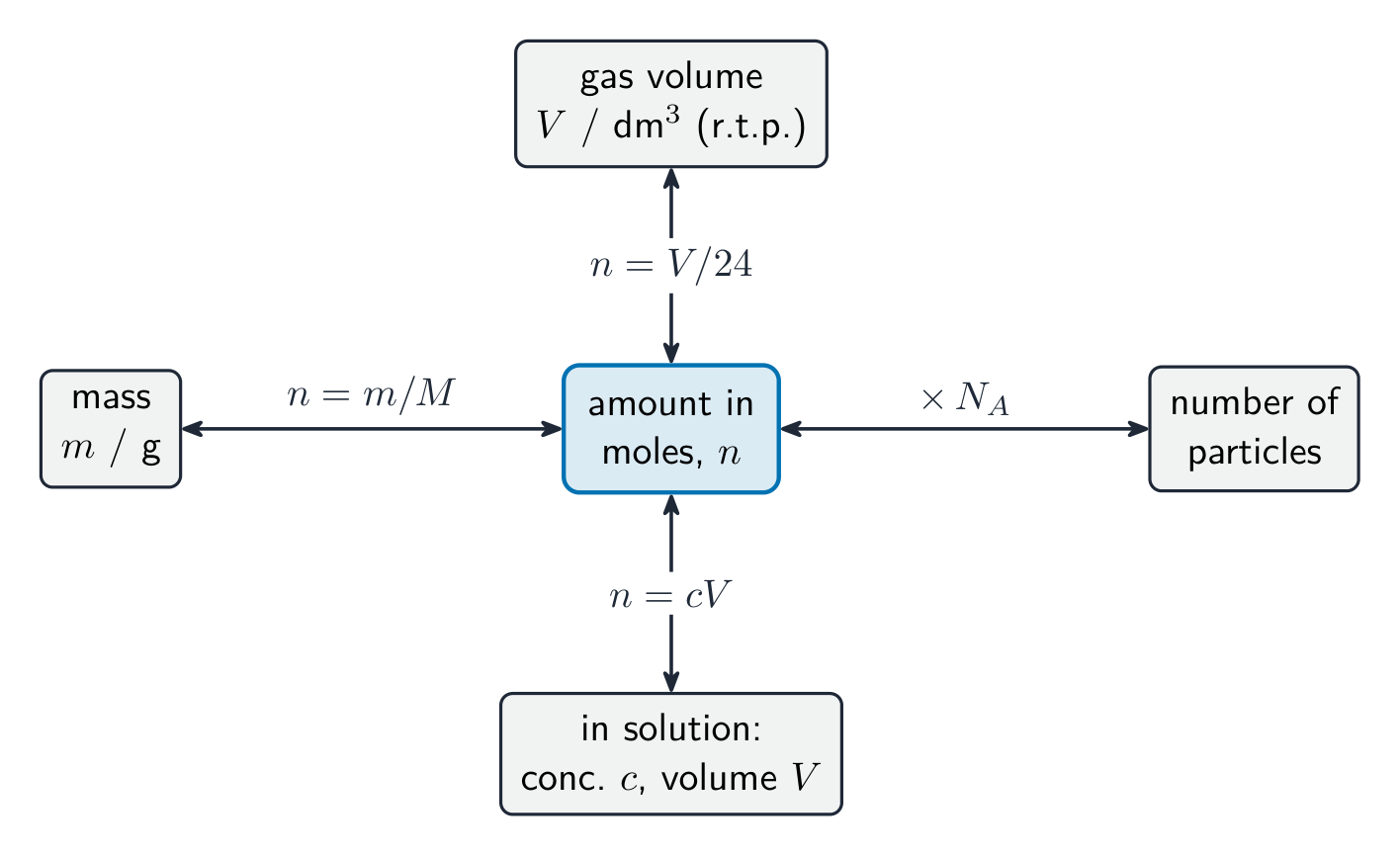
Because atoms are far too small to count, chemists count in moles 摩尔. One mole contains Avogadro's number 阿伏伽德罗常数 of particles, approximately $6.022\times10^{23}$. The molar mass 摩尔质量 (grams per mole; use atomic masses from the periodic table and add them for a compound) converts between mass and moles:
$$n=\frac{m}{M}.$$
Moles are the bridge between the lab (grams you weigh) and the equation (particles that react).
The numbers match on purpose. One water molecule has a mass of 18.0 atomic mass units 原子质量单位 (amu), and one mole of water has a mass of 18.0 g. The same number works at both scales because Avogadro's number is the number of amu in one gram.
Worked example. How many moles, and how many molecules, are in $36.0\ \text{g}$ of water ($M=18.0\ \text{g/mol}$)?
$$n=\frac{m}{M}=\frac{36.0}{18.0}=2.0\ \text{mol},\qquad N=n\,N_A=2.0\times6.022\times10^{23}=1.2\times10^{24}\ \text{molecules}.$$
Worked example (counting atoms inside a molecule). How many hydrogen atoms are in 5.00 g of glucose, $\text{C}_6\text{H}_{12}\text{O}_6$ ($M=180.2$ g/mol)? Use dimensional analysis and let the units cancel:
$$5.00\ \text{g}\times\frac{1\ \text{mol glucose}}{180.2\ \text{g}}\times\frac{12\ \text{mol H}}{1\ \text{mol glucose}}\times\frac{6.022\times10^{23}\ \text{atoms}}{1\ \text{mol H}}=2.01\times10^{23}\ \text{H atoms}.$$
The middle factor comes from the formula: every glucose molecule carries 12 H atoms. Forgetting it gives the number of molecules, not atoms.
Explore
Link mass, moles and molar mass
Molar mass $M$ is the bridge between the mass you weigh and the number of moles: $m = M \times n$. Because $M$ is fixed for a substance, mass is proportional to moles — double the moles, double the mass.
Vocabulary
Train
| English |
|---|
| moles/məʊlz/ |
| Avogadro's number/ˌævəˈɡædrəʊz ˈnʌmbə/ |
| molar mass/ˈməʊlə mæs/ |
| atomic mass unit/əˈtɒmɪk mæs ˈjuːnɪt/ |
1.2
Mass Spectra of Elements
Syllabus
| Learning Objective | Essential Knowledge |
|---|---|
1.2.A |
|
Source: College Board AP Course and Exam Description
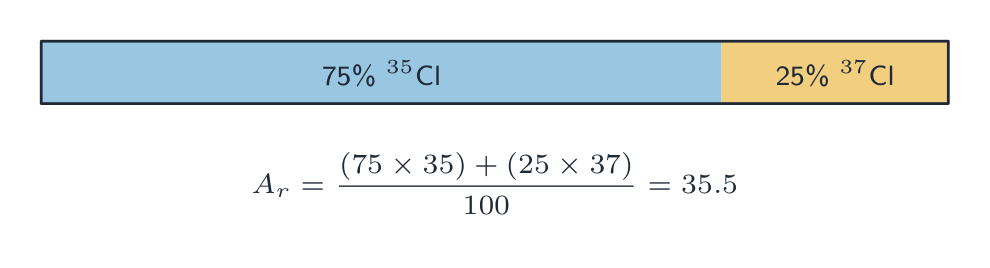
A mass spectrometer 质谱仪 separates ions by mass-to-charge ratio, giving a mass spectrum 质谱. For singly charged atomic ions, its peaks identify each isotope 同位素 (same element, different neutron count), with signals showing their relative abundance 相对丰度. The element's average atomic mass is the abundance-weighted average of its isotope masses.

Worked example. Chlorine is $75.8\%$ chlorine-35 and $24.2\%$ chlorine-37. Its average atomic mass is
$$A_r=(35)(0.758)+(37)(0.242)=26.5+8.95=35.5.$$
The average lies closer to $35$ because that isotope is more abundant – which is why the periodic-table value is $35.5$, not a whole number.
Worked example (working backwards). Boron has two isotopes, boron-10 and boron-11, and an average atomic mass of 10.81. Let $x$ be the fraction of boron-10. Then
$$10x+11(1-x)=10.81\quad\Rightarrow\quad x=0.19.$$
So natural boron is about 19% boron-10 and 81% boron-11. A mass spectrum of boron would show a peak at 11 roughly four times as tall as the peak at 10.
Explore
Explore isotopes — same element, different mass
Keep the protons fixed but change the neutrons to build the two chlorine isotopes ($^{35}$Cl and $^{37}$Cl). Same element, different mass — exactly the peaks a mass spectrum shows.
Vocabulary
Train
| English |
|---|
| mass spectrometer/mæs spekˈtrɒmɪtə/ |
| mass spectrum/mæs ˈspektrəm/ |
| isotope/ˈaɪsətəʊp/ |
| relative abundance/ˈrelətɪv əˈbʌndəns/ |
1.3
Elemental Composition of Pure Substances

Syllabus
| Learning Objective | Essential Knowledge |
|---|---|
1.3.A |
|
Source: College Board AP Course and Exam Description
The percent composition 百分组成 of a compound is each element's mass fraction. From it you find the empirical formula 实验式 (simplest whole-number ratio of atoms) by converting each element's mass to moles and dividing by the smallest. The molecular formula 分子式 is a whole-number multiple of the empirical formula, found from the molar mass.
The law of definite proportions 定比定律 says that every pure sample of a compound has the same mass ratio of its elements. Water from a river and water from a lab both contain 11.2% hydrogen by mass. Some substances are made of separate molecules, such as $\text{H}_2\text{O}$. Others, such as NaCl, are huge networks of ions; their formula only gives the ratio, called the formula unit 化学式单位.
Worked example. A compound is $40.0\%$ C, $6.7\%$ H, and $53.3\%$ O by mass. Assuming $100\ \text{g}$, convert each mass to moles and divide by the smallest:
$$\text{C}:\frac{40.0}{12}=3.33,\quad \text{H}:\frac{6.7}{1}=6.7,\quad \text{O}:\frac{53.3}{16}=3.33 \;\xrightarrow{\div 3.33}\; 1:2:1,$$
so the empirical formula is $\text{CH}_2\text{O}$. If the molar mass were $180\ \text{g/mol}$ ($=6\times30$), the molecular formula would be $\text{C}_6\text{H}_{12}\text{O}_6$ – glucose.
Worked example (a ratio that is not whole). An iron oxide is 69.9% Fe and 30.1% O by mass. In 100 g:
$$\text{Fe}:\frac{69.9}{55.85}=1.252\ \text{mol},\qquad \text{O}:\frac{30.1}{16.00}=1.881\ \text{mol}.$$
Dividing by 1.252 gives $1:1.50$. Do not round 1.50 to 2. Multiply both by 2 to get $2:3$, so the formula is $\text{Fe}_2\text{O}_3$.
Worked example (combustion analysis). A $0.500\ \text{g}$ sample of a compound containing only C, H and O burns completely in oxygen to give $0.733\ \text{g}$ of $\text{CO}_2$ and $0.300\ \text{g}$ of $\text{H}_2\text{O}$. All the carbon ends up in the $\text{CO}_2$ and all the hydrogen in the water:
$$\text{C}:\ \frac{0.733}{44.01}=0.01666\ \text{mol}\ (0.200\ \text{g}),\qquad \text{H}:\ 2\times\frac{0.300}{18.02}=0.0333\ \text{mol}\ (0.0336\ \text{g}).$$
Oxygen came partly from the air, so find the sample's oxygen by difference: $0.500-0.200-0.0336=0.266\ \text{g}$, which is $0.01665\ \text{mol}$. The ratio C : H : O is $1:2:1$, so the empirical formula is $\text{CH}_2\text{O}$.
Vocabulary
Train
| English |
|---|
| percent composition/pəˈsent ˌkɒmpəˈzɪʃn/ |
| empirical formula/emˈpɪrɪkl ˈfɔːmjʊlə/ |
| molecular formula/məˈlekjʊlə ˈfɔːmjʊlə/ |
| law of definite proportions |
| formula unit |
1.4
Composition of Mixtures
Syllabus
| Learning Objective | Essential Knowledge |
|---|---|
1.4.A |
|
Source: College Board AP Course and Exam Description
Unlike a pure compound, a mixture 混合物 has variable composition – its parts keep their own identities. Describe a mixture by the mass or mole fraction of each component; these do not follow a fixed formula. Spectroscopy (like PES or absorption) can measure how much of each component is present.
Elemental analysis also measures purity 纯度. Compare the measured mass percent of an element with the value for the pure compound.
Worked example (purity of table salt). Pure NaCl is $35.45/58.44=60.7\%$ chlorine by mass. A salt sample mixed with sand (which has no chlorine) contains 48.5% Cl. The fraction of the sample that is NaCl is
$$\frac{48.5}{60.7}=0.799,$$
so the sample is about 80% NaCl. Now suppose the impurity is another chloride instead of sand. KCl is only 47.6% Cl, so it would lower the chlorine percent. LiCl is 83.6% Cl, so it would raise it above 60.7%. A result above the pure value is a clue that the impurity is richer in that element than the compound.
Explore
Element, compound or mixture?
Sort each sample into element, compound or mixture.
Vocabulary
Train
| English |
|---|
| mixture/ˈmɪkstʃə/ |
| purity/ˈpjʊərɪti/ |
1.5
Atomic Structure and Electron Configuration

Syllabus
| Learning Objective | Essential Knowledge |
|---|---|
1.5.A |
|
Source: College Board AP Course and Exam Description
An atom is a tiny nucleus 原子核 (protons and neutrons) surrounded by electrons in shells and subshells (s, p, d, f). The electron configuration 电子排布 lists how electrons fill these, lowest energy first (e.g. $1s^2\,2s^2\,2p^6$). For main-group atoms, the outer-shell electrons are the valence electrons 价电子 that take part in bonding. Transition-metal bonding can also involve electrons in an inner d subshell. Coulomb's law 库仑定律 explains their energies:
$$F\propto\frac{q_1q_2}{r^2}.$$
The attraction grows with the charges and falls quickly with distance. Electrons closer to the nucleus, with less shielding 屏蔽 from it, are held more tightly. Inner electrons are called core electrons 内层电子. They sit close to the nucleus and also shield the outer electrons from part of its charge. The charge an outer electron actually feels is the effective nuclear charge 有效核电荷, roughly the number of protons minus the number of core electrons.

Worked example. Write the electron configuration of sulfur ($Z=16$). Fill subshells in order until $16$ electrons are placed: $1s^2\,2s^2\,2p^6\,3s^2\,3p^4$. The $3s$ and $3p$ electrons (six in total) are the valence electrons, so sulfur tends to gain two electrons to complete its octet.
Worked example (ions). For ions, add or remove electrons from the configuration. $\text{S}^{2-}$ gains two: $1s^2\,2s^2\,2p^6\,3s^2\,3p^6$, the same as argon. $\text{Na}^+$ loses its $3s$ electron: $1s^2\,2s^2\,2p^6$, the same as neon. Removing a second electron from $\text{Na}^+$ means taking a core $2p$ electron, which is far closer to the nucleus and feels about 9 units of charge instead of about 1. That is why sodium is always $+1$, never $+2$.

Explore
Explore how electrons fill the shells
Change the atomic number $Z$ and watch the electrons fill the shells lowest-energy-first (the Aufbau principle 构造原理). The outermost electrons are the valence electrons that drive bonding.
Vocabulary
Train
| English |
|---|
| nucleus/ˈnjuːklɪəs/ |
| electron configuration/ɪˈlektrɒn kənˌfɪɡjəˈreɪʃn/ |
| valence electrons/ˈveɪləns ɪˈlektrɒnz/ |
| Coulomb's law/ˈkuːlɒmz lɔː/ |
| shielding/ˈʃiːldɪŋ/ |
| core electrons |
| effective nuclear charge |
1.6
Photoelectron Spectroscopy
Syllabus
| Learning Objective | Essential Knowledge |
|---|---|
1.6.A |
|
Source: College Board AP Course and Exam Description
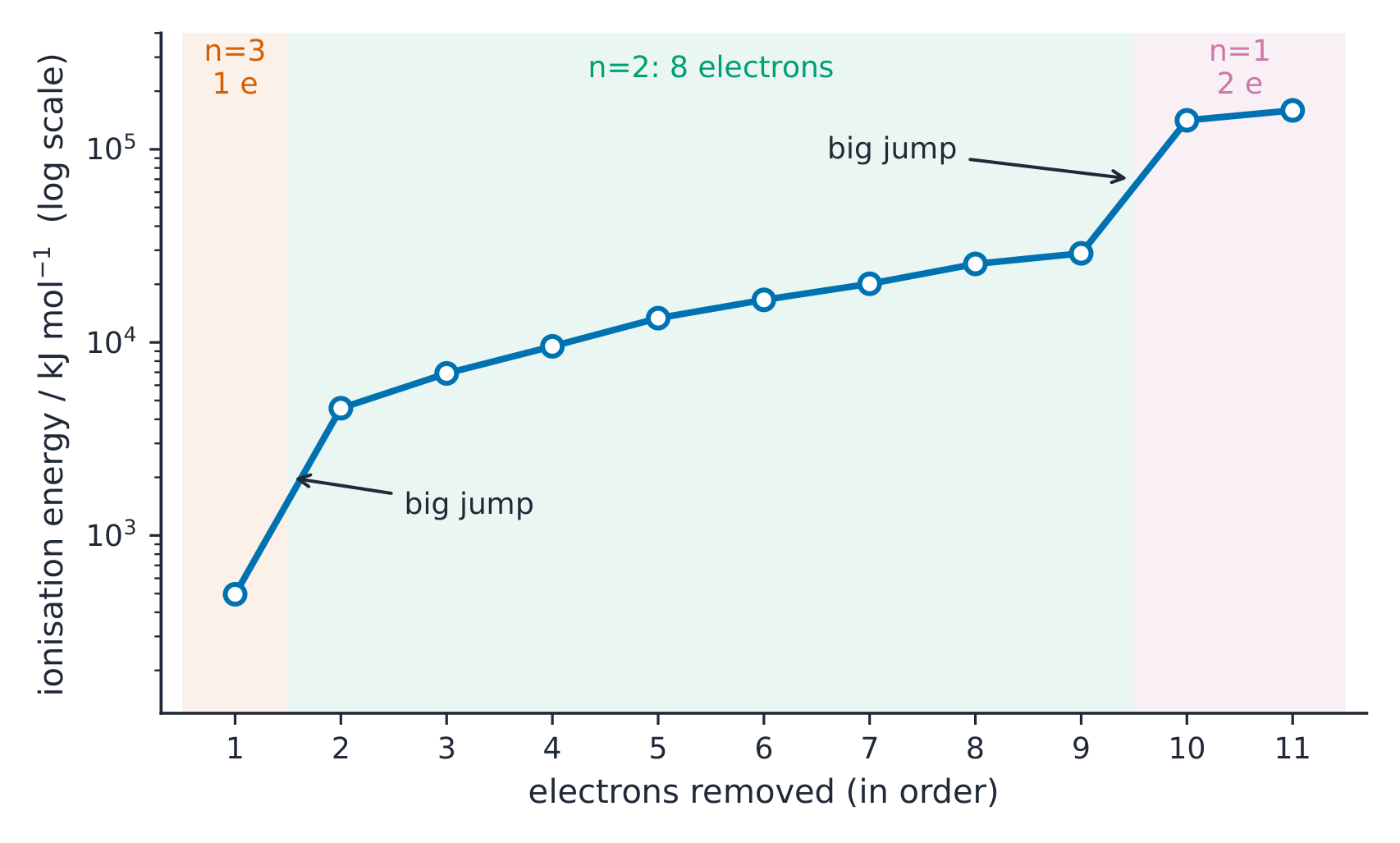
Photoelectron spectroscopy 光电子能谱 (PES) measures the energy needed to remove electrons from each subshell. Each peak is a subshell: its position gives the binding energy (how tightly held) and its height gives the number of electrons in it. PES data let you read an element's electron configuration and confirm shell structure directly.
Two more rules help you read a spectrum. First, peaks at the far left (largest binding energy) belong to the $1s$ electrons, the closest to the nucleus. Second, the same subshell in a heavier element sits further left, because more protons pull on it. The $1s$ peak of sodium (11 protons) lies further left than the $1s$ peak of neon (10 protons).
Worked example (identify the element). A photoelectron spectrum has three peaks. From left to right their relative heights are 2, 2 and 3. The peaks are $1s$, $2s$ and $2p$, so the configuration is $1s^2\,2s^2\,2p^3$. That is 7 electrons: nitrogen. If instead there were four peaks with heights 2, 2, 6 and 1, the configuration would be $1s^2\,2s^2\,2p^6\,3s^1$: sodium.
Worked example (from energy to light). The first ionization energy of sodium is $496\ \text{kJ/mol}$. One atom needs $\dfrac{496\,000}{6.022\times10^{23}}=8.24\times10^{-19}\ \text{J}$. The longest wavelength that can remove the electron is $\lambda=\dfrac{hc}{E}=\dfrac{(6.626\times10^{-34})(3.00\times10^{8})}{8.24\times10^{-19}}=2.41\times10^{-7}\ \text{m}$, in the ultraviolet. Always change molar energies to energy per atom before using $E=hc/\lambda$.

Explore
Match the PES peaks
In a photoelectron spectrum, peak position shows binding energy and peak height shows how many electrons. Match each peak to its subshell in sodium.
Vocabulary
Train
| English |
|---|
| Photoelectron spectroscopy/ˌfəʊtəʊɪˈlektrɒn spekˈtrɒskəpi/ |
1.7
Periodic Trends
Syllabus
| Learning Objective | Essential Knowledge |
|---|---|
1.7.A |
|
Source: College Board AP Course and Exam Description
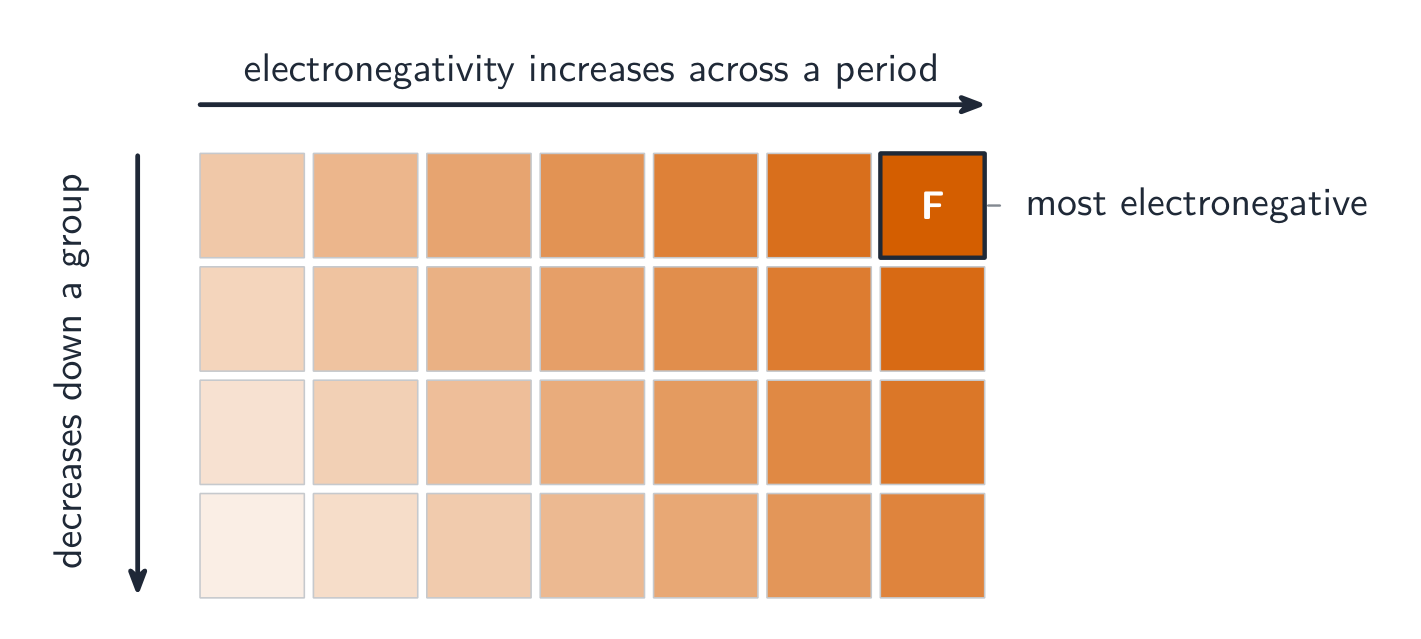
Trends across the periodic table follow from nuclear charge and shielding:
- Atomic radius 原子半径 decreases across a period (stronger pull) and increases down a group (more shells).
- Ionization energy 电离能 (energy to remove an electron) increases across, decreases down – opposite to radius.
- Electronegativity 电负性 (pull on shared electrons) increases across and up, toward fluorine.
- Electron affinity 电子亲和能 (energy released when an atom gains an electron) generally becomes more favourable across a period, for the same reason: a higher effective nuclear charge pulls the incoming electron in.
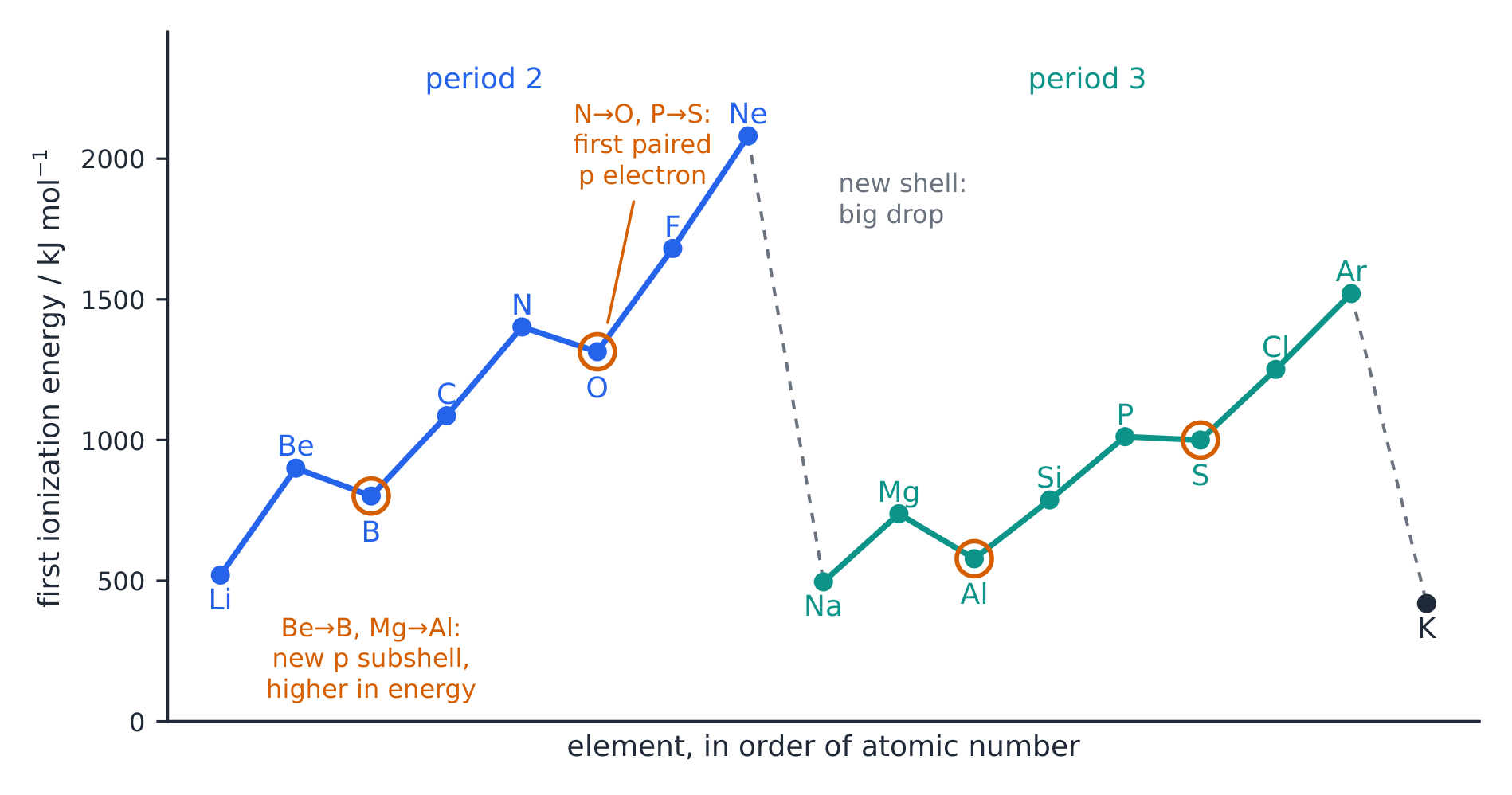
The trend has two small dips, and both can be explained. Boron's first ionization energy is lower than beryllium's because boron's outer electron is in a $2p$ subshell, slightly higher in energy than $2s$ and partly shielded by it. Oxygen's is lower than nitrogen's because oxygen's fourth $2p$ electron must share an orbital with another electron, and the two repel each other.
Ionic radius 离子半径 follows a similar logic. A cation is smaller than its atom: it has lost its outer shell, or at least some outer electrons, while the nuclear charge stays the same. An anion is larger: the extra electrons repel each other. For isoelectronic 等电子 ions (same number of electrons), the one with more protons is smaller:
$$\text{O}^{2-}>\text{F}^->\text{Na}^+>\text{Mg}^{2+}.$$
All four have 10 electrons, but the nuclear charge rises from 8 to 12.
Exam skill (explaining with Coulomb's law). "Explain using atomic structure" questions earn full credit with three linked steps: name the difference in structure (protons, shells, or shielding), say how it changes the distance or the charge, then use Coulomb's law ($F\propto q_1q_2/r^2$) to say how the attraction changes.
- Why is $\text{Al}^{3+}$ smaller than Al? Al loses its three $n=3$ electrons, so the ion's outermost electrons are in $n=2$, closer to the nucleus. Thirteen protons now attract only ten electrons, so the pull on each is stronger and the ion is smaller.
- Why is Ag larger than Cu? Silver's valence electron is in $n=5$, copper's in $n=4$, so it is further from the nucleus on average. Silver has more protons, but the extra inner electrons shield them, so the attraction on the valence electron is weaker and the atom is larger.
Worked example (predicting from trends). The atomic radius of chlorine is 99 pm and of iodine is 133 pm. Bromine lies between them in group 17, so a good estimate is the average, about 116 pm. The measured value is 114 pm. Periodicity lets you estimate a property you have no data for.

Explore
Explore atomic radius across a period
Step across Period 3 and watch the atomic radius shrink — each added proton raises the effective nuclear charge and pulls the same shell in tighter.
Vocabulary
Train
| English |
|---|
| Atomic radius/əˈtɒmɪk ˈreɪdɪəs/ |
| Ionization energy/ˌaɪənaɪˈzeɪʃn ˈenədʒi/ |
| Electronegativity/ɪˌlektrəʊŋɡəˈtɪvɪti/ |
| electron affinity/ɪˈlektrɒn əˈfɪnɪti/ |
| ionic radius/aɪˈɒnɪk ˈreɪdɪəs/ |
| isoelectronic/ˌaɪsəʊlɪkˈtrɒnɪk/ |
1.8
Valence Electrons and Ionic Compounds
Syllabus
| Learning Objective | Essential Knowledge |
|---|---|
1.8.A |
|
Source: College Board AP Course and Exam Description
Atoms gain, lose, or share valence electrons to reach stable configurations. Metals (low ionization energy) lose electrons to form cations 阳离子; nonmetals gain electrons to form anions 阴离子. Oppositely charged ions attract into an ionic compound 离子化合物, whose formula balances the charges to make the whole neutral. For example, aluminium ($3+$) and oxide ($2-$) combine as $\text{Al}_2\text{O}_3$ so the $+6$ and $-6$ cancel.
Elements in the same group form analogous compounds (compounds with the same pattern of formula). Magnesium forms $\text{MgCl}_2$, so calcium and strontium form $\text{CaCl}_2$ and $\text{SrCl}_2$; sodium forms $\text{Na}_2\text{O}$, so potassium forms $\text{K}_2\text{O}$. Reactivity also follows the table. Group 1 metals react more violently with water going down the group, because the outer electron is further from the nucleus and easier to lose: lithium fizzes, sodium races around, and potassium bursts into flame. Halogens become less reactive going down, because a larger atom pulls an extra electron in less strongly.
Common mistakes.
- Taking the simple average of the isotope masses. Weight each mass by its abundance: chlorine is 35.5, not 36.
- Rounding a mole ratio such as $1:1.33$ to $1:1$. A decimal near $.33$, $.5$ or $.67$ means you multiply: $1:1.33\times3 = 3:4$.
- Reading the tallest PES peak as the most tightly held electrons. Peak height gives the number of electrons; peak position (binding energy) gives how tightly they are held, and the core $1s$ peak is furthest out.
- Explaining a smaller radius across a period by "more shells". Across a period the shell count stays the same; the nuclear charge rises while shielding hardly changes, so the electrons are pulled closer.
- Removing a transition metal's $3d$ electrons before its $4s$ electrons when it forms an ion. The $4s$ electrons are lost first: $\text{Fe}^{2+}$ is $[\text{Ar}]\,3d^6$, not $[\text{Ar}]\,4s^2\,3d^4$.
- Saying ionization energy falls down a group because the nucleus has less charge. The nuclear charge rises, but the outer electron is further away and more shielded, so it is held less tightly.
Explore
Watch an ionic bond form by electron transfer
A metal gives up its valence electron(s) and a non-metal takes them, so both reach a full shell. The atoms become oppositely charged ions that attract — that electrostatic pull is the ionic bond.
Vocabulary
Train
| English |
|---|
| cations/ˈkætaɪənz/ |
| anions/ˈænaɪənz/ |
| ionic compound/aɪˈɒnɪk ˈkɒmpaʊnd/ |
1.8
Exam tips
- Use the mole as the hub: convert grams↔moles with $n=m/M$ and moles↔particles with Avogadro's number.
- Relative atomic mass is the abundance-weighted average of the isotopes — it lies closer to the more abundant one, not halfway.
- For an empirical formula, turn each element's mass into moles and divide by the smallest; scale up to whole numbers.
- Read periodic trends from nuclear charge and shielding: atomic radius decreases across a period, ionisation energy and electronegativity increase across (and up).
- Fill electron configurations in energy order; the outer valence electrons control the chemistry.
Interactive lessons on this topic
Work through it step by step, with instant-check exercises.