Skip to content · ⁨ข้ามไปยังเนื้อหา⁩

Chemistry of Life · ⁨เคมีของชีวิต⁩

AP Biology · Topic 1 · ⁨หัวข้อ 1⁩

Video lesson for this topic · ⁨บทเรียนวิดีโอสำหรับหัวข้อนี้⁩ Open the video page · ⁨เปิดหน้าวิดีโอ⁩
9:24

เคมีของชีวิต

ทิ้งก้อนน้ำแข็งลงในแก้วแล้วมันลอยอยู่ ดูเป็นเรื่องธรรมดาแต่ก็แปลกประหลาด ของแข็งเกือบทุกชนิดจมลงในของเหลวของมันเอง เพราะการแข็งตัวจะอัดแน่น…

English narration · English + 中文 subtitles burned in · ⁨การบรรยายภาษาอังกฤษ · คำบรรยายภาษาอังกฤษ + 中文 ลอยตัวบนภาพ⁩

1.1

Structure of Water and Hydrogen Bonding · ⁨โครงสร้างของน้ำและการสร้างพันธะไฮโดรเจน⁩

Syllabus · ⁨หลักสูตร⁩
English

Big Idea 4 — Systems Interactions: Biological systems interact, and these systems and their interactions exhibit complex properties.

Learning Objective 1.1.A: Explain how the properties of water that result from its polarity and hydrogen bonding affect its biological function.

  • 1.1.A.1 Living systems depend on the properties of water to sustain life.
    • 1.1.A.1.i Water has polarity, because of the formation of polar covalent bonds between hydrogen and oxygen within water molecules. This polarity contributes to hydrogen bonding between and within biological molecules.
    • 1.1.A.1.ii Water has a high specific heat capacity, which allows for the maintenance of homeostatic body temperature within living organisms.
    • 1.1.A.1.iii Water has a high heat of vaporization, which allows for the evaporative cooling of the surrounding environment. In living organisms, this property allows for body temperature to be maintained.
  • 1.1.A.2 The hydrogen bonds between adjacent polar water molecules result in cohesion, adhesion, and surface tension.
ไทย

แนวคิดหลัก 4 — ระบบและปฏิสัมพันธ์: ระบบชีวภาพมีปฏิสัมพันธ์กัน และระบบเหล่านี้พร้อมทั้งปฏิสัมพันธ์将它们 exhibits的性质 exhibiting 复杂性质。

วัตถุประสงค์การเรียนรู้ 1.1.A: อธิบายว่าคุณสมบัติของน้ำที่เกิดจากความขั้วและพันธะไฮโดรเจนส่งผลต่อหน้าที่ทางชีวภาพอย่างไร

  • 1.1.A.1 ระบบมีชีวิตขึ้นอยู่กับคุณสมบัติของน้ำเพื่อรักษาชีวิต
    • 1.1.A.1.i น้ำมีความขั้ว เนื่องจากเกิดพันธะโคเวเลนต์ขั้วระหว่างไฮโดรเจนและออกซิเจนภายในโมเลกุลน้ำ ความขั้วนี้มีส่วนร่วมในการเกิดพันธะไฮโดรเจนระหว่างและภายในโมเลกุลทางชีวภาพ
    • 1.1.A.1.ii น้ำมีความจุความร้อนจำเพาะสูง ซึ่งช่วยให้รักษาอุณหภูมิร่างกายที่สมดุลWithinLiving Organisms.
    • 1.1.A.1.iii น้ำมีความร้อนแฝงของการระเหยสูง ซึ่งช่วยให้เกิดการappers周围环境。 Within Living Organisms, this property allows for body temperature to be maintained.
  • 1.1.A.2 พันธะไฮโดรเจนระหว่างโมเลกุลน้ำขั้วที่อยู่ติดกันทำให้เกิดแรงยึดเหนี่ยว (cohesion), แรงยึดเกาะ (adhesion) และความตึงผิว
Source: College Board AP Course and Exam Description · ⁨แหล่งที่มา: คำอธิบายหลักสูตรและข้อสอบ College Board AP⁩

English

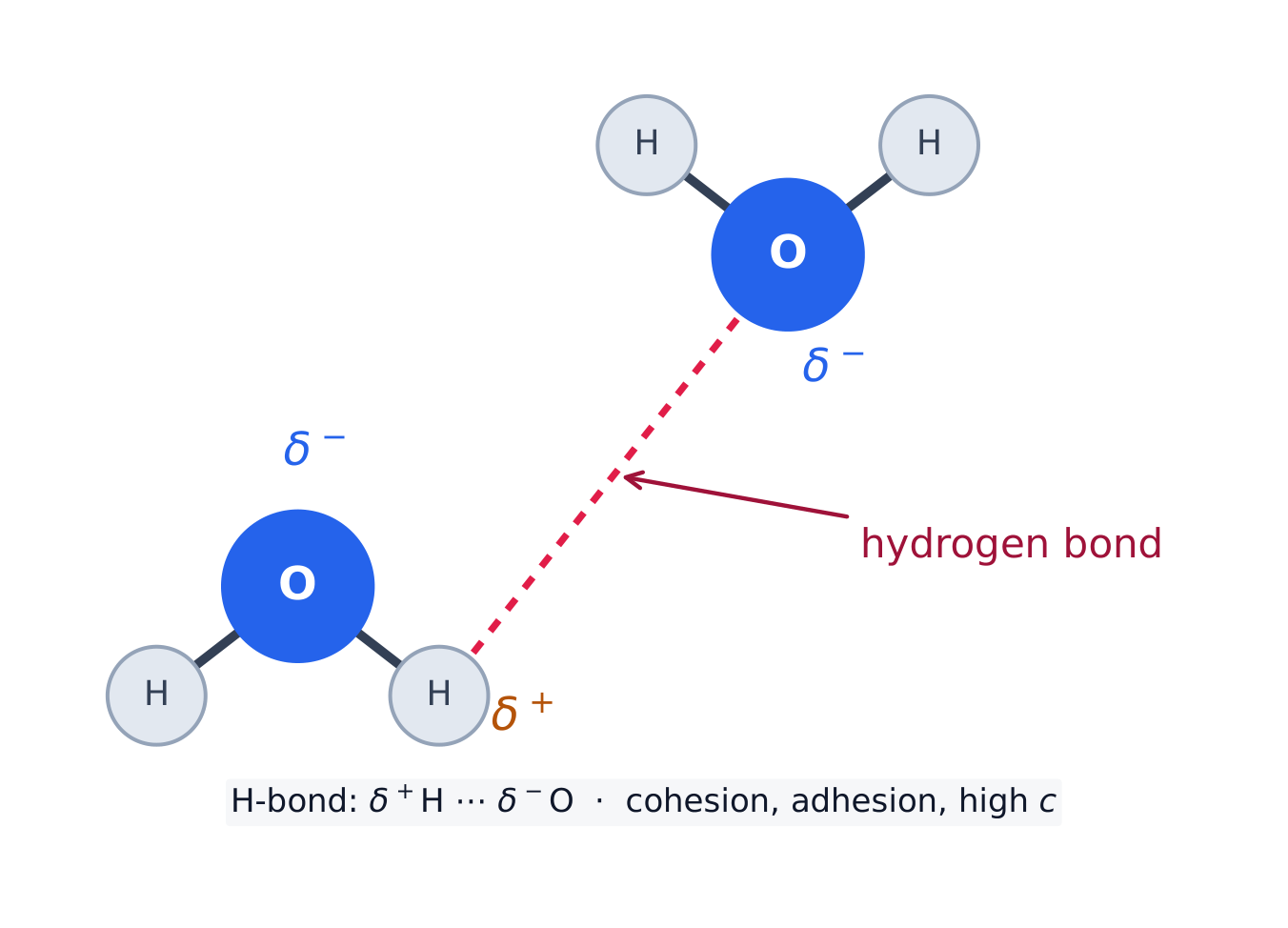
Water is polar 极性: its oxygen pulls electrons more strongly than its hydrogens, giving a slightly negative O and slightly positive H. This lets water molecules form hydrogen bonds 氢键 with each other, which explains water's life-supporting properties:

  • Cohesion 内聚力 and adhesion 附着力 (surface tension, capillary action, water rising in plants),
  • high specific heat 比热容 (resists temperature change, stabilizing organisms),
  • high heat of vaporization (evaporative cooling),
  • ice floating (less dense solid), and being a great solvent for polar and ionic substances.
ไทย
น้ำแข็งลอยอยู่บนน้ำเพราะพันธะไฮโดรเจนทำให้ของแข็งมีความหนาแน่นน้อยกว่าของเหลว

น้ำเป็น ขั้ว: อะตอมออกซิเจนดึงอิเล็กตรอนแรงกว่าอะตอมไฮโดรเจน ทำให้เกิดประจุลบเล็กน้อยที่ O และประจุบวกเล็กน้อยที่ H สิ่งนี้ทำให้โมเลกุลน้ำสามารถสร้าง พันธะไฮโดรเจน กับกันเอง ซึ่งอธิบายคุณสมบัติที่รองรับชีวิตของน้ำ:

  • การยึดเกาะ (cohesion) และการติดพื้นผิว (adhesion) (แรงตึงผิว, การเคลื่อนผ่านรูพรุน, น้ำขึ้นในพืช),
  • ความร้อนจำเพาะสูง (ต้านทานการเปลี่ยนแปลงอุณหภูมิ, ช่วยเสถียรภาพสิ่งมีชีวิต),
  • พลังงานความร้อนของการระเหยสูง (การทำความเย็นด้วยการระเหย),
  • น้ำแข็งลอย (ของแข็งมีความหนาแน่นน้อยกว่า) และเป็นตัวทำละลายที่ดีสำหรับสารขั้วและสารไอออนิก
พันธะไฮโดรเจนระหว่างโมเลกุลน้ำที่มีขั้วสองโมเลกุล
Explore · ⁨สำรวจ⁩

Explore how a covalent bond shares electrons · ⁨สำรวจว่าพันธะโคเวเลนต์แบ่งปันอิเล็กตรอนอย่างไร⁩

Step through two atoms overlapping to share a pair of electrons so each reaches a full shell. In $\text{H}_2$ the two atoms pull equally, so the bond is non-polar — the contrast that makes water's unequal sharing (and its $\delta^+/\delta^-$ dipole) so important. · ⁨ก้าวผ่านสองอะตอมที่ซ้อนทับกันเพื่อ แบ่งปันคู่ของอิเล็กตรอน เพื่อให้แต่ละอะตอมมีชั้นอิเล็กตรอนเต็ม ใน $\text{H}_2$ อะตอมทั้งสองดึง เท่ากัน ดังนั้นพันธะจึงไม่มีขั้ว — ความแตกต่างที่ทำให้การแบ่งปัน ไม่เท่ากัน ของน้ำ (และ $\delta^+/\delta^-$ dipole ของมัน) สำคัญมาก⁩

Vocabulary · ⁨คำศัพท์⁩ Train · ⁨ฝึกฝน⁩
English ไทย
polar/ˈpəʊlə/ polar
hydrogen bonds/ˈhaɪdrədʒn bɒndz/ พันธะไฮโดรเจน
Cohesion/kəʊˈhiːʒn/ แรงยึดเกาะ
adhesion/ədˈhiːʒn/ การยึดติด
specific heat/spəˈsɪfɪk hiːt/ ความร้อนจำเพาะ
Carbon/ˈkɑːbən/ คาร์บอน
1.2

Elements of Life · ⁨องค์ประกอบของชีวิต⁩

Syllabus · ⁨หลักสูตร⁩
English

Big Idea 2 — Energetics: Biological systems use energy and molecular building blocks to grow, reproduce, and maintain dynamic homeostasis.

Learning Objective 1.2.A: Describe the composition of macromolecules required by living organisms.

  • 1.2.A.1 Atoms and molecules from the environment are necessary to build new molecules. Carbon, hydrogen, and oxygen are the most prevalent elements used to build biological molecules such as carbohydrates, proteins, lipids, and nucleic acids. Additionally:
    • 1.2.A.1.i Sulfur is used in the building of proteins.
    • 1.2.A.1.ii Phosphorus is used in the building of phospholipids (a type of lipid) and nucleic acids.
    • 1.2.A.1.iii Nitrogen is used in the building of nucleic acids.
ไทย

แนวคิดหลัก 2 — พลังงาน: ระบบชีวภาพใช้พลังงานและหน่วยสร้างโมเลกุลเพื่อการเจริญเติบโต การสืบพันธุ์ และการรักษาสมดุลภายในแบบไดนามิก

วัตถุประสงค์การเรียนรู้ 1.2.A: อธิบายองค์ประกอบของมาโครโมเลกุลที่สิ่งมีชีวิตต้องการ

  • 1.2.A.1 อะตอมและโมเลกุลจากสิ่งแวดล้อมจำเป็นสำหรับการสร้างโมเลกุลใหม่ คาร์บอน ไฮโดรเจน และออกซิเจนเป็นธาตุที่พบมากที่สุดที่ใช้สร้างโมเลกุลทางชีวภาพ เช่น คาร์โบไฮเดรต โปรตีน.trainids และกรดนิวคลีอิก นอกจากนี้:
    • 1.2.A.1.i ซัลเฟอร์ใช้ในการสร้างโปรตีน
    • 1.2.A.1.ii ฟอสฟอรัสใช้ในการสร้างฟอสโฟลิพิด (ชนิดหนึ่งของ.trainids) และกรดนิวคลีอิก
    • 1.2.A.1.iii ไนโตรเจนใช้ในการสร้างกรดนิวคลีอิก

Source: College Board AP Course and Exam Description · ⁨แหล่งที่มา: คำอธิบายหลักสูตรและข้อสอบ College Board AP⁩

English

Living matter is built mostly from a few elements – carbon, hydrogen, oxygen, nitrogen, phosphorus, and sulfur. Carbon 碳 is central because it forms four stable covalent bonds, building long chains, branches, and rings – the skeletons of all biological molecules.

ไทย

มวลชีวภาพสร้างขึ้นจากธาตุบางชนิดหลักๆ ได้แก่ คาร์บอน ไฮโดรเจน ออกซิเจน ไนโตรเจน ฟอสฟอรัส และกำมะถัน คาร์บอน เป็นศูนย์กลางเนื่องจากสร้างพันธะโคเวเลนต์ที่เสถียรได้สี่ตำแหน่ง สร้างสายยาวกิ่งก้านและวงแหวน ซึ่งเป็นโครงกระดูกของโมเลกุลชีวภาพทั้งหมด

คาร์โบไฮเดรตและไขมันประกอบด้วยคาร์บอน ไฮโดรเจน และออกซิเจน; โปรตีนยังมีไนโตรเจนด้วย
1.3

Introduction to Macromolecules · ⁨บทนำเรื่องโมเลกุลขนาดใหญ่⁩

Syllabus · ⁨หลักสูตร⁩
English

Big Idea 4 — Systems Interactions: Biological systems interact, and these systems and their interactions exhibit complex properties.

Learning Objective 1.3.A: Describe the chemical reactions that build and break biological macromolecules.

  • 1.3.A.1 Hydrolysis is a chemical reaction involving the cleaving of covalent bonds. This type of reaction breaks down molecules into smaller molecules. When water is added to the bond between monomers in a polymer, the bond is broken. The hydrogen ion from a water molecule is added to one monomer and the hydroxyl group of the water molecule is added to the other monomer, completing the reaction.
  • 1.3.A.2 Dehydration synthesis occurs when two smaller molecules are joined together through covalent bonding. A hydrogen ion is removed from one monomer and a hydroxyl group is removed from the other. This causes the loss of the equivalent of a water molecule from the reactants and the connection of the two remaining monomers. The connection of many monomers is known as polymerization.
ไทย

แนวคิดหลัก 4 — ระบบและปฏิสัมพันธ์: ระบบชีวภาพมีปฏิสัมพันธ์กัน และระบบเหล่านี้พร้อมทั้งปฏิสัมพันธ์将它们 exhibits的性质 exhibiting 复杂性质。

วัตถุประสงค์การเรียนรู้ 1.3.A: อธิบายปฏิกิริยาเคมีที่สร้างและทำลายมาโครโมเลกุลทางชีวภาพ

  • 1.3.A.1 การไฮโดรไลซิสคือปฏิกิริยาเคมีที่เกี่ยวข้องกับการแตกหักของพันธะโคเวเลนต์ ประเภทของปฏิกิริยานี้ทำให้โมเลกุลใหญ่แตกตัวเป็นโมเลกุลเล็ก ๆ เมื่อเพิ่มน้ำเข้าไปในพันธะระหว่างโมโนเมอร์ในโพลิเมอร์ พันธะจะแตกตัว ไอออนไฮโดรเจนจากโมเลกุลน้ำจะถูกเพิ่มเข้ากับโมโนเมอร์หนึ่ง และหมู่ไฮดรอกซิลจากโมเลกุลน้ำจะถูกเพิ่มเข้ากับโมโนเมอร์อีกตัวหนึ่ง เพื่อปิดปฏิกิริยา
  • 1.3.A.2 การสังเคราะห์ด้วยการกำจัดน้ำเกิดขึ้นเมื่อโมเลกุลเล็กสองตัวเชื่อมต่อกันผ่านพันธะโคเวเลนต์ ไอออนไฮโดรเจนจะถูกกำจัดออกจากโมโนเมอร์หนึ่ง และหมู่ไฮดรอกซิลจะถูกกำจัดออกจากอีกตัวหนึ่ง สิ่งนี้ทำให้สูญเสียปริมาณเท่ากับโมเลกุลน้ำออกจากสารตั้งต้นและการเชื่อมต่อของโมโนเมอร์ที่เหลืออยู่ การเชื่อมต่อของโมโนเมอร์จำนวนมากเรียกว่าการสังเคราะห์โพลิเมอร์

Source: College Board AP Course and Exam Description · ⁨แหล่งที่มา: คำอธิบายหลักสูตรและข้อสอบ College Board AP⁩

English

Large biological molecules – macromolecules 大分子 – are polymers 聚合物 built from repeating monomers 单体. Cells join monomers by dehydration synthesis 脱水缩合 (removing water to form a bond) and break polymers by hydrolysis 水解 (adding water). Four classes: carbohydrates, lipids, nucleic acids, and proteins.

ไทย

โมเลกุลชีวภาพขนาดใหญ่ – โมเลกุลใหญ่ (macromolecules) – เป็น โพลีเมอร์ ที่สร้างจาก โมโนเมอร์ ซ้ำๆ เซลล์เชื่อมโมโนเมอร์เข้าด้วยกันโดย สังเคราะห์ด้วยการกำจัดน้ำ (dehydration synthesis) (Removing water to form a bond) และสลายโพลีเมอร์โดย ไฮโดรไลซิส (hydrolysis) (adding water). สี่ประเภท: คาร์โบไฮเดรต, ไขมัน, กรดนิวเคลئิก และโปรตีน

สังเคราะห์ด้วยการกำจัดน้ำสร้างโพลีเมอร์และปล่อยน้ำ; ไฮโดรไลซิสเป็นการย้อนกลับของกระบวนการนี้
Explore · ⁨สำรวจ⁩

Explore the four classes of macromolecule by their monomer · ⁨สำรวจ四类大分子及其单体⁩

Sort each clue into the right macromolecule class by matching the monomer that builds it — sugars, nucleotides or amino acids — and notice that lipids are the odd one out that are not true polymers. · ⁨根据构建每种分子的单体(糖、核苷酸或氨基酸)将线索归类到正确的大分子类别,并注意脂质是例外,它们不是真正的聚合物。⁩

Vocabulary · ⁨คำศัพท์⁩ Train · ⁨ฝึกฝน⁩
English ไทย
macromolecules/ˈmækrəmɒlɪkjuːlz/ โมเลกุลขนาดใหญ่
polymers/ˈpɒlɪməz/ โพลิเมอร์
monomers/ˈmɒnəʊməz/ มอนोเมอร์
dehydration synthesis/ˌdiːhaɪˈdreɪʃn ˈsɪnθəsɪs/ การสังเคราะห์แบบขาดน้ำ
hydrolysis/haɪˈdrɒləsɪs/ hydrolysis
Carbohydrates/ˌkɑːbəʊˈhaɪdreɪts/ คาร์โบไฮเดรต
monosaccharides/ˈmɒnəʊsækɑːraɪdz/ โมโนแซ็กคาไรด์
cellulose/ˈseljuːləʊs/ เซลลูโลส
1.4

Carbohydrates · ⁨คาร์โบไฮเดรต⁩

Syllabus · ⁨หลักสูตร⁩
English

Big Idea 4 — Systems Interactions: Biological systems interact, and these systems and their interactions exhibit complex properties.

Learning Objective 1.4.A: Describe the structure and function of carbohydrates.

  • 1.4.A.1 Monosaccharides (simple sugars) are the monomers for polysaccharides (complex carbohydrates). These monomers are connected by covalent bonds to form polymers such as complex carbohydrates, which may be linear or branched.
    • Illustrative examples for 1.4.A.1:
      • Cellulose
      • Starch
      • Glycogen
    • Exclusion statement: The molecular structure of specific carbohydrate polymers is beyond the scope of the AP Exam.
ไทย

แนวคิดหลัก 4 — ระบบและปฏิสัมพันธ์: ระบบชีวภาพมีปฏิสัมพันธ์กัน และระบบเหล่านี้พร้อมทั้งปฏิสัมพันธ์将它们 exhibits的性质 exhibiting 复杂性质。

วัตถุประสงค์การเรียนรู้ 1.4.A: อธิบายโครงสร้างและหน้าที่ของคาร์โบไฮเดรต

  • 1.4.A.1 มอนอสาคาไรด์ (น้ำตาล đơn) เป็นมอนอมเมอร์ของโพลีแซคคาไรด์ (คาร์โบไฮเดรตซับซ้อน) มอนอมเมอร์เหล่านี้เชื่อมโยงกันด้วยพันธะโคเวเลนต์เพื่อสร้างพอลิเมอร์ เช่น คาร์โบไฮเดรตซับซ้อน ซึ่งอาจมีลักษณะเป็นเส้นตรงหรือกิ่งก้าน
    • ตัวอย่างประกอบสำหรับ 1.4.A.1:
      • เซลลูโลส
      • ส্টาร์ช
      • ไกลโคเจน
    • ข้อความยกเว้น: โครงสร้างโมเลกุลของโพลีเมอร์คาร์โบไฮเดรตเฉพาะเจาะจงอยู่นอกขอบเขตของการสอบ AP

Source: College Board AP Course and Exam Description · ⁨แหล่งที่มา: คำอธิบายหลักสูตรและข้อสอบ College Board AP⁩

English

Carbohydrates 碳水化合物 are made of sugar monomers (monosaccharides 单糖 like glucose). They store energy (starch, glycogen) and provide structure (cellulose 纤维素 in plant walls). Their many hydroxyl groups make them polar and water-soluble.

ไทย

คาร์โบไฮเดรต ประกอบด้วยโมโนเมอร์น้ำตาล (โมโนแซคคาไรด์ เช่น กลูโคส) เก็บพลังงาน (แป้ง, ไกลโคเจน) และให้โครงสร้าง (เซลลูโลส ในผนังพืช) กลุ่มไฮดรอกซิลจำนวนมากทำให้它们是ขั้วและละลายน้ำได้ดี

รูปทรงของโพลีแซคคาไรด์เก็บพลังงาน (แป้ง, ไกลโคเจน) และเซลลูโลสเพื่อโครงสร้าง
1.5

Lipids · ⁨ไขมัน⁩

Syllabus · ⁨หลักสูตร⁩
English

Big Idea 4 — Systems Interactions: Biological systems interact, and these systems and their interactions exhibit complex properties.

Learning Objective 1.5.A: Describe the structure and function of lipids.

  • 1.5.A.1 Lipids are typically nonpolar, hydrophobic molecules whose structure and function are derived from the way their subcomponents are assembled. Fatty acids can be described as either saturated or unsaturated.
    • 1.5.A.1.i Saturated fatty acids contain only single bonds between carbon atoms.
    • 1.5.A.1.ii Unsaturated fatty acids contain at least one double bond between carbon atoms, which causes the carbon chain to kink.
    • 1.5.A.1.iii The more double bonds in a fatty acid tail, the more unsaturated the lipid becomes.
    • 1.5.A.1.iv The more unsaturated a lipid is, the more liquid it is at room temperature.
  • 1.5.A.2 Lipids provide a variety of functions for living organisms. Some examples of lipids are fats, steroids including cholesterol, and phospholipids.
    • 1.5.A.2.i Fats provide energy storage and support cell function. In some cases, they can also provide insulation to help keep mammals warm.
    • 1.5.A.2.ii Steroids are hormones that support physiological functions including growth and development, energy metabolism, and homeostasis.
    • 1.5.A.2.iii Cholesterol provides essential structural stability to animal cell membranes.
    • 1.5.A.2.iv Phospholipids group together to form the lipid bilayers found in plasma and cell membranes.
    • Exclusion statement: The molecular structure of specific lipids is beyond the scope of the AP Exam.
ไทย

แนวคิดหลัก 4 — ระบบและปฏิสัมพันธ์: ระบบชีวภาพมีปฏิสัมพันธ์กัน และระบบเหล่านี้พร้อมทั้งปฏิสัมพันธ์将它们 exhibits的性质 exhibiting 复杂性质。

วัตถุประสงค์การเรียนรู้ 1.5.A: อธิบายโครงสร้างและหน้าที่ของลิपิด

  • 1.5.A.1 ลิปิดมักเป็นโมเลกุลไม่ขั้วและไม่ละลายน้ำ โครงสร้างและหน้าที่ของลิปิดเกิดจากการประกอบกันของส่วนย่อยต่างๆ กรดไขมันสามารถอธิบายได้ว่าเป็นชนิดอิ่มตัวหรือไม่อิ่มตัว
    • 1.5.A.1.i กรดไขมันอิ่มตัวมีเพียงพันธะเดี่ยวระหว่างอะตอมของคาร์บอนเท่านั้น
    • 1.5.A.1.ii กรดไขมันไม่อิ่มตัวมีพันธะคู่อย่างน้อยหนึ่งตำแหน่งระหว่างอะตอมของคาร์บอน ซึ่งทำให้สายโซ่คาร์บอนมีการงอ
    • 1.5.A.1.iii ยิ่งกรดไขมันมีพันธะคู่ในหางมากเท่าใด ลิปิดก็ยิ่งมีความไม่อิ่มตัวมากขึ้นเท่านั้น
    • 1.5.A.1.iv ยิ่งลิปิดมีความไม่อิ่มตัวมากเท่าใด ก็ยิ่งมีสภาพเป็นเหลวที่อุณหภูมิห้องมากเท่านั้น
  • 1.5.A.2 ลิปิดทำหน้าที่หลากหลาย bagiสิ่งมีชีวิต ตัวอย่างของลิปิด ได้แก่ ไขมัน สเทียรอยด์ รวมถึงคอเลสเตอรอล และฟอสโฟลิพิด
    • 1.5.A.2.i ไขมันทำหน้าที่เก็บพลังงานและสนับสนุนการทำงานของเซลล์ ในบางกรณียังสามารถช่วยฉนวนความร้อนเพื่อให้สัตว์เลี้ยงลูกด้วยนมอบอุ่นได้
    • 1.5.A.2.ii สเตียรอยด์คือฮอร์โมนที่สนับสนุนการทำงานทางสรีรวิทยา รวมถึงการเจริญเติบโตและพัฒนาการ การเผาผลาญพลังงาน และการรักษาสมดุลภายในร่างกาย
    • 1.5.A.2.iii คอเลสเตอรอลให้ความมั่นคงทางโครงสร้างที่สำคัญต่อเยื่อหุ้มเซลล์สัตว์
    • 1.5.A.2.iv ฟอสโฟลิพิดรวมตัวกันเพื่อสร้างชั้นลิปิดเบایلเยอร์ซึ่งพบได้ในเยื่อหุ้มเซลล์และเยื่อหุ้มพลาสมา
    • ข้อความยกเว้น: โครงสร้างโมเลกุลของลิปิดเฉพาะเจาะจงอยู่นอกขอบเขตของการสอบ AP

Source: College Board AP Course and Exam Description · ⁨แหล่งที่มา: คำอธิบายหลักสูตรและข้อสอบ College Board AP⁩

English

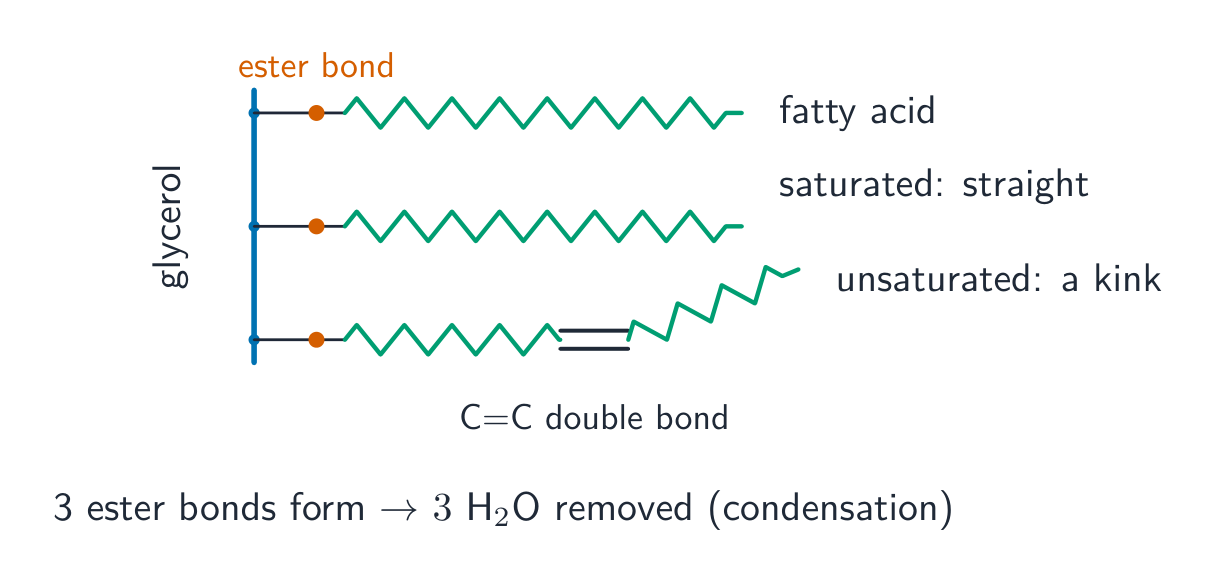
Lipids 脂质 are nonpolar and do not mix with water (hydrophobic 疏水). They include fats (long-term energy storage), phospholipids 磷脂 (which build membranes), and steroids. A phospholipid has a polar "head" and nonpolar "tails," the key to the cell membrane.

ไทย

ไขมัน (Lipids) เป็น ไม่มีขั้วและไม่ผสมกับน้ำ (ไม่ชอบน้ำ/hydrophobic) รวมถึงไขมัน (เก็บพลังงานระยะยาว), ฟอสโฟลิปิด (ซึ่งสร้างเมมเบรน) และสเตียรอยด์ ฟอสโฟลิปิดมี "หัว" ที่มีขั้วและ "หาง" ไม่มีขั้วสองเส้น ซึ่งเป็นกุญแจสำคัญของเยื่อหุ้มเซลล์

ฟอสโฟลิปิดมีหัวขั้วและหางไม่มีขั้วสองเส้น ดังนั้นฟอสโฟลิปิดจึงจัดเรียงเป็นชั้นคู่
ไตรกลีเซอไรด์: กลีเซอรอลเชื่อมต่อกับกรดไขมันสามตัว
Vocabulary · ⁨คำศัพท์⁩ Train · ⁨ฝึกฝน⁩
English ไทย
Lipids/ˈlɪpɪdz/ ลิปิด
hydrophobic/ˌhaɪdrəˈfəʊbɪk/ hydrophobic
phospholipids/ˈfɒsfəlɪpɪdz/ ไขมัน phospholipids
Nucleic acids/njuːˈklɪɪk ˈæsɪdz/ กรดนิวเคลئิก
nucleotides/ˈnjuːklɪɒtaɪdz/ นิวคลีโอไทด์
Proteins/ˈprəʊtiːnz/ โปรตีน
amino acids/əˈmiːnəʊ ˈæsɪdz/ กรดอะมิโน
peptide bonds/ˈpeptaɪd bɒndz/ พันธะเพปไทด์
1.6

Nucleic Acids · ⁨กรดนิวเคลئิก⁩

Syllabus · ⁨หลักสูตร⁩
English

Big Idea 3 — Information Storage and Transmission: Living systems store, retrieve, transmit, and respond to information essential to life processes.

Learning Objective 1.6.A: Describe the structure and function of DNA and RNA.

  • 1.6.A.1 In nucleic acids (DNA and RNA), biological information is encoded in sequences of nucleotide monomers. Each nucleotide has the following structural components: a five-carbon sugar (deoxyribose or ribose), a phosphate, and a nitrogenous base (adenine, thymine, guanine, cytosine, or uracil).
  • 1.6.A.2 Nucleic acids have a linear sequence of nucleotides that have ends, defined by the 3' (three prime) hydroxyl and 5' (five prime) phosphates of the sugar in the nucleotide. During nucleic acid synthesis, nucleotides are added to the 3' end of the growing strand, resulting in the formation of covalent bonds between nucleotides.
    • Exclusion statement: The molecular structure of specific nucleotides is beyond the scope of the AP Exam.
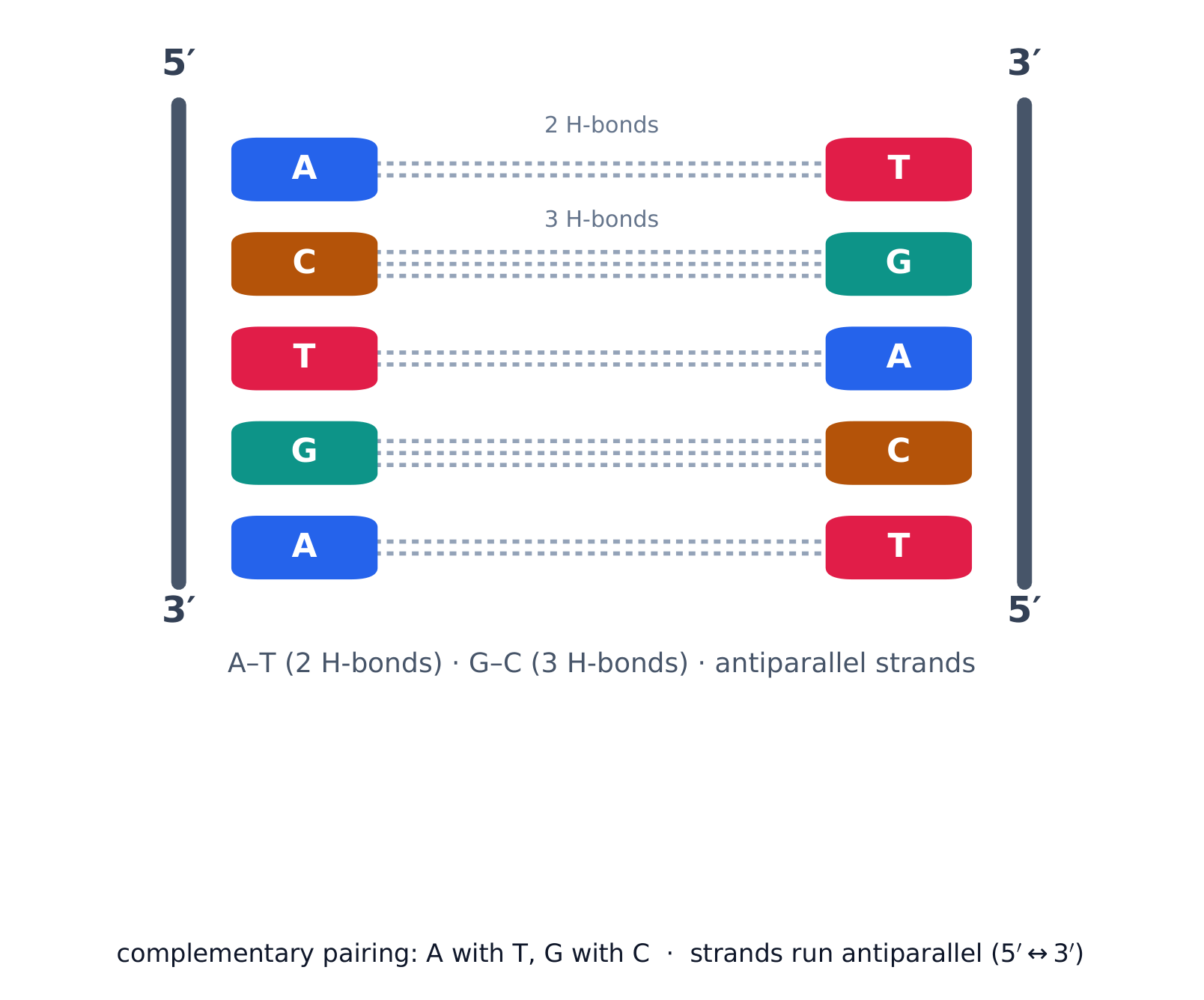
  • 1.6.A.3 DNA is structured as an antiparallel double helix, with two strands of nucleotides running in opposite 5' to 3' orientation. In DNA, adenine nucleotides pair with thymine nucleotides via hydrogen bonds (A-T), and cytosine nucleotides pair with guanine nucleotides via hydrogen bonds (C-G). In RNA, adenine pairs with uracil (A-U).
  • 1.6.A.4 Structural differences between DNA and RNA include:
    • 1.6.A.4.i DNA contains the sugar deoxyribose, and RNA contains the sugar ribose.
    • 1.6.A.4.ii DNA contains the nitrogenous base thymine, and RNA contains the nitrogenous base uracil.
    • 1.6.A.4.iii DNA is typically double stranded, while RNA is typically single stranded.
ไทย

แนวคิดหลักที่ 3 — การจัดเก็บและการส่งต่อข้อมูล: ระบบชีวภาพจัดเก็บ ดึงข้อมูล ส่งต่อ และตอบสนองต่อข้อมูลที่จำเป็นต่อกระบวนการมีชีวิต

วัตถุประสงค์การเรียนรู้ 1.6.A: อธิบายโครงสร้างและหน้าที่ของ DNA และ RNA

  • 1.6.A.1 ในกรดนิวคลีอิก (DNA และ RNA) ข้อมูลทางชีวภาพถูกเข้ารหัสในรูปแบบลำดับของมอนอมเมอร์นิวคลีโอไทด์ นิวคลีโอไทด์แต่ละตัวประกอบด้วยองค์ประกอบโครงสร้างดังนี้: น้ำตาลห้าคาร์บอน (ดีออกซีไรโบส หรือ ไรโบส), หมู่ฟอสเฟต, และเบสไนโตรเจน (อะดีนีน, ไทมิน, กวนีน, ซtosine, หรือ ยูราซิล)
  • 1.6.A.2 กรดนิวคลีอิกมีลำดับเชิงเส้นของนิวคลีโอไทด์ที่มีปลายทั้งสองด้าน ซึ่งกำหนดโดยหมู่ไฮดรอกซิลที่ตำแหน่ง 3' (สามไพร์ม) และหมู่ฟอสเฟตที่ตำแหน่ง 5' (ห้าไพร์ม) ของน้ำตาลในนิวคลีโอไทต์ ระหว่างการสังเคราะห์กรดนิวคลีอิก นิวคลีโอไทด์จะถูกเพิ่มเข้าไปที่ปลาย 3' ของสายที่กำลังยืดออก ทำให้เกิดพันธะโคเวเลนต์ระหว่างนิวคลีโอไทด์
    • ข้อความยกเว้น: โครงสร้างโมเลกุลของนิวคลีโอไทด์เฉพาะเจาะจงอยู่นอกขอบเขตของการสอบ AP
  • 1.6.A.3 DNA มีโครงสร้างเป็นเกลียวคู่แบบสวนทางกัน โดยมีสายนิวคลีโอไทด์สองสายเรียงตัวในทิศทางตรงข้ามกันจาก 5' ไป 3' ใน DNA นิวคลีโอไทด์อะดีนีนจับคู่กับนิวคลีโอไทด์ไทมินผ่านพันธะไฮโดรเจน (A-T) และนิวคลีโอไทด์ไซโตซีนจับคู่กับนิวคลีโอไทด์กวนีนผ่านพันธะไฮโดรเจน (C-G) ใน RNA อะดีนีนจะจับคู่กับยูราซิล (A-U)
  • 1.6.A.4 ความแตกต่างด้านโครงสร้างระหว่าง DNA และ RNA ได้แก่:
    • 1.6.A.4.i DNA มีน้ำตาลดีออกซีไรบอส ส่วน RNA มีน้ำตาลไรโบส
    • 1.6.A.4.ii DNA มีเบสไนโตรเจนไทมิน ส่วน RNA มีเบสไนโตรเจนยูราซิล
    • 1.6.A.4.iii โดยทั่วไป DNA เป็นสายคู่ ในขณะที่ RNA เป็นสายเดี่ยว

Source: College Board AP Course and Exam Description · ⁨แหล่งที่มา: คำอธิบายหลักสูตรและข้อสอบ College Board AP⁩

English

Nucleic acids 核酸 (DNA and RNA) store and carry genetic information. Their monomers are nucleotides 核苷酸, each a sugar, a phosphate, and a nitrogen base. The base sequence encodes instructions; DNA is double-stranded, RNA single-stranded.

ไทย
แบบจำลองเติมพื้นที่ของ DNA สายคู่ (NHGRI)

กรดนิวเคลئิก (DNA และ RNA) เก็บและส่งต่อข้อมูลทางพันธุกรรม โมโนเมอร์ของ它们是 นิวคลีโอไทด์, แต่ละตัวประกอบด้วยน้ำตาล หนึ่งหมู่ฟอสเฟต และเบสไนโตรเจน ลำดับของเบสเข้ารหัสคำสั่ง; DNA เป็นสายคู่, RNA เป็นสายเดี่ยว

การจับคู่เบสเสริมกันยึดสายคู่แบบสวนทางของ DNA ไว้ด้วยกัน
Explore · ⁨สำรวจ⁩

Explore complementary base pairing · ⁨探索互补碱基配对⁩

Step along a DNA template and watch each base pair to its partner by complementary base pairing ($A$ with $T$, $G$ with $C$) — the rule that lets either strand act as a template to rebuild the other. · ⁨沿着DNA模板移动,观察每个碱基如何通过互补碱基配对与其配对伙伴结合($A$与$T$,$G$与$C$)——这一规则使得任一条链都能作为模板重建另一条链。⁩

1.7

Proteins · ⁨โปรตีน⁩

Syllabus · ⁨หลักสูตร⁩
English

Big Idea 3 — Information Storage and Transmission: Living systems store, retrieve, transmit, and respond to information essential to life processes.

Learning Objective 1.7.A: Describe the structure and function of proteins.

  • 1.7.A.1 Proteins comprise linear chains of amino acids connected by the formation of covalent (peptide) bonds that form between a carboxyl group ($-\text{COOH}$) of one amino acid and an amine group ($-\text{NH}_2$) of the next amino acid, resulting in a growing peptide chain.
  • 1.7.A.2 Amino acids are composed of a central carbon atom with a hydrogen atom, a carboxyl group, an amine group, and a variable R group covalently bound to it. The R group of an amino acid can be categorized by three possible chemical properties: hydrophobic/nonpolar, hydrophilic/polar, or ionic. The interactions of these R groups determine the structure and function of that region of the protein.
  • 1.7.A.3 The specific sequence of amino acids in proteins determines the primary structure of a polypeptide as well as the overall shape of the protein.
    • Exclusion statement: The molecular structure of amino acids is beyond the scope of the AP Exam.
  • 1.7.A.4 Secondary structures of proteins are made through the local folding that forms from interactions between atoms of the polypeptide backbone of the amino acid chain. Hydrogen bonding forms shapes such as alpha-helices and beta-pleated sheets.
  • 1.7.A.5 The three-dimensional shape of the tertiary structure of a protein results from the formation of hydrogen bonds, hydrophobic interactions, ionic interactions, or disulfide bridges.
  • 1.7.A.6 The quaternary structure arises from interactions between multiple polypeptides. All four levels of a protein structure determine the function of a protein.
ไทย

แนวคิดหลักที่ 3 — การจัดเก็บและการส่งต่อข้อมูล: ระบบชีวภาพจัดเก็บ ดึงข้อมูล ส่งต่อ และตอบสนองต่อข้อมูลที่จำเป็นต่อกระบวนการมีชีวิต

วัตถุประสงค์การเรียนรู้ 1.7.A: อธิบายโครงสร้างและหน้าที่ของโปรตีน

  • 1.7.A.1 โปรตีนประกอบด้วยสายโซ่เชิงเส้นของกรดอะมิโนที่เชื่อมต่อกันด้วยการเกิดพันธะโคเวเลนต์ (พันธะเพปไทด์) ระหว่างหมู่คาร์บอกซิล ($-\text{COOH}$) ของกรดอะมิโนตัวหนึ่งกับหมู่อะมิโน ($-\text{NH}_2$) ของกรดอะมิโนถัดไป ส่งผลให้เกิดสายเพปไทด์ที่ยาวขึ้น
  • 1.7.A.2 กรดอะมิโนประกอบด้วยอะตอมคาร์บอนกลางที่มีอะตอมไฮโดรเจน หมู่คาร์บอกซิล หมู่อะมิโน และหมู่ R ที่แปรผัน เชื่อมต่อกันด้วยพันธะโคเวเลนต์ หมู่ R ของกรดอะมิโนสามารถจำแนกตามคุณสมบัติทางเคมีได้สามประเภท: ไม่ขั้ว/ไฮโดรโฟบิก, ขั้ว/ไฮโดรฟิลิก, หรือไอออนिक การปฏิสัมพันธ์ของหมู่ R เหล่านี้กำหนดโครงสร้างและหน้าที่ของบริเวณนั้นของโปรตีน
  • 1.7.A.3 ลำดับเฉพาะของกรดอะมิโนในโปรตีนกำหนดโครงสร้างระดับต้นของโพลีเปปไทด์性以及รูปร่างโดยรวมของโปรตีน
    • ข้อความยกเว้น: โครงสร้างโมเลกุลของกรดอะมิโนอยู่นอกขอบเขตของการสอบ AP
  • 1.7.A.4 โครงสร้างระดับรองของโปรตีนเกิดขึ้นจากการพับตัวในพื้นที่จากปฏิสัมพันธ์ระหว่างอะตอมของโครงกระดูกโพลีเปปไทด์ของสายกรดอะมิโน การเกิดพันธะไฮโดรเจนสร้างรูปทรงเช่น แอลฟา-เฮלי็กซ์ และแผ่นพับเบตา
  • 1.7.A.5 รูปร่างสามมิติของโครงสร้างระดับ ثالث เกิดจากการเกิดพันธะไฮโดรเจน ปฏิสัมพันธ์ไฮโดรโฟบิก ปฏิสัมพันธ์ไอออนิก หรือสะพานไดซัลไฟด์
  • 1.7.A.6 โครงสร้างระดับ quadriary เกิดขึ้นจากปฏิสัมพันธ์ระหว่างโพลีเปปไทด์หลายสาย ระดับโครงสร้างของโปรตีนทั้งสี่ระดับกำหนดหน้าที่ของโปรตีน

Source: College Board AP Course and Exam Description · ⁨แหล่งที่มา: คำอธิบายหลักสูตรและข้อสอบ College Board AP⁩

English

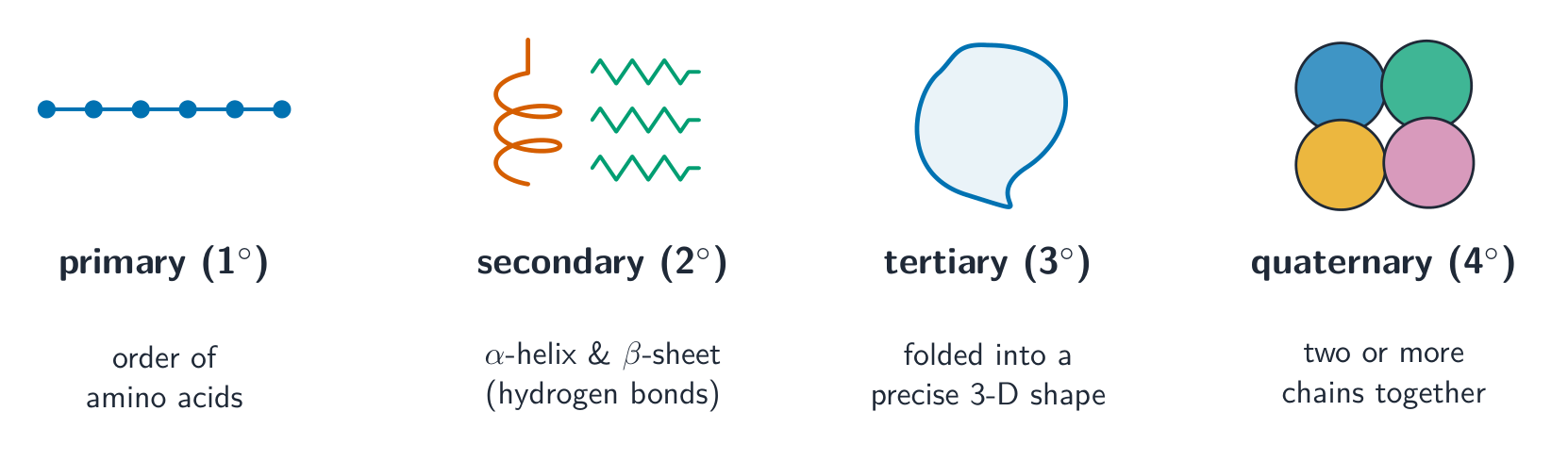
Proteins 蛋白质 are polymers of amino acids 氨基酸 joined by peptide bonds 肽键. Their sequence folds into a specific 3-D shape at four levels (primary, secondary, tertiary, quaternary), and shape determines function – as enzymes, transporters, receptors, and structural parts. Changing the environment (heat, pH) can denature 变性 a protein, unfolding it and stopping its function.

Worked example. Building a polymer from 10 monomers by dehydration synthesis forms 9 bonds and releases 9 water molecules — one per bond, so $N$ monomers release $N-1$ waters. Hydrolysis reverses this exactly: adding those 9 waters breaks the polymer back into 10 monomers. This is why biosynthesis (dehydration) and digestion (hydrolysis) are chemical opposites.

ไทย
โครงสร้างควaternary ของฮีโมโกลบิน: โพลีเปปไทด์พับสี่สาย แต่ละสายถือกลุ่มฮีม

โปรตีน เป็นโพลีเมอร์ของ กรดอะมิโน ที่เชื่อมต่อกันโดย พันธะเพปไทด์ ลำดับของ它们是พับเข้าสู่รูปร่าง 3 มิติเฉพาะที่สี่ระดับ (primary, secondary, tertiary, quaternary) และ รูปร่างกำหนดหน้าที่ – เอนไซม์, ตัวขนส่ง, ตัวรับ และส่วนโครงสร้าง การเปลี่ยนสภาพแวดล้อม (ความร้อน, pH) สามารถ ทำให้เสียสภาพ (denature) โปรตีน ทำให้ unfolded และหยุดการทำงาน

กรดอะมิโน และพันธะเพปไทด์ที่เกิดจากการควบแน่น
สี่ระดับของโครงสร้างโปรตีน
The four levels of protein structure

ตัวอย่างวิธีทำ. การสร้างโพลีเมอร์จาก 10 โมโนเมอร์ โดยสังเคราะห์ด้วยการกำจัดน้ำ จะเกิด 9 พันธะและปล่อย 9 โมเลกุลน้ำ — หนึ่งต่อหนึ่งพันธะ ดังนั้น $N$ โมโนเมอร์จะปล่อย $N-1$ โมเลกุลน้ำ 하이โดรไลซิสย้อนกลับกระบวนการนี้พอดี: การเพิ่มน้ำทั้ง 9 นั้นทำให้สลายโพลีเมอร์กลับกลายเป็น 10 โมโนเมอร์ นี่คือเหตุผลว่าทำไมการสังเคราะห์ทางชีวภาพ (สังเคราะห์ด้วยการกำจัดน้ำ) และการย่อยอาหาร (ไฮโดรไลซิส) จึงเป็นปฏิกิริยาเคมีที่ตรงกันข้ามกัน

Vocabulary · ⁨คำศัพท์⁩ Train · ⁨ฝึกฝน⁩
English ไทย
denature/ˈdenətʃə/ denature
1.7

Exam tips · ⁨ข้อแนะนำสำหรับการสอบ⁩

English
  • Trace every property of water back to its polarity and hydrogen bonding (cohesion, high specific heat, solvent power).
  • Know the four macromolecule classes and their monomers; polymers are built by dehydration synthesis and broken by hydrolysis.
  • For proteins, structure (shape) determines function — heat or a pH change denatures them and stops them working.
  • In DNA the bases pair A–T and C–G on antiparallel strands; RNA is single-stranded and uses U.
  • Link each molecule to its role (carbohydrates: energy/structure; lipids: membranes/storage; nucleic acids: information).
ไทย
  • เชื่อมโยงทุกคุณสมบัติของน้ำกลับไปที่ ความเป็นขั้วและการสร้างพันธะไฮโดรเจน (การยึดเกาะ, ความร้อนจำเพาะสูง, คุณสมบัติการละลาย)
  • รู้จัก四类โมเลกุลใหญ่และโมโนเมอร์ของแต่ละ类; โพลีเมอร์สร้าง由สังเคราะห์ด้วยการกำจัดน้ำและสลายโดยไฮโดรไลซิส
  • สำหรับโปรตีน, โครงสร้าง (รูปร่าง) กำหนดหน้าที่ – ความร้อนหรือการเปลี่ยนแปลง pH ทำให้เสียสภาพ และหยุดการทำงาน
  • ใน DNA เบสจับคู่ A–T และ C–G บนสาย สวนทาง; RNA เป็นสายเดี่ยวและใช้ U
  • เชื่อมโยงแต่ละโมเลกุลเข้ากับบทบาทของมัน (คาร์โบไฮเดรต: พลังงาน/โครงสร้าง; ไขมัน: เมมเบรน/เก็บพลังงาน; กรดนิวเคลئิก: ข้อมูล)

Interactive lessons on this topic · ⁨บทเรียนเชิงโต้ตอบสำหรับหัวข้อนี้⁩

Work through it step by step, with instant-check exercises. · ⁨ทำทีละขั้นตอน พร้อมแบบฝึกหัดตรวจสอบผลทันที⁩

Past Papers · ⁨ข้อสอบย้อนหลัง⁩

More topics in AP Biology · ⁨หัวข้อเพิ่มเติมใน AP Biology⁩

Log in or create account · ⁨เข้าสู่ระบบหรือสร้างบัญชี⁩

IGCSE, A-Level & AP