Proteins
Introduced| English | Meaning |
|---|---|
| protein/ˈprəʊtiːn/ | A biological macromolecule made of one or more folded chains of amino acids. |
| amino acids/əˈmiːnəʊ ˈæsɪdz/ | Organic molecules with amino and carboxyl groups that link together to make proteins. |
| peptide bond/ˈpeptaɪd bɒnd/ | A covalent bond joining amino acids, formed between an amino group and a carboxyl group with water removed. |
| polypeptide/ˌpɒlɪˈpeptaɪd/ | A chain of amino acids joined by peptide bonds. |
| primary structure/ˈpraɪməri ˈstrʌktʃə/ | primary structure |
The workhorses of the cell
- If DNA is the instruction manual, proteins are the machines it builds.
- Enzymes, antibodies, muscle fibres, and channels in membranes are all proteins.
- They do more different jobs than any other kind of molecule.
- And every one of those jobs comes down to a precise shape.
Amino acids: 20 building blocks
- A protein 蛋白质 is a chain of small units called amino acids 氨基酸.
- There are just 20 different amino acids.
- Their order along the chain is set by a gene.
- Twenty letters, in any order and length, spell out millions of possible proteins.
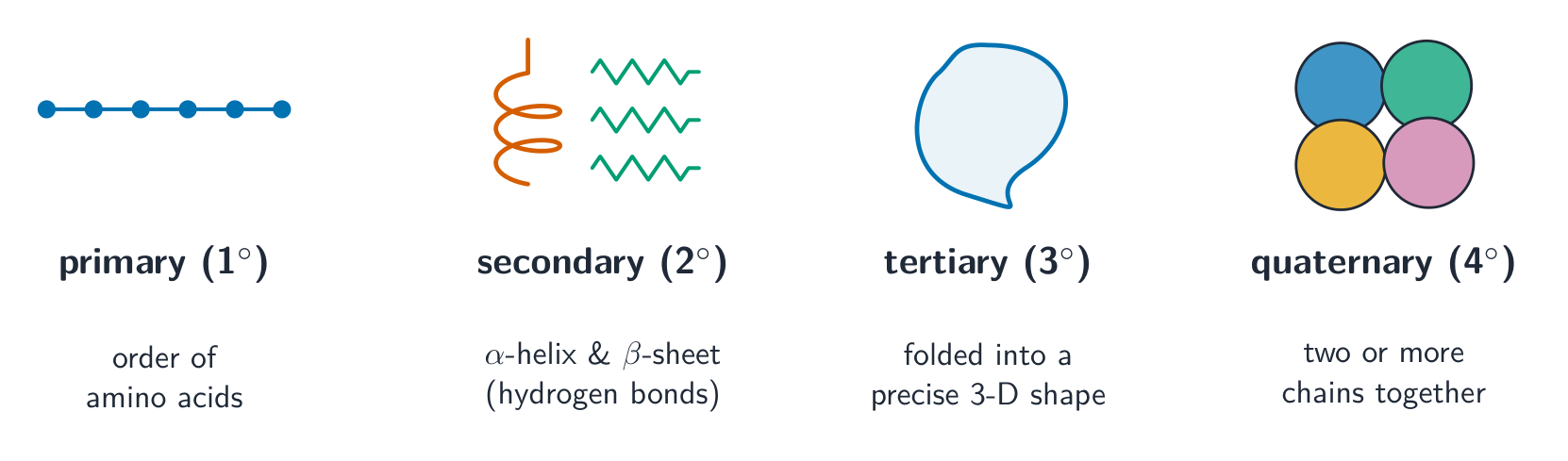
The four levels of protein structure

An amino acid, and the peptide bond 肽键 formed by condensation
The monomer that builds a protein is the…
Difficulty 1/5 · 100 coins + a small bonus on first completion today
Proteins are chains of amino acids — there are 20 different kinds.
Peptide bonds make the chain
- Amino acids join by condensation, forming a peptide bond.
- A chain of many amino acids is a polypeptide 多肽.
- Each bond releases a water molecule, just like other polymers.
- But a straight chain is not yet a working protein.
The bond that joins two amino acids is a ____ bond.
Difficulty 1/5 · 100 coins + a small bonus on first completion today
A peptide bond links amino acids into a chain called a polypeptide.
Folding into shape
- The chain does not stay straight — it folds into a precise 3-D shape.
- The order of amino acids is the primary structure 一级结构.
- Local coils and sheets, then the whole fold, then joined chains build the higher levels.
- That final folded shape is what lets the protein do its job.
The four levels of protein structure
Step up the levels — a chain of amino acids folds into a precise 3-D shape that decides the protein's job.
A protein's 3-D shape decides what job it can do.
Difficulty 1/5 · 100 coins + a small bonus on first completion today
Shape is everything: an enzyme's active site, an antibody's grip — all depend on the folded shape.
Select all true statements about proteins.
Difficulty 2/5 · 140 coins + a small bonus on first completion today
Nucleic acids store the genetic code, not proteins. The other three are correct.
A protein's shape is fragile. High temperature or the wrong pH breaks the bonds holding the fold, and the protein denatures — it unfolds and stops working. This is why a fever is dangerous and why cooking changes egg white forever.
What happens when a protein is denatured by high heat?
Difficulty 1/5 · 100 coins + a small bonus on first completion today
Heat breaks the bonds holding the fold, so the protein denatures — it unfolds and can no longer work.
Why shape is everything — the enzyme active site:
- An enzyme has a pocket shaped to fit one specific molecule.
- The right molecule slots in like a key in a lock.
- Denature the enzyme and the pocket loses its shape — the "key" no longer fits, and the enzyme is useless.
Proteins are chains of amino acids joined by peptide bonds into a polypeptide. The chain folds through several levels (starting with the primary structure) into a precise 3-D shape, and that shape decides the protein's function. Heat or wrong pH denatures it, destroying the shape and the function.
Write from 49 peptide bonds
- One polypeptide contains 50 amino acids in a single chain.
- The chain is unbranched.
How many peptide bonds join them?
Peptide bonds in one chain are amino acids minus one.
How many peptide bonds are in this chain of 50?
Difficulty 1/5 · 100 coins + a small bonus on first completion today
Each bond joins two amino acids, and the ends stay free.