Carbohydrates
Introduced| English | Meaning |
|---|---|
| starch/stɑːtʃ/ | A storage polysaccharide in plants, made from glucose units. |
| monosaccharide/ˈmɒnəʊsækɑːraɪd/ | A single sugar unit that cannot be hydrolysed into smaller carbohydrates. |
| glucose/ˈɡluːkəʊs/ | A simple sugar with molecular formula C₆H₁₂O₆, used by cells as a source of energy. |
| polysaccharide/ˌpɒlɪˈsækɑːraɪd/ | A carbohydrate polymer composed of many sugar units linked together. |
| glycogen/ˈɡlaɪkədʒn/ | A highly branched glucose polysaccharide used for energy storage in animals and fungi. |
| cellulose/ˈseljuːləʊs/ | A structural polysaccharide made of glucose units, forming a major component of plant cell walls. |
| disaccharide/ˌdɪsəkˈhɑːraɪd/ | A carbohydrate made of two monosaccharide units joined by a glycosidic bond. |
Sugars and starches
- Carbohydrates are the cell's fast fuel and some of its building material.
- They range from a single sweet sugar to giant storage molecules.
- Bread, fruit, pasta, and plant fibres are all carbohydrates.
- Their size decides whether they give quick energy or long-term storage.
Monosaccharides: single sugars
- A monosaccharide 单糖 is one sugar unit — the simplest carbohydrate.
- Glucose 葡萄糖 is the most important: the cell's main fuel for respiration.
- Fructose (in fruit) and galactose are other single sugars.
- Most have the formula around $\text{C}_6\text{H}_{12}\text{O}_6$.
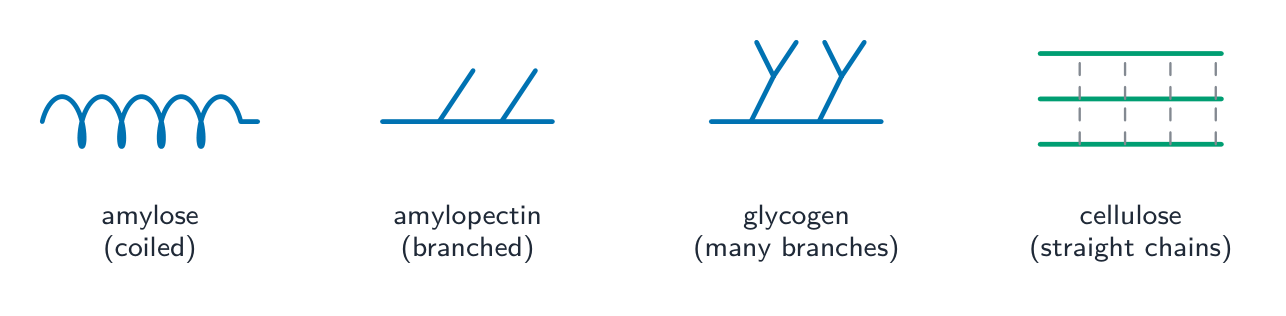
The shapes of storage polysaccharides 多糖 (starch, glycogen 糖原) and structural cellulose 纤维素
A monosaccharide is…
Difficulty 1/5 · 100 coins + a small bonus on first completion today
A monosaccharide ("one sugar") is a single sugar unit — glucose and fructose are examples.
Glucose is the main sugar that cells break down for energy.
Difficulty 1/5 · 100 coins + a small bonus on first completion today
Glucose is the cell's primary fuel — respiration breaks it down to release energy.
Disaccharides: two joined
- A disaccharide 二糖 is two monosaccharides joined by condensation.
- Sucrose (table sugar) = glucose + fructose.
- Lactose (milk sugar) = glucose + galactose.
- One condensation reaction links them and releases water.
Table sugar, sucrose, is a disaccharide made of glucose and ____.
Difficulty 1/5 · 100 coins + a small bonus on first completion today
Sucrose = glucose + fructose, joined by a condensation reaction.
Polysaccharides: many joined
- A polysaccharide is a long chain of many sugar units.
- Starch 淀粉 stores glucose in plants; glycogen stores it in animals.
- Cellulose is a tough polysaccharide that builds plant cell walls.
- Same glucose monomer, different bonds, very different roles.
Sort the sugars
Group each carbohydrate by how many sugar units it contains.
Which polysaccharide do animals use to store glucose?
Difficulty 1/5 · 100 coins + a small bonus on first completion today
Animals store glucose as glycogen (in liver and muscle); plants use starch.
Select all true statements about carbohydrates.
Difficulty 2/5 · 140 coins + a small bonus on first completion today
Carbohydrates range from single sugars to huge polymers, so not all are single units.
Starch and cellulose are both chains of glucose, yet you can digest starch and not cellulose. The glucose units are joined by different bonds, and human enzymes can only break the starch type. That is why plant fibre passes through you.
Glycogen: your body's glucose battery.
- After a meal, spare glucose is joined into glycogen in your liver and muscles.
- Between meals, hydrolysis breaks glycogen back into glucose.
- This keeps your blood glucose steady when you are not eating.
Carbohydrates are sugars, grouped by size: a monosaccharide is one unit (like glucose), a disaccharide is two, and a polysaccharide is many. Starch and glycogen store glucose; cellulose builds plant walls. Size sets the job — quick fuel or long-term storage.
Write from 7 waters in a glucose chain
- Eight glucose units join into one unbranched chain.
- Each new link is a dehydration.
How many water molecules are released?
Eight units in a line have seven joins.
How many waters join eight glucose units?
Difficulty 1/5 · 100 coins + a small bonus on first completion today
Links equal monomers minus one.