| Big Idea | Learning Objective | Essential Knowledge |
|---|---|---|
Big Idea 3 — Information Storage and Transmission | 4.1.A |
|
4.1.B |
|
Cell Communication and Cell Cycle
AP Biology · Topic 4
 7:34
Cell Communication and Cell Cycle
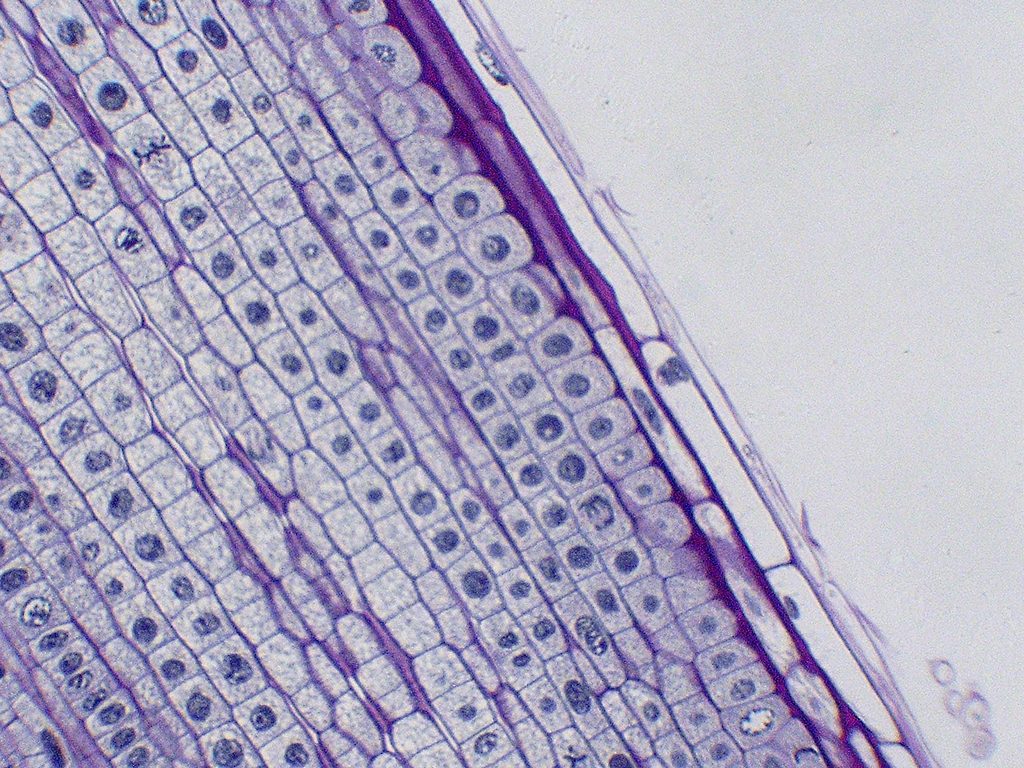
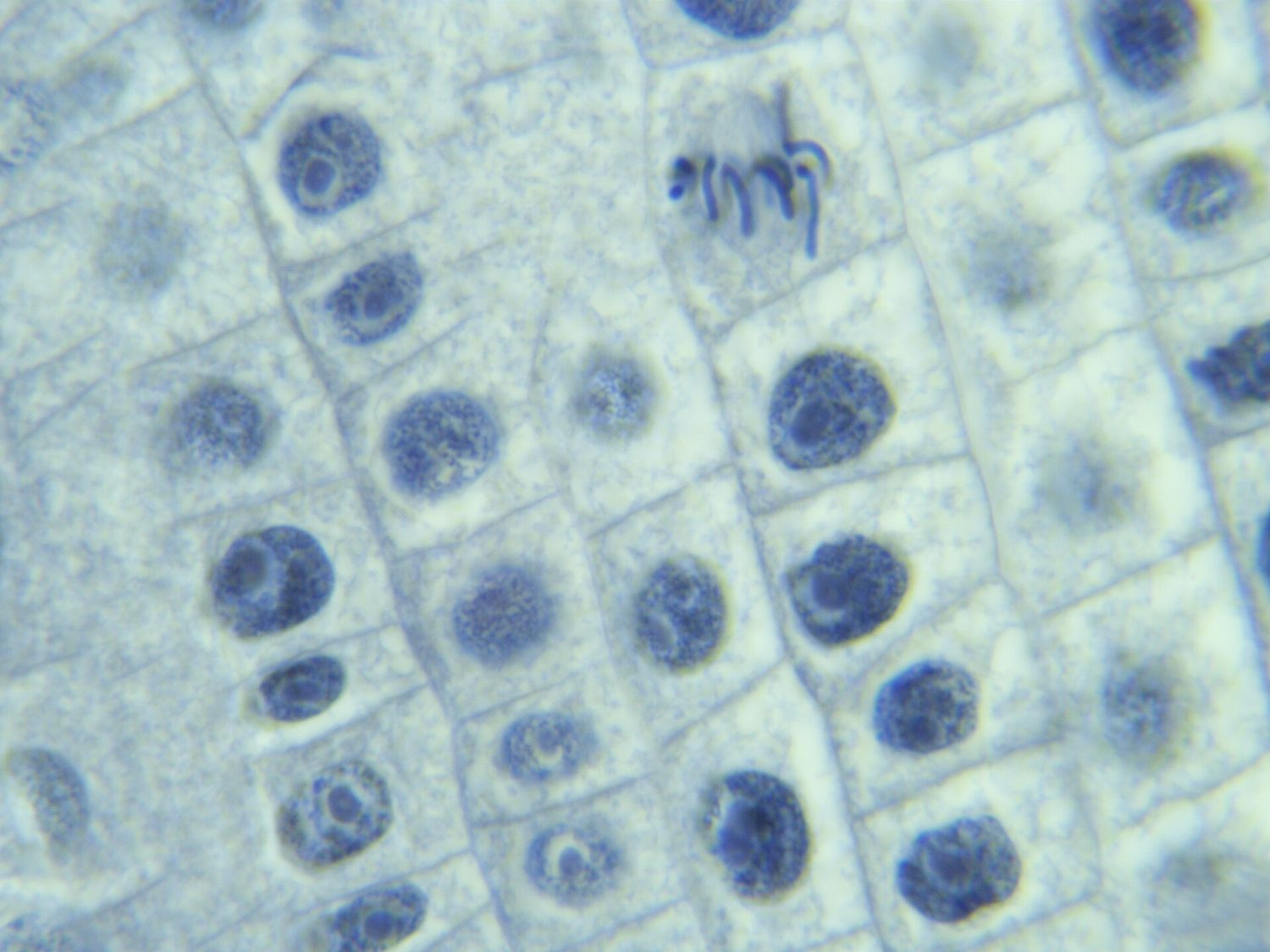
Look closely. These are real cells, photographed in the middle of dividing. Inside your body, millions of new cells are made every second — skin, blood, gut…
English narration · English + 中文 subtitles burned in
4.1
Cell Communication
Syllabus
Source: College Board AP Course and Exam Description
A single molecule of adrenaline 肾上腺素 arriving at a liver cell can release millions of glucose 葡萄糖 molecules within seconds. A single faulty switch in the same kind of pathway can make a cell divide without stopping. This unit follows a signal from the outside of a cell to its response, and shows where the control can fail.
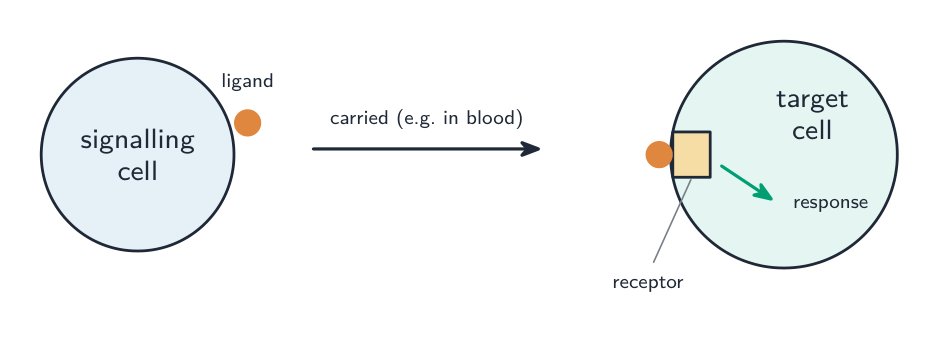
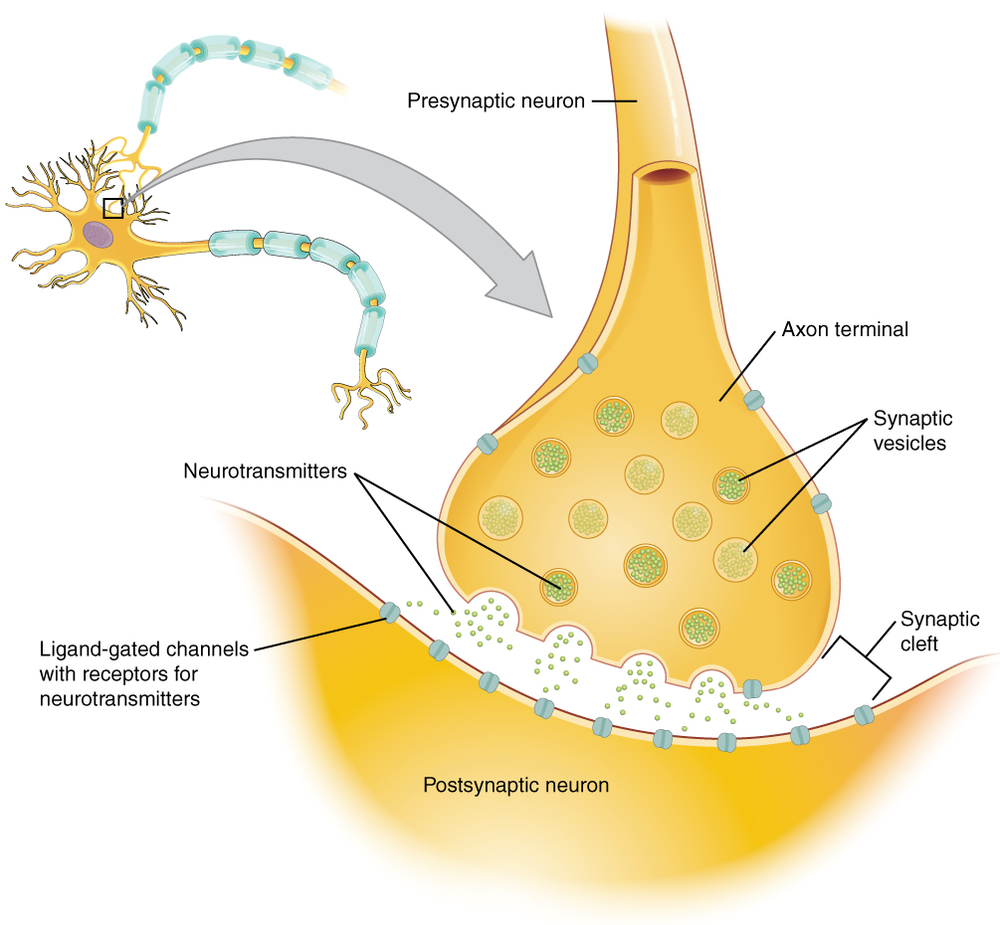
Cells coordinate by sending and receiving chemical signals 信号. In chemical signaling, a ligand 配体 binds a receptor 受体 on a target cell 靶细胞. The ligand may be released or held on a cell surface. Signals travel over different ranges: direct contact (cell junctions 细胞连接), local signaling (nearby cells, like neurotransmitters 神经递质), and long-distance signaling (hormones 激素 carried through the blood in animals; plants use other transport routes).
Each range has classic examples. In direct contact, an immune cell that has engulfed a pathogen shows pieces of it on its surface, and a helper T cell must touch it to read them. Local signals include neurotransmitters, morphogens that tell embryo cells where they are, and quorum sensing, in which bacteria release a chemical and switch on new genes (such as those for glowing or for forming a biofilm) only when enough of them are nearby. Long-distance signals include insulin, human growth hormone, thyroid hormones, testosterone and oestrogen.
Explore
How far does the signal travel?
Sort each kind of cell signalling by how far the message has to travel.
Vocabulary
Train
| English |
|---|
| adrenaline/əˈdrenəlɪn/ |
| glucose/ˈɡluːkəʊs/ |
| signals/ˈsɪɡnlz/ |
| ligand/ˈlɪɡænd/ |
| receptor/rɪˈseptə/ |
| target cell/ˈtɑːɡɪt sel/ |
| cell junctions |
| neurotransmitters/ˈnjuːrətrænsmɪtəz/ |
| hormones/ˈhɔːməʊnz/ |
4.2
Introduction to Signal Transduction
Syllabus
| Big Idea | Learning Objective | Essential Knowledge |
|---|---|---|
Big Idea 3 — Information Storage and Transmission | 4.2.A |
|
4.2.B |
|
Source: College Board AP Course and Exam Description
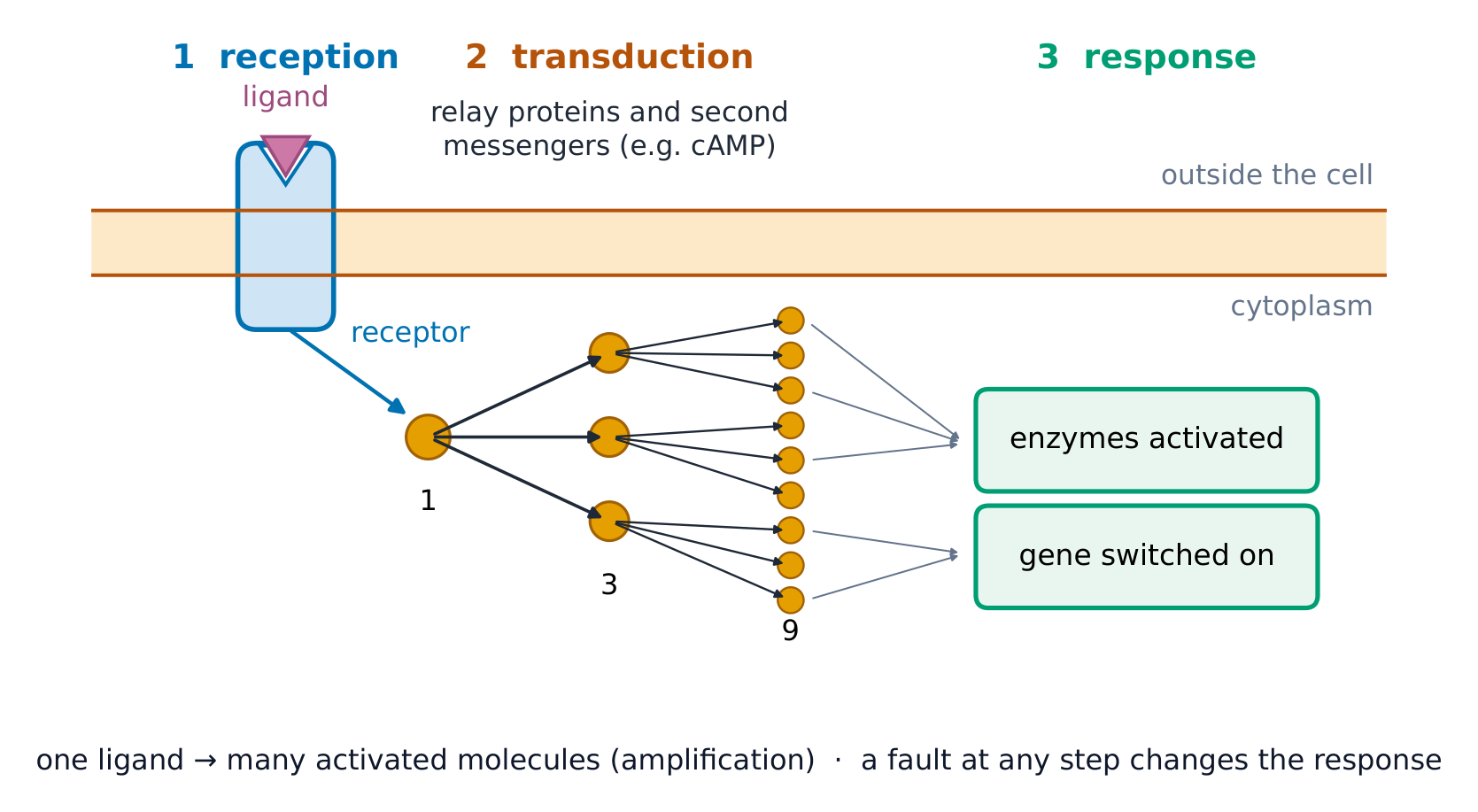
Signal transduction 信号转导 converts an outside signal into a cellular response in three stages: reception 接收 (ligand binds receptor), transduction 转导 (a relay of molecules inside the cell), and response 响应 (a change in the cell's activity, such as switching on a gene). Receptors are specific, so a cell only responds to signals it can receive.
Where the receptor sits depends on the ligand. Large or polar ligands, such as peptide hormones and neurotransmitters, cannot cross the membrane, so they bind receptors on the cell surface. Small nonpolar ligands, such as steroid hormones (oestrogen, testosterone), cross the membrane and bind receptors in the cytoplasm or nucleus; the receptor–hormone complex often acts directly on genes. A receptor has a ligand-binding part that fits only its ligand; when the ligand binds, the receptor's part inside the cell changes shape, and that change starts transduction.
Two kinds of surface receptor appear often on the exam:
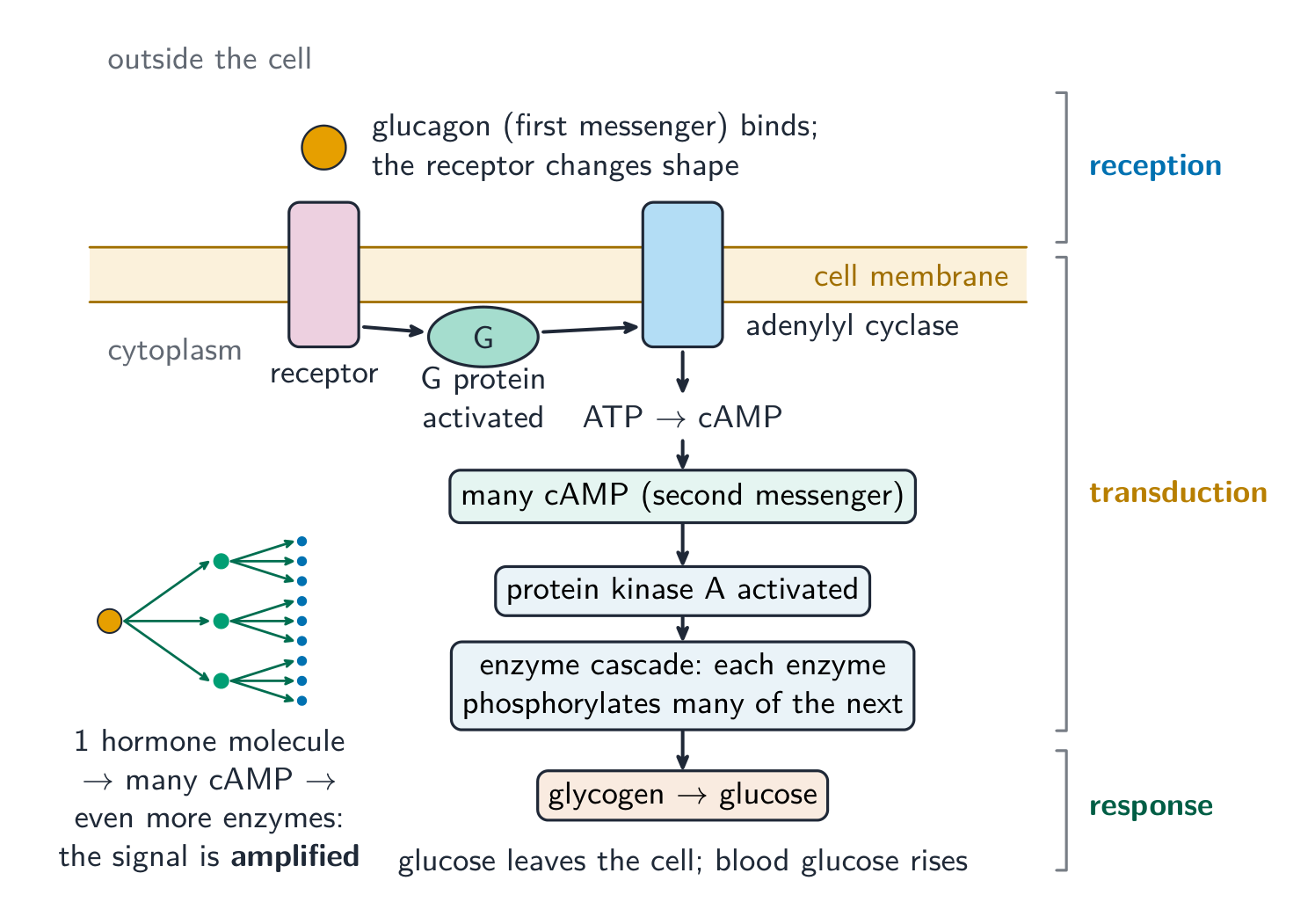
- G protein-coupled receptors (GPCRs). The ligand changes the receptor's shape, so it activates a G protein inside the membrane. An inactive G protein holds GDP; the active receptor makes it swap GDP for GTP, and the GTP-bound G protein switches on an enzyme, such as the one that makes cyclic AMP. The G protein then breaks GTP down to GDP and turns itself off.
- Ligand-gated ion channels. The ligand opens (or closes) a channel. Acetylcholine binding to receptors on a muscle cell opens channels that let $\text{Na}^+$ in, which starts the muscle contracting.
Vocabulary
Train
| English |
|---|
| Signal transduction/ˈsɪɡnl trænsˈdʌkʃn/ |
| reception/rɪˈsepʃn/ |
| transduction/trænsˈdʌkʃn/ |
| response/rɪˈspɒns/ |
4.3
Signal Transduction Pathways
Syllabus
| Big Idea | Learning Objective | Essential Knowledge |
|---|---|---|
Big Idea 3 — Information Storage and Transmission | 4.3.A |
|
4.3.B |
|
Source: College Board AP Course and Exam Description
In the transduction stage, the signal passes through a pathway 通路 – often a cascade 级联 of proteins that activate one another, frequently amplifying 放大 the signal so a few ligands trigger a large response. Second messengers 第二信使 (like cyclic AMP 环磷酸腺苷 or calcium ions) spread the signal quickly through the cell. A change in one step can alter the whole outcome.
Many cascades work by phosphorylation. Enzymes called kinases add a phosphate group, taken from ATP, to the next protein in the relay. The phosphate is charged, so it changes the protein's shape, which switches it on (or, for some proteins, off). Each kinase activates many copies of the next one, so the signal is amplified. Enzymes called phosphatases remove the phosphates, which switches the pathway off again when the signal stops.
The response can be a change in which genes are expressed, a change in an enzyme's activity (adrenaline switches on the breakdown of glycogen to glucose in liver cells), cell division, or even apoptosis 细胞凋亡, programmed cell death.
Worked example (toxins and drugs). Chemicals that act on any step can switch a pathway on or off.
- Cholera toxin changes the G protein in gut cells so that it cannot break down its GTP. The G protein stays on, the cell makes cyclic AMP nonstop, and chloride ions and water pour out of the cells into the gut: severe diarrhoea.
- A mutation that stops GTP from replacing GDP does the opposite: the G protein can never be switched on, so the ligand binds but there is no response.
- Acetylcholinesterase normally breaks down acetylcholine in the gap between nerve and muscle. Inhibit it, and acetylcholine stays bound to the receptors, the channels keep opening, and the muscle keeps being stimulated, leading to spasms.
Vocabulary
Train
| English |
|---|
| pathway |
| cascade |
| amplifying |
| Second messengers |
| cyclic AMP/ˈsaɪklɪk ˌeɪ em ˈpiː/ |
| apoptosis/əpəpˈtəʊsɪs/ |
4.4
Feedback
Syllabus
| Big Idea | Learning Objective | Essential Knowledge |
|---|---|---|
Big Idea 2 — Energetics | 4.4.A |
|
Source: College Board AP Course and Exam Description
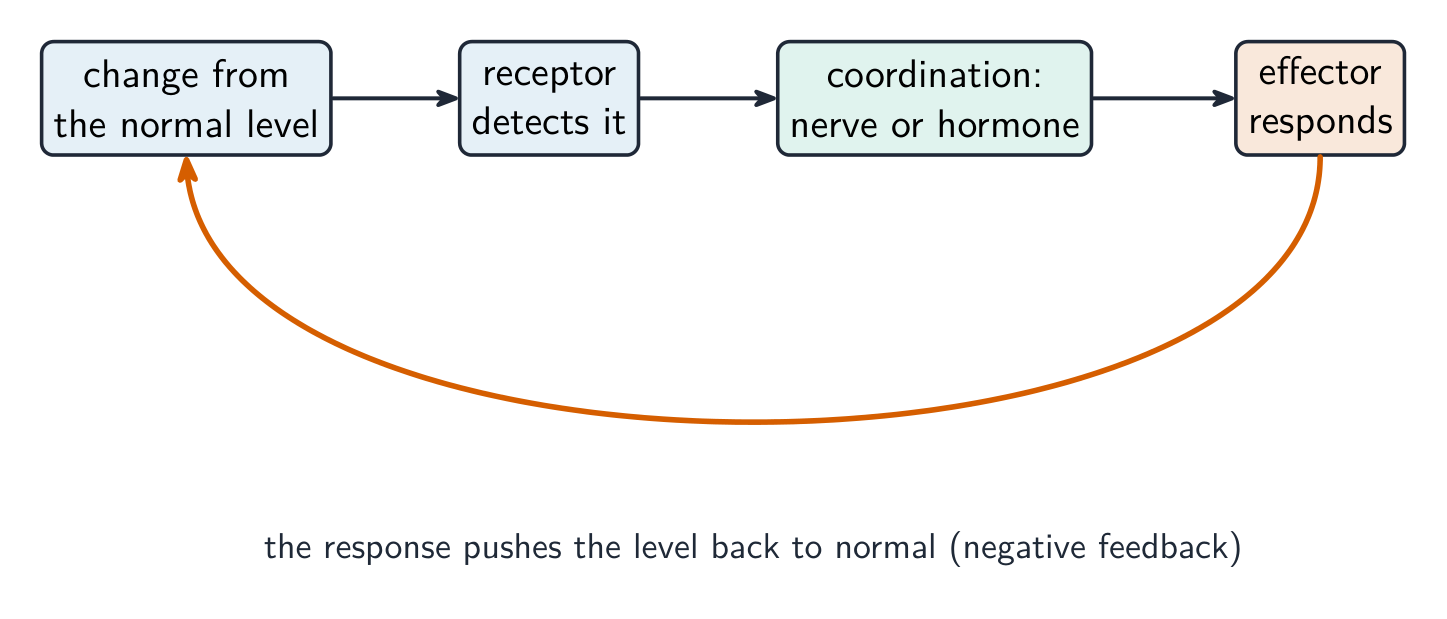
Feedback 反馈 keeps systems balanced:
- Negative feedback 负反馈 counteracts a change to restore a set point 设定点 (like a thermostat 恒温器) – it maintains homeostasis 稳态.
- Positive feedback 正反馈 amplifies a change to push a process to completion (like childbirth contractions 宫缩 or blood clotting 血液凝固).
Worked example (blood sugar). After a meal, blood glucose rises. The pancreas releases insulin 胰岛素, which makes body cells take up glucose and the liver store it as glycogen, so blood glucose falls back to its set point. Between meals, glucose falls; the pancreas releases glucagon, which makes the liver break glycogen down and release glucose. Each hormone reverses the change that triggered it, so both are negative feedback. Positive feedback examples include milk release while a baby feeds (suckling causes more milk release, which encourages more suckling) and fruit ripening: ripening fruit releases the gas ethylene, which makes nearby fruit ripen and release more ethylene.
Explore
Negative feedback keeps things steady
Negative feedback senses a change and reverses it, holding a variable (like blood glucose) near a set point. Push it away and watch the system correct.
Vocabulary
Train
| English |
|---|
| Feedback/ˈfiːdbæk/ |
| Negative feedback/ˈneɡətɪv ˈfiːdbæk/ |
| set point/set pɔɪnt/ |
| thermostat |
| homeostasis/ˌhəʊmiːəˈstɑːsiz/ |
| Positive feedback/ˈpɒzɪtɪv ˈfiːdbæk/ |
| contractions/kənˈtrækʃnz/ |
| blood clotting |
| insulin/ˈɪnsjuːlɪn/ |
4.5
Cell Cycle
Syllabus
| Big Idea | Learning Objective | Essential Knowledge |
|---|---|---|
Big Idea 3 — Information Storage and Transmission | 4.5.A |
|
4.5.B |
|
Source: College Board AP Course and Exam Description
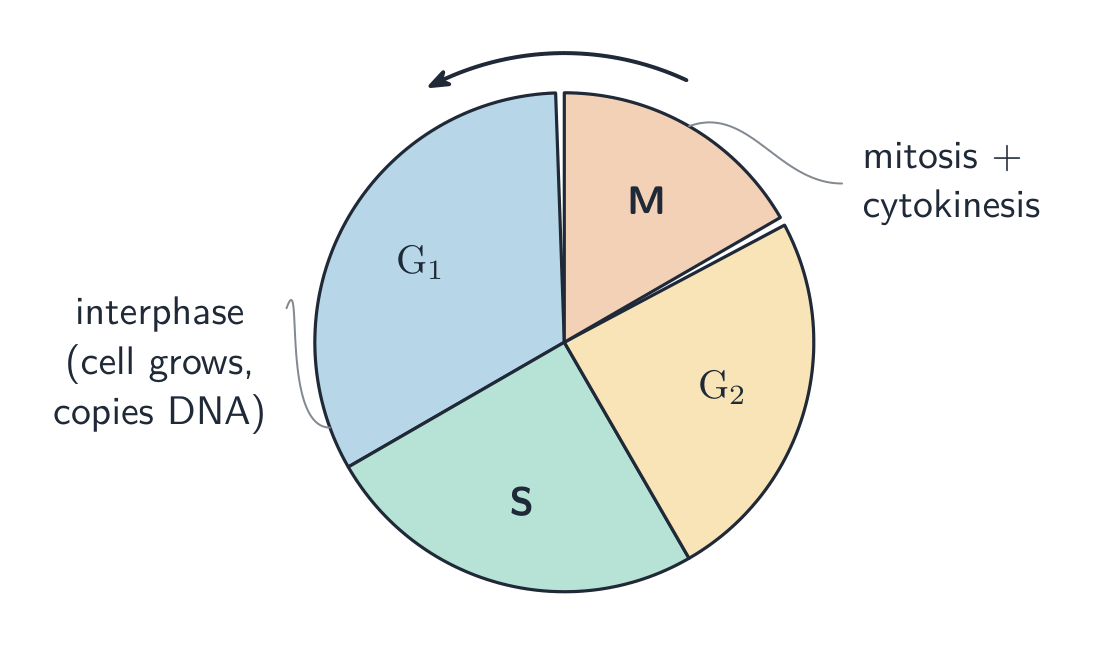
The cell cycle 细胞周期 is the life of a cell from one division to the next: interphase 间期 (G1 growth, S DNA replication DNA复制, G2 preparation) followed by M phase, including mitosis 有丝分裂 and cytokinesis 胞质分裂, which normally produce daughter cells 子细胞 with the same chromosome 染色体 number and very similar genetic information. Interphase takes most of the time; DNA is copied only in S phase.
- G1: the cell grows and is metabolically active, copying its organelles.
- S: each chromosome (spread out as chromatin) is copied, giving two sister chromatids joined at a centromere.
- G2: the cell makes proteins and lots of ATP, and its centrosomes are copied.
- G0: many cells, such as most nerve cells, leave the cycle and stop dividing. Some can return to the cycle when the right signal arrives.
Mitosis passes a complete, identical genome to two daughter cells. It is used for growth, repair of tissues, and asexual reproduction, in four steps:
- Prophase 前期: the chromatids condense into thick, visible chromosomes, the spindle starts to form, and the centrosomes move to opposite poles.
- Metaphase: spindle fibres line the chromosomes up across the middle of the cell.
- Anaphase 后期: the sister chromatids separate and are pulled to opposite poles.
- Telophase 末期: the spindle breaks down and a new nuclear envelope forms around each set of chromosomes.
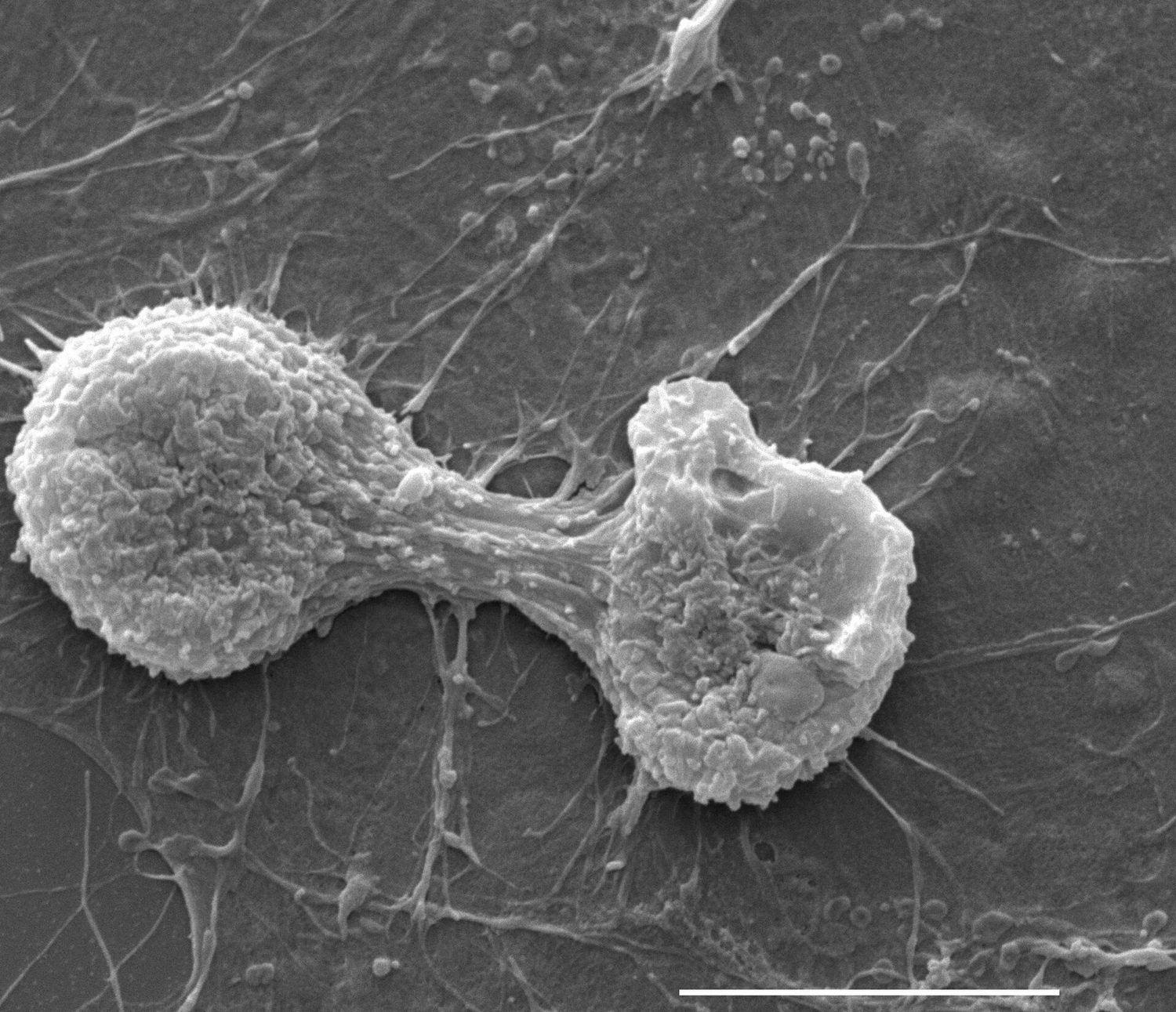
Cytokinesis then divides the cytoplasm: a cleavage furrow pinches an animal cell in two, while a plant cell, held in by its wall, builds a new cell plate across the middle. Chromosomes are visible under a microscope only during division because only then are they tightly condensed; in interphase the DNA is spread out as chromatin.
Explore
Step through the cell cycle
The cell cycle copies the DNA (S phase) then splits it evenly in mitosis, producing two identical cells. Step through the stages.
Vocabulary
Train
| English |
|---|
| cell cycle/sel ˈsaɪkl/ |
| interphase/ˌɪntəˈfeɪz/ |
| mitosis/maɪˈtəʊsɪs/ |
| cytokinesis/ˌsaɪtəkəˈniːsɪs/ |
| daughter cells/ˈdɔːtə selz/ |
| chromosome/ˈkrəʊməsəʊm/ |
| prophase/ˈprɒfeɪz/ |
| anaphase/ˈænəfeɪz/ |
| telophase/ˈteləfeɪz/ |
| DNA replication |
4.6
Regulation of Cell Cycle
Syllabus
| Big Idea | Learning Objective | Essential Knowledge |
|---|---|---|
Big Idea 3 — Information Storage and Transmission | 4.6.A |
|
4.6.B |
|
Source: College Board AP Course and Exam Description
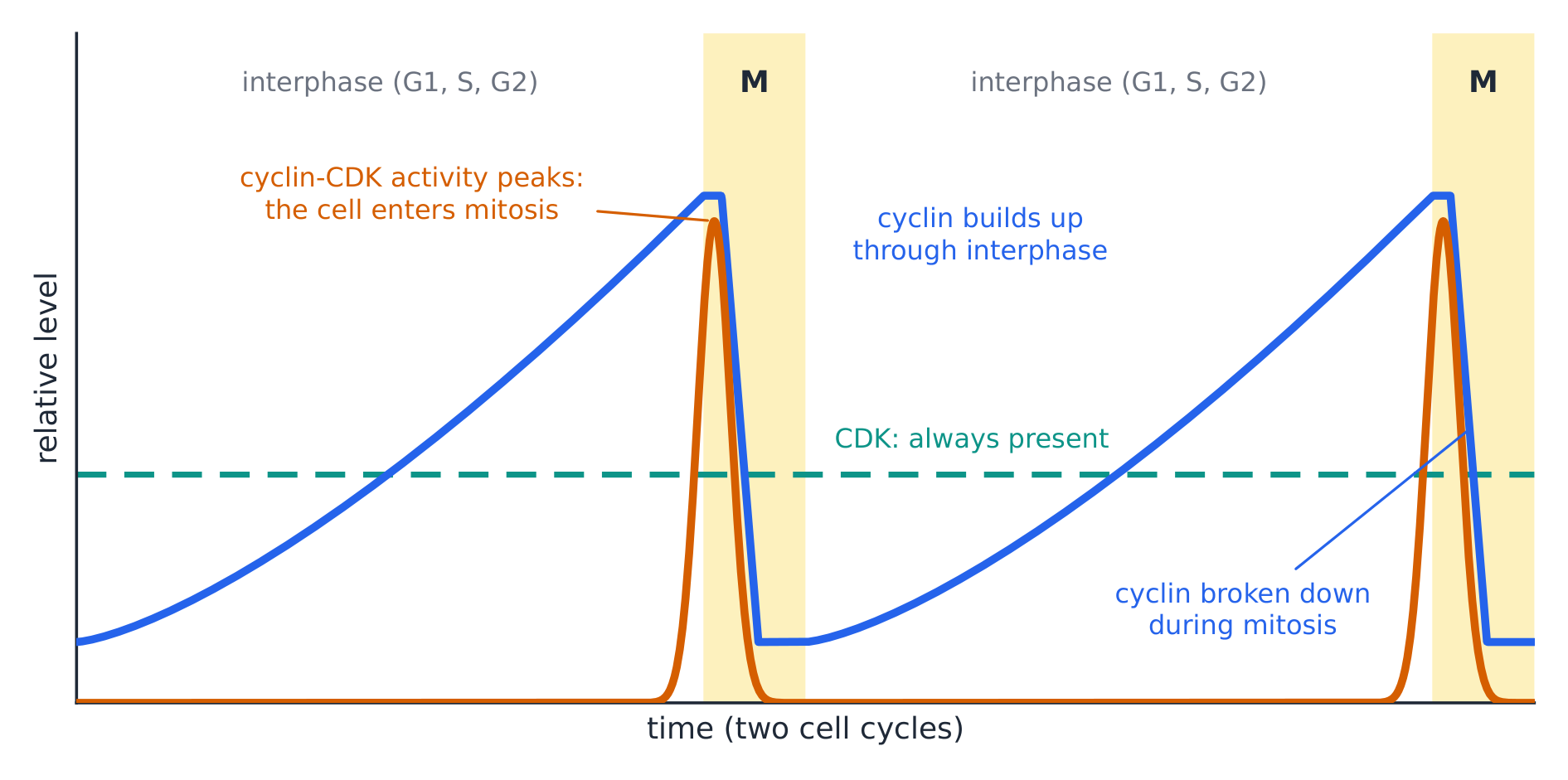
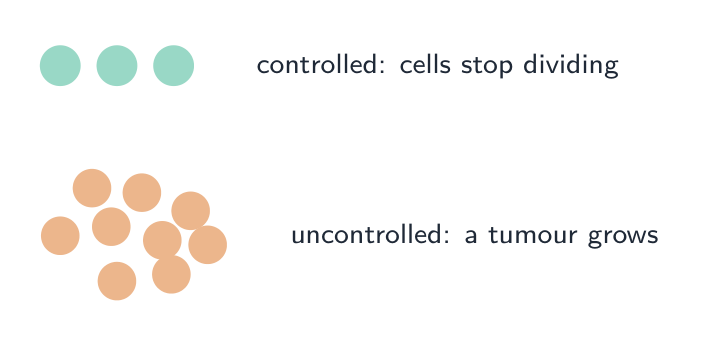
The cycle is controlled at checkpoints 检查点 that verify conditions before proceeding (Is the DNA intact? Are chromosomes attached?). Internal signals (cyclins 周期蛋白 and their kinases 激酶) and external signals drive the cycle forward. When this control fails – for example, a mutation 突变 that ignores a checkpoint – cells divide uncontrollably, which underlies cancer 癌症.
The main checkpoints are at the end of G1 (is the cell big enough, and is the DNA undamaged?), at the end of G2 (has all the DNA been copied correctly?), and in metaphase (is every chromosome attached to the spindle?). The driving force is a pair of proteins: a cyclin-dependent kinase (CDK) is always present, but it is active only when bound to a cyclin. Cyclin builds up through interphase; when enough cyclin–CDK complex has formed, it phosphorylates target proteins that push the cell into mitosis. Then the cyclin is destroyed and the cycle resets. A cell with damaged DNA that cannot be repaired is normally sent into apoptosis instead of dividing.
Worked example. Signal amplification in a cascade: one hormone activates one receptor, which switches on about 100 relay proteins, and each of those makes about 1,000 second-messenger molecules — so a single signal produces roughly $100 \times 1000 = 10^{5}$ product molecules. This is why a hormone concentration as low as $10^{-9}\,\text{M}$ can trigger a large cellular response.
Worked example (predict the effect of a mutation). In a pathway, a ligand activates a G protein, which switches on an enzyme that makes a second messenger. A mutation leaves the G protein permanently active, even with no ligand. Predict the result: the enzyme keeps making second messenger and the response continues without the signal. The cell can no longer switch the response off. In growth-signal pathways, this kind of always-on mutation is a step toward cancer.
Worked example (timing the cell cycle). In an onion root tip, 200 cells are counted: 160 in interphase, 20 in prophase, 8 in metaphase, 6 in anaphase and 6 in telophase. The cycle takes about 24 hours.
- The mitotic index 有丝分裂指数 is the fraction of cells in mitosis: $\dfrac{20+8+6+6}{200}=20\%$.
- For this rough phase-duration estimate, assume an asynchronously dividing sample and use phase fractions as approximate time fractions; growth and sampling biases can affect the estimate. Interphase: $\dfrac{160}{200}\times24=19.2$ hours. Metaphase 中期: $\dfrac{8}{200}\times24\approx1.0$ hour.
DNA content through the cycle. A cell starts G1 with an amount $x$ of DNA. It doubles to $2x$ during S phase and stays at $2x$ through G2 and mitosis. At cytokinesis each daughter cell returns to $x$. A graph of DNA per cell against time is a step up in S, then a step down at division.
Vocabulary
Train
| English |
|---|
| checkpoints/ˈtʃekpɔɪnts/ |
| cyclins/ˈsaɪklɪnz/ |
| kinases |
| mutation/mjuːˈteɪʃn/ |
| cancer/ˈkænsə/ |
| mitotic index/maɪˈtɒtɪk ˈɪndeks/ |
| Metaphase/ˌmetəˈfeɪz/ |
4.6
Practice
Answer each before reading the answers below.
- Name the three stages of cell signalling, in order.
- A drug blocks the receptor for a hormone. Predict the effect on the target cell's response, and explain.
- In a root-tip count, 25 of 250 cells are in mitosis and the cycle lasts 20 hours. Find the mitotic index and the time spent in mitosis.
- Classify each as positive or negative feedback: (a) body temperature falls and shivering begins; (b) contractions during childbirth release oxytocin, which strengthens the contractions.
- A student says: "A cell in G2 has the same amount of DNA as a cell in G1." Correct the student.
4.6
Answers
- Reception, transduction, response.
- The response is reduced or absent. The hormone cannot bind, so the signal never starts the transduction pathway, even though the hormone is present.
- Mitotic index $=\dfrac{25}{250}=10\%$; time in mitosis $\approx0.10\times20=2$ hours.
- (a) Negative feedback: shivering raises the temperature back toward the set point. (b) Positive feedback: the change is amplified until the baby is born.
- DNA is copied in S phase, between G1 and G2, so a G2 cell has twice the DNA of a G1 cell. The amount halves again only when the cell divides.
Common mistakes.
- Saying all receptors are on the cell surface. Receptors for small nonpolar ligands, such as steroid hormones, are inside the cell.
- Saying a phosphate group always switches a protein on. Phosphorylation changes the shape; for some proteins that means off.
- Calling the insulin response positive feedback because insulin "increases" glucose uptake. It reverses the rise in blood glucose, so it is negative feedback.
- Saying chromatids separate in metaphase. They line up in metaphase and separate in anaphase.
- Saying CDKs are made and destroyed each cycle. Cyclin levels rise and fall; the CDK stays, and is active only when cyclin binds.
4.6
Exam tips
- In signal transduction name the three stages: reception → transduction → response.
- Negative feedback reverses a change to keep conditions steady (homeostasis); positive feedback amplifies a change to completion (childbirth, clotting).
- Order the cell cycle: interphase (grow, copy DNA in S phase) then mitosis → two identical daughter cells.
- The DNA is copied once, in S phase, so each daughter gets a full copy.
- Failed checkpoints allow uncontrolled division → cancer.
Interactive lessons on this topic
Work through it step by step, with instant-check exercises.