| Big Idea | Learning Objective | Essential Knowledge |
|---|---|---|
Big Idea 3 — Information Storage and Transmission | 6.1.A |
|
6.1.B |
|
Gene Expression and Regulation
AP Biology · Topic 6
 8:40
Gene Expression and Regulation
That white thread in the tube is real DNA, pulled out of ordinary cells. It looks like nothing at all. But it holds every instruction your body will ever need.…
English narration · English + 中文 subtitles burned in
6.1
DNA and RNA Structure

Syllabus
Source: College Board AP Course and Exam Description
Your liver cells and your nerve cells carry exactly the same DNA, yet one makes bile and the other carries signals. This unit is about how a cell reads its DNA, and how it chooses which parts to read.
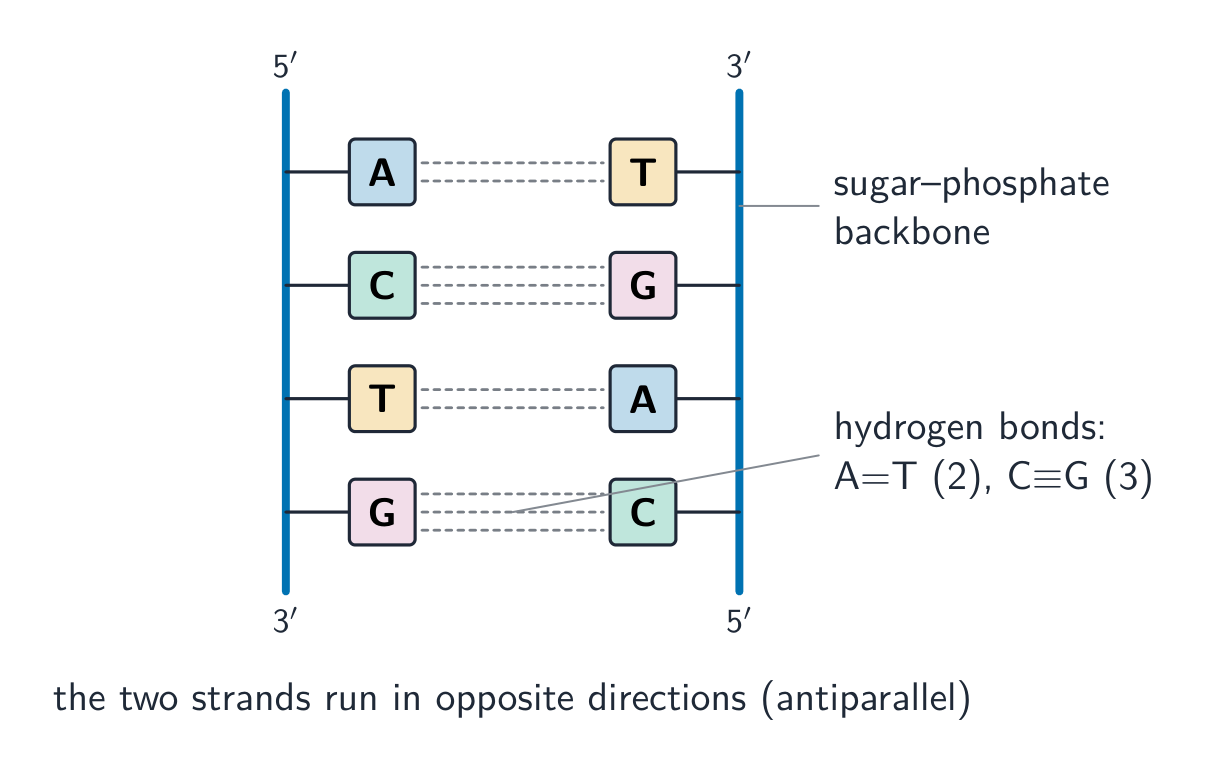
DNA carries genetic information as a double helix 双螺旋 of two strands. Its nucleotides 核苷酸 pair by rule – A with T, G with C (complementary base pairing 互补配对) – so one strand specifies the other. The strands run antiparallel 反平行. RNA is single-stranded, uses uracil (U) instead of thymine, and has ribose sugar.
The bases come in two shapes. Purines 嘌呤 (adenine and guanine) have two rings; pyrimidines 嘧啶 (cytosine, thymine and uracil) have one ring. Every base pair is one purine with one pyrimidine, so the helix has the same width all along its length. This pairing rule is the same in every living thing.
Worked example (base percentages). A sample of double-stranded DNA is 30% adenine. Find the other three bases.
- A pairs with T, so T = 30%.
- That leaves 100 − 60 = 40% for G and C together.
- G pairs with C, so G = C = 20%.
This only works for double-stranded DNA. In single-stranded RNA, A need not equal U.
RNA does three jobs, and its shape suits each one: mRNA carries the code from the nucleus to a ribosome, tRNA carries an amino acid and matches it to a codon, and ribosomal RNA 核糖体RNA (rRNA) is a main building block of the ribosome itself.
How the DNA is packaged differs between the domains, and the CED asks for both.
- Prokaryotic organisms typically have a single circular chromosome 环状染色体 in the cytoplasm, often with extra small circles called plasmids 质粒. Plasmids copy themselves and often carry useful genes, such as antibiotic resistance. Some eukaryotes, such as yeast, have plasmids too.
- Eukaryotic organisms typically have multiple linear chromosomes 线性染色体, and each is condensed by wrapping around proteins called histones 组蛋白. That packing is what fits two metres of DNA into a nucleus a few micrometres across — and because a tightly wound region is hard for the transcription machinery to reach, the packing is itself a level of gene regulation.
Explore
A DNA or an RNA feature?
Sort each structural feature by whether it belongs to DNA or RNA.
Vocabulary
Train
| English |
|---|
| double helix/ˈdʌbl ˈhiːlɪks/ |
| nucleotides/ˈnjuːklɪɒtaɪdz/ |
| complementary base pairing/ˌkɒmplɪˈmentəri beɪs ˈpeərɪŋ/ |
| antiparallel/ˌæntɪˈpærəlel/ |
| purines |
| pyrimidines |
| ribosomal RNA/ˈrɪbəsɒml ˌɑː en ˈeɪ/ |
| single circular chromosome/ˈsɪŋɡl ˈsɜːkjʊlə ˈkrəʊməsəʊm/ |
| plasmids/ˈplæzmɪdz/ |
| multiple linear chromosomes/ˈmʌltɪpl ˈlɪnɪə ˈkrəʊməsəʊmz/ |
| histones/ˈhɪstəʊnz/ |
6.2
DNA Replication

Syllabus
| Big Idea | Learning Objective | Essential Knowledge |
|---|---|---|
Big Idea 3 — Information Storage and Transmission | 6.2.A |
|
Source: College Board AP Course and Exam Description
Before a cell divides, DNA is copied semiconservatively 半保留复制: the helix unwinds and each old strand templates a new one, so each daughter helix has one old and one new strand. DNA polymerase 聚合酶 adds nucleotides following base-pairing rules, building the new strand and proofreading as it goes.
The rule that explains the fork. The two strands of DNA are antiparallel: one runs $5'\rightarrow3'$, the other $3'\rightarrow5'$. DNA polymerase can add nucleotides only to the 3′ end of a growing strand, so every new strand grows $5'\rightarrow3'$. Each enzyme at the fork has one job:
- helicase 解旋酶 unwinds the double helix and separates the strands at the fork.
- topoisomerase 拓扑异构酶 works ahead of the fork, relieving the twisting that unwinding causes.
- primase 引物酶 lays down a short RNA primer RNA引物, because DNA polymerase cannot start a new strand on its own; it can only extend one.
- DNA polymerase adds nucleotides to the 3′ end, and later replaces the RNA primers with DNA.
- ligase 连接酶 joins the separate pieces of DNA into one strand.
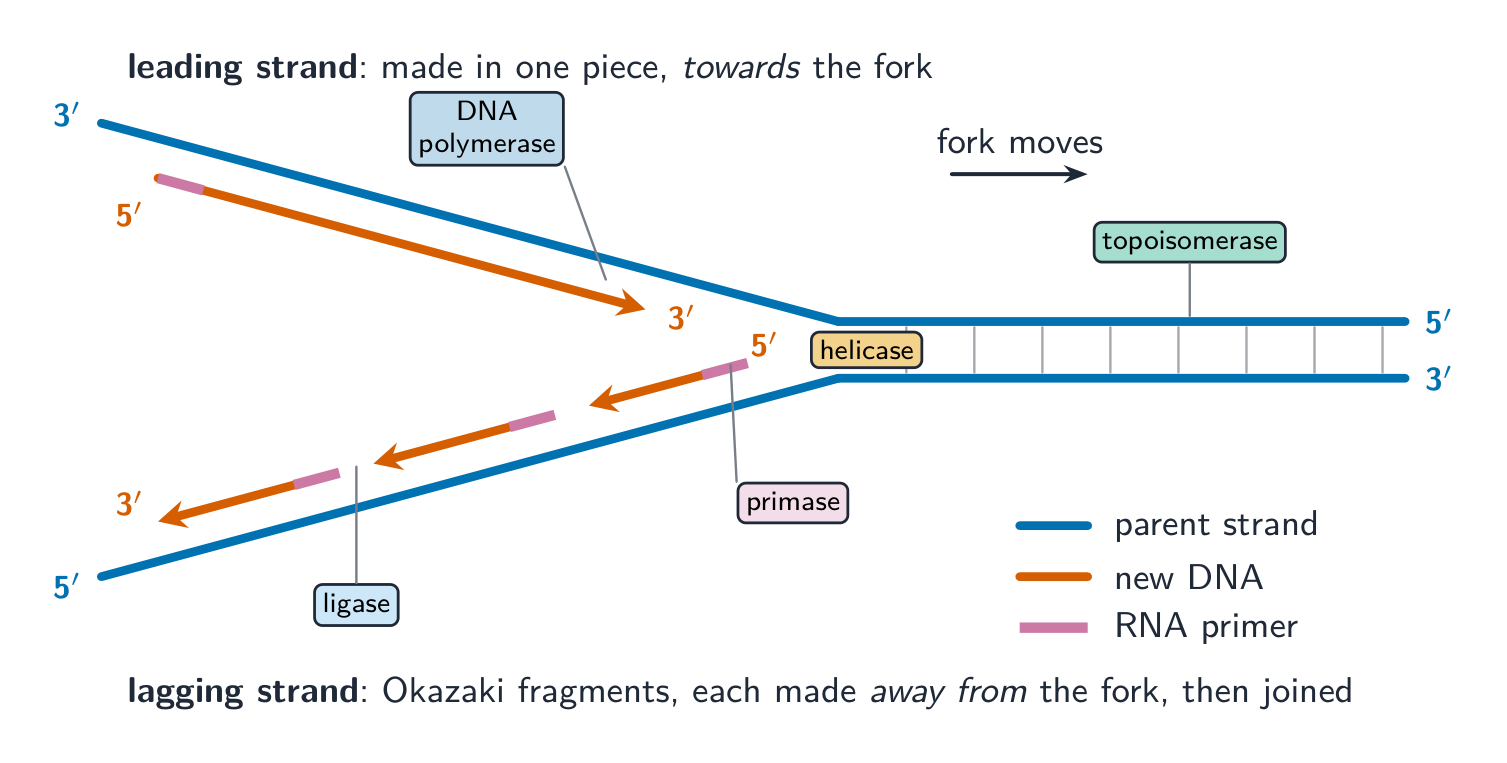
The leading strand 前导链 grows towards the fork, in the same direction as the fork moves, so it is made in one piece. The lagging strand 后随链 must grow away from the fork, so it is made in short Okazaki fragments 冈崎片段. Each needs its own primer, and ligase joins them.
Vocabulary
Train
| English |
|---|
| semiconservatively/ˌsemɪkənˈsɜːvətɪvli/ |
| DNA polymerase/ˌdiː en ˈeɪ ˌpɒlɪməˈreɪz/ |
| helicase/ˈhelɪkeɪs/ |
| topoisomerase/ˈtɒpɔɪsəʊmreɪz/ |
| primase |
| ligase/ˈlɪɡeɪs/ |
| leading strand/ˈliːdɪŋ strænd/ |
| lagging strand/ˈlæɡɪŋ strænd/ |
| Okazaki fragments |
| RNA primer/ˌɑː en ˈeɪ ˈpraɪmə/ |
6.3
Transcription and RNA Processing

Syllabus
| Big Idea | Learning Objective | Essential Knowledge |
|---|---|---|
Big Idea 3 — Information Storage and Transmission | 6.3.A |
|
Source: College Board AP Course and Exam Description
Transcription 转录 copies a gene's DNA into messenger RNA 信使核糖核酸 (mRNA). RNA polymerase RNA聚合酶 reads the template strand of DNA $3'\rightarrow5'$ and builds a complementary RNA $5'\rightarrow3'$, the same direction rule as DNA polymerase. The other DNA strand, the coding strand, has the same sequence as the mRNA, except with T for U. RNA polymerase needs no primer. In eukaryotes the mRNA is then processed: a cap and tail are added, and introns 内含子 are removed by splicing, leaving the exons 外显子 in the mature transcript. Some retained exon regions are untranslated, so exon does not mean only protein-coding sequence.
The 5′ cap added during processing is a modified guanine nucleotide — a GTP cap — and its job is recognition: it helps the ribosome recognise and bind the mRNA, as well as protecting the transcript from degradation as it leaves the nucleus. The poly-A tail 多聚腺苷酸尾, a long run of adenine nucleotides at the 3′ end, makes the mRNA more stable. An mRNA that lasts longer can be translated more times, so it makes more protein.
One gene, many proteins. A cell can keep different sets of exons from the same primary transcript. This alternative splicing 可变剪接 gives different mature mRNAs, and so different proteins, from one gene. It is one reason humans make far more kinds of protein than they have genes.
Worked example (spliced length). A primary transcript is 15 kb long, but the mature mRNA is 7 kb.
- The missing 8 kb are introns, removed by splicing. (Cap and tail are added, so they cannot explain a loss.)
- If the full gene, introns included, is put into a bacterium, the mRNA stays about 15 kb long. Prokaryotes have no splicing machinery, so the introns stay in.
- The protein is then usually wrong: the intron sequences are translated too, often adding stop codons. This is why genetic engineers put a copy without introns into bacteria, made from the mature mRNA.
Explore
Transcribe DNA into messenger RNA
Transcription copies a DNA template into mRNA, pairing A→U, T→A, C→G, G→C. Step through to build the RNA strand base by base.
Vocabulary
Train
| English |
|---|
| Transcription/trænˈskrɪpʃn/ |
| messenger RNA/ˈmesɪndʒə ˌɑː en ˈeɪ/ |
| introns/ɪnˈtrɒnz/ |
| exons/eɡˈzɒnz/ |
| poly-A tail |
| alternative splicing |
| RNA polymerase/ˌɑː en ˈeɪ ˌpɒlɪməˈreɪz/ |
6.4
Translation

Syllabus
| Big Idea | Learning Objective | Essential Knowledge |
|---|---|---|
Big Idea 3 — Information Storage and Transmission | 6.4.A |
|
Source: College Board AP Course and Exam Description
Translation 翻译 builds a protein from the mRNA at the ribosome 核糖体. The mRNA is read in three-base codons 密码子, each specifying an amino acid or a stop signal (the genetic code). Transfer RNA 转运核糖核酸 brings the matching amino acid, and the ribosome links them into a polypeptide until a stop codon ends it. This is the "central dogma": DNA → RNA → protein.
Where it happens. Ribosomes are free in the cytoplasm of all cells, and also on the surface of the rough ER in eukaryotes. A prokaryote has no nucleus, so ribosomes start translating an mRNA while it is still being transcribed. In eukaryotes, transcription (in the nucleus) and translation (in the cytoplasm) are kept apart.
One code for all life. Nearly all living things use the same genetic code: the same codon gives the same amino acid in bacteria, plants and humans. This shared code is evidence that all life has a common ancestor. It is also why a human gene put into a bacterium can make a human protein, such as insulin.
Several codons, one amino acid. There are 64 codons but only 20 amino acids, so most amino acids have more than one codon. The tRNAs for some of these codons are rarer than others. A ribosome waits longer at a codon whose tRNA is rare, so that codon is translated more slowly.
The exception: retroviruses. In a retrovirus 逆转录病毒 such as HIV, the genes are stored as RNA. The enzyme reverse transcriptase 逆转录酶 copies the viral RNA into DNA, which is then put into the host's chromosome. Information flows RNA → DNA, the reverse of the usual direction.
Inside the ribosome. The ribosome has three sites for tRNA: A (where a new tRNA arrives), P (holding the tRNA with the growing chain) and E (exit).
- Initiation: the small subunit binds the mRNA and finds the start codon 起始密码子 AUG. A tRNA carrying methionine pairs with it, and the large subunit joins.
- Elongation: a tRNA whose anticodon 反密码子 is complementary to the next codon enters the A site. A peptide bond 肽键 joins the chain in the P site to the new amino acid. The ribosome then moves one codon towards the 3′ end, and the empty tRNA leaves from the E site.
- Termination: a stop codon 终止密码子 (UAA, UAG or UGA) reaches the A site. No tRNA matches it, so a release factor frees the finished polypeptide.

Worked example (DNA to protein). The template strand of a gene reads $3'$-TAC CGA AAG ATT-$5'$.
- The mRNA is complementary to the template strand, with U instead of T: $5'$-AUG GCU UUC UAA-$3'$.
- Read the codons from the start codon, using the genetic code table: AUG = Met, GCU = Ala, UUC = Phe, UAA = stop.
- The polypeptide is Met–Ala–Phe. The stop codon adds no amino acid.
The tRNA anticodons are $3'$-UAC-$5'$, $3'$-CGA-$5'$ and $3'$-AAG-$5'$. They have the same sequence as the template DNA, but with U for T.
Worked example (protein length). Protein 1 is coded by 234 nucleotides and protein 2 by 495. Assume all of them code for amino acids.
- Each amino acid needs one codon of 3 nucleotides.
- Protein 1: 234 ÷ 3 = 78 amino acids. Protein 2: 495 ÷ 3 = 165 amino acids.
- Protein 2 has 165 − 78 = 87 more amino acids.
Common mistakes.
- Saying DNA polymerase "reads $5'\rightarrow3'$". It builds the new strand $5'\rightarrow3'$, by reading the template $3'\rightarrow5'$.
- Saying the lagging strand is made "more slowly" or "backwards". It is made in the same $5'\rightarrow3'$ direction, but in pieces, because it runs away from the fork.
- Using T in mRNA, or reading the genetic code table with anticodons. The table is written in mRNA codons.
- Giving the stop codon an amino acid.
- Saying a ribosome makes the amino acids. It joins amino acids brought to it by tRNA.
Vocabulary
Train
| English |
|---|
| Translation/trænˈsleɪʃn/ |
| ribosome/ˈriːbəʊsəʊm/ |
| codons/ˈkəʊdɒnz/ |
| transfer RNA/ˈtrænsfɜː ˌɑː en ˈeɪ/ |
| retrovirus |
| reverse transcriptase/rɪˈvɜːs trænˈskrɪpteɪs/ |
| start codon |
| anticodon/ˌæntɪˈkəʊdɒn/ |
| peptide bond/ˈpeptaɪd bɒnd/ |
| stop codon/stɒp ˈkəʊdɒn/ |
6.5
Regulation of Gene Expression

Syllabus
| Big Idea | Learning Objective | Essential Knowledge |
|---|---|---|
Big Idea 3 — Information Storage and Transmission | 6.5.A |
|
6.5.B |
|
Source: College Board AP Course and Exam Description
Cells control which genes are expressed and when. In prokaryotes, operons 操纵子 switch groups of genes on or off. In eukaryotes, regulation happens at many levels – which genes are transcribed (transcription factors, promoters, enhancers), RNA processing, and after translation. This lets a cell respond to its environment without changing its DNA.
Always on, or on when needed. Some genes are expressed all the time, in every cell, because every cell needs their products: they are constitutive 组成型 genes. A gene for a glycolysis enzyme such as GAPDH is one. Others are inducible 诱导型: they are switched on only when a signal is present. Which happens is controlled by regulatory sequences, stretches of DNA near the gene that regulatory proteins bind to.
Two kinds of operon. An operon is a group of genes under one promoter 启动子, so they are switched on and off together.
- The lac operon is inducible. Its genes break down lactose. A repressor 阻遏蛋白 protein sits on the operator and blocks RNA polymerase. Lactose binds the repressor and pulls it off, so the genes are transcribed only when lactose is present.
- The trp operon is repressible 阻遏型. Its genes make the amino acid tryptophan. The genes are normally on. When tryptophan is plentiful, it binds the repressor and activates it, so the repressor blocks transcription. The cell stops making what it already has.
When glucose is there too. Bacteria prefer glucose. While glucose is present, the lac operon stays mostly off even with lactose around. Given both sugars, the bacteria grow on glucose first, pause while the lac genes are switched on, then grow on lactose.
Worked example (reading the graph). Which sugar do the bacteria prefer, and why is there a flat section?
- The first rise happens while glucose is present, so glucose is the preferred sugar.
- The flat section starts when glucose runs out. The cells have not yet made the enzymes for lactose, so they cannot grow.
- Lactose removes the repressor, the lac genes are transcribed and translated, and growth starts again on lactose.
Changes on top of the DNA. Epigenetic 表观遗传的 changes alter gene expression without changing the base sequence, and they can be reversed.
- DNA methylation DNA甲基化, adding methyl groups to DNA, usually switches genes off.
- Histone acetylation 组蛋白乙酰化 loosens the DNA around the histones, so the transcription machinery can reach the genes and they are switched on. Removing the acetyl groups packs the DNA tightly again.
Many control points. In a eukaryote, a gene's output can be changed at every step: how tightly its DNA is packed, whether it is transcribed, how its mRNA is spliced, how long the mRNA lasts, how often it is translated, and whether the protein is modified afterwards. For example, adding a phosphate group can change a protein's shape and switch it on or off. So a tissue can contain plenty of one mRNA but little of its protein, if translation of that mRNA is blocked.
Genes switched together. Eukaryotes have no operons, but they still control groups of genes together. Genes far apart in the genome can share the same regulatory sequence, so one transcription factor switches all of them on at once. A heat shock, for instance, switches on a whole set of heat-shock protein genes together.

Vocabulary
Train
| English |
|---|
| operons/ˈɒpərənz/ |
| constitutive |
| inducible |
| promoter/prəˈməʊtə/ |
| repressor/rɪˈpresə/ |
| repressible |
| epigenetic |
| histone acetylation |
| DNA methylation |
6.6
Gene Expression and Cell Specialization

Syllabus
| Big Idea | Learning Objective | Essential Knowledge |
|---|---|---|
Big Idea 3 — Information Storage and Transmission | 6.6.A |
|
6.6.B |
|
Source: College Board AP Course and Exam Description
Every cell in a body has the same DNA, yet cells differ because they express different genes – differential gene expression 差异表达. This is how one fertilized egg produces many specialized cell types (muscle, nerve, skin); signals during development turn specific genes on and off.
How the switch works. RNA polymerase cannot start transcription on its own. Proteins called transcription factors 转录因子 bind to the promoter, and to enhancers 增强子 that can be far upstream or downstream of the gene. Together they recruit RNA polymerase. Each cell type makes its own mix of transcription factors, so each turns on its own genes. Negative regulators, such as repressors, bind the DNA and block transcription.
During development one transcription factor often switches on the gene for the next, so genes are expressed in a fixed order, a cascade. A cell is a muscle cell because the factors in it switch on muscle proteins, such as actin and myosin, and not the proteins of a nerve cell.
Small RNAs. Some short RNA molecules regulate genes after transcription. A microRNA 微小核糖核酸 or siRNA is loaded into a protein complex (one protein in it is called AGO2). The small RNA base-pairs with a matching mRNA, and the complex then cuts the mRNA or blocks its translation. Less protein is made, though the gene is still transcribed.
Worked example (small-RNA data). In normal cells the mean amount of gene H mRNA is 40 units. In cells with no working AGO2, it is 100 units.
- Percent increase = (100 − 40) ÷ 40 × 100 = 150%.
- Without AGO2, the mRNA is no longer cut, so it builds up. This supports the claim that small RNAs normally lower gene H expression.
- If gene G mRNA hardly changes when AGO2 is lost, small RNAs play a smaller part in regulating gene G.
Explore
Which cell expresses which genes?
Sort each specialized job by the cell type whose genes are switched on to do it.
Vocabulary
Train
| English |
|---|
| differential gene expression/ˌdɪfəˈrenʃl dʒiːn ekˈspreʃn/ |
| transcription factors/trænˈskrɪpʃn ˈfæktəz/ |
| enhancers |
| microRNA |
6.7
Mutations

Syllabus
| Big Idea | Learning Objective | Essential Knowledge |
|---|---|---|
Big Idea 3 — Information Storage and Transmission | 6.7.A |
|
6.7.B |
| |
6.7.C |
|
Source: College Board AP Course and Exam Description
A mutation 突变 is a change in the DNA sequence. Point mutations change one base (silent, missense, or nonsense); insertions/deletions can cause a frameshift 移码 that garbles everything downstream. Mutations in gametes are heritable; they may be harmful, neutral, or beneficial – and beneficial ones supply the variation for natural selection.
Where mutations come from. Mutations arise when DNA polymerase makes a copying error that is not repaired, or from outside causes: radiation such as UV light and X-rays, and reactive chemicals (mutagens 诱变剂). They happen at random. They are not made because the organism needs them.
- A silent mutation changes a codon to another codon for the same amino acid, so the protein is unchanged.
- A missense 错义 mutation changes one amino acid. Its effect depends on where: in an enzyme's active site it can destroy the enzyme, elsewhere it may change little.
- A nonsense 无义 mutation creates an early stop codon, so the protein is cut short.
- A frameshift after an insertion or deletion changes every codon after it, and usually makes a useless protein. An insertion or deletion of three bases keeps the reading frame.
Whether a mutation helps or harms depends on the environment. A mutation in the MC1R gene gives dark fur: harmful on pale sand, but it hides pocket mice living on dark lava rock.
Worked example (codon chart). A mutation changes amino acid 229 from threonine to alanine. Threonine's codons are ACU, ACC, ACA and ACG; alanine's are GCU, GCC, GCA and GCG.
- The codons differ only in the first base: A → G.
- So a single-base substitution (a missense point mutation) is the likely cause, for example ACU → GCU.
- In the template DNA the matching change is T → C.
Whole-chromosome errors change the phenotype too. Mutation is not only a change of base: errors in mitosis or meiosis can result in changes in phenotype. If chromosomes fail to separate — nondisjunction 不分离 — a gamete receives an extra copy or none, and the resulting zygote has an abnormal chromosome number (aneuploidy 非整倍性). Trisomy 21 is the familiar example. Because a whole chromosome carries hundreds of genes, the phenotypic effect is far broader than a point mutation's. Parts of a chromosome can also be lost, copied twice, turned around or moved to another chromosome; these changes in structure also cause genetic disorders.
Bacteria swap genes sideways. Prokaryotes do not have meiosis, but they gain new genes by horizontal gene transfer 水平基因转移, from cells that are not their parents.
- Transformation 转化: a cell takes up DNA from its surroundings, for example from a dead cell.
- Transduction 转导: a virus carries DNA from one bacterium to another.
- Conjugation 接合: one cell passes DNA, often a plasmid, to another through direct contact.
- Transposition: a transposon 转座子 ("jumping gene") moves from one place in the DNA to another.
This is how a gene for antibiotic resistance spreads quickly through a population of bacteria, even between species. Viruses add variation too: if two related viruses infect the same cell, their genes can recombine into a new virus, as happens in flu.
Explore
Helpful, harmful, or neutral?
Sort each mutation by its effect - many do nothing, some harm, and a few help.
Vocabulary
Train
| English |
|---|
| mutation/mjuːˈteɪʃn/ |
| frameshift/ˈfreɪmʃɪft/ |
| mutagens |
| missense |
| nonsense |
| nondisjunction/ˌnɒndɪsˈdʒʌŋkʃn/ |
| aneuploidy/ˈeɪnəplɔɪdi/ |
| horizontal gene transfer |
| transformation/trænsfɔːˈmeɪʃn/ |
| transduction/trænsˈdʌkʃn/ |
| conjugation |
| transposon |
6.8
Biotechnology

Syllabus
| Big Idea | Learning Objective | Essential Knowledge |
|---|---|---|
Big Idea 3 — Information Storage and Transmission | 6.8.A |
|
Source: College Board AP Course and Exam Description
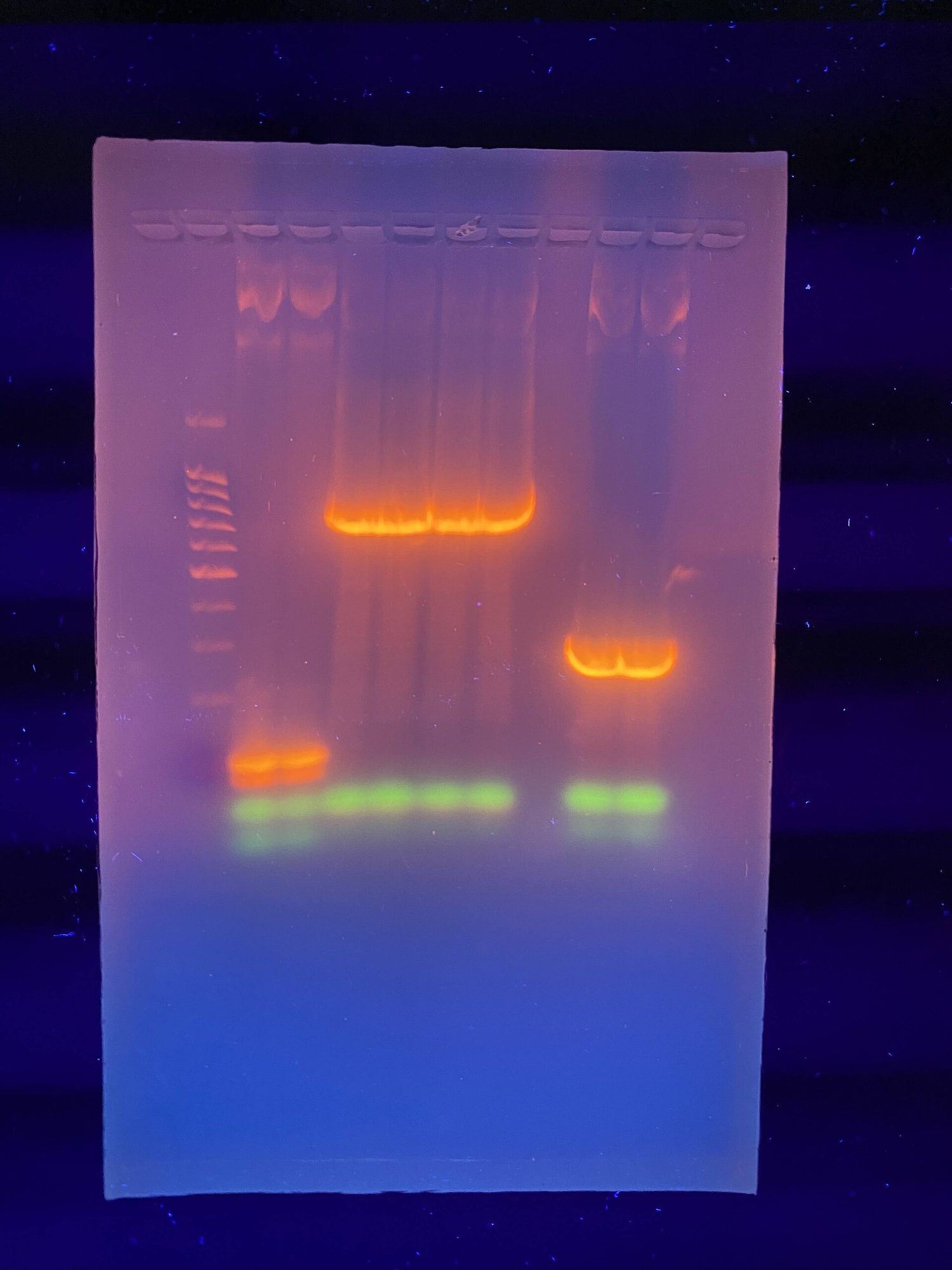
Biotechnology 生物技术 tools manipulate genetic material: PCR 聚合酶链反应 copies DNA, gel electrophoresis 凝胶电泳 separates DNA fragments by size, restriction enzymes and cloning move genes between organisms, and CRISPR edits sequences. These techniques enable genetic testing, engineered organisms, and medical treatments.
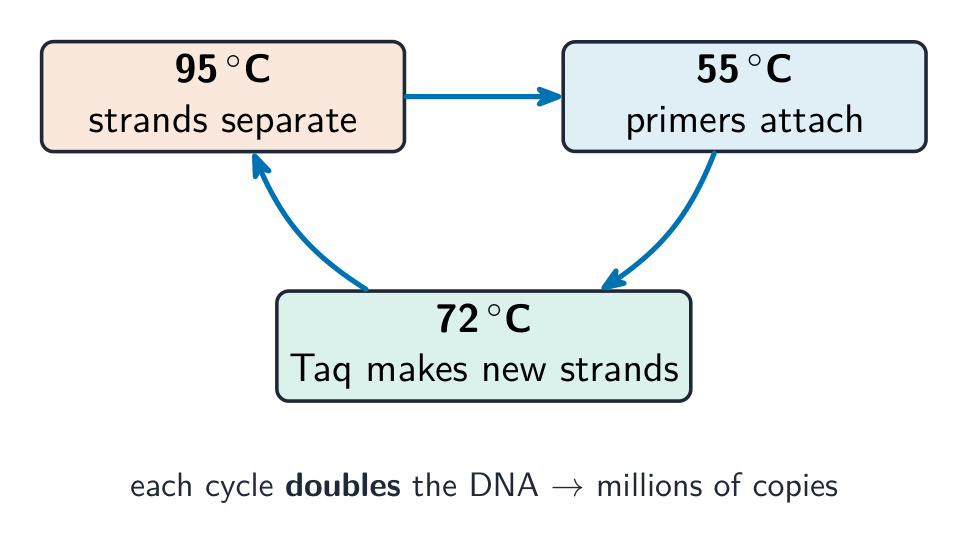
PCR in three steps, repeated about 30 times.
- Denature at about 95 °C: the two DNA strands separate.
- Anneal at about 55 °C: short DNA primers bind to each end of the target region.
- Extend at about 72 °C: a heat-stable DNA polymerase builds new strands from the primers.
Each cycle doubles the target, so after $n$ cycles one copy has become $2^n$ copies.
Measuring gene expression: qPCR. To measure how much of one mRNA a tissue makes, scientists copy its mRNA into DNA and run PCR while a dye makes the DNA glow. The Cq is the cycle at which the glow crosses a threshold. A sample with more starting mRNA reaches the threshold sooner, so a lower Cq means more mRNA.

Worked example (comparing Cq). Sample A has Cq = 18 and sample B has Cq = 21. How much more starting mRNA is in A?
- A reaches the threshold 21 − 18 = 3 cycles earlier.
- Each cycle doubles the DNA, so A started with $2^3 = 8$ times as much.
- Sample C (Cq = 27) has the least: $2^{9} = 512$ times less than A.
Other tools.
- Bacterial transformation: a gene is put into a plasmid, and bacteria take up the plasmid. The plasmid also carries a gene for antibiotic resistance, so only bacteria that took it up grow on a plate containing the antibiotic. The bacteria then copy the gene each time they divide (gene cloning 克隆) and can make its protein.
- DNA sequencing DNA测序 reads the order of bases. Comparing sequences shows how closely species are related, and identifies a species from a small sample. Environmental DNA (eDNA) from water can show a fish lives in a lake without anyone catching it, because primers that match only that species' DNA give a PCR product only if its DNA is there.
- A genetically modified organism 转基因生物 carries a gene from another species; a transgenic animal is one example.

Worked example. A template DNA strand 3'-TAC GGA TTC-5' is transcribed into mRNA 5'-AUG CCU AAG-3'. A ribosome reads three codons: AUG = Met (start), CCU = Pro, AAG = Lys — coding for Met–Pro–Lys. Changing the third base of a codon often gives the same amino acid, because the genetic code is degenerate, which softens the effect of many mutations.
Reading DNA identifies individuals. Because the number of repeats at certain non-coding loci varies from person to person, analysis of DNA can be used for forensic identification: amplify those regions by PCR, separate the fragments by gel electrophoresis, and compare the pattern of band positions with a reference sample. A match is a statement about probability rather than certainty, which is why several loci are tested rather than one.
More common mistakes.
- Saying a higher Cq means more mRNA. It means less: the sample needed more cycles to reach the threshold.
- Saying gene expression is measured by the amount of DNA. Every cell has the same DNA; expression is the amount of mRNA or protein.
- Assuming more mRNA always means more protein. Small RNAs, mRNA stability and translation control all come between them.
- Saying mutations happen "to help the organism adapt". They are random; selection then acts on them.
- Mixing up inducible and repressible operons. Lactose switches the lac genes on; tryptophan switches the trp genes off.
Vocabulary
Train
| English |
|---|
| Biotechnology/ˌbaɪəʊtekˈnɒlədʒi/ |
| PCR/ˌpiː siː ˈɑː/ |
| gel electrophoresis/dʒel ɪˌlektrəʊfɔːˈriːsɪs/ |
| cloning |
| genetically modified organism/dʒɪˈnetɪkli ˈmɒdɪfaɪd ˈɔːɡənɪzəm/ |
| DNA sequencing |
6.8
Exam tips
- Know the central dogma DNA → RNA → protein: transcription makes mRNA, translation reads it in three-base codons at the ribosome.
- Remember RNA is single-stranded and uses U instead of T; replication is semiconservative.
- Every cell has the same DNA — cells differ because they express different genes (differential gene expression).
- A mutation is a change in the DNA sequence and may be harmful, neutral, or beneficial (the raw material for selection).
- Link biotech tools to their jobs: PCR copies DNA; gel electrophoresis separates fragments by size.
- In data questions, name the direction of an effect and back it with numbers from the graph or table, such as a percent change or a Cq difference.
Interactive lessons on this topic
Work through it step by step, with instant-check exercises.