Lipids
Introduced| English | Meaning |
|---|---|
| lipid/ˈlɪpɪd/ | A member of a group of largely water-insoluble biological molecules, including fats, oils, phospholipids and steroids. |
| fatty acid/ˈfæti ˈæsɪd/ | A carboxylic acid with a hydrocarbon chain, commonly a component of lipids such as triglycerides. |
| phospholipid/ˈfɒsfəlɪpɪd/ | A lipid with a phosphate-containing hydrophilic head and hydrophobic fatty-acid tails, commonly forming cell-membrane bilayers. |
| saturated/ˈsætʃəreɪtɪd/ | Describing fatty acids whose hydrocarbon chains contain no carbon-carbon double or triple bonds. |
| unsaturated/ʌnˈsætʃəreɪtɪd/ | Containing one or more carbon-carbon double or triple bonds rather than only single bonds. |
| hydrophobic/ˌhaɪdrəˈfəʊbɪk/ | Unable to mix readily with water, or tending to avoid contact with it. |
The water-fearing family
- Lipids are the fats, oils, and waxes of the cell.
- They store more energy per gram than any other food molecule.
- They also build every cell membrane and act as insulation.
- What unites them is simple: they do not mix with water.
Triglycerides: energy stores
- A lipid 脂质 called a triglyceride stores energy in fat.
- It is one glycerol molecule joined to three fatty acid 脂肪酸 tails.
- Long fatty-acid tails pack a lot of energy into a small space.
- This is why animals store spare energy as fat, not sugar.
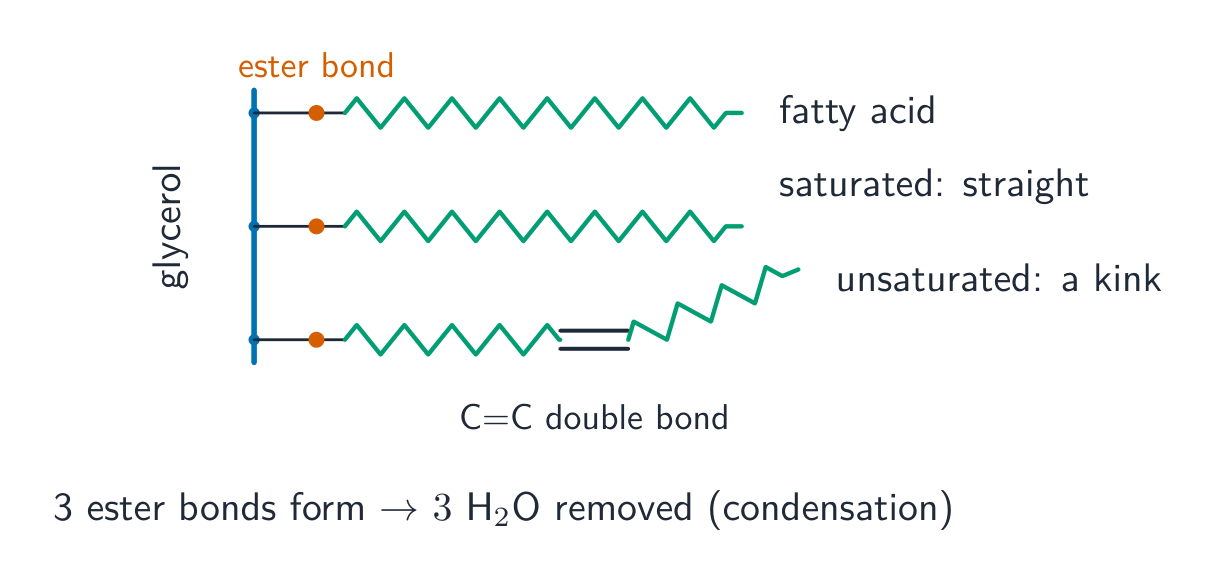
A triglyceride: glycerol joined to three fatty acids
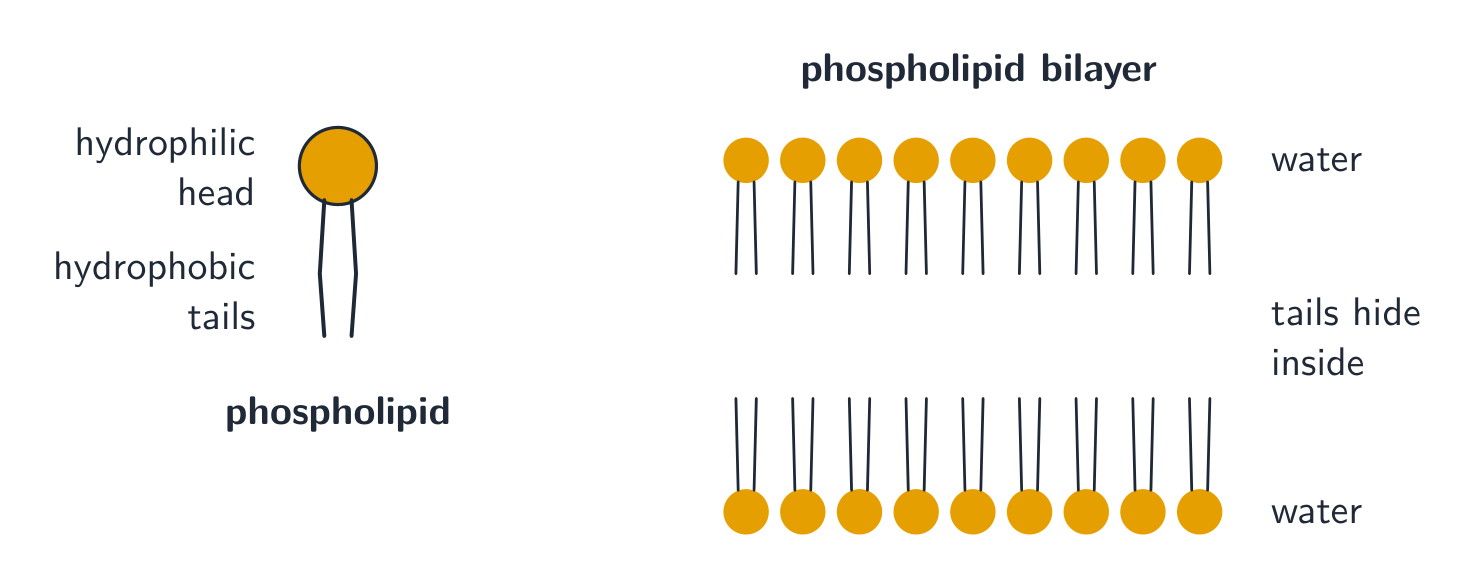
A phospholipid 磷脂 has a polar head and two nonpolar tails, so phospholipids form a bilayer
A triglyceride is made of one glycerol joined to…
Difficulty 1/5 · 100 coins + a small bonus on first completion today
A triglyceride is a glycerol backbone with three fatty acid tails attached.
Saturated vs unsaturated
- A saturated 饱和的 fatty acid has no double bonds — straight chains that pack tightly (a solid fat).
- An unsaturated 不饱和的 fatty acid has C=C double bonds that kink the chain (a liquid oil).
- More double bonds means a more liquid, lower-melting lipid.
- Animal fats tend to be saturated; plant and fish oils tend to be unsaturated.
What makes a fatty acid unsaturated?
Difficulty 1/5 · 100 coins + a small bonus on first completion today
An unsaturated fatty acid has C=C double bonds, which kink the chain and keep it liquid (an oil).
Phospholipids build membranes
- A phospholipid has a phosphate head that likes water and two fatty-acid tails that fear it.
- In water, phospholipids line up into a double layer — a bilayer.
- Heads face the water outside and inside; tails hide in the middle.
- This bilayer is the basis of every cell membrane.
Sort the lipids
Group each lipid by its structure and main job in the body.
The lipid that builds cell membranes is the ____.
Difficulty 1/5 · 100 coins + a small bonus on first completion today
A phospholipid has a water-loving head and water-fearing tails, so it forms the membrane bilayer.
Select all true statements about lipids.
Difficulty 2/5 · 140 coins + a small bonus on first completion today
Lipids are hydrophobic, so they do not dissolve in water. The other three are correct.
Do not treat "fat" as simply bad. Lipids are essential: they store energy, cushion organs, insulate the body, build every membrane, and form steroid hormones. The body cannot work without them.
Lipids are hydrophilic — they dissolve easily in water.
Difficulty 1/5 · 100 coins + a small bonus on first completion today
False. Lipids are mostly nonpolar, so water cannot surround them: they are hydrophobic and do not mix with water.
Why oil and water separate:
- Lipid tails are nonpolar, so water molecules cannot hydrogen-bond to them.
- Water pulls together and squeezes the lipids out.
- Being hydrophobic 疏水的 is exactly what lets phospholipids form a stable membrane in a watery cell.
Lipids are hydrophobic molecules. Triglycerides (glycerol + three fatty acids) are concentrated energy stores; saturated fats are solid, unsaturated oils are liquid. Phospholipids form the membrane bilayer because their tails are hydrophobic and their heads are not.
Write from 3 fatty acids
- A triglyceride is built from glycerol.
- The other parts are fatty acids, and this molecule is not a phospholipid.
How many fatty acids are in one triglyceride?
Tri means three fatty acids on glycerol.
How many fatty acids are in a triglyceride?
Difficulty 1/5 · 100 coins + a small bonus on first completion today
A triglyceride has three fatty-acid chains.