| Big Idea | Learning Objective | Essential Knowledge |
|---|---|---|
Big Idea 1 — Evolution | 7.1.A |
|
7.1.B |
|
Natural Selection
AP Biology · Topic 7
 8:10
Natural Selection
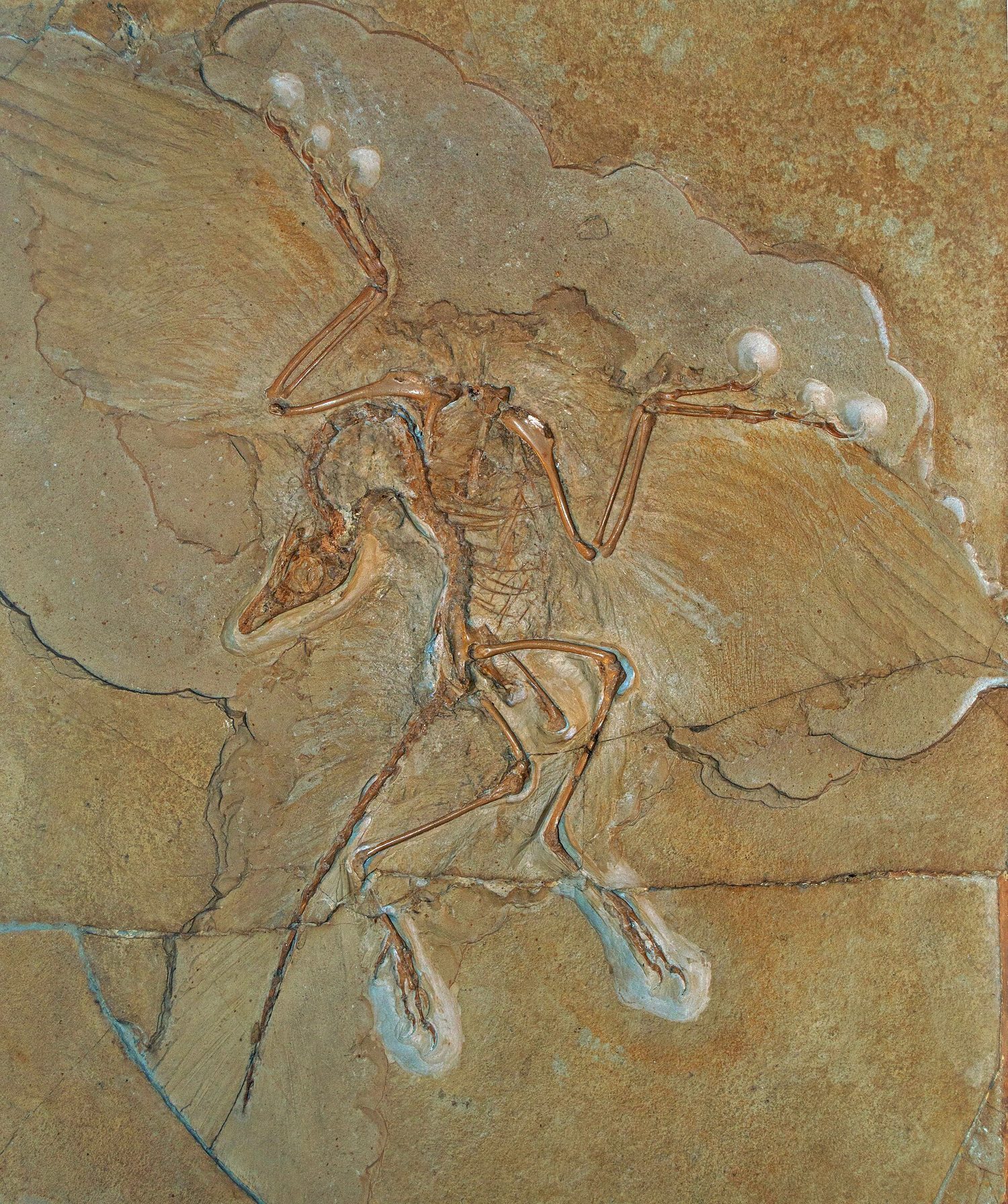
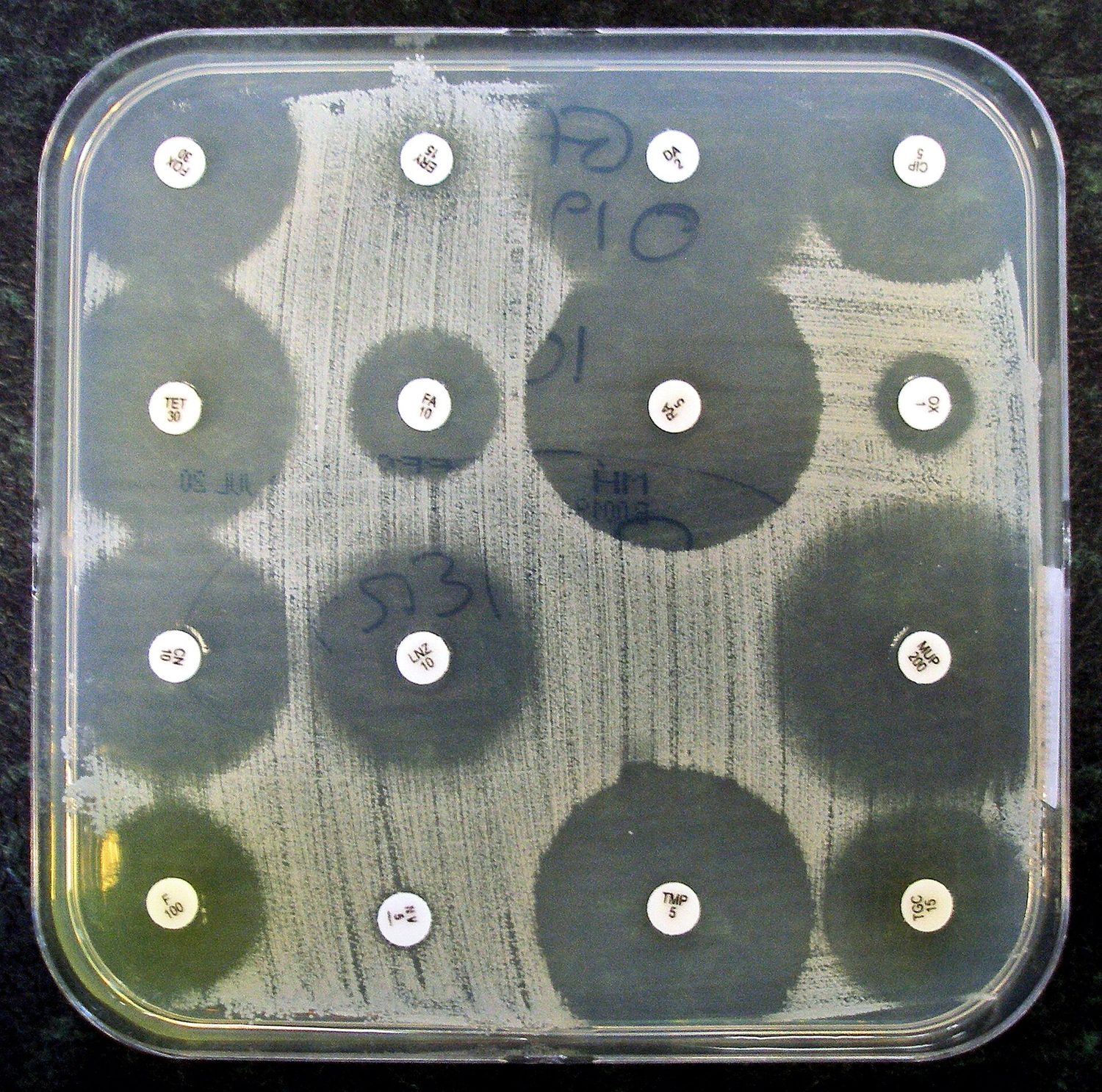
This is a dish of bacteria. Each white disc holds a different antibiotic — a drug made to kill them. Look at the clear rings. A wide ring means the drug still…
English narration · English + 中文 subtitles burned in
7.1
Introduction to Natural Selection

Syllabus
Source: College Board AP Course and Exam Description
In 1977 a drought hit the Galápagos island of Daphne Major. Small, soft seeds ran out, and only finches with deep beaks could crack the large, hard seeds that were left. Most finches died. The next generation had beaks about 4% deeper. Scientists watched evolution happen in a single year.
Evolution 进化 is a change in the heritable traits of a population over generations. Natural selection 自然选择 is its main driver: individuals vary, some variations are heritable, more offspring are produced than survive, and those with traits better suited to the environment survive and reproduce more. Over time, helpful traits become more common.
Darwin's key point was competition 竞争: there are never enough resources for every individual, so some survive and reproduce better than others. This is differential survival and reproduction. And because the biotic and abiotic environment changes from year to year, which variation is favoured can change too. After a wet year in which soft seeds were plentiful, small-beaked finches did better again.
Explore
Selection in action
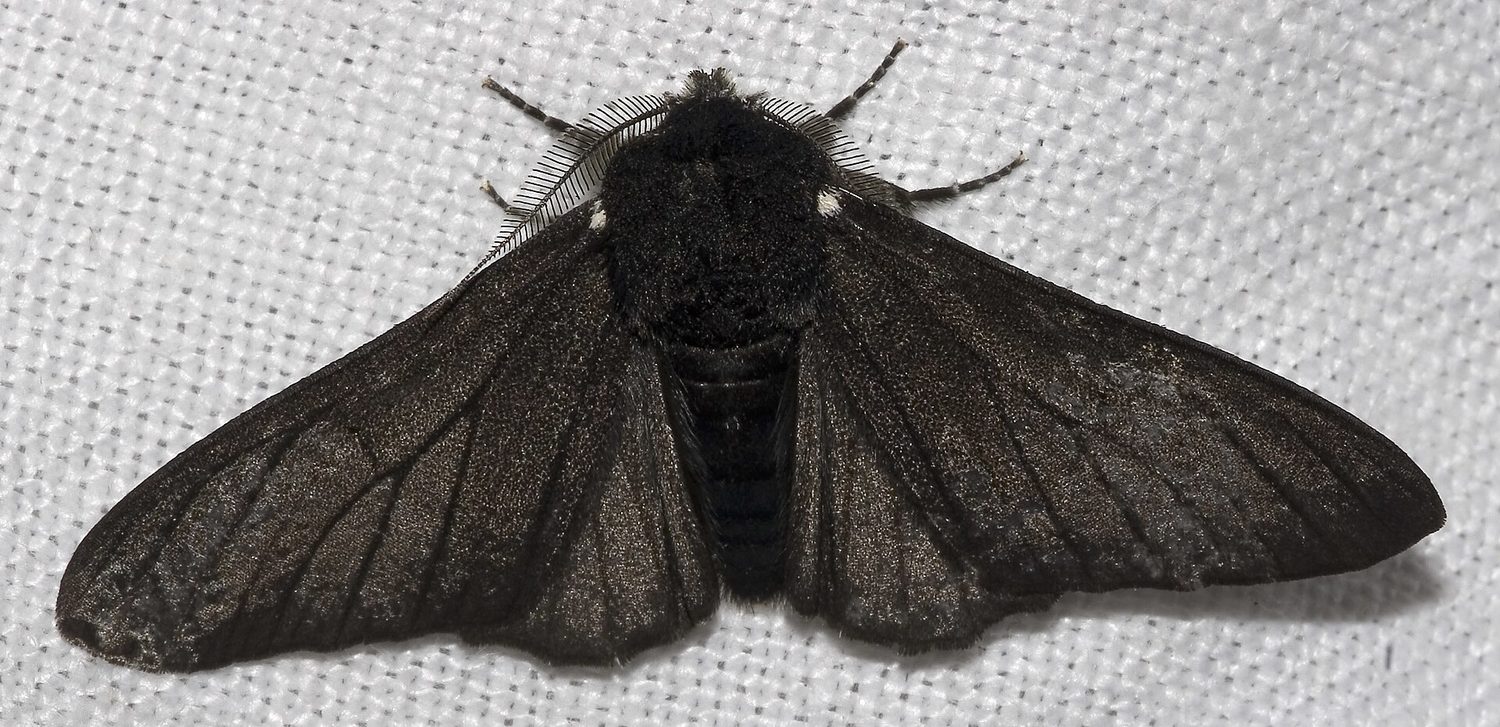
On a dark, sooty tree the better-camouflaged moths survive and breed, so over generations the population shifts.
Vocabulary
Train
| English |
|---|
| Evolution/ɪvəˈluːʃn/ |
| Natural selection/ˈnætʃərəl sɪˈlekʃn/ |
| competition/ˌkɒmpəˈtɪʃn/ |
7.2
Natural Selection
Syllabus
| Big Idea | Learning Objective | Essential Knowledge |
|---|---|---|
Big Idea 1 — Evolution | 7.2.A |
|
7.2.B |
|
Source: College Board AP Course and Exam Description
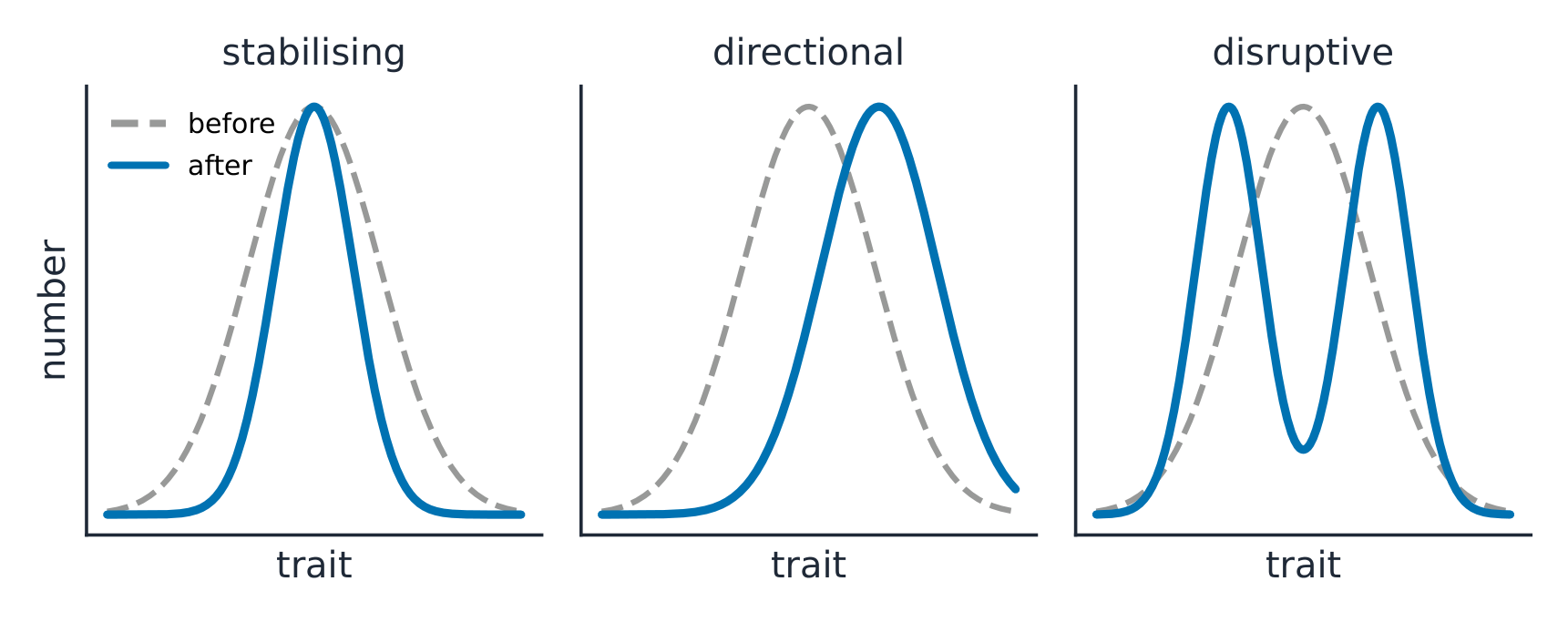
Selection acts on variation 变异. Fitness 适合度 means reproductive success, not strength. Selection comes in modes: directional (favors one extreme), stabilizing (favors the average), and disruptive (favors both extremes). The environment does the "selecting," so a trait that helps in one setting may not in another. Well-suited traits are adaptations 适应.
The same allele can help or harm. The sickle-cell allele causes sickle-cell disease in people with two copies. But people with one copy are protected against malaria, so in places where malaria is common the allele stays frequent. Likewise, the alleles that made insects resistant to DDT spread only where DDT was sprayed.
Variation in molecules matters too. A cell's set of molecules can vary, and that variation can affect fitness. A plant with several forms of an enzyme, each working best at a different temperature, can survive in a wider range of climates. A population of mussels in salty water has more of one form of an enzyme that helps cells balance salt.
Choosing a mate. Sexual selection 性选择 acts on traits that help an individual win a mate, even when they make it easier for predators to see. Male guppies with more coloured spots attract more females. Where there are no predators, the number of spots rises over the generations; where a predator hunts by sight, spots become fewer, because brightly spotted males are eaten first.
Worked example (selection from data). On an island, the mean toe-pad area of anole lizards rose after strong hurricanes.
- Variation: the lizards' toe pads differed in size before the storm, and the difference is partly heritable.
- Selection: lizards with larger toe pads could cling to branches in high winds, so more of them survived.
- Inheritance: the survivors bred, so the next generation had larger toe pads on average.
This is directional selection. Islands hit by more storms experience stronger selection for larger pads.
Explore
Watch selection shift a population
Natural selection: individuals better suited to the environment survive and reproduce more, so helpful traits spread. Change the environment and watch the population adapt.
Vocabulary
Train
| English |
|---|
| variation/ˌveərɪˈeɪʃn/ |
| Fitness/ˈfɪtnəs/ |
| adaptations/ˌædæpˈteɪʃnz/ |
| sexual selection |
7.3
Artificial Selection
Syllabus
| Big Idea | Learning Objective | Essential Knowledge |
|---|---|---|
Big Idea 1 — Evolution | 7.3.A |
|
Source: College Board AP Course and Exam Description
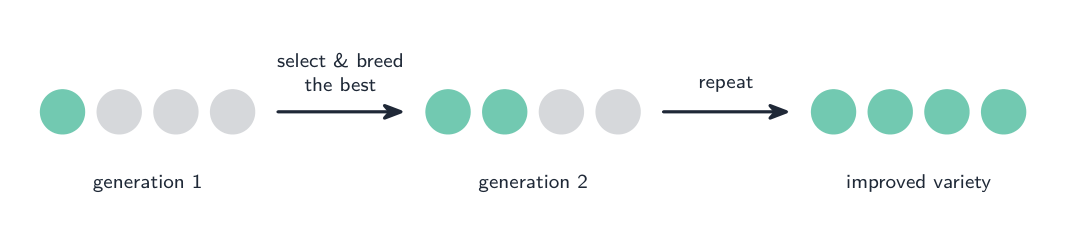
In artificial selection 人工选择, humans – not nature – choose which individuals breed, selecting for desired traits (crops, livestock, dogs). It works the same way as natural selection and, being fast and visible, is strong evidence that selection can reshape populations.
From one species of wild mustard, farmers have bred cabbage (selected for leaves), broccoli (flower buds), kohlrabi (stem) and kale. Artificial selection usually lowers genetic diversity, because only a few chosen individuals breed. A crop field of near-identical plants can be wiped out by one new disease.
Explore
Who is doing the selecting?
Sort each example by whether nature or humans decide which individuals reproduce.
Vocabulary
Train
| English |
|---|
| artificial selection/ˌɑːtɪˈfɪʃl sɪˈlekʃn/ |
7.4
Population Genetics
Syllabus
| Big Idea | Learning Objective | Essential Knowledge |
|---|---|---|
Big Idea 1 — Evolution | 7.4.A |
|
7.4.B |
| |
7.4.C |
|
Source: College Board AP Course and Exam Description
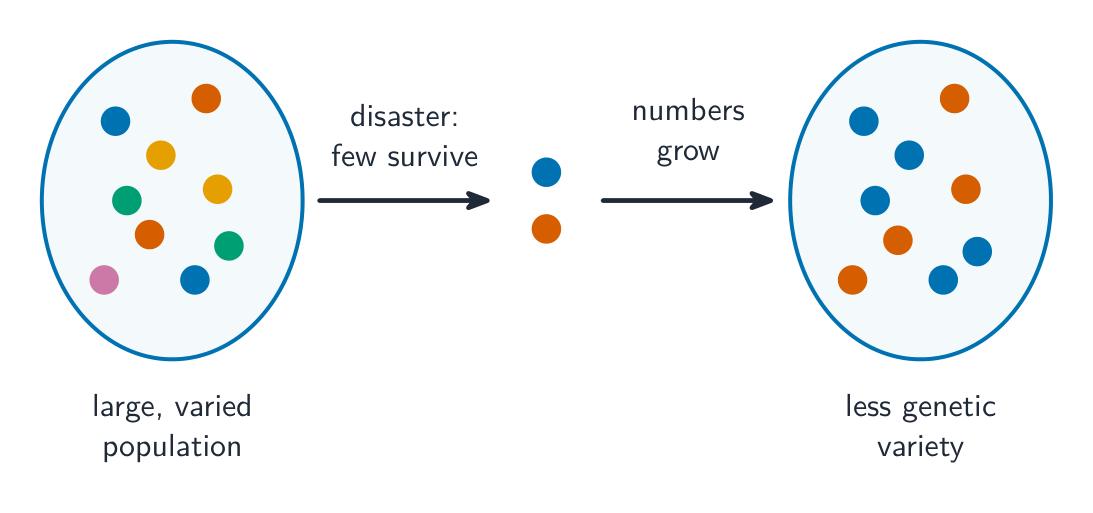
Population genetics 群体遗传学 studies the pool of alleles in a population. Evolution is a change in allele frequencies 等位基因频率 over time. Besides natural selection, allele frequencies change through mutation (new alleles), gene flow 基因流 (migration), and genetic drift 遗传漂变 (random change, strongest in small populations – the bottleneck and founder effects).
- In the bottleneck effect 瓶颈效应, a disaster cuts a population to a few survivors for at least one generation. The survivors' alleles are a random sample, not the best-adapted ones, and many alleles are lost.
- In the founder effect 奠基者效应, a few individuals start a new population, for example on an island. The new population has only the founders' alleles, so its allele frequencies can be very different from the original population's.
Selection is not random; drift is. Drift changes allele frequencies by chance, whatever the alleles do. It can even make a harmful allele common in a small population. Drift can make a small population differ from other populations of its species. Gene flow works the other way: moving alleles between populations keeps them alike and stops them splitting into separate species.
Worked example (genetic rescue). A small, isolated population of snakes declined: few young survived, and many had defects. After males from a large population nearby were released into it, survival rose.
- The small population had lost genetic variation by drift and inbreeding, so many offspring were homozygous for harmful recessive alleles.
- The new males brought new alleles (gene flow).
- Offspring were then more often heterozygous, so the harmful recessive alleles were masked, and more young survived.
Vocabulary
Train
| English |
|---|
| Population genetics/ˌpɒpjʊˈleɪʃn dʒɪˈnetɪks/ |
| allele frequencies/əˈliːl ˈfriːkwənsiz/ |
| gene flow/dʒiːn fləʊ/ |
| genetic drift/dʒɪˈnetɪk drɪft/ |
| bottleneck effect/ˈbɒtəlnek ɪˈfekt/ |
| founder effect/ˈfaʊndə ɪˈfekt/ |
7.5
Hardy-Weinberg Equilibrium

Syllabus
| Big Idea | Learning Objective | Essential Knowledge |
|---|---|---|
Big Idea 1 — Evolution | 7.5.A |
|
Source: College Board AP Course and Exam Description
The Hardy–Weinberg 哈迪-温伯格 model gives the allele and genotype frequencies expected when a population is not evolving. With allele frequencies $p$ and $q$ ($p+q=1$):
$$p^2 + 2pq + q^2 = 1,$$
where $p^2$ and $q^2$ are the homozygotes and $2pq$ the heterozygotes. It holds only under five conditions:
- a large population (so no genetic drift),
- no migration (no gene flow),
- no new mutations,
- random mating,
- no natural selection.
Real populations never meet all five. That is why the model is useful: it is a null hypothesis 零假设, the "nothing is happening" prediction. When real data differ from it, the population is evolving, and the way the data differ hints at the cause.
Worked example. In a population, $16\%$ of individuals show the recessive phenotype, so $q^2=0.16$ and $q=\sqrt{0.16}=0.4$. Then $p=1-q=0.6$. The predicted carrier frequency (heterozygotes) is $2pq=2(0.6)(0.4)=0.48$, i.e. $48\%$, and the homozygous dominants are $p^2=0.6^2=0.36$, i.e. $36\%$. As a check, $0.36+0.48+0.16=1$. This is the standard route: recessive phenotype $\to q^2\to q\to p\to$ everything else.
Worked example (testing for equilibrium). In a sample of 200 plants, 90 are $AA$, 40 are $Aa$ and 70 are $aa$.
- Count alleles: there are 400 in total. $A$ alleles: $2(90)+40=220$, so $p = 220/400 = 0.55$ and $q = 0.45$.
- Expected counts if in equilibrium: $AA = 0.55^2 \times 200 \approx 61$, $Aa = 2(0.55)(0.45)\times 200 \approx 99$, $aa = 0.45^2 \times 200 \approx 41$.
- There are far fewer heterozygotes (40) than expected (99), so the population is not in equilibrium. Non-random mating, such as self-pollination, is one likely cause. A chi-square test (unit 5) would show whether the gap is too big to be chance.
When the genotypes are given as counts, always calculate $p$ by counting alleles. Do not take the square root of a homozygote frequency unless you are told the population is in equilibrium.
Explore
Allele frequencies across a cross
Hardy-Weinberg predicts genotype frequencies ($p^2+2pq+q^2$) in a population that isn't evolving. A Punnett square shows the same allele combining at the population scale.
Vocabulary
Train
| English |
|---|
| Hardy–Weinberg/ˈhɑːdi ˈwaɪnbɜːɡ/ |
| null hypothesis/nʌl haɪˈpɒθəsɪs/ |
7.6
Evidence of Evolution
Syllabus
| Big Idea | Learning Objective | Essential Knowledge |
|---|---|---|
Big Idea 1 — Evolution | 7.6.A |
|
7.6.B |
|
Source: College Board AP Course and Exam Description
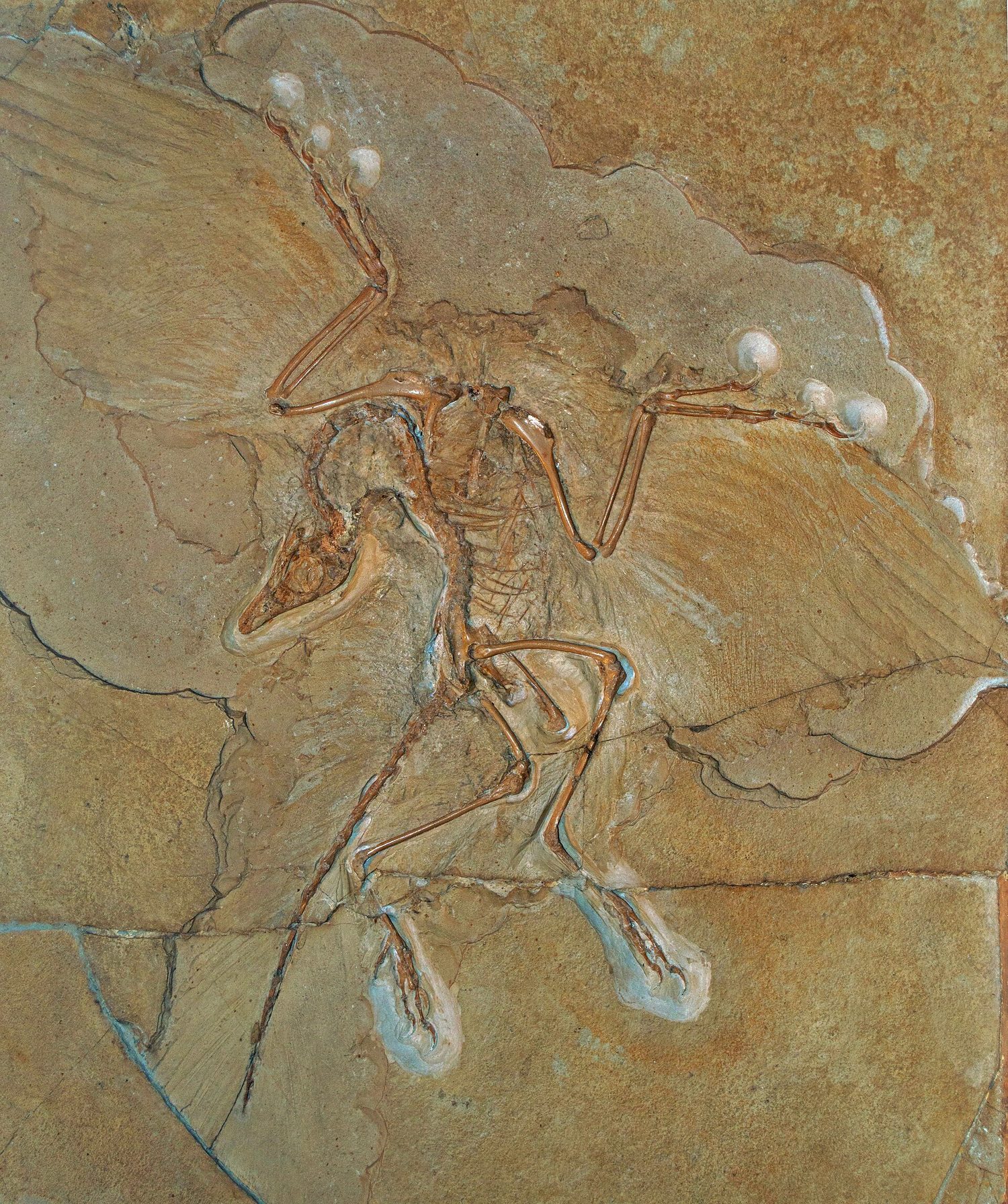
Multiple independent lines support evolution: the fossil record 化石记录, homologous structures 同源结构 (shared anatomy from common ancestry), vestigial structures 痕迹器官, shared embryology, and molecular evidence – the near-universal genetic code and matching DNA/protein sequences. The evidence comes from many sciences: geography, geology, physics, biochemistry and mathematics.
Dating fossils. There are three main ways:
- Rock layers. Lower layers of sedimentary rock are older, so a fossil's layer gives its age relative to other fossils.
- Radioactive decay. Isotopes decay at a fixed rate. Carbon-14 has a half-life of about 5730 years, so it dates remains up to about 50 000 years old; isotopes that decay more slowly date older rocks.
- Geographical data, such as where continents were when the rock formed.
Worked example (carbon dating). A bone has 25% of the carbon-14 that living tissue has.
- 100% → 50% is one half-life; 50% → 25% is a second.
- Age ≈ 2 × 5730 ≈ 11 500 years.
Comparing molecules. The more alike two species' DNA or protein sequences are, the more recently they shared an ancestor. Humans and chimpanzees differ in about 1% of their DNA; humans and mice differ much more. Morphological homologies, including vestigial structures such as the tiny hip bones of whales, point the same way.
Explore
What kind of evidence?
Sort each clue for evolution by the type of evidence it provides.
Vocabulary
Train
| English |
|---|
| fossil record/ˈfɒsl ˈrekɔːd/ |
| homologous structures/həˈmɒləɡəs ˈstrʌktʃəz/ |
| vestigial structures/ˈvestɪdʒl ˈstrʌktʃəz/ |
7.7
Common Ancestry
Syllabus
| Big Idea | Learning Objective | Essential Knowledge |
|---|---|---|
Big Idea 1 — Evolution | 7.7.A |
|
Source: College Board AP Course and Exam Description
All life shares a common ancestor 共同祖先, shown by universal features: the same DNA/RNA machinery, the same genetic code, ribosomes, and core metabolic pathways in all organisms. The more features and sequences two species share, the more recently they diverged.
What all eukaryotes share. Three features are found in all eukaryotes and in no prokaryotes, so all eukaryotes must come from one common ancestor:
- membrane-bound organelles, such as the nucleus and mitochondria;
- linear chromosomes;
- genes that contain introns.
Worked example (glycolysis). Use these facts to argue that glycolysis first appeared in the common ancestor of all living things: (a) nearly all organisms use it; (b) it happens in the cytoplasm; (c) it does not need oxygen.
- (a) A pathway found in almost all living things was most likely inherited from one ancestor, not invented many times.
- (b) It needs no membrane-bound organelle, so it could run in the earliest cells, which had none.
- (c) The early atmosphere had almost no oxygen, so the first cells needed a way of making ATP without it.
Vocabulary
Train
| English |
|---|
| common ancestor/ˈkɒmən ˈænsestə/ |
7.8
Continuing Evolution
Syllabus
| Big Idea | Learning Objective | Essential Knowledge |
|---|---|---|
Big Idea 1 — Evolution | 7.8.A |
|
Source: College Board AP Course and Exam Description
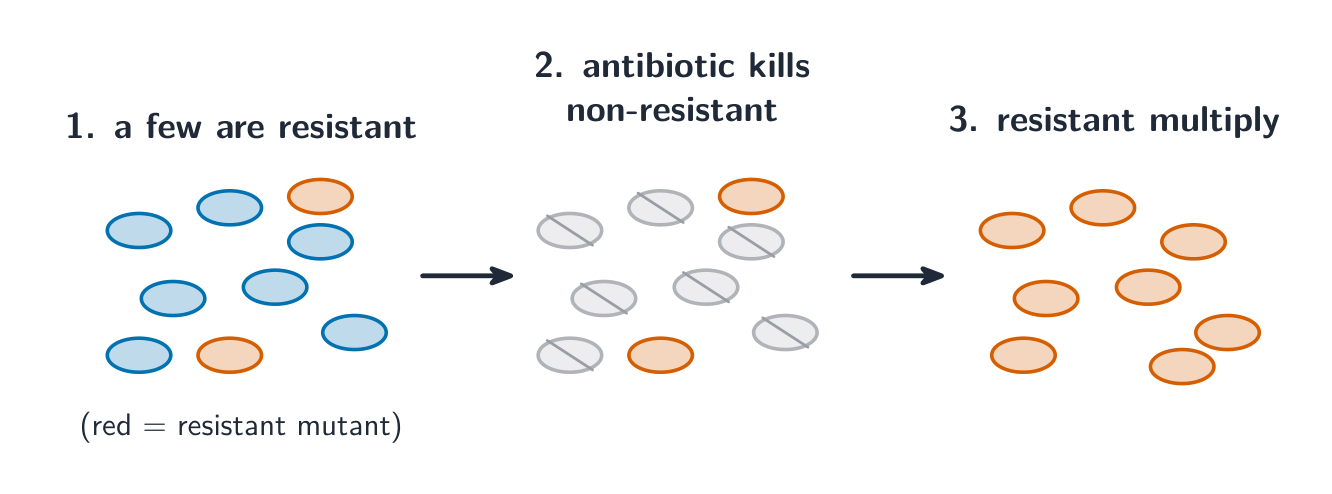
Evolution is ongoing and observable: antibiotic-resistant bacteria, pesticide-resistant insects, and rapid changes in fast-breeding species. Because environments keep changing, selection keeps acting – evolution has no endpoint.
The CED gives four kinds of evidence that evolution is still going on:
- Genomes change over time; we can measure new mutations and changed allele frequencies from one generation to the next.
- The fossil record shows continuous change.
- Resistance evolves to antibiotics, pesticides, herbicides and cancer chemotherapy drugs.
- Pathogens evolve and cause new diseases, such as new strains of flu each year.
Why chemotherapy can fail. A tumour contains many genetically different cells. A drug kills most of them, but any cell that happens to resist it survives and divides. The tumour grows back, now made of resistant cells. This is natural selection inside one body.
Explore
Selection for resistance
Watch how a drug kills most bacteria but the rare resistant ones survive and take over.
7.9
Phylogeny
Syllabus
| Big Idea | Learning Objective | Essential Knowledge |
|---|---|---|
Big Idea 1 — Evolution | 7.9.A |
|
7.9.B |
|
Source: College Board AP Course and Exam Description
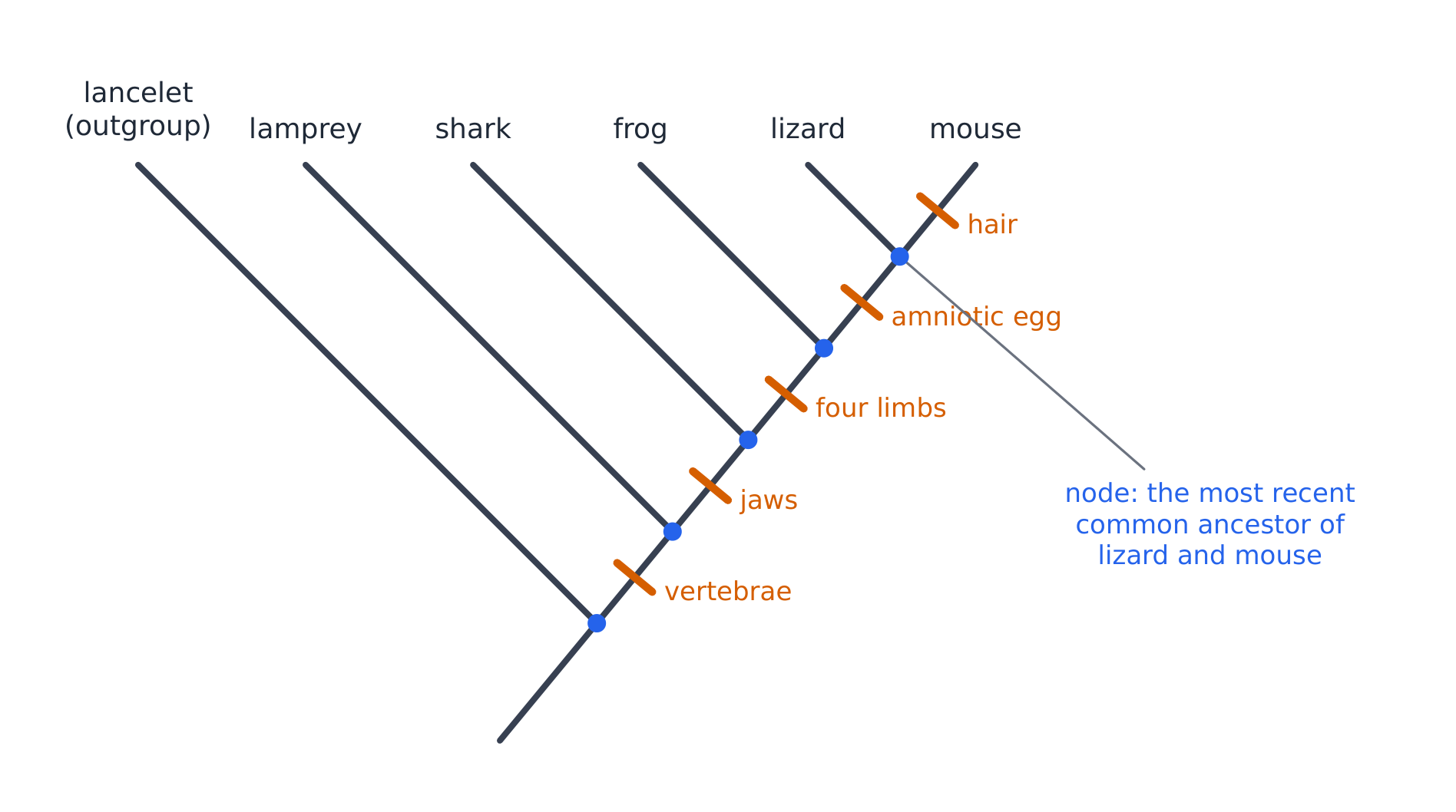
A phylogenetic tree 系统发育树 (cladogram) diagrams evolutionary relationships, with branch points marking common ancestors and shared derived traits grouping related species. Trees are hypotheses, revised as new (especially molecular) data arrive.
Tree or cladogram? A phylogenetic tree shows the amount of change over time: its branch lengths are calibrated by fossils or a molecular clock 分子钟. A cladogram 分支图 shows only the order of branching, with no time scale.
Reading one.
- Each node is the most recent common ancestor of everything above it.
- Two groups are most closely related if they share the most recent node. Do not read relatedness from how close the tips are.
- The outgroup 外类群 is the lineage least closely related to all the others. It branches off first, and it shows which characters are ancestral.
Building one from a table. Use shared derived characters 共有衍征: new characters found in some groups and their descendants, but not in the outgroup.
| vertebrae | jaws | four limbs | amniotic egg | hair | |
|---|---|---|---|---|---|
| lancelet | – | – | – | – | – |
| lamprey | ✓ | – | – | – | – |
| shark | ✓ | ✓ | – | – | – |
| frog | ✓ | ✓ | ✓ | – | – |
| lizard | ✓ | ✓ | ✓ | ✓ | – |
| mouse | ✓ | ✓ | ✓ | ✓ | ✓ |
- The lancelet has none of the characters, so it is the outgroup and branches off first.
- Order the others by how many characters they have: the more they have, the later they branch off.
- Mark each character once, on the branch where it first appeared. Every group above the mark has it.
Molecules beat looks. Molecular data, such as DNA or amino-acid sequences, usually give more accurate trees than morphology. Unrelated species can look alike because they live in similar ways (convergent evolution), but they rarely share long stretches of identical DNA by chance. To build a tree from sequence data, pair up the two species with the fewest differences first, and the outgroup is the one with the most differences from all the others.
Worked example (molecular clock). Humans and chimpanzees differ at 12 positions in a gene, and fossils show they split about 6 million years ago. Humans and gorillas differ at 18 positions.
- Rate = 12 differences ÷ 6 million years = 2 differences per million years.
- Humans and gorillas: 18 ÷ 2 = 9 million years ago.
- This assumes the gene changes at a steady rate in every lineage.

Vocabulary
Train
| English |
|---|
| phylogenetic tree/ˌfaɪləʊdʒˈnetɪk triː/ |
| molecular clock |
| cladogram/ˈklædəɡræm/ |
| outgroup |
| shared derived characters |
7.10
Speciation
Syllabus
| Big Idea | Learning Objective | Essential Knowledge |
|---|---|---|
Big Idea 1 — Evolution | 7.10.A |
|
7.10.B |
| |
7.10.C |
|
Source: College Board AP Course and Exam Description
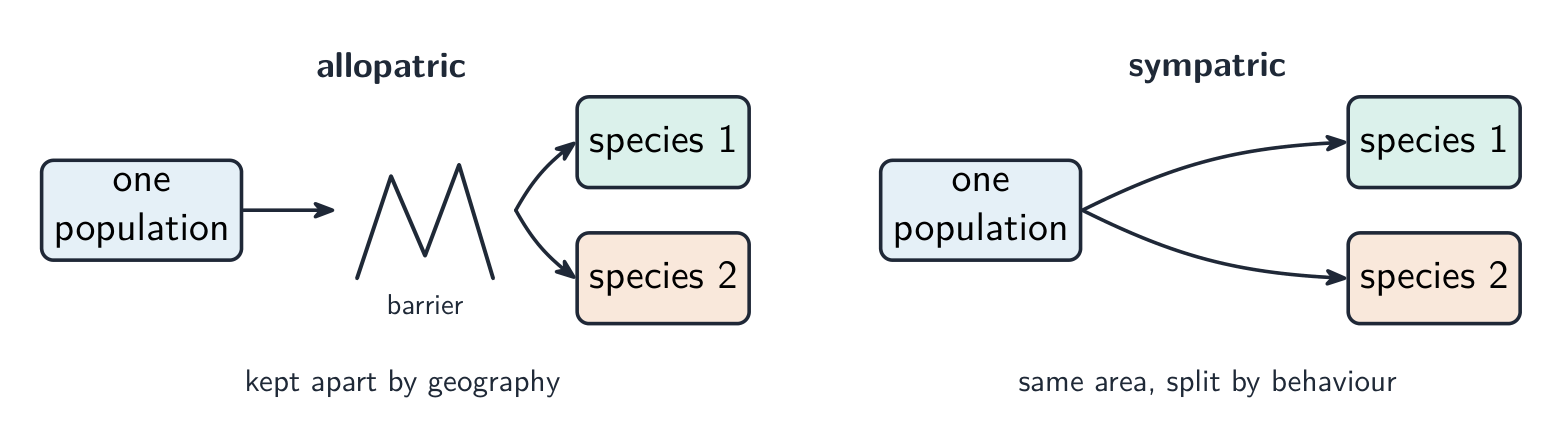
Speciation 物种形成 is the origin of new species, usually when populations become reproductively isolated 生殖隔离 and diverge. Allopatric speciation follows a geographic split; sympatric speciation happens without one. Once populations can no longer interbreed, they are separate species.
The biological species concept 生物学物种概念 defines a species as a group whose members can interbreed and produce fertile, viable offspring, but cannot do so with other groups. It does not work for organisms that reproduce asexually, or for fossils.
Barriers that keep species apart. Prezygotic 合子前隔离 barriers stop a zygote forming at all:
- habitat: they live in different places, such as in water and on land;
- temporal: they breed at different times of day or year;
- behavioural: different courtship songs or displays;
- mechanical: their reproductive parts do not fit;
- gametic: sperm and egg cannot fuse.
Postzygotic 合子后隔离 barriers act after a hybrid zygote has formed: the hybrid dies young, or it is sterile (a mule, from a horse and a donkey), or its own offspring are weak.
How fast? In gradualism 渐变论, species change slowly and steadily over hundreds of thousands or millions of years. In punctuated equilibrium 间断平衡, long periods with little change are broken by short bursts of rapid change. Many fossil records show the second pattern.
Spreading out and converging.
- Divergent evolution 趋异进化: related populations adapt to different habitats and become more and more different.
- Adaptive radiation 适应辐射: one ancestor gives rise to many species quickly, when new habitats open up. The Hawaiian Drosophila flies and Darwin's finches arose this way.
- Convergent evolution 趋同进化: unrelated species face similar selective pressures and evolve similar traits, such as the streamlined bodies of sharks and dolphins. These are analogous traits, not evidence of common ancestry.
Speciation without a barrier. The apple maggot fly Rhagoletis once laid its eggs only on hawthorn. Some flies began to use apple trees, which fruit at a different time. Flies mate on the fruit where they hatched, so the two groups now breed apart and are splitting into two species while living side by side. This is sympatric speciation. In plants, a mistake in meiosis can make a polyploid offspring that cannot breed with its parents: a new species in one generation.
Vocabulary
Train
| English |
|---|
| Speciation/ˌspiːʃɪˈeɪʃn/ |
| reproductively isolated/rɪprəˈdʌktɪvli ˈaɪsəleɪtɪd/ |
| biological species concept |
| prezygotic |
| postzygotic |
| gradualism |
| punctuated equilibrium |
| divergent evolution/daɪˈvɜːdʒənt ɪvəˈluːʃn/ |
| adaptive radiation/əˈdæptɪv ˌreɪdɪˈeɪʃn/ |
| convergent evolution/kənˈvɜːdʒənt ɪvəˈluːʃn/ |
7.11
Variations in Populations
Syllabus
| Big Idea | Learning Objective | Essential Knowledge |
|---|---|---|
Big Idea 4 — Systems Interactions | 7.11.A |
|
Source: College Board AP Course and Exam Description
Genetic diversity 多样性 helps a population survive change – if conditions shift, some variants may already be suited to them. Low diversity (as in an endangered species) leaves a population vulnerable. Variation arises from mutation and the reshuffling of meiosis and sexual reproduction.
- A genetically diverse population is more resilient: when a new disease, drought or predator arrives, some individuals are likely to have alleles that let them survive.
- A population with little diversity can be wiped out by one change. In the 1840s Irish farmers grew almost entirely one variety of potato, so potato blight destroyed nearly the whole crop. California condors and black-footed ferrets were each once reduced to fewer than 30 animals, and lost much of their variation.
- An allele that helps in one environment can harm in another. Bacteria with a resistance allele grow more slowly where there is no antibiotic, so the allele becomes rarer when the antibiotic is no longer used.
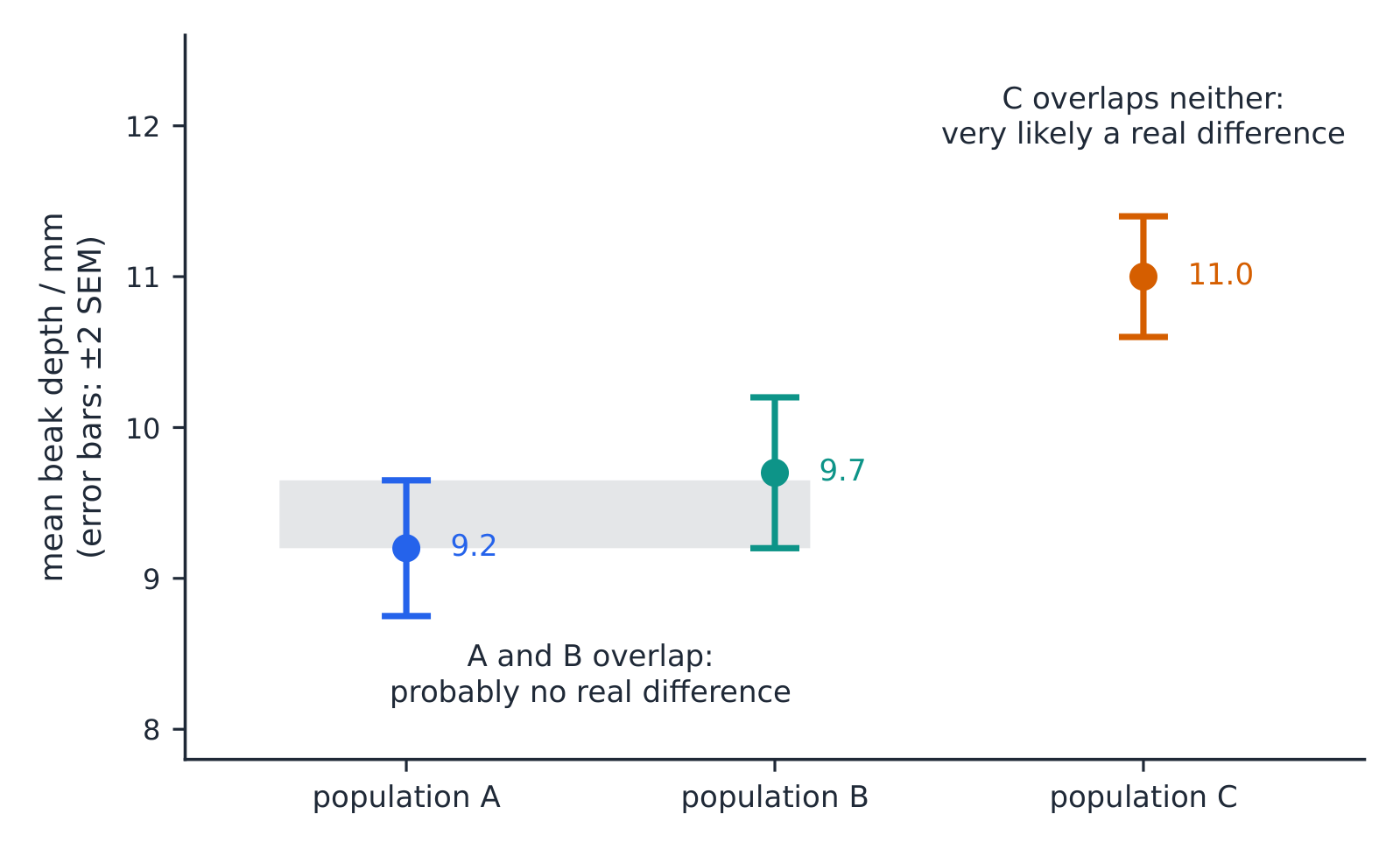
Is a difference real? FRQs often give sample means with error bars of ±2 standard errors of the mean (SEM), about a 95% confidence interval. If the bars of two groups do not overlap, the difference between the means is very likely real (statistically significant). If they overlap, you cannot claim a difference.
Explore
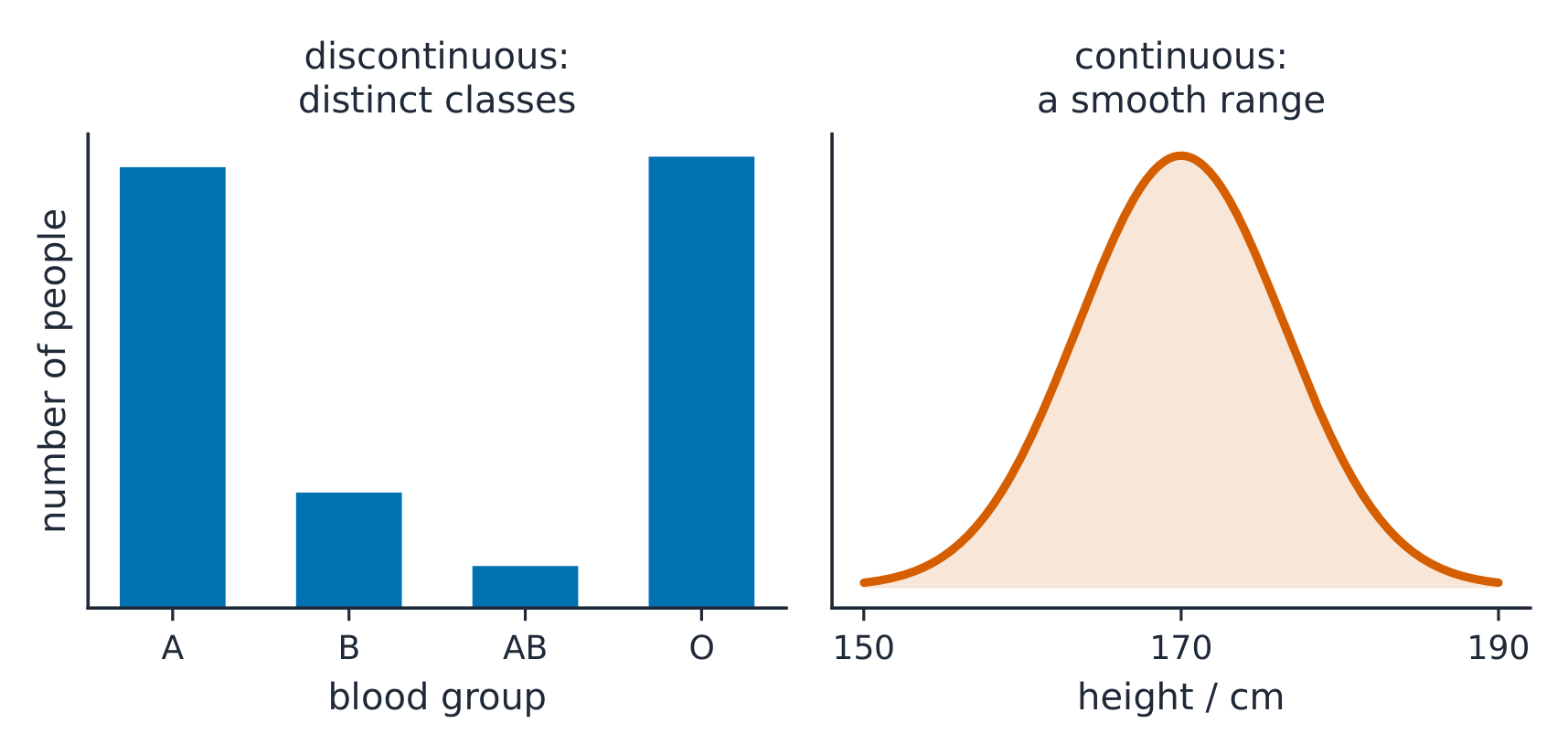
Continuous or discontinuous?
Sort each trait by whether it varies over a smooth range or falls into distinct categories.
Vocabulary
Train
| English |
|---|
| diversity/daɪˈvɜːsɪti/ |
7.12
Origins of Life on Earth
Syllabus
| Big Idea | Learning Objective | Essential Knowledge |
|---|---|---|
Big Idea 4 — Systems Interactions | 7.12.A |
|
Source: College Board AP Course and Exam Description
Evidence suggests early Earth's conditions could form simple organic molecules (the Miller–Urey type experiments), which assembled into polymers, then self-replicating RNA (the "RNA world"), and eventually membrane-bound cells. The first cells were prokaryotes; eukaryotes arose later through endosymbiosis 内共生.
The timeline from geology.
- Earth formed about 4.6 billion years ago.
- Until about 3.9 billion years ago it was too hot and too heavily bombarded by rocks from space for life.
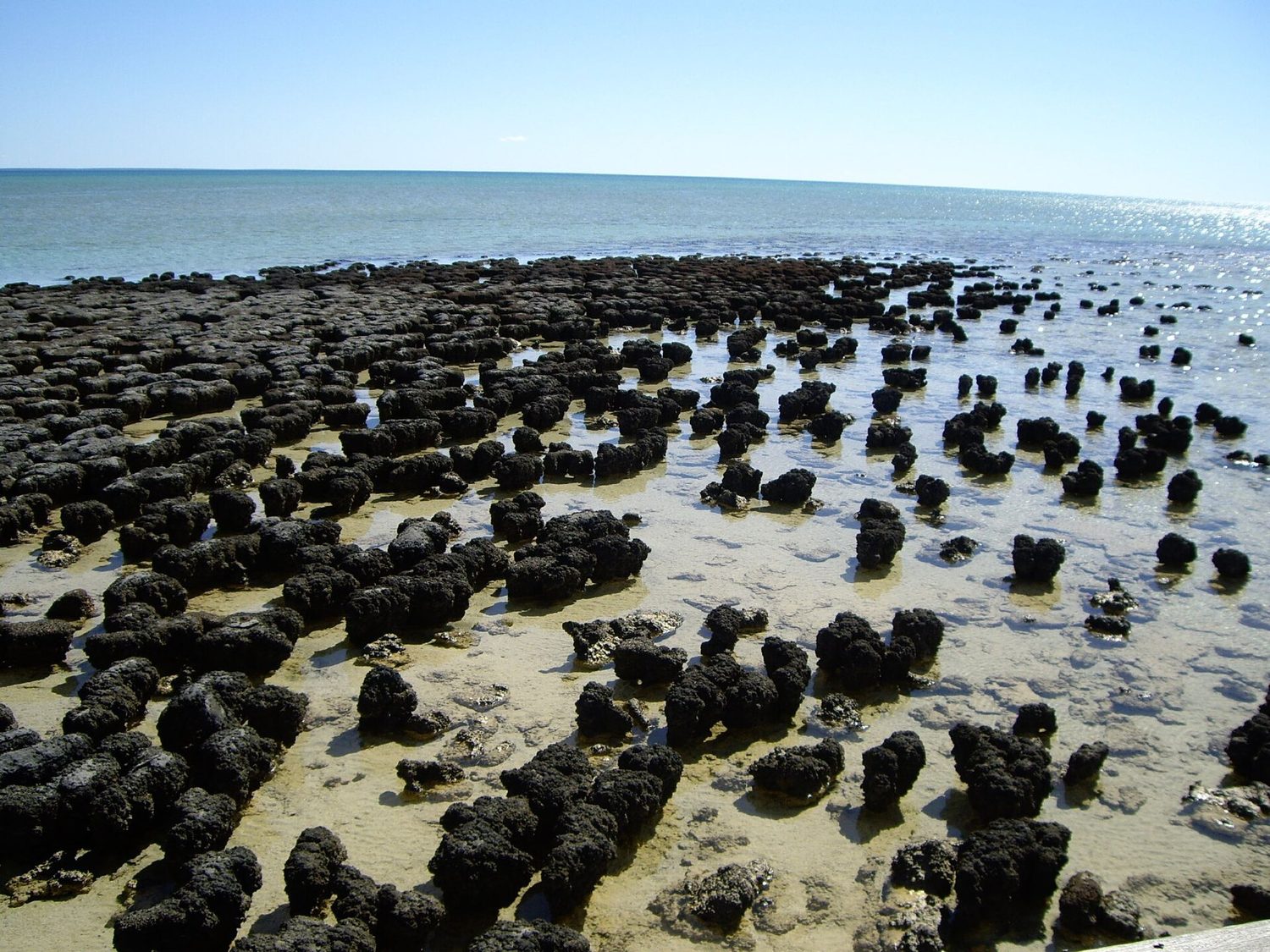
- The oldest fossil evidence of life, from layered microbial mats like stromatolites, is about 3.5 billion years old.
So life appeared within a few hundred million years of conditions allowing it.
The RNA world. This hypothesis says RNA was the first genetic material. RNA can store information and act as a catalyst (an RNA enzyme, a ribozyme). The CED gives its three assumptions:
- Genetic information was passed on by copying RNA.
- That copying needed base pairing.
- Proteins coded by genes were not the catalysts yet.
Even today, the catalytic core of every ribosome is RNA, which supports this idea.

Common mistakes.
- Saying organisms evolve a trait because they need it. Variation arises at random by mutation; selection only changes how common existing variants are.
- Saying the antibiotic or pesticide causes the resistance mutation. Resistant variants were already present; the chemical kills the others, so the resistant ones leave more offspring.
- Reading a cladogram's tip order as relatedness. Relatedness comes from the most recent shared branch point; two tips next to each other are not always closest relatives, and branches can rotate about a node without changing the tree.
- Saying humans evolved from chimpanzees. Humans and chimpanzees share a common ancestor; neither species is the ancestor of the other.
- Mixing up homologous and analogous structures. Homologous structures share an ancestral origin (human arm, whale flipper); analogous structures 同功结构 do a similar job but evolved separately (bird and insect wings), so only homologous structures show common ancestry.
- Using the dominant-phenotype frequency as $p^2$. Dominant phenotype = $p^2+2pq$; always start from the recessive phenotype, $q^2$.
- Saying genetic drift is natural selection. Drift is random; it does not favour better-adapted alleles.
- Saying an individual evolves or "adapts" during its life. Populations evolve; individuals survive or do not.
- Claiming a difference between means whose error bars overlap.
- Saying a cladogram shows how long ago groups split. Only a phylogenetic tree with a time scale does.
- Choosing the outgroup by its name. The outgroup is the group with the fewest of the shared derived characters, or the most sequence differences.
- Saying a population in Hardy–Weinberg equilibrium has equal allele frequencies. Equilibrium means the frequencies are not changing between generations, whatever their values.
Vocabulary
Train
| English |
|---|
| endosymbiosis/ˌendəʊˌsɪmbaɪˈəʊsɪs/ |
| analogous structures |
7.12
Exam tips
- State natural selection cleanly: variation → differential survival and reproduction → helpful traits become common.
- Fitness = reproductive success, not strength or health.
- Evolution is a change in allele frequencies in a population — individuals do not evolve.
- Use Hardy–Weinberg ($p^2+2pq+q^2=1$): start from the recessive phenotype $q^2\to q\to p$.
- Cite independent evidence (fossils, homologous structures, DNA) and explain speciation via reproductive isolation.
Interactive lessons on this topic
Work through it step by step, with instant-check exercises.