Elements of Life
Introduced| English | Meaning |
|---|---|
| elements/ˈelɪmənts/ | Chemical substances whose atoms all have the same proton number. |
| carbon/ˈkɑːbən/ | A chemical element with atomic number 6 and symbol C, central to the structures of organic compounds. |
| trace elements/treɪs ˈelɪmənts/ | trace elements |
Life from a short list
- Everything alive is built from just a handful of the periodic table's elements.
- The same few elements appear in a bacterium, an oak tree, and you.
- A tiny set does almost all the work — and one element leads them all.
- Understanding which elements matter explains what living molecules are made of.
The big four: CHON
- About 96% of a living body is just four elements 元素: carbon, hydrogen, oxygen, nitrogen.
- Oxygen and hydrogen are mostly locked up in water.
- Nitrogen appears in every protein and every nucleic acid.
- Remember them as CHON — the core of life's chemistry.
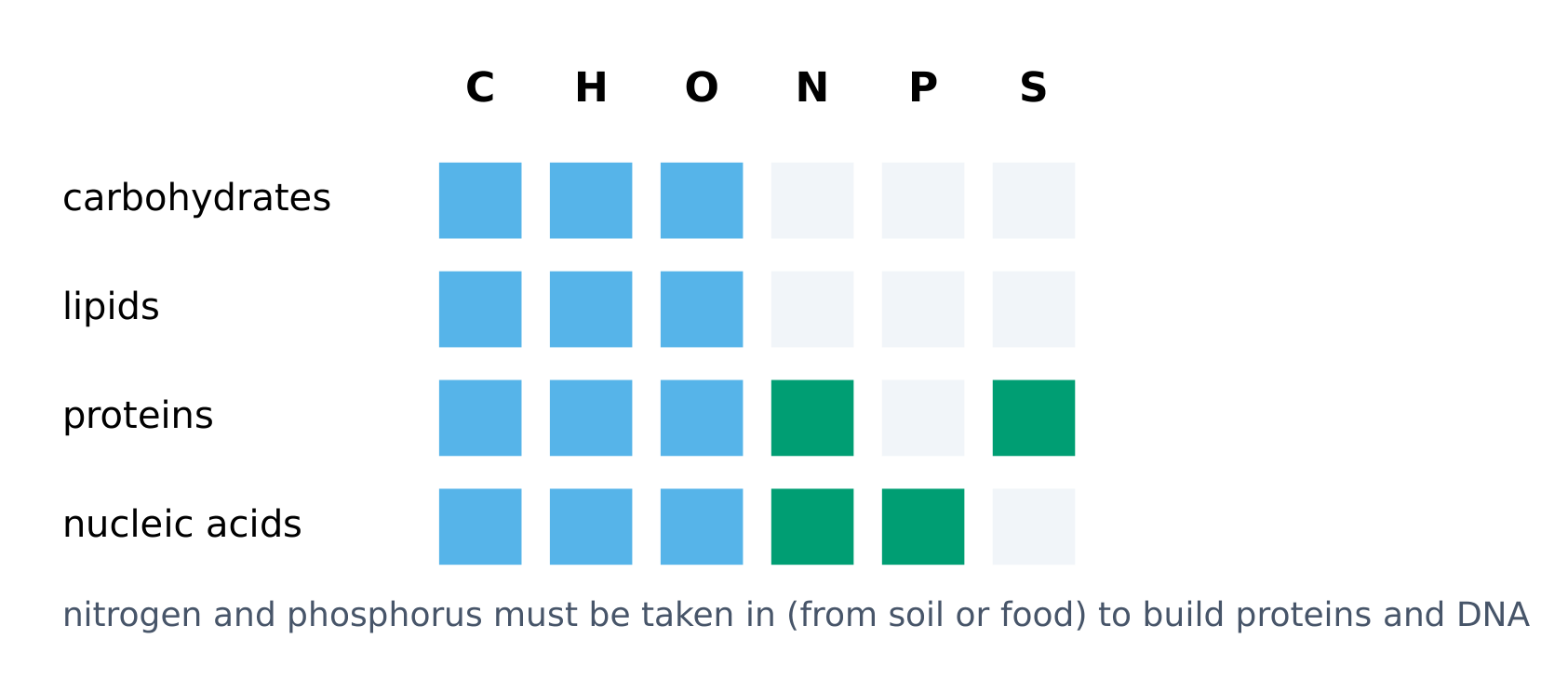
Which elements each macromolecule contains: proteins need N and S, nucleic acids N and P
Four elements make up about 96% of a living body. Which are they?
Difficulty 1/5 · 100 coins + a small bonus on first completion today
Carbon, hydrogen, oxygen and nitrogen (CHON) make up about 96% of living matter.
Carbon is the star
- Carbon 碳 has four outer electrons, so it forms four strong covalent bonds.
- That lets carbon link into long chains, branches, and rings.
- These carbon skeletons are the frames of every large biological molecule.
- No other common element is so versatile at building structure.
How many covalent bonds can one carbon atom form?
Difficulty 2/5 · 140 coins + a small bonus on first completion today
Carbon has four outer electrons, so it forms four bonds — letting it build long chains, branches and rings.
Phosphorus and sulfur are added to CHON to make "CHNOPS". Where is phosphorus especially important?
Difficulty 1/5 · 100 coins + a small bonus on first completion today
Phosphorus forms the phosphate groups in DNA, RNA and the energy carrier ATP.
P, S, and the trace elements
- Add phosphorus and sulfur to CHON and you get CHNOPS — the six main elements.
- Phosphorus builds the phosphate groups in DNA, RNA, and ATP.
- Sulfur helps hold many proteins in shape.
- A handful of trace elements 微量元素 (iron, iodine, calcium…) are needed in tiny amounts but are still essential.
Major or trace element?
Sort elements by how much of a living body they make up. A few elements dominate; others are vital in tiny amounts.
A trace element is unimportant because the body needs so little of it.
Difficulty 1/5 · 100 coins + a small bonus on first completion today
Trace elements are needed in tiny amounts but are still essential — iron carries oxygen, iodine makes thyroid hormones.
Select all true statements about the elements of life.
Difficulty 2/5 · 140 coins + a small bonus on first completion today
Life is built from light elements — mainly CHNOPS — not precious metals.
"Trace" does not mean unimportant. A trace element is needed in a tiny quantity, yet life fails without it — too little iron and blood cannot carry oxygen; too little iodine and the thyroid cannot work.
Iron: a tiny amount, a huge job.
- Iron makes up a vanishingly small fraction of your body mass.
- Yet every haemoglobin molecule needs iron to grip oxygen.
- Without that trace of iron, your blood could not carry oxygen to your cells.
Living things are built mostly from a few light elements — carbon, hydrogen, oxygen, and nitrogen (CHON), plus phosphorus and sulfur (CHNOPS). Carbon's four bonds let it build large molecules. A few trace elements are needed in tiny amounts but are still essential.
Write from the six elements of life
- The short list used to build most biological molecules is C, H, N, O, P and S.
- Carbon's bond count is a different question.
How many elements are in that short list?
CHNOPS is six elements.
How many elements are in the CHNOPS list?
Difficulty 1/5 · 100 coins + a small bonus on first completion today
The list has six symbols.