| Big Idea | Learning Objective | Essential Knowledge |
|---|---|---|
Big Idea 3 — Information Storage and Transmission | 5.1.A |
|
5.1.B |
|
Heredity
AP Biology · Topic 5
 7:53
Heredity
Two snails on the same tree. Same species, same bark, same weather. But look at the shells. One is pale with thin dark bands, the other dark with wide ones.…
English narration · English + 中文 subtitles burned in
5.1
Meiosis

Syllabus
Source: College Board AP Course and Exam Description
Two brown-eyed parents can have a blue-eyed child. Colour blindness is far more common in boys than girls. Two genes on the same chromosome are inherited together, except when they are not. Each of these follows from what chromosomes do in meiosis, and each can be turned into a probability you can calculate.
In animals, Meiosis 减数分裂 produces haploid cells used in forming gametes 配子 (eggs and sperm), with half the diploid chromosome number, so fertilization restores the full set. Not all four meiotic products necessarily become functional gametes. One diploid cell divides twice to give four haploid cells. Meiosis I separates homologous chromosomes 同源染色体 (reducing the number); meiosis II separates sister chromatids (like mitosis).

What happens in each division:
- Prophase I: homologous chromosomes pair up side by side (synapsis), and non-sister chromatids can cross over at points called chiasmata. The spindle forms and the nuclear envelope breaks down.
- Metaphase I: homologous pairs line up across the middle of the cell.
- Anaphase I: the homologues separate; sister chromatids stay joined.
- Telophase I and cytokinesis: two haploid cells form, each chromosome still made of two chromatids.
- Meiosis II is like mitosis: chromosomes line up singly (metaphase II), the centromeres split and sister chromatids are pulled apart (anaphase II), and four haploid cells result.
| Mitosis | Meiosis | |
|---|---|---|
| divisions | one | two |
| cells produced | two | four |
| chromosome number | same as parent (diploid stays diploid) | halved (diploid 二倍体 → haploid 单倍体) |
| daughter cells | genetically identical | genetically different |
| homologues pair up? | no | yes, in prophase I |
| used for | growth, repair, asexual reproduction | making gametes |
Both use a spindle to move chromosomes, and both copy the DNA only once, in the S phase before division. Both depend on chromatids or homologues separating correctly.
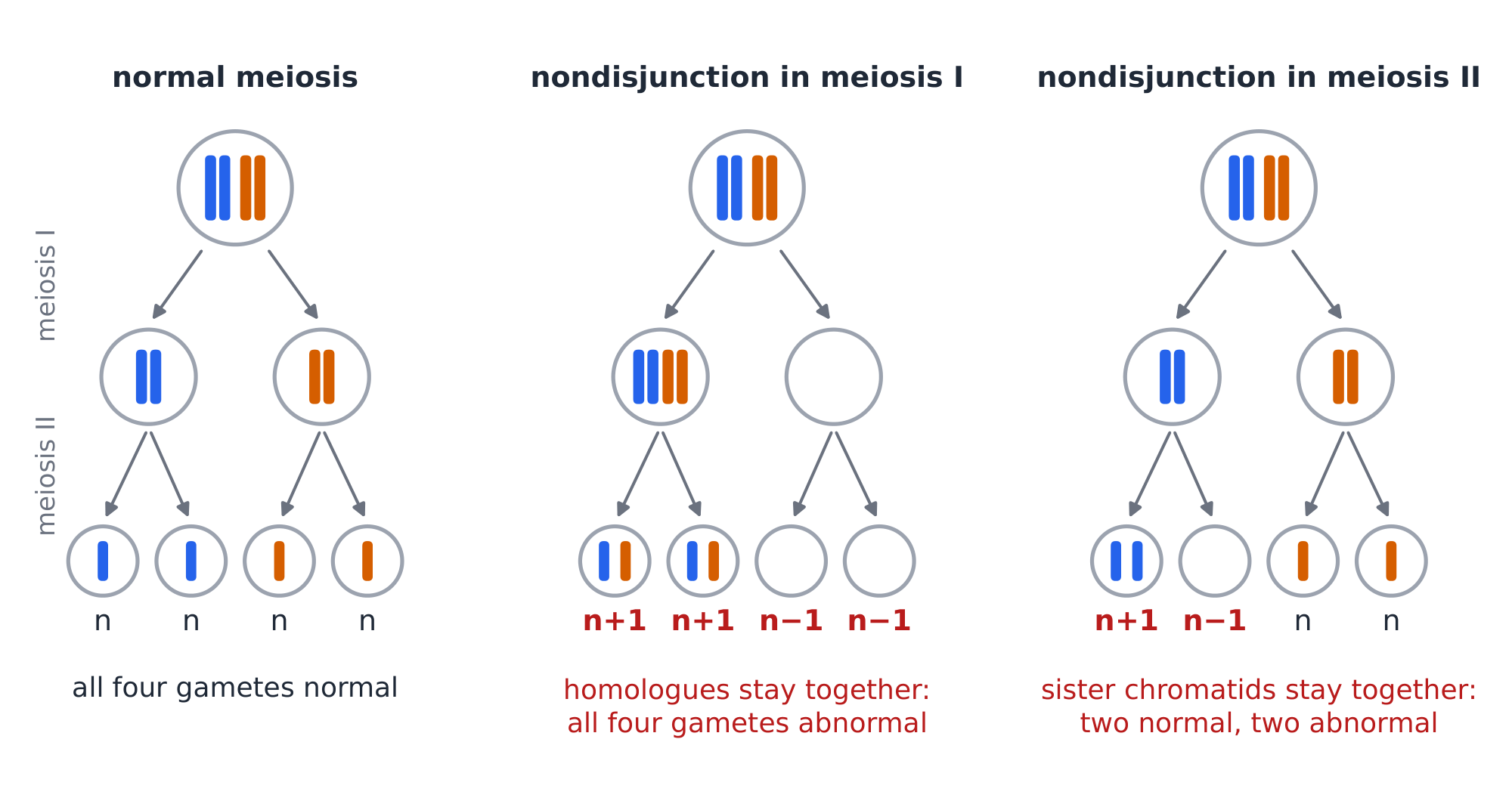
Nondisjunction 不分离 is a failure of separation. If a pair of homologues fails to separate in meiosis I, all four gametes are abnormal: two have an extra chromosome (n+1) and two are missing one (n−1). If sister chromatids fail to separate in meiosis II, only the two gametes from that cell are affected. A zygote formed from an abnormal gamete has the wrong number of chromosomes (aneuploidy 非整倍性); trisomy 21, the cause of Down syndrome, is the best-known example.
A triploid organism (three sets of chromosomes) is usually sterile: in meiosis I the three copies of each chromosome cannot pair off evenly, so almost every gamete gets an unbalanced set. Seedless bananas and watermelons are triploid.
Explore
Divide a cell's chromosomes
Meiosis halves the chromosome number and shuffles genes, making four genetically varied gametes. Step through to see the divisions.
Vocabulary
Train
| English |
|---|
| Meiosis/meɪˈəʊsɪs/ |
| gametes/ˈɡæmiːts/ |
| homologous chromosomes/həˈmɒləɡəs ˈkrəʊməsəʊmz/ |
| diploid/ˈdɪplɔɪd/ |
| haploid/ˈhæplɔɪd/ |
| nondisjunction/ˌnɒndɪsˈdʒʌŋkʃn/ |
| aneuploidy/ˈeɪnəplɔɪdi/ |
5.2
Meiosis and Genetic Diversity

Syllabus
| Big Idea | Learning Objective | Essential Knowledge |
|---|---|---|
Big Idea 3 — Information Storage and Transmission | 5.2.A |
|
Source: College Board AP Course and Exam Description
Meiosis shuffles genes three ways, so offspring differ from parents and each other:
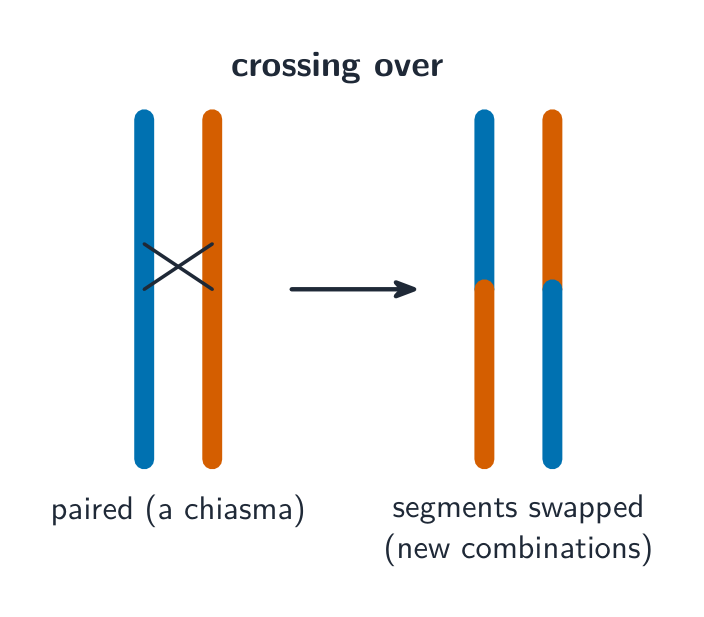
- Crossing over 交叉互换: non-sister chromatids of homologous chromosomes exchange corresponding segments during prophase I.
- Independent assortment 自由组合: each homologous pair lines up and separates randomly.
- Random fertilization: any sperm can meet any egg.
Together these create enormous variation – the raw material for evolution.
Worked example (counting combinations). A cell with $n$ homologous pairs can line them up in $2^n$ ways, so independent assortment alone gives $2^n$ kinds of gamete. A human has $n=23$, so $2^{23}\approx8.4$ million kinds of egg or sperm, before crossing over adds any more. Random fertilization then pairs any one of these with any of the other parent's: $8.4\ \text{million}\times8.4\ \text{million}\approx7\times10^{13}$ combinations for one couple.
Vocabulary
Train
| English |
|---|
| Crossing over/ˈkrɒsɪŋ ˈəʊvə/ |
| Independent assortment/ˌɪndɪˈpendənt əˈsɔːtmənt/ |
5.3
Mendelian Genetics

Syllabus
| Big Idea | Learning Objective | Essential Knowledge |
|---|---|---|
Big Idea 3 — Information Storage and Transmission | 5.3.A |
|
Source: College Board AP Course and Exam Description
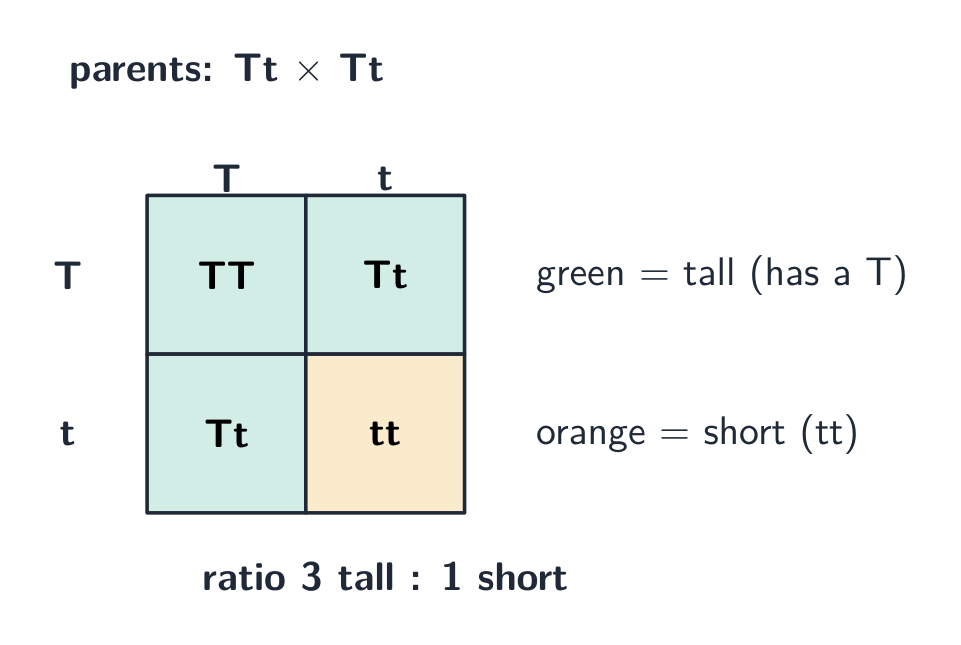
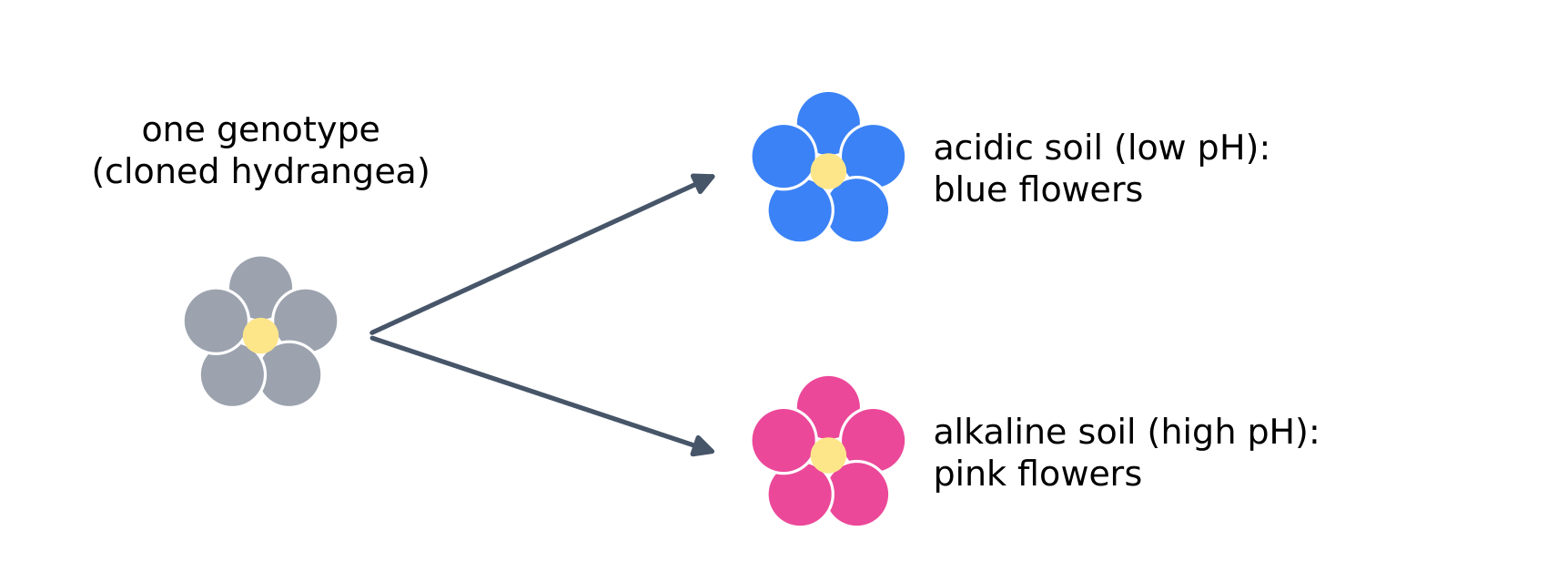
A gene's alternative versions are alleles 等位基因. An organism's genotype 基因型 (its alleles), together with environmental influences, contributes to its phenotype 表型 (its traits). Under complete dominance, a dominant 显性 allele masks a recessive 隐性 one in a heterozygote. In the diploid Mendelian model, the two alleles segregate into different gametes, and unlinked genes assort independently. A Punnett square 庞纳特方格 predicts offspring probabilities; an Aa × Aa cross gives a 3:1 phenotype ratio under complete dominance. Homozygous 纯合 means two identical alleles; heterozygous 杂合 means two different.
Worked example. For a dihybrid cross of two independent genes, $AaBb\times AaBb$, use the multiplication rule instead of a $16$-box square. Each gene alone gives $\tfrac34$ dominant, so the chance an offspring shows both dominant traits is $\tfrac34\times\tfrac34=\tfrac{9}{16}$, and the chance of the fully recessive $aabb$ is $\tfrac14\times\tfrac14=\tfrac{1}{16}$. Multiplying two independent $3{:}1$ ratios is what produces the classic $9{:}3{:}3{:}1$ pattern.
Explore
Cross two parents
A Punnett square combines each parent's alleles to predict the offspring ratios. Set the parent genotypes and read off the expected proportions.
Vocabulary
Train
| English |
|---|
| alleles/əˈliːlz/ |
| genotype/ˈdʒenətaɪp/ |
| phenotype/ˈfenətaɪp/ |
| dominant/ˈdɒmɪnənt/ |
| recessive/rɪˈsesɪv/ |
| Punnett square/ˈpʌnɪt skweə/ |
| Homozygous/ˌhɒməˈzɪɡəs/ |
| heterozygous/ˌhetrəˈzɪɡəs/ |
5.4
Non-Mendelian Genetics

Syllabus
| Big Idea | Learning Objective | Essential Knowledge |
|---|---|---|
Big Idea 3 — Information Storage and Transmission | 5.4.A |
|
Source: College Board AP Course and Exam Description
Many traits do not follow simple dominance:
- Incomplete dominance 不完全显性: heterozygotes are a blend (red × white → pink).
- Codominance 共显性: both alleles show fully (AB blood type).
- Multiple alleles, polygenic 多基因 traits (many genes, like height), pleiotropy (one gene, many effects), and sex-linked 伴性 genes (on sex chromosomes, often the X chromosome) all give more complex ratios.
Three more patterns come up often:
- Non-nuclear inheritance. Mitochondria and chloroplasts have their own DNA and are shared out randomly when cells divide. In animals, mitochondria come from the egg, not the sperm, so a mitochondrial disease passes from a mother to all her children and from a father to none. In plants, chloroplasts come from the ovule, so a leaf-colour trait carried in chloroplast DNA, such as white-striped leaves, follows the mother plant.
- Other sex-determination systems. Birds use Z and W chromosomes: ZZ is male and ZW female, so in birds it is females who show Z-linked recessive traits more often. In bees, males develop from unfertilized eggs and are haploid. In many reptiles, the temperature at which the eggs are kept decides the sex.
- Lethal alleles. If one genotype dies before birth, the expected ratio changes. Crossing two heterozygotes for a lethal recessive allele gives 1 : 2 : 1, but the homozygous recessive quarter never appear, so the survivors are in a 1 : 2 ratio, a sign that an allele is lethal in double dose.
Worked example (chi-square test). To check whether real data fit a predicted ratio, use $\chi^2=\sum\dfrac{(o-e)^2}{e}$. A monohybrid cross predicts $3{:}1$, so of $80$ offspring you expect $60$ dominant and $20$ recessive, but you observe $55$ and $25$. Then $\chi^2=\dfrac{(55-60)^2}{60}+\dfrac{(25-20)^2}{20}=\dfrac{25}{60}+\dfrac{25}{20}=0.42+1.25=1.67$. With $1$ degree of freedom the critical value at $p=0.05$ is $3.84$; since $1.67<3.84$, we fail to reject the null hypothesis – the deviation is within chance.
Worked example (a sex-linked cross). Red–green colour blindness is caused by a recessive allele on the X chromosome. A carrier mother ($X^BX^b$) has children with a father of normal vision ($X^BY$).
- Daughters get the father's $X^B$, so none is colour-blind; half are carriers ($X^BX^b$).
- Sons get the father's $Y$ and either maternal X, so half the sons are colour-blind ($X^bY$).
Boys need only one recessive allele to show the trait, because the Y carries no copy of the gene. That is why X-linked recessive conditions are far more common in males.
Explore
Which inheritance pattern?
Sort each example by the non-Mendelian pattern it follows.
Vocabulary
Train
| English |
|---|
| Incomplete dominance/ɪŋkəmˈpliːt ˈdɒmɪnəns/ |
| Codominance/ˈkəʊdəmɪnəns/ |
| polygenic/ˌpɒlɪˈdʒenɪk/ |
| sex-linked/seks lɪŋkt/ |
5.4
Linked genes and recombination
Genes on the same chromosome are linked 连锁. Nearby genes tend to be inherited together; distant genes can behave as if unlinked because multiple crossovers can hide exchanges. In a testcross, recombination frequency 重组频率 measures recombinant offspring. It estimates short gene separations but approaches a maximum expected value of 50%; it does not keep increasing with map distance:
$$\text{recombination frequency}=\frac{\text{number of recombinant offspring}}{\text{total offspring}}\times100\%.$$
Worked example. A test cross of a dihybrid ($AaBb\times aabb$) gives 445 $AaBb$, 435 $aabb$, 62 $Aabb$ and 58 $aaBb$ offspring. The two large classes match the parents' combinations; the two small ones are recombinants. Recombination frequency $=\dfrac{62+58}{1000}=12\%$, so the genes are about 12 map units apart. Unlinked genes would give four roughly equal classes, near $25\%$ each.
Vocabulary
Train
| English |
|---|
| linked |
| recombination frequency |
5.4
Reading a pedigree
A pedigree 系谱图 shows a trait across generations. Two quick tests decide most AP questions:
- Two unaffected parents with an affected child: the trait is recessive. Each parent must carry a hidden allele.
- An affected mother with an unaffected son: the trait cannot be X-linked recessive, since every son receives his only X from his mother.
Vocabulary
Train
| English |
|---|
| pedigree |
5.5
Environmental Effects on Phenotype
Syllabus
| Big Idea | Learning Objective | Essential Knowledge |
|---|---|---|
Big Idea 4 — Systems Interactions | 5.5.A |
|
Source: College Board AP Course and Exam Description
Phenotype is not set by genes alone – the environment also matters. Temperature, nutrition, and other factors can change how genes are expressed (a Himalayan rabbit's dark fur where it is cold, a plant's height with more sunlight). So identical genotypes can give different phenotypes in different conditions.
Common mistakes.
- Thinking earlier children change the odds for the next one. Each fertilization is independent: if two carriers already have three unaffected children, the chance the fourth is affected is still $\tfrac14$.
- Adding probabilities that should be multiplied. Use the product rule for "this and that" (independent events) and the sum rule for "this or that" (different ways to get the same result).
- Saying a son inherits an X-linked allele from his father. A son gets his only X from his mother; a father passes his X to every daughter and his Y to every son.
- Treating a recombination frequency of about 50% as tight linkage. Values near 50% mean the genes assort independently (far apart or on different chromosomes); small values mean they are close together.
- Writing that a chi-square result "proves" the hypothesis. If $\chi^2$ is below the critical value you fail to reject the null hypothesis; the data are simply consistent with it.
- Using the wrong degrees of freedom. df = number of phenotype classes − 1 (for example 3 for a 9:3:3:1 test).
- Saying sister chromatids separate in anaphase I. In anaphase I the homologues separate; sister chromatids separate in anaphase II.
- Saying nondisjunction in meiosis II makes all four gametes abnormal. Only the two gametes from the cell where it happened are affected.
- Predicting a mitochondrial trait from the father. Mitochondria come from the egg, so these traits follow the mother.
Explore
Genes, environment, or both?
Sort each trait by what most shapes it — the genotype, the environment, or a mix of both.
5.5
Practice
Answer each before reading the answers below.
- Give the expected genotype ratio from $Aa\times aa$.
- In $AaBbCc\times AaBbCc$, with independent genes, what is the probability of an $aabbcc$ offspring?
- A man with haemophilia (X-linked recessive, $X^hY$) has children with a woman with two normal alleles ($X^HX^H$). Predict the sons and the daughters.
- A cross expected to give a $1:1$ ratio produces 88 and 72 of 160 offspring. Find $\chi^2$ and decide at $p=0.05$ (critical value $3.84$ for $df=1$).
- A student says: "Genes that are far apart on the same chromosome are inherited together most strongly." Correct the student.
5.5
Answers
- $1\ Aa:1\ aa$.
- $\left(\tfrac14\right)^3=\tfrac{1}{64}$.
- No son is affected: sons receive the father's $Y$. Every daughter is a carrier, $X^HX^h$: she receives the father's only X, which carries $h$.
- Expected $80$ and $80$: $\chi^2=\dfrac{8^2}{80}+\dfrac{8^2}{80}=1.6$. Since $1.6<3.84$, the difference is not significant; the data are consistent with $1:1$.
- The reverse is true. Crossing over between distant genes is frequent, so they recombine often and can appear almost independent (recombination frequency near $50\%$). Genes close together rarely recombine and are the ones inherited together most strongly.
5.5
Exam tips
- Contrast mitosis (2 identical, full chromosome number) with meiosis (4 non-identical gametes, half the number).
- Explain variation from crossing over, independent assortment, and random fertilisation.
- Use the multiplication rule for dihybrid crosses (each gene's $3{:}1$ multiplied), and a chi-square test ($\chi^2=\sum\frac{(o-e)^2}{e}$) to judge observed vs expected ratios.
- Keep genotype (the alleles) separate from phenotype (what you see) — $AA$ and $Aa$ can look the same.
- Recognise non-Mendelian patterns: incomplete dominance, codominance, and sex linkage.
Interactive lessons on this topic
Work through it step by step, with instant-check exercises.