Ecological Tolerance
Introduced| English | Meaning |
|---|---|
| ecological tolerance/ˌekəˈlɒdʒɪkl ˈtɒlərəns/ | the range of conditions, such as temperature or salinity, that an organism or species can survive |
| optimum range/ˈɒptɪməm reɪndʒ/ | optimum range |
| tolerance range/ˈtɒlərəns reɪndʒ/ | tolerance range |
Not too hot, not too cold
- Every species can survive only within certain conditions.
- Too hot or too cold, too salty or too dry, and it cannot live.
- This range of survivable conditions is its ecological tolerance.
- Where a species lives depends on staying inside that range.
The optimum range
- Ecological tolerance 生态耐受性 is the range of conditions a species can survive.
- In the middle is the optimum range 最适范围, where conditions are ideal.
- Here the population thrives and grows fastest.
- This is where you find the most of that species.
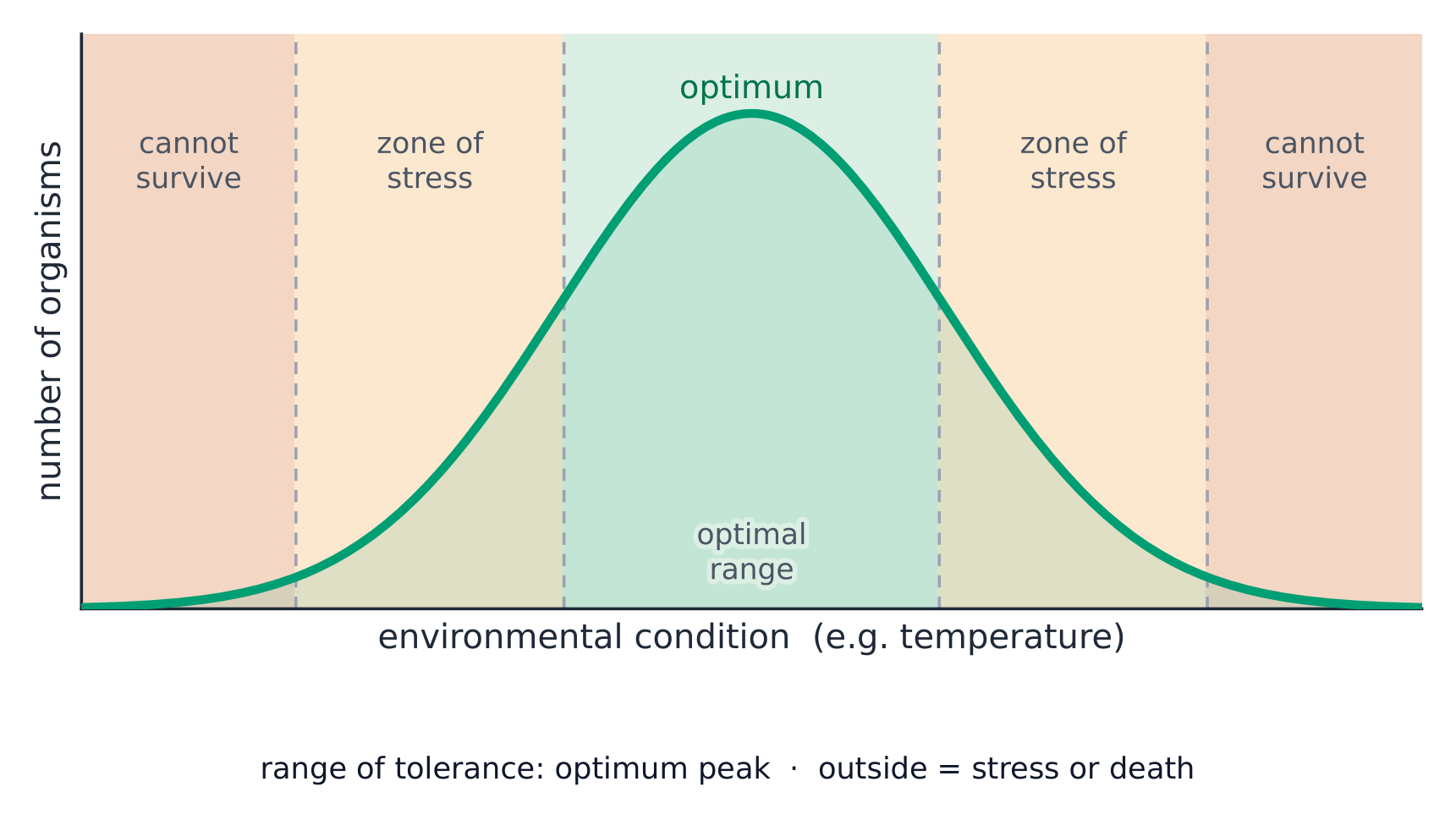
Range of tolerance: organisms thrive near the optimum and are stressed or die outside it
Ecological tolerance is…
Difficulty 1/5 · 100 coins + a small bonus on first completion today
Ecological tolerance is the range of conditions (like temperature) a species can survive.
Zones of stress
- Move away from the optimum and conditions get harder.
- In the zone of stress, individuals survive but struggle.
- They grow slower and reproduce less.
- Fewer of the species live in these tougher zones.
Zones of tolerance
Step from the ideal centre out to the edges - a species thrives, then struggles, then cannot survive.
Where does a population do best?
Difficulty 1/5 · 100 coins + a small bonus on first completion today
A species thrives in its optimum range, where conditions are ideal.
Outside its ____ range, a species cannot survive.
Difficulty 1/5 · 100 coins + a small bonus on first completion today
Beyond the tolerance range, conditions are too extreme and the species dies out there.
Beyond the limits
- Near the edges of the range, conditions become too extreme.
- Past the limits of the tolerance range 耐受范围, the species cannot survive.
- It is simply absent from those places.
- So tolerance sets the boundary of where a species can live.
A species with a narrow tolerance range is more vulnerable to environmental change.
Difficulty 1/5 · 100 coins + a small bonus on first completion today
Narrow tolerance means even a small change can push conditions past what the species can survive.
Select all true statements about ecological tolerance.
Difficulty 2/5 · 140 coins + a small bonus on first completion today
No species tolerates every condition — each has limits. The other three are correct.
A species with a narrow tolerance range is far more at risk. If it can only survive a small band of temperatures, even a small warming can push conditions past its limit. Wide-tolerance species cope with change; narrow-tolerance species can be wiped out.
Coral and warming seas:
- Corals have a narrow temperature tolerance.
- Their optimum is a fairly small band of warm water.
- Even a couple of degrees of ocean warming pushes many reefs past their limit, causing them to bleach and die — a narrow tolerance meeting a changing climate.
Ecological tolerance is the range of conditions a species can survive. It thrives in its optimum range, struggles in the zones of stress toward the edges, and cannot survive beyond its tolerance range. Species with a narrow tolerance are especially vulnerable to environmental change.