| Learning Objective | Essential Knowledge |
|---|---|
2.1.A |
|
Compound Structure and Properties
AP Chemistry · Topic 2
 8:45
Compound Structure and Properties
Three solids on a bench. Table salt. A diamond. A piece of copper. Hit the salt with a hammer and it shatters. The diamond scratches almost anything. The…
English narration · English + 中文 subtitles burned in
2.1
Types of Chemical Bonds

Syllabus
Source: College Board AP Course and Exam Description
Hit a salt crystal with a hammer and it shatters. Hit a copper coin and it only bends. Drag a diamond across glass and the glass is scratched. All three are solids at room temperature, yet they behave completely differently, because their particles are held together in different ways. This unit links those properties to the bonds inside, and then to the shapes of molecules.
A chemical bond 化学键 is an attraction that holds atoms together. Which type forms depends on the atoms' electronegativities:
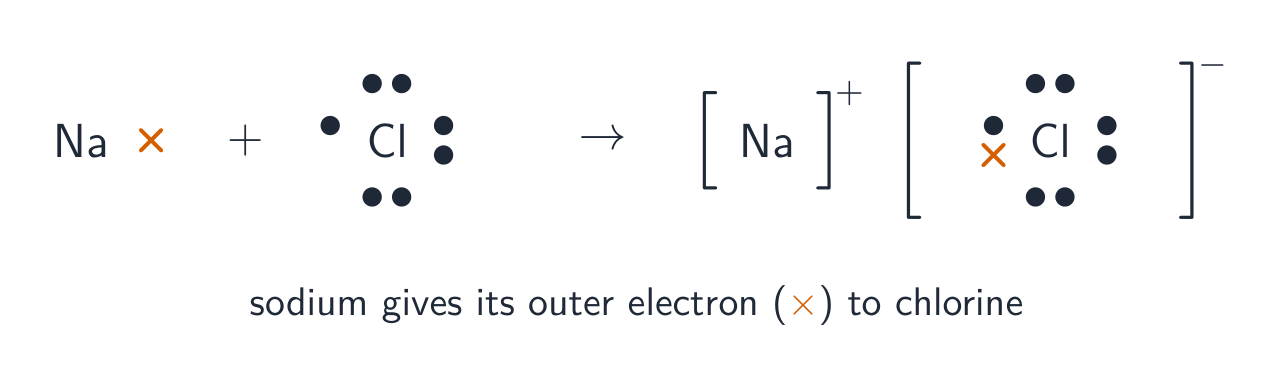
- Ionic bond 离子键: electrostatic attraction holds oppositely charged ions together. Electron transfer from a metal to a nonmetal can form these ions.
- Covalent bond 共价键: nonmetals share electrons (small difference). A big-but-not-huge difference gives a polar covalent 极性共价 bond.
- Metallic bond 金属键: metal atoms share a "sea" of mobile electrons.
Bond type is really a continuum, not three separate boxes. The atom with the higher electronegativity pulls the shared electrons toward itself and gets a partial negative charge (δ−); the other atom is δ+. The larger the electronegativity difference, the larger the bond dipole and the more ionic character the bond has. C–H bonds are treated as nonpolar, because carbon (2.5) and hydrogen (2.1) are so close.
Worked example (rank bond polarity). Use electronegativities H 2.1, C 2.5, N 3.0, O 3.5, F 4.0. The differences are H–F 1.9, H–O 1.4, H–N 0.9 and H–C 0.4. So the polarity order is H–F > H–O > H–N > H–C, and in each bond the δ− end is the non-hydrogen atom. Electronegativity alone does not decide ionic versus covalent, though: as a rule, a metal with a nonmetal is ionic and two nonmetals are covalent.
Explore
Form an ionic bond by electron transfer
An ionic bond forms when a metal gives electrons to a non-metal, making oppositely charged ions that attract; a covalent bond shares electrons instead.
Vocabulary
Train
| English |
|---|
| chemical bond/ˈkemɪkl bɒnd/ |
| Ionic bond/aɪˈɒnɪk bɒnd/ |
| Covalent bond/ˈkəʊvələnt bɒnd/ |
| polar covalent/ˈpəʊlə ˈkəʊvələnt/ |
| Metallic bond/məˈtælɪk bɒnd/ |
2.2
Intramolecular Force and Potential Energy

Syllabus
| Learning Objective | Essential Knowledge |
|---|---|
2.2.A |
|
Source: College Board AP Course and Exam Description
As two atoms approach, a potential energy 势能 curve captures the balance of attraction and repulsion. It dips to a minimum at the bond length 键长 (the stable separation) whose depth is the bond energy 键能. Shorter, stronger bonds sit in deeper, tighter wells; more shared pairs (double, triple bonds) give shorter, stronger bonds.
| Bond | Bond order | Length / pm | Bond energy / kJ mol⁻¹ |
|---|---|---|---|
| C–C | 1 | 154 | 347 |
| C=C | 2 | 134 | 614 |
| C≡C | 3 | 120 | 839 |
Atom size matters too. H–F (92 pm) is much shorter than H–I (161 pm), because iodine's outer electrons are in a shell much further from its nucleus. At very short distances the curve rises steeply, because the two nuclei repel each other.
For ions, Coulomb's law sets the strength: the attraction grows with the ion charges and is larger for smaller ions, which can come closer together.
Worked example (rank lattice strength). Rank MgO, NaF, NaCl and KCl from strongest to weakest attraction. MgO has charges of 2+ and 2−, four times the product of the others, so it is strongest. Among the 1+/1− salts, compare size: $\text{F}^-$ is smaller than $\text{Cl}^-$, and $\text{Na}^+$ is smaller than $\text{K}^+$. So the order is MgO > NaF > NaCl > KCl. Their melting points follow the same order: 2852, 993, 801 and 770 °C.
Exam skill (sketching a curve). Asked to draw the curve for an Al–Cl bond of length 220 pm and energy 425 kJ/mol, put the minimum at $x=220$ pm and $y=-425$ kJ/mol. Then draw a steep rise to the left of it (the nuclei repel), and a slow rise to the right that levels off at zero (separate atoms). For a shorter, stronger bond, the minimum moves left and down; for a longer, weaker one, right and up.
Explore
Reading the potential-energy curve
As two atoms approach, their potential energy changes. Match each region of the curve to what the atoms are doing.
Vocabulary
Train
| English |
|---|
| potential energy/pəˈtenʃl ˈenədʒi/ |
| bond length/bɒnd leŋθ/ |
| bond energy/bɒnd ˈenədʒi/ |
2.3
Structure of Ionic Solids

Syllabus
| Learning Objective | Essential Knowledge |
|---|---|
2.3.A |
|
Source: College Board AP Course and Exam Description
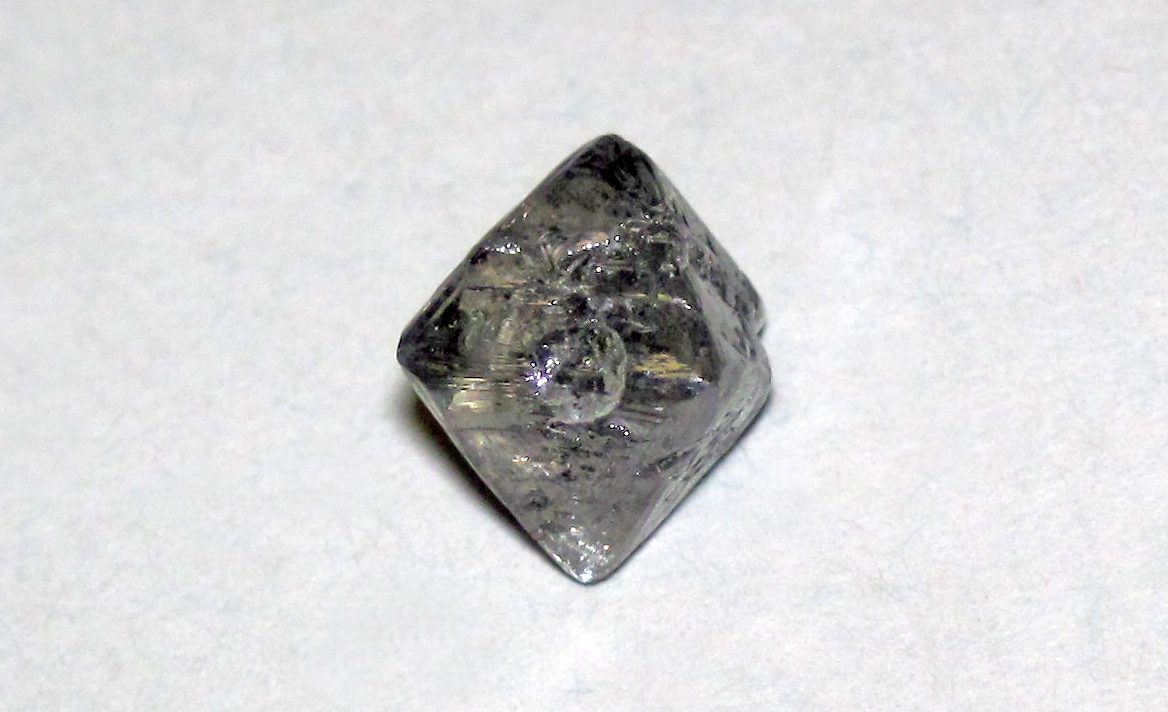
An ionic solid 离子固体 is a repeating 3-D lattice 晶格 of alternating cations and anions, held by strong electrostatic attraction. This explains their high melting points, brittleness, and why they conduct only when molten or dissolved (ions freed to move). The lattice energy rises with larger ion charges and smaller ions, so MgO (both $2+/2-$) melts far higher than NaCl (both $1+/1-$).
The ions arrange themselves so that each one is surrounded by ions of the opposite charge: attraction is as large as possible and repulsion as small as possible. In a particle drawing, show cations and anions alternating, and draw the smaller ion smaller (for example, $\text{Na}^+$ smaller than $\text{Cl}^-$).

Explore
Inside an ionic solid
Oppositely charged ions pack into a giant repeating lattice held by electrostatic forces.
Vocabulary
Train
| English |
|---|
| ionic solid/aɪˈɒnɪk ˈsɒlɪd/ |
| lattice/ˈlætɪs/ |
2.4
Structure of Metals and Alloys
Syllabus
| Learning Objective | Essential Knowledge |
|---|---|
2.4.A |
|
Source: College Board AP Course and Exam Description
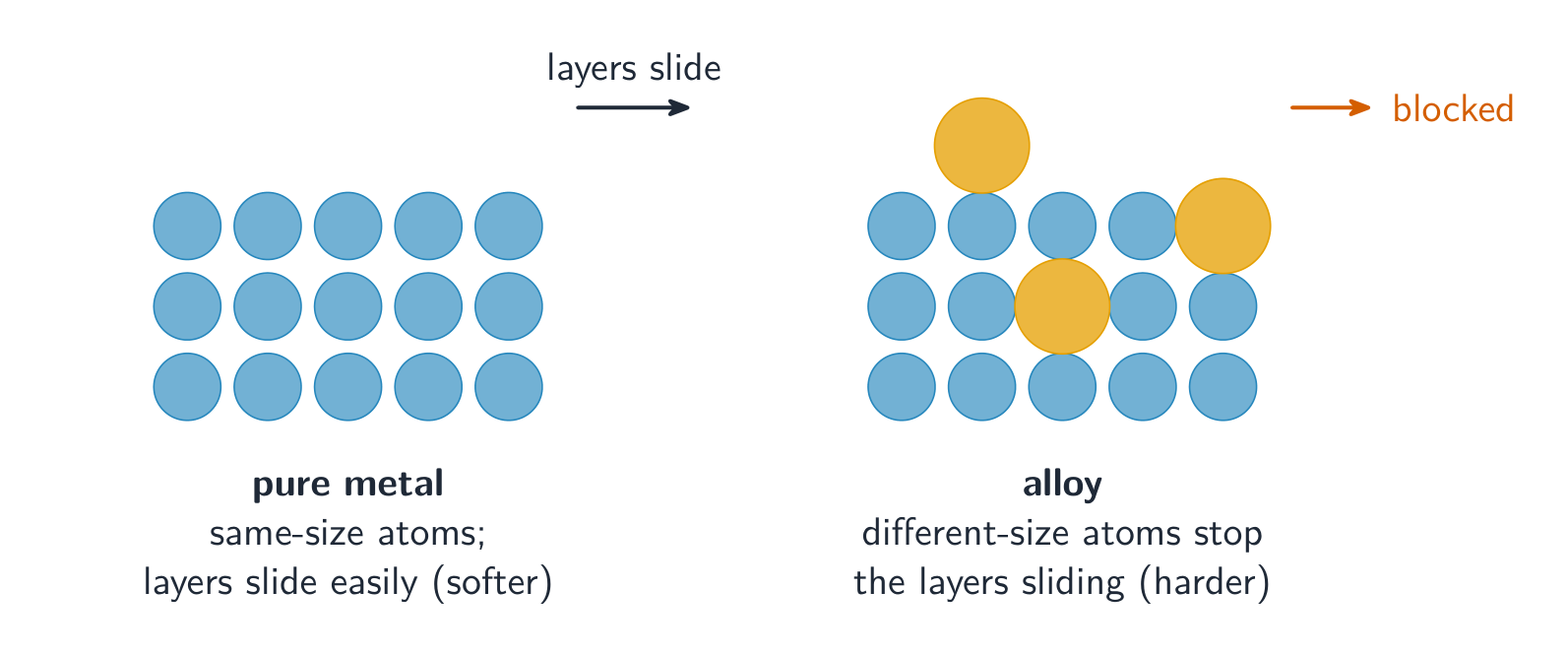
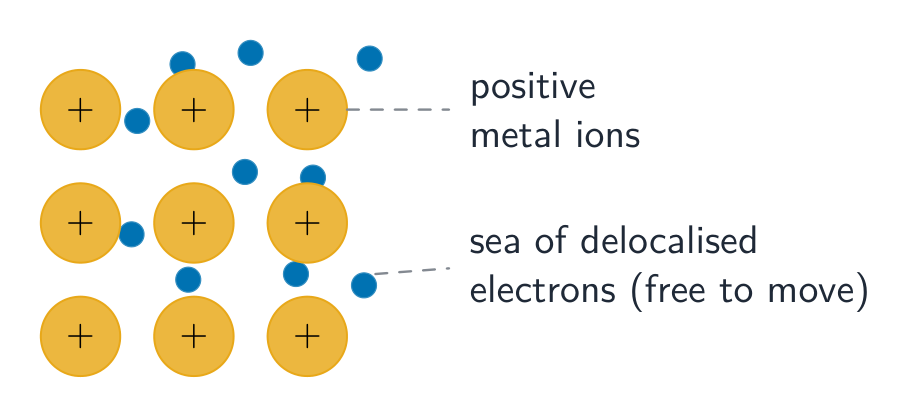
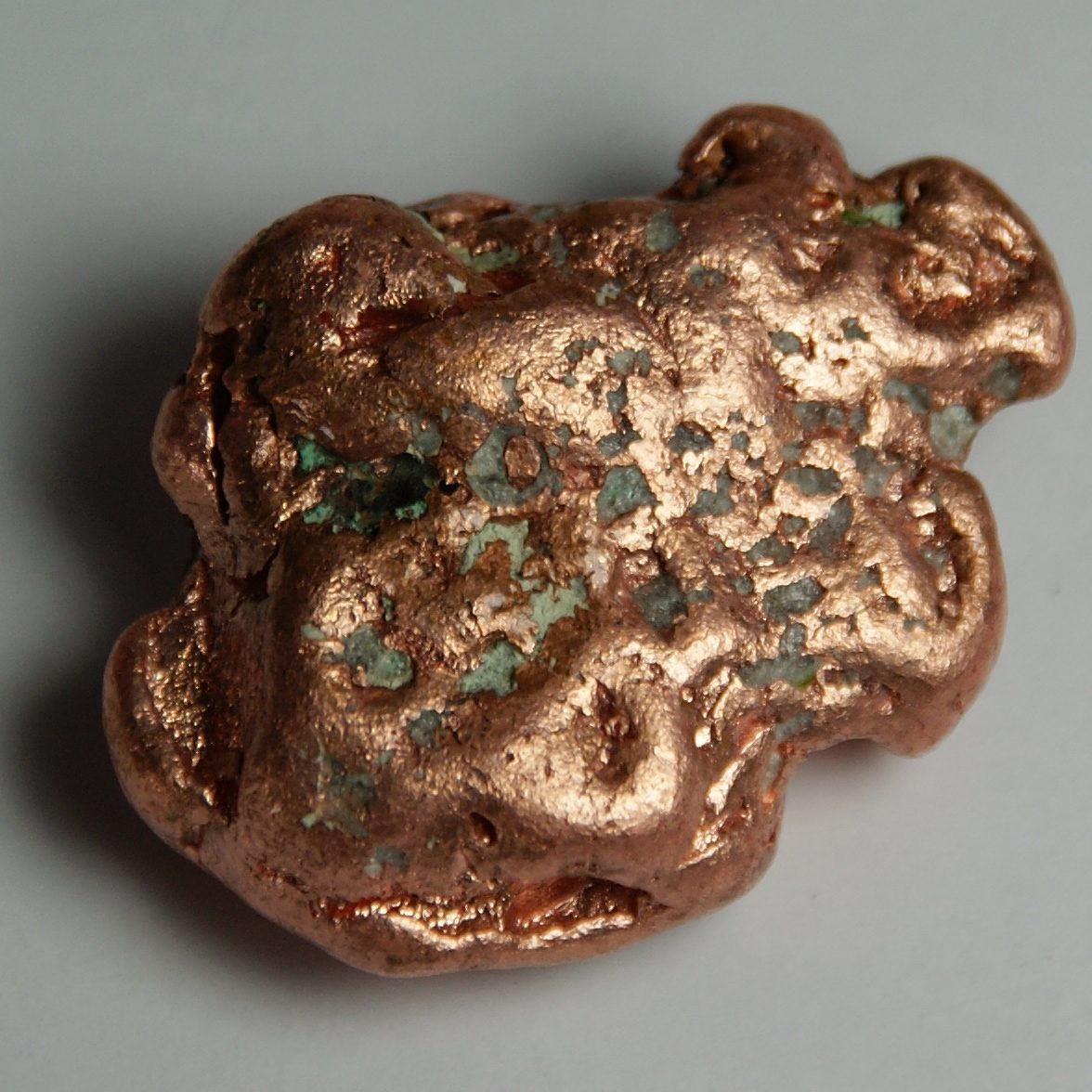
In a metal, cations sit in a lattice bathed in delocalized 离域 electrons, which explains conductivity, malleability, and luster. An alloy 合金 combines a metal with one or more other elements: a substitutional alloy swaps in similar-sized atoms; an interstitial alloy (like steel) fits small atoms into the gaps, making it harder.
Brass is a substitutional alloy: zinc atoms, close in size to copper atoms, replace some of the copper in the lattice. Brass is harder than pure copper but still easy to shape. Steel is interstitial: small carbon atoms sit in the gaps between much larger iron atoms. They lock the layers in place, so steel is harder and stronger, but less malleable and less ductile than pure iron. Both alloys still conduct electricity, because the delocalized electrons remain.
Explore
Slide layers in a metallic lattice
A metal is positive ions in a sea of delocalised electrons. The layers can slide without breaking the bond, so metals are malleable and conduct.
Vocabulary
Train
| English |
|---|
| delocalized/dɪˈlɒkəlaɪzd/ |
| alloy/ˈælɔɪ/ |
2.5
Lewis Diagrams

Syllabus
| Learning Objective | Essential Knowledge |
|---|---|
2.5.A |
|
Source: College Board AP Course and Exam Description
A Lewis diagram 路易斯结构 shows valence electrons as bonding pairs and lone pairs 孤对电子, giving most atoms an octet 八隅体 (8 valence electrons; H wants 2). Steps: count total valence electrons, connect atoms with single bonds, complete octets on outer atoms, then form multiple bonds if the central atom is short.
Worked example. Draw carbon dioxide, $\text{CO}_2$. Total valence electrons $=4+2(6)=16$. Put C in the centre; single bonds to each O use $4$ electrons and leave the outer O atoms short. Completing octets forces two double bonds, $\text{O}=\text{C}=\text{O}$: each O then has two lone pairs, C has none, and all $16$ electrons are placed with every atom at an octet.
Worked example (a triple bond). Draw hydrogen cyanide, HCN. Valence electrons: $1+4+5=10$. Put C in the centre (H can form only one bond, so it is never central): H–C–N uses 4 electrons. Putting the remaining 6 on N as three lone pairs leaves C with only 4 electrons. Move two of N's lone pairs into bonds: H–C≡N, with one lone pair on N. Now C has 8, N has 8 and H has 2.
Some molecules break the octet rule:
- Fewer than eight: boron in $\text{BF}_3$ has only 6 electrons around it.
- More than eight (expanded octet): atoms in period 3 and below, such as P, S, Cl and Xe, can hold 10 or 12, as in $\text{PCl}_5$ and $\text{SF}_6$.
- Odd numbers of electrons: NO has 11 valence electrons, so one atom must be left with an unpaired electron. The Lewis model cannot describe such molecules well; this is one of its limits.
Vocabulary
Train
| English |
|---|
| Lewis diagram/ˈluːɪs ˈdaɪəɡræm/ |
| lone pairs/ləʊn peəz/ |
| octet/ɒkˈtet/ |
2.6
Resonance and Formal Charge

Syllabus
| Learning Objective | Essential Knowledge |
|---|---|
2.6.A |
|
Source: College Board AP Course and Exam Description
When two or more valid Lewis diagrams differ only in electron placement, one delocalized electron distribution is represented by these contributors – resonance 共振. The molecule does not switch between them. Formal charge 形式电荷 (valence electrons minus lone-pair electrons minus half the bonding electrons) picks the best structure: the one with formal charges closest to zero, and any negative charge on the most electronegative atom.
Worked example. Assign formal charges in the nitrate ion, $\text{NO}_3^{-}$ (one double bond, two single bonds). For N (4 bonds, no lone pairs): $5-0-4=+1$. For the double-bonded O (2 lone pairs): $6-4-2=0$. For each single-bonded O (3 lone pairs): $6-6-1=-1$. The total is $+1+0+(-1)+(-1)=-1$, matching the ion's overall charge – a good check that the structure is drawn correctly. Because the three O atoms are equivalent by resonance, the real ion has three identical bonds.
Each N–O bond in nitrate is "one and a third" bonds: shorter and stronger than a single bond, longer and weaker than a double bond. Resonance changes predictions about bond length that a single Lewis diagram would get wrong.
Worked example (unequal bond lengths). In the hydrogen carbonate ion, $\text{HCO}_3^-$, carbon bonds to three oxygens, but one of them also carries the H. The negative charge is shared, by resonance, between the two oxygens without H, so each of those C–O bonds is "one and a half" bonds. The C–OH bond is a single bond in every resonance structure. So two C–O bonds are equal and shorter, and the C–OH bond is longer.
Worked example (choosing with formal charge). Two Lewis diagrams can be drawn for $\text{CO}_2$ with octets everywhere: O=C=O, and O≡C–O. In O=C=O every formal charge is 0. In O≡C–O the triple-bonded O is $6-2-3=+1$, C is $4-0-4=0$, and the single-bonded O is $6-6-1=-1$. The first structure has all formal charges at zero, so it is the better model, and it matches the measured fact that both C–O bonds in $\text{CO}_2$ are the same length.
Explore
Assign the formal charges
Formal charge = valence electrons - lone electrons - bonds. Assign each atom in the nitrate ion.
Vocabulary
Train
| English |
|---|
| resonance/ˈrezənəns/ |
| Formal charge/ˈfɔːml tʃɑːdʒ/ |
2.7
VSEPR and Bond Hybridization

Syllabus
| Learning Objective | Essential Knowledge |
|---|---|
2.7.A
|
|
Source: College Board AP Course and Exam Description
VSEPR 价层电子对互斥 theory predicts shape: electron pairs (bonds and lone pairs) around a central atom spread out as far apart as possible. Counting electron domains gives the geometry (linear, trigonal planar, tetrahedral, …); lone pairs push bonds closer, bending the shape. Hybridization 杂化 ($sp$, $sp^2$, $sp^3$) describes the mixed orbitals matching that geometry. Molecular shape and bond polarity together decide whether the whole molecule is polar.
| Electron domains | Lone pairs | Molecular shape | Example | Ideal angles |
|---|---|---|---|---|
| 2 | 0 | linear | $\text{CO}_2$ | 180° |
| 3 | 0 / 1 | trigonal planar / bent | $\text{BF}_3$ / $\text{SO}_2$ | 120° |
| 4 | 0 / 1 / 2 | tetrahedral / trigonal pyramidal / bent | $\text{CH}_4$ / $\text{NH}_3$ / $\text{H}_2\text{O}$ | 109.5° (less with lone pairs) |
| 5 | 0 / 1 / 2 / 3 | trigonal bipyramidal / seesaw / T-shaped / linear | $\text{PCl}_5$ / $\text{SF}_4$ / $\text{ClF}_3$ / $\text{XeF}_2$ | 90°, 120°, 180° |
| 6 | 0 / 1 / 2 | octahedral / square pyramidal / square planar | $\text{SF}_6$ / $\text{BrF}_5$ / $\text{XeF}_4$ | 90°, 180° |
The hybridization of the central atom matches the number of domains: 2 domains $sp$ (180°), 3 domains $sp^2$ (120°), 4 domains $sp^3$ (109.5°). AP does not ask about hybrids for 5 or 6 domains; for those you only need the shape.
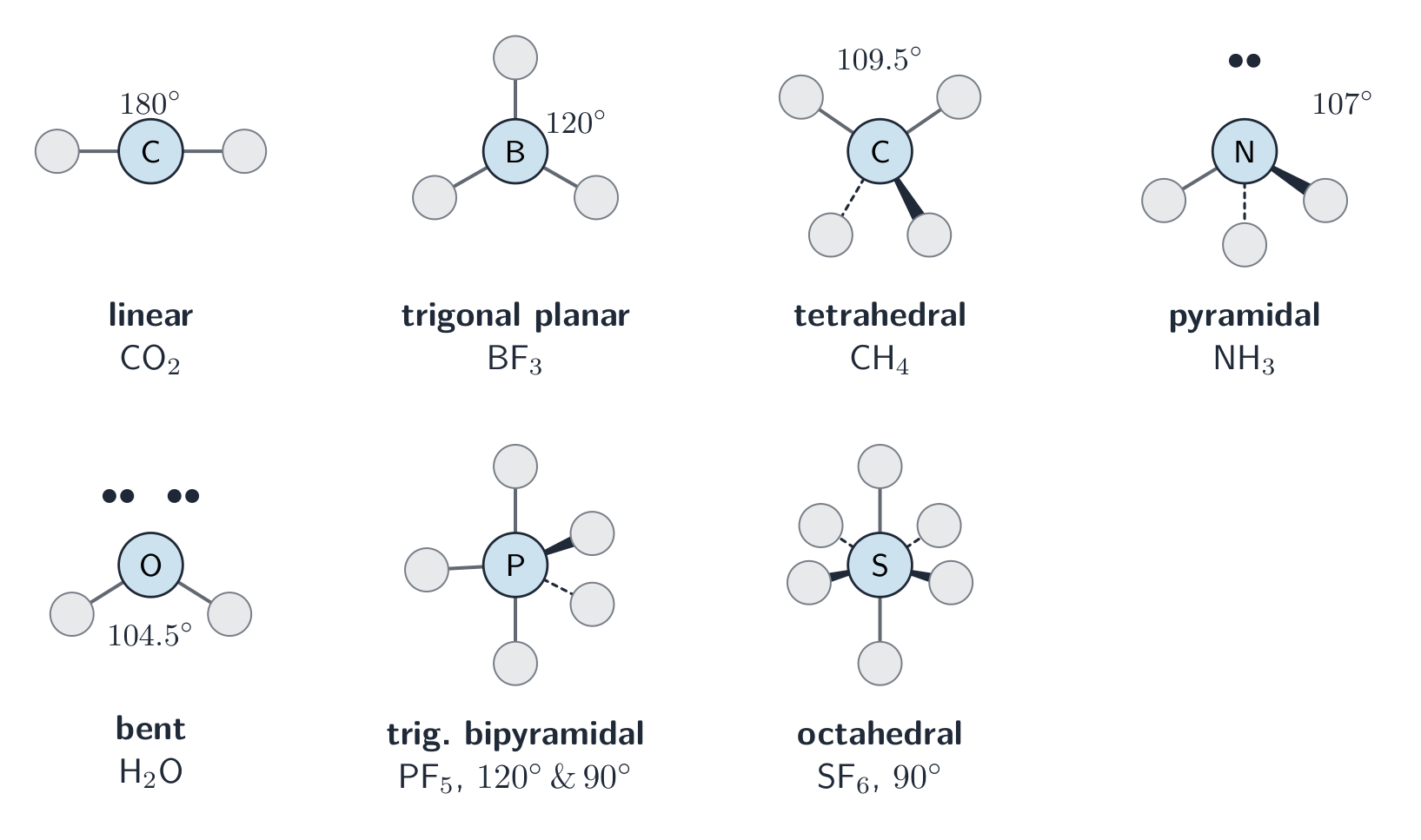
Worked example. Predict the shape of ammonia, $\text{NH}_3$. Nitrogen has $3$ bonding pairs and $1$ lone pair – four electron domains, so the electron geometry is tetrahedral and the hybridization is $sp^3$. The lone pair is invisible in the shape but still pushes the bonds together, so the molecular shape is trigonal pyramidal with a bond angle of about $107^{\circ}$ (a little less than the ideal $109.5^{\circ}$). The three N–H dipoles do not cancel, so the molecule is polar.
Worked example (an expanded octet). Predict the shape of $\text{XeF}_4$ and whether it is polar. Valence electrons: $8+4(7)=36$. Four Xe–F bonds use 8, and three lone pairs on each F use 24, so 4 electrons (2 lone pairs) remain on Xe. Xenon has 6 domains: octahedral electron geometry. The two lone pairs sit opposite each other, at 180°, as far apart as possible. The four F atoms form a square planar shape. The four Xe–F dipoles point in opposite pairs and cancel, so $\text{XeF}_4$ is nonpolar, even though every bond is polar. By contrast, $\text{SF}_4$ (5 domains, 1 lone pair) is seesaw-shaped and polar.
Bonds form when atomic orbitals overlap. Every single bond is one sigma bond σ键 – orbitals overlapping head-on along the line joining the two atoms. A multiple bond adds a pi bond π键, made by $p$ orbitals overlapping sideways above and below that line: a double bond is one sigma + one pi, a triple bond one sigma + two pi. Head-on overlap is more effective, so a sigma bond is stronger (higher bond energy) than a pi bond – which is why a double bond is stronger than a single bond but not twice as strong. A pi bond restricts rotation about the bond. A C=C double bond can give cis and trans forms – geometric isomers 几何异构体 – when each double-bonded carbon has two different attached groups. Ethene does not meet this condition.
Worked example. Count the bonds in ethene, $\text{H}_2\text{C}=\text{CH}_2$. The four C–H bonds are single bonds (one sigma each); the C=C is one sigma plus one pi. So ethene has 5 sigma and 1 pi bond, and that single pi bond is exactly what stops the two $\text{CH}_2$ ends from twisting relative to each other.
Common mistakes.
- Naming the molecular shape from the electron geometry. Ammonia has four electron domains (tetrahedral electron geometry), but its molecular shape, which counts atoms only, is trigonal pyramidal; water is bent.
- Saying a molecule with polar bonds must be polar. In $\text{CO}_2$ and $\text{CCl}_4$ the bond dipoles cancel by symmetry, so the molecule is non-polar.
- Saying resonance structures flip back and forth. The real ion is one delocalized structure; in $\text{NO}_3^{-}$ all three N–O bonds are the same length.
- Saying a double bond is twice as strong as a single bond. The extra pi bond is weaker than a sigma bond, so a double bond is stronger but less than twice as strong.
- Reading a deeper well on a potential-energy curve as a longer bond. A deeper well means a stronger bond; the minimum's position gives the bond length, and stronger bonds between the same atoms are usually shorter.
- Explaining the high melting point of MgO by "more bonds". MgO has larger ion charges ($2+$ and $2-$) and small ions, so the Coulombic attraction, and the lattice energy, is much larger.
- Forgetting the ion's charge when counting valence electrons. For $\text{NO}_3^{-}$ add one electron; for a cation subtract them.
Explore
Predict molecular shape with VSEPR
VSEPR: electron pairs repel and spread as far apart as possible, setting the molecule's shape. Add bonding and lone pairs and watch the geometry change.
Vocabulary
Train
| English |
|---|
| VSEPR/ˈvespə/ |
| Hybridization/ˌhaɪbrɪdaɪˈzeɪʃn/ |
| geometric isomers/ˌdʒiːəʊˈmetrɪk ˈaɪsəməz/ |
| sigma bond/ˈsɪɡmə bɒnd/ |
| pi bond/paɪ bɒnd/ |
2.7
Exam tips
- Decide the bond type from the atoms: ionic (metal + non-metal, electron transfer), covalent (non-metals, sharing), metallic (sea of delocalised electrons).
- An ionic solid conducts only when molten or dissolved (ions free to move), never as a solid.
- Draw Lewis structures to satisfy the octet (H wants 2), then use VSEPR — electron pairs spread as far apart as possible — to predict the shape.
- Lone pairs take up space and push bonds closer, bending the shape (water is bent, ammonia pyramidal).
- A molecule can have polar bonds yet be non-polar overall if its symmetry makes the dipoles cancel ($\text{CO}_2$).
- A single bond is 1 sigma bond; a double bond is 1 sigma + 1 pi, a triple bond 1 sigma + 2 pi. Sigma is stronger than pi, and a pi bond blocks rotation, giving cis/trans geometric isomers.
Interactive lessons on this topic
Work through it step by step, with instant-check exercises.