Introduction to Equilibrium
Introduced| English | Meaning |
|---|---|
| equilibrium/ˌiːkwɪˈlɪbrɪəm/ | A state with no resultant force or resultant moment. |
A busy standstill
- Some reactions never fully finish — they reach a balance.
- Reactants and products settle at steady amounts.
- But underneath, the reaction is still running both ways.
- It is a standstill built from constant motion.
Both ways at once
- A reversible reaction runs forward and backward at the same time.
- At equilibrium 平衡, the two rates become equal.
- It is dynamic: both directions keep going, just in balance.
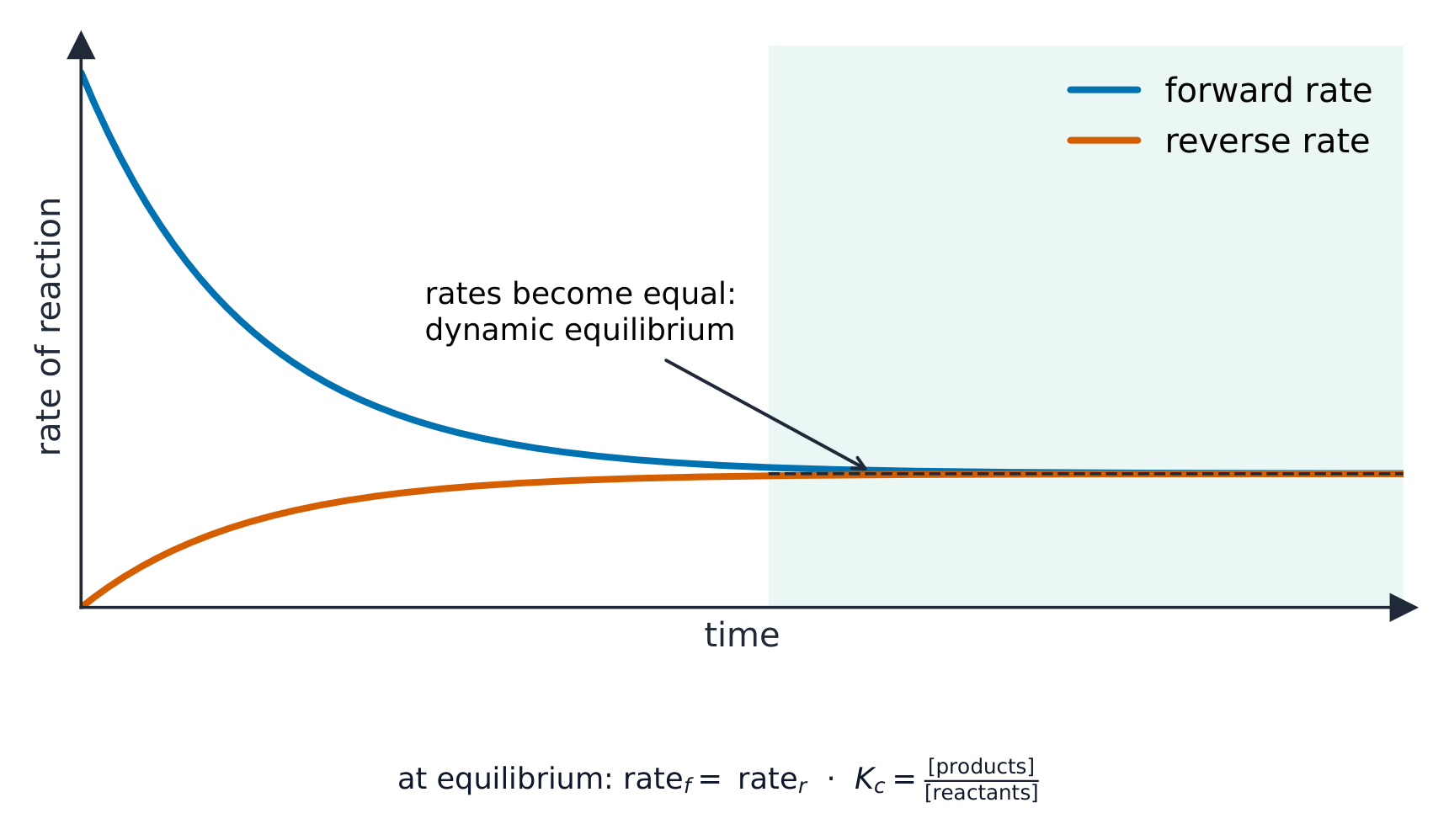
Dynamic equilibrium: the forward and reverse rates become equal
At equilibrium, the forward and reverse reaction rates are...
Difficulty 1/5 · 100 coins + a small bonus on first completion today
Equal rates keep the concentrations constant.
Steady, not stopped
- At equilibrium, the concentrations stay constant.
- They are not zero, and not necessarily equal to each other.
- Products form as fast as they break back down.
At equilibrium, the concentrations of reactants and products are...
Difficulty 1/5 · 100 coins + a small bonus on first completion today
They stop changing but are not necessarily equal to each other.
At equilibrium the concentrations hold ____ over time.
Difficulty 1/5 · 100 coins + a small bonus on first completion today
Equal opposing rates keep concentrations steady.
At equilibrium the reactant concentrations are zero.
Difficulty 1/5 · 100 coins + a small bonus on first completion today
Both reactants and products remain present at steady amounts.
How to spot equilibrium
- The forward rate equals the reverse rate.
- The concentrations hold steady over time.
- The reaction has not stopped; it is balanced.
Reaching dynamic equilibrium
Watch a reversible reaction settle into equilibrium.
At equilibrium, both the forward and reverse reactions have stopped.
Difficulty 1/5 · 100 coins + a small bonus on first completion today
Equilibrium is dynamic -- both keep running at equal rates.
Reaching equilibrium means the reaction has completely finished.
Difficulty 1/5 · 100 coins + a small bonus on first completion today
The reaction continues in both directions, just in balance.
Why do the amounts stop changing at equilibrium?
- The forward and reverse reactions run at the same speed.
- Each product made is matched by one breaking down.
Equilibrium is dynamic, not static — both reactions still happen, just at equal rates. Concentrations are constant but usually not equal to each other. And "equilibrium" does not mean the reaction stopped; it means the two directions balance.
At equilibrium a reversible reaction's forward and reverse rates are equal, so the concentrations hold steady — constant but not zero and not necessarily equal. It is dynamic: both directions keep running in perfect balance, not stopped.