| Enduring Understanding | Learning Objective | Essential Knowledge |
|---|---|---|
CHA-4 | CHA-4.B |
|
Applications of Integration
AP Calculus BC · Topic 8
 9:59
Applications of Integration
Here is a bumpy graph, and the area underneath it. Now imagine pouring that area into a rectangle over the same interval, and letting it level off. The height…
English narration · English + 中文 subtitles burned in
8.1
Finding the Average Value of a Function on an Interval
Syllabus
Source: College Board AP Course and Exam Description
The average value 平均值 of $f$ over $[a,b]$ is the integral 积分 divided by the width:
$$f_{\text{avg}}=\frac{1}{b-a}\int_a^b f(x)\,dx.$$
It is the constant height a rectangle 矩形 would need to have the same area as the region under $f$. Do not confuse this with the average rate of change 变化率 (which uses the derivative 导数).
Worked example. The average value of $f(x)=x^2$ on $[0,3]$ is $\dfrac{1}{3}\displaystyle\int_0^3 x^2\,dx=\dfrac13\left[\dfrac{x^3}{3}\right]_0^3=\dfrac13(9)=3$.
Worked example (average from a table). The height $H$ of a tree, in metres, is measured at times $t$ in years.
| $t$ | $2$ | $3$ | $5$ | $7$ | $10$ |
|---|---|---|---|---|---|
| $H(t)$ | $1.5$ | $2$ | $6$ | $11$ | $15$ |
Use a trapezoidal sum with the four subintervals to estimate the average height for $2\le t\le10$. The widths are unequal ($1,2,2,3$), so compute each trapezoid separately:
$$\int_2^{10}H\,dt\approx1\cdot\frac{1.5+2}{2}+2\cdot\frac{2+6}{2}+2\cdot\frac{6+11}{2}+3\cdot\frac{11+15}{2}=1.75+8+17+39=65.75.$$
The average height is about $\dfrac{65.75}{10-2}\approx8.22$ metres. Forgetting to divide by $b-a=8$ is the most common error.
When is the function equal to its average? If a question asks for the time $t$ at which $A(t)$ equals its average value on $[0,30]$, first compute $A_{\text{avg}}=\dfrac1{30}\displaystyle\int_0^{30}A(t)\,dt$ on the calculator, then solve $A(t)=A_{\text{avg}}$ with the calculator. The Mean Value Theorem for integrals promises such a $t$ exists when $A$ is continuous.
Explore
The average value of a function
y = ax³ + bx² + cx + d
The average value of $f$ on $[a,b]$ is its integral divided by the width — the constant height whose rectangle has the same area as under the curve.
Vocabulary
Train
| English |
|---|
| average value/ˈævrɪdʒ ˈvæljuː/ |
| integral/ˈɪntɪɡrəl/ |
| rectangle/ˈrektæŋɡl/ |
| rate of change/reɪt ɒv tʃeɪndʒ/ |
| derivative/dɪˈrɪvətɪv/ |
8.2
Connecting Position, Velocity, and Acceleration Using Integrals
Syllabus
| Enduring Understanding | Learning Objective | Essential Knowledge |
|---|---|---|
CHA-4 | CHA-4.C |
|
Source: College Board AP Course and Exam Description
For straight-line motion, integration 积分法 reverses differentiation 求导:
$$v(t)=\int a(t)\,dt,\qquad s(t)=\int v(t)\,dt.$$
Two key distinctions: displacement 位移 is $\int_a^b v\,dt$ (net change 净变化 in position), while total distance 总路程 is $\int_a^b |v|\,dt$ (splitting where $v$ changes sign). Speed 速率 is $|v|$.
Worked example. A particle has $v(t)=t^2-4t+3$ for $0\le t\le3$ (metres per second).
- Displacement: $\displaystyle\int_0^3(t^2-4t+3)\,dt=\left[\frac{t^3}{3}-2t^2+3t\right]_0^3=9-18+9=0$ m. The particle ends where it started.
- Distance: $v=(t-1)(t-3)$ is negative on $(1,3)$. $\displaystyle\int_0^1v\,dt=\frac43$ and $\displaystyle\int_1^3v\,dt=-\frac43$, so the total distance is $\dfrac43+\dfrac43=\dfrac83$ m.
Position from a known point. If a train is $300$ m east of the station at $t=2$, its position is $x(t)=300+\displaystyle\int_2^t v(s)\,ds$. The lower limit is the time you know the position, not always $0$.
Interpreting with units. "$\displaystyle\int_0^{40}|v(t)|\,dt$" with $v$ in metres per second means "the total distance, in metres, that the object travels from $t=0$ to $t=40$ seconds". Name the quantity, the units and the time interval.
Vocabulary
Train
| English |
|---|
| integration/ˌɪntɪˈɡreɪʃn/ |
| differentiation/ˌdɪfəˌrenʃɪˈeɪʃn/ |
| displacement/dɪˈspleɪsmənt/ |
| net change/net tʃeɪndʒ/ |
| total distance/ˈtəʊtl ˈdɪstəns/ |
| speed/spiːd/ |
8.3
Using Accumulation Functions and Definite Integrals in Applied Contexts
Syllabus
| Enduring Understanding | Learning Objective | Essential Knowledge |
|---|---|---|
CHA-4 | CHA-4.D |
|
CHA-4.E |
|
Source: College Board AP Course and Exam Description
When a rate is given (flow rate, sales per day), the definite integral 定积分 gives the accumulated total 累积总量, and $\int_a^b R(t)\,dt$ carries the units of $R$ times time. A common setup: initial amount 初始量 $+\int(\text{rate in}-\text{rate out})\,dt$ gives the amount at a later time. Always interpret the answer in context, with units.
Worked example (rate in, rate out). Water flows into a pipe at $12$ cubic feet per hour and drains out at $D(t)=3t$ cubic feet per hour, for $0\le t\le8$. At $t=0$ the pipe holds $30$ cubic feet.
(a) Amount. $W(t)=30+\displaystyle\int_0^t(12-3s)\,ds=30+12t-1.5t^2$.
(b) Increasing or decreasing at $t=3$? Compare the rates, not the amounts: $W'(3)=12-3(3)=3>0$, so the amount is increasing, because water enters faster than it leaves.
(c) Minimum amount. $W'(t)=0$ at $t=4$. Use the candidates test – check the critical point and both endpoints:
| $t$ | $0$ | $4$ | $8$ |
|---|---|---|---|
| $W(t)$ | $30$ | $54$ | $30$ |
The minimum is $30$ cubic feet, at $t=0$ and $t=8$; $t=4$ is the maximum. A sign chart of $W'$ alone can find the maximum, but only the table settles which endpoint is lowest.
Explore
Accumulated inflow is the area
y = 4t (inflow rate)
The area under the inflow rate $R(t)$ is the water added; the total is the initial amount plus that area.
Vocabulary
Train
| English |
|---|
| definite integral/ˈdefɪnət ˈɪntɪɡrəl/ |
| accumulated total |
| initial amount |
8.4
Finding the Area Between Curves Expressed as Functions of x

Syllabus
| Enduring Understanding | Learning Objective | Essential Knowledge |
|---|---|---|
CHA-5 | CHA-5.A |
|
Source: College Board AP Course and Exam Description
The area between $y=f(x)$ (top) and $y=g(x)$ (bottom) from $a$ to $b$ is
$$\int_a^b\big(f(x)-g(x)\big)\,dx.$$
Find the intersection points 交点 for the limits of integration 积分限, and always subtract top minus bottom.
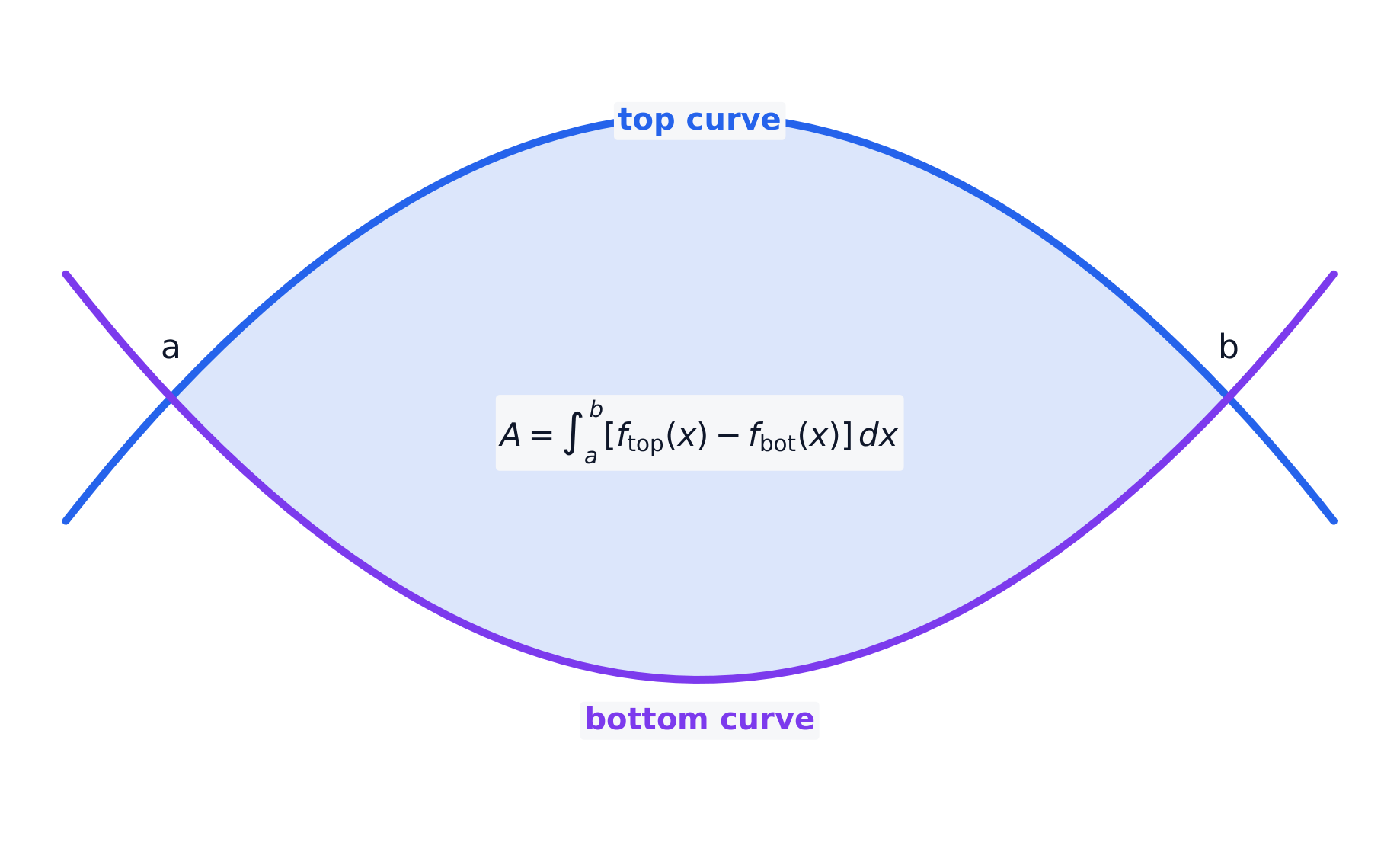
Worked example. Between $y=x$ and $y=x^2$ (crossing at $x=0,1$, with $y=x$ on top), the area is $\displaystyle\int_0^1 (x-x^2)\,dx=\left[\dfrac{x^2}{2}-\dfrac{x^3}{3}\right]_0^1=\dfrac16$.
Explore
A line above a parabola
y = ax² + bx + c
Between the intersection points the line sits above the parabola — the vertical gap, integrated, is the enclosed area.
Vocabulary
Train
| English |
|---|
| intersection point/ˌɪntəˈsekʃn pɔɪnt/ |
| limits of integration/ˈlɪmɪts ɒv ˌɪntɪˈɡreɪʃn/ |
8.5
Finding the Area Between Curves Expressed as Functions of y
Syllabus
| Enduring Understanding | Learning Objective | Essential Knowledge |
|---|---|---|
CHA-5 | CHA-5.A |
|
Source: College Board AP Course and Exam Description
When curves are easier to describe as $x=f(y)$, integrate with respect to $y$ instead, using right minus left:
$$\int_c^d\big(f_{\text{right}}(y)-g_{\text{left}}(y)\big)\,dy.$$
Choosing to integrate in $y$ can avoid splitting the region into several pieces.
Worked example. Find the same area between $y=x$ and $y=x^2$ with horizontal slices. Solve each curve for $x$: the line is $x=y$ and the parabola 抛物线 is $x=\sqrt{y}$. For $0<y<1$, $\sqrt{y}>y$ (try $y=0.25$: $0.5>0.25$), so the parabola is on the right:
$$A=\int_0^1\big(\sqrt{y}-y\big)\,dy=\left[\frac{2}{3}y^{3/2}-\frac{y^2}{2}\right]_0^1=\frac23-\frac12=\frac16.$$
Both methods give $\tfrac16$, as they must.
Explore
A sideways-opening parabola
y = ax² + bx + c
When curves open sideways, horizontal slices (right minus left, integrated in $y$) are the clean choice.
Vocabulary
Train
| English |
|---|
| parabola/pəˈræbələ/ |
8.6
Finding the Area Between Curves That Intersect More Than Twice

Syllabus
| Enduring Understanding | Learning Objective | Essential Knowledge |
|---|---|---|
CHA-5 | CHA-5.A |
|
Source: College Board AP Course and Exam Description
If two curves cross several times, the top and bottom switch. Split the region at each intersection and integrate each piece with the correct top-minus-bottom (or use $\int|f-g|$), then add the pieces.
Worked example. Find the area between $y=x^3$ and $y=x$. They meet where $x^3=x$, at $x=-1,0,1$. Test a point in each piece: at $x=-\tfrac12$, $x^3=-\tfrac18>-\tfrac12$, so the cubic is on top; at $x=\tfrac12$ the line is on top.
$$A=\int_{-1}^{0}(x^3-x)\,dx+\int_0^1(x-x^3)\,dx=\frac14+\frac14=\frac12.$$
Common mistake. Writing $\displaystyle\int_{-1}^{1}(x-x^3)\,dx=0$: the two pieces cancel. On the calculator, $\displaystyle\int_{-1}^{1}\left|x-x^3\right|dx$ gives $\tfrac12$ in one step.
8.7
Volumes with Cross Sections: Squares and Rectangles
Syllabus
| Enduring Understanding | Learning Objective | Essential Knowledge |
|---|---|---|
CHA-5 | CHA-5.B |
|
Source: College Board AP Course and Exam Description
If a solid's cross sections 横截面 perpendicular 垂直 to the $x$-axis are squares 正方形 or rectangles, integrate their area to find the volume 体积. With side length equal to the distance between two curves, a square cross section gives
$$V=\int_a^b \big(f(x)-g(x)\big)^2\,dx.$$
The method is always "integrate the cross-sectional area."
Worked example. The base of a solid is the region under $y=\sqrt{x}$ from $x=0$ to $x=4$, and cross sections perpendicular to the $x$-axis are squares. Each square's side is $s(x)=\sqrt{x}$, so $A(x)=x$ and
$$V=\int_0^4 x\,dx=\left[\frac{x^2}{2}\right]_0^4=8.$$
With semicircles on the same base instead, $A(x)=\tfrac{\pi}{8}\big(\sqrt{x}\big)^2$, so $V=\tfrac{\pi}{8}\cdot 8=\pi$: only the area formula changes.
Worked example. The base of a solid is the region between $y=x$ and $y=x^2$. Cross sections perpendicular to the $x$-axis are squares. Find the volume.
The side of each square is the slice length $s(x)=x-x^2$, so $A(x)=(x-x^2)^2=x^2-2x^3+x^4$ and
$$V=\int_0^1\big(x^2-2x^3+x^4\big)\,dx=\frac13-\frac12+\frac15=\frac{10-15+6}{30}=\frac{1}{30}.$$
Expand the square before integrating; $\int (x-x^2)^2\,dx$ is not $\left(\int (x-x^2)\,dx\right)^2$.
Explore
The base region under √x
y = a·√x
Each square slice sits on the base; its side is the height $\sqrt{x}$, so its area is $(\sqrt{x})^2=x$.
Vocabulary
Train
| English |
|---|
| cross section/krɒs ˈsekʃn/ |
| perpendicular/ˌpɜːpənˈdɪkjʊlə/ |
| square/skweə/ |
| volume/ˈvɒljuːm/ |
8.8
Volumes with Cross Sections: Triangles and Semicircles
Syllabus
| Enduring Understanding | Learning Objective | Essential Knowledge |
|---|---|---|
CHA-5 | CHA-5.B |
|
Source: College Board AP Course and Exam Description
Same idea, different area formula: for equilateral triangle 等边三角形 cross sections use $A=\tfrac{\sqrt3}{4}s^2$, and for semicircular 半圆形的 ones $A=\tfrac{\pi}{8}s^2$ (with $s$ the distance between the curves). Substitute the area formula and integrate.
Worked example. The base is the region between $y=x$ and $y=x^2$ for $0\le x\le1$. Cross sections perpendicular to the $x$-axis have side (or diameter) $s=x-x^2$, and the squares section found $\displaystyle\int_0^1(x-x^2)^2\,dx=\frac1{30}$.
- Equilateral triangles: $V=\dfrac{\sqrt3}{4}\displaystyle\int_0^1(x-x^2)^2\,dx=\dfrac{\sqrt3}{4}\cdot\dfrac1{30}=\dfrac{\sqrt3}{120}$.
- Semicircles: $V=\dfrac{\pi}{8}\cdot\dfrac1{30}=\dfrac{\pi}{240}$.
Only the constant in front changes: square $1$, equilateral triangle $\tfrac{\sqrt3}{4}$, semicircle $\tfrac{\pi}{8}$. The semicircle area is $\tfrac12\pi r^2$ with radius $r=\tfrac s2$: $\tfrac12\pi\tfrac{s^2}{4}=\tfrac{\pi}{8}s^2$. Using $s$ as the radius is the usual slip.
Explore
The base whose slices vary
y = a·√x
The same base region gives different volumes depending on slice shape — only the area constant times $s(x)^2$ changes.
Vocabulary
Train
| English |
|---|
| equilateral triangle/ˌiːkwɪˈlætərəl ˈtraɪæŋɡl/ |
| semicircular |
8.9
Volume with Disc Method: Revolving Around the x- or y-Axis

Syllabus
| Enduring Understanding | Learning Objective | Essential Knowledge |
|---|---|---|
CHA-5 | CHA-5.C |
|
Source: College Board AP Course and Exam Description
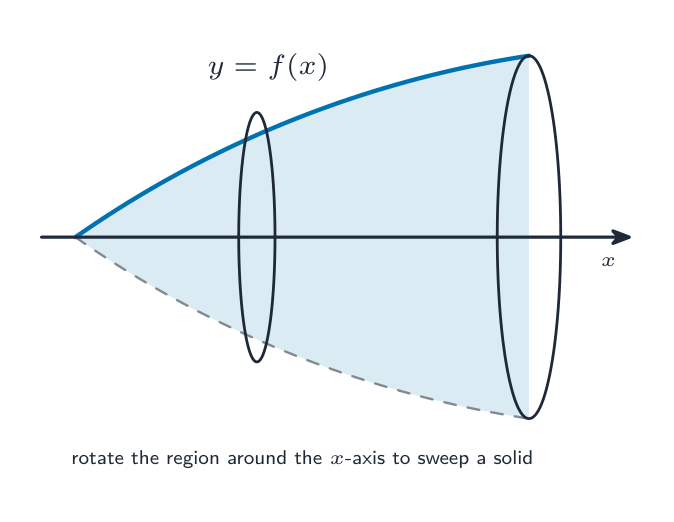
Revolving a region around an axis makes a solid of revolution 旋转体 whose cross sections are discs. The disc method 圆盘法 integrates $\pi(\text{radius})^2$:
$$V=\pi\int_a^b \big(R(x)\big)^2\,dx,$$
where the radius 半径 $R$ is the distance from the curve to the axis. Use $dy$ when revolving around the $y$-axis.
Worked example. Revolving the region under $y=\sqrt{x}$ from $0$ to $4$ about the $x$-axis gives discs of radius $\sqrt{x}$: $V=\pi\displaystyle\int_0^4 (\sqrt{x})^2\,dx=\pi\int_0^4 x\,dx=8\pi$.
Explore
The profile that spins into discs
y = a·√x
Revolving $y=\sqrt x$ about the $x$-axis stacks discs of radius $\sqrt x$ — volume $\pi\int R^2\,dx$.
Vocabulary
Train
| English |
|---|
| solid of revolution/ˈsɒlɪd ɒv ˌrevəˈluːʃn/ |
| disc method/dɪsk ˈmeθəd/ |
| radius/ˈreɪdɪəs/ |
8.10
Volume with Disc Method: Revolving Around Other Axes
Syllabus
| Enduring Understanding | Learning Objective | Essential Knowledge |
|---|---|---|
CHA-5 | CHA-5.C |
|
Source: College Board AP Course and Exam Description
When the axis of revolution 旋转轴 is a horizontal or vertical line like $y=k$ (not an axis), the radius adjusts: $R=|f(x)-k|$. Set up the radius as the distance from the curve to that line, then integrate $\pi R^2$ as before.
Worked example. The region between $y=\sqrt x$ and the line $y=2$, for $0\le x\le4$, is revolved about $y=2$. Each disc has radius $R=2-\sqrt x$ (line minus curve, since the line is above):
$$V=\pi\int_0^4\left(2-\sqrt x\right)^2dx=\pi\int_0^4\left(4-4\sqrt x+x\right)dx=\pi\left(16-\frac{64}{3}+8\right)=\frac{8\pi}{3}.$$
For a write, but do not evaluate question, the integral with correct limits and radius is the whole answer – do not waste time evaluating it.
Explore
The curve above a shifted axis
y = a·√x
Revolving about $y=-1$ makes the radius reach from the curve down to that line — $R=f(x)+1$, larger than $f(x)$.
Vocabulary
Train
| English |
|---|
| axis of revolution |
8.11
Volume with Washer Method: Revolving Around the x- or y-Axis
Syllabus
| Enduring Understanding | Learning Objective | Essential Knowledge |
|---|---|---|
CHA-5 | CHA-5.C |
|
Source: College Board AP Course and Exam Description
If the region does not touch the axis, revolving leaves a hole, so cross sections are washers (rings 圆环). The washer method 垫圈法 subtracts the inner disc:
$$V=\pi\int_a^b\Big(R_{\text{outer}}^2-R_{\text{inner}}^2\Big)\,dx.$$
Identify the outer and inner radii as distances from each curve to the axis.
Explore
Two curves make a ring
y = ax² + bx
Between $y=x$ and $y=\sqrt x$ there is a gap from the axis — revolving makes washers with outer $\sqrt x$, inner $x$.
Vocabulary
Train
| English |
|---|
| ring |
| washer method/ˈwɒʃə ˈmeθəd/ |
8.12
Volume with Washer Method: Revolving Around Other Axes
Syllabus
| Enduring Understanding | Learning Objective | Essential Knowledge |
|---|---|---|
CHA-5 | CHA-5.C |
|
Source: College Board AP Course and Exam Description
As with discs, revolving around a line $y=k$ or $x=k$ shifts both radii – each becomes the distance from its curve to that line. Sketch the region and the axis, label $R_{\text{outer}}$ and $R_{\text{inner}}$, then integrate the difference of squares.
Worked example. Revolve the region between $y=\sqrt{x}$ and $y=x^2$ ($0\le x\le 1$) about (a) the $x$-axis and (b) the line $y=-1$.
(a) On $(0,1)$, $\sqrt{x}>x^2$, so $y=\sqrt{x}$ is farther from the $x$-axis: $R=\sqrt{x}$ and $r=x^2$.
$$V=\pi\int_0^1\big(x-x^4\big)\,dx=\pi\left(\frac12-\frac15\right)=\frac{3\pi}{10}.$$
(b) Each radius is now a distance to $y=-1$, so add $1$ to each height: $R=\sqrt{x}+1$ and $r=x^2+1$. Expand both squares:
$$(\sqrt{x}+1)^2-(x^2+1)^2=\big(x+2\sqrt{x}+1\big)-\big(x^4+2x^2+1\big)=x+2\sqrt{x}-x^4-2x^2.$$
$$V=\pi\int_0^1\big(x+2\sqrt{x}-x^4-2x^2\big)\,dx=\pi\left(\frac12+\frac43-\frac15-\frac23\right)=\frac{29\pi}{30}.$$
Common mistakes. Writing $\pi\int (R-r)^2\,dx$ instead of $\pi\int (R^2-r^2)\,dx$; and, about $y=-1$, using $R=\sqrt{x}-1$ (subtracting) instead of $R=\sqrt{x}-(-1)=\sqrt{x}+1$.
Explore
Two curves above a shifted axis
y = ax² + bx
Revolving about $y=-1$, both radii grow by $1$ — outer $\sqrt x+1$, inner $x+1$; still $R^2-r^2$.
8.13
The Arc Length of a Smooth Curve and Distance Traveled

Syllabus
| Enduring Understanding | Learning Objective | Essential Knowledge |
|---|---|---|
CHA-6 | CHA-6.A |
|
Source: College Board AP Course and Exam Description
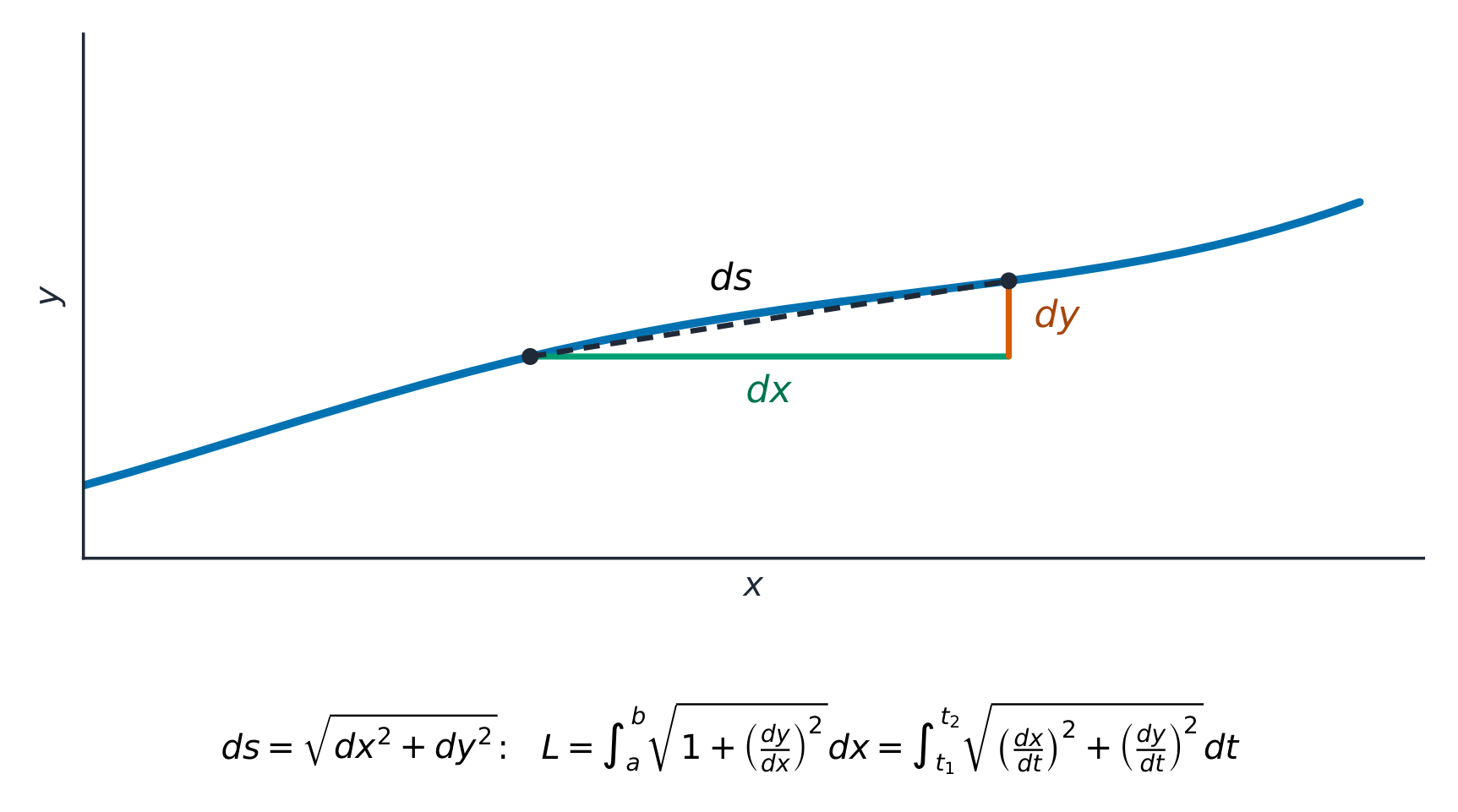
The arc length 弧长 of $y=f(x)$ from $a$ to $b$ is
$$L=\int_a^b\sqrt{1+\big(f'(x)\big)^2}\,dx.$$
This BC-only formula comes from summing tiny hypotenuses 斜边 $\sqrt{dx^2+dy^2}$. The same idea gives the distance a particle 质点 travels along a curved path.
Worked example (perimeter). $R$ is the region between $y=x$ and $y=x^2$ for $0\le x\le1$. Its boundary is a straight segment from $(0,0)$ to $(1,1)$, of length $\sqrt2$, and the parabola, of length $\displaystyle\int_0^1\sqrt{1+(2x)^2}\,dx$. So
$$\text{perimeter}=\sqrt2+\int_0^1\sqrt{1+4x^2}\,dx\approx\sqrt2+1.479\approx2.893.$$
Arc-length integrals rarely have a neat antiderivative; set them up and use the calculator.
Worked example. Find the arc length of $y=\tfrac{2}{3}x^{3/2}$ from $x=0$ to $x=3$. Here $f'(x)=x^{1/2}$, so $1+(f')^2=1+x$ and
$$L=\int_0^3\sqrt{1+x}\,dx=\left[\tfrac{2}{3}(1+x)^{3/2}\right]_0^3=\tfrac{2}{3}(8-1)=\tfrac{14}{3}.$$
Vocabulary
Train
| English |
|---|
| arc length/ɑːk leŋθ/ |
| hypotenuse/haɪˈpɒtənjuːs/ |
| particle/ˈpɑːtɪkl/ |
8.13
Exam tips
- Area between curves is $\int(\text{top}-\text{bottom})\,dx$ — find the intersection points for the limits and keep top minus bottom.
- For a volume of revolution, add up disc/washer cross-sections of area $\pi r^2$ (or $\pi(R^2-r^2)$).
- The average value of $f$ on $[a,b]$ is $\tfrac{1}{b-a}\int_a^b f\,dx$.
- Accumulated change is $\int$ of a rate: total = initial value $+\int_a^b(\text{rate})\,dt$.
- Integration means "adding up infinitely many tiny pieces" — set up the integrand as one thin slice.
- Total distance uses $|v|$; displacement uses $v$. For a minimum or maximum amount, use the candidates test with the endpoints.
Practice.
- Find the average value of $f(x)=\sin x$ on $[0,\pi]$.
- $v(t)=2t-4$ m/s for $0\le t\le5$. Find the displacement and the total distance.
- Find the area enclosed by $y=x^2$ and $y=4$.
- Find the volume when the region under $y=x^2$, $0\le x\le2$, is revolved about the $x$-axis.
- The region between $y=x$ and $y=x^2$ is revolved about the line $y=-1$. Write, but do not evaluate, an integral for the volume.
- Write an integral for the length of $y=\ln x$ from $x=1$ to $x=e$.
Answers.
- $\dfrac1\pi\displaystyle\int_0^\pi\sin x\,dx=\dfrac{2}{\pi}$.
- Displacement $\displaystyle\int_0^5(2t-4)\,dt=25-20=5$ m. $v<0$ on $(0,2)$: distance $=4+9=13$ m.
- They meet at $x=\pm2$: $\displaystyle\int_{-2}^2(4-x^2)\,dx=16-\frac{16}{3}=\frac{32}{3}$.
- $\pi\displaystyle\int_0^2x^4\,dx=\dfrac{32\pi}{5}$.
- $\pi\displaystyle\int_0^1\left[(x+1)^2-(x^2+1)^2\right]dx$.
- $\displaystyle\int_1^e\sqrt{1+\frac1{x^2}}\,dx$.
Interactive lessons on this topic
Work through it step by step, with instant-check exercises.
- Finding the Average Value of a Function on an Interval
- Connecting Position, Velocity, and Acceleration of Functions Using Integrals
- Using Accumulation Functions and Definite Integrals in Applied Contexts
- Finding the Area Between Curves Expressed as Functions of x
- Finding the Area Between Curves Expressed as Functions of y
- Finding the Area Between Curves That Intersect at More Than Two Points
- Volumes with Cross Sections: Squares and Rectangles
- Volumes with Cross Sections: Triangles and Semicircles
- Volume with Disc Method: Revolving Around the x- or y-Axis
- Volume with Disc Method: Revolving Around Other Axes
- Volume with Washer Method: Revolving Around the x- or y-Axis
- Volume with Washer Method: Revolving Around Other Axes
- The Arc Length of a Smooth, Planar Curve and Distance Traveled