Cell Communication
Introduced| English | Meaning |
|---|---|
| signal/ˈsɪɡnl/ | Information conveyed by a molecule, electrical change or other cue that can trigger a biological response. |
| receptor/rɪˈseptə/ | A cell or molecule that detects a stimulus or binds a specific signalling molecule to initiate a response. |
| ligand/ˈlɪɡænd/ | An ion or molecule that binds to another species at a specific site, such as a metal centre or a receptor. |
| target cell/ˈtɑːɡɪt sel/ | A cell with the receptor for a particular signal. |
Cells talk to each other
- A body is trillions of cells, yet they act as one.
- To do that, cells must constantly send and receive messages.
- One cell releases a signal; another detects it and responds.
- This constant conversation keeps the whole organism working together.
Signals and receptors
- A signal 信号 is a molecule one cell sends to affect another.
- The signal molecule is also called a ligand 配体.
- It is detected when it binds a matching receptor 受体 on the target cell.
- Ligand and receptor fit together like a key in a lock.
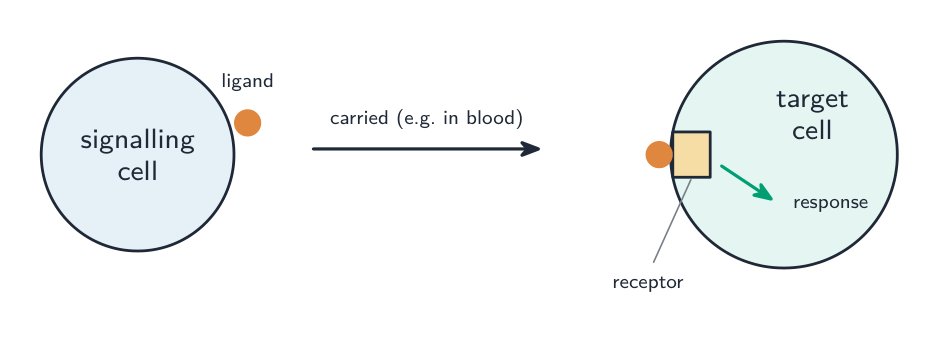
A signal molecule (ligand) binds a matching receptor on the target cell
Why do the cells of a body need to communicate?
Difficulty 1/5 · 100 coins + a small bonus on first completion today
Cells must communicate to act together — growing, defending, and responding as one coordinated body.
Only target cells respond
- A target cell 靶细胞 is one that carries the right receptor.
- Only target cells can detect and respond to a given signal.
- Other cells lack the receptor, so the signal passes them by.
- This is how one signal can reach many cells but affect only some.
A signal molecule (ligand) is detected when it binds to a…
Difficulty 1/5 · 100 coins + a small bonus on first completion today
A ligand binds a specific receptor, like a key in a lock, delivering the message.
Signals travel different distances
- Some cells signal by direct contact, touching a neighbour.
- Some send local signals to nearby cells, like a growth factor.
- Some send long-distance signals — hormones — through the blood.
- The distance depends on how far the message needs to go.
How far does the signal travel?
Sort each kind of cell signalling by how far the message has to travel.
A cell that has the right receptor and can respond to a signal is called a ____ cell.
Difficulty 1/5 · 100 coins + a small bonus on first completion today
Only a target cell with the matching receptor responds; other cells ignore the signal.
A hormone can travel through the blood to reach distant cells all over the body.
Difficulty 1/5 · 100 coins + a small bonus on first completion today
Hormones are long-distance signals — they travel in the blood to far-off target cells.
Select all true statements about cell communication.
Difficulty 2/5 · 140 coins + a small bonus on first completion today
A cell responds only if it has the matching receptor, so not every cell responds to every signal.
A hormone floods the whole body, yet only some cells react. The reason is the receptor: a cell responds only if it carries the matching receptor. No receptor, no response — even if the signal is right there.
Adrenaline before a race:
- Your adrenal glands release adrenaline into the blood.
- It reaches almost every cell in your body.
- But only cells with adrenaline receptors — heart, muscle, liver — respond, speeding you up for action.
Cells communicate by sending a signal (a ligand) that binds a matching receptor on a target cell. Only cells with the right receptor respond. Signals travel by direct contact, locally to nearby cells, or long-distance through the blood as hormones.
Write from endocrine signaling
- A hormone travels in the blood.
- The target cell is in a different organ.
What kind of signaling is this?
Hormones in the blood are endocrine signals.
What signaling uses the blood to a distant organ?
Difficulty 1/5 · 100 coins + a small bonus on first completion today
Distance plus the bloodstream is endocrine.