Regulation of Cell Cycle
Introduced| English | Meaning |
|---|---|
| checkpoint/ˈtʃekpɔɪnt/ | A point where the cell pauses to check itself. |
| cancer/ˈkænsə/ | A group of diseases involving uncontrolled cell growth, with the potential to invade surrounding tissues and spread. |
| cyclins/ˈsaɪklɪnz/ | Proteins whose levels rise and fall to drive the cell cycle. |
| cyclin-dependent kinase/ˈsaɪklɪn dɪˈpendənt ˈkɪneɪs/ | cyclin-dependent kinase |
The cell must decide whether to divide
- A cell detects damaged DNA just before division. Passing that damage to two daughter cells would spread the problem.
- Checkpoints 检查点 and cyclin-controlled enzymes can pause the cycle, permit repair or trigger cell death. Failed control can contribute to uncontrolled growth.
Checkpoints: stop and check
- A checkpoint is a point where the cell pauses to check itself.
- Only if everything is in order does the cycle continue.
- If something is wrong, the cell stops and tries to fix it.
- Checkpoints act like quality-control inspectors along the way.
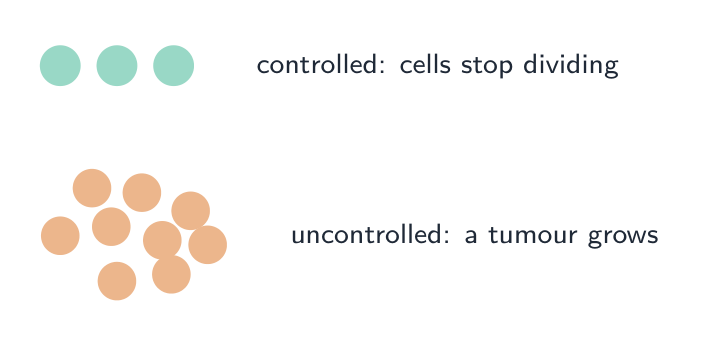
Uncontrolled division from failed checkpoints forms a tumour
A cell cycle checkpoint is a point where the cell…
Difficulty 1/5 · 100 coins + a small bonus on first completion today
A checkpoint halts the cycle to check conditions; the cell continues only if all is well.
What they check
- One checkpoint asks: is the cell big enough and healthy?
- Another asks: was the DNA copied correctly and completely?
- Another asks: are the chromosomes lined up before they separate?
- A failed check halts division until the problem is solved.
Cell cycle checkpoints
Step through the checkpoints — each is a stop-and-check that only lets the cell go on if all is well.
What might a checkpoint check for?
Difficulty 1/5 · 100 coins + a small bonus on first completion today
Checkpoints check for things like DNA damage, cell size, and correct DNA copying before allowing division.
When control fails: cancer 癌症
- If checkpoints stop working, a cell can divide out of control.
- Uncontrolled division builds a lump of cells — a tumour.
- This runaway growth is what we call cancer.
- Healthy checkpoints are the body's defence against it.
What can happen if cell cycle control fails?
Difficulty 1/5 · 100 coins + a small bonus on first completion today
If checkpoints fail, cells divide without control — this uncontrolled growth is cancer.
Checkpoints help prevent damaged cells from dividing.
Difficulty 1/5 · 100 coins + a small bonus on first completion today
By stopping a damaged cell, a checkpoint protects the body from passing on faulty cells.
Select all true statements about cell cycle regulation.
Difficulty 2/5 · 140 coins + a small bonus on first completion today
Checkpoints slow or stop division when needed; they do not speed it up. The other three are correct.
Cyclins 周期蛋白 control kinase activity
- Cyclins vary in abundance through the cycle. Binding a cyclin activates a cyclin-dependent kinase 周期蛋白依赖性激酶 (CDK), which phosphorylates target proteins to help the cell progress.
- Cyclin production and breakdown help control timing. Checkpoint signals can prevent progression when DNA is damaged, replication is incomplete or chromosomes lack proper spindle attachment.
What is the direct role of a cyclin in this explanation?
Difficulty 1/5 · 100 coins + a small bonus on first completion today
An active cyclin–CDK complex phosphorylates cell-cycle targets.
Pause, repair or remove the cell
- A checkpoint can delay division while damage is repaired. If damage cannot be resolved, signalling may trigger apoptosis rather than passing damaged DNA to daughter cells.
- Worked prediction: a defective checkpoint permits DNA-damaged cells to divide. Mutations can accumulate and contribute to cancer; a single defect does not guarantee that every affected cell becomes a tumour.
Loss of a checkpoint can increase cancer risk by allowing damaged cells to divide.
Difficulty 1/5 · 100 coins + a small bonus on first completion today
Failure to pause or remove damaged cells can allow mutations to accumulate.
Which regulated outcome can remove a cell with irreparable damage?
Difficulty 1/5 · 100 coins + a small bonus on first completion today
Programmed cell death can protect the organism from a damaged cell.
A checkpoint failure is serious. If the controls that pause a damaged cell break, that cell divides again and again, passing on its faults — the start of cancer. The whole point of regulation is to catch problems before division.
Catching damaged DNA:
- Suppose a cell's DNA is damaged by UV light from the sun.
- At the next checkpoint, the cell detects the damage and halts.
- It either repairs the DNA or self-destructs — stopping a faulty cell from ever dividing.
The cell cycle is regulated by checkpoints — pauses where the cell checks that conditions (size, DNA copying, chromosome alignment) are correct before continuing. If this control fails, cells divide uncontrollably, which can lead to a tumour and cancer. Checkpoints protect the body by stopping damaged cells.
Write from the G1 checkpoint
- DNA damage is detected before replication.
- A protein such as p53 can stop the cycle.
Which checkpoint is this?
G1 checks the cell before DNA is replicated.
Which checkpoint stops a cell before S when DNA is damaged?
Difficulty 1/5 · 100 coins + a small bonus on first completion today
Damage should be caught before replication.