Signal Transduction Pathways
Introduced| English | Meaning |
|---|---|
| signal transduction pathway/ˈsɪɡnl trænsˈdʌkʃn ˈpæθweɪ/ | A chain of molecules. |
| second messenger/ˈsekənd ˈmesɪndʒə/ | An intracellular molecule or ion that carries a signal onward after a receptor is activated. |
| amplification/ˌæmplɪfɪˈkeɪʃn/ | amplification |
| apoptosis/əpəpˈtəʊsɪs/ | Programmed cell death: the controlled dismantling of a cell. |
One message can change a cell in different ways
- An adrenaline signal can make a liver cell release glucose rapidly. Another signal can change gene expression or tell a damaged cell to die.
- A cellular response depends on the pathway components and cell type; receiving the same external signal does not make every cell perform the same action.
The pathway is a chain
- A signal transduction pathway 信号转导通路 is a chain of molecules.
- Molecule A activates B, B activates C, and so on.
- Each step is a switch, turning on the next part of the chain.
- This relay carries the message from the receptor deep into the cell.
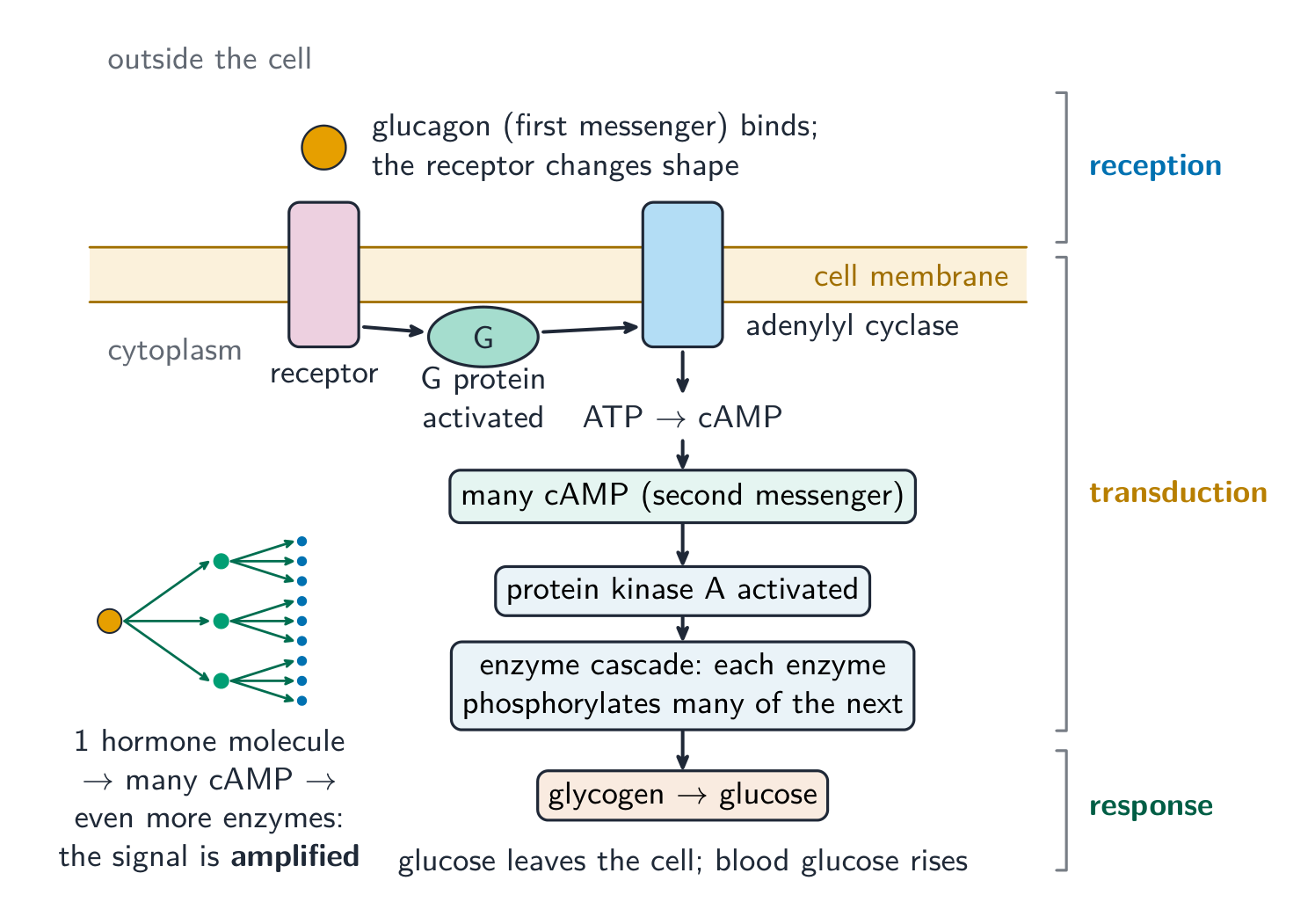
A signalling cascade amplifies the message inside the cell
A signal transduction pathway is…
Difficulty 1/5 · 100 coins + a small bonus on first completion today
A pathway is a relay: molecule A activates B, B activates C, and so on inside the cell.
Second messengers 第二信使 spread it fast
- Some pathways use a second messenger — a small molecule that floods the cell.
- It carries the signal quickly to many places at once.
- This lets the response start almost instantly.
- A single receptor can release a burst of second messengers.
A signalling cascade
Step down the cascade — each molecule activates many of the next, so one signal becomes a huge response.
What is a second messenger?
Difficulty 1/5 · 100 coins + a small bonus on first completion today
A second messenger is a small molecule that rapidly relays and spreads the signal within the cell.
When one signal produces a huge response through a cascade, we call it ____.
Difficulty 1/5 · 100 coins + a small bonus on first completion today
Each step activates many of the next, so amplification turns a tiny signal into a large effect.
Amplification 放大: small in, big out
- At each step, one molecule activates many of the next.
- So the numbers multiply down the chain — this is amplification.
- A handful of signal molecules can end in millions of active molecules.
- This is how a tiny signal produces a large response.
A cascade lets a very small signal cause a very large response.
Difficulty 1/5 · 100 coins + a small bonus on first completion today
Because each step multiplies the numbers, a few signal molecules can drive millions of active molecules.
Select all true statements about signalling pathways.
Difficulty 2/5 · 140 coins + a small bonus on first completion today
Amplification means one signal makes many active molecules, not just one. The other three are correct.
A signal can change enzyme activity or gene expression
- An adrenaline signal in a liver cell can activate a pathway that breaks stored glycogen into material used to release glucose. This is a change in enzyme activity, not a need to make a new gene.
- Other pathways activate transcription factors and change which genes are expressed. Some signals trigger apoptosis 细胞凋亡, a controlled cell-death programme that removes unwanted or damaged cells.
A cellular response can include programmed cell death.
Difficulty 1/5 · 100 coins + a small bonus on first completion today
Apoptosis is a regulated response, not necessarily accidental injury.
A liver cell rapidly activates existing enzymes that break down glycogen. Which response is described?
Difficulty 1/5 · 100 coins + a small bonus on first completion today
The pathway can alter proteins already present; not all responses require new transcription.
A mutation can switch a pathway off or leave it on
- If a receptor can no longer bind its ligand, the normal response may disappear. If a downstream relay protein becomes permanently active, the cell may respond even when no ligand is present.
- Worked comparison: remove the ligand, then measure the output. A normal pathway switches off; a permanently active downstream component can keep the output high. The prediction depends on where the mutation acts.
A mutation makes a downstream relay permanently active. What can happen after the ligand is removed?
Difficulty 1/5 · 100 coins + a small bonus on first completion today
Constitutive relay activity can bypass the need for the upstream signal.
A signalling cascade amplifies: one signal molecule does not make just one product — it makes a flood of them. Never assume "one signal, one response." A few molecules at the top can drive a huge effect at the bottom.
Adrenaline releasing your energy:
- A few adrenaline molecules bind receptors on a liver cell.
- Each triggers a cascade that activates more and more enzymes.
- The result: millions of glucose molecules released into the blood — a giant response from a tiny signal.
A signal transduction pathway is a relay chain where each molecule activates the next, often using a second messenger to spread the signal fast. Because each step activates many of the next, the pathway causes amplification — a tiny signal produces a large response.
Write from 20 kinase molecules
- One ligand-bound receptor activates a phosphorylation cascade.
- The first active kinase then activates many copies of the next kinase. In this case that next step reaches 20 molecules.
What does the jump to 20 molecules show?
Cascades turn one signal into many active enzymes.
What does one signal activating 20 kinases show?
Difficulty 1/5 · 100 coins + a small bonus on first completion today
More active enzymes than signals means amplification.