| Big Idea | Learning Objective | Essential Knowledge |
|---|---|---|
Big Idea 4 — Systems Interactions | 1.1.A |
|
Chemistry of Life
AP Biology · Topic 1
 9:24
Chemistry of Life
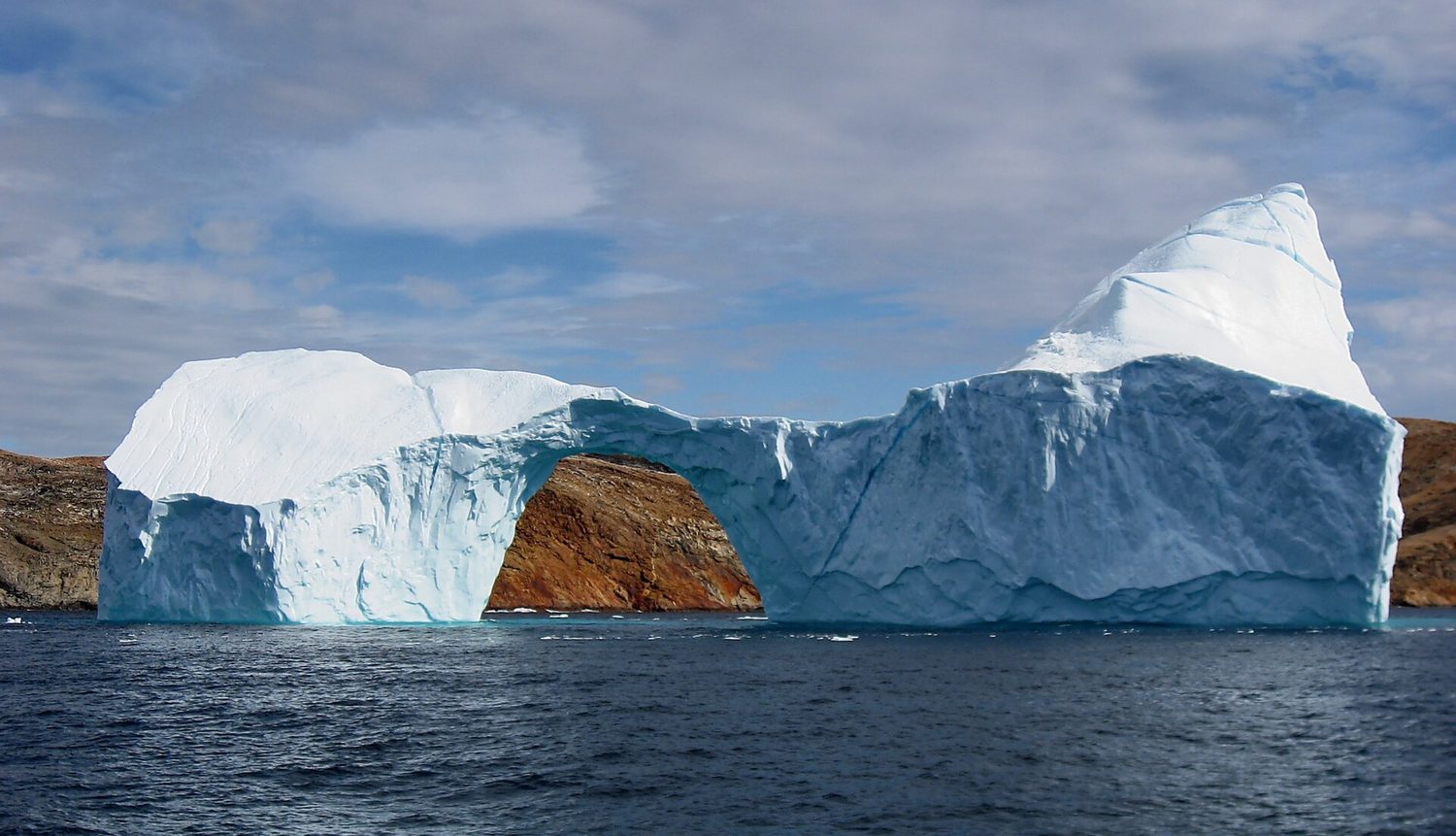
Drop an ice cube into a glass and it floats. That sounds ordinary, but it is strange. Almost every other solid sinks in its own liquid, because freezing packs…
English narration · English + 中文 subtitles burned in
1.1
Structure of Water and Hydrogen Bonding
Syllabus
Source: College Board AP Course and Exam Description
Ice floats, so lakes freeze from the top and fish survive the winter underneath. A single wrong amino acid among hundreds in haemoglobin causes sickle cell disease. Both start at the scale of atoms and bonds, which is where this unit begins.
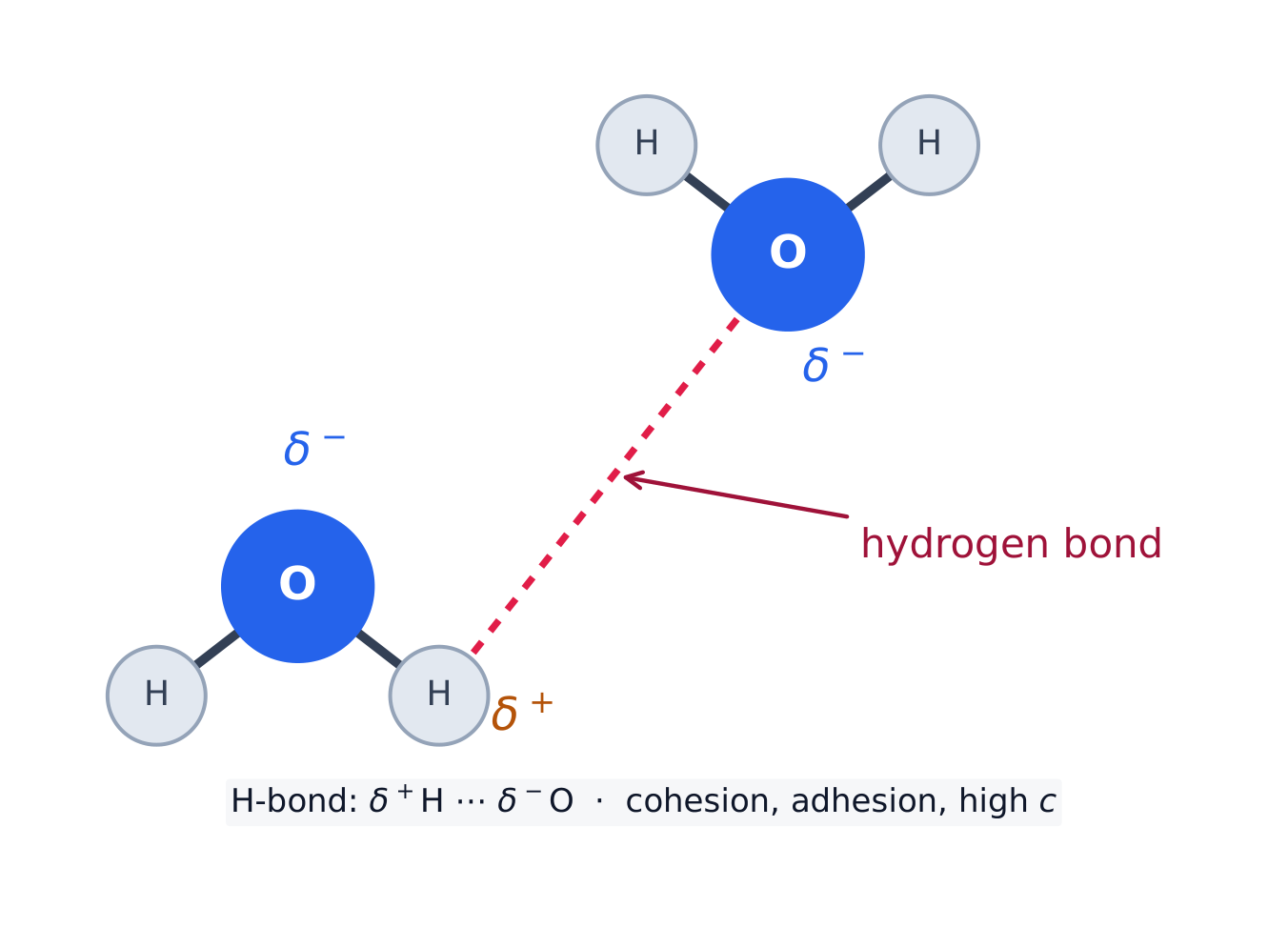
Water is polar 极性: its oxygen pulls electrons more strongly than its hydrogens, giving a slightly negative O and slightly positive H. This lets water molecules form hydrogen bonds 氢键 with each other, which explains water's life-supporting properties:
- Cohesion 内聚力 and adhesion 附着力 (surface tension, capillary action, water rising in plants),
- high specific heat 比热容 (resists temperature change, stabilizing organisms),
- high heat of vaporization (evaporative cooling),
- ice floating (less dense solid), and being a great solvent for polar and ionic substances.
Explore
Explore how a covalent bond shares electrons
Step through two atoms overlapping to share a pair of electrons so each reaches a full shell. In $\text{H}_2$ the two atoms pull equally, so the bond is non-polar — the contrast that makes water's unequal sharing (and its $\delta^+/\delta^-$ dipole) so important.
Vocabulary
Train
| English |
|---|
| polar/ˈpəʊlə/ |
| hydrogen bonds/ˈhaɪdrədʒn bɒndz/ |
| Cohesion/kəʊˈhiːʒn/ |
| adhesion/ədˈhiːʒn/ |
| specific heat/spəˈsɪfɪk hiːt/ |
1.2
Elements of Life
Syllabus
| Big Idea | Learning Objective | Essential Knowledge |
|---|---|---|
Big Idea 2 — Energetics | 1.2.A |
|
Source: College Board AP Course and Exam Description
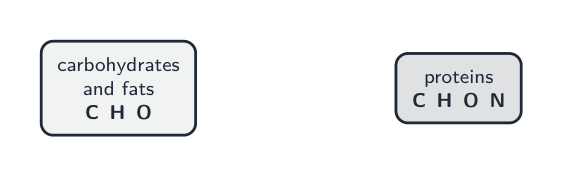
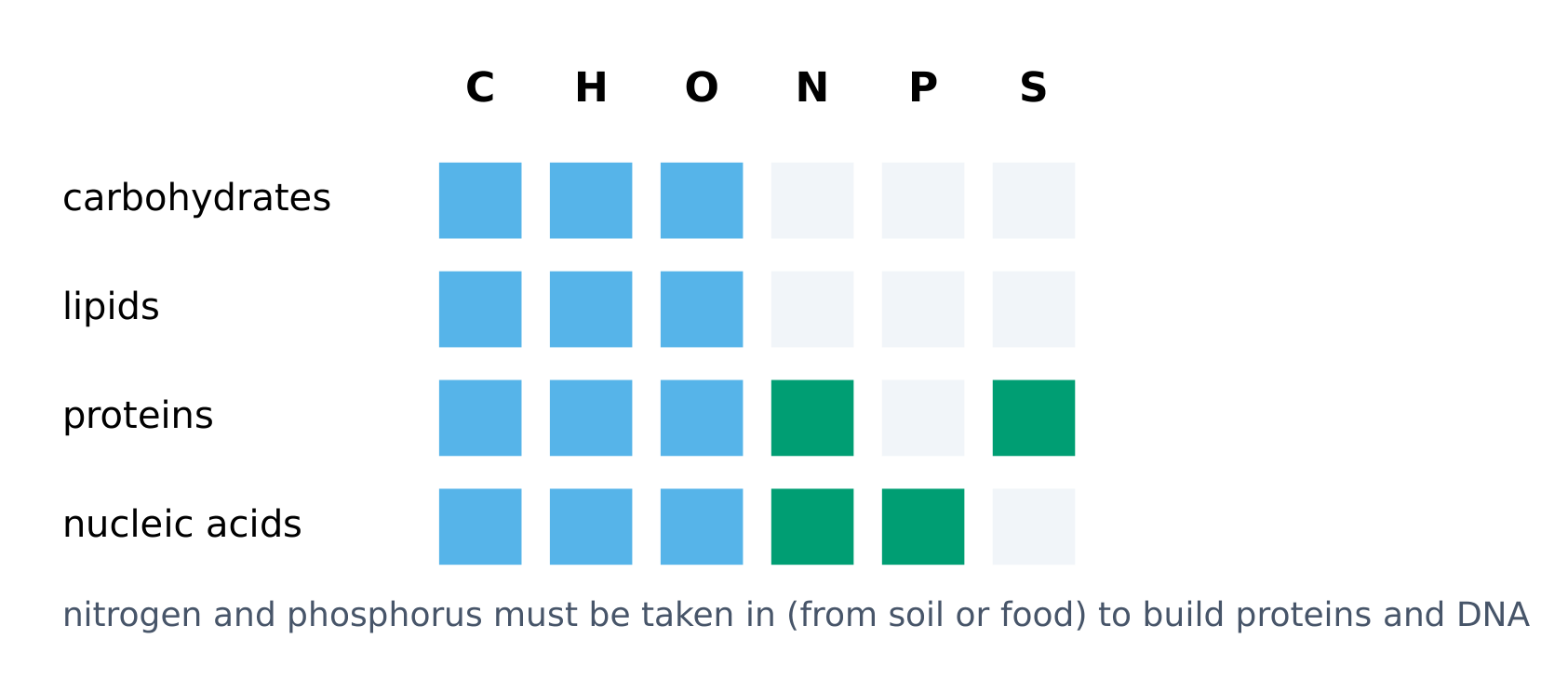
Living matter is built mostly from a few elements – carbon, hydrogen, oxygen, nitrogen, phosphorus, and sulfur. Carbon 碳 is central because it forms four stable covalent bonds, building long chains, branches, and rings – the skeletons of organic biological molecules.
Explore
Major or trace element?
Sort elements by how much of a living body they make up. A few elements dominate; others are vital in tiny amounts.
Vocabulary
Train
| English |
|---|
| Carbon/ˈkɑːbən/ |
1.3
Introduction to Macromolecules
Syllabus
| Big Idea | Learning Objective | Essential Knowledge |
|---|---|---|
Big Idea 4 — Systems Interactions | 1.3.A |
|
Source: College Board AP Course and Exam Description
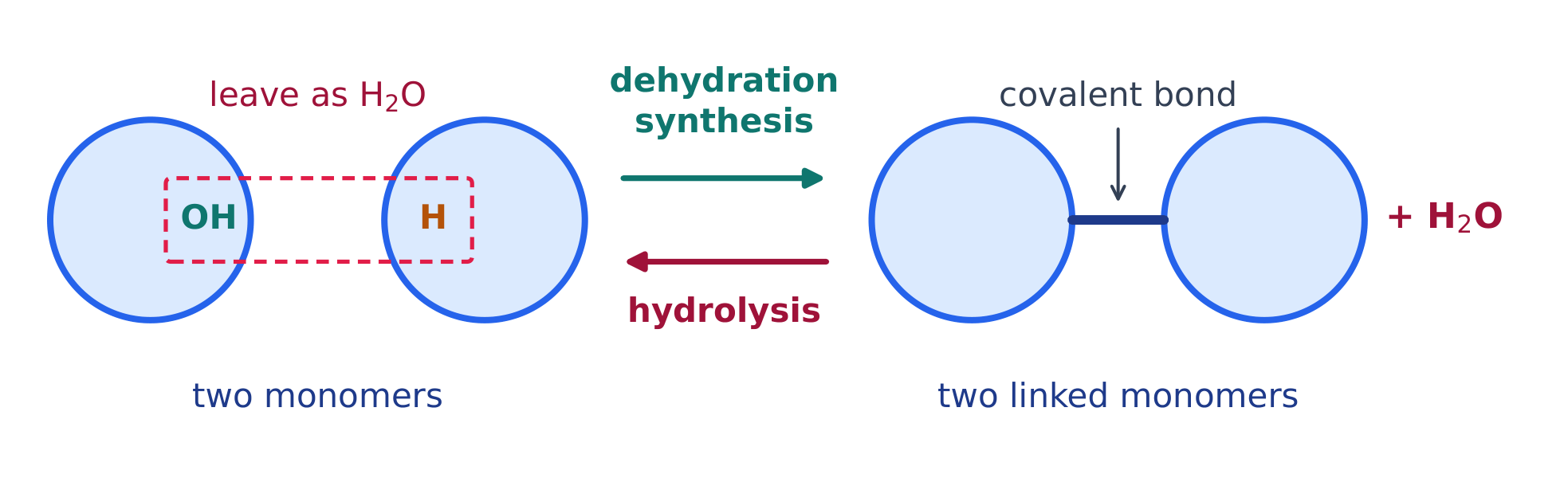
Many large biological molecules – macromolecules 大分子 – are polymers 聚合物 built from repeating monomers 单体. Lipids are also studied among the major biological molecule classes, but are not generally repeating-unit polymers. Cells join monomers by dehydration synthesis 脱水缩合 (removing water to form a bond) and break polymers by hydrolysis 水解 (adding water). Four classes: carbohydrates, lipids, nucleic acids, and proteins.
Explore
Explore the four classes of macromolecule by their monomer
Sort each clue into the right macromolecule class by matching the monomer that builds it — sugars, nucleotides or amino acids — and notice that lipids are the odd one out that are not true polymers.
Vocabulary
Train
| English |
|---|
| macromolecules/ˈmækrəmɒlɪkjuːlz/ |
| polymers/ˈpɒlɪməz/ |
| monomers/ˈmɒnəʊməz/ |
| dehydration synthesis/ˌdiːhaɪˈdreɪʃn ˈsɪnθəsɪs/ |
| hydrolysis/haɪˈdrɒləsɪs/ |
1.4
Carbohydrates
Syllabus
| Big Idea | Learning Objective | Essential Knowledge |
|---|---|---|
Big Idea 4 — Systems Interactions | 1.4.A |
|
Source: College Board AP Course and Exam Description
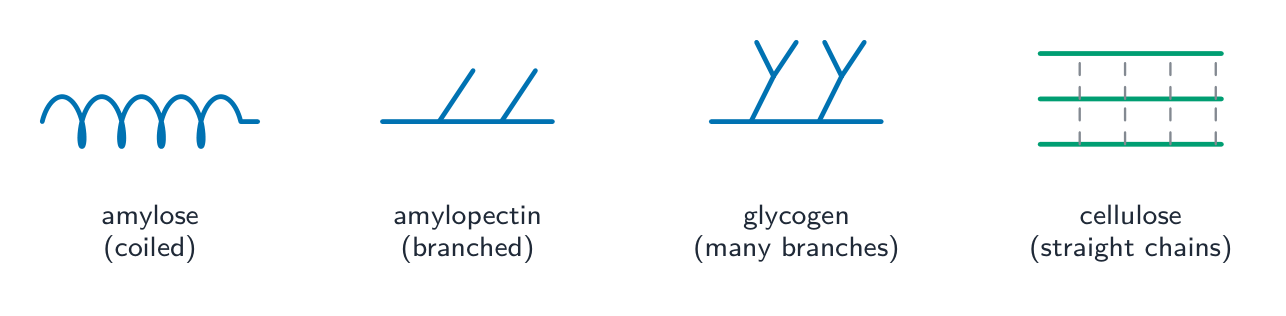
Carbohydrates 碳水化合物 are made of sugar monomers (monosaccharides 单糖 like glucose). They store energy (starch, glycogen) and provide structure (cellulose 纤维素 in plant walls). Many small sugars are polar and dissolve readily in water. Large carbohydrate polymers differ: cellulose, for example, does not dissolve readily in water.
The way the monomers are linked sets the job. Glycogen, the animal energy store, is highly branched, with many ends where enzymes can remove glucose quickly when it is needed. Starch in plants is a mix of unbranched and branched chains. Cellulose chains are long and linear: they lie side by side, hydrogen-bond to each other, and form strong fibres that make plant cell walls rigid. If asked to describe a glucose molecule, say it contains only carbon, hydrogen and oxygen atoms, joined by covalent bonds, with polar O–H groups that hydrogen-bond to water, which is why glucose dissolves.
Explore
Sort the sugars
Group each carbohydrate by how many sugar units it contains.
Vocabulary
Train
| English |
|---|
| Carbohydrates/ˌkɑːbəʊˈhaɪdreɪts/ |
| monosaccharides/ˈmɒnəʊsækɑːraɪdz/ |
| cellulose/ˈseljuːləʊs/ |
1.5
Lipids
Syllabus
| Big Idea | Learning Objective | Essential Knowledge |
|---|---|---|
Big Idea 4 — Systems Interactions | 1.5.A |
|
Source: College Board AP Course and Exam Description
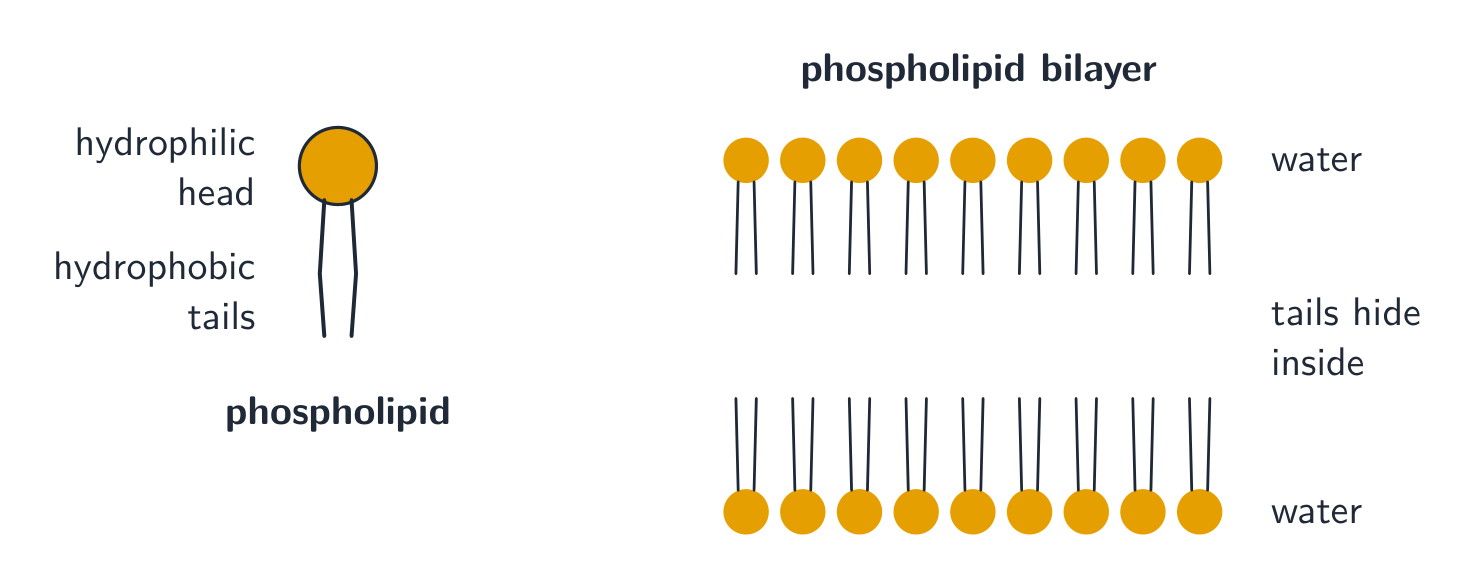
Lipids 脂质 contain large nonpolar, water-repelling (hydrophobic 疏水) regions. Some also have polar regions, so they are not uniformly nonpolar. They include fats (long-term energy storage), phospholipids 磷脂 (which build membranes), and steroids. A phospholipid has a polar "head" and nonpolar "tails," the key to the cell membrane.
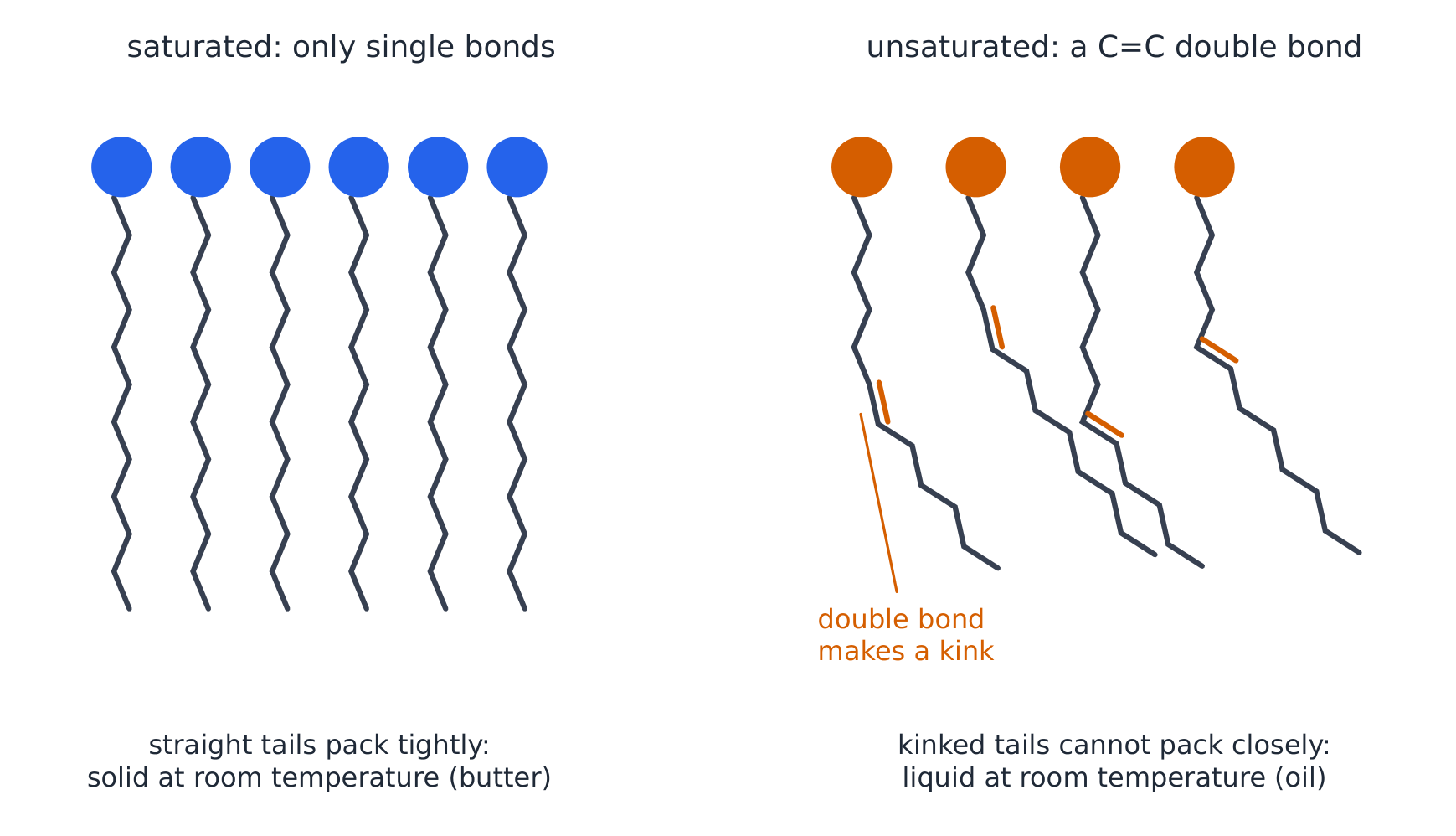
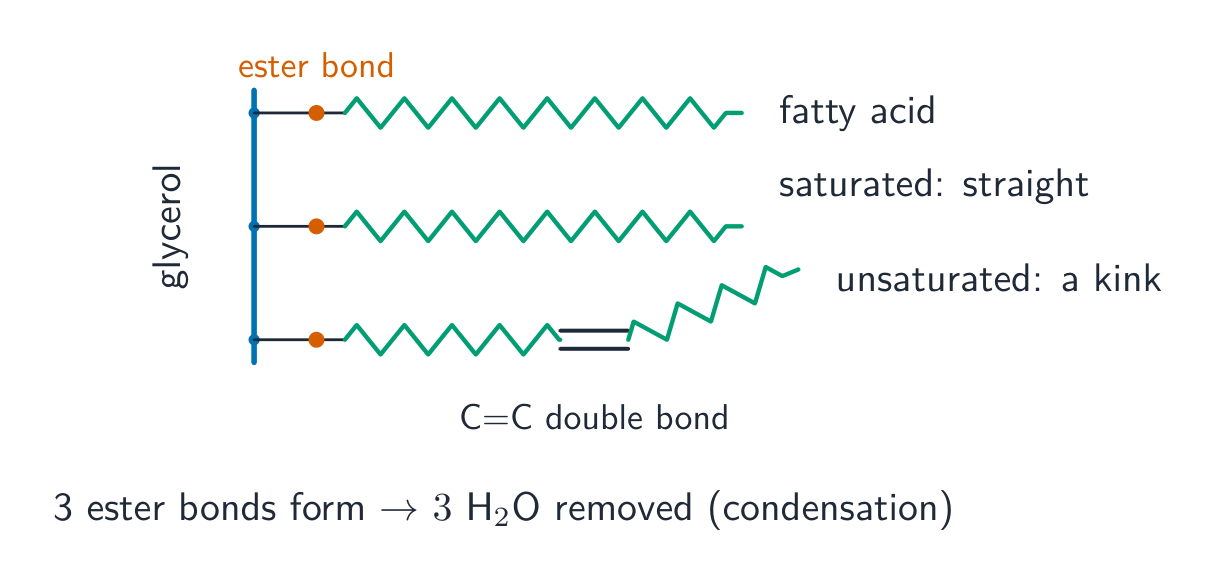
Fatty-acid tails come in two kinds. A saturated 饱和的 fatty acid has only single bonds between its carbon atoms, so its tail is straight. An unsaturated 不饱和的 fatty acid has at least one C=C double bond, which puts a kink in the tail. Straight tails pack closely, so saturated fats such as butter are solid at room temperature. Kinked tails cannot pack closely, so unsaturated fats such as olive oil are liquid. The more double bonds, the more unsaturated, and the more liquid the lipid.
Lipids do several jobs. Fats store energy and, under the skin of mammals, insulate the body. Steroids 类固醇 such as testosterone and oestrogen are hormones that control growth, development and metabolism. Cholesterol 胆固醇 sits among the phospholipids of animal cell membranes and keeps them stable.
Explore
Sort the lipids
Group each lipid by its structure and main job in the body.
Vocabulary
Train
| English |
|---|
| Lipids/ˈlɪpɪdz/ |
| hydrophobic/ˌhaɪdrəˈfəʊbɪk/ |
| phospholipids/ˈfɒsfəlɪpɪdz/ |
| saturated/ˈsætʃəreɪtɪd/ |
| unsaturated/ʌnˈsætʃəreɪtɪd/ |
| Steroids |
| Cholesterol/kəˈlestərɒl/ |
1.6
Nucleic Acids
Syllabus
| Big Idea | Learning Objective | Essential Knowledge |
|---|---|---|
Big Idea 3 — Information Storage and Transmission | 1.6.A |
|
Source: College Board AP Course and Exam Description
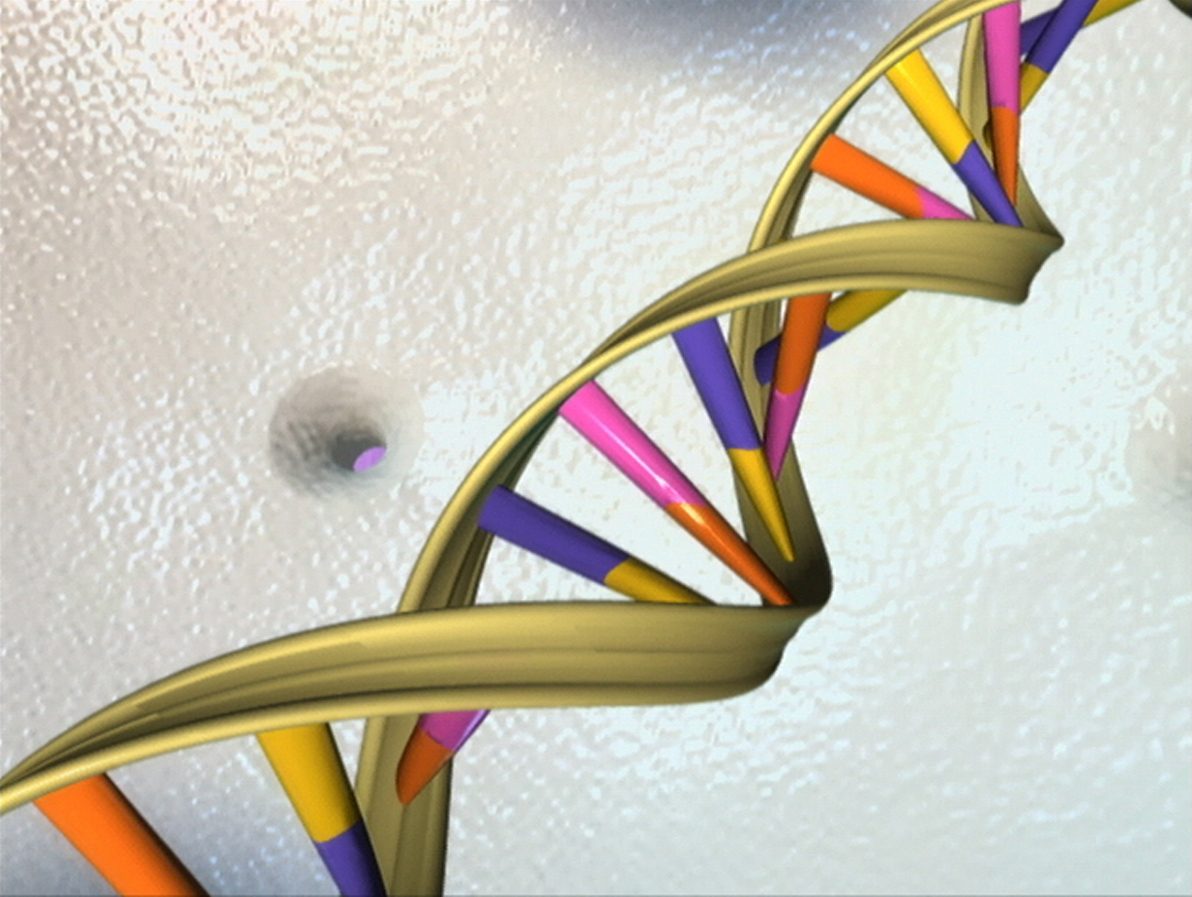
Nucleic acids 核酸 (DNA and RNA) store and carry genetic information. Their monomers are nucleotides 核苷酸, each a sugar, a phosphate, and a nitrogen base. The base sequence encodes instructions; cellular DNA is usually double-stranded, while RNA is usually single-stranded and can fold into paired regions.
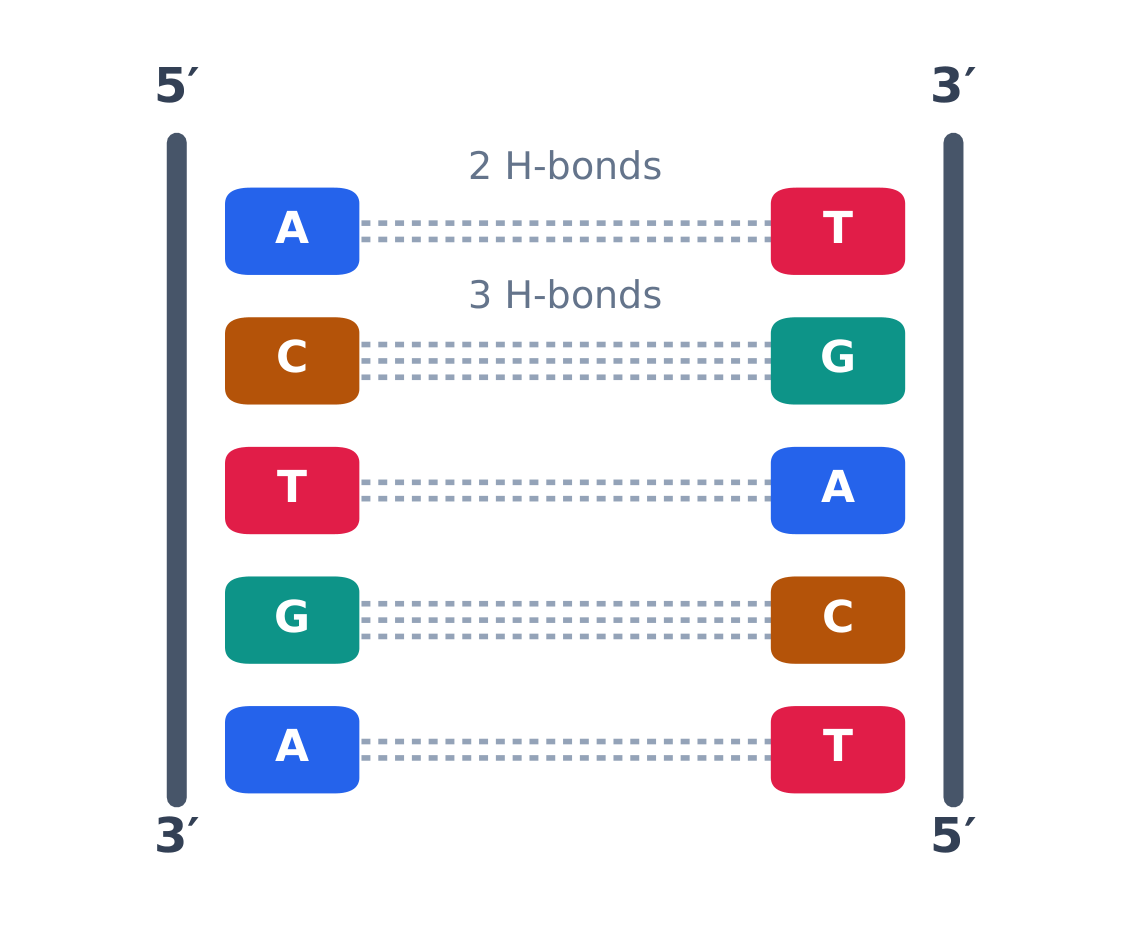
Each nucleotide has three parts: a five-carbon sugar, a phosphate group, and a nitrogenous base 含氮碱基 (A, T, C or G in DNA; A, U, C or G in RNA). The sugar of one nucleotide bonds to the phosphate of the next, making a sugar–phosphate backbone with the bases sticking out. A strand has two different ends: the 5′ end carries a phosphate and the 3′ end a hydroxyl ($-\text{OH}$). New nucleotides are always added to the 3′ end, so a strand grows in the 5′→3′ direction.
| DNA | RNA | |
|---|---|---|
| sugar | deoxyribose | ribose |
| bases | A, T, C, G | A, U, C, G |
| strands | usually two (double helix) | usually one |
Because every nucleotide carries a negatively charged phosphate, DNA as a whole is negatively charged. In an electric field it moves toward the positive electrode, and shorter fragments move faster through a gel. This is how gel electrophoresis and the comet assay separate DNA by size.
Explore
Explore complementary base pairing
Step along a DNA template and watch each base pair to its partner by complementary base pairing ($A$ with $T$, $G$ with $C$) — the rule that lets either strand act as a template to rebuild the other.
Vocabulary
Train
| English |
|---|
| Nucleic acids/njuːˈklɪɪk ˈæsɪdz/ |
| nucleotides/ˈnjuːklɪɒtaɪdz/ |
| nitrogenous base |
1.7
Proteins
Syllabus
| Big Idea | Learning Objective | Essential Knowledge |
|---|---|---|
Big Idea 3 — Information Storage and Transmission | 1.7.A |
|
Source: College Board AP Course and Exam Description
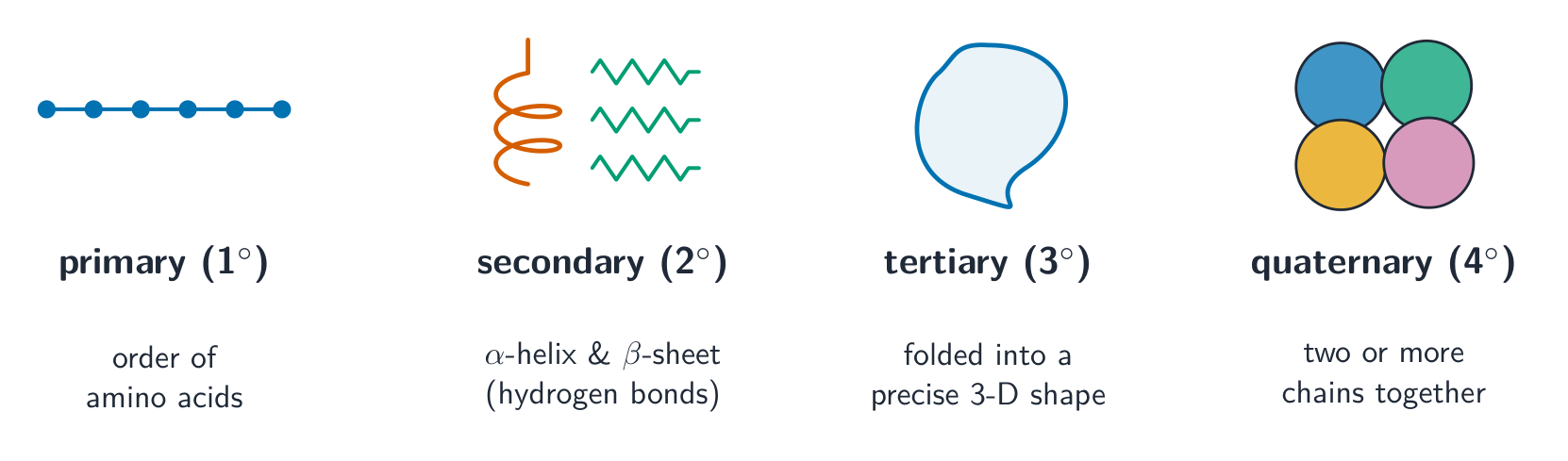
Proteins 蛋白质 are polymers of amino acids 氨基酸 joined by peptide bonds 肽键. Their amino-acid sequence contributes to their 3-D shape (primary, secondary and tertiary structure; quaternary structure applies when multiple polypeptide chains assemble), and shape determines function – as enzymes, transporters, receptors, and structural parts. Changing the environment (heat, pH) can denature 变性 a protein, unfolding it and stopping its function.
Every amino acid has the same backbone: a central carbon bonded to an amine group ($-\text{NH}_2$), a carboxyl group ($-\text{COOH}$), a hydrogen, and an R group 侧链. Only the R group differs, and it falls into one of three classes: nonpolar (hydrophobic), polar, or charged (acidic or basic). A peptide bond joins the carboxyl group of one amino acid to the amine group of the next, so a chain has an amino (N) end and a carboxyl (C) end. The levels of structure come from different interactions:
- Primary structure: the sequence of amino acids.
- Secondary structure 二级结构: hydrogen bonds between atoms of the backbone fold short stretches into α-helices and β-pleated sheets.
- Tertiary structure 三级结构: interactions between R groups (hydrogen bonds, hydrophobic clustering, ionic bonds and disulfide bridges) fold the whole chain into its 3-D shape.
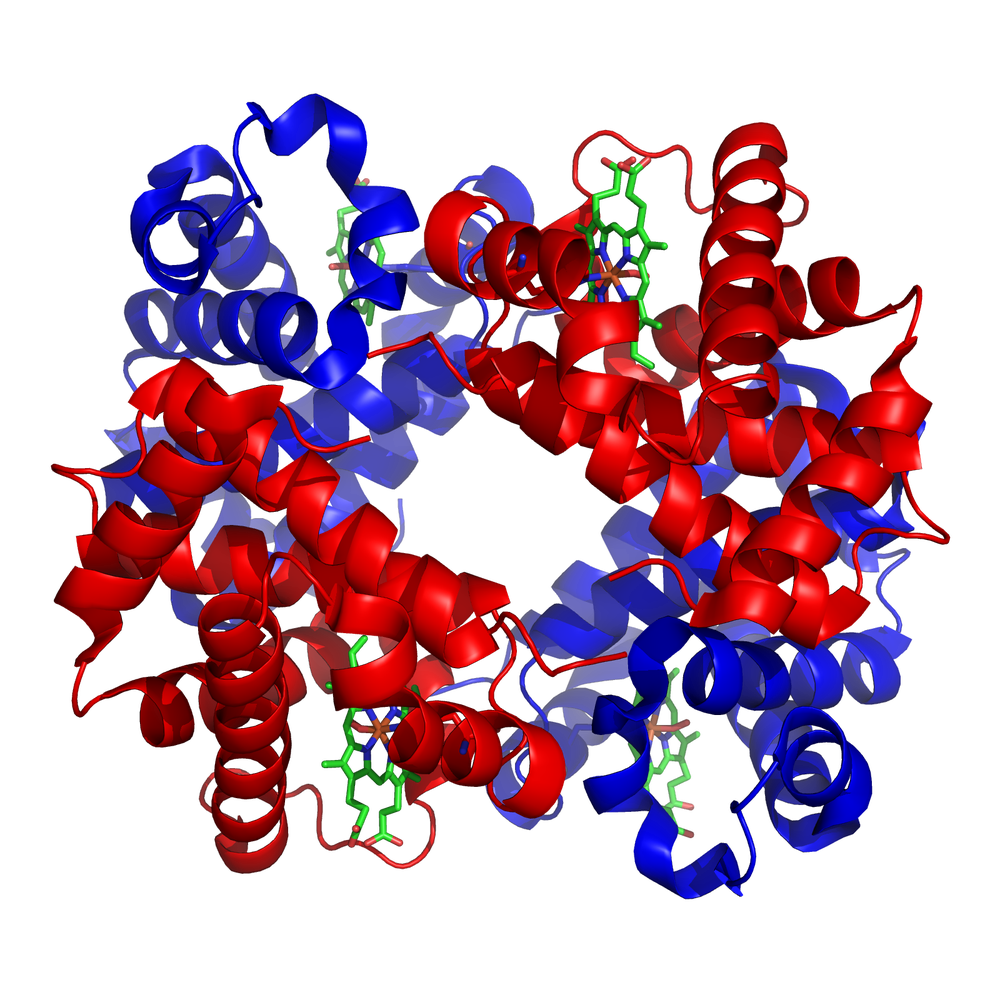
- Quaternary structure: two or more polypeptide chains held together, as in haemoglobin.

Worked example. Building a polymer from 10 monomers by dehydration synthesis forms 9 bonds and releases 9 water molecules — one per bond, so $N$ monomers release $N-1$ waters. Hydrolysis reverses this exactly: adding those 9 waters breaks the polymer back into 10 monomers. This is why biosynthesis (dehydration) and digestion (hydrolysis) are chemical opposites.
Worked example (Chargaff's rule). In double-stranded DNA, A pairs with T and C pairs with G, so the amount of A equals the amount of T, and C equals G. A sample is $30\%$ adenine. Then thymine is also $30\%$, which leaves $40\%$ for C and G together: $20\%$ each. The rule fails for single-stranded RNA, which has no partner strand.
Worked example (tracing elements). Which molecules would take up a radioactive label?
- Sulfur ($^{35}\text{S}$) is found in some amino acids, so it labels proteins, not DNA.
- Phosphorus ($^{32}\text{P}$) is in every nucleotide's phosphate group, so it labels nucleic acids, and also phospholipids, but not most proteins.
- Nitrogen is in amino acids and in nucleotide bases, so it labels both proteins and nucleic acids, but not carbohydrates or fats.
This logic is how Hershey and Chase showed that DNA, not protein, enters a cell to carry the genes.
Worked example (predicting a change in shape). A protein's interior is packed with nonpolar R groups, away from water. A mutation replaces one interior nonpolar amino acid with a charged one. Predict the effect: the charged group is attracted to water and disrupts the hydrophobic core, so the tertiary structure is likely to change. Because shape determines function, the protein may work less well, or not at all.
Common mistakes.
- Calling the O–H bond inside a water molecule a hydrogen bond. That bond is covalent; hydrogen bonds are the weaker attractions between neighbouring water molecules.
- Saying dehydration synthesis adds water. Dehydration synthesis removes a water molecule for each bond; hydrolysis adds one to break it.
- Calling lipids polymers. Fats and phospholipids are not chains of repeating monomers, though they are major biological molecules.
- Saying DNA's two strands run the same way. They are antiparallel 反向平行: one runs 5′→3′, the other 3′→5′.
- Saying a protein's shape comes from its peptide bonds alone. The R groups and their interactions (hydrogen bonds, ionic bonds, hydrophobic clustering, disulfide bridges) fold the chain into its tertiary shape.
- Labelling DNA with $^{35}\text{S}$. DNA contains no sulfur; sulfur labels proteins and phosphorus labels nucleic acids.
- Saying unsaturated fats are solid because their double bonds are stronger. The double bonds put kinks in the tails, so the tails cannot pack closely and the fat stays liquid.
- Mixing up secondary and tertiary structure. Secondary structure comes from hydrogen bonds in the backbone; tertiary structure from interactions between R groups.
- Saying DNA moves toward the negative electrode in a gel. Its phosphates make it negative, so it moves toward the positive electrode.
Vocabulary
Train
| English |
|---|
| Proteins/ˈprəʊtiːnz/ |
| amino acids/əˈmiːnəʊ ˈæsɪdz/ |
| peptide bonds/ˈpeptaɪd bɒndz/ |
| denature/ˈdenətʃə/ |
| R group |
| Secondary structure/ˈsekəndəri ˈstrʌktʃə/ |
| Tertiary structure/ˈtɜːʃjəri ˈstrʌktʃə/ |
| antiparallel/ˌæntɪˈpærəlel/ |
1.7
Practice
Answer each before reading the answers below.
- Explain, using hydrogen bonds, why sweating cools the body.
- A DNA sample contains $18\%$ guanine. Find the percentages of the other three bases.
- How many water molecules are released when 25 amino acids join into one polypeptide?
- A cell is grown with radioactive $^{32}\text{P}$. Which two kinds of molecule become radioactive?
- A student says: "Boiling an egg breaks the peptide bonds in its proteins." Correct the student.
1.7
Answers
- Evaporating water must break many hydrogen bonds, which takes a large amount of energy (a high heat of vaporization). That energy is taken from the skin as the sweat evaporates, cooling it.
- C $=18\%$, so G and C together are $36\%$, leaving $64\%$ for A and T: A $=32\%$ and T $=32\%$.
- $25-1=24$ water molecules, one per peptide bond.
- Nucleic acids (DNA and RNA) and phospholipids, the two kinds containing phosphate groups.
- Heat denatures the protein: it breaks the weak bonds (such as hydrogen bonds) that hold the folded shape. The peptide bonds, and so the primary structure, stay intact.
1.7
Exam tips
- Trace every property of water back to its polarity and hydrogen bonding (cohesion, high specific heat, solvent power).
- Know the four macromolecule classes and their monomers; polymers are built by dehydration synthesis and broken by hydrolysis.
- For proteins, structure (shape) determines function — heat or a pH change denatures them and stops them working.
- In DNA the bases pair A–T and C–G on antiparallel strands; RNA is single-stranded and uses U.
- Link each molecule to its role (carbohydrates: energy/structure; lipids: membranes/storage; nucleic acids: information).
Interactive lessons on this topic
Work through it step by step, with instant-check exercises.