Cell Cycle
Introduced| English | Meaning |
|---|---|
| cell cycle/sel ˈsaɪkl/ | The sequence of growth, DNA replication and division in a proliferating cell. |
| interphase/ˌɪntəˈfeɪz/ | The part of the cell cycle between divisions, including growth and DNA replication. |
| mitosis/maɪˈtəʊsɪs/ | Nuclear division that produces two genetically identical nuclei with the same chromosome number as the original nucleus. |
| cytokinesis/ˌsaɪtəkəˈniːsɪs/ | The division of a cell's cytoplasm to form separate daughter cells. |
| prophase/ˈprɒfeɪz/ | the first stage of mitosis, in which the chromosomes condense, the spindle starts to form and the centrosomes move to opposite poles |
| metaphase/ˌmetəˈfeɪz/ | metaphase |
| anaphase/ˈænəfeɪz/ | The division stage when homologous chromosomes separate in meiosis I, or sister chromatids separate in mitosis and meiosis II. |
| telophase/ˈteləfeɪz/ | the last stage of mitosis, in which the spindle breaks down and a new nuclear envelope forms around each set of chromosomes |
Repair a cut without losing genetic instructions
- Cells near a small wound divide to replace damaged tissue. Each new cell needs the full chromosome set, not a random half of it.
- The cell cycle 细胞周期 coordinates growth, DNA copying and division. Track DNA amount and chromosome movement separately to see how both daughter nuclei receive the instructions.
The cell cycle
- The cell cycle is the repeating sequence a cell follows to divide.
- It has two main parts: a long growth phase, then division.
- Most of the time is spent growing and preparing.
- Division itself is the shorter, dramatic part.
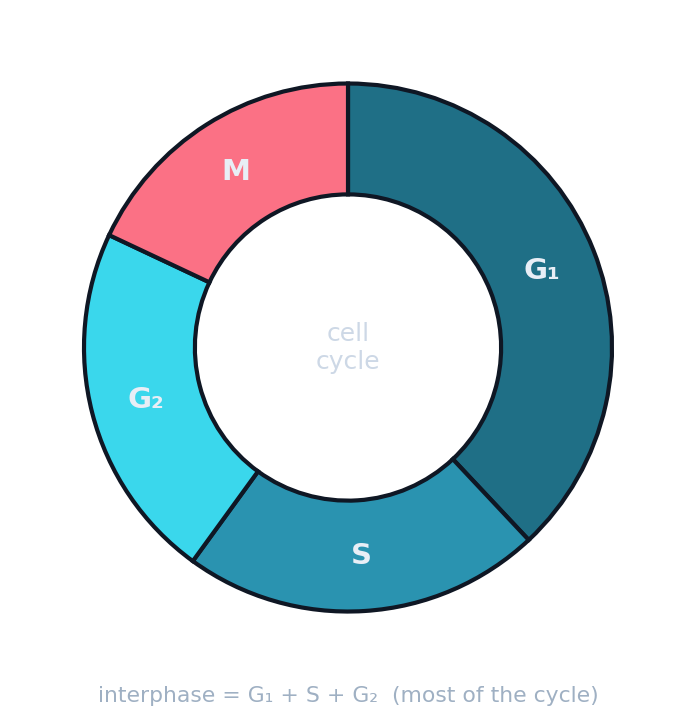
The cell cycle is the sequence a cell follows to…
Difficulty 1/5 · 100 coins + a small bonus on first completion today
The cell cycle takes a cell through growth, DNA copying, and division into two new cells.
Interphase: grow and copy
- Most of the cycle is interphase.
- The cell grows larger and builds more organelles.
- Crucially, it copies all of its DNA, exactly once.
- Now it holds two full sets, ready to be shared.
The stages of mitosis
Drag through prophase, metaphase, anaphase and telophase to watch the chromosomes separate into two identical cells.
During interphase, the cell mainly…
Difficulty 1/5 · 100 coins + a small bonus on first completion today
In interphase the cell grows and copies its DNA, getting ready to divide.
Mitosis and cytokinesis 胞质分裂
- Mitosis divides the copied DNA into two identical nuclei.
- The chromosomes line up, then separate to opposite ends.
- Then cytokinesis splits the cytoplasm into two whole cells.
- The result is two daughter cells, each identical to the parent.
Mitosis produces four genetically different daughter cells.
Difficulty 1/5 · 100 coins + a small bonus on first completion today
False. Mitosis produces two genetically identical daughter cells. Four genetically different cells come from meiosis.
The final splitting of the cytoplasm into two cells is called ____.
Difficulty 1/5 · 100 coins + a small bonus on first completion today
After mitosis divides the nucleus, cytokinesis splits the rest of the cell into two.
Select all true statements about the cell cycle.
Difficulty 2/5 · 140 coins + a small bonus on first completion today
Mitosis makes two identical cells, not different ones. The other three are correct.
Interphase has three distinct stages
- In G1, the cell grows and makes cellular components. During S, DNA is replicated so each chromosome consists of two sister chromatids joined at a centromere. In G2, the cell prepares proteins and energy for division.
- DNA amount doubles in S, but chromosome number counted by centromeres does not. A cell may enter G0, a nondividing state; some cells can re-enter the cycle when appropriate signals arrive.
Put these cell-cycle events in order.
Difficulty 3/5 · 200 coins + a small bonus on first completion today
DNA must be copied before the nucleus and cytoplasm divide.
Follow chromosomes through mitosis
- In prophase 前期, chromosomes condense and the spindle forms. In metaphase 中期, spindle attachments align chromosomes at the equator. In anaphase 后期, sister chromatids separate towards opposite poles.
- In telophase 末期, nuclei reform. Cytokinesis then divides the cytoplasm: animal cells form a cleavage furrow, while plant cells build a cell plate. Mitosis divides the nucleus; cytokinesis divides the cell.
At which mitotic stage do sister chromatids separate?
Difficulty 1/5 · 100 coins + a small bonus on first completion today
Metaphase aligns them; anaphase separates them.
Worked example: count copies without doubling the wrong thing
- A diploid cell has six chromosomes in G1. After S, it still has six chromosomes, now containing twelve chromatids. Each future daughter nucleus receives six chromosomes when sisters separate.
- Replication has doubled the DNA, not produced a new cell or doubled its ploidy. Count chromosome identity by centromeres, and specify the stage when interpreting a diagram.
A cell has six chromosomes before S. How many chromatids are present after replication, before separation?
Difficulty 2/5 · 140 coins + a small bonus on first completion today
Each of the six chromosomes now has two sister chromatids: 6 × 2 = 12.
DNA is copied once, during interphase, before mitosis begins. Mitosis does not copy DNA — it only separates the copies already made. Copy once, then split: get that order right.
Cells that never stop dividing:
- Your skin and gut lining wear away constantly.
- Cells there run the cell cycle again and again to replace losses.
- That is why a scrape heals — new cells are made by mitosis to fill the gap.
The cell cycle takes a cell through growth and division. During interphase the cell grows and copies its DNA once. Then mitosis divides the copied DNA into two identical nuclei, and cytokinesis splits the cell into two identical daughter cells.
Write from 20 chromatids
- A cell has 10 chromosomes before S phase.
- Replication finishes and the chromatids have not separated.
How many chromatids are present?
After S, chromatids are twice the chromosome count.
How many chromatids follow S if the cell started with 10 chromosomes?
Difficulty 1/5 · 100 coins + a small bonus on first completion today
Each chromosome becomes two chromatids. Other options — 12 (the six-chromosome lesson cell); 10 (as if no copy were made).