Hyperbolic functions
Introduced| English | Meaning |
|---|---|
| catenary/kəˈtiːnəri/ | The curve formed by a freely hanging, flexible chain with uniform weight per unit length under gravity. |
| hyperbolic function/ˌhaɪpəˈbɒlɪk ˈfʌŋkʃn/ | A function such as sinh or cosh, defined using sums, differences or ratios of exponential functions. |
| exponential/ˌekspəˈnenʃl/ | Describing a relationship in which a variable occurs in an exponent. |
| identity/aɪˈdentɪti/ | An equation that is true for every allowed value of its variables. |
| reciprocal/rɪˈsɪprəkl/ | The value obtained by dividing one by a non-zero number. |
| domain/dəˈmeɪn/ | The set of input values for which a function is defined. |
| range/reɪndʒ/ | The set of output values actually attained by a function on its stated domain. |
| even function/ˈiːvən ˈfʌŋkʃən/ | A function satisfying f(−x) = f(x) whenever x is in its symmetric domain; its graph is symmetric about the vertical axis. |
| odd function/ɒd ˈfʌŋkʃən/ | A function satisfying f(−x) = −f(x) on a symmetric domain; its graph has rotational symmetry through 180 degrees about the origin. |
| asymptote/ˈæsɪmptəʊt/ | A line that a curve approaches arbitrarily closely as its input or output tends to a particular limit. |
| inverse function/ɪnˈvɜːs ˈfʌŋkʃn/ | A function that reverses another function's mapping on a domain where that mapping is one-to-one. |
| principal branch/ˈprɪnsəpl brɑːntʃ/ | A chosen restriction that gives a single inverse value; inverse cosh uses the nonnegative branch of cosh. |
| logarithmic form/ˌlɒɡəˈrɪθmɪk fɔːm/ | An expression written using a logarithm, often found by solving an exponential equation. |
| derivative/dɪˈrɪvətɪv/ | The instantaneous rate of change of a function with respect to its input. |
A cable needs the right curve
- A freely hanging, uniform chain forms a catenary 悬链线 under gravity. Its shape uses a hyperbolic function 双曲函数, not a parabola.
- A shifted and scaled model is $y=a\cosh((x-h)/a)+k$, with $a>0$. The lowest point is $(h,a+k)$; $\cosh x$ is the normalised model.

The model assumes a flexible chain with uniform weight per unit length and no other loads.
Six functions from exponentials 指数
- An exponential expression uses $e^x>0$. Write the definitions before changing them into an identity 恒等式 or equation.
- Three reciprocal 倒数 functions complete the set. Their denominators decide where each function is defined.
At $x=\ln2$, the exponential values are $2$ and $1/2$. Thus $\sinh x=3/4$, $\cosh x=5/4$ and $\tanh x=3/5$. Their reciprocals are $4/3$, $4/5$ and $5/3$, respectively.
cosh is the average of the two exponentials; sinh is half their difference.
Using cosh x = (eˣ + e⁻ˣ)/2, what is cosh 0?
Difficulty 2/5 · 140 coins + a small bonus on first completion today
cosh 0 = (e⁰ + e⁰)/2 = (1 + 1)/2 = 1.
Using sinh x = (eˣ − e⁻ˣ)/2, what is sinh 0?
Difficulty 2/5 · 140 coins + a small bonus on first completion today
sinh 0 = (1 − 1)/2 = 0.
Find all six hyperbolic functions at $x=\ln3$, starting from $e^x$ and $e^{-x}$.
State the allowed inputs and justify each algebraic step before accepting the result.
Sketch the three basic graphs
- The domain 定义域 of $\sinh$, $\cosh$ and $\tanh$ is all real $x$. Their ranges 值域 are respectively $\mathbb R$, $[1,\infty)$ and $(-1,1)$.
- $\cosh$ is an even function 偶函数, with minimum $(0,1)$. $\sinh$ and $\tanh$ are odd functions 奇函数 and increase through $(0,0)$; $\tanh$ approaches the horizontal asymptotes 渐近线 $y=\pm1$ without reaching them.
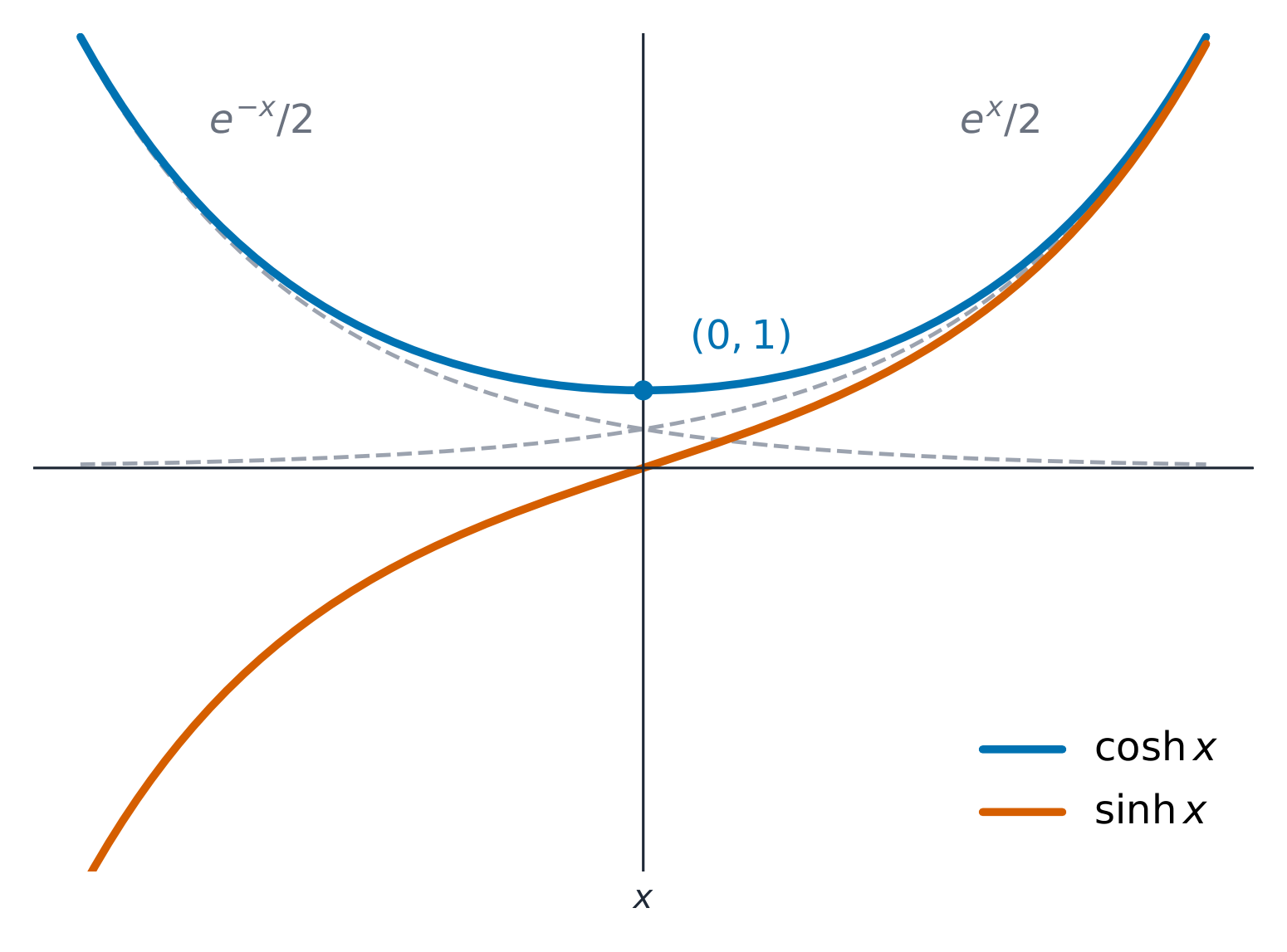
The definitions give $\cosh(-x)=\cosh x$ and $\sinh(-x)=-\sinh x$.

For $\tanh x$, divide numerator and denominator by $e^x$ to see its limiting value $1$ as $x\to\infty$.
Hyperbolic functions
y = a cosh(x)
For positive a, y = a cosh(x) has minimum (0, a). A negative a reflects the graph and gives a maximum there.
Decide whether each equation has a real solution: $\cosh x=1/2$, $\tanh x=1$, and $\sinh x=-2$. Explain with ranges.
State the allowed inputs and justify each algebraic step before accepting the result.
Reciprocals change the ranges
- $\operatorname{sech}x$ is even, defined for every real $x$, and has range $(0,1]$. Its maximum is $(0,1)$ and it approaches $y=0$ in both directions.
- $\operatorname{cosech}x$ and $\coth x$ are odd and exclude $x=0$, a vertical asymptote. Cosech has range $\mathbb R\setminus\{0\}$; coth has range $(-\infty,-1)\cup(1,\infty)$.

Each separate cosech/coth branch decreases. The dashed lines show limits, not parts of the curves.
A reciprocal is not an inverse function 反函数. Also, $\coth0$ is undefined: cancelling symbols does not create a value at an excluded input.
Sketch $y=\operatorname{cosech}x$ and $y=\coth x$. State their domains, ranges, symmetry and asymptotes. Do either have an intercept?
State the allowed inputs and justify each algebraic step before accepting the result.
Sketch $y=\operatorname{sech}(2x)$. Give the turning point, symmetry, range and horizontal limit.
State the allowed inputs and justify each algebraic step before accepting the result.
Prove an identity from the definitions
- Expand the exponential squares to show $\cosh^2x-\sinh^2x=1$. If the question says “starting from definitions”, quoting this identity is not its proof.
- Work from one side with one variable throughout. Put terms over a common denominator before cancelling.
Starting with the definitions,
The denominator is positive for every real $u$. Similarly, dividing $\cosh^2x-\sinh^2x=1$ by $\sinh^2x$ gives $\coth^2x-\operatorname{cosech}^2x=1$, but only for $x\ne0$.
For any x, what does cosh²x − sinh²x equal?
Difficulty 2/5 · 140 coins + a small bonus on first completion today
The hyperbolic identity is cosh²x − sinh²x = 1.
The identity cosh²x + sinh²x = 1 is correct.
Difficulty 1/5 · 100 coins + a small bonus on first completion today
The correct identity is cosh²x − sinh²x = 1 (minus, not plus).
Starting from exponential definitions, prove $\coth^2x-\operatorname{cosech}^2x=1$ and state the restriction.
State the allowed inputs and justify each algebraic step before accepting the result.
Addition and double angles
- Multiply the exponential definitions and collect matching terms. This gives the addition identities below; replacing $v$ by $-v$ gives the subtraction versions.
- Put $v=u=x$ for double angles. Use $\cosh^2x-\sinh^2x=1$ to change between the three forms of $\cosh2x$.
For the cosh addition formula, the sum of products is
This is $\cosh(u+v)$ by its definition.
Use exponentials to prove $\cosh(u+v)=\cosh u\cosh v+\sinh u\sinh v$. Deduce both double-angle forms.
State the allowed inputs and justify each algebraic step before accepting the result.
Derive $\sinh(u-v)$ from the addition formula, then find $\sinh2x$ and evaluate $\sinh(2\ln2)$.
State the allowed inputs and justify each algebraic step before accepting the result.
Solve equations without losing a sign
- Choose an identity or put $t=e^x>0$ to obtain a polynomial. Reject any root that violates the substitution's range, then return to $x$.
- A squared hyperbolic function can give two signs. Use symmetry and the graph to check that all intersections have been found.
Solve $\cosh2x=4\sinh^2x$. The double-angle identity gives
Both signs are valid. Using the inverse formula derived below,
At each intersection, $y=2$. These are different from the minima at $(0,1)$ and $(0,0)$.

Both curves are even, so a positive intersection has a matching negative one.
Solve $\cosh2x=9\sinh^2x$ in exact logarithmic form. Explain how many intersections the two even curves have.
State the allowed inputs and justify each algebraic step before accepting the result.
An inverse needs a chosen branch
- An inverse function reverses a one-to-one function. Reflect its graph in $y=x$; the original domain and range exchange roles.
- Cosh is not one-to-one on all real numbers. Choose the principal branch 主值分支 $x\ge0$, so $\cosh^{-1}x$ has input $x\ge1$ and output at least zero.
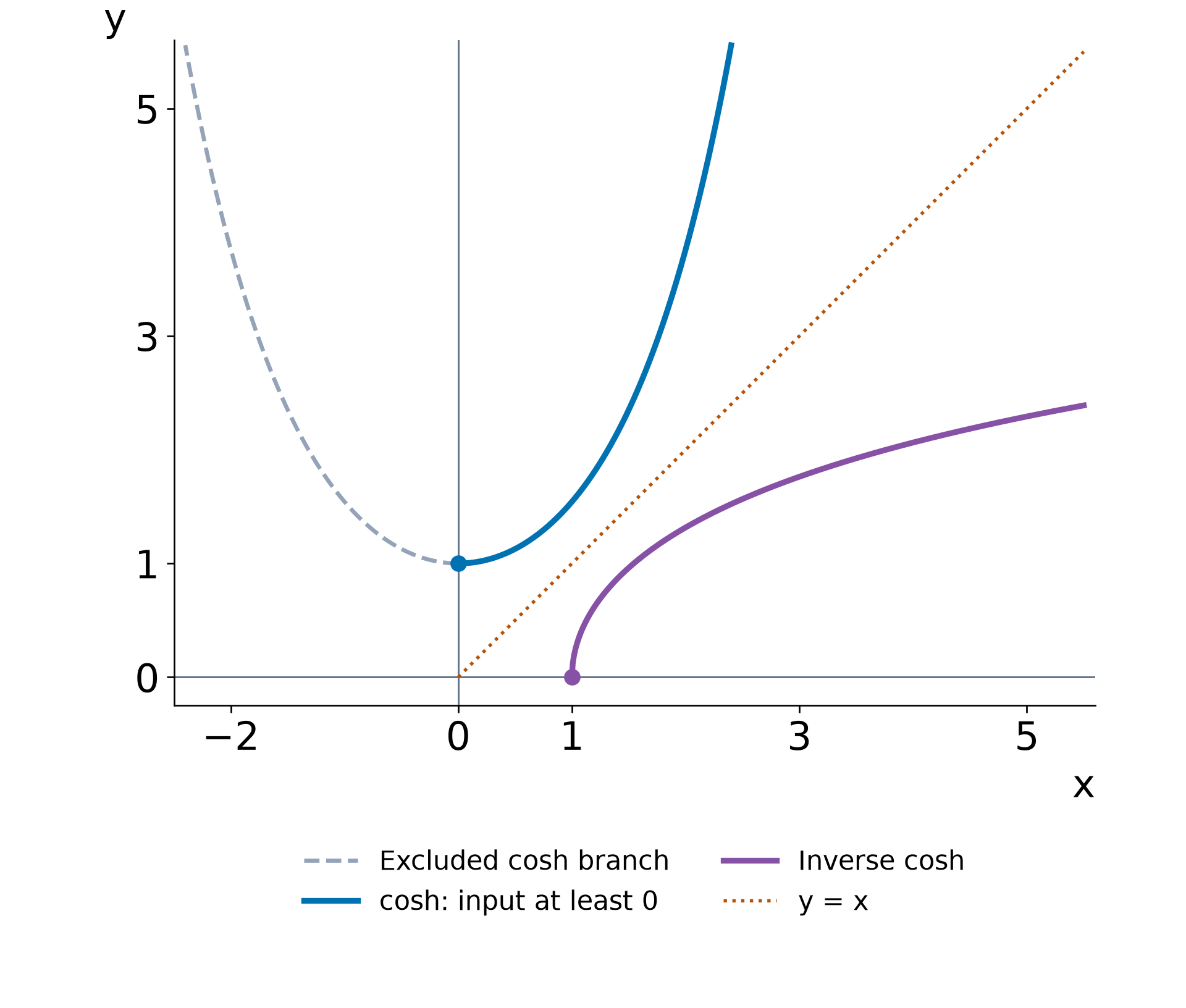
The faded negative-input cosh branch is excluded when defining the principal inverse.
$\cosh^{-1}(\cosh x)=|x|$ for real $x$, not always $x$. For example, $\cosh^{-1}(\cosh(-2))=2$.
Find $\cosh^{-1}(\cosh(-2))$ and explain why the answer is not $-2$.
State the allowed inputs and justify each algebraic step before accepting the result.
Derive inverse sinh through an exponential
- Set $y=\sinh^{-1}x$, so $x=\sinh y$. Put $t=e^y>0$ and solve the resulting quadratic to find its logarithmic form 对数形式.
- Select the positive exponential root. This works for every real $x$, because $\sqrt{x^2+1}>|x|$.
For $x=-3/4$, $t=-3/4+5/4=1/2$. Thus $\sinh^{-1}(-3/4)=-\ln2$. A negative inverse value is allowed here.
Derive $\sinh^{-1}(-2)$ in logarithmic form and show it equals $-\ln(2+\sqrt5)$.
State the allowed inputs and justify each algebraic step before accepting the result.
Derive inverse cosh with its restriction
- Set $y=\cosh^{-1}x\ge0$, so $x\ge1$ and $t=e^y\ge1$. The equation becomes $t^2-2xt+1=0$.
- Choose $t=x+\sqrt{x^2-1}$. For $x>1$, the other root is below $1$ and would give a negative $y$. At $x=1$, both roots are $1$ and $y=0$.
$\cosh^{-1}(5/4)=\ln(5/4+3/4)=\ln2$. However, the equation $\cosh y=5/4$ on the full real domain has two solutions: $y=\pm\ln2$.
For $y=\cosh^{-1}3$, solve the quadratic in $e^y$. Explain why one positive quadratic root is still rejected.
State the allowed inputs and justify each algebraic step before accepting the result.
Find $\sinh^{-1}(3/4)$. Explain why the notation does not mean $1/\sinh(3/4)$.
State the allowed inputs and justify each algebraic step before accepting the result.
Derive inverse tanh and check the endpoints
- Set $y=\tanh^{-1}x$, so $-1<x<1$. Multiplying numerator and denominator of $\tanh y$ by $e^y$ gives $x=(e^{2y}-1)/(e^{2y}+1)$.
- Rearrangement gives a positive ratio only on that interval. The endpoints are excluded, because tanh never equals $1$ or $-1$ at a finite input.
$\tanh^{-1}(3/5)=\tfrac12\ln4=\ln2$. There is no real $\tanh^{-1}(2)$; a logarithm of a negative number would not repair the real-domain problem.
Find $\tanh^{-1}(3/5)$, then explain why neither $\tanh^{-1}1$ nor $\tanh^{-1}2$ is a finite real value.
State the allowed inputs and justify each algebraic step before accepting the result.
Inverses of the reciprocal functions
- Use $\operatorname{sech}^{-1}x=\cosh^{-1}(1/x)$ on $0<x\le1$, with nonnegative output. Use $\operatorname{cosech}^{-1}x=\sinh^{-1}(1/x)$ for $x\ne0$.
- For coth, $\coth^{-1}x=\tanh^{-1}(1/x)$ requires $|x|>1$. These are inverse functions, not the reciprocals of inverse sinh/cosh/tanh.
$\operatorname{sech}^{-1}(4/5)=\cosh^{-1}(5/4)=\ln2$. The full equation $\operatorname{sech}y=4/5$ has $y=\pm\ln2$, but the principal inverse chooses the nonnegative answer.
Find $\operatorname{sech}^{-1}(3/5)$ and all real solutions of $\operatorname{sech}y=3/5$.
State the allowed inputs and justify each algebraic step before accepting the result.
Derive $\coth^{-1}2$ using inverse tanh, and state the real domain of inverse coth.
State the allowed inputs and justify each algebraic step before accepting the result.
Find $\operatorname{cosech}^{-1}(-3/4)$ exactly and explain why its input cannot be zero.
State the allowed inputs and justify each algebraic step before accepting the result.
Match the answer to the original domain
- For $\cosh x=k$, there are no real solutions if $k<1$, one if $k=1$, and two if $k>1$. The inverse gives only the nonnegative solution.
- After using exponentials, retain only positive $t=e^x$. After squaring, test both signs in the original equation; an algebraic root is not automatically allowed.
Solve $2\cosh x+3\sinh x=1$. Setting $t=e^x>0$ gives
Only $t=(1+\sqrt6)/5$ is positive. Therefore
The other quadratic root is not an exponential of a real number.
For real k, classify the real solutions of $\cosh x=k$. Give exact formulas in the case with two solutions.
State the allowed inputs and justify each algebraic step before accepting the result.
Solve $4\cosh x+5\sinh x=2$ by setting $t=e^x$. State the restriction before solving.
State the allowed inputs and justify each algebraic step before accepting the result.
A bridge to differentiation
- The derivatives 导数 $\dfrac{d}{dx}\sinh x=\cosh x$ and $\dfrac{d}{dx}\cosh x=\sinh x$ have no extra minus sign.
- Also $\dfrac{d}{dx}\tanh x=\operatorname{sech}^2x>0$. Full differentiation methods belong to lesson 0203; here the positive derivative confirms tanh's increasing shape.
The derivative of sinh x is:
Difficulty 1/5 · 100 coins + a small bonus on first completion today
The derivative of sinh x is cosh x. Differentiating their exponential definitions proves this directly.
The derivative of cosh x is:
Difficulty 1/5 · 100 coins + a small bonus on first completion today
d/dx(cosh x) = sinh x (no minus sign, unlike d/dx(cos x) = −sin x).
Check definitions, graphs and branches
- Build the six functions from exponentials, then show the graph's intercepts, excluded inputs and limiting lines. Prove identities from the requested starting point.
- Derive inverse logarithmic forms through positive exponentials. State the real domain, chosen branch and every solution of the original equation.
An inverse value and the full solution set can differ. In particular, $\cosh^{-1}a\ge0$ for $a\ge1$, but $\cosh y=a>1$ has two real solutions.
What is cosh of ln 2, and why is the hyperbolic identity a difference rather than a sum?
cosh x is half of e to the x plus e to the minus x. The minus in the identity is the difference from cosine.
What is cosh of ln 2?
Difficulty 1/5 · 100 coins + a small bonus on first completion today
(2 plus 0.5) divided by 2 is 1.25. Other options — 1 (the value of cosh 0); 2 (the value of e to the power ln 2).
Solve $\tanh(2x)=3/5$ exactly, then check the effect of the factor 2.
State the allowed inputs and justify each algebraic step before accepting the result.
Use the logarithmic formula to prove $\sinh^{-1}(-x)=-\sinh^{-1}x$ for every real x. Justify the logarithms.
State the allowed inputs and justify each algebraic step before accepting the result.