Complex numbers (Further Pure 2)
Introduced| English | Meaning |
|---|---|
| de Moivre's theorem/də ˈmɔɪvəz ˈθɪərəm/ | The theorem that raising a complex number in polar form to an integer power raises its modulus to that power and multiplies its argument by that integer. |
| polar form/ˈpəʊlə fɔːm/ | A representation of a non-zero complex number using its positive modulus and an argument. |
| modulus/ˈmɒdjʊləs/ | The non-negative distance of a complex number from the origin. |
| argument/ˈɑːɡjuːmənt/ | An angle from the positive real axis to a non-zero complex number, defined up to whole turns. |
| imaginary part/ɪˈmædʒɪnəri pɑːt/ | The real coefficient multiplying i in a complex number written as a+bi. |
| mathematical induction/ˌmæθɪˈmætɪkl ɪnˈdʌkʃn/ | A proof method using a base case and a conditional step from an arbitrary integer case to the next. |
| roots of unity/ruːts ɒv ˈjuːnɪti/ | Complex numbers satisfying z to the power n equals one, for a specified positive integer n. |
| unit circle/ˈjuːnɪt ˈsɜːkl/ | The circle centred at the origin with radius one. |
| primitive root of unity/ˈprɪmɪtɪv ruːt əv ˈjuːnɪti/ | An nth root of unity whose powers first return to one at exponent n, visiting all n roots. |
| geometric series/ˌdʒiːəʊˈmetrɪk ˈsɪəriːz/ | A sum of terms in which each term is obtained from the preceding one by a fixed ratio. |
| binomial expansion/baɪˈnəʊmɪəl ekˈspænʃn/ | The expansion of a power of a sum of two terms, with binomial coefficients. |
Repeat a turn and a change of scale
- Picture an arrow that turns and changes length after each step. Multiplication of non-zero complex numbers combines these two changes; a power repeats them.
- De Moivre's theorem 棣莫弗定理 links those powers to angles. It also helps turn a trigonometric identity, a polynomial equation or two real series into one complex calculation.
Multiplication by i preserves length. A general non-zero multiplier can change both length and angle.
Multiply lengths and add angles
- Write a non-zero number in polar form 极坐标形式 as $z=r\operatorname{cis}\theta$, where $\operatorname{cis}\theta=\cos\theta+i\sin\theta$. Its modulus 模 is $r>0$ and its argument 辐角 is defined modulo $2\pi$.
- Multiplication multiplies moduli and adds arguments; division divides moduli and subtracts arguments. Adjust the final angle to the interval requested in the question.
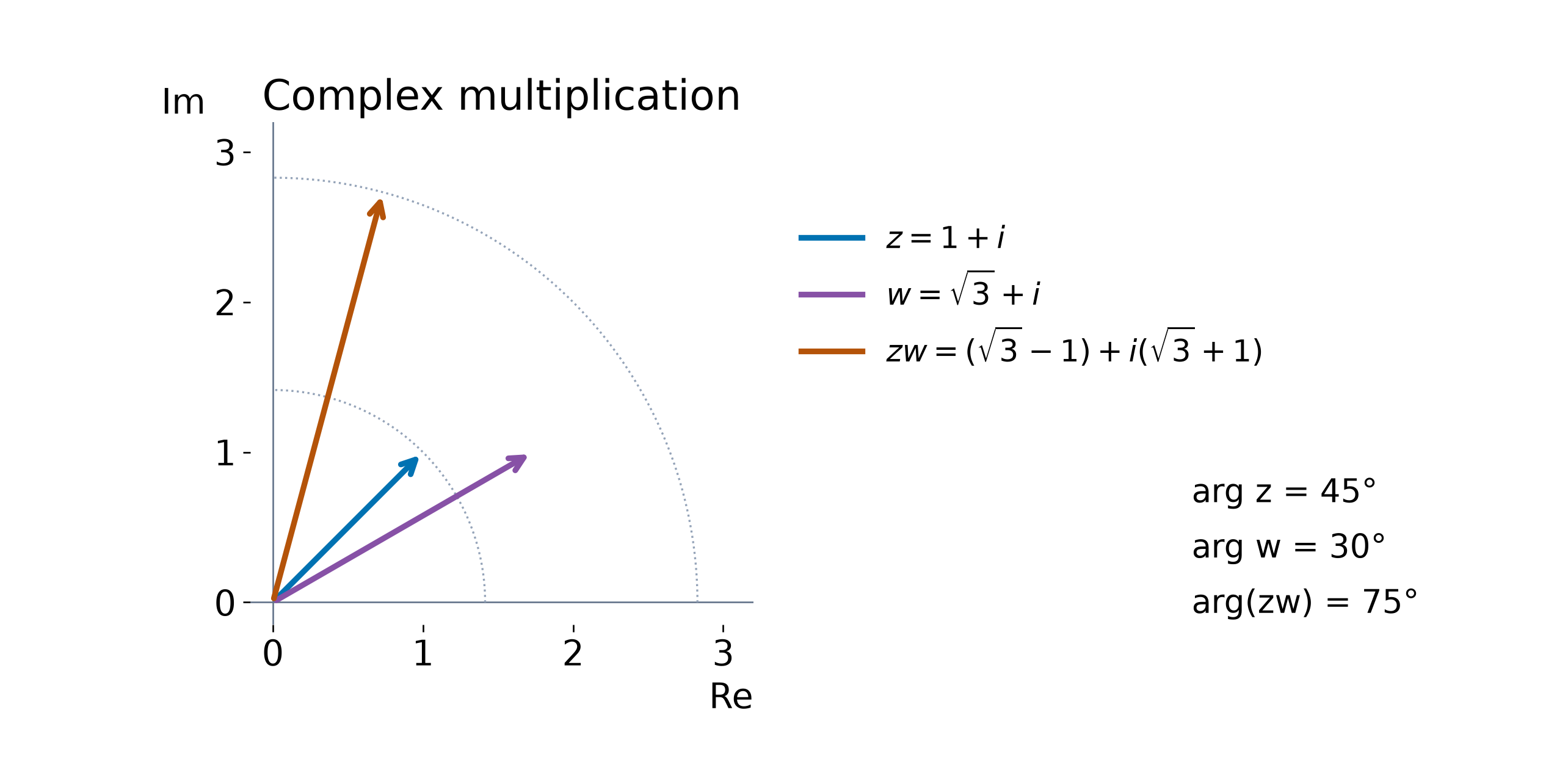
Complex numbers
z = x + yi
For z=1+i, read modulus √2 and argument π/4. Multiplying by i adds π/2 to the argument; a general multiplier also changes the modulus.
Let z=2cis(π/3), w=3cis(π/4). Find zw and z/w in polar form, and explain both geometric effects.
Show the complex setup, restrictions and comparison of parts before checking the model.
Apply positive and negative integer powers
- For an integer $n$, $z^n=r^n\operatorname{cis}(n\theta)$. A negative exponent needs $z\ne0$; taking a reciprocal reverses the angle and replaces the modulus by its reciprocal.
- For $z=1+i=\sqrt2\operatorname{cis}(\pi/4)$, $z^6=8\operatorname{cis}(3\pi/2)=-8i$. Also $z^{-2}=(1/2)\operatorname{cis}(-\pi/2)=-i/2$.
The power multiplies the argument; it does not raise the real and imaginary parts 虚部 separately. Zero has no argument: its positive integer powers can be handled directly, but negative powers of zero are undefined.
De Moivre's theorem states (cos θ + i sin θ)ⁿ equals:
Difficulty 1/5 · 100 coins + a small bonus on first completion today
Raising to the power n multiplies the argument by n: cos nθ + i sin nθ.
Before applying de Moivre to (1 + i)⁸, you must first write 1 + i in ______ form.
Difficulty 1/5 · 100 coins + a small bonus on first completion today
Convert to r(cosθ + i sinθ) first, then raise to the power.
Use polar form to find (1−i)^6 and (1−i)⁻².
Show the complex setup, restrictions and comparison of parts before checking the model.
Which parts of the polar-power method fail for z=0? Does this make 0⁵ undefined?
Show the complex setup, restrictions and comparison of parts before checking the model.
Prove the positive-integer theorem by induction
- Use mathematical induction 数学归纳法. The claim is true at $n=1$. Assume $(\operatorname{cis}\theta)^k=\operatorname{cis}(k\theta)$ for an arbitrary positive integer $k$.
- Multiply this assumed equality by $\operatorname{cis}\theta$. The angle-addition identities give the next case below, so the base case and conditional step prove every positive integer case.
For $m>0$, $(\operatorname{cis}\theta)^{-m}=1/\operatorname{cis}(m\theta)=\operatorname{cis}(-m\theta)$. This extends the proved result to negative integers without claiming that the induction itself covered them.
Prove (cis θ)ⁿ=cis(nθ) for positive integers by induction; include the actual addition-identity step.
Show the complex setup, restrictions and comparison of parts before checking the model.
Explain how the positive-integer theorem proves the case n=−m, m>0.
Show the complex setup, restrictions and comparison of parts before checking the model.
Compare real and imaginary parts
- Expand $(c+is)^n$ with $c=\cos\theta$, $s=\sin\theta$, then compare real parts with $\cos n\theta$ and imaginary parts with $\sin n\theta$.
- For the fifth power, replace $s^2$ by $1-c^2$ in the real part, and $c^2$ by $1-s^2$ in the imaginary part. Show that substitution rather than quoting the final identity.
The real part of the cube similarly gives $\cos3\theta=c^3-3cs^2=4c^3-3c$.
Using de Moivre, cos 3θ expands to:
Difficulty 1/5 · 100 coins + a small bonus on first completion today
Take the real part of (cosθ + i sinθ)³: cos 3θ = 4cos³θ − 3cosθ.
Derive sin 5θ in powers of sin θ by taking the imaginary part of (cos θ+i sin θ)^5.
Show the complex setup, restrictions and comparison of parts before checking the model.
Divide parts to obtain a tangent formula
- If $t=\tan\theta$, divide the imaginary part of $(\cos\theta+i\sin\theta)^3$ by its real part, then divide numerator and denominator by $\cos^3\theta$.
- Both tangents must exist. Thus $\cos\theta\ne0$ and the denominator $1-3t^2\ne0$; an equation obtained by cross-multiplication still needs those checks.
Use real and imaginary parts to express tan 5θ in terms of t=tan θ. State the restrictions.
Show the complex setup, restrictions and comparison of parts before checking the model.
Express a power using multiple angles
- Put $z=\operatorname{cis}\theta$, so $z+z^{-1}=2\cos\theta$ and $z-z^{-1}=2i\sin\theta$. Expand powers and pair $z^m$ with $z^{-m}$.
- The fourth-power expansion below turns $\sin^4\theta$ into a constant plus multiple-angle cosines. Keep the sign of $i^n$ when the power is odd.
The fifth power gives $16\sin^5\theta=\sin5\theta-5\sin3\theta+10\sin\theta$. Only after deriving this may you take a reciprocal: for $\sin\theta\ne0$,
Use z−z⁻¹=2i sin θ to express sin⁶θ using cos 2θ,cos 4θ and cos 6θ.
Show the complex setup, restrictions and comparison of parts before checking the model.
Derive an expression for cosec³θ in terms of sin θ and sin 3θ. State when it is valid.
Show the complex setup, restrictions and comparison of parts before checking the model.
Turn a polynomial into an angle equation
- For $32x^5-40x^3+10x-1=0$, put $x=\cos\theta$. The fifth-angle identity gives $2\cos5\theta-1=0$.
- Choose $0\le\theta\le\pi$, where cosine is one-to-one. Solve $5\theta=\pm\pi/3+2k\pi$ in $[0,5\pi]$, giving the five distinct roots below. Five distinct verified roots exhaust a degree-five polynomial.
Listing five angles does not automatically give five distinct roots when using sine on a larger interval. Check the actual sine/cosine values and the polynomial degree; remove repetitions, not valid different roots.
Find all roots of 16x⁵−20x³+5x=0 as cosine values of rational multiples of π.
Show the complex setup, restrictions and comparison of parts before checking the model.
Use sin 5θ to find all roots of 32x⁵−40x³+10x−1=0 as sine values. Choose −π/2≤θ≤π/2.
Show the complex setup, restrictions and comparison of parts before checking the model.
Handle reciprocal trigonometric roots
- To express roots using secant, put $x=\sec\theta$ and therefore $1/x=\cos\theta$. Divide by a power of $x$ only after excluding $x=0$ from the original polynomial.
- For $x^5-10x^4+40x^2-32=0$, zero is not a root. Dividing by $x^5$ gives $1-2\cos5\theta=0$, so the roots are the secants of the same five angles as in the previous step.
Find all roots of x⁵+10x⁴−40x²+32=0 in the form sec(qπ).
Show the complex setup, restrictions and comparison of parts before checking the model.
Rational powers need a branch convention
- For $z=r\operatorname{cis}\theta\ne0$ and coprime integers $p,q$ with $q>0$, the complex branches of the rational power use all equivalent arguments before dividing the angle by $q$.
- A specified principal value chooses a branch; solving an equation for all roots must retain all $q$ values. Negative $p$ also needs $z\ne0$. Do not use an unreduced fraction to decide the branch count.
For $z=8$ and exponent $2/3$, the three values solve $w^3=64$: they are $4\operatorname{cis}(0)$, $4\operatorname{cis}(2\pi/3)$ and $4\operatorname{cis}(4\pi/3)$. The familiar real value $4$ is one of them.
Find all complex values of 16^(3/4) under the four-branch interpretation, and state the corresponding polynomial equation.
Show the complex setup, restrictions and comparison of parts before checking the model.
Find roots of a non-unit number
- To solve $w^n=R\operatorname{cis}\Theta$ for $R>0$, use modulus $R^{1/n}$ and arguments $(\Theta+2k\pi)/n$, $k=0,\ldots,n-1$. Convert each argument to the requested interval after obtaining the complete set.
- For $w^3=8i$, the roots have modulus $2$ and arguments $\pi/6,5\pi/6,-\pi/2$. Reciprocating them gives the three values of $(8i)^{-1/3}$, with modulus $1/2$ and opposite arguments.
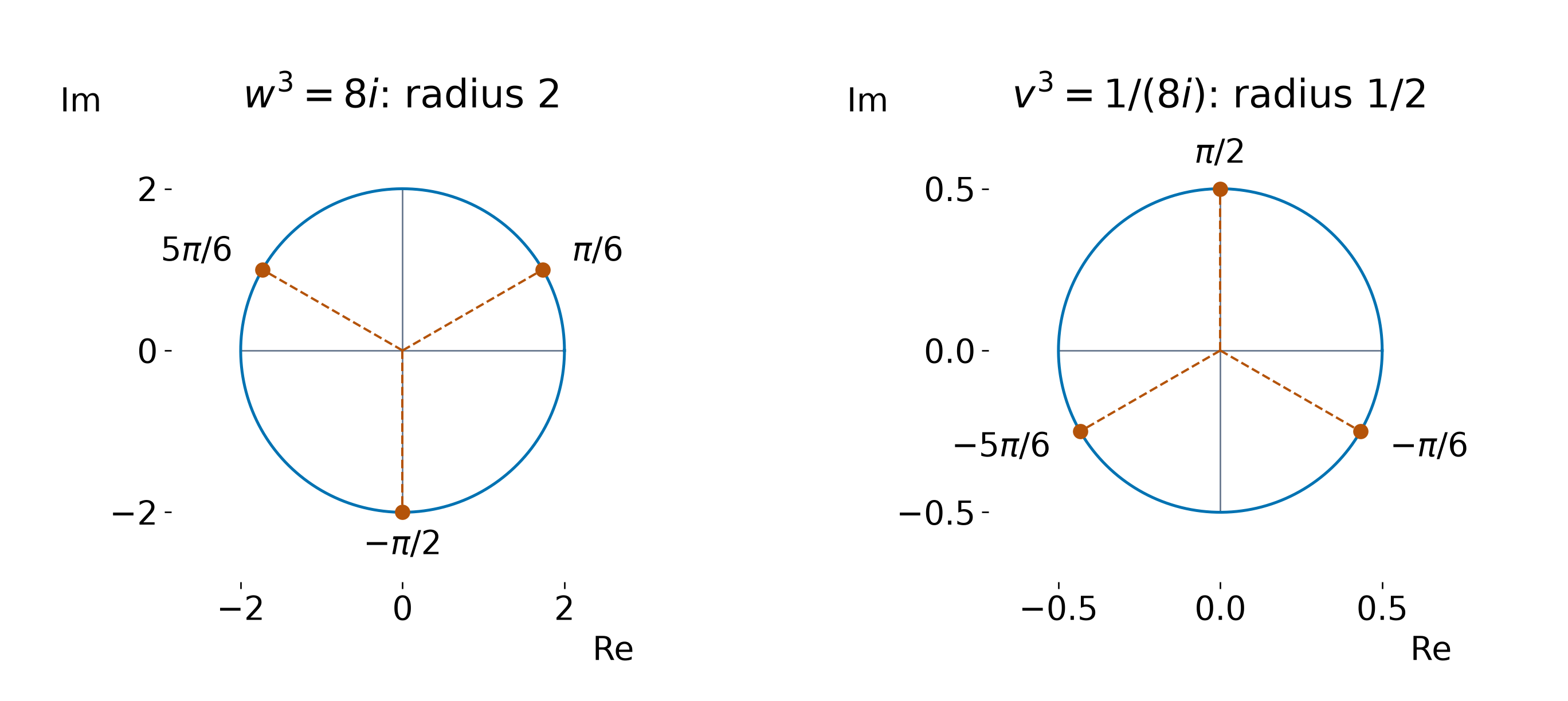
Give all three values of (−8)^(−1/3), using the cube roots of −8 first.
Show the complex setup, restrictions and comparison of parts before checking the model.
Find all roots of w⁴=−16, with −π<arg w≤π.
Show the complex setup, restrictions and comparison of parts before checking the model.
Use the roots of unity 单位根
- The $n$ roots of unity solve $z^n=1$: $z_k=\operatorname{cis}(2k\pi/n)$ for $k=0,\ldots,n-1$. They lie on the unit circle 单位圆 and are separated by $2\pi/n$ radians, or $360^\circ/n$.
- For $n>1$, their sum is zero. They give the linear factors $z-z_k$ of $z^n-1$. If $\omega^3=1$ and $\omega\ne1$, then $1+\omega+\omega^2=0$; do not cancel $\omega-1$ without its non-zero condition.

How many distinct roots of unity does the equation z⁵ = 1 have?
Difficulty 2/5 · 140 coins + a small bonus on first completion today
zⁿ = 1 has exactly n roots, equally spaced on the unit circle; here n = 5.
The fifth-roots of unity are equally spaced on the unit circle. How many degrees apart are consecutive roots?
Difficulty 2/5 · 140 coins + a small bonus on first completion today
360°/5 = 72° between consecutive roots.
The n roots of unity are bunched together near z = 1.
Difficulty 1/5 · 100 coins + a small bonus on first completion today
False. They are equally spaced around the unit circle, at angular gaps of 360°/n starting from z = 1.
Suppose ω³=1 and ω≠1. Simplify 1+ω+ω² and (1−ω)(1−ω²).
Show the complex setup, restrictions and comparison of parts before checking the model.
Check whether powers visit every root
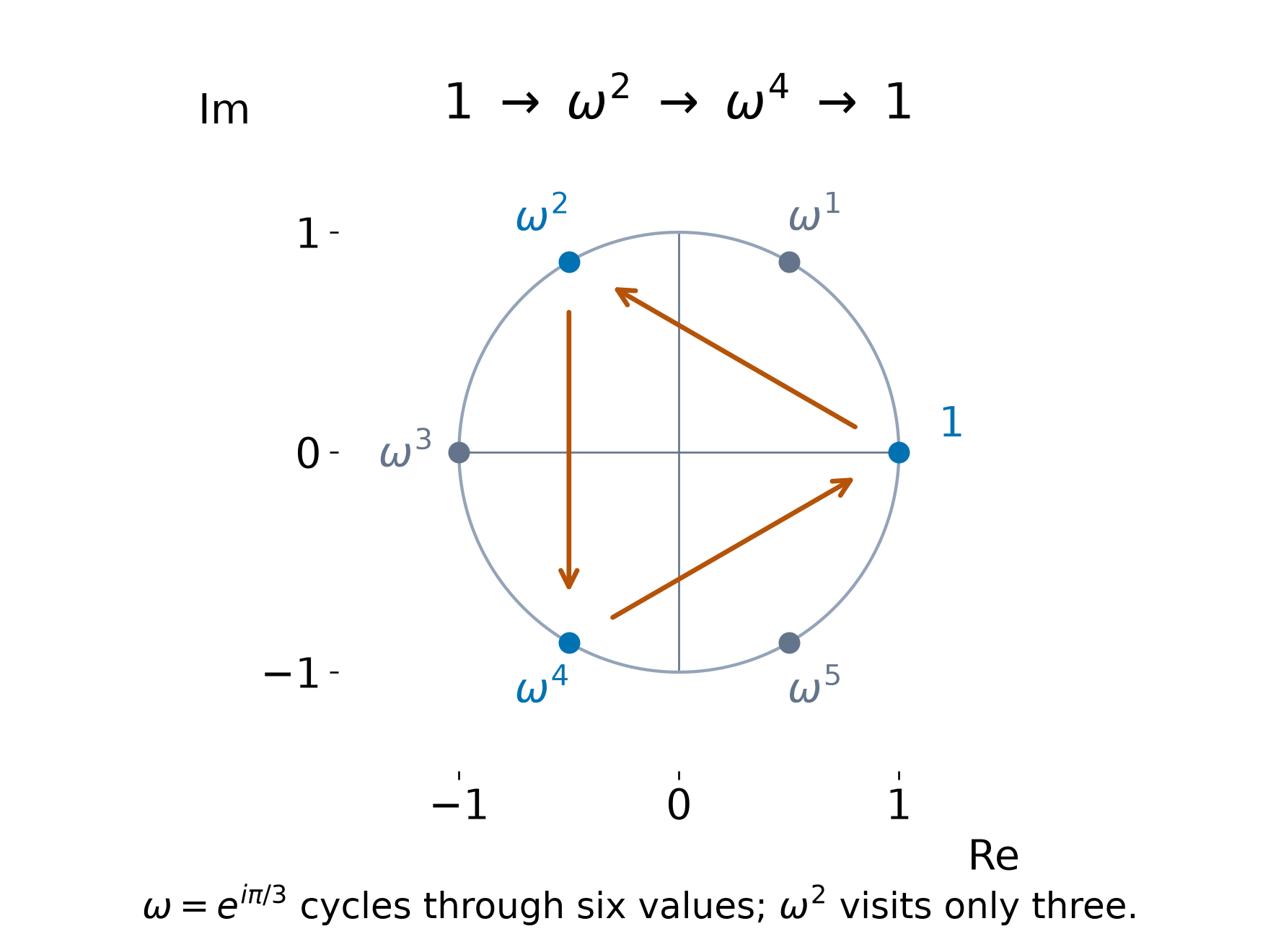
- A primitive root of unity 本原单位根 visits all $n$ roots before its powers return to $1$. For $\omega=\operatorname{cis}(2\pi/n)$ this is the full cycle; a power of $\omega$ can have a shorter cycle.
- For $n=6$, powers of $\omega^2$ visit only $1,\omega^2,\omega^4$ and then repeat. For any integer $m$, the complete sum of $m$th powers below is $6$ if $6$ divides $m$, and zero otherwise.
How many distinct solutions does z to the 8 = 1 have, how many degrees apart are consecutive roots, and why must 1 plus i be written in polar form before De Moivre is used?
The n roots of unity sit on the unit circle at multiples of a full turn divided by n.
Let ω=cis(2π/8). How many different values occur in powers of ω²? Find Σₖ₌₀⁷ω^(2k).
Show the complex setup, restrictions and comparison of parts before checking the model.
For ω=cis(2π/5), find Σₖ₌₀⁴ω^(3k) and Σₖ₌₀⁴ω^(10k).
Show the complex setup, restrictions and comparison of parts before checking the model.
Add C and iS before summing separately
- Let $C=\sum_{r=0}^n\cos(r\theta)$ and $S=\sum_{r=0}^n\sin(r\theta)$. Then $C+iS$ is a geometric series 等比级数 with ratio $z=\operatorname{cis}\theta$.
- For $z\ne1$, sum the series first, then factor the complex exponentials into half-angle forms. When $\theta$ is a multiple of $2\pi$, use the original sums: $C=n+1$, $S=0$.
Find Σᵣ₌₀⁵cos(rπ/3) and Σᵣ₌₀⁵sin(rπ/3), and explain why the half-angle quotient needs a separate case at θ=0.
Show the complex setup, restrictions and comparison of parts before checking the model.
Include a geometric weight
- For $C_n=\sum_{r=1}^n\rho^r\cos(r\theta)$ and $S_n=\sum_{r=1}^n\rho^r\sin(r\theta)$, take $q=\rho\operatorname{cis}\theta$. The finite sum is $q(1-q^n)/(1-q)$ for $q\ne1$.
- Multiply by $1-\overline q$ to make the denominator real, then compare parts. With $D=1-2\rho\cos\theta+\rho^2$, the imaginary part is the expression below; obtain the real part from the same numerator.
For $q=(1+i)/2$ and $n=4$, $q/(1-q)=i$ and $q^4=-1/4$. Hence $\sum_{r=1}^4q^r=5i/4$: the cosine-weighted sum is $0$ and the sine-weighted sum is $5/4$.
Let q=(1+i)/2. Find the real and imaginary parts of Σᵣ₌₁⁸qʳ using a geometric sum.
Show the complex setup, restrictions and comparison of parts before checking the model.
Use a binomial expansion 二项式展开 for binomial weights
- For $C=\sum_{r=0}^n\binom nr\cos(r\theta)$ and $S=\sum_{r=0}^n\binom nr\sin(r\theta)$, the binomial expansion gives $C+iS=(1+e^{i\theta})^n$.
- On $-\pi<\theta<\pi$, $1+e^{i\theta}=2\cos(\theta/2)e^{i\theta/2}$ has non-negative modulus. Apply de Moivre, then compare real and imaginary parts. Starting the sum at $r=1$ removes $1$ from $C$ only.
For $n=6$ and $\theta=\pi/3$, $1+e^{i\theta}=\sqrt3e^{i\pi/6}$, so $C+iS=27e^{i\pi}=-27$. Thus $C=-27$, $S=0$ for $r=0,\ldots,6$.
Evaluate C=Σᵣ₌₁⁵ binom(5,r)cos(rπ/2) and S=Σᵣ₌₁⁵ binom(5,r)sin(rπ/2).
Show the complex setup, restrictions and comparison of parts before checking the model.
Take a justified infinite-series limit
- If $|q|=\rho<1$, $q^n\to0$ and the complex geometric sum from $r=1$ tends to $q/(1-q)$. Take real and imaginary parts after using this convergence condition.
- With the real denominator $D=1-2\rho\cos\theta+\rho^2$, the formulas below follow. For $q=(1+i)/2$, the infinite sum is $i$, so $C=0$, $S=1$.
A finite geometric formula does not justify an infinite sum when $|q|\ge1$. Check convergence before discarding its last term. The special case $q=1$ also makes the finite quotient undefined and must be evaluated directly.
Find Σᵣ₌₁∞(1/3)ʳcos(rπ/3) and its sine counterpart. Justify convergence.
Show the complex setup, restrictions and comparison of parts before checking the model.
Bring down an index by differentiation
- Differentiating the finite sine sum with respect to $\theta$ gives $\sum_{r=1}^nr\rho^r\cos(r\theta)$. Alternatively apply $q\,d/dq$ to the finite geometric polynomial.
- The result below has a justified limit for $|q|<1$, using $n\rho^n\to0$. This uses the finite identity before taking the limit, rather than assuming that an infinite series can always be differentiated term by term.
At $q=i/2$, the limiting weighted sum is $-8/25+6i/25$. Therefore the weighted cosine sum is $-8/25$ and the weighted sine sum is $6/25$.
Find the real and imaginary parts of Σᵣ₌₁⁴r(i/2)ʳ.
Show the complex setup, restrictions and comparison of parts before checking the model.
Evaluate Σᵣ₌₁∞r(1/3)ʳcos(rπ/2) and the corresponding sine sum, using a finite identity before the limit.
Show the complex setup, restrictions and comparison of parts before checking the model.
Choose the complex expression that matches the task
- For a power, state the modulus, argument and branch conditions. For a trigonometric identity, expand before selecting parts. For polynomial roots, choose an angle interval, exclude invalid divisions and count distinct values.
- For sums, choose geometric or binomial weights correctly, combine $C+iS$, and retain exceptional cases and convergence conditions. For roots of unity, check whether powers give a full cycle or a shorter one.
Multiplication combines scale and rotation. De Moivre links powers and angles. Comparing parts produces identities and sums; retaining all allowed arguments produces the complete root set.
How many degrees apart are consecutive roots of z to the 8 = 1?
Difficulty 1/5 · 100 coins + a small bonus on first completion today
360 divided by 8 is 45 degrees. Other options — 72 degrees (the lesson spacing for fifth roots); 8 (the number of roots).