Integration (Further Pure 2)
Introduced| English | Meaning |
|---|---|
| antiderivative/ˌæntɪdɪˈrɪvətɪv/ | A function whose derivative is the given function. |
| standard form/ˈstændəd fɔːm/ | A recognised mathematical form whose method or result can be applied after matching its constants and variables. |
| substitution/ˌsʌbstɪˈtjuːʃn/ | Replacing a variable or expression with a new one; in integration, also change the differential and any limits. |
| hyperbolic/ˌhaɪpəˈbɒlɪk/ | Describes functions such as sinh and cosh that are defined using exponential functions. |
| surd/sɜːd/ | An expression containing a root, such as a square root. |
| completing the square/kəmˈpliːtɪŋ ðə skweə/ | Rewriting a quadratic expression as a squared linear expression plus or minus a constant. |
| trigonometric/ˌtrɪɡənəʊˈmetrɪk/ | Relating to sine, cosine, tangent and their associated functions. |
| reduction formula/rɪˈdʌkʃn ˈfɔːmjʊlə/ | A recurrence relating an integral with one index or power to integrals with smaller indices or powers. |
| Riemann sum/ˈriːmən sʌm/ | A sum of function values multiplied by interval widths that approximates a definite integral. |
| arc length/ɑːk leŋθ/ | The distance along a curved part of a circle or another curve. |
| surface area of revolution/ˈsɜːfɪs ˈeərɪə ɒv ˌrevəˈluːʃn/ | The area of the curved surface swept out when a curve rotates about an axis. |
Length and paint are different integrals
- A curved strip needs material along its length; rotating it around an axis creates a surface to paint. Neither quantity is simply the area under its graph.
- First decide what is being measured. Then choose an antiderivative 原函数, a standard form 标准形式 or a substitution 代换, keeping the limits and any sign restrictions.
Integrate the hyperbolic 双曲 functions
- Reverse the known derivatives to integrate hyperbolic functions. Include a constant $C$ for an indefinite integral; use absolute values where a logarithm's argument can be negative.
- Differentiate a proposed answer to check it. Factors in an argument still matter: $\int\cosh(3x)\,dx=\sinh(3x)/3+C$.
The coth and cosech formulas apply on intervals that exclude $x=0$. Useful product forms are $\int\operatorname{sech}^2x\,dx=\tanh x+C$ and $\int\operatorname{sech}x\tanh x\,dx=-\operatorname{sech}x+C$.
Integrate cosh(4x), sech²(2x) and sech(3x)tanh(3x). Check the factors.
Show the setup, relevant restrictions and evaluation before comparing with the model.
Match the three square-root forms
- For $a>0$, match the expression under the square root before choosing an inverse function. A surd 根式 with a plus sign uses inverse sinh; exchanging the sign changes both the inverse function and the real domain.
- The inverse-cosh answer below uses the positive branch $x>a$. On either real interval $|x|>a$, the logarithmic expression $\ln|x+\sqrt{x^2-a^2}|+C$ gives an antiderivative instead.
What is ∫ 1/(a² + x²) dx?
Difficulty 1/5 · 100 coins + a small bonus on first completion today
This is the standard inverse-tangent integral.
What is ∫ 1/√(4 − x²) dx?
Difficulty 1/5 · 100 coins + a small bonus on first completion today
With a = 2, ∫1/√(a²−x²) dx = sin⁻¹(x/a) = sin⁻¹(x/2) + C.
In ∫ 1/(9 + x²) dx = (1/a)tan⁻¹(x/a) + C, what is a?
Difficulty 2/5 · 140 coins + a small bonus on first completion today
a² = 9 so a = 3; the integral is (1/3)tan⁻¹(x/3) + C.
Match each integral to its result.
Difficulty 2/5 · 140 coins + a small bonus on first completion today
The first two are the inverse-trig standard forms; ∫1/x dx = ln|x| + C.
Find antiderivatives of 1/√(9−x²), 1/√(x²+9) and 1/√(x²−9) on x>3. State the first two real domains too.
Show the setup, relevant restrictions and evaluation before comparing with the model.
On x<−2, find an antiderivative of 1/√(x²−4). Why is arcosh(x/2) unsuitable?
Show the setup, relevant restrictions and evaluation before comparing with the model.
Complete the square before substituting
- Completing the square 配方法 reveals the standard form. Here $x^2+4x+13=(x+2)^2+9$, so a shift makes the inverse-sinh form visible.
- If the coefficient of $x^2$ is not one, factor it carefully too. Check the outside multiplier by differentiating the final answer.
Integrate 1/√(4x²+8x+13), showing the completed square.
Show the setup, relevant restrictions and evaluation before comparing with the model.
Integrate 1/(x²−2x+5).
Show the setup, relevant restrictions and evaluation before comparing with the model.
Use a hyperbolic substitution for a surd
- For $\sqrt{x^2+4}$, put $x=2\sinh u$. Then $dx=2\cosh u\,du$ and the non-negative square root is $2\cosh u$, since $\cosh u>0$.
- Use $\cosh^2u=(1+\cosh2u)/2$ and return to $x$. For a definite integral, either transform both limits or return to $x$ before evaluating them.
From $x=0$ to $x=3/2$, the new limits are $u=0$ and $u=\ln2$. The exact integral is $2\ln2+15/8$.
Use x=3sinh u to evaluate ∫₀⁴√(x²+9) dx.
Show the setup, relevant restrictions and evaluation before comparing with the model.
Choose a trigonometric 三角 branch
- A trigonometric substitution $x=2\sin\theta$ gives $\sqrt{4-x^2}=2|\cos\theta|$. Choose $-\pi/2\le\theta\le\pi/2$ so $\cos\theta\ge0$ before removing the absolute value.
- For the definite integral below, $x=0,1$ become $\theta=0,\pi/6$. The double-angle identity integrates $\cos^2\theta$.
Evaluate ∫₀^(3/2)√(9−x²) dx by a trigonometric substitution.
Show the setup, relevant restrictions and evaluation before comparing with the model.
Reuse integration by parts and a half angle
- For $I=\int e^x\sin x\,dx$, two integrations by parts return to $I$. Collect that repeated integral rather than starting the same calculation again.
- For a rational expression in sine and cosine, $t=\tan(x/2)$ gives $\sin x=2t/(1+t^2)$, $\cos x=(1-t^2)/(1+t^2)$ and $dx=2dt/(1+t^2)$. Work on a branch that does not cross an odd multiple of $\pi$.
Use two integrations by parts to find ∫e^(2x) cos x dx.
Show the setup, relevant restrictions and evaluation before comparing with the model.
Evaluate ∫₀^(π/2) dx/(3+cos x) using t=tan(x/2).
Show the setup, relevant restrictions and evaluation before comparing with the model.
Derive a trigonometric reduction
- A reduction formula 递推公式 links an integral to one with a smaller index. For $I_n=\int_0^{\pi/2}\sin^nx\,dx$, take $u=\sin^{n-1}x$, $dv=\sin x\,dx$ in integration by parts.
- For $n\ge2$, the boundary term is zero. Replacing $\cos^2x$ by $1-\sin^2x$ introduces both $I_{n-2}$ and $I_n$; collect the latter before dividing.
The base cases are $I_0=\pi/2$ and $I_1=1$. Thus $I_4=(3/4)(1/2)I_0=3\pi/16$. Even and odd indices lead to different base cases.
A reduction formula links an integral Iₙ to Iₙ₋₁ so you can work down step by step.
Difficulty 1/5 · 100 coins + a small bonus on first completion today
Reduction formulae express a higher-index integral in terms of a lower one.
Derive the recurrence for Iₙ=∫₀^(π/2)sinⁿx dx and use it to find I₅.
Show the setup, relevant restrictions and evaluation before comparing with the model.
Retain a non-zero boundary term
- For $J_n=\int_0^1x^ne^{2x}\,dx$, integrate $e^{2x}$ and differentiate $x^n$. At $x=1$, the boundary term is $e^2/2$, not zero.
- The recurrence below needs $n\ge1$. Evaluate $J_0$ directly: the lower endpoint contributes $-1/2$. Applying the recurrence at $n=0$ would lose it.
For Jₙ=∫₀¹xⁿe^(2x) dx, derive the reduction and obtain J₃.
Show the setup, relevant restrictions and evaluation before comparing with the model.
Two integrations by parts can reduce by two
- Set $K_n=\int_0^2(2-x)^n\sinh x\,dx$. The first integration by parts gives $-2^n+n\int_0^2(2-x)^{n-1}\cosh x\,dx$.
- For $n\ge2$, a second integration by parts has zero boundary term and gives $K_n=-2^n+n(n-1)K_{n-2}$. The base integrals must still be evaluated directly.
A hint may suggest differentiating $\tan x\sec^{n-2}x$. Its derivative is $(n-1)\sec^nx-(n-2)\sec^{n-2}x$. Integrating from $0$ to $\pi/4$ gives, for $n\ge2$,
Here $H_0=\pi/4$, $H_2=1$ and $H_4=4/3$. The endpoint term is essential.
In the integral of 1 over (16 plus x squared), what is a in (1/a) arctan(x/a), and what must a definite reduction formula do with the boundary term?
The standard form uses a squared plus x squared, so a is the positive square root of 16.
For Kₙ=∫₀²(2−x)ⁿsinh x dx, show the two-step reduction and find K₄.
Show the setup, relevant restrictions and evaluation before comparing with the model.
Use the derivative of tan x sec^(n−2)x to find a recurrence for Hₙ=∫₀^(π/4)secⁿx dx, then calculate H₆.
Show the setup, relevant restrictions and evaluation before comparing with the model.
Draw rectangles before choosing an inequality
- For a positive decreasing function, left-endpoint rectangles overestimate the integral and right-endpoint rectangles underestimate it. Each rectangle has area height times width; a height alone is not its area.
- For $f(x)=1/(1+x)$ on $[0,2]$ with four rectangles, $\Delta x=1/2$. The sums below trap the exact integral $\ln3$.
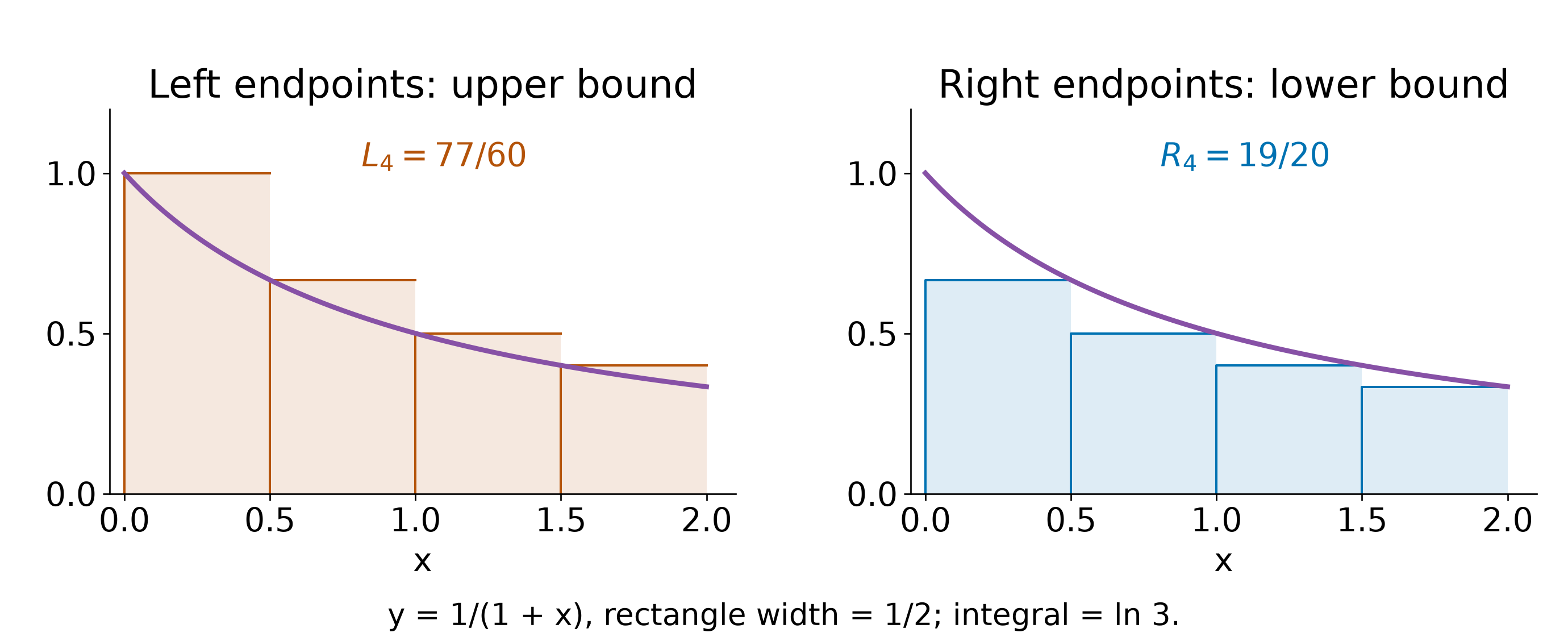
The area under the curve
area = ∫ f(x) dx
The displayed positive quadratic has a definite integral equal to its area on the selected interval. Include width when comparing rectangle areas; general definite integrals give signed area.
Bound ∫₀¹dx/(1+x) using two equal left- and right-endpoint rectangles.
Show the setup, relevant restrictions and evaluation before comparing with the model.
Keep unit-width and shrinking-width sums distinct
- Unit-width rectangles under $1/x$ give, for integers $n\ge2$, $\ln(n+1)<\sum_{r=1}^n1/r<1+\ln n$. For the upper bound, keep the first term $1$ separate and compare terms $r=2,\ldots,n$ with strips from $r-1$ to $r$.
- With $n$ equal strips on $[0,1]$, the width is instead $1/n$. For a continuous function, a Riemann sum 黎曼和 tends to the integral; identify both the width and the sample point.
For an increasing function the left/right inequality directions reverse. Do not copy a decreasing-function diagram without checking the derivative or monotonicity on the actual interval.
For f(x)=x² on [0,1], which endpoint sum is the upper bound? Give both sums for n=2.
Show the setup, relevant restrictions and evaluation before comparing with the model.
Rewrite a sum into height times width
- Divide each denominator by $n^2$ to expose the sample point $r/n$. The sum below is a right-endpoint rectangle sum, not $n$ times the limiting integral.
- Since $f(x)=1/(4+x^2)$ decreases on $[0,1]$, the finite sum is below the integral. The gap between the left and right sums is $(f(0)-f(1))/n=1/(20n)$, which tends to zero.
Find limₙ→∞ Σᵣ₌₁ⁿ n/(9n²+r²), explaining the width and sample point.
Show the setup, relevant restrictions and evaluation before comparing with the model.
For Rₙ=Σᵣ₌₁ⁿ n/(4n²+r²), give a two-sided bound in terms of A=(1/2)arctan(1/2).
Show the setup, relevant restrictions and evaluation before comparing with the model.
Find Cartesian arc length 弧长 from ds
- A small displacement has length $ds=\sqrt{dx^2+dy^2}$. For a single traversal with increasing $x$, the arc length is $L=\int_a^b\sqrt{1+(dy/dx)^2}\,dx$; it is not $\int y\,dx$.
- For $y=\cosh x$, $0\le x\le\ln2$, $\sqrt{1+\sinh^2x}=\cosh x>0$. Thus $L=[\sinh x]_0^{\ln2}=3/4$.
For $y=x^2$, $0\le x\le1$, a hyperbolic substitution in $\int_0^1\sqrt{1+4x^2}\,dx$ gives $L=\sqrt5/2+\sinh^{-1}(2)/4$. The straight-line distance between the endpoints is $\sqrt2$, which is smaller.
Arc length is the integral of √(1 + (______)²) dx.
Difficulty 1/5 · 100 coins + a small bonus on first completion today
Arc length s = ∫√(1 + (dy/dx)²) dx.
Find the arc length of y=2cosh(x/2) for 0≤x≤2ln 2.
Show the setup, relevant restrictions and evaluation before comparing with the model.
Use speed for a parametric curve
- For $x=x(t)$ and $y=y(t)$, $ds=\sqrt{(dx/dt)^2+(dy/dt)^2}\,dt$. Check that the chosen parameter interval traces the required arc once.
- For $x=3(t-\sin t)$, $y=3(1-\cos t)$, $0\le t\le\pi$, the speed is $3\sqrt{2-2\cos t}=6\sin(t/2)$, since the half-angle sine is non-negative.
For $x=\ln(\cosh2t)$, $y=\tan^{-1}(\sinh2t)$, $0\le t\le\ln2$, the derivatives are $2\tanh2t$ and $2\operatorname{sech}2t$. The identity $\tanh^2+\operatorname{sech}^2=1$ makes the speed $2$, so $L=2\ln2$.
For x=2(t−sin t), y=2(1−cos t), 0≤t≤π, find the arc length.
Show the setup, relevant restrictions and evaluation before comparing with the model.
Include both terms in polar arc length
- For a polar curve $r=r(\theta)$, radial and sideways changes contribute separately: $ds^2=dr^2+r^2d\theta^2$. Thus $L=\int_\alpha^\beta\sqrt{r^2+(dr/d\theta)^2}\,d\theta$, with angles in radians.
- For $r=2(1+\cos\theta)$ on $0\le\theta\le\pi$, the square root is $4|\cos(\theta/2)|=4\cos(\theta/2)$. This interval traces the upper half once; its length is $8$.

Find the length of r=3(1+cos θ) on 0≤θ≤π. Would ∫r dθ give the length here?
Show the setup, relevant restrictions and evaluation before comparing with the model.
Choose the radius before finding surface area
- A narrow band of a surface area of revolution 旋转曲面面积 has area $2\pi\rho\,ds$, where $\rho\ge0$ is distance to the rotation axis. About the $x$-axis use $|y|$; about the $y$-axis use $|x|$.
- For $y=x+1$, $0\le x\le2$, $ds=\sqrt2\,dx$. Changing the axis changes the radius even though the arc is the same.
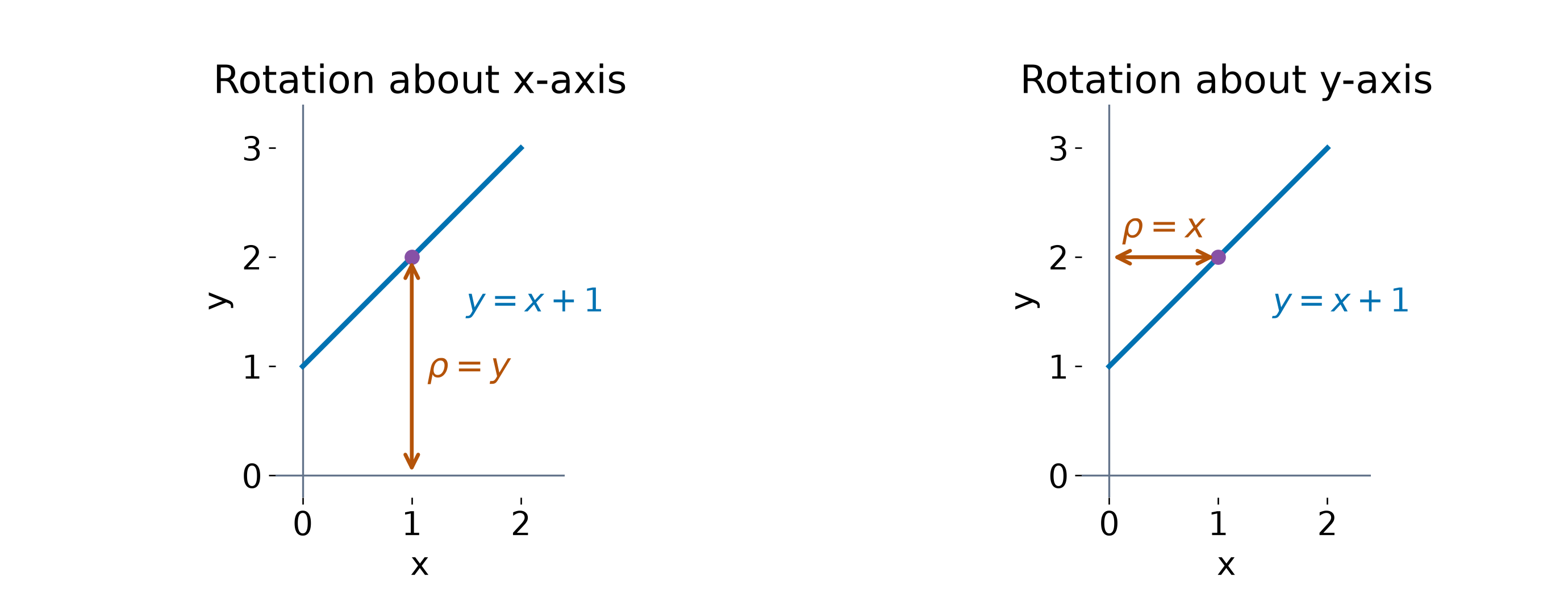
$\pi\int y^2\,dx$ is a volume formula, not a surface-area formula. Negative coordinates do not give negative areas. The syllabus requires Cartesian and parametric surfaces, not surfaces specified directly in polar form.
For y=x+2 on 0≤x≤1, find the surface areas generated about each coordinate axis.
Show the setup, relevant restrictions and evaluation before comparing with the model.
Rotate y=cosh x, 0≤x≤ln 2, about the x-axis. Find the surface area.
Show the setup, relevant restrictions and evaluation before comparing with the model.
Keep the parameter and speed in a surface integral
- For a parametric arc, use $S_x=2\pi\int|y(t)|\sqrt{x'(t)^2+y'(t)^2}\,dt$ or replace $|y(t)|$ by $|x(t)|$ for the $y$-axis. The square-root speed handles decreasing coordinates without producing negative length.
- For $x=2\cos t$, $y=2\sin t$, $0\le t\le\pi/2$, the speed is $2$. Rotation about the $x$-axis gives a hemisphere of radius $2$; the same is true about the $y$-axis.
For x=t²,y=2t,0≤t≤1, find the surface area about the x-axis.
Show the setup, relevant restrictions and evaluation before comparing with the model.
Change the limits when the substitution reverses direction
- A surface integral can need a further substitution after its geometric setup. For $y=\tanh x$, rotating $0\le x\le\tanh^{-1}(1/3)$ about the $x$-axis gives $2\pi\int\tanh x\sqrt{1+\operatorname{sech}^4x}\,dx$.
- Put $u=\sqrt{1+\operatorname{sech}^4x}$. Then $du/dx=-2\operatorname{sech}^4x\tanh x/u<0$ for $x>0$. Reversing the transformed limits removes the minus sign.
At the upper $x$ endpoint, $\tanh x=1/3$, so $\operatorname{sech}^2x=8/9$ and $u=\sqrt{145}/9$. Split $u^2/(u^2-1)=1+1/(u^2-1)$ before integrating. The transformed integral is positive.
In the tanh surface example, explain the reversed limits and obtain an antiderivative of u²/(u²−1).
Show the setup, relevant restrictions and evaluation before comparing with the model.
Set up, simplify, evaluate and check
- For substitutions and reductions, show the transformed differential, endpoint terms and valid index range. For rectangles, draw the comparison and include the rectangle width before taking a limit.
- For arc length or surface area, write $ds$ first, choose the parameter interval and a non-negative radius, then integrate. A plausible antiderivative cannot repair the wrong geometric setup.
Check an indefinite answer by differentiation. Check a reduction at a low allowed index. Check a sum against its diagram. Check a length against its chord and a surface against a simple geometric case where possible.
What is a?
Difficulty 1/5 · 100 coins + a small bonus on first completion today
4 squared is 16, so a is 4. Other options — 16 (the constant in the denominator); 3 (the lesson value for 9 plus x squared).