Differentiation (Further Pure 2)
Introduced| English | Meaning |
|---|---|
| differentiation/ˌdɪfəˌrenʃɪˈeɪʃn/ | The process of finding a derivative with respect to a specified variable. |
| polynomial/ˌpɒlɪˈnəʊmɪəl/ | An expression formed from a finite sum of non-negative integer powers of a variable, each multiplied by a coefficient. |
| hyperbolic/ˌhaɪpəˈbɒlɪk/ | Describes functions such as sinh and cosh that are defined using exponential functions. |
| chain rule/tʃeɪn ruːl/ | The rule for differentiating a composite function by multiplying the outer derivative by the inner derivative. |
| implicit/ɪmˈplɪsɪt/ | Describes a relation in which the dependent variable is not isolated as a function of the independent variable. |
| second derivative/ˈsekənd dɪˈrɪvətɪv/ | The derivative of the first derivative with respect to the same variable. |
| parametric/ˌpærəˈmetrɪk/ | Describes a curve whose coordinates are each given as functions of a parameter. |
| Maclaurin series/məˈklɔːrɪn ˈsɪəriːz/ | A Taylor series centred at zero, whose coefficients are determined by the function's derivatives at zero. |
| coefficient/ˌkəʊɪˈfɪʃənt/ | A number or expression multiplying a specified power or term. |
| interval of convergence/ˈɪntəvl ɒv kənˈvɜːdʒəns/ | The interval of variable values for which a power series converges. |
| diverge/daɪˈvɜːdʒ/ | Fails to approach a finite limit, in the context of a sequence or the partial sums of a series. |
Follow a curve recorded by time
- A moving tool may follow a curve given by $x(t)$ and $y(t)$. Its slope is a change in $y$ per change in $x$, not simply per change in time $t$.
- Differentiation 微分 gives the slope and how it changes. Near $x=0$, a short polynomial 多项式 can match the curve's value, slope and bending without describing the whole curve.
Differentiate the six hyperbolic 双曲 functions
- Differentiate the exponential definitions to obtain $(\sinh x)'=\cosh x$ and $(\cosh x)'=\sinh x$. Unlike ordinary cosine, hyperbolic cosine has no minus sign here.
- Use the quotient or reciprocal rule for the other four hyperbolic functions. The real domains still exclude zeros of a denominator.
| Function | Derivative |
|---|---|
| $\sinh x$ | $\cosh x$ |
| $\cosh x$ | $\sinh x$ |
| $\tanh x$ | $\operatorname{sech}^2x$ |
| $\operatorname{sech}x$ | $-\operatorname{sech}x\tanh x$ |
| $\operatorname{cosech}x$ | $-\operatorname{cosech}x\coth x$ |
| $\coth x$ | $-\operatorname{cosech}^2x$ |
For example, $(\tanh x)'=(\cosh^2x-\sinh^2x)/\cosh^2x=\operatorname{sech}^2x$. The derivatives of cosech and coth apply on $x\ne0$.
The derivative of sinh x is:
Difficulty 1/5 · 100 coins + a small bonus on first completion today
d/dx(sinh x) = cosh x (and d/dx(cosh x) = sinh x).
Differentiate x sinh(2x) and sech(3x). Show the rules used.
State the variable and restrictions, and show the derivative or coefficient calculation before comparing with the model.
Derive d(coth x)/dx from coth x=cosh x/sinh x. State the real restriction.
State the variable and restrictions, and show the derivative or coefficient calculation before comparing with the model.
Derive inverse trigonometric derivatives
- In $y=\sin^{-1}x$, write $\sin y=x$ and differentiate: $\cos y\,y'=1$. The principal branch has $\cos y\ge0$, so $y'=1/\sqrt{1-x^2}$ for $-1<x<1$.
- For $y=\cos^{-1}x$, $-\sin y\,y'=1$, and $\sin y\ge0$ on its principal branch. The derivative is negative. Also retain the familiar inverse-tangent derivative.
Here the superscript $-1$ means an inverse function, not a reciprocal. The inverse sine and cosine functions have endpoint values at $\pm1$, but no finite derivative there.
The derivative of tan⁻¹x is 1/(1+x²). What is its value at x = 0?
Difficulty 2/5 · 140 coins + a small bonus on first completion today
1/(1+0²) = 1.
Derive the derivative of arccos x from cos y=x, and explain its sign and domain.
State the variable and restrictions, and show the derivative or coefficient calculation before comparing with the model.
Derive inverse hyperbolic derivatives
- For $y=\sinh^{-1}x$, differentiation of $\sinh y=x$ gives $\cosh y\,y'=1$. Since $\cosh y>0$, use $\cosh y=\sqrt{1+x^2}$.
- For inverse cosh choose $y\ge0$, so $\sinh y=\sqrt{x^2-1}$. For inverse tanh use $1-\tanh^2y=1-x^2$. Record the open intervals where finite derivatives exist.

Inverse cosh is defined at x=1, with value zero. Its finite derivative formula applies only for x greater than 1.
Match each function to its derivative.
Difficulty 2/5 · 140 coins + a small bonus on first completion today
The hyperbolic pair swap (no minus sign, unlike sin/cos); the inverse trig derivatives are the standard rational/surd forms.
Derive the derivative of inverse tanh from x=tanh y and explain why the real domain is restricted.
State the variable and restrictions, and show the derivative or coefficient calculation before comparing with the model.
At x=1, is inverse cosh defined? Does it have a finite derivative there? Explain using its branch.
State the variable and restrictions, and show the derivative or coefficient calculation before comparing with the model.
Keep the inner derivative and the domain
- The chain rule 链式法则 gives $\dfrac{d}{dx}f(u(x))=f'(u(x))u'(x)$. A correct outer formula is incomplete without the inner derivative.
- For $\cosh^{-1}(2x)$ the function needs $x\ge1/2$, but the finite derivative below needs $x>1/2$. For $\sin^{-1}(2x)$ the finite derivative needs $|x|<1/2$.
Differentiate arsinh(3x), arccos(x/2) and artanh(2x). Give the real finite-derivative domains.
State the variable and restrictions, and show the derivative or coefficient calculation before comparing with the model.
Differentiate arcosh(1+x²). Where does a finite derivative exist, and what happens at zero?
State the variable and restrictions, and show the derivative or coefficient calculation before comparing with the model.
Differentiate an implicit 隐式 relation once
- An implicit relation mixes $x$ and $y$. Treat $y$ as a function of $x$: $(y^2)'=2yy'$ and $(xy)'=y+xy'$ by the product rule.
- For $x^2+xy+y^2=7$, collect all terms containing $y'$ before dividing. At $(1,2)$, the denominator is $5\ne0$ and $y'=-4/5$.
For x²+2xy+3y²=6, find dy/dx and its value at (1,1).
State the variable and restrictions, and show the derivative or coefficient calculation before comparing with the model.
Differentiate the implicit relation again
- A second derivative 二阶导数 is $y''=d^2y/dx^2$. Differentiate the unsimplified first relation again; this often avoids a long quotient.
- Differentiating $2x+y+xy'+2yy'=0$ gives the expression below. At $(1,2)$ substitute $y'=-4/5$ only after forming the second-derivative equation.
The derivative of $yy'$ is $(y')^2+yy''$, not just $yy''$. A denominator zero in a slope formula needs separate analysis; it does not automatically prove that the original curve has no point there.
For x²+2xy+3y²=6, obtain d²y/dx² at (1,1). Show the unsimplified differentiated relation.
State the variable and restrictions, and show the derivative or coefficient calculation before comparing with the model.
For x²+y²=25 on the upper branch, find the first and second derivatives at (3,4).
State the variable and restrictions, and show the derivative or coefficient calculation before comparing with the model.
Combine an inverse with an implicit product
- For $y^2-\sinh^{-1}(xy)=1-\ln2$, the point $(3/4,1)$ lies on the curve because $\sinh^{-1}(3/4)=\ln2$. Set $p=y'$ and $S=\sqrt{1+x^2y^2}$ to organise the calculation.
- The first relation below gives $p=4/7$ at the point. For the second derivative, differentiate before substituting: $(y+xp)'=2p+xy''$ and $S'=xy(y+xp)/S$.
At $(3/4,1)$, $S=5/4$ and $p=4/7$. The second relation becomes
The square-root factor contains the variable $y$ too. Treating it as a function of $x$ alone loses a chain-rule term.
For 2y²−arsinh(xy)=2−ln 2, find the first and second derivatives at (3/4,1). Show where the product and inverse-function rules enter.
The same inverse-sinh derivative must be combined with the implicit product rule twice. The first derivative value is substituted only after the second relation is formed.
Change the parameter derivative into a slope
- A parametric 参数 description uses $x=x(t)$ and $y=y(t)$. Where $x'(t)\ne0$, $dy/dx=y'(t)/x'(t)$. The prime here must refer to the variable you state.
- For $x=t^2-4$, $y=e^t$, $t>0$, the slope is $e^t/(2t)$. At $x=0$ the chosen branch has $t=2$, so the point is $(0,e^2)$ and its slope is $e^2/4$.
For x=t²−1, y=ln t, t>0, locate x=0 and find dy/dx there.
State the variable and restrictions, and show the derivative or coefficient calculation before comparing with the model.
Divide by dx over dt for the second derivative too
- Differentiating $dy/dx$ with respect to $t$ is not yet a second derivative with respect to $x$. Divide that result by $dx/dt$ once more.
- In the worked curve, the extra factor changes the denominator. At $t=2$, the result is $e^2/32$, rather than the parameter derivative $e^2/8$.
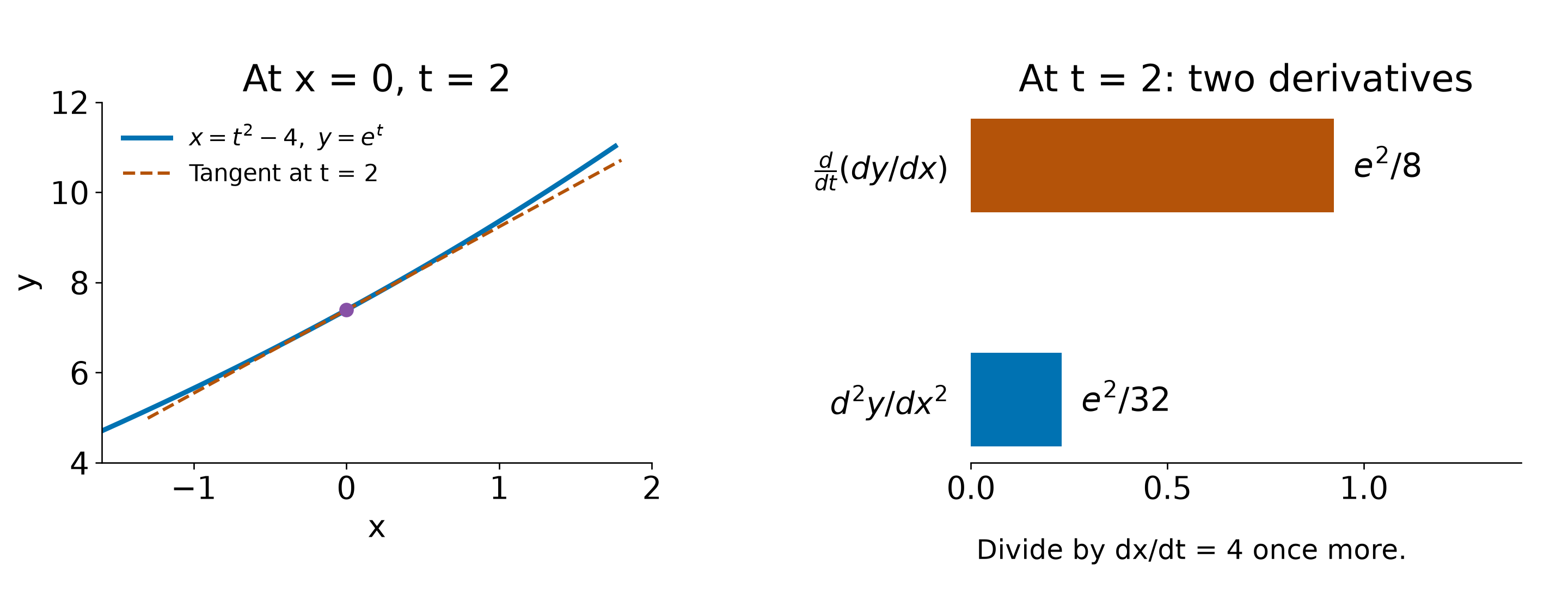
For x=t²−1, y=ln t, t>0, find d²y/dx² and its value where x=0.
State the variable and restrictions, and show the derivative or coefficient calculation before comparing with the model.
Build a polynomial from derivatives at zero
- A Maclaurin series 麦克劳林级数 uses derivatives with respect to $x$, evaluated at $x=0$. Its $x^n$ coefficient 系数 is $f^{(n)}(0)/n!$; do not omit the factorial.
- To find terms through $x^2$, obtain $f(0),f'(0),f''(0)$ before substituting. For $e^x$, these values are all $1$, so the first terms are $1+x+x^2/2$.

Matching derivatives describes local behaviour. It does not by itself prove that an infinite series equals the function everywhere.
The gradient at a point
gradient = dy/dx
The displayed quadratic is 1+x+x²/2, the first three Maclaurin terms for eˣ. At x=0 it matches the value 1 and the slope 1.
The Maclaurin series of eˣ begins:
Difficulty 1/5 · 100 coins + a small bonus on first completion today
eˣ = Σ xⁿ/n! = 1 + x + x²/2! + x³/3! + …
In a Maclaurin series, the constant term is f(0). For f(x) = eˣ, what is f(0)?
Difficulty 2/5 · 140 coins + a small bonus on first completion today
e⁰ = 1, so the constant term is 1.
In the Maclaurin series, the coefficient of xⁿ has n-factorial (written n!) in the ______.
Difficulty 1/5 · 100 coins + a small bonus on first completion today
The xⁿ term is f⁽ⁿ⁾(0)/n! · xⁿ — the n! is in the denominator.
A smooth function has f(0)=2, f′(0)=−3, f″(0)=8 and f‴(0)=−12. Write its expansion through x³.
State the variable and restrictions, and show the derivative or coefficient calculation before comparing with the model.
Obtain a composite expansion by differentiation
- Let $f(x)=e^{1/(x+3)}$ and write $E=e^{1/3}$. The chain rule gives $f'=-(x+3)^{-2}f$; the product rule is then needed for $f''$.
- At zero, $f(0)=E$, $f'(0)=-E/9$ and $f''(0)=7E/81$. Divide the last value by $2!$ to obtain the quadratic coefficient.
For $f(x)=\ln(1+x)$, the values at zero are $0,1,-1,2$ through the third derivative. Thus the first three non-zero terms are $x-x^2/2+x^3/3$. Keep the factorial: $2/3!=1/3$.
Find the Maclaurin expansion of f(x)=exp(2/(1+x)) through x² using differentiation.
State the variable and restrictions, and show the derivative or coefficient calculation before comparing with the model.
Derive the first three non-zero Maclaurin terms for ln(1+2x).
State the variable and restrictions, and show the derivative or coefficient calculation before comparing with the model.
Use successive implicit derivatives for tan
- For $y=\tan x$, start with $y'=\sec^2x=1+y^2$. At $x=0$, $y=0$ and $y'=1$; this relation keeps later derivatives in terms of $y$ and its derivatives.
- The next two derivatives below give $y''(0)=0$ and $y'''(0)=2$. Therefore $\tan x=x+x^3/3+\cdots$; there is no constant or quadratic term. A general coefficient formula is not required here.
For y=arsinh x, start with (1+x²)(y′)²=1. Use successive implicit differentiation to find the first two non-zero terms.
State the variable and restrictions, and show the derivative or coefficient calculation before comparing with the model.
From y=tan x, y′=1+y² and y(0)=0, derive the term in x⁵ after x+x³/3. Do not guess a general coefficient formula.
State the variable and restrictions, and show the derivative or coefficient calculation before comparing with the model.
Locate x zero before expanding a parametric curve
- A Maclaurin expansion is centred on $x=0$, which need not mean $t=0$. For $x=t^2-4$, $y=e^t$, $t>0$, use $t=2$ and the derivatives already obtained.
- Here $y(0)=e^2$, $y_x'(0)=e^2/4$ and $y_{xx}''(0)=e^2/32$. The quadratic coefficient is $e^2/64$, not $e^2/32$.
Without the branch $t>0$, $t=\pm2$ gives two different points with $x=0$. Identify the local branch before assigning a single value $y(0)$.
Use x=t²−1, y=ln t, t>0, to obtain the expansion of y through x². Check with an explicit expression for y.
State the variable and restrictions, and show the derivative or coefficient calculation before comparing with the model.
Join hyperbolic parameters to a local expansion
- For $x=\sinh t$, $y=2t+\cosh t$, the first derivative is $(2+\sinh t)/\cosh t$. Since $\cosh t>0$, division by $dx/dt$ is valid for all real $t$.
- Apply the quotient rule, then divide by $\cosh t$ again. At $x=0$, $t=0$, so $y=1$, $dy/dx=2$ and $d^2y/dx^2=1$.
For x=2sinh t and y=t+3cosh t, find dy/dx, d²y/dx², and the Maclaurin terms through x².
State the variable and restrictions, and show the derivative or coefficient calculation before comparing with the model.
Keep approximation and convergence separate
- A finite Taylor polynomial is a local approximation; an infinite series needs an interval of convergence 收敛区间. For $\ln(1+x)$ that interval is $-1<x\le1$; for $e^x$, sine and cosine it is all real $x$.
- Outside its interval a series may diverge 发散, so adding terms need not improve the approximation. Even within the interval, convergence alone is not a promise of improvement at every finite step.
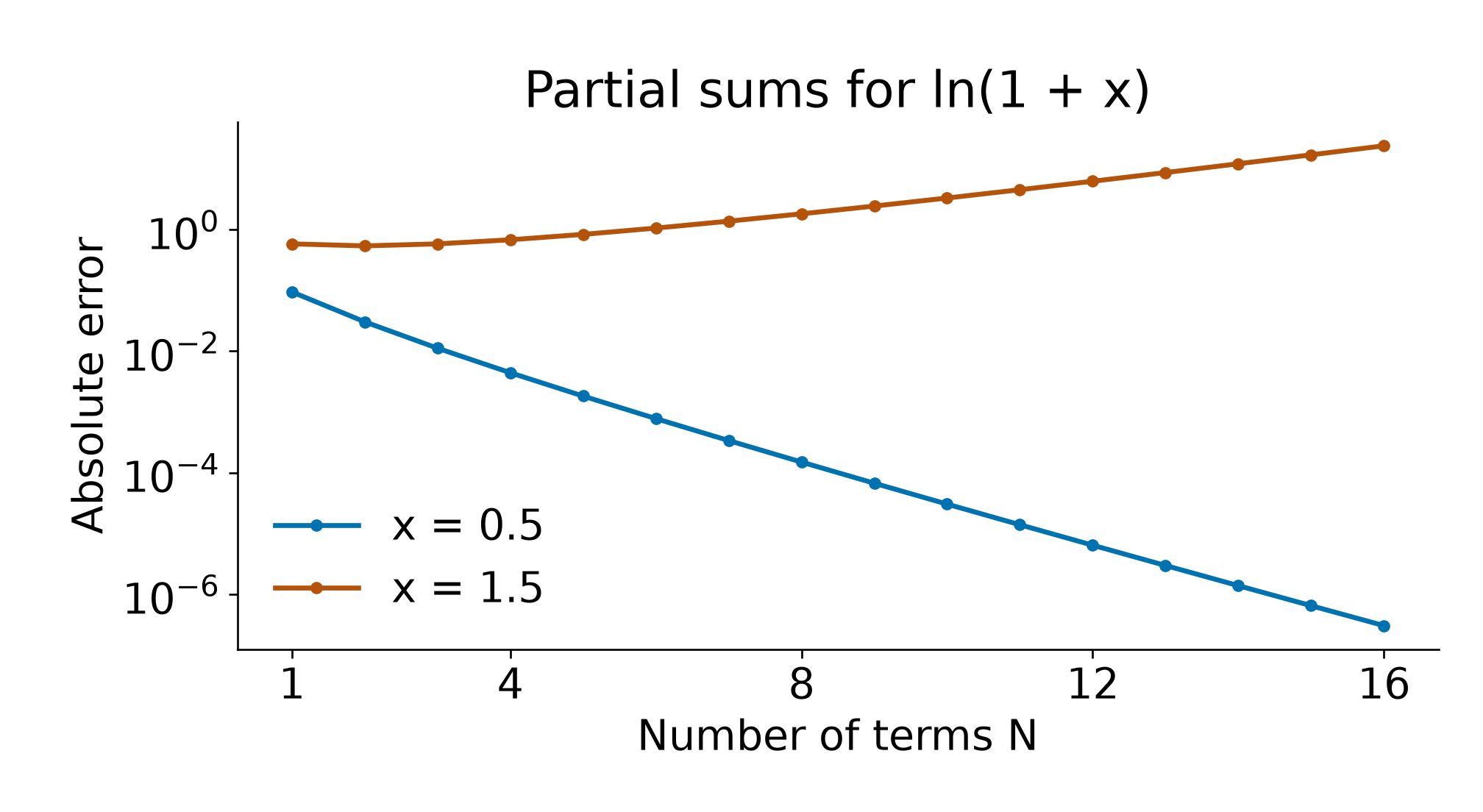
The plotted error is the absolute difference between a finite sum and ln(1+x). Both function values exist; only x=0.5 lies inside the series interval.
The Maclaurin series for ln(1+x) is valid for every value of x.
Difficulty 1/5 · 100 coins + a small bonus on first completion today
It only converges for −1 < x ≤ 1; outside that interval it diverges.
What is the derivative of arctan x at x = 1, and why can adding terms make a series worse outside its interval of convergence?
Substitute x = 1 into 1 over (1 plus x squared). Convergence is a limit statement, not a promise that every extra term helps.
For the Maclaurin series of ln(1+2x), determine the real interval where it equals the function. Is x=0.75 allowed just because the logarithm exists there?
State the variable and restrictions, and show the derivative or coefficient calculation before comparing with the model.
Choose the variable before differentiating
- For an inverse function, state its branch and finite-derivative domain, then apply the inner derivative. For an implicit relation, carry every $y'$ factor and use the product rule again for $y''$.
- For a parametric curve, divide by $dx/dt$ for each derivative with respect to $x$. For a Maclaurin expansion, locate $x=0$, evaluate the needed derivatives, and divide by factorials.
An inverse value can exist where its finite derivative does not. A parameter value need not equal the x-coordinate. A second parameter derivative need not equal $d^2y/dx^2$. Checking these distinctions prevents correct formulas being used at the wrong point.
What is the derivative of arctan x at x = 1?
Difficulty 1/5 · 100 coins + a small bonus on first completion today
1 plus 1 is 2, and 1 divided by 2 is 0.5. Other options — 1 (the lesson value at x = 0); 2 (the value of 1 plus x squared).