Matrices (Further Pure 2)
Introduced| English | Meaning |
|---|---|
| matrix equation/ˈmeɪtrɪks ɪˈkweɪʒn/ | An equation involving matrices and their operations, such as a matrix representation of simultaneous linear equations. |
| non-singular/ˌnɒnˈsɪŋɡjʊlə/ | For a square matrix, having non-zero determinant and therefore an inverse. |
| singular/ˈsɪŋɡjʊlə/ | For a square matrix, having zero determinant and therefore no inverse. |
| consistent/kənˈsɪstənt/ | Describes a system of equations that has at least one solution. |
| inconsistent/ˌɪnkənˈsɪstənt/ | Describes a system of equations that has no solution. |
| eigenvector/ˈaɪɡənvektə/ | A nonzero vector that a linear transformation maps to a scalar multiple of itself. |
| eigenvalue/ˈaɪɡənvæljuː/ | A scalar by which a matrix multiplies a corresponding non-zero eigenvector. |
| scalar/ˈskeɪlə/ | A single number used, for example, to multiply each component of a vector. |
| stretch/stretʃ/ | A transformation that increases lengths in a specified direction by a fixed factor. |
| characteristic equation/ˌkærɪktəˈrɪstɪk ɪˈkweɪʒn/ | For a square matrix A, the equation det(A minus lambda I) equals zero, whose solutions are the matrix's eigenvalues. |
| diagonalisation/daɪˌæɡənəlaɪˈzeɪʃn/ | Writing a matrix as an invertible eigenvector matrix times a diagonal matrix times the inverse eigenvector matrix. |
| diagonal matrix/daɪˈæɡənl ˈmeɪtrɪks/ | A square matrix whose entries outside the main diagonal are all zero. |
| linearly independent/ˈlɪnɪəli ˌɪndɪˈpendənt/ | Describes vectors for which only the combination with every coefficient zero gives the zero vector. |
| Cayley–Hamilton theorem/ˈkeɪli ˈhæmɪltən ˈθɪərəm/ | The theorem that every square matrix satisfies its own characteristic equation. |
One map, many repeated moves
- A matrix can describe one change in a model. Repeating the change needs a power such as $A^{20}$; multiplying twenty times hides the structure.
- This lesson joins three tools: solve a matrix equation 矩阵方程, find special vectors, then simplify powers and inverses. Keep track of when a solution or inverse exists.
Put three equations into one matrix
- Put the coefficients of $x,y,z$ in that order in every row. The right-hand side is a column, not another row of the coefficient matrix.
- To read the matrix equation back, multiply each row by the unknown column. A missing variable has coefficient zero.
Write x+2y−z=4, 3x−z=2 and y+z=5 as a matrix equation. Then read its second row back.
Write the method and check the stated conditions before comparing with the model.
Find and check the unique point
- Here $\det C=1\ne0$, so $C$ is non-singular 非奇异: there is exactly one solution. Inverse multiplication is valid, but elimination is shorter here.
- Subtract the first equation from the second to get $y=2$. The first then gives $x+z=4$, and the third gives $2x+3z=11$; hence $(x,y,z)=(1,2,3)$.
Check all three original equations: $1+2+3=6$, $1+4+3=8$ and $2+2+9=13$. Geometrically, the three planes meet at one point. Checking only two planes is not enough.
Solve x+y+z=7, x+2y+z=10, 2x+y+3z=13. Check every equation and describe the intersection.
Write the method and check the stated conditions before comparing with the model.
A zero determinant needs another check
- A singular 奇异 coefficient matrix has determinant zero. The equations may be consistent 相容 (at least one solution) or inconsistent 不相容 (no solution); singular does not mean no solution.
- For $x+y+z=3$ and $x+2y+z=4$, subtraction gives $y=1$, $x+z=2$. A third equation $2x+3y+2z=7$ adds no condition: the common line is $(x,y,z)=(2-t,1,t)$, $t\in\mathbb R$.
Change only the third right-hand side to $8$. Subtracting the first two equations from the third gives $0=1$, so no point lies on all three planes. Pairwise intersections do not prove a common intersection. Coincident planes can also occur; three identical equations leave a whole plane of solutions.
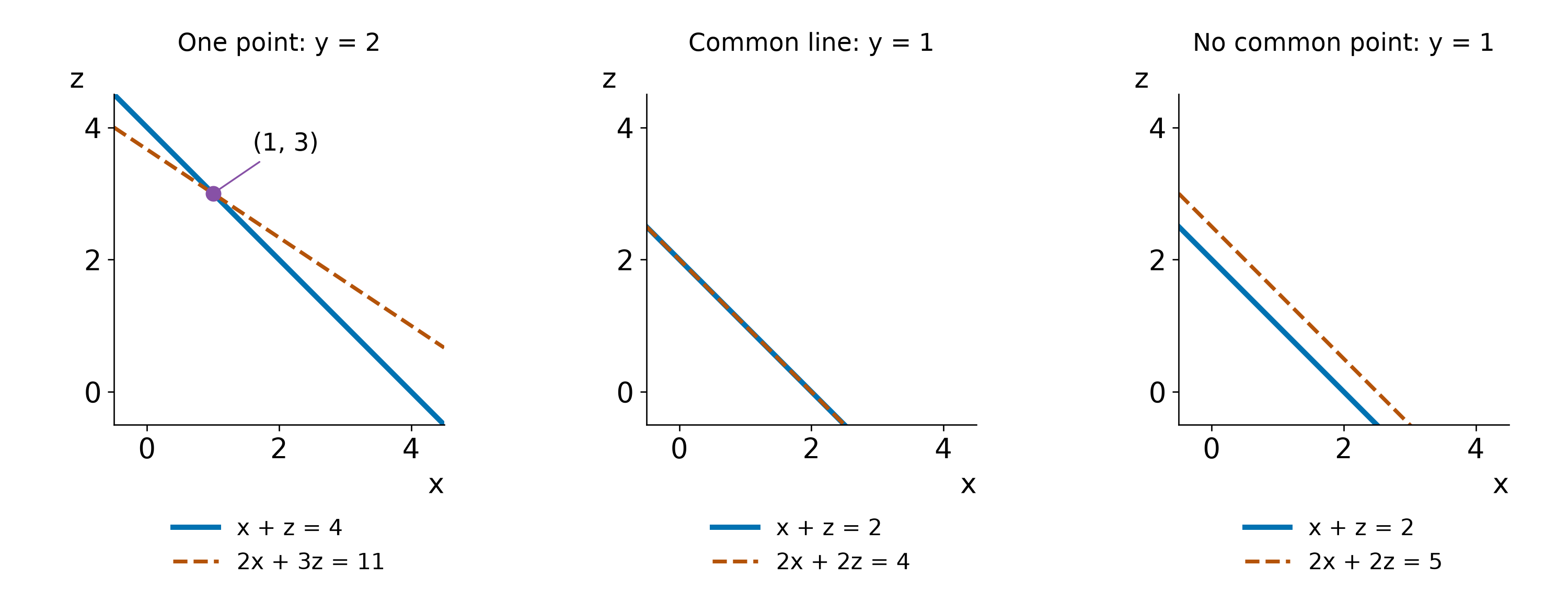
Each panel uses the value of y forced by the first two equations. The remaining lines represent the conditions on x and z.
Solve x+y+z=5, x+2y+z=7, 2x+3y+2z=12. Give all solutions and explain the geometry.
Write the method and check the stated conditions before comparing with the model.
Keep the first two equations of the previous task, but change the third right-hand side to 13. Does a zero determinant give a line of solutions now?
Write the method and check the stated conditions before comparing with the model.
Separate exceptional parameter values
- For the system below, subtract row 1 from rows 2 and 3. The determinant is $(a-1)(a+1)$, so only $a=1,-1$ need a separate consistency check.
- If $a\ne\pm1$, then $y=1/(a-1)$, $z=0$ and $x=3-1/(a-1)$. Never divide by $a-1$ or $a+1$ before separating the zero cases.
At $a=1$, $0=1$ is impossible. At $a=-1$, $y=-1/2$ but $z=t$ is free, giving the common line $(x,y,z)=(7/2-t,-1/2,t)$. Both coefficient matrices are singular; only the second system is consistent.
Classify every real a for x+y+z=5, x+ay+z=7, x+y+(a+2)z=5. Give all solutions when they exist.
Write the method and check the stated conditions before comparing with the model.
A special vector stays on its line
- An eigenvector 特征向量 is a non-zero vector $\mathbf e$ with $A\mathbf e=\lambda\mathbf e$. Its eigenvalue 特征值 is the scalar 标量 $\lambda$. Every non-zero multiple of $\mathbf e$ is another eigenvector for the same value.
- A positive eigenvalue can stretch 拉伸 or shorten a vector. A negative value also reverses it; zero sends it to the origin, where direction is undefined. The zero vector is never an eigenvector, although it solves the equation.
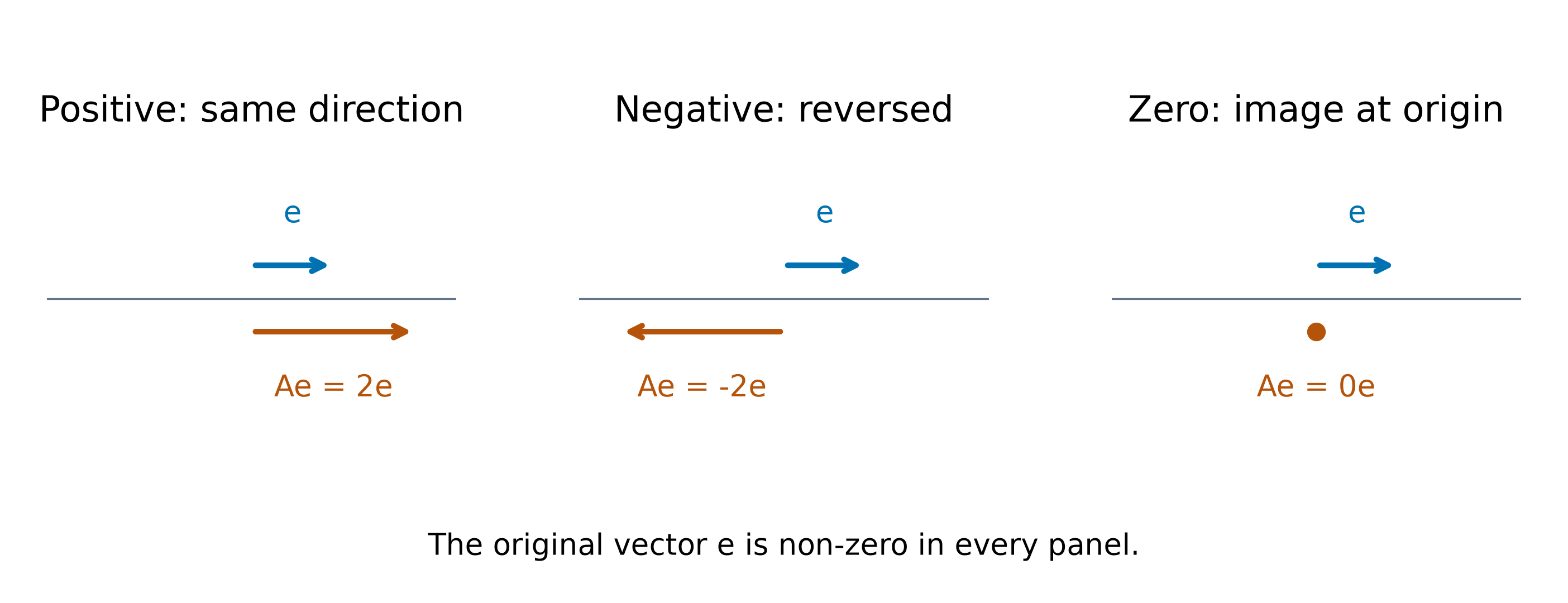
Multiplying an eigenvector by A always rotates it by 90°.
Difficulty 1/5 · 100 coins + a small bonus on first completion today
False. An eigenvector keeps its line: Av = λv, so A only scales it by the eigenvalue λ (reversing it if λ < 0).
If v is an eigenvector of A, then 2v is also an eigenvector of A.
Difficulty 1/5 · 100 coins + a small bonus on first completion today
Eigenvectors are not unique — any non-zero scalar multiple of an eigenvector is also an eigenvector.
For T=diag(−2,0), describe the images of e₁=(1,0)ᵀ and e₂=(0,1)ᵀ. Is the zero vector an eigenvector?
Write the method and check the stated conditions before comparing with the model.
Find two eigenvalues and their vectors
- A non-zero solution of $(A-\lambda I)\mathbf e=\mathbf0$ exists when $\det(A-\lambda I)=0$. This is the characteristic equation 特征方程; using $\det(\lambda I-A)=0$ gives the same roots.
- For the matrix below, $\lambda=1$ gives $u+v=0$, so choose $(1,-1)^T$. For $\lambda=3$, $u-v=0$, so choose $(1,1)^T$. Check each by multiplying by $A$.

Matrices (Further Pure 2)
(x', y') = M(x, y)
Compare the images of (1,1) and (1,−1): the eigenvalues are 3 and 1. General vectors need not stay on their original line.
The matrix [[2,1],[1,2]] has characteristic equation (2−λ)² − 1 = 0, giving λ = 1 or λ = 3. What is the larger eigenvalue?
Difficulty 2/5 · 140 coins + a small bonus on first completion today
(2−λ)² = 1 → 2−λ = ±1 → λ = 1 or 3; the larger is 3.
The eigenvalues of a matrix A are found by solving:
Difficulty 1/5 · 100 coins + a small bonus on first completion today
The characteristic equation det(A − λI) = 0 gives the eigenvalues.
Find the eigenvalues and one eigenvector for each of R with rows (3,1),(1,3). Show the characteristic equation.
Write the method and check the stated conditions before comparing with the model.
Extend the method to three dimensions
- A triangular matrix has the diagonal entries as eigenvalues: its characteristic determinant is the product of the diagonal factors. Do not row-reduce the original matrix to find its eigenvalues; ordinary row operations need not preserve them.
- For each root below, solve $(B-\lambda I)\mathbf e=0$. At $\lambda=3$, the first row gives $-u+v=0$ and the third gives $w=0$, hence $(1,1,0)^T$.
For T with rows (1,2,0),(0,3,0),(0,0,−2), find all eigenvalues and a corresponding non-zero vector for each.
Write the method and check the stated conditions before comparing with the model.
Prove what happens under powers
- Start with $A\mathbf e=\lambda\mathbf e$, not with an inverse of the vector. Then $A^2\mathbf e=A(\lambda\mathbf e)=\lambda^2\mathbf e$; repeating gives $A^n\mathbf e=\lambda^n\mathbf e$ for positive integers $n$.
- Also $(A+cI)\mathbf e=(\lambda+c)\mathbf e$. If $A$ is invertible, $\lambda\ne0$ and multiplication by $A^{-1}$ gives $A^{-1}\mathbf e=\lambda^{-1}\mathbf e$. Positive powers do not require invertibility.
For $B$, the vector $(0,0,1)^T$ has eigenvalue $-1$. Under $B^2$ its eigenvalue is $1$, under $B^3$ it is $-1$, and under $B^{-1}$ it is $-1$. The vector remains non-zero in all these cases.
Given Ae=λe with e≠0, prove A³e=λ³e. If A is invertible, prove the inverse result too. Which argument needs invertibility?
Write the method and check the stated conditions before comparing with the model.
Match each column to its eigenvalue
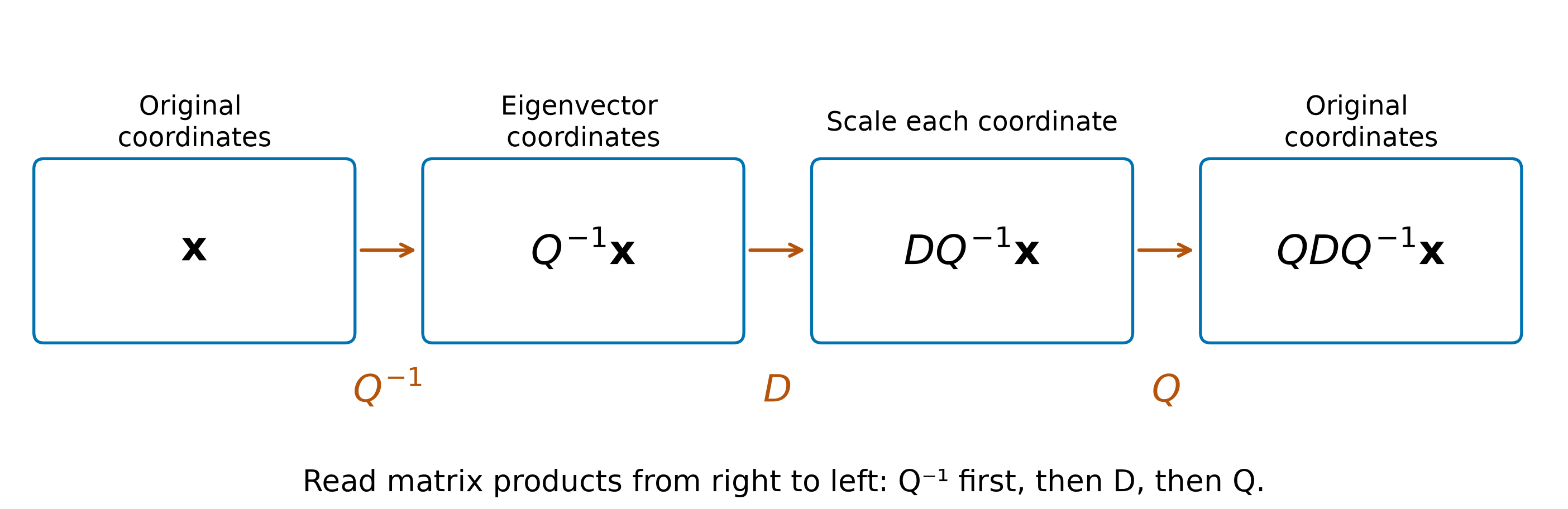
- Diagonalisation 对角化 writes $B=QDQ^{-1}$, where $D$ is a diagonal matrix 对角矩阵. Put eigenvectors in the columns of $Q$, and put their eigenvalues in the same order down $D$.
- $BQ=QD$ checks all three eigenvector equations at once. The columns must be linearly independent 线性无关 so that $Q^{-1}$ exists. Real, distinct eigenvalues guarantee this in the syllabus cases; do not assume every matrix is diagonalisable.
In the diagonalisation A = QDQ⁻¹, the matrix D contains:
Difficulty 1/5 · 100 coins + a small bonus on first completion today
D is a diagonal matrix with the eigenvalues of A on its main diagonal.
For lesson matrix B, a student takes Q columns (1,1,0)ᵀ,(1,0,0)ᵀ,(0,0,1)ᵀ but D=diag(2,3,−1). Repair the claim B=QDQ⁻¹.
Write the method and check the stated conditions before comparing with the model.
Compute powers without repeated multiplication
- In $(QDQ^{-1})(QDQ^{-1})$, the middle $Q^{-1}Q$ cancels. Thus $B^n=QD^nQ^{-1}$: raise only the diagonal entries of $D$ to the power.
- For $n=0$ this gives $I$; because $B$ is invertible, the same formula holds for negative integers too. Its upper-right block shows why powers of individual entries of $B$ would be wrong.
For the earlier $2\times2$ matrix $A$, choose $Q_A=\begin{pmatrix}1&1\\-1&1\end{pmatrix}$ and $D_A=\operatorname{diag}(1,3)$. Then
If A = QDQ⁻¹, then A³ = QD³Q⁻¹. If D has diagonal entries 1 and 3, D³ has diagonal entries 1 and ?
Difficulty 2/5 · 140 coins + a small bonus on first completion today
D³ has diagonal entries 1³ = 1 and 3³ = 27.
For A with rows (2,1),(1,2), use diagonalisation to calculate A⁴. Do not raise each entry to its fourth power.
Write the method and check the stated conditions before comparing with the model.
For lesson B, find B⁵ and B⁻¹ using its diagonal form. Explain why the inverse power is allowed.
Write the method and check the stated conditions before comparing with the model.
Reuse the vectors for a changed matrix
- A polynomial $f(B)$ has the same eigenvectors with eigenvalues $f(\lambda)$. Therefore $f(B)=Qf(D)Q^{-1}$; do not change $Q$ merely because the question asks about a shifted or squared matrix.
- For $(B+I)^2$, use $D'=\operatorname{diag}(9,16,0)$ with the same $Q$. It is singular but still diagonalisable. Repeated transformed eigenvalues also do not invalidate an already invertible $Q$.
For $(B-2I)^3$, the diagonal becomes $\operatorname{diag}(0,1,-27)$. For $B^{-1}$ it becomes $\operatorname{diag}(1/2,1/3,-1)$. In every case, keep the order $2,3,-1$ used to build $Q$.
Use lesson B and its Q to diagonalise (B−I)². Two eigenvalues of the transformed matrix coincide: does this stop your method?
Write the method and check the stated conditions before comparing with the model.
Reconstruct a matrix from its eigenvectors
- Given the eigenvectors first, form $Q$ and $D$, then calculate $QDQ^{-1}$. The columns may be scaled separately by non-zero numbers without changing the resulting matrix.
- If $(1,1)^T$ has eigenvalue $4$ and $(1,-1)^T$ has eigenvalue $2$, the calculation below gives $R$. Check $R(1,1)^T=4(1,1)^T$ and $R(1,-1)^T=2(1,-1)^T$.
The matrix has rows (4, 1) and (1, 4). What is its larger eigenvalue, and why is an eigenvector not a single vector?
The eigenvalues solve (4 minus lambda) squared minus 1 = 0. Scaling an eigenvector does not change the eigenvalue equation.
A matrix T has eigenvalues 1,4,−2 with respective eigenvectors (1,0,0)ᵀ,(1,1,0)ᵀ,(0,0,1)ᵀ. Reconstruct T and verify the three equations.
Write the method and check the stated conditions before comparing with the model.
For a≠0, take Q with columns (a,0,0)ᵀ,(1,a,0)ᵀ,(0,0,1)ᵀ and D=diag(1,3,−2). Find T=QDQ⁻¹ in terms of a.
Write the method and check the stated conditions before comparing with the model.
A matrix satisfies its own equation
- The Cayley–Hamilton theorem 凯莱–哈密顿定理 states that a square matrix satisfies its characteristic equation. Replace the variable by the matrix and each scalar constant by that constant times $I$.
- For $B$, expanding the three factors gives $\lambda^3-4\lambda^2+\lambda+6=0$. Therefore $B^3-4B^2+B+6I=0$, or $B^3=4B^2-B-6I$.
Use the characteristic equation of the matrix named in the question. Writing $B^3-4B^2+B+6=0$ omits the identity matrix and adds a scalar to a matrix. The theorem does not say that the whole matrix is an eigenvalue.
For R with rows (3,1),(1,3), find the characteristic equation and state Cayley–Hamilton with all identity terms.
Write the method and check the stated conditions before comparing with the model.
Reduce higher powers to lower ones
- Multiply the identity for $B^3$ by $B$, then replace $B^3$ again. The answer becomes a combination of $B^2,B,I$, without diagonalising again.
- A shifted cube can be expanded because $B$ and $I$ commute. After expanding, reduce every power of degree three or more using Cayley–Hamilton.
Using R²−6R+8I=0 for R with rows (3,1),(1,3), express R³ in terms of R and I, then give its entries.
Write the method and check the stated conditions before comparing with the model.
Use B³−4B²+B+6I=0 to reduce (B+I)³ to pB²+qB+rI. Give p,q,r.
Write the method and check the stated conditions before comparing with the model.
Obtain an inverse from Cayley–Hamilton
- $\det B=-6\ne0$, so multiply the characteristic identity by $B^{-1}$ and collect it. This gives an inverse as a polynomial in $B$; do not multiply by an inverse before checking it exists.
- For the $2\times2$ matrix $A$, $A^2-4A+3I=0$ gives $A^{-1}=(4I-A)/3$. Cayley–Hamilton works for both matrix sizes.
An inverse square can simplify further. Multiply the identity for $B^3$ by $B^{-2}$: $B-4I+B^{-1}+6B^{-2}=0$. Substitute the expression for $B^{-1}$ to obtain $B^{-2}=(B^2-10B+25I)/36$.
Use R²−6R+8I=0 to find R⁻¹ for R with rows (3,1),(1,3). Verify the result.
Write the method and check the stated conditions before comparing with the model.
For lesson B, use Cayley–Hamilton to write B⁻² as a polynomial of degree at most 2 in B.
Write the method and check the stated conditions before comparing with the model.
Choose and justify the method
- For three equations: form the coefficient matrix, separate singular parameter values, then solve or prove inconsistency and describe the geometry. For eigenvectors: state non-zero, solve the characteristic equation and match each vector to its root.
- For powers or inverses: choose diagonalisation or Cayley–Hamilton, show the intermediate identity, and check the result. A determinant, a list of roots or a final matrix alone may leave most of the method unexplained.
$C\mathbf x=\mathbf b$ describes simultaneous equations. $A\mathbf e=\lambda\mathbf e$, $\mathbf e\ne0$, describes a special direction. $A=QDQ^{-1}$ requires an invertible eigenvector matrix. Cayley–Hamilton reduces matrix powers and, when the matrix is non-singular, gives its inverse.
What is the larger eigenvalue?
Difficulty 1/5 · 100 coins + a small bonus on first completion today
The eigenvalues are 3 and 5, so the larger one is 5. Other options — 3 (the smaller eigenvalue, and also the lesson larger eigenvalue); 125 (the cube of the larger eigenvalue).
For T with rows (1,2,0),(0,3,0),(0,0,−2), give Q,D, find T⁴, and use its characteristic equation to obtain T⁻¹. Verify at least one off-diagonal entry.
Write the method and check the stated conditions before comparing with the model.