Skip to content · ⁨コンテンツへスキップ⁩

Parametric Equations, Polar Coordinates, and Vector-Valued Functions

AP Calculus BC · Topic 9 · ⁨トピック 9⁩

View Slides · ⁨查看幻灯片⁩ Train · ⁨練習する⁩
Video lesson for this topic · ⁨このトピックのビデオレッスン⁩ Open the video page · ⁨動画ページを開く⁩
6:06

パラメータ曲線、ベクトル & 極座標

y = f(x) の形で書けない曲線があります。粒子がループを描く場合や、自身と交差する経路の場合—one xに対して2つのyが存在することになります—

English narration · English + 中文 subtitles burned in · ⁨英語ナレーション・英語+中文字幕 burning-in⁩

9.1

Defining and Differentiating Parametric Equations · ⁨パラメータ方程式の定義と微分⁩

Syllabus · ⁨シラバス⁩
English

Enduring Understanding (CHA-3): Derivatives allow us to solve real-world problems involving rates of change.

Learning Objective CHA-3.G: Calculate derivatives of parametric functions. BC ONLY

  • CHA-3.G.1 Methods for calculating derivatives of real-valued functions can be extended to parametric functions. BC ONLY
  • CHA-3.G.2 For a curve defined parametrically, the value of $\dfrac{dy}{dx}$ at a point on the curve is the slope of the line tangent to the curve at that point. $\dfrac{dy}{dx}$, the slope of the line tangent to a curve defined using parametric equations, can be determined by dividing $\dfrac{dy}{dt}$ by $\dfrac{dx}{dt}$, provided $\dfrac{dx}{dt}$ does not equal zero. BC ONLY
日本語

持続的理解 (CHA-3): 導関数を用いることで、変化率に関連する現実世界の問題を解決できる。

学習目標 CHA-3.G: 参数函数の導関数を計算する。BC ONLY

  • CHA-3.G.1 実数値関数の導関数を計算する方法は、parameter functions に拡張できる。BC ONLY
  • CHA-3.G.2 parameterで定義された曲線において、曲線上の一点における $\dfrac{dy}{dx}$ の値は、その点における接線の傾きである。$\dfrac{dy}{dx}$、parameter方程式で定義された曲線の接線の傾きは、$\dfrac{dy}{dt}$ を $\dfrac{dx}{dt}$ で割ることで求められる。ただし、$\dfrac{dx}{dt}$ が零ではない場合に限る。BC ONLY
Source: College Board AP Course and Exam Description · ⁨出典: College Board AP コースおよび試験説明書⁩

English

Parametric equations 参数方程 give $x$ and $y$ each as functions of a parameter $t$ (often time): $x=x(t)$, $y=y(t)$. They trace a curve that need not be a function of $x$. The slope of the curve is found with the chain rule:

$$\frac{dy}{dx}=\frac{dy/dt}{dx/dt}\qquad(dx/dt\neq0).$$

Worked example. For $x=t^2$, $y=t^3-t$, find the slope at $t=2$. Here $\dfrac{dx}{dt}=2t$ and $\dfrac{dy}{dt}=3t^2-1$, so $\dfrac{dy}{dx}=\dfrac{3t^2-1}{2t}$; at $t=2$ this is $\dfrac{11}{4}$.

日本語
軌道上のISS: パラメータ方程式は時間を関数とした位置を表す

パラメータ方程式は、$x$ と $y$ をそれぞれ パラメータ $t$(多くの場合、時間)の関数として表します:$x=x(t)$, $y=y(t)$。これらは曲線を描きますが、必ずしも $x$ の関数であるとは限りません。この曲線の傾きは連鎖律を用いて求められます:

$$\frac{dy}{dx}=\frac{dy/dt}{dx/dt}\qquad(dx/dt\neq0).$$

** worked example.** $x=t^2$ 、 $y=t^3-t$ に対して、 $t=2$ における接線の傾きを求めます。ここでは $\dfrac{dx}{dt}=2t$ および $\dfrac{dy}{dt}=3t^2-1$ なので、 $\dfrac{dy}{dx}=\dfrac{3t^2-1}{2t}$ となります; $t=2$ においてこれは $\dfrac{11}{4}$ です。

Vocabulary · ⁨語彙⁩ Train · ⁨練習する⁩
English 日本語
Parametric equations/ˌpærəˈmetrɪk ɪˈkweɪʒnz/ パラメータ方程式
vector-valued function/ˈvektə ˈvæljuːd ˈfʌŋkʃn/ ベクトル値関数
Polar coordinates/ˈpəʊlə kəʊˈɔːdɪnəts/ 極座標
9.2

Second Derivatives of Parametric Equations · ⁨パラメータ方程式の二階導関数⁩

Syllabus · ⁨シラバス⁩
English

Enduring Understanding (CHA-3): Derivatives allow us to solve real-world problems involving rates of change.

Learning Objective CHA-3.G: Calculate derivatives of parametric functions. BC ONLY

  • CHA-3.G.3 $\dfrac{d^2 y}{dx^2}$ can be calculated by dividing $\dfrac{d}{dt}\left(\dfrac{dy}{dx}\right)$ by $\dfrac{dx}{dt}$. BC ONLY
日本語

持続的理解 (CHA-3): 導関数を用いることで、変化率に関連する現実世界の問題を解決できる。

学習目標 CHA-3.G: 参数函数の導関数を計算する。BC ONLY

  • CHA-3.G.3 $\dfrac{d^2 y}{dx^2}$ は、$\dfrac{d}{dt}\left(\dfrac{dy}{dx}\right)$ を $\dfrac{dx}{dt}$ で割ることで計算できる。BC ONLY

Source: College Board AP Course and Exam Description · ⁨出典: College Board AP コースおよび試験説明書⁩

English

The second derivative is not $\dfrac{d^2y/dt^2}{d^2x/dt^2}$. Instead, differentiate the first derivative with respect to $t$, then divide by $dx/dt$ again:

$$\frac{d^2y}{dx^2}=\frac{\dfrac{d}{dt}\!\left(\dfrac{dy}{dx}\right)}{dx/dt}.$$
Use it to test concavity of a parametric curve.

日本語

二階導関数は $\dfrac{d^2y/dt^2}{d^2x/dt^2}$ ではない。代わりに、第一導関数を $t$ で微分し、さらに $dx/dt$ で割る必要がある:

$$\frac{d^2y}{dx^2}=\frac{\dfrac{d}{dt}\!\left(\dfrac{dy}{dx}\right)}{dx/dt}.$$
これを使って、パラメータ曲線の凹凸性を判定する。

9.3

Finding Arc Lengths of Curves Given by Parametric Equations · ⁨パラメータ方程式で与えられた曲線の弧長を求める⁩

Syllabus · ⁨シラバス⁩
English

Enduring Understanding (CHA-6): Definite integrals allow us to solve problems involving the accumulation of change in length over an interval.

Learning Objective CHA-6.B: Determine the length of a curve in the plane defined by parametric functions, using a definite integral. BC ONLY

  • CHA-6.B.1 The length of a parametrically defined curve can be calculated using a definite integral. BC ONLY
日本語

持続的知識 (CHA-6): 確定积分は、区間における長さの変化の蓄積に関する問題を解決するために用いられる。

学習目標 CHA-6.B: parameter函数によって定義された平面内の曲線の長さを、确定积分を用いて求める。BC ONLY

  • CHA-6.B.1 parameterで定義された曲線の長さは、确定积分を用いて計算できる。BC ONLY

Source: College Board AP Course and Exam Description · ⁨出典: College Board AP コースおよび試験説明書⁩

English

The length of a parametric curve for $t$ from $a$ to $b$ is

$$L=\int_a^b\sqrt{\left(\frac{dx}{dt}\right)^2+\left(\frac{dy}{dt}\right)^2}\,dt.$$
This is the parametric version of arc length – summing tiny hypotenuses $\sqrt{dx^2+dy^2}$ over the parameter.

日本語

$t$ におけるパラメータ曲線の $a$ から $b$ までの弧長は以下の通りである

$$L=\int_a^b\sqrt{\left(\frac{dx}{dt}\right)^2+\left(\frac{dy}{dt}\right)^2}\,dt.$$
これはパラメータ方向に微小な斜辺 $\sqrt{dx^2+dy^2}$ を足し合わせる弧長のパラメータ版である。

9.4

Defining and Differentiating Vector-Valued Functions · ⁨ベクトル値関数の定義と微分⁩

Syllabus · ⁨シラバス⁩
English

Enduring Understanding (CHA-3): Derivatives allow us to solve real-world problems involving rates of change.

Learning Objective CHA-3.H: Calculate derivatives of vector-valued functions. BC ONLY

  • CHA-3.H.1 Methods for calculating derivatives of real-valued functions can be extended to vector-valued functions. BC ONLY
日本語

持続的理解 (CHA-3): 導関数を用いることで、変化率に関連する現実世界の問題を解決できる。

学習目標 CHA-3.H: ベクトル値関数の導関数を計算する。BC ONLY

  • CHA-3.H.1 実数値関数の導関数を計算する方法は、ベクトル値関数に拡張できる。BC ONLY

Source: College Board AP Course and Exam Description · ⁨出典: College Board AP コースおよび試験説明書⁩

English

A vector-valued function 向量值函数 $\vec{r}(t)=\langle x(t),\,y(t)\rangle$ gives a position vector for each $t$. Differentiate component-wise: the velocity is $\vec{v}(t)=\langle x'(t),\,y'(t)\rangle$ and the acceleration is $\vec{a}(t)=\langle x''(t),\,y''(t)\rangle$. The speed is the magnitude $|\vec{v}|=\sqrt{x'^2+y'^2}$.

日本語

ベクトル値関数 $\vec{r}(t)=\langle x(t),\,y(t)\rangle$ は、各 $t$ に対して位置ベクトルを対応させる。成分ごとに微分すると、速度は $\vec{v}(t)=\langle x'(t),\,y'(t)\rangle$ 、加速度は $\vec{a}(t)=\langle x''(t),\,y''(t)\rangle$ となる。速さは大きさ $|\vec{v}|=\sqrt{x'^2+y'^2}$ である。

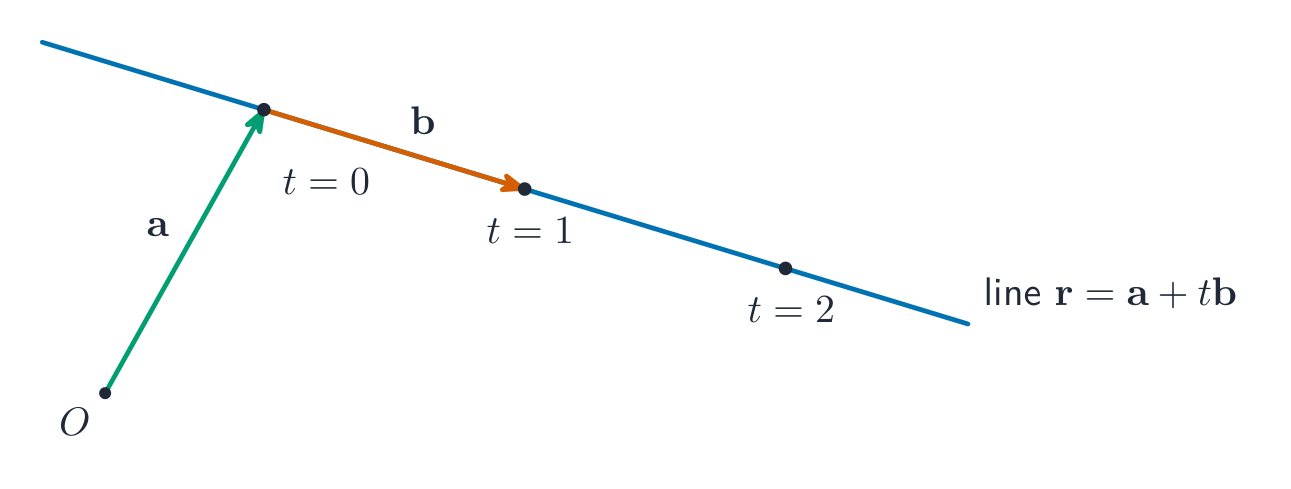
ベクトル値関数の直線:a から始まり、t だけの b の方向へスライドする
ベクトル値の直線:点 a を始点とし、方向 b の t 倍だけ移動する
Explore · ⁨探索⁩

Add vector-valued components

A vector-valued function packs an $x(t)$ and $y(t)$ into one vector. Differentiating each component gives the velocity vector, tangent to the path.

9.5

Integrating Vector-Valued Functions · ⁨ベクトル値関数の積分⁩

Syllabus · ⁨シラバス⁩
English

Enduring Understanding (FUN-8): Solving an initial value problem allows us to determine an expression for the position of a particle moving in the plane.

Learning Objective FUN-8.A: Determine a particular solution given a rate vector and initial conditions. BC ONLY

  • FUN-8.A.1 Methods for calculating integrals of real-valued functions can be extended to parametric or vector-valued functions. BC ONLY
日本語

持続的知識 (FUN-8): 初期値問題の解くことにより、平面内を動く粒子の位置を表す式を求めることができる。

学習目標 FUN-8.A: 速度ベクトルと初期条件が与えられたとき、特定の解を求める。BC ONLY

  • FUN-8.A.1 実数値関数の積分を計算する方法は、parameter関数やベクトル値関数に拡張できる。BC ONLY

Source: College Board AP Course and Exam Description · ⁨出典: College Board AP コースおよび試験説明書⁩

English

Integrate a vector function component by component. Given acceleration or velocity plus an initial condition, integrate each component and use the condition to find the constants – recovering velocity from acceleration, or position from velocity.

日本語

ベクトル関数を 成分ごとに積分する。加速度または速度と初期条件が与えられた場合、各成分を積分して定数を見つけ、初期条件を用いて速度(加速度から)や位置(速度から)を取り戻す。

9.6

Solving Motion Problems Using Parametric and Vector-Valued Functions · ⁨パラメータ方程式およびベクトル値関数を用いた運動問題の解法⁩

Syllabus · ⁨シラバス⁩
English

Enduring Understanding (FUN-8): Solving an initial value problem allows us to determine an expression for the position of a particle moving in the plane.

Learning Objective FUN-8.B: Determine values for positions and rates of change in problems involving planar motion. BC ONLY

  • FUN-8.B.1 Derivatives can be used to determine velocity, speed, and acceleration for a particle moving along a curve in the plane defined using parametric or vector-valued functions. BC ONLY
  • FUN-8.B.2 For a particle in planar motion over an interval of time, the definite integral of the velocity vector represents the particle's displacement (net change in position) over the interval of time, from which we might determine its position. The definite integral of speed represents the particle's total distance traveled over the interval of time. BC ONLY
日本語

持続的知識 (FUN-8): 初期値問題の解くことにより、平面内を動く粒子の位置を表す式を求めることができる。

学習目標 FUN-8.B: 平面運動に関する問題における位置および変化率の値を求める。BC ONLY

  • FUN-8.B.1 導関数は、parameter方程式またはベクトル値関数によって定義された平面内の曲線上を動く粒子について、速度、速さ、加速度を求めるために用いられる。BC ONLY
  • FUN-8.B.2 時間区間における平面運動の粒子について、速度ベクトルの确定积分は、その時間区間における粒子の変位(位置の総変化量)を表し、そこから位置を決定することができる。速さの确定积分は、その時間区間における粒子の移動総距離を表す。BC ONLY

Source: College Board AP Course and Exam Description · ⁨出典: College Board AP コースおよび試験説明書⁩

English

For a particle moving in a plane: position is $\langle x(t),y(t)\rangle$, velocity and acceleration are its derivatives, speed is $|\vec v|$, and the distance traveled over $[a,b]$ is

$$\int_a^b\sqrt{x'(t)^2+y'(t)^2}\,dt.$$

Exam skill: these plane-motion problems appear on the BC free-response nearly every year – be fluent finding speed, the position at a later time (initial point plus the integral of velocity), and total distance.

Worked example. A particle has position $\langle t^2,\ t^3-t\rangle$. Its velocity is $\langle 2t,\ 3t^2-1\rangle$, so at $t=1$ the velocity is $\langle 2,\ 2\rangle$ and the speed is $\sqrt{2^2+2^2}=2\sqrt{2}$. Its position at $t=2$ is $\langle 4,\ 6\rangle$.

日本語

平面内を動く粒子について:位置は $\langle x(t),y(t)\rangle$ 、速度と加速度はその導関数であり、速さは $|\vec v|$ であり、$[a,b]$ 間に移動した 距離 は以下の通りである

$$\int_a^b\sqrt{x'(t)^2+y'(t)^2}\,dt.$$

Exam skill: これらの平面運動問題は、ほぼ毎年BC自由回答問題に出題される——速さ、後続の時刻における位置(初期点+速度の積分)、総移動距離の求め方を習熟しておくこと。

** worked example.** 位置が $\langle t^2,\ t^3-t\rangle$ である粒子がある。その速度は $\langle 2t,\ 3t^2-1\rangle$ であるため、$t=1$ における速度は $\langle 2,\ 2\rangle$ 、速さは $\sqrt{2^2+2^2}=2\sqrt{2}$ となる。$t=2$ における位置は $\langle 4,\ 6\rangle$ である。

9.7

Defining Polar Coordinates and Differentiating in Polar Form · ⁨極座標の定義と極形式での微分⁩

Syllabus · ⁨シラバス⁩
English

Enduring Understanding (FUN-3): Recognizing opportunities to apply derivative rules can simplify differentiation.

Learning Objective FUN-3.G: Calculate derivatives of functions written in polar coordinates. BC ONLY

  • FUN-3.G.1 Methods for calculating derivatives of real-valued functions can be extended to functions in polar coordinates. BC ONLY
  • FUN-3.G.2 For a curve given by a polar equation $r = f(\theta)$, derivatives of $r$, $x$, and $y$ with respect to $\theta$, and first and second derivatives of $y$ with respect to $x$ can provide information about the curve. BC ONLY
日本語

持続的理解 (FUN-3): 導関数の法則を適用する機会を見出すことで、微分が単純化される。

学習目標 FUN-3.G: 極座標で表された関数の導関数を計算する。BC ONLY

  • FUN-3.G.1 実数値関数の導関数を計算する方法は、極座標で表された関数に拡張できる。BC ONLY
  • FUN-3.G.2 極方程式 $r = f(\theta)$ で与えられた曲線において、$r$、$x$、$y$ の $\theta$ に対する導関数、および $y$ の $x$ に対する一階および二階導関数は、曲線に関する情報を提供する。BC ONLY

Source: College Board AP Course and Exam Description · ⁨出典: College Board AP コースおよび試験説明書⁩

English
Tracing a polar curve

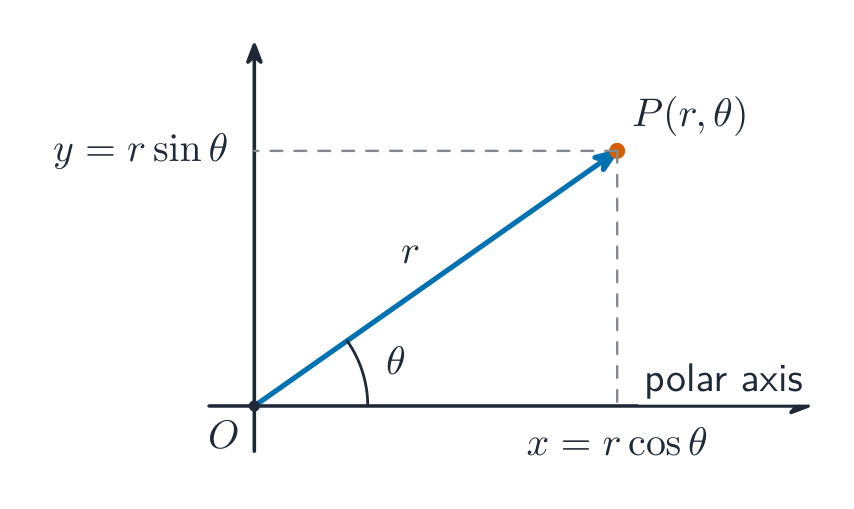
Polar coordinates 极坐标 locate a point by its distance $r$ from the origin and angle $\theta$: convert with $x=r\cos\theta$, $y=r\sin\theta$. A polar curve $r=f(\theta)$ is a parametric curve in $\theta$, so its slope is

$$\frac{dy}{dx}=\frac{dy/d\theta}{dx/d\theta},\quad\text{with } x=r\cos\theta,\ y=r\sin\theta.$$

日本語
Tracing a polar curve

極座標は、原点からの距離 $r$ と角度 $\theta$ で点を指定する:$x=r\cos\theta$, $y=r\sin\theta$ で変換できる。極曲線 $r=f(\theta)$ は $\theta$ におけるパラメータ曲線であるため、その傾きは以下となる

$$\frac{dy}{dx}=\frac{dy/d\theta}{dx/d\theta},\quad\text{with } x=r\cos\theta,\ y=r\sin\theta.$$

極座標は点の距離 r と角度 theta で表す
Explore · ⁨探索⁩

Plot a polar curve

In polar coordinates a point is a distance $r$ at angle $\theta$. Letting $r$ depend on $\theta$ traces curves like this cardioid.

9.8

Finding the Area of a Polar Region · ⁨極領域の面積を求める⁩

Syllabus · ⁨シラバス⁩
English

Enduring Understanding (CHA-5): Definite integrals allow us to solve problems involving the accumulation of change in area or volume over an interval.

Learning Objective CHA-5.D: Calculate areas of regions defined by polar curves using definite integrals. BC ONLY

  • CHA-5.D.1 The concept of calculating areas in rectangular coordinates can be extended to polar coordinates. BC ONLY
日本語

持続的理解 (CHA-5): 定積分を用いることで、区間における面積または体積の変化の蓄積に関する問題を解くことができる。

学習目標 CHA-5.D: 确定积分を用いて、極曲線で定義された領域の面積を計算する。BC ONLY

  • CHA-5.D.1 直交座標系における面積の計算概念は、極座標系に拡張できる。BC ONLY

Source: College Board AP Course and Exam Description · ⁨出典: College Board AP コースおよび試験説明書⁩

English

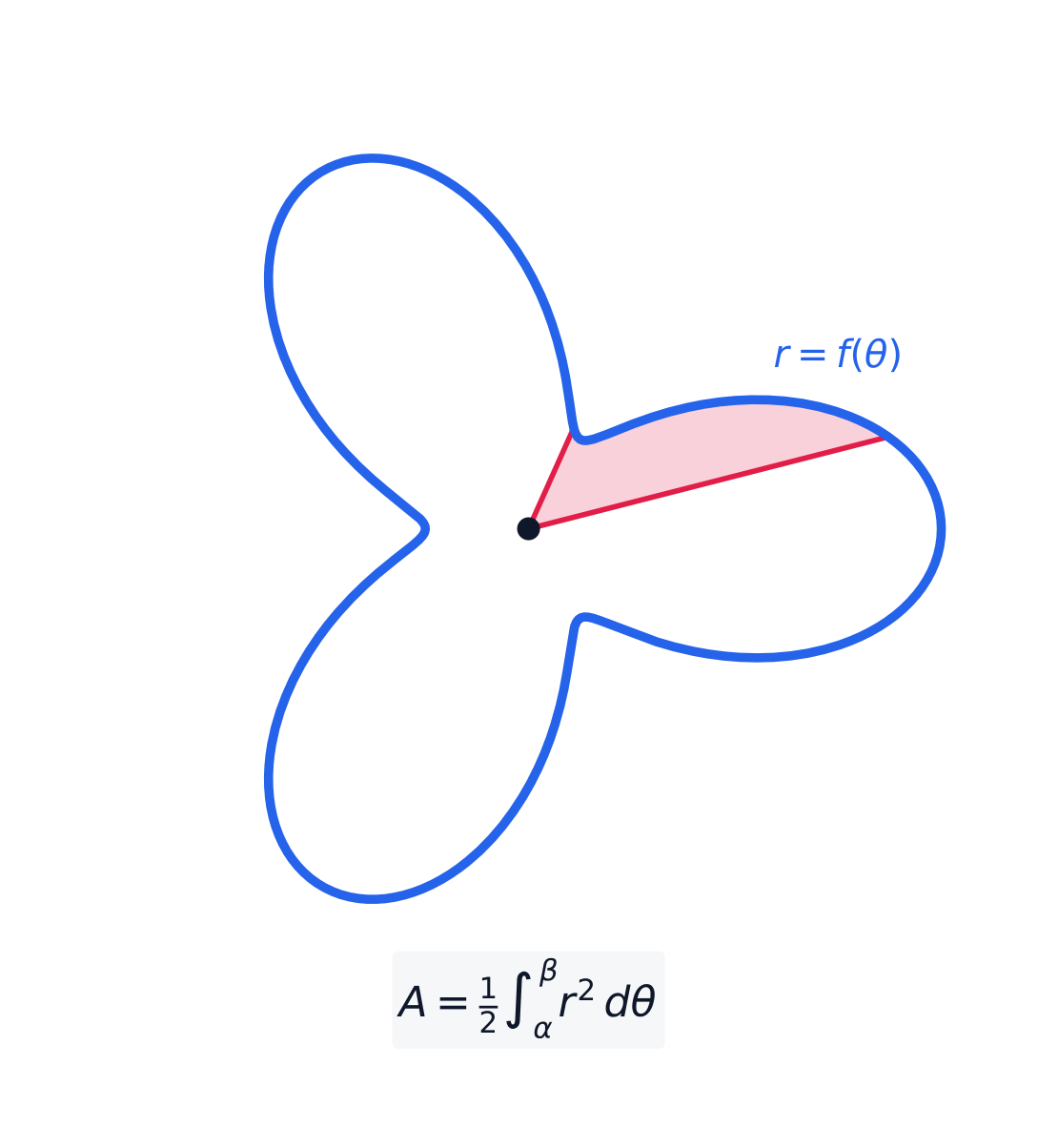
The area swept out by a polar curve $r=f(\theta)$ from $\alpha$ to $\beta$ is

$$A=\frac12\int_\alpha^\beta \big(f(\theta)\big)^2\,d\theta.$$
The region is a "fan" of thin triangular sectors; choosing the correct $\theta$-limits (where the curve starts and finishes tracing the region) is the main challenge.

Worked example. Find the area of one petal of the rose $r=2\sin(2\theta)$ (traced for $\theta$ from $0$ to $\tfrac{\pi}{2}$). Using $\sin^2 u=\tfrac12(1-\cos 2u)$,

$$A=\frac12\int_0^{\pi/2}(2\sin 2\theta)^2\,d\theta=\int_0^{\pi/2}(1-\cos 4\theta)\,d\theta=\left[\theta-\tfrac{\sin 4\theta}{4}\right]_0^{\pi/2}=\frac{\pi}{2}.$$

日本語

極曲線 $r=f(\theta)$ が $\alpha$ から $\beta$ まで描き出す面積は以下の通りである

$$A=\frac12\int_\alpha^\beta \big(f(\theta)\big)^2\,d\theta.$$
領域は細い三角形セクターの「扇」である;正しい $\theta$ の限界(曲線が領域の描画を始めると終わる場所)を選ぶことが最大の難しさである。

** worked example.** 薔薇曲線 $r=2\sin(2\theta)$ の一輪の面積を求めよ($\theta$ が ⟨$0$⟩ から ⟨$\tfrac{\pi}{2}$⟩ まで描かれる)。$\sin^2 u=\tfrac12(1-\cos 2u)$ を用いると、

$$A=\frac12\int_0^{\pi/2}(2\sin 2\theta)^2\,d\theta=\int_0^{\pi/2}(1-\cos 4\theta)\,d\theta=\left[\theta-\tfrac{\sin 4\theta}{4}\right]_0^{\pi/2}=\frac{\pi}{2}.$$

極領域の面積は、r の二乗 d theta の積分の半分として掃き出される
影付き領域は、$\alpha$ から $\beta$ まで掃き出された細い扇形の集合であり、各扇形の面積は $\tfrac12 r^2\,d\theta$ であるため、総和は $\tfrac12\int_\alpha^\beta r^2\,d\theta$ となる。
9.9

Finding the Area of the Region Bounded by Two Polar Curves · ⁨2つの極曲線で囲まれた領域の面積を求める⁩

Syllabus · ⁨シラバス⁩
English

Enduring Understanding (CHA-5): Definite integrals allow us to solve problems involving the accumulation of change in area or volume over an interval.

Learning Objective CHA-5.D: Calculate areas of regions defined by polar curves using definite integrals. BC ONLY

  • CHA-5.D.2 Areas of regions bounded by polar curves can be calculated with definite integrals. BC ONLY
日本語

持続的理解 (CHA-5): 定積分を用いることで、区間における面積または体積の変化の蓄積に関する問題を解くことができる。

学習目標 CHA-5.D: 确定积分を用いて、極曲線で定義された領域の面積を計算する。BC ONLY

  • CHA-5.D.2 極曲線で囲まれた領域の面積は、定積分を用いて計算できる。BCのみ

Source: College Board AP Course and Exam Description · ⁨出典: College Board AP コースおよび試験説明書⁩

English

For the area between an outer curve $r_1$ and an inner curve $r_2$, subtract the sectors:

$$A=\frac12\int_\alpha^\beta\big(r_1^2-r_2^2\big)\,d\theta.$$
Find the intersection angles first (set $r_1=r_2$), and be careful which curve is outer over each interval – they can swap.

日本語

外側の曲線 $r_1$ と内側の曲線 $r_2$ の間の面積については、セクターを引く:

$$A=\frac12\int_\alpha^\beta\big(r_1^2-r_2^2\big)\,d\theta.$$
まず 交点の角度 を求める($r_1=r_2$ と置く)、各区間でどの曲線が外側にあるか注意すること——入れ替わることがある。

9.9

Exam tips · ⁨試験対策⁩

English
  • For parametric curves, $\tfrac{dy}{dx}=\tfrac{dy/dt}{dx/dt}$; speed is $\sqrt{(dx/dt)^2+(dy/dt)^2}$.
  • A vector-valued function carries the same information — differentiate/integrate it component by component.
  • In polar, convert with $x=r\cos\theta$, $y=r\sin\theta$; area swept is $\tfrac12\int r^2\,d\theta$.
  • Watch the direction of tracing (the sign of $dx/dt$) and set correct $\theta$-limits for polar area.
  • Eliminate the parameter to recover the ordinary $y$-vs-$x$ shape when it helps.
日本語
  • パラメータ曲線の場合、$\tfrac{dy}{dx}=\tfrac{dy/dt}{dx/dt}$;速さは $\sqrt{(dx/dt)^2+(dy/dt)^2}$ 。
  • ベクトル値関数も同じ情報を持つ——成分ごとに微分・積分する。
  • 極座標では、$x=r\cos\theta$, $y=r\sin\theta$ で変換し、掃過面積は $\tfrac12\int r^2\,d\theta$ 。
  • 描画の向き($dx/dt$ の符号)に注意し、極面積のための正しい $\theta$ の限界を設定する。
  • 必要に応じてパラメータを消去して、通常の $y$ vs $x$ の形に戻す。

Interactive lessons on this topic · ⁨このトピックのインタラクティブ授業⁩

Work through it step by step, with instant-check exercises. · ⁨一歩ずつ進め、即時チェック付きの問題で学習します。⁩

Past Papers · ⁨過去問⁩

More topics in AP Calculus BC · ⁨AP Calculus BC の他のトピック⁩

Log in or create account · ⁨ログインまたはアカウント作成⁩

IGCSE, A-Level & AP