Skip to content · ⁨Lompat ke konten⁩
Subjects · ⁨Materi⁩

AP Environmental Science · ⁨AP Sains Lingkungan⁩

Tips

AP Environmental Science joins ecology, earth systems, populations, land and water use, energy, pollution and global change. It is genuinely interdisciplinary — biology, chemistry, geology and economics in one course — and the exam rewards connecting them, not listing them.

Numbers matter here. You will calculate by hand: percentage change, energy from a resource, doubling time, half-life, dose per person. No calculator was traditionally allowed, so practise the arithmetic itself, not only the setup.

Name a real case and quantify it. "Deforestation is bad" earns nothing; a named place, a mechanism and a number earns the marks.

The notes cover all nine units and work the calculations APES actually sets — energy, population, pollution — through in full. Released FRQs are in the library. This exam rewards naming a specific example, so the notes flag the case studies worth committing to memory.

  • 1

    The Living World: Ecosystems · ⁨Dunia Hidup: Ekosistem⁩

    Watch lesson · ⁨Tonton pelajaran⁩
    1.1

    Introduction to Ecosystems

    Syllabus · ⁨Silabus⁩
    English

    Enduring Understanding (ERT-1): Ecosystems are the result of biotic and abiotic interactions.

    Learning Objective ERT-1.A: Explain how the availability of resources influences species interactions.

    • ERT-1.A.1 In a predator-prey relationship, the predator is an organism that eats another organism (the prey).
    • ERT-1.A.2 Symbiosis is a close and long-term interaction between two species in an ecosystem. Types of symbiosis include mutualism, commensalism, and parasitism.
    • ERT-1.A.3 Competition can occur within or between species in an ecosystem where there are limited resources. Resource partitioning—using the resources in different ways, places, or at different times—can reduce the negative impact of competition on survival.
    Bahasa Indonesia

    Pemahaman Abadi (ERT-1): Ekosistem adalah hasil dari interaksi biotik dan abiotik.

    Tujuan Pembelajaran ERT-1.A: Jelaskan bagaimana ketersediaan sumber daya mempengaruhi interaksi spesies.

    • ERT-1.A.1 Dalam hubungan predator-mangsa, predator adalah organisme yang memakan organisme lain (mangsa).
    • ERT-1.A.2 Simbiosis adalah interaksi dekat dan jangka panjang antara dua spesies dalam suatu ekosistem. Jenis-jenis simbiosis meliputi mutualisme, komensalisme, dan parasitisme.
    • ERT-1.A.3 Kompetisi dapat terjadi di dalam atau antar spesies dalam ekosistem yang memiliki sumber daya terbatas. Pembagian sumber daya—menggunakan sumber daya dengan cara, tempat, atau waktu yang berbeda—dapat mengurangi dampak negatif kompetisi terhadap kelangsungan hidup.

    Source: College Board AP Course and Exam Description · ⁨Sumber: Deskripsi Kursus dan Ujian College Board AP⁩

    An ecosystem 生态系统 is all the living things (biotic) and non-living things (abiotic) in an area, interacting together. Organisms depend on each other and on their physical environment, and interactions like predation 捕食, competition 竞争, and symbiosis 共生 (mutualism, commensalism, parasitism) shape the community.

    Explore · ⁨Jelajahi⁩

    Explore how a population grows · ⁨Jelajahi bagaimana populasi tumbuh⁩

    Change the growth rate $r$ and the carrying capacity $K$. Growth is fast when a population is small, then levels off as resources run short and the ecosystem fills up. · ⁨Ubah laju pertumbuhan $r$ dan kapasitas dukung $K$. Pertumbuhan cepat ketika populasi kecil, lalu melandai saat sumber daya menipis dan ekosistem penuh.⁩

    Vocabulary · ⁨Kosa kata⁩ Train · ⁨Latih⁩
    English Bahasa Indonesia
    ecosystem/ˈiːkəʊsɪstəm/ ekosistem
    predation/prɪˈdeɪʃn/ pemangsaan
    competition/ˌkɒmpəˈtɪʃn/ kompetisi
    symbiosis/ˌsɪmbaɪˈəʊsɪs/ simbiosis
    1.2

    Terrestrial Biomes

    Syllabus · ⁨Silabus⁩
    English

    Enduring Understanding (ERT-1): Ecosystems are the result of biotic and abiotic interactions.

    Learning Objective ERT-1.B: Describe the global distribution and principal environmental aspects of terrestrial biomes.

    • ERT-1.B.1 A biome contains characteristic communities of plants and animals that result from, and are adapted to, its climate.
    • ERT-1.B.2 Major terrestrial biomes include taiga, temperate rainforests, temperate seasonal forests, tropical rainforests, shrubland, temperate grassland, savanna, desert, and tundra.
    • ERT-1.B.3 The global distribution of nonmineral terrestrial natural resources, such as water and trees for lumber, varies because of some combination of climate, geography, latitude and altitude, nutrient availability, and soil.
    • ERT-1.B.4 The worldwide distribution of biomes is dynamic; the distribution has changed in the past and may again shift as a result of global climate changes.
    Bahasa Indonesia

    Pemahaman Abadi (ERT-1): Ekosistem adalah hasil dari interaksi biotik dan abiotik.

    Tujuan Pembelajaran ERT-1.B: Menguraikan distribusi global dan aspek lingkungan utama dari bioma darat.

    • ERT-1.B.1 Bioma berisi komunitas karakteristik tumbuhan dan hewan yang merupakan hasil dari, dan beradaptasi dengan, iklimnya.
    • ERT-1.B.2 Bioma darat utama meliputi taiga, hutan hujan tempera, hutan musiman tempera, hutan hujan tropis, semak belukar, padang rumput tempera, savana, gurun, dan tundra.
    • ERT-1.B.3 Distribusi global sumber daya alam nonmineral darat, seperti air dan pohon untuk bahan bakar kayu, bervariasi karena kombinasi iklim, geografi, lintang dan ketinggian, ketersediaan nutrisi, dan tanah.
    • ERT-1.B.4 Distribusi bioma di seluruh dunia bersifat dinamis; distribusinya telah berubah di masa lalu dan mungkin akan bergeser lagi sebagai akibat perubahan iklim global.

    Source: College Board AP Course and Exam Description · ⁨Sumber: Deskripsi Kursus dan Ujian College Board AP⁩

    A biome 生物群系 is a large region defined by its climate and characteristic life. Terrestrial biomes (deserts, grasslands, tropical rainforest, temperate forest, taiga, tundra) are determined mainly by temperature and precipitation 降水. Each has plants and animals adapted to those conditions.

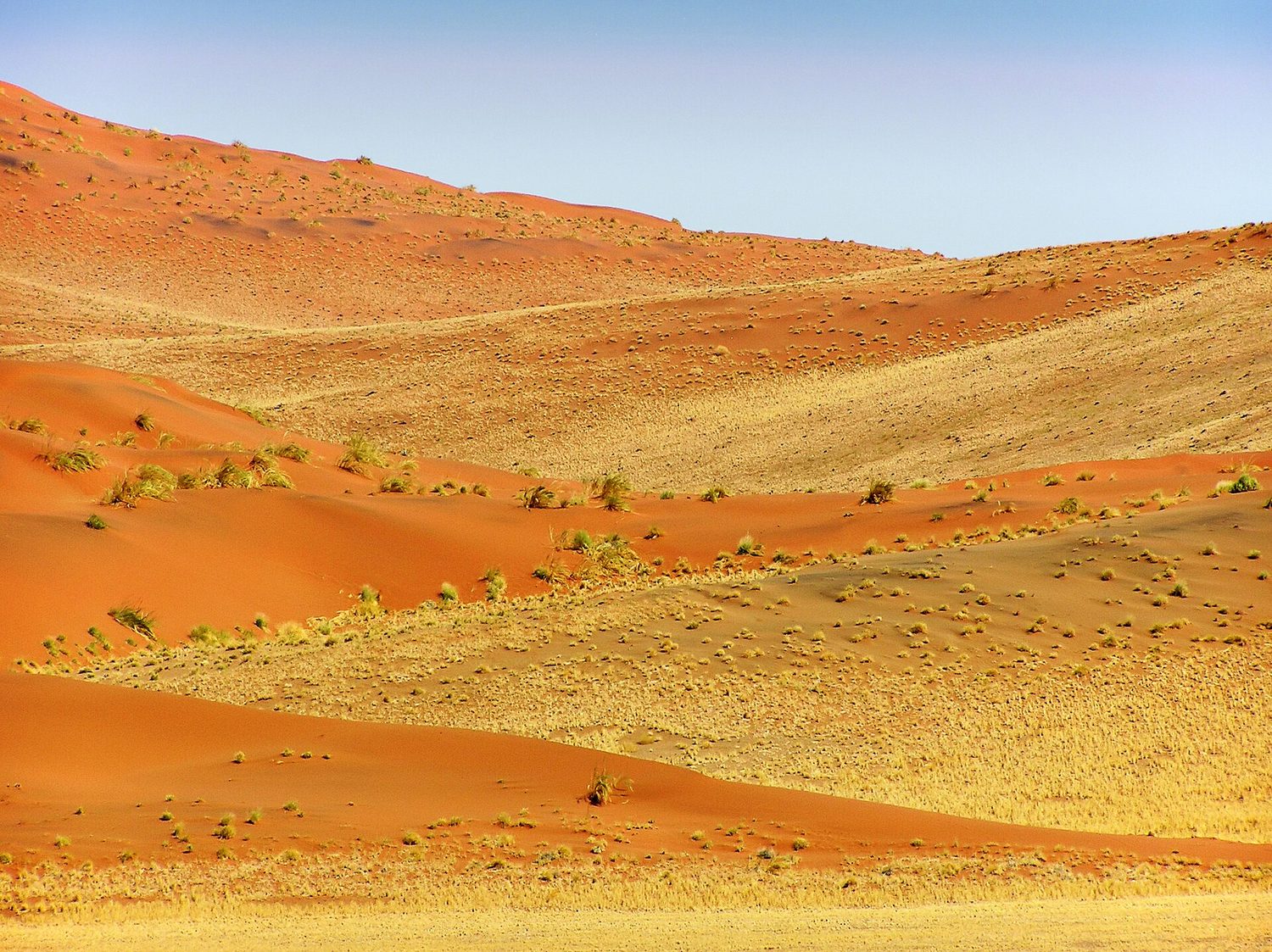
    The two images below sit at opposite ends of the precipitation scale, which is why their life looks so different:

    A misty tropical rainforest with dense, layered green canopy on steep hills
    A tropical rainforest 热带雨林: hot and wet all year, giving dense layered plant life and the richest biodiversity of any land biome
    A dry desert of bare sand dunes with almost no plants
    A desert 沙漠: very low precipitation, so only sparse drought-adapted life survives
    Vocabulary · ⁨Kosa kata⁩ Train · ⁨Latih⁩
    English Bahasa Indonesia
    biome/ˈbaɪəʊm/ biom
    temperature and precipitation/ˈtemprɪtʃə ænd prɪˌsɪpɪˈteɪʃn/ suhu dan curah hujan
    tropical rainforest/ˈtrɒpɪkl ˈreɪnfɒrɪst/ hujan tropis
    desert/ˈdezət/ gurun
    1.3

    Aquatic Biomes

    Syllabus · ⁨Silabus⁩
    English

    Enduring Understanding (ERT-1): Ecosystems are the result of biotic and abiotic interactions.

    Learning Objective ERT-1.C: Describe the global distribution and principal environmental aspects of aquatic biomes.

    • ERT-1.C.1 Freshwater biomes include streams, rivers, ponds, and lakes. These freshwater biomes are a vital resource for drinking water.
    • ERT-1.C.2 Marine biomes include oceans, coral reefs, marshland, and estuaries. Algae in marine biomes supply a large portion of the Earth's oxygen, and also take in carbon dioxide from the atmosphere.
    • ERT-1.C.3 The global distribution of nonmineral marine natural resources, such as different types of fish, varies because of some combination of salinity, depth, turbidity, nutrient availability, and temperature.
    Bahasa Indonesia

    Pemahaman Abadi (ERT-1): Ekosistem adalah hasil dari interaksi biotik dan abiotik.

    Tujuan Pembelajaran ERT-1.C: Menguraikan distribusi global dan aspek lingkungan utama dari bioma akuatik.

    • ERT-1.C.1 Bioma air tawar mencakup sungai, danau, kolam, dan danau. Bioma air tawar ini merupakan sumber daya vital untuk air minum.
    • ERT-1.C.2 Bioma laut mencakup samudra, terumbu karang, rawa, dan muara. Alga di bioma laut menyediakan sebagian besar oksigen Bumi, dan juga menyerap karbon dioksida dari atmosfer.
    • ERT-1.C.3 Distribusi global sumber daya alam nonmineral laut, seperti berbagai jenis ikan, bervariasi karena kombinasi salinitas, kedalaman, kekeruhan, ketersediaan nutrisi, dan suhu.

    Source: College Board AP Course and Exam Description · ⁨Sumber: Deskripsi Kursus dan Ujian College Board AP⁩

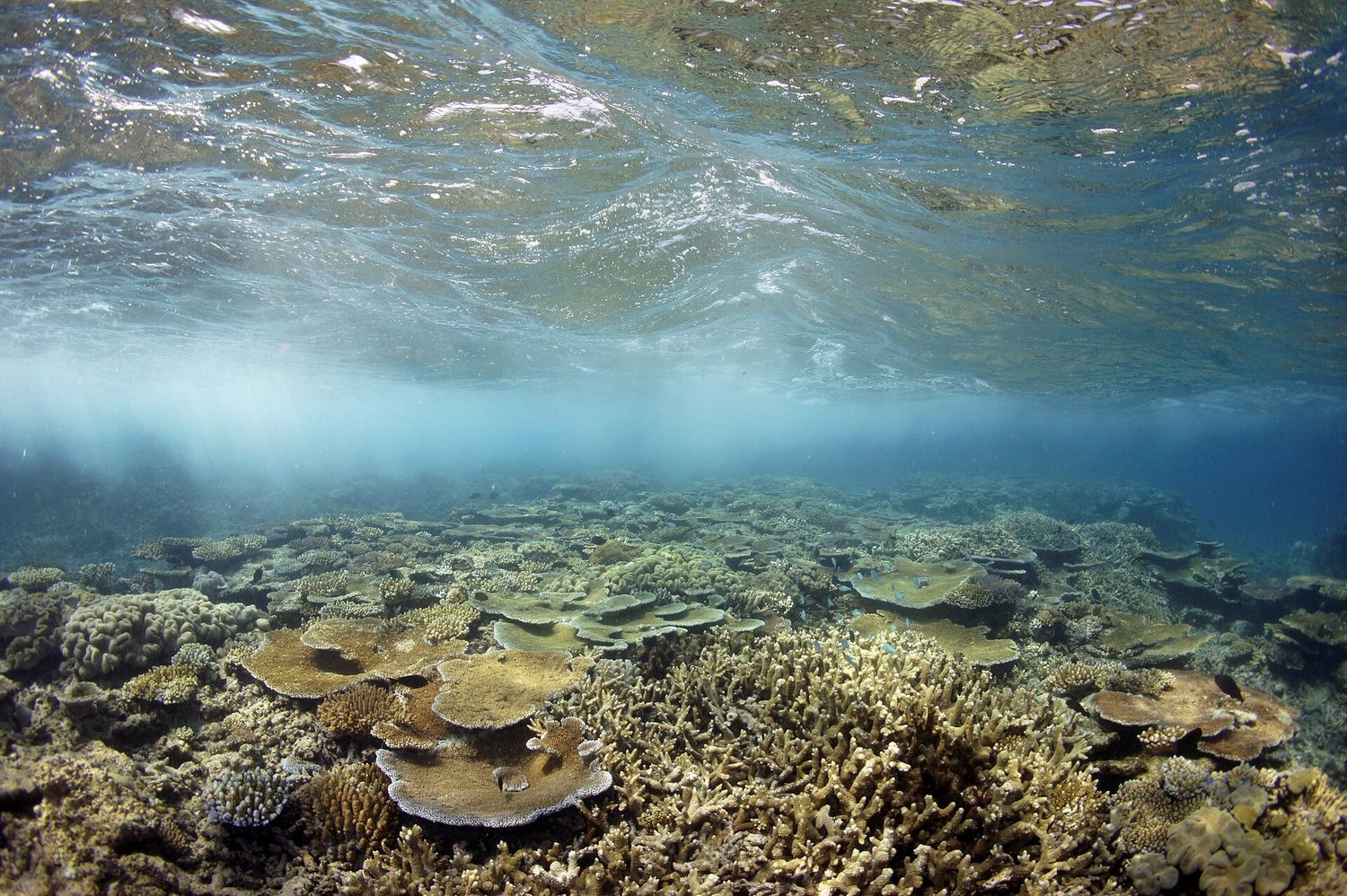
    Aquatic biomes cover more of Earth than land. Freshwater (streams, lakes, wetlands) and marine (open ocean, coral reefs, estuaries) systems differ in salinity 盐度, sunlight, and nutrients. Estuaries 河口 (where rivers meet the sea) and coral reefs are especially productive and biodiverse.

    An underwater view of a coral reef just below the sea surface, covered in corals
    A coral reef 珊瑚礁: warm, sunlit, shallow water makes it one of the most productive and biodiverse of all biomes
    Vocabulary · ⁨Kosa kata⁩ Train · ⁨Latih⁩
    English Bahasa Indonesia
    salinity/seɪˈlɪnɪti/ salinitas
    Estuaries/ˈestjuːəriz/ Estuari
    coral reef/ˈkɒrəl riːf/ karang karang
    1.4

    The Carbon Cycle

    Syllabus · ⁨Silabus⁩
    English

    Enduring Understanding (ERT-1): Ecosystems are the result of biotic and abiotic interactions.

    Learning Objective ERT-1.D: Explain the steps and reservoir interactions in the carbon cycle.

    • ERT-1.D.1 The carbon cycle is the movement of atoms and molecules containing the element carbon between sources and sinks.
    • ERT-1.D.2 Some of the reservoirs in which carbon compounds occur in the carbon cycle hold those compounds for long periods of time, while some hold them for relatively short periods of time.
    • ERT-1.D.3 Carbon cycles between photosynthesis and cellular respiration in living things.
    • ERT-1.D.4 Plant and animal decomposition have led to the storage of carbon over millions of years. The burning of fossil fuels quickly moves that stored carbon into atmospheric carbon, in the form of carbon dioxide.
    Bahasa Indonesia

    Pemahaman Abadi (ERT-1): Ekosistem adalah hasil dari interaksi biotik dan abiotik.

    Tujuan Pembelajaran ERT-1.D: Menjelaskan langkah-langkah dan interaksi reservoir dalam siklus karbon.

    • ERT-1.D.1 Siklus karbon adalah pergerakan atom dan molekul yang mengandung unsur karbon antara sumber dan penampung.
    • ERT-1.D.2 Beberapa reservoir tempat senyawa karbon terdapat dalam siklus karbon menyimpan senyawa tersebut untuk periode waktu yang lama, sementara beberapa menyimpannya untuk periode waktu yang relatif pendek.
    • ERT-1.D.3 Karbon bersirkulasi antara fotosintesis dan respirasi seluler pada makhluk hidup.
    • ERT-1.D.4 Dekomposisi tumbuhan dan hewan telah mengarah pada penyimpanan karbon selama jutaan tahun. Pembakaran bahan bakar fosil dengan cepat memindahkan karbon tersimpan itu ke karbon atmosfer, dalam bentuk karbon dioksida.

    Source: College Board AP Course and Exam Description · ⁨Sumber: Deskripsi Kursus dan Ujian College Board AP⁩

    The carbon cycle

    The carbon cycle 碳循环 moves carbon between the atmosphere, organisms, oceans, and rocks. Photosynthesis removes $\text{CO}_2$; respiration, decomposition, and burning fossil fuels 化石燃料 return it. Burning fossil fuels adds carbon far faster than natural processes remove it.

    The carbon cycle moves carbon among the atmosphere, living things, and fossil fuels
    The carbon cycle moves carbon among the atmosphere, living things, and fossil fuels
    Vocabulary · ⁨Kosa kata⁩ Train · ⁨Latih⁩
    English Bahasa Indonesia
    carbon cycle/ˈkɑːbən ˈsaɪkl/ siklus karbon
    fossil fuels/ˈfɒsl ˈfjuːəlz/ bahan bakar fosil
    1.5

    The Nitrogen Cycle

    Syllabus · ⁨Silabus⁩
    English

    Enduring Understanding (ERT-1): Ecosystems are the result of biotic and abiotic interactions.

    Learning Objective ERT-1.E: Explain the steps and reservoir interactions in the nitrogen cycle.

    • ERT-1.E.1 The nitrogen cycle is the movement of atoms and molecules containing the element nitrogen between sources and sinks.
    • ERT-1.E.2 Most of the reservoirs in which nitrogen compounds occur in the nitrogen cycle hold those compounds for relatively short periods of time.
    • ERT-1.E.3 Nitrogen fixation is the process in which atmospheric nitrogen is converted into a form of nitrogen (primarily ammonia) that is available for uptake by plants and that can be synthesized into plant tissue.
    • ERT-1.E.4 The atmosphere is the major reservoir of nitrogen.
    Bahasa Indonesia

    Pemahaman Abadi (ERT-1): Ekosistem adalah hasil dari interaksi biotik dan abiotik.

    Tujuan Pembelajaran ERT-1.E: Menjelaskan langkah-langkah dan interaksi reservoir dalam siklus nitrogen.

    • ERT-1.E.1 Siklus nitrogen adalah pergerakan atom dan molekul yang mengandung unsur nitrogen antara sumber dan penampung.
    • ERT-1.E.2 Sebagian besar reservoir tempat senyawa nitrogen terdapat dalam siklus nitrogen menyimpan senyawa tersebut untuk periode waktu yang relatif pendek.
    • ERT-1.E.3 Fiksasi nitrogen adalah proses di mana nitrogen atmosfer diubah menjadi bentuk nitrogen (terutama amonia) yang tersedia untuk diserap oleh tanaman dan yang dapat disintesis menjadi jaringan tumbuhan.
    • ERT-1.E.4 Atmosfer adalah reservoir utama nitrogen.

    Source: College Board AP Course and Exam Description · ⁨Sumber: Deskripsi Kursus dan Ujian College Board AP⁩

    The nitrogen cycle

    The nitrogen cycle 氮循环 makes nitrogen usable for life. Nitrogen fixation 固氮 (by bacteria) converts atmospheric $\text{N}_2$ to ammonia; nitrification and assimilation pass it through organisms; denitrification returns $\text{N}_2$ to the air. Fertilizer adds reactive nitrogen, which can pollute water.

    The nitrogen cycle: N is fixed into soil nitrates, passed through food, and returned to the air by denitrification
    The nitrogen cycle: N$_2$ is fixed into soil nitrates, passed through food, and returned to the air by denitrification
    Vocabulary · ⁨Kosa kata⁩ Train · ⁨Latih⁩
    English Bahasa Indonesia
    nitrogen cycle/ˈnaɪtrədʒn ˈsaɪkl/ siklus nitrogen
    Nitrogen fixation/ˈnaɪtrədʒn fɪkˈseɪʃn/ Fiksasi nitrogen
    1.6

    The Phosphorus Cycle

    Syllabus · ⁨Silabus⁩
    English

    Enduring Understanding (ERT-1): Ecosystems are the result of biotic and abiotic interactions.

    Learning Objective ERT-1.F: Explain the steps and reservoir interactions in the phosphorus cycle.

    • ERT-1.F.1 The phosphorus cycle is the movement of atoms and molecules containing the element phosphorus between sources and sinks.
    • ERT-1.F.2 The major reservoirs of phosphorus in the phosphorus cycle are rock and sediments that contain phosphorus-bearing minerals.
    • ERT-1.F.3 There is no atmospheric component in the phosphorus cycle, and the limitations this imposes on the return of phosphorus from the ocean to land make phosphorus naturally scarce in aquatic and many terrestrial ecosystems. In undisturbed ecosystems, phosphorus is the limiting factor in biological systems.
    Bahasa Indonesia

    Pemahaman Abadi (ERT-1): Ekosistem adalah hasil dari interaksi biotik dan abiotik.

    Tujuan Pembelajaran ERT-1.F: Menjelaskan langkah-langkah dan interaksi reservoir dalam siklus fosfor.

    • ERT-1.F.1 Siklus fosfor adalah pergerakan atom dan molekul yang mengandung unsur fosfor antara sumber dan penampung.
    • ERT-1.F.2 Reservoir utama fosfor dalam siklus fosfor adalah batuan dan sedimen yang mengandung mineral pembawa fosfor.
    • ERT-1.F.3 Tidak ada komponen atmosfer dalam siklus fosfor, dan keterbatasan yang ditimbulkannya terhadap pengembalian fosfor dari lautan ke daratan membuat fosfor secara alami langka di ekosistem akuatik dan banyak ekosistem darat. Dalam ekosistem yang tidak terganggu, fosfor adalah faktor pembatas dalam sistem biologis.

    Source: College Board AP Course and Exam Description · ⁨Sumber: Deskripsi Kursus dan Ujian College Board AP⁩

    The phosphorus cycle 磷循环 has no atmospheric (gas) stage – phosphorus moves through rock, soil, water, and organisms. It is slow and often the limiting nutrient 限制性营养 for growth, so added phosphorus (fertilizer, detergents) can trigger algal blooms.

    The phosphorus cycle: rock weathers to soil phosphate and slowly sediments back, with no gas phase
    The phosphorus cycle: rock weathers to soil phosphate and slowly sediments back, with no gas phase
    Vocabulary · ⁨Kosa kata⁩ Train · ⁨Latih⁩
    English Bahasa Indonesia
    phosphorus cycle/ˈfɒsfɔːrəs ˈsaɪkl/ siklus fosfor
    limiting nutrient/ˈlɪmɪtɪŋ ˈnjuːtrɪənt/ nutrien pembatas
    1.7

    The Hydrologic (Water) Cycle

    Syllabus · ⁨Silabus⁩
    English

    Enduring Understanding (ERT-1): Ecosystems are the result of biotic and abiotic interactions.

    Learning Objective ERT-1.G: Explain the steps and reservoir interactions in the hydrologic cycle.

    • ERT-1.G.1 The hydrologic cycle, which is powered by the sun, is the movement of water in its various solid, liquid, and gaseous phases between sources and sinks.
    • ERT-1.G.2 The oceans are the primary reservoir of water at the Earth's surface, with ice caps and groundwater acting as much smaller reservoirs.
    Bahasa Indonesia

    Pemahaman Abadi (ERT-1): Ekosistem adalah hasil dari interaksi biotik dan abiotik.

    Tujuan Pembelajaran ERT-1.G: Menjelaskan langkah-langkah dan interaksi reservoir dalam siklus hidrologi.

    • ERT-1.G.1 Siklus hidrologi, yang didorong oleh matahari, adalah pergerakan air dalam berbagai fase padat, cair, dan gas antara sumber dan penampung.
    • ERT-1.G.2 Samudra merupakan reservoir air utama di permukaan Bumi, dengan tutup es dan air tanah berfungsi sebagai reservoir yang jauh lebih kecil.

    Source: College Board AP Course and Exam Description · ⁨Sumber: Deskripsi Kursus dan Ujian College Board AP⁩

    The hydrologic (water) cycle

    The water cycle 水循环 moves water by evaporation 蒸发, transpiration 蒸腾 (from plants), condensation, precipitation, and runoff. It distributes fresh water and shapes climate; human use and land changes can alter its flow.

    The water cycle: evaporation and transpiration lift water to the air; precipitation and runoff return it
    The water cycle: evaporation and transpiration lift water to the air; precipitation and runoff return it
    Vocabulary · ⁨Kosa kata⁩ Train · ⁨Latih⁩
    English Bahasa Indonesia
    water cycle/ˈwɔːtə ˈsaɪkl/ siklus air
    evaporation/ɪˌvæpəˈreɪʃn/ penguapan
    transpiration/trænspəˈreɪʃn/ transpirasi
    1.8

    Primary Productivity

    Syllabus · ⁨Silabus⁩
    English

    Enduring Understanding (ENG-1): Energy can be converted from one form to another.

    Learning Objective ENG-1.A: Explain how solar energy is acquired and transferred by living organisms.

    • ENG-1.A.1 Primary productivity is the rate at which solar energy (sunlight) is converted into organic compounds via photosynthesis over a unit of time.
    • ENG-1.A.2 Gross primary productivity is the total rate of photosynthesis in a given area.
    • ENG-1.A.3 Net primary productivity is the rate of energy storage by photosynthesizers in a given area, after subtracting the energy lost to respiration.
    • ENG-1.A.4 Productivity is measured in units of energy per unit area per unit time (e.g., $\text{kcal/m}^2\text{/yr}$).
    • ENG-1.A.5 Most red light is absorbed in the upper 1m of water, and blue light only penetrates deeper than 100m in the clearest water. This affects photosynthesis in aquatic ecosystems, whose photosynthesizers have adapted mechanisms to address the lack of visible light.
    Bahasa Indonesia

    Pemahaman Abadi (ENG-1): Energi dapat dikonversi dari satu bentuk ke bentuk lainnya.

    Tujuan Pembelajaran ENG-1.A: Jelaskan bagaimana energi matahari diperoleh dan ditransfer oleh organisme hidup.

    • ENG-1.A.1 Produktivitas primer adalah laju konversi energi matahari (sinar matahari) menjadi senyawa organik melalui fotosintesis dalam satuan waktu.
    • ENG-1.A.2 Produktivitas primer kotor adalah total laju fotosintesis di suatu area tertentu.
    • ENG-1.A.3 Produktivitas primer bersih adalah laju penyimpanan energi oleh organisme berfotosintesis di suatu area tertentu, setelah dikurangi energi yang hilang akibat respirasi.
    • ENG-1.A.4 Produktivitas diukur dalam satuan energi per satuan luas per satuan waktu (misalnya, $\text{kcal/m}^2\text{/yr}$).
    • ENG-1.A.5 Sebagian besar cahaya merah diserap dalam 1m pertama air, dan cahaya biru hanya menembus lebih dalam dari 100m di air yang paling jernih. Hal ini memengaruhi fotosintesis di ekosistem akuatik, di mana organisme berfotosintesis memiliki mekanisme adaptasi untuk mengatasi kurangnya cahaya tampak.

    Source: College Board AP Course and Exam Description · ⁨Sumber: Deskripsi Kursus dan Ujian College Board AP⁩

    Primary productivity 初级生产力 is the rate at which producers capture energy (usually by photosynthesis). Gross primary productivity (GPP) is the total captured; net primary productivity (NPP) is what remains after the producers' own respiration – the energy available to the rest of the ecosystem. Warm, wet, sunlit systems (rainforests, reefs) are most productive.

    Worked example. If producers in a grassland capture $20{,}000\ \text{kcal/m}^2/\text{yr}$ of energy (GPP) and burn $8{,}000\ \text{kcal/m}^2/\text{yr}$ in their own respiration, then $\text{NPP}=\text{GPP}-R=20{,}000-8{,}000=12{,}000\ \text{kcal/m}^2/\text{yr}$. Only that NPP – not the full GPP – is available to the consumers above.

    Explore · ⁨Jelajahi⁩

    Explore GPP, respiration and NPP · ⁨Jelajahi GPP, respirasi, dan NPP⁩

    The energy producers capture (GPP) splits into what they burn for their own respiration $R$ and what is left over as new biomass — $\text{NPP} = \text{GPP} - R$, and useful + wasted always equals the input. · ⁨Energi yang ditangkap produsen (GPP) terbagi menjadi apa yang mereka bakar untuk respirasi mereka sendiri $R$ dan apa yang tersisa sebagai biomassa baru — $\text{NPP} = \text{GPP} - R$, dan berguna + terbuang selalu sama dengan input.⁩

    Vocabulary · ⁨Kosa kata⁩ Train · ⁨Latih⁩
    English Bahasa Indonesia
    Primary productivity/ˈpraɪməri ˌprɒdəkˈtɪvɪti/ Produktivitas primer
    1.9

    Trophic Levels

    Syllabus · ⁨Silabus⁩
    English

    Enduring Understanding (ENG-1): Energy can be converted from one form to another.

    Learning Objective ENG-1.B: Explain how energy flows and matter cycles through trophic levels.

    • ENG-1.B.1 All ecosystems depend on a continuous inflow of high-quality energy in order to maintain their structure and function of transferring matter between the environment and organisms via biogeochemical cycles.
    • ENG-1.B.2 Biogeochemical cycles are essential for life and each cycle demonstrates the conservation of matter.
    • ENG-1.B.3 In terrestrial and near-surface marine communities, energy flows from the sun to producers in the lowest trophic levels and then upward to higher trophic levels.
    Bahasa Indonesia

    Pemahaman Abadi (ENG-1): Energi dapat dikonversi dari satu bentuk ke bentuk lainnya.

    Tujuan Pembelajaran ENG-1.B: Jelaskan bagaimana energi mengalir dan materi bersiklus melalui tingkat trofik.

    • ENG-1.B.1 Semua ekosistem bergantung pada aliran masuk energi berkualitas tinggi secara terus-menerus untuk mempertahankan struktur dan fungsinya dalam mentransfer materi antara lingkungan dan organisme melalui siklus biogeokimia.
    • ENG-1.B.2 Siklus biogeokimia sangat penting bagi kehidupan dan setiap siklus menunjukkan kekekalan materi.
    • ENG-1.B.3 Di komunitas darat dan laut permukaan dekat, energi mengalir dari matahari ke produsen di tingkat trofik terendah, kemudian naik ke tingkat trofik yang lebih tinggi.

    Source: College Board AP Course and Exam Description · ⁨Sumber: Deskripsi Kursus dan Ujian College Board AP⁩

    Energy flow & the 10% rule

    Organisms occupy trophic levels 营养级: producers 生产者 (make their own food), then primary, secondary, and tertiary consumers 消费者, with decomposers 分解者 recycling nutrients at every level. Each level depends on the energy captured below it.

    Vocabulary · ⁨Kosa kata⁩ Train · ⁨Latih⁩
    English Bahasa Indonesia
    trophic levels/ˈtrəʊfɪk ˈlevlz/ Tingkat trofik
    producers/prəˈdjuːsəz/ produsen
    primary, secondary, and tertiary consumers/ˈpraɪməri ˈsekəndəri ænd ˈtɜːʃjəri kənˈsuːməz/ konsumen primer, sekunder, dan tersier
    decomposers/ˌdiːkəmˈpəʊzəz/ pengurai
    1.10

    Energy Flow and the 10% Rule

    Syllabus · ⁨Silabus⁩
    English

    Enduring Understanding (ENG-1): Energy can be converted from one form to another.

    Learning Objective ENG-1.C: Determine how the energy decreases as it flows through ecosystems.

    • ENG-1.C.1 The 10% rule approximates that in the transfer of energy from one trophic level to the next, only about 10% of the energy is passed on.
    • ENG-1.C.2 The loss of energy that occurs when energy moves from lower to higher trophic levels can be explained through the laws of thermodynamics.
    Bahasa Indonesia

    Pemahaman Abadi (ENG-1): Energi dapat dikonversi dari satu bentuk ke bentuk lainnya.

    Tujuan Pembelajaran ENG-1.C: Menentukan bagaimana energi berkurang saat mengalir melalui ekosistem.

    • ENG-1.C.1 Aturan 10% memperkirakan bahwa dalam transfer energi dari satu tingkat trofik ke tingkat berikutnya, hanya sekitar 10% energi yang diteruskan.
    • ENG-1.C.2 Hilangnya energi yang terjadi ketika energi bergerak dari tingkat trofik rendah ke tinggi dapat dijelaskan melalui hukum termodinamika.

    Source: College Board AP Course and Exam Description · ⁨Sumber: Deskripsi Kursus dan Ujian College Board AP⁩

    Energy flows one way through an ecosystem and is lost as heat at each transfer. The 10% rule: only about 10% of the energy at one trophic level passes to the next; the other 90% powers life processes and escapes as heat. This is why food chains are short and top predators are few.

    Worked example. Continuing from $12{,}000\ \text{kcal/m}^2/\text{yr}$ of NPP at the producer level, the primary consumers receive about $10\%=1{,}200\ \text{kcal}$, secondary consumers $\approx120\ \text{kcal}$, and tertiary consumers only $\approx12\ \text{kcal}$. After three transfers the energy has shrunk a thousand-fold – the arithmetic reason a fourth or fifth trophic level rarely has enough to support it.

    An energy pyramid: only about 10% of energy passes to the next trophic level
    An energy pyramid: only about 10% of energy passes to the next trophic level
    Explore · ⁨Jelajahi⁩

    Explore the 10% rule · ⁨Jelajahi aturan 10%⁩

    Set the energy producers capture and the ecological efficiency, then watch only about a tenth pass to each level up — this is why the apex predator is left with so little and food chains stay short. · ⁨Tetapkan energi yang ditangkap produsen dan efisiensi ekologis, lalu perhatikan hanya sekitar sepersepuluh yang diteruskan ke tingkat berikutnya — inilah mengapa predator puncak mendapatkan sangat sedikit dan rantai makanan tetap pendek.⁩

    1.11

    Food Chains and Food Webs

    Syllabus · ⁨Silabus⁩
    English

    Enduring Understanding (ENG-1): Energy can be converted from one form to another.

    Learning Objective ENG-1.D: Describe food chains and food webs, and their constituent members by trophic level.

    • ENG-1.D.1 A food web is a model of an interlocking pattern of food chains that depicts the flow of energy and nutrients in two or more food chains.
    • ENG-1.D.2 Positive and negative feedback loops can each play a role in food webs. When one species is removed from or added to a specific food web, the rest of the food web can be affected.
    Bahasa Indonesia

    Pemahaman Abadi (ENG-1): Energi dapat dikonversi dari satu bentuk ke bentuk lainnya.

    Tujuan Pembelajaran ENG-1.D: Menguraikan rantai makanan dan jaring-jaring makanan, serta anggotanya berdasarkan tingkat trofik.

    • ENG-1.D.1 Jaring-jaring makanan adalah model pola saling terkait dari rantai makanan yang menggambarkan aliran energi dan nutrisi dalam dua atau lebih rantai makanan.
    • ENG-1.D.2 Umpan balik positif dan negatif masing-masing dapat berperan dalam jaring-jaring makanan. Ketika satu spesies dihilangkan atau ditambahkan ke dalam jaring-jaring makanan tertentu, bagian lainnya dari jaring-jaring makanan dapat terpengaruh.

    Source: College Board AP Course and Exam Description · ⁨Sumber: Deskripsi Kursus dan Ujian College Board AP⁩

    A food chain 食物链 is a single line of who-eats-whom; a food web 食物网 links many chains into a realistic picture of feeding relationships. Because species are interconnected, removing one (especially a keystone species 关键种) can disrupt the whole web.

    A food web links many food chains; arrows point the way energy flows
    A food web links many food chains; arrows point the way energy flows
    Vocabulary · ⁨Kosa kata⁩ Train · ⁨Latih⁩
    English Bahasa Indonesia
    food chain/fuːd tʃeɪn/ rantai makanan
    food web/fuːd web/ jaring-jaring makanan
    keystone species/ˈkiːstəʊn ˈspiːsiːz/ spesies kunci
    1.11

    Exam tips

    • Remember energy flows and is lost (the 10% rule) while matter cycles (carbon, nitrogen, phosphorus, water).
    • Apply the 10% rule down a food chain and know NPP = GPP − respiration (only NPP is available to consumers).
    • Learn each biogeochemical cycle's stores and how humans disturb it (burning fossil fuels adds CO₂; fertiliser adds nitrogen/phosphorus).
    • Producers are most abundant because so little energy reaches the top.
    • Use correct units and show your arithmetic on the free-response math questions (no calculator — keep numbers round).
  • 2

    The Living World: Biodiversity · ⁨Dunia Hidup: Keanekaragaman Hayati⁩

    Watch lesson · ⁨Tonton pelajaran⁩
    2.1

    Introduction to Biodiversity

    Syllabus · ⁨Silabus⁩
    English

    Enduring Understanding (ERT-2): Ecosystems have structure and diversity that change over time.

    Learning Objective ERT-2.A: Explain levels of biodiversity and their importance to ecosystems.

    • ERT-2.A.1 Biodiversity in an ecosystem includes genetic, species, and habitat diversity.
    • ERT-2.A.2 The more genetically diverse a population is, the better it can respond to environmental stressors. Additionally, a population bottleneck can lead to a loss of genetic diversity.
    • ERT-2.A.3 Ecosystems that have a larger number of species are more likely to recover from disruptions.
    • ERT-2.A.4 Loss of habitat leads to a loss of specialist species, followed by a loss of generalist species. It also leads to reduced numbers of species that have large territorial requirements.
    • ERT-2.A.5 Species richness refers to the number of different species found in an ecosystem.
    Bahasa Indonesia

    Pemahaman Abadi (ERT-2): Ekosistem memiliki struktur dan keanekaragaman yang berubah seiring waktu.

    Tujuan Pembelajaran ERT-2.A: Jelaskan tingkat keanekaragaman hayati dan kepentingannya bagi ekosistem.

    • ERT-2.A.1 Keanekaragaman hayati dalam sebuah ekosistem mencakup keanekaragaman genetik, spesies, dan habitat.
    • ERT-2.A.2 Semakin beragam secara genetik suatu populasi, semakin baik ia dapat merespons stresor lingkungan. Selain itu, bottleneck populasi dapat menyebabkan hilangnya keanekaragaman genetik.
    • ERT-2.A.3 Ekosistem yang memiliki jumlah spesies lebih besar lebih mungkin pulih dari gangguan.
    • ERT-2.A.4 Hilangnya habitat menyebabkan hilangnya spesies spesialis, diikuti oleh hilangnya spesies generalis. Hal ini juga menyebabkan penurunan jumlah spesies yang memerlukan wilayah territorial yang luas.
    • ERT-2.A.5 Kekayaan spesies merujuk pada jumlah spesies berbeda yang ditemukan dalam sebuah ekosistem.

    Source: College Board AP Course and Exam Description · ⁨Sumber: Deskripsi Kursus dan Ujian College Board AP⁩

    Biodiversity 生物多样性 is the variety of life, measured at three levels:

    • Genetic diversity – variety of genes within a species. More genetic variety means a population can better respond to environmental stressors 环境压力; a population bottleneck 种群瓶颈 (a sharp drop in numbers) throws that variety away and leaves the survivors vulnerable.
    • Species diversity – the number of species (species richness 物种丰富度) and how evenly individuals are spread among them.
    • Habitat diversity – the variety of habitats in a region.

    More species-rich ecosystems are more resilient 有韧性的: they recover from disruption more readily, because varied species can fill roles when conditions change. Habitat loss removes species in a predictable order – specialist 特化 species (narrow needs) go first, then the hardier generalist 广适性 species, and species that need large territories decline as their range shrinks.

    Biodiversity has three levels: genetic, species, and habitat
    Biodiversity has three levels: genetic, species, and habitat
    A coral reef: high biodiversity concentrates species and ecosystem services in a small area
    A coral reef: high biodiversity concentrates species and ecosystem services in a small area
    Vocabulary · ⁨Kosa kata⁩ Train · ⁨Latih⁩
    English Bahasa Indonesia
    Biodiversity/ˌbaɪəʊdaɪˈvɜːsɪti/ Keanekaragaman Hayati
    environmental stressors/enˌvaɪrənˈmentl ˈstresəz/ stressor lingkungan
    population bottleneck/ˌpɒpjʊˈleɪʃn ˈbɒtəlnek/ leher botol populasi
    species richness/ˈspiːsiːz ˈrɪtʃnəs/ kekayaan spesies
    resilient/rɪˈsɪlɪənt/ tangguh
    specialist/ˈspeʃəlɪst/ spesialis
    generalist/ˈdʒenərəlɪst/ generalis
    2.2

    Ecosystem Services

    Syllabus · ⁨Silabus⁩
    English

    Enduring Understanding (ERT-2): Ecosystems have structure and diversity that change over time.

    Learning Objective ERT-2.B: Describe ecosystem services.

    • ERT-2.B.1 There are four categories of ecosystem services: provisioning, regulating, cultural, and supporting.

    Learning Objective ERT-2.C: Describe the results of human disruptions to ecosystem services.

    • ERT-2.C.1 Anthropogenic activities can disrupt ecosystem services, potentially resulting in economic and ecological consequences.
    Bahasa Indonesia

    Pemahaman Abadi (ERT-2): Ekosistem memiliki struktur dan keanekaragaman yang berubah seiring waktu.

    Tujuan Pembelajaran ERT-2.B: Deskripsikan layanan ekosistem.

    • ERT-2.B.1 Ada empat kategori layanan ekosistem: penyediaan, pengaturan, budaya, dan pendukung.

    Tujuan Pembelajaran ERT-2.C: Deskripsikan hasil gangguan manusia terhadap layanan ekosistem.

    • ERT-2.C.1 Aktivitas antropogenik dapat mengganggu layanan ekosistem, berpotensi menghasilkan konsekuensi ekonomi dan ekologis.

    Source: College Board AP Course and Exam Description · ⁨Sumber: Deskripsi Kursus dan Ujian College Board AP⁩

    Ecosystem services 生态系统服务 are the free benefits nature gives people, in four categories:

    • Provisioning – products: food, fresh water, timber, fibre.
    • Regulating – processes that keep conditions stable: climate regulation, water filtration, pollination, flood control.
    • Cultural – non-material value: recreation, beauty, spiritual and educational value.
    • Supporting – the services that make the others possible: nutrient cycling, soil formation, photosynthesis.

    Anthropogenic 人为的 (human-caused) activities can disrupt these services, with real economic and ecological costs – for example, losing pollinators forces farmers to pay for pollination that bees once did for free.

    Vocabulary · ⁨Kosa kata⁩ Train · ⁨Latih⁩
    English Bahasa Indonesia
    Ecosystem services/ˈiːkəʊsɪstəm ˈsɜːvɪsɪz/ Layanan ekosistem
    Anthropogenic/ˌænθrəpəˈdʒenɪk/ Anthropogenic
    2.3

    Island Biogeography

    Syllabus · ⁨Silabus⁩
    English

    Enduring Understanding (ERT-2): Ecosystems have structure and diversity that change over time.

    Learning Objective ERT-2.D: Describe island biogeography.

    • ERT-2.D.1 Island biogeography is the study of the ecological relationships and distribution of organisms on islands, and of these organisms' community structures.
    • ERT-2.D.2 Islands have been colonized in the past by new species arriving from elsewhere.

    Learning Objective ERT-2.E: Describe the role of island biogeography in evolution.

    • ERT-2.E.1 Many island species have evolved to be specialists versus generalists because of the limited resources, such as food and territory, on most islands. The long-term survival of specialists may be jeopardized if and when invasive species, typically generalists, are introduced and outcompete the specialists.
    Bahasa Indonesia

    Pemahaman Abadi (ERT-2): Ekosistem memiliki struktur dan keanekaragaman yang berubah seiring waktu.

    Tujuan Pembelajaran ERT-2.D: Deskripsikan biogeografi pulau.

    • ERT-2.D.1 Biogeografi pulau adalah studi tentang hubungan ekologis dan distribusi organisme di pulau-pulau, serta struktur komunitas organisme tersebut.
    • ERT-2.D.2 Pulau telah dihuni di masa lalu oleh spesies baru yang tiba dari tempat lain.

    Tujuan Pembelajaran ERT-2.E: Deskripsikan peran biogeografi pulau dalam evolusi.

    • ERT-2.E.1 Banyak spesies pulau berevolusi menjadi spesialis dibandingkan generalis karena keterbatasan sumber daya, seperti makanan dan wilayah, di sebagian besar pulau. Kelangsungan hidup jangka panjang spesies spesialis dapat terancam jika dan ketika spesies invasif, biasanya generalis, diperkenalkan dan mengalahkan spesies spesialis.

    Source: College Board AP Course and Exam Description · ⁨Sumber: Deskripsi Kursus dan Ujian College Board AP⁩

    Island biogeography

    Island biogeography 岛屿生物地理学 studies how many species an island (or any isolated habitat patch) holds. The number settles at a balance between two rates:

    • Immigration of new species – higher for islands closer to the mainland.
    • Extinction of resident species – lower on larger islands.

    So big, near islands hold the most species; small, remote ones the fewest. Isolation also drives evolution: island species often become specialists because resources are limited, and many are endemic 特有 – found nowhere else. That makes them fragile. When an invasive species 入侵物种 (usually a tough generalist) arrives, it can outcompete the specialists, which have nowhere else to go.

    Larger and nearer islands hold more species, balancing immigration against extinction
    Larger and nearer islands hold more species, balancing immigration against extinction
    Vocabulary · ⁨Kosa kata⁩ Train · ⁨Latih⁩
    English Bahasa Indonesia
    Island biogeography/ˈaɪlənd ˌbaɪəʊdʒɪˈɒɡrəfi/ Biogeografi kepulauan
    endemic/enˈdemɪk/ endemik
    invasive species/ɪnˈveɪsɪv ˈspiːsiːz/ spesies invasif
    2.4

    Ecological Tolerance

    Syllabus · ⁨Silabus⁩
    English

    Enduring Understanding (ERT-2): Ecosystems have structure and diversity that change over time.

    Learning Objective ERT-2.F: Describe ecological tolerance.

    • ERT-2.F.1 Ecological tolerance refers to the range of conditions, such as temperature, salinity, flow rate, and sunlight that an organism can endure before injury or death results.
    • ERT-2.F.2 Ecological tolerance can apply to individuals and to species.
    Bahasa Indonesia

    Pemahaman Abadi (ERT-2): Ekosistem memiliki struktur dan keanekaragaman yang berubah seiring waktu.

    Tujuan Pembelajaran ERT-2.F: Deskripsikan toleransi ekologi.

    • ERT-2.F.1 Toleransi ekologi merujuk pada rentang kondisi, seperti suhu, salinitas, kecepatan aliran, dan sinar matahari yang dapat ditolerir oleh organisme sebelum terjadi cedera atau kematian.
    • ERT-2.F.2 Toleransi ekologi dapat berlaku untuk individu maupun spesies.

    Source: College Board AP Course and Exam Description · ⁨Sumber: Deskripsi Kursus dan Ujian College Board AP⁩

    Every species has a range of tolerance 耐受范围 – the span of conditions (temperature, salinity, pH, sunlight) it can survive. Near the middle is an optimal range 最适范围 where individuals thrive; toward the edges are zones of stress 胁迫区 where they survive but struggle to grow or reproduce; beyond the limits they die. Ecological tolerance 生态耐受性 applies both to a single individual and to a whole species, and it decides where an organism can live and how it copes with change.

    Within its optimal range a species thrives; toward the limits it is stressed, then cannot survive
    Within its optimal range a species thrives; toward the limits it is stressed, then cannot survive
    Vocabulary · ⁨Kosa kata⁩ Train · ⁨Latih⁩
    English Bahasa Indonesia
    range of tolerance/reɪndʒ ɒv ˈtɒlərəns/ rentang toleransi
    optimal range/ˈɒptɪml reɪndʒ/ rentang optimal
    zones of stress/zəʊnz ɒv stres/ zona stres
    Ecological tolerance/ˌekəˈlɒdʒɪkl ˈtɒlərəns/ Toleransi ekologis
    2.5

    Natural Disruptions to Ecosystems

    Syllabus · ⁨Silabus⁩
    English

    Enduring Understanding (ERT-2): Ecosystems have structure and diversity that change over time.

    Learning Objective ERT-2.G: Explain how natural disruptions, both short- and long-term, impact an ecosystem.

    • ERT-2.G.1 Natural disruptions to ecosystems have environmental consequences that may, for a given occurrence, be as great as, or greater than, many human-made disruptions.
    • ERT-2.G.2 Earth system processes operate on a range of scales in terms of time. Processes can be periodic, episodic, or random.
    • ERT-2.G.3 Earth's climate has changed over geological time for many reasons.
    • ERT-2.G.4 Sea level has varied significantly as a result of changes in the amount of glacial ice on Earth over geological time.
    • ERT-2.G.5 Major environmental change or upheaval commonly results in large swathes of habitat changes.
    • ERT-2.G.6 Wildlife engages in both short- and long-term migration for a variety of reasons, including natural disruptions.
    Bahasa Indonesia

    Pemahaman Abadi (ERT-2): Ekosistem memiliki struktur dan keanekaragaman yang berubah seiring waktu.

    Tujuan Pembelajaran ERT-2.G: Jelaskan bagaimana gangguan alami, baik jangka pendek maupun panjang, berdampak pada ekosistem.

    • ERT-2.G.1 Gangguan alami pada ekosistem memiliki konsekuensi lingkungan yang mungkin, untuk suatu kejadian tertentu, sama besarnya atau bahkan lebih besar daripada banyak gangguan buatan manusia.
    • ERT-2.G.2 Proses sistem Bumi beroperasi pada berbagai skala waktu. Proses dapat bersifat periodik, episodik, atau acak.
    • ERT-2.G.3 Iklim Bumi telah berubah sepanjang waktu geologis karena banyak alasan.
    • ERT-2.G.4 Muka laut telah bervariasi secara signifikan sebagai akibat dari perubahan jumlah es gletser di Bumi sepanjang waktu geologis.
    • ERT-2.G.5 Perubahan atau guncangan lingkungan besar umumnya mengakibatkan perubahan habitat dalam area yang luas.
    • ERT-2.G.6 Satwa liar melakukan migrasi jangka pendek dan panjang untuk berbagai alasan, termasuk gangguan alam.

    Source: College Board AP Course and Exam Description · ⁨Sumber: Deskripsi Kursus dan Ujian College Board AP⁩

    Natural events disrupt ecosystems across every timescale, and a single natural event can rival or exceed a human-made one. Earth's processes come in three timing patterns:

    • Periodic 周期性 – regular cycles (seasons, tides).
    • Episodic 偶发性 – occasional, irregular events (fires, floods, volcanic eruptions).
    • Random 随机 – no pattern (a meteor strike).

    Over geological time, Earth's climate has shifted for many reasons, and sea level has risen and fallen with the amount of glacial ice – each change reshaping large swaths of habitat. Wildlife responds by migration 迁徙, moving short or long distances to follow conditions.

    A wall of flame and smoke racing through the tops of a conifer forest
    A crown fire sweeping through a forest. Fire is a natural episodic disturbance, and many species are adapted to it
    Vocabulary · ⁨Kosa kata⁩ Train · ⁨Latih⁩
    English Bahasa Indonesia
    Periodic/ˌpɪərɪˈɒdɪk/ Periodik
    Episodic/ˌepɪˈsɒdɪk/ Episodik
    Random/ˈrændəm/ Acak
    migration/maɪˈɡreɪʃn/ migrasi
    2.6

    Adaptations

    Syllabus · ⁨Silabus⁩
    English

    Enduring Understanding (ERT-2): Ecosystems have structure and diversity that change over time.

    Learning Objective ERT-2.H: Describe how organisms adapt to their environment.

    • ERT-2.H.1 Organisms adapt to their environment over time, both in short- and long-term scales, via incremental changes at the genetic level.
    • ERT-2.H.2 Environmental changes, either sudden or gradual, may threaten a species' survival, requiring individuals to alter behaviors, move, or perish.
    Bahasa Indonesia

    Pemahaman Abadi (ERT-2): Ekosistem memiliki struktur dan keanekaragaman yang berubah seiring waktu.

    Tujuan Pembelajaran ERT-2.H: Deskripsikan bagaimana organisme beradaptasi dengan lingkungannya.

    • ERT-2.H.1 Organisme beradaptasi dengan lingkungannya seiring waktu, baik pada skala jangka pendek maupun panjang, melalui perubahan bertahap pada tingkat genetik.
    • ERT-2.H.2 Perubahan lingkungan, baik secara tiba-tiba maupun bertahap, dapat mengancam kelangsungan hidup suatu spesies, sehingga individu-individu harus mengubah perilaku, berpindah, atau mati.

    Source: College Board AP Course and Exam Description · ⁨Sumber: Deskripsi Kursus dan Ujian College Board AP⁩

    An adaptation 适应 is an inherited trait that improves survival and reproduction in an environment. Adaptations arise through natural selection 自然选择 – incremental genetic change accumulating over generations, not within a single lifetime. When the environment changes, individuals must alter their behaviour, move, or die; if change comes faster than a population can adapt, it declines. A periodic disturbance such as fire is often part of a healthy cycle, and many species are adapted to it (some pine cones open only in a fire's heat).

    Vocabulary · ⁨Kosa kata⁩ Train · ⁨Latih⁩
    English Bahasa Indonesia
    adaptation/ˌædæpˈteɪʃn/ adaptasi
    natural selection/ˈnætʃərəl sɪˈlekʃn/ seleksi alam
    2.7

    Ecological Succession

    Syllabus · ⁨Silabus⁩
    English

    Enduring Understanding (ERT-2): Ecosystems have structure and diversity that change over time.

    Learning Objective ERT-2.I: Describe ecological succession.

    • ERT-2.I.1 There are two main types of ecological succession: primary and secondary succession.
    • ERT-2.I.2 A keystone species in an ecosystem is a species whose activities have a particularly significant role in determining community structure.
    • ERT-2.I.3 An indicator species is a plant or animal that, by its presence, abundance, scarcity, or chemical composition, demonstrates that some distinctive aspect of the character or quality of an ecosystem is present.

    Learning Objective ERT-2.J: Describe the effect of ecological succession on ecosystems.

    • ERT-2.J.1 Pioneer members of an early successional species commonly move into unoccupied habitat and over time adapt to its particular conditions, which may result in the origin of new species.
    • ERT-2.J.2 Succession in a disturbed ecosystem will affect the total biomass, species richness, and net productivity over time.
    Bahasa Indonesia

    Pemahaman Abadi (ERT-2): Ekosistem memiliki struktur dan keanekaragaman yang berubah seiring waktu.

    Tujuan Pembelajaran ERT-2.I: Jelaskan suksesi ekologi.

    • ERT-2.I.1 Terdapat dua jenis utama suksesi ekologi: suksesi primer dan suksesi sekunder.
    • ERT-2.I.2 Spesies kunci dalam sebuah ekosistem adalah spesies yang aktivitasnya memiliki peran sangat signifikan dalam menentukan struktur komunitas.
    • ERT-2.I.3 Spesies indikator adalah tumbuhan atau hewan yang, melalui keberadaannya, kelimpahan, kelangkaan, atau komposisi kimianya, menunjukkan bahwa aspek khas tertentu dari karakter atau kualitas ekosistem hadir.

    Tujuan Pembelajaran ERT-2.J: Jelaskan efek suksesi ekologi terhadap ekosistem.

    • ERT-2.J.1 Anggota perintis dari spesies suksesi awal biasanya masuk ke habitat yang tidak terisi dan seiring waktu beradaptasi dengan kondisi khusus habitat tersebut, yang dapat menghasilkan munculnya spesies baru.
    • ERT-2.J.2 Suksesi pada ekosistem yang terganggu akan memengaruhi total biomassa, kekayaan spesies, dan produktivitas bersih sepanjang waktu.

    Source: College Board AP Course and Exam Description · ⁨Sumber: Deskripsi Kursus dan Ujian College Board AP⁩

    Ecological succession

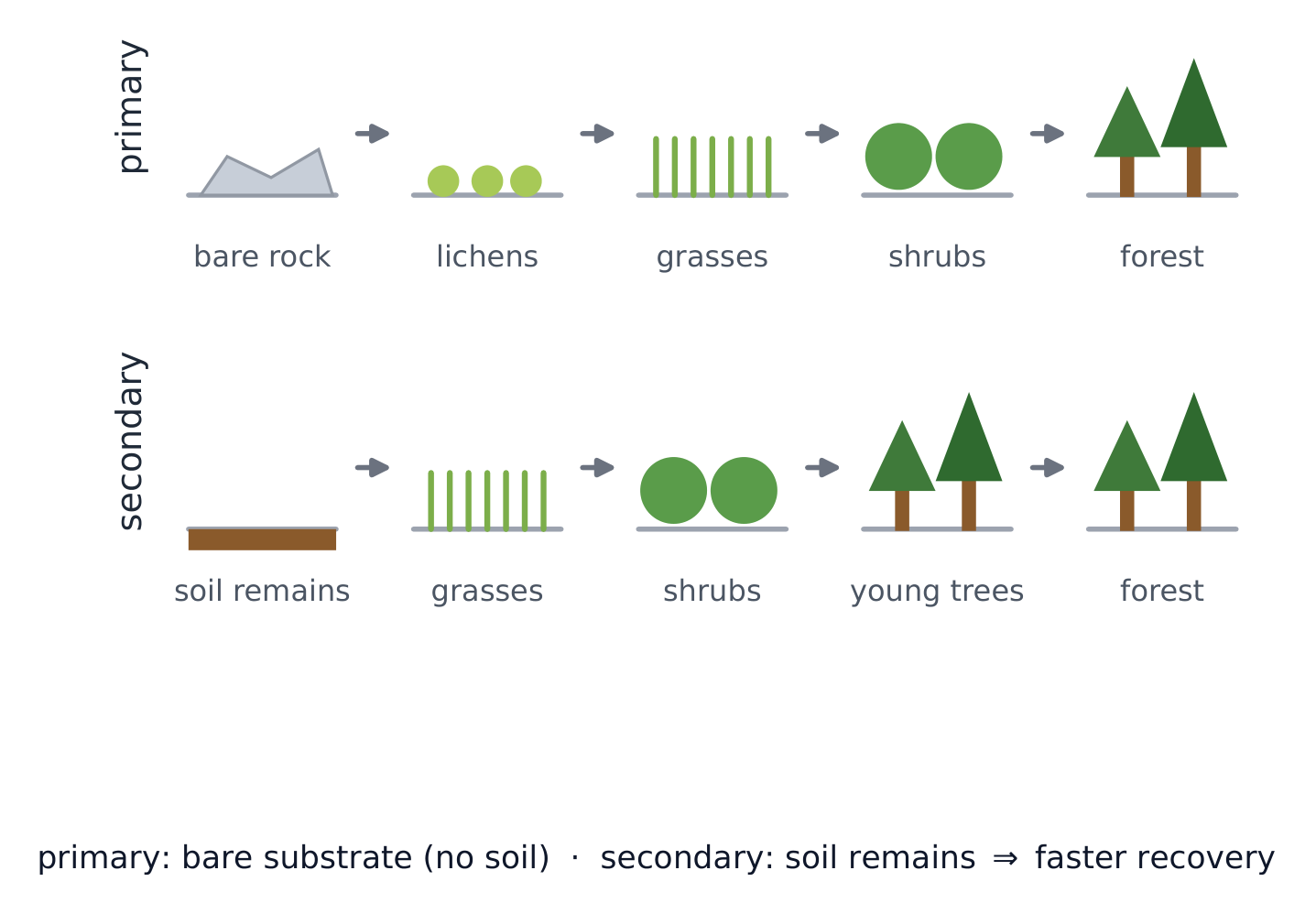
    Ecological succession 生态演替 is the gradual, orderly change in a community over time:

    • Primary succession 初级演替 starts on bare rock with no soil – after a glacier retreats or lava cools. Pioneer species 先锋物种 such as lichens 地衣 arrive first and slowly build soil. It is slow.
    A rock surface covered in yellow, orange, and pale-green crusty patches of lichen
    Lichens growing straight on bare rock. As pioneer species they slowly break the rock down and build the first thin soil
    • Secondary succession 次级演替 follows a disturbance that leaves the soil intact – after a fire or abandoned farming – so it is much faster.

    Succession tends toward a relatively stable climax community 顶极群落. Two special roles shape a community out of proportion to their numbers: a keystone species 关键种, whose activities hold the community structure together (remove it and the community collapses – sea otters keeping urchins in check), and an indicator species 指示物种, whose presence or health signals the condition of the whole ecosystem (lichens vanish where the air is polluted).

    Primary succession builds from bare rock; secondary succession regrows from surviving soil
    Primary succession builds from bare rock; secondary succession regrows from surviving soil

    Worked example. A pond holds 3 fish species with 5, 3, and 2 individuals ($N=10$). Simpson's Diversity Index $=1-\sum\left(\tfrac{n}{N}\right)^2 = 1-\left[(0.5)^2+(0.3)^2+(0.2)^2\right] = 1-0.38 = 0.62$. A value near 1 means high diversity; near 0 means one species dominates. Adding a fourth, evenly-sized species would push the index higher.

    Vocabulary · ⁨Kosa kata⁩ Train · ⁨Latih⁩
    English Bahasa Indonesia
    Ecological succession/ˌekəˈlɒdʒɪkl səkˈseʃn/ Suksesi ekologis
    Primary succession/ˈpraɪməri səkˈseʃn/ Suksesi primer
    Pioneer species/paɪəˈnɪə ˈspiːsiːz/ Spesies perintis
    lichens/ˈlaɪkənz/ lumut
    Secondary succession/ˈsekəndəri səkˈseʃn/ Suksesi sekunder
    climax community/ˈklaɪmæks kəˈmjuːnɪti/ komunitas klimaks
    keystone species/ˈkiːstəʊn ˈspiːsiːz/ spesies kunci
    indicator species/ˈɪndɪkeɪtə ˈspiːsiːz/ spesies indikator
    2.7

    Exam tips

    • Describe biodiversity at three levels: genetic, species, and habitat, and link higher diversity to greater resilience.
    • Specialist species (narrow needs) are more vulnerable than generalists when a habitat changes.
    • Distinguish primary succession (bare rock, no soil, slow) from secondary (soil intact, faster).
    • Explain a keystone species (outsized effect) and an indicator species (signals ecosystem health).
    • Name the four ecosystem services (provisioning, regulating, cultural, supporting) with examples.
  • 3

    Populations · ⁨Populasi⁩

    Watch lesson · ⁨Tonton pelajaran⁩
    3.1

    Generalist and Specialist Species · ⁨Spesies Generalis dan Spesialis⁩

    Syllabus · ⁨Silabus⁩
    English

    Enduring Understanding (ERT-3): Populations change over time in reaction to a variety of factors.

    Learning Objective ERT-3.A: Identify differences between generalist and specialist species.

    • ERT-3.A.1 Specialist species tend to be advantaged in habitats that remain constant, while generalist species tend to be advantaged in habitats that are changing.
    Bahasa Indonesia

    Pemahaman Abadi (ERT-3): Populasi berubah seiring waktu sebagai respons terhadap berbagai faktor.

    Tujuan Pembelajaran ERT-3.A: Identifikasi perbedaan antara spesies generalis dan spesialis.

    • ERT-3.A.1 Spesies spesialis cenderung diuntungkan di habitat yang tetap konstan, sementara spesies generalis cenderung diuntungkan di habitat yang sedang berubah.

    Source: College Board AP Course and Exam Description · ⁨Sumber: Deskripsi Kursus dan Ujian College Board AP⁩

    English

    A generalist 广适性物种 can live in many habitats and eat many foods (raccoon, cockroach) – flexible, so it copes well with change. A specialist 狭适性物种 needs specific conditions or foods (panda, koala) – efficient in a stable habitat but very vulnerable if that habitat changes.

    Bahasa Indonesia

    Sebuah generalis dapat hidup di banyak habitat dan memakan banyak makanan (raksasa racun, kecoak) – fleksibel, sehingga mampu bertahan dengan baik terhadap perubahan. Seorang spesialis membutuhkan kondisi atau makanan spesifik (panda, koala) – efisien dalam habitat yang stabil tetapi sangat rentan jika habitat tersebut berubah.

    3.2

    K-Selected and r-Selected Species · ⁨Spesies Terpilih K dan Terpilih r⁩

    Syllabus · ⁨Silabus⁩
    English

    Enduring Understanding (ERT-3): Populations change over time in reaction to a variety of factors.

    Learning Objective ERT-3.B: Identify differences between K- and r-selected species.

    • ERT-3.B.1 K-selected species tend to be large, have few offspring per reproduction event, live in stable environments, expend significant energy for each offspring, mature after many years of extended youth and parental care, have long life spans/life expectancy, and reproduce more than once in their lifetime. Competition for resources in K-selected species' habitats is usually relatively high.
    • ERT-3.B.2 r-selected species tend to be small, have many offspring, expend or invest minimal energy for each offspring, mature early, have short life spans, and may reproduce only once in their lifetime. Competition for resources in r-selected species' habitats is typically relatively low.
    • ERT-3.B.3 Biotic potential refers to the maximum reproductive rate of a population in ideal conditions.
    • ERT-3.B.4 Many species have reproductive strategies that are not uniquely r-selected or K-selected, or they change in different conditions at different times.
    • ERT-3.B.5 K-selected species are typically more adversely affected by invasive species than r-selected species, which are minimally affected by invasive species. Most invasive species are r-selected species.
    Bahasa Indonesia

    Pemahaman Abadi (ERT-3): Populasi berubah seiring waktu sebagai respons terhadap berbagai faktor.

    Tujuan Pembelajaran ERT-3.B: Identifikasi perbedaan antara spesies terpilih K dan r.

    • ERT-3.B.1 Spesies terpilih K cenderung berukuran besar, memiliki sedikit keturunan per peristiwa reproduksi, hidup di lingkungan stabil, mengeluarkan energi signifikan untuk setiap keturunan, matang setelah banyak tahun masa muda dan perawatan orang tua yang panjang, memiliki umur/ekspektasi hidup yang panjang, dan bereproduksi lebih dari sekali dalam seumur hidupnya. Persaingan sumber daya di habitat spesies terpilih K biasanya relatif tinggi.
    • ERT-3.B.2 Spesies terpilih r cenderung berukuran kecil, memiliki banyak keturunan, mengeluarkan atau menginvestasikan energi minimal untuk setiap keturunan, matang lebih awal, memiliki umur pendek, dan mungkin hanya bereproduksi sekali dalam seumur hidupnya. Persaingan sumber daya di habitat spesies terpilih r biasanya relatif rendah.
    • ERT-3.B.3 Potensi biotik merujuk pada tingkat reproduksi maksimum suatu populasi dalam kondisi ideal.
    • ERT-3.B.4 Banyak spesies memiliki strategi reproduksi yang tidak secara eksklusif dipilih r atau K, atau mereka berubah dalam kondisi berbeda pada waktu yang berbeda.
    • ERT-3.B.5 Spesies terpilih K biasanya lebih terdampak negatif oleh spesies invasif dibandingkan spesies terpilih r, yang minim terdampak oleh spesies invasif. Sebagian besar spesies invasif adalah spesies terpilih r.

    Source: College Board AP Course and Exam Description · ⁨Sumber: Deskripsi Kursus dan Ujian College Board AP⁩

    English

    Two reproductive strategies:

    • $r$-selected species produce many offspring with little care, mature fast, and have short lives (insects, weeds). They colonize quickly and boom-and-bust.
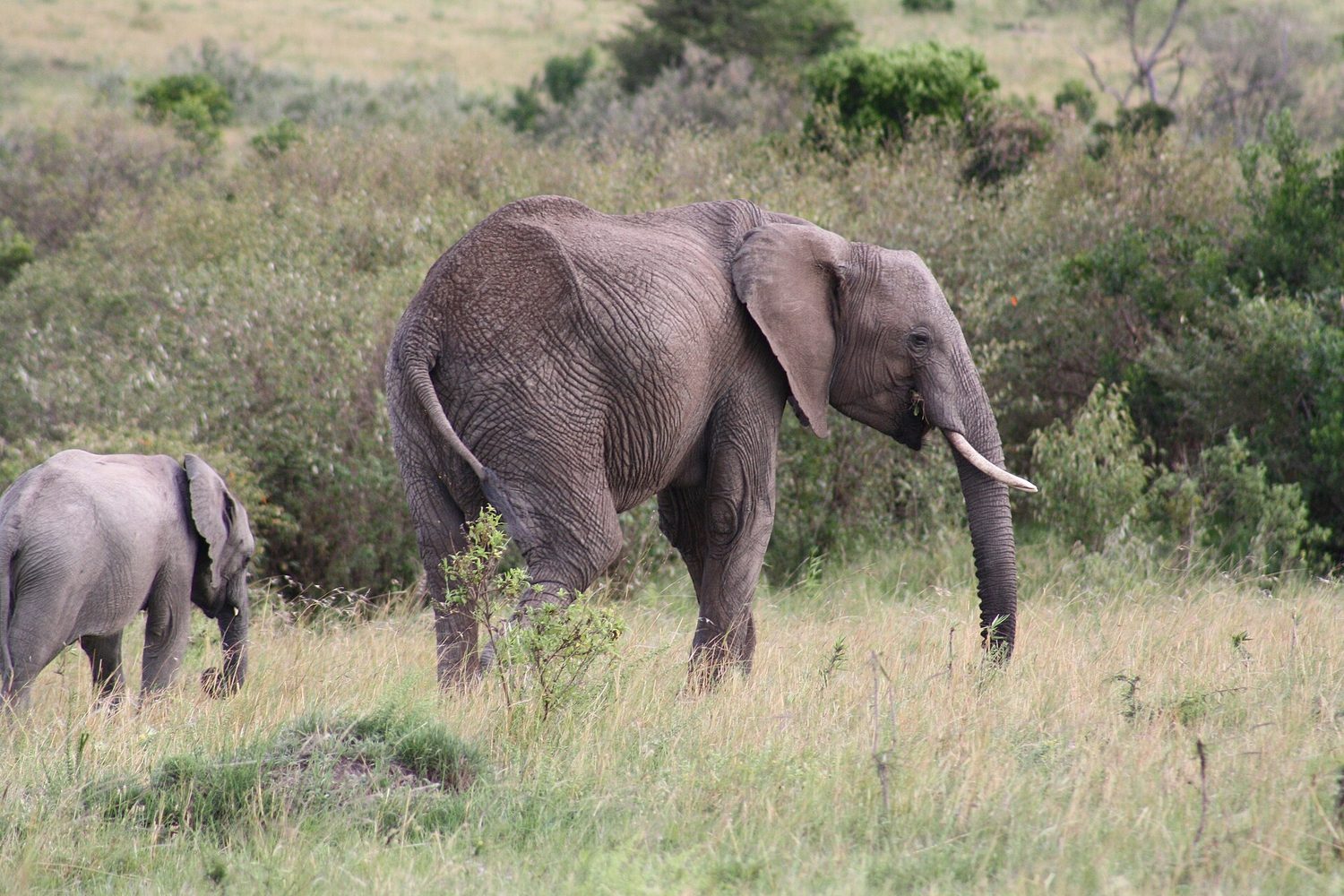
    • $K$-selected species produce few offspring with much care, mature slowly, and live long (elephants, humans). They do well near carrying capacity in stable environments but recover slowly from losses.
    Bahasa Indonesia

    Dua strategi reproduksi:

    • $r$-terpilih spesies menghasilkan banyak keturunan dengan sedikit perawatan, matang cepat, dan memiliki umur pendek (serangga, gulma). Mereka menjelajah dengan cepat dan mengalami lonjakan serta kehancuran.
    • $K$-terpilih spesies menghasilkan sedikit keturunan dengan banyak perawatan, matang lambat, dan hidup panjang (gajah, manusia). Mereka berkembang baik dekat kapasitas tampung dalam lingkungan yang stabil tetapi pulih lambat dari kerugian.
    Gajah dewasa berjalan dengan anak tunggal kecilnya melintasi padang rumput
    Gajah dengan anak tunggalnya: spesies terpilih K memiliki sedikit keturunan tetapi berinvestasi berat di setiap satu, sehingga pulih lambat jika jumlahnya turun
    Kelinci muda: spesies terpilih r menghasilkan banyak keturunan dengan cepat dengan investasi parental yang minim
    Kelinci muda: spesies terpilih r menghasilkan banyak keturunan dengan cepat dengan investasi parental yang minim
    3.3

    Survivorship Curves · ⁨Kurva Kelangsungan Hidup⁩

    Syllabus · ⁨Silabus⁩
    English

    Enduring Understanding (ERT-3): Populations change over time in reaction to a variety of factors.

    Learning Objective ERT-3.C: Explain survivorship curves.

    • ERT-3.C.1 A survivorship curve is a line that displays the relative survival rates of a cohort—a group of individuals of the same age—in a population, from birth to the maximum age reached by any one cohort member. There are Type I, Type II, and Type III curves.
    • ERT-3.C.2 Survivorship curves differ for K-selected and r-selected species, with K-selected species typically following a Type I or Type II curve and r-selected species following a Type III curve.
    Bahasa Indonesia

    Pemahaman Abadi (ERT-3): Populasi berubah seiring waktu sebagai respons terhadap berbagai faktor.

    Tujuan Pembelajaran ERT-3.C: Jelaskan kurva kelangsungan hidup.
    • ERT-3.C.1 Kurva kelangsungan hidup adalah garis yang menampilkan tingkat kelangsungan hidup relatif dari sebuah kohort—sekelompok individu dengan usia sama—dalam suatu populasi, sejak lahir hingga usia maksimum yang dicapai oleh anggota kohort mana pun. Terdapat kurva Tipe I, Tipe II, dan Tipe III.
    • ERT-3.C.2 Kurva kelangsungan hidup berbeda untuk spesies terpilih K dan r, dengan spesies terpilih K biasanya mengikuti kurva Tipe I atau Tipe II dan spesies terpilih r mengikuti kurva Tipe III.

    Source: College Board AP Course and Exam Description · ⁨Sumber: Deskripsi Kursus dan Ujian College Board AP⁩

    English

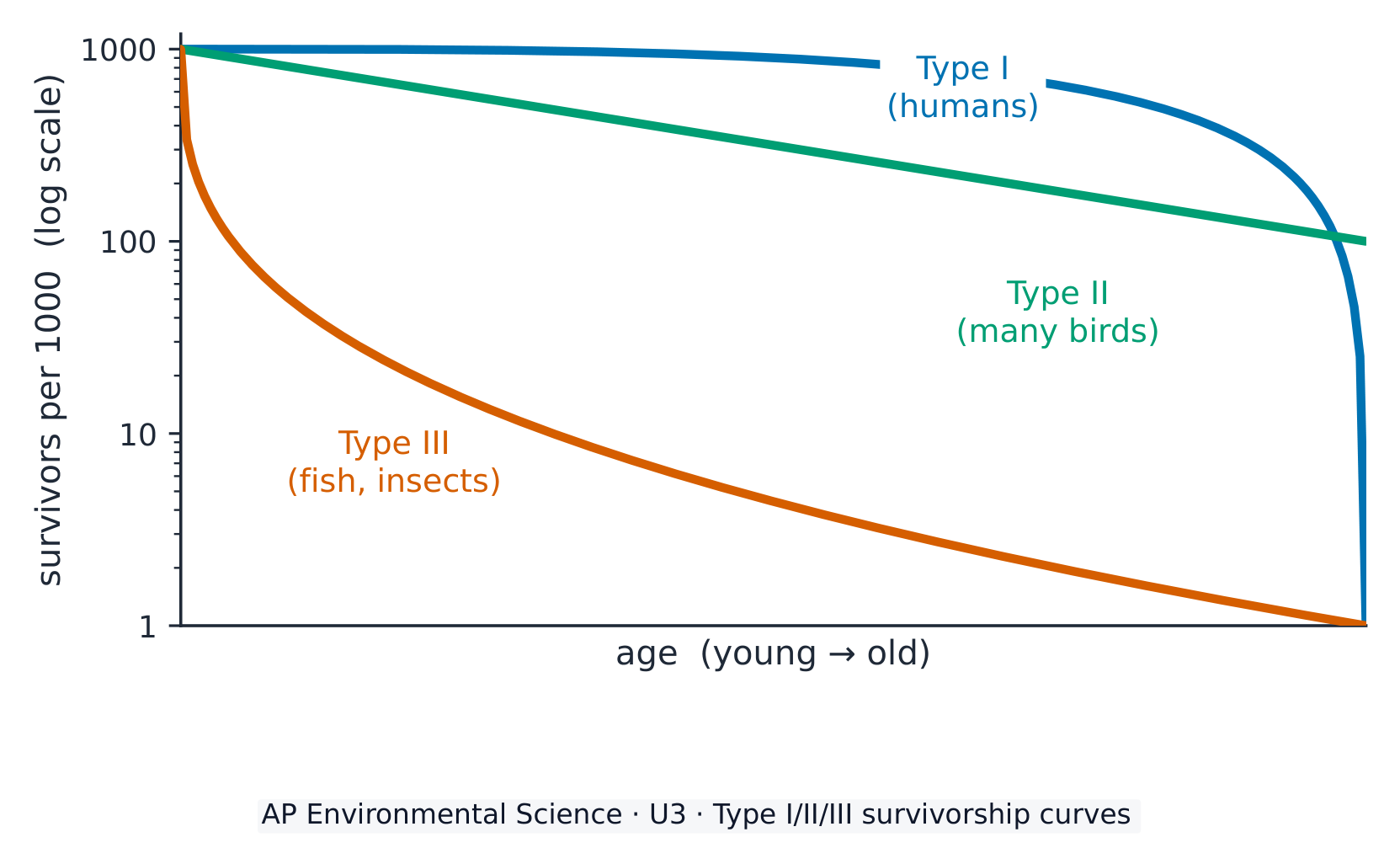
    A survivorship curve 存活曲线 plots how many individuals survive at each age (on a log scale). Type I (humans): most survive to old age, then die – a convex curve. Type II (many birds): a constant death rate at all ages – a straight line. Type III ($r$-selected: fish, insects): most die young, a few survive – a concave curve.

    Bahasa Indonesia

    Sebuah kurva kelangsungan hidup memplot berapa banyak individu yang bertahan pada setiap usia (pada skala log). Tipe I (manusia): sebagian besar bertahan hingga tua, lalu mati – kurva cembung. Tipe II (banyak burung): tingkat kematian konstan di semua usia – garis lurus. Tipe III ($r$-terpilih: ikan, serangga): sebagian besar mati muda, sedikit yang bertahan – kurva cekung.

    Kurva kelangsungan hidup Tipe I, II, dan III pada skala log
    Kurva kelangsungan hidup Tipe I, II, dan III pada skala log
    Vocabulary · ⁨Kosa kata⁩ Train · ⁨Latih⁩
    English Bahasa Indonesia
    generalist/ˈdʒenərəlɪst/ generalis
    specialist/ˈspeʃəlɪst/ spesialis
    survivorship curve/səˈvaɪvəʃɪp kɜːv/ kurva kelangsungan hidup
    3.4

    Carrying Capacity · ⁨Kapasitas Tampung⁩

    Syllabus · ⁨Silabus⁩
    English

    Enduring Understanding (ERT-3): Populations change over time in reaction to a variety of factors.

    Learning Objective ERT-3.D: Describe carrying capacity.

    • ERT-3.D.1 When a population exceeds its carrying capacity (carrying capacity can be denoted as K), overshoot occurs. There are environmental impacts of population overshoot, including resource depletion.

    Learning Objective ERT-3.E: Describe the impact of carrying capacity on ecosystems.

    • ERT-3.E.1 A major ecological effect of population overshoot is dieback of the population (often severe to catastrophic) because the lack of available resources leads to famine, disease, and/or conflict.
    Bahasa Indonesia

    Pemahaman Abadi (ERT-3): Populasi berubah seiring waktu sebagai respons terhadap berbagai faktor.

    Tujuan Pembelajaran ERT-3.D: Jelaskan kapasitas dukung.

    • ERT-3.D.1 Ketika suatu populasi melebihi kapasitas dukungnya (kapasitas dukung dapat dilambangkan sebagai K), terjadi overshoot (kelebihan muat). Ada dampak lingkungan dari kelebihan muat populasi, termasuk habisnya sumber daya.

    Tujuan Pembelajaran ERT-3.E: Jelaskan dampak kapasitas dukung terhadap ekosistem.

    • ERT-3.E.1 Efek ekologis utama dari kelebihan muat populasi adalah kemunduran populasi (sering kali parah hingga katastropik) karena kurangnya sumber daya yang tersedia yang menyebabkan kelaparan, penyakit, dan/atau konflik.

    Source: College Board AP Course and Exam Description · ⁨Sumber: Deskripsi Kursus dan Ujian College Board AP⁩

    English
    Predator & prey populations cycle
    Exponential vs logistic growth

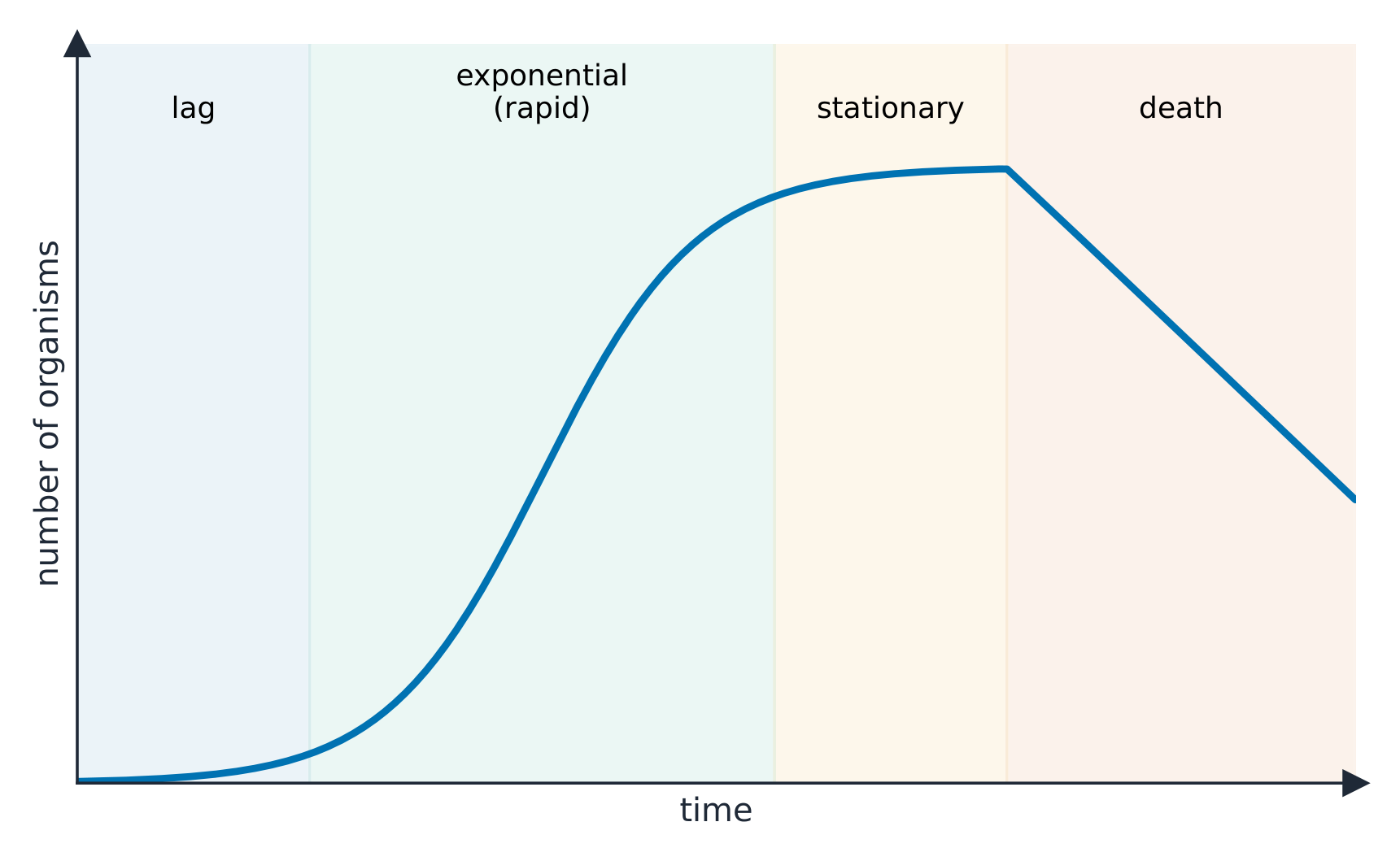
    The carrying capacity 环境容纳量 ($K$) is the maximum population an environment can support long-term. A population may overshoot $K$ when resources are temporarily plentiful, then crash (dieback) as resources run out. Populations tend to fluctuate around $K$.

    Bahasa Indonesia
    Populasi predator & mangsa bersiklus
    Pertumbuhan eksponensial vs logistik

    Kapasitas tampung ($K$) adalah populasi maksimum yang dapat didukung lingkungan jangka panjang. Populasi dapat melebihi batas $K$ ketika sumber daya sementara melimpah, kemudian runtuh (kematian massal) saat sumber daya habis. Populasi cenderung berfluktuasi di sekitar $K$.

    Pertumbuhan populasi melandai pada kapasitas tampung lingkungan
    Pertumbuhan populasi melandai pada kapasitas tampung lingkungan
    Kawanan rusa: ketika populasi mendekati kapasitas tampung, sumber daya membatasi pertumbuhan lebih lanjut
    Kawanan rusa: ketika populasi mendekati kapasitas tampung, sumber daya membatasi pertumbuhan lebih lanjut
    Explore · ⁨Jelajahi⁩

    Growth up to carrying capacity · ⁨Pertumbuhan menuju kapasitas dukung⁩

    A population grows toward the carrying capacity $K$ its resources can support, then levels off. Push the growth rate up and watch it overshoot and settle. · ⁨Populasi tumbuh menuju kapasitas dukung $K$ yang dapat ditopang sumber dayanya, lalu melandai. Dorong laju pertumbuhan naik dan saksikan ia melebihi batas dan menetap.⁩

    Vocabulary · ⁨Kosa kata⁩ Train · ⁨Latih⁩
    English Bahasa Indonesia
    carrying capacity/ˈkæriɪŋ kəˈpæsɪti/ kapasitas dukung
    exponentially/ˌekspəˈnenʃəli/ eksponensial
    logistic/ləˈdʒɪstɪk/ logistik
    Limiting factors/ˈlɪmɪtɪŋ ˈfæktəz/ Faktor pembatas
    age-structure diagram/eɪdʒ ˈstrʌktʃə ˈdaɪəɡræm/ diagram struktur usia
    total fertility rate/ˈtəʊtl fɜːˈtɪlɪti reɪt/ tingkat kesuburan total
    ecological footprint/ˌekəˈlɒdʒɪkl ˈfʊtprɪnt/ jejak ekologis
    3.5

    Population Growth and Resource Availability · ⁨Pertumbuhan Populasi dan Ketersediaan Sumber Daya⁩

    Syllabus · ⁨Silabus⁩
    English

    Enduring Understanding (ERT-3): Populations change over time in reaction to a variety of factors.

    Learning Objective ERT-3.F: Explain how resource availability affects population growth.

    • ERT-3.F.1 Population growth is limited by environmental factors, especially by the available resources and space.
    • ERT-3.F.2 Resource availability and the total resource base are limited and finite over all scales of time.
    • ERT-3.F.3 When the resources needed by a population for growth are abundant, population growth usually accelerates.
    • ERT-3.F.4 When the resource base of a population shrinks, the increased potential for unequal distribution of resources will ultimately result in increased mortality, decreased fecundity, or both, resulting in population growth declining to, or below, carrying capacity.
    Bahasa Indonesia

    Pemahaman Abadi (ERT-3): Populasi berubah seiring waktu sebagai respons terhadap berbagai faktor.

    Tujuan Pembelajaran ERT-3.F: Jelaskan bagaimana ketersediaan sumber daya memengaruhi pertumbuhan populasi.

    • ERT-3.F.1 Pertumbuhan populasi dibatasi oleh faktor lingkungan, terutama oleh sumber daya dan ruang yang tersedia.
    • ERT-3.F.2 Ketersediaan sumber daya dan basis sumber daya total terbatas dan finite pada semua skala waktu.
    • ERT-3.F.3 Ketika sumber daya yang dibutuhkan oleh suatu populasi untuk pertumbuhan melimpah, pertumbuhan populasi biasanya dipercepat.
    • ERT-3.F.4 Ketika basis sumber daya suatu populasi menyusut, peningkatan potensi distribusi sumber daya yang tidak merata pada akhirnya akan mengakibatkan peningkatan kematian, penurunan fekunditas, atau keduanya, yang mengakibatkan pertumbuhan populasi menurun hingga, atau di bawah, kapasitas dukung.

    Source: College Board AP Course and Exam Description · ⁨Sumber: Deskripsi Kursus dan Ujian College Board AP⁩

    English

    With abundant resources a population grows exponentially 指数增长 ($J$-curve). As resources become limited, growth slows to logistic 逻辑斯蒂增长 ($S$-curve), leveling at $K$. Limiting factors 限制因素 (food, water, space, disease) set the ceiling.

    Bahasa Indonesia

    Dengan sumber daya melimpah populasi tumbuh secara eksponensial ($J$-kurva). Saat sumber daya menjadi terbatas, pertumbuhan melambat menjadi logistik ($S$-kurva), melandai pada $K$. Faktor pembatas (makanan, air, ruang, penyakit) menetapkan batas atas.

    3.6

    Age Structure Diagrams · ⁨Diagram Struktur Usia⁩

    Syllabus · ⁨Silabus⁩
    English

    Enduring Understanding (EIN-1): Human populations change in reaction to a variety of factors, including social and cultural factors.

    Learning Objective EIN-1.A: Explain age structure diagrams.

    • EIN-1.A.1 Population growth rates can be interpreted from age structure diagrams by the shape of the structure.
    • EIN-1.A.2 A rapidly growing population will, as a rule, have a higher proportion of younger people compared to stable or declining populations.
    Bahasa Indonesia

    Pemahaman Abadi (EIN-1): Populasi manusia berubah sebagai respons terhadap berbagai faktor, termasuk faktor sosial dan budaya.

    Tujuan Pembelajaran EIN-1.A: Jelaskan diagram struktur usia.

    • EIN-1.A.1 Tingkat pertumbuhan populasi dapat ditafsirkan dari diagram struktur usia berdasarkan bentuk strukturnya.
    • EIN-1.A.2 Populasi yang tumbuh cepat akan, pada umumnya, memiliki proporsi penduduk yang lebih muda dibandingkan populasi yang stabil atau menurun.

    Source: College Board AP Course and Exam Description · ⁨Sumber: Deskripsi Kursus dan Ujian College Board AP⁩

    English

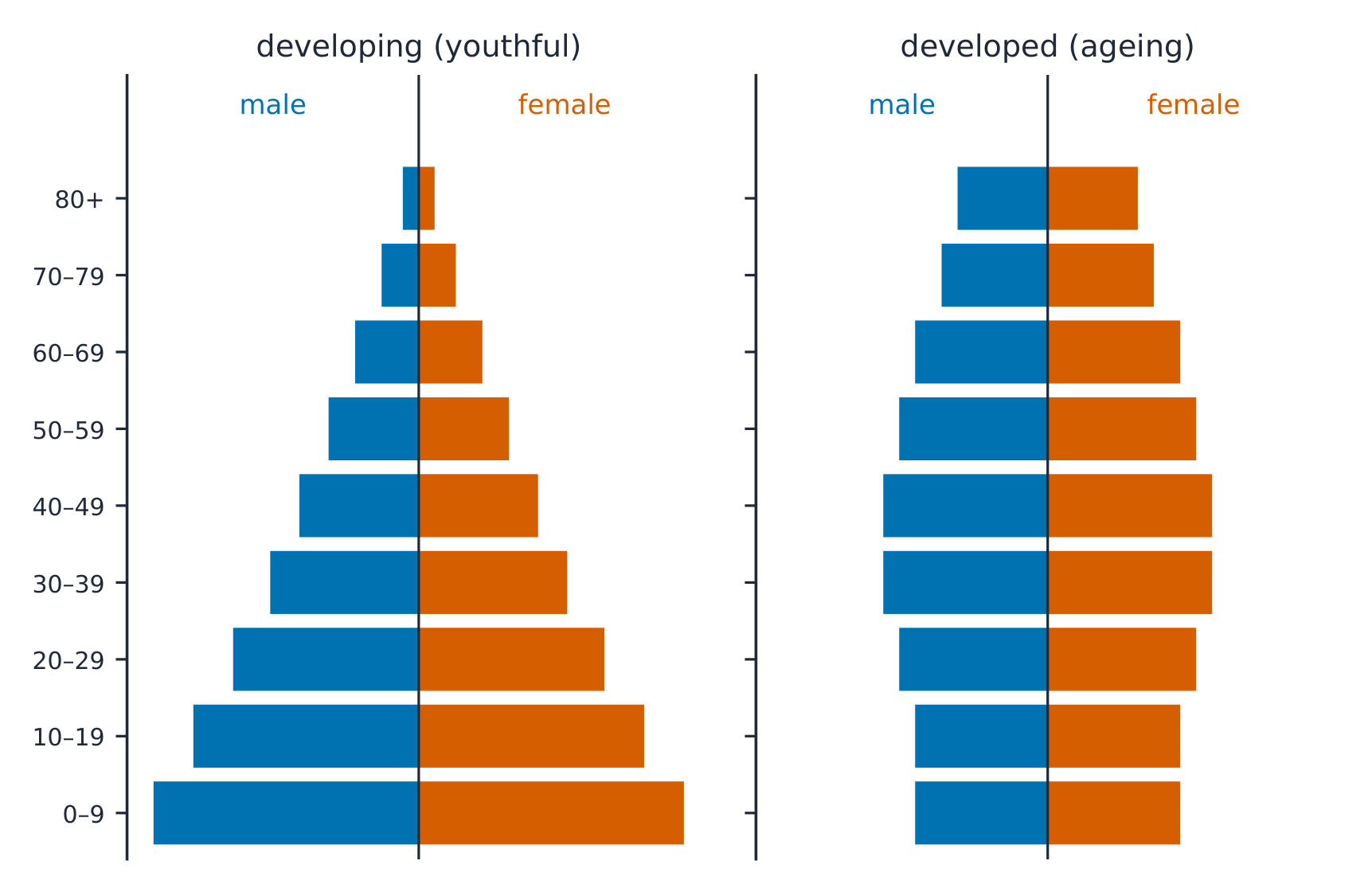
    An age-structure diagram 年龄结构图 shows the proportion of a population in each age group. A wide base (many young) predicts rapid growth; even bars predict a stable population; a narrow base predicts decline. They forecast a country's future population.
    Bahasa Indonesia

    Sebuah diagram struktur usia menunjukkan proporsi populasi dalam setiap kelompok usia. Dasar yang lebar (banyak muda) memprediksi pertumbuhan cepat; bilah yang merata memprediksi populasi stabil; dasar yang sempit memprediksi penurunan. Mereka memproyeksikan populasi masa depan suatu negara.

    Piramida penduduk negara berkembang dan negara maju
    Piramida penduduk negara berkembang dan negara maju
    3.7

    Total Fertility Rate · ⁨Tingkat Fertilitas Total⁩

    Syllabus · ⁨Silabus⁩
    English

    Enduring Understanding (EIN-1): Human populations change in reaction to a variety of factors, including social and cultural factors.

    Learning Objective EIN-1.B: Explain factors that affect total fertility rate in human populations.

    • EIN-1.B.1 Total fertility rate (TFR) is affected by the age at which females have their first child, educational opportunities for females, access to family planning, and government acts and policies.
    • EIN-1.B.2 If fertility rate is at replacement levels, a population is considered relatively stable.
    • EIN-1.B.3 Factors associated with infant mortality rates include whether mothers have access to good healthcare and nutrition. Changes in these factors can lead to changes in infant mortality rates over time.
    Bahasa Indonesia

    Pemahaman Abadi (EIN-1): Populasi manusia berubah sebagai respons terhadap berbagai faktor, termasuk faktor sosial dan budaya.

    Tujuan Pembelajaran EIN-1.B: Jelaskan faktor-faktor yang memengaruhi tingkat fertilitas total pada populasi manusia.

    • EIN-1.B.1 Tingkat kesuburan total (TFR) dipengaruhi oleh usia saat perempuan memiliki anak pertama, peluang pendidikan bagi perempuan, akses terhadap keluarga berencana, serta undang-undang dan kebijakan pemerintah.
    • EIN-1.B.2 Jika tingkat kesuburan berada pada tingkat penggantian, populasi dianggap relatif stabil.
    • EIN-1.B.3 Faktor yang berkaitan dengan tingkat kematian bayi meliputi apakah ibu memiliki akses ke perawatan kesehatan dan nutrisi yang baik. Perubahan dalam faktor-faktor ini dapat menyebabkan perubahan tingkat kematian bayi dari waktu ke waktu.

    Source: College Board AP Course and Exam Description · ⁨Sumber: Deskripsi Kursus dan Ujian College Board AP⁩

    English

    The total fertility rate 总生育率 (TFR) is the average number of children per woman. A replacement level of about 2.1 keeps a population steady; above it grows, below it shrinks. TFR falls with education, access to family planning, and lower infant mortality.

    Bahasa Indonesia

    Tingkat fertilitas total (TFR) adalah rata-rata jumlah anak per wanita. Tingkat pengganti sekitar 2.1 menjaga populasi tetap stabil; di atas itu tumbuh, di bawah itu menyusut. TFR menurun seiring pendidikan, akses kontrasepsi, dan mortalitas bayi yang lebih rendah.

    3.8

    Human Population Dynamics · ⁨Dinamika Populasi Manusia⁩

    Syllabus · ⁨Silabus⁩
    English

    Enduring Understanding (EIN-1): Human populations change in reaction to a variety of factors, including social and cultural factors.

    Learning Objective EIN-1.C.1: Explain how human populations experience growth and decline.

    • EIN-1.C.1 Birth rates, infant mortality rates, and overall death rates, access to family planning, access to good nutrition, access to education, and postponement of marriage all affect whether a human population is growing or declining.
    • EIN-1.C.2 Factors limiting global human population include the Earth's carrying capacity and the basic factors that limit human population growth as set forth by Malthusian theory.
    • EIN-1.C.3 Population growth can be affected by both density-independent factors, such as major storms, fires, heat waves, or droughts, and density-dependent factors, such as access to clean water and air, food availability, disease transmission, or territory size.
    • EIN-1.C.4 The rule of 70 states that dividing the number 70 by the percentage population growth rate approximates the population's doubling time.
    Bahasa Indonesia

    Pemahaman Abadi (EIN-1): Populasi manusia berubah sebagai respons terhadap berbagai faktor, termasuk faktor sosial dan budaya.

    Tujuan Pembelajaran EIN-1.C.1: Jelaskan bagaimana populasi manusia mengalami pertumbuhan dan penurunan.

    • EIN-1.C.1 Tingkat kelahiran, tingkat kematian bayi, dan tingkat kematian keseluruhan, akses terhadap keluarga berencana, akses ke nutrisi yang baik, akses ke pendidikan, serta penundaan pernikahan semuanya memengaruhi apakah suatu populasi manusia sedang tumbuh atau menurun.
    • EIN-1.C.2 Faktor pembatas populasi manusia global mencakup kapasitas tampung Bumi dan faktor dasar yang membatasi pertumbuhan populasi manusia sebagaimana dikemukakan dalam teori Malthusian.
    • EIN-1.C.3 Pertumbuhan populasi dapat dipengaruhi oleh faktor yang tidak bergantung pada kepadatan, seperti badai besar, kebakaran, gelombang panas, atau kekeringan, serta faktor yang bergantung pada kepadatan, seperti akses ke air bersih dan udara, ketersediaan makanan, penularan penyakit, atau ukuran wilayah.
    • EIN-1.C.4 Aturan 70 menyatakan bahwa membagi angka 70 dengan persentase laju pertumbuhan populasi akan memperkirakan waktu penggandaan populasi.

    Source: College Board AP Course and Exam Description · ⁨Sumber: Deskripsi Kursus dan Ujian College Board AP⁩

    English

    Human population growth depends on birth rate, death rate, and migration. Rapid growth strains resources and increases the ecological footprint 生态足迹. Factors lowering birth rates include education (especially of women), urbanization, and economic development.

    Worked example. A country has a birth rate of $30$ per $1000$ and a death rate of $10$ per $1000$. The natural growth rate is $\dfrac{30-10}{10}=2.0\%$ per year (dividing the per-thousand difference by $10$ converts it to a percent). By the rule of 70, the population doubles in about $\dfrac{70}{2.0}=35$ years. If development cut the growth rate to $1.0\%$, the doubling time would stretch to $\dfrac{70}{1.0}=70$ years.

    Bahasa Indonesia

    Pertumbuhan populasi manusia bergantung pada tingkat kelahiran, tingkat kematian, dan migrasi. Pertumbuhan cepat membebani sumber daya dan meningkatkan jejak ekologis. Faktor yang menurunkan tingkat kelahiran termasuk pendidikan (terutama perempuan), urbanisasi, dan pembangunan ekonomi.

    Contoh terpecahkan. Sebuah negara memiliki tingkat kelahiran $30$ per $1000$ dan tingkat kematian $10$ per $1000$. Tingkat pertumbuhan alami adalah $\dfrac{30-10}{10}=2.0\%$ per tahun (membagi selisih per seribu dengan $10$ mengubahnya menjadi persentase). Berdasarkan aturan 70, populasi berlipat ganda dalam waktu sekitar $\dfrac{70}{2.0}=35$ tahun. Jika pembangunan menurunkan tingkat pertumbuhan menjadi $1.0\%$, waktu berlipat ganda akan meluas menjadi $\dfrac{70}{1.0}=70$ tahun.

    Kota padat yang ramai: dinamika populasi manusia bergantung pada tingkat kelahiran, tingkat kematian, dan migrasi
    Kota padat yang ramai: dinamika populasi manusia bergantung pada tingkat kelahiran, tingkat kematian, dan migrasi
    3.9

    Demographic Transition · ⁨Transisi Demografis⁩

    Syllabus · ⁨Silabus⁩
    English

    Enduring Understanding (EIN-1): Human populations change in reaction to a variety of factors, including social and cultural factors.

    Learning Objective EIN-1.D: Define the demographic transition.

    • EIN-1.D.1 The demographic transition refers to the transition from high to lower birth and death rates in a country or region as development occurs and that country moves from a pre-industrial to an industrialized economic system. This transition is typically demonstrated through a four-stage demographic transition model (DTM).
    • EIN-1.D.2 Characteristics of developing countries include higher infant mortality rates and more children in the workforce than developed countries.
    Bahasa Indonesia

    Pemahaman Abadi (EIN-1): Populasi manusia berubah sebagai respons terhadap berbagai faktor, termasuk faktor sosial dan budaya.

    Tujuan Pembelajaran EIN-1.D: Definisikan transisi demografi.

    • EIN-1.D.1 Transisi demografi merujuk pada peralihan dari tingkat kelahiran dan kematian yang tinggi menjadi lebih rendah di suatu negara atau wilayah seiring dengan perkembangan, di mana negara tersebut beralih dari sistem ekonomi pra-industri menuju industri. Peralihan ini biasanya digambarkan melalui model transisi demografi empat tahap (DTM).
    • EIN-1.D.2 Ciri-ciri negara berkembang meliputi tingkat kematian bayi yang lebih tinggi dan jumlah anak yang bekerja lebih banyak dibandingkan negara maju.

    Source: College Board AP Course and Exam Description · ⁨Sumber: Deskripsi Kursus dan Ujian College Board AP⁩

    English

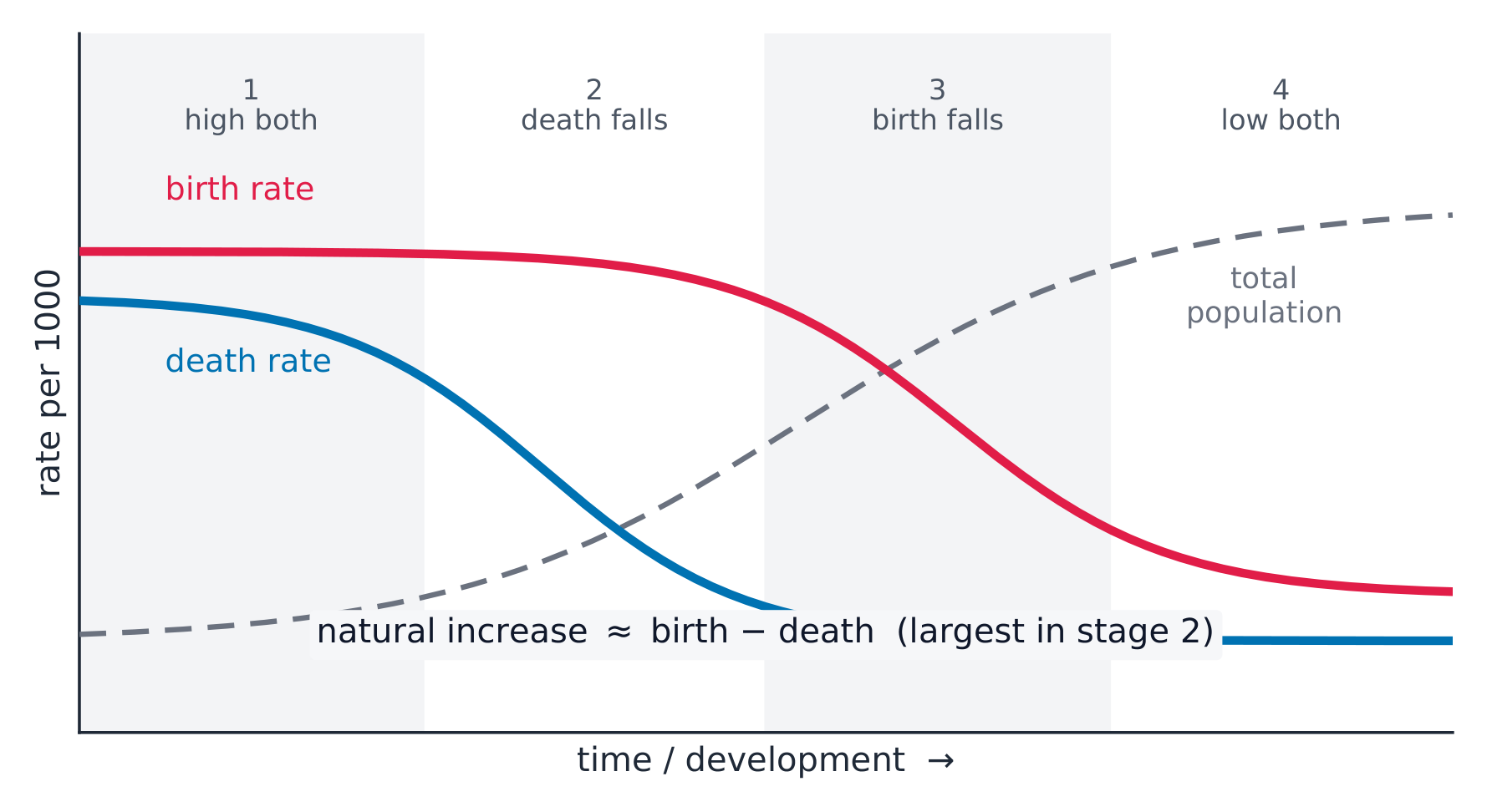
    The demographic transition 人口转型 describes how a country's growth changes as it develops, in stages: (1) high birth and death rates (slow growth); (2) death rate falls (rapid growth); (3) birth rate falls (slowing growth); (4) both low (stable). Developed nations are in later stages; many developing nations are in the rapid-growth stages.

    The population grows fastest in stages 2 and 3 – the gap between a still-high birth rate and an already-fallen death rate. That lag is why a country's population keeps climbing long after its death rate drops.

    Bahasa Indonesia

    Transisi demografis menggambarkan bagaimana pertumbuhan suatu negara berubah seiring perkembangannya, melalui tahap-tahap: (1) tingkat kelahiran dan kematian tinggi (pertumbuhan lambat); (2) tingkat kematian turun (pertumbuhan cepat); (3) tingkat kelahiran turun (pertumbuhan melambat); (4) keduanya rendah (stabil). Negara maju berada di tahap akhir; banyak negara berkembang berada di tahap pertumbuhan cepat.

    Empat tahap transisi demografis
    Empat tahap transisi demografis

    Populasi tumbuh paling cepat pada tahap 2 dan 3 – kesenjangan antara tingkat kelahiran yang masih tinggi dan tingkat kematian yang sudah turun. Keterlambatan ini menyebabkan populasi suatu negara terus meningkat lama setelah tingkat kematian turun.

    Vocabulary · ⁨Kosa kata⁩ Train · ⁨Latih⁩
    English Bahasa Indonesia
    demographic transition/ˌdeməˈɡræfɪk trænˈsɪʃn/ transisi demografis
    3.9

    Exam tips · ⁨Tips ujian⁩

    English
    • Use the rule of 70: doubling time ≈ 70 ÷ growth-rate(%); a growth rate is (births − deaths) per 1000 ÷ 10.
    • Read age-structure diagrams: a wide base predicts rapid growth, even bars a stable population.
    • Contrast r-selected (many offspring, little care) and K-selected (few, much care) strategies.
    • Know the demographic transition stages and what lowers birth rates (education, family planning, development).
    • A falling growth rate still means growth — the population only shrinks when deaths exceed births.
    Bahasa Indonesia
    • Gunakan aturan 70: waktu berlipat ganda ≈ 70 ÷ tingkat pertumbuhan(%); tingkat pertumbuhan adalah (kelahiran − kematian) per 1000 ÷ 10.
    • Bacalah diagram struktur usia: dasar yang lebar memprediksi pertumbuhan cepat, sementara baris yang rata menunjukkan populasi stabil.
    • Bandingkan strategi r-selected (banyak keturunan, sedikit perawatan) dan K-selected (sedikit, banyak perawatan).
    • Pahami tahap transisi demografis serta faktor yang menurunkan tingkat kelahiran (pendidikan, keluarga berencana, pembangunan).
    • Penurunan tingkat pertumbuhan tetap berarti pertumbuhan – populasi hanya menyusut ketika kematian melebihi kelahiran.
  • 4

    Earth Systems and Resources · ⁨Sistem Bumi dan Sumber Daya⁩

    Watch lesson · ⁨Tonton pelajaran⁩
    4.1

    Plate Tectonics

    Syllabus · ⁨Silabus⁩
    English

    Enduring Understanding (ERT-4): Earth's systems interact, resulting in a state of balance over time.

    Learning Objective ERT-4.A: Describe the geological changes and events that occur at convergent, divergent, and transform plate boundaries.

    • ERT-4.A.1 Convergent boundaries can result in the creation of mountains, island arcs, earthquakes, and volcanoes.
    • ERT-4.A.2 Divergent boundaries can result in seafloor spreading, rift valleys, volcanoes, and earthquakes.
    • ERT-4.A.3 Transform boundaries can result in earthquakes.
    • ERT-4.A.4 Maps that show the global distribution of plate boundaries can be used to determine the location of volcanoes, island arcs, earthquakes, hot spots, and faults.
    • ERT-4.A.5 An earthquake occurs when stress overcomes a locked fault, releasing stored energy.
    Bahasa Indonesia

    Pemahaman Berkelanjutan (ERT-4): Sistem-sistem Bumi berinteraksi, menghasilkan keadaan keseimbangan seiring berjalannya waktu.

    Tujuan Pembelajaran ERT-4.A: Deskripsikan perubahan geologis dan peristiwa yang terjadi di batas lempeng konvergen, divergen, dan transform.

    • ERT-4.A.1 Batas konvergen dapat menghasilkan pembentukan pegunungan, busur kepulauan, gempa bumi, dan gunung berapi.
    • ERT-4.A.2 Batas divergen dapat menghasilkan penyebaran dasar laut, lembah retakan, gunung berapi, dan gempa bumi.
    • ERT-4.A.3 Batas transform dapat menghasilkan gempa bumi.
    • ERT-4.A.4 Peta yang menunjukkan distribusi global batas lempeng dapat digunakan untuk menentukan lokasi gunung berapi, busur kepulauan, gempa bumi, titik panas, dan sesar.
    • ERT-4.A.5 Gempa bumi terjadi ketika tegangan melampaui sesar yang terkunci, melepaskan energi yang tersimpan.

    Source: College Board AP Course and Exam Description · ⁨Sumber: Deskripsi Kursus dan Ujian College Board AP⁩

    The three plate boundaries

    Earth's crust is broken into plates 板块 that slowly move on the mantle – plate tectonics 板块构造. At divergent boundaries plates spread apart (new crust); at convergent they collide (mountains, volcanoes, earthquakes); at transform they slide past (earthquakes). Boundaries create hazards but also volcanic soils and mineral resources.

    Bright orange molten lava fountaining out of a dark volcanic crater in Iceland
    A volcano erupting at a plate boundary in Iceland. Molten rock rising between spreading plates builds new crust
    Vocabulary · ⁨Kosa kata⁩ Train · ⁨Latih⁩
    English Bahasa Indonesia
    plates/pleɪts/ pelat
    plate tectonics/pleɪt tekˈtɒnɪks/ tektonik lempeng
    4.2

    Soil Formation and Erosion

    Syllabus · ⁨Silabus⁩
    English

    Enduring Understanding (ERT-4): Earth's systems interact, resulting in a state of balance over time.

    Learning Objective ERT-4.B: Describe the characteristics and formation of soil.

    • ERT-4.B.1 Soils are formed when parent material is weathered, transported, and deposited.
    • ERT-4.B.2 Soils are generally categorized by horizons based on their composition and organic material.
    • ERT-4.B.3 Soils can be eroded by winds or water. Protecting soils can protect water quality as soils effectively filter and clean water that moves through them.
    Bahasa Indonesia

    Pemahaman Berkelanjutan (ERT-4): Sistem-sistem Bumi berinteraksi, menghasilkan keadaan keseimbangan seiring berjalannya waktu.

    Tujuan Pembelajaran ERT-4.B: Deskripsikan karakteristik dan pembentukan tanah.

    • ERT-4.B.1 Tanah terbentuk ketika bahan induk tererosi, ditransportasikan, dan diendapkan.
    • ERT-4.B.2 Tanah umumnya dikategorikan berdasarkan horizon berdasarkan komposisi dan materi organiknya.
    • ERT-4.B.3 Tanah dapat tererosi oleh angin atau air. Melindungi tanah dapat melindungi kualitas air karena tanah secara efektif menyaring dan membersihkan air yang mengalir melewatinya.

    Source: College Board AP Course and Exam Description · ⁨Sumber: Deskripsi Kursus dan Ujian College Board AP⁩

    Soil 土壤 forms slowly as rock weathers 风化 and organic matter builds up. Erosion 侵蚀 is the removal of soil by wind and water, sped up by removing vegetation (farming, deforestation, overgrazing). Because soil forms so slowly, erosion faster than formation depletes a vital resource.
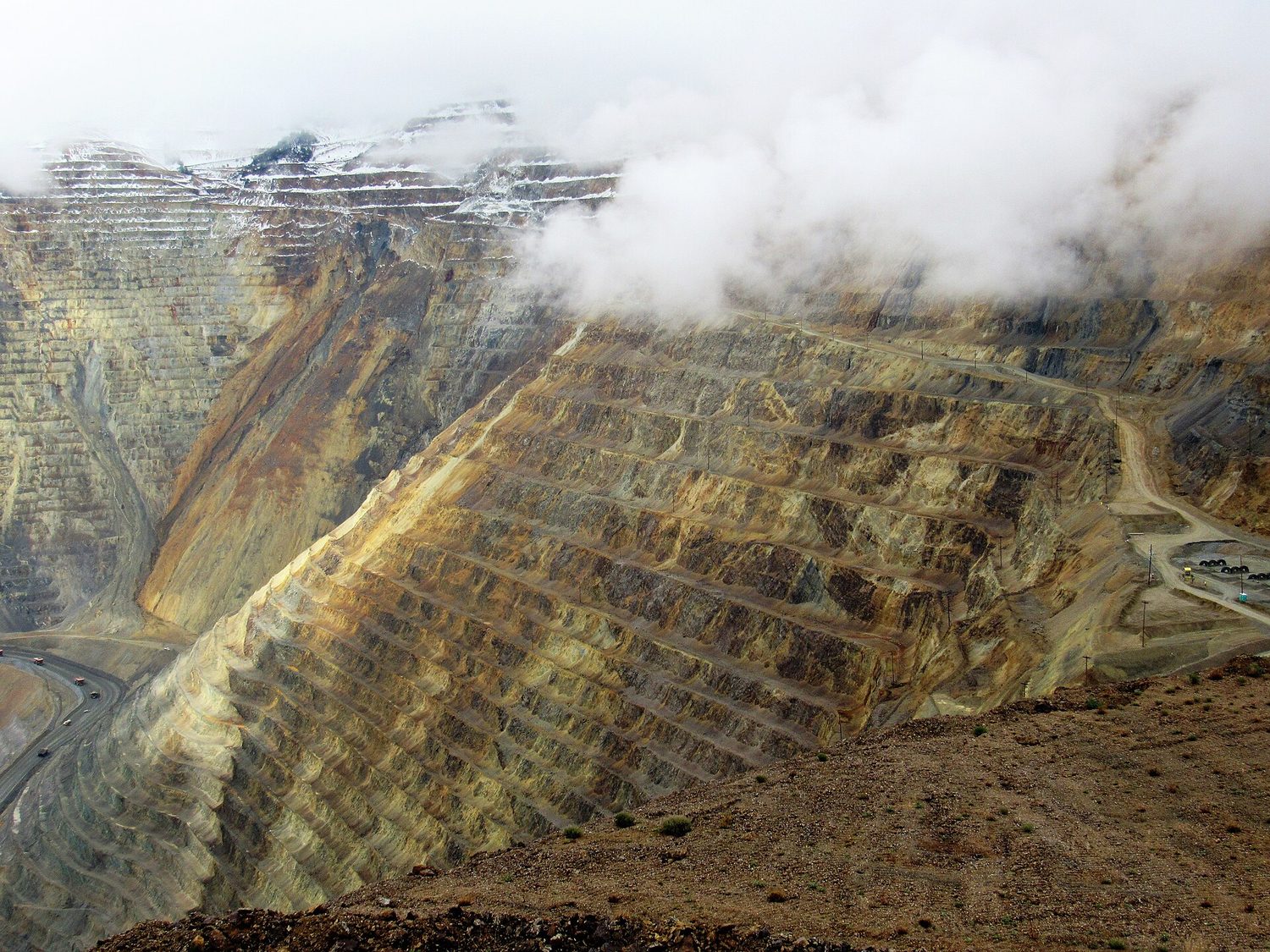
    Soil horizons form over time as parent rock weathers; erosion can strip topsoil and reverse that progress
    Soil horizons form over time as parent rock weathers; erosion can strip topsoil and reverse that progress
    Vocabulary · ⁨Kosa kata⁩ Train · ⁨Latih⁩
    English Bahasa Indonesia
    Soil/sɔɪl/ Tanah
    weathers/ˈweðəz/ mengikis
    Erosion/ɪˈrəʊʒn/ Erosi
    4.3

    Soil Composition and Properties

    Syllabus · ⁨Silabus⁩
    English

    Enduring Understanding (ERT-4): Earth's systems interact, resulting in a state of balance over time.

    Learning Objective ERT-4.C: Describe similarities and differences between properties of different soil types.

    • ERT-4.C.1 Water holding capacity—the total amount of water soil can hold—varies with different soil types. Water retention contributes to land productivity and fertility of soils.
    • ERT-4.C.2 The particle size and composition of each soil horizon can affect the porosity, permeability, and fertility of the soil.
    • ERT-4.C.3 There are a variety of methods to test the chemical, physical, and biological properties of soil that can aid in a variety of decisions, such as irrigation and fertilizer requirements.
    • ERT-4.C.4 A soil texture triangle is a diagram that allows for the identification and comparison of soil types based on their percentage of clay, silt, and sand.
    Bahasa Indonesia

    Pemahaman Berkelanjutan (ERT-4): Sistem-sistem Bumi berinteraksi, menghasilkan keadaan keseimbangan seiring berjalannya waktu.

    Tujuan Pembelajaran ERT-4.C: Deskripsikan persamaan dan perbedaan antara sifat-sifat berbagai jenis tanah.

    • ERT-4.C.1 Kapasitas simpan air—jumlah total air yang dapat ditahan tanah—berubah sesuai dengan jenis tanah yang berbeda. Retensi air berkontribusi pada produktivitas lahan dan kesuburan tanah.
    • ERT-4.C.2 Ukuran partikel dan komposisi setiap horizon tanah dapat memengaruhi porositas, permeabilitas, dan kesuburan tanah.
    • ERT-4.C.3 Terdapat berbagai metode untuk menguji sifat kimia, fisik, dan biologis tanah yang dapat membantu dalam berbagai keputusan, seperti kebutuhan irigasi dan pupuk.
    • ERT-4.C.4 Segitiga tekstur tanah adalah diagram yang memungkinkan identifikasi dan perbandingan jenis tanah berdasarkan persentase liat, debu, dan pasir.

    Source: College Board AP Course and Exam Description · ⁨Sumber: Deskripsi Kursus dan Ujian College Board AP⁩

    Soil is a mix of sand, silt, and clay (its texture 质地), plus organic matter, water, and air, layered in horizons 土层. Texture controls porosity 孔隙度 and permeability 渗透性 – how well soil holds water and nutrients. Loam (a balanced mix) is best for plants.

    A vertical pit cut through soil, showing a dark topsoil band over reddish-brown mineral layers, with a tape measure for scale
    A pit dug through soil shows its horizons: dark organic topsoil on top, then paler mineral layers, over broken rock (tape for scale)
    Vocabulary · ⁨Kosa kata⁩ Train · ⁨Latih⁩
    English Bahasa Indonesia
    texture/ˈtekstʃə/ tekstur
    horizons/həˈraɪznz/ horizon
    porosity/pɔːˈrɒsɪti/ porositas
    permeability/ˌpɜːməˈbɪlɪti/ permeabilitas
    4.4

    Earth's Atmosphere

    Syllabus · ⁨Silabus⁩
    English

    Enduring Understanding (ERT-4): Earth's systems interact, resulting in a state of balance over time.

    Learning Objective ERT-4.D: Describe the structure and composition of the Earth's atmosphere.

    • ERT-4.D.1 The atmosphere is made up of major gases, each with its own relative abundance.
    • ERT-4.D.2 The layers of the atmosphere are based on temperature gradients and include the troposphere, stratosphere, mesosphere, thermosphere, and exosphere.
    Bahasa Indonesia

    Pemahaman Berkelanjutan (ERT-4): Sistem-sistem Bumi berinteraksi, menghasilkan keadaan keseimbangan seiring berjalannya waktu.

    Tujuan Pembelajaran ERT-4.D: Deskripsikan struktur dan komposisi atmosfer Bumi.

    • ERT-4.D.1 Atmosfer terdiri dari gas-gas utama, masing-masing dengan kelimpahan relatifnya sendiri.
    • ERT-4.D.2 Lapisan-lapisan atmosfer didasarkan pada gradien suhu dan mencakup troposfer, stratosfer, mesosfer, termosfer, dan eksosfer.

    Source: College Board AP Course and Exam Description · ⁨Sumber: Deskripsi Kursus dan Ujian College Board AP⁩

    The atmosphere 大气层 is layered: the troposphere 对流层 (weather, where we live), the stratosphere 平流层 (holding the ozone layer), and higher layers. It is mostly nitrogen and oxygen, with trace gases (including greenhouse gases) that regulate temperature.

    Clean dry air is about 78% nitrogen, 21% oxygen, and 1% other gases
    Clean dry air is about 78% nitrogen, 21% oxygen, and 1% other gases
    Vocabulary · ⁨Kosa kata⁩ Train · ⁨Latih⁩
    English Bahasa Indonesia
    atmosphere/ˈætməsfɪə/ atmosfer
    troposphere/ˈtrɒpəsfɪə/ troposfer
    stratosphere/ˈstrætəsfɪə/ stratosfer
    4.5

    Global Wind Patterns

    Syllabus · ⁨Silabus⁩
    English

    Enduring Understanding (ERT-4): Earth's systems interact, resulting in a state of balance over time.

    Learning Objective ERT-4.E: Explain how environmental factors can result in atmospheric circulation.

    • ERT-4.E.1 Global wind patterns primarily result from the most intense solar radiation arriving at the equator, resulting in density differences and the Coriolis effect.
    Bahasa Indonesia

    Pemahaman Berkelanjutan (ERT-4): Sistem-sistem Bumi berinteraksi, menghasilkan keadaan keseimbangan seiring berjalannya waktu.

    Tujuan Pembelajaran ERT-4.E: Jelaskan bagaimana faktor lingkungan dapat menghasilkan sirkulasi atmosfer.

    • ERT-4.E.1 Pola angin global terutama dihasilkan dari radiasi surya paling intens yang mencapai ekuator, menghasilkan perbedaan densitas dan efek Coriolis.

    Source: College Board AP Course and Exam Description · ⁨Sumber: Deskripsi Kursus dan Ujian College Board AP⁩

    Global wind patterns

    Uneven solar heating drives global wind patterns 全球风带. Warm air rises at the equator and sinks at about 30°, creating convection cells 对流环流 (Hadley, Ferrel, polar) and prevailing winds (trade winds, westerlies). The spinning Earth deflects winds – the Coriolis effect 科里奥利效应 – shaping weather and climate.

    Three circulation cells per hemisphere set the prevailing surface winds
    Three circulation cells per hemisphere set the prevailing surface winds
    Vocabulary · ⁨Kosa kata⁩ Train · ⁨Latih⁩
    English Bahasa Indonesia
    global wind patterns/ˈɡləʊbl wɪnd ˈpætnz/ pola angin global
    convection cells/kənˈvekʃn selz/ sel konveksi
    Coriolis effect/ˌkɒrɪˈəʊliz ɪˈfekt/ efek Coriolis
    4.6

    Watersheds

    Syllabus · ⁨Silabus⁩
    English

    Enduring Understanding (ERT-4): Earth's systems interact, resulting in a state of balance over time.

    Learning Objective ERT-4.F: Describe the characteristics of a watershed.

    • ERT-4.F.1 Characteristics of a given watershed include its area, length, slope, soil, vegetation types, and divides with adjoining watersheds.
    Bahasa Indonesia

    Pemahaman Berkelanjutan (ERT-4): Sistem-sistem Bumi berinteraksi, menghasilkan keadaan keseimbangan seiring berjalannya waktu.

    Tujuan Pembelajaran ERT-4.F: Deskripsikan karakteristik sebuah DAS.

    • ERT-4.F.1 Karakteristik sebuah DAS tertentu meliputi luasnya area, panjang, kemiringan, jenis tanah, tipe vegetasi, dan pemisah dengan DAS tetangga.

    Source: College Board AP Course and Exam Description · ⁨Sumber: Deskripsi Kursus dan Ujian College Board AP⁩

    A watershed 流域 is all the land that drains to a common body of water. Everything that happens on the land – farming, paving, pollution – affects the water it drains into, so watersheds are key units for managing water quality.

    A waterfall in a river basin: a watershed is the land that drains into a stream or lake
    A waterfall in a river basin: a watershed is the land that drains into a stream or lake
    Vocabulary · ⁨Kosa kata⁩ Train · ⁨Latih⁩
    English Bahasa Indonesia
    watershed/ˈwɔːtəʃed/ daerah aliran sungai
    4.7

    Solar Radiation and Earth's Seasons

    Syllabus · ⁨Silabus⁩
    English

    Enduring Understanding (ENG-2): Most of the Earth's atmospheric processes are driven by input of energy from the sun.

    Learning Objective ENG-2.A: Explain how the sun's energy affects the Earth's surface.

    • ENG-2.A.1 Incoming solar radiation (insolation) is the Earth's main source of energy and is dependent on season and latitude.
    • ENG-2.A.2 The angle of the sun's rays determines the intensity of the solar radiation. Due to the shape of the Earth, the latitude that is directly horizontal to the solar radiation receives the most intensity.
    • ENG-2.A.3 The highest solar radiation per unit area is received at the equator and decreases toward the poles.
    • ENG-2.A.4 The solar radiation received at a location on the Earth's surface varies seasonally, with the most radiation received during the location's longest summer day and the least on the shortest winter day.
    • ENG-2.A.5 The tilt of Earth's axis of rotation causes the Earth's seasons and the number of hours of daylight in a particular location on the Earth's surface.
    Bahasa Indonesia

    Pemahaman Berkelanjutan (ENG-2): Sebagian besar proses atmosfer Bumi didorong oleh input energi dari matahari.

    Tujuan Pembelajaran ENG-2.A: Jelaskan bagaimana energi matahari memengaruhi permukaan Bumi.

    • ENG-2.A.1 Radiasi surya masuk (insolasi) adalah sumber energi utama Bumi dan bergantung pada musim dan lintang.
    • ENG-2.A.2 Sudut sinar matahari menentukan intensitas radiasi matahari. Karena bentuk Bumi, lintang yang secara langsung horizontal terhadap radiasi matahari menerima intensitas paling tinggi.
    • ENG-2.A.3 Radiasi matahari tertinggi per satuan area diterima di ekuator dan menurun menuju kutub.
    • ENG-2.A.4 Radiasi matahari yang diterima di suatu lokasi di permukaan Bumi bervariasi secara musiman, dengan radiasi paling banyak diterima selama hari musim panas terpanjang di lokasi tersebut dan paling sedikit pada hari musim dingin terpendek.
    • ENG-2.A.5 Kemiringan sumbu rotasi Bumi menyebabkan musim-musim di Bumi serta jumlah jam cahaya siang di suatu lokasi tertentu di permukaan Bumi.

    Source: College Board AP Course and Exam Description · ⁨Sumber: Deskripsi Kursus dan Ujian College Board AP⁩

    Seasons come from Earth's tilted axis (about 23.5°), not its distance from the Sun. The hemisphere tilted toward the Sun gets more direct sunlight and longer days (summer). The tilt also makes the tropics warm year-round and the poles cold.

    The tilt of the Earth's axis causes the seasons
    The tilt of the Earth's axis causes the seasons
    4.8

    Earth's Geography and Climate

    Syllabus · ⁨Silabus⁩
    English

    Enduring Understanding (ENG-2): Most of the Earth's atmospheric processes are driven by input of energy from the sun.

    Learning Objective ENG-2.B: Describe how the Earth's geography affects weather and climate.

    • ENG-2.B.1 Weather and climate are affected not only by the sun's energy but by geologic and geographic factors, such as mountains and ocean temperature.
    • ENG-2.B.2 A rain shadow is a region of land that has become drier because a higher elevation area blocks precipitation from reaching the land.
    Bahasa Indonesia

    Pemahaman Berkelanjutan (ENG-2): Sebagian besar proses atmosfer Bumi didorong oleh input energi dari matahari.

    Tujuan Pembelajaran ENG-2.B: Jelaskan bagaimana geografi Bumi memengaruhi cuaca dan iklim.

    • ENG-2.B.1 Cuaca dan iklim tidak hanya dipengaruhi oleh energi matahari tetapi juga oleh faktor geologis dan geografis, seperti pegunungan dan suhu laut.
    • ENG-2.B.2 Bayangan hujan adalah wilayah daratan yang menjadi lebih kering karena area bertekanan lebih tinggi menghalangi presipitasi agar tidak mencapai daratan tersebut.

    Source: College Board AP Course and Exam Description · ⁨Sumber: Deskripsi Kursus dan Ujian College Board AP⁩

    Geography shapes climate: latitude (sunlight angle), elevation (cooler with height), proximity to oceans (moderating temperature), and mountains creating a rain shadow 雨影 (wet windward side, dry leeward side). These factors decide which biome forms where.

    Desert dunes: latitude, altitude and ocean currents shape Earth's climate regions
    Desert dunes: latitude, altitude and ocean currents shape Earth's climate regions
    Vocabulary · ⁨Kosa kata⁩ Train · ⁨Latih⁩
    English Bahasa Indonesia
    rain shadow/reɪn ˈʃædəʊ/ bayangan hujan
    4.9

    El Nino and La Nina

    Syllabus · ⁨Silabus⁩
    English

    Enduring Understanding (ENG-2): Most of the Earth's atmospheric processes are driven by input of energy from the sun.

    Learning Objective ENG-2.C: Describe the environmental changes and effects that result from El Niño or La Niña events (El Niño–Southern Oscillation).

    • ENG-2.C.1 El Niño and La Niña are phenomena associated with changing ocean surface temperatures in the Pacific Ocean. These phenomena can cause global changes to rainfall, wind, and ocean circulation patterns.
    • ENG-2.C.2 El Niño and La Niña are influenced by geological and geographic factors and can affect different locations in different ways.
    Bahasa Indonesia

    Pemahaman Berkelanjutan (ENG-2): Sebagian besar proses atmosfer Bumi didorong oleh input energi dari matahari.

    Tujuan Pembelajaran ENG-2.C: Jelaskan perubahan lingkungan dan efek yang dihasilkan dari peristiwa El Niño atau La Niña (Osilasi Selatan El Niño).

    • ENG-2.C.1 El Niño dan La Niña adalah fenomena yang terkait dengan perubahan suhu permukaan laut di Samudra Pasifik. Fenomena ini dapat menyebabkan perubahan global pada pola curah hujan, angin, dan sirkulasi laut.
    • ENG-2.C.2 El Niño dan La Niña dipengaruhi oleh faktor geologis dan geografis dan dapat memengaruhi berbagai lokasi dengan cara yang berbeda-beda.

    Source: College Board AP Course and Exam Description · ⁨Sumber: Deskripsi Kursus dan Ujian College Board AP⁩

    El Niño and La Niña

    El Niño 厄尔尼诺 and La Niña 拉尼娜 are periodic shifts in Pacific Ocean temperatures and winds. El Niño (warm eastern Pacific) and La Niña (cool eastern Pacific) alter rainfall, storms, and fisheries worldwide – for example, floods in some regions and droughts in others.

    Worked example. A tectonic plate moves 5 cm per year. How far does it travel in 1 million years? $5\ \text{cm/yr}\times 10^{6}\ \text{yr}=5\times10^{6}\ \text{cm}=50\ \text{km}$. A tiny yearly motion adds up to ocean-basin-scale distances over geologic time — the same slow rate that opens oceans and builds mountain ranges.

    Vocabulary · ⁨Kosa kata⁩ Train · ⁨Latih⁩
    English Bahasa Indonesia
    El Niño/el ˈniːnjəʊ/ El Niño
    La Niña/læ ˈniːnjə/ La Niña
    4.9

    Exam tips

    • Seasons come from the Earth's tilt, not its distance from the Sun.
    • Soil forms very slowly, so erosion faster than formation permanently depletes it; know soil texture (sand/silt/clay) and horizons.
    • Explain global wind patterns from uneven heating + the Coriolis effect, and a rain shadow (wet windward, dry leeward).
    • Name the atmospheric layers (troposphere = weather, stratosphere = ozone) and air composition (~78% N₂, 21% O₂).
    • El Niño / La Niña are Pacific temperature shifts that change rainfall worldwide.
  • 5

    Land and Water Use · ⁨Penggunaan Lahan dan Air⁩

    Watch lesson · ⁨Tonton pelajaran⁩
    5.1

    The Tragedy of the Commons

    Syllabus · ⁨Silabus⁩
    English

    Enduring Understanding (EIN-2): When humans use natural resources, they alter natural systems.

    Learning Objective EIN-2.A: Explain the concept of the tragedy of the commons.

    • EIN-2.A.1 The tragedy of the commons suggests that individuals will use shared resources in their own self-interest rather than in keeping with the common good, thereby depleting the resources.
    Bahasa Indonesia

    Pemahaman Abadi (EIN-2): Ketika manusia menggunakan sumber daya alam, mereka mengubah sistem alami.

    Tujuan Pembelajaran EIN-2.A: Jelaskan konsep tragedi sumber daya bersama.

    • EIN-2.A.1 Tragedi sumber daya bersama menunjukkan bahwa individu akan menggunakan sumber daya bersama demi kepentingan pribadi alih-alih demi kebaikan bersama, sehingga menguras sumber daya tersebut.

    Source: College Board AP Course and Exam Description · ⁨Sumber: Deskripsi Kursus dan Ujian College Board AP⁩

    The tragedy of the commons

    The tragedy of the commons 公地悲剧: when a resource is shared and open to all (a fishery, the atmosphere, a pasture), each user takes as much as they can for private gain, and the shared resource is overused and degraded for everyone. Solutions require regulation, privatization, or cooperative management.

    Vocabulary · ⁨Kosa kata⁩ Train · ⁨Latih⁩
    English Bahasa Indonesia
    tragedy of the commons/ˈtrædʒədi ɒvðə ˈkɒmənz/ tragedi sumber daya bersama
    5.2

    Clearcutting

    Syllabus · ⁨Silabus⁩
    English

    Enduring Understanding (EIN-2): When humans use natural resources, they alter natural systems.

    Learning Objective EIN-2.B: Describe the effect of clearcutting on forests.

    • EIN-2.B.1 Clearcutting can be economically advantageous but leads to soil erosion, increased soil and stream temperatures, and flooding.
    • EIN-2.B.2 Forests contain trees that absorb pollutants and store carbon dioxide. The cutting and burning of trees releases carbon dioxide and contributes to climate change.
    Bahasa Indonesia

    Pemahaman Abadi (EIN-2): Ketika manusia menggunakan sumber daya alam, mereka mengubah sistem alami.

    Tujuan Pembelajaran EIN-2.B: Jelaskan efek penebangan lahan terhadap hutan.

    • EIN-2.B.1 Penebangan lahan dapat menguntungkan secara ekonomi tetapi menyebabkan erosi tanah, peningkatan suhu tanah dan aliran sungai, serta banjir.
    • EIN-2.B.2 Hutan berisi pohon-pohon yang menyerap polutan dan menyimpan karbon dioksida. Pemotongan dan pembakaran pohon melepaskan karbon dioksida dan berkontribusi pada perubahan iklim.

    Source: College Board AP Course and Exam Description · ⁨Sumber: Deskripsi Kursus dan Ujian College Board AP⁩

    Clearcutting 皆伐 removes all trees from an area at once. It is cheap and efficient but causes erosion 侵蚀, loss of habitat and biodiversity, flooding, and higher soil temperatures. Recovery is slow, and nearby streams suffer from sediment.

    A hillside where a strip of forest has been completely cut, leaving bare brown soil next to standing green trees
    A fresh clearcut: every tree in the strip is taken at once, leaving bare soil that erodes and washes into streams
    Deforestation lowers biodiversity and causes erosion, flooding, and higher CO2
    Deforestation lowers biodiversity and causes erosion, flooding, and higher CO2
    Vocabulary · ⁨Kosa kata⁩ Train · ⁨Latih⁩
    English Bahasa Indonesia
    Clearcutting/ˈklɪəkʌtɪŋ/ Penebangan serentak (clearcutting)
    erosion/ɪˈrəʊʒn/ erosi
    5.3

    The Green Revolution

    Syllabus · ⁨Silabus⁩
    English

    Enduring Understanding (EIN-2): When humans use natural resources, they alter natural systems.

    Learning Objective EIN-2.C: Describe changes in agricultural practices.

    • EIN-2.C.1 The Green Revolution started a shift to new agricultural strategies and practices in order to increase food production, with both positive and negative results. Some of these strategies and methods are mechanization, genetically modified organisms (GMOs), fertilization, irrigation, and the use of pesticides.
    • EIN-2.C.2 Mechanization of farming can increase profits and efficiency for farms. It can also increase reliance on fossil fuels.
    Bahasa Indonesia

    Pemahaman Abadi (EIN-2): Ketika manusia menggunakan sumber daya alam, mereka mengubah sistem alami.

    Tujuan Pembelajaran EIN-2.C: Jelaskan perubahan dalam praktik pertanian.

    • EIN-2.C.1 Revolusi Hijau memulai pergeseran menuju strategi dan praktik pertanian baru untuk meningkatkan produksi pangan, dengan hasil positif dan negatif. Beberapa strategi dan metode ini adalah mekanisasi, organisme transgenik (GMO), pemupukan, irigasi, dan penggunaan pestisida.
    • EIN-2.C.2 Mekanisasi pertanian dapat meningkatkan keuntungan dan efisiensi bagi peternakan. Hal ini juga dapat meningkatkan ketergantungan pada bahan bakar fosil.

    Source: College Board AP Course and Exam Description · ⁨Sumber: Deskripsi Kursus dan Ujian College Board AP⁩

    The Green Revolution 绿色革命 boosted crop yields with high-yield seeds, synthetic fertilizers 化肥, pesticides 农药, irrigation, and mechanization. It fed billions but brought costs: soil degradation, water pollution, high energy and water use, and loss of crop diversity (monoculture 单一栽培).

    NPK fertilisers supply the three elements plants need most
    NPK fertilisers supply the three elements plants need most
    Vocabulary · ⁨Kosa kata⁩ Train · ⁨Latih⁩
    English Bahasa Indonesia
    Green Revolution/ɡriːn ˌrevəˈluːʃn/ Revolusi Hijau
    synthetic fertilizers/sɪnˈθetɪk ˈfɜːtəlaɪzəz/ pupuk sintetis
    pesticides/ˈpestɪsaɪdz/ pestisida
    monoculture/ˈmɒnəʊkʌltʃə/ monokultur
    5.4

    Impacts of Agricultural Practices

    Syllabus · ⁨Silabus⁩
    English

    Enduring Understanding (EIN-2): When humans use natural resources, they alter natural systems.

    Learning Objective EIN-2.D: Describe agricultural practices that cause environmental damage.

    • EIN-2.D.1 Agricultural practices that can cause environmental damage include tilling, slash-and-burn farming, and the use of fertilizers.
    Bahasa Indonesia

    Pemahaman Abadi (EIN-2): Ketika manusia menggunakan sumber daya alam, mereka mengubah sistem alami.

    Tujuan Pembelajaran EIN-2.D: Jelaskan praktik pertanian yang menyebabkan kerusakan lingkungan.

    • EIN-2.D.1 Praktik pertanian yang dapat menyebabkan kerusakan lingkungan meliputi pembajakan, pertanian tebang-bakar, dan penggunaan pupuk.

    Source: College Board AP Course and Exam Description · ⁨Sumber: Deskripsi Kursus dan Ujian College Board AP⁩

    Practices such as tilling, monoculture, and heavy fertilizer/pesticide use cause erosion, soil salinization 土壤盐碱化, nutrient runoff (causing eutrophication 富营养化), and loss of biodiversity. Sustainable methods reduce these harms.

    Intensive farmland: tillage, fertilisers and monocultures raise yields but can erode soil and pollute water
    Intensive farmland: tillage, fertilisers and monocultures raise yields but can erode soil and pollute water
    Vocabulary · ⁨Kosa kata⁩ Train · ⁨Latih⁩
    English Bahasa Indonesia
    soil salinization/sɔɪl ˌseɪlɪnaɪˈzeɪʃn/ salinisasi tanah
    eutrophication/ˌjuːtrəfɪˈkeɪʃn/ eutrofikasi
    5.5

    Irrigation Methods

    Syllabus · ⁨Silabus⁩
    English

    Enduring Understanding (EIN-2): When humans use natural resources, they alter natural systems.

    Learning Objective EIN-2.E: Describe different methods of irrigation.

    • EIN-2.E.1 The largest human use of freshwater is for irrigation (70%).
    • EIN-2.E.2 Types of irrigation include drip irrigation, flood irrigation, furrow irrigation, drip irrigation, and spray irrigation.

    Learning Objective EIN-2.F: Describe the benefits and drawbacks of different methods of irrigation.

    • EIN-2.F.1 Waterlogging occurs when too much water is left to sit in the soil, which raises the water table of groundwater and inhibits plants' ability to absorb oxygen through their roots.
    • EIN-2.F.2 Furrow irrigation involves cutting furrows between crop rows and filling them with water. This system is inexpensive, but about 1/3 of the water is lost to evaporation and runoff.
    • EIN-2.F.3 Flood irrigation involves flooding an agricultural field with water. This system sees about 20% of the water lost to evaporation and runoff. This can also lead to waterlogging of the soil.
    • EIN-2.F.4 Spray irrigation involves pumping ground water into spray nozzles across an agricultural field. This system is more efficient than flood and furrow irrigation, with only 1/4 or less of the water lost to evaporation or runoff. However, spray systems are more expensive than flood and furrow irrigation, and also requires energy to run.
    • EIN-2.F.5 Drip irrigation uses perforated hoses to release small amounts of water to plant roots. This system is the most efficient, with only about 5% of water lost to evaporation and runoff. However, this system is expensive and so is not often used.
    • EIN-2.F.6 Salinization occurs when the salts in groundwater remain in the soil after the water evaporates. Over time, salinization can make soil toxic to plants.
    • EIN-2.F.7 Aquifers can be severely depleted if overused for agricultural irrigation, as has happened to the Ogallala Aquifer in the central United States.
    Bahasa Indonesia

    Pemahaman Abadi (EIN-2): Ketika manusia menggunakan sumber daya alam, mereka mengubah sistem alami.

    Tujuan Pembelajaran EIN-2.E: Jelaskan berbagai metode irigasi.

    • EIN-2.E.1 Penggunaan air tawar terbesar oleh manusia adalah untuk irigasi (70%).
    • EIN-2.E.2 Jenis irigasi meliputi irigasi tetes, irigasi genangan, irigasi parit, irigasi tetes, dan irigasi semprot.

    Tujuan Pembelajaran EIN-2.F: Jelaskan manfaat dan kerugian dari berbagai metode irigasi.

    • EIN-2.F.1 Genangan air terjadi ketika terlalu banyak air dibiarkan menggenang di tanah, yang menaikkan muka air tanah dan menghambat kemampuan tanaman untuk menyerap oksigen melalui akarnya.
    • EIN-2.F.2 Irigasi parit melibatkan pembuatan parit antar barisan tanaman dan mengisinya dengan air. Sistem ini murah, tetapi sekitar 1/3 air hilang melalui penguapan dan limpasan.
    • EIN-2.F.3 Irigasi genangan melibatkan pendangkalan lahan pertanian dengan air. Sistem ini mengalami kehilangan sekitar 20% air melalui penguapan dan limpasan. Ini juga dapat menyebabkan genangan air di tanah.
    • EIN-2.F.4 Irigasi semprot melibatkan pemompaan air tanah ke nosel semprot di seluruh lahan pertanian. Sistem ini lebih efisien daripada irigasi genangan dan parit, dengan hanya 1/4 atau kurang air yang hilang melalui penguapan atau limpasan. Namun, sistem semprot lebih mahal daripada irigasi genangan dan parit, serta memerlukan energi untuk beroperasi.
    • EIN-2.F.5 Irigasi tetes menggunakan selang berlubang untuk melepaskan sejumlah kecil air ke akar tanaman. Sistem ini paling efisien, dengan hanya sekitar 5% air yang hilang melalui penguapan dan limpasan. Namun, sistem ini mahal sehingga jarang digunakan.
    • EIN-2.F.6 Salinisasi terjadi ketika garam dalam air tanah tetap berada di tanah setelah air menguap. Seiring waktu, salinisasi dapat membuat tanah beracun bagi tanaman.
    • EIN-2.F.7 Akuifer dapat terdeplesi secara parah jika digunakan berlebihan untuk irigasi pertanian, seperti yang terjadi pada Akuifer Ogallala di Amerika Serikat bagian tengah.

    Source: College Board AP Course and Exam Description · ⁨Sumber: Deskripsi Kursus dan Ujian College Board AP⁩

    Irrigation 灌溉 supplies water to crops, and it is by far the largest human use of freshwater - about 70% of it worldwide, a figure the exam expects you to know. Drip irrigation is the most efficient (least evaporation); flood and spray methods waste more water and can cause waterlogging and salinization as evaporation leaves salts behind. Over-irrigation depletes aquifers 含水层 (underground stores of freshwater) faster than they refill.

    Irrigation methods compared: drip wastes the least water, flooding the most
    Irrigation methods compared: drip wastes the least water, flooding the most
    Vocabulary · ⁨Kosa kata⁩ Train · ⁨Latih⁩
    English Bahasa Indonesia
    Irrigation/ˌɪrɪˈɡeɪʃn/ Irigasi
    aquifers/ˈækwɪfəz/ akuifer
    5.6

    Pest Control Methods

    Syllabus · ⁨Silabus⁩
    English

    Enduring Understanding (EIN-2): When humans use natural resources, they alter natural systems.

    Learning Objective EIN-2.G: Describe the benefits and drawbacks of different methods of pest control.

    • EIN-2.G.1 One consequence of using common pest-control methods such as pesticides, herbicides, fungicides, rodenticides, and insecticides is that organisms can become resistant to them through artificial selection. Pest control decreases crop damage by pest and increases crop yields.
    • EIN-2.G.2 Crops can be genetically engineered to increase their resistance to pests and diseases. However, using genetically engineered crops in planting or other ways can lead to loss of genetic diversity of that particular crop.
    Bahasa Indonesia

    Pemahaman Abadi (EIN-2): Ketika manusia menggunakan sumber daya alam, mereka mengubah sistem alami.

    Tujuan Pembelajaran EIN-2.G: Jelaskan manfaat dan kerugian dari berbagai metode pengendalian hama.

    • EIN-2.G.1 Salah satu konsekuensi penggunaan metode pengendalian hama umum seperti pestisida, herbisida, fungisida, racun tikus, dan insektisida adalah bahwa organisme dapat menjadi resisten terhadapnya melalui seleksi buatan. Pengendalian hama mengurangi kerusakan tanaman oleh hama dan meningkatkan hasil panen.
    • EIN-2.G.2 Tanaman dapat direkayasa genetiknya untuk meningkatkan ketahanan terhadap hama dan penyakit. Namun, penggunaan tanaman rekayasa genetika dalam penanaman atau cara lain dapat menyebabkan hilangnya keragaman genetik dari tanaman tersebut.

    Source: College Board AP Course and Exam Description · ⁨Sumber: Deskripsi Kursus dan Ujian College Board AP⁩

    Pesticides kill pests and raise yields, but cause problems: they harm non-target species, pollute water, and drive pesticide resistance 抗药性 (survivors breed, so stronger doses are needed – the "pesticide treadmill").

    Aerial pesticide spraying: chemical pest control can protect yields but also harm non-target species and create resistant pests
    Aerial pesticide spraying: chemical pest control can protect yields but also harm non-target species and create resistant pests
    Vocabulary · ⁨Kosa kata⁩ Train · ⁨Latih⁩
    English Bahasa Indonesia
    pesticide resistance/ˈpestɪsaɪd rɪˈzɪstəns/ resistensi pestisida
    5.7

    Meat Production Methods

    Syllabus · ⁨Silabus⁩
    English

    Enduring Understanding (EIN-2): When humans use natural resources, they alter natural systems.

    Learning Objective EIN-2.H: Identify different methods of meat production.

    • EIN-2.H.1 Methods of meat production include concentrated animal feeding operations (CAFOs), also called feedlots, and free-range grazing.

    Learning Objective EIN-2.I: Describe the benefits and drawbacks of different methods of meat production.

    • EIN-2.I.1 Meat production is less efficient than agriculture; it takes approximately 20 times more land to produce the same amount of calories from meat as from plants.
    • EIN-2.I.2 Concentrated animal feeding operation (CAFOs) are used as a way to quickly get livestock ready for slaughter. They tend to be crowded, and animals are fed grains or feed that are not as suitable as grass. Additionally, feedlots generate a large amount of organic waste, which can contaminate ground and surface water. The use of feedlots are less expensive than other methods, which can keep costs to consumers down.
    • EIN-2.I.3 Free range grazing allows animals to graze on grass during their entire lifecycle. Meat from free range animals tends to be free from antibiotics and other chemicals used in feedlots. Organic waste from these animals acts as fertilizer. Free range grazing requires large areas of land and the meat produced is more expensive for consumers.
    • EIN-2.I.4 Overgrazing occurs when too many animals feed on a particular area of land. Overgrazing causes loss of vegetation, which leads to soil erosion.
    • EIN-2.I.5 Overgrazing can cause desertification. Desertification is the degradation of low precipitation regions toward being increasingly arid until they become deserts.
    • EIN-2.I.6 Less consumption of meat could reduce $\text{CO}_2$, methane, and $\text{N}_2\text{O}$ emissions; conserve water; reduce the use of antibiotics and growth hormones; and improve topsoil.
    Bahasa Indonesia

    Pemahaman Abadi (EIN-2): Ketika manusia menggunakan sumber daya alam, mereka mengubah sistem alami.

    Tujuan Pembelajaran EIN-2.H: Identifikasi berbagai metode produksi daging.

    • EIN-2.H.1 Metode produksi daging meliputi operasi pemberian pakan hewan terkonsentrasi (CAFOs), juga disebut feedlot, dan penggembalaan bebas.

    Tujuan Pembelajaran EIN-2.I: Jelaskan manfaat dan kerugian dari berbagai metode produksi daging.

    • EIN-2.I.1 Produksi daging kurang efisien dibandingkan pertanian; dibutuhkan sekitar 20 kali lebih banyak lahan untuk menghasilkan jumlah kalori yang sama dari daging dibandingkan dari tanaman.
    • EIN-2.I.2 Operasi pemeliharaan hewan terkonsentrasi (CAFOs) digunakan sebagai cara untuk mempersiapkan ternak dengan cepat agar siap dipotong. Tempat ini cenderung padat, dan hewan diberi pakan biji-bijian atau makanan yang tidak seoptimal rumput. Selain itu, tempat penggemukan menghasilkan banyak limbah organik yang dapat mencemari air tanah dan permukaan. Penggunaan tempat penggemuran lebih murah daripada metode lain, sehingga dapat menekan biaya bagi konsumen.
    • EIN-2.I.3 Penggembalaan bebas memungkinkan hewan menggembalakan rumput sepanjang siklus hidupnya. Daging dari hewan free range cenderung bebas dari antibiotik dan bahan kimia lain yang digunakan di tempat penggemuran. Limbah organik dari hewan ini berfungsi sebagai pupuk. Penggembalaan bebas memerlukan lahan yang luas dan daging yang dihasilkan lebih mahal bagi konsumen.
    • EIN-2.I.4 Overgrazing terjadi ketika terlalu banyak hewan memakan vegetasi di area tertentu. Overgrazing menyebabkan hilangnya vegetasi, yang berujung pada erosi tanah.
    • EIN-2.I.5 Overgrazing dapat menyebabkan desertifikasi. Desertifikasi adalah degradasi wilayah dengan curah hujan rendah menjadi semakin kering hingga berubah menjadi gurun.
    • EIN-2.I.6 Pengurangan konsumsi daging dapat mengurangi emisi $\text{CO}_2$, metana, dan emisi $\text{N}_2\text{O}$; menghemat air; mengurangi penggunaan antibiotik dan hormon pertumbuhan; serta memperbaiki lapisan tanah atas.

    Source: College Board AP Course and Exam Description · ⁨Sumber: Deskripsi Kursus dan Ujian College Board AP⁩

    Producing meat, especially in concentrated animal feeding operations (CAFOs), uses large amounts of land, water, feed, and energy, and generates waste and methane 甲烷 (a greenhouse gas). Meat is far less energy-efficient than plant food because of the 10% rule – higher trophic levels waste more energy.

    Overgrazing 过度放牧 - letting livestock eat vegetation faster than it regrows - strips the soil of its protective cover. On dry land this can drive desertification 荒漠化: the degradation of low-precipitation regions until they become deserts. The sustainable answer is rotational grazing 轮牧, moving livestock regularly between pastures so no single area is grazed bare.

    Vocabulary · ⁨Kosa kata⁩ Train · ⁨Latih⁩
    English Bahasa Indonesia
    methane/ˈmiːθeɪn/ metana
    Overgrazing/ˌəʊvəˈɡreɪzɪŋ/ Pencemaran padang rumput berlebihan (overgrazing)
    desertification/dɪˌzɜːtɪfɪˈkeɪʃn/ desertifikasi
    rotational grazing/rəʊˈteɪʃənl ˈɡreɪzɪŋ/ penggembalaan rotasi
    5.8

    Impacts of Overfishing

    Syllabus · ⁨Silabus⁩
    English

    Enduring Understanding (EIN-2): When humans use natural resources, they alter natural systems.

    Learning Objective EIN-2.J: Describe causes of and problems related to overfishing.

    • EIN-2.J.1 Overfishing has led to the extreme scarcity of some fish species, which can lessen biodiversity in aquatic systems and harm people who depend on fishing for food and commerce.
    Bahasa Indonesia

    Pemahaman Abadi (EIN-2): Ketika manusia menggunakan sumber daya alam, mereka mengubah sistem alami.

    Tujuan Pembelajaran EIN-2.J: Jelaskan penyebab dan masalah terkait penangkapan ikan berlebih.

    • EIN-2.J.1 Penangkapan ikan berlebih telah menyebabkan kelangkaan ekstrem pada beberapa spesies ikan, yang dapat menurunkan keanekaragaman hayati dalam sistem akuatik dan merugikan masyarakat yang bergantung pada perikanan untuk pangan dan perdagangan.

    Source: College Board AP Course and Exam Description · ⁨Sumber: Deskripsi Kursus dan Ujian College Board AP⁩

    Overfishing 过度捕捞 removes fish faster than they reproduce, collapsing populations (like cod). Bycatch (unwanted catch) and destructive methods (bottom trawling) damage ecosystems. It is a classic tragedy of the commons in the open ocean.

    Explore · ⁨Jelajahi⁩

    Push a fish stock past its limit · ⁨Dorong stok ikan melewati batasnya⁩

    A population grows toward its carrying capacity $K$, but harvesting faster than it can breed collapses the stock. Raise the pressure and watch the population crash. · ⁨Populasi tumbuh menuju kapasitas dukung $K$, namun eksploitasi yang lebih cepat daripada reproduksinya dapat menghancurkan stok. Tingkatkan tekanan dan saksikan populasi runtuh.⁩

    Vocabulary · ⁨Kosa kata⁩ Train · ⁨Latih⁩
    English Bahasa Indonesia
    Overfishing/ˌəʊvəˈfɪʃɪŋ/ Penangkapan ikan berlebihan
    5.9

    Impacts of Mining

    Syllabus · ⁨Silabus⁩
    English

    Enduring Understanding (EIN-2): When humans use natural resources, they alter natural systems.

    Learning Objective EIN-2.K: Describe natural resource extraction through mining.

    • EIN-2.K.1 As the more accessible ores are mined to depletion, mining operations are forced to access lower grade ores. Accessing these ores requires increased use of resources that can cause increased waste and pollution.
    • EIN-2.K.2 Surface mining is the removal of large portions of soil and rock, called overburden, in order to access the ore underneath. An example is strip mining, which removes the vegetation from an area, making the area more susceptible to erosion.

    Learning Objective EIN-2.L: Describe ecological and economic impacts of natural resource extraction through mining.

    • EIN-2.L.1 Mining wastes include the soil and rocks that are moved to gain access to the ore and the waste, called slag and tailings that remain when the minerals have been removed from the ore. Mining helps to provide low cost energy and material necessary to make products. The mining of coal can destroy habitats, contaminate ground water, and release dust particles and methane.
    • EIN-2.L.2 As coal reserves get smaller, due to a lack of easily accessible reserves, it becomes necessary to access coal through subsurface mining, which is very expensive.
    Bahasa Indonesia

    Pemahaman Abadi (EIN-2): Ketika manusia menggunakan sumber daya alam, mereka mengubah sistem alami.

    Tujuan Pembelajaran EIN-2.K: Jelaskan ekstraksi sumber daya alam melalui pertambangan.

    • EIN-2.K.1 Saat bijih yang lebih mudah diakses habis ditambang, operasi pertambangan terpaksa mengakses bijih berkualitas lebih rendah. Mengakses bijih ini membutuhkan peningkatan penggunaan sumber daya yang dapat menyebabkan peningkatan limbah dan polusi.
    • EIN-2.K.2 Pertambangan permukaan adalah pengangkatan sebagian besar tanah dan batuan, yang disebut overburden, untuk mengakses bijih di bawahnya. Contohnya adalah pertambangan strip, yang menghilangkan vegetasi dari suatu area, membuat area tersebut lebih rentan terhadap erosi.

    Tujuan Pembelajaran EIN-2.L: Jelaskan dampak ekologis dan ekonomi dari ekstraksi sumber daya alam melalui pertambangan.

    • EIN-2.L.1 Limbah pertambangan meliputi tanah dan batuan yang dipindahkan untuk mengakses bijih, serta limbah yang disebut slag dan tailings yang tersisa setelah mineral dikeluarkan dari bijih. Pertambangan membantu menyediakan energi dan material murah yang diperlukan untuk memproduksi barang. Pertambangan batu bara dapat menghancurkan habitat, mencemari air tanah, dan melepaskan partikel debu serta metana.
    • EIN-2.L.2 Seiring menipisnya cadangan batu bara akibat kurangnya cadangan yang mudah diakses, menjadi perlu untuk mengakses batu bara melalui pertambangan bawah permukaan, yang sangat mahal.

    Source: College Board AP Course and Exam Description · ⁨Sumber: Deskripsi Kursus dan Ujian College Board AP⁩

    Mining 采矿 extracts minerals and fuels but disturbs land, especially surface (strip) mining and mountaintop removal. Impacts include habitat destruction, acid mine drainage 酸性矿山废水, and toxic tailings polluting water.

    A vast open-pit mine: a spiral of terraced benches cut deep into the ground, kilometres across
    An open-pit mine 露天矿: benches are cut ever wider and deeper to reach the ore, destroying habitat and exposing rock that pollutes water

    When the easily reached deposits are gone, mining moves underground to subsurface mining 地下开采, which is far more expensive and dangerous - the same pattern applies to coal as its accessible reserves shrink.

    Vocabulary · ⁨Kosa kata⁩ Train · ⁨Latih⁩
    English Bahasa Indonesia
    Mining/ˈmaɪnɪŋ/ Pertambangan
    acid mine drainage/ˈæsɪd maɪn ˈdreɪnɪdʒ/ drainase tambang asam
    subsurface mining/ˈsʌbsəfɪs ˈmaɪnɪŋ/ pertambangan bawah permukaan
    open-pit mine/ˈəʊpən pɪt maɪn/ tambang terbuka
    5.10

    Impacts of Urbanization

    Syllabus · ⁨Silabus⁩
    English

    Enduring Understanding (EIN-2): When humans use natural resources, they alter natural systems.

    Learning Objective EIN-2.M: Describe the effects of urbanization on the environment.

    • EIN-2.M.1 Urbanization can lead to depletion of resources and saltwater intrusion in the hydrologic cycle.
    • EIN-2.M.2 Urbanization, through the burning of fossil fuels and landfills, affects the carbon cycle by increasing the amount of carbon dioxide in the atmosphere.
    • EIN-2.M.3 Impervious surfaces are human-made structures—such as roads, buildings, sidewalks, and parking lots—that do not allow water to reach the soil, leading to flooding.
    • EIN-2.M.4 Urban sprawl is the change in population distribution from high population density areas to low density suburbs that spread into rural lands, leading to potential environmental problems.
    Bahasa Indonesia

    Pemahaman Abadi (EIN-2): Ketika manusia menggunakan sumber daya alam, mereka mengubah sistem alami.

    Tujuan Pembelajaran EIN-2.M: Jelaskan efek urbanisasi terhadap lingkungan.

    • EIN-2.M.1 Urbanisasi dapat menyebabkan pengurangan sumber daya dan intrusi air asin dalam siklus hidrologi.
    • EIN-2.M.2 Urbanisasi, melalui pembakaran bahan bakar fosil dan tempat pembuangan sampah, memengaruhi siklus karbon dengan meningkatkan jumlah karbon dioksida di atmosfer.
    • EIN-2.M.3 Permukaan kedap air adalah struktur buatan manusia—seperti jalan raya, bangunan, trotoar, dan tempat parkir—yang tidak memungkinkan air mencapai tanah, sehingga menyebabkan banjir.
    • EIN-2.M.4 Penyebaran kota (urban sprawl) adalah perubahan distribusi populasi dari area kepadatan tinggi ke pinggiran kota berkepadatan rendah yang menyebar ke lahan pedesaan, yang berpotensi menimbulkan masalah lingkungan.

    Source: College Board AP Course and Exam Description · ⁨Sumber: Deskripsi Kursus dan Ujian College Board AP⁩

    Urbanization 城市化 replaces natural land with impervious surfaces 不透水面 (roads, buildings), increasing runoff and flooding, creating urban heat islands 热岛, and generating pollution and waste. Urban sprawl consumes farmland and habitat. It also strains the hydrologic cycle 水循环: a dense city depletes local water, and heavy groundwater pumping near a coast draws seawater into the aquifer - saltwater intrusion 海水入侵 - which can ruin a freshwater supply.

    An aerial view of low-density single-family houses spreading out to the horizon over former fields
    Urban sprawl 城市扩张: housing spreads over former farmland, sealing the soil so rain runs off instead of soaking in
    Vocabulary · ⁨Kosa kata⁩ Train · ⁨Latih⁩
    English Bahasa Indonesia
    Urbanization/ˌɜːbənaɪˈzeɪʃn/ Urbanisasi
    impervious surfaces/ɪmˈpɜːvɪəs ˈsɜːfɪsɪz/ permukaan kedap air
    urban heat islands/ˈɜːbən hiːt ˈaɪləndz/ pulau panas perkotaan
    hydrologic cycle/ˌhaɪdrəˈlɒdʒɪk ˈsaɪkl/ siklus hidrologis
    saltwater intrusion/ˈsɒltwɔːtə ɪnˈtruːʒn/ intrusi air asin
    urban sprawl/ˈɜːbən sprɔːl/ penyebaran kota
    5.11

    Ecological Footprints

    Syllabus · ⁨Silabus⁩
    English

    Enduring Understanding (EIN-2): When humans use natural resources, they alter natural systems.

    Learning Objective EIN-2.N: Explain the variables measured in an ecological footprint.

    • EIN-2.N.1 Ecological footprints compare resource demands and waste production required for an individual or a society.
    Bahasa Indonesia

    Pemahaman Abadi (EIN-2): Ketika manusia menggunakan sumber daya alam, mereka mengubah sistem alami.

    Tujuan Pembelajaran EIN-2.N: Jelaskan variabel yang diukur dalam jejak ekologi.

    • EIN-2.N.1 Jejak ekologi membandingkan permintaan sumber daya dan produksi limbah yang diperlukan untuk seorang individu atau masyarakat.

    Source: College Board AP Course and Exam Description · ⁨Sumber: Deskripsi Kursus dan Ujian College Board AP⁩

    An ecological footprint 生态足迹 measures the land and water a person or population needs to supply resources and absorb wastes. Wealthy, high-consumption nations have much larger footprints. If everyone's footprint exceeds Earth's capacity, resources are being used unsustainably.

    Worked example. Earth provides roughly $1.6$ global hectares (gha) of biocapacity per person. If the average person's footprint is $2.7\ \text{gha}$, humanity is demanding about $\tfrac{2.7}{1.6}\approx1.7$ Earths – living beyond what the planet can renew. Worse, if everyone consumed like a high-income nation at $8\ \text{gha}$ per person, it would take $\tfrac{8}{1.6}=5$ Earths – exactly why footprint-per-person is the key sustainability yardstick.

    Vocabulary · ⁨Kosa kata⁩ Train · ⁨Latih⁩
    English Bahasa Indonesia
    ecological footprint/ˌekəˈlɒdʒɪkl ˈfʊtprɪnt/ jejak ekologis
    5.12

    Introduction to Sustainability

    Syllabus · ⁨Silabus⁩
    English

    Enduring Understanding (STB-1): Humans can mitigate their impact on land and water resources through sustainable use.

    Learning Objective STB-1.A: Explain the concept of sustainability.

    • STB-1.A.1 Sustainability refers to humans living on Earth and their use of resources without depletion of the resources for future generations. Environmental indicators that can guide humans to sustainability include biological diversity, food production, average global surface temperatures and $\text{CO}_2$ concentrations, human population, and resource depletion.
    • STB-1.A.2 Sustainable yield is the amount of a renewable resource that can be taken without reducing the available supply.
    Bahasa Indonesia

    Pemahaman Abadi (STB-1): Manusia dapat mengurangi dampak mereka terhadap sumber daya daratan dan air melalui penggunaan berkelanjutan.

    Tujuan Pembelajaran STB-1.A: Jelaskan konsep keberlanjutan.

    • STB-1.A.1 Keberlanjutan merujuk pada kehidupan manusia di Bumi dan penggunaan sumber daya mereka tanpa menguras sumber daya untuk generasi mendatang. Indikator lingkungan yang dapat membimbing manusia menuju keberlanjutan meliputi keanekaragaman hayati, produksi pangan, suhu rata-rata permukaan global, konsentrasi $\text{CO}_2$, populasi manusia, dan pengurangan sumber daya.
    • STB-1.A.2 Hasil panen berkelanjutan adalah jumlah sumber daya terbarukan yang dapat diambil tanpa mengurangi pasokan yang tersedia.

    Source: College Board AP Course and Exam Description · ⁨Sumber: Deskripsi Kursus dan Ujian College Board AP⁩

    Sustainability 可持续性 means meeting present needs without harming future generations' ability to meet theirs. It balances environmental health, economic viability, and social equity, using resources no faster than they can be replaced.

    Wind turbines on farmland: sustainable resource use meets present needs without locking out future generations
    Wind turbines on farmland: sustainable resource use meets present needs without locking out future generations
    Vocabulary · ⁨Kosa kata⁩ Train · ⁨Latih⁩
    English Bahasa Indonesia
    Sustainability/səˌsteɪnəˈbɪlɪti/ Keberlanjutan
    5.13

    Methods to Reduce Urban Runoff

    Syllabus · ⁨Silabus⁩
    English

    Enduring Understanding (STB-1): Humans can mitigate their impact on land and water resources through sustainable use.

    Learning Objective STB-1.B: Describe methods for mitigating problems related to urban runoff.

    • STB-1.B.1 Methods to increase water infiltration include replacing traditional pavement with permeable pavement, planting trees, increased use of public transportation, and building up, not out.
    Bahasa Indonesia

    Pemahaman Abadi (STB-1): Manusia dapat mengurangi dampak mereka terhadap sumber daya daratan dan air melalui penggunaan berkelanjutan.

    Tujuan Pembelajaran STB-1.B: Jelaskan metode untuk mengatasi masalah yang terkait dengan aliran permukaan kota.

    • STB-1.B.1 Metode untuk meningkatkan infiltrasi air meliputi mengganti perkerasan tradisional dengan perkerasan tembus air, menanam pohon, peningkatan penggunaan transportasi umum, dan membangun ke atas, bukan ke luar.

    Source: College Board AP Course and Exam Description · ⁨Sumber: Deskripsi Kursus dan Ujian College Board AP⁩

    Reduce runoff with permeable pavement 透水路面, rain gardens and green roofs 绿色屋顶, retention ponds, and preserved vegetation. These let water soak in, filtering pollutants and recharging groundwater instead of flooding streams.

    Vocabulary · ⁨Kosa kata⁩ Train · ⁨Latih⁩
    English Bahasa Indonesia
    permeable pavement/ˈpɜːməbl ˈpeɪvmənt/ permukaan tembus air
    green roofs/ɡriːn ruːfs/ atap hijau
    5.14

    Integrated Pest Management

    Syllabus · ⁨Silabus⁩
    English

    Enduring Understanding (STB-1): Humans can mitigate their impact on land and water resources through sustainable use.

    Learning Objective STB-1.C: Describe integrated pest management.

    • STB-1.C.1 Integrated pest management (IPM) is a combination of methods used to effectively control pest species while minimizing the disruption to the environment. These methods include biological, physical, and limited chemical methods such as biocontrol, intercropping, crop rotation, and natural predators of the pests.

    Learning Objective STB-1.D: Describe the benefits and drawbacks of integrated pest management (IPM).

    • STB-1.D.1 The use of integrated pest management (IPM) reduces the risk that pesticides pose to wildlife, water supplies, and human health.
    • STB-1.D.2 Integrated pest management (IPM) minimizes disruptions to the environment and threats to human health but can be complex and expensive.
    Bahasa Indonesia

    Pemahaman Abadi (STB-1): Manusia dapat mengurangi dampak mereka terhadap sumber daya daratan dan air melalui penggunaan berkelanjutan.

    Tujuan Pembelajaran STB-1.C: Jelaskan pengendalian hama terpadu.

    • STB-1.C.1 Pengendalian hama terpadu (IPM) adalah kombinasi metode yang digunakan untuk mengendalikan spesies hama secara efektif sambil meminimalkan gangguan terhadap lingkungan. Metode-metode ini mencakup biologi, fisik, dan metode kimia terbatas seperti biokontrol, penanaman tumpang sari, rotasi tanaman, dan predator alami hama.

    Tujuan Pembelajaran STB-1.D: Jelaskan manfaat dan kekurangan pengendalian hama terpadu (IPM).

    • STB-1.D.1 Penggunaan pengendalian hama terpadu (IPM) mengurangi risiko yang ditimbulkan pestisida bagi satwa liar, pasokan air, dan kesehatan manusia.
    • STB-1.D.2 Pengendalian hama terpadu (IPM) meminimalkan gangguan terhadap lingkungan dan ancaman bagi kesehatan manusia tetapi dapat menjadi rumit dan mahal.

    Source: College Board AP Course and Exam Description · ⁨Sumber: Deskripsi Kursus dan Ujian College Board AP⁩

    Integrated pest management 综合虫害管理 (IPM) combines methods – biological controls (natural predators), crop rotation, limited targeted pesticides, and monitoring – to control pests with less chemical use, slowing resistance and protecting non-target species.

    Vocabulary · ⁨Kosa kata⁩ Train · ⁨Latih⁩
    English Bahasa Indonesia
    Integrated pest management/ˈɪntɪɡreɪtɪd pest ˈmænɪdʒmənt/ Pengelolaan hama terpadu
    5.15

    Sustainable Agriculture

    Syllabus · ⁨Silabus⁩
    English

    Enduring Understanding (STB-1): Humans can mitigate their impact on land and water resources through sustainable use.

    Learning Objective STB-1.E: Describe sustainable agricultural and food production practices.

    • STB-1.E.1 The goal of soil conservation is to prevent soil erosion. Different methods of soil conservation include contour plowing, windbreaks, perennial crops, terracing, no-till agriculture, and strip cropping.
    • STB-1.E.2 Strategies to improve soil fertility include crop rotation and the addition of green manure and limestone.
    • STB-1.E.3 Rotational grazing is the regular rotation of livestock between different pastures in order to avoid overgrazing in a particular area.
    Bahasa Indonesia

    Pemahaman Abadi (STB-1): Manusia dapat mengurangi dampak mereka terhadap sumber daya daratan dan air melalui penggunaan berkelanjutan.

    Tujuan Pembelajaran STB-1.E: Jelaskan praktik pertanian dan produksi pangan yang berkelanjutan.

    • STB-1.E.1 Tujuan konservasi tanah adalah mencegah erosi tanah. Berbagai metode konservasi tanah termasuk bajak kontur, rumpun penahan angin, tanaman perennial, terasering, pertanian tanpa olah tanah, dan penanaman strip.
    • STB-1.E.2 Strategi untuk meningkatkan kesuburan tanah meliputi rotasi tanaman dan penambahan pupuk hijau serta kapur.
    • STB-1.E.3 Penggembalaan rotasional adalah perputangan ternak secara teratur antara padang rumput yang berbeda untuk menghindari penggembalaan berlebihan di area tertentu.

    Source: College Board AP Course and Exam Description · ⁨Sumber: Deskripsi Kursus dan Ujian College Board AP⁩

    Sustainable farming protects soil and water: crop rotation 轮作, cover crops, contour plowing 等高耕作, terracing 梯田, reduced tillage, and agroforestry. These cut erosion, maintain fertility, and reduce chemical inputs.

    Green rice paddies shaped into curving level steps that follow the contours of a steep hillside
    Rice terraces cut a steep slope into level steps, so water and soil stay in place instead of eroding downhill
    Vocabulary · ⁨Kosa kata⁩ Train · ⁨Latih⁩
    English Bahasa Indonesia
    crop rotation/krɒp rəʊˈteɪʃn/ rotasi tanaman
    contour plowing/ˈkɒntʊə ˈplaʊɪŋ/ bajak kontur
    terracing/ˈterɪsɪŋ/ terasering
    5.16

    Aquaculture

    Syllabus · ⁨Silabus⁩
    English

    Enduring Understanding (STB-1): Humans can mitigate their impact on land and water resources through sustainable use.

    Learning Objective STB-1.F: Describe the benefits and drawbacks of aquaculture.

    • STB-1.F.1 Aquaculture has expanded because it is highly efficient, requires only small areas of water, and requires little fuel.
    • STB-1.F.2 Aquaculture can contaminate wastewater, and fish that escape may compete or breed with wild fish. The density of fish in aquaculture can lead to increases in disease incidences, which can be transmitted to wild fish.
    Bahasa Indonesia

    Pemahaman Abadi (STB-1): Manusia dapat mengurangi dampak mereka terhadap sumber daya daratan dan air melalui penggunaan berkelanjutan.

    Tujuan Pembelajaran STB-1.F: Jelaskan manfaat dan kerugian akuakultur.

    • STB-1.F.1 Akuakultur telah berkembang karena sangat efisien, memerlukan hanya sedikit luas air, dan membutuhkan sedikit bahan bakar.
    • STB-1.F.2 Akuakultur dapat mencemari limbah air, dan ikan yang melarikan diri mungkin bersaing atau kawin dengan ikan liar. Kepadatan ikan dalam akuakultur dapat menyebabkan peningkatan insiden penyakit, yang dapat menular ke ikan liar.

    Source: College Board AP Course and Exam Description · ⁨Sumber: Deskripsi Kursus dan Ujian College Board AP⁩

    Aquaculture 水产养殖 (fish farming) eases pressure on wild stocks and is efficient, but can pollute water with waste and antibiotics, spread disease to wild fish, and destroy habitat (like mangroves for shrimp farms).

    Vocabulary · ⁨Kosa kata⁩ Train · ⁨Latih⁩
    English Bahasa Indonesia
    Aquaculture/ˈækwəkʌltʃə/ Akuakultur
    5.17

    Sustainable Forestry

    Syllabus · ⁨Silabus⁩
    English

    Enduring Understanding (STB-1): Humans can mitigate their impact on land and water resources through sustainable use.

    Learning Objective STB-1.G: Describe methods for mitigating human impact on forests.

    • STB-1.G.1 Some of the methods for mitigating deforestation include reforestation, using and buying wood harvested by ecologically sustainable forestry techniques, and reusing wood.
    • STB-1.G.2 Methods to protect forests from pathogens and insects include integrated pest management (IPM) and the removal of affected trees.
    • STB-1.G.3 Prescribed burn is a method by which forests are set on fire under controlled conditions in order to reduce the occurrence of natural fires.
    Bahasa Indonesia

    Pemahaman Abadi (STB-1): Manusia dapat mengurangi dampak mereka terhadap sumber daya daratan dan air melalui penggunaan berkelanjutan.

    Tujuan Pembelajaran STB-1.G: Jelaskan metode untuk memitigasi dampak manusia terhadap hutan.

    • STB-1.G.1 Beberapa metode untuk memitigasi deforestasi meliputi reboisasi, penggunaan dan pembelian kayu yang dipanen melalui teknik kehutanan berkelanjutan secara ekologis, serta penggunaan kembali kayu.
    • STB-1.G.2 Metode untuk melindungi hutan dari patogen dan serangga termasuk pengendalian hama terpadu (IPM) dan pembuangan pohon yang terinfeksi.
    • STB-1.G.3 Pembakaran terencana adalah metode dengan mana hutan dibakar di bawah kondisi terkendali untuk mengurangi kejadian kebakaran alam.

    Source: College Board AP Course and Exam Description · ⁨Sumber: Deskripsi Kursus dan Ujian College Board AP⁩

    Sustainable forestry keeps forests productive: selective cutting 择伐 instead of clearcutting, replanting, leaving buffer strips along streams, and long rotation times. It maintains habitat, prevents erosion, and lets forests keep providing ecosystem services.

    Forests also absorb pollutants and store carbon dioxide, so cutting and burning them releases $\text{CO}_2$ and worsens climate change. Ways to mitigate deforestation include reforestation 重新造林 (replanting), buying wood from ecologically sustainable forestry, and reusing wood. A separate tool is the prescribed burn 计划烧除: deliberately burning a forest under controlled conditions to clear fuel, so a later wildfire cannot grow catastrophic.

    Vocabulary · ⁨Kosa kata⁩ Train · ⁨Latih⁩
    English Bahasa Indonesia
    selective cutting/sɪˈlektɪv ˈkʌtɪŋ/ pemotongan selektif
    reforestation/rɪˌfɒrɪˈsteɪʃn/ reboisasi
    prescribed burn/prɪˈskraɪbd bɜːn/ pembakaran terkendali
    5.17

    Exam tips

    • Explain the tragedy of the commons — shared, unowned resources get overused — and how rules/ownership prevent it.
    • Weigh the trade-offs of the green revolution, irrigation (salinisation, aquifer depletion), and mining/urbanisation.
    • Compute an ecological footprint in "number of Earths" (footprint ÷ biocapacity per person); it is measured per person.
    • List the harms of deforestation (erosion, flooding, lost habitat, more CO₂).
    • Define sustainability (meeting needs without harming future generations) and give sustainable methods (IPM, crop rotation, quotas).
  • 6

    Energy Resources and Consumption · ⁨Sumber Daya Energi dan Konsumsi⁩

    Watch lesson · ⁨Tonton pelajaran⁩
    6.1

    Renewable and Nonrenewable Resources · ⁨Sumber Daya Terbarukan dan Tak Terbarukan⁩

    Syllabus · ⁨Silabus⁩
    English

    Enduring Understanding (ENG-3): Humans use energy from a variety of sources, resulting in positive and negative consequences.

    Learning Objective ENG-3.A: Identify differences between nonrenewable and renewable energy sources.

    • ENG-3.A.1 Nonrenewable energy sources are those that exist in a fixed amount and involve energy transformation that cannot be easily replaced.
    • ENG-3.A.2 Renewable energy sources are those that can be replenished naturally, at or near the rate of consumption, and reused.
    Bahasa Indonesia

    Pemahaman Abadi (ENG-3): Manusia menggunakan energi dari berbagai sumber, yang mengakibatkan konsekuensi positif dan negatif.

    Tujuan Pembelajaran ENG-3.A: Identifikasi perbedaan antara sumber energi tidak terbarukan dan terbarukan.

    • ENG-3.A.1 Sumber energi tidak terbarukan adalah sumber yang jumlahnya terbatas dan melibatkan transformasi energi yang sulit digantikan.
    • ENG-3.A.2 Sumber energi terbarukan adalah sumber yang dapat diperbarui secara alami, pada laju konsumsi atau mendekati laju konsumsi, dan dapat digunakan kembali.

    Source: College Board AP Course and Exam Description · ⁨Sumber: Deskripsi Kursus dan Ujian College Board AP⁩

    English

    A renewable resource 可再生资源 replenishes on a human timescale (sun, wind, water, biomass); a nonrenewable resource 不可再生资源 exists in fixed amounts that take millions of years to form (fossil fuels, nuclear fuel). Nonrenewables will eventually run out and often pollute more.

    Bahasa Indonesia

    Sumber daya terbarukan diperbarui dalam skala waktu manusia (matahari, angin, air, biomassa); sumber daya tak terbarukan ada dalam jumlah tetap yang membutuhkan jutaan tahun untuk terbentuk (bahan bakar fosil, bahan bakar nuklir). Sumber daya tak terbarukan akhirnya akan habis dan sering kali lebih banyak mencemari.

    Turbin angin: sumber terbarukan diperbarui dalam skala waktu manusia; bahan bakar fosil tidak
    Kincir angin: sumber terbarukan diperbarui dalam skala waktu manusia; bahan bakar fosil tidak
    Vocabulary · ⁨Kosa kata⁩ Train · ⁨Latih⁩
    English Bahasa Indonesia
    Biomass/ˌbaɪəʊˈmæs/ Biomassa
    Ethanol/ˈeθənɒl/ Etanol
    energy return on energy investment (EROEI)/ˈenədʒi rɪˈtɜːn ɒn ˈenədʒi ɪnˈvestmənt/ pengembalian energi terhadap investasi energi (EROEI)
    6.2

    Global Energy Consumption · ⁨Konsumsi Energi Global⁩

    Syllabus · ⁨Silabus⁩
    English

    Enduring Understanding (ENG-3): Humans use energy from a variety of sources, resulting in positive and negative consequences.

    Learning Objective ENG-3.B: Describe trends in energy consumption.

    • ENG-3.B.1 The use of energy resources is not evenly distributed between developed and developing countries.
    • ENG-3.B.2 The most widely used sources of energy globally are fossil fuels.
    • ENG-3.B.3 As developing countries become more developed, their reliance on fossil fuels for energy increases.
    • ENG-3.B.4 As the world becomes more industrialized, the demand for energy increases.
    • ENG-3.B.5 Availability, price, and governmental regulations influence which energy sources people use and how they use them.
    Bahasa Indonesia

    Pemahaman Abadi (ENG-3): Manusia menggunakan energi dari berbagai sumber, yang mengakibatkan konsekuensi positif dan negatif.

    Tujuan Pembelajaran ENG-3.B: Jelaskan tren konsumsi energi.

    • ENG-3.B.1 Penggunaan sumber daya energi tidak terdistribusi secara merata antara negara maju dan negara berkembang.
    • ENG-3.B.2 Sumber energi yang paling banyak digunakan secara global adalah bahan bakar fosil.
    • ENG-3.B.3 Seiring dengan semakin majunya negara-negara berkembang, ketergantungan mereka terhadap bahan bakar fosil untuk energi meningkat.
    • ENG-3.B.4 Seiring dengan semakin industrialisasinya dunia, permintaan terhadap energi meningkat.
    • ENG-3.B.5 Ketersediaan, harga, dan peraturan pemerintah memengaruhi jenis sumber energi apa yang digunakan orang dan bagaimana mereka menggunakannya.

    Source: College Board AP Course and Exam Description · ⁨Sumber: Deskripsi Kursus dan Ujian College Board AP⁩

    English

    Global energy use is rising, especially in developing nations. Most energy still comes from fossil fuels 化石燃料. Wealthy nations consume the most per person; access to energy shapes economic development.

    Bahasa Indonesia

    Penggunaan energi global meningkat, terutama di negara-negara berkembang. Sebagian besar energi masih berasal dari bahan bakar fosil. Negara-negara kaya mengonsumsi paling banyak per kapita; akses terhadap energi membentuk perkembangan ekonomi.

    Explore · ⁨Jelajahi⁩

    Trace energy from source to use · ⁨Jejak energi dari sumber hingga penggunaannya⁩

    A Sankey diagram shows how energy flows from sources to useful work — and how much is lost. Most primary energy is wasted as heat before it does anything useful. · ⁨Diagram Sankey menunjukkan bagaimana energi mengalir dari sumber ke kerja berguna — dan berapa banyak yang hilang. Sebagian besar energi primer terbuang sebagai panas sebelum melakukan sesuatu yang bermanfaat.⁩

    6.3

    Fuel Types and Uses · ⁨Jenis dan Penggunaan Bahan Bakar⁩

    Syllabus · ⁨Silabus⁩
    English

    Enduring Understanding (ENG-3): Humans use energy from a variety of sources, resulting in positive and negative consequences.

    Learning Objective ENG-3.C: Identify types of fuels and their uses.

    • ENG-3.C.1 Wood is commonly used as fuel in the forms of firewood and charcoal. It is often used in developing countries because it is easily accessible.
    • ENG-3.C.2 Peat is partially decomposed organic material that can be burned for fuel.
    • ENG-3.C.3 Three types of coal used for fuel are lignite, bituminous, and anthracite. Heat, pressure, and depth of burial contribute to the development of various coal types and their qualities.
    • ENG-3.C.4 Natural gas, the cleanest of the fossil fuels, is mostly methane.
    • ENG-3.C.5 Crude oil can be recovered from tar sands, which are a combination of clay, sand, water, and bitumen.
    • ENG-3.C.6 Fossil fuels can be made into specific fuel types for specialized uses (e.g., in motor vehicles).
    • ENG-3.C.7 Cogeneration occurs when a fuel source is used to generate both useful heat and electricity.
    Bahasa Indonesia

    Pemahaman Abadi (ENG-3): Manusia menggunakan energi dari berbagai sumber, yang mengakibatkan konsekuensi positif dan negatif.

    Tujuan Pembelajaran ENG-3.C: Identifikasi jenis-jenis bahan bakar dan penggunaannya.

    • ENG-3.C.1 Kayu umumnya digunakan sebagai bahan bakar dalam bentuk kayu bakar dan arang. Kayu sering digunakan di negara berkembang karena mudah diakses.
    • ENG-3.C.2 Turba adalah material organik yang terurai sebagian yang dapat dibakar sebagai bahan bakar.
    • ENG-3.C.3 Tiga jenis batu bara yang digunakan sebagai bahan bakar adalah lignit, bituminous, dan antrasit. Panas, tekanan, dan kedalaman penguburan berkontribusi pada pembentukan berbagai jenis batu bara dan kualitasnya.
    • ENG-3.C.4 Gas alam, yang merupakan bahan bakar fosil paling bersih, utamanya terdiri dari metana.
    • ENG-3.C.5 Minyak mentah dapat diekstraksi dari tar sands, yang merupakan campuran lempung, pasir, air, dan bitumen.
    • ENG-3.C.6 Bahan bakar fosil dapat diubah menjadi jenis bahan bakar spesifik untuk penggunaan khusus (misalnya, pada kendaraan bermotor).
    • ENG-3.C.7 Cogeneration terjadi ketika sumber bahan bakar digunakan untuk menghasilkan panas yang berguna dan listrik sekaligus.

    Source: College Board AP Course and Exam Description · ⁨Sumber: Deskripsi Kursus dan Ujian College Board AP⁩

    English

    Different fuels suit different needs: coal and natural gas for electricity, oil for transportation, and biomass for heating and cooking in many regions. Each has trade-offs in cost, availability, and pollution.

    Bahasa Indonesia

    Berbagai jenis bahan bakar sesuai untuk kebutuhan yang berbeda: batubara dan gas alam untuk listrik, minyak untuk transportasi, dan biomassa untuk pemanasan serta memasak di banyak wilayah. Masing-masing memiliki kompromi dalam hal biaya, ketersediaan, dan polusi.

    6.4

    Distribution of Natural Energy Resources · ⁨Distribusi Sumber Daya Energi Alam⁩

    Syllabus · ⁨Silabus⁩
    English

    Enduring Understanding (ENG-3): Humans use energy from a variety of sources, resulting in positive and negative consequences.

    Learning Objective ENG-3.D: Identify where natural energy resources occur.

    • ENG-3.D.1 The global distribution of natural energy resources, such as ores, coal, crude oil, and gas, is not uniform and depends on regions' geologic history.
    Bahasa Indonesia

    Pemahaman Abadi (ENG-3): Manusia menggunakan energi dari berbagai sumber, yang mengakibatkan konsekuensi positif dan negatif.

    Tujuan Pembelajaran ENG-3.D: Identifikasi lokasi terjadinya sumber daya energi alam.

    • ENG-3.D.1 Distribusi global sumber daya energi alam, seperti bijih, batu bara, minyak mentah, dan gas, tidak seragam dan bergantung pada sejarah geologi wilayah tersebut.

    Source: College Board AP Course and Exam Description · ⁨Sumber: Deskripsi Kursus dan Ujian College Board AP⁩

    English

    Energy resources are unevenly distributed – oil is concentrated in some regions, coal in others, and renewables depend on local sun, wind, or rivers. This uneven distribution drives trade, economics, and geopolitics.

    Bahasa Indonesia

    Sumber daya energi terdistribusi secara tidak merata – minyak terkonsentrasi di beberapa wilayah, batubara di wilayah lain, dan energi terbarukan bergantung pada sinar matahari, angin, atau sungai lokal. Distribusi yang tidak merata ini mendorong perdagangan, ekonomi, dan geopolitik.

    6.5

    Fossil Fuels · ⁨Bahan Bakar Fosil⁩

    Syllabus · ⁨Silabus⁩
    English

    Enduring Understanding (ENG-3): Humans use energy from a variety of sources, resulting in positive and negative consequences.

    Learning Objective ENG-3.E: Describe the use and methods of fossil fuels in power generation.

    • ENG-3.E.1 The combustion of fossil fuels is a chemical reaction between the fuel and oxygen that yields carbon dioxide and water and releases energy.
    • ENG-3.E.2 Energy from fossil fuels is produced by burning those fuels to generate heat, which then turns water into steam. That steam turns a turbine, which spins a generator, producing electricity.
    • ENG-3.E.3 Humans use a variety of methods to extract fossil fuels from the earth for energy generation.

    Learning Objective ENG-3.F: Describe the effects of fossil fuels on the environment.

    • ENG-3.F.1 Hydrologic fracturing (fracking) can cause groundwater contamination and the release of volatile organic compounds.
    Bahasa Indonesia

    Pemahaman Abadi (ENG-3): Manusia menggunakan energi dari berbagai sumber, yang mengakibatkan konsekuensi positif dan negatif.

    Tujuan Pembelajaran ENG-3.E: Jelaskan penggunaan dan metode bahan bakar fosil dalam pembangkitan tenaga listrik.

    • ENG-3.E.1 Pembakaran bahan bakar fosil adalah reaksi kimia antara bahan bakar dan oksigen yang menghasilkan karbon dioksida dan air serta melepaskan energi.
    • ENG-3.E.2 Energi dari bahan bakar fosil dihasilkan dengan membakar bahan bakar tersebut untuk menghasilkan panas, yang kemudian mengubah air menjadi uap. Uap tersebut memutar turbin, yang memutar generator, menghasilkan listrik.
    • ENG-3.E.3 Manusia menggunakan berbagai metode untuk mengekstrak bahan bakar fosil dari bumi guna pembangkitan energi.

    Tujuan Pembelajaran ENG-3.F: Jelaskan dampak bahan bakar fosil terhadap lingkungan.

    • ENG-3.F.1 Frakturasi hidrologis (fracking) dapat menyebabkan kontaminasi air tanah dan pelepasan senyawa organik volatil.

    Source: College Board AP Course and Exam Description · ⁨Sumber: Deskripsi Kursus dan Ujian College Board AP⁩

    English

    Fossil fuels (coal, oil, natural gas) formed from ancient organisms. They are energy-dense and reliable but nonrenewable and the main source of $\text{CO}_2$ and air pollution. Coal is the dirtiest; natural gas burns cleaner but leaks methane 甲烷.

    Coal forms in stages, and its rank climbs with the heat, pressure, and depth of burial it has endured. Partly decomposed plant matter first becomes peat 泥炭 (which can itself be dried and burned), then soft brown lignite, then bituminous 烟煤 coal, and finally hard anthracite 无烟煤 – each step is drier, more carbon-rich, and higher in energy, so anthracite burns hottest and cleanest.

    Oil and natural gas are increasingly reached by hydraulic fracturing 水力压裂 ("fracking"): a high-pressure fluid is pumped into shale rock to crack it open and release the trapped fuel. It has unlocked huge reserves, but it can contaminate groundwater (methane and chemicals reaching drinking-water wells), release volatile organic compounds 挥发性有机化合物 into the air, and trigger minor earthquakes.

    Crude oil can also be recovered from tar sands 油砂 – a mix of clay, sand, water, and thick bitumen 沥青. Separating the oil is energy- and water-intensive and clears large areas of land, so its environmental cost per barrel of oil is high.

    Bahasa Indonesia

    Bahan bakar fosil (batubara, minyak, gas alam) terbentuk dari organisme purba. Mereka berenergi tinggi dan andal tetapi tidak terbarukan dan merupakan sumber utama $\text{CO}_2$ serta polusi udara. Batubara adalah yang paling kotor; gas alam terbakar lebih bersih tetapi bocor metana.

    Tambang batubara lignit terbuka, dengan pembangkit listrik yang sedang membakar berada tepat di belakangnya: bahan bakar digali langsung dari tanah dan dibakar di tempat tersebut *Tambang lignit (batubara cokelat) terbuka yang memasok pembangkit listrik di belakangnya — bahan bakar digali dari tanah dan dibakar di tempat tersebut

    Batubara terbentuk melalui tahapan, dan peringkatnya meningkat seiring dengan panas, tekanan, dan kedalaman penguburan yang dialaminya. Sisa tumbuhan yang terurai sebagian pertama-tama menjadi torba (yang dapat dikeringkan dan dibakar sendiri), kemudian lignite cokelat lembut, lalu batubara bituminous, dan akhirnya anthracite keras – setiap tahap lebih kering, kaya karbon, dan berenergi lebih tinggi, sehingga anthracite terbakar paling panas dan bersih.

    Minyak dan gas alam kini semakin dicapai melalui fraktur hidrolik (

    Minyak mentah juga dapat diekstraksi dari pasir aspal – campuran lempung, pasir, air, dan bitumen kental. Memisahkan minyak membutuhkan energi dan air yang intensif serta membersihkan area tanah yang luas, sehingga biaya lingkungan per barel minyaknya tinggi.

    Vocabulary · ⁨Kosa kata⁩ Train · ⁨Latih⁩
    English Bahasa Indonesia
    renewable resource/rɪˈnjuːəbl rɪˈzɔːs/ sumber daya terbarukan
    nonrenewable resource/ˌnɒnrɪˈnjuːəbl rɪˈzɔːs/ sumber daya tak terbarukan
    fossil fuels/ˈfɒsl ˈfjuːəlz/ bahan bakar fosil
    methane/ˈmiːθeɪn/ metana
    lignite/ˈlɪɡnaɪt/ lignit
    peat/piːt/ gambut
    bituminous/baɪˈtjuːmɪnəs/ batu bara bituminous
    anthracite/ˈænθrəsaɪt/ batu bara antrasit
    hydraulic fracturing/haɪˈdrɔːlɪk ˈfræktʃərɪŋ/ frakturasi hidrolik
    volatile organic compounds/ˈvɒlətaɪl ɔːˈɡænɪk ˈkɒmpaʊndz/ senyawa organik volatil
    tar sands/tɑː sændz/ pasir aspal
    bitumen/ˈbɪtʃuːmən/ bitumen
    Nuclear power/ˈnjuːklɪə ˈpaʊə/ Tenaga nuklir
    6.6

    Nuclear Power · ⁨Tenaga Nuklir⁩

    Syllabus · ⁨Silabus⁩
    English

    Enduring Understanding (ENG-3): Humans use energy from a variety of sources, resulting in positive and negative consequences.

    Learning Objective ENG-3.G: Describe the use of nuclear energy in power generation.

    • ENG-3.G.1 Nuclear power is generated through fission, where atoms of Uranium-235, which are stored in fuel rods, are split into smaller parts after being struck by a neutron. Nuclear fission releases a large amount of heat, which is used to generate steam, which powers a turbine and generates electricity.
    • ENG-3.G.2 Radioactivity occurs when the nucleus of a radioactive isotope loses energy by emitting radiation.
    • ENG-3.G.3 Uranium-235 remains radioactive for a long time, which leads to the problems associated with the disposal of nuclear waste.
    • ENG-3.G.4 Nuclear power generation is a nonrenewable energy source. Nuclear power is considered a cleaner energy source because it does not produce air pollutants, but it does release thermal pollution and hazardous solid waste.

    Learning Objective ENG-3.H: Describe the effects of the use of nuclear energy on the environment.

    • ENG-3.H.1 Three Mile Island, Chernobyl, and Fukushima are three cases where accidents or natural disasters led to the release of radiation. These releases have had short- and long-term impacts on the environment.
    • ENG-3.H.2 A radioactive element's half-life can be used to calculate a variety of things, including the rate of decay and the radioactivity level at specific points in time.
    Bahasa Indonesia

    Pemahaman Abadi (ENG-3): Manusia menggunakan energi dari berbagai sumber, yang mengakibatkan konsekuensi positif dan negatif.

    Tujuan Pembelajaran ENG-3.G: Jelaskan penggunaan energi nuklir dalam pembangkitan tenaga listrik.

    • ENG-3.G.1 Tenaga nuklir dihasilkan melalui fisi, di mana atom Uranium-235, yang disimpan dalam batang bahan bakar, terbelah menjadi bagian-bagian yang lebih kecil setelah tertembus neutron. Fisi nuklir melepaskan sejumlah besar panas, yang digunakan untuk menghasilkan uap, yang menggerakkan turbin dan menghasilkan listrik.
    • ENG-3.G.2 Radioaktivitas terjadi ketika inti isotop radioaktif kehilangan energi dengan memancarkan radiasi.
    • ENG-3.G.3 Uranium-235 tetap radioaktif dalam waktu yang lama, yang menyebabkan masalah terkait dengan pembuangan limbah nuklir.
    • ENG-3.G.4 Pembangkitan tenaga nuklir merupakan sumber energi tak terbarukan. Tenaga nuklir dianggap sebagai sumber energi yang lebih bersih karena tidak menghasilkan polutan udara, namun memancarkan polusi termal dan limbah padat berbahaya.

    Tujuan Pembelajaran ENG-3.H: Jelaskan dampak penggunaan energi nuklir terhadap lingkungan.

    • ENG-3.H.1 Three Mile Island, Chernobyl, dan Fukushima adalah tiga kasus di mana kecelakaan atau bencana alam menyebabkan pelepasan radiasi. Pelepasan ini telah berdampak jangka pendek dan jangka panjang terhadap lingkungan.
    • ENG-3.H.2 Waktu paruh unsur radioaktif dapat digunakan untuk menghitung berbagai hal, termasuk laju peluruhan dan tingkat radioaktivitas pada titik waktu tertentu.

    Source: College Board AP Course and Exam Description · ⁨Sumber: Deskripsi Kursus dan Ujian College Board AP⁩

    English

    Nuclear power 核能 splits uranium (fission 裂变) to boil water and drive turbines. It produces no $\text{CO}_2$ and lots of energy from little fuel, but risks include radioactive waste 核废料 (long-lived), the danger of meltdowns, and high cost.

    Worked example. Radioactive waste decays by its half-life – the time for half of it to decay. Suppose an isotope has a half-life of $30$ years and a reactor leaves $100\ \text{g}$ of it. After $30$ years $50\ \text{g}$ remains; after $60$ years $25\ \text{g}$; after $90$ years (three half-lives) $100\times\left(\tfrac12\right)^3=12.5\ \text{g}$. Because the drop is halving, not linear, the waste stays hazardous for many half-lives – the core reason it must be stored safely for centuries.

    Bahasa Indonesia

    Tenaga nuklir membelah uranium (fisi) untuk mendidihkan air dan memutar turbin. Ini menghasilkan tidak ada $\text{CO}_2$ dan banyak energi dari sedikit bahan bakar, namun risikonya mencakup limbah radioaktif berumur panjang, bahaya melelehnya reaktor, dan biaya yang tinggi.

    Contoh terkerjakan. Limbah radioaktif meluruh melalui waktu paruh-nya – waktu yang dibutuhkan agar separuhnya meluruh. Misalkan suatu isotop memiliki waktu paruh $30$ tahun dan reaktor menyisakan $100\ \text{g}$ darinya. Setelah $30$ tahun tersisa $50\ \text{g}$; setelah $60$ tahun $25\ \text{g}$; setelah $90$ tahun (tiga waktu paruh) tersisa $100\times\left(\tfrac12\right)^3=12.5\ \text{g}$. Karena penurunannya bersifat setengah (bukan linier), limbah tetap berbahaya selama banyak waktu paruh – alasan mendasar mengapa ia harus disimpan dengan aman selama ratusan tahun.

    Fisi nuklir inti uranium-235 melepaskan energi *Fisi nuklir inti uranium-235 melepaskan energi

    Pembangkit tenaga nuklir di tepi laut: dua bangunan reaktor persegi panjang besar, menggunakan air laut untuk pendingin
    Pembangkit tenaga nuklir. Bangunan reaktor menyimpan bahan bakar; lautan menyediakan air pendingin. Perhatikan bahwa tidak ada asap — fisi tidak menghasilkan $\text{CO}_2$
    Vocabulary · ⁨Kosa kata⁩ Train · ⁨Latih⁩
    English Bahasa Indonesia
    fission/ˈfɪʃn/ fisi
    waste/weɪst/ limbah
    6.7

    Energy from Biomass · ⁨Energi dari Biomassa⁩

    Syllabus · ⁨Silabus⁩
    English

    Enduring Understanding (ENG-3): Humans use energy from a variety of sources, resulting in positive and negative consequences.

    Learning Objective ENG-3.I: Describe the effects of the use of biomass in power generation on the environment.

    • ENG-3.I.1 Burning of biomass produces heat for energy at a relatively low cost, but it also produces carbon dioxide, carbon monoxide, nitrogen oxides, particulates, and volatile organic compounds. The overharvesting of trees for fuel also causes deforestation.
    • ENG-3.I.2 Ethanol can be used as a substitute for gasoline. Burning ethanol does not introduce additional carbon into the atmosphere via combustion, but the energy return on energy investment for ethanol is low.
    Bahasa Indonesia

    Pemahaman Abadi (ENG-3): Manusia menggunakan energi dari berbagai sumber, yang mengakibatkan konsekuensi positif dan negatif.

    Tujuan Pembelajaran ENG-3.I: Jelaskan dampak penggunaan biomassa dalam pembangkitan tenaga listrik terhadap lingkungan.

    • ENG-3.I.1 Pembakaran biomassa menghasilkan panas untuk energi dengan biaya relatif rendah, tetapi juga menghasilkan karbon dioksida, karbon monoksida, oksida nitrogen, partikulat, dan senyawa organik volatil. Penebangan pohon berlebihan untuk bahan bakar juga menyebabkan deforestasi.
    • ENG-3.I.2 Etanol dapat digunakan sebagai pengganti bensin. Pembakaran etanol tidak menambahkan karbon tambahan ke atmosfer melalui pembakaran, namun rasio pengembalian energi terhadap investasi energi untuk etanol rendah.

    Source: College Board AP Course and Exam Description · ⁨Sumber: Deskripsi Kursus dan Ujian College Board AP⁩

    English

    Biomass 生物质 (wood, crops, waste, biofuels like ethanol) is renewable and can be carbon-neutral if replanted, but burning it causes air pollution, and growing fuel crops competes with food and habitat.

    Ethanol 乙醇, made from crops such as corn or sugarcane, can substitute for gasoline and adds no new carbon when burned (the plant absorbed that $\text{CO}_2$ as it grew). Its drawback is a low energy return on energy investment (EROEI) 能量投资回报率: growing, harvesting, and distilling the crop uses nearly as much energy as the fuel finally delivers.

    Bahasa Indonesia

    Biomassa (kayu, tanaman pangan, limbah, biofuel seperti etanol) dapat terbarukan dan netral karbon jika ditanam kembali, namun membakarnya menyebabkan polusi udara, dan menanam tanaman bahan bakar bersaing dengan pangan dan habitat.

    Etanol, dibuat dari tanaman seperti jagung atau tebu, dapat menggantikan bensin dan tidak menambah karbon baru saat dibakar (tanaman menyerap $\text{CO}_2$ tersebut saat tumbuh). Kekurangannya adalah energi kembali terhadap investasi energi (EROEI) yang rendah: menumbuhkan, memanen, dan menyuling tanaman menggunakan hampir sebanyak energi yang akhirnya dihasilkan oleh bahan bakar.

    6.8

    Solar Energy · ⁨Energi Surya⁩

    Syllabus · ⁨Silabus⁩
    English

    Enduring Understanding (ENG-3): Humans use energy from a variety of sources, resulting in positive and negative consequences.

    Learning Objective ENG-3.J: Describe the use of solar energy in power generation.

    • ENG-3.J.1 Photovoltaic solar cells capture light energy from the sun and transform it directly into electrical energy. Their use is limited by the availability of sunlight.
    • ENG-3.J.2 Active solar energy systems use solar energy to heat a liquid through mechanical and electric equipment to collect and store the energy captured from the sun.
    • ENG-3.J.3 Passive solar energy systems absorb heat directly from the sun without the use of mechanical and electric equipment, and energy cannot be collected or stored.

    Learning Objective ENG-3.K: Describe the effects of the use of solar energy in power generation on the environment.

    • ENG-3.K.1 Solar energy systems have low environmental impact and produce clean energy, but they can be expensive. Large solar energy farms may negatively impact desert ecosystems.
    Bahasa Indonesia

    Pemahaman Abadi (ENG-3): Manusia menggunakan energi dari berbagai sumber, yang mengakibatkan konsekuensi positif dan negatif.

    Tujuan Pembelajaran ENG-3.J: Jelaskan penggunaan energi surya dalam pembangkitan tenaga listrik.

    • ENG-3.J.1 Sel surya fotovoltaik menangkap energi cahaya dari matahari dan mengubahnya langsung menjadi energi listrik. Penggunaannya terbatas oleh ketersediaan sinar matahari.
    • ENG-3.J.2 Sistem energi suraktif menggunakan energi matahari untuk memanaskan cairan melalui peralatan mekanis dan listrik guna mengumpulkan dan menyimpan energi yang ditangkap dari matahari.
    • ENG-3.J.3 Sistem energi pasif menyerap panas langsung dari matahari tanpa menggunakan peralatan mekanis dan listrik, serta energinya tidak dapat dikumpulkan atau disimpan.

    Tujuan Pembelajaran ENG-3.K: Jelaskan dampak penggunaan energi suraktif dalam pembangkitan listrik terhadap lingkungan.

    • ENG-3.K.1 Sistem energi suraktif memiliki dampak lingkungan yang rendah dan menghasilkan energi bersih, namun bisa jadi mahal. Ladang energi suraktif skala besar dapat berdampak negatif pada ekosistem gurun.

    Source: College Board AP Course and Exam Description · ⁨Sumber: Deskripsi Kursus dan Ujian College Board AP⁩

    English

    Solar 太阳能 converts sunlight to electricity (photovoltaic panels) or heat. It is renewable and clean during use, but intermittent (no sun at night), needs space, and has manufacturing impacts.

    Bahasa Indonesia

    Energi surya mengubah cahaya matahari menjadi listrik (panel fotovoltaik) atau panas. Ini terbarukan dan bersih saat digunakan, tetapi terputus-putus (tidak ada matahari di malam hari), memerlukan ruang, dan memiliki dampak manufaktur.

    Lapangan luas yang tertutup barisan panel surya miring di bawah langit biru *Ladang surya. Barisan panel fotovoltaik dimiringkan menghadap matahari; output besar memerlukan area tanah yang luas

    Vocabulary · ⁨Kosa kata⁩ Train · ⁨Latih⁩
    English Bahasa Indonesia
    Solar/ˈsəʊlə/ Surya
    photovoltaic/ˌfəʊtəʊvəʊlˈteɪɪk/ fotovoltaik
    Hydroelectric/ˌhaɪdrəʊɪˈlektrɪk/ listrik tenaga air
    reservoir/ˈrezəvwɑː/ wadah penampungan
    dam/dæm/ bendung
    6.9

    Hydroelectric Power · ⁨Tenaga Hidroelektrik⁩

    Syllabus · ⁨Silabus⁩
    English

    Enduring Understanding (ENG-3): Humans use energy from a variety of sources, resulting in positive and negative consequences.

    Learning Objective ENG-3.L: Describe the use of hydroelectricity in power generation.

    • ENG-3.L.1 Hydroelectric power can be generated in several ways. Dams built across rivers collect water in reservoirs. The moving water can be used to spin a turbine. Turbines can also be placed in small rivers, where the flowing water spins the turbine.
    • ENG-3.L.2 Tidal energy uses the energy produced by tidal flows to turn a turbine.

    Learning Objective ENG-3.M: Describe the effects of the use of hydroelectricity in power generation on the environment.

    • ENG-3.M.1 Hydroelectric power does not generate air pollution or waste, but construction of the power plants can be expensive, and there may be a loss of or change in habitats following the construction of dams.
    Bahasa Indonesia

    Pemahaman Abadi (ENG-3): Manusia menggunakan energi dari berbagai sumber, yang mengakibatkan konsekuensi positif dan negatif.

    Tujuan Pembelajaran ENG-3.L: Jelaskan penggunaan tenaga air dalam pembangkitan listrik.

    • ENG-3.L.1 Tenaga air dapat dihasilkan dengan beberapa cara. Bendungan yang dibangun melintasi sungai menampung air di waduk. Aliran air dapat digunakan untuk memutar turbin. Turbin juga dapat ditempatkan di sungai-sungai kecil, di mana air yang mengalir memutar turbin tersebut.
    • ENG-3.L.2 Energi pasang surut menggunakan energi yang dihasilkan oleh arus pasang surut untuk memutar turbin.

    Tujuan Pembelajaran ENG-3.M: Jelaskan dampak penggunaan tenaga air dalam pembangkitan listrik terhadap lingkungan.

    • ENG-3.M.1 Pembangkit tenaga air tidak menghasilkan polusi udara atau limbah, namun pembangunan pembangkitnya bisa jadi mahal, dan mungkin terjadi hilangan atau perubahan habitat setelah pembangunan bendungan.

    Source: College Board AP Course and Exam Description · ⁨Sumber: Deskripsi Kursus dan Ujian College Board AP⁩

    English

    Hydroelectric 水电 power uses flowing water (dams) to spin turbines – renewable and low-emission, but dams flood habitat, block fish migration, trap sediment, and displace people.

    Bahasa Indonesia

    Tenaga hidroelektrik menggunakan aliran air (pembangkit bendungan) untuk memutar turbin – terbarukan dan emisi rendah, tetapi bendamu menggenangi habitat, menghalangi migrasi ikan, menjebak sedimen, dan memindahkan penduduk.

    Bendungan beton tinggi di lembah: waduk penuh di belakang dinding lengkung, dan rumah pembangkit di dasar tempat air dilepaskan *Bendungan hidroelektrik. Waduk ditahan di balik dinding; air jatuh melewati bendungan untuk memutar turbin di rumah pembangkit di dasarnya

    6.10

    Geothermal Energy · ⁨Energi Geotermal⁩

    Syllabus · ⁨Silabus⁩
    English

    Enduring Understanding (ENG-3): Humans use energy from a variety of sources, resulting in positive and negative consequences.

    Learning Objective ENG-3.N: Describe the use of geothermal energy in power generation.

    • ENG-3.N.1 Geothermal energy is obtained by using the heat stored in the Earth's interior to heat up water, which is brought back to the surface as steam. The steam is used to drive an electric generator.

    Learning Objective ENG-3.O: Describe the effects of the use of geothermal energy in power generation on the environment.

    • ENG-3.O.1 The cost of accessing geothermal energy can be prohibitively expensive, as is not easily accessible in many parts of the world. In addition, it can cause the release of hydrogen sulfide.
    Bahasa Indonesia

    Pemahaman Abadi (ENG-3): Manusia menggunakan energi dari berbagai sumber, yang mengakibatkan konsekuensi positif dan negatif.

    Tujuan Pembelajaran ENG-3.N: Jelaskan penggunaan energi panas bumi dalam pembangkit listrik.

    • ENG-3.N.1 Energi panas bumi diperoleh dengan menggunakan panas yang tersimpan di dalam interior Bumi untuk memanaskan air, yang kemudian dikembalikan ke permukaan sebagai uap. Uap ini digunakan untuk memutar generator listrik.

    Tujuan Pembelajaran ENG-3.O: Jelaskan efek penggunaan energi panas bumi dalam pembangkit listrik terhadap lingkungan.

    • ENG-3.O.1 Biaya akses terhadap energi panas bumi bisa sangat mahal, karena tidak mudah diakses di banyak bagian dunia. Selain itu, hal ini dapat menyebabkan pelepasan hidrogen sulfida.

    Source: College Board AP Course and Exam Description · ⁨Sumber: Deskripsi Kursus dan Ujian College Board AP⁩

    English

    Geothermal 地热能 taps Earth's internal heat for electricity and heating. It is renewable and reliable, but only practical where hot rock is near the surface (volcanic regions) and can release underground gases.

    Bahasa Indonesia

    Geotermal memanfaatkan panas internal Bumi untuk listrik dan pemanasan. Ini terbarukan dan andal, tetapi hanya praktis di mana batuan panas dekat permukaan (wilayah vulkanik) dan dapat melepaskan gas bawah tanah.

    Pembangkit geotermal di dataran vulkanik gersang di Islandia, dengan uap putih naik dari fasilitas dan pipa-pipa *Pembangkit geotermal di Islandia, wilayah vulkanik. Uap dari batuan panas di bawah dipipa ke atas untuk memutar turbin

    Vocabulary · ⁨Kosa kata⁩ Train · ⁨Latih⁩
    English Bahasa Indonesia
    Geothermal/ˌdʒiːəʊˈθɜːml/ Geotermal
    Steam/stiːm/ Uap
    hydrogen fuel cell/ˈhaɪdrədʒn ˈfjuːəl sel/ sel bahan bakar hidrogen
    6.11

    Hydrogen Fuel Cell · ⁨Sel Bahan Bakar Hidrogen⁩

    Syllabus · ⁨Silabus⁩
    English

    Enduring Understanding (ENG-3): Humans use energy from a variety of sources, resulting in positive and negative consequences.

    Learning Objective ENG-3.P: Describe the use of hydrogen fuel cells in power generation.

    • ENG-3.P.1 Hydrogen fuel cells are an alternate to non-renewable fuel sources. They use hydrogen as fuel, combining the hydrogen and oxygen in the air to form water and release energy (electricity) in the process. Water is the product (emission) of a fuel cell.

    Learning Objective ENG-3.Q: Describe the effects of the use of hydrogen fuel cells in power generation on the environment.

    • ENG-3.Q.1 Hydrogen fuel cells have low environmental impact and produce no carbon dioxide when the hydrogen is produced from water. However, the technology is expensive and energy is still needed to create the hydrogen gas used in the fuel cell.
    Bahasa Indonesia

    Pemahaman Abadi (ENG-3): Manusia menggunakan energi dari berbagai sumber, yang mengakibatkan konsekuensi positif dan negatif.

    Tujuan Pembelajaran ENG-3.P: Jelaskan penggunaan sel bahan bakar hidrogen dalam pembangkit listrik.

    • ENG-3.P.1 Sel bahan bakar hidrogen merupakan alternatif bagi sumber bahan bakar tidak terbarukan. Mereka menggunakan hidrogen sebagai bahan bakar, menggabungkan hidrogen dan oksigen dari udara untuk membentuk air dan melepaskan energi (listrik) dalam prosesnya. Air adalah produk (emisi) dari sel bahan bakar.

    Tujuan Pembelajaran ENG-3.Q: Jelaskan efek penggunaan sel bahan bakar hidrogen dalam pembangkit listrik terhadap lingkungan.

    • ENG-3.Q.1 Sel bahan bakar hidrogen memiliki dampak lingkungan yang rendah dan tidak menghasilkan karbon dioksida jika hidrogen diproduksi dari air. Namun, teknologi ini mahal dan tetap diperlukan energi untuk menciptakan gas hidrogen yang digunakan dalam sel bahan bakar.

    Source: College Board AP Course and Exam Description · ⁨Sumber: Deskripsi Kursus dan Ujian College Board AP⁩

    English

    A hydrogen fuel cell 氢燃料电池 combines hydrogen and oxygen to make electricity, with water as the only emission at use. But producing hydrogen usually requires energy (often from fossil fuels), and storage is difficult.

    Bahasa Indonesia

    Sel bahan bakar hidrogen menggabungkan hidrogen dan oksigen untuk menghasilkan listrik, dengan air sebagai satu-satunya emisi saat digunakan. Namun, produksi hidrogen biasanya memerlukan energi (sering dari bahan bakar fosil), dan penyimpanannya sulit.

    Sel bahan bakar hidrogen–oksigen menghasilkan listrik, dengan air sebagai produk tunggal
    Sel bahan bakar hidrogen–oksigen menghasilkan listrik, dengan air sebagai produk tunggal
    6.12

    Wind Energy · ⁨Energi Angin⁩

    Syllabus · ⁨Silabus⁩
    English

    Enduring Understanding (ENG-3): Humans use energy from a variety of sources, resulting in positive and negative consequences.

    Learning Objective ENG-3.R: Describe the use of wind energy in power generation.

    • ENG-3.R.1 Wind turbines use the kinetic energy of moving air to spin a turbine, which spins a generator, producing electricity.

    Learning Objective ENG-3.S: Describe the effects of the use of wind energy in power generation on the environment.

    • ENG-3.S.1 Wind energy is a renewable, clean source of energy. However, birds and bats may be killed if they fly into the spinning turbine blades.
    Bahasa Indonesia

    Pemahaman Abadi (ENG-3): Manusia menggunakan energi dari berbagai sumber, yang mengakibatkan konsekuensi positif dan negatif.

    Tujuan Pembelajaran ENG-3.R: Jelaskan penggunaan energi angin dalam pembangkit listrik.

    • ENG-3.R.1 Turbin angin menggunakan energi kinetik dari udara bergerak untuk memutar turbin, yang kemudian memutar generator, menghasilkan listrik.

    Tujuan Pembelajaran ENG-3.S: Jelaskan efek penggunaan energi angin dalam pembangkit listrik terhadap lingkungan.

    • ENG-3.S.1 Energi angin adalah sumber energi terbarukan dan bersih. Namun, burung dan kelelawar dapat tewas jika terbang ke bilah turbin yang berputar.

    Source: College Board AP Course and Exam Description · ⁨Sumber: Deskripsi Kursus dan Ujian College Board AP⁩

    English

    Wind 风能 turbines convert moving air to electricity – renewable, clean, and low-operating-cost, but intermittent, land- or sea-intensive, and a hazard to birds and bats. Best where winds are strong and steady.

    Bahasa Indonesia

    Turbin angin mengubah udara bergerak menjadi listrik – terbarukan, bersih, dan biaya operasional rendah, tetapi bersifat intermiten, membutuhkan lahan atau laut yang luas, dan membahayakan burung serta kelelawar. Terbaik di tempat angin kuat dan stabil.

    Tiga turbin angin putih tinggi berdiri di atas lahan pertanian hijau
    Turbin angin di lahan pertanian. Mereka memakan sedikit tanah, sehingga lahan di antaranya masih bisa ditanami
    Vocabulary · ⁨Kosa kata⁩ Train · ⁨Latih⁩
    English Bahasa Indonesia
    Wind/wɪnd/ Angin
    wind turbines/wɪnd ˈtɜːbaɪnz/ turbin angin
    6.13

    Energy Conservation · ⁨Konservasi Energi⁩

    Syllabus · ⁨Silabus⁩
    English

    Enduring Understanding (ENG-3): Humans use energy from a variety of sources, resulting in positive and negative consequences.

    Learning Objective ENG-3.T: Describe methods for conserving energy.

    • ENG-3.T.1 Some of the methods for conserving energy around a home include adjusting the thermostat to reduce the use of heat and air conditioning, conserving water, use of energy-efficient appliances, and conservation landscaping.
    • ENG-3.T.2 Methods for conserving energy on a large scale include improving fuel economy for vehicles, using BEVs (battery electric vehicles) and hybrid vehicles, using public transportation, and implementing green building design features.
    Bahasa Indonesia

    Pemahaman Abadi (ENG-3): Manusia menggunakan energi dari berbagai sumber, yang mengakibatkan konsekuensi positif dan negatif.

    Tujuan Pembelajaran ENG-3.T: Jelaskan metode untuk menghemat energi.

    • ENG-3.T.1 Beberapa metode untuk menghemat energi di sekitar rumah meliputi penyesuaian termostat untuk mengurangi penggunaan pemanas dan pendingin udara, penghematan air, penggunaan peralatan hemat energi, dan pelestarian lanskap.
    • ENG-3.T.2 Metode untuk menghemat energi dalam skala besar termasuk meningkatkan efisiensi bahan bakar kendaraan, menggunakan BEV (kendaraan listrik baterai) dan kendaraan hibrida, menggunakan transportasi umum, serta menerapkan fitur desain bangunan ramah lingkungan.

    Source: College Board AP Course and Exam Description · ⁨Sumber: Deskripsi Kursus dan Ujian College Board AP⁩

    English

    Energy conservation 节能 reduces demand through efficiency (LED lighting, insulation, efficient appliances, public transport) and behavior. Saving energy is often the cheapest and cleanest option – the energy you do not use needs no fuel and makes no pollution.

    A related efficiency gain is cogeneration 热电联产 (combined heat and power): a single fuel burn is used to make both electricity and useful heat, capturing the waste heat that an ordinary power plant simply dumps – so far more of the fuel's energy ends up doing useful work.

    Worked example. Replacing a $60\ \text{W}$ incandescent bulb with a $10\ \text{W}$ LED that gives the same light saves $50\ \text{W}$. Running it $5$ hours a day saves $50\ \text{W}\times5\ \text{h}=250\ \text{Wh}=0.25\ \text{kWh}$ per day, or about $0.25\times365\approx91\ \text{kWh}$ per year. Multiply that by every bulb in a city and conservation rivals a new power plant – at far lower cost.

    Bahasa Indonesia

    Konservasi energi mengurangi permintaan melalui efisiensi (pencahayaan LED, isolasi, peralatan efisien, transportasi umum) dan perilaku. Menghemat energi sering kali menjadi pilihan termurah dan terbersih – energi yang tidak Anda gunakan tidak butuh bahan bakar dan tidak menghasilkan polusi.

    Peningkatan efisiensi terkait adalah ko-generasi (pembangkitan panas dan tenaga gabungan): pembakaran satu jenis bahan bakar digunakan untuk menghasilkan baik listrik dan panas berguna, menangkap panas buangan yang oleh pembangkit listrik biasa hanya dibuang – sehingga jauh lebih banyak energi dari bahan bakar tersebut berakhir melakukan kerja berguna.

    Contoh pengerjaan. Mengganti bohlam incandescent $60\ \text{W}$ dengan LED $10\ \text{W}$ yang memberikan cahaya sama menghemat $50\ \text{W}$. Menjalankannya $5$ jam sehari menghemat $50\ \text{W}\times5\ \text{h}=250\ \text{Wh}=0.25\ \text{kWh}$ per hari, atau sekitar $0.25\times365\approx91\ \text{kWh}$ per tahun. Kalikan itu dengan setiap bohlam di sebuah kota dan konservasi menyaingi pembangkit listrik baru – dengan biaya jauh lebih rendah.

    Ladang panel surya: menghasilkan lebih banyak energi terbarukan dan memotong permintaan keduanya adalah strategi konservasi energi *Ladang panel surya: menghasilkan lebih banyak energi terbarukan dan memotong permintaan keduanya adalah strategi konservasi energi

    Vocabulary · ⁨Kosa kata⁩ Train · ⁨Latih⁩
    English Bahasa Indonesia
    Energy conservation/ˈenədʒi ˌkɒnsəˈveɪʃn/ Kekekalan energi
    cogeneration/ˌkəʊdʒənəˈreɪʃn/ ko-generasi
    power station/ˈpaʊə ˈsteɪʃn/ pusat pembangkit listrik
    nuclear power station/ˈnjuːklɪə ˈpaʊə ˈsteɪʃn/ pusat pembangkit listrik tenaga nuklir
    6.13

    Exam tips · ⁨Tips ujian⁩

    English
    • Separate renewable (sun, wind, water) from non-renewable (fossil fuels, nuclear) and weigh each source's trade-offs.
    • Fossil fuels are energy-dense but emit CO₂; nuclear emits no CO₂ but leaves long-lived waste.
    • Do half-life math: after $n$ half-lives a fraction $(\tfrac12)^n$ remains.
    • Note that solar and wind are intermittent and need storage or backup.
    • Conservation (efficiency) is often the cheapest, cleanest option — the energy not used needs no fuel.
    • Know the coal ranks (peat → lignite → bituminous → anthracite; more heat/pressure/burial → higher energy) and the unconventional fuels fracking (shale oil/gas; groundwater + VOC pollution) and tar sands (bitumen, energy-intensive).
    • Ethanol adds no net CO₂ but has a low EROEI; cogeneration (combined heat and power) captures waste heat so one fuel gives both electricity and heat.
    Bahasa Indonesia
    • Pisahkan terbarukan (matahari, angin, air) dari tidak terbarukan (bahan bakar fosil, nuklir) dan timbang trade-off setiap sumbernya.
    • Bahan bakar fosil padat energi namun memancarkan CO₂; nuklir tidak memancarkan CO₂ tetapi meninggalkan limbah berumur panjang.
    • Lakukan matematika waktu paruh: setelah $n$ waktu paruh, sebagian $(\tfrac12)^n$ tersisa.
    • Perhatikan bahwa matahari dan angin bersifat intermiten dan memerlukan penyimpanan atau cadangan.
    • Konservasi (efisiensi) sering kali menjadi pilihan termurah dan terbersih – energi yang tidak digunakan tidak butuh bahan bakar.
    • Kenali tingkatan batubara (torba → lignit → bituminous → antrasit; semakin banyak panas/tekanan/penguburan → energi lebih tinggi) dan bahan bakar tak konvensional fracking (minyak/gas syal; pencemaran air tanah + VOC) dan pasir tera (bitumen, intensif energi).
    • Etanol tidak menambah CO₂ neto tetapi memiliki EROEI rendah; ko-generasi (pembangkitan panas dan tenaga gabungan) menangkap panas buangan sehingga satu bahan bakar memberikan listrik dan panas.
  • 7

    Atmospheric Pollution · ⁨Polusi Atmosfer⁩

    Watch lesson · ⁨Tonton pelajaran⁩
    7.1

    Introduction to Air Pollution · ⁨Pengantar Polusi Udara⁩

    Syllabus · ⁨Silabus⁩
    English

    Enduring Understanding (STB-2): Human activities have physical, chemical, and biological consequences for the atmosphere.

    Learning Objective STB-2.A: Identify the sources and effects of air pollutants.

    • STB-2.A.1 Coal combustion releases air pollutants including carbon dioxide, sulfur dioxide, toxic metals, and particulates.
    • STB-2.A.2 The combustion of fossil fuels releases nitrogen oxides into the atmosphere. They lead to the production of ozone, formation of photochemical smog, and convert to nitric acid in the atmosphere, causing acid rain. Other pollutants produced by fossil fuel combustion include carbon monoxide, hydrocarbons, and particulate matter.
    • STB-2.A.3 Air quality can be affected through the release of sulfur dioxide during the burning of fossil fuels, mainly diesel fuels.
    • STB-2.A.4 Through the Clean Air Act, the Environmental Protection Agency (EPA) regulated the use of lead, particularly in fuels, which dramatically decreased the amount of lead in the atmosphere.
    • STB-2.A.5 Air pollutants can be primary or secondary pollutants.
    Bahasa Indonesia

    Pemahaman Berkelanjutan (STB-2): Aktivitas manusia memiliki konsekuensi fisik, kimia, dan biologis bagi atmosfer.

    Tujuan Pembelajaran STB-2.A: Identifikasi sumber dan efek polutan udara.

    • STB-2.A.1 Pembakaran batubara melepaskan polutan udara termasuk karbon dioksida, sulfur dioksida, logam beracun, dan partikulat.
    • STB-2.A.2 Pembakaran bahan bakar fosil melepaskan nitrogen oksida ke atmosfer. Hal ini menyebabkan produksi ozon, pembentukan smog foto-kimia, dan berubah menjadi asam nitrat di atmosfer, menyebabkan hujan asam. Polutan lain yang dihasilkan oleh pembakaran bahan bakar fosil meliputi karbon monoksida, hidrokarbon, dan materi partikulat.
    • STB-2.A.3 Kualitas udara dapat terpengaruh melalui pelepasan sulfur dioksida selama pembakaran bahan bakar fosil, terutama bahan bakar diesel.
    • STB-2.A.4 Melalui Undang-Undang Udara Bersih, Badan Perlindungan Lingkungan (EPA) mengatur penggunaan timbal, khususnya dalam bahan bakar, yang secara drastis mengurangi jumlah timbal di atmosfer.
    • STB-2.A.5 Polutan udara dapat bersifat primer atau sekunder.

    Source: College Board AP Course and Exam Description · ⁨Sumber: Deskripsi Kursus dan Ujian College Board AP⁩

    English

    Air pollution 空气污染 is harmful substances in the atmosphere. Primary pollutants 一次污染物 are emitted directly (carbon monoxide, nitrogen oxides, sulfur dioxide, particulates); secondary pollutants 二次污染物 form in the air from reactions (like ozone in smog). Most come from burning fossil fuels in vehicles, power plants, and industry.

    Bahasa Indonesia

    Polusi udara adalah zat berbahaya di atmosfer. Polutan primer dipancarkan langsung (karbon monoksida, oksida nitrogen, sulfur dioksida, partikulat); polutan sekunder terbentuk di udara dari reaksi (seperti ozon dalam smog). Sebagian besar berasal dari pembakaran bahan bakar fosil pada kendaraan, pembangkit listrik, dan industri.

    7.2

    Photochemical Smog · ⁨Smog Fotochemical⁩

    Syllabus · ⁨Silabus⁩
    English

    Enduring Understanding (STB-2): Human activities have physical, chemical, and biological consequences for the atmosphere.

    Learning Objective STB-2.B: Explain the causes and effects of photochemical smog and methods to reduce it.

    • STB-2.B.1 Photochemical smog is formed when nitrogen oxides and volatile organic hydrocarbons react with heat and sunlight to produce a variety of pollutants.
    • STB-2.B.2 Many environmental factors affect the formation of photochemical smog.
    • STB-2.B.3 Nitrogen oxide is produced early in the day. Ozone concentrations peak in the afternoon and are higher in the summer because ozone is produced by chemical reactions between oxygen and sunlight.
    • STB-2.B.4 Volatile Organic Compounds (VOCs), such as formaldehyde and gasoline, evaporate or sublimate at room temperature. Trees are a natural source of VOCs.
    • STB-2.B.5 Photochemical smog often forms in urban areas because of the large number of motor vehicles there.
    • STB-2.B.6 Photochemical smog can be reduced through the reduction of nitrogen oxide and VOCs.
    • STB-2.B.7 Photochemical smog can harm human health in several ways, including causing respiratory problems and eye irritation.
    Bahasa Indonesia

    Pemahaman Berkelanjutan (STB-2): Aktivitas manusia memiliki konsekuensi fisik, kimia, dan biologis bagi atmosfer.

    Tujuan Pembelajaran STB-2.B: Jelaskan penyebab dan efek smog foto-kimia serta metode untuk menguranginya.

    • STB-2.B.1 Smog foto-kimia terbentuk ketika nitrogen oksida dan hidrokarbon organik volatil bereaksi dengan panas dan sinar matahari untuk menghasilkan berbagai jenis polutan.
    • STB-2.B.2 Banyak faktor lingkungan mempengaruhi pembentukan smog foto-kimia.
    • STB-2.B.3 Nitrogen oksida diproduksi di awal hari. Konsentrasi ozon mencapai puncaknya di sore hari dan lebih tinggi di musim panas karena ozon diproduksi oleh reaksi kimia antara oksigen dan sinar matahari.
    • STB-2.B.4 Senyawa Organik Volatil (VOC), seperti formaldehida dan bensin, menguap atau menyublim pada suhu ruang. Pohon adalah sumber alami VOC.
    • STB-2.B.5 Smog foto-kimia sering kali terbentuk di area perkotaan karena banyaknya kendaraan bermotor di sana.
    • STB-2.B.6 Smog foto-kimia dapat dikurangi melalui pengurangan nitrogen oksida dan VOC.
    • STB-2.B.7 Smog foto-kimia dapat membahayakan kesehatan manusia dengan beberapa cara, termasuk menyebabkan masalah pernapasan dan iritasi mata.

    Source: College Board AP Course and Exam Description · ⁨Sumber: Deskripsi Kursus dan Ujian College Board AP⁩

    English

    Photochemical smog 光化学烟雾 forms when sunlight drives reactions among nitrogen oxides and volatile organic compounds from car exhaust, producing ground-level ozone 臭氧. It is worst in sunny, car-heavy cities and harms lungs. (Ground-level ozone is a pollutant, unlike the protective ozone layer high up.)

    Bahasa Indonesia

    Smog fotochemical terbentuk ketika sinar matahari mendorong reaksi antara oksida nitrogen dan senyawa organik volatil dari knalpot mobil, menghasilkan ozon di permukaan tanah. Ini paling parah di kota-kota yang cerah dan padat kendaraan serta merusak paru-paru. (Ozon permukaan tanah adalah polutan, berbeda dengan lapisan ozon pelindung di ketinggian.)

    Siluet kota Los Angeles hampir tak terlihat melalui kabut abu-abu-cokelat tebal, dengan mobil di jalan tol di latar depan *Smog fotochemical di atas Los Angeles: pada hari cerah, knalpot mobil bereaksi di bawah cahaya menghasilkan kabut cokelat yang menyembunyikan garis cakrawala kota

    7.3

    Thermal Inversion · ⁨Inversi Termal⁩

    Syllabus · ⁨Silabus⁩
    English

    Enduring Understanding (STB-2): Human activities have physical, chemical, and biological consequences for the atmosphere.

    Learning Objective STB-2.C: Describe thermal inversion and its relationship with pollution.

    • STB-2.C.1 During a thermal inversion, the normal temperature gradient in the atmosphere is altered as the air temperature at the Earth's surface is cooler than the air at higher altitudes.
    • STB-2.C.2 Thermal inversion traps pollution close to the ground, especially smog and particulates.
    Bahasa Indonesia

    Pemahaman Berkelanjutan (STB-2): Aktivitas manusia memiliki konsekuensi fisik, kimia, dan biologis bagi atmosfer.

    Tujuan Pembelajaran STB-2.C: Jelaskan inversi termal dan hubungannya dengan polusi.

    • STB-2.C.1 Selama inversi termal, gradien suhu normal di atmosfer berubah sebagai akibat suhu udara di permukaan bumi yang lebih dingin daripada udara pada ketinggian yang lebih tinggi.
    • STB-2.C.2 Inversi termal menjebak polusi dekat dengan tanah, terutama smog dan partikulat.

    Source: College Board AP Course and Exam Description · ⁨Sumber: Deskripsi Kursus dan Ujian College Board AP⁩

    English
    Thermal inversion

    A thermal inversion 逆温 traps pollution near the ground. Normally warm air rises and carries pollutants away, but in an inversion a layer of warm air sits above cooler air, capping it. Pollutants accumulate below – causing dangerous smog episodes, especially in valleys.

    Bahasa Indonesia

    *Inversi termal

    Sebuah inversi termal menjebak polusi dekat permukaan tanah. Biasanya udara hangat naik dan membawa polusi menjauh, tetapi dalam inversi, lapisan udara hangat berada di atas udara dingin, menutupinya. Polutan terkumpul di bawah – menyebabkan episode smog berbahaya, terutama di lembah.

    Udara hangat biasanya naik dan menyebarkan polusi; inversi menutupnya dekat permukaan tanah *Biasanya udara hangat naik dan menyebarkan polusi; inversi menutupinya dekat permukaan tanah

    Vocabulary · ⁨Kosa kata⁩ Train · ⁨Latih⁩
    English Bahasa Indonesia
    Air pollution/eə pəˈluːʃn/ Polusi udara
    Primary pollutants/ˈpraɪməri pəˈluːtənts/ polutan primer
    secondary pollutants/ˈsekəndəri pəˈluːtənts/ polutan sekunder
    Photochemical smog/ˌfəʊtəʊˈkemɪkl smɒɡ/ Asap foto-kimia
    ozone/ˈəʊzəʊn/ ozon
    thermal inversion/ˈθɜːml ɪnˈvɜːʃn/ inversi termal
    Particulate matter/pəˈtɪkjʊleɪt ˈmætə/ Partikel udara
    7.4

    Atmospheric CO2 and Particulates · ⁨CO2 Atmosfer dan Partikulat⁩

    Syllabus · ⁨Silabus⁩
    English

    Enduring Understanding (STB-2): Human activities have physical, chemical, and biological consequences for the atmosphere.

    Learning Objective STB-2.D: Describe natural sources of $CO_2$ and particulates.

    • STB-2.D.1 $CO_2$ appears naturally in the atmosphere from sources such as respiration, decomposition, and volcanic eruptions.
    • STB-2.D.2 There are a variety of natural sources of particulate matter.
    Bahasa Indonesia

    Pemahaman Berkelanjutan (STB-2): Aktivitas manusia memiliki konsekuensi fisik, kimia, dan biologis bagi atmosfer.

    Tujuan Pembelajaran STB-2.D: Jelaskan sumber alamiah $CO_2$ dan partikulat.

    • STB-2.D.1 $CO_2$ muncul secara alami di atmosfer dari sumber seperti respirasi, dekomposisi, dan letusan gunung berapi.
    • STB-2.D.2 Terdapat berbagai macam sumber alamiah dari materi partikulat.

    Source: College Board AP Course and Exam Description · ⁨Sumber: Deskripsi Kursus dan Ujian College Board AP⁩

    English

    Rising atmospheric $\text{CO}_2$ from fossil fuels enhances the greenhouse effect and warms the climate. Particulate matter 颗粒物 (tiny solid/liquid particles, PM2.5 and PM10) penetrates deep into lungs, causing respiratory and heart disease, and reduces visibility.

    Bahasa Indonesia

    Peningkatan $\text{CO}_2$ atmosferik dari bahan bakar fosil meningkatkan efek rumah kaca dan menghangatkan iklim. Bahan partikulat (partikel padat/cair kecil, PM2.5 dan PM10) menembus dalam ke paru-paru, menyebabkan penyakit pernapasan dan jantung, serta mengurangi visibilitas.

    7.5

    Indoor Air Pollutants · ⁨Polutan Udara Dalam Ruangan⁩

    Syllabus · ⁨Silabus⁩
    English

    Enduring Understanding (STB-2): Human activities have physical, chemical, and biological consequences for the atmosphere.

    Learning Objective STB-2.E: Identify indoor air pollutants.

    • STB-2.E.1 Carbon monoxide is an indoor air pollutant that is classified as an asphyxiant.
    • STB-2.E.2 Indoor air pollutants that are classified as particulates include asbestos, dust, and smoke.
    • STB-2.E.3 Indoor air pollutants can come from natural sources, human-made sources, and combustion.
    • STB-2.E.4 Common natural source indoor air pollutants include radon, mold, and dust.
    • STB-2.E.5 Common human-made indoor air pollutants include insulation, Volatile Organic Compounds (VOCs) from furniture, paneling and carpets; formaldehyde from building materials, furniture, upholstery, and carpeting; and lead from paints.
    • STB-2.E.6 Common combustion air pollutants include carbon monoxide, nitrogen oxides, sulfur dioxide, particulates, and tobacco smoke.
    • STB-2.E.7 Radon-222 is a naturally occurring radioactive gas that is produced by the decay of uranium found in some rocks and soils.

    Learning Objective STB-2.F: Describe the effects of indoor air pollutants.

    • STB-2.F.1 Radon gas can infiltrate homes as it moves up through the soil and enters homes via the basement or cracks in the walls or foundation. It is also dissolved in groundwater that enters homes through a well.
    • STB-2.F.2 Exposure to radon gas can lead to radon-induced lung cancer, which is the second leading cause of lung cancer in America.
    Bahasa Indonesia

    Pemahaman Berkelanjutan (STB-2): Aktivitas manusia memiliki konsekuensi fisik, kimia, dan biologis bagi atmosfer.

    Tujuan Pembelajaran STB-2.E: Identifikasi polutan udara dalam ruangan.

    • STB-2.E.1 Karbon monoksida adalah polutan udara dalam ruangan yang diklasifikasikan sebagai zat pengasfiksiasi.
    • STB-2.E.2 Polutan udara dalam ruangan yang diklasifikasikan sebagai partikulat meliputi asbes, debu, dan asap.
    • STB-2.E.3 Polutan udara dalam ruangan dapat berasal dari sumber alami, buatan manusia, dan pembakaran.
    • STB-2.E.4 Sumber alami umum polutan udara dalam ruangan meliputi radon, jamur, dan debu.
    • STB-2.E.5 Polutan udara dalam ruangan buatan manusia yang umum meliputi isolasi, Senyawa Organik Volatil (VOC) dari furnitur, paneling, dan karpet; formaldehida dari bahan bangunan, furnitur, pelapis, dan karpet; serta timbal dari cat.
    • STB-2.E.6 Polutan udara pembakaran yang umum meliputi karbon monoksida, nitrogen oksida, sulfur dioksida, partikulat, dan asap tembakau.
    • STB-2.E.7 Radon-222 adalah gas radioaktif yang terjadi secara alami yang dihasilkan oleh peluruhan uranium yang ditemukan di beberapa batuan dan tanah.

    Tujuan Pembelajaran STB-2.F: Jelaskan efek polutan udara dalam ruangan.

    • STB-2.F.1 Gas radon dapat masuk ke rumah saat bergerak naik melalui tanah dan memasuki rumah melalui ruang bawah tanah atau retakan pada dinding atau fondasi. Gas ini juga terlarut dalam air tanah yang masuk ke rumah melalui sumur.
    • STB-2.F.2 Paparan gas radon dapat menyebabkan kanker paru-paru yang dipicu oleh radon, yang merupakan penyebab kanker paru-paru kedua terbanyak di Amerika.

    Source: College Board AP Course and Exam Description · ⁨Sumber: Deskripsi Kursus dan Ujian College Board AP⁩

    English

    Indoor air can be more polluted than outdoor. Common indoor pollutants include radon 氡 (radioactive gas from the ground, a lung-cancer risk), carbon monoxide, asbestos 石棉, tobacco smoke, mold, and VOCs from paints and furnishings. Ventilation and source control reduce exposure.

    Bahasa Indonesia

    Udara dalam ruangan bisa lebih terpolusi daripada luar. Polutan dalam ruangan umum meliputi radon (gas radioaktif dari tanah, risiko kanker paru-paru), karbon monoksida, asbes, asap tembakau, jamur, dan VOCs dari cat dan furnitur. Ventilasi dan pengendalian sumber mengurangi paparan.

    Kompor dalam ruangan: asap biomassa adalah polutan udara dalam ruangan utama di banyak rumah tangga di seluruh dunia *Kompor masak dalam ruangan: asap biomassa adalah polutan udara dalam ruangan utama di banyak rumah di seluruh dunia

    Vocabulary · ⁨Kosa kata⁩ Train · ⁨Latih⁩
    English Bahasa Indonesia
    radon/ˈreɪdɒn/ radon
    asbestos/æsˈbestəs/ asbes
    catalytic converters/ˌkætəˈlɪtɪk kənˈvɜːtəz/ konverter katalitik
    scrubbers/ˈskrʌbəz/ scrubber
    electrostatic precipitators/ɪˌlektrəʊˈstætɪk prɪˈsɪpɪteɪtəz/ pengendap elektrostatik
    7.6

    Reduction of Air Pollutants · ⁨Pengurangan Polutan Udara⁩

    Syllabus · ⁨Silabus⁩
    English

    Enduring Understanding (STB-2): Human activities have physical, chemical, and biological consequences for the atmosphere.

    Learning Objective STB-2.G: Explain how air pollutants can be reduced at the source.

    • STB-2.G.1 Methods to reduce air pollutants include regulatory practices, conservation practices, and alternative fuels.
    • STB-2.G.2 A vapor recovery nozzle is an air pollution control device on a gasoline pump that prevents fumes from escaping into the atmosphere when fueling a motor vehicle.
    • STB-2.G.3 A catalytic converter is an air pollution control device for internal combustion engines that converts pollutants (CO, $NO_x$, and hydrocarbons) in exhaust into less harmful molecules ($CO_2$, $N_2$, $O_2$, and $H_2O$).
    • STB-2.G.4 Wet and dry scrubbers are air pollution control devices that remove particulates and/or gases from industrial exhaust streams.
    • STB-2.G.5 Methods to reduce air pollution from coal-burning power plants include scrubbers and electrostatic precipitators.
    Bahasa Indonesia

    Pemahaman Berkelanjutan (STB-2): Aktivitas manusia memiliki konsekuensi fisik, kimia, dan biologis bagi atmosfer.

    Tujuan Pembelajaran STB-2.G: Jelaskan bagaimana polutan udara dapat dikurangi di sumbernya.

    • STB-2.G.1 Metode untuk mengurangi polutan udara meliputi praktik regulasi, praktik konservasi, dan bahan bakar alternatif.
    • STB-2.G.2 Nozel pemulihan uap adalah perangkat pengendalian polusi udara pada pompa bensin yang mencegah uap keluar ke atmosfer saat mengisi bahan bakar kendaraan bermotor.
    • STB-2.G.3 Konverter katalitik adalah perangkat pengendalian polusi udara untuk mesin pembakaran dalam yang mengonversi polutan (CO, $NO_x$, dan hidrokarbon) dalam gas buang menjadi molekul yang kurang berbahaya ($CO_2$, $N_2$, $O_2$, dan $H_2O$).
    • STB-2.G.4 Scrubber basah dan kering adalah perangkat pengendalian polusi udara yang menghilangkan partikulat dan/atau gas dari aliran gas buang industri.
    • STB-2.G.5 Metode untuk mengurangi polusi udara dari pembangkit listrik berbasis batubara meliputi scrubber dan presipitator elektrostatik.

    Source: College Board AP Course and Exam Description · ⁨Sumber: Deskripsi Kursus dan Ujian College Board AP⁩

    English

    Air pollution is cut by technology and policy: catalytic converters 催化转化器 on cars, scrubbers 洗涤器 and electrostatic precipitators 静电除尘器 on smokestacks, cleaner fuels, and laws like the Clean Air Act setting emission limits. Reducing fossil-fuel use addresses the root cause.

    Bahasa Indonesia

    Polusi udara dikurangi melalui teknologi dan kebijakan: konverter katalitik pada mobil, scrubber dan pengendap elektrostatik pada cerobong asap, bahan bakar lebih bersih, dan undang-undang seperti Clean Air Act menetapkan batas emisi. Mengurangi penggunaan bahan bakar fosil mengatasi akar masalah.

    Konverter katalitik mengubah NO dan CO berbahaya menjadi N2 dan CO2 yang tidak berbahaya
    Konverter katalitik mengubah NO dan CO berbahaya menjadi N2 dan CO2 yang tidak berbahaya
    7.7

    Acid Rain · ⁨Hujan Asam⁩

    Syllabus · ⁨Silabus⁩
    English

    Enduring Understanding (STB-2): Human activities have physical, chemical, and biological consequences for the atmosphere.

    Learning Objective STB-2.H: Describe acid deposition.

    • STB-2.H.1 Acid rain and deposition is due to nitrogen oxides and sulfur oxides from anthropogenic and natural sources in the atmosphere.
    • STB-2.H.2 Nitric oxides that cause acid deposition come from motor vehicles and coal-burning power plants. Sulfur dioxides that cause acid deposition come from coal-burning power plants.

    Learning Objective STB-2.I: Describe the effects of acid deposition on the environment.

    • STB-2.I.1 Acid deposition mainly affects communities that are downwind from coal-burning power plants.
    • STB-2.I.2 Acid rain and deposition can lead to the acidification of soils and bodies of water and corrosion of human-made structures.
    • STB-2.I.3 Regional differences in soils and bedrock affect the impact that acid deposition has on the region—such as limestone bedrock's ability to neutralize the effect of acid rain on lakes and ponds.
    Bahasa Indonesia

    Pemahaman Berkelanjutan (STB-2): Aktivitas manusia memiliki konsekuensi fisik, kimia, dan biologis bagi atmosfer.

    Tujuan Pembelajaran STB-2.H: Deskripsikan endapan asam.

    • STB-2.H.1 Hujan asam dan endapan asam disebabkan oleh oksida nitrogen dan oksida sulfur dari sumber antropogenik dan alami di atmosfer.
    • STB-2.H.2 Oksida nitrat yang menyebabkan endapan asam berasal dari kendaraan bermotor dan pembangkit listrik berbasis batubara. Sulfur dioksida yang menyebabkan endapan asam berasal dari pembangkit listrik berbasis batubara.

    Tujuan Pembelajaran STB-2.I: Deskripsikan dampak endapan asam terhadap lingkungan.

    • STB-2.I.1 Endapan asam terutama memengaruhi komunitas yang berada di arah angin dari pembangkit listrik berbasis batubara.
    • STB-2.I.2 Hujan asam dan endapan asam dapat menyebabkan pengasaman tanah dan badan air serta korosi struktur buatan manusia.
    • STB-2.I.3 Perbedaan regional dalam tanah dan batuan dasar memengaruhi dampak yang ditimbulkan endapan asam pada wilayah tersebut—seperti kemampuan batuan kapur untuk menetralkan efek hujan asam pada danau dan kolam.

    Source: College Board AP Course and Exam Description · ⁨Sumber: Deskripsi Kursus dan Ujian College Board AP⁩

    English

    Acid rain 酸雨 forms when sulfur dioxide and nitrogen oxides react with water in the air to make sulfuric and nitric acids, which fall far downwind. It acidifies lakes and soils (harming fish and trees), leaches nutrients, and corrodes buildings. Reducing $\text{SO}_2$ and $\text{NO}_x$ emissions is the fix.

    Bahasa Indonesia

    Hujan asam terbentuk ketika sulfur dioksida dan oksida nitrogen bereaksi dengan air di udara membentuk asam sulfat dan nitrat, yang jatuh jauh di arah angin. Ia mengasamkan danau dan tanah (merusak ikan dan pohon), melarutkan nutrisi, dan mengikis bangunan. Mengurangi emisi $\text{SO}_2$ dan $\text{NO}_x$ adalah solusinya.

    Oksida nitrogen dan sulfur membentuk asam nitrat dan sulfat dalam hujan
    Oksida nitrogen dan sulfur membentuk asam nitrat dan sulfat dalam air hujan
    Kematian hutan: deposisi asam dari SO2 dan NOx dapat merusak pohon-pohon yang jauh di arah angin dari sumbernya
    Kematian hutan: deposisi asam dari SO2 dan NOx dapat merusak pohon-pohon yang jauh di arah angin dari sumbernya
    Explore · ⁨Jelajahi⁩

    How acidic is acid rain? · ⁨Seberapa asam hujan asam?⁩

    Acid rain forms when sulfur and nitrogen oxides dissolve into rain, dropping its pH well below the normal ~5.6. Each pH unit down is ten times more acidic. · ⁨Hujan asam terbentuk ketika oksida sulfur dan nitrogen terlarut dalam air hujan, menurunkan pH-nya jauh di bawah ~5.6 normal. Setiap penurunan satu unit pH berarti sepuluh kali lebih asam.⁩

    Vocabulary · ⁨Kosa kata⁩ Train · ⁨Latih⁩
    English Bahasa Indonesia
    Acid rain/ˈæsɪd reɪn/ Hujan asam
    noise pollution/nɔɪz pəˈluːʃn/ polusi suara
    hearing loss/ˈhɪərɪŋ lɒs/ kerusakan pendengaran
    stress/stres/ tegangan
    wildlife/ˈwaɪldlaɪf/ satwa liar
    7.8

    Noise Pollution · ⁨Polusi Suara⁩

    Syllabus · ⁨Silabus⁩
    English

    Enduring Understanding (STB-2): Human activities have physical, chemical, and biological consequences for the atmosphere.

    Learning Objective STB-2.J: Describe human activities that result in noise pollution and its effects.

    • STB-2.J.1 Noise pollution is sound at levels high enough to cause physiological stress and hearing loss.
    • STB-2.J.2 Sources of noise pollution in urban areas include transportation, construction, and domestic and industrial activity.
    • STB-2.J.3 Some effects of noise pollution on animals in ecological systems include stress, the masking of sounds used to communicate or hunt, damaged hearing, and causing changes to migratory routes.
    Bahasa Indonesia

    Pemahaman Berkelanjutan (STB-2): Aktivitas manusia memiliki konsekuensi fisik, kimia, dan biologis bagi atmosfer.

    Tujuan Pembelajaran STB-2.J: Deskripsikan aktivitas manusia yang menghasilkan polusi suara dan dampaknya.

    • STB-2.J.1 Polusi suara adalah suara pada tingkat yang cukup tinggi untuk menyebabkan stres fisiologis dan kehilangan pendengaran.
    • STB-2.J.2 Sumber polusi suara di perkotaan termasuk transportasi, konstruksi, serta aktivitas domestik dan industri.
    • STB-2.J.3 Beberapa dampak polusi suara terhadap hewan dalam sistem ekologi meliputi stres, penyamaran suara yang digunakan untuk berkomunikasi atau berburu, kerusakan pendengaran, dan perubahan jalur migrasi.

    Source: College Board AP Course and Exam Description · ⁨Sumber: Deskripsi Kursus dan Ujian College Board AP⁩

    English

    Noise pollution 噪声污染 is unwanted or harmful sound in the environment. Major sources are road traffic, aircraft, trains, industry, and construction. In people, long or loud exposure causes hearing loss 听力损失, stress 压力, sleep loss, and higher blood pressure. It also disturbs wildlife 野生动物: it masks the sounds animals use to communicate, navigate, and find mates, and underwater noise from ships is especially harmful to whales and dolphins. It is reduced by sound barriers, quieter engines and mufflers, and land-use planning such as buffer zones around airports.

    Worked example. Normal rain has a pH of about 5.6; an acid-rain sample measures pH 3.6. Because pH is a base-10 logarithmic scale, each unit is a $10\times$ change in hydrogen-ion concentration, so pH 3.6 is $10^{(5.6-3.6)}=10^{2}=100$ times more acidic than normal rain. That hundred-fold jump is why acid rain damages leaves, soils, and limestone so quickly.

    Bahasa Indonesia

    Polusi suara adalah suara yang tidak diinginkan atau berbahaya di lingkungan. Sumber utamanya meliputi lalu lintas jalan, pesawat terbang, kereta api, industri, dan konstruksi. Pada manusia, paparan yang lama atau keras menyebabkan kerusakan pendengaran, stres, kehilangan tidur, dan tekanan darah tinggi. Hal ini juga mengganggu liar: suara tersebut menutupi bunyi yang digunakan hewan untuk berkomunikasi, bernavigasi, dan mencari pasangan, serta polusi suara bawah air dari kapal sangat berbahaya bagi paus dan lumba-lumba. Hal ini dikurangi dengan dinding peredam suara, mesin yang lebih tenang dan peredam knalpot, serta perencanaan tata guna lahan seperti zona penyangga di sekitar bandara.

    Contoh terpecahkan. Hujan normal memiliki pH sekitar 5,6; sampel hujan asam mengukur pH 3,6. Karena pH adalah skala logaritma basis-10, setiap satuan adalah perubahan $10\times$ dalam konsentrasi ion hidrogen, sehingga pH 3,6 adalah $10^{(5.6-3.6)}=10^{2}=100$ kali lebih asam daripada hujan normal. Lonjakan seratus kali inilah yang menyebabkan hujan asam merusak daun, tanah, dan batu kapur dengan begitu cepat.

    7.8

    Exam tips · ⁨Tips ujian⁩

    English
    • Distinguish primary pollutants (emitted directly: CO, NOₓ, SO₂, particulates) from secondary (form in the air: ground-level ozone).
    • Ground-level ozone is a pollutant, but the ozone layer high up is protective — do not confuse them.
    • Explain how a thermal inversion traps pollution near the ground.
    • Acid rain (from SO₂ and NOₓ) often falls far downwind, making it an international problem.
    • Link control methods to pollutants (catalytic converters, scrubbers, cleaner fuels, emission laws).
    Bahasa Indonesia
    • Bedakan polutan primer (dipancarkan langsung: CO, NOₓ, SO₂, partikulat) dari sekunder (terbentuk di udara: ozon tingkat tanah).
    • Ozon tingkat tanah adalah polutan, tetapi lapisan ozon di ketinggian bersifat pelindung — jangan tertukar keduanya.
    • Jelaskan bagaimana inversi termal menjebak polusi dekat permukaan tanah.
    • Hujan asam (dari SO₂ dan NOₓ) sering jatuh jauh di arah angin, menjadikannya masalah internasional.
    • Hubungkan metode pengendalian dengan polutan (konverter katalitik, scrubber, bahan bakar bersih, undang-undang emisi).
  • 8

    Aquatic and Terrestrial Pollution · ⁨Polusi Perairan dan Daratan⁩

    Watch lesson · ⁨Tonton pelajaran⁩
    8.1

    Sources of Pollution · ⁨Sumber Polusi⁩

    Syllabus · ⁨Silabus⁩
    English

    Enduring Understanding (STB-3): Human activities, including the use of resources, have physical, chemical, and biological consequences for ecosystems.

    Learning Objective STB-3.A: Identify differences between point and nonpoint sources of pollution.

    • STB-3.A.1 A point source refers to a single, identifiable source of a pollutant, such as a smokestack or waste discharge pipe.
    • STB-3.A.2 Nonpoint sources of pollution are diffused and can therefore be difficult to identify, such as pesticide spraying or urban runoff.
    Bahasa Indonesia

    Pemahaman Abadi (STB-3): Aktivitas manusia, termasuk penggunaan sumber daya, memiliki konsekuensi fisik, kimia, dan biologis bagi ekosistem.

    Tujuan Pembelajaran STB-3.A: Identifikasi perbedaan antara sumber polusi titik dan non-titik.

    • STB-3.A.1 Sumber titik merujuk pada satu sumber polutan yang teridentifikasi secara spesifik, seperti cerobong asap atau pipa pembuangan limbah.
    • STB-3.A.2 Sumber non-titik bersifat tersebar sehingga sulit diidentifikasi, seperti penyemprotan pestisida atau aliran permukaan urban.

    Source: College Board AP Course and Exam Description · ⁨Sumber: Deskripsi Kursus dan Ujian College Board AP⁩

    English

    Pollution sources are point or nonpoint. A point source 点源 comes from a single, identifiable place (a factory pipe, a sewage outfall) – easy to locate and regulate. A nonpoint source 非点源 is spread out (farm runoff, urban street runoff, car exhaust) – much harder to control because it comes from everywhere.

    Bahasa Indonesia

    Sumber polusi bersifat titik atau non-titik. Sumber titik berasal dari satu tempat yang teridentifikasi (pipa pabrik, pembuangan air limbah) — mudah dilacak dan diregulasi. Sumber non-titik tersebar luas (limpasan pertanian, limpasan jalan perkotaan, knalpot mobil) — jauh lebih sulit dikendalikan karena berasal dari mana-mana.

    8.2

    Human Impacts on Ecosystems · ⁨Dampak Manusia terhadap Ekosistem⁩

    Syllabus · ⁨Silabus⁩
    English

    Enduring Understanding (STB-3): Human activities, including the use of resources, have physical, chemical, and biological consequences for ecosystems.

    Learning Objective STB-3.B: Describe the impacts of human activities on aquatic ecosystems.

    • STB-3.B.1 Organisms have a range of tolerance for various pollutants. Organisms have an optimum range for each factor where they can maintain homeostasis. Outside of this range, organisms may experience physiological stress, limited growth, reduced reproduction, and in extreme cases, death.
    • STB-3.B.2 Coral reefs have been suffering damage due to a variety of factors, including increasing ocean temperature, sediment runoff, and destructive fishing practices.
    • STB-3.B.3 Oil spills in marine waters cause organisms to die from the hydrocarbons in oil. Oil that floats on the surface of water can coat the feathers of birds and fur of marine mammals. Some components of oil sink to the ocean floor, killing some bottom-dwelling organisms.
    • STB-3.B.4 Oil that washes up on the beach can have economic consequences on the fishing and tourism industries.
    • STB-3.B.5 Oceanic dead zones are areas of low oxygen in the world's oceans caused by increased nutrient pollution.
    • STB-3.B.6 An oxygen sag curve is a plot of dissolved oxygen levels versus the distance from a source of pollution, usually excess nutrients and biological refuse.
    • STB-3.B.7 Heavy metals used for industry, especially mining and burning of fossil fuels, can reach the groundwater, impacting the drinking water supply.
    • STB-3.B.8 Litter that reaches aquatic ecosystems, besides being unsightly, can create intestinal blockage and choking hazards for wildlife and introduce toxic substances to the food chain.
    • STB-3.B.9 Increased sediment in waterways can reduce light infiltration, which can affect primary producers and visual predators. Sediment can also settle, disrupting habitats.
    • STB-3.B.10 When elemental sources of mercury enter aquatic environments, bacteria in the water convert it to highly toxic methylmercury.
    Bahasa Indonesia

    Pemahaman Abadi (STB-3): Aktivitas manusia, termasuk penggunaan sumber daya, memiliki konsekuensi fisik, kimia, dan biologis bagi ekosistem.

    Tujuan Pembelajaran STB-3.B: Jelaskan dampak aktivitas manusia terhadap ekosistem akuatik.

    • STB-3.B.1 Organisme memiliki rentang toleransi terhadap berbagai polutan. Organisme memiliki rentang optimum untuk setiap faktor di mana mereka dapat mempertahankan homeostasis. Di luar rentang ini, organisme dapat mengalami stres fisiologis, pertumbuhan terbatas, penurunan reproduksi, dan dalam kasus ekstrem, kematian.
    • STB-3.B.2 Terumbu karang telah mengalami kerusakan akibat berbagai faktor, termasuk kenaikan suhu laut, limpasan sedimen, dan praktik penangkapan ikan yang merusak.
    • STB-3.B.3 Tumpahan minyak di perairan laut menyebabkan organisme mati akibat hidrokarbon dalam minyak. Minyak yang mengapung di permukaan air dapat melapisi bulu burung dan bulu mamalia laut. Beberapa komponen minyak tenggelam ke dasar laut, membunuh beberapa organisme pemuka dasar.
    • STB-3.B.4 Minyak yang terbawa ke pantai dapat memiliki konsekuensi ekonomi pada industri perikanan dan pariwisata.
    • STB-3.B.5 Zona mati di lautan adalah area dengan oksigen rendah di lautan dunia yang disebabkan oleh peningkatan polusi nutrisi.
    • STB-3.B.6 Kurva sag oksigen adalah grafik kadar oksigen terlarut terhadap jarak dari sumber polusi, biasanya kelebihan nutrisi dan sisa biologis.
    • STB-3.B.7 Logam berat yang digunakan untuk industri, terutama pertambangan dan pembakaran bahan bakar fosil, dapat mencapai air tanah, memengaruhi pasokan air minum.
    • STB-3.B.8 Sampah yang masuk ke ekosistem akuatik, selain terlihat jelek, dapat menciptakan penyumbatan usus dan bahaya tersedak bagi satwa liar serta memasukkan zat beracun ke dalam rantai makanan.
    • STB-3.B.9 Peningkatan sedimen di saluran air dapat mengurangi infiltrasi cahaya, yang dapat mempengaruhi produsen primer dan predator visual. Sedimen juga dapat mengendap, mengganggu habitat.
    • STB-3.B.10 Ketika sumber merkuri elementer masuk ke lingkungan akuatik, bakteri di dalam air mengubahnya menjadi metilkurkuma yang sangat beracun.

    Source: College Board AP Course and Exam Description · ⁨Sumber: Deskripsi Kursus dan Ujian College Board AP⁩

    English

    Human activities – pollution, habitat destruction, overharvesting, introducing species – degrade ecosystems and reduce biodiversity. Because species are interconnected, harming one part can ripple through the whole system.

    Bahasa Indonesia

    Aktivitas manusia – polusi, kerusakan habitat,过 harvesting, introduksi spesies – merusak ekosistem dan mengurangi keanekaragaman hayati. Karena spesies saling terhubung, merusak satu bagian dapat berdampak pada seluruh sistem.

    8.3

    Endocrine Disruptors · ⁨Pengganggu Endokrin⁩

    Syllabus · ⁨Silabus⁩
    English

    Enduring Understanding (STB-3): Human activities, including the use of resources, have physical, chemical, and biological consequences for ecosystems.

    Learning Objective STB-3.C: Describe endocrine disruptors.

    • STB-3.C.1 Endocrine disruptors are chemicals that can interfere with the endocrine system of animals.

    Learning Objective STB-3.D: Describe the effects of endocrine disruptors on ecosystems.

    • STB-3.D.1 Endocrine disruptors can lead to birth defects, developmental disorders, and gender imbalances in fish and other species.
    Bahasa Indonesia

    Pemahaman Abadi (STB-3): Aktivitas manusia, termasuk penggunaan sumber daya, memiliki konsekuensi fisik, kimia, dan biologis bagi ekosistem.

    Tujuan Pembelajaran STB-3.C: Jelaskan pengganggu endokrin.

    • STB-3.C.1 Pengganggu endokrin adalah bahan kimia yang dapat mengganggu sistem endokrin hewan.

    Tujuan Pembelajaran STB-3.D: Jelaskan efek pengganggu endokrin terhadap ekosistem.

    • STB-3.D.1 Pengganggu endokrin dapat menyebabkan cacat lahir, gangguan perkembangan, dan ketidakseimbangan gender pada ikan dan spesies lainnya.

    Source: College Board AP Course and Exam Description · ⁨Sumber: Deskripsi Kursus dan Ujian College Board AP⁩

    English

    Endocrine disruptors 内分泌干扰物 are chemicals (some pesticides, plasticizers like BPA) that mimic or block hormones, disrupting growth, reproduction, and development in wildlife and humans even at very low doses.

    Bahasa Indonesia

    Pengganggu endokrin adalah bahan kimia (beberapa pestisida, plastisizer seperti BPA) yang meniru atau memblokir hormon, mengganggu pertumbuhan, reproduksi, dan perkembangan pada satwa liar dan manusia bahkan pada dosis yang sangat rendah.

    8.4

    Human Impacts on Wetlands and Mangroves · ⁨Dampak Manusia terhadap Rawa dan Mangrove⁩

    Syllabus · ⁨Silabus⁩
    English

    Enduring Understanding (STB-3): Human activities, including the use of resources, have physical, chemical, and biological consequences for ecosystems.

    Learning Objective STB-3.E: Describe the impacts of human activity on wetlands and mangroves.

    • STB-3.E.1 Wetlands are areas where water covers the soil, either part or all of the time.
    • STB-3.E.2 Wetlands provide a variety of ecological services, including water purification, flood protection, water filtration, and habitat.
    • STB-3.E.3 Threats to wetlands and mangroves include commercial development, dam construction, overfishing, and pollutants from agriculture and industrial waste.
    Bahasa Indonesia

    Pemahaman Abadi (STB-3): Aktivitas manusia, termasuk penggunaan sumber daya, memiliki konsekuensi fisik, kimia, dan biologis bagi ekosistem.

    Tujuan Pembelajaran STB-3.E: Jelaskan dampak aktivitas manusia terhadap lahan basah dan hutan mangrove.

    • STB-3.E.1 Lahan basah adalah area di mana air menutupi tanah, baik sebagian maupun seluruhnya, pada sebagian atau seluruh waktu.
    • STB-3.E.2 Lahan basah menyediakan berbagai layanan ekologis, termasuk pemurnian air, perlindungan banjir, penyaringan air, dan habitat.
    • STB-3.E.3 Ancaman bagi lahan basah dan hutan mangrove meliputi pembangunan komersial, pembangunan bendungan, penangkapan ikan berlebihan, dan polutan dari limbah pertanian dan industri.

    Source: College Board AP Course and Exam Description · ⁨Sumber: Deskripsi Kursus dan Ujian College Board AP⁩

    English

    Wetlands 湿地 and mangroves 红树林 filter pollutants, store floodwater, and nurse young fish, but they are drained and cleared for farms, shrimp ponds, and development. Losing them removes valuable ecosystem services and coastal protection.

    Bahasa Indonesia

    Rawa dan mangrove menyaring polutan, menyimpan air banjir, dan melindungi benih ikan muda, tetapi mereka digundulkan dan dibersihkan untuk ladang, tambak udang, dan pembangunan. Kehilangan mereka menghilangkan layanan ekosistem berharga dan perlindungan pesisir.

    Akar tiang mangrove yang lebat dan melengkung naik dari air dangkal
    Akar mangrove: kusut ini menjebak sedimen, meredakan gelombang, dan memberikan tempat berlindung bagi benih ikan muda, semua layanan hilang ketika mangrove ditebang
    Vocabulary · ⁨Kosa kata⁩ Train · ⁨Latih⁩
    English Bahasa Indonesia
    point source/pɔɪnt sɔːs/ sumber titik
    nonpoint source/ˌnɒnˈpɔɪnt sɔːs/ sumber non-titik
    Endocrine disruptors/ˈendəʊkraɪn dɪsˈrʌptəz/ Pengganggu endokrin
    Wetlands/ˈwetləndz/ Rawa-rawa
    mangroves/ˈmæŋɡrəʊvz/ mangrove
    8.5

    Eutrophication · ⁨Eutrofikasi⁩

    Syllabus · ⁨Silabus⁩
    English

    Enduring Understanding (STB-3): Human activities, including the use of resources, have physical, chemical, and biological consequences for ecosystems.

    Learning Objective STB-3.F: Explain the environmental effects of excessive use of fertilizers and detergents on aquatic ecosystems.

    • STB-3.F.1 Eutrophication occurs when a body of water is enriched in nutrients.
    • STB-3.F.2 The increase in nutrients in eutrophic aquatic environments causes an algal bloom. When the algal bloom dies, microbes digest the algae, along with the oxygen in the water, leading to a decrease in the dissolved oxygen levels in the water. The lack of dissolved oxygen can result in large die-offs of fish and other aquatic organisms.
    • STB-3.F.3 Hypoxic waterways are those bodies of water that are low in dissolved oxygen.
    • STB-3.F.4 Compared to eutrophic waterways, oligotrophic waterways have very low amounts of nutrients, stable algae populations, and high dissolved oxygen.
    • STB-3.F.5 Anthropogenic causes of eutrophication are agricultural runoff and wastewater release.
    Bahasa Indonesia

    Pemahaman Abadi (STB-3): Aktivitas manusia, termasuk penggunaan sumber daya, memiliki konsekuensi fisik, kimia, dan biologis bagi ekosistem.

    Tujuan Pembelajaran STB-3.F: Jelaskan dampak lingkungan dari penggunaan pupuk dan deterjen yang berlebihan terhadap ekosistem akuatik.

    • STB-3.F.1 Eutrofikasi terjadi ketika suatu perairan kaya akan nutrisi.
    • STB-3.F.2 Peningkatan nutrisi dalam lingkungan akuatik eutrofik menyebabkan bloom alga. Ketika bloom alga mati, mikroba mencerna alga tersebut, bersama dengan oksigen di dalam air, yang menyebabkan penurunan kadar oksigen terlarut dalam air. Kekurangan oksigen terlarut dapat mengakibatkan kematian massal ikan dan organisme akuatik lainnya.
    • STB-3.F.3 Saluran air hipoksik adalah perairan yang memiliki kadar oksigen terlarut rendah.
    • STB-3.F.4 Dibandingkan dengan saluran air eutrofik, saluran air oligotrofik memiliki jumlah nutrisi yang sangat rendah, populasi alga yang stabil, dan oksigen terlarut yang tinggi.
    • STB-3.F.5 Penyebab antropogenik eutrofikasi adalah aliran limpasan pertanian dan pembuangan air limbah.

    Source: College Board AP Course and Exam Description · ⁨Sumber: Deskripsi Kursus dan Ujian College Board AP⁩

    English
    Eutrophication

    Eutrophication 富营养化 happens when excess nutrients (nitrogen, phosphorus from fertilizer and sewage) trigger algal blooms 藻华. When the algae die, decomposers use up the oxygen, creating hypoxic 缺氧 "dead zones" that suffocate fish.

    Bahasa Indonesia
    Eutrofikasi

    Eutrofikasi terjadi ketika nutrisi berlebih (nitrogen, fosfor dari pupuk dan limbah) memicu bunga rampai alga. Ketika alga mati, dekomposer menggunakan oksigen, menciptakan hipoksia "zona mati" yang membuat ikan tenggelam.

    Kolam kecil yang seluruh permukaannya tertutup lapisan tebal alga berwarna hijau cerah
    Kolam yang tersumbat oleh bunga rampai alga: nutrisi tambahan memungkinkan alga menutupi seluruh permukaan. Ketika mereka mati dan membusuk, air kehilangan oksigennya
    Pupuk berlebih menyebabkan alga mekar, lalu air kehilangan oksigennya
    Pupuk berlebih membuat alga mekar, kemudian air kehilangan oksigennya
    Vocabulary · ⁨Kosa kata⁩ Train · ⁨Latih⁩
    English Bahasa Indonesia
    Eutrophication/ˌjuːtrəfɪˈkeɪʃn/ Eutrofikasi
    algal blooms/ˈælɡl bluːmz/ bloom alga
    hypoxic/ˌhaɪpəʊˈzɪk/ hipoksik
    Thermal pollution/ˈθɜːml pəˈluːʃn/ Pencemaran termal
    Persistent organic pollutants/pəˈsɪstənt ɔːˈɡænɪk pəˈluːtənts/ polutan organik persisten
    Bioaccumulation/ˌbaɪəʊəˌkjuːmjʊˈleɪʃn/ bioakumulasi
    8.6

    Thermal Pollution · ⁨Polusi Termal⁩

    Syllabus · ⁨Silabus⁩
    English

    Enduring Understanding (STB-3): Human activities, including the use of resources, have physical, chemical, and biological consequences for ecosystems.

    Learning Objective STB-3.G: Describe the effects of thermal pollution on aquatic ecosystems.

    • STB-3.G.1 Thermal pollution occurs when heat released into the water produces negative effects to the organisms in that ecosystem.
    • STB-3.G.2 Variations in water temperature affect the concentration of dissolved oxygen because warm water does not contain as much oxygen as cold water.
    Bahasa Indonesia

    Pemahaman Abadi (STB-3): Aktivitas manusia, termasuk penggunaan sumber daya, memiliki konsekuensi fisik, kimia, dan biologis bagi ekosistem.

    Tujuan Pembelajaran STB-3.G: Jelaskan dampak polusi termal terhadap ekosistem akuatik.

    • STB-3.G.1 Polusi termal terjadi ketika panas yang dilepaskan ke dalam air menghasilkan efek negatif terhadap organisme di ekosistem tersebut.
    • STB-3.G.2 Variasi suhu air memengaruhi konsentrasi oksigen terlarut karena air hangat tidak mengandung oksigen sebanyak air dingin.

    Source: College Board AP Course and Exam Description · ⁨Sumber: Deskripsi Kursus dan Ujian College Board AP⁩

    English

    Thermal pollution 热污染 is heat added to water, usually from power-plant cooling. Warm water holds less dissolved oxygen and stresses aquatic life adapted to cooler temperatures.

    Bahasa Indonesia

    Polusi termal adalah panas yang ditambahkan ke air, biasanya dari pendingin pembangkit listrik. Air hangat menahan oksigen terlarut lebih sedikit dan menekan kehidupan akuatik yang beradaptasi dengan suhu yang lebih dingin.

    8.7

    Persistent Organic Pollutants (POPs) · ⁨Polutan Organik Persisten (POPs)⁩

    Syllabus · ⁨Silabus⁩
    English

    Enduring Understanding (STB-3): Human activities, including the use of resources, have physical, chemical, and biological consequences for ecosystems.

    Learning Objective STB-3.H: Describe the effect of persistent organic pollutants (POPs) on ecosystems.

    • STB-3.H.1 Persistent organic pollutants (POPs) do not easily break down in the environment because they are synthetic, carbon-based molecules (such as DDT and PCBs).
    • STB-3.H.2 Persistent organic pollutants (POPs) can be toxic to organisms because they are soluble in fat, which allows them to accumulate in organisms' fatty tissues.
    • STB-3.H.3 Persistent organic pollutants (POPs) can travel over long distances via wind and water before being redeposited.
    Bahasa Indonesia

    Pemahaman Abadi (STB-3): Aktivitas manusia, termasuk penggunaan sumber daya, memiliki konsekuensi fisik, kimia, dan biologis bagi ekosistem.

    Tujuan Pembelajaran STB-3.H: Jelaskan dampak polutan organik persisten (POPs) terhadap ekosistem.

    • STB-3.H.1 Polutan organik persisten (POPs) tidak mudah terurai di lingkungan karena merupakan molekul berbasis karbon sintetis (seperti DDT dan PCBs).
    • STB-3.H.2 Polutan organik persisten (POPs) dapat bersifat toksik bagi organisme karena larut dalam lemak, yang memungkinkan mereka untuk menumpuk di jaringan lemak organisme.
    • STB-3.H.3 Polutan organik persisten (POPs) dapat bergerak dalam jarak jauh melalui angin dan air sebelum diendapkan kembali.

    Source: College Board AP Course and Exam Description · ⁨Sumber: Deskripsi Kursus dan Ujian College Board AP⁩

    English

    Persistent organic pollutants 持久性有机污染物 (POPs, like DDT and PCBs) resist breakdown, so they last for decades, travel far, and are fat-soluble, so they build up in organisms. This sets up bioaccumulation and biomagnification.

    Bahasa Indonesia

    Polutan organik persisten (POPs, seperti DDT dan PCBs) tahan terhadap pemecahan, sehingga bertahan selama puluhan tahun, menyebar jauh, dan larut dalam lemak, sehingga menumpuk dalam organisme. Hal ini memicu bioakumulasi dan biomagnifikasi.

    8.8

    Bioaccumulation and Biomagnification · ⁨Bioakumulasi dan Biomagnifikasi⁩

    Syllabus · ⁨Silabus⁩
    English

    Enduring Understanding (STB-3): Human activities, including the use of resources, have physical, chemical, and biological consequences for ecosystems.

    Learning Objective STB-3.I: Describe bioaccumulation and biomagnification.

    • STB-3.I.1 Bioaccumulation is the selective absorption and concentration of elements or compounds by cells in a living organism, most commonly fat-soluble compounds.
    • STB-3.I.2 Biomagnification is the increase in concentration of substances per unit of body tissue that occurs in successively higher trophic levels of a food chain or in a food web.

    Learning Objective STB-3.J: Describe the effects of bioaccumulation and biomagnification.

    • STB-3.J.1 Some effects that can occur in an ecosystem when a persistent substance is biomagnified in a food chain include eggshell thinning and developmental deformities in top carnivores of the higher trophic levels.
    • STB-3.J.2 Humans also experience harmful effects from biomagnification, including issues with the reproductive, nervous, and circulatory systems.
    • STB-3.J.3 DDT, mercury, and PCBs are substances that bioaccumulate and have significant environmental impacts.
    Bahasa Indonesia

    Pemahaman Abadi (STB-3): Aktivitas manusia, termasuk penggunaan sumber daya, memiliki konsekuensi fisik, kimia, dan biologis bagi ekosistem.

    Tujuan Pembelajaran STB-3.I: Jelaskan bioakumulasi dan biomagnifikasi.

    • STB-3.I.1 Bioakumulasi adalah penyerapan selektif dan konsentrasi elemen atau senyawa oleh sel-sel dalam organisme hidup, paling sering senyawa yang larut dalam lemak.
    • STB-3.I.2 Biomagnifikasi adalah peningkatan konsentrasi zat per unit jaringan tubuh yang terjadi pada tingkat trofik yang lebih tinggi secara berurutan dalam rantai makanan atau jaring-jaring makanan.

    Tujuan Pembelajaran STB-3.J: Jelaskan dampak bioakumulasi dan biomagnifikasi.

    • STB-3.J.1 Beberapa dampak yang dapat terjadi dalam ekosistem ketika zat persisten mengalami biomagnifikasi dalam rantai makanan meliputi penipisan cangkang telur dan cacat perkembangan pada karnivora puncak di tingkat trofik yang lebih tinggi.
    • STB-3.J.2 Manusia juga mengalami efek merugikan dari biomagnifikasi, termasuk masalah pada sistem reproduksi, saraf, dan sirkulasi.
    • STB-3.J.3 DDT, merkuri, dan PCBs adalah zat-zat yang mengalami bioakumulasi dan memiliki dampak lingkungan yang signifikan.

    Source: College Board AP Course and Exam Description · ⁨Sumber: Deskripsi Kursus dan Ujian College Board AP⁩

    English
    Bioaccumulation and biomagnification

    Bioaccumulation 生物累积 is the build-up of a toxin within one organism over its life. Biomagnification 生物放大 is the increase in concentration up the food chain – top predators end up with the highest levels, which is why large predatory fish carry the most mercury.

    Worked example. Suppose lake water holds DDT at just $0.01\ \text{ppm}$. Plankton concentrate it to $0.5\ \text{ppm}$, small fish to $2\ \text{ppm}$, large fish to $10\ \text{ppm}$, and a fish-eating eagle to $25\ \text{ppm}$. From water to eagle the concentration has multiplied about $\dfrac{25}{0.01}=2500$-fold – which is why a top predator can be poisoned even when the water itself looks only lightly polluted.

    Bahasa Indonesia
    Bioakumulasi dan biomagnifikasi

    Bioakumulasi adalah penumpukan racun di dalam satu organisme sepanjang hidupnya. Biomagnifikasi adalah peningkatan konsentrasi naik sepanjang rantai makanan – predator puncak berakhir dengan kadar tertinggi, itulah sebabnya ikan predator besar membawa paling banyak merkuri.

    Contoh terpecahkan. Misalkan air danau mengandung DDT hanya $0.01\ \text{ppm}$. Plankton mengkonsentrasikannya menjadi $0.5\ \text{ppm}$, ikan kecil menjadi $2\ \text{ppm}$, ikan besar menjadi $10\ \text{ppm}$, dan elang pemakan ikan menjadi $25\ \text{ppm}$. Dari air hingga elang, konsentrasi telah berlipat ganda sekitar $\dfrac{25}{0.01}=2500$-kali – itulah mengapa predator puncak bisa keracunan meskipun airnya sendiri terlihat hanya tercemar ringan.

    Explore · ⁨Jelajahi⁩

    Toxins concentrate up the food chain · ⁨Toksin terkonsentrasi sepanjang rantai makanan⁩

    Bioaccumulation builds a toxin up in one organism; biomagnification concentrates it at each step up the food chain, so top predators carry the highest doses. · ⁨Bioakumulasi menumpuk racun dalam satu organisme; biomagnifikasi mem konsentrasikannya pada setiap tingkat naik dalam rantai makanan, sehingga predator puncak membawa dosis tertinggi.⁩

    Vocabulary · ⁨Kosa kata⁩ Train · ⁨Latih⁩
    English Bahasa Indonesia
    Biomagnification/ˌbaɪəʊˌmæɡnɪfɪˈkeɪʃn/ Biomagnifikasi
    sanitary landfills/ˈsænɪtəri ˈlændfɪlz/ tempat pembuangan sampah terkelola
    incinerators/ɪnˈsɪnəreɪtəz/ pembangkit insinerator
    e-waste/iː weɪst/ sampah elektronik
    garbage patches/ˈɡɑːbɪdʒ ˈpætʃɪz/ patch sampah laut
    reduce, reuse, recycle/rɪˈdjuːs riːˈjuːz rɪˈsaɪkl/ kurangi, gunakan kembali, daur ulang
    8.9

    Solid Waste Disposal · ⁨Pembuangan Limbah Padat⁩

    Syllabus · ⁨Silabus⁩
    English

    Enduring Understanding (STB-3): Human activities, including the use of resources, have physical, chemical, and biological consequences for ecosystems.

    Learning Objective STB-3.K: Describe solid waste disposal methods.

    • STB-3.K.1 Solid waste is any discarded material that is not a liquid or gas. It is generated in domestic, industrial, business, and agricultural sectors.
    • STB-3.K.2 Solid waste is most often disposed of in landfills. Landfills can contaminate groundwater and release harmful gases.
    • STB-3.K.3 Electronic waste, or e-waste, is composed of discarded electronic devices including televisions, cell phones, and computers.
    • STB-3.K.4 A sanitary municipal landfill consists of a bottom liner (plastic or clay), a storm water collection system, a leachate collection system, a cap, and a methane collection system.

    Learning Objective STB-3.L: Describe the effects of solid waste disposal methods.

    • STB-3.L.1 Factors in landfill decomposition include the composition of the trash and conditions needed for microbial decomposition of the waste.
    • STB-3.L.2 Solid waste can also be disposed of through incineration, where waste is burned at high temperatures. This method significantly reduces the volume of solid waste but releases air pollutants.
    • STB-3.L.3 Some items are not accepted in sanitary landfills and may be disposed of illegally, leading to environmental problems. One example is used rubber tires, which when left in piles can become breeding grounds for mosquitoes that can spread disease.
    • STB-3.L.4 Some countries dispose of their waste by dumping it in the ocean. This practice, along with other sources of plastic, has led to large floating islands of trash in the oceans. Additionally, wildlife can become entangled in the waste, as well as ingest it.
    Bahasa Indonesia

    Pemahaman Abadi (STB-3): Aktivitas manusia, termasuk penggunaan sumber daya, memiliki konsekuensi fisik, kimia, dan biologis bagi ekosistem.

    Tujuan Pembelajaran STB-3.K: Jelaskan metode pembuangan sampah padat.

    • STB-3.K.1 Sampah padat adalah segala bahan yang dibuang yang bukan berupa cairan atau gas. Sampah ini dihasilkan dari sektor domestik, industri, bisnis, dan pertanian.
    • STB-3.K.2 Sampah padat paling sering dibuang di tempat pembuangan akhir (TPA). TPA dapat mencemari air tanah dan melepaskan gas berbahaya.
    • STB-3.K.3 Sampah elektronik, atau e-waste, terdiri dari perangkat elektronik yang dibuang termasuk televisi, ponsel, dan komputer.
    • STB-3.K.4 TPA municipal sanitasi terdiri dari pelapis bawah (plastik atau tanah liat), sistem pengumpulan air hujan, sistem pengumpul leachate, penutup, dan sistem pengumpul metana.

    Tujuan Pembelajaran STB-3.L: Jelaskan dampak metode pembuangan sampah padat.

    • STB-3.L.1 Faktor dalam dekomposisi TPA mencakup komposisi sampah dan kondisi yang diperlukan untuk dekomposisi mikrobial limbah.
    • STB-3.L.2 Sampah padat juga dapat dibuang melalui insinerasi, di mana limbah dibakar pada suhu tinggi. Metode ini secara signifikan mengurangi volume sampah padat tetapi melepaskan polutan udara.
    • STB-3.L.3 Beberapa item tidak diterima di TPA sanitasi dan mungkin dibuang secara ilegal, yang menyebabkan masalah lingkungan. Salah satu contohnya adalah ban bekas, yang ketika dibiarkan dalam tumpukan dapat menjadi sarang berkembang biak nyamuk yang dapat menyebarkan penyakit.
    • STB-3.L.4 Beberapa negara membuang limbahnya dengan cara membuangnya ke laut. Praktik ini, bersama dengan sumber plastik lainnya, telah menyebabkan pulau-pulau sampah terapung yang besar di lautan. Selain itu, satwa liar dapat terjebak dalam limbah, serta menginginkannya.

    Source: College Board AP Course and Exam Description · ⁨Sumber: Deskripsi Kursus dan Ujian College Board AP⁩

    English

    Solid waste is any discarded material that is not a liquid or gas, generated by homes, industry, business, and agriculture. It is buried in sanitary landfills 卫生填埋场 (lined to limit leachate) or burned in incinerators 焚烧炉 (reduces volume but emits pollutants). Landfills take space and can leak; both have environmental costs, so reducing waste is preferred.

    Two categories the exam names specifically: e-waste 电子垃圾 (discarded electronics - phones, computers, televisions - which contain toxic metals), and ocean dumping, where plastic and other waste collect into vast floating garbage patches 垃圾带 far out at sea.

    Bahasa Indonesia

    Limbah padat adalah material yang dibuang apa pun yang bukan cairan atau gas, dihasilkan oleh rumah tangga, industri, bisnis, dan pertanian. Limbah ini dikubur di tampungan sanitary (dilapisi untuk membatasi rembesan) atau dibakar di pembakar sampah (mengurangi volume namun memancarkan polutan). Sampah membutuhkan ruang dan dapat bocor; keduanya memiliki biaya lingkungan, jadi mengurangi limbah lebih disukai.

    Dua kategori yang disebutkan secara spesifik dalam ujian: limbah elektronik (elektronik bekas - telepon, komputer, televisi - yang mengandung logam beracun), dan pembuangan laut, di mana plastik dan limbah lain terkumpul menjadi lapangan sampah terapung yang sangat luas jauh di tengah laut.

    Tumpukan besar Tempat Pembuangan Akhir (TPA) limbah yang tertimbun menjulang di atas kota di lembah di bawahnya
    Tempat Pembuangan Akhir: limbah padat ditimbun di sini dalam sel berlapis. Ini memakan lahan dan dapat bocor, sehingga mengurangi limbah adalah prioritas utama
    8.10

    Waste Reduction Methods · ⁨Metode Pengurangan Limbah⁩

    Syllabus · ⁨Silabus⁩
    English

    Enduring Understanding (STB-3): Human activities, including the use of resources, have physical, chemical, and biological consequences for ecosystems.

    Learning Objective STB-3.M: Describe changes to current practices that could reduce the amount of generated waste and their associated benefits and drawbacks.

    • STB-3.M.1 Recycling is a process by which certain solid waste materials are processed and converted into new products.
    • STB-3.M.2 Recycling is one way to reduce the current global demand on minerals, but this process is energy-intensive and can be costly.
    • STB-3.M.3 Composting is the process of organic matter such as food scraps, paper, and yard waste decomposing. The product of this decomposition can be used as fertilizer. Drawbacks to composting include odor and rodents.
    • STB-3.M.4 E-waste can be reduced by recycling and reuse. E-wastes may contain hazardous chemicals, including heavy metals such as lead and mercury, which can leach from landfills into groundwater if they are not disposed of properly.
    • STB-3.M.5 Landfill mitigation strategies range from burning waste for energy to restoring habitat on former landfills for use as parks.
    • STB-3.M.6 The combustion of gases produced from decomposition of organic material in landfills can be used to turn turbines and generate electricity. This process reduces landfill volume.
    Bahasa Indonesia

    Pemahaman Abadi (STB-3): Aktivitas manusia, termasuk penggunaan sumber daya, memiliki konsekuensi fisik, kimia, dan biologis bagi ekosistem.

    Tujuan Pembelajaran STB-3.M: Deskripsikan perubahan terhadap praktik saat ini yang dapat mengurangi jumlah limbah yang dihasilkan beserta manfaat dan kekurangannya.

    • STB-3.M.1 daur ulang adalah proses di mana material limbah padat tertentu diproses dan dikonversi menjadi produk baru.
    • STB-3.M.2 Daur ulang adalah salah satu cara untuk mengurangi permintaan global saat ini terhadap mineral, tetapi proses ini intensif energi dan dapat memakan biaya.
    • STB-3.M.3 Komposting adalah proses dekomposisi materi organik seperti sisa makanan, kertas, dan limbah halaman. Hasil dekomposisi ini dapat digunakan sebagai pupuk. Kekurangan komposting meliputi bau dan tikus.
    • STB-3.M.4 Limbah elektronik dapat dikurangi melalui daur ulang dan penggunaan kembali. Limbah elektronik dapat mengandung bahan kimia berbahaya, termasuk logam berat seperti timbal dan merkuri, yang dapat meresap dari tempat pembuangan sampah ke air tanah jika tidak dibuang dengan benar.
    • STB-3.M.5 Strategi mitigasi tempat pembuangan akhir bervariasi dari pembakaran limbah untuk energi hingga restorasi habitat di bekas TPA untuk digunakan sebagai taman.
    • STB-3.M.6 Pembakaran gas yang dihasilkan dari dekomposisi materi organik di TPA dapat digunakan untuk memutar turbin dan menghasilkan listrik. Proses ini mengurangi volume TPA.

    Source: College Board AP Course and Exam Description · ⁨Sumber: Deskripsi Kursus dan Ujian College Board AP⁩

    English

    The waste hierarchy is reduce, reuse, recycle 减量、再利用、回收, plus composting 堆肥 for organic waste. Reducing consumption is best (no waste to manage); recycling and composting recover materials and cut landfill use.

    Bahasa Indonesia

    Hierarki limbah adalah reduce (kurangi), reuse (gunakan kembali), recycle (daur ulang), serta composting (kompos) untuk limbah organik. Mengurangi konsumsi adalah yang terbaik (tidak ada limbah yang harus dikelola); daur ulang dan kompos memulihkan material dan mengurangi penggunaan TPA.

    Vocabulary · ⁨Kosa kata⁩ Train · ⁨Latih⁩
    English Bahasa Indonesia
    composting/ˈkɒmpɒstɪŋ/ kompos
    Sewage treatment/ˈsuːɪdʒ ˈtriːtmənt/ Pengolahan air limbah
    8.11

    Sewage Treatment · ⁨Pengolahan Air Limbah⁩

    Syllabus · ⁨Silabus⁩
    English

    Enduring Understanding (STB-3): Human activities, including the use of resources, have physical, chemical, and biological consequences for ecosystems.

    Learning Objective STB-3.N: Describe best practices in sewage treatment.

    • STB-3.N.1 Primary treatment of sewage is the physical removal of large objects, often through the use of screens and grates, followed by the settling of solid waste in the bottom of a tank.
    • STB-3.N.2 Secondary treatment is a biological process in which bacteria break down organic matter into carbon dioxide and inorganic sludge, which settles in the bottom of a tank. The tank is aerated to increase the rate at which the bacteria break down the organic matter.
    • STB-3.N.3 Tertiary treatment is the use of ecological or chemical processes to remove any pollutants left in the water after primary and secondary treatment.
    • STB-3.N.4 Prior to discharge, the treated water is exposed to one or more disinfectants (usually, chlorine, ozone, or UV light) to kill bacteria.
    Bahasa Indonesia

    Pemahaman Abadi (STB-3): Aktivitas manusia, termasuk penggunaan sumber daya, memiliki konsekuensi fisik, kimia, dan biologis bagi ekosistem.

    Tujuan Pembelajaran STB-3.N: Deskripsikan praktik terbaik dalam pengolahan air limbah.

    • STB-3.N.1 Pengolahan primer air limbah adalah penghilangan fisik benda-benda besar, sering kali menggunakan saringan dan kisi-kisi, diikuti dengan pengendapan limbah padat di dasar tangki.
    • STB-3.N.2 Pengolahan sekunder adalah proses biologis di mana bakteri menguraikan materi organik menjadi karbon dioksida dan lumpur anorganik, yang mengendap di dasar tangki. Tangki diasumsikan untuk meningkatkan laju bakteri menguraikan materi organik.
    • STB-3.N.3 Pengolahan tersier adalah penggunaan proses ekologis atau kimiawi untuk menghilangkan polutan yang tersisa dalam air setelah pengolahan primer dan sekunder.
    • STB-3.N.4 Sebelum dibuang, air yang telah diolah dieksposkan kepada satu atau lebih disinfektan (biasanya klorin, ozon, atau sinar UV) untuk membunuh bakteri.

    Source: College Board AP Course and Exam Description · ⁨Sumber: Deskripsi Kursus dan Ujian College Board AP⁩

    English

    Sewage treatment 污水处理 cleans wastewater in stages: primary (settling out solids), secondary (bacteria break down organic matter), and sometimes tertiary (removing nutrients and disinfecting). This protects waterways from pathogens and nutrient pollution.

    Bahasa Indonesia

    Pengolahan air limbah membersihkan air buangan secara bertahap: primer (pengendapan padatan), sekunder (bakteri menguraikan bahan organik), dan terkadang tersier (penghilangan nutrisi dan disinfeksi). Hal ini melindungi jalur air dari patogen dan polusi nutrisi.

    Mengolah air agar aman: sedimentasi, filtrasi, lalu disinfeksi
    Mengolah air agar aman: sedimentasi, filtrasi, lalu disinfeksi
    8.12

    Lethal Dose 50% (LD50) · ⁨Dosis Lethal 50% (LD50)⁩

    Syllabus · ⁨Silabus⁩
    English

    Enduring Understanding (EIN-3): Pollutants can have both direct and indirect impacts on the health of organisms, including humans.

    Learning Objective EIN-3.A: Define lethal dose 50% ($LD_{50}$).

    • EIN-3.A.1 Lethal dose 50% ($LD_{50}$) is the dose of a chemical that is lethal to 50% of the population of a particular species.
    Bahasa Indonesia

    Pemahaman Berkelanjutan (EIN-3): Polutan dapat berdampak langsung maupun tidak langsung terhadap kesehatan organisme, termasuk manusia.

    Tujuan Pembelajaran EIN-3.A: Definisikan dosis letal 50% ($LD_{50}$).

    • EIN-3.A.1 Dosis letal 50% ($LD_{50}$) adalah dosis bahan kimia yang mematikan bagi 50% populasi spesies tertentu.

    Source: College Board AP Course and Exam Description · ⁨Sumber: Deskripsi Kursus dan Ujian College Board AP⁩

    English
    The dose-response curve and LD50

    The LD50 半数致死量 is the dose of a substance that kills 50% of a test population. A lower LD50 means a more toxic substance (less is needed to be deadly). It is a standard way to compare toxicity.

    Worked example. Chemical A has an LD50 of $5\ \text{mg}$ per kg of body weight; chemical B, $500\ \text{mg/kg}$. Because A's value is $100$ times smaller, A is about $100\times$ more toxic. For a $70\ \text{kg}$ adult, the dose of A expected to be lethal to half of people is $5\ \text{mg/kg}\times70\ \text{kg}=350\ \text{mg}$ – a tiny amount, whereas B would take $500\times70=35{,}000\ \text{mg}$ ($35\ \text{g}$).

    Bahasa Indonesia
    Kurva dosis-respons dan LD50

    LD50 adalah dosis zat yang membunuh 50% populasi uji. LD50 yang lebih rendah berarti zat yang lebih beracun (dosis lebih sedikit sudah cukup mematikan). Ini adalah cara standar untuk membandingkan tingkat toksisitas.

    Contoh terpecahkan. Bahan kimia A memiliki LD50 sebesar $5\ \text{mg}$ per kg berat badan; bahan kimia B, $500\ \text{mg/kg}$. Karena nilai A $100$ kali lebih kecil, A sekitar $100\times$ lebih beracun. Untuk orang dewasa berat $70\ \text{kg}$, dosis A yang diperkirakan mematikan separuh populasi adalah $5\ \text{mg/kg}\times70\ \text{kg}=350\ \text{mg}$ – jumlah yang sangat kecil, sementara B membutuhkan $500\times70=35{,}000\ \text{mg}$ ($35\ \text{g}$).

    Vocabulary · ⁨Kosa kata⁩ Train · ⁨Latih⁩
    English Bahasa Indonesia
    LD50/ˌel diː ˈfɪfti/ LD50
    dose–response curve/dəʊs rɪˈspɒns kɜːv/ kurva dosis-respons
    threshold/ˈθreʃəʊld/ ambang batas
    Pathogens/ˈpæθədʒnz/ patogen
    Cholera/ˈkɒlərə/ Kolera
    Dysentery/ˈdɪsəntəri/ disenteri
    8.13

    Dose Response Curve · ⁨Kurva Dosis-Respons⁩

    Syllabus · ⁨Silabus⁩
    English

    Enduring Understanding (EIN-3): Pollutants can have both direct and indirect impacts on the health of organisms, including humans.

    Learning Objective EIN-3.B: Evaluate dose response curves.

    • EIN-3.B.1 A dose response curve describes the effect on an organism or mortality rate in a population based on the dose of a particular toxin or drug.
    Bahasa Indonesia

    Pemahaman Berkelanjutan (EIN-3): Polutan dapat berdampak langsung maupun tidak langsung terhadap kesehatan organisme, termasuk manusia.

    Tujuan Pembelajaran EIN-3.B: Evaluasi kurva respons dosis.

    • EIN-3.B.1 Kurva respons dosis menggambarkan efek pada organisme atau tingkat kematian dalam suatu populasi berdasarkan dosis racun atau obat tertentu.

    Source: College Board AP Course and Exam Description · ⁨Sumber: Deskripsi Kursus dan Ujian College Board AP⁩

    English

    A dose–response curve 剂量反应曲线 plots the effect against the dose. Generally, a higher dose causes a greater effect. Some chemicals have a threshold 阈值 (no effect below it); for others any exposure carries risk. These curves guide safety limits.

    Bahasa Indonesia

    Kurva dosis–respons memplot efek terhadap dosis. Secara umum, dosis yang lebih tinggi menyebabkan efek yang lebih besar. Beberapa kimia memiliki ambang batas (tidak ada efek di bawahnya); untuk yang lain, paparan apa pun membawa risiko. Kurva ini menjadi panduan batas keamanan.

    8.14

    Pollution and Human Health · ⁨Polusi dan Kesehatan Manusia⁩

    Syllabus · ⁨Silabus⁩
    English

    Enduring Understanding (EIN-3): Pollutants can have both direct and indirect impacts on the health of organisms, including humans.

    Learning Objective EIN-3.C: Identify sources of human health issues that are linked to pollution.

    • EIN-3.C.1 It can be difficult to establish a cause and effect between pollutants and human health issues because humans experience exposure to a variety of chemicals and pollutants.
    • EIN-3.C.2 Dysentery is caused by untreated sewage in streams and rivers.
    • EIN-3.C.3 Mesothelioma is a type of cancer caused mainly by exposure to asbestos.
    • EIN-3.C.4 Respiratory problems and overall lung function can be impacted by elevated levels of tropospheric ozone.
    Bahasa Indonesia

    Pemahaman Berkelanjutan (EIN-3): Polutan dapat berdampak langsung maupun tidak langsung terhadap kesehatan organisme, termasuk manusia.

    Tujuan Pembelajaran EIN-3.C: Identifikasi sumber masalah kesehatan manusia yang terkait dengan pencemaran.

    • EIN-3.C.1 Sulit menetapkan hubungan sebab-akibat antara polutan dan masalah kesehatan manusia karena manusia mengalami paparan berbagai jenis bahan kimia dan polutan.
    • EIN-3.C.2 Disentri disebabkan oleh limbah domestik yang tidak diolah di aliran sungai dan danau.
    • EIN-3.C.3 Mesotelioma adalah jenis kanker yang terutama disebabkan oleh paparan asbes.
    • EIN-3.C.4 Masalah pernapasan dan fungsi paru-paru secara keseluruhan dapat terpengaruh oleh tingginya kadar ozon troposfer.

    Source: College Board AP Course and Exam Description · ⁨Sumber: Deskripsi Kursus dan Ujian College Board AP⁩

    English

    Pollution harms health directly (respiratory disease from air pollution, poisoning from contaminated water) and indirectly. Dose, duration, and individual sensitivity all affect the outcome. The poor are often most exposed and least protected.

    Bahasa Indonesia

    Polusi merusak kesehatan secara langsung (penyakit pernapasan akibat polusi udara, keracunan dari air terkontaminasi) dan tidak langsung. Dosis, durasi, dan sensitivitas individu semuanya memengaruhi hasil. Orang miskin sering kali paling terpapar dan paling kurang terlindungi.

    8.15

    Pathogens and Infectious Diseases · ⁨Patogen dan Penyakit Menular⁩

    Syllabus · ⁨Silabus⁩
    English

    Enduring Understanding (EIN-3): Pollutants can have both direct and indirect impacts on the health of organisms, including humans.

    Learning Objective EIN-3.D: Explain human pathogens and their cycling through the environment.

    • EIN-3.D.1 Pathogens adapt to take advantage of new opportunities to infect and spread through human populations.
    • EIN-3.D.2 Specific pathogens can occur in many environments regardless of the appearance of sanitary conditions.
    • EIN-3.D.3 As equatorial-type climate zones spread north and south in to what are currently subtropical and temperate climate zones, pathogens, infectious diseases, and any associated vectors are spreading into these areas where the disease has not previously been known to occur.
    • EIN-3.D.4 Poverty-stricken, low-income areas often lack sanitary waste disposal and have contaminated drinking water supplies, leading to havens and opportunities for the spread of infectious diseases.
    • EIN-3.D.5 Plague is a disease carried by organisms infected with the plague bacteria. It is transferred to humans via the bite of an infected organism or through contact with contaminated fluids or tissues.
    • EIN-3.D.6 Tuberculosis is a bacterial infection that typically attacks the lungs. It is spread by breathing in the bacteria from the bodily fluids of an infected person.
    • EIN-3.D.7 Malaria is a parasitic disease caused by bites from infected mosquitoes. It is most often found in sub-Saharan Africa.
    • EIN-3.D.8 West Nile virus is transmitted to humans via bites from infected mosquitoes.
    • EIN-3.D.9 Severe acute respiratory syndrome (SARS) is a form of pneumonia. It is transferred by inhaling or touching infected fluids.
    • EIN-3.D.10 Middle East Respiratory Syndrome (MERS) is a viral respiratory illness that is transferred from animals to humans.
    • EIN-3.D.11 Zika is a virus caused by bites from infected mosquitoes. It can be transmitted through sexual contact.
    • EIN-3.D.12 Cholera is a bacterial disease that is contracted from infected water.
    Bahasa Indonesia

    Pemahaman Berkelanjutan (EIN-3): Polutan dapat berdampak langsung maupun tidak langsung terhadap kesehatan organisme, termasuk manusia.

    Tujuan Pembelajaran EIN-3.D: Jelaskan patogen manusia dan siklusnya melalui lingkungan.

    • EIN-3.D.1 Patogen beradaptasi untuk memanfaatkan peluang baru dalam menginfeksi dan menyebar di populasi manusia.
    • EIN-3.D.2 Patogen spesifik dapat ditemukan di banyak lingkungan terlepas dari kondisi sanitasinya.
    • EIN-3.D.3 Saat zona iklim tipe ekuator meluas ke utara dan selatan menuju zona iklim subtropis dan temperate saat ini, patogen, penyakit menular, dan vektor terkait lainnya menyebar ke wilayah-wilayah tersebut di mana penyakit tersebut belum pernah diketahui terjadi sebelumnya.
    • EIN-3.D.4 Daerah miskin dan berpenghasilan rendah sering kali kekurangan pembuangan limbah yang bersih dan memiliki pasokan air minum yang terkontaminasi, yang menyebabkan daerah ini menjadi sarang dan peluang penyebaran penyakit menular.
    • EIN-3.D.5 Wabah adalah penyakit yang dibawa oleh organisme yang terinfeksi bakteri wabah. Penularan kepada manusia terjadi melalui gigitan organisme yang terinfeksi atau melalui kontak dengan cairan atau jaringan yang terkontaminasi.
    • EIN-3.D.6 TBC adalah infeksi bakteri yang biasanya menyerang paru-paru. Penyakit ini menyebar dengan menghirup bakteri dari cairan tubuh seseorang yang terinfeksi.
    • EIN-3.D.7 Malaria adalah penyakit parasitik yang disebabkan oleh gigitan nyamuk terinfeksi. Penyakit ini paling sering ditemukan di Afrika sub-Sahara.
    • EIN-3.D.8 Virus West Nile ditularkan kepada manusia melalui gigitan nyamuk terinfeksi.
    • EIN-3.D.9 Sindrom Respiratori Akut Berat (SARS) adalah bentuk pneumonia. Penyakit ini ditularkan dengan menghirup atau menyentuh cairan yang terinfeksi.
    • EIN-3.D.10 Sindrom Respiratori Timur Tengah (MERS) adalah penyakit pernapasan virus yang ditularkan dari hewan ke manusia.
    • EIN-3.D.11 Zika adalah virus yang disebabkan oleh gigitan nyamuk terinfeksi. Virus ini dapat ditularkan melalui kontak seksual.
    • EIN-3.D.12 Kolera adalah penyakit bakteri yang tertular dari air terkontaminasi.

    Source: College Board AP Course and Exam Description · ⁨Sumber: Deskripsi Kursus dan Ujian College Board AP⁩

    English

    Pathogens 病原体 (bacteria, viruses, parasites) spread through contaminated water and food. The exam names specific diseases and expects you to know how each one is transmitted, because the transmission route decides the defence:

    Disease Type How it spreads
    Cholera 霍乱 bacterial drinking water contaminated with sewage
    Dysentery 痢疾 bacterial untreated sewage in streams and rivers
    Plague 鼠疫 bacterial bite of an infected organism (e.g. fleas) or contact with infected fluids
    Tuberculosis (TB) 结核病 bacterial breathing in bacteria from an infected person's bodily fluids
    Malaria 疟疾 parasitic bite of an infected mosquito 蚊子 (mostly sub-Saharan Africa)
    West Nile / Zika 西尼罗/寨卡 viral bite of an infected mosquito (Zika also via sexual contact)
    SARS / MERS viral inhaling or touching infected fluids; MERS passes from animals to humans

    Two big-picture ideas carry marks. Poverty deepens the problem - low-income areas often lack sanitary waste disposal and clean water, giving water-borne diseases a haven. And climate change spreads disease: as warm equatorial climate zones expand toward the poles, mosquitoes and other vectors 传播媒介 - and the diseases they carry - move into temperate regions that never had them before. Clean water, sanitation, and vector control remain the main defences.

    Bahasa Indonesia

    Patogen (bakteri, virus, parasit) menyebar melalui air dan makanan yang terkontaminasi. Soal ujian menyebutkan penyakit spesifik dan mengharapkan Anda mengetahui bagaimana masing-masing ditularkan, karena rute penularan menentukan pertahanan:

    Penyakit Jenis Cara Penularan
    Kolera bakteri minum air yang terkontaminasi limbah
    Disentri bakteri limbah yang tidak diolah di sungai dan aliran air
    Wabah Maut Hitam (Plague) bakteri gigitan organisme terinfeksi (misalnya kutu) atau kontak dengan cairan tubuh terinfeksi
    Tuberkulosis (TB) bakteri menghirup bakteri dari cairan tubuh orang yang terinfeksi
    Malaria parasitik gigitan nyamuk terinfeksi (nyamuk) (terutama Afrika sub-Sahara)
    Nile Barat / Zika virus gigitan nyamuk terinfeksi (Zika juga melalui kontak seksual)
    SARS / MERS virus menghirup atau menyentuh cairan terinfeksi; MERS berpindah dari hewan ke manusia

    Dua gagasan besar memberikan poin. Kemiskinan memperparah masalah - daerah berpenghasilan rendah sering kali tidak memiliki pembuangan limbah sanitasi dan air bersih, memberi tempat berlindung bagi penyakit yang ditularkan melalui air. Dan perubahan iklim menyebarkan penyakit: saat zona iklim khatulistiwa yang hangat meluas menuju kutub, nyamuk dan vektor lainnya - beserta penyakit yang mereka bawa - masuk ke wilayah beriklim sedang yang sebelumnya tidak pernah memilikinya. Air bersih, sanitasi, dan pengendalian vektor tetap menjadi pertahanan utama.

    Vocabulary · ⁨Kosa kata⁩ Train · ⁨Latih⁩
    English Bahasa Indonesia
    Plague/pleɪɡ/ wabah pestis
    Tuberculosis (TB)/ˌtjuːbəkjʊˈləʊsɪs/ Tuberkulosis (TB)
    Malaria/mæˈleərɪə/ Malaria
    mosquito/məˈskiːtəʊ/ nyamuk
    West Nile / Zika/west naɪl ˈziːkə/ Nile Barat / Zika
    vectors/ˈvektəz/ vektor
    8.15

    Exam tips · ⁨Tips ujian⁩

    English
    • Trace eutrophication step by step: nutrient runoff → algal bloom → decay → oxygen depletion → fish die.
    • Bioaccumulation builds up in one organism; biomagnification increases up the food chain, so top predators are hit hardest.
    • Read an LD50: a lower value means more toxic; multiply by body mass for a lethal dose.
    • Order the waste hierarchy reduce > reuse > recycle, and the stages of sewage treatment.
    • Link pathogens to contaminated water and to clean-water/sanitation defences.
    Bahasa Indonesia
    • Jejak eutrofikasi langkah demi langkah: limpasan nutrisi → blooming alga → pelapukan → depleksi oksigen → ikan mati.
    • Bioakumulasi menumpuk dalam satu organisme; biomagnifikasi meningkat sepanjang rantai makanan, sehingga predator puncak terkena dampak terparah.
    • Membaca LD50: nilai lebih rendah berarti lebih beracun; kalikan dengan massa tubuh untuk dosis mematikan.
    • Urutkan hierarki limbah reduce > reuse > recycle, dan tahap-tahap pengolahan air limbah.
    • Hubungkan patogen dengan air terkontaminasi dan pertahanan air bersih/sanitasi.
  • 9

    Global Change · ⁨Perubahan Global⁩

    Watch lesson · ⁨Tonton pelajaran⁩
    9.1

    Stratospheric Ozone Depletion · ⁨Penipisan Ozon Stratosfer⁩

    Syllabus · ⁨Silabus⁩
    English

    Enduring Understanding (STB-4): Local and regional human activities can have impacts at the global level.

    Learning Objective STB-4.A: Explain the importance of stratospheric ozone to life on Earth.

    • STB-4.A.1 The stratospheric ozone layer is important to the evolution of life on Earth and the continued health and survival of life on Earth.
    • STB-4.A.2 Stratospheric ozone depletion is caused by anthropogenic factors, such as chlorofluorocarbons (CFCs), and natural factors, such as the melting of ice crystals in the atmosphere at the beginning of the Antarctic spring.
    • STB-4.A.3 A decrease in stratospheric ozone increases the UV rays that reach the Earth's surface. Exposure to UV rays can lead to skin cancer and cataracts in humans.
    Bahasa Indonesia

    Pemahaman Abadi (STB-4): Aktivitas manusia lokal dan regional dapat memiliki dampak pada tingkat global.

    Tujuan Pembelajaran STB-4.A: Jelaskan pentingnya ozon stratosfer bagi kehidupan di Bumi.

    • STB-4.A.1 Lapisan ozon stratosfer penting bagi evolusi kehidupan di Bumi dan kelangsungan kesehatan serta kelangsungan hidup kehidupan di Bumi.
    • STB-4.A.2 Penipisan ozon stratosfer disebabkan oleh faktor antropogenik, seperti klorofluorokarbon (CFCs), dan faktor alami, seperti peleburan kristal es di atmosfer pada awal musim semi Antartika.
    • STB-4.A.3 Penurunan ozon stratosfer meningkatkan sinar UV yang mencapai permukaan Bumi. Paparan sinar UV dapat menyebabkan kanker kulit dan katarak pada manusia.

    Source: College Board AP Course and Exam Description · ⁨Sumber: Deskripsi Kursus dan Ujian College Board AP⁩

    English
    Stratospheric ozone depletion

    The ozone layer 臭氧层 high in the stratosphere absorbs harmful ultraviolet 紫外线 radiation. CFCs 氯氟烃 (chlorofluorocarbons, once used in coolants and sprays) drift up and release chlorine that destroys ozone, thinning it (the Antarctic "ozone hole"). More UV reaching the surface raises skin cancer, cataracts, and crop damage.

    Bahasa Indonesia
    Penipisan ozon stratosfer

    Lapisan ozon di ketinggian stratosfer menyerap radiasi ultraviolet yang berbahaya. CFCs (chlorofluorocarbons, dulu digunakan dalam pendingin dan semprotan) bergerak naik dan melepaskan klorin yang menghancurkan ozon, menipiskannya (lubang ozon Antartika "ozone hole"). Lebih banyak UV mencapai permukaan meningkatkan kanker kulit, katarak, dan kerusakan tanaman.

    Peta satelit NASA Belahan Bumi Selatan dengan bercak biru tua besar yang menunjukkan kadar ozon sangat rendah di atas Antartika
    Lubang ozon di atas Antartika (biru tua) pada peta NASA: inilah tempat lapisan ozon menipis paling parah
    Vocabulary · ⁨Kosa kata⁩ Train · ⁨Latih⁩
    English Bahasa Indonesia
    ozone layer/ˈəʊzəʊn ˈleɪə/ lapisan ozon
    ultraviolet/ˌʊltrəˈvaɪəlɪt/ ultraviolet
    CFCs/ˌsiː ef ˈsiːz/ CFCs
    Montreal Protocol/ˌmɒntrɪˈɔːl ˈprəʊtəkɒl/ Protokol Montreal
    9.2

    Reducing Ozone Depletion · ⁨Mengurangi Penipisan Ozon⁩

    Syllabus · ⁨Silabus⁩
    English

    Enduring Understanding (STB-4): Local and regional human activities can have impacts at the global level.

    Learning Objective STB-4.B: Describe chemicals used to substitute for chlorofluorocarbons (CFCs).

    • STB-4.B.1 Ozone depletion can be mitigated by replacing ozone-depleting chemicals with substitutes that do not deplete the ozone layer. Hydrofluorocarbons (HFCs) are one such replacement, but some are strong greenhouse gases.
    Bahasa Indonesia

    Pemahaman Abadi (STB-4): Aktivitas manusia lokal dan regional dapat memiliki dampak pada tingkat global.

    Tujuan Pembelajaran STB-4.B: Deskripsikan bahan kimia yang digunakan untuk menggantikan klorofluorokarbon (CFCs).

    • STB-4.B.1 Penipisan ozon dapat dikurangi dengan mengganti bahan kimia yang menguras ozon dengan pengganti yang tidak merusak lapisan ozon. Hidrofluorokarbon (HFCs) adalah salah satu penggantinya, namun beberapa di antaranya merupakan gas rumah kaca yang kuat.

    Source: College Board AP Course and Exam Description · ⁨Sumber: Deskripsi Kursus dan Ujian College Board AP⁩

    English

    The Montreal Protocol 蒙特利尔议定书 (1987) phased out CFCs worldwide and is a rare environmental success – the ozone layer is slowly recovering. Substitutes (like HFCs and HCFCs) replaced CFCs, though some are themselves greenhouse gases.

    Bahasa Indonesia

    Protokol Montreal (1987) menghapus CFCs secara bertahap di seluruh dunia dan merupakan keberhasilan lingkungan yang langka – lapisan ozon perlahan pulih. Pengganti (seperti HFCs dan HCFCs) menggantikan CFCs, meskipun beberapa di antaranya sendiri adalah gas rumah kaca.

    9.3

    The Greenhouse Effect · ⁨Efek Rumah Kaca⁩

    Syllabus · ⁨Silabus⁩
    English

    Enduring Understanding (STB-4): Local and regional human activities can have impacts at the global level.

    Learning Objective STB-4.C: Identify the greenhouse gases.

    • STB-4.C.1 The principal greenhouse gases are carbon dioxide, methane, water vapor, nitrous oxide, and chlorofluorocarbons (CFCs).
    • STB-4.C.2 While water vapor is a greenhouse gas, it doesn't contribute significantly to global climate change because it has a short residence time in the atmosphere.
    • STB-4.C.3 The greenhouse effect results in the surface temperature necessary for life on Earth to exist.

    Learning Objective STB-4.D: Identify the sources and potency of the greenhouse gases.

    • STB-4.D.1 Carbon dioxide, which has a global warming potential (GWP) of 1, is used as a reference point for the comparison of different greenhouse gases and their impacts on global climate change. Chlorofluorocarbons (CFCs) have the highest GWP, followed by nitrous oxide, then methane.
    Bahasa Indonesia

    Pemahaman Abadi (STB-4): Aktivitas manusia lokal dan regional dapat memiliki dampak pada tingkat global.

    Tujuan Pembelajaran STB-4.C: Identifikasi gas-gas rumah kaca.

    • STB-4.C.1 Gas rumah kaca utama adalah karbon dioksida, metana, uap air, oksida nitrat, dan klorofluorokarbon (CFCs).
    • STB-4.C.2 Meskipun uap air adalah gas rumah kaca, uap air tidak berkontribusi signifikan terhadap perubahan iklim global karena waktu tinggalnya di atmosfer relatif singkat.
    • STB-4.C.3 Efek rumah kaca menghasilkan suhu permukaan yang diperlukan agar kehidupan dapat eksis di Bumi.

    Tujuan Pembelajaran STB-4.D: Identifikasi sumber dan potensi gas-gas rumah kaca.

    • STB-4.D.1 Karbon dioksida, yang memiliki potensi pemanasan global (GWP) sebesar 1, digunakan sebagai titik referensi untuk perbandingan berbagai gas rumah kaca dan dampaknya terhadap perubahan iklim global. Klorofluorokarbon (CFCs) memiliki GWP tertinggi, diikuti oleh oksida nitrat, kemudian metana.

    Source: College Board AP Course and Exam Description · ⁨Sumber: Deskripsi Kursus dan Ujian College Board AP⁩

    English
    The greenhouse effect

    The greenhouse effect 温室效应 keeps Earth warm: greenhouse gases 温室气体 let sunlight in but trap outgoing infrared heat. This natural effect makes Earth livable. The problem is the enhanced greenhouse effect – humans adding extra gases that trap more heat.

    Bahasa Indonesia
    Efek rumah kaca

    Efek rumah kaca menjaga kehangatan Bumi: gas rumah kaca memungkinkan cahaya matahari masuk tetapi menahan panas inframerah yang keluar. Efek alami ini membuat Bumi layak huni. Masalahnya adalah efek rumah kaca yang ditingkatkan – manusia menambahkan gas tambahan yang menangkap lebih banyak panas.

    Gas rumah kaca menyerap panas yang dipancarkan Bumi dan memantulkan sebagian kembali
    Gas rumah kaca menyerap panas yang dipancarkan Bumi dan memantulkan sebagian kembali
    Vocabulary · ⁨Kosa kata⁩ Train · ⁨Latih⁩
    English Bahasa Indonesia
    greenhouse effect/ˈɡriːnhaʊs ɪˈfekt/ efek rumah kaca
    greenhouse gases/ˈɡriːnhaʊs ˈɡæsɪz/ gas rumah kaca
    methane/ˈmiːθeɪn/ metana
    global warming potential (GWP)/ˈɡləʊbl ˈwɔːmɪŋ pəˈtenʃl/ potensi pemanasan global (GWP)
    Global climate change/ˈɡləʊbl ˈklaɪmət tʃeɪndʒ/ Perubahan iklim global
    sea levels/siː ˈlevlz/ ketinggian muka air laut
    9.4

    Increases in the Greenhouse Gases · ⁨Peningkatan Gas Rumah Kaca⁩

    Syllabus · ⁨Silabus⁩
    English

    Enduring Understanding (STB-4): Local and regional human activities can have impacts at the global level.

    Learning Objective STB-4.E: Identify the threats to human health and the environment posed by an increase in greenhouse gases.

    • STB-4.E.1 Global climate change, caused by excess greenhouse gases in the atmosphere, can lead to a variety of environmental problems including rising sea levels resulting from melting ice sheets and ocean water expansion, and disease vectors spreading from the tropics toward the poles. These problems can lead to changes in population dynamics and population movements in response.
    Bahasa Indonesia

    Pemahaman Abadi (STB-4): Aktivitas manusia lokal dan regional dapat memiliki dampak pada tingkat global.

    Tujuan Pembelajaran STB-4.E: Identifikasi ancaman terhadap kesehatan manusia dan lingkungan yang ditimbulkan oleh peningkatan gas rumah kaca.

    • STB-4.E.1 Perubahan iklim global, yang disebabkan oleh kelebihan gas rumah kaca di atmosfer, dapat menyebabkan berbagai masalah lingkungan termasuk kenaikan muka air laut akibat pelepasan lembaran es dan perluasan air lautan, serta penyebaran vektor penyakit dari wilayah tropis menuju kutub. Masalah-masalah ini dapat memicu perubahan dinamika populasi dan perpindahan penduduk sebagai responsnya.

    Source: College Board AP Course and Exam Description · ⁨Sumber: Deskripsi Kursus dan Ujian College Board AP⁩

    English

    Human activities raise greenhouse gases: $\text{CO}_2$ from burning fossil fuels and deforestation, methane 甲烷 from livestock, landfills, and rice paddies, and nitrous oxide from fertilizers. Methane traps far more heat per molecule than $\text{CO}_2$ but is less abundant.

    To compare gases fairly, we use global warming potential (GWP) 全球变暖潜能值 - how much heat one unit of a gas traps over a set time, relative to $\text{CO}_2$. $\text{CO}_2$ is the reference, with GWP = 1, so every other gas is measured against it. Ranked by GWP: CFCs are highest, then nitrous oxide, then methane - all trap far more heat per molecule than $\text{CO}_2$. But GWP alone does not decide impact: $\text{CO}_2$ still causes the most warming overall because it is released in vastly greater quantity. The exam expects both ideas - a high GWP and how much is emitted.

    Bahasa Indonesia

    Aktivitas manusia meningkatkan gas rumah kaca: $\text{CO}_2$ dari pembakaran bahan bakar fosil dan deforestasi, metana dari ternak, tempat pembuangan sampah, dan sawah padi, serta oksida nitrat dari pupuk. Metana menjebak jauh lebih banyak panas per molekul daripada $\text{CO}_2$ tetapi lebih sedikit jumlahnya.

    Untuk membandingkan gas secara adil, kita menggunakan potensi pemanasan global (GWP) - seberapa banyak panas yang dijebak oleh satu unit gas dalam periode waktu tertentu, relatif terhadap $\text{CO}_2$. $\text{CO}_2$ adalah referensi, dengan GWP = 1, sehingga setiap gas lain diukur terhadapnya. Diurutkan berdasarkan GWP: CFCs tertinggi, kemudian oksida nitrat, lalu metana - semuanya menjebak jauh lebih banyak panas per molekul daripada $\text{CO}_2$. Namun GWP saja tidak menentukan dampak: $\text{CO}_2$ tetap menyebabkan paling banyak pemanasan secara keseluruhan karena dilepaskan dalam jumlah yang jauh lebih besar. Ujian mengharapkan kedua ide tersebut - GWP tinggi dan berapa banyak yang dipancarkan.

    Penambangan dan pembakaran batu bara: pembakaran bahan bakar fosil adalah pendorong utama kenaikan CO2 atmosfer
    Penambangan dan pembakaran batu bara: pembakaran bahan bakar fosil adalah pendorong utama kenaikan CO2 atmosfer
    9.5

    Global Climate Change · ⁨Perubahan Iklim Global⁩

    Syllabus · ⁨Silabus⁩
    English

    Enduring Understanding (STB-4): Local and regional human activities can have impacts at the global level.

    Learning Objective STB-4.F: Explain how changes in climate, both short- and long-term, impact ecosystems.

    • STB-4.F.1 The Earth has undergone climate change throughout geologic time, with major shifts in global temperatures causing periods of warming and cooling as recorded with $\text{CO}_2$ data and ice cores.
    • STB-4.F.2 Effects of climate change include rising temperatures, melting permafrost and sea ice, rising sea levels, and displacement of coastal populations.
    • STB-4.F.3 Marine ecosystems are affected by changes in sea level, some positively, such as in newly created habitats on now-flooded continental shelves, and some negatively, such as deeper communities that may no longer be in the photic zone of seawater.
    • STB-4.F.4 Winds generated by atmospheric circulation help transport heat throughout the Earth. Climate change may change circulation patterns, as temperature changes may impact Hadley cells and the jet stream.
    • STB-4.F.5 Oceanic currents, or the ocean conveyor belt, carry heat throughout the world. When these currents change, it can have a big impact on global climate, especially in coastal regions.
    • STB-4.F.6 Climate change can affect soil through changes in temperature and rainfall, which can impact soil's viability and potentially increase erosion.
    • STB-4.F.7 Earth's polar regions are showing faster response times to global climate change because ice and snow in these regions reflect the most energy back out to space, leading to a positive feedback loop.
    • STB-4.F.8 As the Earth warms, this ice and snow melts, meaning less solar energy is radiated back into space and instead is absorbed by the Earth's surface. This in turn causes more warming of the polar regions.
    • STB-4.F.9 Global climate change response time in the Arctic is due to positive feedback loops involving melting sea ice and thawing tundra, and the subsequent release of greenhouse gases like methane.
    • STB-4.F.10 One consequence of the loss of ice and snow in polar regions is the effect on species that depend on the ice for habitat and food.
    Bahasa Indonesia

    Pemahaman Abadi (STB-4): Aktivitas manusia lokal dan regional dapat memiliki dampak pada tingkat global.

    Tujuan Pembelajaran STB-4.F: Jelaskan bagaimana perubahan iklim, baik jangka pendek maupun panjang, memengaruhi ekosistem.

    • STB-4.F.1 Bumi telah mengalami perubahan iklim sepanjang waktu geologi, dengan pergeseran suhu global besar yang menyebabkan periode pemanasan dan pendinginan seperti yang terekam melalui data $\text{CO}_2$ dan inti es.
    • STB-4.F.2 Dampak perubahan iklim meliputi kenaikan suhu, pencairan permafrost dan es laut, kenaikan muka air laut, dan perpindahan penduduk pesisir.
    • STB-4.F.3 Ekosistem laut dipengaruhi oleh perubahan muka air laut, beberapa secara positif, seperti pada habitat yang baru terbentuk di rak benua yang kini tergenang, dan beberapa secara negatif, seperti komunitas yang lebih dalam yang mungkin sudah tidak berada lagi di zona fotonik air laut.
    • STB-4.F.4 Angin yang dihasilkan oleh sirkulasi atmosfer membantu mengangkut panas di seluruh dunia. Perubahan iklim dapat mengubah pola sirkulasi, karena perubahan suhu dapat memengaruhi sel Hadley dan jet stream.
    • STB-4.F.5 Arus samudra, atau sabuk konveyor samudra, membawa panas ke seluruh dunia. Ketika arus ini berubah, hal itu dapat berdampak besar pada iklim global, terutama di daerah pesisir.
    • STB-4.F.6 Perubahan iklim dapat memengaruhi tanah melalui perubahan suhu dan curah hujan, yang dapat memengaruhi kesuburan tanah dan berpotensi meningkatkan erosi.
    • STB-4.F.7 Wilayah kutub Bumi menunjukkan waktu respons yang lebih cepat terhadap perubahan iklim global karena es dan salju di wilayah-wilayah tersebut memantulkan paling banyak energi kembali ke luar angkasa, yang menyebabkan umpan balik positif.
    • STB-4.F.8 Seiring dengan pemanasan Bumi, es dan salju ini mencair, yang berarti kurang energi matahari yang dipantulkan kembali ke luar angkasa dan sebaliknya diserap oleh permukaan Bumi. Hal ini pada gilirannya menyebabkan lebih banyak pemanasan di wilayah kutub.
    • STB-4.F.9 Waktu respons perubahan iklim global di Arktik disebabkan oleh umpan balik positif yang melibatkan pencairan es laut dan pencairan tundra, serta pelepasan gas rumah kaca seperti metana.
    • STB-4.F.10 Salah satu konsekuensi dari hilangnya es dan salju di wilayah kutub adalah dampaknya terhadap spesies yang bergantung pada es untuk habitat dan makanan.

    Source: College Board AP Course and Exam Description · ⁨Sumber: Deskripsi Kursus dan Ujian College Board AP⁩

    English

    Global climate change 气候变化 is the long-term shift in climate from the enhanced greenhouse effect: rising average temperatures, melting ice, rising sea levels 海平面, more extreme weather, and shifting rainfall. It disrupts ecosystems, agriculture, and human communities worldwide.

    Bahasa Indonesia

    Perubahan iklim global adalah pergeseran iklim jangka panjang akibat efek rumah kaca yang diperkuat: kenaikan suhu rata-rata, pencairan es, kenaikan muka air laut, cuaca ekstrem yang lebih sering, dan perubahan pola curah hujan. Hal ini mengganggu ekosistem, pertanian, dan komunitas manusia di seluruh dunia.

    Tembok es gletser yang tinggi dengan potongan besar yang jatuh ke laut dalam semburan kabut
    Gletser yang pecah masuk ke laut. Pemanasan mencairkan es daratan, yang menambah volume air ke lautan dan menaikkan muka air laut
    9.6

    Ocean Warming · ⁨Pemanasan Laut⁩

    Syllabus · ⁨Silabus⁩
    English

    Enduring Understanding (STB-4): Local and regional human activities can have impacts at the global level.

    Learning Objective STB-4.G: Explain the causes and effects of ocean warming.

    • STB-4.G.1 Ocean warming is caused by the increase in greenhouse gases in the atmosphere.
    • STB-4.G.2 Ocean warming can affect marine species in a variety of ways, including loss of habitat, and metabolic and reproductive changes.
    • STB-4.G.3 Ocean warming is causing coral bleaching, which occurs when the loss of algae within corals cause the corals to bleach white. Some corals recover and some die.
    Bahasa Indonesia

    Pemahaman Abadi (STB-4): Aktivitas manusia lokal dan regional dapat memiliki dampak pada tingkat global.

    Tujuan Pembelajaran STB-4.G: Jelaskan penyebab dan efek pemanasan laut.

    • STB-4.G.1 Pemanasan laut disebabkan oleh peningkatan gas rumah kaca di atmosfer.
    • STB-4.G.2 Pemanasan laut dapat memengaruhi spesies laut dalam berbagai cara, termasuk kehilangan habitat, serta perubahan metabolik dan reproduksi.
    • STB-4.G.3 Pemanasan laut menyebabkan pemutihan karang (coral bleaching), yaitu ketika hilangnya alga di dalam karang menyebabkan karang menjadi putih. Beberapa karang pulih dan beberapa lainnya mati.

    Source: College Board AP Course and Exam Description · ⁨Sumber: Deskripsi Kursus dan Ujian College Board AP⁩

    English

    As the climate warms, oceans absorb most of the extra heat. Ocean warming causes coral bleaching 珊瑚白化 (corals expel their algae and can die), shifts species ranges, reduces dissolved oxygen, and – with melting ice – raises sea level through thermal expansion.

    Bahasa Indonesia

    Seiring dengan pemanasan iklim, lautan menyerap sebagian besar panas berlebih. Pemanasan laut menyebabkan pemutihan karang (karang mengeluarkan alga mereka dan bisa mati), pergeseran sebaran spesies, penurunan oksigen terlarut, dan – bersama pencairan es – menaikkan muka air laut melalui ekspansi termal.

    Koloni karang bercabang yang berubah sepenuhnya menjadi putih tulang, berdampingan dengan terumbu yang sehat dan gelap
    Koloni karang yang memutih: air yang lebih hangat membuatnya mengeluarkan alga berwarna-warni, menyisakan kerangka putih telanjang. Jika panas berlangsung lama, karang akan mati
    Vocabulary · ⁨Kosa kata⁩ Train · ⁨Latih⁩
    English Bahasa Indonesia
    coral bleaching/ˈkɒrəl ˈbliːtʃɪŋ/ pemutihan karang
    ocean acidification/ˈəʊʃn əˌsɪdɪfɪˈkeɪʃn/ asidifikasi laut
    calcium carbonate/ˈkælsɪəm ˈkɑːbəneɪt/ kalsium karbonat
    invasive species/ɪnˈveɪsɪv ˈspiːsiːz/ spesies invasif
    9.7

    Ocean Acidification · ⁨Pengasaman Laut⁩

    Syllabus · ⁨Silabus⁩
    English

    Enduring Understanding (STB-4): Local and regional human activities can have impacts at the global level.

    Learning Objective STB-4.H: Explain the causes and effects of ocean acidification.

    • STB-4.H.1 Ocean acidification is the decrease in pH of the oceans, primarily due to increased $\text{CO}_2$ concentrations in the atmosphere, and can be expressed as chemical equations.
    • STB-4.H.2 As more $\text{CO}_2$ is released into the atmosphere, the oceans, which absorb a large part of that $\text{CO}_2$, become more acidic.
    • STB-4.H.3 Anthropogenic activities that contribute to ocean acidification are those that lead to increased $\text{CO}_2$ concentrations in the atmosphere: burning of fossil fuels, vehicle emissions, and deforestation.
    • STB-4.H.4 Ocean acidification damages coral because acidification makes it difficult for them to form shells, due to the loss of calcium carbonate.
    Bahasa Indonesia

    Pemahaman Abadi (STB-4): Aktivitas manusia lokal dan regional dapat memiliki dampak pada tingkat global.

    Tujuan Pembelajaran STB-4.H: Jelaskan penyebab dan efek pengasaman laut.

    • STB-4.H.1 Pengasaman laut adalah penurunan pH laut, terutama akibat peningkatan konsentrasi $\text{CO}_2$ di atmosfer, dan dapat dinyatakan sebagai persamaan kimia.
    • STB-4.H.2 Saat lebih banyak $\text{CO}_2$ dilepaskan ke atmosfer, lautan yang menyerap sebagian besar $\text{CO}_2$ tersebut menjadi lebih asam.
    • STB-4.H.3 Aktivitas antropogenik yang berkontribusi pada pengasaman laut adalah aktivitas yang menyebabkan peningkatan konsentrasi $\text{CO}_2$ di atmosfer: pembakaran bahan bakar fosil, emisi kendaraan, dan deforestasi.
    • STB-4.H.4 Pengasaman laut merusak karang karena pengasaman membuat mereka sulit membentuk cangkang, akibat hilangnya kalsium karbonat.

    Source: College Board AP Course and Exam Description · ⁨Sumber: Deskripsi Kursus dan Ujian College Board AP⁩

    English

    The ocean absorbs about a quarter of our $\text{CO}_2$, which forms carbonic acid – ocean acidification 海洋酸化. Lower pH makes it harder for corals, shellfish, and plankton to build calcium carbonate 碳酸钙 shells and skeletons, threatening marine food webs.

    Bahasa Indonesia

    Laut menyerap sekitar seperempat $\text{CO}_2$ kita, yang membentuk asam karbonat – pengasaman laut. pH yang lebih rendah membuat karang, moluska berkerang, dan plankton lebih sulit membangun cangkang dan kerangka kalsium karbonat, mengancam jaring makanan laut.

    Explore · ⁨Jelajahi⁩

    How the ocean acidifies · ⁨Bagaimana pengasaman laut terjadi⁩

    Oceans absorb CO$_2$, which forms carbonic acid and lowers seawater pH. Even a small drop is a big rise in acidity (the scale is logarithmic) and harms shell-builders. · ⁨Laut menyerap CO$_2$, yang membentuk asam karbonat dan menurunkan pH air laut. Penurunan kecil saja merupakan kenaikan signifikan dalam keasaman (skalanya logaritmik) dan membahayakan pembentuk cangkang.⁩

    9.8

    Invasive Species · ⁨Spesies Invasif⁩

    Syllabus · ⁨Silabus⁩
    English

    Enduring Understanding (EIN-4): The health of a species is closely tied to its ecosystem, and minor environmental changes can have a large impact.

    Learning Objective EIN-4.A: Explain the environmental problems associated with invasive species and strategies to control them.

    • EIN-4.A.1 Invasive species are species that can live, and sometimes thrive, outside of their normal habitat. Invasive species can sometimes be beneficial, but they are considered invasive when they threaten native species.
    • EIN-4.A.2 Invasive species are often generalist, r-selected species and therefore may outcompete native species for resources.
    • EIN-4.A.3 Invasive species can be controlled through a variety of human interventions.
    Bahasa Indonesia

    Pemahaman Berkelanjutan (EIN-4): Kesehatan suatu spesies sangat terkait dengan ekosistemnya, dan perubahan lingkungan kecil dapat berdampak besar.

    Tujuan Pembelajaran EIN-4.A: Jelaskan masalah lingkungan yang terkait dengan spesies invasif dan strategi untuk mengendalikannya.

    • EIN-4.A.1 Spesies invasif adalah spesies yang dapat hidup, dan terkadang berkembang biak, di luar habitat aslinya. Spesies invasif kadang-kadang bermanfaat, tetapi dianggap invasif ketika mengancam spesies asli.
    • EIN-4.A.2 Spesies invasif sering kali merupakan spesies generalis yang dipilih secara r, sehingga dapat mengalahkan spesies asli dalam memperebutkan sumber daya.
    • EIN-4.A.3 Spesies invasif dapat dikendalikan melalui berbagai intervensi manusia.

    Source: College Board AP Course and Exam Description · ⁨Sumber: Deskripsi Kursus dan Ujian College Board AP⁩

    English

    An invasive species 入侵物种 is a non-native species that spreads and harms its new ecosystem. With no natural predators, it outcompetes natives, spreads disease, and reduces biodiversity (kudzu, zebra mussels, Burmese pythons). Human trade and travel move them around.

    Bahasa Indonesia

    Sebuah spesies invasif adalah spesies non-pribumi yang menyebar dan merusak ekosistem barunya. Tanpa predator alami, ia bersaing mengalahkan spesies asli, menyebarkan penyakit, dan mengurangi keanekaragaman hayati (kudzu, kerang zebra, ular piton Birma). Perdagangan dan perjalanan manusia memindahkan mereka ke berbagai tempat.

    Perbukitan pohon yang sepenuhnya tertutup di bawah selimut hijau tebal merambat kudzu
    Merambat invasif kudzu yang mencekik kelompok pohon. Tanpa predator alami di rumah barunya, ia menutupi dan membunuh apa pun yang ditaklukinya
    9.9

    Endangered Species · ⁨Spesies Terancam Punah⁩

    Syllabus · ⁨Silabus⁩
    English

    Enduring Understanding (EIN-4): The health of a species is closely tied to its ecosystem, and minor environmental changes can have a large impact.

    Learning Objective EIN-4.B: Explain how species become endangered and strategies to combat the problem.

    • EIN-4.B.1 A variety of factors can lead to a species becoming threatened with extinction, such as being extensively hunted, having limited diet, being outcompeted by invasive species, or having specific and limited habitat requirements.
    • EIN-4.B.2 Not all species will be in danger of extinction when exposed to the same changes in their ecosystem. Species that are able to adapt to changes in their environment or that are able to move to a new environment are less likely to face extinction.
    • EIN-4.B.3 Selective pressures are any factors that change the behaviors and fitness of organisms within an environment.
    • EIN-4.B.4 Species in a given ecosystem compete for resources like territory, food, mates, and habitat, and this competition may lead to endangerment or extinction.
    • EIN-4.B.5 Strategies to protect animal populations include criminalizing poaching, protecting animal habitats, and legislation.
    Bahasa Indonesia

    Pemahaman Berkelanjutan (EIN-4): Kesehatan suatu spesies sangat terkait dengan ekosistemnya, dan perubahan lingkungan kecil dapat berdampak besar.

    Tujuan Pembelajaran EIN-4.B: Jelaskan bagaimana spesies menjadi terancam punah dan strategi untuk mengatasi masalah ini.

    • EIN-4.B.1 Berbagai faktor dapat menyebabkan spesies terancam punah, seperti perburuan intensif, diet yang terbatas, kalah bersaing oleh spesies invasif, atau memiliki persyaratan habitat yang spesifik dan terbatas.
    • EIN-4.B.2 Tidak semua spesies akan berada dalam bahaya kepunahan ketika terpapar perubahan ekosistem yang sama. Spesies yang mampu beradaptasi dengan perubahan lingkungannya atau berpindah ke lingkungan baru lebih kecil kemungkinannya untuk mengalami kepunahan.
    • EIN-4.B.3 Tekanan seleksi adalah faktor apa pun yang mengubah perilaku dan kebugaran organisme dalam suatu lingkungan.
    • EIN-4.B.4 Spesies dalam ekosistem tertentu berkompetisi untuk sumber daya seperti wilayah, makanan, pasangan, dan habitat, dan kompetisi ini dapat mengarah pada ancaman kepunahan.
    • EIN-4.B.5 Strategi untuk melindungi populasi hewan meliputi kriminalisasi perburuan liar, perlindungan habitat hewan, dan legislasi.

    Source: College Board AP Course and Exam Description · ⁨Sumber: Deskripsi Kursus dan Ujian College Board AP⁩

    English

    An endangered species 濒危物种 is at risk of extinction. Causes are summarized as HIPPO: Habitat loss, Invasive species, Pollution, Population (human) growth, and Overharvesting. Protection includes laws (the Endangered Species Act), protected areas, and captive breeding.

    Bahasa Indonesia

    Sebuah spesies terancam punah berada dalam risiko kepunahan. Penyebabnya diringkas sebagai HIPPO: Kehilangan Habitat, Spesies Invasif, Pencemaran, Pertumbuhan Populasi (manusia), dan Eksploitasi Berlebih. Perlindungan mencakup undang-undang (The Endangered Species Act), kawasan lindung, dan pembiakan dalam penangkaran.

    Terumbu karang: kehilangan habitat, pemanasan, dan pengasaman menempatkan seluruh komunitas terumbu dalam risiko kepunahan
    Terumbu karang: kehilangan habitat, pemanasan, dan pengasaman menempatkan seluruh komunitas terumbu dalam risiko kepunahan
    Explore · ⁨Jelajahi⁩

    A population under pressure · ⁨Populasi di bawah tekanan⁩

    When deaths outpace births, a population falls toward extinction. Below a critical size, low genetic diversity and chance events make recovery harder. · ⁨Ketika kematian melebihi kelahiran, populasi menurun menuju kepunahan. Di bawah ukuran kritis, keragaman genetik yang rendah dan peristiwa acak membuat pemulihan menjadi lebih sulit.⁩

    Vocabulary · ⁨Kosa kata⁩ Train · ⁨Latih⁩
    English Bahasa Indonesia
    endangered species/enˈdeɪndʒəd ˈspiːsiːz/ spesies terancam punah
    habitat fragmentation/ˈhæbɪtæt ˌfræɡmənˈteɪʃn/ fragmentasi habitat
    The ozone hole/ðɪ ˈəʊzəʊn həʊl/ lubang ozon
    A glacier/ə ˈɡleɪʃə/ Glasier
    9.10

    Human Impacts on Biodiversity · ⁨Dampak Manusia pada Keanekaragaman Hayati⁩

    Syllabus · ⁨Silabus⁩
    English

    Enduring Understanding (EIN-4): The health of a species is closely tied to its ecosystem, and minor environmental changes can have a large impact.

    Learning Objective EIN-4.C: Explain how human activities affect biodiversity and strategies to combat the problem.

    • EIN-4.C.1 HIPPCO (habitat destruction, invasive species, population growth, pollution, climate change, and over exploitation) describes the main factors leading to a decrease in biodiversity.
    • EIN-4.C.2 Habitat fragmentation occurs when large habitats are broken into smaller, isolated areas. Causes of habitat fragmentation include the construction of roads and pipelines, clearing for agriculture or development, and logging.
    • EIN-4.C.3 The scale of habitat fragmentation that has an adverse effect on the inhabitants of a given ecosystem will vary from species to species within that ecosystem.
    • EIN-4.C.4 Global climate change can cause habitat loss via changes in temperature, precipitation, and sea level rise.
    • EIN-4.C.5 Some organisms have been somewhat or completely domesticated and are now managed for economic returns, such as honeybee colonies and domestic livestock. This domestication can have a negative impact on the biodiversity of that organism.
    • EIN-4.C.6 Some ways humans can mitigate the impact of loss of biodiversity include creating protected areas, use of habitat corridors, promoting sustainable land use practices, and restoring lost habitats.
    Bahasa Indonesia

    Pemahaman Berkelanjutan (EIN-4): Kesehatan suatu spesies sangat terkait dengan ekosistemnya, dan perubahan lingkungan kecil dapat berdampak besar.

    Tujuan Pembelajaran EIN-4.C: Jelaskan bagaimana aktivitas manusia memengaruhi keanekaragaman hayati dan strategi untuk mengatasi masalah tersebut.

    • EIN-4.C.1 HIPPCO (perusakan habitat, spesies invasif, pertumbuhan populasi, polusi, perubahan iklim, dan eksploitasi berlebihan) menggambarkan faktor-faktor utama yang menyebabkan penurunan keanekaragaman hayati.
    • EIN-4.C.2 Fragmentasi habitat terjadi ketika habitat besar terpecah menjadi area-area yang lebih kecil dan terisolasi. Penyebab fragmentasi habitat meliputi pembangunan jalan dan pipa, pembersihan lahan untuk pertanian atau pengembangan, dan penebangan pohon.
    • EIN-4.C.3 Skala fragmentasi habitat yang berdampak buruk pada penghuni ekosistem tertentu akan bervariasi dari satu spesies ke spesies lainnya dalam ekosistem tersebut.
    • EIN-4.C.4 Perubahan iklim global dapat menyebabkan hilangnya habitat melalui perubahan suhu, curah hujan, dan kenaikan muka air laut.
    • EIN-4.C.5 Beberapa organisme telah didomasikan sebagian atau seluruhnya dan kini dikelola untuk keuntungan ekonomi, seperti koloni lebah madu dan ternak peliharaan. Domestikasi ini dapat berdampak negatif pada keanekaragaman hayati organisme tersebut.
    • EIN-4.C.6 Beberapa cara yang dapat dilakukan manusia untuk mengurangi dampak hilangnya keanekaragaman hayati meliputi pembuatan kawasan lindung, penggunaan koridor habitat, promosi praktik penggunaan lahan berkelanjutan, dan pemulihan habitat yang hilang.

    Source: College Board AP Course and Exam Description · ⁨Sumber: Deskripsi Kursus dan Ujian College Board AP⁩

    English

    Together, habitat loss, climate change, pollution, invasive species, and overexploitation are driving a rapid loss of biodiversity – some call it a sixth mass extinction. Reducing these pressures, conserving habitat, and sustainable practices are the ways to slow it and protect the ecosystem services all life depends on.

    A specific and heavily-tested driver is habitat fragmentation 栖息地破碎化: large continuous habitats are broken into smaller, isolated patches by roads, pipelines, and development. Fragmentation is worse than simple area loss, because the small patches cut populations off from each other, reduce genetic diversity, and expose more edge to predators and invasive species.

    Worked example. Atmospheric CO$_2$ rose from about 280 ppm before industrialisation to about 420 ppm today. The percent increase is $\dfrac{420-280}{280}\times100\% = \dfrac{140}{280}\times100\% = 50\%$. This roughly 50% rise in the main long-lived greenhouse gas is the core driver of the enhanced greenhouse effect and modern warming.

    Bahasa Indonesia

    Bersama-sama, kehilangan habitat, perubahan iklim, pencemaran, spesies invasif, dan eksploitasi berlebihan sedang mendorong hilangnya keanekaragaman hayati yang cepat - beberapa menyebutnya sebagai kepunahan massal keenam. Mengurangi tekanan-tekanan ini, melestarikan habitat, dan praktik berkelanjutan adalah cara untuk memperlambat hal itu dan melindungi layanan ekosistem yang bergantung pada semua kehidupan.

    Pendorong spesifik dan sangat sering diuji adalah fragmentasi habitat: habitat yang luas dan kontinyu terpecah menjadi petak-petak kecil yang terisolasi oleh jalan, pipa, dan pembangunan. Fragmentasi lebih buruk daripada sekadar kehilangan area, karena petak-petak kecil memisahkan populasi satu sama lain, mengurangi keragaman genetik, dan mengekspos lebih banyak tepi terhadap predator dan spesies invasif.

    Konservasi in-situ dan ex-situ melindungi spesies
    Konservasi in-situ dan ex-situ melindungi spesies

    Contoh terpecah. CO$_2$ atmosfer naik dari sekitar 280 ppm sebelum industrialisasi menjadi sekitar 420 ppm hari ini. Persentase kenaikannya adalah $\dfrac{420-280}{280}\times100\% = \dfrac{140}{280}\times100\% = 50\%$. Kenaikan sekitar 50% pada gas rumah kaca jangka panjang utama ini merupakan pendorong inti dari efek rumah kaca yang diperkuat dan pemanasan modern.

    9.10

    Exam tips · ⁨Tips ujian⁩

    English
    • Keep ozone depletion (CFCs let in more UV) and climate change (greenhouse gases trap more heat) as two different problems.
    • Explain the natural greenhouse effect and the enhanced version from extra CO₂ and methane.
    • Connect ocean warming (coral bleaching) and ocean acidification (CO₂ → carbonic acid → weaker shells).
    • An invasive species is dangerous because it has no natural predators in its new home.
    • Summarise threats to biodiversity with HIPPO (Habitat loss, Invasive species, Pollution, Population, Overharvesting).
    Bahasa Indonesia
    • Jaga penipisan ozon (CFCs memungkinkan lebih banyak UV masuk) dan perubahan iklim (gas rumah kaca menjebak lebih banyak panas) sebagai dua masalah yang berbeda.
    • Jelaskan efek rumah kaca alami dan versi diperkuat dari kelebihan CO₂ dan metana.
    • Hubungkan pemanasan laut (pemutihan karang) dan pengasaman laut (CO₂ → asam karbonat → cangkang yang lebih lemah).
    • Sebuah spesies invasif berbahaya karena tidak memiliki predator alami di rumahnya baru.
    • Ringkas ancaman terhadap keanekaragaman hayati dengan HIPPO (Kehilangan Habitat, Spesies Invasif, Pencemaran, Populasi, Eksploitasi Berlebih).

Log in or create account · ⁨Masuk atau buat akun⁩

IGCSE, A-Level & AP