Skip to content · ⁨ข้ามไปยังเนื้อหา⁩
Subjects · ⁨รายวิชา⁩

AP Chemistry

Tips · ⁨เคล็ดลับ⁩

AP Chemistry ครอบคลุมตั้งแต่ โครงสร้างอะตอมและความเป็นระยะ ผ่าน พันธะเคมีและเรขาคณิตโมเลกุล, แรงระหว่างโมเลกุล, สโตกิโอเมตรีและสารละลาย, จลนศาสตร์, อุณหพลศาสตร์, สมดุล, กรดและเบส และ อิเล็กโทรเคมี แนวคิดหลักคือ คำอธิบายในระดับอนุภาค: คำถามเกือบทุกข้อจบด้วย "อธิบายทำไม" และคำตอบต้องพูดถึง อนุภาค, แรง และพลังงาน

สองแนวคิดที่ได้อัตราส่วนคะแนนมากที่สุด คือ แรงระหว่างโมเลกุล ที่อธิบายจุดเดือด ความสามารถในการละลาย และโครมาโทกราฟ และ หลักการของเลอชาเตอลิเย ที่อธิบายการเลื่อนของสมดุลทุกชนิด การเรียนรู้ทั้งสองอย่างนี้ให้ถูกต้องจะช่วยให้เข้าใจเนื้อหาส่วนใหญ่ในข้อสอบได้

การคำนวณโดยไม่ระบุหน่วยและเลขมีนัยสำคัญถือเป็นคำตอบที่ไม่สมบูรณ์

บันทึกตามหน่วย CED ทั้งเก้าแต่ละหน่วยมีตัวอย่างวิธีทำและความสัมพันธ์จากแผ่นสูตรในข้อสอบ ในห้องสมุดมี FRQs (คำถามแบบเขียนตอบ) และเกณฑ์การให้คะแนน – คำถามยาวด้านเคมีเน้น การอธิบายพฤติกรรมในระดับอนุภาค ดังนั้นแบบตอบต้นฉบับจึงเขียนในสำนวนดังกล่าว

  • 1

    Atomic Structure and Properties · ⁨โครงสร้างและคุณสมบัติของอะตอม⁩

    Watch lesson · ⁨ดูบทเรียน⁩
    1.1

    Moles and Molar Mass

    Syllabus · ⁨หลักสูตร⁩
    English

    Learning Objective 1.1.A: Calculate quantities of a substance or its relative number of particles using dimensional analysis and the mole concept.

    • 1.1.A.1 One cannot count particles directly while performing laboratory work. Thus, there must be a connection between the masses of substances reacting and the actual number of particles undergoing chemical changes.
    • 1.1.A.2 Avogadro's number ($N_{\mathrm{A}} = 6.022 \times 10^{23}\ \mathrm{mol}^{-1}$) provides the connection between the number of moles in a pure sample of a substance and the number of constituent particles (or formula units) of that substance.
    • 1.1.A.3 Expressing the mass of an individual atom or molecule in atomic mass units (amu) is useful because the average mass in amu of one particle (atom or molecule) or formula unit of a substance will always be numerically equal to the molar mass of that substance in grams. Thus, there is a quantitative connection between the mass of a substance and the number of particles that the substance contains.
      • Equation: $n = m/M$
    ไทย

    วัตถุประสงค์การเรียนรู้ 1.1.A: คำนวณปริมาณของสารหรือจำนวนอนุภาคสัมพัทธ์由其 using dimensional analysis และแนวคิดเรื่องโมล

    • 1.1.A.1 ไม่สามารถนับจำนวนอนุภาคโดยตรงขณะทำการทดลองในห้องปฏิบัติการ ดังนั้นจึงจำเป็นต้องมีความสัมพันธ์ระหว่างมวลของสารที่ทำปฏิกิริยากับจำนวนอนุภาคจริง发生的 chemical changes
    • 1.1.A.2 จำนวน Avogadro ($N_{\mathrm{A}} = 6.022 \times 10^{23}\ \mathrm{mol}^{-1}$) ช่วยสร้างความเชื่อมโยงระหว่างจำนวนโมลในตัวอย่างบริสุทธิ์ของสารกับจำนวนอนุภาคองค์ประกอบ (หรือหน่วยสูตร) ของสารนั้น
    • 1.1.A.3 การแสดงมวลของอะตอมหรือโมเลกุลเดี่ยวหนึ่งตัวในหน่วยมวลอะตอม (amu) เป็นประโยชน์เพราะมวลเฉลี่ยใน amu ของหนึ่งอนุภาค (อะตอมหรือโมเลกุล) หรือหน่วยสูตรของสารใด ๆ จะมีค่าทางตัวเลขเท่ากับมวลโมลาร์ของสารนั้นในหน่วยกรัม ดังนั้นจึงมีความสัมพันธ์เชิงปริมาณระหว่างมวลของสารกับจำนวนอนุภาคที่สารนั้นประกอบด้วย
      • สมการ: $n = m/M$

    Source: College Board AP Course and Exam Description · ⁨แหล่งที่มา: คำอธิบายหลักสูตรและข้อสอบ College Board AP⁩

    Because atoms are far too small to count, chemists count in moles 摩尔. One mole is Avogadro's number 阿伏伽德罗常数 of particles, $N_A=6.022\times10^{23}$. The molar mass 摩尔质量 (grams per mole, read off the periodic table) converts between mass and moles:

    $$n=\frac{m}{M}.$$
    Moles are the bridge between the lab (grams you weigh) and the equation (particles that react).

    The mole is the hub: convert between mass, particles, gas volume, and concentration
    The mole is the hub: convert between mass, particles, gas volume, and concentration

    Worked example. How many moles, and how many molecules, are in $36.0\ \text{g}$ of water ($M=18.0\ \text{g/mol}$)?

    $$n=\frac{m}{M}=\frac{36.0}{18.0}=2.0\ \text{mol},\qquad N=n\,N_A=2.0\times6.022\times10^{23}=1.2\times10^{24}\ \text{molecules}.$$

    Explore · ⁨สำรวจ⁩

    Link mass, moles and molar mass · ⁨เชื่อมโยงมวล โมล และมวลโมลาร์⁩

    Molar mass $M$ is the bridge between the mass you weigh and the number of moles: $m = M \times n$. Because $M$ is fixed for a substance, mass is proportional to moles — double the moles, double the mass. · ⁨มวลโมลาร์ $M$ เป็นสะพานเชื่อมระหว่างมวลที่วัดได้กับจำนวน โมล: $m = M \times n$. เนื่องจาก $M$ มีค่าคงที่สำหรับสารหนึ่งๆ มวลจึง แปรผันตรง กับโมล — เพิ่มโมลเป็นสองเท่า มวลก็เพิ่มเป็นสองเท่า⁩

    Vocabulary · ⁨คำศัพท์⁩ Train · ⁨ฝึกฝน⁩
    English ไทย
    moles/məʊlz/ โมล
    Avogadro's number/ˌævəˈɡædrəʊz ˈnʌmbə/ ค่าเลขอาโวกาโดร
    molar mass/ˈməʊlə mæs/ มวลโมลาร์
    1.2

    Mass Spectra of Elements

    Syllabus · ⁨หลักสูตร⁩
    Learning ObjectiveEssential Knowledge

    1.2.A
    Explain the quantitative relationship between the mass spectrum of an element and the masses of the element's isotopes.

    • 1.2.A.1 The mass spectrum of a sample containing a single element can be used to determine the identity of the isotopes of that element and the relative abundance of each isotope in nature.
    • 1.2.A.2 The average atomic mass of an element can be estimated from the weighted average of the isotopic masses using the mass of each isotope and its relative abundance.
      • Exclusion Statement: Interpreting mass spectra of samples containing multiple elements or peaks arising from species other than singly charged monatomic ions will not be assessed on the AP Exam.

    Source: College Board AP Course and Exam Description · ⁨แหล่งที่มา: คำอธิบายหลักสูตรและข้อสอบ College Board AP⁩

    Mass spectrometry

    A mass spectrometer 质谱仪 separates atoms by mass, giving a mass spectrum 质谱: peaks at each isotope 同位素 (same element, different neutron count) with heights showing their relative abundance 相对丰度. The element's average atomic mass is the abundance-weighted average of its isotope masses.

    Relative atomic mass is the abundance-weighted average of the isotopes
    Relative atomic mass is the abundance-weighted average of the isotopes
    The mass spectrum of chlorine: two isotopes with different abundances
    The mass spectrum of chlorine: two isotopes with different abundances

    Worked example. Chlorine is $75.8\%$ chlorine-35 and $24.2\%$ chlorine-37. Its average atomic mass is

    $$A_r=(35)(0.758)+(37)(0.242)=26.5+8.95=35.5.$$
    The average lies closer to $35$ because that isotope is more abundant – which is why the periodic-table value is $35.5$, not a whole number.

    Explore · ⁨สำรวจ⁩

    Explore isotopes — same element, different mass · ⁨สำรวจไอโซโทป — ธาตุเดียวกัน มวลต่างกัน⁩

    Keep the protons fixed but change the neutrons to build the two chlorine isotopes ($^{35}$Cl and $^{37}$Cl). Same element, different mass — exactly the peaks a mass spectrum shows. · ⁨คง โปรตอนไว้แต่เปลี่ยน นิวตรอน เพื่อสร้างไอโซโทปคลอรีนทั้งสอง ($^{35}$Cl และ $^{37}$Cl) ธาตุเดียวกัน มวลต่างกัน — ตรงกับยอดที่สเปกตรัมมวลแสดง⁩

    Vocabulary · ⁨คำศัพท์⁩ Train · ⁨ฝึกฝน⁩
    English ไทย
    mass spectrometer/mæs spekˈtrɒmɪtə/ สเปกโตรมิเตอร์มวล
    mass spectrum/mæs ˈspektrəm/ สเปกตรัมมวล
    isotope/ˈaɪsətəʊp/ ไอโซโทป
    relative abundance/ˈrelətɪv əˈbʌndəns/ ความอุดมสมบูรณ์เชิงสัมพัทธ์
    1.3

    Elemental Composition of Pure Substances

    Syllabus · ⁨หลักสูตร⁩
    English

    Learning Objective 1.3.A: Explain the quantitative relationship between the elemental composition by mass and the empirical formula of a pure substance.

    • 1.3.A.1 Some pure substances are composed of individual molecules, while others consist of atoms or ions held together in fixed proportions as described by a formula unit.
    • 1.3.A.2 According to the law of definite proportions, the ratio of the masses of the constituent elements in any pure sample of that compound is always the same.
    • 1.3.A.3 The chemical formula that lists the lowest whole number ratio of atoms of the elements in a compound is the empirical formula.
    ไทย

    วัตถุประสงค์การเรียนรู้ 1.3.A: อธิบายความสัมพันธ์เชิงปริมาณระหว่างส่วนประกอบโดยธาตุตามมวลและสูตรเชิง empirical ของสารบริสุทธิ์

    • 1.3.A.1 สารบริสุทธิ์บางชนิดประกอบด้วยโมเลกุลแยกกัน แต่บางชนิดประกอบด้วยอะตอมหรือไอออนที่จับกันอยู่ในสัดส่วนคงที่ตามที่อธิบายโดยหน่วยสูตร
    • 1.3.A.2 ตามกฎของสัดส่วนที่แน่นอน อัตราส่วนของมวลของธาตุองค์ประกอบในตัวอย่างบริสุทธิ์ของสารประกอบใด ๆ จะมีค่าเท่ากันเสมอ
    • 1.3.A.3 สูตรเคมีที่ระบุอัตราส่วนจำนวนเต็มต่ำสุดของอะตอมของธาตุในสารประกอบคือสูตรเชิง empirical

    Source: College Board AP Course and Exam Description · ⁨แหล่งที่มา: คำอธิบายหลักสูตรและข้อสอบ College Board AP⁩

    The percent composition 百分组成 of a compound is each element's mass fraction. From it you find the empirical formula 实验式 (simplest whole-number ratio of atoms) by converting each element's mass to moles and dividing by the smallest. The molecular formula 分子式 is a whole-number multiple of the empirical formula, found from the molar mass.

    Finding the empirical formula: mass to moles, divide by the smallest, read the ratio
    Finding the empirical formula: mass to moles, divide by the smallest, read the ratio

    Worked example. A compound is $40.0\%$ C, $6.7\%$ H, and $53.3\%$ O by mass. Assuming $100\ \text{g}$, convert each mass to moles and divide by the smallest:

    $$\text{C}:\frac{40.0}{12}=3.33,\quad \text{H}:\frac{6.7}{1}=6.7,\quad \text{O}:\frac{53.3}{16}=3.33 \;\xrightarrow{\div 3.33}\; 1:2:1,$$
    so the empirical formula is $\text{CH}_2\text{O}$. If the molar mass were $180\ \text{g/mol}$ ($=6\times30$), the molecular formula would be $\text{C}_6\text{H}_{12}\text{O}_6$ – glucose.

    Vocabulary · ⁨คำศัพท์⁩ Train · ⁨ฝึกฝน⁩
    English ไทย
    percent composition/pəˈsent ˌkɒmpəˈzɪʃn/ องค์ประกอบเปอร์เซ็นต์
    empirical formula/emˈpɪrɪkl ˈfɔːmjʊlə/ สูตรอย่างง่าย
    molecular formula/məˈlekjʊlə ˈfɔːmjʊlə/ สูตรโมเลกุล
    1.4

    Composition of Mixtures

    Syllabus · ⁨หลักสูตร⁩
    English

    Learning Objective 1.4.A: Explain the quantitative relationship between the elemental composition by mass and the composition of substances in a mixture.

    • 1.4.A.1 Pure substances contain atoms, molecules, or formula units of a single type. Mixtures contain atoms, molecules, or formula units of two or more types, whose relative proportions can vary.
    • 1.4.A.2 Elemental analysis can be used to determine the relative numbers of atoms in a substance and to determine its purity.
    ไทย

    วัตถุประสงค์การเรียนรู้ 1.4.A: อธิบายความสัมพันธ์เชิงปริมาณระหว่างส่วนประกอบโดยธาตุตามมวลและส่วนประกอบของสารในสารผสม

    • 1.4.A.1 สารบริสุทธิ์ประกอบด้วยอะตอม โมเลกุล หรือหน่วยสูตรชนิดเดียว ส่วนผสมประกอบด้วยอะตอม โมเลกุล หรือหน่วยสูตรสองชนิดขึ้นไป ซึ่งสัดส่วนสัมพัทธ์อาจเปลี่ยนแปลงได้
    • 1.4.A.2 การวิเคราะห์ธาตุสามารถใช้ในการกำหนดจำนวนอะตอมสัมพัทธ์ในสารและตรวจสอบความบริสุทธิ์ของสาร

    Source: College Board AP Course and Exam Description · ⁨แหล่งที่มา: คำอธิบายหลักสูตรและข้อสอบ College Board AP⁩

    Unlike a pure compound, a mixture 混合物 has variable composition – its parts keep their own identities. Describe a mixture by the mass or mole fraction of each component; these do not follow a fixed formula. Spectroscopy (like PES or absorption) can measure how much of each component is present.

    Vocabulary · ⁨คำศัพท์⁩ Train · ⁨ฝึกฝน⁩
    English ไทย
    mixture/ˈmɪkstʃə/ ส่วนผสม
    1.5

    Atomic Structure and Electron Configuration

    Syllabus · ⁨หลักสูตร⁩
    English

    Learning Objective 1.5.A: Represent the ground-state electron configuration of an atom of an element or its ions using the Aufbau principle.

    • 1.5.A.1 The atom is composed of negatively charged electrons and a positively charged nucleus that is made of protons and neutrons.
    • 1.5.A.2 Coulomb's law is used to calculate the force between two charged particles.
      • Equation: $F_{coulombic} \propto \dfrac{q_1 q_2}{r^2}$
    • 1.5.A.3 In atoms and ions, the electrons can be thought of as being in "shells (energy levels)" and "subshells (sublevels)," as described by the ground-state electron configuration. Inner electrons are called core electrons, and outer electrons are called valence electrons. The electron configuration is explained by quantum mechanics, as delineated in the Aufbau principle and exemplified in the periodic table of the elements.
      • Exclusion Statement: The assignment of quantum numbers to electrons in subshells of an atom will not be assessed on the AP Exam.
    • 1.5.A.4 The relative energy required to remove an electron from different subshells of an atom or ion or from the same subshell in different atoms or ions (ionization energy) can be estimated through a qualitative application of Coulomb's law. This energy is related to the distance from the nucleus and the effective (shield) charge of the nucleus.
    ไทย

    วัตถุประสงค์การเรียนรู้ 1.5.A: แสดงการจัดเรียงอิเล็กตรอนสถานะพื้นของอะตอมของธาตุหรือไอออน由其 using the Aufbau principle

    • 1.5.A.1 อะตอมประกอบด้วยอิเล็กตรอนที่มีประจุลบและนิวเคลียสที่มีประจุบวกซึ่งประกอบด้วยโปรตอนและนิวตรอน
    • 1.5.A.2 กฎของคูลอมบ์ใช้คำนวณแรงระหว่างอนุภาคที่มีประจุสองตัว
      • สมการ: $F_{coulombic} \propto \dfrac{q_1 q_2}{r^2}$
    • 1.5.A.3 ในอะตอมและไอออน อิเล็กตรอนสามารถพิจารณาว่าอยู่ใน "ชั้น (ระดับพลังงาน)" และ "ชั้นย่อย (ระดับย่อย)" ตามที่อธิบายโดยการจัดเรียงอิเล็กตรอนสถานะพื้น อิเล็กตรอนชั้นในเรียกว่าอิเล็กตรอนแกนกลาง และอิเล็กตรอนชั้นนอกเรียกว่าอิเล็กตรอนวาเลนซ์ การจัดเรียงอิเล็กตรอนอธิบายได้ด้วยกลศาสตร์ควอนตัม ตามที่กำหนดไว้ในหลักการ Aufbau และเห็นได้จากตารางธาตุ
      • ข้อควรระวัง: การกำหนดเลขควอนตัมให้กับอิเล็กตรอนในชั้นย่อยของอะตอมจะไม่ถูกทดสอบในการสอบ AP
    • 1.5.A.4 พลังงานสัมพัทธ์ที่ต้องการในการดึงอิเล็กตรอนออกจากชั้นย่อยต่างๆ ของอะตอมหรือไอออน หรือจากชั้นย่อยเดียวกันในอะตอมหรือไอออนต่างกัน (พลังงานไอออไนเซชัน) สามารถประมาณการได้通过对 qualitative application of Coulomb's law พลังงานนี้เกี่ยวข้องกับระยะห่างจากนิวเคลียสและประจุที่มีประสิทธิภาพ ( shielding charge) ของนิวเคลียส

    Source: College Board AP Course and Exam Description · ⁨แหล่งที่มา: คำอธิบายหลักสูตรและข้อสอบ College Board AP⁩

    An atom is a tiny nucleus 原子核 (protons and neutrons) surrounded by electrons in shells and subshells (s, p, d, f). The electron configuration 电子排布 lists how electrons fill these, lowest energy first (e.g. $1s^2\,2s^2\,2p^6$). The outermost, highest-energy electrons – the valence electrons 价电子 – control chemistry. Coulomb's law explains their energies: electrons closer to, and less shielded from, the nucleus are held more tightly.

    An atom: a tiny nucleus of protons and neutrons, with electrons in shells
    An atom: a tiny nucleus of protons and neutrons, with electrons in shells
    A row of nine burning dishes, each flame a different vivid colour — crimson, orange, yellow, green, blue, violet
    Flame tests: each metal ion gives its own colour because heat excites its electrons and, as they drop back down, they emit light of specific wavelengths

    Worked example. Write the electron configuration of sulfur ($Z=16$). Fill subshells in order until $16$ electrons are placed: $1s^2\,2s^2\,2p^6\,3s^2\,3p^4$. The $3s$ and $3p$ electrons (six in total) are the valence electrons, so sulfur tends to gain two electrons to complete its octet.

    The periodic table organises elements by atomic structure — electron configuration explains the patterns
    The periodic table organises elements by atomic structure — electron configuration explains the patterns
    Explore · ⁨สำรวจ⁩

    Explore how electrons fill the shells · ⁨สำรวจอิเล็กตรอนเติมชั้น⁩

    Change the atomic number $Z$ and watch the electrons fill the shells lowest-energy-first (the Aufbau principle 构造原理). The outermost electrons are the valence electrons that drive bonding. · ⁨เปลี่ยนเลขอะตอม $Z$ และดูอิเล็กตรอนเติมระดับพลังงานตามลำดับจากต่ำไปสูง (ตาม หลักAufbau 构造原理). อิเล็กตรอนชั้นนอกสุดคือ อิเล็กตรอนวาเลนซ์ ที่ทำหน้าที่ในการเกิดพันธะ⁩

    Vocabulary · ⁨คำศัพท์⁩ Train · ⁨ฝึกฝน⁩
    English ไทย
    nucleus/ˈnjuːklɪəs/ นิวเคลียส
    electron configuration/ɪˈlektrɒn kənˌfɪɡjəˈreɪʃn/ การจัดเรียงอิเล็กตรอน
    valence electrons/ˈveɪləns ɪˈlektrɒnz/ อิเล็กตรอนวงนอก
    1.6

    Photoelectron Spectroscopy

    Syllabus · ⁨หลักสูตร⁩
    English

    Learning Objective 1.6.A: Explain the relationship between the photoelectron spectrum of an atom or ion and: i. The ground-state electron configuration of the species. ii. The interactions between the electrons and the nucleus.

    • 1.6.A.1 The energies of the electrons in a given shell can be measured experimentally with photoelectron spectroscopy (PES). The position of each peak in the PES spectrum is related to the energy required to remove an electron from the corresponding subshell, and the relative height of each peak is (ideally) proportional to the number of electrons in that subshell.
    ไทย

    วัตถุประสงค์การเรียนรู้ 1.6.A: อธิบายความสัมพันธ์ระหว่างสเปกตรัมโฟโตอิเล็กตรอนของอะตอมหรือไอออนกับ: i. การจัดเรียงอิเล็กตรอนสถานะพื้นของสปีชีสนั้น ii. การมีปฏิสัมพันธ์ระหว่างอิเล็กตรอนกับนิวเคลียส

    • 1.6.A.1 พลังงานของอิเล็กตรอนในชั้นที่กำหนดสามารถวัดได้ by photoelectron spectroscopy (PES) ตำแหน่งของยอดแหลมแต่ละตัวในสเปกตรัม PES เกี่ยวข้องกับพลังงานที่ต้องการในการดึงอิเล็กตรอนออกจากชั้นย่อยที่เกี่ยวข้อง และความสูงสัมพัทธ์ของยอดแหลมแต่ละตัวจะ (ในทางทฤษฎี) แปรผันตรงกับจำนวนอิเล็กตรอนในชั้นย่อยนั้น

    Source: College Board AP Course and Exam Description · ⁨แหล่งที่มา: คำอธิบายหลักสูตรและข้อสอบ College Board AP⁩

    Photoelectron spectroscopy 光电子能谱 (PES) measures the energy needed to remove electrons from each subshell. Each peak is a subshell: its position gives the binding energy (how tightly held) and its height gives the number of electrons in it. PES data let you read an element's electron configuration and confirm shell structure directly.

    Successive ionisation energies reveal the shell structure through big jumps
    Successive ionisation energies reveal the shell structure through big jumps
    The photoelectron spectrum of neon: one peak per subshell, height set by electron count
    The photoelectron spectrum of neon: one peak per subshell, height set by electron count
    Vocabulary · ⁨คำศัพท์⁩ Train · ⁨ฝึกฝน⁩
    English ไทย
    Photoelectron spectroscopy/ˌfəʊtəʊɪˈlektrɒn spekˈtrɒskəpi/ สเปกโทรสโกปีของโฟโตอิเล็กตรอน
    1.7

    Periodic Trends

    Syllabus · ⁨หลักสูตร⁩
    Learning ObjectiveEssential Knowledge

    1.7.A
    Explain the relationship between trends in atomic properties of elements and electronic structure and periodicity.

    • 1.7.A.1 The organization of the periodic table is based on patterns of recurring properties of the elements, which are explained by patterns of ground-state electron configurations and the presence of completely or partially filled shells (and subshells) of electrons in atoms.
      • Exclusion Statement: Writing the electron configuration of elements that are exceptions to the aufbau principle will not be assessed on the AP Exam.
    • 1.7.A.2 Trends in atomic properties within the periodic table (periodicity) can be predicted by the position of the element on the periodic table and qualitatively understood using Coulomb's law, the shell model, and the concepts of shielding and effective nuclear charge. These properties include:
      • i. Ionization energy
      • ii. Atomic and ionic radii
      • iii. Electron affinity
      • iv. Electronegativity.
    • 1.7.A.3 The periodicity (in 1.7.A.2) is useful to predict/estimate values of properties in the absence of data.

    Source: College Board AP Course and Exam Description · ⁨แหล่งที่มา: คำอธิบายหลักสูตรและข้อสอบ College Board AP⁩

    Trends across the periodic table follow from nuclear charge and shielding:

    Electronegativity rises across a period and falls down a group
    Electronegativity rises across a period and falls down a group
    • Atomic radius 原子半径 decreases across a period (stronger pull) and increases down a group (more shells).
    • Ionization energy 电离能 (energy to remove an electron) increases across, decreases down – opposite to radius.
    • Electronegativity 电负性 (pull on shared electrons) increases across and up, toward fluorine.
    Periodic trends: how radius, ionization energy, and electronegativity change across and down
    Periodic trends: how radius, ionization energy, and electronegativity change across and down
    Explore · ⁨สำรวจ⁩

    Explore atomic radius across a period · ⁨สำรวจรัศมีอะตอมตลอดคาบ⁩

    Step across Period 3 and watch the atomic radius shrink — each added proton raises the effective nuclear charge and pulls the same shell in tighter. · ⁨เดินผ่านคาบที่ 3 และดู รัศมีอะตอม หดตัวลง — เมื่อเพิ่มโปรตอนเข้าไป จะทำให้ประจุนิวเคลียสที่มีผลเพิ่มขึ้น ดึงชั้นอิเล็กตรอนเดียวกันเข้ามาใกล้ขึ้น⁩

    Vocabulary · ⁨คำศัพท์⁩ Train · ⁨ฝึกฝน⁩
    English ไทย
    Atomic radius/əˈtɒmɪk ˈreɪdɪəs/ รัศมีอะตอม
    Ionization energy/ˌaɪənaɪˈzeɪʃn ˈenədʒi/ พลังงานไอออไนเซชัน
    Electronegativity/ɪˌlektrəʊŋɡəˈtɪvɪti/ อิเล็กโทรเนกาติวิทิตี้
    1.8

    Valence Electrons and Ionic Compounds

    Syllabus · ⁨หลักสูตร⁩
    English

    Learning Objective 1.8.A: Explain the relationship between trends in the reactivity of elements and periodicity.

    • 1.8.A.1 The likelihood that two elements will form a chemical bond is determined by the interactions between the valence electrons and nuclei of elements.
    • 1.8.A.2 Elements in the same column of the periodic table tend to form analogous compounds.
    • 1.8.A.3 Typical charges of atoms in ionic compounds are governed by the number of valence electrons and predicted by their location on the periodic table.
    ไทย

    วัตถุประสงค์การเรียนรู้ 1.8.A: อธิบายความสัมพันธ์ระหว่างแนวโน้มความ reactive ของธาตุกับความเป็นรอบ

    • 1.8.A.1 ความน่าจะเป็นที่ธาตุสองชนิดจะสร้างพันธะเคมีขึ้นอยู่กับปฏิสัมพันธ์ระหว่างอิเล็กตรอนวงนอกและนิวเคลียสของธาตุ
    • 1.8.A.2 ธาตุอยู่ในคอลัมน์เดียวกันของตารางสารประกอบมีแนวโน้มที่จะเกิดสารประกอบที่คล้ายคลึงกัน
    • 1.8.A.3 ประจุทั่วไปของอะตอมในสารประกอบไอออนิกถูกกำหนดโดยจำนวนอิเล็กตรอนวงนอกและทำนายได้จากตำแหน่งบนตารางสารประกอบ

    Source: College Board AP Course and Exam Description · ⁨แหล่งที่มา: คำอธิบายหลักสูตรและข้อสอบ College Board AP⁩

    Atoms gain, lose, or share valence electrons to reach stable configurations. Metals (low ionization energy) lose electrons to form cations 阳离子; nonmetals gain electrons to form anions 阴离子. Oppositely charged ions attract into an ionic compound 离子化合物, whose formula balances the charges to make the whole neutral. For example, aluminium ($3+$) and oxide ($2-$) combine as $\text{Al}_2\text{O}_3$ so the $+6$ and $-6$ cancel.

    Explore · ⁨สำรวจ⁩

    Watch an ionic bond form by electron transfer · ⁨ดูการเกิดพันธะไอออนิกจากการถ่ายโอนอิเล็กตรอน⁩

    A metal gives up its valence electron(s) and a non-metal takes them, so both reach a full shell. The atoms become oppositely charged ions that attract — that electrostatic pull is the ionic bond. · ⁨โลหะจะ ให้ อิเล็กตรอนวาเลนซ์แก่非金属 และ非金属จะ รับ ไป ทำให้ทั้งสองมีระดับอิเล็กตรอนเต็ม Both atoms become oppositely charged ไอออน ที่ดึงดูดกัน — แรงดึงนี้คือ พันธะไอออนิก⁩

    Vocabulary · ⁨คำศัพท์⁩ Train · ⁨ฝึกฝน⁩
    English ไทย
    cations/ˈkætaɪənz/ แคตไอออน
    anions/ˈænaɪənz/ แอนไอออน
    ionic compound/aɪˈɒnɪk ˈkɒmpaʊnd/ สารประกอบไอออนิก
    1.8

    Exam tips

    • Use the mole as the hub: convert grams↔moles with $n=m/M$ and moles↔particles with Avogadro's number.
    • Relative atomic mass is the abundance-weighted average of the isotopes — it lies closer to the more abundant one, not halfway.
    • For an empirical formula, turn each element's mass into moles and divide by the smallest; scale up to whole numbers.
    • Read periodic trends from nuclear charge and shielding: atomic radius decreases across a period, ionisation energy and electronegativity increase across (and up).
    • Fill electron configurations in energy order; the outer valence electrons control the chemistry.
  • 2

    Compound Structure and Properties · ⁨โครงสร้างและคุณสมบัติของสารประกอบ⁩

    Watch lesson · ⁨ดูบทเรียน⁩
    2.1

    Types of Chemical Bonds · ⁨ประเภทของพันธะเคมี⁩

    Syllabus · ⁨หลักสูตร⁩
    English

    Learning Objective 2.1.A: Explain the relationship between the type of bonding and the properties of the elements participating in the bond.

    • 2.1.A.1 Electronegativity values for the representative elements increase going from left to right across a period and decrease going down a group. These trends can be understood qualitatively through the electronic structure of the atoms, the shell model, and Coulomb's law.
    • 2.1.A.2 Valence electrons shared between atoms of similar electronegativity constitute a nonpolar covalent bond. For example, bonds between carbon and hydrogen are effectively nonpolar even though carbon is slightly more electronegative than hydrogen.
    • 2.1.A.3 Valence electrons shared between atoms of unequal electronegativity constitute a polar covalent bond.
      • i. The atom with a higher electronegativity will develop a partial negative charge relative to the other atom in the bond.
      • ii. In single bonds, greater differences in electronegativity lead to greater bond dipoles.
      • iii. All polar bonds have some ionic character, and the difference between ionic and covalent bonding is not distinct but rather a continuum.
    • 2.1.A.4 The difference in electronegativity is not the only factor in determining if a bond should be designated as ionic or covalent. Generally, bonds between a metal and nonmetal are ionic, and bonds between two nonmetals are covalent. Examination of the properties of a compound is the best way to characterize the type of bonding.
    • 2.1.A.5 In a metallic solid, the valence electrons from the metal atoms are considered to be delocalized and not associated with any individual atom.
    ไทย

    วัตถุประสงค์การเรียนรู้ 2.1.A: อธิบายความสัมพันธ์ระหว่างประเภทของพันธะกับคุณสมบัติของธาตุที่มีส่วนร่วมในพันธะ

    • 2.1.A.1 ค่าอิเล็กโทรเนกาติวิตีของธาตุกลุ่มหลักเพิ่มขึ้นเมื่อเคลื่อนที่จากซ้ายไปขวาข้ามคาบ และลดลงเมื่อเคลื่อนที่ลงกลุ่ม แนวโน้มเหล่านี้สามารถเข้าใจในเชิงโครงสร้างอิเล็กทรอนิกส์ของอะตอม โมเดลชั้นพลังงาน และกฎของคูลอมบ์
    • 2.1.A.2 อิเล็กตรอนวงนอกที่แบ่งปันกันระหว่างอะตอมที่มีค่าอิเล็กโทรเนกาติวิตีใกล้เคียงกันจะสร้างพันธะโคเวเลนต์ไม่มีขั้ว ตัวอย่างเช่น พันธะระหว่างคาร์บอนและไฮโดรเจนแทบจะเป็นไม่มีขั้วแม้ว่าคาร์บอนจะมีค่าอิเล็กโทรเนกาติวิตีสูงกว่าไฮโดรเจนเล็กน้อยก็ตาม
    • 2.1.A.3 อิเล็กตรอนวงนอกที่แบ่งปันกันระหว่างอะตอมที่มีค่าอิเล็กโทรเนกาติวิตีไม่เท่ากันจะสร้างพันธะโคเวเลนต์มีขั้ว
      • i. อะตอมที่มีค่าอิเล็กโทรเนกาติวิตีสูงกว่าจะเกิดประจุลบบางส่วนเมื่อเทียบกับอะตอมอื่นในพันธะ
      • ii. ในพันธะเดี่ยว ความแตกต่างของค่าอิเล็กโทรเนกาติวิตีที่ใหญ่ขึ้นจะนำไปสู่ไดโพลของพันธะที่ใหญ่ขึ้น
      • iii. พันธะมีขั้วทั้งหมดมีลักษณะเป็นไอออนิกบางส่วน และการแยกแยะระหว่างพันธะไอออนิกและพันธะโคเวเลนต์ไม่ได้ชัดเจนแต่เป็นต่อเนื่อง
    • 2.1.A.4 ความแตกต่างของค่าอิเล็กโทรเนกาติวิตีไม่ใช่ปัจจัยเดียวในการกำหนดว่าควรระบุว่าเป็นพันธะไอออนิกหรือโคเวเลนต์ โดยทั่วไป พันธะระหว่างโลหะและไม่โลหะจะเป็นไอออนิก และพันธะระหว่างไม่โลหะสองชนิดจะเป็นโคเวเลนต์ การพิจารณาคุณสมบัติของสารประกอบเป็นวิธีที่ดีที่สุดในการจำแนกประเภทของพันธะ
    • 2.1.A.5 ในของแข็งโลหะ อิเล็กตรอนวงนอกจากอะตอมโลหะถูกมองว่าเป็นอิเล็กตรอนที่กระจายตัวและไม่เกี่ยวข้องกับอะตอมใดอะตอมหนึ่งโดยเฉพาะ

    Source: College Board AP Course and Exam Description · ⁨แหล่งที่มา: คำอธิบายหลักสูตรและข้อสอบ College Board AP⁩

    English

    A chemical bond 化学键 is an attraction that holds atoms together. Which type forms depends on the atoms' electronegativities:

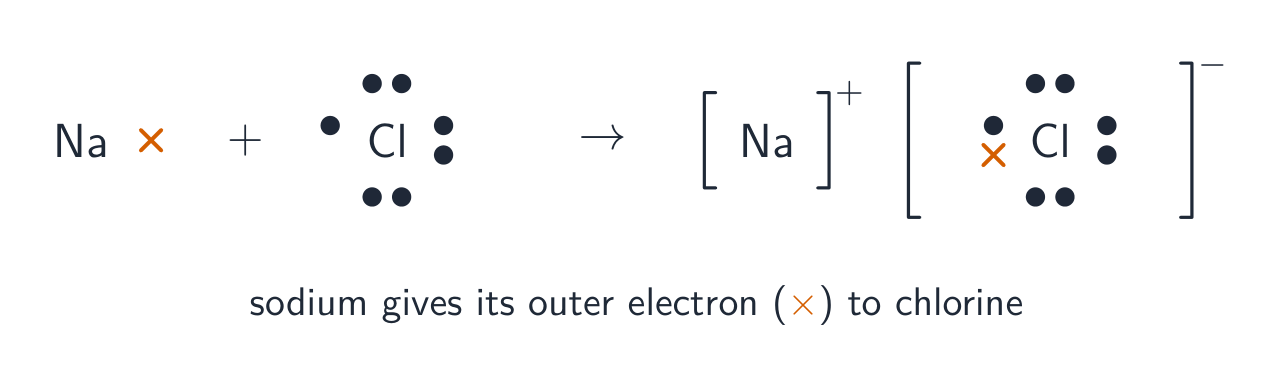
    • Ionic bond 离子键: electrons transfer from a metal to a nonmetal (large electronegativity difference).
    • Covalent bond 共价键: nonmetals share electrons (small difference). A big-but-not-huge difference gives a polar covalent 极性共价 bond.
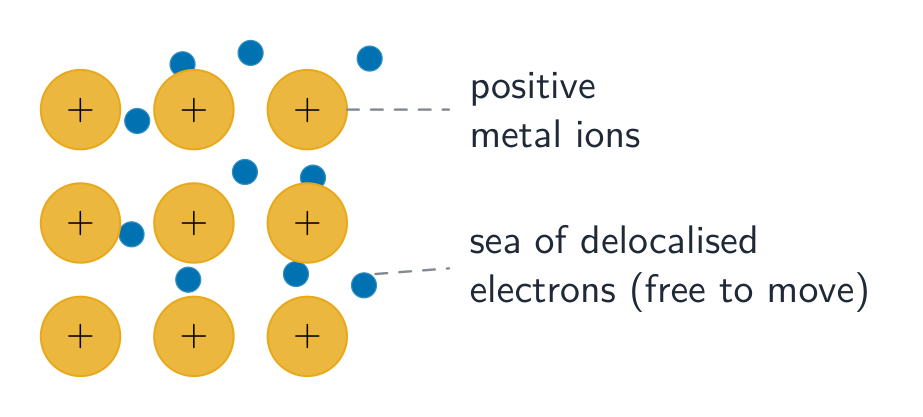
    • Metallic bond 金属键: metal atoms share a "sea" of mobile electrons.
    ไทย
    ผลึกโซเดียมคลอไรด์: ของแข็งไอออนิกก่อตัวเป็นโครงตาข่ายของไอออนที่มีประจุตรงกัน
    ผลึกโซเดียมคลอไรด์: ของแข็งไอออนิกประกอบด้วยโครงข่ายของไอออนที่มีประจุตรงข้ามกัน

    พันธะเคมี คือแรงดึงดูดที่จับอะตอมเข้าด้วยกัน ประเภทของพันธะขึ้นอยู่กับค่าอิเล็กโทรเนกาติวิทิตี้ของอะตอม:

    การเกิดพันธะไอออนิก: โลหะถ่ายโอนอิเล็กตรอนชั้นนอกไปยังสารไม่โลหะ
    การเกิดพันธะไอออนิก: โลหะถ่ายโอนอิเล็กตรอนชั้นนอกไปยังสารไม่โลหะ
    • พันธะไอออนิก: อิเล็กตรอนถูกถ่ายโอนจากโลหะไปยังสารไม่โลหะ (มีความต่างของค่าอิเล็กโทรเนกาติวิธิिताสูง)
    • พันธะโคเวเลนต์: สารไม่โลหะ แบ่งปัน อิเล็กตรอน (ความต่างต่ำ) ความต่างระดับกลางแต่ไม่มากจะก่อให้เกิด พันธะโคเวเลนต์ขั้ว
    • พันธะโลหะ: อะตอมของโลหะแบ่งปัน "ทะเล" ของอิเล็กตรอนอิสระเคลื่อนที่ได้อิสระ
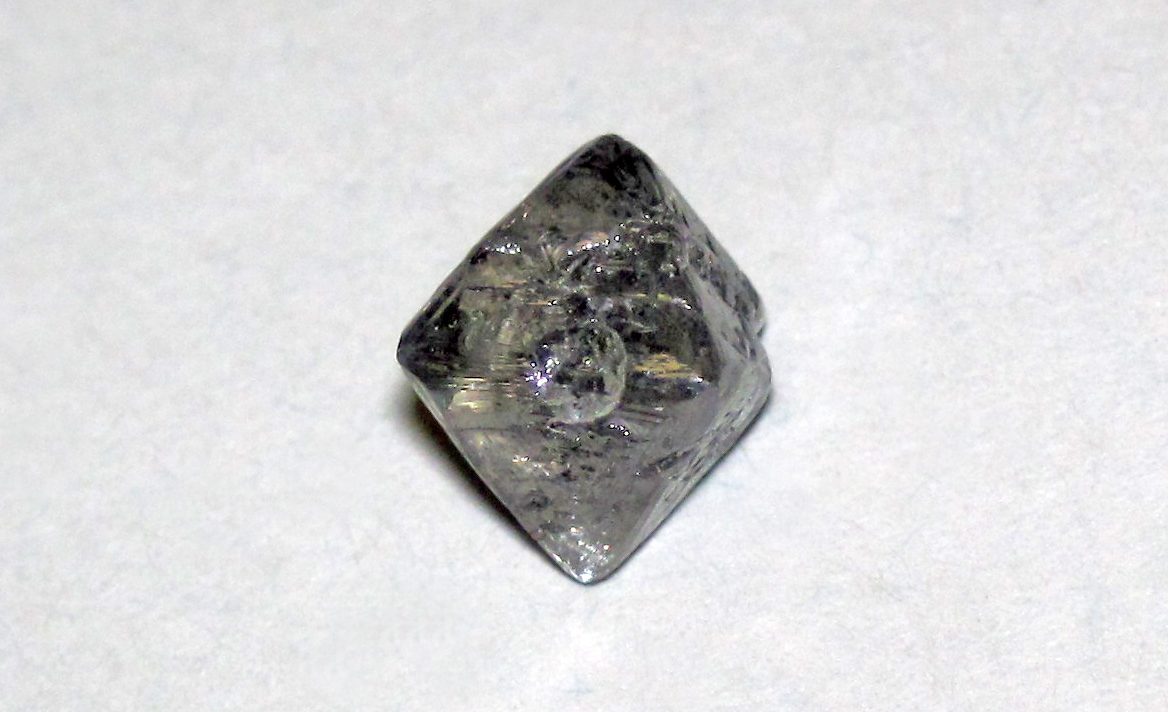
    ผลึกเพชร: โครงสร้างเครือข่ายโคเวเลนต์ขนาดใหญ่อธิบายความแข็งสูงและจุดหลอมเหลวสูง
    ผลึกเพชร: โครงสร้างเครือข่ายโคเวเลนต์ขนาดใหญ่อธิบายความแข็งสูงและจุดหลอมเหลวสูง
    Explore · ⁨สำรวจ⁩

    Form an ionic bond by electron transfer · ⁨สร้างพันธะไอออนิกด้วยการถ่ายโอนอิเล็กตรอน⁩

    An ionic bond forms when a metal gives electrons to a non-metal, making oppositely charged ions that attract; a covalent bond shares electrons instead. · ⁨พันธะไอออนิก เกิดเมื่อโลหะให้电子แก่非金属 ทำให้เกิดไอออนที่มีประจุตรงข้ามซึ่งดึงดูดกัน; ส่วน พันธะโคเวเลนต์ จะแบ่งปัน电子แทน⁩

    2.2

    Intramolecular Force and Potential Energy · ⁨แรงภายในโมเลกุลและพลังงานศักย์⁩

    Syllabus · ⁨หลักสูตร⁩
    English

    Learning Objective 2.2.A: Represent the relationship between potential energy and distance between atoms, based on factors that influence the interaction strength.

    • 2.2.A.1 A graph of potential energy versus the distance between atoms (internuclear distance) is a useful representation for describing the interactions between atoms. Such graphs illustrate both the equilibrium bond length (the separation between atoms at which the potential energy is lowest) and the bond energy (the energy required to separate the atoms).
    • 2.2.A.2 In a covalent bond, the bond length is influenced by both the size of the atom's core and the bond order (i.e., single, double, triple). Bonds with a higher order are shorter and have larger bond energies.
    • 2.2.A.3 Coulomb's law can be used to understand the strength of interactions between cations and anions.
      • i. Because the interaction strength is proportional to the charge on each ion, larger charges lead to stronger interactions.
      • ii. Because the interaction strength increases as the distance between the centers of the ions (nuclei) decreases, smaller ions lead to stronger interactions.
    ไทย

    วัตถุประสงค์การเรียนรู้ 2.2.A: แสดงความสัมพันธ์ระหว่างพลังงานศักย์และระยะห่างระหว่างอะตอม โดยพิจารณาจากปัจจัยที่ส่งผลต่อความแข็งแรงของการโต้ตอบ

    • 2.2.A.1 กราฟแสดงพลังงานศักย์เทียบกับระยะห่างระหว่างอะตอม (ระยะห่างระหว่างนิวเคลียส) เป็นวิธีการนำเสนอที่มีประโยชน์สำหรับการอธิบายปฏิสัมพันธ์ระหว่างอะตอม กราฟดังกล่าวชี้ให้เห็นทั้งความยาวพันธะสมดุล (ระยะห่างระหว่างอะตอมที่พลังงานศักย์ต่ำสุด) และพลังงานพันธะ (พลังงานที่ใช้เพื่อแยกอะตอมออกจากกัน)
    • 2.2.A.2 ในพันธะโคเวเลนต์ ความยาวพันธะได้รับอิทธิพลจากทั้งสองขนาดแกนกลางของอะตอมและลำดับพันธะ (เช่น พันธะเดี่ยว พันธะคู่ พันธะสาม) พันธะที่มีลำดับสูงจะมีความยาวสั้นและมีพลังงานพันธะมากกว่า
    • 2.2.A.3 กฎของคูลอมบ์สามารถใช้เพื่อทำความเข้าใจความแข็งแรงของการโต้ตอบระหว่างแคทไอออนและแอนไอออน
      • i. เนื่องจากความแข็งแรงของการโต้ตอบแปรผันตรงกับประจุของแต่ละไอออน ดังนั้นประจุที่ใหญ่ขึ้นจะนำไปสู่การโต้ตอบที่แรงขึ้น
      • ii. เนื่องจากความแข็งแรงของการโต้ตอบเพิ่มขึ้นเมื่อระยะห่างระหว่างศูนย์กลางของไอออน (นิวเคลียส) ลดลง ไอออนที่มีขนาดเล็กกว่าจึงนำไปสู่การโต้ตอบที่แรงขึ้น

    Source: College Board AP Course and Exam Description · ⁨แหล่งที่มา: คำอธิบายหลักสูตรและข้อสอบ College Board AP⁩

    English

    As two atoms approach, a potential energy 势能 curve captures the balance of attraction and repulsion. It dips to a minimum at the bond length 键长 (the stable separation) whose depth is the bond energy 键能. Shorter, stronger bonds sit in deeper, tighter wells; more shared pairs (double, triple bonds) give shorter, stronger bonds.

    ไทย

    เมื่ออะตอมสองตัวเข้าใกล้กัน กราฟ พลังงานศักย์ จะแสดงสมดุลระหว่างแรงดึงดูดและแรงผลัก จุดต่ำสุดอยู่ที่ ระยะพันธะ (ระยะแยกที่เสถียร) ซึ่งความลึกของจุดนี้คือ พลังงานพันธะ พันธะที่สั้นกว่าจะแข็งแรงกว่าและอยู่ในบ่อพลังงานที่ลึกและแคบกว่า การมีคู่SharedElectrons越多 (พันธะคู่, พันธะสาม) ทำให้พันธะสั้นและแข็งแรงขึ้น

    2.3

    Structure of Ionic Solids · ⁨โครงสร้างของของแข็งไอออนิก⁩

    Syllabus · ⁨หลักสูตร⁩
    English

    Learning Objective 2.3.A: Represent an ionic solid with a particulate model that is consistent with Coulomb's law and the properties of the constituent ions.

    • 2.3.A.1 The cations and anions in an ionic crystal are arranged in a systematic, periodic 3-D array that maximizes the attractive forces among cations and anions while minimizing the repulsive forces.
      • Exclusion statement: Knowledge of specific crystal structures is not essential to an understanding of the learning objective and will not be assessed on the AP Exam.
    ไทย

    วัตถุประสงค์การเรียนรู้ 2.3.A: แสดงของแข็งไอออนิกด้วยแบบจำลองระดับอนุภาคที่สอดคล้องกับกฎของคูลอมบ์และคุณสมบัติของไอออนองค์ประกอบ

    • 2.3.A.1 แคทไอออนและแอนไอออนในผลึกไอออนิกมีการจัดเรียงในรูปแบบ 3 มิติที่เป็นระบบและซ้ำซ้อนซึ่งเพิ่มแรงดึงดูดระหว่างแคทไอออนและแอนไอออนให้มากที่สุดwhile ลดแรงผลักให้น้อยที่สุด
      • ข้อตัดออก: ความรู้เกี่ยวกับโครงสร้างผลึกเฉพาะเจาะจงไม่จำเป็นต่อการเข้าใจวัตถุประสงค์การเรียนรู้และไม่จะถูกประเมินในการสอบ AP

    Source: College Board AP Course and Exam Description · ⁨แหล่งที่มา: คำอธิบายหลักสูตรและข้อสอบ College Board AP⁩

    English

    An ionic solid 离子固体 is a repeating 3-D lattice 晶格 of alternating cations and anions, held by strong electrostatic attraction. This explains their high melting points, brittleness, and why they conduct only when molten or dissolved (ions freed to move). The lattice energy rises with larger ion charges and smaller ions, so MgO (both $2+/2-$) melts far higher than NaCl (both $1+/1-$).

    ไทย

    ของแข็งไอออนิกเป็น 3-D-แลตทิซ ซ้ำซ้อนของแคทไอออนและแอนไอออนสลับกัน ยึดติดกันด้วยแรงดึงดูดทางไฟฟ้าสถิตที่แข็งแกร่ง สิ่งนี้อธิบายจุดหลอมเหลวที่สูง ความเปราะบาง และทำไมจึงนำไฟฟ้าได้เฉพาะเมื่อละลายน้ำหรือละลาย (ไอออนอิสระในการเคลื่อนที่) พลังงานแลตทิซ เพิ่มขึ้นตามประจุไอออนที่ใหญ่ขึ้นและไอออนขนาดเล็กกว่า ดังนั้น MgO (ทั้ง $2+/2-$) หลอมเหลวสูงกว่า NaCl (both $1+/1-$) มาก

    ไอออนจัดเรียงตัวเป็นโครงข่ายขนาดใหญ่ของไอออนบวกและลบสลับกัน *ไอออนจัดเรียงตัวเป็นโครงข่ายขนาดใหญ่ของไอออนบวกและลบสลับกัน

    Vocabulary · ⁨คำศัพท์⁩ Train · ⁨ฝึกฝน⁩
    English ไทย
    lattice/ˈlætɪs/ ผลึก (lattice)
    delocalized/dɪˈlɒkəlaɪzd/ กระจายตัว (delocalized)
    2.4

    Structure of Metals and Alloys · ⁨โครงสร้างของโลหะและอัลลอย⁩

    Syllabus · ⁨หลักสูตร⁩
    English

    Learning Objective 2.4.A: Represent a metallic solid and/or alloy using a model to show essential characteristics of the structure and interactions present in the substance.

    • 2.4.A.1 Metallic bonding can be represented as an array of positive metal ions surrounded by delocalized valence electrons (i.e., a "sea of electrons").
    • 2.4.A.2 Interstitial alloys form between atoms of significantly different radii, where the smaller atoms fill the interstitial spaces between the larger atoms (e.g., with steel in which carbon occupies the interstices in iron).
    • 2.4.A.3 Substitutional alloys form between atoms of comparable radius, where one atom substitutes for the other in the lattice. (e.g., in certain brass alloys, other elements, usually zinc, substitute for copper.)
    ไทย

    วัตถุประสงค์การเรียนรู้ 2.4.A: แสดงของแข็งโลหะและ/หรืออัลลอย โดยใช้แบบจำลองเพื่อแสดงคุณลักษณะสำคัญของโครงสร้างและการโต้ตอบที่มีอยู่ในสารนั้น

    • 2.4.A.1 พันธะโลหะสามารถแสดงได้ด้วยแถวของไอออนโลหะบวกที่ถูกล้อมรอบด้วยอิเล็กตรอนวงนอกที่กระจายตัว (即在 "ทะเลของอิเล็กตรอน")
    • 2.4.A.2 อัลลอยแบบช่องว่างเกิดขึ้นระหว่างอะตอมที่มีรัศมีแตกต่างกันอย่างมาก โดยอะตอมขนาดเล็กจะเติมเต็มช่องว่างระหว่างอะตอมขนาดใหญ่ (เช่น ในเหล็กกล้าที่คาร์บอนเข้าไปอยู่ในช่องว่างของเหล็ก)
    • 2.4.A.3 อัลลอยแบบแทนที่เกิดขึ้นระหว่างอะตอมที่มีรัศมีใกล้เคียงกัน โดยอะตอมหนึ่งจะแทนที่อีกอะตอมหนึ่งในโครงตาข่าย (เช่น ในบางชนิดของทองเหลือง ธาตุอื่นมักจะเป็นสังกะสีจะแทนที่ทองแดง)

    Source: College Board AP Course and Exam Description · ⁨แหล่งที่มา: คำอธิบายหลักสูตรและข้อสอบ College Board AP⁩

    English

    In a metal, cations sit in a lattice bathed in delocalized 离域 electrons, which explains conductivity, malleability, and luster. An alloy 合金 mixes metals: a substitutional alloy swaps in similar-sized atoms; an interstitial alloy (like steel) fits small atoms into the gaps, making it harder.

    ไทย

    ในโลหะ แคทไอออนจะอยู่ภายในโครงข่ายที่浸泡ใน อิเล็กตรอนอิสระเคลื่อนที่ ซึ่งอธิบายความเป็นตัวนำไฟฟ้า ความอ่อนตัว และความเงางาม อัลลอย คือการผสมโลหะ: อัลลอยแบบแทนที่ เปลี่ยนอะตอมที่มีขนาดใกล้เคียงกัน; อัลลอยแบบแทรกช่องว่าง (เช่น เหล็กกล้า) แทรกอะตอมขนาดเล็กเข้าไปในช่องว่าง ทำให้แข็งขึ้น

    Different-sized atoms in an alloy stop the layers sliding, so it is harder
    Different-sized atoms in an alloy stop the layers sliding, so it is harder
    การพันธะโลหะ: ไอออนบวกในทะเลของอิเล็กตรอนที่เคลื่อนที่ได้
    การพันธะโลหะ: ไอออนบวกในทะเลของอิเล็กตรอนที่เคลื่อนได้

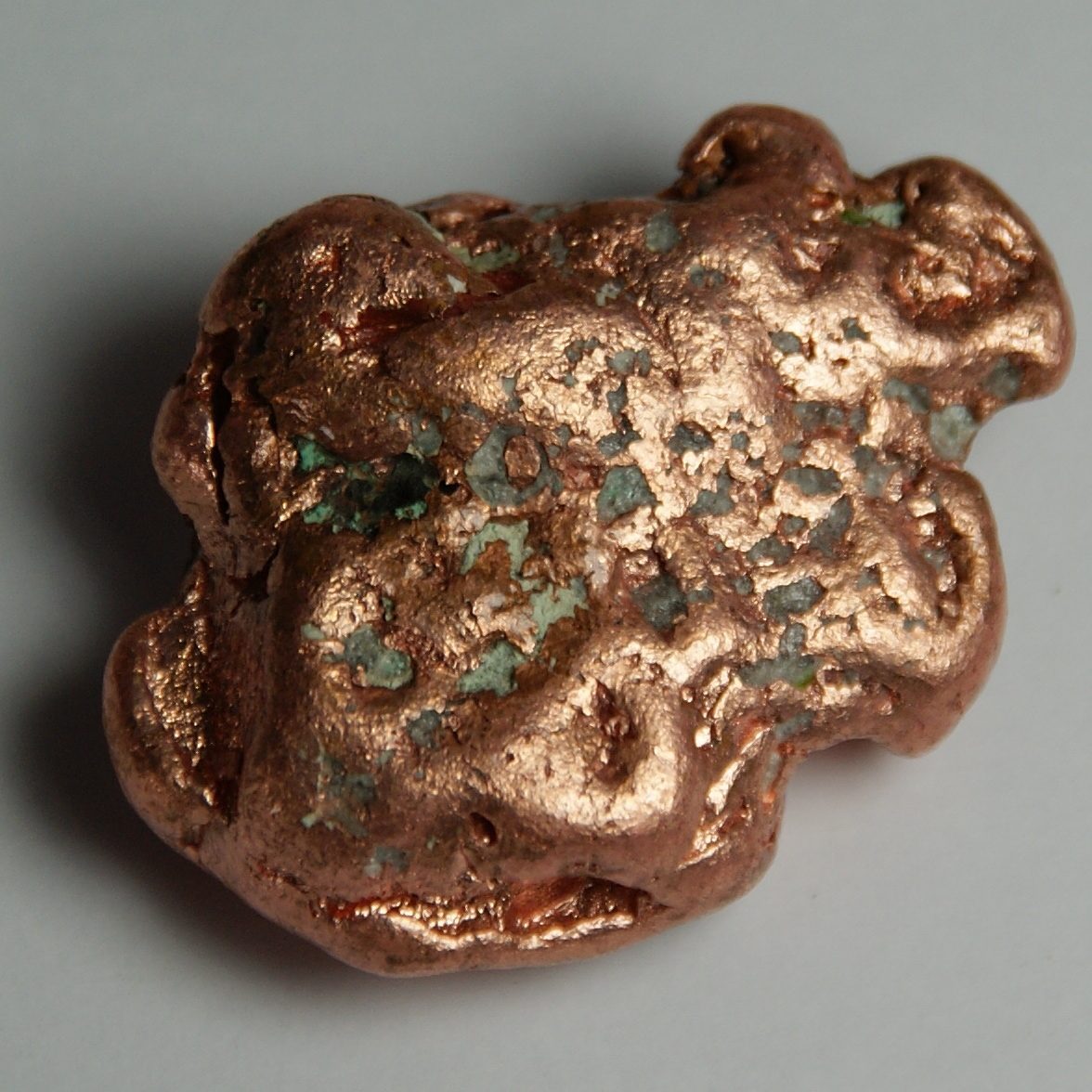
    ทองแดงธรรมชาติ: พันธะโลหะทำให้เป็นของแข็งมันวาว ยืดหยุ่น และมีอิเล็กตรอนอิสระเคลื่อนที่ *ทองแดงธรรมชาติ: พันธะโลหะทำให้เป็นของแข็งมันวาว ยืดหยุ่น และมีอิเล็กตรอนอิสระเคลื่อนที่

    Explore · ⁨สำรวจ⁩

    Slide layers in a metallic lattice · ⁨เลื่อนชั้นในโครงตาข่ายโลหะ⁩

    A metal is positive ions in a sea of delocalised electrons. The layers can slide without breaking the bond, so metals are malleable and conduct. · ⁨โลหะ คือไอออนบวกอยู่ในทะเลของอิเล็กตรอนที่ไม่ติดขัด ชั้นสามารถเลื่อน彼此的โดยไม่ทำให้พันธะขาดหาย ทำให้โลหะมีความยืดหยุ่นและนำไฟฟ้าได้ดี⁩

    Vocabulary · ⁨คำศัพท์⁩ Train · ⁨ฝึกฝน⁩
    English ไทย
    chemical bond/ˈkemɪkl bɒnd/ พันธะเคมี
    Ionic bond/aɪˈɒnɪk bɒnd/ พันธะไอออนิก
    Covalent bond/ˈkəʊvələnt bɒnd/ พันธะโคเวเลนต์
    polar covalent/ˈpəʊlə ˈkəʊvələnt/ โคเวเลนต์มีขั้ว (polar covalent)
    Metallic bond/məˈtælɪk bɒnd/ พันธะโลหะ
    potential energy/pəˈtenʃl ˈenədʒi/ พลังงานศักย์
    bond length/bɒnd leŋθ/ ความยาวพันธะ
    bond energy/bɒnd ˈenədʒi/ พลังงานพันธะ
    ionic solid/aɪˈɒnɪk ˈsɒlɪd/ ของแข็งไอออนิก
    alloy/ˈælɔɪ/ อัลลอยด์
    Lewis diagram/ˈluːɪs ˈdaɪəɡræm/ แผนเลวิส
    lone pairs/ləʊn peəz/ คู่โดดเดี่ยว
    octet/ɒkˈtet/ อิเล็กตรอนแปด
    resonance/ˈrezənəns/ เรโซแนนซ์
    Formal charge/ˈfɔːml tʃɑːdʒ/ ประจุทางการ
    2.5

    Lewis Diagrams · ⁨แผนภาพลิวอิส⁩

    Syllabus · ⁨หลักสูตร⁩
    English

    Learning Objective 2.5.A: Represent a molecule with a Lewis diagram.

    • 2.5.A.1 Lewis diagrams can be constructed according to an established set of principles.
    ไทย

    จุดประสงค์การเรียนรู้ 2.5.A: แสดงโครงสร้างโมเลกุลด้วยแผนภาพเลวิส

    • 2.5.A.1 แผนภาพเลวิสสามารถสร้างได้ตามหลักการที่กำหนดไว้

    Source: College Board AP Course and Exam Description · ⁨แหล่งที่มา: คำอธิบายหลักสูตรและข้อสอบ College Board AP⁩

    English

    A Lewis diagram 路易斯结构 shows valence electrons as bonding pairs and lone pairs 孤对电子, giving most atoms an octet 八隅体 (8 valence electrons; H wants 2). Steps: count total valence electrons, connect atoms with single bonds, complete octets on outer atoms, then form multiple bonds if the central atom is short.

    Worked example. Draw carbon dioxide, $\text{CO}_2$. Total valence electrons $=4+2(6)=16$. Put C in the centre; single bonds to each O use $4$ electrons and leave the outer O atoms short. Completing octets forces two double bonds, $\text{O}=\text{C}=\text{O}$: each O then has two lone pairs, C has none, and all $16$ electrons are placed with every atom at an octet.

    ไทย

    แผนภาพลิวอิส แสดงอิเล็กตรอนวงนอกเป็นคู่พันธะและ คู่อิเล็กตรอนอิสระ ทำให้ hầu hếtอะตอมมี ออกเตต (8 อิเล็กตรอนวงนอก; H ต้องการ 2) ขั้นตอน: นับจำนวนอิเล็กตรอนวงนอกทั้งหมด เชื่อมอะตอมด้วยพันธะเดี่ยว เติมออกเตตให้อะตอมภายนอก แล้วสร้างพันธะหลายตัวหากอะตอมกลางมีไม่พอ

    แผนภาพจุดและเครื่องหมายไขว้แสดงคู่พันธะและคู่อิเล็กตรอนอิสระในโมเลกุล
    แผนภาพจุดและเครื่องหมายไขว้แสดงคู่พันธะและคู่อิเล็กตรอนอิสระในโมเลกุล

    ตัวอย่างฝึกหัด. วาดคาร์บอนไดออกไซด์, $\text{CO}_2$. จำนวนอิเล็กตรอนวงนอกทั้งหมด $=4+2(6)=16$. วาง C ไว้ตรงกลาง; พันธะเดี่ยวไปยัง O แต่ละตัวใช้ $4$ อิเล็กตรอน และทำให้อะตอม O ภายนอกขาดออกเตต การเติมออกเตตจะบังคับให้เกิดพันธะคู่สองตัว, $\text{O}=\text{C}=\text{O}$: ทุก O จะมีคู่อิเล็กตรอนอิสระสองคู่, C ไม่มี, และวาง $16$ อิเล็กตรอนทั้งหมดโดยที่ทุกอะตอมอยู่ในสถานะออกเตตแล้ว

    2.6

    Resonance and Formal Charge · ⁨เรโซแนนซ์และประจุทางรูปธรรม⁩

    Syllabus · ⁨หลักสูตร⁩
    English

    Learning Objective 2.6.A: Represent a molecule with a Lewis diagram that accounts for resonance between equivalent structures or that uses formal charge to select between nonequivalent structures.

    • 2.6.A.1 In cases where more than one equivalent Lewis structure can be constructed, resonance must be included as a refinement to the Lewis structure. In many such cases, this refinement is needed to provide qualitatively accurate predictions of molecular structure and properties.
    • 2.6.A.2 The octet rule and formal charge can be used as criteria for determining which of several possible valid Lewis diagrams provides the best model for predicting molecular structure and properties.
    • 2.6.A.3 As with any model, there are limitations to the use of the Lewis structure model, particularly in cases with an odd number of valence electrons.
    ไทย

    จุดประสงค์การเรียนรู้ 2.6.A: แสดงโครงสร้างโมเลกุลด้วยแผนภาพเลวิสที่พิจารณาถึงเรโซแนนซ์ระหว่างโครงสร้างที่เท่าเทียมกัน หรือใช้ประจุรูปเพื่อเลือกโครงสร้างที่ไม่เท่าเทียมกัน

    • 2.6.A.1 ในกรณีที่มีแผนภาพเลวิสที่เท่าเทียมกันได้มากกว่าหนึ่งแบบ ต้องรวมเรโซแนนซ์ไว้เป็นการปรับปรุงโครงสร้างเลวิส ในหลายกรณี การปรับปรุงนี้จำเป็นเพื่อให้ได้การคาดการณ์เชิงคุณภาพที่ถูกต้องเกี่ยวกับโครงสร้างและคุณสมบัติของโมเลกุล
    • 2.6.A.2 กฎออกเตตและประจุรูปสามารถใช้เป็นเกณฑ์ในการกำหนดว่าจากแผนภาพเลวิสที่เป็นไปได้หลายแบบ แบบใดให้โมเดลที่ดีที่สุดสำหรับการทำนายโครงสร้างและคุณสมบัติของโมเลกุล
    • 2.6.A.3 เหมือนกับโมเดลอื่นๆ การใช้โมเดลโครงสร้างเลวิสมีข้อจำกัด โดยเฉพาะในกรณีที่มีจำนวนอิเล็กตรอนเวเลนซ์เป็นเลขคี่

    Source: College Board AP Course and Exam Description · ⁨แหล่งที่มา: คำอธิบายหลักสูตรและข้อสอบ College Board AP⁩

    English

    When two or more valid Lewis diagrams differ only in electron placement, the true structure is an average – resonance 共振. Formal charge 形式电荷 (valence electrons minus lone-pair electrons minus half the bonding electrons) picks the best structure: the one with formal charges closest to zero, and any negative charge on the most electronegative atom.

    Worked example. Assign formal charges in the nitrate ion, $\text{NO}_3^{-}$ (one double bond, two single bonds). For N (4 bonds, no lone pairs): $5-0-4=+1$. For the double-bonded O (2 lone pairs): $6-4-2=0$. For each single-bonded O (3 lone pairs): $6-6-1=-1$. The total is $+1+0+(-1)+(-1)=-1$, matching the ion's overall charge – a good check that the structure is drawn correctly. Because the three O atoms are equivalent by resonance, the real ion has three identical bonds.

    ไทย

    เมื่อแผนภาพลิวอิสที่ถูกต้องสองแบบหรือมากกว่าแตกต่างกันเพียงการวางตำแหน่งอิเล็กตรอน โครงสร้างจริงจะเป็นค่าเฉลี่ย – เรโซแนนซ์ ประจุทางรูปธรรม (อิเล็กตรอนวงนอก ลบ อิเล็กตรอนคู่ อิสระ ลบ ครึ่งหนึ่งของอิเล็กตรอนพันธะ) ช่วยเลือกโครงสร้างที่ดีที่สุด: โครงสร้างที่มีประจุทางรูปธรรมใกล้ศูนย์มากที่สุด และมีประจุลบอยู่บนอะตอมที่มีค่าความอิเล็กโทรเนกาติวิตีสูงสุด

    ตัวอย่างวิธีทำ. กำหนดประจุรูปธรรมในไอออนไนเตรต, $\text{NO}_3^{-}$ (พันธะคู่หนึ่ง, พันธะเดี่ยวสอง). สำหรับ N (4 พันธะ, ไม่มีคู่อิเล็กตรอน): $5-0-4=+1$. สำหรับ O ที่มีพันธะคู่ (2 คู่อิเล็กตรอน): $6-4-2=0$. สำหรับแต่ละ O ที่มีพันธะเดี่ยว (3 คู่อิเล็กตรอน): $6-6-1=-1$. ผลรวมคือ $+1+0+(-1)+(-1)=-1$, ตรงกับประจุรวมของไอออน – เป็นวิธีตรวจสอบที่ดีว่าโครงสร้างวาดถูกต้อง เพราะอะตอมออกซิเจนทั้งสามสมมูลกันโดยเรโซแนนซ์ ไอออนจริงจึงมีพันธะที่เหมือนกันสามพันธะ

    2.7

    VSEPR and Bond Hybridization · ⁨ทฤษฎี VSEPR และการผสมผสาน orbital⁩

    Syllabus · ⁨หลักสูตร⁩
    English

    Learning Objective 2.7.A: Based on the relationship between Lewis diagrams, VSEPR theory, bond orders, and bond polarities:

    • i. Explain structural properties of molecules.

    • ii. Explain electron properties of molecules.

    • 2.7.A.1 VSEPR theory uses the Coulombic repulsion between electrons as a basis for predicting the arrangement of electron pairs around a central atom.

    • 2.7.A.2 Both Lewis diagrams and VSEPR theory must be used for predicting electronic and structural properties of many covalently bonded molecules and polyatomic ions, including the following:

      • i. Molecular geometry (linear, trigonal planar, tetrahedral, trigonal pyramidal, bent, trigonal bipyramidal, seesaw, T-shaped, octahedral, square pyramidal, square planar)
      • ii. Bond angles
      • iii. Relative bond energies based on bond order
      • iv. Relative bond lengths (multiple bonds, effects of atomic radius)
      • v. Presence of a dipole moment
      • vi. Hybridization of valence orbitals for atoms within a molecule or polyatomic ion
    • 2.7.A.3 The terms "hybridization" and "hybrid atomic orbital" are used to describe the arrangement of electrons around a central atom. When the central atom is $sp$ hybridized, its ideal bond angles are $180°$; for $sp^2$ hybridized atoms the bond angles are $120°$; and for $sp^3$ hybridized atoms the bond angles are $109.5°$.

      • Exclusion statement: An understanding of the derivation and depiction of hybrid orbitals will not be assessed on the AP Exam. The course includes the distinction between sigma and pi bonding, the use of VSEPR to explain the shapes of molecules, and the $sp$, $sp^2$, and $sp^3$ nomenclature.
      • Exclusion statement: Hybridization involving d orbitals will not be assessed on the AP Exam. When an atom has more than four pairs of electrons surrounding the central atom, students are only responsible for the shape of the resulting molecule.
    • 2.7.A.4 Bond formation is associated with overlap between atomic orbitals. In multiple bonds, such overlap leads to the formation of both sigma and pi bonds. The overlap is stronger in sigma than pi bonds, which is reflected in sigma bonds having greater bond energy than pi bonds. The presence of a pi bond also prevents the rotation of the bond and leads to geometric isomers.

      • Exclusion statement: Molecular orbital theory is recommended as a way to provide deeper insight into bonding. However, the AP Exam will neither explicitly assess molecular orbital diagrams, filling of molecular orbitals, nor the distinction between bonding, nonbonding, and antibonding orbitals.
    ไทย

    จุดประสงค์การเรียนรู้ 2.7.A: โดยอาศัยความสัมพันธ์ระหว่างแผนภาพเลวิส ทฤษฎี VSEPR ลำดับพันธะ และความขั้วของพันธะ:

    • i. อธิบายคุณสมบัติทางโครงสร้างของโมเลกุล

    • ii. อธิบายคุณสมบัติทางอิเล็กทรอนิกส์ของโมเลกุล

    • 2.7.A.1 ทฤษฎี VSEPR ใช้แรงผลัก đẩyแบบคูลอมบ์ระหว่างอิเล็กตรอนเป็นพื้นฐานในการทำนายการจัดเรียงของคู่อิเล็กตรอนรอบอะตอมกลาง

    • 2.7.A.2 ทั้งแผนภาพเลวิสและทฤษฎี VSEPR ต้องถูกนำมาใช้ร่วมกันในการทำนายคุณสมบัติทางอิเล็กทรอนิกส์และโครงสร้างของโมเลกุลและไอออนพอลิอะตอมิกที่จับกันด้วยพันธะโคแวลेंटหลายชนิด รวมถึงสิ่งต่อไปนี้:

      • i. รูปทรงเรขาคณิตของโมเลกุล (เชิงเส้น, สามเหลี่ยมระนาบ, เทตระเฮดรัล, สามเหลี่ยมพีระมิด, มุมงอ, บิพิรามิดสามเหลี่ยม, เสาไม้ไผ่, รูปร่างตัว T, แอททาเฮดรัล, พีระมิดฐานสี่เหลี่ยม, ระนาบสี่เหลี่ยม)
      • ii. มุมพันธะ
      • iii. พลังงานพันธะสัมพัทธ์ตามลำดับพันธะ
      • iv. ความยาวพันธะสัมพัทธ์ (พันธะคู่ พันธะสาม ผลกระทบของรัศมีอะตอม)
      • v. การมีอยู่ของไดโพลโมเมนต์
      • vi. การผสมผสานออร์บิทัลเวเลนซ์ของอะตอมภายในโมเลกุลหรือไอออนพอลิอะตอมิก
    • 2.7.A.3 คำว่า "การผสมผสาน" และ "ออร์บิทัลอะตอมผสม" ใช้เพื่ออธิบายการจัดเรียงของอิเล็กตรอนรอบอะตอมกลาง เมื่ออะตอมกลางมีการผสม $sp$ มุมพันธะในอุดมคติจะเป็น $180°$; สำหรับอะตอมที่มีการผสม $sp^2$ มุมพันธะจะเป็น $120°$; และสำหรับอะตอมที่มีการผสม $sp^3$ มุมพันธะจะเป็น $109.5°$

      • ข้อความยกเว้น: ความเข้าใจในการหามาตรฐานและการแสดงออร์บิทัลผสมจะไม่ถูกทดสอบในข้อสอบ AP หลักสูตรนี้ครอบคลุมความแตกต่างระหว่างพันธะซิกมาและไพ, การใช้ VSEPR เพื่ออธิบายรูปร่างของโมเลกุล, และการตั้งชื่อ $sp$, $sp^2$ และ $sp^3$
      • ข้อความยกเว้น: การผสมผสานออร์บิทัลที่ involvement d จะไม่ถูกทดสอบในข้อสอบ AP เมื่ออะตอมมีคู่อิเล็กตรอนรอบอะตอมกลางมากกว่าสี่คู่ นักเรียนต้องรับผิดชอบเฉพาะรูปร่างของโมเลกุลที่เกิดขึ้นเท่านั้น
    • 2.7.A.4 การเกิดพันธะเกี่ยวข้องกับทับซ้อนกันของออร์บิทัลอะตอม ในพันธะหลายชั้น การทับซ้อนนี้จะนำไปสู่การสร้างทั้งพันธะซิกมาและพันธะไพ การทับซ้อนในพันธะซิกมาจะแข็งแกร่งกว่าพันธะไพ ซึ่งสะท้อนให้เห็นว่าพันธะซิกมามีพลังงานพันธะสูงกว่าพันธะไพ การมีอยู่ของพันธะไพยังป้องกันไม่ให้พันธะหมุนและนำไปสู่การเกิดไอโซเมอร์เชิงเรขาคณิต

      • ข้อความยกเว้น: ทฤษฎีออร์บิทัลโมเลกุลแนะนำให้เป็นวิธีการเพื่อให้ความรู้ลึกซึ้งขึ้นเรื่องพันธะ อย่างไรก็ตาม ข้อสอบ AP จะไม่ทดสอบแผนภาพออร์บิทัลโมเลกุลโดยตรง, การเติมเต็มออร์บิทัลโมเลกุล, หรือความแตกต่างระหว่างออร์บิทัลพันธะ, ออร์บิทัลที่ไม่ใช่พันธะ, และออร์บิทัล?p?

    Source: College Board AP Course and Exam Description · ⁨แหล่งที่มา: คำอธิบายหลักสูตรและข้อสอบ College Board AP⁩

    English
    VSEPR: molecular shapes

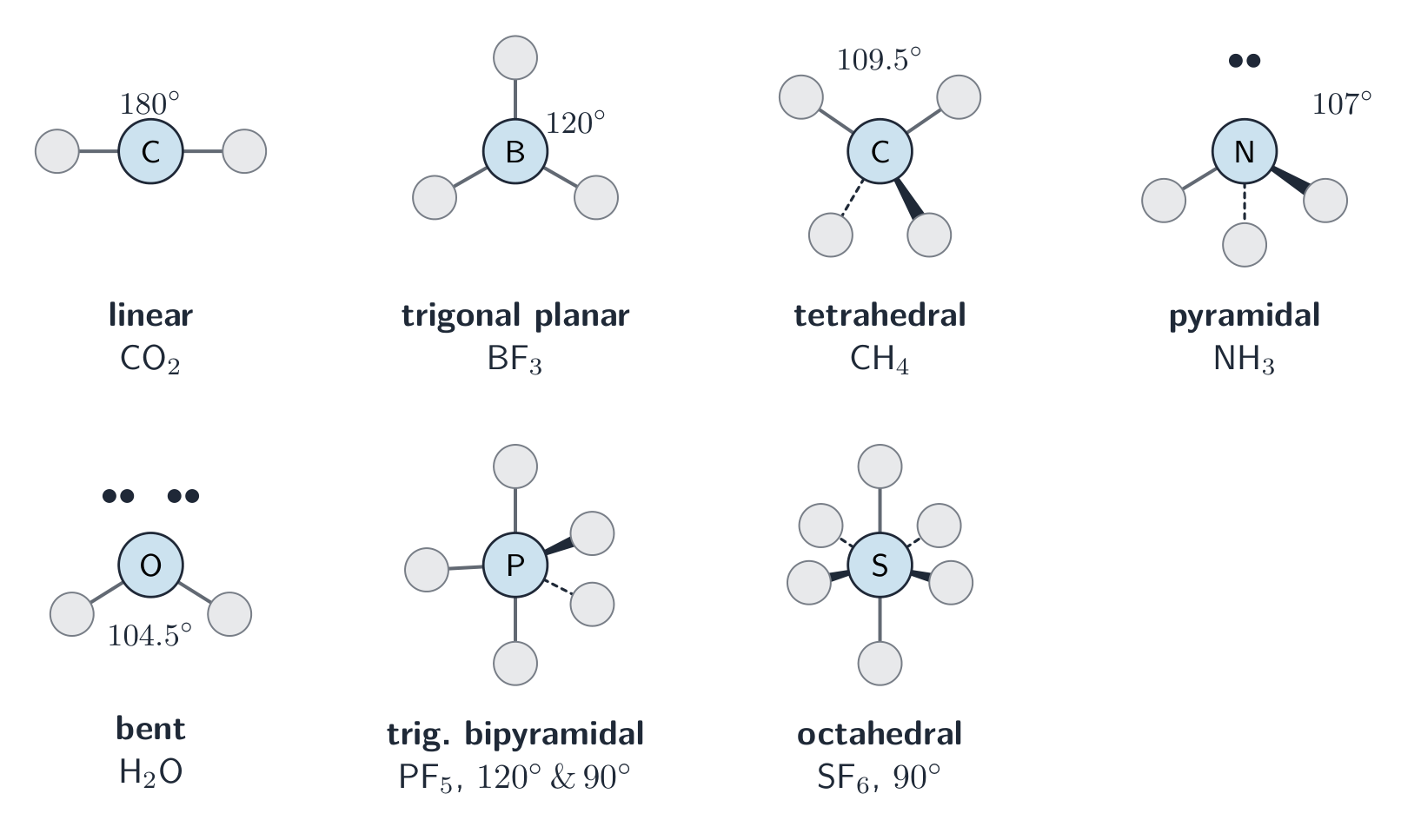
    VSEPR 价层电子对互斥 theory predicts shape: electron pairs (bonds and lone pairs) around a central atom spread out as far apart as possible. Counting electron domains gives the geometry (linear, trigonal planar, tetrahedral, …); lone pairs push bonds closer, bending the shape. Hybridization 杂化 ($sp$, $sp^2$, $sp^3$) describes the mixed orbitals matching that geometry. Molecular shape and bond polarity together decide whether the whole molecule is polar.

    Worked example. Predict the shape of ammonia, $\text{NH}_3$. Nitrogen has $3$ bonding pairs and $1$ lone pair – four electron domains, so the electron geometry is tetrahedral and the hybridization is $sp^3$. The lone pair is invisible in the shape but still pushes the bonds together, so the molecular shape is trigonal pyramidal with a bond angle of about $107^{\circ}$ (a little less than the ideal $109.5^{\circ}$). The three N–H dipoles do not cancel, so the molecule is polar.

    Bonds form when atomic orbitals overlap. Every single bond is one sigma bond σ键 – orbitals overlapping head-on along the line joining the two atoms. A multiple bond adds a pi bond π键, made by $p$ orbitals overlapping sideways above and below that line: a double bond is one sigma + one pi, a triple bond one sigma + two pi. Head-on overlap is more effective, so a sigma bond is stronger (higher bond energy) than a pi bond – which is why a double bond is stronger than a single bond but not twice as strong. A pi bond also locks the two atoms so they cannot rotate about the bond; a C=C double bond therefore has fixed cis and trans forms – geometric isomers 几何异构体 that a freely-rotating single bond could never show.

    Worked example. Count the bonds in ethene, $\text{H}_2\text{C}=\text{CH}_2$. The four C–H bonds are single bonds (one sigma each); the C=C is one sigma plus one pi. So ethene has 5 sigma and 1 pi bond, and that single pi bond is exactly what stops the two $\text{CH}_2$ ends from twisting relative to each other.

    ไทย
    VSEPR: molecular shapes

    ทฤษฎี VSEPR ทำนายรูปร่าง: คู่อิเล็กตรอน (พันธะและคู่อิเล็กตรอน) รอบอะตอมกลางจะกระจายตัวห่างกันมากที่สุด การนับโดเมนของอิเล็กตรอนให้เรารู้อารมณ์เรขาคณิต (เชิงเส้น, สามเหลี่ยมแบนราบ, เททราเฮดรอล, …); คู่อิเล็กตรอนดันพันธะเข้าใกล้กัน ทำให้รูปร่างโค้งงอ การผสมผสาน orbital ($sp$, $sp^2$, $sp^3$) อธิบายถึง orbital ผสมที่ตรงกับอารมณ์เรขาคณิตนั้น รูปร่างโมเลกุลและความขั้วของพันธะร่วมกันกำหนดว่าโมเลกุลทั้งหมดเป็นขั้วหรือไม่

    การผสมผสาน orbital และรูปร่าง: sp3 เททราเฮดรอล, sp2 แบนราบ, sp เชิงเส้น
    การผสมผสาน orbital และรูปร่าง: sp3 เททราเฮดรอล, sp2 แบนราบ, sp เชิงเส้น
    รูปร่าง VSEPR ที่พบบ่อยและมุมพันธะของพวกมัน
    รูปร่าง VSEPR ที่พบบ่อยและมุมพันธะของพวกมัน

    ตัวอย่างวิธีทำ. ทำนายรูปร่างของแอมโมเนีย, $\text{NH}_3$. ไนโตรเจนมี $3$ คู่อิเล็กตรอนพันธะและ $1$ คู่ อิเล็กตรอนอิสระ – สี่โดเมนของอิเล็กตรอน ดังนั้นอารมณ์เรขาคณิตของอิเล็กตรอนคือเททราเฮดรอลและการผสมผสาน orbital คือ $sp^3$. คู่อิเล็กตรอนอิสระมองไม่เห็นในรูปร่างแต่ยังดันพันธะเข้าหากัน ดังนั้น รูปร่างโมเลกุล จึงเป็นสามเหลี่ยมพีระมิดด้วยมุมพันธะประมาณ $107^{\circ}$ (น้อยกว่าค่ามาตรฐาน $109.5^{\circ}$ เล็กน้อย). ไดโพล N–H ทั้งสามไม่หักล้างกัน โมเลกุลจึงเป็นขั้ว

    พันธะเกิดขึ้นเมื่อ orbital อะตอม ทับซ้อนกัน. พันธะเดี่ยวทุกอันเป็น sigma bond σ – orbital ทับซ้อนกันแบบหัวต่อหัวตามแนวเส้นที่เชื่อมอะตอมทั้งสอง. พันธะหลายชั้นเพิ่ม pi bond π, ซึ่งเกิดจาก $p$ orbital ทับซ้อนกันด้านข้างเหนือและใต้เส้นนั้น: พันธะคู่คือ sigma + pi หนึ่งอัน, พันธะสามคือ sigma + pi สองอัน. การทับซ้อนแบบหัวต่อหัวมีประสิทธิภาพมากกว่า ดังนั้น sigma bond จึง แข็งแรงกว่า (พลังงานพันธะสูงกว่า) pi bond – นั่นเป็นเหตุผลที่ว่าพันธะคู่แข็งแรงกว่าพันธะเดี่ยวแต่ไม่แรงเป็นสองเท่า. Pi bond ยัง ล็อกอะตอมทั้งสอง ไม่ให้หมุนรอบพันธะได้; พันธะ C=C จึงมีรูปแบบ cis และ trans ที่ตายตัว – isomers ทางเรขาคณิต ที่พันธะเดี่ยวซึ่งหมุนได้อิสระไม่สามารถแสดงได้

    ตัวอย่างวิธีทำ. นับพันธะในเอทีน, $\text{H}_2\text{C}=\text{CH}_2$. พันธะ C–H ทั้งสี่เป็นพันธะเดี่ยว (sigma หนึ่งอันต่อพันธะ); C=C เป็น sigma หนึ่งอันบวก pi หนึ่งอัน. ดังนั้นเอทีนมี 5 sigma และ 1 pi bond, และ pi bond เดียวนี้เองที่ทำให้ปลาย $\text{CH}_2$ ทั้งสองไม่สามารถบิดเบือนต่อกันได้

    Explore · ⁨สำรวจ⁩

    Predict molecular shape with VSEPR · ⁨ทำนายรูปทรงโมเลกุลด้วยทฤษฎี VSEPR⁩

    VSEPR: electron pairs repel and spread as far apart as possible, setting the molecule's shape. Add bonding and lone pairs and watch the geometry change. · ⁨VSEPR: คู่อิเล็กตรอนจะผลักกันและกระจายตัวออกห่างที่สุด เพื่อกำหนดรูปทรงของโมเลกุล เพิ่มคู่พันธะและคู่อิเล็กตรอนเดี่ยว แล้วดูการเปลี่ยนแปลงทางเรขาคณิต⁩

    Vocabulary · ⁨คำศัพท์⁩ Train · ⁨ฝึกฝน⁩
    English ไทย
    VSEPR/ˈvespə/ VSEPR
    Hybridization/ˌhaɪbrɪdaɪˈzeɪʃn/ ไฮบริไดเซชัน
    sigma bond/ˈsɪɡmə bɒnd/ พันธะซิกมา
    pi bond/paɪ bɒnd/ พันธะไพ
    geometric isomers/ˌdʒiːəʊˈmetrɪk ˈaɪsəməz/ ไอโซเมอร์ทางเรขาคณิต
    2.7

    Exam tips · ⁨ข้อแนะนำสำหรับการสอบ⁩

    English
    • Decide the bond type from the atoms: ionic (metal + non-metal, electron transfer), covalent (non-metals, sharing), metallic (sea of delocalised electrons).
    • An ionic solid conducts only when molten or dissolved (ions free to move), never as a solid.
    • Draw Lewis structures to satisfy the octet (H wants 2), then use VSEPR — electron pairs spread as far apart as possible — to predict the shape.
    • Lone pairs take up space and push bonds closer, bending the shape (water is bent, ammonia pyramidal).
    • A molecule can have polar bonds yet be non-polar overall if its symmetry makes the dipoles cancel ($\text{CO}_2$).
    • A single bond is 1 sigma bond; a double bond is 1 sigma + 1 pi, a triple bond 1 sigma + 2 pi. Sigma is stronger than pi, and a pi bond blocks rotation, giving cis/trans geometric isomers.
    ไทย
    • ตัดสินประเภทพันธะจากอะตอม: ไอออนิก (โลหะ + ไมhapus, การถ่ายโอนอิเล็กตรอน), โคเวเลนต์ (ไมhapus, การแบ่งปัน), โลหะ (ทะเลอิเล็กตรอนที่เคลื่อนที่ได้)
    • ของแข็งไอออนิกนำไฟฟ้าได้เฉพาะเมื่อ หลอมเหลวหรือละลาย (ไอออนเคลื่อนที่ได้อิสระ) ไม่เคยเป็นของแข็ง
    • วาด โครงสร้างLewis เพื่อให้อยู่ในกฎออกเตต (H ต้องการ 2), แล้วใช้ VSEPR – คู่อิเล็กตรอนกระจายห่างที่สุด – เพื่อยทำนายรูปร่าง
    • คู่อิเล็กตรอนอิสระ ใช้พื้นที่และดันพันธะเข้าใกล้กัน ทำให้รูปร่างโค้งงอ (น้ำเป็นรูปงอ, แอมโมเนียเป็นรูปพีระมิด)
    • โมเลกุลอาจมีพันธะขั้วแต่เป็น ไม่ขั้วโดยรวม หากความสมมาตรทำให้ไดโพลหักล้างกัน ($\text{CO}_2$)
    • พันธะเดี่ยวคือ 1 sigma bond; พันธะคู่คือ 1 sigma + 1 pi, พันธะสามคือ 1 sigma + 2 pi. Sigma แข็งแรงกว่า pi, และ pi bond บังคับไม่ให้หมุน เกิด isomers ทางเรขาคณิต cis/trans
  • 3

    Properties of Substances and Mixtures · ⁨คุณสมบัติของสารและส่วนผสม⁩

    Watch lesson · ⁨ดูบทเรียน⁩
    3.1

    Intermolecular and Interparticle Forces · ⁨แรงระหว่างโมเลกุลและแรงระหว่างอนุภาค⁩

    Syllabus · ⁨หลักสูตร⁩
    English

    Learning Objective 3.1.A: Explain the relationship between the chemical structures of molecules and the relative strength of their intermolecular forces when: i. The molecules are of the same chemical species. ii. The molecules are of two different chemical species.

    • 3.1.A.1 London dispersion forces are a result of the Coulombic interactions between temporary, fluctuating dipoles. London dispersion forces are often the strongest net intermolecular force between large molecules.
      • i. Dispersion forces increase with increasing contact area between molecules and with increasing polarizability of the molecules.
      • ii. The polarizability of a molecule increases with an increasing number of electrons in the molecule and the size of the electron cloud. It is enhanced by the presence of pi bonding.
      • iii. The term "London dispersion forces" should not be used synonymously with the term "van der Waals forces."
    • 3.1.A.2 The dipole moment of a polar molecule leads to additional interactions with other chemical species.
      • i. Dipole-induced dipole interactions are present between a polar and nonpolar molecule. These forces are always attractive. The strength of these forces increases with the magnitude of the dipole of the polar molecule and with the polarizability of the nonpolar molecule.
      • ii. Dipole-dipole interactions are present between polar molecules. The interaction strength depends on the magnitudes of the dipoles and their relative orientation. Interactions between polar molecules are typically greater than those between nonpolar molecules of comparable size because these interactions act in addition to London dispersion forces.
      • iii. Ion-dipole forces of attraction are present between ions and polar molecules. These tend to be stronger than dipole-dipole forces.
    • 3.1.A.3 The relative strength and orientation dependence of dipole-dipole and ion-dipole forces can be understood qualitatively by considering the sign of the partial charges responsible for the molecular dipole moment, and how these partial charges interact with an ion or with an adjacent dipole.
    • 3.1.A.4 Hydrogen bonding is a strong type of intermolecular interaction that exists when hydrogen atoms covalently bonded to the highly electronegative atoms (N, O, and F) are attracted to the negative end of a dipole formed by the electronegative atom (N, O, and F) in a different molecule, or a different part of the same molecule.
    • 3.1.A.5 In large biomolecules, noncovalent interactions may occur between different molecules or between different regions of the same large biomolecule.
    ไทย

    จุดประสงค์การเรียนรู้ 3.1.A: อธิบายความสัมพันธ์ระหว่างโครงสร้างทางเคมีของโมเลกุลกับความแข็งแรงสัมพัทธ์ของแรงระหว่างโมเลกุลเมื่อ: i. โมเลกุลเป็นสารเคมีชนิดเดียวกัน ii. โมเลกุลเป็นสารเคมีสองชนิดต่างกัน

    • 3.1.A.1 แรงลอนดอนเกิดจากการมีปฏิสัมพันธ์แบบคูลอมบ์ระหว่างไดโพลชั่วคราวที่เปลี่ยนแปลงค่า แรงลอนดอนมักเป็นแรงระหว่างโมเลกุลสุทธิที่แข็งแกร่งที่สุดในโมเลกุลขนาดใหญ่
      • i. แรง disperion เพิ่มขึ้นตามพื้นที่สัมผัสระหว่างโมเลกุลที่เพิ่มขึ้นและความสามารถในการทำให้เป็นขั้วของโมเลกุลที่เพิ่มขึ้น
      • ii. ความสามารถในการทำให้เป็นขั้วของโมเลกุลเพิ่มขึ้นตามจำนวนอิเล็กตรอนในโมเลกุลและขนาดของเมฆอิเล็กตรอน การเพิ่มประสิทธิภาพนี้เกิดจากการมีอยู่ของพันธะไพ
      • iii. คำว่า "แรงลอนดอน" ไม่ควรใช้แทนคำคำว่า "แรงวานเดอรวาลส์"
    • 3.1.A.2 ไดโพลโมเมนต์ของโมเลกุลที่มีขั้วนำไปสู่การมีปฏิสัมพันธ์เพิ่มเติมกับสารเคมีอื่น
      • i. ปฏิสัมพันธ์ไดโพล-เหนี่ยวนำไดโพลมีอยู่ในระหว่างโมเลกุลที่มีขั้วและไม่ขั้ว แรงเหล่านี้มีความดึงดูดเสมอ ความแข็งแกร่งของแรงเหล่านี้เพิ่มขึ้นตามขนาดของไดโพลของโมเลกุลที่มีขั้วและความสามารถในการทำให้เป็นขั้วของโมเลกุลที่ไม่ขั้ว
      • ii. ปฏิสัมพันธ์ไดโพล-ไดโพลมีอยู่ในระหว่างโมเลกุลที่มีขั้ว ความแข็งแกร่งของการขึ้นอยู่กับขนาดของไดโพลและการจัดวางสัมพัทธ์它们的。ปฏิกิริยาระหว่างโมเลกุลที่มีขั้วมักมากกว่าระหว่างโมเลกุลที่ไม่ขั้วที่มีขนาดเทียบเท่าเนื่องจากปฏิกิริยานี้เกิดขึ้นเพิ่มเติมจากแรงลอนดอน
      • iii. แรงดึงดูดไอออน-ไดโพลมีอยู่ในระหว่างไอออนและโมเลกุลที่มีขั้ว แรงเหล่านี้มักแข็งแกร่งกว่าแรงไดโพล-ไดโพล
    • 3.1.A.3 ความสัมพันธ์ของความเข้มและความขึ้นอยู่กับการจัดวางตัวของแรงดิปอล-ดิปอลและแรงไอออน-ดิปอลสามารถอธิบายโดยเชิงคุณภาพได้จากการพิจารณาเครื่องหมายของประจุย่อยที่เป็นสาเหตุของโมเมนต์ดิปอลของโมเลกุล และวิธีที่ประจุย่อยเหล่านี้มีปฏิสัมพันธ์กับไอออนหรือกับดิปอลที่อยู่ติดกัน
    • 3.1.A.4 พันธไฮโดรเจนเป็นประเภทหนึ่งของการดึงดูดระหว่างโมเลกุลที่ค่อนข้างแข็งแรง เกิดขึ้นเมื่ออะตอมไฮโดรเจนที่เชื่อมต่อกันด้วยพันธะโควาเลนต์กับอะตอมที่มีค่าอิเล็กโทรเนกาติวิตีสูง (N, O และ F) ถูกดึงดูดไปยังขั้วลบของดิปอลที่เกิดจากอะตอมที่มีค่าอิเล็กโทรเนกาติวิตีสูง (N, O และ F) ในโมเลกุลอื่น หรือในส่วนต่าง ๆ ของโมเลกุลเดียวกัน
    • 3.1.A.5 ในไบโอมoléกุลขนาดใหญ่ อาจเกิดการมีปฏิสัมพันธ์แบบไม่ใช้พันธะโควาเลนต์ระหว่างโมเลกุลต่าง ๆ หรือระหว่างบริเวณต่าง ๆ ของไบโอมoléกุลขนาดใหญ่ตัวเดียวกัน

    Source: College Board AP Course and Exam Description · ⁨แหล่งที่มา: คำอธิบายหลักสูตรและข้อสอบ College Board AP⁩

    English

    Intermolecular forces 分子间作用力 (IMFs) are attractions between molecules – much weaker than bonds, but they set melting/boiling points. From weakest to strongest:

    • London dispersion forces 伦敦色散力: present in all molecules; they arise from Coulombic attraction between temporary, fluctuating dipoles, and are stronger for larger, more polarizable electron clouds - often the strongest net force between large molecules.
    • Dipole–dipole 偶极-偶极: between polar molecules. Their strength depends on the size of the dipoles and their relative orientation - a $\delta+$ end lining up with a neighbour's $\delta-$ end attracts, so these act in addition to dispersion and make polar molecules stickier than nonpolar ones of similar size.
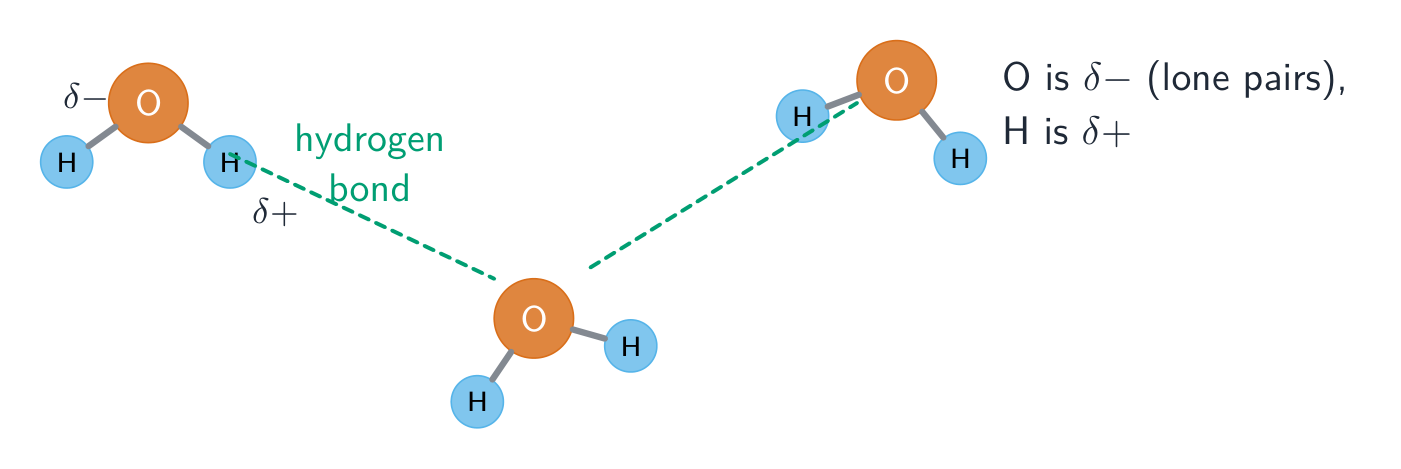
    • Hydrogen bonding 氢键: a strong dipole force when H is bonded to N, O, or F.
    • Ion–dipole 离子-偶极: between an ion and a polar molecule (the ion pulls on the oppositely-charged end of the dipole). These are the strongest of the four here (stronger even than hydrogen bonds), and are exactly what lets water dissolve an ionic solid - each $\text{Na}^+$ is surrounded by the $\delta-$ oxygen ends of water molecules.

    The whole ladder is understood qualitatively by looking at the sign of the partial charges: a larger or better-aligned partial charge, or a full ionic charge, gives a stronger attraction. Stronger IMFs mean higher boiling points and lower vapor pressure. This is why water ($18\ \text{g/mol}$, hydrogen-bonded) boils at $100\,{}^{\circ}\text{C}$ while methane ($16\ \text{g/mol}$, dispersion only) boils at $-162\,{}^{\circ}\text{C}$.

    ไทย

    แรงระหว่างโมเลกุล (IMFs) คือแรงดึงดูด ระหว่าง โมเลกุล – อ่อนกว่าพันธะมาก แต่กำหนดจุดหลอมเหลว/จุดเดือด. จากอ่อนไปหาแรง:

    London dispersion: ไดโพลชั่วขณะเหนี่ยวนำไดโพลในเพื่อนบ้าน
    London dispersion: ไดโพลชั่วขณะเหนี่ยวนำไดโพลในเพื่อนบ้าน
    Hydrogen bonding: H บน N/O/F ดึงดูดคู่อิเล็กตรอนอิสระของอีกโมเลกุลหนึ่ง
    Hydrogen bonding: H บน N/O/F ดึงดูดคู่อิเล็กตรอนอิสระของอีกโมเลกุลหนึ่ง
    • แรงลอนดอน: มีอยู่ใน ทุก โมเลกุล; เกิดจากแรงคูลอมบ์ระหว่าง ไดโพลชั่วคราวที่ผันแปร, และแรงนี้ stronger对于 larger, more polarizable electron clouds - มักเป็นแรงสุทธิที่แข็งแกร่งที่สุดระหว่างโมเลกุลขนาดใหญ่
    • ไดโพล-ไดโพล: ระหว่างโมเลกุลขั้ว. ความแข็งแรงขึ้นอยู่กับขนาดของไดโพล และการจัดวางสัมพัทธ์ - ปลาย $\delta+$ ที่เรียงตัวกับ $\delta-$ ปลายของเพื่อนบ้านจะดึงดูดกัน ดังนั้นแรงเหล่านี้จึงทำงาน เพิ่มเติม กับแรงลอนดอน ทำให้โมเลกุลขั้วเหนียวหนืดกว่าโมเลกุลไม่ขั้วที่มีขนาดใกล้เคียงกัน
    • พันธะไฮโดรเจน: เป็นแรงไดโพลที่รุนแรงเมื่อ H ผูกกับ N, O, หรือ F
    • ไอออน-ไดโพล: ระหว่าง ไอออน กับโมเลกุลขั้ว (ไอออนดึงที่ปลายที่มีประจุตรงข้ามของไดโพล). เหล่านี้เป็น แรงที่แข็งแกร่งที่สุด ในสี่ข้อนี้ (แม้จะแรงกว่าพันธะไฮโดรเจน), และเป็นสิ่งที่ทำให้สารละลายไอออนิกละลายในน้ำได้ - แต่ละ $\text{Na}^+$ ถูกล้อมรอบด้วย $\delta-$ ปลายออกซิเจนของโมเลกุลน้ำ

    บันไดทั้งหมดเข้าใจได้แบบ เชิงคุณภาพ โดยดูที่ เครื่องหมายของประจุย่อย: ประจุย่อยที่ใหญ่ขึ้นหรือจัดวางได้ดีขึ้น, หรือประจุไอออนเต็ม, ให้แรงดึงดูดที่audio更强. แรงระหว่างโมเลกุลที่audio更强意味 higheracha points and lower vapor pressure. นี่คือเหตุผลที่น้ำ ($18\ \text{g/mol}$, มีพันธะไฮโดรเจน) ลวกที่ $100\,{}^{\circ}\text{C}$ ในขณะที่มีเทน ($16\ \text{g/mol}$, มีเพียงแรงลอนดอน) ลวกที่ $-162\,{}^{\circ}\text{C}$

    Vocabulary · ⁨คำศัพท์⁩ Train · ⁨ฝึกฝน⁩
    English ไทย
    Intermolecular forces/ˌɪntəməˈlekjʊlə ˈfɔːsɪz/ แรงระหว่างโมเลกุล
    London dispersion forces/ˈlʌndn dɪˈspɜːʃn ˈfɔːsɪz/ แรงลอนดอน
    Dipole–dipole/ˈdaɪpəʊl ˈdaɪpəʊl/ ไดโพล–ไดโพล
    Ion–dipole/ˈaɪɒn ˈdaɪpəʊl/ ไอออน–ไดโพล
    Hydrogen bonding/ˈhaɪdrədʒn ˈbɒndɪŋ/ พันธะไฮโดรเจน
    malleable/ˈmæləbl/ นูนได้
    ductile/ˈdʌktaɪl/ ด่าง (ductile)
    free valence electrons/friː ˈveɪləns ɪˈlektrɒnz/ อิเล็กตรอนอิสระในวงนอกสุด
    crystalline/ˈkrɪstəlaɪn/ ผลึก
    amorphous/əˈmɔːfəs/ ไม่มีรูปทรง (อะมอร์ฟัส)
    Kinetic molecular theory/kɪˈnetɪk məˈlekjʊlə ˈθɪəri/ ทฤษฎีจลน์ของโมเลกุล
    3.2

    Properties of Solids · ⁨คุณสมบัติของของแข็ง⁩

    Syllabus · ⁨หลักสูตร⁩
    English

    Learning Objective 3.2.A: Explain the relationship among the macroscopic properties of a substance, the particulate-level structure of the substance, and the interactions between these particles.

    • 3.2.A.1 Many properties of liquids and solids are determined by the strengths and types of intermolecular forces present. Because intermolecular interactions are overcome completely when a substance vaporizes, the vapor pressure and boiling point are directly related to the strength of those interactions. Melting points also tend to correlate with interaction strength, but because the interactions are only rearranged, in melting, the relations can be more subtle.
    • 3.2.A.2 Particulate-level representations, showing multiple interacting chemical species, are a useful means to communicate or understand how intermolecular interactions help to establish macroscopic properties.
    • 3.2.A.3 Due to strong interactions between ions, ionic solids tend to have low vapor pressures, high melting points, and high boiling points. They tend to be brittle due to the repulsion of like charges caused when one layer slides across another layer. They conduct electricity only when the ions are mobile, as when the ionic solid is melted (i.e., in a molten state) or dissolved in water or another solvent.
    • 3.2.A.4 In covalent network solids, the atoms are covalently bonded together into a three-dimensional network (e.g., diamond) or layers of two-dimensional networks (e.g., graphite). These are only formed from nonmetals and metalloids: elemental (e.g., diamond, graphite) or binary compounds (e.g., silicon dioxide and silicon carbide). Due to the strong covalent interactions, covalent solids have high melting points. Three-dimensional network solids are also rigid and hard, because the covalent bond angles are fixed. However, graphite is soft because adjacent layers can slide past each other relatively easily.
    • 3.2.A.5 Molecular solids are composed of distinct, individual units of covalently-bonded molecules attracted to each other through relatively weak intermolecular forces. Molecular solids generally have a low melting point because of the relatively weak intermolecular forces present between the molecules. They do not conduct electricity because their valence electrons are tightly held within the covalent bonds and the lone pairs of each constituent molecule. Molecular solids are sometimes composed of very large molecules or polymers.
    • 3.2.A.6 Metallic solids are good conductors of electricity and heat, due to the presence of free valence electrons. They also tend to be malleable and ductile, due to the ease with which the metal cores can rearrange their structure. In an interstitial alloy, interstitial atoms tend to make the lattice more rigid, decreasing malleability and ductility. Alloys typically retain a sea of mobile electrons and so remain conducting.
    • 3.2.A.7 In large biomolecules or polymers, noncovalent interactions may occur between different molecules or between different regions of the same large biomolecule. The functionality and properties of such molecules depend strongly on the shape of the molecule, which is largely dictated by noncovalent interactions.
    ไทย

    จุดประสงค์การเรียนรู้ 3.2.A: อธิบายความสัมพันธ์ระหว่างคุณสมบัติทางมหภาคของสาร โครงสร้างในระดับอนุภาคของสาร และการมีปฏิสัมพันธ์ระหว่างอนุภาคเหล่านี้

    • 3.2.A.1 คุณสมบัติหลายอย่างของของเหลวและของแข็งกำหนดโดยความเข้มและประเภทของแรงระหว่างโมเลกุลที่มีอยู่ เนื่องจากมีการเอาชนะแรงระหว่างโมเลกุลอย่างสมบูรณ์เมื่อสารระเหย ความดันไอน้ำและจุดเดือดจึงสัมพันธ์โดยตรงกับความเข้มของแรงเหล่านั้น จุดหลอมเหลวก็มักจะมีแนวโน้มสัมพันธ์กับความเข้มของการมีปฏิสัมพันธ์เช่นกัน แต่เนื่องจากแรงเหล่านั้นเพียงมีการจัดเรียงใหม่เท่านั้นในการหลอมเหลว ความสัมพันธ์อาจซับซ้อนกว่านั้นเล็กน้อย
    • 3.2.A.2 ภาพแสดงในระดับอนุภาค ซึ่งแสดงสปีชีส์เคมีหลายชนิดที่มีปฏิสัมพันธ์กัน เป็นเครื่องมือที่มีประโยชน์ในการสื่อสารหรือทำความเข้าใจว่าการมีปฏิสัมพันธ์ระหว่างโมเลกุลช่วยกำหนดคุณสมบัติทางมหภาคได้อย่างไร
    • 3.2.A.3 เนื่องจากมีการมีปฏิสัมพันธ์ที่แข็งแกร่งระหว่างไอออน ของแข็งไอออนิกจึงมีแนวโน้มที่จะมีความดันไอน้ำต่ำ จุดหลอมเหลวสูง และจุดเดือดสูง มีแนวโน้มที่จะเปราะหักเนื่องจากแรงผลักกันของประจุเดียวกันที่เกิดขึ้นเมื่อชั้นหนึ่งเลื่อนผ่านอีกชั้นหนึ่ง它们นำไฟฟ้าได้ก็ต่อเมื่อไอออนเคลื่อนที่ได้ เช่น เมื่อของแข็งไอออนิกร้อนละลาย (即在熔融状态) หรือละลายในน้ำหรือตัวทำละลายอื่น
    • 3.2.A.4 ในของแข็งเครือข่ายโควาเลนต์ อะตอมจะเชื่อมต่อกันด้วยพันธะโควาเลนต์เป็นเครือข่ายสามมิติ (เช่น คาร์บอนไดออกไซด์) หรือชั้นของเครือข่ายสองมิติ (เช่น แพลทินัม) เหล่านี้เกิดขึ้นจากธาตุไม่ใช่โลหะและเมทัลลอยด์เท่านั้น: ธาตุบริสุทธิ์ (เช่น คาร์บอนไดออกไซด์, แพลทินัม) หรือสารประกอบไบนารี (เช่น ซิลิคอนไดออกไซด์และซิลิคอนคาร์ไบด์) เนื่องจากมีการมีปฏิสัมพันธ์แบบโควาเลนต์ที่แข็งแกร่ง ของแข็งโควาเลนต์จึงมีจุดหลอมเหลวสูง ของแข็งเครือข่ายสามมิติยังมีลักษณะแข็งและเปราะ เนื่องจากมุมพันธะโควาเลนซ์ถูกกำหนดไว้แล้ว อย่างไรก็ตาม แพลทินัมมีความนุ่มเพราะชั้นที่อยู่ติดกันสามารถเลื่อนผ่านกันได้ relatif易
    • 3.2.A.5 ของแข็งโมเลกุลประกอบด้วยหน่วยโมเลกุลที่แยกออกจากกันอย่างชัดเจนซึ่งเชื่อมต่อกันด้วยพันธะโคเวเลนต์ และถูกดึงดูดเข้าหากันผ่านแรงระหว่างโมเลกุลที่ค่อนข้างอ่อน ของแข็งโมเลกุลโดยทั่วไปมีจุดหลอมเหลวต่ำเนื่องจากแรงระหว่างโมเลกุลที่ค่อนข้างอ่อนที่มีอยู่ระหว่างโมเลกุล ониไม่สามารถนำไฟฟ้าได้เนื่องจากอิเล็กตรอนชั้นนอกสุดถูกยึดไว้แน่นภายในพันธะโคเวเลนต์และคู่อิเล็กตรอนโดดเดี่ยวของโมเลกุลองค์ประกอบแต่ละตัว ของแข็งโมเลกุลบางครั้งอาจประกอบด้วยโมเลกุลขนาดใหญ่หรือโพลิเมอร์
    • 3.2.A.6 ของแข็งโลหะเป็นตัวนำไฟฟ้าและความร้อนที่ดี เนื่องจากมีอิเล็กตรอนชั้นนอกอิสระ มีแนวโน้มที่จะมีความเหนียวและยืดหยุ่นได้ง่าย เนื่องจากแกนโลหะสามารถจัดโครงสร้างใหม่ได้อย่างสะดวก ในสารผสมแบบอินเทอร์สติเชียล อะตอมอินเทอร์สติเชียลมักจะทำให้โครงตาข่ายแข็งแรงขึ้น ลดความเหนียวและความยืดหยุ่น สารผสมโดยทั่วไปยังคงมีทะเลอิเล็กตรอนเคลื่อนที่ได้และดังนั้นจึงยังคงนำไฟฟ้าได้
    • 3.2.A.7 ในชีวโมเลกุลขนาดใหญ่หรือโพลิเมอร์ อาจเกิดปฏิสัมพันธ์ที่ไม่ใช่โคเวเลนต์ระหว่างโมเลกุลที่แตกต่างกันหรือระหว่างบริเวณต่างๆ ของชีวโมเลกุลขนาดใหญ่เดียวกัน ฟังก์ชันและคุณสมบัติของโมเลกุลเหล่านี้ขึ้นอยู่กับรูปร่างของโมเลกุลอย่างมาก ซึ่งส่วนใหญ่กำหนดโดยปฏิสัมพันธ์ที่ไม่ใช่โคเวเลนต์

    Source: College Board AP Course and Exam Description · ⁨แหล่งที่มา: คำอธิบายหลักสูตรและข้อสอบ College Board AP⁩

    English

    A solid's properties reflect the particles and forces holding it: ionic, covalent-network (a 3D network like diamond, very hard and high-melting; graphite is a layered exception — high-melting but soft, because its 2D layers slide over one another), metallic, and molecular solids (held by weak IMFs, soft, low-melting). Matching a solid's properties to its structure is a common exam task.

    Metallic solids conduct electricity and heat and are malleable 可锻的 and ductile 可延展的, all because their free valence electrons 自由价电子 move easily and let the metal ions slide past one another without breaking the bonding. Solids are also either crystalline 晶体 (particles in a regular, repeating 3-D arrangement) or amorphous 非晶体 (no long-range order, like glass).

    ไทย

    คุณสมบัติของของแข็งสะท้อนถึงอนุภาคและแรงที่ยึดมันไว้: ไอออนิก, โคเวเลนต์-เน็ตเวิร์ก (เครือข่าย 3 มิติ เช่น เพชร, แข็งมากและจุดหลอมเหลวสูง; กราไฟต์ เป็นข้อยกเว้นแบบชั้น — จุดหลอมเหลวสูงแต่อ่อนนุ่ม เพราะชั้น 2 มิติลื่นไหลผ่านกัน), โลหะ, และ โมเลกุล ของแข็ง (ยึดด้วยแรงระหว่างโมเลกุลที่อ่อน, นุ่ม, จุดหลอมเหลวต่ำ) การจับคู่คุณสมบัติของของแข็งกับโครงสร้างเป็นข้อสอบทั่วไป

    โลหะ ของแข็งนำไฟฟ้าและความร้อนและเป็น มัลเลเบิล (เปราะบาง/ขึ้นรูปง่าย) และ ดักไทล์ (ดึงเส้นได้), ทั้งหมดนี้เนื่องจาก อิเล็กตรอนวอลเลนซ์อิสระ เคลื่อนที่ได้ง่ายและทำให้ไอออนโลหะเลื่อนผ่านกันได้โดยไม่ทำลายพันธะ ของแข็งยังแบ่งเป็น คริสตัลไลน์ (อนุภาคเรียงตัวเป็นระเบียบซ้ำใน 3 มิติ) หรือ แอมอร์ฟัส (ไม่มีลำดับระยะยาว เช่น กระจก)

    โครงสร้างของแข็งสี่ประเภท: ไอออนิกขนาดใหญ่, โมเลกุลเล็ก, โคเวเลนต์ขนาดใหญ่, และโลหะ
    โครงสร้างของแข็งสี่ประเภท: ไอออนิกขนาดใหญ่, โมเลกุลเล็ก, โคเวเลนต์ขนาดใหญ่, และโลหะ
    3.3

    Solids, Liquids, and Gases · ⁨ของแข็ง, ของเหลว, และแก๊ส⁩

    Syllabus · ⁨หลักสูตร⁩
    English

    Learning Objective 3.3.A: Represent the differences between solid, liquid, and gas phases using a particulate-level model.

    • 3.3.A.1 Solids can be crystalline, where the particles are arranged in a regular three-dimensional structure, or they can be amorphous, where the particles do not have a regular, orderly arrangement. In both cases, the motion of the individual particles is limited, and the particles do not undergo overall translation with respect to each other. The structure of the solid is influenced by interparticle interactions and the ability of the particles to pack together.
    • 3.3.A.2 The constituent particles in liquids are in close contact with each other, and they are continually moving and colliding. The arrangement and movement of particles are influenced by the nature and strength of the forces (e.g., polarity, hydrogen bonding, and temperature) between the particles.
    • 3.3.A.3 The solid and liquid phases for a particular substance typically have similar molar volume because, in both phases, the constituent particles are in close contact at all times.
    • 3.3.A.4 In the gas phase, the particles are in constant motion. Their frequencies of collision and the average spacing between them are dependent on temperature, pressure, and volume. Because of this constant motion, and minimal effects of forces between particles, a gas has neither a definite volume nor a definite shape.
      • Exclusion Statement: Understanding/interpreting phase diagrams will not be assessed on the AP Exam.
    ไทย

    วัตถุประสงค์การเรียนรู้ 3.3.A: แสดงความแตกต่างระหว่างสถานะของแข็ง ของเหลว และแก๊ส โดยใช้โมเดลระดับอนุภาค

    • 3.3.A.1 ของแข็งสามารถเป็นผลึก (crystalline) ซึ่งอนุภาคจะเรียงตัวในโครงสร้างสามมิติที่เป็นระเบียบ หรืออาจเป็นอเมอร์ฟัส (amorphous) ซึ่งอนุภาคไม่มีระเบียบการเรียงตัวที่สม่ำเสมอ ในทั้งสองกรณี การเคลื่อนที่ของอนุภาคแต่ละตัวจะถูกจำกัด และอนุภาคจะไม่มีการเคลื่อนที่รวมเมื่อเทียบกับกัน โครงสร้างของของแข็งได้รับอิทธิพลจากแรงระหว่างอนุภาคและความสามารถในการจัดเรียงตัวของอนุภาคให้แน่น
    • 3.3.A.2 อนุภาคองค์ประกอบในของเหลวอยู่ใกล้กันและมีการเคลื่อนที่และชนกันอย่างต่อเนื่อง การจัดเรียงและการเคลื่อนที่ของอนุภาคได้รับอิทธิพลจากลักษณะและความแรงของแรงระหว่างอนุภาค (เช่น ความขั้ว, พันธะไฮโดรเจน, และอุณหภูมิ)
    • 3.3.A.3 สถานะของแข็งและของเหลวสำหรับสารชนิดหนึ่งมีปริมาตรมอลาร์คล้ายกันเพราะในทั้งสองสถานะ อนุภาคองค์ประกอบจะอยู่ใกล้กันตลอดเวลา
    • 3.3.A.4 ในสถานะแก๊ส อนุภาคมีการเคลื่อนที่อย่างต่อเนื่อง ความถี่ของการชนและระยะห่างเฉลี่ยระหว่างกันขึ้นอยู่กับอุณหภูมิ ความดัน และปริมาตร เนื่องจากมีการเคลื่อนที่อย่างต่อเนื่องและผลกระทบจากแรงระหว่างอนุภาคมีน้อยมาก แก๊สจึงไม่มีปริมาตรหรือรูปร่างที่กำหนดตายตัว
      • ข้อจำกัด: ความเข้าใจ/การตีความแผนภูมิเฟสจะไม่ถูกประเมินในการสอบ AP

    Source: College Board AP Course and Exam Description · ⁨แหล่งที่มา: คำอธิบายหลักสูตรและข้อสอบ College Board AP⁩

    English

    The three states differ in how tightly particles are held. Rising temperature raises average kinetic energy; when it overcomes the attractions, the substance melts or boils. Gases are mostly empty space, so they are compressible and fill their container.

    ไทย

    สามสถานะแตกต่างกันโดยความแน่นหนาของการยึดอนุภาค เมื่อ อุณหภูมิ เพิ่มขึ้นพลังงานจลน์เฉลี่ยจะสูงขึ้น เมื่อเกินแรงดึงดูด的物质จะละลายหรือระเหย แก๊สมีพื้นที่ว่างส่วนใหญ่ จึงบีบอัดได้และเติมเต็มภาชนะ

    อนุภาคถูกจัดเรียงแน่นในของแข็ง, ใกล้เคียงแต่เคลื่อนที่ได้ในของเหลว, และห่างกันในแก๊ส
    อนุภาคถูกจัดเรียงแน่นในของแข็ง, ใกล้เคียงแต่เคลื่อนที่ได้ในของเหลว, และห่างกันในแก๊ส
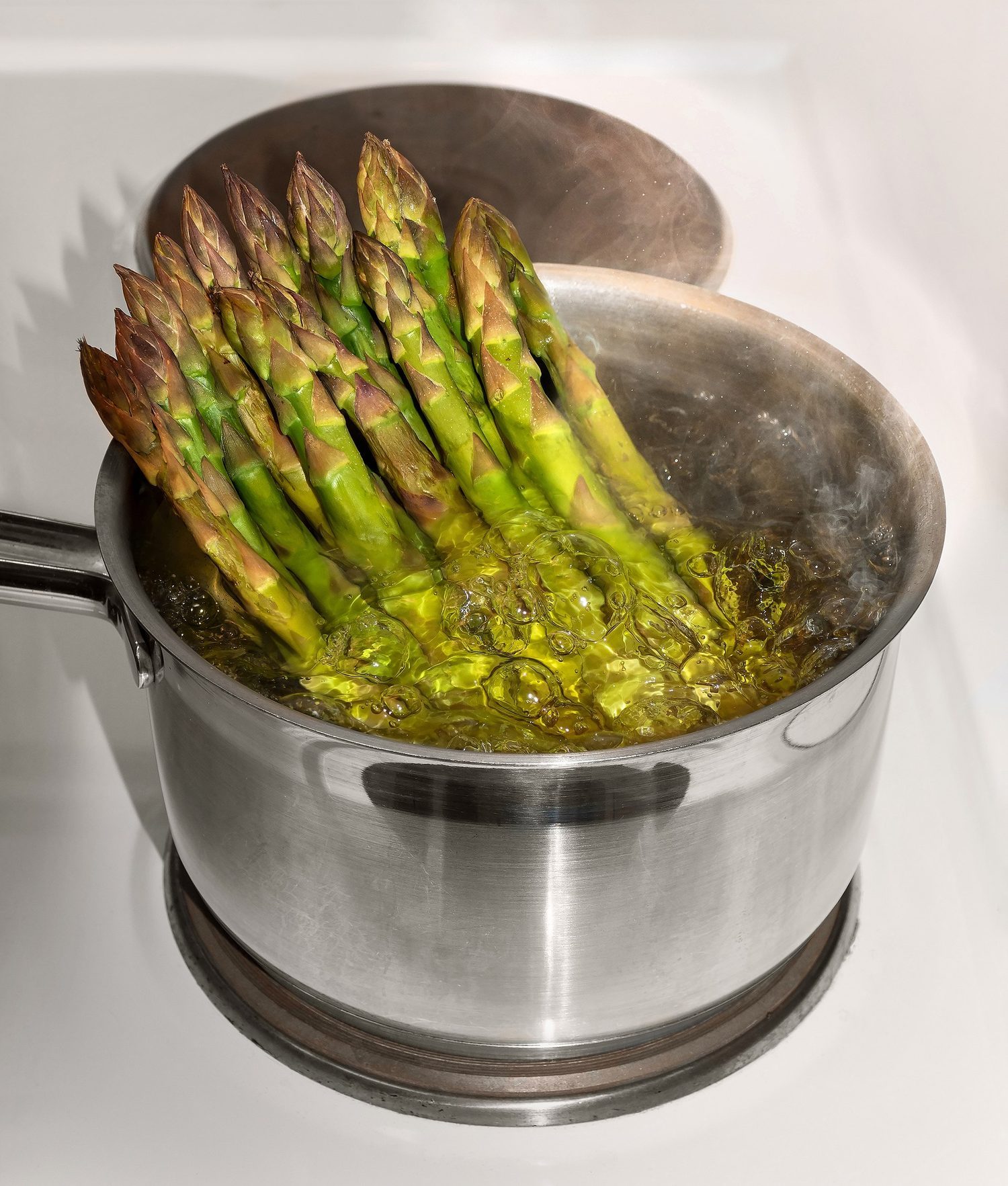
    ไอน้ำลอยจากน้ำเดือด: แก๊สขยายตัวเติมเต็มพื้นที่และสอดคล้องกับกฎแก๊สอุดมคติที่ T สูงและ P ต่ำ
    ไอน้ำลอยจากน้ำเดือด: แก๊สขยายตัวเติมเต็มพื้นที่และสอดคล้องกับกฎแก๊สอุดมคติที่ T สูงและ P ต่ำ
    Explore · ⁨สำรวจ⁩

    Melt and boil by adding heat · ⁨หลอมเหลวและเดือดโดยการให้ความร้อน⁩

    Temperature sets the average kinetic energy of the particles. Warm a solid and the particles break their fixed pattern (melt), then spread right out (boil). · ⁨อุณหภูมิกำหนดพลังงานจลน์เฉลี่ยของอนุภาค ให้ความร้อนกับของแข็ง อนุภาคจะหลุดจากตำแหน่งตายตัว (หลอมเหลว) จากนั้นกระจายตัวออกไปอย่างเต็มที่ (เดือด)⁩

    3.4

    The Ideal Gas Law · ⁨กฎแก๊สอุดมคติ⁩

    Syllabus · ⁨หลักสูตร⁩
    English

    Learning Objective 3.4.A: Explain the relationship between the macroscopic properties of a sample of gas or mixture of gases using the ideal gas law.

    • 3.4.A.1 The macroscopic properties of ideal gases are related through the ideal gas law:
      • EQN: $PV = nRT$.
    • 3.4.A.2 In a sample containing a mixture of ideal gases, the pressure exerted by each component (the partial pressure) is independent of the other components. Therefore, the partial pressure of a gas within the mixture is proportional to its mole fraction ($X$), and the total pressure of the sample is the sum of the partial pressures.
      • EQN: $P_{A} = P_{total} \times X_{A}$, where $X_{A} =$ moles A/total moles;
      • EQN: $P_{total} = P_{A} + P_{B} + P_{C} + \ldots$
    • 3.4.A.3 Graphical representations of the relationships between $P$, $V$, $T$, and $n$ are useful to describe gas behavior.
    ไทย

    วัตถุประสงค์การเรียนรู้ 3.4.A: อธิบายความสัมพันธ์ระหว่างคุณสมบัติมหภาคของตัวอย่างแก๊สหรือส่วนผสมของแก๊สโดยใช้กฎแก๊สอุดมคติ

    • 3.4.A.1 คุณสมบัติมหภาคของแก๊สอุดมคติเชื่อมโยงกันผ่านกฎแก๊สอุดมคติ:
      • EQN: $PV = nRT$.
    • 3.4.A.2 ในตัวอย่างที่มีส่วนผสมของแก๊สอุดมคติ แรงดันที่แต่ละส่วนประกอบ exert (แรงดันย่อย) เป็นอิสระจากส่วนประกอบอื่น ดังนั้น แรงดันย่อยของแก๊สใดหนึ่งในส่วนผสมจึงแปรผันตรงกับเศษมอล ($X$) และแรงดันรวมของตัวอย่างคือผลบวกของแรงดันย่อย
      • EQN: $P_{A} = P_{total} \times X_{A}$, โดย $X_{A} =$ คือโมล A / โมลทั้งหมด;
      • EQN: $P_{total} = P_{A} + P_{B} + P_{C} + \ldots$
    • 3.4.A.3 การแสดงกราฟความสัมพันธ์ระหว่าง $P$, $V$, $T$, และ $n$ ช่วยอธิบายพฤติกรรมของแก๊ส

    Source: College Board AP Course and Exam Description · ⁨แหล่งที่มา: คำอธิบายหลักสูตรและข้อสอบ College Board AP⁩

    English

    An ideal gas obeys

    $$PV=nRT,$$
    linking pressure, volume, moles, and absolute temperature. Use it to find any one quantity from the others, or (holding some constant) to predict how a gas responds to a change.

    Worked example. How many moles of gas fill a $2.0\ \text{L}$ container at $300\ \text{K}$ and $1.5\ \text{atm}$? Using $R=0.0821\ \text{L atm/(mol K)}$,

    $$n=\frac{PV}{RT}=\frac{1.5\times2.0}{0.0821\times300}=0.12\ \text{mol}.$$
    Always use kelvin for $T$ and match the units of $R$ to your pressure and volume.

    ไทย

    แก๊สอุดมคติ สอดคล้องกับ

    $$PV=nRT,$$
    การเชื่อมโยงความดัน ปริมาตร จำนวนโมล และอุณหภูมิสัมบูรณ์ ใช้หาค่าใดค่าหนึ่งจากค่าที่เหลือ, หรือ (เมื่อคงค่าบางอย่างไว้) เพื่อทำนายปฏิกิริยาของแก๊สต่อการเปลี่ยนแปลง

    แก๊สอุดมคตินี้คือโมเดลของอนุภาคจุดที่ไม่มีแรงระหว่างกัน
    แก๊สอุดมคตินี้คือโมเดลของอนุภาคจุดที่ไม่มีแรงระหว่างกัน

    ตัวอย่างวิธีทำ. มีแก๊สจำนวนกี่โมลที่เติม $2.0\ \text{L}$ ที่ $300\ \text{K}$ และ $1.5\ \text{atm}$? โดยใช้ $R=0.0821\ \text{L atm/(mol K)}$,

    $$n=\frac{PV}{RT}=\frac{1.5\times2.0}{0.0821\times300}=0.12\ \text{mol}.$$
    ต้องใช้ เคลวิน เสมอสำหรับ $T$ และปรับหน่วยของ $R$ ให้ตรงกับความดันและปริมาตรของคุณ

    Explore · ⁨สำรวจ⁩

    Compress a gas and watch the pressure · ⁨บีบอัดแก๊สและดูความดัน⁩

    $PV = nRT$. At fixed temperature, squeezing the gas into a smaller volume packs the molecules closer, so they hit the walls more often and the pressure rises. · ⁨$PV = nRT$. ที่อุณหภูมิคงที่ การบีบแก๊สให้อยู่ใน ปริมาตร เล็กลงจะทำให้โมเลกุลอยู่ชิดกันมากขึ้น พัดชนผนังบ่อยขึ้น ส่งผลให้ ความดัน เพิ่มขึ้น⁩

    3.5

    Kinetic Molecular Theory · ⁨ทฤษฎีโมเลกุลจลน์⁩

    Syllabus · ⁨หลักสูตร⁩
    English

    Learning Objective 3.5.A: Explain the relationship between the motion of particles and the macroscopic properties of gases with: i. The kinetic molecular theory (KMT). ii. A particulate model. iii. A graphical representation.

    • 3.5.A.1 The kinetic molecular theory (KMT) relates the macroscopic properties of gases to motions of the particles in the gas. The Maxwell-Boltzmann distribution describes the distribution of the kinetic energies of particles at a given temperature.
    • 3.5.A.2 All the particles in a sample of matter are in continuous, random motion. The average kinetic energy of a particle is related to its average velocity by the equation:
      • EQN: $KE = \frac{1}{2}\,mv^{2}$.
    • 3.5.A.3 The Kelvin temperature of a sample of matter is proportional to the average kinetic energy of the particles in the sample.
    • 3.5.A.4 The Maxwell-Boltzmann distribution provides a graphical representation of the energies/velocities of particles at a given temperature.
    ไทย

    วัตถุประสงค์การเรียนรู้ 3.5.A: อธิบายความสัมพันธ์ระหว่างการเคลื่อนที่ของอนุภาคกับคุณสมบัติมหภาคของแก๊สโดย: i. ทฤษฎีโมเลกุลจลน์ (KMT) ii. โมเดลระดับอนุภาค iii. การแสดงกราฟ

    • 3.5.A.1 ทฤษฎีโมเลกุลจลน์ (KMT) เชื่อมโยงคุณสมบัติมหภาคของแก๊สกับการเคลื่อนที่ของอนุภาคในแก๊ส การกระจายแมกซ์เวลล์-โบลต์ซมันน์ (Maxwell-Boltzmann distribution) อธิบายการกระจายของพลังงานจลน์ของอนุภาคที่อุณหภูมิที่กำหนด
    • 3.5.A.2 อนุภาคทั้งหมดในตัวอย่างสสารมีการเคลื่อนที่แบบสุ่มต่อเนื่องกัน พลังงานจลน์เฉลี่ยของอนุภาคเกี่ยวข้องกับความเร็วเฉลี่ยโดยสมการ:
      • EQN: $KE = \frac{1}{2}\,mv^{2}$.
    • 3.5.A.3 อุณหภูมิเคลวินของตัวอย่างสสารแปรผันตรงกับพลังงานจลน์เฉลี่ยของอนุภาคในตัวอย่าง
    • 3.5.A.4 การกระจายแมกซ์เวลล์-โบลต์ซมันน์เป็นการแสดงกราฟของพลังงาน/ความเร็วของอนุภาคที่อุณหภูมิที่กำหนด

    Source: College Board AP Course and Exam Description · ⁨แหล่งที่มา: คำอธิบายหลักสูตรและข้อสอบ College Board AP⁩

    English
    Kinetic theory: gas pressure

    Kinetic molecular theory 分子运动论 explains gas behavior: particles are tiny, in constant random motion, with negligible volume and no attractions, and collisions are elastic. Temperature is proportional to average kinetic energy, so at a given temperature lighter molecules move faster (Graham's law of effusion).

    ไทย
    ทฤษฎีจลน์: ความดันก๊าซ

    ทฤษฎีโมเลกุลจลน์ อธิบายพฤติกรรมแก๊ส: อนุภาคมีขนาดเล็ก, เคลื่อนที่สุ่มอย่างต่อเนื่อง, มีปริมาตรน้อยมากและไม่มีการดึงดูด, และการชนเป็นแบบยืดหยุ่น อุณหภูมิ สัดส่วนกับพลังงานจลน์เฉลี่ย ดังนั้นที่อุณหภูมินั้นโมเลกุลที่มีมวลเบาจะเคลื่อนที่เร็วกว่า (กฎเกรแฮมเรื่องการแพร่)

    การแจกแจงแม็กซ์เวลล์-โบลต์ซมันน์ของความเร็วโมเลกุลเลื่อนไปทางขวาเมื่อถูกความร้อน
    การแจกแจงแม็กซ์เวลล์-โบลต์ซมันน์ของความเร็วโมเลกุลเลื่อนไปทางขวาเมื่อถูกความร้อน
    Explore · ⁨สำรวจ⁩

    Heat a gas and watch the speed spread · ⁨ให้ความร้อนแก๊สและดูการกระจายตัวของความเร็ว⁩

    Gas molecules have a range of speeds. Raising the temperature shifts the whole distribution to higher speeds and flattens it, so more molecules move fast. · ⁨โมเลกุลของแก๊สมี ช่วง ความเร็วต่างๆ การเพิ่ม อุณหภูมิ จะทำให้การกระจายตัวทั้งหมด SHIFT ไปสู่ความเร็วที่สูงขึ้นและแบนลง ทำให้มีโมเลกุลเคลื่อนที่เร็วมากขึ้น⁩

    3.6

    Deviation from the Ideal Gas Law · ⁨ความเบี่ยงเบนจากกฎแก๊สอุดมคติ⁩

    Syllabus · ⁨หลักสูตร⁩
    English

    Learning Objective 3.6.A: Explain the relationship among non-ideal behaviors of gases, interparticle forces, and/or volumes.

    • 3.6.A.1 The ideal gas law does not explain the actual behavior of real gases. Deviations from the ideal gas law may result from interparticle attractions among gas molecules, particularly at conditions that are close to those resulting in condensation. Deviations may also arise from particle volumes, particularly at extremely high pressures.
    ไทย

    วัตถุประสงค์การเรียนรู้ 3.6.A: อธิบายความสัมพันธ์ระหว่างพฤติกรรมที่ไม่เป็นอุดมคติของแก๊ส, แรงระหว่างอนุภาค, และ/หรือปริมาตร

    • 3.6.A.1 กฎแก๊สอุดมคติไม่อธิบายพฤติกรรมจริงของแก๊สจริง ความเบี่ยงเบนจากกฎแก๊สอุดมคติอาจเกิดจากแรงดึงดูดระหว่างโมเลกุลแก๊ส โดยเฉพาะในสภาวะที่ใกล้เคียงกับการควบแน่น ความเบี่ยงเบนยังอาจเกิดจากปริมาตรของอนุภาค โดยเฉพาะที่ความดันสูงมาก

    Source: College Board AP Course and Exam Description · ⁨แหล่งที่มา: คำอธิบายหลักสูตรและข้อสอบ College Board AP⁩

    English

    Real gases deviate from ideal behavior at high pressure and low temperature, where molecules are close enough that their real volume and their attractions matter. Attractions lower the pressure below ideal; molecular volume raises it.

    ไทย

    แก๊สจริง เบี่ยงเบนจากพฤติกรรมอุดมคติที่ ความดันสูง และ อุณหภูมิต่ำ ซึ่งโมเลกุลอยู่ใกล้กันพอที่ปริมาตรจริงและการดึงดูดของมันจะมีความสำคัญ การดึงดูดลดความดันต่ำกว่าอุดมคติ; ปริมาตรโมเลกุลเพิ่มให้สูงกว่า

    3.7

    Solutions and Mixtures · ⁨สารละลายและส่วนผสม⁩

    Syllabus · ⁨หลักสูตร⁩
    English

    Learning Objective 3.7.A: Calculate the number of solute particles, volume, or molarity of solutions.

    • 3.7.A.1 Solutions, also sometimes called homogeneous mixtures, can be solids, liquids, or gases. In a solution, the macroscopic properties do not vary throughout the sample. In a heterogeneous mixture, the macroscopic properties depend on location in the mixture.
    • 3.7.A.2 Solution composition can be expressed in a variety of ways; molarity is the most common method used in the laboratory.
      • EQN: $M = n_{solute}/L_{solution}$
    ไทย

    วัตถุประสงค์การเรียนรู้ 3.7.A: คำนวณจำนวนอนุภาคตัวละลาย ปริมาตร หรือโมลาริตี้ของโซลูชัน

    • 3.7.A.1 โซลูชัน (ซึ่งบางครั้งเรียกว่าส่วนผสมแบบโฮโมจีนียส) สามารถเป็นของแข็ง ของเหลว หรือแก๊ส ในโซลูชัน คุณสมบัติมหภาคไม่เปลี่ยนแปลงตลอดตัวอย่าง ในส่วนผสมแบบเฮเทอโรจีนียส (heterogeneous mixture) คุณสมบัติมหภาคขึ้นอยู่กับตำแหน่งในส่วนผสม
    • 3.7.A.2 ส่วนประกอบของสารละลายสามารถแสดงได้หลายรูปแบบ; ความเข้มข้นแบบโมลาร์ (Molarity) เป็นวิธีที่พบบ่อยที่สุดในห้องปฏิบัติการ
      • EQN: $M = n_{solute}/L_{solution}$

    Source: College Board AP Course and Exam Description · ⁨แหล่งที่มา: คำอธิบายหลักสูตรและข้อสอบ College Board AP⁩

    English

    A solution 溶液 is a homogeneous mixture of a solute 溶质 dissolved in a solvent 溶剂. Concentration is usually molarity 摩尔浓度:

    $$M=\frac{\text{moles of solute}}{\text{liters of solution}}.$$
    Dilution conserves moles: $M_1V_1=M_2V_2$.

    Worked example. What volume of water must you add to $50\ \text{mL}$ of $6.0\ \text{M}$ HCl to make it $2.0\ \text{M}$? The moles of HCl are unchanged, so $M_1V_1=M_2V_2$ gives the final volume $V_2=\dfrac{M_1V_1}{M_2}=\dfrac{6.0\times50}{2.0}=150\ \text{mL}$. You therefore add $150-50=100\ \text{mL}$ of water.

    ไทย

    สารละลาย คือส่วนผสมเนื้อเดียวกันของ ตัวละลาย ที่ละลายใน ตัวทำละลาย ความเข้มข้นมักจะเป็น โมลาริตี้:

    $$M=\frac{\text{moles of solute}}{\text{liters of solution}}.$$
    การเจือจาง รักษามวลสารไว้: $M_1V_1=M_2V_2$.

    ตัวอย่างวิธีทำ. ต้องเติมน้ำปริมาณเท่าไหร่เพื่อทำให้ $50\ \text{mL}$ ของ $6.0\ \text{M}$ HCl มีความเข้มข้น $2.0\ \text{M}$? มวลสารของ HCl ไม่เปลี่ยนแปลง, ดังนั้น $M_1V_1=M_2V_2$ ให้ปริมาตรสุดท้าย $V_2=\dfrac{M_1V_1}{M_2}=\dfrac{6.0\times50}{2.0}=150\ \text{mL}$. คุณดังนั้นต้อง เพิ่ม $150-50=100\ \text{mL}$ ของน้ำ

    Vocabulary · ⁨คำศัพท์⁩ Train · ⁨ฝึกฝน⁩
    English ไทย
    solution/səˈluːʃn/ สารละลาย
    solute/ˈsɒljuːt/ ตัวละลาย
    solvent/ˈsɒlvənt/ ตัวทำละลาย
    molarity/məʊˈlærɪti/ โมลาริตี้
    3.8

    Representations of Solutions · ⁨การแสดงภาพสารละลาย⁩

    Syllabus · ⁨หลักสูตร⁩
    English

    Learning Objective 3.8.A: Using particulate models for mixtures: i. Represent interactions between components. ii. Represent concentrations of components.

    • 3.8.A.1 Particulate representations of solutions communicate the structure and properties of solutions, by illustration of the relative concentrations of the components in the solution and/or drawings that show interactions among the components.
      • Exclusion Statement: Colligative properties will not be assessed on the AP Exam.
      • Exclusion Statement: Calculations of molality, percent by mass, and percent by volume for solutions will not be assessed on the AP Exam.
    ไทย

    วัตถุประสงค์การเรียนรู้ 3.8.A: การใช้แบบจำลองอนุภาคสำหรับสารผสม: i. แสดงปฏิสัมพันธ์ระหว่างองค์ประกอบ ii. แสดงความเข้มข้นขององค์ประกอบ

    • 3.8.A.1 การแสดงภาพด้วยอนุภาคของสารละลายสื่อถึงโครงสร้างและคุณสมบัติของสารละลาย โดยการแสดงความเข้มข้นสัมพัทธ์ขององค์ประกอบในสารละลายและ/หรือวาดภาพที่แสดงปฏิสัมพันธ์ระหว่างองค์ประกอบ
      • ข้อยกเว้น: คุณสมบัติเชิงคอลลิเกตivas จะไม่ถูกทดสอบในการสอบ AP Exam
      • ข้อยกเว้น: การคำนวณโมลาลิตี, เปอร์เซ็นต์โดยมวล, และเปอร์เซ็นต์โดยปริมาตรสำหรับสารละลายจะไม่ถูกทดสอบในการสอบ AP Exam

    Source: College Board AP Course and Exam Description · ⁨แหล่งที่มา: คำอธิบายหลักสูตรและข้อสอบ College Board AP⁩

    English

    A particulate diagram shows the solute and solvent particles. For an ionic solute, show it fully dissociated into separate ions surrounded by solvent; count particles to reason about concentration and conductivity.

    ไทย

    แผนภาพอนุภาค แสดงตัวละลายและตัวทำละลาย สำหรับตัวละลายไอออนิก, แสดงให้ แยกตัว ออกเป็นไอออนเดี่ยวๆ ล้อมรอบด้วยตัวทำละลายนับจำนวนอนุภาคเพื่อวิเคราะห์ความเข้มข้นและการนำไฟฟ้า

    3.9

    Separation of Solutions and Mixtures · ⁨การแยกสารละลายและส่วนผสม⁩

    Syllabus · ⁨หลักสูตร⁩
    English

    Learning Objective 3.9.A: Explain the results of a separation experiment based on intermolecular interactions.

    • 3.9.A.1 The components of a liquid solution cannot be separated by filtration. They can, however, be separated using processes that take advantage of differences in the intermolecular interactions of the components.
      • i. Chromatography (paper, thin-layer, and column) separates chemical species by taking advantage of the differential strength of intermolecular interactions between and among the components of the solution (the mobile phase) and with the surface components of the stationary phase. The resulting chromatogram can be used to infer the relative polarities of components in a mixture.
      • ii. Distillation separates chemical species by taking advantage of the differential strength of intermolecular interactions between and among the components and the effects these interactions have on the vapor pressures of the components in the mixture.
    ไทย

    วัตถุประสงค์การเรียนรู้ 3.9.A: อธิบายผลการทดลองแยกสารโดยอ้างอิงจากปฏิสัมพันธ์ระหว่างโมเลกุล

    • 3.9.A.1 องค์ประกอบของสารละลายเหลวไม่สามารถแยกด้วยการกรองได้ แต่สามารถแยกได้โดยใช้กระบวนการที่อาศัยความแตกต่างของแรงระหว่างโมเลกุลขององค์ประกอบ
      • i. โครมาโตกราฟี (กระดาษ, ชั้นบาง, และคอลัมน์) แยกสเปชีส์เคมีโดยใช้ความแตกต่างของความเข้มของแรงระหว่างโมเลกุลระหว่างและภายในองค์ประกอบของสารละลาย (เฟสนำเคลื่อนที่) และกับพื้นผิวขององค์ประกอบของเฟสนิ่ง ผลลัพธ์ที่ได้คือโครมาโทแกรมสามารถใช้อนุมานความมีขั้วสัมพัทธ์ขององค์ประกอบในสารผสมได้
      • ii. การกลั่นแยกสเปชีส์เคมีโดยใช้ความแตกต่างของความเข้มของแรงระหว่างโมเลกุลระหว่างและภายในองค์ประกอบ以及ผลกระทบของแรงเหล่านี้ต่อความดันไอขององค์ประกอบในสารผสม

    Source: College Board AP Course and Exam Description · ⁨แหล่งที่มา: คำอธิบายหลักสูตรและข้อสอบ College Board AP⁩

    English

    Because a mixture's components keep their properties, physical methods separate them: filtration (by particle size), distillation (by boiling point), and chromatography 色谱法 (by how strongly each component sticks to a stationary phase versus moving with a solvent).

    ไทย

    เนื่องจากส่วนประกอบของส่วนผสมรักษาคุณสมบัติไว้, วิธีกายภาพแยกพวกมัน: การกรอง (ตามขนาดอนุภาค), การกลั่น (ตามจุดเดือด), และ โครมาโตกราฟี (ตามความแข็งแรงในการยึดติดกับเฟสนิ่งเมื่อเทียบกับเคลื่อนที่ไปกับตัวทำละลาย)

    โครมาโตกราฟีกระดาษแยกสารผสมเมื่อตัวทำละลายไหลขึ้นไปบนกระดาษ
    โครมาโตกราฟีกระดาษแยกสารผสมเมื่อตัวทำละลายไหลขึ้นไปบนกระดาษ
    Vocabulary · ⁨คำศัพท์⁩ Train · ⁨ฝึกฝน⁩
    English ไทย
    chromatography/krəʊməˈtɒɡrəfi/ ครอมาโทกราฟ
    Solubility/ˌsɒljuːˈbɪlɪti/ ความละลายได้
    Spectroscopy/spekˈtrɒskəpi/ สเปกโทรสโคปี
    photons/ˈfəʊtɒnz/ โฟตอน
    Beer–Lambert law/bɪə ˈlæmbət lɔː/ กฎของบีร์–แลมเบิร์ต
    3.10

    Solubility · ⁨ความสามารถในการละลาย⁩

    Syllabus · ⁨หลักสูตร⁩
    English

    Learning Objective 3.10.A: Explain the relationship between the solubility of ionic and molecular compounds in aqueous and nonaqueous solvents, and the intermolecular interactions between particles.

    • 3.10.A.1 Substances with similar intermolecular interactions tend to be miscible or soluble in one another.
    ไทย

    จุดประสงค์การเรียนรู้ 3.10.A: อธิบายความสัมพันธ์ระหว่างความสามารถในการละลายของสารประกอบไอออนิกและโมเลกุลในน้ำและตัวทำละลายที่ไม่ใช่น้ำ และการมีปฏิสัมพันธ์ระหว่างโมเลกุล

    • 3.10.A.1 สารที่มีลักษณะการมีปฏิสัมพันธ์ระหว่างโมเลกุลคล้ายคลึงกันมักจะผสมเข้าด้วยกันได้หรือละลาย друг в друга

    Source: College Board AP Course and Exam Description · ⁨แหล่งที่มา: คำอธิบายหลักสูตรและข้อสอบ College Board AP⁩

    English

    Solubility 溶解度 is how much solute dissolves. "Like dissolves like": polar (and ionic) solutes dissolve in polar solvents; nonpolar in nonpolar. Dissolving happens when solute–solvent attractions are comparable to the attractions being broken.

    ไทย

    ความสามารถในการละลาย คือปริมาณตัวละลายที่ละลายได้ "เหมือนละลายเหมือน": ขั้ว (และไอออนิก) ตัวละลายละลายในขั้วตัวทำละลาย; ไม่มีขั้วในไม่มีขั้ว การละลายเกิดขึ้นเมื่อแรงดึงดูดระหว่างตัวละลาย–ตัวทำละลายเทียบเท่ากับการทำลายแรงดึงดูด

    กลุ่มผลึกสีฟ้าสว่างขนาดใหญ่แก้วของทองแดง(II) ซัลเฟต
    ผลึกทองแดง(II) ซัลเฟตสีฟ้าที่เจริญเติบโตจากสารละลาย: สารละลายอิ่มตัวที่ทิ้งไว้ให้ระเหยจะตกตะกอนของแข็งที่ละลายไว้กลับมาเป็นผลึกที่มีระเบียบ
    3.11

    Spectroscopy and the Electromagnetic Spectrum · ⁨สเปกโทรสโกปีและสเปกตรัมแม่เหล็กไฟฟ้า⁩

    Syllabus · ⁨หลักสูตร⁩
    English

    Learning Objective 3.11.A: Explain the relationship between a region of the electromagnetic spectrum and the types of molecular or electronic transitions associated with that region.

    • 3.11.A.1 Differences in absorption or emission of photons in different spectral regions are related to the different types of molecular motion or electronic transition:
      • i. Microwave radiation is associated with transitions in molecular rotational levels.
      • ii. Infrared radiation is associated with transitions in molecular vibrational levels.
      • iii. Ultraviolet/visible radiation is associated with transitions in electronic energy levels.
    ไทย

    จุดประสงค์การเรียนรู้ 3.11.A: อธิบายความสัมพันธ์ระหว่างช่วงหนึ่งของสเปกตรัมคลื่นแม่เหล็กไฟฟ้ากับประเภทของการเปลี่ยนผ่านระดับโมเลกุลหรือระดับอิเล็กทรอนิกส์ที่เกี่ยวข้องกับช่วงนั้น

    • 3.11.A.1 ความแตกต่างในการดูดกลืนหรือปล่อยโฟตอนในช่วงสเปกตรัมต่าง ๆ มีความเกี่ยวข้องกับประเภทของการเคลื่อนที่ระดับโมเลกุลหรือการเปลี่ยนผ่านระดับอิเล็กทรอนิกส์ที่แตกต่างกัน:
      • i. คลื่นไมโครเวฟเกี่ยวข้องกับการเปลี่ยนผ่านระดับการหมุนของโมเลกุล
      • ii. คลื่นอินฟราเรดเกี่ยวข้องกับการเปลี่ยนผ่านระดับการสั่นสะเทือนของโมเลกุล
      • iii. คลื่นอัลตราไวโอเลต/แสงที่มองเห็นได้เกี่ยวข้องกับการเปลี่ยนผ่านระดับพลังงานอิเล็กทรอนิกส์

    Source: College Board AP Course and Exam Description · ⁨แหล่งที่มา: คำอธิบายหลักสูตรและข้อสอบ College Board AP⁩

    English

    Spectroscopy 光谱学 studies how matter absorbs or emits light. Different regions of the electromagnetic spectrum probe different changes: microwaves (rotation), infrared (bond vibrations), ultraviolet–visible (electron transitions). The light absorbed reveals structure.

    ไทย

    สเปกโทรสโกปี ศึกษาว่าสสารดูดกลืนหรือปล่อยแสงอย่างไร พื้นที่ต่างๆ ของ สเปกตรัมแม่เหล็กไฟฟ้า ตรวจสอบการเปลี่ยนแปลงที่แตกต่างกัน: ไมโครเวฟ (การหมุน), อินฟราเรด (การสั่นของพันธะ), ยูวี-วิสิibble (การเปลี่ยนระดับพลังงานอิเล็กตรอน). แสงที่ถูกดูดกลืนเปิดเผยโครงสร้าง

    Explore · ⁨สำรวจ⁩

    Scan across the electromagnetic spectrum · ⁨สแกนผ่านสเปกตรัมคลื่นแม่เหล็กไฟฟ้า⁩

    Light is a wave with a range of wavelengths. Shorter wavelength means higher frequency and more energy per photon, from radio waves up to gamma rays. · ⁨แสงเป็นคลื่นที่มี ความยาวคลื่น หลากหลาย ความยาวคลื่นสั้นกว่าหมายถึง ความถี่ สูงขึ้นและมีพลังงานต่อโฟตอนมากกว่า ตั้งแต่คลื่นวิทยุจนถึงรังสีแกมมา⁩

    3.12

    Properties of Photons · ⁨คุณสมบัติของโฟตอน⁩

    Syllabus · ⁨หลักสูตร⁩
    English

    Learning Objective 3.12.A: Explain the properties of an absorbed or emitted photon in relationship to an electronic transition in an atom or molecule.

    • 3.12.A.1 When a photon is absorbed (or emitted) by an atom or molecule, the energy of the species is increased (or decreased) by an amount equal to the energy of the photon.

    • 3.12.A.2 The wavelength of the electromagnetic wave is related to its frequency and the speed of light by the equation:

      • EQN: $c = \lambda\nu$.

      The energy of a photon is related to the frequency of the electromagnetic wave through Planck's equation:

      • EQN: $E = h\nu$.
    ไทย

    จุดประสงค์การเรียนรู้ 3.12.A: อธิบายคุณสมบัติของโฟตอนที่ถูกดูดกลืนหรือปล่อยออกมา โดยเชื่อมโยงกับการเปลี่ยนผ่านระดับอิเล็กทรอนิกส์ในอะตอมหรือโมเลกุล

    • 3.12.A.1 เมื่อโฟตอนถูกดูดกลืน (หรือปล่อย) โดยอะตอมหรือโมเลกุล พลังงานของสปีชีส์จะเพิ่มขึ้น (หรือลดลง) เป็นจำนวนเท่ากับพลังงานของโฟตอน

    • 3.12.A.2 ความยาวคลื่นของคลื่นแม่เหล็กไฟฟ้ามีความสัมพันธ์กับความถี่และความเร็วแสงตามสมการ:

      • EQN: $c = \lambda\nu$.

      พลังงานของโฟตอนมีความสัมพันธ์กับความถี่ของคลื่นแม่เหล็กไฟฟ้าผ่านสมการของพลังค์:

      • EQN: $E = h\nu$.

    Source: College Board AP Course and Exam Description · ⁨แหล่งที่มา: คำอธิบายหลักสูตรและข้อสอบ College Board AP⁩

    English

    Light is carried by photons 光子, each with energy $E=h\nu=\dfrac{hc}{\lambda}$. Higher frequency (shorter wavelength) means higher energy. A molecule absorbs a photon only when its energy matches an allowed energy gap.

    ไทย

    แสงพาโดย โฟตอน, แต่ละตัวมีพลังงาน $E=h\nu=\dfrac{hc}{\lambda}$. ความถี่สูงขึ้น (ความยาวคลื่นสั้นลง) หมายความว่าพลังงานสูงขึ้น. โมเลกุลดูดกลืนโฟตอนก็ต่อเมื่อพลังงานของมันตรงกับช่องว่างพลังงานที่ยอมรับได้เท่านั้น

    3.13

    The Beer-Lambert Law · ⁨กฎบีร์-แลมเบิร์ต⁩

    Syllabus · ⁨หลักสูตร⁩
    English

    Learning Objective 3.13.A: Explain the amount of light absorbed by a solution of molecules or ions in relationship to the concentration, path length, and molar absorptivity.

    • 3.13.A.1 The Beer-Lambert law relates the absorption of light by a solution to three variables according to the equation:

      • EQN: $A = \varepsilon bc$.

      The molar absorptivity, $\varepsilon$, describes how intensely a chemical species absorbs light of a specific wavelength. The path length, $b$, and concentration, $c$, are proportional to the number of light-absorbing particles in the light path.

    • 3.13.A.2 In most experiments the path length and wavelength of light are held constant. In such cases, the absorbance is proportional only to the concentration of absorbing molecules or ions. The spectrophotometer is typically set to the wavelength of maximum absorbance (optimum wavelength) for the species being analyzed to ensure the maximum sensitivity of measurement.

    ไทย

    จุดประสงค์การเรียนรู้ 3.13.A: อธิบายปริมาณแสงที่สารละลายของโมเลกุลหรือไอออนดูดกลืน โดยเชื่อมโยงกับความเข้มข้น ระยะทาง และความหนาแน่นการดูดกลืน摩尔

    • 3.13.A.1 กฎของบิئر-แลมเบิร์ตแสดงความสัมพันธ์ระหว่างการดูดกลืนแสงของสารละลายกับตัวแปรสามตัวตามสมการ:

      • EQN: $A = \varepsilon bc$.

      ค่าความหนาแน่นการดูดกลืน摩尔, $\varepsilon$, อธิบายถึงความเข้มที่สปีชีส์เคมีดูดกลืนแสงที่มีความยาวคลื่นเฉพาะ ค่าระยะทาง, $b$, และความเข้มข้น, $c$, เป็นสัดส่วนกับจำนวนอนุภาคที่ดูดกลืนแสงในเส้นทางแสง

    • 3.13.A.2 ในการทดลองส่วนใหญ่ ระยะทางและความยาวคลื่นของแสงจะถูกคงไว้ ในกรณีเช่นนี้ ค่าการดูดกลืนจะเป็นสัดส่วนกับความเข้มข้นของโมเลกุลหรือไอออนที่ดูดกลืนแสงเท่านั้น เครื่องสเปกโทรโฟโตมิเตอร์มักจะถูกตั้งค่าที่ความยาวคลื่นของการดูดกลืนสูงสุด (ความยาวคลื่นที่เหมาะสม) สำหรับสปีชีส์ที่กำลังวิเคราะห์เพื่อให้มั่นใจถึงความไวสูงสุดของการวัด

    Source: College Board AP Course and Exam Description · ⁨แหล่งที่มา: คำอธิบายหลักสูตรและข้อสอบ College Board AP⁩

    English

    The Beer–Lambert law 比尔-朗伯定律 relates how much light a solution absorbs to its concentration:

    $$A=\varepsilon\,b\,c,$$
    where $A$ is absorbance, $\varepsilon$ the molar absorptivity, $b$ the path length, and $c$ the concentration. Since $A$ is proportional to $c$, measuring absorbance is a fast way to find an unknown concentration.

    Worked example. A dye has molar absorptivity $\varepsilon=2000\ \text{L/(mol cm)}$; in a $1.0\ \text{cm}$ cell a sample reads absorbance $A=0.40$. Its concentration is $c=\dfrac{A}{\varepsilon b}=\dfrac{0.40}{2000\times1.0}=2.0\times10^{-4}\ \text{M}$. Because $A\propto c$, a solution twice as concentrated would read $A=0.80$ – the basis of a calibration curve.

    ไทย

    กฎบีร์-แลมเบิร์ต เชื่อมโยงปริมาณแสงที่สารละลายดูดกลืนกับความเข้มข้น:

    $$A=\varepsilon\,b\,c,$$
    โดยที่ $A$ คือการดูดกลืนแสง, $\varepsilon$ ค่าสัมประสิทธิ์การดูดกลืนต่อโมล, $b$ ระยะทางผ่าน, และ $c$ คือความเข้มข้น. เนื่องจาก $A$ สัดส่วนกับ $c$, การวัดค่าการดูดกลืนแสงจึงเป็นวิธีรวดเร็วในการหาความเข้มข้นที่ไม่ทราบค่า

    ตัวอย่างที่แสดงวิธีทำ. สีย้อมมีค่าสัมประสิทธิ์การดูดกลืนโมล $\varepsilon=2000\ \text{L/(mol cm)}$; ในเซลล์ $1.0\ \text{cm}$ ตัวอย่างอ่านค่าความดูดกลืนแสงได้ $A=0.40$. ความเข้มข้นของมันคือ $c=\dfrac{A}{\varepsilon b}=\dfrac{0.40}{2000\times1.0}=2.0\times10^{-4}\ \text{M}$. เนื่องจาก $A\propto c$, สารละลายที่มีความเข้มข้นเป็นสองเท่าจะอ่านค่าได้ $A=0.80$ – ซึ่งเป็นพื้นฐานของกราฟการปรับเทียบ.

    Explore · ⁨สำรวจ⁩

    Link absorbance to concentration · ⁨เชื่อมโยงการดูดกลืนแสงกับความเข้มข้น⁩

    The Beer-Lambert law says absorbance $A = \varepsilon b c$: absorbance is proportional to concentration, so a calibration line lets you read an unknown concentration. · ⁨กฎBeer-Lambert บอกว่าการดูดกลืน $A = \varepsilon b c$: การดูดกลืน แปรผันตรง กับความเข้มข้น ดังนั้นเส้นมาตรฐานจะช่วยอ่านค่าความเข้มข้นที่ไม่ทราบค่าได้⁩

    3.13

    Exam tips · ⁨ข้อแนะนำสำหรับการสอบ⁩

    English
    • Intermolecular forces (dispersion < dipole–dipole < hydrogen bonding) set boiling points — they are much weaker than the bonds inside a molecule.
    • Boiling breaks the forces between molecules, not the covalent bonds within them.
    • Use $PV=nRT$ with temperature in kelvin and $R$ matched to your pressure/volume units.
    • For solutions use molarity $M=\text{mol}/\text{L}$; dilution conserves moles, so $M_1V_1=M_2V_2$.
    • "Like dissolves like" — polar/ionic solutes dissolve in polar solvents, non-polar in non-polar.
    ไทย
    • แรงระหว่างโมเลกุล (แรงกระจายตัว < แรงดิปอล-ดิปอล < พันธไฮโดรเจน) กำหนดจุดเดือด – ซึ่งอ่อนกว่าพันธภายในโมเลกุลมาก
    • การระเหยทำลายแรง ระหว่างโมเลกุล ไม่ใช่พันธโคเวเลนต์ภายในโมเลกุล
    • ใช้ $PV=nRT$ กับอุณหภูมิในหน่วย เคลวิน และ $R$ ให้ตรงกับหน่วยความดัน/ปริมาตรของคุณ
    • สำหรับสารละลายใช้โมลาริตี้ $M=\text{mol}/\text{L}$; การเจือจางรักษาจำนวนโมลไว้ ดังนั้น $M_1V_1=M_2V_2$
    • "เหมือนละลายเหมือน" – สารละลายขั้ว/ไอออนิกจะละลายในตัวทำละลายขั้ว, ไม่ขั้วจะละลายในไม่ขั้ว
  • 4

    Chemical Reactions · ⁨ปฏิกิริยาเคมี⁩

    Watch lesson · ⁨ดูบทเรียน⁩
    4.1

    Recognizing a Chemical Reaction · ⁨การระบุปฏิกิริยาเคมี⁩

    Syllabus · ⁨หลักสูตร⁩
    English

    Learning Objective 4.1.A: Identify evidence of chemical and physical changes in matter.

    • 4.1.A.1 A physical change occurs when a substance undergoes a change in properties but not a change in composition. Changes in the phase of a substance (solid, liquid, gas) or formation/separation of mixtures of substances are common physical changes.
    • 4.1.A.2 A chemical change occurs when substances are transformed into new substances, typically with different compositions. Production of heat or light, formation of a gas, formation of a precipitate, and/or color change provide possible evidence that a chemical change has occurred.
    ไทย

    วัตถุประสงค์การเรียนรู้ 4.1.A: ระบุหลักฐานของการเปลี่ยนแปลงทางเคมีและฟิสิกส์ในสสาร

    • 4.1.A.1 การเปลี่ยนแปลงทางกายภาพเกิดขึ้นเมื่อสารมีการเปลี่ยนแปลงในคุณสมบัติแต่ไม่มีการเปลี่ยนแปลงในองค์ประกอบ การเปลี่ยนสถานะของสาร (ของแข็ง, ของเหลว, ก๊าซ) หรือการสร้าง/การแยกสารผสมของสารเป็นตัวอย่างทั่วไปของการเปลี่ยนแปลงทางกายภาพ
    • 4.1.A.2 การเปลี่ยนแปลงทางเคมีเกิดขึ้นเมื่อสารถูกแปลงเป็นสารใหม่ โดยปกติจะมีองค์ประกอบต่างกัน การเกิดความร้อนหรือแสง, การเกิดแก๊ส, การเกิดตะกอน, และการ/หรือการเปลี่ยนสี เป็นหลักฐานที่เป็นไปได้ว่าเกิดการเปลี่ยนแปลงทางเคมี

    Source: College Board AP Course and Exam Description · ⁨แหล่งที่มา: คำอธิบายหลักสูตรและข้อสอบ College Board AP⁩

    English

    A chemical reaction 化学反应 rearranges atoms into new substances. Signs one has happened: a color change, a gas or precipitate 沉淀 forming, or a temperature change. Atoms are conserved, so an equation must be balanced – the same count of each element on both sides.

    ไทย
    แมกนีเซียมเผาไหม้: ปฏิกิริยาเคมีจัดเรียงอะตอมใหม่และปล่อยพลังงานออกมาเป็นแสงและความร้อน
    แมกนีเซียมเผาไหม้: ปฏิกิริยาเคมีจัดเรียงอะตอมใหม่และปล่อยพลังงานออกมาเป็นแสงและความร้อน

    ปฏิกิริยาเคมี จัดเรียงอะตอมเป็นสารใหม่ สัญญาณที่บ่งบอกว่าเกิดขึ้น: การเปลี่ยนแปลงสี, การเกิดแก๊สหรือ ตะกอน, หรือการเปลี่ยนแปลงอุณหภูมิ อะตอมถูกอนุรักษ์ไว้ ดังนั้นสมการต้อง สมดุล – มีจำนวนของแต่ละธาตุเท่ากันทั้งสองข้าง

    4.2

    Net Ionic Equations · ⁨สมการไอออนรวม⁩

    Syllabus · ⁨หลักสูตร⁩
    English

    Learning Objective 4.2.A: Represent changes in matter with a balanced chemical or net ionic equation: i. For physical changes. ii. For given information about the identity of the reactants and/or product. iii. For ions in a given chemical reaction.

    • 4.2.A.1 All physical and chemical processes can be represented symbolically by balanced equations.
    • 4.2.A.2 Chemical equations represent chemical changes. These changes are the result of a rearrangement of atoms into new combinations; thus, any representation of a chemical change must contain equal numbers of atoms of every element before and after the change occurred. Equations thus demonstrate that mass and charge are conserved in chemical reactions.
    • 4.2.A.3 Balanced molecular, complete ionic, and net ionic equations are differing symbolic forms used to represent a chemical reaction. The form used to represent the reaction depends on the context in which it is to be used.
    ไทย

    วัตถุประสงค์การเรียนรู้ 4.2.A: แสดงการเปลี่ยนแปลงของสสารด้วยสมการเคมีหรือสมการไอออนสุทธิที่สมดุล: i. สำหรับการเปลี่ยนแปลงทางกายภาพ ii. สำหรับข้อมูลที่กำหนดเกี่ยวกับตัวตนของสารตั้งต้นและ/หรือผลิตภัณฑ์ iii. สำหรับไอออนในปฏิกิริยาเคมีที่กำหนดให้

    • 4.2.A.1 กระบวนการทางกายภาพและเคมีทั้งหมดสามารถแสดงด้วยสัญลักษณ์ผ่านสมการที่สมดุล
    • 4.2.A.2 สมการเคมีแสดงถึงการเปลี่ยนแปลงทางเคมี การเปลี่ยนแปลงเหล่านี้เกิดจากการจัดเรียงอะตอมใหม่เป็นกลุ่มรวมใหม่ ดังนั้น การแสดงภาพของการเปลี่ยนแปลงทางเคมีใด ๆ ต้องมีจำนวนอะตอมของทุกธาตุเท่ากันก่อนและหลังการเปลี่ยนแปลง สมการดังนั้นจึงแสดงให้เห็นว่ามวลและประจุคงที่ในปฏิกิริยาเคมี
    • 4.2.A.3 สมการโมเลกุลที่สมดุล, สมการไอออนสมบูรณ์, และสมการไอออนสุทธิ เป็นรูปแบบสัญลักษณ์ที่แตกต่างกันที่ใช้เพื่อแสดงปฏิกิริยาเคมี รูปแบบที่ใช้ขึ้นอยู่กับบริบทที่จะนำไปใช้

    Source: College Board AP Course and Exam Description · ⁨แหล่งที่มา: คำอธิบายหลักสูตรและข้อสอบ College Board AP⁩

    English

    For reactions in water, ionic compounds split into ions. A net ionic equation 净离子方程式 shows only the species that actually change, leaving out the spectator ions 旁观离子 that appear unchanged on both sides. It captures the real chemistry (e.g. $\text{Ag}^+ + \text{Cl}^- \rightarrow \text{AgCl}(s)$).

    ไทย

    สำหรับปฏิกิริยาในน้ำ สารประกอบไอออนิกแยกออกเป็นไอออน สมการไอออนรวม แสดงเฉพาะสปีชีส์ที่เปลี่ยนแปลงจริง ทิ้ง ไอออนผู้ชม ที่ไม่เปลี่ยนบนทั้งสองข้างไว้ มันจับเคมีที่แท้จริง (เช่น $\text{Ag}^+ + \text{Cl}^- \rightarrow \text{AgCl}(s)$)

    การผสมสารละลายสองชนิดอาจทำให้เกิดตะกอนที่ไม่ละลาย
    การผสมสารละลายสองชนิดอาจทำให้เกิดตะกอนที่ไม่ละลาย
    4.3

    Three Ways to Represent a Reaction · ⁨วิธีแสดงปฏิกิริยาสามรูปแบบ⁩

    Syllabus · ⁨หลักสูตร⁩
    English

    Learning Objective 4.3.A: Represent a given chemical reaction or physical process with a consistent particulate model.

    • 4.3.A.1 Balanced chemical equations in their various forms can be translated into symbolic particulate representations.
    ไทย

    วัตถุประสงค์การเรียนรู้ 4.3.A: แสดงปฏิกิริยาเคมีหรือกระบวนการทางกายภาพที่กำหนดด้วยแบบจำลองอนุภาคที่สอดคล้องกัน

    • 4.3.A.1 สมการเคมีที่สมดุลในรูปแบบต่าง ๆ สามารถแปลเป็น表现形式อนุภาคด้วยสัญลักษณ์ได้

    Source: College Board AP Course and Exam Description · ⁨แหล่งที่มา: คำอธิบายหลักสูตรและข้อสอบ College Board AP⁩

    English

    The same reaction can be shown as a symbolic equation, a particulate drawing (atoms and molecules), and a macroscopic observation (what you see). Moving between these levels – connecting the equation to the particles to the beaker – is a core skill.

    ไทย

    ปฏิกิริยาดังกล่าวสามารถแสดงได้ด้วย สมการสัญลักษณ์, ภาพระดับอนุภาค (อะตอมและโมเลกุล), และ การสังเกตในระดับมหภาค (สิ่งที่เห็นได้) การเปลี่ยนระหว่างระดับเหล่านี้ – เชื่อมโยงสมการเข้ากับอนุภาคกับแก้วทดลอง – เป็นทักษะหลัก

    สมการที่สมดุลมีจำนวนอะตอมของแต่ละชนิดเท่ากันทั้งสองข้าง
    สมการที่สมดุลมีจำนวนอะตอมของแต่ละชนิดเท่ากันทั้งสองข้าง
    4.4

    Physical Changes versus Chemical Changes · ⁨การเปลี่ยนแปลงทางกายภาพกับการเปลี่ยนแปลงทางเคมี⁩

    Syllabus · ⁨หลักสูตร⁩
    English

    Learning Objective 4.4.A: Explain the relationship between macroscopic characteristics and bond interactions for: i. Chemical processes. ii. Physical processes.

    • 4.4.A.1 Processes that involve the breaking and/or formation of chemical bonds are typically classified as chemical processes. Processes that involve only changes in intermolecular interactions, such as phase changes, are typically classified as physical processes.
    • 4.4.A.2 Sometimes physical processes involve the breaking of chemical bonds. For example, plausible arguments could be made for the dissolution of a salt in water, as either a physical or chemical process, involves breaking of ionic bonds, and the formation of ion-dipole interactions between ions and solvent.
    ไทย

    วัตถุประสงค์การเรียนรู้ 4.4.A: อธิบายความสัมพันธ์ระหว่างลักษณะระดับมหภาคและการเชื่อมโยงพันธะสำหรับ: i. กระบวนการทางเคมี ii. กระบวนการทางกายภาพ

    • 4.4.A.1 กระบวนการที่เกี่ยวข้องกับการแตกและ/หรือการสร้างพันธะเคมี มักจะจัดประเภทเป็นกระบวนการทางเคมี กระบวนการที่เกี่ยวข้องกับการเปลี่ยนแปลงเพียงอย่างเดียวในแรงระหว่างโมเลกุล เช่น การเปลี่ยนสถานะ มักจะจัดประเภทเป็นกระบวนการทางกายภาพ
    • 4.4.A.2 บางครั้งกระบวนการทางกายภาพเกี่ยวข้องกับการแตกของพันธะเคมี ตัวอย่างเช่น การละลายเกลือในน้ำ อาจให้เหตุผลสมเหตุสมผลได้ว่าทั้งเป็นกระบวนการทางกายภาพหรือเคมี ซึ่งเกี่ยวข้องกับการแตกของพันธะไอออน และการสร้างแรงระหว่างไอออนและไดโพลระหว่างไอออนกับตัวทำละลาย

    Source: College Board AP Course and Exam Description · ⁨แหล่งที่มา: คำอธิบายหลักสูตรและข้อสอบ College Board AP⁩

    English

    A physical change 物理变化 alters form but not identity (melting, dissolving); a chemical change 化学变化 makes new substances by breaking and forming bonds. Dissolving salt is physical; the salt is unchanged and recoverable.

    ไทย

    การเปลี่ยนแปลงทางกายภาพ เปลี่ยนรูปแต่ไม่เปลี่ยนตัวตน (การหลอมเหลว, การละลาย); การเปลี่ยนแปลงทางเคมี สร้างสารใหม่ด้วยการทำลายและสร้างพันธะ การละลายเกลือเป็นการเปลี่ยนแปลงทางกายภาพ; เกลือไม่เปลี่ยนแปลงและสามารถดึงกลับมาได้

    4.5

    Stoichiometry · ⁨สโตइโควมิตรี⁩

    Syllabus · ⁨หลักสูตร⁩
    English

    Learning Objective 4.5.A: Explain changes in the amounts of reactants and products based on the balanced reaction equation for a chemical process.

    • 4.5.A.1 Because atoms must be conserved during a chemical process, it is possible to calculate product amounts by using known reactant amounts, or to calculate reactant amounts given known product amounts.
    • 4.5.A.2 Coefficients of balanced chemical equations contain information regarding the proportionality of the amounts of substances involved in the reaction. These values can be used in chemical calculations involving the mole concept.
    • 4.5.A.3 Stoichiometric calculations can be combined with the ideal gas law and calculations involving molarity to quantitatively study gases and solutions.
    ไทย

    วัตถุประสงค์การเรียนรู้ 4.5.A: อธิบายการเปลี่ยนแปลงของปริมาณสารตั้งต้นและผลิตภัณฑ์ตามสมการปฏิกิริยาที่สมดุลสำหรับกระบวนการทางเคมี

    • 4.5.A.1 เนื่องจากอะตอมต้องคงอยู่ระหว่างกระบวนการทางเคมี จึงเป็นไปได้ที่จะคำนวณปริมาณผลิตภัณฑ์โดยใช้ปริมาณสารตั้งต้น Known หรือคำนวณปริมาณสารตั้งต้นเมื่อทราบปริมาณผลิตภัณฑ์
    • 4.5.A.2 ค่าสัมประสิทธิ์ในสมการเคมีที่สมดุลมีข้อมูลเกี่ยวกับความสัมพันธ์ของปริมาณสารที่เกี่ยวข้องในปฏิกิริยา ค่าเหล่านี้สามารถใช้ในการคำนวณทางเคมีที่เกี่ยวข้องกับแนวคิดโมล
    • 4.5.A.3 การคำนวณสโตอิกียมตรีสามารถรวมกับกฎแก๊สอุดมคติและการคำนวณที่เกี่ยวข้องกับความเข้มข้นแบบโมลาร์เพื่อศึกษาแก๊สและสารละลายอย่างมีปริมาณ

    Source: College Board AP Course and Exam Description · ⁨แหล่งที่มา: คำอธิบายหลักสูตรและข้อสอบ College Board AP⁩

    English

    Stoichiometry 化学计量 uses the balanced equation's mole ratios to relate amounts of reactants and products. The path is always grams → moles → (mole ratio) → moles → grams. The limiting reactant 限量反应物 runs out first and sets the maximum product (the theoretical yield 理论产量); the percent yield compares actual to theoretical.

    Worked example. How much water forms when $4.0\ \text{g}$ of hydrogen burns in excess oxygen? $2\text{H}_2+\text{O}_2\rightarrow2\text{H}_2\text{O}$. Convert to moles, cross the mole ratio ($2:2=1:1$ here), convert back:

    $$n(\text{H}_2)=\frac{4.0}{2.0}=2.0\ \text{mol}\;\Rightarrow\;n(\text{H}_2\text{O})=2.0\ \text{mol}\;\Rightarrow\;m=2.0\times18=36\ \text{g}.$$

    Worked example (limiting reactant). $10.0\ \text{g}$ of N$_2$ reacts with $5.0\ \text{g}$ of H$_2$ ($\text{N}_2+3\text{H}_2\rightarrow2\text{NH}_3$). Which runs out? Moles: $n(\text{N}_2)=10.0/28=0.36$, $n(\text{H}_2)=5.0/2=2.5$. The reaction needs $3$ H$_2$ per N$_2$; you have $2.5/0.36=7.0$, far more than $3$, so N$_2$ is limiting. It makes $2\times0.36=0.72\ \text{mol}$ of ammonia, with hydrogen left over.

    ไทย

    สโตइโควมิตรี ใช้อัตราส่วนโมลจากสมการที่สมดุลเพื่อเชื่อมโยงปริมาณของสารตั้งต้นและผลิตภัณฑ์ เส้นทางคือกรัม → โมล → (อัตราส่วนโมล) → โมล → กรัม สารตั้งต้นจำกัด หมดก่อนและกำหนดผลผลิตสูงสุด (ผลผลิตทฤษฎี); เปอร์เซ็นต์ผลผลิต เปรียบเทียบผลผลิตจริงต่อทฤษฎี

    สารตั้งต้นจำกัดหมดก่อนและกำหนดปริมาณผลิตภัณฑ์ที่เกิดขึ้น
    สารตั้งต้นจำกัดหมดก่อนและกำหนดปริมาณผลิตภัณฑ์ที่เกิดขึ้น

    ตัวอย่างที่แสดงวิธีทำ. น้ำเกิด了多少เมื่อ $4.0\ \text{g}$ ของไฮโดรเจนเผาไหม้ในออกซิเจนเกิน? $2\text{H}_2+\text{O}_2\rightarrow2\text{H}_2\text{O}$. แปลงเป็นโมล, ข้ามอัตราส่วนโมล ($2:2=1:1$ ที่นี่), แปลงกลับ:

    $$n(\text{H}_2)=\frac{4.0}{2.0}=2.0\ \text{mol}\;\Rightarrow\;n(\text{H}_2\text{O})=2.0\ \text{mol}\;\Rightarrow\;m=2.0\times18=36\ \text{g}.$$

    ตัวอย่างที่แสดงวิธีทำ (สารตั้งต้นจำกัด). $10.0\ \text{g}$ ของ N$_2$ ทำปฏิกิริยากับ $5.0\ \text{g}$ ของ H$_2$ ($\text{N}_2+3\text{H}_2\rightarrow2\text{NH}_3$). ตัวไหนหมดก่อน? โมล: $n(\text{N}_2)=10.0/28=0.36$, $n(\text{H}_2)=5.0/2=2.5$. ปฏิกิริยาต้องการ $3$ H$_2$ ต่อ N$_2$; คุณมี $2.5/0.36=7.0$, มากกว่า $3$ มาก, ดังนั้น N$_2$ คือตัวจำกัด. มันสร้าง $2\times0.36=0.72\ \text{mol}$ ของแอมโมเนีย, พร้อมไฮโดรเจนเหลืออยู่

    Explore · ⁨สำรวจ⁩

    Scale reactants and products by the mole ratio · ⁨ปรับขนาดปฏิกิริยาตามอัตราส่วนโมล⁩

    A balanced equation fixes the mole ratio between species. Product amount is proportional to the limiting reactant, scaled by that ratio. · ⁨สมการที่สมดุลกำหนด อัตราส่วนโมล ระหว่างสปีชีส์ ปริมาณผลิตภัณฑ์จะ แปรผันตรง กับสารจำกัด โดยคูณด้วยอัตราส่วนนั้น⁩

    4.6

    Introduction to Titration · ⁨บทนำเรื่องไทเทรชัน⁩

    Syllabus · ⁨หลักสูตร⁩
    English

    Learning Objective 4.6.A: Identify the equivalence point in a titration based on the amounts of the titrant and analyte, assuming the titration reaction goes to completion.

    • 4.6.A.1 Titrations may be used to determine the amount of an analyte in solution. The titrant has a known concentration of a species that reacts specifically and quantitatively with the analyte. The equivalence point of the titration occurs when the analyte is totally consumed by the reacting species in the titrant. The equivalence point is often indicated by a change in a property (such as color) that occurs when the equivalence point is reached. This observable event is called the endpoint of the titration.
    ไทย

    วัตถุประสงค์การเรียนรู้ 4.6.A: ระบุจุดเสมอส่วนในการไทเทรชันโดยอ้างอิงจากปริมาณสารไทเทรนต์และสารวิเคราะห์ โดยสมมติว่าปฏิกิริยาไทเทรชันดำเนินไปจนสมบูรณ์

    • 4.6.A.1 การไทเทรตอาจใช้เพื่อหาปริมาณสารวิเคราะห์ในสารละลาย ทิตแรนต์มีความเข้มข้นที่ทราบของสปีชีส์ที่ทำปฏิกิริยาเฉพาะและตามปริมาณทางเคมีกับสารวิเคราะห์ จุดสมมูลของการไทเทรตเกิดขึ้นเมื่อสารวิเคราะห์ถูกสปีชีส์ทำปฏิกิริยาในทิตแรตบริโภครวมทั้งหมด จุดสมมูลมักแสดงด้วยการเปลี่ยนแปลงคุณสมบัติ (เช่น สี) ที่เกิดขึ้นเมื่อถึงจุดสมมูล เหตุการณ์ที่สังเกตได้นี้เรียกว่าจุดสิ้นสุดของการไทเทรต

    Source: College Board AP Course and Exam Description · ⁨แหล่งที่มา: คำอธิบายหลักสูตรและข้อสอบ College Board AP⁩

    English
    An acid–base titration curve

    A titration 滴定 finds an unknown concentration by reacting it with a solution of known concentration until they reach the equivalence point 等当点 (stoichiometrically equal). From the known volume and concentration, use the mole ratio to find the unknown. An indicator or a pH curve signals the endpoint.

    Worked example. $25.0\ \text{mL}$ of hydrochloric acid is exactly neutralized by $30.0\ \text{mL}$ of $0.100\ \text{M}$ NaOH. Find the acid's concentration. The reaction is $1:1$, so the moles match:

    $$n(\text{NaOH})=0.0300\times0.100=3.00\times10^{-3}\ \text{mol}=n(\text{HCl}),\qquad [\text{HCl}]=\frac{3.00\times10^{-3}}{0.0250}=0.120\ \text{M}.$$

    ไทย
    กราฟไทเทรชันกรด-เบส

    ไทเทรชัน หาความเข้มข้นที่ไม่ทราบโดยทำปฏิกิริยากับสารละลายที่มีความเข้มข้น已知จนกระทั่งถึง จุดสมมูล (สมมูลเชิงสโตइโควมิตรี) จากปริมาตรและความ浓度 known, ใช้อัตราส่วนโมลเพื่อหาสิ่งที่ไม่รู้ อินดิเคเตอร์ หรือกราฟ pH บ่งบอกจุดสิ้นสุด

    อุปกรณ์ไทเทรต: บิวเรตต์จ่ายสารละลาย Known เข้าไปในกระบอกพารอน
    อุปกรณ์ไทเทรชัน: burette ส่งสารละลาย known เข้า锥形 flask

    ตัวอย่างที่แสดงวิธีทำ. $25.0\ \text{mL}$ ของกรดไฮโดรคลอริกถูกทำให้เป็นกลางโดย $30.0\ \text{mL}$ ของ $0.100\ \text{M}$ NaOH อย่างสมบูรณ์. หาความเข้มข้นของกรด. ปฏิกิริยานี้คือ $1:1$, ดังนั้นโมลตรงกัน:

    $$n(\text{NaOH})=0.0300\times0.100=3.00\times10^{-3}\ \text{mol}=n(\text{HCl}),\qquad [\text{HCl}]=\frac{3.00\times10^{-3}}{0.0250}=0.120\ \text{M}.$$

    -setup ไทเทรชัน: ปริมาตรที่ทำปฏิกิริยาจาก burette หาความเข้มข้นของสารละลายที่ไม่รู้
    setup ไทเทรชัน: ปริมาตรที่ทำปฏิกิริยาจาก burette หาความเข้มข้นของสารละลายที่ไม่รู้
    Explore · ⁨สำรวจ⁩

    Titrate an acid and find the equivalence point · ⁨ทำปฏิกิริยาไทเทรตกรดเพื่อหาจุดสมมูล⁩

    Adding base to acid raises the pH slowly, then sharply at the equivalence point where moles of acid and base are equal. The steep jump locates that volume. · ⁨การเติมเบสลงในกรดจะทำให้ pH ค่อยๆ เพิ่มขึ้น แล้วพุ่งสูงขึ้นอย่างรวดเร็วที่ จุดสมมูล ซึ่งโมลของกรดและเบสเท่ากัน จุดกระโดดชันนี้จะบอกปริมาตรที่ต้องการ⁩

    Vocabulary · ⁨คำศัพท์⁩ Train · ⁨ฝึกฝน⁩
    English ไทย
    titration/taɪˈtreɪʃn/ การไทเทรต
    4.7

    Types of Chemical Reactions · ⁨ประเภทของปฏิกิริยาเคมี⁩

    Syllabus · ⁨หลักสูตร⁩
    English

    Learning Objective 4.7.A: Identify a reaction as acid-base, oxidation-reduction, or precipitation.

    • 4.7.A.1 Acid-base reactions involve transfer of one or more protons ($\text{H}^+$ ions) between chemical species.
    • 4.7.A.2 Oxidation-reduction (redox) reactions involve transfer of one or more electrons between chemical species, as indicated by changes in oxidation numbers of the involved species. Combustion is an important subclass of oxidation-reduction reactions, in which a species reacts with oxygen gas. In the case of hydrocarbons, carbon dioxide and water are products of complete combustion.
    • 4.7.A.3 In a redox reaction, electrons are transferred from the species that is oxidized to the species that is reduced.
      • Exclusion statement: The meaning of the terms "reducing agent" and "oxidizing agent" will not be assessed on the AP Exam.
    • 4.7.A.4 Oxidation numbers may be assigned to each of the atoms in the reactants and products; this is often an effective way to identify the oxidized and reduced species in a redox reaction.
    • 4.7.A.5 Precipitation reactions frequently involve mixing ions in aqueous solution to produce an insoluble or sparingly soluble ionic compound. All sodium, potassium, ammonium, and nitrate salts are soluble in water.
      • Exclusion statement: Rote memorization of "solubility rules" other than those implied in 4.7.A.5 will not be assessed on the AP Exam.
    ไทย

    วัตถุประสงค์การเรียนรู้ 4.7.A: ระบุปฏิกิริยาว่าเป็นปฏิกิริยาระหว่างกรด-เบส, การออกซิเดชัน-รีดักชัน หรือการตกตะกอน

    • 4.7.A.1 ปฏิกิริยาระหว่างกรด-เบสเกี่ยวข้องกับการถ่ายโอนโปรตอนหนึ่งหรือมากกว่า (ไอออน $\text{H}^+$) ระหว่างสปีชีส์เคมี
    • 4.7.A.2 ปฏิกิริยาออกซิเดชัน-รีดักชัน (เรด็อกซ์) เกี่ยวข้องกับการถ่ายโอนอิเล็กตรอนหนึ่งหรือมากกว่าระหว่างสปีชีส์เคมี ซึ่งแสดงด้วยการเปลี่ยนเลขออกซิเดชันของสปีชีส์ที่เกี่ยวข้อง การเผาไหม้เป็นกลุ่มย่อยที่สำคัญของปฏิกิริยาออกซิเดชัน-รีดักชัน ในซึ่งสปีชีส์หนึ่งทำปฏิกิริยากับแก๊สออกซิเจน ในกรณีของไฮโดรคาร์บอน คาร์บอนไดออกไซด์และน้ำคือผลิตภัณฑ์จากการเผาไหม้อย่างสมบูรณ์
    • 4.7.A.3 ในปฏิกิริยาเรด็อกซ์ อิเล็กตรอนจะถูกถ่ายโอนจากสปีชีส์ที่ถูกออกซิเดชันไปยังสปีชีส์ที่ถูกรีดิวซ์
      • ข้อความยกเว้น: ความหมายของคำศัพท์ "ตัวลด" และ "ตัวออกซิไดซ์" จะไม่ถูกทดสอบในการสอบ AP
    • 4.7.A.4 เลขออกซิเดชันสามารถกำหนดให้กับอะตอมแต่ละตัวของสารตั้งต้นและผลิตภัณฑ์; นี่มักเป็นวิธีที่มีประสิทธิภาพในการระบุสปีชีส์ที่ถูกออกซิเดชันและรีดิวซ์ในปฏิกิริยาเรด็อกซ์
    • 4.7.A.5 ปฏิกิริยาการตกตะกอนมักเกี่ยวข้องกับการผสมไอออนในสารละลายน้ำเพื่อผลิต_compound_ไอออนที่ไม่ละลายหรือละลายได้เล็กน้อย เกลือของโซเดียม โพแทสเซียม แอมโมเนียม และไนเตรตทั้งหมดละลายในน้ำ
      • ข้อความยกเว้น: การท่องจำ "กฎความละลาย" อื่นๆ นอกเหนือจากที่บ่งชี้ใน 4.7.A.5 จะไม่ถูกทดสอบในการสอบ AP

    Source: College Board AP Course and Exam Description · ⁨แหล่งที่มา: คำอธิบายหลักสูตรและข้อสอบ College Board AP⁩

    English

    Common patterns include synthesis (combining), decomposition (breaking apart), combustion (with oxygen, releasing energy), precipitation (forming an insoluble solid), acid–base (proton transfer), and redox (electron transfer). Recognizing the type helps predict the products.

    ไทย

    รูปแบบทั่วไปรวมถึง สังเคราะห์ (การรวมตัว), การสลายตัว (การแตกหัก), การเผาไหม้ (กับออกซิเจน, ปล่อยพลังงาน), การตกตะกอน (การสร้างของแข็งไม่ละลาย), กรด-เบส (การถ่ายโอนโปรตอน), และ รีดอกซ์ (การถ่ายโอนอิเล็กตรอน) การระบุประเภทช่วยทำนายผลิตภัณฑ์

    4.8

    Acid-Base Reactions · ⁨ปฏิกิริยากรด-เบส⁩

    Syllabus · ⁨หลักสูตร⁩
    English

    Learning Objective 4.8.A: Identify species as Brønsted-Lowry acids, bases, and/or conjugate acid-base pairs, based on proton-transfer involving those species.

    • 4.8.A.1 By definition, a Brønsted-Lowry acid is a proton donor and a Brønsted-Lowry base is a proton acceptor.
    • 4.8.A.2 Only in aqueous solutions, water plays an important role in many acid-base reactions, as its molecular structure allows it to accept protons from and donate protons to dissolved species.
    • 4.8.A.3 When an acid or base ionizes in water, the conjugate acid-base pairs can be identified and their relative strengths compared.
      • Exclusion statement: Lewis acid-base concepts will not be assessed on the AP Exam. The emphasis in AP Chemistry is on reactions in aqueous solution.
    ไทย

    วัตถุประสงค์การเรียนรู้ 4.8.A: ระบุสปีชีส์เป็นกรดเบรอนสเตด-โลว์รี เบสเบรอนสเตด-โลว์รี และ/หรือคู่กรด-เบสคอนจูเกต โดยอาศัยการถ่ายโอนโปรตอนที่เกี่ยวข้องกับสปีชีส์เหล่านั้น

    • 4.8.A.1 ตามนิยาม กรดเบรอนสเตด-โลว์รีคือผู้ให้โปรตอน และเบสเบรอนสเตด-โลว์รีคือผู้รับโปรตอน
    • 4.8.A.2 เฉพาะในสารละลายน้ำ น้ำจึงมีบทบาทสำคัญในปฏิกิริยาระหว่างกรด-เบสหลายชนิด เนื่องจากโครงสร้างโมเลกุลของมันอนุญาตให้รับโปรตอนจากและให้โปรตอนแก่สปีชีส์ที่ละลายอยู่
    • 4.8.A.3 เมื่อกรดหรือเบสแตกตัวในน้ำ คู่กรด-เบสคอนจูเกตสามารถระบุได้และเปรียบเทียบความเข้มสัมพัทธ์ของพวกมัน
      • ข้อความยกเว้น: แนวคิดกรด-เบสลิวอิสจะไม่ถูกทดสอบในการสอบ AP การเน้นในเคมิสตรี AP คือปฏิกิริยาในสารละลายน้ำ

    Source: College Board AP Course and Exam Description · ⁨แหล่งที่มา: คำอธิบายหลักสูตรและข้อสอบ College Board AP⁩

    English

    An acid 酸 donates a proton ($\text{H}^+$); a base 碱 accepts one (Brønsted–Lowry). They react to form water and a salt: $\text{H}^+ + \text{OH}^- \rightarrow \text{H}_2\text{O}$. Strong acids and bases dissociate completely; weak ones only partly.

    ไทย

    กรด donate โปรตอน ($\text{H}^+$); เบส accept一个 (Brønsted–Lowry). พวกมันทำปฏิกิริยาสร้างน้ำและเกลือ: $\text{H}^+ + \text{OH}^- \rightarrow \text{H}_2\text{O}$. กรดและเบสแรง dissociate ทั้งหมด; อ่อนๆ ทำเพียงบางส่วน

    บรอนสเตด-โลว์รี: กรดมอบโปรตอนให้เบส เกิดคู่กรด-เบสคู่ควบสองชุด
    บรอนสเตด-โลว์รี: กรดมอบโปรตอนให้เบส เกิดคู่กรด-เบสคู่ควบสองชุด
    Explore · ⁨สำรวจ⁩

    Move along the pH scale · ⁨เคลื่อนที่ไปตามสเกล pH⁩

    pH measures how acidic or basic a solution is. Each step of 1 pH is a tenfold change in hydrogen-ion concentration; 7 is neutral, below is acidic, above is basic. · ⁨pH บ่งบอกความเป็นกรดหรือเบสของสารละลาย Each step of 1 pH is a tenfold change in hydrogen-ion concentration; 7 is neutral, below is acidic, above is basic.⁩

    4.9

    Oxidation-Reduction (Redox) Reactions · ⁨ปฏิกิริยาออกซิเดชัน-รีดักชัน (Redox)⁩

    Syllabus · ⁨หลักสูตร⁩
    English

    Learning Objective 4.9.A: Represent a balanced redox reaction equation using half-reactions.

    • 4.9.A.1 Balanced chemical equations for redox reactions can be constructed from half-reactions.
    ไทย

    วัตถุประสงค์การเรียนรู้ 4.9.A: เขียนสมการปฏิกิริยาเรด็อกซ์ที่สมดุลโดยใช้ครึ่งปฏิกิริยา

    • 4.9.A.1 สมการเคมีที่สมดุลสำหรับปฏิกิริยาเรด็อกซ์สามารถสร้างได้จากครึ่งปฏิกิริยา

    Source: College Board AP Course and Exam Description · ⁨แหล่งที่มา: คำอธิบายหลักสูตรและข้อสอบ College Board AP⁩

    English

    In a redox 氧化还原 reaction, electrons transfer between species. Oxidation 氧化 is loss of electrons (oxidation number rises); reduction 还原 is gain (oxidation number falls). Track changes with oxidation numbers, and remember every oxidation is paired with a reduction – the electrons lost equal the electrons gained.

    Worked example. Find the oxidation number of manganese in permanganate, $\text{KMnO}_4$. Potassium is $+1$ and each oxygen is $-2$ (four of them, $-8$). The whole formula is neutral, so $(+1)+\text{Mn}+(-8)=0$, giving $\text{Mn}=+7$ – its maximum, which is why permanganate is a powerful oxidizing agent (it can only gain electrons).

    ไทย

    ใน redox reaction, อิเล็กตรอน transfer ระหว่าง species. Oxidation คือ loss of electrons (oxidation number rises); reduction คือ gain (oxidation number falls). ติดตามการเปลี่ยนแปลงด้วย numbers ออกซิเดชัน, และจำไว้ว่าทุก oxidation จะคู่กับ reduction – อิเล็กตรอนที่เสียเท่ากับอิเล็กตรอนที่ได้รับ

    Redox คือ electron transfer: reducing agent ถูก oxidised, oxidising agent Reduced
    Redox คือ electron transfer: reducing agent ถูก oxidise, oxidising agent Reduced

    ตัวอย่างวิธีทำ. หาเลขออกซิเดชันของแมงกานีสในเพอร์แมงกาเนต, $\text{KMnO}_4$. โพแทสเซียมมีค่า $+1$ และออกซิเจนแต่ละตัวมีค่า $-2$ (สี่ตัว รวมเป็น $-8$). สูตรทั้งหมดเป็นกลาง电荷 ดังนั้น $(+1)+\text{Mn}+(-8)=0$ ซึ่งได้ $\text{Mn}=+7$ – ซึ่งเป็นค่าสูงสุด ดังนั้นเพอร์แมงกาเนตจึงเป็นสารออกซิไดซ์ที่แรง (เพราะรับอิเล็กตรอนได้เพียงอย่างเดียว)

    Explore · ⁨สำรวจ⁩

    Watch electrons transfer in a redox reaction · ⁨ดูการถ่ายโอนอิเล็กตรอนในปฏิกิริยารีดอกซ์⁩

    In a redox reaction one species is oxidised (loses electrons) and another is reduced (gains them). Follow the electrons move from the metal to the non-metal. · ⁨ใน ปฏิกิริยารีดอกซ์ สปีชีส์หนึ่งจะถูก ออกซิไดซ์ (เสียelectrons) และอีกสปีชีส์จะถูก รีดิวซ์ (รับelectrons) ติดตามการเคลื่อนย้ายของelectrons จากโลหะไปยัง非金属⁩

    Vocabulary · ⁨คำศัพท์⁩ Train · ⁨ฝึกฝน⁩
    English ไทย
    redox/rɪˈdɒks/ รีด็อกซ์
    Oxidation/ˌɒksɪˈdeɪʃn/ การออกซิเดชัน
    reduction/rɪˈdʌkʃn/ การลดรูป (reduction)
    4.9

    Exam tips · ⁨ข้อแนะนำสำหรับการสอบ⁩

    English
    • Balance every equation and work in moles — convert grams→moles, cross the mole ratio, then convert back.
    • Find the limiting reactant by comparing mole ratios; it sets the maximum product (theoretical yield).
    • In redox, remember OIL RIG: oxidation is loss of electrons, reduction is gain; every oxidation is paired with a reduction.
    • For titrations use the balanced ratio to link the known and unknown at the equivalence point.
    • A net ionic equation shows only the species that change; leave out spectator ions.
    ไทย
    • จัดสมการให้สมดุลและคำนวณเป็น โมล — แปลงกรัม→โมล ใช้อัตราส่วนโมล แล้วแปลงกลับ
    • หา สารจำกัดปฏิกิริยา โดยเปรียบเทียบอัตราส่วนโมล;它会กำหนดปริมาณผลิตภัณฑ์สูงสุด (ผลผลิตทางทฤษฎี)
    • ในปฏิกิริยารีดอกซ์ จำไว้ว่า OIL RIG: Oxidation คือ Loss of electrons (การสูญเสียอิเล็กตรอน), Reduction คือ Gain (การได้รับ); ทุกการออกซิเดชันจะคู่กับการรีดักชันเสมอ
    • สำหรับงานไทเทรต ใช้สัดส่วนที่สมดุลเพื่อเชื่อมโยงสารที่ทราบและไม่ทราบกันที่ จุดสมมูล (equivalence point)
    • สมการไอออนสุทธิ (net ionic equation) แสดงเฉพาะสปีชีส์ที่เกิดการเปลี่ยนแปลง saja; ทิ้งไอออนผู้ชม (spectator ions) ออกไป
    Vocabulary · ⁨คำศัพท์⁩ Train · ⁨ฝึกฝน⁩
    English ไทย
    chemical reaction/ˈkemɪkl rɪˈækʃn/ ปฏิกิริยาเคมี
    precipitate/prɪˈsɪpɪteɪt/ ตะกอน
    net ionic equation/net aɪˈɒnɪk ɪˈkweɪʒn/ สมการไอออนสุทธิ
    spectator ions/spekˈteɪtə ˈaɪɒnz/ ไอออนผู้ชม
    physical change/ˈfɪzɪkl tʃeɪndʒ/ การเปลี่ยนแปลงทางกายภาพ
    chemical change/ˈkemɪkl tʃeɪndʒ/ การเปลี่ยนแปลงทางเคมี
    Stoichiometry/ˌstəʊɪkɪˈɒmətri/ สโตइโอเมทรี
    limiting reactant/ˈlɪmɪtɪŋ rɪˈæktənt/ สารตั้งต้นจำกัดปริมาณ
    theoretical yield/θɪəˈretɪkl jiːld/ ผลผลิตตามทฤษฎี
    equivalence point/ɪˈkwɪvələns pɔɪnt/ จุดสมมูล
    acid/ˈæsɪd/ กรด (acid)
    base/beɪs/ ฐาน
  • 5

    Kinetics · ⁨จลนศาสตร์ของปฏิกิริยา⁩

    Watch lesson · ⁨ดูบทเรียน⁩
    5.1

    How Fast a Reaction Goes · ⁨ความเร็วของปฏิกิริยา⁩

    Syllabus · ⁨หลักสูตร⁩
    English

    Learning Objective 5.1.A: Explain the relationship between the rate of a chemical reaction and experimental parameters.

    • 5.1.A.1 The kinetics of a chemical reaction is defined as the rate at which an amount of reactants is converted to products per unit of time.
    • 5.1.A.2 The rates of change of reactant and product concentrations are determined by the stoichiometry in the balanced chemical equation.
    • 5.1.A.3 The rate of a reaction is influenced by reactant concentrations, temperature, surface area, catalysts, and other environmental factors.
    ไทย

    วัตถุประสงค์การเรียนรู้ 5.1.A: อธิบายความสัมพันธ์ระหว่างอัตราการเกิดปฏิกิริยาเคมีและพารามิเตอร์การทดลอง

    • 5.1.A.1 จลนศาสตร์ของปฏิกิริยาเคมีนิยามว่าคืออัตราที่ปริมาณของสารตั้งต้นถูกแปลงเป็นผลิตภัณฑ์ต่อหน่วยเวลา
    • 5.1.A.2 อัตราการเปลี่ยนแปลงของความเข้มข้นของสารตั้งต้นและผลิตภัณฑ์ถูกกำหนดโดยstoresichiometry_ในสมการเคมีที่สมดุล
    • 5.1.A.3 อัตราการเกิดปฏิกิริยาได้รับอิทธิพลจากความเข้มข้นของสารตั้งต้น อุณหภูมิ พื้นที่ผิว ตัวเร่งปฏิกิริยา และปัจจัยสิ่งแวดล้อมอื่นๆ

    Source: College Board AP Course and Exam Description · ⁨แหล่งที่มา: คำอธิบายหลักสูตรและข้อสอบ College Board AP⁩

    English
    The Maxwell–Boltzmann distribution

    Kinetics 动力学 studies reaction rate 反应速率 – how fast reactants become products. Rate is the change in concentration per unit time, and it typically decreases as reactants are used up. Rate rises with higher concentration, higher temperature, greater surface area, and a catalyst.

    ไทย
    เครื่อง catalytic converter: ตัวเร่งปฏิกิริยาช่วยเพิ่มอัตราการเกิดปฏิกิริยาโดยการลดพลังงานกระตุ้นโดยไม่ถูกใช้ไป
    เครื่อง catalytic converter: ตัวเร่งปฏิกิริยาช่วยเพิ่มอัตราการเกิดปฏิกิริยาโดยการลดพลังงานกระตุ้นโดยไม่ถูกใช้ไป
    การกระจายแบบ Maxwell–Boltzmann

    จลนศาสตร์ (Kinetics) ศึกษา อัตราการเกิดปฏิกิริยา – ว่าสารตั้งต้นเปลี่ยนเป็นผลิตภัณฑ์เร็วแค่ไหน อัตราคือการเปลี่ยนแปลงของความเข้มข้นต่อหน่วยเวลา และมัก ลดลง เมื่อสารตั้งต้นถูกใช้ไป อัตราเพิ่มขึ้นเมื่อมีความเข้มข้นสูงขึ้น อุณหภูมิสูงขึ้น พื้นที่ผิวมากขึ้น และมีตัวเร่งปฏิกิริยา

    เมื่อมีอนุภาคมากขึ้นในพื้นที่เท่าเดิม จะชนกันบ่อยขึ้น ทำให้อัตราเพิ่มขึ้น
    เมื่อมีอนุภาคมากขึ้นในพื้นที่เท่าเดิม จะชนกันบ่อยขึ้น ทำให้อัตราเพิ่มขึ้น
    กระบอกฉีดยาแก๊ส: การวัดปริมาตรแก๊สตามเวลาให้ค่าอัตราปฏิกิริยາจากความชัน
    แกลเลียงแก๊ส: การวัดปริมาตรแก๊สตามเวลาเพื่อให้ได้อัตราจากความชัน
    Explore · ⁨สำรวจ⁩

    Change conditions and watch the rate · ⁨เปลี่ยนเงื่อนไขและดูอัตราการเกิดปฏิกิริยา⁩

    Reaction rate rises with temperature, concentration, and a catalyst — each gives more frequent or more successful collisions. Change each and watch the reaction speed up. · ⁨อัตราการเกิดปฏิกิริยา เพิ่มขึ้นตาม อุณหภูมิ, ความเข้มข้น และ ตัวเร่งปฏิกิริยา — ทุกอย่างช่วยเพิ่มจำนวนหรือประสิทธิภาพของการชนกัน เปลี่ยนแต่ละปัจจัยแล้วดูปฏิกิริยาเร็วขึ้น⁩

    Vocabulary · ⁨คำศัพท์⁩ Train · ⁨ฝึกฝน⁩
    English ไทย
    Kinetics/kɪˈnetɪks/ จลนศาสตร์ของปฏิกิริยา
    reaction rate/rɪˈækʃn reɪt/ อัตราการเกิดปฏิกิริยา
    catalyst/ˈkætəlɪst/ ตัวเร่งปฏิกิริยา
    5.2

    Writing the Rate Law · ⁨การเขียนกฎอัตรา (Rate Law)⁩

    Syllabus · ⁨หลักสูตร⁩
    English

    Learning Objective 5.2.A: Represent experimental data with a consistent rate law expression.

    • 5.2.A.1 Experimental methods can be used to monitor the amounts of reactants and/or products of a reaction over time and to determine the rate of the reaction.
    • 5.2.A.2 The rate law expresses the rate of a reaction as proportional to the concentration of each reactant raised to a power.
    • 5.2.A.3 The power of each reactant in the rate law is the order of the reaction with respect to that reactant. The sum of the powers of the reactant concentrations in the rate law is the overall order of the reaction.
    • 5.2.A.4 The proportionality constant in the rate law is called the rate constant. The value of this constant is temperature dependent and the units reflect the overall reaction order.
    • 5.2.A.5 Comparing initial rates of a reaction is a method to determine the order with respect to each reactant.
    ไทย

    วัตถุประสงค์การเรียนรู้ 5.2.A: แสดงข้อมูลการทดลองด้วยนิพจน์กฎอัตราที่สอดคล้องกัน

    • 5.2.A.1 วิธีการทดลองสามารถใช้ในการติดตามปริมาณสารตั้งต้นและ/หรือผลิตภัณฑ์ของปฏิกิริยาตามเวลา และเพื่อหาอัตราการเกิดปฏิกิริยา
    • 5.2.A.2 กฎอัตราแสดงถึงอัตราการเกิดปฏิกิริยาที่แปรผันตรงกับความเข้มข้นของแต่ละสารตั้งต้นยกกำลังด้วยเลขชี้กำลังหนึ่ง
    • 5.2.A.3 เลขชี้กำลังของแต่ละสารตั้งต้นในกฎอัตราคืออันดับของปฏิกิริยาสัมพันธ์กับสารตั้งต้นนั้น ผลรวมของเลขชี้กำลังของความเข้มข้นสารตั้งต้นในกฎอัตราคืออันดับโดยรวมของปฏิกิริยา
    • 5.2.A.4 ค่าคงที่การแปรผันในกฎอัตราเรียกว่าค่าคงที่อัตรา (rate constant) ค่าของค่าคงที่นี้ขึ้นอยู่กับอุณหภูมิ และหน่วยจะสะท้อนอันดับโดยรวมของปฏิกิริยา
    • 5.2.A.5 การเปรียบเทียบอัตราเริ่มต้นของปฏิกิริยาเป็นวิธีการหนึ่งในการหาอันดับของปฏิกิริยาสัมพันธ์กับแต่ละสารตั้งต้น

    Source: College Board AP Course and Exam Description · ⁨แหล่งที่มา: คำอธิบายหลักสูตรและข้อสอบ College Board AP⁩

    English

    The rate law 速率方程 relates rate to reactant concentrations:

    $$\text{rate}=k[\text{A}]^m[\text{B}]^n,$$
    where $k$ is the rate constant 速率常数 and $m,n$ are the orders 级数. Orders are found experimentally (not from the balanced coefficients) by seeing how the rate changes when you change one concentration at a time.

    Worked example. In experiments, doubling $[\text{A}]$ makes the rate four times larger, while doubling $[\text{B}]$ leaves the rate unchanged. So the reaction is second order in A ($2^2=4$) and zero order in B, giving $\text{rate}=k[\text{A}]^2$. The overall order is $2+0=2$. Never read the orders off the balanced coefficients – only experiment gives them.

    ไทย

    กฎอัตรา เชื่อมโยงอัตรากับความเข้มข้นของสารตั้งต้น:

    $$\text{rate}=k[\text{A}]^m[\text{B}]^n,$$
    โดยที่ $k$ คือ ค่าคงที่อัตรา (rate constant) และ $m,n$ คือ อันดับปฏิกิริยา (orders). อันดับปฏิกิริยาหาได้จาก การทดลอง (ไม่ใช่จากสัมประสิทธิ์ในสมการที่สมดุล) โดยการดูว่าอัตราเปลี่ยนอย่างไรเมื่อเราเปลี่ยนความเข้มข้นของสารหนึ่งอย่างเท่านั้น

    อัตราปฏิกิริยาเทียบกับความเข้มข้นสำหรับปฏิกิริยาอันดับศูนย์ อันดับหนึ่ง และอันดับสอง
    อัตราเทียบกับความเข้มข้นสำหรับปฏิกิริยาอันดับศูนย์, อันดับหนึ่ง, และอันดับสอง

    ตัวอย่างวิธีทำ. ในการทดลอง การเพิ่ม $[\text{A}]$ เป็นสองเท่า ทำให้อัตรา เพิ่มขึ้นสี่เท่า ในขณะที่การเพิ่ม $[\text{B}]$ เป็นสองเท่า อัตรายังคงเดิม ดังนั้นปฏิกิริยานี้เป็น อันดับสอง ของ A ($2^2=4$) และเป็น อันดับศูนย์ ของ B ทำให้ได้ $\text{rate}=k[\text{A}]^2$. อันดับรวมคือ $2+0=2$. ห้ามอ่านอันดับจากสัมประสิทธิ์ในสมการที่สมดุลเลย – มีแต่การทดลองเท่านั้นที่จะบอกได้

    Vocabulary · ⁨คำศัพท์⁩ Train · ⁨ฝึกฝน⁩
    English ไทย
    rate constant/reɪt ˈkɒnstənt/ ค่าคงที่อัตรา
    orders/ˈɔːdəz/ orders
    5.3

    Concentration Over Time · ⁨ความเข้มข้นตามเวลา⁩

    Syllabus · ⁨หลักสูตร⁩
    English

    Learning Objective 5.3.A: Identify the rate law expression of a chemical reaction using data that show how the concentrations of reaction species change over time.

    • 5.3.A.1 The order of a reaction can be inferred from a graph of concentration of reactant versus time.
    • 5.3.A.2 If a reaction is first order with respect to a reactant being monitored, a plot of the natural log (ln) of the reactant concentration as a function of time will be linear.
    • 5.3.A.3 If a reaction is second order with respect to a reactant being monitored, a plot of the reciprocal of the concentration of that reactant versus time will be linear.
    • 5.3.A.4 The slopes of the concentration versus time data for zeroth, first, and second order reactions can be used to determine the rate constant for the reaction.
      • Zeroth order:
      • Equation: $[\mathrm{A}]_t - [\mathrm{A}]_0 = -kt$
      • First order:
      • Equation: $\ln[\mathrm{A}]_t - \ln[\mathrm{A}]_0 = -kt$
      • Second order:
      • Equation: $1/[\mathrm{A}]_t - 1/[\mathrm{A}]_0 = kt$
    • 5.3.A.5 Half-life is a critical parameter for first order reactions because the half-life is constant and related to the rate constant for the reaction by the equation:
      • Equation: $t_{1/2} = 0.693/k.$
    • 5.3.A.6 Radioactive decay processes provide an important illustration of first order kinetics.
    ไทย

    วัตถุประสงค์การเรียนรู้ 5.3.A: ระบุรูปสมการกฎอัตราของปฏิกิริยาเคมีโดยใช้ข้อมูลที่แสดงถึงการเปลี่ยนแปลงความเข้มข้นของสปีชีส์ในปฏิกิริยาตามเวลา

    • 5.3.A.1 อันดับของปฏิกิริยาสามารถสรุปได้จากกราฟแสดงความเข้มข้นของสารตั้งต้นเทียบกับเวลา
    • 5.3.A.2 หากปฏิกิริยามีอันดับหนึ่งสัมพันธ์กับสารตั้งต้นที่กำลังติดตาม การพล็อตลอการิทึมธรรมชาติ (ln) ของความเข้มข้นของสารตั้งต้นเทียบกับเวลาจะเป็นเส้นตรง
    • 5.3.A.3 หากปฏิกิริยามีอันดับสองสัมพันธ์กับสารตั้งต้นที่กำลังติดตาม การพล็อตส่วนกลับของความเข้มข้นของสารตั้งต้นนั้นเทียบกับเวลาจะเป็นเส้นตรง
    • 5.3.A.4 ความชันของข้อมูลความเข้มข้นเทียบกับเวลาสำหรับปฏิกิริยาระดับศูนย์ ระดับหนึ่ง และระดับสอง สามารถใช้หาค่าคงที่อัตราของปฏิกิริยาได้
      • ปฏิกิริยาระดับศูนย์:
      • สมการ: $[\mathrm{A}]_t - [\mathrm{A}]_0 = -kt$
      • ปฏิกิริยาระดับหนึ่ง:
      • สมการ: $\ln[\mathrm{A}]_t - \ln[\mathrm{A}]_0 = -kt$
      • ปฏิกิริยาระดับสอง:
      • สมการ: $1/[\mathrm{A}]_t - 1/[\mathrm{A}]_0 = kt$
    • 5.3.A.5 เวลาครึ่งชีวิตเป็นพารามิเตอร์ที่สำคัญสำหรับปฏิกิริยาระดับหนึ่ง เนื่องจากเวลาครึ่งชีวิตมีค่าคงที่และสัมพันธ์กับค่าคงที่อัตราของปฏิกิริยาโดยสมการ:
      • สมการ: $t_{1/2} = 0.693/k.$
    • 5.3.A.6 กระบวนการสลายตัวทางรังสีเป็นตัวอย่างที่สำคัญของการจลนศาสตร์อันดับหนึ่ง

    Source: College Board AP Course and Exam Description · ⁨แหล่งที่มา: คำอธิบายหลักสูตรและข้อสอบ College Board AP⁩

    English

    The integrated rate laws describe how concentration falls with time and give straight-line tests:

    • Zero order: $[\text{A}]$ vs $t$ is linear.
    • First order: $\ln[\text{A}]$ vs $t$ is linear; constant half-life 半衰期.
    • Second order: $\dfrac{1}{[\text{A}]}$ vs $t$ is linear.

    Whichever plot is straight tells you the order and gives $k$ from its slope.

    Worked example. A first-order reaction has rate constant $k=0.030\ \text{s}^{-1}$. Its half-life is

    $$t_{1/2}=\frac{0.693}{k}=\frac{0.693}{0.030}=23\ \text{s},$$
    and, being first order, that half-life stays the same no matter how much reactant remains – so after $46\ \text{s}$ ($2$ half-lives) one quarter is left.

    ไทย

    กฎอัตรารวม (integrated rate laws) อธิบายว่าความเข้มข้นลดลงตามเวลาอย่างไร และให้กราฟเส้นตรง用来ทดสอบ:

    ปฏิกิริยาลำดับแรกมีครึ่งชีวิตคงที่
    ปฏิกิริยาลำดับแรกมีครึ่งชีวิตคงที่
    • อันดับศูนย์: $[\text{A}]$ เทียบกับ $t$ เป็นเส้นตรง
    • อันดับหนึ่ง: $\ln[\text{A}]$ เทียบกับ $t$ เป็นเส้นตรง; ครึ่งอายุ (half-life) คงที่
    • อันดับสอง: $\dfrac{1}{[\text{A}]}$ เทียบกับ $t$ เป็นเส้นตรง

    กราฟใดที่เป็นเส้นตรง บอกได้ว่าอันดับปฏิกิริยาคืออะไร และให้ $k$ จากความชันของกราฟนั้น

    ตัวอย่างวิธีทำ. ปฏิกิริยาอันดับหนึ่งมีค่าคงที่อัตรา $k=0.030\ \text{s}^{-1}$. ครึ่งอายุของมันคือ

    $$t_{1/2}=\frac{0.693}{k}=\frac{0.693}{0.030}=23\ \text{s},$$
    และเนื่องจากเป็นอันดับหนึ่ง ครึ่งอายุนั้นจะคงที่ไม่ว่าจะมีสารตั้งต้นเหลืออยู่เท่าไหร่ – ดังนั้นหลังจาก $46\ \text{s}$ ($2$ ครึ่งอายุ) จะเหลืออยู่เพียงหนึ่งในสี่

    Explore · ⁨สำรวจ⁩

    Track concentration as a reaction runs · ⁨ติดตามความเข้มข้นขณะปฏิกิริยากำลังดำเนิน⁩

    As reactants are used up the rate slows, so a concentration-time curve is steep at first and flattens out. Raising temperature or adding a catalyst steepens it. · ⁨เมื่อสารตั้งต้นถูกใช้ไป อัตราการเกิดปฏิกิริยาลดลง กราฟความเข้มข้น-เวลาจึงชันมากในตอนแรกแล้วค่อยๆ เรียบเรียบ การเพิ่มอุณหภูมิหรือเติมตัวเร่งปฏิกิริยาจะทำให้กราฟชันขึ้น⁩

    Vocabulary · ⁨คำศัพท์⁩ Train · ⁨ฝึกฝน⁩
    English ไทย
    rate law/reɪt lɔː/ กฎอัตรา
    half-life/hɑːf laɪf/ ครึ่งอายุ (half-life)
    5.4

    The Steps a Reaction Really Takes · ⁨ขั้นตอนจริงที่ปฏิกิริยาเกิดขึ้น⁩

    Syllabus · ⁨หลักสูตร⁩
    English

    Learning Objective 5.4.A: Represent an elementary reaction as a rate law expression using stoichiometry.

    • 5.4.A.1 The rate law of an elementary reaction can be inferred from the stoichiometry of the particles participating in a collision.
    • 5.4.A.2 Elementary reactions involving the simultaneous collision of three or more particles are rare.
    ไทย

    วัตถุประสงค์การเรียนรู้ 5.4.A: แสดงปฏิกิริยาย่อยในรูปสมการกฎอัตราโดยใช้storeschiometry

    • 5.4.A.1 กฎอัตราของปฏิกิริยาย่อยสามารถสรุปได้จากstoreschiometryของอนุภาคที่มีส่วนร่วมในการชนกัน
    • 5.4.A.2 ปฏิกิริยาย่อยที่เกี่ยวข้องกับการชนกันพร้อมกันของสามอนุภาคขึ้นไปมีน้อยมาก

    Source: College Board AP Course and Exam Description · ⁨แหล่งที่มา: คำอธิบายหลักสูตรและข้อสอบ College Board AP⁩

    English

    A reaction mechanism 反应机理 is the sequence of elementary steps 基元反应 that actually occur. Their molecularity (how many particles collide in a step) sets that step's rate law directly. Species made in one step and used up in a later one are intermediates 中间体.

    ไทย

    กลไกปฏิกิริยา (reaction mechanism) คือลำดับของ ขั้นตอนย่อย (elementary steps) ที่เกิดขึ้นจริง โมเลกุลarity (molecularity) ของแต่ละขั้นตอน (จำนวนอนุภาคที่ชนกันในขั้นนั้น) กำหนดกฎอัตรานั้นโดยตรง สปีชีส์ที่ถูกสร้าง在某 step และถูกใช้在某 later stepเรียกว่า สารกลาง (intermediates)

    Vocabulary · ⁨คำศัพท์⁩ Train · ⁨ฝึกฝน⁩
    English ไทย
    reaction mechanism/rɪˈækʃn ˈmekənɪzəm/ กลไกของปฏิกิริยา
    elementary steps/ˌelɪˈmentəri steps/ ขั้นตอนพื้นฐาน
    intermediates/ˌɪntəˈmiːdɪəts/ สารตัวกลาง
    5.5

    Why Collisions Do or Do Not React · ⁨ทำไมการชนถึงทำให้ปฏิกิริยาเกิดหรือไม่เกิด⁩

    Syllabus · ⁨หลักสูตร⁩
    English

    Learning Objective 5.5.A: Explain the relationship between the rate of an elementary reaction and the frequency, energy, and orientation of particle collisions.

    • 5.5.A.1 For an elementary reaction to successfully produce products, reactants must successfully collide to initiate bond-breaking and bond-making events.
    • 5.5.A.2 In most reactions, only a small fraction of the collisions leads to a reaction. Successful collisions have both sufficient energy to overcome the activation energy requirements and orientations that allow the bonds to rearrange in the required manner.
    • 5.5.A.3 The Maxwell-Boltzmann distribution curve describes the distribution of particle energies; this distribution can be used to gain a qualitative estimate of the fraction of collisions with sufficient energy to lead to a reaction, and also how that fraction depends on temperature.
    ไทย

    วัตถุประสงค์การเรียนรู้ 5.5.A: อธิบายความสัมพันธ์ระหว่างอัตราการเกิดปฏิกิริยาย่อยกับความถี่ พลังงาน และการจัดวางตัวของอนุภาคในการชนกัน

    • 5.5.A.1 เพื่อให้ปฏิกิริยาย่อยสร้างผลิตภัณฑ์ได้อย่างสำเร็จ สารตั้งต้นต้องชนกันอย่างมีประสิทธิภาพเพื่อบริหารการแตกและการสร้างพันธะ
    • 5.5.A.2 ในปฏิกิริยาส่วนใหญ่ มีเพียงเศษเล็กfractionน้อยของการชน就会导致发生ปฏิกิริยา การชนอย่างสำเร็จต้องมีทั้งพลังงานเพียงพอที่จะ passphrase requirements ของพลังงานกระตุ้น และการจัดวางที่อนุญาตให้พันธะจัดเรียงใหม่ในลักษณะที่ต้องการ
    • 5.5.A.3 กราฟการแจกแจงแมกซ์เวลล์-โบลต์ซมันน์อธิบายการแจกแจงพลังงานของอนุภาค; การแจกแจงนี้สามารถใช้ประมาณ fraction ของการชนที่มีพลังงานเพียงพอที่จะนำไปสู่ปฏิกิริยาในเชิงคุณภาพ และแสดงว่า fraction นั้นขึ้นอยู่กับอุณหภูมิอย่างไร

    Source: College Board AP Course and Exam Description · ⁨แหล่งที่มา: คำอธิบายหลักสูตรและข้อสอบ College Board AP⁩

    English
    Collision theory

    Collision theory 碰撞理论: molecules must collide with enough energy (the activation energy 活化能, $E_a$) and the correct orientation to react. Higher temperature means more molecules exceed $E_a$, so the reaction speeds up sharply.

    ไทย
    ทฤษฎีการชน

    ทฤษฎีการชน: โมเลกุลต้องชนกันด้วยพลังงานเพียงพอ (พลังงานกระตุ้น, $E_a$) และมี ทิศทาง (orientation) ที่ถูกต้องเพื่อให้เกิดปฏิกิริยา อุณหภูมิที่สูงขึ้นหมายถึงมีโมเลกุลจำนวนมากเกิน $E_a$ มากกว่าเดิม ดังนั้นปฏิกิริยาจึงเร่งขึ้นอย่างรวดเร็ว

    การชนจะเกิดปฏิกิริยาได้ก็ต่อเมื่อมีทิศทางที่ถูกต้องและมีพลังงานเพียงพอ
    การชนจะเกิดปฏิกิริยาได้ก็ต่อเมื่อมีทิศทางที่ถูกต้องและมีพลังงานเพียงพอ
    Explore · ⁨สำรวจ⁩

    Which molecules clear the activation energy · ⁨โมเลกุลใดผ่านพลังงานกระตุ้นได้⁩

    Only collisions with energy above the activation energy react. Heating shifts the speed distribution right, so a much larger fraction of molecules can react. · ⁨เฉพาะการชนกันที่มีพลังงานเกิน พลังงานกระตุ้น จึงเกิดปฏิกิริยาได้ การให้ความร้อนทำให้การกระจายความเร็ว SHIFT ไปทางขวา ทำให้มีสัดส่วนของโมเลกุลที่สามารถเกิดปฏิกิริยาได้มากขึ้นอย่างมาก⁩

    Vocabulary · ⁨คำศัพท์⁩ Train · ⁨ฝึกฝน⁩
    English ไทย
    Collision theory/kəˈlɪʒn ˈθɪəri/ ทฤษฎีการชน
    activation energy/ˌæktɪˈveɪʃn ˈenədʒi/ พลังงานก่อกวน (activation energy)
    energy profile/ˈenədʒi ˈprəʊfaɪl/ โปรไฟล์พลังงาน
    5.6

    Reading an Energy Profile · ⁨การอ่านกราฟพลังงาน (Energy Profile)⁩

    Syllabus · ⁨หลักสูตร⁩
    English

    Learning Objective 5.6.A: Represent the activation energy and overall energy change in an elementary reaction using a reaction energy profile.

    • 5.6.A.1 Elementary reactions typically involve the breaking of some bonds and the forming of new ones.
    • 5.6.A.2 The reaction coordinate is the axis along which the complex set of motions involved in rearranging reactants to form products can be plotted.
    • 5.6.A.3 The energy profile gives the energy along the reaction coordinate, which typically proceeds from reactants, through a transition state, to products. The energy difference between the reactants and the transition state is the activation energy for the forward reaction.
    • 5.6.A.4 The rate of an elementary reaction is temperature dependent because the proportion of particle collisions that are energetic enough to reach the transition state varies with temperature. The Arrhenius equation relates the temperature dependence of the rate of an elementary reaction to the activation energy needed by molecular collisions to reach the transition state.
      • Exclusion statement: Calculations involving the Arrhenius equation will not be assessed on the AP Exam.
    ไทย

    วัตถุประสงค์การเรียนรู้ 5.6.A: แสดงพลังงานกระตุ้นและการเปลี่ยนแปลงพลังงานโดยรวมในปฏิกิริยาย่อยโดยใช้โปรไฟล์พลังงานของปฏิกิริยา

    • 5.6.A.1 ปฏิกิริยาย่อยมักเกี่ยวข้องกับการแตกของพันธะบางส่วนและการสร้างพันธะใหม่
    • 5.6.A.2 พิกัดปฏิกิริยาเป็นแกนที่ชุดการเคลื่อนไหวที่ซับซ้อนที่เกี่ยวข้องในการจัดเรียงสารตั้งต้นเพื่อสร้างผลิตภัณฑ์สามารถพล็อตได้
    • 5.6.A.3 โปรไฟล์พลังงานให้พลังงานตามพิกัดปฏิกิริยา ซึ่งมักดำเนินจากสารตั้งต้น ผ่านสถานะเปลี่ยนผ่าน ไปยังผลิตภัณฑ์ ส่วนต่างของพลังงานระหว่างสารตั้งต้นกับสถานะเปลี่ยนผ่านคือพลังงานกระตุ้นสำหรับปฏิกิริยาไปข้างหน้า
    • 5.6.A.4 อัตราของปฏิกิริยาย่อยขึ้นอยู่กับอุณหภูมิเนื่องจากสัดส่วนของการชนของอนุภาคที่มีพลังงานเพียงพอที่จะถึงสถานะเปลี่ยนผ่านแปรผันตามอุณหภูมิ สมการอาร์เรเนียสเชื่อมโยงการพึ่งพาอุณหภูมิของอัตราการเกิดปฏิกิริยาย่อยกับพลังงานกระตุ้นที่จำเป็นสำหรับการชนของโมเลกุลเพื่อถึงสถานะเปลี่ยนผ่าน
      • ข้อควรระวัง: การคำนวณที่เกี่ยวข้องกับสมการอาร์เรเนียสจะไม่ถูกทดสอบในข้อสอบ AP

    Source: College Board AP Course and Exam Description · ⁨แหล่งที่มา: คำอธิบายหลักสูตรและข้อสอบ College Board AP⁩

    English
    Reaction energy profile

    An energy profile 能量图 plots energy along the reaction path. The peak is the transition state 过渡态; the climb from reactants to the peak is $E_a$; the difference between reactant and product energies is the enthalpy change $\Delta H$ (down for exothermic).

    ไทย
    กราฟพลังงานของปฏิกิริยา

    กราฟพลังงานython พลังงานตามเส้นทางปฏิกิริยา จุดยอดคือ สถานะผ่าน (transition state); การปีนจากสารตั้งต้นสู่จุดยอดคือ $E_a$; ส่วนต่างระหว่างพลังงานของสารตั้งต้นและผลิตภัณฑ์คือ enthalpy change $\Delta H$ (ลงสำหรับ exothermic)

    ปฏิกิริยาคายความร้อนสิ้นสุดต่ำกว่าสารตั้งต้น; ปฏิกิริยาสอบความร้อนสิ้นสุดสูงกว่า
    ปฏิกิริยา exothermic ลงต่ำกว่าสารตั้งต้น; endothermic ขึ้นสูงกว่า
    Explore · ⁨สำรวจ⁩

    Read activation energy off the profile · ⁨อ่านค่าพลังงานกระตุ้นจากกราฟพลังงาน⁩

    An energy profile plots energy along the reaction. The hump is the activation energy; the drop from reactants to products is $\Delta H$. A catalyst lowers the hump. · ⁨กราฟพลังงาน แสดงพลังงานตามแนวปฏิกิริยา ยอดเขาคือ พลังงานกระตุ้น; การลดลงจากสารตั้งต้นไปสู่ผลิตภัณฑ์คือ $\Delta H$. ตัวเร่งปฏิกิริยาช่วยลดยอดเขาลง⁩

    Vocabulary · ⁨คำศัพท์⁩ Train · ⁨ฝึกฝน⁩
    English ไทย
    transition state/trænˈsɪʃn steɪt/ สถานะทรานซิชัน
    5.7

    The Sequence of Steps · ⁨ลำดับขั้นตอน⁩

    Syllabus · ⁨หลักสูตร⁩
    English

    Learning Objective 5.7.A: Identify the components of a reaction mechanism.

    • 5.7.A.1 A reaction mechanism consists of a series of elementary reactions, or steps, that occur in sequence. The components may include reactants, intermediates, products, and catalysts.
    • 5.7.A.2 The elementary steps when combined should align with the overall balanced equation of a chemical reaction.
    • 5.7.A.3 A reaction intermediate is produced by some elementary steps and consumed by others, such that it is present only while a reaction is occurring.
    • 5.7.A.4 Experimental detection of a reaction intermediate is a common way to build evidence in support of one reaction mechanism over an alternative mechanism.
      • Exclusion statement: Collection of data pertaining to detection of a reaction intermediate will not be assessed on the AP Exam.
    ไทย

    วัตถุประสงค์การเรียนรู้ 5.7.A: ระบุองค์ประกอบของกลไกปฏิกิริยา

    • 5.7.A.1 กลไกปฏิกิริยาประกอบด้วย سلسلةของปฏิกิริยาย่อย หรือขั้นตอน ที่เกิดขึ้นตามลำดับ องค์ประกอบอาจรวมถึงสารตั้งต้น中间体 ผลิตภัณฑ์ และตัวเร่งปฏิกิริยา
    • 5.7.A.2 ขั้นตอนย่อยเมื่อรวมกันแล้วควรสอดคล้องกับสมการเคมีที่ดุลแล้วโดยรวม
    • 5.7.A.3中间体被某些步骤产生并被其他步骤消耗,因此它仅在反应进行时存在
    • 5.7.A.4 การตรวจจับ中间体通过实验是支持某一反应机理而非替代机理的常见方法
      • ข้อควรระวัง: การเก็บข้อมูลเกี่ยวกับการตรวจจับ中间体 จะไม่ถูกทดสอบในข้อสอบ AP

    Source: College Board AP Course and Exam Description · ⁨แหล่งที่มา: คำอธิบายหลักสูตรและข้อสอบ College Board AP⁩

    English

    In a multi-step mechanism, the steps must add up to the overall balanced equation (intermediates cancel). Each step has its own energy hill; the tallest hill is the slowest step.

    ไทย

    ในกลไกหลายขั้นตอน ขั้นตอนต่างๆ ต้อง บวกกัน ได้เป็นสมการรวมที่สมดุล (สารกลางหักล้างกัน) แต่ละขั้นตอนมีเนินพลังงานของตัวเอง; เนินที่สูงที่สุดคือขั้นตอนที่ช้าที่สุด

    ขั้นตอนช้าที่มีกำแพงพลังงานสูงกว่าคือขั้นกำหนดอัตรา
    ขั้นตอนที่ช้าและมีกำแพงสูงคือตัวกำหนดอัตรา
    Vocabulary · ⁨คำศัพท์⁩ Train · ⁨ฝึกฝน⁩
    English ไทย
    rate-determining step/reɪt dɪˈtɜːmɪnɪŋ step/ ขั้นกำหนดอัตรา
    5.8

    Finding the Rate Law From a Mechanism · ⁨การหากฎอัตราจากกลไก⁩

    Syllabus · ⁨หลักสูตร⁩
    English

    Learning Objective 5.8.A: Identify the rate law for a reaction from a mechanism in which the first step is rate limiting.

    • 5.8.A.1 For reaction mechanisms in which each elementary step is irreversible, or in which the first step is rate limiting, the rate law of the reaction is set by the molecularity of the slowest elementary step (i.e., the rate-limiting step).
      • Exclusion statement: Collection of data pertaining to detection of a reaction intermediate will not be assessed on the AP Exam.
    ไทย

    วัตถุประสงค์การเรียนรู้ 5.8.A: ระบุกฎอัตราของปฏิกิริยาจากกลไกที่ขั้นตอนแรกเป็นขั้นจำกัดอัตรา

    • 5.8.A.1 สำหรับกลไกปฏิกิริยาที่แต่ละขั้นตอนย่อยเป็นแบบไม่สามารถย้อนกลับได้ หรือที่ขั้นตอนแรกเป็นขั้นตอนกำหนดอัตรา แล้วกฎอัตราของปฏิกิริยานั้นจะถูกกำหนดโดยโมเลกุลarity ของขั้นตอนย่อยที่ช้าที่สุด (นั่นคือ ขั้นตอนกำหนดอัตรา)
      • ข้อควรระวัง: การเก็บข้อมูลเกี่ยวกับการตรวจจับ中间体 จะไม่ถูกทดสอบในข้อสอบ AP

    Source: College Board AP Course and Exam Description · ⁨แหล่งที่มา: คำอธิบายหลักสูตรและข้อสอบ College Board AP⁩

    English

    The rate-determining step 决速步骤 is the slowest step; its molecularity gives the overall rate law. A valid mechanism must (1) add to the overall reaction and (2) predict the experimentally observed rate law.

    Worked example. Suppose the slow (rate-determining) step is the bimolecular collision $\text{NO}_2+\text{NO}_2\rightarrow\text{NO}_3+\text{NO}$. Its molecularity gives the rate law directly: $\text{rate}=k[\text{NO}_2]^2$. If experiment shows exactly this, the proposed mechanism is consistent; if experiment gave $\text{rate}=k[\text{NO}_2]$, the mechanism would be wrong.

    ไทย

    ขั้นตอนที่กำหนดอัตรา (rate-determining step) คือขั้นตอนที่ช้าที่สุด; โมเลกุลarity ของขั้นนี้กำหนดกฎอัตรารวม กลไกที่ถูกต้องต้อง (1) บวกกันได้ปฏิกิริยารวม และ (2) ทำนายกฎอัตราที่สังเกตจากการทดลองได้

    ตัวอย่างวิธีทำ. สมมติว่าขั้นตอนที่ช้า (ตัวกำหนดอัตรา) คือการชนกันแบบ bimolecular $\text{NO}_2+\text{NO}_2\rightarrow\text{NO}_3+\text{NO}$. โมเลกุลarity ของขั้นนี้กำหนดกฎอัตราโดยตรง: $\text{rate}=k[\text{NO}_2]^2$. หากการทดลองแสดงผลลัพธ์เช่นนี้ กลไกที่เสนอมาสอดคล้องกัน; หากการทดลองได้ $\text{rate}=k[\text{NO}_2]$ กลไกนั้นจะผิด

    5.9

    When the First Step Is Fast · ⁨เมื่อขั้นตอนแรกเร็ว⁩

    Syllabus · ⁨หลักสูตร⁩
    English

    Learning Objective 5.9.A: Identify the rate law for a reaction from a mechanism in which the first step is not rate limiting.

    • 5.9.A.1 If the first elementary reaction is not rate limiting, approximations (such as pre-equilibrium) must be made to determine a rate law expression.
    ไทย

    จุดประสงค์การเรียนรู้ 5.9.A: ระบุกฎอัตราจากกลไกปฏิกิริยาที่ขั้นตอนแรกไม่ใช่ขั้นตอนกำหนดอัตรา

    • 5.9.A.1 หากขั้นตอนย่อยแรกไม่ใช่ขั้นตอนกำหนดอัตรา จำเป็นต้องมีการประมาณค่า (เช่น การประมาณการก่อนสมดุล) เพื่อหาสมการกฎอัตรา

    Source: College Board AP Course and Exam Description · ⁨แหล่งที่มา: คำอธิบายหลักสูตรและข้อสอบ College Board AP⁩

    English

    If a fast step precedes the slow one, an intermediate appears in the slow step's rate law. Use the fast pre-equilibrium to rewrite that intermediate in terms of reactants, so the final rate law contains only measurable species.

    ไทย

    หากมีขั้นตอนเร็วนำหน้าขั้นตอนช้า สารกลางจะปรากฏในกฎอัตราของขั้นที่ช้า ให้ใช้ สมดุลก่อนหน้าแบบเร็ว (fast pre-equilibrium) เพื่อเขียนใหม่สารกลางนั้นในรูปของสารตั้งต้น เพื่อให้กฎอัตราส่งท้ายมีเพียงสปีชีส์ที่วัดได้เท่านั้น

    5.10

    Energy Profiles for Many Steps · ⁨กราฟพลังงานสำหรับหลายขั้นตอน⁩

    Syllabus · ⁨หลักสูตร⁩
    English

    Learning Objective 5.10.A: Represent the activation energy and overall energy change in a multistep reaction with a reaction energy profile.

    • 5.10.A.1 Knowledge of the energetics of each elementary reaction in a mechanism allows for the construction of an energy profile for a multistep reaction.
    ไทย

    วัตถุประสงค์การเรียนรู้ 5.10.A: แสดงพลังงานก่อกวนและการเปลี่ยนแปลงพลังงานรวมในปฏิกิริยาแบบหลายขั้นตอนด้วยโปรไฟล์พลังงานปฏิกิริยา

    • 5.10.A.1 ความรู้เกี่ยวกับอุณหพลศาสตร์ของแต่ละปฏิกิริยาขั้นพื้นฐานในกลไกช่วยให้สามารถสร้างโปรไฟล์พลังงานสำหรับปฏิกิริยาแบบหลายขั้นตอนได้

    Source: College Board AP Course and Exam Description · ⁨แหล่งที่มา: คำอธิบายหลักสูตรและข้อสอบ College Board AP⁩

    English

    A multi-step reaction's profile shows several peaks (one per step) with valleys (intermediates) between them. The highest peak is the rate-determining transition state – it controls the overall rate.

    ไทย

    โปรไฟล์ของปฏิกิริยาหลายขั้นตอนแสดงยอดเขาหลายจุด (หนึ่งจุดต่อหนึ่งขั้นตอน) พร้อมหุบเขา (สารกลาง) อยู่ระหว่างยอดเขาเหล่านั้น ยอดเขาที่สูงที่สุด คือสถานะเปลี่ยนผ่านที่กำหนดอัตราการเกิดปฏิกิริยา – ซึ่งเป็นตัวควบคุมอัตราการเกิดปฏิกิริยารวม

    5.11

    How Catalysts Speed Things Up · ⁨วิธีที่ตัวเร่งปฏิกิริยาช่วยให้ปฏิกิริยาดำเนินการเร็วขึ้น⁩

    Syllabus · ⁨หลักสูตร⁩
    English

    Learning Objective 5.11.A: Explain the relationship between the effect of a catalyst on a reaction and changes in the reaction mechanism.

    • 5.11.A.1 In order for a catalyst to increase the rate of a reaction, the addition of the catalyst must increase the number of effective collisions and/or provide a reaction path with a lower activation energy relative to the original reaction coordinate.
    • 5.11.A.2 In a reaction mechanism containing a catalyst, the net concentration of the catalyst is constant. However, the catalyst will frequently be consumed in the rate-determining step of the reaction, only to be regenerated in a subsequent step in the mechanism.
    • 5.11.A.3 Some catalysts accelerate a reaction by binding to the reactant(s). The reactants are either oriented more favorably or react with lower activation energy. There is often a new reaction intermediate in which the catalyst is bound to the reactant(s). Many enzymes function in this manner.
    • 5.11.A.4 Some catalysts involve covalent bonding between the catalyst and the reactant(s). An example is acid-base catalysis, in which a reactant or intermediate either gains or loses a proton. This introduces a new reaction intermediate and new elementary reactions involving that intermediate.
    • 5.11.A.5 In surface catalysis, a reactant or intermediate binds to, or forms a covalent bond with, the surface. This introduces elementary reactions involving these new bound reaction intermediate(s).
    ไทย

    วัตถุประสงค์การเรียนรู้ 5.11.A: อธิบายความสัมพันธ์ระหว่างผลของตัวเร่งปฏิกิริยากับปฏิกิริยาและการเปลี่ยนแปลงในกลไกปฏิกิริยา

    • 5.11.A.1 เพื่อให้ตัวเร่งปฏิกิริยาเพิ่มอัตราการเกิดปฏิกิริยา การเพิ่มตัวเร่งปฏิกิริยาต้องเพิ่มจำนวนการชนที่มีประสิทธิผลและ/หรือให้เส้นทางปฏิกิริยากsWith_พลังงานก่อกวนต่ำกว่าเมื่อเทียบกับเส้นทางการเกิดปฏิกิริยาเดิม
    • 5.11.A.2 ในกลไกปฏิกิริยาที่มีตัวเร่งปฏิกิริยา ความเข้มข้นสุทธิของตัวเร่งปฏิกิริยานั้นคงที่ อย่างไรก็ตาม ตัวเร่งปฏิกิริยามักจะถูกบริโภคในขั้นตอนกำหนดอัตราการเกิดปฏิกิริยา ของปฏิกิริยา แล้วถูกสร้างใหม่ในขั้นตอนถัดไปของกลไก
    • 5.11.A.3 ตัวเร่งปฏิกิริยาบางชนิดเร่งปฏิกิริยาโดยการจับกับสารตั้งต้น(们) สารตั้งต้นถูกจัดวางในทิศทางที่ดีขึ้นหรือทำปฏิกิริยากับพลังงานก่อกวนต่ำลง มักมีตัวกลางปฏิกิริยารุ่นใหม่ในซึ่งตัวเร่งปฏิกิริยาจับกับสารตั้งต้น(们) เอนไซม์จำนวนมากทำงานในลักษณะนี้
    • 5.11.A.4 ตัวเร่งปฏิกิริยาบางชนิดเกี่ยวข้องกับพันธะโคเวเลนต์ระหว่างตัวเร่งปฏิกิริยากับสารตั้งต้น(们) ตัวอย่างคือการเร่งปฏิกิริยาระหว่างกรด-เบส ในซึ่งสารตั้งต้นหรือตัวกลาง either gained or lost a proton This introduces a new reaction intermediate and new elementary reactions involving that intermediate.
    • 5.11.A.5 ในการเร่งปฏิกิริยาบนพื้นผิว สารตั้งต้นหรือตัวกลางจะจับกับหรือสร้างพันธะโคเวเลนต์กับพื้นผิว สิ่งนี้引入了 elementary reactions involving these new bound reaction intermediate(s).

    Source: College Board AP Course and Exam Description · ⁨แหล่งที่มา: คำอธิบายหลักสูตรและข้อสอบ College Board AP⁩

    English

    A catalyst 催化剂 speeds a reaction by providing a new pathway with a lower activation energy, without being consumed. It does not change $\Delta H$ or the equilibrium position – only how fast equilibrium is reached. On an energy profile, a catalyst lowers the peak(s).

    ไทย

    ตัวเร่งปฏิกิริยา ช่วยเพิ่มอัตราการเกิดปฏิกิริยาโดยการสร้างเส้นทางใหม่ที่มี พลังงานกระตุ้นต่ำกว่า โดยไม่ถูกใช้ไปเอง มันไม่เปลี่ยน $\Delta H$ หรือตำแหน่งสมดุล – แต่ทำให้ถึงจุดสมดุลได้เร็วขึ้น ในโปรไฟล์พลังงาน ตัวเร่งปฏิกิริยาจะลดความสูงของยอดเขา(s)

    ตัวเร่งปฏิกิริยาให้เส้นทางที่มีพลังงานกระตุ้นต่ำกว่า; การเปลี่ยนแปลงเอนทาลปีไม่เปลี่ยน
    ตัวเร่งปฏิกิริยาให้เส้นทางที่มีพลังงานกระตุ้นต่ำกว่า; การเปลี่ยนแปลงเอนทาลปีไม่เปลี่ยน
    5.11

    Exam tips · ⁨ข้อแนะนำสำหรับการสอบ⁩

    English
    • Rate rises with concentration, temperature, surface area, and a catalyst — explain each with collision theory (more, or more energetic, successful collisions).
    • Temperature works mainly by getting more particles above the activation energy, not just more collisions.
    • Reaction orders come from experiment, not the balanced coefficients — see how the rate changes when one concentration is varied.
    • On an energy profile the hill height is the activation energy and the reactant–product gap is $\Delta H$.
    • A catalyst lowers the activation energy (a new pathway) but leaves $\Delta H$ and the equilibrium position unchanged.
    ไทย
    • อัตราการเกิดปฏิกิริยาเพิ่มขึ้นตาม ความเข้มข้น อุณหภูมิ พื้นที่ผิว และตัวเร่งปฏิกิริยา — อธิบายแต่ละปัจจัยด้วย ทฤษฎีการชนกัน (มีการชนกันที่ประสบความสำเร็จมากขึ้น หรือมีพลังงานสูงขึ้นในการชนกัน),
    • อุณหภูมิทำงานโดยทำให้มี อนุภาคจำนวนมากที่มีพลังงานเกินกว่าพลังงานกระตุ้น ไม่ใช่แค่การชนกันมากขึ้นเท่านั้น
    • อันดับของปฏิกิริยามาจากการทดลอง ไม่ใช่จากสัมประสิทธิ์ในสมการที่ปรับแล้ว – ดูว่าอัตราเปลี่ยนแปลงอย่างไรเมื่อเปลี่ยนความเข้มข้นของสารตั้งต้นหนึ่งชนิด
    • ใน โปรไฟล์พลังงาน ความสูงของภูเขาคือพลังงานกระตุ้น ส่วนช่องว่างระหว่างสารตั้งต้นและผลิตภัณฑ์คือ $\Delta H$
    • ตัวเร่งปฏิกิริยา ลดพลังงานกระตุ้น (สร้างเส้นทางใหม่) แต่คง $\Delta H$ และตำแหน่งสมดุลไว้ไม่เปลี่ยนแปลง
  • 6

    Thermochemistry · ⁨เทอร์โมเคมี⁩

    Watch lesson · ⁨ดูบทเรียน⁩
    6.1

    Endothermic and Exothermic Processes · ⁨กระบวนการดูดความร้อนและคายความร้อน⁩

    Syllabus · ⁨หลักสูตร⁩
    English

    Learning Objective 6.1.A: Explain the relationship between experimental observations and energy changes associated with a chemical or physical transformation.

    • 6.1.A.1 Temperature changes in a system indicate energy changes.
    • 6.1.A.2 Energy changes in a system can be described as endothermic and exothermic processes such as the heating or cooling of a substance, phase changes, or chemical transformations.
    • 6.1.A.3 When a chemical reaction occurs, the energy of the system either decreases (exothermic reaction), increases (endothermic reaction), or remains the same. For exothermic reactions, the energy lost by the reacting species (system) is gained by the surroundings, as heat transfer from or work done by the system. Likewise, for endothermic reactions, the system gains energy from the surroundings by heat transfer to or work done on the system.
    • 6.1.A.4 The formation of a solution may be an exothermic or endothermic process, depending on the relative strengths of intermolecular/interparticle interactions before and after the dissolution process.
    ไทย

    จุดประสงค์การเรียนรู้ 6.1.A: อธิบายความสัมพันธ์ระหว่างผลการทดลองกับการเปลี่ยนแปลงพลังงานที่เกี่ยวข้องกับการเปลี่ยนแปลงทางเคมีหรือฟิสิกส์

    • 6.1.A.1 การเปลี่ยนแปลงอุณหภูมิในระบบบ่งบอกถึงการเปลี่ยนแปลงพลังงาน
    • 6.1.A.2 การเปลี่ยนแปลงพลังงานในระบบสามารถอธิบายได้ด้วยกระบวนการดูดความร้อนและคายความร้อน เช่น การให้ความร้อนหรือความเย็นแก่สาร การเปลี่ยนสถานะ หรือการเปลี่ยนแปลงทางเคมี
    • 6.1.A.3 เมื่อเกิดปฏิกิริยาเคมี พลังงานของระบบอาจลดลง (ปฏิกิริยาคายความร้อน), เพิ่มขึ้น (ปฏิกิริยาดูดความร้อน) หรือคงที่ สำหรับปฏิกิริยาคายความร้อน พลังงานที่สูญเสียโดยสปีชีส์ทำปฏิกิริยา (ระบบ) จะถูก-absorbed-โดยสิ่งแวดล้อม ผ่านการถ่ายเทความร้อนหรือการทำงานที่ทำโดยระบบ ในทำนองเดียวกัน สำหรับปฏิกิริยาดูดความร้อน ระบบจะรับพลังงานจากสิ่งแวดล้อมผ่านการถ่ายเทความร้อนเข้าหรือการทำงานที่ทำต่อระบบ
    • 6.1.A.4 การเกิดสารละลายอาจเป็นกระบวนการคายความร้อนหรือดูดความร้อน ขึ้นอยู่กับความแรงสัมพัทธ์ของแรงระหว่างโมเลกุล/ระหว่างอนุภาค ก่อนและหลังกระบวนการละลาย

    Source: College Board AP Course and Exam Description · ⁨แหล่งที่มา: คำอธิบายหลักสูตรและข้อสอบ College Board AP⁩

    English

    Thermochemistry 热化学 tracks energy in reactions. A process is exothermic 放热 if it releases energy to the surroundings (feels hot, $\Delta H<0$) and endothermic 吸热 if it absorbs energy (feels cold, $\Delta H>0$). Breaking bonds costs energy; forming bonds releases it – the net decides the sign.

    ไทย
    ถุงเย็นทันที: กระบวนการดูดความร้อนดูดความร้อนจากสิ่งแวดล้อม
    ถุงเย็นทันที: กระบวนการดูดความร้อนดูดความร้อนจากสิ่งแวดล้อม

    เทอร์โมเคมี ติดตามพลังงานในปฏิกิริยา กระบวนการเป็น คายความร้อน หากปล่อยพลังงานสู่สิ่งแวดล้อม (รู้สึกร้อน, $\Delta H<0$) และเป็น ดูดความร้อน หากดูดพลังงาน (รู้สึกเย็น, $\Delta H>0$) การแตกพันธะต้องใช้พลังงาน การสร้างพันธะจะปล่อยพลังงาน – ผลต่างสุทธิจะเป็นตัวกำหนดเครื่องหมาย

    ปฏิกิริยาคายความร้อนทำให้สิ่งแวดล้อมอุ่นขึ้น; กระบวนการดูดความร้อนทำให้สิ่งแวดล้อมเย็นลง
    ปฏิกิริยาคายความร้อนทำให้สิ่งแวดล้อมอุ่นขึ้น; กระบวนการดูดความร้อนทำให้สิ่งแวดล้อมเย็นลง
    Explore · ⁨สำรวจ⁩

    Compare endothermic and exothermic profiles · ⁨เปรียบเทียบกราฟเอนโดเทอร์มิกและเอ็กซ์โซเทอร์มิก⁩

    An exothermic reaction releases energy (products lower than reactants, $\Delta H<0$); an endothermic one absorbs it. The hump is the activation energy. · ⁨ปฏิกิริยาเอ็กซ์โซเทอร์มิก ปล่อยพลังงาน (ผลิตภัณฑ์ต่ำกว่าสารตั้งต้น, $\Delta H<0$); ปฏิกิริยาเอนโดเทอร์มิก ดูดซับพลังงาน ยอดเขาคือพลังงานกระตุ้น⁩

    6.2

    Energy Diagrams · ⁨แผนภูมิพลังงาน⁩

    Syllabus · ⁨หลักสูตร⁩
    English

    Learning Objective 6.2.A: Represent a chemical or physical transformation with an energy diagram.

    • 6.2.A.1 A physical or chemical process can be described with an energy diagram that shows the endothermic or exothermic nature of that process.
    ไทย

    จุดประสงค์การเรียนรู้ 6.2.A: แสดงการเปลี่ยนแปลงทางเคมีหรือฟิสิกส์ด้วยแผนภูมิพลังงาน

    • 6.2.A.1 กระบวนการทางฟิสิกส์หรือเคมีสามารถอธิบายได้ด้วยแผนภูมิพลังงานที่แสดงลักษณะการดูดหรือคายความร้อนของกระบวนการนั้น

    Source: College Board AP Course and Exam Description · ⁨แหล่งที่มา: คำอธิบายหลักสูตรและข้อสอบ College Board AP⁩

    English

    An energy diagram plots energy from reactants to products. Reactants above products means exothermic; below means endothermic. The vertical gap between them is the enthalpy change $\Delta H$.

    ไทย

    แผนภูมิพลังงานพล็อตพลังงานจากสารตั้งต้นไปยังผลิตภัณฑ์ สารตั้งต้นอยู่เหนือผลิตภัณฑ์หมายถึงการคายความร้อน; อยู่ใต้หมายถึงการดูดความร้อน ช่องว่างแนวตั้งระหว่างสองสิ่งนี้คือการเปลี่ยนแปลงเอนทาลปี $\Delta H$

    แผนภูมิพลังงาน: ผลิตภัณฑ์การคายความร้อนอยู่ที่ใต้สารตั้งต้น, การดูดความร้อนอยู่เหนือ
    แผนภูมิพลังงาน: ผลิตภัณฑ์การคายความร้อนอยู่ที่ใต้สารตั้งต้น, การดูดความร้อนอยู่เหนือ
    6.3

    Heat Transfer and Thermal Equilibrium · ⁨การถ่ายเทความร้อนและสมดุลทางความร้อน⁩

    Syllabus · ⁨หลักสูตร⁩
    English

    Learning Objective 6.3.A: Explain the relationship between the transfer of thermal energy and molecular collisions.

    • 6.3.A.1 The particles in a warmer body have a greater average kinetic energy than those in a cooler body.
    • 6.3.A.2 Collisions between particles in thermal contact can result in the transfer of energy. This process is called "heat transfer," "heat exchange," or "transfer of energy as heat."
    • 6.3.A.3 Eventually, thermal equilibrium is reached as the particles continue to collide. At thermal equilibrium, the average kinetic energy of both bodies is the same, and hence, their temperatures are the same.
    ไทย

    จุดประสงค์การเรียนรู้ 6.3.A: อธิบายความสัมพันธ์ระหว่างการถ่ายเทพลังงานความร้อนกับการชนกันของโมเลกุล

    • 6.3.A.1 อนุภาคในวัตถุที่มีอุณหภูมิสูงกว่ามีพลังงานจลน์เฉลี่ยมากกว่าอนุภาคในวัตถุที่มีอุณหภูมิต่ำกว่า
    • 6.3.A.2 การชนกันระหว่างอนุภาคที่สัมผัสกันทางความร้อนสามารถนำไปสู่การถ่ายเทพลังงาน กระบวนการนี้เรียกว่า "การถ่ายเทความร้อน" "การแลกเปลี่ยนความร้อน" หรือ "การถ่ายโอนพลังงานด้วยความร้อน"
    • 6.3.A.3 ในที่สุดก็จะถึงความสมดุลทางความร้อนเมื่ออนุภาคยังคงชนกัน ที่ความสมดุลทางความร้อน พลังงานจลน์เฉลี่ยของทั้งสองวัตถุจะเท่ากัน และดังนั้น อุณหภูมิของทั้งสองก็เท่ากัน

    Source: College Board AP Course and Exam Description · ⁨แหล่งที่มา: คำอธิบายหลักสูตรและข้อสอบ College Board AP⁩

    English

    Heat 热量 flows from hot to cold until objects reach thermal equilibrium 热平衡 (equal temperature). Energy is conserved: the heat lost by the hot object equals the heat gained by the cold one.

    ไทย

    ความร้อน ไหลจากวัตถุร้อนไปยังวัตถุเย็นจนวัตถุทั้งสองถึง สมดุลทางความร้อน (อุณหภูมิเท่ากัน) พลังงานถูกอนุรักษ์: ความร้อนที่วัตถุร้อนสูญเสียเท่ากับความร้อนที่วัตถุเย็นได้รับ

    6.4

    Heat Capacity and Calorimetry · ⁨ความจุความร้อนและการวัดค่าความร้อน⁩

    Syllabus · ⁨หลักสูตร⁩
    English

    Learning Objective 6.4.A: Calculate the heat $q$ absorbed or released by a system undergoing heating/cooling based on the amount of the substance, the heat capacity, and the change in temperature.

    • 6.4.A.1 The heating of a cool body by a warmer body is an important form of energy transfer between two systems. The amount of heat transferred between two bodies may be quantified by the heat transfer equation:

      • Equation: $q = mc\Delta T$.

      Calorimetry experiments are used to measure the transfer of heat.

    • 6.4.A.2 The first law of thermodynamics states that energy is conserved in chemical and physical processes.

    • 6.4.A.3 The transfer of a given amount of thermal energy will not produce the same temperature change in equal masses of matter with differing specific heat capacities.

    • 6.4.A.4 Heating a system increases the energy of the system, while cooling a system decreases the energy of the system.

    • 6.4.A.5 The specific heat capacity of a substance and the molar heat capacity are both used in energy calculations.

    • 6.4.A.6 Chemical systems change their energy through three main processes: heating/cooling, phase transitions, and chemical reactions.

    • 6.4.A.7 In calorimetry experiments involving dissolution, temperature changes of the mixture within the calorimeter can be used to determine the direction of energy flow. If the temperature of the mixture increases, thermal energy is released by the dissolution process (exothermic). If the temperature of the mixture decreases, thermal energy is absorbed by the dissolution process (endothermic).

    ไทย

    จุดประสงค์การเรียนรู้ 6.4.A: คำนวณความร้อน $q$ ที่ระบบดูดหรือคายขณะ undergoing การให้ความร้อน/ความเย็น โดยพิจารณาจากปริมาณสาร ความจุความร้อน และการเปลี่ยนแปลงอุณหภูมิ

    • 6.4.A.1 การให้ความร้อนวัตถุที่เย็นด้วยวัตถุที่ร้อน merupakanรูปแบบสำคัญของการถ่ายโอนพลังงานระหว่างสองระบบ ปริมาณความร้อนที่ถ่ายโอนระหว่างสองวัตถุสามารถคำนวณได้จากสมการการถ่ายเทความร้อน:

      • สมการ: $q = mc\Delta T$.

      การทดลองวัดความร้อนใช้เพื่อวัดการถ่ายเทความร้อน

    • 6.4.A.2 กฎข้อที่หนึ่งแห่งเทอร์โมไดนามิกส์ระบุว่าพลังงานถูกอนุรักษ์ในกระบวนการทางเคมีและฟิสิกส์

    • 6.4.A.3 การถ่ายโอนพลังงานความร้อนในปริมาณที่กำหนดจะไม่ทำให้เกิดการเปลี่ยนแปลงอุณหภูมิเท่ากันในมวลสารที่มีขนาดเท่ากันแต่มีความจุความร้อนจำเพาะต่างกัน

    • 6.4.A.4 การให้ความร้อนระบบ会增加พลังงานของระบบ ในขณะที่การทำให้เย็นระบบ会降低พลังงานของระบบ

    • 6.4.A.5 ความจุความร้อนจำเพาะของสารและความจุความร้อนโมลาร์ใช้ทั้งคู่ในการคำนวณพลังงาน

    • 6.4.A.6 ระบบทางเคมีเปลี่ยนพลังงานผ่านสามกระบวนการหลัก: การให้ความร้อน/ความเย็น การเปลี่ยนสถานะ และปฏิกิริยาเคมี

    • 6.4.A.7 ในการทดลองวัดความร้อนที่เกี่ยวข้องกับการละลาย การเปลี่ยนแปลงอุณหภูมิของส่วนผสมภายในเครื่องวัดความร้อนสามารถใช้เพื่อกำหนดทิศทางของการไหลของพลังงาน หากอุณหภูมิของส่วนผสมเพิ่มขึ้น พลังงานความร้อนถูกปล่อยออกมาจากกระบวนการละลาย (คายความร้อน) หากอุณหภูมิของส่วนผสมลดลง พลังงานความร้อนถูกดูดซับโดยกระบวนการละลาย (ดูดความร้อน)

    Source: College Board AP Course and Exam Description · ⁨แหล่งที่มา: คำอธิบายหลักสูตรและข้อสอบ College Board AP⁩

    English

    The heat to change a substance's temperature is

    $$q=mc\,\Delta T,$$
    where $c$ is the specific heat 比热容 (energy per gram per degree). Calorimetry 量热法 measures a reaction's heat by tracking the temperature change of surrounding water: the heat the water gains equals the heat the reaction releases.

    Worked example. A reaction in a coffee-cup calorimeter warms $100\ \text{g}$ of water by $8.0\,{}^{\circ}\text{C}$ ($c=4.18\ \text{J/(g}\,{}^{\circ}\text{C)}$). The heat absorbed by the water is

    $$q=mc\,\Delta T=100\times4.18\times8.0=3.3\times10^{3}\ \text{J}.$$
    By energy conservation the reaction released this $3.3\ \text{kJ}$, so it is exothermic ($q_{\text{rxn}}=-3.3\ \text{kJ}$).

    ไทย

    ความร้อนที่ต้องการเพื่อเปลี่ยนอุณหภูมิของสารคือ

    $$q=mc\,\Delta T,$$
    โดยที่ $c$ คือ ความจุความร้อนจำเพาะ (พลังงานต่อกรัมต่อองศา) การวัดค่าความร้อน วัดความร้อนของปฏิกิริยาโดยการติดตามการเปลี่ยนแปลงอุณหภูมิของน้ำรอบข้าง: ความร้อนที่น้ำได้รับเท่ากับความร้อนที่ปฏิกิริยาปล่อยออกมา

    การวัดค่าความร้อน: วัดการเปลี่ยนแปลงอุณหภูมิของสารละลายที่มีมวลทราบล่วงหน้า
    การวัดค่าความร้อน: วัดการเปลี่ยนแปลงอุณหภูมิของสารละลายที่มีมวลทราบล่วงหน้า

    ตัวอย่างวิธีทำ. ปฏิกิริยาในเครื่องวัดค่าความร้อนแบบถ้วยกาแฟทำให้ $100\ \text{g}$ ของน้ำอุ่นขึ้น $8.0\,{}^{\circ}\text{C}$ ($c=4.18\ \text{J/(g}\,{}^{\circ}\text{C)}$) ความร้อนที่น้ำดูดรับคือ

    $$q=mc\,\Delta T=100\times4.18\times8.0=3.3\times10^{3}\ \text{J}.$$
    ด้วยการอนุรักษ์พลังงาน ปฏิกิริยานี้จึง ปล่อย $3.3\ \text{kJ}$ ออกมา ดังนั้นจึงเป็นการคายความร้อน ($q_{\text{rxn}}=-3.3\ \text{kJ}$)

    Explore · ⁨สำรวจ⁩

    Heat different materials · ⁨ความร้อนแยกวัสดุต่างกัน⁩

    $Q=mc\Delta T$: a high specific heat (like water's) means a lot of energy for a small temperature rise. Compare materials for the same heat input. · ⁨$Q=mc\Delta T$: ค่า ความร้อนจำเพาะ สูง (เช่น ของน้ำ) หมายความว่าต้องใช้พลังงานมากเพื่อให้อุณหภูมิเพิ่มขึ้นเล็กน้อย เปรียบเทียบวัสดุภายใต้การใส่ความร้อนเท่ากัน⁩

    Vocabulary · ⁨คำศัพท์⁩ Train · ⁨ฝึกฝน⁩
    English ไทย
    Thermochemistry/ˈθɜːməkemɪstri/ เทอร์โมเคมี
    exothermic/eɡzəˈðɜːmɪk/ คายความร้อน
    endothermic/ˌendəʊˈθɜːmɪk/ ดูดความร้อน
    Heat/hiːt/ ความร้อน
    thermal equilibrium/ˈθɜːml ˌiːkwɪˈlɪbrɪəm/ สมดุลความร้อน
    specific heat/spəˈsɪfɪk hiːt/ ความร้อนจำเพาะ
    Calorimetry/ˌkælɔːˈrɪmətri/ การวัดความร้อน
    phase change/feɪz tʃeɪndʒ/ การเปลี่ยนแปลงสถานะ
    enthalpy of reaction/enˈθælpi ɒv rɪˈækʃn/ เอนثالปีของปฏิกิริยา
    state function/steɪt ˈfʌŋkʃn/ ฟังก์ชันสถานะ
    standard enthalpy of formation/ˈstændəd enˈθælpi ɒv fɔːˈmeɪʃn/ เอนثالปีมาตรฐานของการเกิดสารประกอบ
    Hess's law/ˈhesɪz lɔː/ กฎของเฮส (Hess's law)
    6.5

    Energy of Phase Changes · ⁨พลังงานของการเปลี่ยนสถานะ⁩

    Syllabus · ⁨หลักสูตร⁩
    English

    Learning Objective 6.5.A: Explain changes in the heat $q$ absorbed or released by a system undergoing a phase transition based on the amount of the substance in moles and the molar enthalpy of the phase transition.

    • 6.5.A.1 Energy must be transferred to a system to cause a substance to melt (or boil). The energy of the system therefore increases as the system undergoes a solid-to-liquid (or liquid-to-gas) phase transition. Likewise, a system releases energy when it freezes (or condenses). The energy of the system decreases as the system undergoes a liquid-to-solid (or gas-to-liquid) phase transition. The temperature of a pure substance remains constant during a phase change.
    • 6.5.A.2 The energy absorbed during a phase change is equal to the energy released during a complementary phase change in the opposite direction. For example, the molar enthalpy of condensation of a substance is equal to the negative of its molar enthalpy of vaporization. Similarly, the molar enthalpy of fusion can be used to calculate the energy absorbed when melting a substance and the energy released when freezing a substance.
    ไทย

    จุดประสงค์การเรียนรู้ 6.5.A: อธิบายการเปลี่ยนแปลงความร้อน $q$ ที่ระบบดูดหรือคายขณะ undergo การเปลี่ยนสถานะ โดยพิจารณาจากปริมาณสารเป็นโมลและเอนทาลปีโมลาร์ของการเปลี่ยนสถานะ

    • 6.5.A.1 ต้องมีการถ่ายโอนพลังงานเข้าสู่ระบบเพื่อให้สารหลอมเหลว (หรือระเหย) ดังนั้นพลังงานของระบบจึงเพิ่มขึ้นเมื่อระบบ undergo การเปลี่ยนสถานะจากของแข็งเป็นของเหลว (หรือของเหลวเป็นแก๊ส) ในทำนองเดียวกัน ระบบจะปล่อยพลังงานเมื่อแข็งตัว (หรือควบแน่น) พลังงานของระบบจะลดลงเมื่อระบบ undergo การเปลี่ยนสถานะจากของเหลวเป็นของแข็ง (หรือแก๊สเป็นของเหลว) อุณหภูมิของสารบริสุทธิ์จะคงที่ระหว่างการเปลี่ยนสถานะ
    • 6.5.A.2 พลังงานที่ดูดซับระหว่างการเปลี่ยนสถานะจะมีค่าเท่ากับพลังงานที่ปล่อยออกduring การเปลี่ยนสถานะที่สมบูรณ์ในทิศทางตรงข้าม ตัวอย่างเช่น เอนทาลปีโมลาร์ของการควบแน่นของสารจะมีค่าเท่ากับลบของเอนทาลปีโมลาร์ของการระเหย同样地,เอนทาลปีโมลาร์ของการหลอมเหลวสามารถใช้คำนวณพลังงานที่ดูดซับขณะหลอมเหลวสารและพลังงานที่ปล่อยออกขณะแข็งตัวสาร

    Source: College Board AP Course and Exam Description · ⁨แหล่งที่มา: คำอธิบายหลักสูตรและข้อสอบ College Board AP⁩

    English

    During a phase change 相变 (melting, boiling) the temperature stays constant while heat goes into breaking intermolecular forces, not raising kinetic energy. The energy needed is $q=n\,\Delta H_{\text{fus}}$ (melting) or $q=n\,\Delta H_{\text{vap}}$ (boiling) – the flat steps on a heating curve.

    ไทย

    ระหว่างการ เปลี่ยนสถานะ (การหลอมเหลว, การเดือด) อุณหภูมิจะ คงที่ ในขณะที่ความร้อนถูกนำไปใช้เพื่อBREAKแรงระหว่างโมเลกุล ไม่ใช่เพิ่มพลังงานจลน์ พลังงานที่ต้องใช้คือ $q=n\,\Delta H_{\text{fus}}$ (การหลอมเหลว) หรือ $q=n\,\Delta H_{\text{vap}}$ (การเดือด) – ซึ่งเป็นขั้นราบบนกราฟความร้อน

    ไอน้ำจากการต้มน้ำ: การเปลี่ยนสถานะดูดหรือปล่อยพลังงานที่อุณหภูมิคงที่
    ไอน้ำจากการต้มน้ำ: การเปลี่ยนสถานะดูดหรือปล่อยพลังงานที่อุณหภูมิคงที่
    Explore · ⁨สำรวจ⁩

    Heat through a phase change · ⁨ให้ความร้อนผ่านการเปลี่ยนสถานะ⁩

    During a phase change the temperature holds flat while energy breaks bonds — the latent heat. Watch the plateaus at melting and boiling. · ⁨ระหว่างการ เปลี่ยนสถานะ อุณหภูมิจะคงที่ขณะที่พลังงานทำลายพันธะ —即潜热. ดูระดับราบที่จุดหลอมเหลวและจุดเดือด⁩

    6.6

    Introduction to Enthalpy of Reaction · ⁨บทนำเรื่องเอนทาลปีของปฏิกิริยา⁩

    Syllabus · ⁨หลักสูตร⁩
    English

    Learning Objective 6.6.A: Calculate the heat $q$ absorbed or released by a system undergoing a chemical reaction in relationship to the amount of the reacting substance in moles and the molar enthalpy of reaction.

    • 6.6.A.1 The enthalpy change of a reaction gives the amount of heat energy released (for negative values) or absorbed (for positive values) by a chemical reaction at constant pressure.
    • 6.6.A.2 When the products of a reaction are at a different temperature than their surroundings, they exchange energy with the surroundings to reach thermal equilibrium. Thermal energy is transferred to the surroundings as the reactants convert to products in an exothermic reaction. Thermal energy is transferred from the surroundings as the reactants convert to products in an endothermic reaction.
    • 6.6.A.3 The chemical potential energy of the products of a reaction is different from that of the reactants because of the breaking and forming of bonds. The energy difference results in a change in the kinetic energy of the particles, which manifests as a temperature change.
      • Exclusion Statement: The technical distinctions between enthalpy and internal energy will not be assessed on the AP Exam. Most reactions studied at the AP level are carried out at constant pressure, where the enthalpy change of the process is equal to the heat (and by extension, the energy) of reaction.
    ไทย

    จุดประสงค์การเรียนรู้ 6.6.A: คำนวณความร้อน $q$ ที่ถูกดูดกลืนหรือปล่อยออกมาโดยระบบที่กำลังเกิดปฏิกิริยาเคมี โดยสัมพันธ์กับปริมาณของสารที่เข้าทำปฏิกิริยาในหน่วยโมลและเอนทาลปีของปฏิกิริยาต่อหนึ่งโมล

    • 6.6.A.1 การเปลี่ยนแปลงเอนทาลปีของปฏิกิริยาแสดงถึงปริมาณพลังงานความร้อนที่ถูกปล่อยออก (สำหรับค่าลบ) หรือถูกดูดกลืน (สำหรับค่าบวก) โดยปฏิกิริยาเคมีที่ความดันคงที่
    • 6.6.A.2 เมื่อผลิตภัณฑ์ของปฏิกิริยามีอุณหภูมิแตกต่างจากสิ่งแวดล้อม ониจะแลกเปลี่ยนพลังงานกับสิ่งแวดล้อมเพื่อให้ถึงสภาวะสมดุลทางความร้อน พลังงานความร้อนจะถูกถ่ายโอนไปยังสิ่งแวดล้อมเมื่อสารตั้งต้นเปลี่ยนเป็นผลิตภัณฑ์ในปฏิกิริยาแบบคายความร้อน พลังงานความร้อนจะถูกถ่ายโอนจากสิ่งแวดล้อมเมื่อสารตั้งต้นเปลี่ยนเป็นผลิตภัณฑ์ในปฏิกิริยาแบบดูดความร้อน
    • 6.6.A.3 พลังงานศักย์ทางเคมีของผลิตภัณฑ์ต่างจากสารตั้งต้นเนื่องจากมีการแตกและการสร้างพันธะ ความแตกต่างของพลังงานนี้ส่งผลให้เกิดการเปลี่ยนแปลงพลังงานจลน์ของอนุภาค ซึ่งปรากฏเป็นการเปลี่ยนแปลงอุณหภูมิ
      • ข้อสังเกต: ความแตกต่างเชิงเทคนิคระหว่างเอนทาลปีและพลังงานภายในจะไม่ถูกทดสอบในการสอบ AP ส่วนใหญ่ปฏิกิริยาที่ศึกษาในระดับ AP จะดำเนินการที่ความดันคงที่ ซึ่งการเปลี่ยนแปลงเอนทาลปีของกระบวนการมีค่าเท่ากับความร้อน (และโดยนัยคือพลังงาน) ของปฏิกิริยา

    Source: College Board AP Course and Exam Description · ⁨แหล่งที่มา: คำอธิบายหลักสูตรและข้อสอบ College Board AP⁩

    English

    The enthalpy of reaction 反应焓 $\Delta H_{\text{rxn}}$ is the heat released or absorbed at constant pressure. Because enthalpy is a state function 状态函数, $\Delta H$ depends only on the initial and final states, not the path taken – the key that makes the next three methods work.

    ไทย

    เอนทาลปีของปฏิกิริยา $\Delta H_{\text{rxn}}$ คือความร้อนที่ถูกปล่อยหรือดูดที่ความดันคงที่ เนื่องจากเอนทาลปีเป็น ฟังก์ชันสถานะ $\Delta H$ จึงขึ้นอยู่กับเฉพาะสถานะเริ่มต้นและสุดท้ายเท่านั้น ไม่ขึ้นกับเส้นทางที่ใช้ – ซึ่งเป็นกุญแจสำคัญที่ทำให้สามวิธีการถัดไปใช้งานได้

    6.7

    Bond Enthalpies · ⁨พลังงานพันธะ⁩

    Syllabus · ⁨หลักสูตร⁩
    English

    Learning Objective 6.7.A: Calculate the enthalpy change of a reaction based on the average bond energies of bonds broken and formed in the reaction.

    • 6.7.A.1 During a chemical reaction, bonds are broken and/or formed, and these events change the potential energy of the system.
    • 6.7.A.2 The average energy required to break all of the bonds in the reactant molecules can be estimated by adding up the average bond energies of all the bonds in the reactant molecules. Likewise, the average energy released in forming the bonds in the product molecules can be estimated. If the energy released is greater than the energy required, the reaction is exothermic. If the energy required is greater than the energy released, the reaction is endothermic.
    ไทย

    จุดประสงค์การเรียนรู้ 6.7.A: คำนวณการเปลี่ยนแปลงเอนทาลปีของปฏิกิริยาตามพลังงานพันธะเฉลี่ยของพันธะที่ถูกแตกและสร้างขึ้นในปฏิกิริยา

    • 6.7.A.1 ระหว่างปฏิกิริยาเคมี พันธะจะถูกแตกและ/หรือสร้างขึ้น และเหตุการณ์เหล่านี้จะเปลี่ยนพลังงานศักย์ของระบบ
    • 6.7.A.2 พลังงานเฉลี่ยที่ต้องการในการแตกพันธะทั้งหมดในโมเลกุลของสารตั้งต้นสามารถประมาณได้โดยการรวมพลังงานพันธะเฉลี่ยของพันธะทั้งหมดในโมเลกุลของสารตั้งต้น ในทำนองเดียวกัน พลังงานเฉลี่ยที่ถูกปล่อยออกมาในการสร้างพันธะในโมเลกุลของผลิตภัณฑ์ก็สามารถประมาณได้ หากพลังงานที่ถูกปล่อยออกมากกว่าพลังงานที่ต้องการ ปฏิกิริยานั้นจะเป็นปฏิกิริยาแบบคายความร้อน หากพลังงานที่ต้องการมากกว่าพลังงานที่ถูกปล่อยออก ปฏิกิริยานั้นจะเป็นปฏิกิริยาแบบดูดความร้อน

    Source: College Board AP Course and Exam Description · ⁨แหล่งที่มา: คำอธิบายหลักสูตรและข้อสอบ College Board AP⁩

    English

    One way to estimate $\Delta H$: sum the energy to break all reactant bonds, then subtract the energy released forming product bonds:

    $$\Delta H \approx \sum (\text{bonds broken}) - \sum (\text{bonds formed}).$$
    This is an approximation, since bond enthalpies are averages.

    Worked example. Estimate $\Delta H$ for $\text{H}_2+\text{Cl}_2\rightarrow2\text{HCl}$ using bond enthalpies H–H $=436$, Cl–Cl $=242$, H–Cl $=431\ \text{kJ/mol}$. Break both reactant bonds ($436+242=678$) and form two H–Cl bonds ($2\times431=862$):

    $$\Delta H\approx 678-862=-184\ \text{kJ},$$
    exothermic, because the strong H–Cl bonds formed release more than the reactant bonds cost.

    ไทย

    อีกวิธีหนึ่งในการประมาณค่า $\Delta H$: รวมพลังงาน用於 BREAK พันธะของสารตั้งต้นทั้งหมด แล้วลบด้วยพลังงาน ** Released** ในการสร้างพันธะของผลิตภัณฑ์:

    $$\Delta H \approx \sum (\text{bonds broken}) - \sum (\text{bonds formed}).$$
    นี่เป็นการประมาณค่า เนื่องจากพลังงานพันธะเป็นค่าเฉลี่ย

    การแตกพันธะต้องดูดพลังงาน; การสร้างพันธะจะปล่อยพลังงาน
    การแตกพันธะต้องดูดพลังงาน; การสร้างพันธะจะปล่อยพลังงาน

    ตัวอย่างวิธีทำ. ประมาณค่า $\Delta H$ สำหรับ $\text{H}_2+\text{Cl}_2\rightarrow2\text{HCl}$ โดยใช้พลังงานพันธะ H–H $=436$, Cl–Cl $=242$, H–Cl $=431\ \text{kJ/mol}$. แตกพันธะของสารตั้งต้นทั้งสอง ($436+242=678$) และสร้างพันธะ H–Cl สองอัน ($2\times431=862$):

    $$\Delta H\approx 678-862=-184\ \text{kJ},$$
    เป็นการคายความร้อน เพราะพันธะ H–Cl ที่แข็งแรงซึ่งเกิดขึ้นใหม่ ปล่อยพลังงานมากกว่าต้นทุนของพันธะสารตั้งต้น

    6.8

    Enthalpy of Formation · ⁨เอนทาลปีของการเกิด⁩

    Syllabus · ⁨หลักสูตร⁩
    English

    Learning Objective 6.8.A: Calculate the enthalpy change for a chemical or physical process based on the standard enthalpies of formation.

    • 6.8.A.1 Tables of standard enthalpies of formation can be used to calculate the standard enthalpies of reactions.
      • Equation: $\Delta H^{\circ}_{reaction} = \Sigma \Delta H^{\circ}_{f\ products} - \Sigma \Delta H^{\circ}_{f\ reactants}$
    ไทย

    จุดประสงค์การเรียนรู้ 6.8.A: คำนวณการเปลี่ยนแปลงเอนทาลปีสำหรับกระบวนการทางเคมีหรือฟิสิกส์ตามเอนทาลปีการเกิดมาตรฐาน

    • 6.8.A.1 ตารางเอนทาลปีการเกิดมาตรฐานสามารถใช้คำนวณเอนทาลปีของปฏิกิริยามาตรฐานได้
      • สมการ: $\Delta H^{\circ}_{reaction} = \Sigma \Delta H^{\circ}_{f\ products} - \Sigma \Delta H^{\circ}_{f\ reactants}$

    Source: College Board AP Course and Exam Description · ⁨แหล่งที่มา: คำอธิบายหลักสูตรและข้อสอบ College Board AP⁩

    English

    The standard enthalpy of formation 生成焓 $\Delta H_f^\circ$ is the enthalpy to make one mole of a compound from its elements (zero for an element in its standard state). Then

    $$\Delta H_{\text{rxn}}^\circ = \sum \Delta H_f^\circ(\text{products}) - \sum \Delta H_f^\circ(\text{reactants}).$$

    Worked example. Find $\Delta H_{\text{rxn}}^\circ$ for burning methane, $\text{CH}_4+2\text{O}_2\rightarrow\text{CO}_2+2\text{H}_2\text{O}$, given $\Delta H_f^\circ$: CH$_4=-75$, CO$_2=-394$, H$_2$O$=-286\ \text{kJ/mol}$ (O$_2=0$). Products minus reactants:

    $$\Delta H_{\text{rxn}}^\circ=[-394+2(-286)]-[-75+0]=-966+75=-891\ \text{kJ},$$
    a large release, as expected for a combustion.

    ไทย

    เอนทาลปีมาตรฐานของการเกิด $\Delta H_f^\circ$ คือเอนทาลปี用于สร้างสารประกอบหนึ่งโมลจากธาตุองค์ประกอบ (เป็นศูนย์สำหรับธาตุในสถานะมาตรฐาน) จากนั้น

    $$\Delta H_{\text{rxn}}^\circ = \sum \Delta H_f^\circ(\text{products}) - \sum \Delta H_f^\circ(\text{reactants}).$$

    การเกิดสร้างสารประกอบจากธาตุองค์ประกอบ; การเผาไหม้เผาผลาญในออกซิเจน
    การเกิดสร้างสารประกอบจากธาตุองค์ประกอบ; การเผาไหม้เผาผลาญในออกซิเจน

    ตัวอย่างวิธีทำ. หา $\Delta H_{\text{rxn}}^\circ$ สำหรับการเผาไหม้เมทาน, $\text{CH}_4+2\text{O}_2\rightarrow\text{CO}_2+2\text{H}_2\text{O}$, กำหนดให้ $\Delta H_f^\circ$: CH$_4=-75$, CO$_2=-394$, H$_2$O$=-286\ \text{kJ/mol}$ (O$_2=0$). ผลิตภัณฑ์ลบด้วยสารตั้งต้น:

    $$\Delta H_{\text{rxn}}^\circ=[-394+2(-286)]-[-75+0]=-966+75=-891\ \text{kJ},$$
    เป็นการปล่อยความร้อนมาก ตามที่คาดหวังสำหรับการเผาไหม้

    6.9

    Hess's Law · ⁨กฎเฮสส์⁩

    Syllabus · ⁨หลักสูตร⁩
    English

    Learning Objective 6.9.A: Represent a chemical or physical process as a sequence of steps.

    • 6.9.A.1 Many processes can be broken down into a series of steps. Each step in the series has its own energy change.

    Learning Objective 6.9.B: Explain the relationship between the enthalpy of a chemical or physical process and the sum of the enthalpies of the individual steps.

    • 6.9.B.1 Because total energy is conserved (first law of thermodynamics), and each individual reaction in a sequence transfers thermal energy to or from the surroundings, the net thermal energy transferred in the sequence will be equal to the sum of the thermal energy transfers in each of the steps. These thermal energy transfers are the result of potential energy changes among the species in the reaction sequence; thus, at constant pressure, the enthalpy change of the overall process is equal to the sum of the enthalpy changes of the individual steps.
    • 6.9.B.2 The following are essential principles of Hess's law:
      • i. When a reaction is reversed, the enthalpy change stays constant in magnitude but becomes reversed in mathematical sign.
      • ii. When a reaction is multiplied by a factor $c$, the enthalpy change is multiplied by the same factor $c$.
      • iii. When two (or more) reactions are added to obtain an overall reaction, the individual enthalpy changes of each reaction are added to obtain the net enthalpy change of the overall reaction.
      • Exclusion Statement: The concept of state functions will not be assessed on the AP Exam.
    ไทย

    จุดประสงค์การเรียนรู้ 6.9.A: แสดงกระบวนการทางเคมีหรือฟิสิกส์เป็นลำดับขั้นตอน

    • 6.9.A.1 หลายกระบวนการสามารถแยกออกเป็นชุดของขั้นตอนได้ แต่ละขั้นตอนในชุดจะมีค่าการเปลี่ยนแปลงพลังงานของตัวเอง

    จุดประสงค์การเรียนรู้ 6.9.B: อธิบายความสัมพันธ์ระหว่างเอนทาลปีของกระบวนการทางเคมีหรือฟิสิกส์กับผลรวมของเอนทาลปีของขั้นตอนย่อยต่างๆ

    • 6.9.B.1 เนื่องจากพลังงานรวมถูกอนุรักษ์ (กฎข้อที่หนึ่งของอุณหพลศาสตร์) และแต่ละปฏิกิริยาย่อยในลำดับจะถ่ายโอนพลังงานความร้อนเข้าหรือออกจากสิ่งแวดล้อม พลังงานความร้อนสุทธิที่ถ่ายโอนในลำดับนี้จะเท่ากับผลรวมของการถ่ายโอนพลังงานความร้อนในแต่ละขั้นตอน การถ่ายโอนพลังงานความร้อนเหล่านี้เป็นผลมาจากการเปลี่ยนแปลงพลังงานศักย์ระหว่างสปีชีส์ในลำดับปฏิกิริยา ดังนั้นที่ความดันคงที่ การเปลี่ยนแปลงเอนทาลปีของกระบวนการโดยรวมจะมีค่าเท่ากับผลรวมของการเปลี่ยนแปลงเอนทาลปีของแต่ละขั้นตอนย่อย
    • 6.9.B.2 หลักการสำคัญของกฎของเฮสมีดังนี้:
      • i. เมื่อปฏิกิริยาย้อนกลับ การเปลี่ยนแปลงเอนทาลปีจะมีขนาดเท่าเดิมแต่เครื่องหมายทางคณิตศาสตร์จะกลับด้าน
      • ii. เมื่อปฏิกิริยากำคูณด้วยตัวคูณ $c$ การเปลี่ยนแปลงเอนทาลปีจะถูกคูณด้วยตัวคูณนั้นเอง $c$
      • iii. เมื่อปฏิกิริยาสอง (หรือมากกว่า) ปฏิกิริยาถูกนำมารวมกันเพื่อได้รับปฏิกิริยารวมกัน การเปลี่ยนแปลงเอนทาลปีของแต่ละปฏิกิริยาจะถูกนำมารวมกันเพื่อรับค่าการเปลี่ยนแปลงเอนทาลปีสุทธิของปฏิกิริยารวม
      • ข้อสังเกต: แนวคิดเกี่ยวกับฟังก์ชันสถานะจะไม่ถูกทดสอบในการสอบ AP

    Source: College Board AP Course and Exam Description · ⁨แหล่งที่มา: คำอธิบายหลักสูตรและข้อสอบ College Board AP⁩

    English
    Hess's law: the route does not matter

    Hess's law 盖斯定律: if a reaction is the sum of several steps, its $\Delta H$ is the sum of the steps' $\Delta H$ values. Reverse a step and flip the sign; scale a step and scale its $\Delta H$. This lets you find a hard-to-measure $\Delta H$ by combining known reactions – a frequent exam calculation.

    ไทย
    กฎเฮสส์: เส้นทางไม่สำคัญ

    กฎของเฮส: หากปฏิกิริยาเป็นผลรวมของหลายขั้นตอน ค่า $\Delta H$ ของปฏิกิริยานั้นจะเป็นผลรวมของค่า $\Delta H$ ของแต่ละขั้นตอน กลับขั้นตอนหนึ่งให้เปลี่ยนเครื่องหมาย; ขยายขนาดขั้นตอนใดให้ขยาย $\Delta H$ ของขั้นตอนนั้นด้วย วิธีนี้ช่วยให้หา $\Delta H$ ที่วัดได้ยากโดยการรวมปฏิกิริยาที่ทราบค่าไว้ – ซึ่งเป็นโจทย์คำนวณที่พบบ่อยในการสอบ

    กฎของเฮส: เส้นทางโดยตรงและทางอ้อมให้ค่าการเปลี่ยนแปลงเอนทาลปีรวมเท่ากัน
    กฎของเฮส: เส้นทางโดยตรงและทางอ้อมให้ค่าการเปลี่ยนแปลงเอนทาลปีรวมเท่ากัน
    6.9

    Exam tips · ⁨ข้อแนะนำสำหรับการสอบ⁩

    English
    • An exothermic reaction has $\Delta H<0$ (feels hot); endothermic has $\Delta H>0$ — always give $\Delta H$ a sign and units.
    • In calorimetry use $q=mc\,\Delta T$ with the mass of the water/solution; the reaction releases what the water gains.
    • Bond enthalpies: $\Delta H\approx\sum(\text{bonds broken})-\sum(\text{bonds made})$ — breaking is endothermic, making is exothermic (the classic sign trap).
    • Hess's law: the total $\Delta H$ is the sum of the steps' — reverse a step and flip the sign, scale a step and scale $\Delta H$.
    • During a phase change the temperature stays constant while energy goes into the forces between particles.
    ไทย
    • ปฏิกิริยาคายความร้อน มี $\Delta H<0$ (รู้สึกร้อน); ปฏิกิริยาดูดความร้อน มี $\Delta H>0$ — ให้ $\Delta H$ เป็นเครื่องหมายและหน่วยเสมอ
    • ในการวัดความร้อนใช้ $q=mc\,\Delta T$ กับมวลของ น้ำ/สารละลาย; ปฏิกิริยาปล่อยพลังงานเท่าที่น้ำได้รับ
    • พลังงานพันธะ: $\Delta H\approx\sum(\text{bonds broken})-\sum(\text{bonds made})$ — การแตกตัวเป็นดูดความร้อน การสร้างเป็นคายความร้อน (กับดักเครื่องหมายคลาสสิก)
    • กฎของเฮส: ค่า $\Delta H$ รวมคือผลรวมของขั้นตอน — กลับด้านขั้นตอนหนึ่งและเปลี่ยนเครื่องหมาย, ขยายขนาดขั้นตอนหนึ่งและขยาย $\Delta H$ ตามสัดส่วน
    • ระหว่าง การเปลี่ยนสถานะ อุณหภูมิคงที่ในขณะที่พลังงานถูกนำไปใช้กับแรงระหว่างอนุภาค
  • 7

    Equilibrium · ⁨สมดุล⁩

    Watch lesson · ⁨ดูบทเรียน⁩
    7.1

    Introduction to Equilibrium · ⁨บทนำสู่สมดุลเคมี⁩

    Syllabus · ⁨หลักสูตร⁩
    English

    Learning Objective 7.1.A: Explain the relationship between the occurrence of a reversible chemical or physical process, and the establishment of equilibrium, to experimental observations.

    • 7.1.A.1 Many observable processes are reversible. Examples include evaporation and condensation of water, absorption and desorption of a gas, or dissolution and precipitation of a salt. Some important reversible chemical processes include the transfer of protons in acid-base reactions and the transfer of electrons in redox reactions.
    • 7.1.A.2 When equilibrium is reached, no observable changes occur in the system. Reactants and products are simultaneously present, and the concentrations or partial pressures of all species remain constant.
    • 7.1.A.3 The equilibrium state is dynamic. The forward and reverse processes continue to occur at equal rates, resulting in no net observable change.
    • 7.1.A.4 Graphs of concentration, partial pressure, or rate of reaction versus time for simple chemical reactions can be used to understand the establishment of chemical equilibrium.
    ไทย

    จุดประสงค์การเรียนรู้ 7.1.A: อธิบายความสัมพันธ์ระหว่างการเกิดขึ้นของกระบวนการทางเคมีหรือฟิสิกส์ที่ย้อนกลับได้ และการเกิดสมดุล กับผลการทดลองที่สังเกตได้

    • 7.1.A.1 กระบวนการที่สังเกตได้อาจย้อนกลับได้หลายอย่าง ตัวอย่างเช่น การระเหยและการควบแน่นของน้ำ การดูดซับและการคายก๊าซ หรือการละลายและการตกตะกอนของเกลือ กระบวนการทางเคมีที่ย้อนกลับที่สำคัญบางประการรวมถึงการถ่ายโอนโปรตอนในปฏิกิริยາกรด-เบส และการถ่ายโอนอิเล็กตรอนในปฏิกิริยาออกซิเดชัน-รีดักชัน
    • 7.1.A.2 เมื่อถึงสภาวะสมดุล ไม่มีการเปลี่ยนแปลงใด ๆ ที่สังเกตได้ในระบบ สารตั้งต้นและผลิตภัณฑ์มีอยู่พร้อมกัน และความเข้มข้นหรือแรงดันย่อยของทุกสปีชีส์ยังคงที่
    • 7.1.A.3 สภาวะสมดุลมีลักษณะพลวัต กระบวนการไปข้างหน้าและย้อนกลับยังคงดำเนินต่อไปด้วยอัตราเท่ากัน ส่งผลให้ไม่มีการเปลี่ยนแปลงสุทธิที่สังเกตได้
    • 7.1.A.4 กราฟของความเข้มข้น แรงดันย่อย หรืออัตราการปฏิกิริยา เทียบกับเวลา สำหรับปฏิกิริยาเคมี đơn giản สามารถใช้เพื่อเข้าใจการเกิดขึ้นของสมดุลทางเคมี

    Source: College Board AP Course and Exam Description · ⁨แหล่งที่มา: คำอธิบายหลักสูตรและข้อสอบ College Board AP⁩

    English
    Dynamic equilibrium

    A reversible reaction 可逆反应 runs both ways. Chemical equilibrium 化学平衡 is reached when the forward and reverse rates become equal, so concentrations stop changing. Equilibrium is dynamic – both reactions continue, but at matching rates, so nothing appears to change.

    The rates graph above explains why concentrations settle; this next graph shows what the concentrations do – reactants fall and products rise until, once the rates match, both hold constant (they need not be equal).

    ไทย
    สารละลายโคบอลต์คลอไรด์: ระบบสมดุลจะเคลื่อนที่เมื่อเงื่อนไขเปลี่ยนแปลง (เลอชาเตลีย)
    สารละลายโคบอลต์คลอไรด์: ระบบสมดุลจะเคลื่อนที่เมื่อเงื่อนไขเปลี่ยนแปลง (เลอชาเตลีย)

    *สมดุลพลวัต

    ปฏิกิริยาที่ย้อนกลับได้ เกิดขึ้นได้ทั้งสองทิศทาง สมดุลเคมี จะเกิดขึ้นเมื่ออัตราไปข้างหน้าและย้อนกลับ เท่ากัน ทำให้ความเข้มข้นหยุดเปลี่ยนแปลง สมดุลเป็น พลวัต – ทั้งสองปฏิกิริยากำหนดดำเนินต่อไป แต่ด้วยอัตราที่เท่ากัน จึงไม่มีการเปลี่ยนแปลงที่สังเกตเห็นได้

    สมดุลพลวัต: อัตราไปข้างหน้าและย้อนกลับเท่ากัน
    สมดุลพลวัต: อัตราไปข้างหน้าและย้อนกลับเท่ากัน

    กราฟอัตราข้างต้นอธิบาย ว่าทำไม ความเข้มข้นจึงนิ่ง; กราฟถัดไปแสดง ว่า ความเข้มข้นทำอย่างไร – สารตั้งต้นลดลงและผลิตภัณฑ์เพิ่มขึ้นจนกว่าอัตราจะเท่ากัน แล้วทั้งสองจะคงที่ (ไม่จำเป็นต้องเท่ากัน)

    ความเข้มข้นของสารตั้งต้นและผลิตภัณฑ์เปลี่ยนแปลง แล้วคงที่เมื่อถึงสมดุล
    ความเข้มข้นของสารตั้งต้นและผลิตภัณฑ์เปลี่ยนแปลง แล้วคงที่เมื่อถึงสมดุล
    Vocabulary · ⁨คำศัพท์⁩ Train · ⁨ฝึกฝน⁩
    English ไทย
    reversible reaction/rɪˈvɜːsɪbl rɪˈækʃn/ ปฏิกิริยาที่ย้อนกลับได้
    Chemical equilibrium/ˈkemɪkl ˌiːkwɪˈlɪbrɪəm/ สมดุลทางเคมี
    reaction quotient/rɪˈækʃn ˈkwəʊʃənt/ ตัวส่วนปฏิกิริยา
    equilibrium constant/ˌiːkwɪˈlɪbrɪəm ˈkɒnstənt/ ค่าคงที่สมดุล
    Le Chatelier's principle/lə ˈtʃeɪtlɪəz ˈprɪnsɪpl/ หลักการของเลอชาเตอลิเยร์
    solubility product/ˌsɒljuːˈbɪlɪti ˈprɒdʌkt/ ผลคูณความละลาย
    7.2

    Direction of Reversible Reactions · ⁨ทิศทางของปฏิกิริยาย้อนกลับได้⁩

    Syllabus · ⁨หลักสูตร⁩
    English

    Learning Objective 7.2.A: Explain the relationship between the direction in which a reversible reaction proceeds and the relative rates of the forward and reverse reactions.

    • 7.2.A.1 If the rate of the forward reaction is greater than the reverse reaction, then there is a net conversion of reactants to products. If the rate of the reverse reaction is greater than that of the forward reaction, then there is a net conversion of products to reactants. An equilibrium state is reached when these rates are equal.
    ไทย

    วัตถุประสงค์การเรียนรู้ 7.2.A: อธิบายความสัมพันธ์ระหว่างทิศทางที่ปฏิกิริยาย้อนกลับดำเนินไป กับอัตราส่วนสัมพัทธ์ของปฏิกิริยาไปข้างหน้าและปฏิกิริยาย้อนกลับ

    • 7.2.A.1 หากอัตราของปฏิกิริยาไปข้างหน้ามากกว่าปฏิกิริยาย้อนกลับ จะมีผลผลิตสุทธิจากการเปลี่ยนสารตั้งต้นเป็นผลิตภัณฑ์ หากอัตราของปฏิกิริยาย้อนกลับมากกว่าปฏิกิริยาไปข้างหน้า จะมีผลผลิตสุทธิจากการเปลี่ยนผลิตภัณฑ์กลับเป็นสารตั้งต้น สภาวะสมดุลจะเกิดขึ้นเมื่ออัตรานี้เท่ากัน

    Source: College Board AP Course and Exam Description · ⁨แหล่งที่มา: คำอธิบายหลักสูตรและข้อสอบ College Board AP⁩

    English

    At equilibrium the amounts of reactants and products are fixed but usually not equal. Whether the mixture favors products or reactants depends on the reaction; you compare the current state to the equilibrium condition to predict which way it shifts.

    ไทย

    ที่สมดุลปริมาณสารตั้งต้นและผลิตภัณฑ์มีค่าคงที่แต่โดยทั่วไป ไม่เท่ากัน การที่ผสมจะเอื้อต่อผลิตภัณฑ์หรือสารตั้งต้นขึ้นอยู่กับปฏิกิริยา; คุณเปรียบเทียบสถานะปัจจุบันกับสภาวะสมดุลเพื่อทำนายทิศทางการเคลื่อนที่

    7.3

    The Reaction Quotient and Equilibrium Constant · ⁨ตัวประกอบปฏิกิริยาและค่าคงที่สมดุล⁩

    Syllabus · ⁨หลักสูตร⁩
    Learning ObjectiveEssential Knowledge

    7.3.A
    Represent the reaction quotient $Q_c$ or $Q_p$, for a reversible reaction, and the corresponding equilibrium expressions $K_c = Q_c$ or $K_p = Q_p$.

    • 7.3.A.1 The reaction quotient $Q_c$ describes the relative concentrations of reaction species at any time. For gas phase reactions, the reaction quotient may instead be written in terms of partial pressures as $Q_p$. The reaction quotient tends toward the equilibrium constant such that at equilibrium $K_c = Q_c$ and $K_p = Q_p$. As examples, for the reaction

      $$a\,\mathrm{A} + b\,\mathrm{B} \rightleftarrows c\,\mathrm{C} + d\,\mathrm{D}$$
      the law of mass action indicates that the equilibrium expression for $(K_c, Q_c)$ is

      • Equation: $K_c = \dfrac{[\mathrm{C}]^c [\mathrm{D}]^d}{[\mathrm{A}]^a [\mathrm{B}]^b}$

      and that for $(K_p, Q_p)$ is

      • Equation: $K_p = \dfrac{(P_\mathrm{C})^c (P_\mathrm{D})^d}{(P_\mathrm{A})^a (P_\mathrm{B})^b}$
      • Exclusion statement: Conversion between $K_c$ and $K_p$ will not be assessed on the AP Exam. Students should be aware of the conceptual differences and pay attention to whether $K_c$ or $K_p$ is used in an exam question.
      • Exclusion statement: Equilibrium calculations on systems where a dissolved species is in equilibrium with that species in the gas phase will not be assessed on the AP Exam.
    • 7.3.A.2 The reaction quotient does not include substances whose concentrations (or partial pressures) are independent of the amount, such as for solids and pure liquids.

    Source: College Board AP Course and Exam Description · ⁨แหล่งที่มา: คำอธิบายหลักสูตรและข้อสอบ College Board AP⁩

    English

    The reaction quotient 反应商 $Q$ has the same form as the equilibrium expression but uses current concentrations:

    $$Q=\frac{[\text{products}]}{[\text{reactants}]}\ \text{(each raised to its coefficient)}.$$
    At equilibrium $Q$ equals the equilibrium constant 平衡常数 $K$. Comparing them predicts direction: $Q shifts forward (toward products); $Q>K$ shifts reverse; $Q=K$ means already at equilibrium.

    ไทย

    ตัวประกอบปฏิกิริยา $Q$ มีรูปแบบเดียวกับนิพจน์สมดุลแต่ใช้ ความเข้มข้นปัจจุบัน:

    $$Q=\frac{[\text{products}]}{[\text{reactants}]}\ \text{(each raised to its coefficient)}.$$
    ที่สมดุล $Q$ เท่ากับ ค่าคงที่สมดุล $K$ การเปรียบเทียบช่วยทำนายทิศทาง: $Q เคลื่อนที่ ไปข้างหน้า ( toward products ); $Q>K$ เคลื่อนที่ ย้อนกลับ; $Q=K$ หมายถึงอยู่ที่สมดุลอยู่แล้ว

    7.4

    Calculating the Equilibrium Constant · ⁨การคำนวณค่าคงที่สมดุล⁩

    Syllabus · ⁨หลักสูตร⁩
    English

    Learning Objective 7.4.A: Calculate $K_c$ or $K_p$ based on experimental observations of concentrations or pressures at equilibrium.

    • 7.4.A.1 Equilibrium constants can be determined from experimental measurements of the concentrations or partial pressures of the reactants and products at equilibrium.
    ไทย

    วัตถุประสงค์การเรียนรู้ 7.4.A: คำนวณ $K_c$ หรือ $K_p$ จากผลการทดลองของความเข้มข้นหรือแรงดันที่สภาวะสมดุล

    • 7.4.A.1 ค่าคงที่สมดุลสามารถกำหนดได้จากผลการทดลองของความเข้มข้นหรือแรงดันย่อยของสารตั้งต้นและผลิตภัณฑ์ที่สภาวะสมดุล

    Source: College Board AP Course and Exam Description · ⁨แหล่งที่มา: คำอธิบายหลักสูตรและข้อสอบ College Board AP⁩

    English

    Write $K$ from the balanced equation (pure solids and liquids are left out). From equilibrium concentrations (or partial pressures for $K_p$), plug in and compute. $K_c$ uses molarities; $K_p$ uses pressures.

    Worked example. For $\text{N}_2\text{O}_4\rightleftharpoons2\text{NO}_2$, the equilibrium concentrations are $[\text{N}_2\text{O}_4]=0.20\ \text{M}$ and $[\text{NO}_2]=0.10\ \text{M}$. Then

    $$K_c=\frac{[\text{NO}_2]^2}{[\text{N}_2\text{O}_4]}=\frac{(0.10)^2}{0.20}=0.050.$$
    The NO$_2$ coefficient of $2$ becomes the power; N$_2$O$_4$ (coefficient $1$) is just to the first power.

    ไทย

    เขียน $K$ จากสมการที่ถ่วงน้ำหนักแล้ว (ของแข็งบริสุทธิ์และของเหลวถูกตัดออก) แทนค่าความเข้มข้นที่สมดุล (หรือความดันย่อยสำหรับ $K_p$) แล้วคำนวณ $K_c$ ใช้โมลาริตี้; $K_p$ ใช้ความดัน

    ตัวอย่างที่หาคำตอบแล้ว. สำหรับ $\text{N}_2\text{O}_4\rightleftharpoons2\text{NO}_2$, ความเข้มข้นที่สมดุลคือ $[\text{N}_2\text{O}_4]=0.20\ \text{M}$ และ $[\text{NO}_2]=0.10\ \text{M}$. จากนั้น

    $$K_c=\frac{[\text{NO}_2]^2}{[\text{N}_2\text{O}_4]}=\frac{(0.10)^2}{0.20}=0.050.$$
    สัมประสิทธิ์ NO$_2$ ของ $2$ กลายเป็นเลขชี้กำลัง; N$_2$O$_4$ (สัมประสิทธิ์ $1$) เป็นเลขชี้กำลังเพียงหนึ่ง

    7.5

    Magnitude of the Equilibrium Constant · ⁨ขนาดของค่าคงที่สมดุล⁩

    Syllabus · ⁨หลักสูตร⁩
    English

    Learning Objective 7.5.A: Explain the relationship between very large or very small values of $K$ and the relative concentrations of chemical species at equilibrium.

    • 7.5.A.1 Some equilibrium reactions have very large $K$ values and proceed essentially to completion. Others have very small $K$ values and barely proceed at all.
    ไทย

    วัตถุประสงค์การเรียนรู้ 7.5.A: อธิบายความสัมพันธ์ระหว่างค่า非常大的หรือเล็กมากของ $K$ และความเข้มข้นสัมพัทธ์ของสปีชีส์เคมีที่สภาวะสมดุล

    • 7.5.A.1 บางปฏิกิริยามี $K$ ที่มีค่า非常大และดำเนินไปจนเกือบสมบูรณ์atie others have very small $K$ values and barely proceed at all.

    Source: College Board AP Course and Exam Description · ⁨แหล่งที่มา: คำอธิบายหลักสูตรและข้อสอบ College Board AP⁩

    English
    • $K\gg 1$: products strongly favored (reaction nearly complete).
    • $K\ll 1$: reactants favored (little reaction).
    • $K\approx 1$: significant amounts of both.

    The size of $K$ tells you where the equilibrium "sits."

    ไทย
    • $K\gg 1$: ผลิตภัณฑ์ถูกเอื้ออย่างมาก (ปฏิกิริยาเกือบสมบูรณ์).
    • $K\ll 1$: สารตั้งต้นถูกเอื้อ (ปฏิกิริยาน้อย).
    • $K\approx 1$: มีปริมาณที่สำคัญของทั้งสอง.

    ขนาดของ $K$ บอกให้คุณรู้ว่าสมดุล "อยู่" ที่ไหน

    7.6

    Properties of the Equilibrium Constant · ⁨คุณสมบัติของค่าคงที่สมดุล⁩

    Syllabus · ⁨หลักสูตร⁩
    English

    Learning Objective 7.6.A: Represent a multistep process with an overall equilibrium expression, using the constituent $K$ expressions for each individual reaction.

    • 7.6.A.1 When a reaction is reversed, $K$ is inverted.
    • 7.6.A.2 When the stoichiometric coefficients of a reaction are multiplied by a factor $c$, $K$ is raised to the power $c$.
    • 7.6.A.3 When reactions are added together, the $K$ of the resulting overall reaction is the product of the $K$'s for the reactions that were summed.
    • 7.6.A.4 Since the expressions for $K$ and $Q$ have identical mathematical forms, all valid algebraic manipulations of $K$ also apply to $Q$.
    ไทย

    วัตถุประสงค์การเรียนรู้ 7.6.A: แสดงกระบวนการหลายขั้นตอนด้วยสมการสมดุลโดยรวม โดยใช้ $K$ ส่วนประกอบของแต่ละปฏิกิริยา

    • 7.6.A.1 เมื่อปฏิกิริยาถูก 역กลับ $K$ จะถูก역กลับ
    • 7.6.A.2 เมื่อสัมประสิทธิ์storesichiometric coefficients of a reaction are multiplied by a factor $c$, $K$ is raised to the power $c$.
    • 7.6.A.3 เมื่อปฏิกิริยานำมารวมกัน $K$ ของปฏิกิริยารวมที่เกิดขึ้นคือผลคูณของ $K$ สำหรับปฏิกิริยาที่ถูกนำมารวมกัน
    • 7.6.A.4 เนื่องจาก $K$ และ $Q$ มีรูปแบบทางคณิตศาสตร์เหมือนกัน การดัดแปลงทางพีชคณิตที่ถูกต้องทั้งหมดของ $K$ ก็ใช้ได้กับ $Q$ ด้วย

    Source: College Board AP Course and Exam Description · ⁨แหล่งที่มา: คำอธิบายหลักสูตรและข้อสอบ College Board AP⁩

    English

    $K$ changes in predictable ways: reversing a reaction inverts $K$ ($1/K$); multiplying coefficients by $n$ raises $K$ to the $n$th power; adding reactions multiplies their $K$ values. Only temperature changes the value of $K$ itself.

    ไทย

    $K$ เปลี่ยนแปลงในแบบที่คาดเดาได้: กลับด้านปฏิกิริยา ผกผัน $K$ ($1/K$); คูณสัมประสิทธิ์ด้วย $n$ จะยก $K$ ขึ้นเป็น $n$; บวกปฏิกิริยาเข้าด้วยกัน คูณ ค่า $K$ ของพวกเขาเข้าด้วยกัน มีเพียง อุณหภูมิ เท่านั้นที่เปลี่ยนค่าของ $K$ เอง

    7.7

    Calculating Equilibrium Concentrations · ⁨การคำนวณความเข้มข้นที่สมดุล⁩

    Syllabus · ⁨หลักสูตร⁩
    English

    Learning Objective 7.7.A: Identify the concentrations or partial pressures of chemical species at equilibrium based on the initial conditions and the equilibrium constant.

    • 7.7.A.1 The concentrations or partial pressures of species at equilibrium can be predicted given the balanced reaction, initial concentrations, and the appropriate $K$.
    • 7.7.A.2 When $Q < K$, the reaction will proceed with a net consumption of reactants and generation of products. When $Q > K$, the reaction will proceed with a net consumption of products and generation of reactants. When $Q = K$, the system is at dynamic equilibrium; both forward and reverse reactions proceed at the same rate, and the proportion of reactants and products remains constant.
    ไทย

    วัตถุประสงค์การเรียนรู้ 7.7.A: ระบุความเข้มข้นหรือแรงดันย่อยของสปีชีส์เคมีที่สภาวะสมดุลโดยพิจารณาจากเงื่อนไขเริ่มต้นและค่าคงที่สมดุล

    • 7.7.A.1 ความเข้มข้นหรือแรงดันย่อยของสปีชีส์ที่สภาวะสมดุลสามารถทำนายได้หากทราบสมการที่ดุลแล้ว ความเข้มข้นเริ่มต้น และ $K$ ที่เหมาะสม
    • 7.7.A.2 เมื่อ $Q < K$, ปฏิกิริยาจะดำเนินไปด้วยการบริโภคสารตั้งต้นสุทธิและการเกิดผลิตภัณฑ์สุทธิ เมื่อ $Q > K$, ปฏิกิริยาจะดำเนินไปด้วยการบริโภคผลิตภัณฑ์สุทธิและการเกิดสารตั้งต้นสุทธิ เมื่อ $Q = K$, ระบบอยู่ในสมดุลพลวัต; ทั้งปฏิกิริยาไปข้างหน้าและปฏิกิริยาย้อนกลับดำเนินไปด้วยอัตราเท่ากัน และสัดส่วนของสารตั้งต้นและผลิตภัณฑ์คงที่

    Source: College Board AP Course and Exam Description · ⁨แหล่งที่มา: คำอธิบายหลักสูตรและข้อสอบ College Board AP⁩

    English

    Use an ICE table (Initial, Change, Equilibrium): fill in starting amounts, express the change with $x$ using the mole ratios, then substitute into the $K$ expression and solve for $x$. When $K$ is small, the approximation "$x$ is negligible" often simplifies the algebra.

    Worked example. For $\text{H}_2+\text{I}_2\rightleftharpoons2\text{HI}$ with $K_c=50$, start with $0.100\ \text{M}$ each of H$_2$ and I$_2$. The ICE table gives equilibrium $[\text{H}_2]=[\text{I}_2]=0.100-x$ and $[\text{HI}]=2x$. Substitute:

    $$K_c=\frac{(2x)^2}{(0.100-x)^2}=50\;\Rightarrow\;\frac{2x}{0.100-x}=\sqrt{50}=7.07\;\Rightarrow\;x=0.078,$$
    so $[\text{HI}]=2x=0.156\ \text{M}$. Taking the square root of both sides works here because the expression is a perfect square.

    ไทย

    ใช้ ตาราง ICE (เริ่มต้น, เปลี่ยนแปลง, สมดุล): กรอกปริมาณเริ่มต้น, แสดงการเปลี่ยนแปลงโดยใช้ $x$ ตามอัตราส่วนโมล แล้วแทนค่าลงใน $K$-expression และแก้สมการเพื่อหาค่า $x$ เมื่อ $K$ มีค่าน้อย การประมาณการว่า "$x$ สามารถละเลยได้" มักช่วยทำให้การคำนวณพีชคณิตง่ายขึ้น

    ตัวอย่างที่หาคำตอบแล้ว. สำหรับ $\text{H}_2+\text{I}_2\rightleftharpoons2\text{HI}$ กับ $K_c=50$, เริ่มต้นด้วย $0.100\ \text{M}$ ของ H$_2$ และ I$_2$ เท่ากัน ตาราง ICE ให้สมดุล $[\text{H}_2]=[\text{I}_2]=0.100-x$ และ $[\text{HI}]=2x$. แทนค่า:

    $$K_c=\frac{(2x)^2}{(0.100-x)^2}=50\;\Rightarrow\;\frac{2x}{0.100-x}=\sqrt{50}=7.07\;\Rightarrow\;x=0.078,$$
    ดังนั้น $[\text{HI}]=2x=0.156\ \text{M}$. การถอดรากที่สองทั้งสองข้างทำได้ที่นี่เพราะนิพจน์เป็นกำลังสองสมบูรณ์

    7.8

    Representations of Equilibrium · ⁨รูปแบบการแสดงสมดุล⁩

    Syllabus · ⁨หลักสูตร⁩
    English

    Learning Objective 7.8.A: Represent a system undergoing a reversible reaction with a particulate model.

    • 7.8.A.1 Particulate representations can be used to describe the relative numbers of reactant and product particles present prior to and at equilibrium, and the value of the equilibrium constant.
    ไทย

    จุดประสงค์การเรียนรู้ 7.8.A: แสดงระบบที่กำลังทำปฏิกิริยากลับได้ด้วยแบบจำลองอนุภาค

    • 7.8.A.1 การแสดงด้วยอนุภาคสามารถใช้เพื่ออธิบายจำนวนสัมพัทธ์ของอนุภาคสารตั้งต้นและผลิตภัณฑ์ที่มีอยู่ก่อนและที่สมดุล รวมถึงค่าของค่าคงที่สมดุล

    Source: College Board AP Course and Exam Description · ⁨แหล่งที่มา: คำอธิบายหลักสูตรและข้อสอบ College Board AP⁩

    English

    A particulate picture at equilibrium shows a fixed mix of reactant and product particles. Graphs of concentration vs time level off (never reaching zero) once equilibrium is reached – both curves flatten at the same moment.

    ไทย

    ภาพระดับอนุภาคที่สมดุลแสดงส่วนผสมที่ตายตัวของอนุภาคสารตั้งต้นและผลิตภัณฑ์ กราฟความเข้มข้นเทียบกับเวลาจะราบลง (ไม่เคยเป็นศูนย์) เมื่อถึงสมดุล – ทั้งสองเส้นโค้งราบ在同一时刻

    7.9

    Introduction to Le Chatelier's Principle · ⁨บทนำสู่หลักการของเลอชาเตลีย์⁩

    Syllabus · ⁨หลักสูตร⁩
    English

    Learning Objective 7.9.A: Identify the response of a system at equilibrium to an external stress, using Le Châtelier's principle.

    • 7.9.A.1 Le Châtelier's principle can be used to predict the response of a system to stresses such as addition or removal of a chemical species, change in temperature, change in volume/pressure of a gas-phase system, or dilution of a reaction system.
    • 7.9.A.2 Le Châtelier's principle can be used to predict the effect that a stress will have on experimentally measurable properties such as pH, temperature, and color of a solution.
    ไทย

    จุดประสงค์การเรียนรู้ 7.9.A: ระบุการตอบสนองของระบบที่สมดุลต่อแรงกดดันภายนอก โดยใช้กฎของเลอชาเตลีย์

    • 7.9.A.1 กฎของเลอชาเตลีย์สามารถใช้ทำนายการตอบสนองของระบบต่อแรงกดดัน เช่น การเพิ่มหรือลดสปีชีส์ทางเคมี การเปลี่ยนแปลงอุณหภูมิ การเปลี่ยนปริมาตร/ความดันของระบบแก๊ส หรือการเจือจางระบบปฏิกิริยา
    • 7.9.A.2 กฎของเลอชาเตลีย์สามารถใช้ทำนายผลกระทบของแรงกดดันต่อคุณสมบัติที่วัดได้ในห้องปฏิบัติการ เช่น ค่า pH อุณหภูมิ และสีของสารละลาย

    Source: College Board AP Course and Exam Description · ⁨แหล่งที่มา: คำอธิบายหลักสูตรและข้อสอบ College Board AP⁩

    English
    Le Chatelier's principle

    Le Chatelier's principle 勒沙特列原理: if you disturb a system at equilibrium, it shifts to partly counteract the change. Adding a reactant shifts forward; removing product shifts forward; increasing pressure (by reducing volume) shifts toward the side with fewer gas moles; raising temperature shifts in the endothermic direction.

    ไทย
    หลักการของเลอชาเตลียี

    หลักการของเลอชาเตลีย์: หากคุณรบกวนระบบที่สมดุล มันจะเคลื่อนที่เพื่อ ลดทอนการเปลี่ยนแปลงนั้นบางส่วน การเพิ่มสารตั้งต้นจะเคลื่อนที่ไปข้างหน้า; การกำจัดผลิตภัณฑ์จะเคลื่อนที่ไปข้างหน้า; การเพิ่มความดัน (โดยการลดปริมาตร) จะเคลื่อนที่ hacia ด้านที่มีจำนวนโมลก๊าซน้อยกว่า; การเพิ่มอุณหภูมิจะเคลื่อนที่ไปในทิศทางดูดความร้อน

    หลักการของเลอชาเตลีย์: สมดุลเคลื่อนที่เพื่อต้านทานการเปลี่ยนแปลงที่เกิดขึ้น
    หลักการของเลอชาเตลีย์: สมดุลเคลื่อนที่เพื่อต้านทานการเปลี่ยนแปลงที่เกิดขึ้น
    โรงงานแอมโมเนีย: สมดุลอุตสาหกรรมเช่นกระบวนการฮาเบอร์ขับเคลื่อนด้วยความดัน อุณหภูมิ และตัวเร่งปฏิกิริยา
    โรงงานแอมโมเนีย: สมดุลอุตสาหกรรมเช่นกระบวนการฮาเบอร์ขับเคลื่อนด้วยความดัน อุณหภูมิ และตัวเร่งปฏิกิริยา
    Explore · ⁨สำรวจ⁩

    Disturb an equilibrium · ⁨รบกวนสมดุลเคมี⁩

    Le Chatelier's principle: an equilibrium shifts to oppose a change. Add reactant, change pressure or temperature and watch the position of equilibrium move. · ⁨หลักการLe Chatelier: สมดุลจะ SHIFT เพื่อต้านทานการเปลี่ยนแปลง เติมสารตั้งต้น เปลี่ยนความดันหรืออุณหภูมิ แล้วดูตำแหน่งสมดุลเคลื่อนที่⁩

    7.10

    The Reaction Quotient and Le Chatelier's Principle · ⁨ตัวประกอบปฏิกิริยากับหลักการของเลอชาเตลีย์⁩

    Syllabus · ⁨หลักสูตร⁩
    English

    Learning Objective 7.10.A: Explain the relationships between $Q$, $K$, and the direction in which a reversible reaction will proceed to reach equilibrium.

    • 7.10.A.1 A disturbance to a system at equilibrium causes $Q$ to differ from $K$, thereby taking the system out of equilibrium. The system responds by bringing $Q$ back into agreement with $K$, thereby establishing a new equilibrium state.
    • 7.10.A.2 Some stresses, such as changes in concentration, cause a change in $Q$ only. A change in temperature causes a change in $K$. In either case, the concentrations or partial pressures of species redistribute to bring $Q$ and $K$ back into equality.
    ไทย

    จุดประสงค์การเรียนรู้ 7.10.A: อธิบายความสัมพันธ์ระหว่าง $Q$, $K$, และทิศทางที่ปฏิกิริยาย้อนกลับจะดำเนินต่อไปเพื่อเข้าสู่สมดุล

    • 7.10.A.1 การรบกวนระบบที่สมดุลจะทำให้ $Q$ แตกต่างจาก $K$ ซึ่งทำให้ระบบหลุดออกจากสภาวะสมดุล ระบบจะตอบสนองด้วยการทำให้ $Q$ กลับเข้ามาสอดคล้องกับ $K$ ซึ่งนำไปสู่การกำหนดสภาวะสมดุลใหม่
    • 7.10.A.2 ความเครียดบางชนิด เช่น การเปลี่ยนแปลงความเข้มข้น ทำให้เกิดการเปลี่ยนแปลงใน $Q$ เท่านั้น การเปลี่ยนแปลงอุณหภูมิทำให้เกิดการเปลี่ยนแปลงใน $K$ ในทั้งสองกรณี ความเข้มข้นหรือแรงดันย่อยของสปีชีส์จะจัดเรียงตัวใหม่เพื่อทำให้ $Q$ และ $K$ กลับมาอยู่ในสภาวะเท่ากัน

    Source: College Board AP Course and Exam Description · ⁨แหล่งที่มา: คำอธิบายหลักสูตรและข้อสอบ College Board AP⁩

    English

    You can justify every Le Chatelier shift with $Q$ versus $K$: a disturbance changes $Q$, and the system reacts to bring $Q$ back to $K$. This quantitative view backs up the qualitative rule and is the fuller answer on the exam.

    ไทย

    คุณสามารถอธิบายทุกการเคลื่อนที่ตามหลักเลอชาเตลีย์ได้ด้วย $Q$ เทียบกับ $K$: การรบกวนเปลี่ยน $Q$, และระบบตอบสนองเพื่อ带回 $Q$ กลับไปที่ $K$. มุมมองเชิงปริมาณนี้สนับสนุนกฎเชิงคุณภาพและเป็นคำตอบที่ครบถ้วนกว่าในการสอบ

    Explore · ⁨สำรวจ⁩

    Compare Q with K · ⁨เปรียบเทียบ Q กับ K⁩

    If the reaction quotient $Q the forward reaction is favoured; $Q>K$ favours the reverse. Perturb the system and watch it move back toward $Q=K$. · ⁨หาก ** quotient ปฏิกิริยา** $Q ปฏิกิริยาไปข้างหน้าจะ đượcfavoured; $Q>K$ favore ปฏิกิริยาย้อนกลับ รบกวนระบบแล้วดูมันเคลื่อนที่กลับเข้าสู่ $Q=K$⁩

    7.11 7.12

    Introduction to Solubility Equilibria · ⁨บทนำเรื่องสมดุลการละลาย⁩

    Syllabus · ⁨หลักสูตร⁩
    English

    Learning Objective 7.11.A: Calculate the solubility of a salt based on the value of $K_{sp}$ for the salt.

    • 7.11.A.1 The dissolution of a salt is a reversible process whose extent can be described by $K_{sp}$, the solubility-product constant.
    • 7.11.A.2 The solubility of a substance can be calculated from the $K_{sp}$ for the dissolution process. This relationship can also be used to predict the relative solubility of different substances.
    • 7.11.A.3 The solubility rules (see 4.7.A.5) can be quantitatively related to $K_{sp}$, in which $K_{sp}$ values $>1$ correspond to soluble salts.
    • 7.11.A.4 The molar solubility of one or more species in a saturated solution can be used to calculate the $K_{sp}$ of a substance.
    ไทย

    วัตถุประสงค์การเรียนรู้ 7.11.A: คำนวณความละลายของเกลือจากค่า $K_{sp}$ ของเกลือนั้น

    • 7.11.A.1 การละลายของเกลือเป็นกระบวนการที่ย้อนกลับได้ ซึ่งสามารถอธิบาย extent ได้ด้วย $K_{sp}$ หรือ ค่าคงที่ผลคูณความละลาย (solubility-product constant)
    • 7.11.A.2 ความละลายของสารสามารถคำนวณได้จาก $K_{sp}$ สำหรับกระบวนการละลาย ความสัมพันธ์นี้ยังสามารถใช้เพื่อทำนายความละลายสัมพัทธ์ของสารต่างๆ ได้ด้วย
    • 7.11.A.3 กฎความละลาย (ดู 4.7.A.5) สามารถเชื่อมโยงเชิงปริมาณกับ $K_{sp}$ โดยในนั้น $K_{sp}$ ที่มีค่า $>1$ จะสอดคล้องกับเกลือที่มีความละลายสูง
    • 7.11.A.4 ความละลายโมลาร์ของหนึ่งหรือหลายสปีชีส์ในสารละลายอิ่มตัวสามารถใช้คำนวณ $K_{sp}$ ของสารได้
    English

    Learning Objective 7.12.A: Identify the solubility of a salt, and/or the value of $K_{sp}$ for the salt, based on the concentration of a common ion already present in solution.

    • 7.12.A.1 The solubility of a salt is reduced when it is dissolved into a solution that already contains one of the ions present in the salt. The impact of this "common-ion effect" on solubility can be understood qualitatively using Le Châtelier's principle or calculated from the $K_{sp}$ for the dissolution process.
    ไทย

    วัตถุประสงค์การเรียนรู้ 7.12.A: ระบุความละลายของเกลือ และ/หรือ ค่า $K_{sp}$ ของเกลือ โดยพิจารณาจากความเข้มข้นของไอออนร่วมที่มีอยู่ในสารละลายอยู่แล้ว

    • 7.12.A.1 ความละลายของเกลือจะลดลงเมื่อละลายลงในสารละลายที่มีไอออนใดไอออนหนึ่งของไอออนที่มีอยู่ในเกลืออยู่แล้ว ผลกระทบของ "ผลของไอออนร่วม" ต่อความละลายสามารถเข้าใจแบบคุณภาพได้โดยใช้หลักการของ Le Châtelier หรือคำนวณได้จาก $K_{sp}$ สำหรับกระบวนการละลาย

    Source: College Board AP Course and Exam Description · ⁨แหล่งที่มา: คำอธิบายหลักสูตรและข้อสอบ College Board AP⁩

    English

    For a slightly soluble salt, the solubility product 溶度积 $K_{sp}$ is the equilibrium constant for its dissolving:

    $$\text{M}_a\text{X}_b(s)\rightleftharpoons a\,\text{M}^{b+}+b\,\text{X}^{a-},\qquad K_{sp}=[\text{M}^{b+}]^a[\text{X}^{a-}]^b.$$
    A smaller $K_{sp}$ means less soluble. The common-ion effect – adding an ion already in the salt – pushes the equilibrium back and lowers solubility.

    Worked example. Silver chloride has $K_{sp}=1.8\times10^{-10}$. If its molar solubility is $s$, then $[\text{Ag}^+]=[\text{Cl}^-]=s$, so $K_{sp}=s^2$ and

    $$s=\sqrt{1.8\times10^{-10}}=1.3\times10^{-5}\ \text{M}.$$
    Adding NaCl (a common ion) would raise $[\text{Cl}^-]$, forcing $s$ down – far less AgCl would dissolve.

    ไทย

    สำหรับเกลือที่ละลายได้เล็กน้อย คงที่ผลคูณการละลาย $K_{sp}$ คือค่าคงที่สมดุลของการละลาย:

    $$\text{M}_a\text{X}_b(s)\rightleftharpoons a\,\text{M}^{b+}+b\,\text{X}^{a-},\qquad K_{sp}=[\text{M}^{b+}]^a[\text{X}^{a-}]^b.$$
    $K_{sp}$ ที่เล็กลงหมายความว่ามีความสามารถในการละลายน้อยลง ผลของไอออนร่วม – การเพิ่มไอออนที่มีอยู่แล้วในเกลือ – ดันสมดุลกลับและ ลด ความสามารถในการละลาย

    **ตัวอย่างฝึกหัด.**datetime silver chloride มี $K_{sp}=1.8\times10^{-10}$. หากความสามารถในการละลายต่อโมลคือ $s$, แล้ว $[\text{Ag}^+]=[\text{Cl}^-]=s$, ดังนั้น $K_{sp}=s^2$ และ

    $$s=\sqrt{1.8\times10^{-10}}=1.3\times10^{-5}\ \text{M}.$$
    การเติม NaCl (ไอออนร่วม) จะทำให้ $[\text{Cl}^-]$ สูงขึ้น บังคับให้ $s$ ลดลง – AgCl จะละลายได้น้อยลงมาก

    7.11 7.12

    Exam tips · ⁨ข้อแนะนำสำหรับการสอบ⁩

    English
    • At equilibrium the forward and reverse rates are equal, but the amounts are usually not.
    • Leave pure solids and liquids out of the $K$ expression; a large $K$ favours products, a small $K$ favours reactants.
    • Apply Le Chatelier: add reactant → shift forward; raise pressure → shift toward fewer gas moles; raise temperature → shift in the endothermic direction.
    • A catalyst does not shift the position of equilibrium — it only speeds the approach.
    • Use an ICE table for equilibrium concentrations, and the small-$x$ approximation when $K$ is small.
    ไทย
    • ที่สมดุล อัตราปฏิกิริยาไปข้างหน้าและย้อนกลับจะเท่ากัน แต่ปริมาณสารมักจะไม่เท่ากัน
    • ทิ้งของแข็งบริสุทธิ์และของเหลวออกจากสมการ $K$; ค่า $K$ ที่ใหญ่เอื้อต่อผลิตภัณฑ์ ส่วนค่า $K$ ที่เล็กเอื้อต่อสารตั้งต้น
    • ใช้หลักการ เลอชาตลียีร์: เติมสารตั้งต้น → สมดุลเลื่อนไปข้างหน้า; เพิ่มความดัน → สมดุลเลื่อน hacia มולแก๊สน้อยลง; เพิ่มอุณหภูมิ → สมดุลเลื่อน hacia ทิศทาง ดูดความร้อน
    • ตัวเร่งปฏิกิริยาไม่เลื่อนตำแหน่งสมดุล – มันเพียงแต่เร่งการเข้าสู่สมดุลเท่านั้น
    • ใช้ ตาราง ICE สำหรับความเข้มข้นที่สมดุล, และการประมาณค่า $x$ เล็กเมื่อ $K$ มีค่าน้อย
  • 8

    Acids and Bases · ⁨กรดและเบส⁩

    Watch lesson · ⁨ดูบทเรียน⁩
    8.1

    Introduction to Acids and Bases · ⁨บทนำเรื่องกรดและเบส⁩

    Syllabus · ⁨หลักสูตร⁩
    Learning ObjectiveEssential Knowledge

    8.1.A
    Calculate the values of $\mathrm{pH}$ and $\mathrm{pOH}$, based on $K_w$ and the concentration of all species present in a neutral solution of water.

    • 8.1.A.1 The concentrations of hydronium ion and hydroxide ion are often reported as $\mathrm{pH}$ and $\mathrm{pOH}$, respectively.
      • Equation: $\mathrm{pH} = -\log[\mathrm{H_3O^+}]$
      • Equation: $\mathrm{pOH} = -\log[\mathrm{OH^-}]$
      • The terms "hydrogen ion" and "hydronium ion" and the symbols $\mathrm{H^+}(aq)$ and $\mathrm{H_3O^+}(aq)$ are often used interchangeably for the aqueous ion of hydrogen. Hydronium ion and $\mathrm{H_3O^+}(aq)$ are preferred, but $\mathrm{H^+}(aq)$ is also accepted on the AP Exam.
    • 8.1.A.2 Water autoionizes with an equilibrium constant $K_w$.
      • Equation: $K_w = [\mathrm{H_3O^+}][\mathrm{OH^-}] = 1.0 \times 10^{-14}$ at 25°C
    • 8.1.A.3 In pure water, $\mathrm{pH} = \mathrm{pOH}$ is called a neutral solution. At 25°C, $\mathrm{p}K_w = 14.0$ and thus $\mathrm{pH} = \mathrm{pOH} = 7.0$.
      • Equation: $\mathrm{p}K_w = 14 = \mathrm{pH} + \mathrm{pOH}$ at 25°C
    • 8.1.A.4 The value of $K_w$ is temperature dependent, so the pH of pure, neutral water will deviate from 7.0 at temperatures other than 25°C.

    Source: College Board AP Course and Exam Description · ⁨แหล่งที่มา: คำอธิบายหลักสูตรและข้อสอบ College Board AP⁩

    English

    By the Brønsted–Lowry definition, an acid 酸 is a proton ($\text{H}^+$) donor and a base 碱 is a proton acceptor. When an acid donates a proton it becomes its conjugate base 共轭碱; a base gaining a proton becomes its conjugate acid 共轭酸. Water is amphoteric – it can act as either.

    ไทย
    กระดาษลิทมัส: ตัวบ่งชี้กรด-เบสเปลี่ยนสีตามความเข้มข้น H⁺ (pH)
    กระดาษลิทมัส: ตัวบ่งชี้กรด-เบสเปลี่ยนสีตามความเข้มข้น H⁺ (pH)

    ตามนิยามของ บรอนสเตด-โลวรี กรด คือผู้ให้โปรตอน ($\text{H}^+$) และ เบส คือผู้รับโปรตอน เมื่อกรดให้โปรตอน它将กลายเป็น เบสคู่ควบ; เบสที่รับโปรตอนจะกลายเป็น กรดคู่ควบ น้ำเป็น แอมฟอเทริก – สามารถทำหน้าที่ได้ทั้งสองแบบ

    กรดแรงแตกตัวเต็ม; กรดอ่อนแตกตัวบางส่วนเท่านั้น
    กรดแรงแตกตัวเต็ม; กรดอ่อนแตกตัวบางส่วนเท่านั้น
    แถบทดสอบ pH: ความแรงและความเข้มข้นของกรด-เบกกำหนดค่า pH ที่คุณวัดได้
    แถบทดสอบ pH: ความแรงและความเข้มข้นของกรด-เบสกำหนดค่า pH ที่คุณวัดได้
    Vocabulary · ⁨คำศัพท์⁩ Train · ⁨ฝึกฝน⁩
    English ไทย
    acid/ˈæsɪd/ กรด (acid)
    base/beɪs/ ฐาน
    conjugate base/ˈkɒndʒuːɡeɪt beɪs/ เบสคู่ควบ
    conjugate acid/ˈkɒndʒuːɡeɪt ˈæsɪd/ กรดคอนจูเกต
    autoionization/ˌɔːtəʊˌaɪənaɪˈzeɪʃn/ ไอออไนเซชันด้วยตนเอง
    hydronium ion/haɪˈdrəʊnɪəm ˈaɪɒn/ ไอออนไฮเดรเนียม
    ion-product constant of water/ˈaɪɒn ˈprɒdʌkt ˈkɒnstənt ɒv ˈwɔːtə/ คงที่ผลคูณไอออนของน้ำ
    neutral/ˈnjuːtrəl/ เป็นกลาง
    pH/piː eɪtʃ/ pH
    strong acid/strɒŋ ˈæsɪd/ กรดแก่
    strong base/strɒŋ beɪs/ เบสแก่
    weak acid/wiːk ˈæsɪd/ กรดอ่อน
    8.1

    The Autoionization of Water · ⁨การแตกตัวของน้ำด้วยตนเอง⁩

    Syllabus · ⁨หลักสูตร⁩
    Learning ObjectiveEssential Knowledge

    8.1.A
    Calculate the values of $\mathrm{pH}$ and $\mathrm{pOH}$, based on $K_w$ and the concentration of all species present in a neutral solution of water.

    • 8.1.A.1 The concentrations of hydronium ion and hydroxide ion are often reported as $\mathrm{pH}$ and $\mathrm{pOH}$, respectively.
      • Equation: $\mathrm{pH} = -\log[\mathrm{H_3O^+}]$
      • Equation: $\mathrm{pOH} = -\log[\mathrm{OH^-}]$
      • The terms "hydrogen ion" and "hydronium ion" and the symbols $\mathrm{H^+}(aq)$ and $\mathrm{H_3O^+}(aq)$ are often used interchangeably for the aqueous ion of hydrogen. Hydronium ion and $\mathrm{H_3O^+}(aq)$ are preferred, but $\mathrm{H^+}(aq)$ is also accepted on the AP Exam.
    • 8.1.A.2 Water autoionizes with an equilibrium constant $K_w$.
      • Equation: $K_w = [\mathrm{H_3O^+}][\mathrm{OH^-}] = 1.0 \times 10^{-14}$ at 25°C
    • 8.1.A.3 In pure water, $\mathrm{pH} = \mathrm{pOH}$ is called a neutral solution. At 25°C, $\mathrm{p}K_w = 14.0$ and thus $\mathrm{pH} = \mathrm{pOH} = 7.0$.
      • Equation: $\mathrm{p}K_w = 14 = \mathrm{pH} + \mathrm{pOH}$ at 25°C
    • 8.1.A.4 The value of $K_w$ is temperature dependent, so the pH of pure, neutral water will deviate from 7.0 at temperatures other than 25°C.

    Source: College Board AP Course and Exam Description · ⁨แหล่งที่มา: คำอธิบายหลักสูตรและข้อสอบ College Board AP⁩

    English

    Even pure water conducts a tiny current, because water molecules react with each other in a reaction called autoionization 自偶电离:

    $$2\text{H}_2\text{O} \rightleftharpoons \text{H}_3\text{O}^+ + \text{OH}^-.$$
    One water molecule passes a proton to another, making a hydronium ion 水合氢离子 ($\text{H}_3\text{O}^+$, the ion we loosely write as $\text{H}^+$) and a hydroxide ion. This equilibrium has its own constant, the ion-product constant of water 水的离子积:
    $$K_w = [\text{H}_3\text{O}^+][\text{OH}^-] = 1.0\times10^{-14}$$
    at 25 °C. Defining $\text{pOH}=-\log[\text{OH}^-]$ and taking $-\log$ of the $K_w$ expression gives the rule the rest of this topic leans on:
    $$\text{pH} + \text{pOH} = \text{p}K_w = 14.0$$
    (again at 25 °C). Know one of pH or pOH and you get the other by subtracting from 14.

    In pure water the two ions form in equal numbers, so $[\text{H}_3\text{O}^+]=[\text{OH}^-]$ and $\text{pH}=\text{pOH}=7.0$. This is what neutral 中性 means. Acidic means $[\text{H}_3\text{O}^+]>[\text{OH}^-]$ (pH below 7); basic is the reverse.

    Worked example. A solution has $[\text{H}_3\text{O}^+]=2.0\times10^{-3}\ \text{M}$. Find $[\text{OH}^-]$. Because $K_w$ always holds in water,

    $$[\text{OH}^-]=\frac{K_w}{[\text{H}_3\text{O}^+]}=\frac{1.0\times10^{-14}}{2.0\times10^{-3}}=5.0\times10^{-12}\ \text{M}.$$
    The hydroxide concentration is far smaller than the hydronium, confirming the solution is acidic.

    $K_w$ is temperature dependent: autoionization is endothermic, so heating water shifts it forward and raises $K_w$. At 50 °C, $K_w>1.0\times10^{-14}$, so neutral water has $\text{pH}=\text{pOH}<7.0$. It is still neutral, because the ion concentrations are still equal – neutral means equal ions, not a pH of exactly 7.

    ไทย

    แม้แต่น้ำบริสุทธิ์ก็นำกระแสไฟฟ้าเล็กน้อยได้ เนื่องจากโมเลกุลของน้ำทำปฏิกิริยากันเองในปฏิกิริยาที่เรียกว่า การแตกตัวของน้ำด้วยตนเอง:

    $$2\text{H}_2\text{O} \rightleftharpoons \text{H}_3\text{O}^+ + \text{OH}^-.$$
    โมเลกุลน้ำหนึ่งโมเลกุลส่งโปรตอนไปยังอีกโมเลกุลหนึ่ง ทำให้เกิด ไอออนไฮโดรเนียม ($\text{H}_3\text{O}^+$, ไอออนที่เราเขียนย่อๆ ว่า $\text{H}^+$) และไอออนไฮดรอกไซด์ สมดุลนี้จะมีค่าคงที่ของมันเอง ซึ่งเรียกว่า ค่าคงที่ผลคูณไอออนของน้ำ:
    $$K_w = [\text{H}_3\text{O}^+][\text{OH}^-] = 1.0\times10^{-14}$$
    ที่ 25 °C. กำหนด $\text{pOH}=-\log[\text{OH}^-]$ และนำ $-\log$ ของ $K_w$来表达式得出了该主题其余部分依赖的规则:
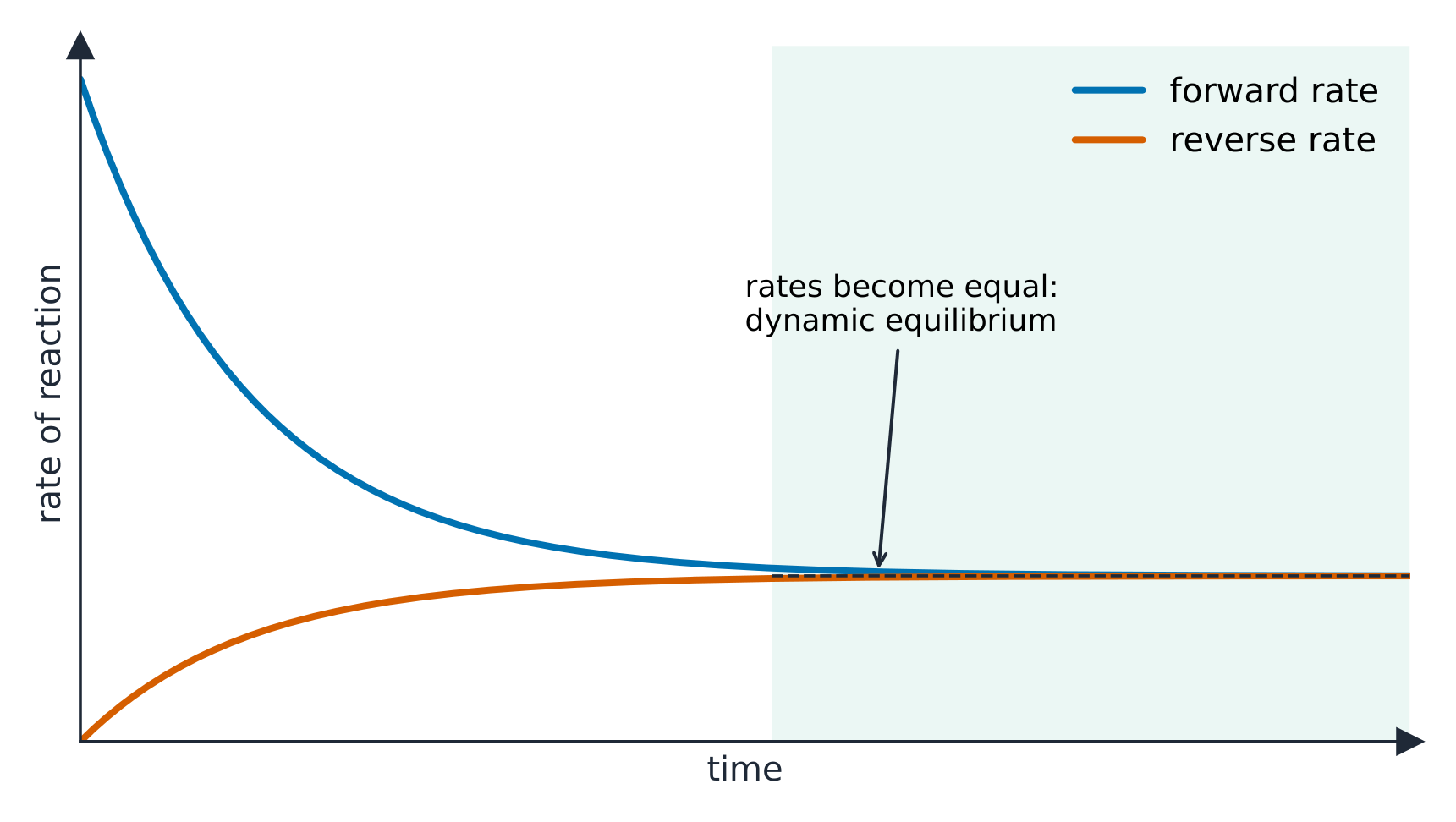
    $$\text{pH} + \text{pOH} = \text{p}K_w = 14.0$$
    (อีกครั้งที่ 25 °C). รู้ค่า pH หรือ pOH ใดค่าหนึ่ง คุณจะได้ค่าอีกค่าหนึ่งโดยการลบออกจาก 14
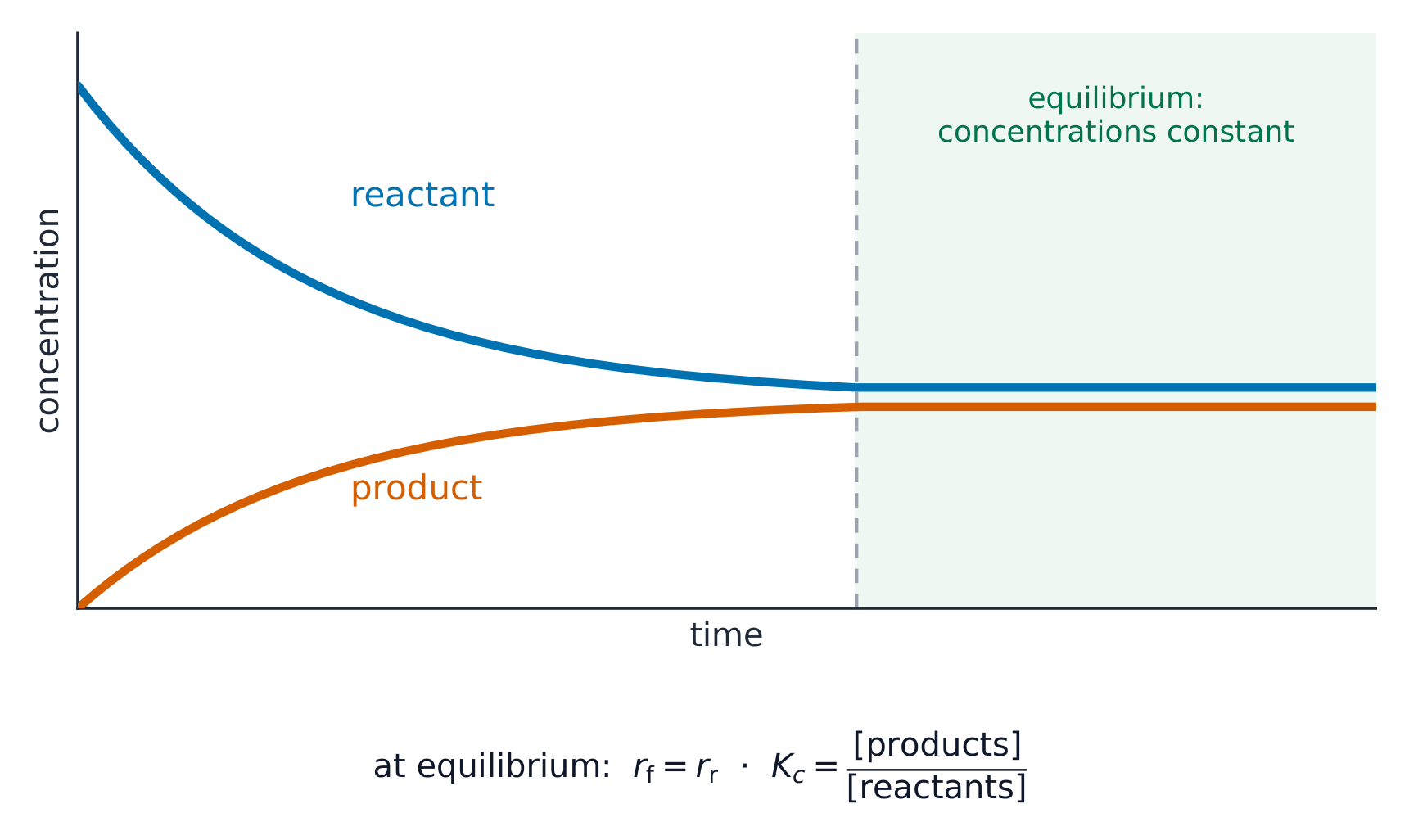
    ในน้ำบริสุทธิ์ ไอออนทั้งสองเกิดขึ้นในจำนวนเท่ากัน ดังนั้น $[\text{H}_3\text{O}^+]=[\text{OH}^-]$ และ $\text{pH}=\text{pOH}=7.0$ นี่คือสิ่งที่ ความเป็นกลาง หมายถึง กรดหมายถึง $[\text{H}_3\text{O}^+]>[\text{OH}^-]$ (pH ต่ำกว่า 7); เบสคือตรงกันข้าม

    ตัวอย่างวิธีทำ สารละลายมี $[\text{H}_3\text{O}^+]=2.0\times10^{-3}\ \text{M}$. หา $[\text{OH}^-]$. เพราะ $K_w$ เป็นจริงเสมอในน้ำ,

    $$[\text{OH}^-]=\frac{K_w}{[\text{H}_3\text{O}^+]}=\frac{1.0\times10^{-14}}{2.0\times10^{-3}}=5.0\times10^{-12}\ \text{M}.$$
    ความเข้มข้นไฮดรอกไซด์น้อยกว่ามากเมื่อเทียบกับไฮโดรเนียม ยืนยันว่าสารละลายนี้เป็นกรด

    $K_w$ ขึ้นอยู่กับอุณหภูมิ: การแตกตัวเองเป็นปฏิกิริยารับความร้อน ดังนั้นการเพิ่มอุณหภูมิน้ำจะทำให้สมดุลเลื่อนไปข้างหน้าและทำให้ $K_w$ เพิ่มขึ้น ที่ 50 °C, $K_w>1.0\times10^{-14}$ ดังนั้นน้ำที่เป็นกลางจะมี $\text{pH}=\text{pOH}<7.0$ มันยังคงเป็นกลางอยู่ เพราะความเข้มข้นของไอออนยังเท่ากัน – ความความเป็นกลางหมายถึงไอออนที่เท่ากัน ไม่ใช่ค่า pH เท่ากับ 7 พอดี

    แถบวัด pH: น้ำแตกตัวเองทำให้น้ำบริสุทธิ์มีค่า pH 7; กรดและเบสทำให้ H+ และ OH- เปลี่ยนแปลง
    แถบวัด pH: น้ำแตกตัวเองทำให้น้ำบริสุทธิ์มีค่า pH 7; กรดและเบสทำให้ H+ และ OH- เปลี่ยนแปลง
    8.2

    pH and pOH of Strong Acids and Bases · ⁨ค่า pH และ pOH ของกรดและเบสแรง⁩

    Syllabus · ⁨หลักสูตร⁩
    English

    Learning Objective 8.2.A: Calculate $\mathrm{pH}$ and $\mathrm{pOH}$ based on concentrations of all species in a solution of a strong acid or a strong base.

    • 8.2.A.1 Molecules of a strong acid (e.g., $\mathrm{HCl}$, $\mathrm{HBr}$, $\mathrm{HI}$, $\mathrm{HClO_4}$, $\mathrm{H_2SO_4}$, and $\mathrm{HNO_3}$) will completely ionize in aqueous solution to produce hydronium ions and the conjugate base of the acid. As such, the concentration of $\mathrm{H_3O^+}$ in a strong acid solution is equal to the initial concentration of the strong acid, and thus the $\mathrm{pH}$ of the strong acid solution is easily calculated.
    • 8.2.A.2 When dissolved in solution, strong bases (e.g., group I and II hydroxides) completely dissociate to produce hydroxide ions. As such, the concentration of $\mathrm{OH^-}$ in a strong base solution is equal to the initial concentration of a group I hydroxide and double the initial concentration of a group II hydroxide, and thus the $\mathrm{pOH}$ (and $\mathrm{pH}$) of the strong base solution is easily calculated.
    ไทย

    学习目的 8.2.A: 基于强酸或强碱溶液中所有物种的浓度计算$\mathrm{pH}$和$\mathrm{pOH}$。

    • 8.2.A.1 โมเลกุลของกรดแรง (เช่น $\mathrm{HCl}$, $\mathrm{HBr}$, $\mathrm{HI}$, $\mathrm{HClO_4}$, $\mathrm{H_2SO_4}$, และ $\mathrm{HNO_3}$) จะแตกตัวเป็นไอออนอย่างสมบูรณ์ในน้ำเพื่อสร้างไฮโดรนิ움ไอออนและเบสคู่ควบของกรด ดังนั้นความเข้มข้นของ $\mathrm{H_3O^+}$ ในสารละลายกรดแรงจึงเท่ากับความเข้มข้นเริ่มต้นของกรดแรง และดังนั้น $\mathrm{pH}$ ของสารละลายกรดแรงจึงคำนวณได้ง่าย
    • 8.2.A.2 当溶解在溶液中时,强碱(如第I族和第II族氢氧化物)完全解离产生氢氧根离子。因此,强碱溶液中$\mathrm{OH^-}$的浓度等于第I族氢氧化物的初始浓度和第II族氢氧化物初始浓度的两倍,从而强碱溶液的$\mathrm{pOH}$(以及$\mathrm{pH}$)易于计算。

    Source: College Board AP Course and Exam Description · ⁨แหล่งที่มา: คำอธิบายหลักสูตรและข้อสอบ College Board AP⁩

    English

    The pH pH值 scale measures acidity: $\text{pH}=-\log[\text{H}^+]$, with $\text{pH}+\text{pOH}=14$ at 25 °C. A strong acid 强酸 or strong base 强碱 dissociates completely, so its ion concentration equals its concentration – read pH directly. Lower pH means more acidic.

    Worked example. Find the pH of $0.010\ \text{M}$ HCl. Because HCl is a strong acid it is fully dissociated, so $[\text{H}^+]=0.010\ \text{M}$ and

    $$\text{pH}=-\log(0.010)=2.0.$$
    For a strong base like $0.010\ \text{M}$ NaOH, $\text{pOH}=2.0$, so $\text{pH}=14-2.0=12.0$.

    ไทย

    pH สเกลวัดความเป็นกรด: $\text{pH}=-\log[\text{H}^+]$, โดยมี $\text{pH}+\text{pOH}=14$ ที่ 25 °C. กรดแรง หรือ เบสแรง จะแตกตัว สมบูรณ์, ดังนั้นความเข้มข้นไอออนจึงเท่ากับความเข้มข้นสาร – อ่านค่า pH ได้โดยตรง ค่า pH ต่ำลงหมายความว่ามีความเป็นกรดมากขึ้น

    สเกล pH: pH คือลอการิทึมลบของความเข้มข้นไฮโดรเจนไอออน
    สเกล pH: pH คือลอการิทึมลบของความเข้มข้นไฮโดรเจนไอออน

    ตัวอย่างวิธีทำ. หา pH ของ $0.010\ \text{M}$ HCl เนื่องจาก HCl เป็นกรดแรงจึงแตกตัวสมบูรณ์ ทำให้ $[\text{H}^+]=0.010\ \text{M}$ และ

    $$\text{pH}=-\log(0.010)=2.0.$$
    สำหรับเบสแรงอย่าง $0.010\ \text{M}$ NaOH, $\text{pOH}=2.0$, ดังนั้น $\text{pH}=14-2.0=12.0$.

    Explore · ⁨สำรวจ⁩

    Move along the pH scale · ⁨เคลื่อนที่ไปตามสเกล pH⁩

    pH measures hydrogen-ion concentration on a log scale: each unit is a tenfold change. Strong acids sit low, strong bases high, 7 is neutral. · ⁨pH วัดความเข้มข้นของไฮโดรเจนไอออนบนสเกลลอการิทึม: แต่ละหน่วยคือการเปลี่ยนแปลงสิบเท่า กรดแรงมีค่าต่ำ เบสแรงมีค่าสูง, 7 เป็นกลาง⁩

    8.3

    Weak Acid and Base Equilibria · ⁨สมดุลกรดและเบสอ่อน⁩

    Syllabus · ⁨หลักสูตร⁩
    English

    Learning Objective 8.3.A: Explain the relationship among $\mathrm{pH}$, $\mathrm{pOH}$, and concentrations of all species in a solution of a monoprotic weak acid or weak base.

    • 8.3.A.1 Weak acids react with water to produce hydronium ions. However, only a small percentage of molecules of a weak acid will ionize in this way. Thus, the concentration of $\mathrm{H_3O^+}$ is much less than the initial concentration of the molecular acid, and the vast majority of the acid molecules remain un-ionized.
    • 8.3.A.2 A solution of a weak acid involves equilibrium between an un-ionized acid and its conjugate base. The equilibrium constant for this reaction is $K_a$, often reported as $\mathrm{p}K_a$. The pH of a weak acid solution can be determined from the initial acid concentration and the $\mathrm{p}K_a$.
      • Equation: $K_a = \dfrac{[\mathrm{H_3O^+}][\mathrm{A^-}]}{[\mathrm{HA}]}$
      • Equation: $\mathrm{p}K_a = -\log K_a$
    • 8.3.A.3 Weak bases react with water to produce hydroxide ions in solution. However, ordinarily just a small percentage of the molecules of a weak base in solution will ionize in this way. Thus, the concentration of $\mathrm{OH^-}$ in the solution does not equal the initial concentration of the base, and the vast majority of the base molecules remain un-ionized.
    • 8.3.A.4 A solution of a weak base involves equilibrium between an un-ionized base and its conjugate acid. The equilibrium constant for this reaction is $K_b$, often reported as $\mathrm{p}K_b$. The $\mathrm{pH}$ of a weak base solution can be determined from the initial base concentration and the $\mathrm{p}K_b$.
      • Equation: $K_b = \dfrac{[\mathrm{OH^-}][\mathrm{HB^+}]}{[\mathrm{B}]}$
      • Equation: $\mathrm{p}K_b = -\log K_b$
    • 8.3.A.5 The percent ionization of a weak acid (or base) can be calculated from its $\mathrm{p}K_a$ ($\mathrm{p}K_b$) and the initial concentration of the acid (base). The percent ionization can also be calculated from the initial concentration of the acid (base) and the equilibrium concentration of any of the species in the equilibrium expression.
    • 8.3.A.6 For any conjugate acid-base pair, the acid ionization constant and base ionization constant are related by $K_w$:
      • Equation: $K_w = K_a \times K_b$
      • Equation: $\mathrm{p}K_w = \mathrm{p}K_a + \mathrm{p}K_b$
    ไทย

    学习目标 8.3.A: 解释$\mathrm{pH}$、$\mathrm{pOH}$与一元弱酸或弱碱溶液中所有物种浓度之间的关系。

    • 8.3.A.1 弱酸与水反应生成水合氢离子。然而,只有很小比例的弱酸分子会以这种方式电离。因此,$\mathrm{H_3O^+}$的浓度远小于分子的初始酸浓度,绝大多数酸分子保持未电离状态。
    • 8.3.A.2 弱酸溶液涉及未电离酸与其共轭碱之间的平衡。该反应的平衡常数是$K_a$,通常报告为$\mathrm{p}K_a$。弱酸溶液的pH可以根据初始酸浓度和$\mathrm{p}K_a$确定。
      • สมการ: $K_a = \dfrac{[\mathrm{H_3O^+}][\mathrm{A^-}]}{[\mathrm{HA}]}$
      • สมการ: $\mathrm{p}K_a = -\log K_a$
    • 8.3.A.3 弱碱与水反应在溶液中产生氢氧根离子。然而,通常只有很小比例的溶液中的弱碱分子会以这种方式电离。因此,溶液中的$\mathrm{OH^-}$浓度不等于碱的初始浓度,绝大多数碱分子保持未电离状态。
    • 8.3.A.4 การหาค่า pH ของสารละลายเบสอ่อนเกี่ยวข้องกับสมดุลระหว่างเบสที่ไม่แตกตัวและกรดคู่ควบของมัน ค่าคงที่สมดุลสำหรับปฏิกิริยานี้คือ $K_b$ ซึ่งมักรายงานในรูป $\mathrm{p}K_b$ ค่า $\mathrm{pH}$ ของสารละลายเบสอ่อนสามารถคำนวณได้จากความเข้มข้นเริ่มต้นของเบสและความ $\mathrm{p}K_b$
      • สมการ: $K_b = \dfrac{[\mathrm{OH^-}][\mathrm{HB^+}]}{[\mathrm{B}]}$
      • สมการ: $\mathrm{p}K_b = -\log K_b$
    • 8.3.A.5 เปอร์เซ็นต์การแตกตัวของกรดอ่อน (หรือเบส) สามารถคำนวณได้จากค่า $\mathrm{p}K_a$ ($\mathrm{p}K_b$) และความเข้มข้นเริ่มต้นของกรด (เบส) เปอร์เซ็นต์การแตกตัวยังสามารถคำนวณได้จากความเข้มข้นเริ่มต้นของกรด (เบส) และความเข้มข้นที่สมดุลของสปีชีส์ใดๆ ในนิพจน์สมดุล
    • 8.3.A.6 สำหรับคู่กรด-เบสคู่ควบ ค่าคงที่การแตกตัวของกรดและค่าคงที่การแตกตัวของเบสจะสัมพันธ์กันโดย $K_w$:
      • สมการ: $K_w = K_a \times K_b$
      • สมการ: $\mathrm{p}K_w = \mathrm{p}K_a + \mathrm{p}K_b$

    Source: College Board AP Course and Exam Description · ⁨แหล่งที่มา: คำอธิบายหลักสูตรและข้อสอบ College Board AP⁩

    English

    A weak acid 弱酸 only partly dissociates, described by an equilibrium constant $K_a$ (larger $K_a$ = stronger weak acid); a weak base has $K_b$. For any conjugate acid–base pair the two are linked through water, $K_a\times K_b = K_w$, so $\text{p}K_a+\text{p}K_b=14$ – a stronger acid always has a weaker conjugate base. Because dissociation is small, find $[\text{H}^+]$ with an ICE table and the $K_a$ expression, often using the small-$x$ approximation.

    Worked example. Find the pH of $0.10\ \text{M}$ acetic acid, $K_a=1.8\times10^{-5}$. Let $x=[\text{H}^+]$ at equilibrium; the ICE table gives $K_a=\dfrac{x^2}{0.10-x}\approx\dfrac{x^2}{0.10}$ (small-$x$ approximation), so

    $$x=\sqrt{K_a\times0.10}=\sqrt{1.8\times10^{-6}}=1.3\times10^{-3}\ \text{M}\;\Rightarrow\;\text{pH}=-\log(1.3\times10^{-3})=2.9.$$
    The weak acid is far less acidic than a strong acid of the same concentration (which would be pH $1.0$).

    ไทย

    กรดอ่อนจะแตกตัว บางส่วน เท่านั้น อธิบายได้ด้วยค่าคงที่สมดุล $K_a$ (ค่า $K_a$ ที่ใหญ่ขึ้น = กรดอ่อนที่แข็งแรงขึ้น); ฐานอ่อนจะมี $K_b$ สำหรับคู่กรด-เบสที่สัมพันธ์กัน ทั้งสองจะเชื่อมโยงผ่านน้ำ $K_a\times K_b = K_w$ ดังนั้น $\text{p}K_a+\text{p}K_b=14$ – กรดที่แข็งแรงกว่าจะมีเบสที่สัมพันธ์กันอ่อนกว่าเสมอ เนื่องจากมีการแตกตัวน้อย ให้หาค่า $[\text{H}^+]$ โดยใช้ตาราง ICE และสมการ $K_a$ โดยมักใช้การประมาณค่า $x$ ที่น้อย

    ตัวอย่างวิธีทำ. หา pH ของ $0.10\ \text{M}$ กรดอะซิติก, $K_a=1.8\times10^{-5}$. กำหนด $x=[\text{H}^+]$ ที่สมดุล ตาราง ICE จะได้ $K_a=\dfrac{x^2}{0.10-x}\approx\dfrac{x^2}{0.10}$ (การประมาณค่า $x$ เล็ก), ดังนั้น

    $$x=\sqrt{K_a\times0.10}=\sqrt{1.8\times10^{-6}}=1.3\times10^{-3}\ \text{M}\;\Rightarrow\;\text{pH}=-\log(1.3\times10^{-3})=2.9.$$
    กรดอ่อนนี้เป็นกรดได้น้อยกว่ากรดแรงที่มีความเข้มข้นเท่ากันมาก (ซึ่งจะมีค่า pH $1.0$)

    8.4

    Acid-Base Reactions and Buffers · ⁨ปฏิกิริยากรด-เบสและสารบัฟเฟอร์⁩

    Syllabus · ⁨หลักสูตร⁩
    English

    Learning Objective 8.4.A: Explain the relationship among the concentrations of major species in a mixture of weak and strong acids and bases.

    • 8.4.A.1 When a strong acid and a strong base are mixed, they react quantitatively in a reaction represented by the equation: $\mathrm{H^+}(aq) + \mathrm{OH^-}(aq) \rightarrow \mathrm{H_2O}(l)$. The pH of the resulting solution may be determined from the concentration of excess reagent.
    • 8.4.A.2 When a weak acid and a strong base are mixed, they react quantitatively in a reaction represented by the equation: $\mathrm{HA}(aq) + \mathrm{OH^-}(aq) \rightleftarrows \mathrm{A^-}(aq)\ \mathrm{H_2O}(l)$. If the weak acid is in excess, then a buffer solution is formed, and the $\mathrm{pH}$ can be determined from the Henderson-Hasselbalch (H–H) equation (see 8.9.A.1). If the strong base is in excess, then the $\mathrm{pH}$ can be determined from the moles of excess hydroxide ion and the total volume of solution. If they are equimolar, then the (slightly basic) $\mathrm{pH}$ can be determined from the equilibrium represented by the equation: $\mathrm{A^-}(aq) + \mathrm{H_2O}(l) \rightleftarrows \mathrm{HA}(aq) + \mathrm{OH^-}(aq)$.
    • 8.4.A.3 When a weak base and a strong acid are mixed, they will react quantitatively in a reaction represented by the equation: $\mathrm{B}(aq) + \mathrm{H_3O^+}(aq) \rightleftarrows \mathrm{HB^+}(aq) + \mathrm{H_2O}(l)$. If the weak base is in excess, then a buffer solution is formed, and the $\mathrm{pH}$ can be determined from the H–H equation. If the strong acid is in excess, then the $\mathrm{pH}$ can be determined from the moles of excess hydronium ion and the total volume of solution. If they are equimolar, then the (slightly acidic) $\mathrm{pH}$ can be determined from the equilibrium represented by the equation: $\mathrm{HB^+}(aq) + \mathrm{H_2O}(l) \rightleftarrows \mathrm{B}(aq) + \mathrm{H_3O^+}(aq)$.
    • 8.4.A.4 When a weak acid and a weak base are mixed, they will react to an equilibrium state whose reaction may be represented by the equation: $\mathrm{HA}(aq) + \mathrm{B}(aq) \rightleftarrows \mathrm{A^-}(aq) + \mathrm{HB^+}(aq)$.
    ไทย

    จุดประสงค์การเรียนรู้ 8.4.A: อธิบายความสัมพันธ์ระหว่างความเข้มข้นของสปีชีส์หลักในสารผสมระหว่างกรดอ่อนและเบสอ่อนกับกรดแรงและเบสแรง

    • 8.4.A.1 เมื่อผสมกรดแรงกับเบสแรง จะเกิดปฏิกิริยาตามปริมาณที่แสดงด้วยสมการ: $\mathrm{H^+}(aq) + \mathrm{OH^-}(aq) \rightarrow \mathrm{H_2O}(l)$ ค่า pH ของสารละลายที่เกิดขึ้นสามารถพิจารณาได้จากความเข้มข้นของสารตั้งต้นที่เหลือเกิน
    • 8.4.A.2 เมื่อผสมกรดอ่อนกับเบสแรง จะเกิดปฏิกิริยาตามปริมาณที่แสดงด้วยสมการ: $\mathrm{HA}(aq) + \mathrm{OH^-}(aq) \rightleftarrows \mathrm{A^-}(aq)\ \mathrm{H_2O}(l)$ หากกรดอ่อนเหลือเกิน จะเกิดสารละลายบัฟเฟอร์ และค่า $\mathrm{pH}$ สามารถคำนวณได้จากสมการเฮนเดอร์สัน-แฮสเซลดาลช์ (H–H) (ดู 8.9.A.1) หากเบสแรงเหลือเกิน ค่า $\mathrm{pH}$ สามารถคำนวณจากโมลของไอออนไฮดรอกไซด์เหลือเกินและปริมาตรรวมของสารละลาย หากมีจำนวนโมลเท่ากัน ค่า (เป็นเบสเล็กน้อย) $\mathrm{pH}$ สามารถคำนวณได้จากสมดุลที่แสดงด้วยสมการ: $\mathrm{A^-}(aq) + \mathrm{H_2O}(l) \rightleftarrows \mathrm{HA}(aq) + \mathrm{OH^-}(aq)$
    • 8.4.A.3 เมื่อผสมเบสอ่อนกับกรดแรง จะเกิดปฏิกิริยาตามปริมาณที่แสดงด้วยสมการ: $\mathrm{B}(aq) + \mathrm{H_3O^+}(aq) \rightleftarrows \mathrm{HB^+}(aq) + \mathrm{H_2O}(l)$ หากเบสอ่อนเหลือเกิน จะเกิดสารละลายบัฟเฟอร์ และค่า $\mathrm{pH}$ สามารถคำนวณได้จากสมการ H–H หากกรดแรงเหลือเกิน ค่า $\mathrm{pH}$ สามารถคำนวณจากโมลของไอออนไฮโดรเนียมเหลือเกินและปริมาตรรวมของสารละลาย หากมีจำนวนโมลเท่ากัน ค่า (เป็นกรดเล็กน้อย) $\mathrm{pH}$ สามารถคำนวณได้จากสมดุลที่แสดงด้วยสมการ: $\mathrm{HB^+}(aq) + \mathrm{H_2O}(l) \rightleftarrows \mathrm{B}(aq) + \mathrm{H_3O^+}(aq)$
    • 8.4.A.4 เมื่อผสมกรดอ่อนกับเบสอ่อน จะเกิดปฏิกิริยาไปจนถึงสถานะสมดุลซึ่งสามารถแสดงได้ด้วยสมการ: $\mathrm{HA}(aq) + \mathrm{B}(aq) \rightleftarrows \mathrm{A^-}(aq) + \mathrm{HB^+}(aq)$

    Source: College Board AP Course and Exam Description · ⁨แหล่งที่มา: คำอธิบายหลักสูตรและข้อสอบ College Board AP⁩

    English

    A buffer 缓冲溶液 resists pH change. It contains a weak acid and its conjugate base (or a weak base and its conjugate acid) in comparable amounts. Added acid is neutralized by the conjugate base, and added base by the weak acid, so pH barely moves.

    ไทย

    สารบัฟเฟอร์ ทนต่อการเปลี่ยนแปลงค่า pH มีกรดอ่อน และ เบสคู่ควบของมัน (หรือเบสอ่อนและกรดคู่ควบ) ในปริมาณใกล้เคียงกัน เมื่อเพิ่มกรดจะถูก中和โดยเบสคู่ควบ และเมื่อเพิ่มเบสจะถูก中和โดยกรดอ่อน ทำให้ค่า pH เคลื่อนไหวเล็กน้อย

    8.5

    Acid-Base Titrations · ⁨การไทเทรตกรด-เบส⁩

    Syllabus · ⁨หลักสูตร⁩
    English

    Learning Objective 8.5.A: Explain results from the titration of a mono- or polyprotic acid or base solution, in relation to the properties of the solution and its components.

    • 8.5.A.1 An acid-base reaction can be carried out under controlled conditions in a titration. A titration curve, plotting $\mathrm{pH}$ against the volume of titrant added, is useful for summarizing results from a titration.
    • 8.5.A.2 At the equivalence point for titrations of monoprotic acids or bases, the number of moles of titrant added is equal to the number of moles of analyte originally present. This relationship can be used to obtain the concentration of the analyte. This is the case for titrations of strong acids/bases and weak acids/bases.
    • 8.5.A.3 For titrations of weak acids/bases, it is useful to consider the point halfway to the equivalence point, that is, the half-equivalence point. At this point, there are equal concentrations of each species in the conjugate acid-base pair, for example, for a weak acid $[\mathrm{HA}] = [\mathrm{A^-}]$. Because $\mathrm{pH} = \mathrm{p}K_a$ when the conjugate acid and base have equal concentrations, the $\mathrm{p}K_a$ can be determined from the $\mathrm{pH}$ at the half-equivalence point in a titration.
    • 8.5.A.4 At the equivalence point, pH is determined by the major species in solution. Strong acid and strong base titrations result in neutral pH at the equivalence point. However, in titrations of weak acids (weak bases), the conjugate base of the weak acid (conjugate acid of the weak base) is present at the equivalence point and can undergo proton-transfer reactions with the surrounding water, producing basic (acidic) solutions.
    • 8.5.A.5 For polyprotic acids, titration curves can be used to determine the number of acidic protons. In doing so, the major species present at any point along the curve can be identified, along with the $\mathrm{p}K_a$ associated with each proton in a weak polyprotic acid.
      • Exclusion statement: Computation of the concentration of each species present in the titration curve for polyprotic acids will not be assessed on the AP Exam. Such computations for titration of monoprotic acids are within the scope of the course (see 8.4.A.2 and 8.4.A.3), as is qualitative reasoning regarding what species are present in large versus small concentrations at any point in a titration of a polyprotic acid.
    ไทย

    จุดประสงค์การเรียนรู้ 8.5.A: อธิบายผลการไทเทรตสารละลายกรดหรือเบสแบบโปรตอนเดียวหรือหลายโปรตอน โดยเชื่อมโยงกับคุณสมบัติของสารละลายและองค์ประกอบต่างๆ

    • 8.5.A.1 ปฏิกิริยาระหว่างกรดกับเบสสามารถดำเนินการภายใต้เงื่อนไขควบคุมได้ในการไทเทรต กราฟไทเทรตซึ่งพล็อต $\mathrm{pH}$ เทียบกับปริมาตรของสารไทเทรตที่เติมเข้าไป มีประโยชน์ต่อการสรุปผลการไทเทรต
    • 8.5.A.2 ที่จุดเสมอส่วนสำหรับการไทเทรตกรดหรือเบสแบบโปรตอนเดียว จำนวนโมลของสารไทเทรตที่เติมเข้าไปจะเท่ากับจำนวนโมลของสารวิเคราะห์ที่มีอยู่เดิม ความสัมพันธ์นี้สามารถใช้หาค่าความเข้มข้นของสารวิเคราะห์ได้ เป็นกรณีของการไทเทรตกรด/เบสแรงและกรด/เบสอ่อน
    • 8.5.A.3 สำหรับการไทเทรตกรด/เบสอ่อน จะมีความสำคัญในการพิจารณาจุดกึ่งกลาง menujuจุดเสมอส่วน นั่นคือ จุดกึ่งเสมอส่วน ที่จุดนี้ มีความเข้มข้นเท่ากันของสปีชีส์แต่ละชนิดในคู่กรด-เบสคู่คอนจูเกต เช่น สำหรับกรดอ่อน $[\mathrm{HA}] = [\mathrm{A^-}]$ เนื่องจาก $\mathrm{pH} = \mathrm{p}K_a$ เมื่อกรดและเบสคู่คอนจูเกตมีความเข้มข้นเท่ากัน ค่า $\mathrm{p}K_a$ สามารถคำนวณได้จาก $\mathrm{pH}$ ที่จุดกึ่งเสมอส่วนในการไทเทรต
    • 8.5.A.4 ที่จุดเสมอส่วน ค่า pH ถูกกำหนดโดยสปีชีส์หลักในสารละลาย การไทเทรตกรดแรงและเบสแรงให้ค่า pH เป็นกลางที่จุดเสมอส่วน แต่ในการไทเทรตกรดอ่อน (เบสอ่อน) เบสคู่คอนจูเกตของกรดอ่อน (กรดคู่คอนจูเกตของเบสอ่อน) จะมีอยู่ที่จุดเสมอส่วนและสามารถทำปฏิกิริยาถ่ายโอนโปรตอนกับน้ำรอบข้าง ทำให้เกิดสารละลายที่เป็นเบส (กรด)
    • 8.5.A.5 สำหรับกรดหลายโปรตอน กราฟไทเทรตสามารถใช้ระบุจำนวนโปรตอนที่เป็นกรดได้ ในการทำเช่นนี้ สามารถระบุสปีชีส์หลักที่มีอยู่ ณ จุดใดๆ บนกราฟ พร้อมด้วย $\mathrm{p}K_a$ ที่เกี่ยวข้องกับโปรตอนแต่ละตัวในกรดหลายโปรตอนอ่อน
      • ข้อจำกัด: การคำนวณความเข้มข้นของแต่ละสปีชีส์ที่มีอยู่ในกราฟไทเทรตสำหรับกรดหลายโปรตอนจะไม่ถูกทดสอบในข้อสอบ AP การคำนวณดังกล่าวสำหรับการไทเทรตกรดโปรตอนเดียวอยู่ในขอบเขตของหลักสูตร (ดู 8.4.A.2 และ 8.4.A.3) รวมถึงการให้เหตุผลเชิงคุณภาพเกี่ยวกับสปีชีส์ใดมีอยู่มากหรือน้อย ณ จุดใดๆ ของการไทเทรตกรดหลายโปรตอน

    Source: College Board AP Course and Exam Description · ⁨แหล่งที่มา: คำอธิบายหลักสูตรและข้อสอบ College Board AP⁩

    English
    An acid–base titration curve

    A titration curve 滴定曲线 plots pH as base (or acid) is added. Key points: the equivalence point 等当点 (moles of acid = moles of base – a steep jump), and the half-equivalence point, where $\text{pH}=\text{p}K_a$ (half the weak acid is converted, so a buffer is at its center).

    An acid-base indicator 酸碱指示剂 is itself a weak acid whose protonated and deprotonated forms have different colours, so its colour responds to pH. You pick an indicator whose colour change happens near the titration's equivalence-point pH, so the colour flips just as the reaction completes.

    ไทย
    กราฟไทเทรชันกรด-เบส

    กราฟการไทเทรตแสดงค่า pH เมื่อเพิ่มเบส (หรือกรด) จุดสำคัญ: จุดเทียบเท่า (โมลของกรด = โมลของเบส – มีการกระโดดสูงชัน) และ จุดครึ่งเทียบเท่า, ที่ $\text{pH}=\text{p}K_a$ (กรดอ่อนถูกเปลี่ยนไปครึ่งหนึ่ง ทำให้สารบัฟเฟอร์อยู่ในจุดกึ่งกลาง)

    ตัวบ่งชี้กรด-เบส เป็นกรดอ่อนชนิดหนึ่งที่มีรูปทรงที่มีโปรตอนและไม่มีโปรตอน สีต่างกัน, ดังนั้นสีจึงตอบสนองต่อค่า pH คุณเลือกตัวบ่งชี้whose สีเปลี่ยนใกล้กับค่า pH ที่จุดเทียบเท่าของการไทเทรต เพื่อให้สีเปลี่ยนทันทีเมื่อปฏิกิริยาเสร็จสิ้น

    กราฟการไทเทรตมีการกระโดดสูงชันใกล้จุดเทียบเท่า
    กราฟการไทเทรตมีการกระโดดสูงชันใกล้จุดเทียบเท่า
    Explore · ⁨สำรวจ⁩

    Titrate to the equivalence point · ⁨ไทเทรตถึงจุดสมมูล⁩

    A titration curve rises gently, then sharply at the equivalence point where moles of acid and base match. The steep jump pinpoints that volume. · ⁨กราฟไทเทรต เพิ่มขึ้นอย่างช้าๆ แล้วพุ่งขึ้นอย่างรวดเร็วที่ จุดสมมูล ซึ่งโมลของกรดและเบสเท่ากัน จุดกระโดดชันนี้จะระบุปริมาตรนั้นได้อย่างแม่นยำ⁩

    Vocabulary · ⁨คำศัพท์⁩ Train · ⁨ฝึกฝน⁩
    English ไทย
    titration curve/taɪˈtreɪʃn kɜːv/ กราฟการไทเทรต
    equivalence point/ɪˈkwɪvələns pɔɪnt/ จุดสมมูล
    acid-base indicator/ˈæsɪd beɪs ˈɪndɪkeɪtə/ อินดิเคเตอร์กรด-เบส
    Buffer capacity/ˈbʌfə kəˈpæsɪti/ ความจุของบัฟเฟอร์
    8.6

    Molecular Structure of Acids and Bases · ⁨โครงสร้างโมเลกุลของกรดและเบส⁩

    Syllabus · ⁨หลักสูตร⁩
    Learning ObjectiveEssential Knowledge

    8.6.A
    Explain the relationship between the strength of an acid or base and the structure of the molecule or ion.

    • 8.6.A.1 The protons on a molecule that will participate in acid-base reactions, and the relative strength of these protons, can be inferred from the molecular structure.
      • i. Strong acids (such as $\mathrm{HCl}$, $\mathrm{HBr}$, $\mathrm{HI}$, $\mathrm{HClO_4}$, $\mathrm{H_2SO_4}$, and $\mathrm{HNO_3}$) have very weak conjugate bases that are stabilized by electronegativity, inductive effects, resonance, or some combination thereof.
      • ii. Carboxylic acids are one common class of weak acid.
      • iii. Strong bases (such as group I and II hydroxides) have very weak conjugate acids.
      • iv. Common weak bases include nitrogenous bases such as ammonia as well as carboxylate ions.
      • v. Electronegative elements tend to stabilize the conjugate base relative to the conjugate acid, and so increase acid strength.

    Source: College Board AP Course and Exam Description · ⁨แหล่งที่มา: คำอธิบายหลักสูตรและข้อสอบ College Board AP⁩

    English

    Strength has structural roots. An acid is stronger when its conjugate base is more stable – for example, more electronegative atoms or resonance spreading the negative charge stabilize it. For oxoacids, more oxygen atoms on the central atom means a stronger acid.

    ไทย

    ความแรงมีรากฐานมาจากโครงสร้าง กรดจะแรงขึ้นเมื่อ เบสคู่ควบมีความเสถียรมากขึ้น – เช่น เมื่อมีอะตอมที่มีประจุลบสูงหรือการกระจายตัวของประจุด้วยเรโซแนนซ์ช่วยทำให้เสถียร สำหรับกรดออกโซ (oxoacids) การมีอะตอมออกซิเจนมากขึ้นบนอะตอมกลางจะทำให้เป็นกรดที่แรงขึ้น

    8.7

    pH and pKa · ⁨ค่า pH และ pKa⁩

    Syllabus · ⁨หลักสูตร⁩
    English

    Learning Objective 8.7.A: Explain the relationship between the predominant form of a weak acid or base in solution at a given $\mathrm{pH}$ and the $\mathrm{p}K_a$ of the conjugate acid or the $\mathrm{p}K_b$ of the conjugate base.

    • 8.7.A.1 The protonation state of an acid or base (i.e., the relative concentrations of $\mathrm{HA}$ and $\mathrm{A^-}$) can be predicted by comparing the $\mathrm{pH}$ of a solution to the $\mathrm{p}K_a$ of the acid in that solution. When solution $\mathrm{pH} < \mathrm{acid}\ \mathrm{p}K_a$, the acid form has a higher concentration than the base form. When solution $\mathrm{pH} > \mathrm{acid}\ \mathrm{p}K_a$, the base form has a higher concentration than the acid form.
    • 8.7.A.2 Acid-base indicators are substances that exhibit different properties (such as color) in their protonated versus deprotonated state, making that property respond to the $\mathrm{pH}$ of a solution.
    • 8.7.A.3 To ensure accurate results in a titration experiment, acid-base indicators should be selected that have a $\mathrm{p}K_a$ close to the $\mathrm{pH}$ at the equivalence point.
    ไทย

    วัตถุประสงค์การเรียนรู้ 8.7.A: อธิบายความสัมพันธ์ระหว่างรูปแบบหลักของกรดอ่อนหรือเบสอ่อนในสารละลายที่ $\mathrm{pH}$ ที่กำหนดไว้ กับ $\mathrm{p}K_a$ ของกรดคู่ควบ หรือ $\mathrm{p}K_b$ ของเบสคู่ควบ

    • 8.7.A.1 สถานะการรับโปรตอนของกรดหรือเบส (คือ ความเข้มข้นสัมพัทธ์ของ $\mathrm{HA}$ และ $\mathrm{A^-}$) สามารถทำนายได้โดยการเปรียบเทียบ $\mathrm{pH}$ ของสารละลายกับ $\mathrm{p}K_a$ ของกรดในสารละลายนั้น เมื่อสารละลายมี $\mathrm{pH} < \mathrm{acid}\ \mathrm{p}K_a$ รูปแบบกรดจะมีความเข้มข้นสูงกว่ารูปแบบเบส เมื่อสารละลายมี $\mathrm{pH} > \mathrm{acid}\ \mathrm{p}K_a$ รูปแบบเบสจะมีความเข้มข้นสูงกว่ารูปแบบกรด
    • 8.7.A.2 ตัวบ่งชี้กรด-เบสเป็นสารที่แสดงคุณสมบัติที่แตกต่างกัน (เช่น สี) ในสถานะการรับโปรตอนและสถานะการสูญเสียโปรตอน ทำให้คุณสมบัตินั้นตอบสนองต่อการเปลี่ยนแปลง $\mathrm{pH}$ ของสารละลาย
    • 8.7.A.3 เพื่อให้ได้ผลลัพธ์ที่แม่นยำในการทดลองไทเทรต ควรเลือกตัวบ่งชี้กรด-เบสที่มี $\mathrm{p}K_a$ ใกล้กับ $\mathrm{pH}$ ที่จุดสมมูล

    Source: College Board AP Course and Exam Description · ⁨แหล่งที่มา: คำอธิบายหลักสูตรและข้อสอบ College Board AP⁩

    English

    $\text{p}K_a=-\log K_a$: a smaller $\text{p}K_a$ means a stronger acid. Comparing pH to $\text{p}K_a$ tells you the dominant form: below $\text{p}K_a$ the acid form dominates; above it, the conjugate base form dominates.

    ไทย

    $\text{p}K_a=-\log K_a$: ค่า $\text{p}K_a$ ที่ น้อยลง บ่งบอกถึงกรดที่ แรงขึ้น การเปรียบเทียบค่า pH กับ $\text{p}K_a$ บอกคุณได้ว่ารูปทรงใดจะโดดเด่นกว่า: ต่ำกว่า $\text{p}K_a$ รูปทรงกรดจะโดดเด่น; สูงกว่านั้น รูปทรงเบสคู่ควบจะโดดเด่น

    8.8

    Properties of Buffers · ⁨คุณสมบัติของสารกันกรดด่าง⁩

    Syllabus · ⁨หลักสูตร⁩
    English

    Learning Objective 8.8.A: Explain the relationship between the ability of a buffer to stabilize $\mathrm{pH}$ and the reactions that occur when an acid or a base is added to a buffered solution.

    • 8.8.A.1 A buffer solution contains a large concentration of both members in a conjugate acid-base pair. The conjugate acid reacts with added base and the conjugate base reacts with added acid. These reactions are responsible for the ability of a buffer to stabilize $\mathrm{pH}$.
    ไทย

    วัตถุประสงค์การเรียนรู้ 8.8.A: อธิบายความสัมพันธ์ระหว่างความสามารถของบัฟเฟอร์ในการรักษา $\mathrm{pH}$ ให้คงที่ กับปฏิกิริยาที่เกิดขึ้นเมื่อเติมกรดหรือเบสลงในสารละลายที่มีบัฟเฟอร์

    • 8.8.A.1 สารละลายบัฟเฟอร์มีความเข้มข้นสูงของทั้งสองส่วนในคู่กรด-เบสคู่ควบ กรดคู่ควบจะทำปฏิกิริยากับเบสที่ถูกเติมเข้าไป และเบสคู่ควบจะทำปฏิกิริยากับกรดที่ถูกเติมเข้าไป ปฏิกิริยาเหล่านี้เป็นสาเหตุที่ทำให้บัฟเฟอร์สามารถรักษา $\mathrm{pH}$ ให้คงที่ได้

    Source: College Board AP Course and Exam Description · ⁨แหล่งที่มา: คำอธิบายหลักสูตรและข้อสอบ College Board AP⁩

    English
    How a buffer resists pH change

    A buffer works best when the weak acid and conjugate base concentrations are similar (pH near $\text{p}K_a$). Choose a buffer whose $\text{p}K_a$ is close to the target pH. Diluting a buffer barely changes its pH, because the acid-to-base ratio stays the same.

    ไทย
    สารกันกรดด่างต้านทานการเปลี่ยนแปลงค่า pHอย่างไร

    สารกันกรดด่างทำงานได้ดีที่สุดเมื่อความเข้มข้นของกรดอ่อนและเบสคู่ควบ ใกล้เคียงกัน (ค่า pH ใกล้เคียง $\text{p}K_a$) เลือกสารกันกรดด่างที่มี $\text{p}K_a$ ใกล้เคียงกับค่า pH เป้าหมาย การเจือจางสารกันกรดด่างแทบไม่เปลี่ยนค่า pH เพราะ อัตราส่วน ระหว่างกรดต่อเบสคงเดิม

    สารกันกรดด่างต้านทานการเปลี่ยนแปลงค่า pHโดยการดูดซับกรดหรือเบสที่เติมเข้าไป
    สารกันกรดด่างต้านทานการเปลี่ยนแปลงค่า pHโดยการดูดซับกรดหรือเบสที่เติมเข้าไป
    Vocabulary · ⁨คำศัพท์⁩ Train · ⁨ฝึกฝน⁩
    English ไทย
    buffer/ˈbʌfə/ buffer
    8.9

    The Henderson-Hasselbalch Equation · ⁨สมการเฮนเดอร์สัน-เฮซเซลบัลช⁩

    Syllabus · ⁨หลักสูตร⁩
    English

    Learning Objective 8.9.A: Identify the $\mathrm{pH}$ of a buffer solution based on the identity and concentrations of the conjugate acid-base pair used to create the buffer.

    • 8.9.A.1 The $\mathrm{pH}$ of the buffer is related to the $\mathrm{p}K_a$ of the acid and the concentration ratio of the conjugate acid-base pair. This relation is a consequence of the equilibrium expression associated with the dissociation of a weak acid, and is described by the Henderson-Hasselbalch equation. Adding small amounts of acid or base to a buffered solution does not significantly change the ratio of $[\mathrm{A^-}]/[\mathrm{HA}]$ and thus does not significantly change the solution $\mathrm{pH}$. The change in $\mathrm{pH}$ on addition of acid or base to a buffered solution is therefore much less than it would have been in the absence of the buffer.
      • Equation: $\mathrm{pH} = \mathrm{p}K_a + \log\dfrac{[\mathrm{A^-}]}{[\mathrm{HA}]}$
      • Exclusion statement: Computation of the change in pH resulting from the addition of an acid or a base to a buffer will not be assessed on the AP Exam.
      • Exclusion statement: Derivation of the Henderson-Hasselbalch equation will not be assessed on the AP Exam.
    ไทย

    วัตถุประสงค์การเรียนรู้ 8.9.A: ระบุ $\mathrm{pH}$ ของสารละลายบัฟเฟอร์โดยพิจารณาจากเอกลักษณ์และความเข้มข้นของคู่กรด-เบสคู่ควบที่ใช้เตรียมบัฟเฟอร์นั้น

    • 8.9.A.1 $\mathrm{pH}$ ของบัฟเฟอร์เกี่ยวข้องกับ $\mathrm{p}K_a$ ของกรดและอัตราส่วนความเข้มข้นของคู่กรด-เบสคู่ควบ ความสัมพันธ์นี้เป็นผลมาจากรูปแบบสมดุลที่เกี่ยวข้องกับการแตกตัวของกรดอ่อน และอธิบายได้ด้วยสมการเฮนเดอร์สัน-ฮาazelbalch การเติมกรดหรือเบสในปริมาณเล็กน้อยลงไปในสารละลายบัฟเฟอร์จะไม่เปลี่ยนอัตราส่วนของ $[\mathrm{A^-}]/[\mathrm{HA}]$ อย่างมีนัยสำคัญ จึงไม่ทำให้ $\mathrm{pH}$ ของสารละลายเปลี่ยนแปลงอย่างมาก การเปลี่ยนแปลงของ $\mathrm{pH}$ เมื่อเติมกรดหรือเบสลงในสารละลายบัฟเฟอร์จึงน้อยกว่ามากเมื่อเทียบกับการเปลี่ยนแปลงที่ไม่มีบัฟเฟอร์อยู่
      • สมการ: $\mathrm{pH} = \mathrm{p}K_a + \log\dfrac{[\mathrm{A^-}]}{[\mathrm{HA}]}$
      • ข้อจำกัด: การคำนวณการเปลี่ยนแปลงค่า pH ที่เกิดจากการเติมกรดหรือเบสลงในบัฟเฟอร์ จะไม่ถูกวัดความรู้ในข้อสอบ AP
      • ข้อจำกัด: การพิสูจน์ที่มาของสมการเฮนเดอร์สัน-ฮาazelbalch จะไม่ถูกวัดความรู้ในข้อสอบ AP

    Source: College Board AP Course and Exam Description · ⁨แหล่งที่มา: คำอธิบายหลักสูตรและข้อสอบ College Board AP⁩

    English

    For a buffer, the pH follows from the acid-to-base ratio:

    $$\text{pH}=\text{p}K_a+\log\frac{[\text{A}^-]}{[\text{HA}]}.$$
    When the concentrations are equal, the log is zero and $\text{pH}=\text{p}K_a$. Use it to design a buffer or find its pH quickly.

    Worked example. A buffer holds $0.20\ \text{M}$ acetic acid ($\text{p}K_a=4.74$) and $0.30\ \text{M}$ acetate. Its pH is

    $$\text{pH}=4.74+\log\frac{0.30}{0.20}=4.74+\log(1.5)=4.74+0.18=4.92.$$
    A little more conjugate base than acid pushes the pH just above $\text{p}K_a$, as the equation predicts.

    ไทย

    สำหรับสารกันกรดด่าง ค่า pH สามารถหาได้จากอัตราส่วนกรดต่อเบส:

    $$\text{pH}=\text{p}K_a+\log\frac{[\text{A}^-]}{[\text{HA}]}.$$
    เมื่อความเข้มข้นเท่ากัน ลอกaritึมจะเป็นศูนย์และ $\text{pH}=\text{p}K_a$ ใช้สมการนี้ในการออกแบบสารกันกรดด่างหรือหาค่า pH ได้รวดเร็ว

    ตัวอย่างฝึกปฏิบัติ. สารกันกรดด่างหนึ่งประกอบด้วย $0.20\ \text{M}$ กรดอะซิติก ($\text{p}K_a=4.74$) และ $0.30\ \text{M}$ อะซิเตต ค่า pH ของมันคือ

    $$\text{pH}=4.74+\log\frac{0.30}{0.20}=4.74+\log(1.5)=4.74+0.18=4.92.$$
    เมื่อมีเบสคู่ควบมากกว่ากรดเล็กน้อย จะผลักให้ค่า pH สูงขึ้นเหนือ $\text{p}K_a$ เล็กน้อย ตามที่สมการทำนายไว้

    8.10

    Buffer Capacity · ⁨ความจุของสารกันกรดด่าง⁩

    Syllabus · ⁨หลักสูตร⁩
    English

    Learning Objective 8.10.A: Explain the relationship between the buffer capacity of a solution and the relative concentrations of the conjugate acid and conjugate base components of the solution.

    • 8.10.A.1 Increasing the concentration of the buffer components (while keeping the ratio of these concentrations constant) keeps the $\mathrm{pH}$ of the buffer the same but increases the capacity of the buffer to neutralize added acid or base.
    • 8.10.A.2 When a buffer has more conjugate acid than base, it has a greater buffer capacity for addition of added base than acid. When a buffer has more conjugate base than acid, it has a greater buffer capacity for addition of added acid than base.
    ไทย

    จุดประสงค์การเรียนรู้ 8.10.A: อธิบายความสัมพันธ์ระหว่างความจุบัฟเฟอร์ของสารละลายกับความเข้มข้นสัมพัทธ์ของส่วนประกอบกรดคอนจูเกตและเบสคอนจูเกตของสารละลาย

    • 8.10.A.1 การเพิ่มความเข้มข้นขององค์ประกอบบัฟเฟอร์ (โดยรักษาอัตราส่วนของความเข้มข้นเหล่านี้ไว้ให้คงที่) จะทำให้ $\mathrm{pH}$ ของบัฟเฟอร์คงเดิมแต่เพิ่มความสามารถของบัฟเฟอร์ในการเป็นกลางกรดหรือเบสที่ถูกเติมเข้าไป
    • 8.10.A.2 เมื่อบัฟเฟอร์มีกรดคอนจูเกตมากกว่าเบส จะมีความจุบัฟเฟอร์สำหรับการเพิ่มเบสมากกว่ากรด เมื่อบัฟเฟอร์มีเบสคอนจูเกตมากกว่ากรด จะมีความจุบัฟเฟอร์สำหรับการเพิ่มกรดมากกว่าเบส

    Source: College Board AP Course and Exam Description · ⁨แหล่งที่มา: คำอธิบายหลักสูตรและข้อสอบ College Board AP⁩

    English

    Buffer capacity 缓冲容量 is how much acid or base a buffer can absorb before its pH changes sharply. It is greatest when the components are concentrated and in roughly equal amounts. Once one component is used up, the buffer fails.

    ไทย

    ความจุของสารกันกรดด่าง คือปริมาณกรดหรือเบสที่สารกันกรดด่างสามารถดูดซับได้ก่อนที่ค่า pH จะเปลี่ยนแปลงอย่างรุนแรง ค่านี้จะมากที่สุดเมื่อส่วนประกอบมีความ เข้มข้น และมีปริมาณ เท่ากัน อย่างประมาณการ เมื่อส่วนประกอบส่วนหนึ่งถูกใช้หมดไป สารกันกรดด่างจะล้มเหลว

    8.11

    pH and Solubility · ⁨ค่า pH และการละลาย⁩

    Syllabus · ⁨หลักสูตร⁩
    Learning ObjectiveEssential Knowledge

    8.11.A
    Identify the qualitative effect of changes in pH on the solubility of a salt.

    • 8.11.A.1 The solubility of a salt is pH sensitive when one of the constituent ions is a weak acid, a weak base, or the hydroxide ion. These effects can be understood qualitatively using Le Châtelier's principle.
      • Exclusion statement: Computations of solubility as a function of pH will not be assessed on the AP Exam.

    Source: College Board AP Course and Exam Description · ⁨แหล่งที่มา: คำอธิบายหลักสูตรและข้อสอบ College Board AP⁩

    English

    The solubility of a salt with a basic anion rises in acidic solution: the added $\text{H}^+$ reacts with the anion, removing it from the solubility equilibrium and pulling more solid to dissolve (Le Chatelier applied to $K_{sp}$). So pH can control whether an ionic solid dissolves.

    ไทย

    ความละลายของเกลือที่มีไอออนเบสจะ เพิ่มขึ้น ในสารละลายกรด: $\text{H}^+$ ที่เติมเข้าไปจะทำปฏิกิริยากับไอออนนั้น ทำให้ไอออนหายไปจากสมดุลความละลายและดึงให้แข็งตัวละลายเพิ่มเติม (ตามหลักเลอชาเตอลิเออร์ที่ใช้กับ $K_{sp}$) ดังนั้นค่า pH จึงควบคุมได้ว่าแข็งตัวแบบไอออนิกจะละลายหรือไม่

    8.11

    Exam tips · ⁨ข้อแนะนำสำหรับการสอบ⁩

    English
    • Neutral means equal ions, not pH 7. In pure water $[\text{H}_3\text{O}^+]=[\text{OH}^-]$; since $K_w$ rises with temperature, neutral pH drifts below 7 above 25 °C. Use $K_w=[\text{H}_3\text{O}^+][\text{OH}^-]=1.0\times10^{-14}$ (25 °C) to convert between $[\text{OH}^-]$ and $[\text{H}_3\text{O}^+]$.
    • $\text{pH}=-\log[\text{H}^+]$ is logarithmic — each unit is a ten-fold change in $[\text{H}^+]$.
    • A strong acid/base dissociates completely (so $[\text{H}^+]$ = concentration); a weak one only partly, needing $K_a$.
    • A buffer contains a weak acid and its conjugate base together; it resists pH change by mopping up added acid or base.
    • On a titration curve the equivalence point is the steep jump; the half-equivalence point has $\text{pH}=\text{p}K_a$.
    • A smaller $\text{p}K_a$ means a stronger acid.
    ไทย
    • ความเป็นกลางหมายถึงจำนวนไอออนเท่ากัน ไม่ใช่ pH 7. ในน้ำบริสุทธิ์ $[\text{H}_3\text{O}^+]=[\text{OH}^-]$; เนื่องจาก $K_w$ เพิ่มขึ้นตามอุณหภูมิ ค่า pH ที่เป็นกลางจึงลอยต่ำลงต่ำกว่า 7 เมื่อเกิน 25 °C ใช้ $K_w=[\text{H}_3\text{O}^+][\text{OH}^-]=1.0\times10^{-14}$ (25 °C) เพื่อแปลงระหว่าง $[\text{OH}^-]$ และ $[\text{H}_3\text{O}^+]$
    • $\text{pH}=-\log[\text{H}^+]$ เป็น ลอการิทึม – แต่ละหน่วยคือการเปลี่ยนแปลงสิบเท่าใน $[\text{H}^+]$
    • กรด/เบส แรง แตกตัวสมบูรณ์ (ดังนั้น $[\text{H}^+]$ = ความเข้มข้น); ส่วน อ่อน แตกตัวเพียงบางส่วน ต้องใช้ $K_a$
    • สารกันกรดด่าง มีกรดอ่อน และ เบสคู่ควบอยู่ด้วยกัน; มันต้านทานการเปลี่ยนแปลงค่า pHโดยการดูดซับกรดหรือเบสที่เติมเข้าไป
    • บนกราฟการไทเทรต จุดสมมูล คือการกระโดดที่ชัน; จุดครึ่งสมมูล จะมี $\text{pH}=\text{p}K_a$
    • ค่า $\text{p}K_a$ ที่ต่ำกว่าหมายถึงกรดที่แรงกว่า
  • 9

    Thermodynamics and Electrochemistry · ⁨อุณหพลศาสตร์และอิเล็กโทรเคมี⁩

    Watch lesson · ⁨ดูบทเรียน⁩
    9.1

    Introduction to Entropy · ⁨บทนำเรื่องเอนโทรปี⁩

    Syllabus · ⁨หลักสูตร⁩
    English

    Learning Objective 9.1.A: Identify the sign and relative magnitude of the entropy change associated with chemical or physical processes.

    • 9.1.A.1 Entropy increases when matter becomes more dispersed. For example, the phase change from solid to liquid or from liquid to gas results in a dispersal of matter as the individual particles become freer to move and generally occupy a larger volume. Similarly, for a gas, the entropy increases when there is an increase in volume (at constant temperature), and the gas molecules are able to move within a larger space. For reactions involving gas-phase reactants or products, the entropy generally increases when the total number of moles of gas-phase products is greater than the total number of moles of gas-phase reactants.
    • 9.1.A.2 Entropy increases when energy is dispersed. According to kinetic molecular theory (KMT), the distribution of kinetic energy among the particles of a gas broadens as the temperature increases. As a result, the entropy of the system increases with an increase in temperature.
    ไทย

    วัตถุประสงค์การเรียนรู้ 9.1.A: ระบุเครื่องหมายและขนาดสัมพัทธ์ของการเปลี่ยนแปลงเอนโทรปีที่เกี่ยวข้องกับกระบวนการทางเคมีหรือทางกายภาพ

    • 9.1.A.1 เอนโทรปีเพิ่มขึ้นเมื่อสสารกระจายตัวมากขึ้น ตัวอย่างเช่น การเปลี่ยนสถานะจากของแข็งเป็นของเหลวหรือจากของเหลวเป็นแก๊ส ส่งผลให้เกิดการกระจายตัวของสสารเนื่องจากอนุภาคแต่ละตัวเคลื่อนที่ได้อิสระขึ้นและโดยทั่วไปจะครอบคลุมพื้นที่ที่ใหญ่ขึ้น เช่นเดียวกัน สำหรับแก๊ส เอนโทรปี会增加เมื่อมีปริมาตรเพิ่มขึ้น (ที่อุณหภูมิคงที่) และโมเลกุลของแก๊สสามารถเคลื่อนที่ภายในพื้นที่ที่ใหญ่ขึ้น สำหรับปฏิกิริยาที่มีสารตั้งต้นหรือผลิตภัณฑ์เป็นเฟสแก๊ส เอนโทรปีจะเพิ่มขึ้นโดยทั่วไปเมื่อจำนวนโมลรวมของผลิตภัณฑ์ที่เป็นเฟสแก๊สมากกว่าจำนวนโมลรวมของสารตั้งต้นที่เป็นเฟสแก๊ส
    • 9.1.A.2 เอนโทรปีเพิ่มขึ้นเมื่อพลังงานกระจายตัวออกไป ตามทฤษฎีโมเลกุลเชิงจลน์ (KMT) การแจกแจงพลังงานจลน์ในหมู่อนุภาคของแก๊สจะกว้างขึ้นเมื่ออุณหภูมิสูงขึ้น ผลที่ตามมาคือเอนโทรปีของระบบจะเพิ่มขึ้นเมื่ออุณหภูมิสูงขึ้น

    Source: College Board AP Course and Exam Description · ⁨แหล่งที่มา: คำอธิบายหลักสูตรและข้อสอบ College Board AP⁩

    English

    Entropy 熵 $S$ measures the dispersal of energy and matter – loosely, the number of ways to arrange a system. Entropy increases when a substance goes solid → liquid → gas, when a solid dissolves, when gas moles increase, or when temperature rises. More disorder means higher entropy.

    ไทย
    แบตเตอรี่ในบ้าน: เซลล์ไฟฟ้าเคมีแปลงพลังงานอิสระทางเคมีให้เป็นงานไฟฟ้า
    แบตเตอรี่ในบ้าน: เซลล์ไฟฟ้าเคมีแปลงพลังงานอิสระทางเคมีให้เป็นงานไฟฟ้า

    เอนโทรปี $S$ วัดการกระจายตัวของพลังงานและสสาร – โดยสังเขปคือจำนวนวิธีที่จะจัดเรียงระบบ เอนโทรปีจะ เพิ่มขึ้น เมื่อสารเปลี่ยนสถานะจากแข็ง → ของเหลว → ก๊าซ, เมื่อแข็งละลาย, เมื่อจำนวนโมลของก๊าซเพิ่มขึ้น, หรือเมื่ออุณหภูมิสูงขึ้น ความไร้ระเบียบที่มากขึ้นหมายความว่าเอนโทรปีสูงขึ้น

    เอนโทรปีเพิ่มขึ้นจากของแข็งเป็นของเหลวเป็นแก๊ส
    เอนโทรปีเพิ่มขึ้นจากของแข็งเป็นของเหลวเป็นแก๊ส
    Vocabulary · ⁨คำศัพท์⁩ Train · ⁨ฝึกฝน⁩
    English ไทย
    Entropy/ˈentrəpi/ เอนโทรปี
    Gibbs free energy/ɡɪbz friː ˈenədʒi/ พลังงานอิสระของ吉布斯
    thermodynamically favorable/ˌθɜːməʊdaɪˈnæmɪkli ˈfeɪvərəbl/ เป็นไปได้อย่างมีนัยสำคัญทางอุณหพลศาสตร์
    galvanic (voltaic) cell/ɡælˈvænɪk sel/ เซลล์กัลวานิก (โวลตาइค)
    9.2

    Absolute Entropy and Entropy Change · ⁨เอนโทรปีสัมบูรณ์และการเปลี่ยนแปลงเอนโทรปี⁩

    Syllabus · ⁨หลักสูตร⁩
    English

    Learning Objective 9.2.A: Calculate the standard entropy change for a chemical or physical process based on the absolute entropies (standard molar entropies) of the species involved in the process.

    • 9.2.A.1 The entropy change for a process can be calculated from the absolute entropies of the species involved before and after the process occurs.
      • Equation: $\Delta S^{\circ}_{reaction} = \Sigma S^{\circ}_{products} - \Sigma S^{\circ}_{reactants}$
    ไทย

    จุดประสงค์การเรียนรู้ 9.2.A: คำนวณการเปลี่ยนแปลงเอนโทรปีมาตรฐานสำหรับกระบวนการทางเคมีหรือฟิสิกส์ โดยอาศัยค่าเอนโทรปีสัมบูรณ์ (เอนโทรปีโมลาร์มาตรฐาน) ของสปีชีส์ที่เกี่ยวข้องในกระบวนการนั้น

    • 9.2.A.1 การเปลี่ยนแปลงเอนโทรปีของกระบวนการหนึ่งสามารถคำนวณได้จากค่าเอนโทรปีสัมบูรณ์ของสปีชีส์ที่เกี่ยวข้องก่อนและหลังที่กระบวนการนั้นเกิดขึ้น
      • สมการ: $\Delta S^{\circ}_{reaction} = \Sigma S^{\circ}_{products} - \Sigma S^{\circ}_{reactants}$

    Source: College Board AP Course and Exam Description · ⁨แหล่งที่มา: คำอธิบายหลักสูตรและข้อสอบ College Board AP⁩

    English

    Every substance has a positive absolute entropy $S^\circ$. For a reaction,

    $$\Delta S^\circ = \sum S^\circ(\text{products}) - \sum S^\circ(\text{reactants}).$$
    Predict its sign from the change in gas moles: making more gas raises entropy ($\Delta S>0$).

    ไทย

    ทุกสารมีค่าเอนโทรปีสัมบูรณ์เป็นบวก $S^\circ$ สำหรับปฏิกิริยา,

    $$\Delta S^\circ = \sum S^\circ(\text{products}) - \sum S^\circ(\text{reactants}).$$
    ทำนาย เครื่องหมาย จากการเปลี่ยนแปลงจำนวนโมลของก๊าซ: การเกิดก๊าซมากขึ้นเพิ่มเอนโทรปี ($\Delta S>0$)

    9.3

    Gibbs Free Energy and Thermodynamic Favorability · ⁨พลังงานอิสระของกิบส์และความเอื้ออำนวยทางอุณหพลศาสตร์⁩

    Syllabus · ⁨หลักสูตร⁩
    English

    Learning Objective 9.3.A: Explain whether a physical or chemical process is thermodynamically favored based on an evaluation of $\Delta G^{\circ}$.

    • 9.3.A.1 The Gibbs free energy change for a chemical process in which all the reactants and products are present in a standard state (as pure substances, as solutions of 1.0 M concentration, or as gases at a pressure of 1.0 atm (or 1.0 bar)) is given the symbol $\Delta G^{\circ}$.

    • 9.3.A.2 The standard Gibbs free energy change for a chemical or physical process is a measure of thermodynamic favorability. Historically, the term "spontaneous" has been used to describe processes for which $\Delta G^{\circ} < 0$. The phrase "thermodynamically favored" is preferred instead so that common misunderstandings (equating "spontaneous" with "suddenly" or "without cause") can be avoided. When $\Delta G^{\circ} < 0$ for the process, it is said to be thermodynamically favored.

    • 9.3.A.3 The standard Gibbs free energy change for a physical or chemical process may also be determined from the standard Gibbs free energy of formation of the reactants and products.

      • Equation: $\Delta G^{\circ}_{reaction} = \Sigma \Delta G^{\circ}_{f\ products} - \Sigma \Delta G^{\circ}_{f\ reactants}$
    • 9.3.A.4 In some cases, it is necessary to consider both enthalpy and entropy to determine if a process will be thermodynamically favored. The freezing of water and the dissolution of sodium nitrate are examples of such phenomena.

    • 9.3.A.5 Knowing the values of $\Delta H^{\circ}$ and $\Delta S^{\circ}$ for a process at a given temperature allows $\Delta G^{\circ}$ to be calculated directly.

      • Equation: $\Delta G^{\circ} = \Delta H^{\circ} - T\,\Delta S^{\circ}$
    • 9.3.A.6 In general, the temperature conditions for a process to be thermodynamically favored ($\Delta G^{\circ} < 0$) can be predicted from the signs of $\Delta H^{\circ}$ and $\Delta S^{\circ}$ as shown in the table below:

      $\Delta H^{\circ}$ $\Delta S^{\circ}$ Symbols $\Delta G^{\circ} < 0$, favored at:
      $< 0$ $> 0$ $<\ >$ all $T$
      $> 0$ $< 0$ $>\ <$ no $T$
      $> 0$ $> 0$ $>\ >$ high $T$
      $< 0$ $< 0$ $<\ <$ low $T$

      In cases where $\Delta H^{\circ} < 0$ and $\Delta S^{\circ} > 0$, no calculation of $\Delta G^{\circ}$ is necessary to determine that the process is thermodynamically favored ($\Delta G^{\circ} < 0$). In cases where $\Delta H^{\circ} > 0$ and $\Delta S^{\circ} < 0$, no calculation of $\Delta G^{\circ}$ is necessary to determine that the process is thermodynamically unfavored ($\Delta G^{\circ} > 0$).

    ไทย

    จุดประสงค์การเรียนรู้ 9.3.A: อธิบายว่ากระบวนการทางฟิสิกส์หรือเคมีใดมีความเอื้ออำนวยทางอุณหพลศาสตร์หรือไม่ โดยพิจารณาจากการประเมิน $\Delta G^{\circ}$

    • 9.3.A.1 การเปลี่ยนแปลงพลังงานอิสระของกิบส์สำหรับกระบวนการทางเคมีที่สารตั้งต้นและผลิตภัณฑ์ทั้งหมดอยู่ในสถานะมาตรฐาน (เป็นสารบริสุทธิ์, เป็นสารละลายที่มีความเข้มข้น 1.0 M, หรือเป็นแก๊สที่มีความดัน 1.0 atm (หรือ 1.0 bar)) ใช้สัญลักษณ์แทนด้วย $\Delta G^{\circ}$

    • 9.3.A.2 การเปลี่ยนแปลงพลังงานอิสระของกิบส์มาตรฐานสำหรับกระบวนการทางเคมีหรือฟิสิกส์เป็นตัวชี้วัดความเอื้ออำนวยทางอุณหพลศาสตร์ ในอดีตมีการใช้คำว่า " serviço" (spontaneous) เพื่ออธิบายกระบวนการที่มี $\Delta G^{\circ} < 0$ แต่ปัจจุบันนิยมใช้คำว่า "มีความเอื้ออำนวยทางอุณหพลศาสตร์" (thermodynamically favored) แทน เพื่อหลีกเลี่ยงความเข้าใจผิดทั่วไป (เช่น การเทียบคำว่า " serviço" กับ "ทันที" หรือ "โดยไม่มีสาเหตุ") เมื่อ $\Delta G^{\circ} < 0$ สำหรับกระบวนการ则该被认为具有热力学优势。

    • 9.3.A.3 การเปลี่ยนแปลงพลังงานอิสระของกิบส์มาตรฐานสำหรับกระบวนการทางฟิสิกส์หรือเคมียังสามารถกำหนดได้จากค่าพลังงานอิสระของกิบส์มาตรฐานของการเกิดของสารตั้งต้นและผลิตภัณฑ์

      • สมการ: $\Delta G^{\circ}_{reaction} = \Sigma \Delta G^{\circ}_{f\ products} - \Sigma \Delta G^{\circ}_{f\ reactants}$
    • 9.3.A.4 ในบางกรณี จำเป็นต้องพิจารณาทั้งเอนทาลปีและเอนโทรปีเพื่อตัดสินว่ากระบวนการจะมีความเอื้ออำนวยทางอุณหพลศาสตร์หรือไม่ ตัวอย่างของปรากฏการณ์เหล่านี้คือการแข็งตัวของน้ำและการละลายของโซเดียมไนเตรต

    • 9.3.A.5 การทราบค่าของ $\Delta H^{\circ}$ และ $\Delta S^{\circ}$ สำหรับกระบวนการที่อุณหภูมิที่กำหนด สามารถทำให้ $\Delta G^{\circ}$ ถูกคำนวณได้โดยตรง

      • สมการ: $\Delta G^{\circ} = \Delta H^{\circ} - T\,\Delta S^{\circ}$
    • 9.3.A.6 โดยทั่วไป สภาวะอุณหภูมิสำหรับกระบวนการที่จะมีความเอื้ออำนวยทางอุณหพลศาสตร์ ($\Delta G^{\circ} < 0$) สามารถทำนายได้จากเครื่องหมายของ $\Delta H^{\circ}$ และ $\Delta S^{\circ}$ ตามที่แสดงในตารางด้านล่าง:

      $\Delta H^{\circ}$ $\Delta S^{\circ}$ สัญลักษณ์ $\Delta G^{\circ} < 0$, ที่เอื้ออำนวยที่:
      $< 0$ $> 0$ $<\ >$ ทุก $T$
      $> 0$ $< 0$ $>\ <$ ไม่มี $T$
      $> 0$ $> 0$ $>\ >$ อุณหภูมิสูง $T$
      $< 0$ $< 0$ $<\ <$ อุณหภูมิต่ำ $T$

      ในกรณีที่ $\Delta H^{\circ} < 0$ และ $\Delta S^{\circ} > 0$ ไม่จำเป็นต้องคำนวณ $\Delta G^{\circ}$ เพื่อดูว่ากระบวนการมีความเอื้ออำนวยทางอุณหพลศาสตร์ ($\Delta G^{\circ} < 0$) ในกรณีที่ $\Delta H^{\circ} > 0$ และ $\Delta S^{\circ} < 0$ ไม่จำเป็นต้องคำนวณ $\Delta G^{\circ}$ เพื่อดูว่ากระบวนการไม่มีความเอื้ออำนวยทางอุณหพลศาสตร์ ($\Delta G^{\circ} > 0$)

    Source: College Board AP Course and Exam Description · ⁨แหล่งที่มา: คำอธิบายหลักสูตรและข้อสอบ College Board AP⁩

    English

    Gibbs free energy 吉布斯自由能 combines enthalpy and entropy:

    $$\Delta G = \Delta H - T\Delta S.$$
    A process is thermodynamically favorable 热力学有利 when $\Delta G<0$. So exothermic ($\Delta H<0$) and entropy-increasing ($\Delta S>0$) reactions are always favorable; when the two oppose, temperature decides.

    Worked example. A reaction has $\Delta H=+40\ \text{kJ/mol}$ and $\Delta S=+120\ \text{J/(mol K)}$. It is endothermic (unfavorable enthalpy) but entropy-increasing, so it becomes favorable only when hot enough. Setting $\Delta G=\Delta H-T\Delta S<0$ and matching units ($\Delta S=0.120\ \text{kJ}$):

    $$T>\frac{\Delta H}{\Delta S}=\frac{40}{0.120}=333\ \text{K}\;(60\,{}^{\circ}\text{C}).$$

    ไทย

    พลังงานอิสระของกิบส์ รวมเอนทาลปีและเอนโทรปีเข้าด้วยกัน:

    $$\Delta G = \Delta H - T\Delta S.$$
    กระบวนการหนึ่งจะ เกิดเองทางอุณหพลศาสตร์ เมื่อ $\Delta G<0$ ดังนั้นปฏิกิริยาคายความร้อน ($\Delta H<0$) และเพิ่มเอนโทรปี ($\Delta S>0$) จึงเกิดเองเสมอ; เมื่อทั้งสองอย่างขัดแย้งกัน อุณหภูมิจะเป็นตัวชี้ขาด

    ว่าปฏิกิริยาจะเอื้อหรือไม่ จากเครื่องหมายของการเปลี่ยนแปลงเอนทาลปีและเอนโทรปี
    ว่าปฏิกิริยาจะเอื้อหรือไม่ จากเครื่องหมายของการเปลี่ยนแปลงเอนทาลปีและเอนโทรปี

    ตัวอย่างฝึกปฏิบัติ. ปฏิกิริยานี้มี $\Delta H=+40\ \text{kJ/mol}$ และ $\Delta S=+120\ \text{J/(mol K)}$ มันเป็นปฏิกิริยาดูดความร้อน (เอนทาลปีไม่เป็นผลดี) แต่เพิ่มเอนโทรปี ดังนั้นจึงจะเป็นผลดีก็ต่อเมื่อร้อนพอแล้ว ตั้งค่า $\Delta G=\Delta H-T\Delta S<0$ และปรับหน่วยให้ตรง ($\Delta S=0.120\ \text{kJ}$):

    $$T>\frac{\Delta H}{\Delta S}=\frac{40}{0.120}=333\ \text{K}\;(60\,{}^{\circ}\text{C}).$$

    9.4

    Thermodynamic and Kinetic Control · ⁨การควบคุมทางอุณหพลศาสตร์และจลนศาสตร์⁩

    Syllabus · ⁨หลักสูตร⁩
    English

    Learning Objective 9.4.A: Explain, in terms of kinetics, why a thermodynamically favored reaction might not occur at a measurable rate.

    • 9.4.A.1 Many processes that are thermodynamically favored do not occur to any measurable extent, or they occur at extremely slow rates.
    • 9.4.A.2 Processes that are thermodynamically favored, but do not proceed at a measurable rate, are under "kinetic control." High activation energy is a common reason for a process to be under kinetic control. The fact that a process does not proceed at a noticeable rate does not mean that the chemical system is at equilibrium. If a process is known to be thermodynamically favored, and yet does not occur at a measurable rate, it is reasonable to conclude that the process is under kinetic control.
    ไทย

    จุดประสงค์การเรียนรู้ 9.4.A: อธิบายในเชิงจลนศาสตร์ว่าทำไมปฏิกิริยาที่มีความเอื้ออำนวยทางอุณหพลศาสตร์อาจไม่เกิดขึ้นในอัตราที่วัดได้

    • 9.4.A.1 กระบวนการหลายอย่างที่มีความเอื้ออำนวยทางอุณหพลศาสตร์ไม่เกิดขึ้นในระดับที่วัดได้ หรือเกิดขึ้นด้วยอัตราที่ช้ามาก
    • 9.4.A.2 กระบวนการที่มีความเอื้ออำนวยทางอุณหพลศาสตร์แต่ไม่ดำเนินต่อไปในอัตราที่วัดได้ อยู่ภายใต้ "การควบคุมทางจลนศาสตร์" (kinetic control) พลังงานกระตุ้นที่สูงเป็นเหตุผลทั่วไปที่ทำให้กระบวนการอยู่ภายใต้การควบคุมทางจลนศาสตร์ ความจริงที่ว่ากระบวนการไม่ดำเนินต่อไปในอัตราที่สังเกตได้并不意味着 chemical system处于平衡状态。如果一个过程已知是热力学有利的,但并未以可测量的速率发生,可以合理推断该过程受动力学控制。

    Source: College Board AP Course and Exam Description · ⁨แหล่งที่มา: คำอธิบายหลักสูตรและข้อสอบ College Board AP⁩

    English

    $\Delta G<0$ says a reaction can happen, not that it will happen fast. A reaction can be thermodynamically favorable yet kinetically slow because of a high activation energy (diamond → graphite). Thermodynamics gives the direction; kinetics gives the speed.

    ไทย

    $\Delta G<0$ บอกว่าปฏิกิริยา สามารถ เกิดขึ้นได้ ไม่ใช่บอกว่า它会 เร็ว如此发生。 ปฏิกิริยาอาจเป็นไปตามหลักอุณหพลศาสตร์แต่ ช้า ทางจลนศาสตร์เนื่องจากพลังงานก่อกวนสูง (เพชร → แกลไฟต์) อุณหพลศาสตร์บอกทิศทาง; จลนศาสตร์บอกความเร็ว

    9.5

    Free Energy and Equilibrium · ⁨พลังงานอิสระและสมดุล⁩

    Syllabus · ⁨หลักสูตร⁩
    English

    Learning Objective 9.5.A: Explain whether a process is thermodynamically favored using the relationships between $K$, $\Delta G^{\circ}$, and $T$.

    • 9.5.A.1 The phrase "thermodynamically favored" ($\Delta G^{\circ} < 0$) means that the products are favored at equilibrium ($K > 1$) under standard conditions.
    • 9.5.A.2 The equilibrium constant is related to free energy by the equations
      • Equation: $K = e^{-\Delta G^{\circ}/RT}$
      • Equation: $\Delta G^{\circ} = -RT \ln K$
    • 9.5.A.3 Connections between $K$ and $\Delta G^{\circ}$ can be made qualitatively through estimation. When $\Delta G^{\circ}$ is near zero, the equilibrium constant will be close to 1. When $\Delta G^{\circ}$ is much larger or much smaller than $RT$, the value of $K$ deviates strongly from 1.
    • 9.5.A.4 Processes with $\Delta G^{\circ} < 0$ favor products (i.e., $K > 1$) and those with $\Delta G^{\circ} > 0$ favor reactants (i.e., $K < 1$).
    ไทย

    จุดประสงค์การเรียนรู้ 9.5.A: อธิบายว่ากระบวนการมีความเอื้ออำนวยทางอุณหพลศาสตร์หรือไม่ โดยใช้ความสัมพันธ์ระหว่าง $K$, $\Delta G^{\circ}$ และ $T$

    • 9.5.A.1 คำว่า "มีความเอื้ออำนวยทางอุณหพลศาสตร์" ($\Delta G^{\circ} < 0$) หมายถึง/products被优先于反应物在平衡状态下($K > 1$)在标准条件下。
    • 9.5.A.2 ค่าคงที่สมดุลเกี่ยวข้องกับพลังงานอิสระผ่านสมการ
      • สมการ: $K = e^{-\Delta G^{\circ}/RT}$
      • สมการ: $\Delta G^{\circ} = -RT \ln K$
    • 9.5.A.3 ความเชื่อมโยงระหว่าง $K$ และ $\Delta G^{\circ}$ สามารถทำได้แบบคุณภาพผ่านการประมาณค่า เมื่อ $\Delta G^{\circ}$ ใกล้เคียงศูนย์ ค่าคงที่สมดุลจะใกล้กับ 1 เมื่อ $\Delta G^{\circ}$ มีค่ามากกว่าหรือน้อยกว่า $RT$ อย่างมาก ค่าของ $K$ จะเบี่ยงเบนอย่างมากจาก 1
    • 9.5.A.4 กระบวนการที่มี $\Delta G^{\circ} < 0$ favore products (คือ $K > 1$) และกระบวนการที่มี $\Delta G^{\circ} > 0$ favore reactants (คือ $K < 1$)

    Source: College Board AP Course and Exam Description · ⁨แหล่งที่มา: คำอธิบายหลักสูตรและข้อสอบ College Board AP⁩

    English

    Free energy links to the equilibrium constant:

    $$\Delta G^\circ = -RT\ln K.$$
    So $\Delta G^\circ<0$ gives $K>1$ (products favored), and $\Delta G^\circ>0$ gives $K<1$. At equilibrium $\Delta G=0$.

    ไทย

    พลังงานอิสระเชื่อมโยงกับค่าคงที่สมดุล:

    $$\Delta G^\circ = -RT\ln K.$$
    ดังนั้น $\Delta G^\circ<0$ ให้ $K>1$ (ผลิตภัณฑ์ถูกสนับสนุน), และ $\Delta G^\circ>0$ ให้ $K<1$. ที่สมดุล $\Delta G=0$

    แบตเตอรี่แปลงพลังงานอิสระของปฏิกิริยารีดักชัน-ออกซิเดชันที่เกิดขึ้นเองให้เป็นงานไฟฟ้า
    แบตเตอรี่แปลงพลังงานอิสระของปฏิกิริยารีดักชัน-ออกซิเดชันที่เกิดขึ้นเองให้เป็นงานไฟฟ้า
    9.6

    Free Energy of Dissolution · ⁨พลังงานอิสระของการละลาย⁩

    Syllabus · ⁨หลักสูตร⁩
    English

    Learning Objective 9.6.A: Explain the relationship between the solubility of a salt and changes in the enthalpy and entropy that occur in the dissolution process.

    • 9.6.A.1 The free energy change ($\Delta G^{\circ}$) for dissolution of a substance reflects a number of factors: the breaking of the intermolecular interactions that hold the solid together, the reorganization of the solvent around the dissolved species, and the interaction of the dissolved species with the solvent. It is possible to estimate the sign and relative magnitude of the enthalpic and entropic contributions to each of these factors. However, making predictions for the total change in free energy of dissolution can be challenging due to the cancellations among the free energies associated with the three factors cited.
    ไทย

    จุดประสงค์การเรียนรู้ 9.6.A: อธิบายความสัมพันธ์ระหว่างความละลายของเกลือกับการเปลี่ยนแปลงของเอนทาลปีและเอนโทรピーที่เกิดขึ้นในกระบวนการละลาย

    • 9.6.A.1 การเปลี่ยนแปลงพลังงานอิสระ ($\Delta G^{\circ}$) จากกระบวนการละลายของสารสะท้อนปัจจัยหลายประการ: การแตกหักของแรงยึดเหนี่ยวระหว่างโมเลกุลที่จับก้อนของแข็งไว้ together, การจัดเรียงตัวใหม่ของตัวทำละลายรอบสปีชีส์ที่ละลายแล้ว และการมีปฏิสัมพันธ์ของสปีชีส์ที่ละลายแล้วกับตัวทำละลาย เป็นไปได้ที่จะประมาณค่าเครื่องหมายและขนาดสัมพัทธ์ของการมีส่วนร่วมด้านเอนทาลปีและเอนโทรปีของแต่ละปัจจัยเหล่านี้ อย่างไรก็ตาม การทำนายการเปลี่ยนแปลงพลังงานอิสระรวมจากการละลายอาจเป็นเรื่องยากเนื่องจากผลลบกันของพลังงานอิสระที่เกี่ยวข้องกับปัจจัยทั้งสามที่กล่าวถึงข้างต้น

    Source: College Board AP Course and Exam Description · ⁨แหล่งที่มา: คำอธิบายหลักสูตรและข้อสอบ College Board AP⁩

    English

    Whether a salt dissolves depends on the free-energy change of dissolving. Dissolving often increases entropy (ordered solid → dispersed ions) but may cost enthalpy; the sign of $\Delta G$ (and thus $K_{sp}$) follows from $\Delta H - T\Delta S$.

    ไทย

    ว่าเกลือจะละลายขึ้นอยู่กับค่าการเปลี่ยนแปลงพลังงานอิสระของการละลาย การละลายมักเพิ่มเอนโทรปี (แข็งที่มีระเบียบ → ไอออนกระจายตัว) แต่อาจต้องใช้เอนทาลปี; เครื่องหมายของ $\Delta G$ (และดังนั้น $K_{sp}$) มาจาก $\Delta H - T\Delta S$

    9.7

    Coupled Reactions · ⁨ปฏิกิริยาที่จับคู่กัน⁩

    Syllabus · ⁨หลักสูตร⁩
    English

    Learning Objective 9.7.A: Explain the relationship between external sources of energy or coupled reactions and their ability to drive thermodynamically unfavorable processes.

    • 9.7.A.1 An external source of energy can be used to make a thermodynamically unfavorable process occur. Examples include:
      • 9.7.A.1.i Electrical energy to drive an electrolytic cell or charge a battery.
      • 9.7.A.1.ii Light to drive the overall conversion of carbon dioxide to glucose in photosynthesis.
    • 9.7.A.2 A desired product can be formed by coupling a thermodynamically unfavorable reaction that produces that product to a favorable reaction (e.g., the conversion of $ATP$ to $ADP$ in biological systems). In the coupled system, the individual reactions share one or more common intermediates. The sum of the individual reactions produces an overall reaction that achieves the desired outcome and has $\Delta G^{\circ} < 0$.
    ไทย

    จุดประสงค์การเรียนรู้ 9.7.A: อธิบายความสัมพันธ์ระหว่างแหล่งพลังงานภายนอกหรือปฏิกิริยาแบบคู่กับความสามารถในการขับเคลื่อนกระบวนการที่ไม่เป็นไปตามทางอุณหพลศาสตร์

    • 9.7.A.1 แหล่งพลังงานภายนอกสามารถนำมาใช้เพื่อให้กระบวนการที่ไม่เป็นไปตามทางอุณหพลศาสตร์เกิดขึ้นได้ ตัวอย่างเช่น:
      • 9.7.A.1.i พลังงานไฟฟ้าเพื่อขับเคลื่อนเซลล์อิเล็กโทรไลต์หรือชาร์จแบตเตอรี่
      • 9.7.A.1.ii แสงเพื่อขับเคลื่อนการแปลงคาร์บอนไดออกไซด์เป็นกลูโคสในภาพรวมของกระบวนการสังเคราะห์ด้วยแสง
    • 9.7.A.2 ผลิตภัณฑ์ที่ต้องการสามารถเกิดได้โดยการจับคู่ปฏิกิริยาที่ไม่เป็นไปตามทางอุณหพลศาสตร์ซึ่งผลิตผลิตภัณฑ์นั้นเข้ากับปฏิกิริยาที่เป็นไปตามทาง (เช่น การเปลี่ยน $ATP$ เป็น $ADP$ ในระบบชีวภาพ) ในระบบที่ถูกจับคู่ ปฏิกิริยาแต่ละอย่างจะแบ่งปันตัวกลางร่วมกันหนึ่งหรือมากกว่า ผลรวมของปฏิกิริยาแต่ละอย่างจะสร้างปฏิกิริยารวมที่บรรลุผลลัพธ์ที่ต้องการและมี $\Delta G^{\circ} < 0$

    Source: College Board AP Course and Exam Description · ⁨แหล่งที่มา: คำอธิบายหลักสูตรและข้อสอบ College Board AP⁩

    English

    An unfavorable reaction ($\Delta G>0$) can be driven by coupling it to a favorable one ($\Delta G<0$) that shares a common intermediate, as long as the sum has $\Delta G<0$. This is how cells use ATP to power otherwise unfavorable processes.

    ไทย

    ปฏิกิริยาที่ไม่เอื้อ ($\Delta G>0$) สามารถถูกขับเคลื่อนโดย การจับคู่它与一个有利的反应($\Delta G<0$)共享共同中间体,只要总和有$\Delta G<0$。这就是细胞使用ATP驱动其他不利过程的方式。

    9.8

    Galvanic and Electrolytic Cells · ⁨เซลล์กัลวานิกและอิเล็กโทรไลติก⁩

    Syllabus · ⁨หลักสูตร⁩
    English

    Learning Objective 9.8.A: Explain the relationship between the physical components of an electrochemical cell and the overall operational principles of the cell.

    • 9.8.A.1 Each component of an electrochemical cell (electrodes, solutions in the half-cells, salt bridge, voltage/current measuring device) plays a specific role in the overall functioning of the cell. The operational characteristics of the cell (galvanic vs. electrolytic, direction of electron flow, reactions occurring in each half-cell, change in electrode mass, evolution of a gas at an electrode, ion flow through the salt bridge) can be described at both the macroscopic and particulate levels.
    • 9.8.A.2 Galvanic, sometimes called voltaic, cells involve a thermodynamically favored reaction, whereas electrolytic cells involve a thermodynamically unfavored reaction. Visual representations of galvanic and electrolytic cells are tools of analysis to identify where half-reactions occur and in what direction current flows.
    • 9.8.A.3 For all electrochemical cells, oxidation occurs at the anode and reduction occurs at the cathode.
      • Exclusion statement: Labeling an electrode as positive or negative will not be assessed on the AP Exam.
    ไทย

    จุดประสงค์การเรียนรู้ 9.8.A: อธิบายความสัมพันธ์ระหว่างส่วนประกอบทางกายภาพของเซลล์เคมีไฟฟ้าและหลักการดำเนินการโดยรวมของเซลล์

    • 9.8.A.1 ส่วนประกอบแต่ละตัวของเซลล์เคมีไฟฟ้า (ขั้วไฟฟ้า, สารละลายในครึ่งเซลล์, สะพานเกลือ, อุปกรณ์วัดแรงดัน/กระแส) มีบทบาทเฉพาะในการทำงานโดยรวมของเซลล์ ลักษณะการดำเนินงานของเซลล์ (กัลวานิก vs อิเล็กโทรไลต์, ทิศทางการไหลของอิเล็กตรอน, ปฏิกิริยาที่เกิดขึ้นในครึ่งเซลล์แต่ละอัน, การเปลี่ยนแปลงมวลของขั้วไฟฟ้า, การเกิดแก๊สที่ขั้วไฟฟ้า, การไหลของไอออนผ่านสะพานเกลือ) สามารถอธิบายได้ในระดับมหภาคและระดับอนุภาค
    • 9.8.A.2 เซลล์กัลวานิก บางครั้งเรียกว่าเซลล์โวลตา เกี่ยวข้องกับปฏิกิริยาที่เป็นไปตามทางอุณหพลศาสตร์ ในขณะที่เซลล์อิเล็กโทรไลต์เกี่ยวข้องกับปฏิกิริยาที่ไม่เป็นไปตามทางอุณหพลศาสตร์ ภาพแสดงของเซลล์กัลวานิกและเซลล์อิเล็กโทรไลต์เป็นเครื่องมือวิเคราะห์เพื่อระบุตำแหน่งที่เกิดปฏิกิริยາครึ่งเซลล์และทิศทางที่กระแสไหล
    • 9.8.A.3 สำหรับเซลล์เคมีไฟฟ้าทั้งหมด การเกิดออกซิเดชันเกิดขึ้นที่อะโนดและการเกิดรีดักชันเกิดขึ้นที่แคโทด
      • ข้อความยกเว้น: การกำหนดป้ายชื่อขั้วไฟฟ้าว่าเป็นบวกหรือลบจะไม่ถูกประเมินในข้อสอบ AP

    Source: College Board AP Course and Exam Description · ⁨แหล่งที่มา: คำอธิบายหลักสูตรและข้อสอบ College Board AP⁩

    English
    The galvanic cell

    Redox reactions can move electrons through a wire:

    • A galvanic (voltaic) cell 原电池 uses a favorable reaction ($\Delta G<0$) to produce electricity – a battery.
    • An electrolytic cell 电解池 uses electricity to force an unfavorable reaction ($\Delta G>0$).

    In both, oxidation happens at the anode 阳极 and reduction at the cathode 阴极.

    ไทย
    เซลล์กัลวานิก

    ปฏิกิริยารีดักชัน-ออกซิเดชันสามารถเคลื่อนย้ายอิเล็กตรอนผ่านสายไฟได้:

    เซลล์กัลวานิกที่มีสะพานเกลือและโวลต์มิเตอร์
    เซลล์กัลวานิกที่มีสะพานเกลือและโวลต์มิเตอร์
    • เซลล์กัลวานิก (โวลตาิก) ใช้ปฏิกิริยาที่เป็นไปเอง ($\Delta G<0$) เพื่อผลิตไฟฟ้า – เช่น แบตเตอรี่
    • เซลล์อิเล็กโทรไลต์ ใช้ไฟฟ้าเพื่อ บังคับให้ปฏิกิริยาที่ไม่เป็นไปเอง ($\Delta G>0$) เกิดขึ้น

    ในทั้งสองกรณี การเกิดออกซิเดชัน เกิดที่ อะโนด และ การเกิดรีดักชัน เกิดที่ แคโทด

    แบตเตอรี่เชิงพาณิชย์: เซลล์กัลวานิกเปลี่ยนพลังงานอิสระทางเคมีให้เป็นงานไฟฟ้า
    แบตเตอรี่เชิงพาณิชย์: เซลล์กัลวานิกเปลี่ยนพลังงานอิสระทางเคมีให้เป็นงานไฟฟ้า
    Explore · ⁨สำรวจ⁩

    Transfer electrons in a cell · ⁨ถ่ายโอนอิเล็กตรอนในเซลล์⁩

    In a galvanic cell a spontaneous redox reaction drives electrons through a wire, doing electrical work; oxidation at one electrode, reduction at the other. · ⁨ใน เซลล์กัลวานิก ปฏิกิริยารีดอกซ์ที่เกิดขึ้นเองจะขับเคลื่อนอิเล็กตรอนผ่านสายไฟ เพื่อสร้างงานไฟฟ้า; เกิดการออกซิเดชันที่ขั้วหนึ่ง และการรีดิวซ์ที่อีกขั้วหนึ่ง⁩

    9.9

    Cell Potential and Free Energy · ⁨ศักย์ของเซลล์และพลังงานอิสระ⁩

    Syllabus · ⁨หลักสูตร⁩
    English

    Learning Objective 9.9.A: Explain whether an electrochemical cell is thermodynamically favored, based on its standard cell potential and the constituent half-reactions within the cell.

    • 9.9.A.1 Electrochemistry encompasses the study of redox reactions that occur within electrochemical cells. The reactions are either thermodynamically favored (resulting in a positive voltage) or thermodynamically unfavored (resulting in a negative voltage and requiring an externally applied potential for the reaction to proceed).
    • 9.9.A.2 The standard cell potential of electrochemical cells can be calculated by identifying the oxidation and reduction half-reactions and their respective standard reduction potentials.
    • 9.9.A.3 $\Delta G^{\circ}$ (standard Gibbs free energy change) is proportional to the negative of the cell potential for the redox reaction from which it is constructed. Thus, a cell with a positive $E^{\circ}$ involves a thermodynamically favored reaction, and a cell with a negative $E^{\circ}$ involves a thermodynamically unfavored reaction.
      • Equation: $\Delta G^{\circ} = -nFE^{\circ}$
    ไทย

    จุดประสงค์การเรียนรู้ 9.9.A: อธิบายว่าเซลล์เคมีไฟฟ้าเป็นไปตามทางอุณหพลศาสตร์หรือไม่ โดยอ้างอิงจากแรงดันเซลล์มาตรฐานและปฏิกิริยาครึ่งเซลล์องค์ประกอบภายในเซลล์

    • 9.9.A.1 เคมีไฟฟ้าครอบคลุมการศึกษาปฏิกิริยาระหว่างออกซิเดชัน-รีดักชันที่เกิดขึ้นภายในเซลล์เคมีไฟฟ้า ปฏิกิริยาเหล่านั้นอาจเป็นไปตามทางอุณหพลศาสตร์ (ส่งผลให้ได้รับแรงดันบวก) หรือไม่เป็นไปตามทางอุณหพลศาสตร์ (ส่งผลให้ได้รับแรงดันลบและต้องการแรงดันไฟฟ้าภายนอกที่นำไปใช้เพื่อให้ปฏิกิริยานั้นดำเนินต่อไป)
    • 9.9.A.2 แรงดันเซลล์มาตรฐานของเซลล์เคมีไฟฟ้าสามารถคำนวณได้โดยระบุปฏิกิริยาครึ่งออกซิเดชันและครึ่งรีดักชันและค่าศักย์รีดักชันมาตรฐานของแต่ละปฏิกิริยา
    • 9.9.A.3 $\Delta G^{\circ}$ (การเปลี่ยนแปลงพลังงานอิสระกิบส์มาตรฐาน) สัมพันธ์โดยตรงกับค่าลบของแรงดันเซลล์สำหรับปฏิกิริยาระหว่างออกซิเดชัน-รีดักชันที่สร้างมันขึ้นมา ดังนั้น เซลล์ที่มี $E^{\circ}$ บวกจะเกี่ยวข้องกับปฏิกิริยาที่เป็นไปตามทางอุณหพลศาสตร์ และเซลล์ที่มี $E^{\circ}$ ลบจะเกี่ยวข้องกับปฏิกิริยาที่ไม่เป็นไปตามทางอุณหพลศาสตร์
      • สมการ: $\Delta G^{\circ} = -nFE^{\circ}$

    Source: College Board AP Course and Exam Description · ⁨แหล่งที่มา: คำอธิบายหลักสูตรและข้อสอบ College Board AP⁩

    English

    The cell potential 电池电势 $E^\circ_{\text{cell}}$ measures the driving force in volts, found from standard reduction potentials ($E^\circ_{\text{cathode}}-E^\circ_{\text{anode}}$). It links to free energy by

    $$\Delta G^\circ = -nFE^\circ_{\text{cell}},$$
    where $n$ is moles of electrons and $F$ the Faraday constant. A positive $E^\circ_{\text{cell}}$ means a favorable (galvanic) reaction.

    Worked example. A cell pairs a copper cathode ($\text{Cu}^{2+}+2e^-\rightarrow\text{Cu}$, $E^\circ=+0.34\ \text{V}$) with a zinc anode ($\text{Zn}^{2+}+2e^-\rightarrow\text{Zn}$, $E^\circ=-0.76\ \text{V}$). The cell potential is

    $$E^\circ_{\text{cell}}=E^\circ_{\text{cathode}}-E^\circ_{\text{anode}}=0.34-(-0.76)=1.10\ \text{V}.$$
    It is positive, so the reaction is spontaneous and the cell (a Daniell cell) acts as a battery.

    ไทย

    ศักย์ของเซลล์ $E^\circ_{\text{cell}}$ วัดแรงขับเคลื่อนเป็นโวลต์ ซึ่งหาได้จากศักย์การเกิดรีดักชันมาตรฐาน ($E^\circ_{\text{cathode}}-E^\circ_{\text{anode}}$) เชื่อมโยงกับพลังงานอิสระโดย

    $$\Delta G^\circ = -nFE^\circ_{\text{cell}},$$
    โดยที่ $n$ คือจำนวนโมลของอิเล็กตรอน และ $F$ คือค่าคงที่ฟาราเดย์ ค่า บวก ของ $E^\circ_{\text{cell}}$ บ่งบอกถึงปฏิกิริยาที่เป็นไปเอง (เซลล์กัลวานิก)

    อนุกรมศักย์ขั้วไฟฟ้ามาตรฐาน
    อนุกรมศักย์ขั้วไฟฟ้ามาตรฐาน

    ตัวอย่างคำนวณ. เซลล์นี้จับคู่แคโทดทองแดง ($\text{Cu}^{2+}+2e^-\rightarrow\text{Cu}$, $E^\circ=+0.34\ \text{V}$) กับอะโนดสังกะสี ($\text{Zn}^{2+}+2e^-\rightarrow\text{Zn}$, $E^\circ=-0.76\ \text{V}$) ศักย์ของเซลล์คือ

    $$E^\circ_{\text{cell}}=E^\circ_{\text{cathode}}-E^\circ_{\text{anode}}=0.34-(-0.76)=1.10\ \text{V}.$$
    มีค่าบวก ดังนั้นปฏิกิริยาจึงเกิดขึ้นเอง และเซลล์ (เซลล์เดเนียล) ทำหน้าที่เหมือนแบตเตอรี่

    Vocabulary · ⁨คำศัพท์⁩ Train · ⁨ฝึกฝน⁩
    English ไทย
    anode/ˈænəʊd/ แอนโอด
    cathode/ˈkæθəʊd/ แคโทด
    cell potential/sel pəˈtenʃl/ ศักย์ไฟฟ้าเซลล์
    Nernst equation/nɜːnst ɪˈkweɪʒn/ สมการนرنสต์
    9.10

    Cell Potential Under Nonstandard Conditions · ⁨ศักย์ของเซลล์ภายใต้สภาวะที่ไม่ใช่มาตรฐาน⁩

    Syllabus · ⁨หลักสูตร⁩
    English

    Learning Objective 9.10.A: Explain the relationship between deviations from standard cell conditions and changes in the cell potential.

    • 9.10.A.1 In a real system under nonstandard conditions, the cell potential will vary depending on the concentrations of the active species. The cell potential is a driving force toward equilibrium; the farther the reaction is from equilibrium, the greater the magnitude of the cell potential.

    • 9.10.A.2 Equilibrium arguments such as Le Châtelier's principle do not apply to electrochemical systems, because the systems are not in equilibrium.

    • 9.10.A.3 The standard cell potential $E^{\circ}$ corresponds to the standard conditions of $Q = 1$. As the system approaches equilibrium, the magnitude (i.e., absolute value) of the cell potential decreases, reaching zero at equilibrium (when $Q = K$). Deviations from standard conditions that take the cell further from equilibrium than $Q = 1$ will increase the magnitude of the cell potential relative to $E^{\circ}$. Deviations from standard conditions that take the cell closer to equilibrium than $Q = 1$ will decrease the magnitude of the cell potential relative to $E^{\circ}$. In concentration cells, the direction of spontaneous electron flow can be determined by considering the direction needed to reach equilibrium.

    • 9.10.A.4 Algorithmic calculations using the Nernst equation are insufficient to demonstrate an understanding of electrochemical cells under nonstandard conditions. However, students should qualitatively understand the effects of concentration on cell potential and use conceptual reasoning, including the qualitative use of the Nernst equation:

      • Equation: $E = E^{\circ} - (RT/nF) \ln Q$

      to solve problems.

    ไทย

    วัตถุประสงค์การเรียนรู้ 9.10.A: อธิบายความสัมพันธ์ระหว่างความเบี่ยงเบนจากสภาวะมาตรฐานของเซลล์กับการเปลี่ยนแปลงศักย์เซลล์

    • 9.10.A.1 ในระบบจริงภายใต้สภาวะที่ไม่มาตรฐาน ศักย์เซลล์จะแปรผันตามความเข้มข้นของสเปชีส์ที่ทำปฏิกิริยา ศักย์เซลล์เป็นแรงขับเคลื่อนไปสู่สมดุลยิ่งปฏิกิริยาระยะห่างจากสมดุลมากเท่าใด ขนาดของศักย์เซลล์ก็ยิ่งมีค่ามากเท่านั้น
    • 9.10.A.2 หลักการสมดุลเช่นกฎของเลอชาเตอลิเยร์ไม่สามารถใช้กับระบบไฟฟ้าเคมีได้ เนื่องจากระบบเหล่านั้นไม่ได้อยู่ในสภาวะสมดุล
    • 9.10.A.3 ศักย์เซลล์มาตรฐาน $E^{\circ}$ สอดคล้องกับสภาวะมาตรฐานของ $Q = 1$ เมื่อระบบเข้าใกล้สมดุล ขนาด (即 ค่าสัมบูรณ์) ของศักย์เซลล์จะลดลง จนเป็นศูนย์ที่จุดสมดุล (เมื่อ $Q = K$) ความเบี่ยงเบนจากสภาวะมาตรฐานที่ทำให้เซลล์ห่างจากสมดุลมากกว่า $Q = 1$ จะเพิ่มขนาดของศักย์เซลล์เมื่อเทียบกับ $E^{\circ}$ ความเบี่ยงเบนจากสภาวะมาตรฐานที่ทำให้เซลล์เข้าใกล้สมดุลมากกว่า $Q = 1$ จะลดขนาดของศักย์เซลล์เมื่อเทียบกับ $E^{\circ}$ ในเซลล์ความเข้มข้น ทิศทางของการไหลของอิเล็กตรอนโดยธรรมชาติสามารถกำหนดได้ด้วยการพิจารณาทิศทางที่ต้องใช้เพื่อให้ถึงสมดุล
    • 9.10.A.4 การคำนวณด้วยอัลกอริทึมโดยใช้สมการเนิร์นสต์ไม่เพียงพอที่จะแสดงถึงความเข้าใจเรื่องเซลล์ไฟฟ้าเคมีภายใต้สภาวะที่ไม่มาตรฐาน อย่างไรก็ตาม นักเรียนควรมีความเข้าใจเชิงคุณภาพเกี่ยวกับผลกระทบของความเข้มข้นต่อศักย์เซลล์และใช้เหตุผลเชิงแนวคิด รวมถึงการใช้สมการเนิร์นซ์เชิงคุณภาพ:
      • สมการ: $E = E^{\circ} - (RT/nF) \ln Q$

    เพื่อแก้ปัญหา

    Source: College Board AP Course and Exam Description · ⁨แหล่งที่มา: คำอธิบายหลักสูตรและข้อสอบ College Board AP⁩

    English

    Away from standard conditions, the potential shifts with concentration – the Nernst equation 能斯特方程 (qualitatively): as reactants are consumed, $Q$ rises and $E_{\text{cell}}$ falls, reaching zero at equilibrium (a dead battery). Changing a concentration shifts $E_{\text{cell}}$ the way Le Chatelier predicts.

    ไทย

    นอกเหนือจากสภาวะมาตรฐาน ศักย์จะเปลี่ยนแปลงตามความเข้มข้น – สมการเนิร์นสต์ (แบบคุณภาพ): เมื่อสารตั้งต้นถูกใช้ไป $Q$ จะเพิ่มขึ้นและ $E_{\text{cell}}$ จะลดลง จนถึงศูนย์ที่จุดสมดุล (แบตเตอรี่ย่อย) การเปลี่ยนความเข้มข้นจะ SHIFT $E_{\text{cell}}$ ในทิศทางที่เลอชาเตอลีเย predicted

    9.11

    Electrolysis and Faraday's Law · ⁨อิเล็กโทรไลซิสและกฎของฟาราเดย์⁩

    Syllabus · ⁨หลักสูตร⁩
    English

    Learning Objective 9.11.A: Calculate the amount of charge flow based on changes in the amounts of reactants and products in an electrochemical cell.

    • 9.11.A.1 Faraday's laws can be used to determine the stoichiometry of the redox reaction occurring in an electrochemical cell with respect to the following:
      • 9.11.A.1.i Number of electrons transferred
      • 9.11.A.1.ii Mass of material deposited on or removed from an electrode (as in electroplating)
      • 9.11.A.1.iii Current
      • 9.11.A.1.iv Time elapsed
      • 9.11.A.1.v Charge of ionic species
      • Equation: $I = q/t$
    ไทย

    จุดประสงค์การเรียนรู้ 9.11.A: คำนวณปริมาณการไหลของประจุไฟฟ้าจากผลเปลี่ยนแปลงของปริมาณสารตั้งต้นและผลิตภัณฑ์ในเซลล์ไฟฟ้าเคมี

    • 9.11.A.1 กฎของฟาราเดย์สามารถนำไปใช้เพื่อกำหนดสโตichiometry (สัมประสิทธิ์ stoichiometric) ของปฏิกิริยารีดออกซ์ที่เกิดขึ้นในเซลล์ไฟฟ้าเคมี相对于สิ่งต่อไปนี้:
      • 9.11.A.1.i จำนวนอิเล็กตรอนที่ถูกถ่ายโอน
      • 9.11.A.1.ii มวลของวัสดุที่สะสมอยู่หรือถูกกำจัดออกจากขั้วไฟฟ้า (เช่น ในการชุบไฟฟ้า)
      • 9.11.A.1.iii กระแสไฟฟ้า
      • 9.11.A.1.iv เวลาที่ผ่านไป
      • 9.11.A.1.v ประจุของสปีชีส์ไอออน
      • สมการ: $I = q/t$

    Source: College Board AP Course and Exam Description · ⁨แหล่งที่มา: คำอธิบายหลักสูตรและข้อสอบ College Board AP⁩

    English
    Electrolysis

    In electrolysis 电解, the charge passed determines how much substance is deposited or produced – Faraday's law 法拉第定律. Convert current × time to charge, charge to moles of electrons ($F=96{,}485$ C/mol), then use the half-reaction's electron ratio to get moles (and mass) of product.

    Worked example. A current of $2.0\ \text{A}$ flows for $30\ \text{minutes}$ through copper(II) sulfate ($\text{Cu}^{2+}+2e^-\rightarrow\text{Cu}$). How much copper is deposited? The charge is $Q=It=2.0\times1800=3600\ \text{C}$, giving $3600/96485=0.0373\ \text{mol}$ of electrons. Since each Cu needs $2$ electrons, $0.0187\ \text{mol}$ of Cu forms, a mass of $0.0187\times63.5=1.2\ \text{g}$.

    ไทย
    อิเล็กโทรไลซิส

    ใน อิเล็กโทรไลซิส ปริมาณประจุที่ไหลผ่านกำหนดปริมาณสารที่ตกตะกอนหรือเกิดขึ้น – กฎของฟาราเดย์ แปลงกระแส × เวลา เป็นประจุ เปลี่ยนประจุเป็นโมลของอิเล็กตรอน ($F=96{,}485$ C/mol) แล้วใช้อัตราส่วนอิเล็กตรอนจาก HALF-REACTION เพื่อหาโมล (และมวล) ของผลิตภัณฑ์

    การอิเล็กโทรไลซิส: ไอออนเคลื่อนที่ไปยังขั้วไฟฟ้าและถูกปลดประจุ
    อิเล็กโทรไลซิส: ไอออนเคลื่อนที่ไปยังขั้วไฟฟ้าและเกิดการปลดประจุ

    ตัวอย่างคำนวณ. กระแส $2.0\ \text{A}$ ไหลผ่านสำหรับ $30\ \text{minutes}$ ผ่าน铜(II) ซัลเฟต ($\text{Cu}^{2+}+2e^-\rightarrow\text{Cu}$) มีทองแดงตกตะกอนกี่กรัม? ประจุที่ได้คือ $Q=It=2.0\times1800=3600\ \text{C}$ ทำให้ได้ $3600/96485=0.0373\ \text{mol}$ ของอิเล็กตรอน เนื่องจาก Cu แต่ละตัวต้องใช้ $2$ อิเล็กตรอน จึงได้ $0.0187\ \text{mol}$ ของ Cu เกิดขึ้น ซึ่งมีมวลเท่ากับ $0.0187\times63.5=1.2\ \text{g}$

    Explore · ⁨สำรวจ⁩

    Electrolyse a molten salt · ⁨อิเล็กโทรไลต์เกลือหลอมเหลว⁩

    Electrolysis uses current to force a non-spontaneous reaction: positive ions gain electrons at the cathode, negative ions lose them at the anode. Charge sets the amount deposited. · ⁨การแยกอิเล็กโทรไลต์ ใช้กระแสไฟเพื่อกระตุ้นปฏิกิริยาที่ไม่เกิดขึ้นเอง: ไอออนบวกรับอิเล็กตรอนที่ขั้วแคโทด และไอออนลบเสียอิเล็กตรอนที่ขั้วแอโนด ปริมาณประจุกำหนดปริมาณสารที่สะสม⁩

    Vocabulary · ⁨คำศัพท์⁩ Train · ⁨ฝึกฝน⁩
    English ไทย
    electrolytic cell/ɪˌlektrəˈlɪtɪk sel/ เซลล์อิเล็กโทรไลต์
    electrolysis/ɪlekˈtrɒləsɪs/ electrolysis
    Faraday's law/ˈfærədeɪz lɔː/ กฎของ فارาเดย์
    9.11

    Exam tips · ⁨ข้อแนะนำสำหรับการสอบ⁩

    English
    • A process is thermodynamically favourable when $\Delta G<0$; combine enthalpy and entropy with $\Delta G=\Delta H-T\Delta S$ (match units — kJ vs J).
    • Entropy increases solid→liquid→gas and when more gas moles are produced.
    • Favourable does not mean fast — a high activation energy can make a $\Delta G<0$ reaction extremely slow (kinetic control).
    • In electrochemistry a positive $E^\circ_{\text{cell}}=E^\circ_{\text{cathode}}-E^\circ_{\text{anode}}$ means a spontaneous (galvanic) cell; oxidation is at the anode, reduction at the cathode.
    • In electrolysis the charge passed ($Q=It$) fixes the amount deposited (Faraday's law).
    ไทย
    • กระบวนการหนึ่งจะ เกิดเองทางอุณหพลศาสตร์ เมื่อ $\Delta G<0$; รวมเอนทาลปีและเอนโทรปีด้วย $\Delta G=\Delta H-T\Delta S$ (ตรวจสอบให้แน่ใจว่าหน่วยตรงกัน — kJ เทียบกับ J)
    • เอนโทรپی เพิ่มขึ้น จากของแข็ง→ของเหลว→แก๊ส และเมื่อเกิดแก๊สมোলมากขึ้น
    • เป็นไปได้ไม่แปลว่าเร็ว – พลังงานกระตุ้นที่สูงอาจทำให้ปฏิกิริยา $\Delta G<0$ ช้ามาก (ควบคุมโดยจลนศาสตร์)
    • ในเคมีไฟฟ้า ค่าบวก ของ $E^\circ_{\text{cell}}=E^\circ_{\text{cathode}}-E^\circ_{\text{anode}}$ หมายถึงเซลล์ที่เกิดขึ้นเอง (กัลวานิก); ออกซิเดชันอยู่ที่ อะโนด, รีดักชันอยู่ที่ แคโทด
    • ในอิเล็กโทรไลซิสประจุที่ไหลผ่าน ($Q=It$) กำหนดปริมาณที่ตกตะกอน (กฎของฟาราเดย์)

Log in or create account · ⁨เข้าสู่ระบบหรือสร้างบัญชี⁩

IGCSE, A-Level & AP