Olhe para o cabo principal desta ponte. Essa curva não é acidental. Todo cabo como esse pende na mesma forma, e uma regra curta descreve cada ponto em…
English narration · English + 中文 subtitles burned in · Narração em inglês · Legendas em inglês + 中文 gravadas
English
This handout covers Topic 2, Algebra and graphs. Parts marked (Extended) are only tested on the Extended papers; everything else is for both levels.
Português
Este material cobre o Tópico 2, Álgebra e gráficos. As partes marcadas (Estendido) são testadas apenas nas provas Estendidas; tudo o mais é para ambos os níveis.
2.1
Working with algebra · Trabalhando com álgebra
Syllabus · Programa
English
Subject content
Notes and examples
1 Know that letters can be used to represent generalised numbers.
2 Substitute numbers into expressions and formulas.
Português
Conteúdo do assunto
Notas e exemplos
1 Saiba que letras podem ser usadas para representar números generalizados.
2 Substitua números em expressões e fórmulas.
Source: Cambridge International syllabus · Fonte: Programa Cambridge International
English
In algebra 代数 we use letters to stand for numbers. A letter whose value can change is a variable 变量. To substitute 代入 means to put a number in place of a letter.
Worked example. Find the value of $3x^{2} - 2y$ when $x = 4$ and $y = 5$.
Na álgebra 代数 usamos letras para representar números. Uma letra cujo valor pode mudar é uma variável 变量. Substituir 代入 significa colocar um número no lugar de uma letra.
Exemplo resolvido. Encontre o valor de $3x^{2} - 2y$ quando $x = 4$ e $y = 5$.
5 Completar o quadrado para expressões da forma $ax^2 + bx + c$.
Source: Cambridge International syllabus · Fonte: Programa Cambridge International
English
A term 项 is a single part of an expression 表达式, such as $5a$ or $-9b$. Like terms 同类项 have exactly the same letters; you may add or subtract them. The number in front of the letter is the coefficient 系数.
Collect like terms: $2a^{2} + 5a^{2} = 7a^{2}$, $3ab - 9ab = -6ab$, $-1 + 4 = 3$. So the answer is
$$7a^{2} - 6ab + 3.$$
To expand 展开 means to multiply out brackets 括号. Multiply every term inside by the term outside; for two brackets, multiply every term in the first by every term in the second.
Um termo 项 é uma parte única de uma expressão 表达式, como $5a$ ou $-9b$. Termos semelhantes 同类项 têm exatamente as mesmas letras; você pode somá-los ou subtraí-los. O número à frente da letra é o coeficiente 系数.
Expandindo um colchete com um modelo de áreaColetando termos semelhantes: some termos com a mesma letra
Para expandir 展开 significa multiplicar fora dos parênteses 括号. Multiplique cada termo dentro pelo termo de fora; para dois parênteses, multiplique cada termo do primeiro por cada termo do segundo.
Expressões quadráticas 二次$ax^{2} + bx + c$: encontre dois números que multipliquem para dar $a \times c$ e somem para dar $b$, então separe o termo do meio.
Exemplo resolvido. Fatore $2x^{2} + 7x + 3$.
Aqui $a \times c = 6$ e $b = 7$. Os números $1$ e $6$ funcionam. Separe e agrupe:
Source: Cambridge International syllabus · Fonte: Programa Cambridge International
English
An algebraic fraction 分式 has algebra on the top or bottom. Add and subtract using a common denominator; multiply and divide as with ordinary fractions.
Uma fração algébrica 分式 tem álgebra no numerador ou denominador. Some e subtraia usando um denominador comum; multiplique e divida como com frações comuns.
Simplifique frações algébricas fatorando antes de cancelar.
2.4
Indices in algebra · Índices na álgebra
Syllabus · Programa
English
Subject content
Notes and examples
1 Understand and use indices (positive, zero and negative).
e.g. $2^x = 32$. Find the value of $x$.
2 Understand and use the rules of indices.
e.g. simplify: • $(5x^3)^2$ • $12a^5 \div 3a^{-2}$ • $6x^7y^4 \times 5x^{-5}y$. Knowledge of logarithms is not required.
Português
Conteúdo do assunto
Notas e exemplos
1 Compreenda e use índices (positivos, zero e negativos).
Ex. $2^x = 32$. Encontre o valor de $x$.
2 Compreenda e use as regras dos índices.
Ex. simplifique: • $(5x^3)^2$ • $12a^5 \div 3a^{-2}$ • $6x^7y^4 \times 5x^{-5}y$. Conhecimento de logaritmos não é necessário.
English
Subject content
Notes and examples
1 Understand and use indices (positive, zero, negative and fractional).
e.g. solve: • $32^x = 2$ • $5^{x+1} = 25^x$.
2 Understand and use the rules of indices.
e.g. simplify: • $3x^{-4} \times \frac{2}{3}x^{\frac{1}{2}}$ • $\frac{2}{5}x^{\frac{1}{2}} \div 2x^{-2}$ • $\left(\frac{2x^5}{3}\right)^3$. Knowledge of logarithms is not required.
Português
Conteúdo do assunto
Notas e exemplos
1 Compreenda e utilize índices (positivos, zero, negativos e fracionários).
p.ex. resolva: • $32^x = 2$ • $5^{x+1} = 25^x$.
2 Compreenda e use as regras dos índices.
Ex. simplifique: • $3x^{-4} \times \frac{2}{3}x^{\frac{1}{2}}$ • $\frac{2}{5}x^{\frac{1}{2}} \div 2x^{-2}$ • $\left(\frac{2x^5}{3}\right)^3$. Conhecimento de logaritmos não é necessário.
Source: Cambridge International syllabus · Fonte: Programa Cambridge International
English
The laws of indices 指数 work with letters too: $a^{m} \times a^{n} = a^{m+n}$, $a^{m} \div a^{n} = a^{m-n}$, and $(a^{m})^{n} = a^{mn}$.
4 Solve simultaneous linear equations in two unknowns.
5 Solve simultaneous equations, involving one linear and one non-linear.
With powers no higher than two.
6 Solve quadratic equations by factorisation, completing the square and by use of the quadratic formula.
Includes writing a quadratic expression in completed square form. Candidates may be expected to give solutions in surd form. The quadratic formula is given in the List of formulas.
7 Change the subject of formulas.
e.g. change the subject of a formula where: • the subject appears twice • there is a power or root of the subject.
Português
Conteúdo do assunto
Notas e exemplos
1 Construa expressões, equações e fórmulas.
p.ex. escreva uma expressão para o produto de dois números pares consecutivos. Inclui a construção de sistemas de equações simultâneas.
4 Resolva sistemas de equações lineares simultâneas em duas incógnitas.
5 Resolva sistemas de equações simultâneas, envolvendo uma linear e uma não-linear.
Com potências não superiores a duas.
6 Resolva equações quadráticas por fatoração, completação do quadrado e pelo uso da fórmula geral.
Inclui escrever uma expressão quadrática na forma de quadrado completo. Os candidatos podem ser solicitados a dar soluções em forma radical. A fórmula geral está dada na Lista de fórmulas.
7 Mude o sujeito das fórmulas.
p.ex. mude o sujeito de uma fórmula onde: • o sujeito aparece duas vezes • há uma potência ou raiz do sujeito.
Source: Cambridge International syllabus · Fonte: Programa Cambridge International
English
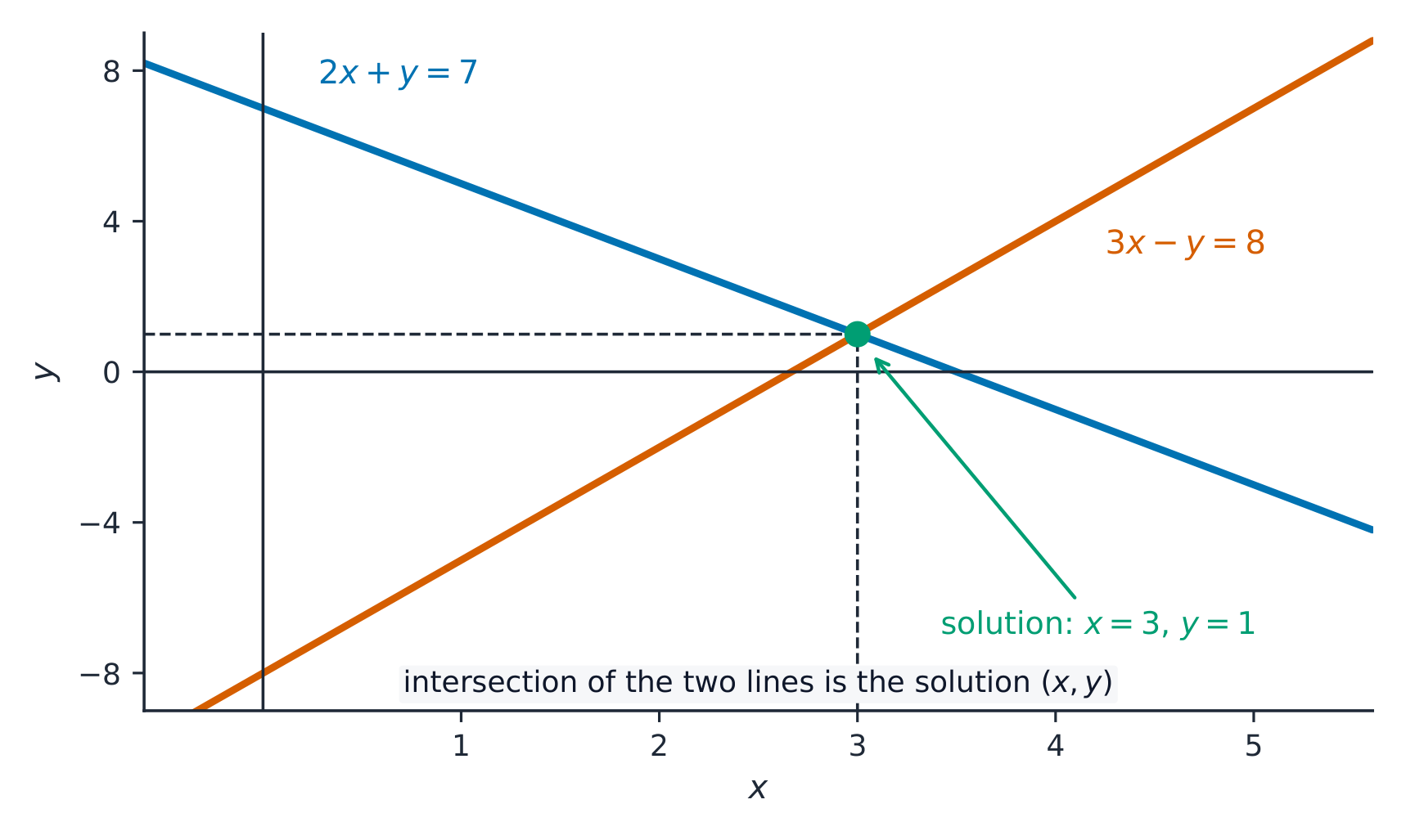
Simultaneous equations: where the lines cross
An equation 方程 says two expressions are equal. To solve a linear 一次 equation, do the same operation to both sides until the unknown 未知数 is alone.
To change the subject 公式变形 of a formula means to rearrange it so a chosen letter is alone on one side.
Worked example. Make $r$ the subject of $A = \pi r^{2}$ (Extended, because of the power).
$$r^{2} = \frac{A}{\pi} \;\Rightarrow\; r = \sqrt{\frac{A}{\pi}}.$$
When the letter appears twice (Extended), collect those terms and factorise. To make $x$ the subject of $y = \dfrac{x + 1}{x - 1}$:
$$y(x - 1) = x + 1 \;\Rightarrow\; yx - x = 1 + y \;\Rightarrow\; x(y - 1) = 1 + y \;\Rightarrow\; x = \frac{1 + y}{y - 1}.$$
Português
Equações simultâneas: onde as linhas se cruzam
Uma equação 方程 diz que duas expressões são iguais. Para resolver uma equação linear 一次, faça a mesma operação nos dois lados até que o incógnita 未知数 fique sozinha.
Represent and interpret inequalities, including on a number line.
When representing and interpreting inequalities on a number line: • open circles should be used to represent strict inequalities (<, >) • closed circles should be used to represent inclusive inequalities ($\leqslant$, $\geqslant$) e.g. $-3 \leqslant x < 1$
Português
Conteúdo do assunto
Notas e exemplos
Represente e interprete desigualdades, incluindo em uma reta numérica.
Ao representar e interpretar desigualdades em uma reta numérica: • círculos abertos devem ser usados para representar desigualdades estritas (<, >) • círculos fechados devem ser usados para representar desigualdades inclusivas ($\leqslant$, $\geqslant$) ex. $-3 \leqslant x < 1$
English
Subject content
Notes and examples
1 Represent and interpret inequalities, including on a number line.
When representing and interpreting inequalities on a number line: • open circles should be used to represent strict inequalities (<, >) • closed circles should be used to represent inclusive inequalities ($\leqslant$, $\geqslant$). e.g. $-3 \leqslant x < 1$
2 Construct, solve and interpret linear inequalities.
3 Represent and interpret linear inequalities in two variables graphically.
The following conventions should be used: • broken lines should be used to represent strict inequalities (<, >) • solid lines should be used to represent inclusive inequalities ($\leqslant$, $\geqslant$) • shading should be used to represent unwanted regions (unless otherwise directed in the question). e.g. graphs of $x < 1$ and $y \geqslant 1$
4 List inequalities that define a given region.
Linear programming problems are not included.
Português
Conteúdo do assunto
Notas e exemplos
1 Represente e interprete desigualdades, incluindo em uma reta numérica.
Ao representar e interpretar desigualdades em uma reta numérica: • círculos abertos devem ser usados para representar desigualdades estritas (<, >) • círculos fechados devem ser usados para representar desigualdades inclusivas ($\leqslant$, $\geqslant$). p.ex. $-3 \leqslant x < 1$
2 Construa, resolva e interprete desigualdades lineares.
3 Represente e interprete desigualdades lineares em duas variáveis graficamente.
As seguintes convenções devem ser usadas: • linhas tracejadas devem ser usadas para representar desigualdades estritas (<, >) • linhas sólidas devem ser usadas para representar desigualdades inclusivas ($\leqslant$, $\geqslant$) • sombreamento deve ser usado para representar regiões indesejadas (a menos que direcionado de outra forma na questão). p.ex. gráficos de $x < 1$ e $y \geqslant 1$
4 Liste desigualdades que definem uma região dada.
Problemas de programação linear não são incluídos.
Source: Cambridge International syllabus · Fonte: Programa Cambridge International
English
An inequality 不等式 uses $<$, $>$, $\leqslant$ or $\geqslant$. Solve it like an equation, but reverse the sign if you multiply or divide by a negative number.
On a number line 数轴, use an open circle for $<$ or $>$ (value not included) and a closed circle for $\leqslant$ or $\geqslant$ (value included).
Regions (Extended)
An inequality in two letters describes a region 区域 of the graph. Draw the boundary line (broken for $<$ or $>$, solid for $\leqslant$ or $\geqslant$) and shade the unwanted side. You may also be asked to list the inequalities that define a given region.
Português
Uma desigualdade 不等式 usa $<$, $>$, $\leqslant$ ou $\geqslant$. Resolva-a como uma equação, mas inverta o sinal se multiplicar ou dividir por um número negativo.
Em uma reta numérica 数轴, use um círculo aberto para $<$ ou $>$ (valor não incluído) e um círculo fechado para $\leqslant$ ou $\geqslant$ (valor incluído).
$-\tfrac{1}{3} \leqslant x < 3$: um círculo fechado inclui o valor final, um círculo aberto o exclui.
Regiões (Estendido)
Uma desigualdade em duas letras descreve uma região 区域 do gráfico. Desenhe a linha limite (tracejada para $<$ ou $>$, sólida para $\leqslant$ ou $\geqslant$) e sombree o lado indesejado. Você também pode ser solicitado a listar as desigualdades que definem uma região dada.
Explore · Explorar
Desigualdades
y = ax + b
Uma desigualdade pergunta onde a linha está acima ou abaixo de um valor.
e.g. write the next two terms in this sequence: 1, 3, 6, 10, 15, ... , ...
2 Recognise patterns in sequences, including the term-to-term rule, and relationships between different sequences.
3 Find and use the $n$th term of the following sequences: (a) linear (b) simple quadratic (c) simple cubic.
e.g. find the $n$th term of 2, 5, 10, 17
Português
Conteúdo do assunto
Notas e exemplos
1 Continue uma sequência numérica ou padrão dado.
Ex. escreva os próximos dois termos nesta sequência: 1, 3, 6, 10, 15, ... , ...
2 Reconheça padrões em sequências, incluindo a regra termo-para-termo e relações entre diferentes sequências.
3 Encontre e use o ⟨$n$⟩-ésimo termo das seguintes sequências: (a) linear (b) quadrática simples (c) cúbica simples.
Ex. encontre o ⟨$n$⟩-ésimo termo de 2, 5, 10, 17
English
Subject content
Notes and examples
1 Continue a given number sequence or pattern.
Subscript notation may be used, e.g. $T_n$ is the $n$th term of sequence $T$.
2 Recognise patterns in sequences, including the term-to-term rule, and relationships between different sequences.
Includes linear, quadratic, cubic and exponential sequences and simple combinations of these.
3 Find and use the $n$th term of sequences.
Português
Conteúdo do assunto
Notas e exemplos
1 Continue uma sequência numérica ou padrão dado.
A notação de subscritos pode ser usada, p.ex. $T_n$ é o $n$-ésimo termo da sequência $T$.
2 Reconheça padrões em sequências, incluindo a regra termo-a-termo e relações entre diferentes sequências.
Inclui sequências lineares, quadráticas, cúbicas e exponenciais e combinações simples destas.
3 Encontre e use o $n$-ésimo termo de sequências.
Source: Cambridge International syllabus · Fonte: Programa Cambridge International
English
A sequence 数列 is a list of numbers that follow a rule. The term-to-term rule 递推规则 tells you how to get the next term from the one before.
To find the rule for the term in position $n$ (the $n$th term), look at how the terms change.
Linear sequence (the terms go up by the same amount each time). The difference is the multiple of $n$.
Worked example. Find the $n$th term of $2, 5, 8, 11, \dots$
The terms go up by $3$, so start with $3n$. Since $3 \times 1 = 3$ but the first term is $2$, subtract $1$: the $n$th term is $3n - 1$.
Quadratic sequence (the differences themselves change by the same amount). The second difference equals $2 \times$ the coefficient of $n^{2}$.
Worked example. Find the $n$th term of $2, 5, 10, 17, \dots$
First differences are $3, 5, 7$; the second difference is $2$, so the $n^{2}$ part is $1n^{2}$. Subtracting $n^{2}$ ($1, 4, 9, 16$) from the sequence leaves $1, 1, 1, 1$. So the $n$th term is $n^{2} + 1$.
A cubic 三次 sequence such as $1, 8, 27, 64, \dots$ has $n$th term $n^{3}$. An exponential sequence 指数数列 such as $2, 6, 18, 54, \dots$ multiplies by a fixed number each time; here the $n$th term is $2 \times 3^{\,n-1}$.
Português
Brócolis Romanesco: espirais autorrecorrentes formam um padrão numérico natural.
Uma sequência 数列 é uma lista de números que seguem uma regra. A regra termo a termo 递推规则 diz como obter o próximo termo a partir do anterior.
Para encontrar a regra para o termo na posição $n$ (o $n$th termo), observe como os termos mudam.
Sequência linear (os termos aumentam na mesma quantidade cada vez). A diferença é o múltiplo de $n$.
Exemplo resolvido. Encontre o $n$th termo de $2, 5, 8, 11, \dots$
Os termos aumentam em $3$, então comece com $3n$. Como $3 \times 1 = 3$ mas o primeiro termo é $2$, subtraia $1$: o $n$th termo é $3n - 1$.
Sequência quadrática (as diferenças em si mudam na mesma quantidade). A segunda diferença é igual a $2 \times$ o coeficiente de $n^{2}$.
Exemplo resolvido. Encontre o $n$th termo de $2, 5, 10, 17, \dots$
As primeiras diferenças são $3, 5, 7$; a segunda diferença é $2$, então a parte $n^{2}$ é $1n^{2}$. Subtraindo $n^{2}$ ($1, 4, 9, 16$) da sequência sobra $1, 1, 1, 1$. Então o $n$th termo é $n^{2} + 1$.
Uma sequência cúbica 三次 como $1, 8, 27, 64, \dots$ tem o $n$-ésimo termo $n^{3}$. Uma sequência exponencial 指数数列 como $2, 6, 18, 54, \dots$ multiplica por um número fixo a cada vez; aqui o $n$-ésimo termo é $2 \times 3^{\,n-1}$.
Explore · Explorar
Sequências numéricas
Construa um termo de uma sequência aritmética (soma d) ou geométrica (multiplica r) passo a passo.
Direct and inverse proportion (Extended) · Proporção direta e inversa (Estendido)
Syllabus · Programa
English
Subject content
Notes and examples
Express direct and inverse proportion in algebraic terms and use this form of expression to find unknown quantities.
Includes linear, square, square root, cube and cube root proportion. Knowledge of proportional symbol ($\propto$) is required.
Português
Conteúdo do assunto
Notas e exemplos
Expresse proporção direta e inversa em termos algébricos e use esta forma de expressão para encontrar quantidades desconhecidas.
Inclui proporção linear, quadrada, raiz quadrada, cúbica e raiz cúbica. Conhecimento do símbolo de proporção ($\propto$) é necessário.
Source: Cambridge International syllabus · Fonte: Programa Cambridge International
English
Two quantities are in direct proportion 正比例 if one is always a fixed multiple of the other: $y \propto x$ means $y = kx$, where $k$ is a constant 常数. They are in inverse proportion 反比例 if one rises as the other falls: $y \propto \dfrac{1}{x}$ means $y = \dfrac{k}{x}$. The symbol $\propto$ is read "is proportional to". You can also have proportion to a square, square root, cube or cube root.
Worked example.$y$ is in direct proportion to $x$, and $y = 12$ when $x = 3$. Find $y$ when $x = 7$.
First find $k$: $12 = k \times 3$, so $k = 4$ and $y = 4x$. Then $y = 4 \times 7 = 28$.
Português
Duas quantidades estão em proporção direta 正比例 se uma for sempre um múltiplo fixo da outra: $y \propto x$ significa $y = kx$, onde $k$ é uma constante 常数. Elas estão em proporção inversa 反比例 se uma aumenta à medida que a outra diminui: $y \propto \dfrac{1}{x}$ significa $y = \dfrac{k}{x}$. O símbolo $\propto$ é lido "é proporcional a". Você também pode ter proporção a um quadrado, raiz quadrada, cubo ou raiz cúbica.
Exemplo resolvido.$y$ está em proporção direta com $x$, e vale $y = 12$ quando $x = 3$. Encontre $y$ quando $x = 7$.
Primeiro encontre $k$: $12 = k \times 3$, então $k = 4$ e $y = 4x$. Depois $y = 4 \times 7 = 28$.
Explore · Explorar
Proporcionalidade inversa
y = a/x
Proporcionalidade Inversa: conforme x dobra, y cai pela metade — uma curva recíproca com duas assintotas.
Graphs in practical situations · Gráficos em situações práticas
Syllabus · Programa
English
Subject content
Notes and examples
1 Use and interpret graphs in practical situations including travel graphs and conversion graphs.
e.g. interpret the gradient of a straight-line graph as a rate of change.
2 Draw graphs from given data.
e.g. draw a distance–time graph to represent a journey.
Português
Conteúdo do assunto
Notas e exemplos
1 Use e interprete gráficos em situações práticas, incluindo gráficos de deslocamento e gráficos de conversão.
Ex. interprete a inclinação de um gráfico de linha reta como uma taxa de variação.
2 Desenhe gráficos a partir de dados fornecidos.
Ex. desenhe um gráfico distância-tempo para representar uma viagem.
English
Subject content
Notes and examples
1 Use and interpret graphs in practical situations including travel graphs and conversion graphs.
Includes estimation and interpretation of the gradient of a tangent at a point.
2 Draw graphs from given data.
3 Apply the idea of rate of change to simple kinematics involving distance–time and speed–time graphs, acceleration and deceleration.
4 Calculate distance travelled as area under a speed–time graph.
Areas will involve linear sections of the graph only.
Português
Conteúdo do assunto
Notas e exemplos
1 Use e interprete gráficos em situações práticas, incluindo gráficos de viagem e gráficos de conversão.
Inclui estimativa e interpretação da inclinação de uma tangente em um ponto.
2 Desenhe gráficos a partir de dados fornecidos.
3 Aplique a ideia de taxa de variação à cinemática simples envolvendo gráficos de distância-tempo e velocidade-tempo, aceleração e desaceleração.
4 Calcule a distância percorrida como área sob um gráfico de velocidade-tempo.
As áreas envolverão apenas seções lineares do gráfico.
Source: Cambridge International syllabus · Fonte: Programa Cambridge International
English
Speed-time graphs: gradient and area
The gradient 斜率 (steepness) of a graph shows a rate of change 变化率.
A travel graph 行程图 (distance–time graph) has gradient equal to speed; a flat part means the object is not moving.
A conversion graph 换算图 is a straight line used to change between two units (for example, miles and kilometres).
Speed–time graphs (Extended)
On a speed–time graph the gradient is the acceleration 加速度 (or deceleration 减速度 if the speed falls), and the area 面积 under the graph is the distance 距离 travelled.
Worked example. A car speeds up from rest to $20\text{ m/s}$ in $8\text{ s}$, then stays at $20\text{ m/s}$ for $12\text{ s}$. Find the acceleration and the total distance.
Acceleration $= \dfrac{20}{8} = 2.5\text{ m/s}^{2}$. The distance is the area: a triangle plus a rectangle,
A inclinação 斜率 (declividade) de um gráfico mostra uma taxa de variação 变化率.
Um gráfico de viagem 行程图 (gráfico distância-tempo) tem inclinação igual à velocidade; uma parte plana significa que o objeto não está se movendo.
Um gráfico de conversão 换算图 é uma linha reta usada para converter entre duas unidades (por exemplo, milhas e quilômetros).
Em um gráfico distância-tempo, a inclinação é a velocidade; uma seção plana significa que o objeto parou.
Gráficos velocidade-tempo (Estendido)
Em um gráfico velocidade-tempo, a inclinação é a aceleração 加速度 (ou desaceleração 减速度 se a velocidade cair), e a área 面积 sob o gráfico é a distância 距离 percorrida.
Exemplo resolvido. Um carro acelera do repouso até $20\text{ m/s}$ em $8\text{ s}$, depois mantém-se a $20\text{ m/s}$ por $12\text{ s}$. Encontre a aceleração e a distância total.
Aceleração $= \dfrac{20}{8} = 2.5\text{ m/s}^{2}$. A distância é a área: um triângulo mais um retângulo,
1 Construct tables of values, and draw, recognise and interpret graphs for functions of the following forms: • $ax + b$ • $\pm x^2 + ax + b$ • $\frac{a}{x} \ (x \neq 0)$ where $a$ and $b$ are integer constants.
2 Solve associated equations graphically, including finding and interpreting roots by graphical methods.
e.g. find the intersection of a line and a curve.
Português
Conteúdo do assunto
Notas e exemplos
1 Construa tabelas de valores, e desenhe, reconheça e interprete gráficos para funções das seguintes formas: • $ax + b$ • $\pm x^2 + ax + b$ • $\frac{a}{x} \ (x \neq 0)$ where $a$ and $b$ are integer constants.
2 Resolva equações associadas graficamente, incluindo encontrar e interpretar raízes por métodos gráficos.
ex.: encontre a interseção de uma reta e uma curva.
English
Subject content
Notes and examples
1 Construct tables of values, and draw, recognise and interpret graphs for functions of the following forms: • $a x^n$ (includes sums of no more than three of these) • $a b^x + c$ where $n = -2, -1, -\frac{1}{2}, 0, \frac{1}{2}, 1, 2, 3$; $a$ and $c$ are rational numbers; and $b$ is a positive integer.
2 Solve associated equations graphically, including finding and interpreting roots by graphical methods.
e.g. finding the intersection of a line and a curve.
3 Draw and interpret graphs representing exponential growth and decay problems.
Português
Conteúdo do assunto
Notas e exemplos
1 Construir tabelas de valores, e desenhar, reconhecer e interpretar gráficos para funções das seguintes formas: • $a x^n$ (inclui somas de no máximo três destes) • $a b^x + c$ onde $n = -2, -1, -\frac{1}{2}, 0, \frac{1}{2}, 1, 2, 3$; $a$ e $c$ são números racionais; e $b$ é um inteiro positivo.
2 Resolver equações associadas graficamente, incluindo encontrar e interpretar raízes por métodos gráficos.
p.ex. encontrando a interseção de uma reta e uma curva.
3 Desenhar e interpretar gráficos representando problemas de crescimento e decaimento exponencial.
Source: Cambridge International syllabus · Fonte: Programa Cambridge International
English
To draw a graph, make a table of values 数值表: choose values of $x$, work out $y$, then plot the coordinates 坐标 and join them with a smooth curve.
The points where a graph crosses the $x$-axis (the horizontal axis 坐标轴) are the roots 根 — the solutions of $y = 0$.
You can solve an equation by reading a graph. The intersection point 交点 of a line and a curve gives the solution of the two equations together.
For exponential growth 指数增长 and exponential decay 指数衰减, the graph of $y = a\,b^{x} + c$ rises (or falls) faster and faster and flattens towards a horizontal line.
Português
Para desenhar um gráfico, faça uma tabela de valores 数值表: escolha valores de $x$, calcule $y$, depois plote as coordenadas 坐标 e una-os com uma curva suave.
Os pontos onde um gráfico cruza o eixo $x$ (o eixo horizontal eixo 坐标轴) são as raízes 根 — as soluções de $y = 0$.
Você pode resolver uma equação lendo um gráfico. O ponto de interseção 交点 de uma linha e uma curva fornece a solução das duas equações juntas.
Para crescimento exponencial 指数增长 e decaimento exponencial 指数衰减, o gráfico de $y = a\,b^{x} + c$ sobe (ou desce) cada vez mais rápido e achata-se em direção a uma linha horizontal.
Explore · Explorar
Graficar uma quadrática
y = ax² + bx + c
Arraste a, b e c e observe a parábola mover-se — o seu ponto de viragem e onde cruza os eixos.
2.11
Sketching curves · Esboçando curvas
Syllabus · Programa
English
Subject content
Notes and examples
Recognise, sketch and interpret graphs of the following functions: (a) linear (b) quadratic.
Knowledge of symmetry and roots is required. Knowledge of turning points is not required.
Português
Conteúdo do assunto
Notas e exemplos
Reconheça, esboce e interprete gráficos das seguintes funções: (a) linear (b) quadrática.
Conhecimento de simetria e raízes é necessário. Conhecimento de pontos de virada não é necessário.
English
Subject content
Notes and examples
Recognise, sketch and interpret graphs of the following functions: (a) linear (b) quadratic (c) cubic (d) reciprocal (e) exponential.
Functions will be equivalent to: • $ax + by = c$ • $y = ax^2 + bx + c$ • $y = ax^3 + b$ • $y = ax^3 + bx^2 + cx$ • $y = \frac{a}{x} + b$ • $y = ar^x + b$ where $a$, $b$ and $c$ are rational numbers and $r$ is a rational, positive number. Knowledge of turning points, roots and symmetry is required. Knowledge of vertical and horizontal asymptotes is required. Finding turning points of quadratics by completing the square is required.
Português
Conteúdo do assunto
Notas e exemplos
Reconhecer, esboçar e interpretar gráficos das seguintes funções: (a) lineares (b) quadráticas (c) cúbicas (d) recíprocas (e) exponenciais.
As funções serão equivalentes a: • $ax + by = c$ • $y = ax^2 + bx + c$ • $y = ax^3 + b$ • $y = ax^3 + bx^2 + cx$ • $y = \frac{a}{x} + b$ • $y = ar^x + b$ onde $a$, $b$ e $c$ são números racionais e $r$ é um número racional positivo. É necessário conhecimento de pontos de viragem, raízes e simetria. É necessário conhecimento de assíntotas verticais e horizontais. Encontrar pontos de viragem de quadráticas completando o quadrado é exigido.
Source: Cambridge International syllabus · Fonte: Programa Cambridge International
English
A quick sketch should show the right shape and the key features: where it crosses the axes, any symmetry 对称, and any line the curve gets close to.
Function
Shape
linear, $y = mx + c$
straight line; gradient $m$, $y$-intercept 截距$c$
quadratic, $y = ax^{2} + bx + c$
a parabola 抛物线 (U-shape if $a>0$, $\cap$-shape if $a<0$)
cubic, $y = ax^{3} + bx + c$
an S-shaped curve
reciprocal, $y = \dfrac{a}{x} + b$
two separate curves
exponential, $y = a\,r^{x} + b$
fast growth or decay
For a parabola, completing the square gives the turning point 转折点 (the lowest or highest point). For example $y = (x + 3)^{2} - 8$ has its turning point at $(-3, -8)$.
An asymptote 渐近线 is a line that the curve gets closer and closer to but never touches — for example, the $x$-axis for $y = \dfrac{a}{x}$, or the line $y = b$ for $y = a\,r^{x} + b$.
Português
Um esboço rápido deve mostrar a forma correta e os recursos-chave: onde cruza os eixos, qualquer simetria 对称, e qualquer linha a qual a curva se aproxima.
Função
Formato
linear, $y = mx + c$
linha reta; declive $m$, intercepto $y$-intercepto 截距$c$
quadrática, $y = ax^{2} + bx + c$
uma parábola 抛物线 (forma de U se $a>0$, $\cap$forma de S se $a<0$)
cúbica, $y = ax^{3} + bx + c$
uma curva em forma de S
recíproca, $y = \dfrac{a}{x} + b$
duas curvas separadas
exponencial, $y = a\,r^{x} + b$
crescimento ou decaimento rápido
Os formatos básicos dos gráficos; conhecer cada formato permite fazer esboços rápidos a partir da equação.
Para uma parábola, a completação de quadrado dá o ponto de virada 转折点 (o ponto mais baixo ou mais alto). Por exemplo, $y = (x + 3)^{2} - 8$ tem seu ponto de virada em $(-3, -8)$.
A completação de quadrado, $y=(x+3)^2-8$, mostra o ponto de virada $(-3,-8)$ e a linha de simetria $x=-3$.
Uma assíntota 渐近线 é uma linha que a curva se aproxima cada vez mais, mas nunca toca — por exemplo, o eixo $x$ para $y = \dfrac{a}{x}$, ou a linha $y = b$ para $y = a\,r^{x} + b$.
1 Estimate gradients of curves by drawing tangents.
2 Use the derivatives of functions of the form $ax^n$, where $a$ is a rational constant and $n$ is a positive integer or zero, and simple sums of not more than three of these.
$\frac{\mathrm{d}y}{\mathrm{d}x}$ notation will be expected.
3 Apply differentiation to gradients and stationary points (turning points).
4 Discriminate between maxima and minima by any method.
Maximum and minimum points may be identified by: • an accurate sketch • use of the second differential • inspecting the gradient either side of a turning point. Candidates are not expected to identify points of inflection.
Português
Conteúdo do assunto
Notas e exemplos
1 Estimar gradientes de curvas desenhando tangentes.
2 Utilizar as derivadas de funções da forma $ax^n$, onde $a$ é uma constante racional e $n$ é um inteiro positivo ou zero, e somas simples de no máximo três destes.
A notação $\frac{\mathrm{d}y}{\mathrm{d}x}$ será exigida.
3 Aplicar diferenciação a gradientes e pontos estacionários (pontos de viragem).
4 Discriminar entre máximos e mínimos por qualquer método.
Pontos de máximo e mínimo podem ser identificados por: • um esboço preciso • uso da segunda derivada • inspecionar o gradiente de ambos os lados de um ponto de viragem. Os candidatos não são esperados a identificar pontos de inflexão.
Source: Cambridge International syllabus · Fonte: Programa Cambridge International
English
Differentiation 微分 finds the gradient of a curve at any point. You can estimate it by drawing a tangent 切线 (a line that just touches the curve) and measuring its gradient.
The exact rule: if $y = ax^{n}$, then the derivative 导数 is
The turning point is $(3, -4)$. To decide whether a turning point is a maximum 最大值 or a minimum 最小值, check the sign of the gradient on each side, or use the second derivative (positive means a minimum).
Português
Diferenciação 微分 encontra a inclinação de uma curva em qualquer ponto. Você pode estimá-la desenhando uma tangente 切线 (uma linha que apenas toca a curva) e medindo sua inclinação.
A inclinação de uma curva em um ponto é igual à inclinação da tangente naquele ponto — isso é o que a diferenciação encontra.
A regra exata: se $y = ax^{n}$, então a derivada 导数是
O ponto de virada é $(3, -4)$. Para decidir se um ponto de virada é um máximo 最大值 ou um mínimo 最小值, verifique o sinal da inclinação em cada lado, ou use a segunda derivada (positivo significa mínimo).
Explore · Explorar
Declive de uma curva
y = ax³ + bx² + cx + d
Mova o ponto: a tangente mostra o declive ali, que é o que a diferenciação encontra.
2 Understand and find inverse functions $f^{-1}(x)$.
3 Form composite functions as defined by $gf(x) = g(f(x))$.
e.g. $f(x) = \frac{3}{x + 2}$ and $g(x) = (3x + 5)^2$. Find $fg(x)$. Give your answer as a fraction in its simplest form. Candidates are not expected to find the domains and ranges of composite functions. This topic may include mapping diagrams.
Português
Conteúdo do assunto
Notas e exemplos
1 Compreender funções, domínio e contradomínio e utilizar notação funcional.
2 Compreender e encontrar funções inversas $f^{-1}(x)$.
3 Formar funções compostas definidas por $gf(x) = g(f(x))$.
p.ex. $f(x) = \frac{3}{x + 2}$ e $g(x) = (3x + 5)^2$. Encontrar $fg(x)$. Apresentar a resposta como uma fração na sua forma mais simples. Os candidatos não são esperados a encontrar os domínios e contradomínios de funções compostas. Este tópico pode incluir diagramas de mapeamento.
Source: Cambridge International syllabus · Fonte: Programa Cambridge International
English
A function 函数 turns each input into one output. We write $f(x)$, for example $f(x) = 3x - 5$, so $f(2) = 1$. The set of allowed inputs is the domain 定义域; the set of possible outputs is the range 值域.
The inverse function 反函数$f^{-1}(x)$ undoes the function. To find it, write $y = f(x)$, swap the roles, and make $x$ the subject.
Worked example. Find the inverse of $f(x) = 3x - 5$.
Uma função 函数 transforma cada entrada em uma saída. Escrevemos $f(x)$, por exemplo $f(x) = 3x - 5$, então $f(2) = 1$. O conjunto de entradas permitidas é o domínio 定义域; o conjunto de saídas possíveis é o contradomínio 值域.
A função inversa 反函数$f^{-1}(x)$ desfaz a função. Para encontrá-la, escreva $y = f(x)$, troque os papéis e isole $x$.
Exemplo resolvido. Encontre a inversa de $f(x) = 3x - 5$.
When you expand brackets, multiply every term and watch the signs, especially with a minus in front: $-(x - 3) = -x + 3$.
To solve an equation, do the same thing to both sides. When you multiply or divide an inequality by a negative number, flip the sign.
Factorise fully: take out the highest common factor first, then look for a difference of two squares or a quadratic pattern.
A quadratic usually has two solutions — give both. Check whether the question wants factorising, the formula, or completing the square.
When substituting into a formula, put each value in brackets first, so signs and powers come out right.
Português
Ao expandir colchetes, multiplique todos os termos e preste atenção aos sinais, especialmente com um sinal de menos na frente: $-(x - 3) = -x + 3$.
Para resolver uma equação, faça a mesma coisa em ambos os lados. Quando você multiplica ou divide uma desigualdade por um número negativo, virte o sinal.
Fatorar completamente: tire primeiro o maior fator comum, depois procure uma diferença de dois quadrados ou um padrão quadrático.
Uma equação quadrática geralmente tem duas soluções — forneça ambas. Verifique se a questão pede fatoração, a fórmula ou completação de quadrado.
Ao substituir em uma fórmula, coloque cada valor entre parênteses primeiro, para que os sinais e potências saiam corretos.
Interactive lessons on this topic · Aulas interativas sobre este tópico
Work through it step by step, with instant-check exercises. · Passe por ele passo a passo, com exercícios de verificação instantânea.
Pick one and the site follows you — notes, papers, videos and practice all open on it. · Escolha uma e o site te seguirá — notas, provas, vídeos e prática abrirão nela.
Type to search notes, lessons, code, vocabulary and past-paper questions across every subject. · Digite para pesquisar notas, aulas, código, vocabulário e questões de provas anteriores em todas as disciplinas.