Heat Capacity and Calorimetry
Introduced| English | Meaning |
|---|---|
| specific heat capacity/spəˈsɪfɪk hiːt kəˈpæsɪti/ | The energy needed to raise the temperature of one kilogram of a substance by one kelvin or one degree Celsius. |
| calorimetry/ˌkælɔːˈrɪmətri/ | Measurement of heat transferred during a physical or chemical process. |
Why water is so hard to heat
- Sand at the beach burns your feet while the sea stays cool.
- Same sunshine, wildly different temperatures.
- Some materials soak up lots of energy per degree; others little.
- A simple formula captures exactly how much.
Specific heat capacity
- Specific heat capacity 比热容 is the energy to warm 1 g by 1 degree.
- Water's is high, so it heats and cools slowly.
- The bigger it is, the more energy each degree costs.
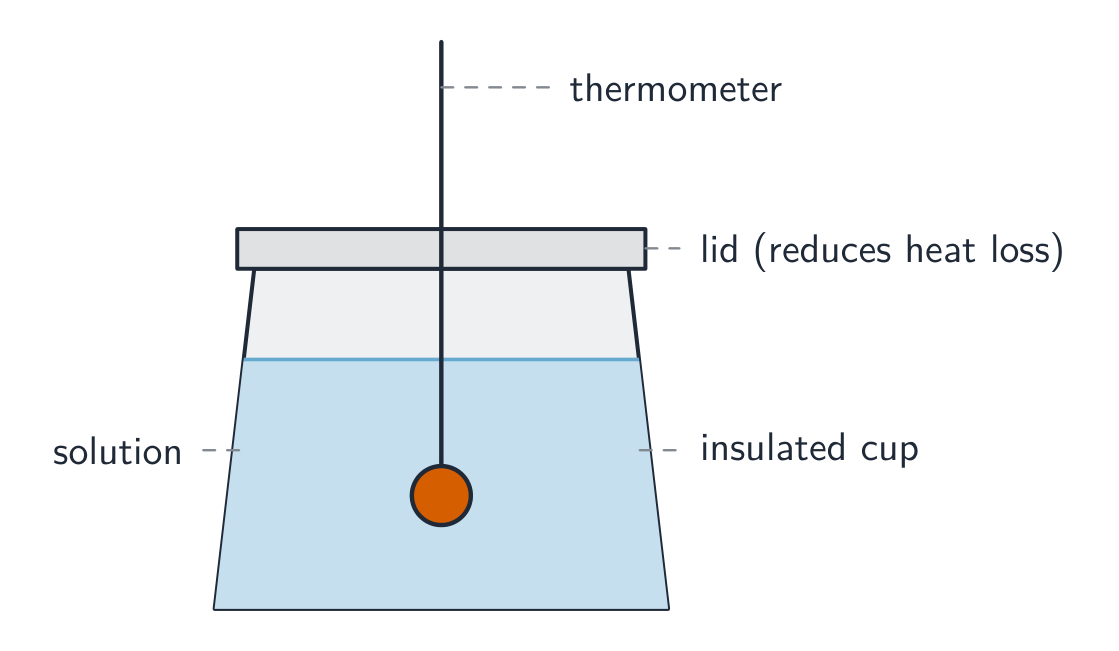
Calorimetry 量热法: measure the temperature change of a known mass of solution
Water's high specific heat means its temperature changes very easily.
Difficulty 1/5 · 100 coins + a small bonus on first completion today
False. A high specific heat means a lot of energy is needed per degree, so water resists changes in temperature.
A substance with a high specific heat warms up ____ than one with a low value.
Difficulty 1/5 · 100 coins + a small bonus on first completion today
High specific heat means more energy per degree, so slower warming.
The heat equation
- The heat absorbed or released is:
- Here $m$ is mass, $c$ the specific heat, and $\Delta T$ the temperature change.
In $q = mc\Delta T$, the symbol $\Delta T$ is the...
Difficulty 1/5 · 100 coins + a small bonus on first completion today
Use the change in temperature, not the absolute value.
A metal absorbs $500\ \text{J}$, warming $50\ \text{g}$ by $20$ degrees. Its specific heat $c$ (in J/g per degree, 2 decimals)?
Difficulty 2/5 · 140 coins + a small bonus on first completion today
$c = q/(m\Delta T) = 500/(50\times20) = 0.5$.
Calorimetry
- Calorimetry measures heat by watching a temperature change.
- Heat lost by one thing equals heat gained by another.
- That balance lets us find an unknown quantity.
Heat needed to warm water
The heat needed depends on mass, specific heat capacity and temperature change (q = mcΔT).
In calorimetry, the heat lost by the hot object equals the heat...
Difficulty 1/5 · 100 coins + a small bonus on first completion today
Energy is conserved -- heat lost equals heat gained.
Heat $200\ \text{g}$ of water ($c = 4.18$) by $10$ degrees. How much heat?
- $q = mc\Delta T = 200 \times 4.18 \times 10$.
- $q = 8360\ \text{J}$.
Heat $100\ \text{g}$ of water ($c = 4.18$) by $5$ degrees. The heat (in J)?
Difficulty 2/5 · 140 coins + a small bonus on first completion today
$q = mc\Delta T = 100 \times 4.18 \times 5 = 2090\ \text{J}$.
Use the temperature change ($\Delta T$), not the absolute temperature, in $q = mc\Delta T$. Water's high specific heat is exactly why it resists temperature change. And in calorimetry, the heat lost by the hot object equals the heat gained by the cold one, because energy is conserved.
Specific heat capacity is the energy to warm 1 g by 1 degree, and the heat is $q = mc\Delta T$ (using the temperature change). Calorimetry measures heat from a temperature change, using the rule that heat lost equals heat gained.