The Sequence of Steps
Introduced| English | Meaning |
|---|---|
| rate-determining step/reɪt dɪˈtɜːmɪnɪŋ step/ | The slowest elementary step. |
The slowest link sets the pace
- A chain of tasks is only as fast as its slowest one.
- A reaction's steps are the same — one drags its feet.
- That slowpoke controls how fast the whole thing goes.
- Speed up the fast steps and nothing changes.
The rate-determining step
- The rate-determining step 决速步 is the slowest elementary step.
- It is the bottleneck of the whole mechanism.
- The overall rate can go no faster than this step.
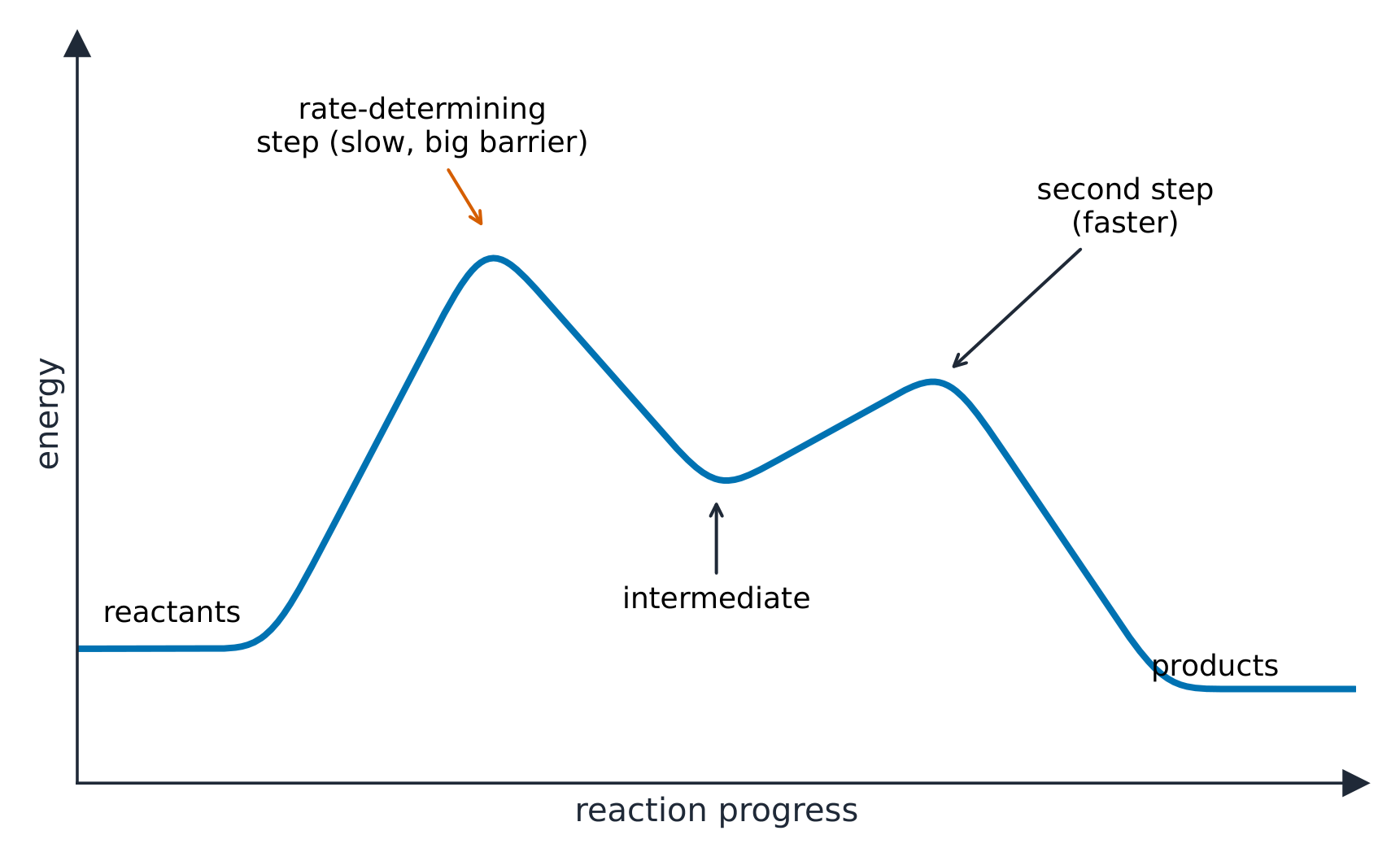
The slow step with the higher barrier is rate-determining
The rate-determining step is the...
Difficulty 1/5 · 100 coins + a small bonus on first completion today
The slowest step is the bottleneck controlling the overall rate.
The overall reaction can go no faster than its ____ step.
Difficulty 1/5 · 100 coins + a small bonus on first completion today
The slowest (rate-determining) step caps the overall rate.
The rate law follows it
- The overall rate law comes from the slowest step's reactants.
- A step's own coefficients are its orders, unlike the overall reaction.
- So the mechanism predicts the experimental rate law.
For a slow step $A + A \to C$, the rate law is...
Difficulty 1/5 · 100 coins + a small bonus on first completion today
Two A's collide in the slow step, giving second order in A.
The coefficients of any overall balanced equation can be used as reaction orders.
Difficulty 1/5 · 100 coins + a small bonus on first completion today
False. Coefficients give orders only for elementary steps. Overall rate laws must be found by experiment or from the mechanism.
Fast steps barely matter
- Steps after the slow one do not affect the rate.
- Speeding up a fast step leaves the overall rate unchanged.
- Only the bottleneck matters.
The rate-determining step
Follow a two-step mechanism and spot the slow step that controls the rate.
Speeding up a fast step that is not the bottleneck changes the overall rate.
Difficulty 1/5 · 100 coins + a small bonus on first completion today
Only the slowest step controls the rate.
Slow step: $A + A \to C$. Fast step: $C + B \to D$.
- The slow step's reactants are two A's.
- So $\text{rate} = k[A]^2$, set entirely by the slow step.
The experimental rate law is best predicted from...
Difficulty 1/5 · 100 coins + a small bonus on first completion today
The slowest step's reactants set the rate law.
The rate law comes from the rate-determining (slowest) step, not from the overall balanced equation. A step's coefficients give its orders only because it is elementary. And speeding up a step that is not the bottleneck will not speed the reaction.
The rate-determining step is the slowest elementary step, and it sets the overall rate and rate law. Because it is elementary, its coefficients are its orders. Faster steps before or after it do not change the pace — only the bottleneck does.