Phylogeny
Introduced| English | Meaning |
|---|---|
| phylogeny/faɪˈlɒdʒeni/ | phylogeny |
| phylogenetic tree/ˌfaɪləʊdʒˈnetɪk triː/ | A branching diagram of evolutionary relationships built from shared evidence. |
| taxonomy/tækˈsɒnəmi/ | taxonomy |
Mapping life's family tree
- If all life is related, we can draw the relationships as a tree.
- Close relatives sit on nearby branches; distant ones split off long ago.
- Scientists build these trees from DNA and anatomy.
- The study of these evolutionary relationships is called phylogeny.
The phylogenetic tree
- A phylogenetic tree 系统发育树 shows how species are related.
- The tips are living species; the branch points are common ancestors.
- The study of building and reading these trees is phylogeny 系统发育.
- Two species that branch off recently are more closely related.
A phylogenetic tree shows…
Difficulty 1/5 · 100 coins + a small bonus on first completion today
A phylogenetic tree maps how species are related through common ancestors — the study is phylogeny.
Reading the tree
- Each branch point marks a shared ancestor.
- To see how related two species are, find where their branches meet.
- A more recent meeting point means a closer relationship.
- Surprises happen — birds branch from within the reptiles.
From domain down to species
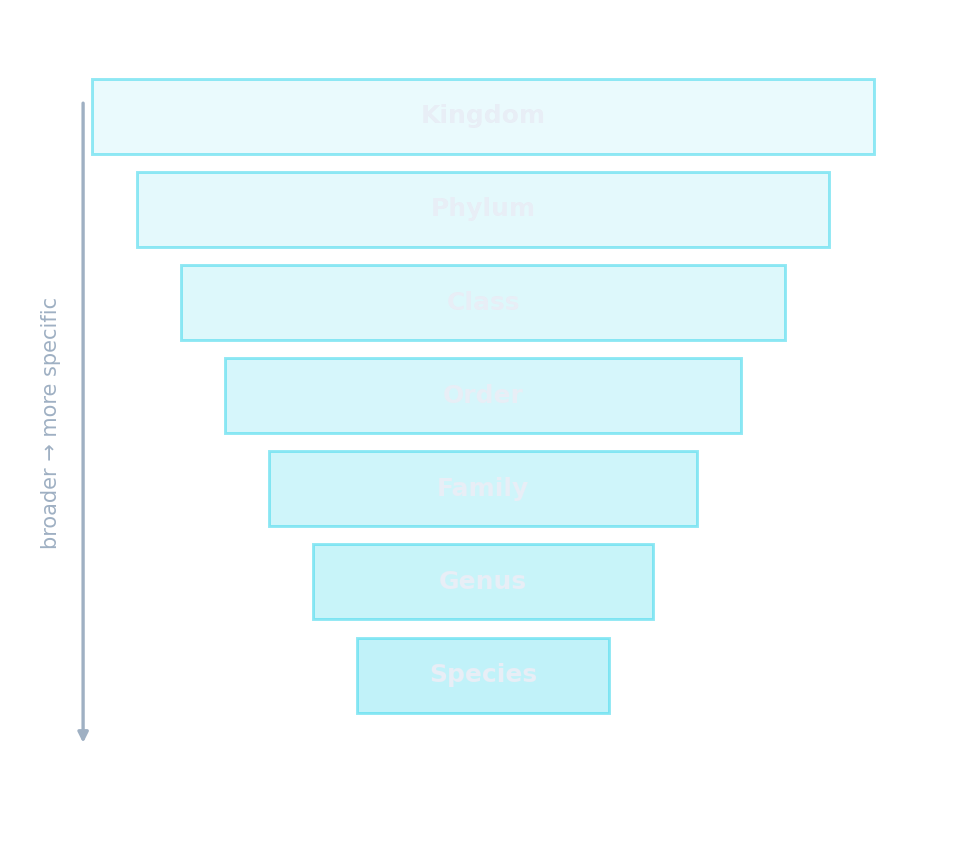
Step down the classification ranks - each level is narrower and groups more closely related organisms.
On a phylogenetic tree, a branch point represents…
Difficulty 1/5 · 100 coins + a small bonus on first completion today
Each branch point is a common ancestor from which the branches above it descend.
Classifying into ranks
- Taxonomy 分类学 sorts life into a set of nested ranks.
- From broad to narrow: domain, kingdom, phylum, class, order, family, genus, species.
- Each level down groups more closely related organisms.
- The narrowest rank, species, is a single kind of organism.
The system of naming and classifying organisms into ranks is called ____.
Difficulty 1/5 · 100 coins + a small bonus on first completion today
Taxonomy classifies life into nested ranks, from domain down to species.
Which is the narrowest classification rank listed here?
Difficulty 1/5 · 100 coins + a small bonus on first completion today
Species is the narrowest rank — one kind of organism; domain is the broadest.
Select all true statements about phylogeny.
Difficulty 2/5 · 140 coins + a small bonus on first completion today
A tree shows relationships, not which species is "best". The other three are correct.
Read relatedness from the branch points, not from how close the tips sit on the page. Two species drawn side by side may be distant relatives; what matters is where their branches join, not where they end up on the diagram.
A surprising cousin:
- You might guess a crocodile is most closely related to a lizard.
- But on the tree, crocodiles share a more recent ancestor with birds.
- So a crocodile is more closely related to a sparrow than to a lizard — the branch points reveal it.
Phylogeny studies how species are related, drawn as a phylogenetic tree whose branch points are common ancestors. Taxonomy classifies life into nested ranks from domain down to species. Read relatedness from where branches join, and build the trees from DNA and anatomical evidence.
Write from a more recent common ancestor
- Species A and B share a node that species C does not share.
- C joins the tree at an older node.
Which pair is more closely related?
Closer relatives share a later branch point.
Which species are closest on this tree?
Difficulty 1/5 · 100 coins + a small bonus on first completion today
The shared recent node joins A and B.