Population Genetics
Introduced| English | Meaning |
|---|---|
| population/ˌpɒpjʊˈleɪʃn/ | All the organisms of one species living in a particular area at a particular time. |
| gene pool/dʒiːn puːl/ | All the alleles present in a population at a particular time. |
| allele frequency/əˈliːl ˈfriːkwənsi/ | allele frequency |
Evolution seen in a population
- A single organism cannot evolve — it lives and dies with the genes it was born with.
- Evolution only shows up when you look at a whole population over time.
- To study it, biologists track the mix of alleles in that population.
- This is the field of population genetics.
The gene pool
- A population 种群 is a group of the same species living together.
- All the alleles in that population make up its gene pool 基因库.
- The gene pool is like a giant shared box of genetic variety.
- Every new offspring is dealt its genes from this pool.
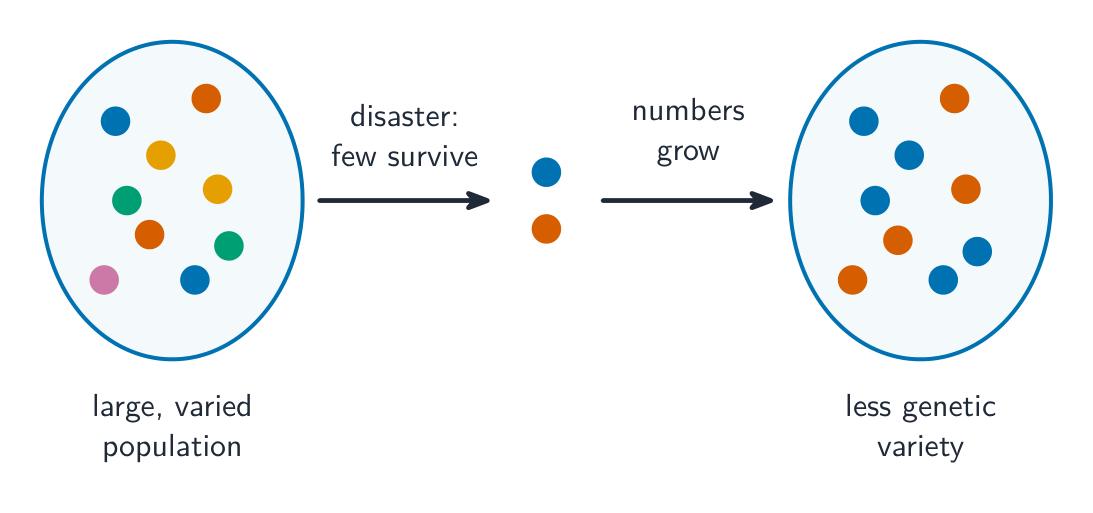
A population bottleneck reduces genetic variety
A gene pool is…
Difficulty 1/5 · 100 coins + a small bonus on first completion today
A gene pool is the whole collection of alleles in a population at a given time.
Allele frequency
- Allele frequency 等位基因频率 is how common each allele is in the gene pool.
- If an allele is in 70% of the copies, its frequency is 0.7.
- Frequencies show which versions of a gene dominate the population.
- Tracking them lets us measure evolution precisely.
Evolution as changing allele frequency
Step through how selection changes the mix of alleles in a gene pool over generations.
Allele frequency describes…
Difficulty 1/5 · 100 coins + a small bonus on first completion today
Allele frequency is the proportion of a gene pool made up of one particular allele.
Evolution = changing frequencies
- When an allele becomes more or less common, the gene pool has changed.
- Evolution, at this level, is a change in allele frequency over generations.
- Selection, migration, mutation, and chance can all shift the frequencies.
- Add up these shifts over time, and a population evolves.
At the population level, evolution is a change in allele ____ over generations.
Difficulty 1/5 · 100 coins + a small bonus on first completion today
Evolution is defined as a change in allele frequency in a population over time.
Natural selection, migration, and mutation can all change allele frequencies.
Difficulty 1/5 · 100 coins + a small bonus on first completion today
Selection, migration, mutation, and chance (genetic drift) all shift allele frequencies.
Select all true statements about population genetics.
Difficulty 2/5 · 140 coins + a small bonus on first completion today
Individuals do not evolve; populations do, as allele frequencies change. The other three are correct.
Individuals do not evolve — populations do. Your own alleles are fixed for life. Evolution is the change in allele frequency across a whole population over generations, not a change inside one organism.
Counting a colour allele:
- Suppose a beetle population is 40% dark alleles, 60% light.
- Birds eat the light beetles more easily, so fewer light alleles get passed on.
- Next generation the dark allele frequency rises to 55% — the population has evolved.
Population genetics studies the gene pool — all the alleles in a population. Allele frequency measures how common each allele is. Evolution at this level is a change in allele frequency over generations, driven by selection, migration, mutation, and chance. Populations evolve; individuals do not.
Write from an allele frequency of 0.4
- A gene has 100 allele copies in the population.
- 40 of them are the dominant allele. Hardy-Weinberg q of 0.3 is a different lesson.
What is the frequency of the dominant allele?
Allele frequency is the count of that allele divided by all copies.
What is the dominant allele frequency?
Difficulty 1/5 · 100 coins + a small bonus on first completion today
40 copies out of 100 is 0.4. Other options — 0.3 (the other lesson's q); 40 (the raw count).