Evidence of Evolution
Introduced| English | Meaning |
|---|---|
| fossils/ˈfɒslz/ | The preserved remains of organisms from the past. |
| homologous structures/həˈmɒləɡəs ˈstrʌktʃəz/ | Structures inherited from a common ancestor, which may now have similar or different functions. |
| vestigial structure/ˈvestɪdʒl ˈstrʌktʃə/ | vestigial structure |
| molecular evidence/məˈlekjʊlə ˈevɪdəns/ | molecular evidence |
How do we know evolution happened?
- Evolution is slow, so no one can watch a fish become a mammal.
- Yet we have overwhelming evidence that it happened.
- The evidence comes from several completely different fields.
- And they all point to the same conclusion.
Fossils: a record over time
- Fossils 化石 are the preserved remains of organisms from the past.
- Deeper rock layers hold older fossils; higher layers, younger ones.
- This gives a sequence showing how life changed over millions of years.
- We even find transitional forms — part-fish, part-amphibian.
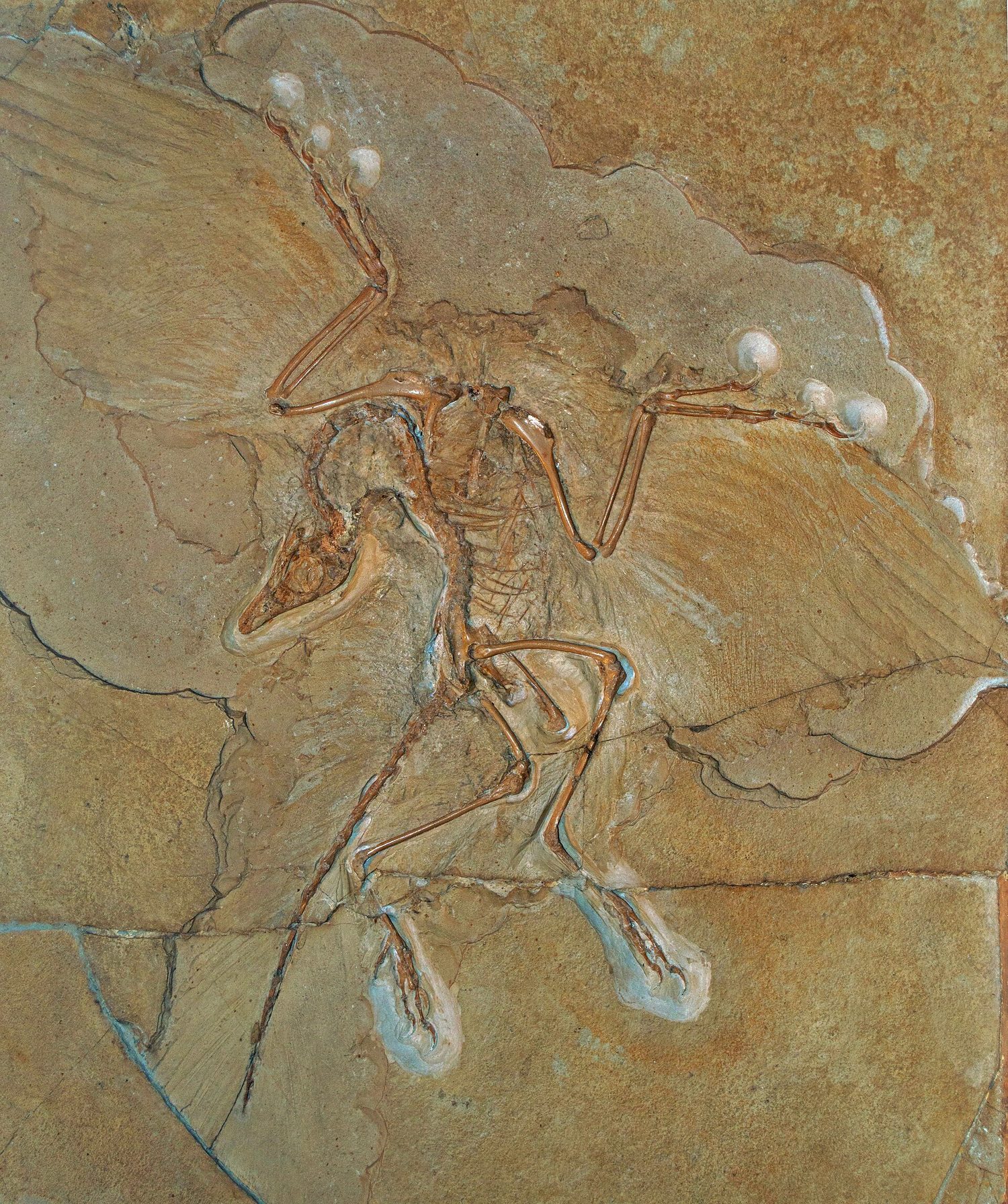
Archaeopteryx fossil: feathers plus reptilian features— evidence of common ancestry
How do fossils provide evidence for evolution?
Difficulty 1/5 · 100 coins + a small bonus on first completion today
Fossils preserve organisms from the past, showing a sequence of change across millions of years.
Anatomy: shared body plans
- Homologous structures 同源结构 share the same underlying plan in different species.
- The arm bones of a human, a bat's wing, and a whale's flipper match closely.
- This makes sense only if they inherited that plan from a common ancestor.
- A vestigial structure 痕迹结构 (like the human tailbone) is a shrunken leftover from an ancestor.
Homologous structures, like the arm bones of humans, bats, and whales, suggest…
Difficulty 1/5 · 100 coins + a small bonus on first completion today
Homologous structures share the same basic plan because they came from a common ancestor.
A body part that has lost most of its original function, like the human tailbone, is a ____ structure.
Difficulty 1/5 · 100 coins + a small bonus on first completion today
A vestigial structure is a reduced leftover from an ancestor that once used it fully.
Molecules: the code agrees
- The strongest modern evidence is in DNA itself.
- Closely related species share more of their DNA sequence.
- Humans and chimps share about 98% of their DNA.
- This molecular evidence 分子证据 matches the family tree drawn from fossils and anatomy.
What kind of evidence?
Sort each clue for evolution by the type of evidence it provides.
Species that are closely related share more of their DNA sequence.
Difficulty 1/5 · 100 coins + a small bonus on first completion today
The more recently two species shared an ancestor, the more similar their DNA — strong molecular evidence.
Select all lines of evidence for evolution.
Difficulty 2/5 · 140 coins + a small bonus on first completion today
Weather says nothing about evolution. The other three are real, independent lines of evidence.
Be careful: homologous structures share a common origin (same plan, maybe different jobs), while analogous structures share only a function (a bird's wing and an insect's wing evolved separately). Only homology is evidence of common ancestry.
The pentadactyl (five-fingered) limb:
- Humans, bats, whales, and lizards all have the same set of limb bones.
- They use them very differently — grasping, flying, swimming, walking.
- Same bones, different jobs: exactly what you expect if they share an ancestor.
Evolution is supported by many independent lines of evidence: the fossils that record change over time, homologous structures and vestigial structures in anatomy, and molecular evidence from shared DNA. All of them point to the same conclusion — living things share common ancestors.
Write from a vestigial structure
- Whales have small hip bones and no walking hind legs.
- Related land mammals have full hips used for walking.
What kind of evidence is the whale hip?
Reduced ancestral structures are vestigial evidence.
What is the whale hip bone as evidence?
Difficulty 1/5 · 100 coins + a small bonus on first completion today
The reduced hip matches a walking ancestor.