Skip to content · ⁨דלג לתוכן⁩
Subjects · ⁨נושאים⁩

AP Chemistry · ⁨כימיה AP⁩

Tips · ⁨טיפים⁩

קורס AP Chemistry עובר ממבנה אטומי ותחזוריות דרךקשרים גיאומטריה מולקולרית, כוחות בין-מולקולריים, סטואקיומטריה ופתריות, קinetics, תרמודינמיקה, איזון, חומצות ובסיסים, ואלקטרוכימיה. הקו המנחה הוא הסבר ברמת חלקיק: כמעט כל שאלה מסתיימת ב"הסבר מדוע", והתשובה חובה לדבר על חלקיקים, כוחות ואנרגיה.

רעיונות אחדים נושאים את העומס הגבוה ביותר. כוחות בין-מולקולריים מסבירים נקודות רתיחה, מסיסות וכרומטוגרפיה. עקרון לה שאטלייה מסביר כל שינוי באיזון. לימוד שניהם בצורה מסודרת יפתח חלק גדול מהמבחן.

חישוב ללא יחידות ומספרים משמעותיים הוא תשובה לא מלאה.

הערכים עוקבים אחרי תשע יחידות CED, כל אחת עם דוגמאות מפורטות והיחסים הנתונים בדף המשוואות של המבחן. FRQs עבריים והנחיות ניקוד נמצאים בספרייה – שאלות הארוכות בכימיה משלמות על הסבר התנהגות ברמת חלקיק, ולכן התשובות הדגם נכתבות בלשון זו.

  • 1

    Atomic Structure and Properties · ⁨מבנה אטומי ותכונות⁩

    Watch lesson · ⁨צפה בשיעור⁩
    1.1

    Moles and Molar Mass

    Syllabus · ⁨סיילבוס⁩
    English

    Learning Objective 1.1.A: Calculate quantities of a substance or its relative number of particles using dimensional analysis and the mole concept.

    • 1.1.A.1 One cannot count particles directly while performing laboratory work. Thus, there must be a connection between the masses of substances reacting and the actual number of particles undergoing chemical changes.
    • 1.1.A.2 Avogadro's number ($N_{\mathrm{A}} = 6.022 \times 10^{23}\ \mathrm{mol}^{-1}$) provides the connection between the number of moles in a pure sample of a substance and the number of constituent particles (or formula units) of that substance.
    • 1.1.A.3 Expressing the mass of an individual atom or molecule in atomic mass units (amu) is useful because the average mass in amu of one particle (atom or molecule) or formula unit of a substance will always be numerically equal to the molar mass of that substance in grams. Thus, there is a quantitative connection between the mass of a substance and the number of particles that the substance contains.
      • Equation: $n = m/M$
    עברית

    מטרות למידה 1.1.A: חישוב כמות חומר או מספר חלקיקיו היחסי באמצעות ניתוח מימדים והרעיון של המול.

    • 1.1.A.1 אין ספירת חלקיקים ישירה בזמן ביצוע עבודה מעבדת. לכן, חייב להיות קשר בין מסות החומרים המגיבים לבין המספר בפועל של חלקיקים העוברים שינויים כימיים.
    • 1.1.A.2 מספר אווגדרו ($N_{\mathrm{A}} = 6.022 \times 10^{23}\ \mathrm{mol}^{-1}$) מספק את הקשר בין מספר המולים בדגימה טהורה של חומר לבין מספר החלקיקים המרכיבים (או היחידות הנוסחתיות) של חומר זה.
    • 1.1.A.3 ביטוי המסה של אטום או מולקולה בודד ביחידות מסה אטומית (amu) הוא שימושי מכיוון שהמסה הממוצעת ב-amu של חלקיק אחד (אטום או מולקולה) או יחידה נוסחתית אחת של חומר תהיה תמיד שווה מספרית למסה המולרית של חומר זה בגרמים. כך, קיים קשר כמותי בין מסת החומר לבין מספר החלקיקים שהוא מכיל.
      • משוואה: $n = m/M$

    Source: College Board AP Course and Exam Description · ⁨מקור: תיאור הקורס והמבחן של College Board AP⁩

    Because atoms are far too small to count, chemists count in moles 摩尔. One mole is Avogadro's number 阿伏伽德罗常数 of particles, $N_A=6.022\times10^{23}$. The molar mass 摩尔质量 (grams per mole, read off the periodic table) converts between mass and moles:

    $$n=\frac{m}{M}.$$
    Moles are the bridge between the lab (grams you weigh) and the equation (particles that react).

    The mole is the hub: convert between mass, particles, gas volume, and concentration
    The mole is the hub: convert between mass, particles, gas volume, and concentration

    Worked example. How many moles, and how many molecules, are in $36.0\ \text{g}$ of water ($M=18.0\ \text{g/mol}$)?

    $$n=\frac{m}{M}=\frac{36.0}{18.0}=2.0\ \text{mol},\qquad N=n\,N_A=2.0\times6.022\times10^{23}=1.2\times10^{24}\ \text{molecules}.$$

    Explore · ⁨חקור⁩

    Link mass, moles and molar mass · ⁨קשר בין מסה, מולים ומסה מולרית⁩

    Molar mass $M$ is the bridge between the mass you weigh and the number of moles: $m = M \times n$. Because $M$ is fixed for a substance, mass is proportional to moles — double the moles, double the mass. · ⁨מסה מולרית $M$ היא הגשר בין המסה שאתה שוקל לבין מספר המוסים: $m = M \times n$. מכיוון ש$M$ קבוע לחומר, המסה יחסונית למוסים — כפילת המולים מובילה לכפל המסה.⁩

    Vocabulary · ⁨מילון מונחים⁩ Train · ⁨אימון⁩
    English עברית
    moles/məʊlz/ מוֹל (חומר)
    Avogadro's number/ˌævəˈɡædrəʊz ˈnʌmbə/ מספר אווגדרו
    molar mass/ˈməʊlə mæs/ מסת מולרית
    1.2

    Mass Spectra of Elements

    Syllabus · ⁨סיילבוס⁩
    English

    Learning Objective 1.2.A: Explain the quantitative relationship between the mass spectrum of an element and the masses of the element's isotopes.

    • 1.2.A.1 The mass spectrum of a sample containing a single element can be used to determine the identity of the isotopes of that element and the relative abundance of each isotope in nature.
    • 1.2.A.2 The average atomic mass of an element can be estimated from the weighted average of the isotopic masses using the mass of each isotope and its relative abundance.
      • Exclusion Statement: Interpreting mass spectra of samples containing multiple elements or peaks arising from species other than singly charged monatomic ions will not be assessed on the AP Exam.
    עברית

    מטרות למידה 1.2.A: הסבר הקשר הכמותי בין ספקטרום המסה של יסוד לבין המסות האיזוטופים שלו.

    • 1.2.A.1 ניתן להשתמש בספקטרום המסה של דוגמה המכילה יסוד אחד כדי לקבוע את זהות האיזוטופים של יסוד זה ואת התפוצה היחסית של כל איזוטופ בטבע.
    • 1.2.A.2 ניתן להעריך את המסה האטומית הממוצעת של יסוד מתוך ממוצע משוקלל של המסות האיזוטופיות, תוך שימוש במסת כל איזוטופ ובתפוצתו היחסית.
      • הערה על חריגות: פרשנות של ספקטרום מסה לדוגמאות המכילות יותר מיסוד אחד או פיקים הנובעים ממינים אחרים מאיוני מונו-אטומיים טעונים ב单个 מטען לא תיבחן בבחן AP.

    Source: College Board AP Course and Exam Description · ⁨מקור: תיאור הקורס והמבחן של College Board AP⁩

    Mass spectrometry

    A mass spectrometer 质谱仪 separates atoms by mass, giving a mass spectrum 质谱: peaks at each isotope 同位素 (same element, different neutron count) with heights showing their relative abundance 相对丰度. The element's average atomic mass is the abundance-weighted average of its isotope masses.

    Relative atomic mass is the abundance-weighted average of the isotopes
    Relative atomic mass is the abundance-weighted average of the isotopes
    The mass spectrum of chlorine: two isotopes with different abundances
    The mass spectrum of chlorine: two isotopes with different abundances

    Worked example. Chlorine is $75.8\%$ chlorine-35 and $24.2\%$ chlorine-37. Its average atomic mass is

    $$A_r=(35)(0.758)+(37)(0.242)=26.5+8.95=35.5.$$
    The average lies closer to $35$ because that isotope is more abundant – which is why the periodic-table value is $35.5$, not a whole number.

    Explore · ⁨חקור⁩

    Explore isotopes — same element, different mass · ⁨חקור איזוטופים — אותו יסוד, מסה שונה⁩

    Keep the protons fixed but change the neutrons to build the two chlorine isotopes ($^{35}$Cl and $^{37}$Cl). Same element, different mass — exactly the peaks a mass spectrum shows. · ⁨שמור על פרוטונים קבועים אך שינה את הניטרונים כדי לבנות את שני איזוטופי הכלור ($^{35}$Cl ו$^{37}$Cl). אותו יסוד, מסה שונה — בדיוק כמו הפיקים שמציג ספקטרום מסה.⁩

    Vocabulary · ⁨מילון מונחים⁩ Train · ⁨אימון⁩
    English עברית
    mass spectrometer/mæs spekˈtrɒmɪtə/ ספקטרומטר מסה
    mass spectrum/mæs ˈspektrəm/ מספק מסה
    isotope/ˈaɪsətəʊp/ איזוטופ
    relative abundance/ˈrelətɪv əˈbʌndəns/ תפוצה יחסית
    1.3

    Elemental Composition of Pure Substances

    Syllabus · ⁨סיילבוס⁩
    English

    Learning Objective 1.3.A: Explain the quantitative relationship between the elemental composition by mass and the empirical formula of a pure substance.

    • 1.3.A.1 Some pure substances are composed of individual molecules, while others consist of atoms or ions held together in fixed proportions as described by a formula unit.
    • 1.3.A.2 According to the law of definite proportions, the ratio of the masses of the constituent elements in any pure sample of that compound is always the same.
    • 1.3.A.3 The chemical formula that lists the lowest whole number ratio of atoms of the elements in a compound is the empirical formula.
    עברית

    מטרות למידה 1.3.A: הסבר הקשר הכמותי בין הרכב אלמנטרי לפי מסה לבין הנוסחה האמפירית של חומר טהור.

    • 1.3.A.1 חומרים טהורים מסוימים מורכבים ממולקלות בודדות, בעוד אחרים מורכבים מאטומים או יונים הקשורים ביניהם ביחסים קבועים כפי שמתואר בנוסחת יחידה.
    • 1.3.A.2 לפי חוק היחסים הקבועים, היחס בין המסות של האלמנטים המרכיבים בכל דוגמה טהורה של תרכובת זו היא תמיד אותו דבר.
    • 1.3.A.3 הנוסחה הכימית שמפרטת את היחס השלם הנמוך ביותר של אטומים של האלמנטים בתרכובת היא הנוסחה האמפירית.

    Source: College Board AP Course and Exam Description · ⁨מקור: תיאור הקורס והמבחן של College Board AP⁩

    The percent composition 百分组成 of a compound is each element's mass fraction. From it you find the empirical formula 实验式 (simplest whole-number ratio of atoms) by converting each element's mass to moles and dividing by the smallest. The molecular formula 分子式 is a whole-number multiple of the empirical formula, found from the molar mass.

    Finding the empirical formula: mass to moles, divide by the smallest, read the ratio
    Finding the empirical formula: mass to moles, divide by the smallest, read the ratio

    Worked example. A compound is $40.0\%$ C, $6.7\%$ H, and $53.3\%$ O by mass. Assuming $100\ \text{g}$, convert each mass to moles and divide by the smallest:

    $$\text{C}:\frac{40.0}{12}=3.33,\quad \text{H}:\frac{6.7}{1}=6.7,\quad \text{O}:\frac{53.3}{16}=3.33 \;\xrightarrow{\div 3.33}\; 1:2:1,$$
    so the empirical formula is $\text{CH}_2\text{O}$. If the molar mass were $180\ \text{g/mol}$ ($=6\times30$), the molecular formula would be $\text{C}_6\text{H}_{12}\text{O}_6$ – glucose.

    Vocabulary · ⁨מילון מונחים⁩ Train · ⁨אימון⁩
    English עברית
    percent composition/pəˈsent ˌkɒmpəˈzɪʃn/ הרכב אחוזי
    empirical formula/emˈpɪrɪkl ˈfɔːmjʊlə/ נוסחה אמפירית
    molecular formula/məˈlekjʊlə ˈfɔːmjʊlə/ נוסחה מולקולרית
    1.4

    Composition of Mixtures

    Syllabus · ⁨סיילבוס⁩
    English

    Learning Objective 1.4.A: Explain the quantitative relationship between the elemental composition by mass and the composition of substances in a mixture.

    • 1.4.A.1 Pure substances contain atoms, molecules, or formula units of a single type. Mixtures contain atoms, molecules, or formula units of two or more types, whose relative proportions can vary.
    • 1.4.A.2 Elemental analysis can be used to determine the relative numbers of atoms in a substance and to determine its purity.
    עברית

    מטרות למידה 1.4.A: הסבר הקשר הכמותי בין הרכב אלמנטרי לפי מסה לבין הרכב החומרים במערכת מעורבת.

    • 1.4.A.1 חומרים טהורים מכילים אטומים, מולקלות או נוסחות יחידה של סוג אחד בלבד. מערכות מעורבות מכילות אטומים, מולקלות או נוסחות יחידה של שני סוגים או יותר, שהיחסים היחסיים שלהם עשויים להשתנות.
    • 1.4.A.2 ניתוח אלמנטרי יכול לשמש לקביעת המספרים היחסיים של אטומים בחומר ולקביעת הטוהרות שלו.

    Source: College Board AP Course and Exam Description · ⁨מקור: תיאור הקורס והמבחן של College Board AP⁩

    Unlike a pure compound, a mixture 混合物 has variable composition – its parts keep their own identities. Describe a mixture by the mass or mole fraction of each component; these do not follow a fixed formula. Spectroscopy (like PES or absorption) can measure how much of each component is present.

    Vocabulary · ⁨מילון מונחים⁩ Train · ⁨אימון⁩
    English עברית
    mixture/ˈmɪkstʃə/ תערובת
    1.5

    Atomic Structure and Electron Configuration

    Syllabus · ⁨סיילבוס⁩
    English

    Learning Objective 1.5.A: Represent the ground-state electron configuration of an atom of an element or its ions using the Aufbau principle.

    • 1.5.A.1 The atom is composed of negatively charged electrons and a positively charged nucleus that is made of protons and neutrons.
    • 1.5.A.2 Coulomb's law is used to calculate the force between two charged particles.
      • Equation: $F_{coulombic} \propto \dfrac{q_1 q_2}{r^2}$
    • 1.5.A.3 In atoms and ions, the electrons can be thought of as being in "shells (energy levels)" and "subshells (sublevels)," as described by the ground-state electron configuration. Inner electrons are called core electrons, and outer electrons are called valence electrons. The electron configuration is explained by quantum mechanics, as delineated in the Aufbau principle and exemplified in the periodic table of the elements.
      • Exclusion Statement: The assignment of quantum numbers to electrons in subshells of an atom will not be assessed on the AP Exam.
    • 1.5.A.4 The relative energy required to remove an electron from different subshells of an atom or ion or from the same subshell in different atoms or ions (ionization energy) can be estimated through a qualitative application of Coulomb's law. This energy is related to the distance from the nucleus and the effective (shield) charge of the nucleus.
    עברית

    מטרות למידה 1.5.A: הצגת הגדרת האלקטרונים במצב היסוד של אטום של יסוד או של היונים שלו באמצעות עקרון הבנייה (Aufbau).

    • 1.5.A.1 האטום מורכב מאלקטרונים בעלי מטען שלילי וגרעין בעל מטען חיובי המורכב מפרוטונים וניטרונים.
    • 1.5.A.2 חוק קולון משמש לחישוב הכוח בין שני חלקיקים טעונים.
      • משוואה: $F_{coulombic} \propto \dfrac{q_1 q_2}{r^2}$
    • 1.5.A.3 באטומים וביונים, ניתן לראות באלקטרונים כאילו הם נמצאים ב"מערכות (רמות אנרגיה)" וב"תת-מערכות (רמות משנה)", כפי שתואר בהגדרת האלקטרונים במצב היסוד. אלקטרונים פנימיים נקראים אלקטרוני ליבה, ואלקטרונים חיצוניים נקראים אלקטרונים ערכתיים. ההגדרה האלקטרונית מסובה על ידי מכניקת הקוונטים, כפי שמתואר בעקרון הבנייה ומוצג בטבלה המחזורית של האלמנטים.
      • הערה על חריגות: הקצאת מספרים קוונטיים לאלקטרונים בתת-מערכות של אטום לא תיבחן בבחן AP.
    • 1.5.A.4 ניתן להעריך את האנרגיה היחסית הנדרשת להסרת אלקטרון מאזורים תת-קליים שונים באטום או יון, או מאותו אזור תת-קליי באטומים או יונים שונים (אנרגיית יוניזציה), על ידי יישום איכותני של חוק קולון. אנרגיה זו קשורה למרחק מהגרן ולמטען היעיל (המוגן) של הגרן.

    Source: College Board AP Course and Exam Description · ⁨מקור: תיאור הקורס והמבחן של College Board AP⁩

    An atom is a tiny nucleus 原子核 (protons and neutrons) surrounded by electrons in shells and subshells (s, p, d, f). The electron configuration 电子排布 lists how electrons fill these, lowest energy first (e.g. $1s^2\,2s^2\,2p^6$). The outermost, highest-energy electrons – the valence electrons 价电子 – control chemistry. Coulomb's law explains their energies: electrons closer to, and less shielded from, the nucleus are held more tightly.

    An atom: a tiny nucleus of protons and neutrons, with electrons in shells
    An atom: a tiny nucleus of protons and neutrons, with electrons in shells
    A row of nine burning dishes, each flame a different vivid colour — crimson, orange, yellow, green, blue, violet
    Flame tests: each metal ion gives its own colour because heat excites its electrons and, as they drop back down, they emit light of specific wavelengths

    Worked example. Write the electron configuration of sulfur ($Z=16$). Fill subshells in order until $16$ electrons are placed: $1s^2\,2s^2\,2p^6\,3s^2\,3p^4$. The $3s$ and $3p$ electrons (six in total) are the valence electrons, so sulfur tends to gain two electrons to complete its octet.

    The periodic table organises elements by atomic structure — electron configuration explains the patterns
    The periodic table organises elements by atomic structure — electron configuration explains the patterns
    Explore · ⁨חקור⁩

    Explore how electrons fill the shells · ⁨חקור כיצד אלקטרונים ממלאים את הקליפות⁩

    Change the atomic number $Z$ and watch the electrons fill the shells lowest-energy-first (the Aufbau principle 构造原理). The outermost electrons are the valence electrons that drive bonding. · ⁨שנה את המספר האטומי $Z$ וצפה באלקטרונים ממלאים את הקליפות מהנמוכה-באנרגיה הראשונה (עקרון אויבאו构造原理). האלקטרונים החיצוניים ביותר הם האלקטרונים הערכתיים המניעים קישור.⁩

    Vocabulary · ⁨מילון מונחים⁩ Train · ⁨אימון⁩
    English עברית
    nucleus/ˈnjuːklɪəs/ ליבה
    electron configuration/ɪˈlektrɒn kənˌfɪɡjəˈreɪʃn/ תצורת אלקטרונים
    valence electrons/ˈveɪləns ɪˈlektrɒnz/ אלקטרונים ערכות
    1.6

    Photoelectron Spectroscopy

    Syllabus · ⁨סיילבוס⁩
    English

    Learning Objective 1.6.A: Explain the relationship between the photoelectron spectrum of an atom or ion and: i. The ground-state electron configuration of the species. ii. The interactions between the electrons and the nucleus.

    • 1.6.A.1 The energies of the electrons in a given shell can be measured experimentally with photoelectron spectroscopy (PES). The position of each peak in the PES spectrum is related to the energy required to remove an electron from the corresponding subshell, and the relative height of each peak is (ideally) proportional to the number of electrons in that subshell.
    עברית

    מטרה לימודית 1.6.A: הסבר הקשר בין ספקטרום הפוטואלקטרונים של אטום או יון לבין: i. הריכוז האלקטרוני במצב היסוד של המינים. ii. האינטראקציות בין האלקטרונים לגרן.

    • 1.6.A.1 ניתן למדוד ניסוינית את אנרגיות האלקטרונים בקליה נתונה באמצעות ספקטרוסקופיית פוטואלקטרונים (PES). מיקום כל פס בספקטרום PES קשור לאנרגיה הנדרשה להסרת אלקטרון מאזור התת-קליי המתאים, וגובהו היחסי של כל פס הוא (אידיאלית) פרופורציונלי למספר האלקטרונים באזור זה.

    Source: College Board AP Course and Exam Description · ⁨מקור: תיאור הקורס והמבחן של College Board AP⁩

    Photoelectron spectroscopy 光电子能谱 (PES) measures the energy needed to remove electrons from each subshell. Each peak is a subshell: its position gives the binding energy (how tightly held) and its height gives the number of electrons in it. PES data let you read an element's electron configuration and confirm shell structure directly.

    Successive ionisation energies reveal the shell structure through big jumps
    Successive ionisation energies reveal the shell structure through big jumps
    The photoelectron spectrum of neon: one peak per subshell, height set by electron count
    The photoelectron spectrum of neon: one peak per subshell, height set by electron count
    Vocabulary · ⁨מילון מונחים⁩ Train · ⁨אימון⁩
    English עברית
    Photoelectron spectroscopy/ˌfəʊtəʊɪˈlektrɒn spekˈtrɒskəpi/ ספקטרוסקופיית פוטואלקטרונים
    1.7

    Periodic Trends

    Syllabus · ⁨סיילבוס⁩
    English

    Learning Objective 1.7.A: Explain the relationship between trends in atomic properties of elements and electronic structure and periodicity.

    • 1.7.A.1 The organization of the periodic table is based on patterns of recurring properties of the elements, which are explained by patterns of ground-state electron configurations and the presence of completely or partially filled shells (and subshells) of electrons in atoms.
      • Exclusion Statement: Writing the electron configuration of elements that are exceptions to the aufbau principle will not be assessed on the AP Exam.
    • 1.7.A.2 Trends in atomic properties within the periodic table (periodicity) can be predicted by the position of the element on the periodic table and qualitatively understood using Coulomb's law, the shell model, and the concepts of shielding and effective nuclear charge. These properties include:
      • i. Ionization energy
      • ii. Atomic and ionic radii
      • iii. Electron affinity
      • iv. Electronegativity.
    • 1.7.A.3 The periodicity (in 1.7.A.2) is useful to predict/estimate values of properties in the absence of data.
    עברית

    מטרה לימודית 1.7.A: הסבר הקשר בין מגמות במאפיינים אטומיים של יסודות לבין מבנה אלקטרוני ומחזוריות.

    • 1.7.A.1 הארגון בטבלה המחזורית מתבסס על דפוסי תכונות חוזרות של יסודות, המוסברים על ידי דפוסי ריכוז אלקטרוני במצב היסוד ונוכחות קליאות (ותת-קליאות) אלקטרונים ממולאות לחלוטין או חלקית באטומים.
      • הצהרת חריגה: כתיבת הריכוז האלקטרוני של יסודות שהם חריגים לעקרון האופבו עומדת בהערכה במבחן AP.
    • 1.7.A.2 ניתן לחזות מגמות במאפיינים אטומיים בתוך הטבלה המחזורית (מחזוריות) לפי מיקום היסוד בטבלה המחזורית ולהבין אותן איכותית באמצעות חוק קולון, מודל הקליאות וה concepts של הגנה ומטען גרעיני יעיל. מאפיינים אלו כוללים:
      • i. אנרגיית יוניזציה
      • ii. רדיאוסים אטומיים ואיוניים
      • iii. אפיליות לאלקטרונים
      • iv. שליליות אלקטרונית.
    • 1.7.A.3 המחזוריות (ב-1.7.A.2) שימושית לחזות/להעריך ערכים של תכונות בהיעדר נתונים.

    Source: College Board AP Course and Exam Description · ⁨מקור: תיאור הקורס והמבחן של College Board AP⁩

    Trends across the periodic table follow from nuclear charge and shielding:

    Electronegativity rises across a period and falls down a group
    Electronegativity rises across a period and falls down a group
    • Atomic radius 原子半径 decreases across a period (stronger pull) and increases down a group (more shells).
    • Ionization energy 电离能 (energy to remove an electron) increases across, decreases down – opposite to radius.
    • Electronegativity 电负性 (pull on shared electrons) increases across and up, toward fluorine.
    Periodic trends: how radius, ionization energy, and electronegativity change across and down
    Periodic trends: how radius, ionization energy, and electronegativity change across and down
    Explore · ⁨חקור⁩

    Explore atomic radius across a period · ⁨חקור רדיוס אטומי לאורך מחזור⁩

    Step across Period 3 and watch the atomic radius shrink — each added proton raises the effective nuclear charge and pulls the same shell in tighter. · ⁨התקדם במחזור 3 וצפה ברדיוס האטומי מתכווץ — כל פרוטון נוסף מעלה את המטען הגרעיני האפקטיבי ומשוך את אותה קליפה פנימה בחוזקה.⁩

    Vocabulary · ⁨מילון מונחים⁩ Train · ⁨אימון⁩
    English עברית
    Atomic radius/əˈtɒmɪk ˈreɪdɪəs/ רדיוס אטומי
    Ionization energy/ˌaɪənaɪˈzeɪʃn ˈenədʒi/ אנרגיית יוניזציה
    Electronegativity/ɪˌlektrəʊŋɡəˈtɪvɪti/ אלקטרושליליות
    1.8

    Valence Electrons and Ionic Compounds

    Syllabus · ⁨סיילבוס⁩
    English

    Learning Objective 1.8.A: Explain the relationship between trends in the reactivity of elements and periodicity.

    • 1.8.A.1 The likelihood that two elements will form a chemical bond is determined by the interactions between the valence electrons and nuclei of elements.
    • 1.8.A.2 Elements in the same column of the periodic table tend to form analogous compounds.
    • 1.8.A.3 Typical charges of atoms in ionic compounds are governed by the number of valence electrons and predicted by their location on the periodic table.
    עברית

    מטרה לימודית 1.8.A: הסבר הקשר בין מגמות במגיבות יסודות לבין מחזוריות.

    • 1.8.A.1 הסיכוי ששני יסודות ייצרו קשר כימי נקבע על ידי האינטראקציות בין אלקטרונים בערך לגרעיני היסודות.
    • 1.8.A.2 יסודות באותה עמודה בטבלה המחזורית נוטים ליצור תרכובות מקבילות.
    • 1.8.A.3 המטענים האופייניים של אטומים בתרכובות יוניות נקבעים על ידי מספר האלקטרונים העל-קורתיים ומתוחזים לפי מיקוםם בטבלה המחזורית.

    Source: College Board AP Course and Exam Description · ⁨מקור: תיאור הקורס והמבחן של College Board AP⁩

    Atoms gain, lose, or share valence electrons to reach stable configurations. Metals (low ionization energy) lose electrons to form cations 阳离子; nonmetals gain electrons to form anions 阴离子. Oppositely charged ions attract into an ionic compound 离子化合物, whose formula balances the charges to make the whole neutral. For example, aluminium ($3+$) and oxide ($2-$) combine as $\text{Al}_2\text{O}_3$ so the $+6$ and $-6$ cancel.

    Explore · ⁨חקור⁩

    Watch an ionic bond form by electron transfer · ⁨צפה בהתקשרות יונית נוצרת על ידי העברת אלקטרונים⁩

    A metal gives up its valence electron(s) and a non-metal takes them, so both reach a full shell. The atoms become oppositely charged ions that attract — that electrostatic pull is the ionic bond. · ⁨מתכת נוטשת את האלקטרון(ים) הערכתי שלה ואי-מתכת לוקחת אותם, כך ששניהם מגיעים לקליפה מלאה. האטומים הופכים ליונים טעונים בצורה הפוכה שנמשכים זה לזה — משיכה אלקטרוסטטית זו היא הקשר היוני.⁩

    Vocabulary · ⁨מילון מונחים⁩ Train · ⁨אימון⁩
    English עברית
    cations/ˈkætaɪənz/ קטיונים
    anions/ˈænaɪənz/ אניונים
    ionic compound/aɪˈɒnɪk ˈkɒmpaʊnd/ תרכובת יונית
    1.8

    Exam tips

    • Use the mole as the hub: convert grams↔moles with $n=m/M$ and moles↔particles with Avogadro's number.
    • Relative atomic mass is the abundance-weighted average of the isotopes — it lies closer to the more abundant one, not halfway.
    • For an empirical formula, turn each element's mass into moles and divide by the smallest; scale up to whole numbers.
    • Read periodic trends from nuclear charge and shielding: atomic radius decreases across a period, ionisation energy and electronegativity increase across (and up).
    • Fill electron configurations in energy order; the outer valence electrons control the chemistry.
  • 2

    Compound Structure and Properties · ⁨מבנה תרכובתי ותכונות⁩

    Watch lesson · ⁨צפה בשיעור⁩
    2.1

    Types of Chemical Bonds · ⁨סוגי קשרים כימיים⁩

    Syllabus · ⁨סיילבוס⁩
    English

    Learning Objective 2.1.A: Explain the relationship between the type of bonding and the properties of the elements participating in the bond.

    • 2.1.A.1 Electronegativity values for the representative elements increase going from left to right across a period and decrease going down a group. These trends can be understood qualitatively through the electronic structure of the atoms, the shell model, and Coulomb's law.
    • 2.1.A.2 Valence electrons shared between atoms of similar electronegativity constitute a nonpolar covalent bond. For example, bonds between carbon and hydrogen are effectively nonpolar even though carbon is slightly more electronegative than hydrogen.
    • 2.1.A.3 Valence electrons shared between atoms of unequal electronegativity constitute a polar covalent bond.
      • i. The atom with a higher electronegativity will develop a partial negative charge relative to the other atom in the bond.
      • ii. In single bonds, greater differences in electronegativity lead to greater bond dipoles.
      • iii. All polar bonds have some ionic character, and the difference between ionic and covalent bonding is not distinct but rather a continuum.
    • 2.1.A.4 The difference in electronegativity is not the only factor in determining if a bond should be designated as ionic or covalent. Generally, bonds between a metal and nonmetal are ionic, and bonds between two nonmetals are covalent. Examination of the properties of a compound is the best way to characterize the type of bonding.
    • 2.1.A.5 In a metallic solid, the valence electrons from the metal atoms are considered to be delocalized and not associated with any individual atom.
    עברית

    מטרת הלמידה 2.1.A: להסביר את הקשר בין סוג הקשר לבין התכונות של היסודים המשתתפים בקשר.

    • 2.1.A.1 ערכי האלקטרושליליות ליסודות הנציגים עולים משמאל לימין לאורך מחזור ויורדים למטה במחלקה. מגמות אלו ניתן להבין באופן איכותי דרך המבנה האלקטרוני של האטומים, הדגם השכבתי וחוק קולון.
    • 2.1.A.2 אלקטרונים על-קורתיים המשותפים בין אטומים בעלי אלקטרושליליות דומה מהווים קשר קוולנטי בלתי קוטבי. לדוגמה, קשרים בין פחמן לחמצן הם בלתי קוטביים בפועל גם אם לפחמן אלקטרושליליות מעט גבוהה יותר מאשר לחמצן.
    • 2.1.A.3 אלקטרונים על-קורתיים המשותפים בין אטומים בעלי אלקטרושליליות שונה מהווים קשר קוולנטי קוטבי.
      • i. האטום בעל האלקטרושליליות הגבוהה יותר יפתח מטען חלקי שלילי ביחס לאטום האחר בקשר.
      • ii. בקשרים יחידים, הבדלים גדולים יותר באלקטרושליליות מובילים לדיפולים קשר גדולים יותר.
      • iii. לכל הקשרים הקוטביים יש תכונה יונית מסוימת, וההבדל בין קשר יוני לקשר קוולנטי אינו חד אך אלא רצף.
    • 2.1.A.4 ההבדל באלקטרושליליות אינו הגורם היחיד בקביעת אם לקשר יש לתאר כיוני או קוולנטי. בדרך כלל, קשרים בין מתכת לא-מתכת הם יוניים, וקשרים בין שני אל-מתכות הם קוולנטיים. בדיקת התכונות של תרכובת היא הדרך הטובה ביותר לאפיין את סוג הקשר.
    • 2.1.A.5 במוצק מתכתי, האלקטרונים העל-קורתיים מאטומי המתכת נחשבים כמעוכבים ולא קשורים לאטום יחיד.

    Source: College Board AP Course and Exam Description · ⁨מקור: תיאור הקורס והמבחן של College Board AP⁩

    English

    A chemical bond 化学键 is an attraction that holds atoms together. Which type forms depends on the atoms' electronegativities:

    • Ionic bond 离子键: electrons transfer from a metal to a nonmetal (large electronegativity difference).
    • Covalent bond 共价键: nonmetals share electrons (small difference). A big-but-not-huge difference gives a polar covalent 极性共价 bond.
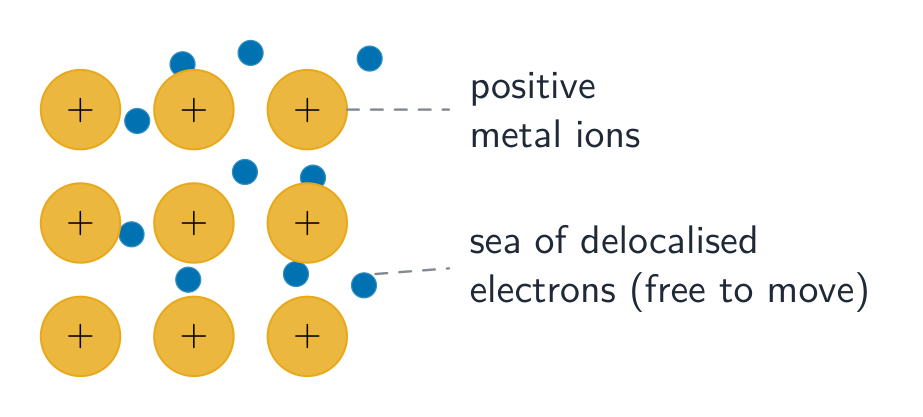
    • Metallic bond 金属键: metal atoms share a "sea" of mobile electrons.
    עברית

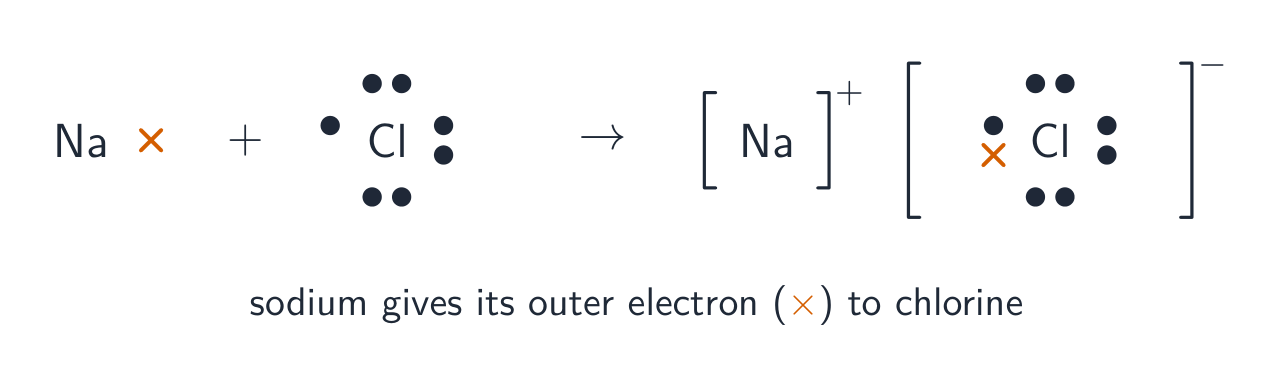
    גבישי נתרן כלור: מוצקים יוניים יוצרים רשת של יונים בעלי מטען הפוך *גבישי נתרן כלור: מוצקים יוניים יוצרים רשת של יונים בעלי מטען הפוך

    קשר כימי הוא משיכה שמחזיקה אטומים יחד. סוג הקשר שנוצר תלוי באלקטרונגטיביות של האטומים:

    Ionic bonding: a metal transfers its outer electrons to a non-metal *קשר יוני: מתכת מעבירה את אלקטרוני הערכיות שלה לאל-מתכת
    • קשר יוני: אלקטרונים עוברים ממתכת לאל-מתכת (הבדל אלקטרונגטיבי גדול).
    • קשר קוולנטי: אל-מתכות משתפות אלקטרונים (הבדל קטן). הבדל גדול אך לא עצום נותן קשר קוולנטי מקוטב.
    • קשר מתכתי: אטומי מתכת משתפים "ימה" של אלקטרונים זזים.

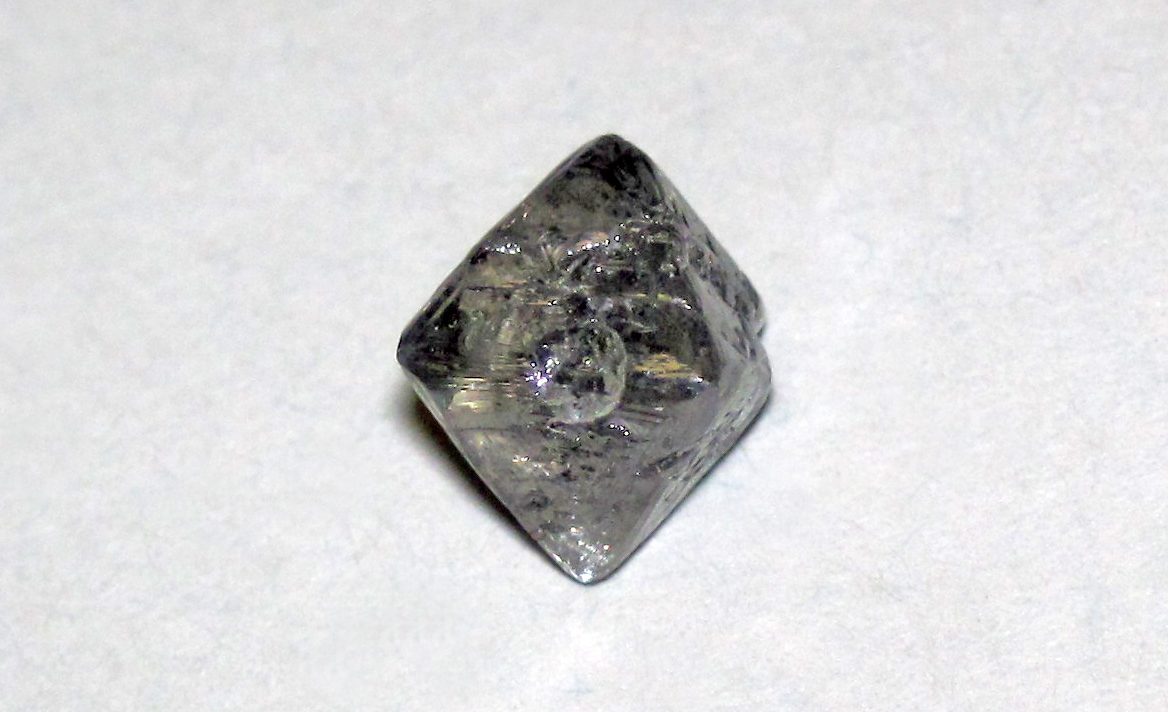
    A diamond crystal: giant covalent networks explain extreme hardness and high melting points *גביש יהלום: רשתות קוולנטיות ענקיות מסבירות קשיחות קיצונית ונקודות היתוך גבוהות

    Explore · ⁨חקור⁩

    Form an ionic bond by electron transfer · ⁨צור קשר יוני על ידי העברת אלקטרונים⁩

    An ionic bond forms when a metal gives electrons to a non-metal, making oppositely charged ions that attract; a covalent bond shares electrons instead. · ⁨קשר יוני נוצר כאשר מתכת נותנת אלקטרונים לאי-מתכת, מה שיוצר יונים טעונים בצורה הפוכה שנמשכים זה לזה; קשר קוולנטי משתף אלקטרונים במקום זאת.⁩

    Vocabulary · ⁨מילון מונחים⁩ Train · ⁨אימון⁩
    English עברית
    chemical bond/ˈkemɪkl bɒnd/ קשר כימי
    Ionic bond/aɪˈɒnɪk bɒnd/ קשר יוני
    Covalent bond/ˈkəʊvələnt bɒnd/ קשר קוולנטי
    polar covalent/ˈpəʊlə ˈkəʊvələnt/ קוולנטי מקוטב
    2.2

    Intramolecular Force and Potential Energy · ⁨כוחות פני-מולקולריים ואנרגיה פוטנציאלית⁩

    Syllabus · ⁨סיילבוס⁩
    English

    Learning Objective 2.2.A: Represent the relationship between potential energy and distance between atoms, based on factors that influence the interaction strength.

    • 2.2.A.1 A graph of potential energy versus the distance between atoms (internuclear distance) is a useful representation for describing the interactions between atoms. Such graphs illustrate both the equilibrium bond length (the separation between atoms at which the potential energy is lowest) and the bond energy (the energy required to separate the atoms).
    • 2.2.A.2 In a covalent bond, the bond length is influenced by both the size of the atom's core and the bond order (i.e., single, double, triple). Bonds with a higher order are shorter and have larger bond energies.
    • 2.2.A.3 Coulomb's law can be used to understand the strength of interactions between cations and anions.
      • i. Because the interaction strength is proportional to the charge on each ion, larger charges lead to stronger interactions.
      • ii. Because the interaction strength increases as the distance between the centers of the ions (nuclei) decreases, smaller ions lead to stronger interactions.
    עברית

    מטרת הלמידה 2.2.A: לייצג את הקשר בין אנרגיה פוטנציאלית למרחק בין אטומים, בהתבסס על גורמים המשפיעים על עוצמת האינטראקציה.

    • 2.2.A.1 גרף של אנרגיה פוטנציאלית לעומת המרחק בין אטומים (מרחק פני-גרעיני) הוא ייצוג שימושי לתיאור האינטראקציות בין אטומים. גרפים כאלה ממחישים גם את אורך הקשר בשיווי משקל (המרחק בין אטומים בו האנרגיה הפוטנציאלית נמוכה ביותר) וגם את אנרגיית הקשר (האנרגיה הנדרשת להפרדת האטומים).
    • 2.2.A.2 בקשר קוולנטי, אורך הקשר מושפע גם מגודל ליבת האטום וגם מסדר הקשר (כלומר, יחיד, כפול, משולש). קשרים עם סדר גבוה יותר הם קצרים יותר ויש להם אנרגיות קשר גדולות יותר.
    • 2.2.A.3 ניתן להשתמש בחוק קולון כדי להבין את עוצמת האינטראקציות בין קטיונים ואניונים.
      • i. מכיוון שעוצמת האינטראקציה פרופורציונלית למטען בכל יון, מטענים גדולים יותר מובילים לאינטראקציות חזקות יותר.
      • ii. מכיוון שעוצמת האינטראקציה עולה כאשר המרחק בין מרכזי היונים (גרעינים) קטן, יונים קטנים יותר מובילים לאינטראקציות חזקות יותר.

    Source: College Board AP Course and Exam Description · ⁨מקור: תיאור הקורס והמבחן של College Board AP⁩

    English

    As two atoms approach, a potential energy 势能 curve captures the balance of attraction and repulsion. It dips to a minimum at the bond length 键长 (the stable separation) whose depth is the bond energy 键能. Shorter, stronger bonds sit in deeper, tighter wells; more shared pairs (double, triple bonds) give shorter, stronger bonds.

    עברית

    כאטומים שניים מתקרבים זה לזה, עקומת אנרגיה פוטנציאלית משקפת את איזון הכוחות האטרקטיביים והדוחים. העקומה יורדת למינימום ב-אורך הקשר (המרחק היציב), ועומקה הוא אנרגיית הקשר. קשרים קצרים וחזקים נמצאים באגמים עמוקים וצמודים יותר; כמות רבה יותר של זוגות משותפים (קשרים כפולים או משולשים) מובילה לקשרים קצרים וחזקים יותר.

    2.3

    Structure of Ionic Solids · ⁨מבנה של תרכובות יוניות מוצקות⁩

    Syllabus · ⁨סיילבוס⁩
    English

    Learning Objective 2.3.A: Represent an ionic solid with a particulate model that is consistent with Coulomb's law and the properties of the constituent ions.

    • 2.3.A.1 The cations and anions in an ionic crystal are arranged in a systematic, periodic 3-D array that maximizes the attractive forces among cations and anions while minimizing the repulsive forces.
      • Exclusion statement: Knowledge of specific crystal structures is not essential to an understanding of the learning objective and will not be assessed on the AP Exam.
    עברית

    מטרת הלמידה 2.3.A: לייצג מוצק יוני עם דגם חלקיקי התואם לחוק קולון ולתכונות היונים המרכיבים אותו.

    • 2.3.A.1 הקטיונים והאניונים בגביש יוני מסודרים במבנה מחזורי ושיטתי 3-ממדי שמקסימים את הכוחות המושכים בין קטיונים ואניונים וממינימים את הכוחות הדוחים.
      • הצהרת פסילה: ידע על מבני גביש ספציפיים אינו הכרחי להבנת מטרת הלמידה ולא יימדד במבחן AP.

    Source: College Board AP Course and Exam Description · ⁨מקור: תיאור הקורס והמבחן של College Board AP⁩

    English

    An ionic solid 离子固体 is a repeating 3-D lattice 晶格 of alternating cations and anions, held by strong electrostatic attraction. This explains their high melting points, brittleness, and why they conduct only when molten or dissolved (ions freed to move). The lattice energy rises with larger ion charges and smaller ions, so MgO (both $2+/2-$) melts far higher than NaCl (both $1+/1-$).

    עברית

    נוצר יוני הוא רשת 3-D חוזרת של קטיונים ואניונים מתחלפים, המוחזקים על ידי משיכה אלקטרוסטטית חזקה. הדבר מסביר את נקודות ההיתוך הגבוהות שלהם, שבירותם, ולמה הם מוליכים רק כאשר נוזלים או מומסים (היונים משוחררים לתנועה). אנרגיית הרשת עולה עם מטעני יון גדולים יותר ויונים קטנים יותר, ולכן MgO (שניהם $2+/2-$) נמס טמפרטורה הרבה גבוהה יותר מ-NaCl (שניהם $1+/1-$).

    היונים ארוזים ברשת ענקית של יונים חיוביים ושליליים סוסיגים
    היונים ארוזים ברשת ענקית של יונים חיוביים ושליליים סוסיגים
    Vocabulary · ⁨מילון מונחים⁩ Train · ⁨אימון⁩
    English עברית
    lattice/ˈlætɪs/ רשת גבישית
    delocalized/dɪˈlɒkəlaɪzd/ מבוזז
    2.4

    Structure of Metals and Alloys · ⁨מבנה של מתכות וסגסוגות⁩

    Syllabus · ⁨סיילבוס⁩
    English

    Learning Objective 2.4.A: Represent a metallic solid and/or alloy using a model to show essential characteristics of the structure and interactions present in the substance.

    • 2.4.A.1 Metallic bonding can be represented as an array of positive metal ions surrounded by delocalized valence electrons (i.e., a "sea of electrons").
    • 2.4.A.2 Interstitial alloys form between atoms of significantly different radii, where the smaller atoms fill the interstitial spaces between the larger atoms (e.g., with steel in which carbon occupies the interstices in iron).
    • 2.4.A.3 Substitutional alloys form between atoms of comparable radius, where one atom substitutes for the other in the lattice. (e.g., in certain brass alloys, other elements, usually zinc, substitute for copper.)
    עברית

    מטרת למידה 2.4.A: לייצג מוצק מתכתי ו/או סגסוגת באמצעות דגם כדי להראות את התכונות המבנית והאינטראקציות העיקריות החברות בחומר.

    • 2.4.A.1 קשר מתכתי ניתן לייצוג כמערך של יוני מתכת חיוביים המוקפים באלקטרונים ערכתיים לא-ממוקדים (כלומר, "ים אלקטרונים").
    • 2.4.A.2 סגסוגות אינטרסטריציות נוצרות בין אטומים בעלי רדיוסים שונים משמעותית, כאשר האטומים הקטנים ממלאים את החללים האינטרסטריציים בין האטומים הגדולים (למשל, בפלדה שבה פחמן תופס את החללים בין ברזל).
    • 2.4.A.3 סגסוגות חלופיות נוצרות בין אטומים בעלי רדיוס דומה, כאשר אטום אחד מחליף את השני במסגרת. (למשל, בסגסוגות פליז מסוימות, אלמנטים אחרים, בדרך כלל אבץ, מחליפים נחושת.)

    Source: College Board AP Course and Exam Description · ⁨מקור: תיאור הקורס והמבחן של College Board AP⁩

    English

    In a metal, cations sit in a lattice bathed in delocalized 离域 electrons, which explains conductivity, malleability, and luster. An alloy 合金 mixes metals: a substitutional alloy swaps in similar-sized atoms; an interstitial alloy (like steel) fits small atoms into the gaps, making it harder.

    עברית

    בתכת, הקטיונים יושבים ברשת הטבולה באלקטרונים דלוקאליזציה, מה שמסביר את המוליכות, העובדות והברק. סגסוגת מערבבת מתכות: סגסוגת חלופתית מחליפה אטומים בעלי גודל דומה; סגסוגת אינטרstitialית (כמו פלדה) מכניסה אטומים קטנים לתוך הפער בין האטומים, מה שהופך אותה לקשה יותר.

    אטומים בגדלים שונים בסגסוגת מונעים החלקת שכבות, ולכן היא קשה יותר
    אטומים בגדלים שונים בסגסוגת מונעים החלקת שכבות, ולכן היא קשה יותר
    קשר מתכתי: יונים חיוביים בים של אלקטרונים ממוקמים-מרחוק
    קשר מתכתי: יונים חיוביים בים של אלקטרונים ממוקמים-מרחוק
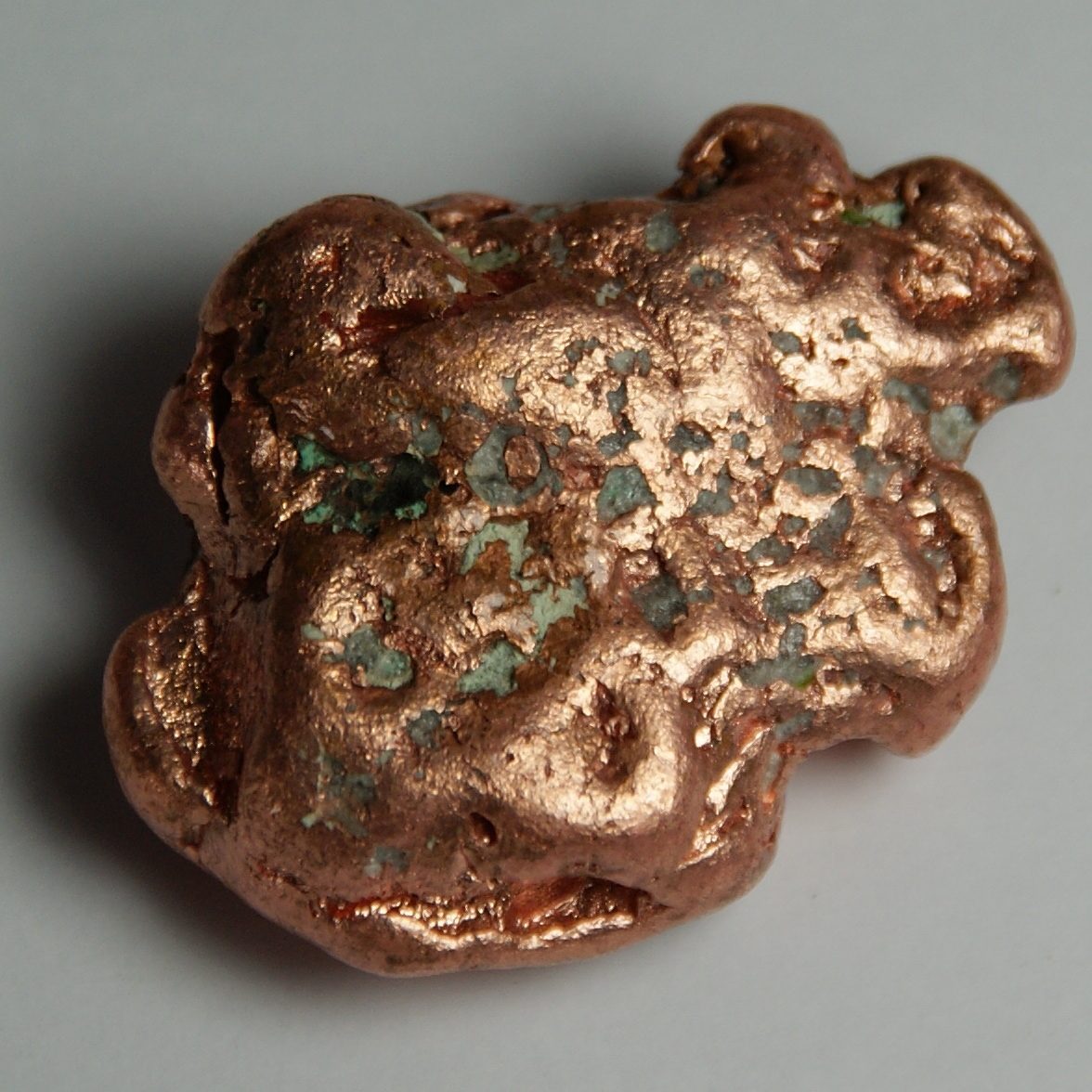
    נחושת טבעית: הקשר המתכתי נותן מוצק מבריק ועובד עם אלקטרונים דלוקאליזציה
    נחושת טבעית: הקשר המתכתי נותן מוצק מבריק ועובד עם אלקטרונים דלוקאליזציה
    Explore · ⁨חקור⁩

    Slide layers in a metallic lattice · ⁨החלק שכבות ברשת מתכתית⁩

    A metal is positive ions in a sea of delocalised electrons. The layers can slide without breaking the bond, so metals are malleable and conduct. · ⁨מתכת היא יונים חיוביים בים של אלקטרונים דלוקלים. השכבות יכולות להחליק ללא שבירת הקשר, ולכן מתכות הן可塑יות ומוליכות חשמל.⁩

    Vocabulary · ⁨מילון מונחים⁩ Train · ⁨אימון⁩
    English עברית
    Metallic bond/məˈtælɪk bɒnd/ קשר מתכתי
    potential energy/pəˈtenʃl ˈenədʒi/ אנרגיה פוטנציאלית
    bond length/bɒnd leŋθ/ אורך קשר
    bond energy/bɒnd ˈenədʒi/ אנרגיית קשר
    ionic solid/aɪˈɒnɪk ˈsɒlɪd/ נוזל יוני
    alloy/ˈælɔɪ/ סגסוגת
    Lewis diagram/ˈluːɪs ˈdaɪəɡræm/ דיאגרמת לויס
    lone pairs/ləʊn peəz/ זוגות אלקטרונים בודדים
    octet/ɒkˈtet/ אוקטט
    resonance/ˈrezənəns/ תהודה
    Formal charge/ˈfɔːml tʃɑːdʒ/ טענה פורמלית
    2.5

    Lewis Diagrams · ⁨דיאגרמות לויס⁩

    Syllabus · ⁨סיילבוס⁩
    English

    Learning Objective 2.5.A: Represent a molecule with a Lewis diagram.

    • 2.5.A.1 Lewis diagrams can be constructed according to an established set of principles.
    עברית

    מטרת למידה 2.5.A: לייצג מולקולה באמצעות דיאגרמת לויס.

    • 2.5.A.1 דיאגרמות לויס יכולות להיות בנותées לפי סדרה מקובלת של עקרונות.

    Source: College Board AP Course and Exam Description · ⁨מקור: תיאור הקורס והמבחן של College Board AP⁩

    English

    A Lewis diagram 路易斯结构 shows valence electrons as bonding pairs and lone pairs 孤对电子, giving most atoms an octet 八隅体 (8 valence electrons; H wants 2). Steps: count total valence electrons, connect atoms with single bonds, complete octets on outer atoms, then form multiple bonds if the central atom is short.

    Worked example. Draw carbon dioxide, $\text{CO}_2$. Total valence electrons $=4+2(6)=16$. Put C in the centre; single bonds to each O use $4$ electrons and leave the outer O atoms short. Completing octets forces two double bonds, $\text{O}=\text{C}=\text{O}$: each O then has two lone pairs, C has none, and all $16$ electrons are placed with every atom at an octet.

    עברית

    דיאגרמת לויס מציגה אלקטרונים בשכבת הערכיות כזוגות קשר וזוגות בידוד, ומעניקה לרוב האטומים אוקטט (8 אלקטרונים בשכבת הערכיות; H זקוק ל-2). שלבים: ספורו את סך אלקטרוני הערכיות, חברו את האטומים בקשרים יחידים, השלימו את האוקטטים באטומים החיצוניים, ולאחר מכן צרו קשרים מרובים אם לאטום המרכזי חסרים אלקטרונים.

    דיאגרמות נקודה וצלב מראים את זוגות הקשר וזוגות הבידוד במולקולה
    דיאגרמות נקודה וצלב מראים את זוגות הקשר וזוגות הבידוד במולקולה

    דוגמה מופת. צייר את דו-חמצן הפחמן, $\text{CO}_2$. סך אלקטרוני הערכיות $=4+2(6)=16$. הנח C במרכז; קשרים יחידים לכל O משמשים $4$ אלקטרונים ומוותרים על האטומים החיצוניים של O. השלמת האוקטט מחייבת שני קשרים כפולים, $\text{O}=\text{C}=\text{O}$: כל O מקבל אז זוגות אלקטרונים בודדים, ל-C אין, וכל $16$ אלקטרונים ממוקמים כאשר כל אטום נמצא באוקטט.

    2.6

    Resonance and Formal Charge · ⁨תנועה וטענה פורמלית⁩

    Syllabus · ⁨סיילבוס⁩
    English

    Learning Objective 2.6.A: Represent a molecule with a Lewis diagram that accounts for resonance between equivalent structures or that uses formal charge to select between nonequivalent structures.

    • 2.6.A.1 In cases where more than one equivalent Lewis structure can be constructed, resonance must be included as a refinement to the Lewis structure. In many such cases, this refinement is needed to provide qualitatively accurate predictions of molecular structure and properties.
    • 2.6.A.2 The octet rule and formal charge can be used as criteria for determining which of several possible valid Lewis diagrams provides the best model for predicting molecular structure and properties.
    • 2.6.A.3 As with any model, there are limitations to the use of the Lewis structure model, particularly in cases with an odd number of valence electrons.
    עברית

    מטרת למידה 2.6.A: לייצג מולקולה באמצעות דיאגרמת לויס שמחשבת תהודה בין מבנים equivalent או משתמש במטען פורמלי לבחירה בין מבנים non-equivalent.

    • 2.6.A.1 במקרים שבהם ניתן לבנות יותר מדיאגרמת לויס equivalent אחת, יש לכלול תהודה כשיפור לדיאגרמת לויס. במקרים רבים, שיפור זה נדרש כדי לספק תחזיות מדויקות איכותית לגבי מבנה ותכונות המולקולה.
    • 2.6.A.2 כלל האוקטט ומטען פורמלי יכולים לשמש כקריטריונים לקביעת איזה מדיאגרמת לויס possible valid מהמספר האפשריות מספק את הדגם הטוב ביותר לתחזית מבנה ותכונות המולקולה.
    • 2.6.A.3 כמו בכל דגם, ישנם מגבלות לשימוש בדגם דיאגרמת לויס, במיוחד במקרים עם מספר אי-זוגי של אלקטרונים ערכתיים.

    Source: College Board AP Course and Exam Description · ⁨מקור: תיאור הקורס והמבחן של College Board AP⁩

    English

    When two or more valid Lewis diagrams differ only in electron placement, the true structure is an average – resonance 共振. Formal charge 形式电荷 (valence electrons minus lone-pair electrons minus half the bonding electrons) picks the best structure: the one with formal charges closest to zero, and any negative charge on the most electronegative atom.

    Worked example. Assign formal charges in the nitrate ion, $\text{NO}_3^{-}$ (one double bond, two single bonds). For N (4 bonds, no lone pairs): $5-0-4=+1$. For the double-bonded O (2 lone pairs): $6-4-2=0$. For each single-bonded O (3 lone pairs): $6-6-1=-1$. The total is $+1+0+(-1)+(-1)=-1$, matching the ion's overall charge – a good check that the structure is drawn correctly. Because the three O atoms are equivalent by resonance, the real ion has three identical bonds.

    עברית

    כאשר שתי דיאגרמות לויס תקפות מונחות שונות רק במיקום האלקטרונים, המבנה האמיתי הוא ממוצע – תנועה. טענה פורמלית (אלקטרונות ערכיים פחות אלקטרוני זוג בידוד פחות חצי מאלקטרוני הקשר) בוחרת את המבנה הטוב ביותר: celui עם טענות פורמליות הקרובות לאפס, וככל שהטענה השלילית נמצאת על האטום האלקטרונegative ביותר.

    דוגמה מפורטת. קבעו טענות פורמליות ביון הניטרט, $\text{NO}_3^{-}$ (קשר כפול אחד, שני קשרים יחידים). עבור N (4 קשרים, ללא זוגות בידוד): $5-0-4=+1$. עבור O בעל הקשר הכפול (2 זוגות בידוד): $6-4-2=0$. עבור כל O בעל הקשר היחיד (3 זוגות בידוד): $6-6-1=-1$. הסך הכול הוא $+1+0+(-1)+(-1)=-1$, התואם מטענת היון הכוללת – בדיקה טובה שישורט correctly. מכיוון שארבעת אטומי ה-O שווים זה לזה בתנועה, ליון האמיתי יש שלושה קשרים זהים.

    2.7

    VSEPR and Bond Hybridization · ⁨VSEPR והיברידיזציה של קשרים⁩

    Syllabus · ⁨סיילבוס⁩
    English

    Learning Objective 2.7.A: Based on the relationship between Lewis diagrams, VSEPR theory, bond orders, and bond polarities:

    • i. Explain structural properties of molecules.

    • ii. Explain electron properties of molecules.

    • 2.7.A.1 VSEPR theory uses the Coulombic repulsion between electrons as a basis for predicting the arrangement of electron pairs around a central atom.

    • 2.7.A.2 Both Lewis diagrams and VSEPR theory must be used for predicting electronic and structural properties of many covalently bonded molecules and polyatomic ions, including the following:

      • i. Molecular geometry (linear, trigonal planar, tetrahedral, trigonal pyramidal, bent, trigonal bipyramidal, seesaw, T-shaped, octahedral, square pyramidal, square planar)
      • ii. Bond angles
      • iii. Relative bond energies based on bond order
      • iv. Relative bond lengths (multiple bonds, effects of atomic radius)
      • v. Presence of a dipole moment
      • vi. Hybridization of valence orbitals for atoms within a molecule or polyatomic ion
    • 2.7.A.3 The terms "hybridization" and "hybrid atomic orbital" are used to describe the arrangement of electrons around a central atom. When the central atom is $sp$ hybridized, its ideal bond angles are $180°$; for $sp^2$ hybridized atoms the bond angles are $120°$; and for $sp^3$ hybridized atoms the bond angles are $109.5°$.

      • Exclusion statement: An understanding of the derivation and depiction of hybrid orbitals will not be assessed on the AP Exam. The course includes the distinction between sigma and pi bonding, the use of VSEPR to explain the shapes of molecules, and the $sp$, $sp^2$, and $sp^3$ nomenclature.
      • Exclusion statement: Hybridization involving d orbitals will not be assessed on the AP Exam. When an atom has more than four pairs of electrons surrounding the central atom, students are only responsible for the shape of the resulting molecule.
    • 2.7.A.4 Bond formation is associated with overlap between atomic orbitals. In multiple bonds, such overlap leads to the formation of both sigma and pi bonds. The overlap is stronger in sigma than pi bonds, which is reflected in sigma bonds having greater bond energy than pi bonds. The presence of a pi bond also prevents the rotation of the bond and leads to geometric isomers.

      • Exclusion statement: Molecular orbital theory is recommended as a way to provide deeper insight into bonding. However, the AP Exam will neither explicitly assess molecular orbital diagrams, filling of molecular orbitals, nor the distinction between bonding, nonbonding, and antibonding orbitals.
    עברית

    מטרת למידה 2.7.A: על בסיס הקשר בין דיאגרמות לויס, תיאוריית VSEPR, סדר קשר וקוטביות קשר:

    • i. הסבר תכונות מבניות של מולקולות.

    • ii. הסבר תכונות אלקטרוניות של מולקולות.

    • 2.7.A.1 תיאוריית VSEPR משתמשת בדחייה הקולונית בין אלקטרונים כבסיס לחזות את סידור זוגות האלקטרונים סביב אטום מרכזי.

    • 2.7.A.2 יש להשתמש במבני לואיס ובתיאוריית VSEPR כדי לחזות תכונות אלקטרוניות ומבניות של מולקולות רבות קשרים קוולנטיים ויונים פולי-אטומיים, כולל הבאים:

      • i. גיאומטריה מולקולרית (ליניארית, משולשת מישורית, טטרהדרית, משולשת פירמידלית, מעוקלת, דו-פירמידלית משולשת, מסתור, צורת T, אוקטהדרית, פירמידה ריבועית, מישורית ריבועית)
      • ii. זוויות קשר
      • iii. אנרגיות קשר יחסיות על בסיס סדר הקשר
      • iv. אורכי קשר יחסים (קשרים מרובים, השפעות של רדיוס אטומי)
      • v. נוכחות של מומנט דיפול
      • vi. היברידיזציה של אורביטלים ערכתיים לאטומים בתוך מולקולה או יון פולי-אטומי
    • 2.7.A.3 המונחים "היברידיות" ו"אלקטרונה היברידי אטומי" משמשים לתיאור סידור האלקטרונים סביב אטום מרכזי. כאשר האטום המרכזי נמצא בהיברידציה $sp$, זוויות הקשר האידיאליות שלו הן $180°$; עבור אטומים בהיברידציה $sp^2$, זוויות הקשר הן $120°$; ועבור אטומים בהיברידציה $sp^3$, זוויות הקשר הן $109.5°$.

      • הצהרת חריגה: לא ייבחן בבחן AP ההבנה של הגזירה והצגה של אורביטלים היברידיים. הקורס כולל את ההבחנה בין קשר סיגמה ופי, השימוש ב-VSEPR להסבר צורות מולקולות, ואת $sp$, $sp^2$, ו$sp^3$ המינוח.
      • הצהרת חריגה: היברידיזציה המעורבת באורביטלי d לא תיבחן בבחן AP. כאשר לאטום יש יותר מארבעה זוגות אלקטרונים סביב האטום המרכזי, התלמידים אחראים רק לצורה של המולקולה הנוצרת.
    • 2.7.A.4 יצירת קשרים קשורה לשחף בין אורביטלים אטומיים. בקשרים מרובים, שחף זה מוביל ליצירתם של קשרים סיגמה ופי גם יחד. השחף חזק יותר בקשרי סיגמה מאשר בקשרי פי, מה שמבטא בעובדה שקשרי סיגמה בעלי אנרגיית קשר גבוהה יותר מקשרי פי. נוכחות של קשר פי מונעת גם כן סיבוב סביב הקשר ומובילה ליצירת איזומרים גיאומטריים.

      • הצהרת חריגה: תיאוריית האורביטלים המולקולרית מומלצת כישיטה לספק העמקה deeper לקשרים. עם זאת, בבחן AP לא ייבחן במפורש דיאגרמות אורביטלים מולקולריים, מילוי אורביטלים מולקולריים, או ההבחנה בין אורביטלי קשר, אי-קשר ואנטי-קשר.

    Source: College Board AP Course and Exam Description · ⁨מקור: תיאור הקורס והמבחן של College Board AP⁩

    English
    VSEPR: molecular shapes

    VSEPR 价层电子对互斥 theory predicts shape: electron pairs (bonds and lone pairs) around a central atom spread out as far apart as possible. Counting electron domains gives the geometry (linear, trigonal planar, tetrahedral, …); lone pairs push bonds closer, bending the shape. Hybridization 杂化 ($sp$, $sp^2$, $sp^3$) describes the mixed orbitals matching that geometry. Molecular shape and bond polarity together decide whether the whole molecule is polar.

    Worked example. Predict the shape of ammonia, $\text{NH}_3$. Nitrogen has $3$ bonding pairs and $1$ lone pair – four electron domains, so the electron geometry is tetrahedral and the hybridization is $sp^3$. The lone pair is invisible in the shape but still pushes the bonds together, so the molecular shape is trigonal pyramidal with a bond angle of about $107^{\circ}$ (a little less than the ideal $109.5^{\circ}$). The three N–H dipoles do not cancel, so the molecule is polar.

    Bonds form when atomic orbitals overlap. Every single bond is one sigma bond σ键 – orbitals overlapping head-on along the line joining the two atoms. A multiple bond adds a pi bond π键, made by $p$ orbitals overlapping sideways above and below that line: a double bond is one sigma + one pi, a triple bond one sigma + two pi. Head-on overlap is more effective, so a sigma bond is stronger (higher bond energy) than a pi bond – which is why a double bond is stronger than a single bond but not twice as strong. A pi bond also locks the two atoms so they cannot rotate about the bond; a C=C double bond therefore has fixed cis and trans forms – geometric isomers 几何异构体 that a freely-rotating single bond could never show.

    Worked example. Count the bonds in ethene, $\text{H}_2\text{C}=\text{CH}_2$. The four C–H bonds are single bonds (one sigma each); the C=C is one sigma plus one pi. So ethene has 5 sigma and 1 pi bond, and that single pi bond is exactly what stops the two $\text{CH}_2$ ends from twisting relative to each other.

    עברית
    VSEPR: צורות מולקולריות

    תיאוריית VSEPR חוזה צורה: זוגות אלקטרונים (קשרים וזוגות בידוד) סביב אטום מרכזי מתפשטים ככל שהיאפשרי הרחוק זה מזה. ספירת תחומי אלקטרונים נותנת גיאומטריה (קוויתית, משולשית מישורית, טטרהדרית…); זוגות בידוד דוחפים קשרים קרובים יותר, ומעוותים את הצורה. היברידיזציה ($sp$, $sp^2$, $sp^3$) מתארת את האורביטלים המעורבים התואמים לגיאומטריה זו. צורת המולקולה וקוטביות הקשר יחד קובעים האם המולקולה כולה קוטבית.

    היברידיזציה וצורה: sp3 טטרהדרית, sp2 מישורית, sp קוויתית
    היברידיות ומבנה: sp3 טטרהדרלי, sp2 מישורי, sp לינארי
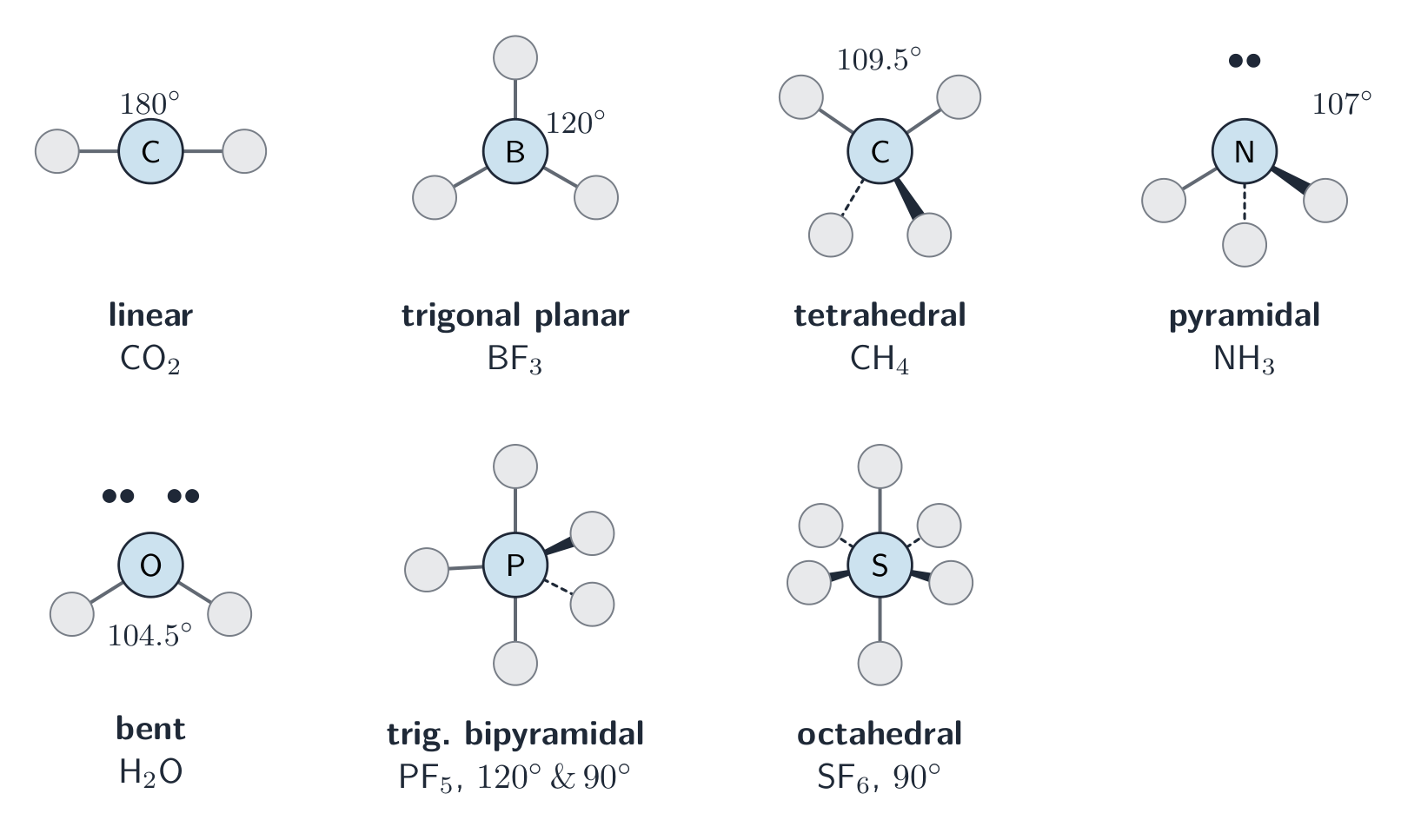
    המבנים הנפוצים של VSEPR והזוויות הקשר שלהם
    המבנים הנפוצים של VSEPR והזוויות הקשר שלהם

    דוגמה פתורה. נחזה את המבנה של האמוניה, $\text{NH}_3$. לחנקן יש $3$ זוגות קשר ו$1$ זוג אלקטרונים בודד – ארבעה אזורים אלקטרוניים, ולכן הגיאומטריה האלקטרונית היא טטרהדרלית וההיברידיה היא $sp^3$. הזוג הבודד אינו נראה במבנה המולקולרי אך עדיין דוחף את הקשרים זה אל זה, ולכן המבנה המולקולרי הוא טריגונלי-פרמידי עם זווית קשר של כ-$107^{\circ}$ (מעט פחות מהזווית האידיאלית $109.5^{\circ}$). שלושת דייפולי ה-N–H לא מתבטלים, ולכן המולקולה קוטבית.

    קשרים נוצרים כאשר אורביטלי אטומיים מתכנסים. כל קשר יחיד הוא קשר סigma σ – אורביטלים מתכנסים ראש-על-ראש לאורך הקו המחבר בין שני האטומים. קשר כפול או משולש מוסיף קשר פה π, הנוצר על ידי אורביטלים $p$ המתכנסים בצד מעל ומתחת לקו הזה: קשר כפול הוא סigma אחד + פה אחד, קשר משולש הוא סigma אחד + שני פה. התכנסות ראש-על-ראש יעילה יותר, ולכן קשר סigma חזק יותר (אנרגיית קשר גבוהה יותר) מאשר קשר פה – הדבר שמסביר מדוע קשר כפול חזק מקשר יחיד אך אינו חזק פי שניים. קשר פה גם נעול את שני האטומים כך שלא יכולים לסובב סביב הקשר; לכן לקשר C=C כפול יש צורות ציס ו-טרנס קבועות – איזומרים גיאומטריים שאין להם מקביל בקשר יחיד החופשי מסובב.

    דוגמה פתורה. ספרו את הקשרים באתינ, $\text{H}_2\text{C}=\text{CH}_2$. ארבעת הקשרים C–H הם קשרים יחידים (סigma אחד לכל אחד); הקשר C=C הוא סigma אחד ועוד פה אחד. לכן לאתינ יש 5 קשרי סigma ו-1 קשר פה, והקשר פה היחיד הוא בדיוק מה שמניע את שני קצוות ה-$\text{CH}_2$ מסתובב ביחס זה לזה.

    Explore · ⁨חקור⁩

    Predict molecular shape with VSEPR · ⁨תאר צורת מולקולה עם VSEPR⁩

    VSEPR: electron pairs repel and spread as far apart as possible, setting the molecule's shape. Add bonding and lone pairs and watch the geometry change. · ⁨VSEPR: זוגות אלקטרונים דוחים זה את זה ומתפשטים ככל שהאפשרות מאפשרת, מה שקובע את צורת המולקולה. הוסף זוגות קישוריים ולונות וצפה בשינוי הגיאומטריה.⁩

    Vocabulary · ⁨מילון מונחים⁩ Train · ⁨אימון⁩
    English עברית
    VSEPR/ˈvespə/ VSEPR
    Hybridization/ˌhaɪbrɪdaɪˈzeɪʃn/ היברידציה
    sigma bond/ˈsɪɡmə bɒnd/ קשר סigma
    pi bond/paɪ bɒnd/ קשר פיי
    geometric isomers/ˌdʒiːəʊˈmetrɪk ˈaɪsəməz/ איזומרים גיאומטריים
    2.7

    Exam tips · ⁨טיפים לבחינות⁩

    English
    • Decide the bond type from the atoms: ionic (metal + non-metal, electron transfer), covalent (non-metals, sharing), metallic (sea of delocalised electrons).
    • An ionic solid conducts only when molten or dissolved (ions free to move), never as a solid.
    • Draw Lewis structures to satisfy the octet (H wants 2), then use VSEPR — electron pairs spread as far apart as possible — to predict the shape.
    • Lone pairs take up space and push bonds closer, bending the shape (water is bent, ammonia pyramidal).
    • A molecule can have polar bonds yet be non-polar overall if its symmetry makes the dipoles cancel ($\text{CO}_2$).
    • A single bond is 1 sigma bond; a double bond is 1 sigma + 1 pi, a triple bond 1 sigma + 2 pi. Sigma is stronger than pi, and a pi bond blocks rotation, giving cis/trans geometric isomers.
    עברית
    • קבעו את סוג הקשר לפי האטומים: יוני (מתכת + לא-מתכת, העברת אלקטרון), קוולנטי (לא-מתכות, שיתוף), מתכתי (ים של אלקטרונים מרוכזים).
    • מוצק יוני מוליך רק כאשר הוא מומס או ממיס (יונים חופשיים לתנועה), לעולם לא במצב מוצק.
    • שרטטו מבני לויס כדי לספק את הכלל של השמונה (ל-H יש צורך ב-2), ואז השתמשו ב-VSEPR – זוגות אלקטרונים מתפשטים ככל שהמרחק הגדול ביותר האפשרי – כדי לחזות את המבנה.
    • זוגות אלקטרונים בודדים תופסים מקום ודוחפים קשרים קרוב יותר, מכופפים את המבנה (מים הם מעוקל, אמוניה פרמידית).
    • למולקולה יכולים להיות קשרים קוטביים אך היא בלתי קוטבית בסך הכל אם הסימטריה שלה גורמת להתבטלות הדייפולים ($\text{CO}_2$).
    • קשר יחיד הוא 1 סigma; קשר כפול הוא 1 סigma + 1 פה, קשר משולש הוא 1 סigma + 2 פה. סaudio חזק יותר מפלה, וקשר פה חוסם סיבוב, מה שמוביל ל-איזומרים גיאומטריים ציס/טרנס.
  • 3

    Properties of Substances and Mixtures · ⁨תכונות חומרים ותערובות⁩

    Watch lesson · ⁨צפה בשיעור⁩
    3.1

    Intermolecular and Interparticle Forces

    Syllabus · ⁨סיילבוס⁩
    English

    Learning Objective 3.1.A: Explain the relationship between the chemical structures of molecules and the relative strength of their intermolecular forces when: i. The molecules are of the same chemical species. ii. The molecules are of two different chemical species.

    • 3.1.A.1 London dispersion forces are a result of the Coulombic interactions between temporary, fluctuating dipoles. London dispersion forces are often the strongest net intermolecular force between large molecules.
      • i. Dispersion forces increase with increasing contact area between molecules and with increasing polarizability of the molecules.
      • ii. The polarizability of a molecule increases with an increasing number of electrons in the molecule and the size of the electron cloud. It is enhanced by the presence of pi bonding.
      • iii. The term "London dispersion forces" should not be used synonymously with the term "van der Waals forces."
    • 3.1.A.2 The dipole moment of a polar molecule leads to additional interactions with other chemical species.
      • i. Dipole-induced dipole interactions are present between a polar and nonpolar molecule. These forces are always attractive. The strength of these forces increases with the magnitude of the dipole of the polar molecule and with the polarizability of the nonpolar molecule.
      • ii. Dipole-dipole interactions are present between polar molecules. The interaction strength depends on the magnitudes of the dipoles and their relative orientation. Interactions between polar molecules are typically greater than those between nonpolar molecules of comparable size because these interactions act in addition to London dispersion forces.
      • iii. Ion-dipole forces of attraction are present between ions and polar molecules. These tend to be stronger than dipole-dipole forces.
    • 3.1.A.3 The relative strength and orientation dependence of dipole-dipole and ion-dipole forces can be understood qualitatively by considering the sign of the partial charges responsible for the molecular dipole moment, and how these partial charges interact with an ion or with an adjacent dipole.
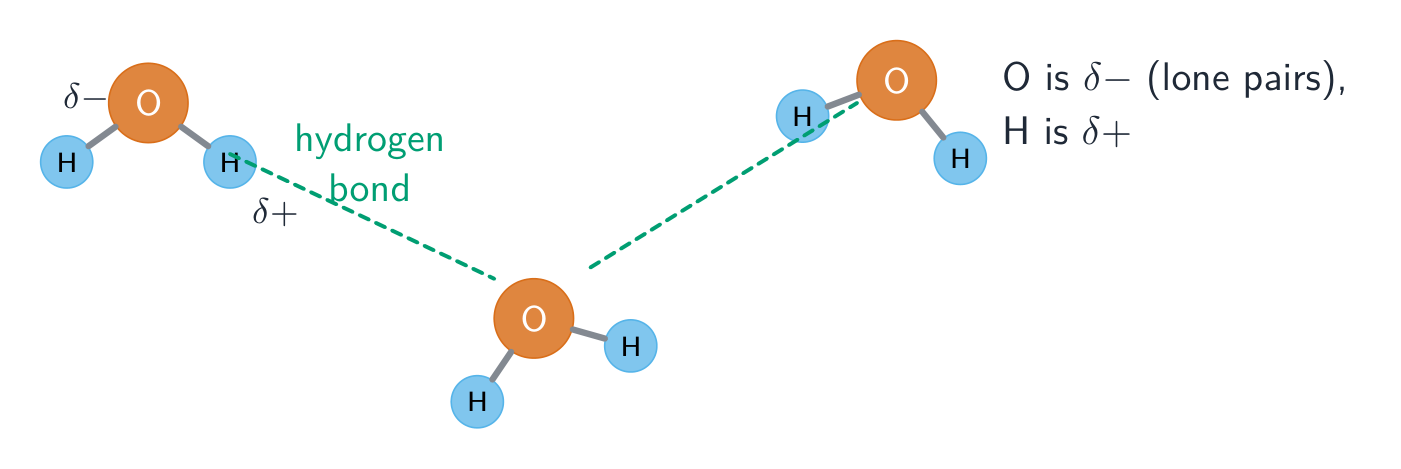
    • 3.1.A.4 Hydrogen bonding is a strong type of intermolecular interaction that exists when hydrogen atoms covalently bonded to the highly electronegative atoms (N, O, and F) are attracted to the negative end of a dipole formed by the electronegative atom (N, O, and F) in a different molecule, or a different part of the same molecule.
    • 3.1.A.5 In large biomolecules, noncovalent interactions may occur between different molecules or between different regions of the same large biomolecule.
    עברית

    מטרת למידה 3.1.A: הסבר את הקשר בין המבנים הכימיים של מולקולות לבין החוזק היחסי של הכוחות הבין-מולקולריים שלהן כאשר: i. המולקולות הן מאותו מין כימי. ii. המולקולות הן משני מינים כימיים שונים.

    • 3.1.A.1 כוחות פיזור לונדון הם תוצאה של אינטראקציות קולומביות בין דיפולים זמניים ותנודתיים. כוחות פיזור לונדון לעיתים קרובות הם הכוח הבין-מולקולרי הרשמי החזק ביותר בין מולקולות גדולות.
      • i. כוחות פיזור עולים עם הגדלת שטח המגע בין מולקולות ועם הגדלת הניתנות לפולარიזציה של המולקולות.
      • ii. הניתנות לפולारीזציה של מולקולה עולה עם הגדלת מספר האלקטרונים במולקולה וגודל הענן האלקטרוני. היא מחוזקת בנוכחות של קשרי פי.
      • iii. את הביטוי "כוחות פיזור לונדון" אין להשתמש כמילה מקבילה לביטוי "כוחות ואן דר ואלס".
    • 3.1.A.2 המומנט הדו-קוטבי של מולקולה קוטבית גורם לאינטראקציות נוספות עם מינים כימיים אחרים.
      • i. אינטראקציות דו-קוטבי-מופעל-דו-קוטבי קיימות בין מולקולה קוטבית למולקולה לא קוטבית. כוחות אלו הם תמיד מושכים. חוזק הכוחות עולה עם הגודל של המומנט הדו-קוטבי במולקולה הקוטבית ועם הקיטביות של המולקולה הלא קוטבית.
      • ii. אינטראקציות דו-קוטבי-דו-קוטבי קיימות בין מולקולות קוטביות. חוזק האינטראקציה תלוי בגדלים של המומנטים הדו-קוביים ובאוריינטציה היחסית שלהם. אינטראקציות בין מולקולות קוטביות הן בדרך כלל חזקות יותר מאשר בין מולקולות לא קוטביות בגודל דומה, משום שהאינטראקציות הללו פועלות בנוסף לכוחות פיזור לונדון.
      • iii. כוחות משיכה יון-דו-קוטבי קיימים בין יונים ומולקולות קוטביות. כוחות אלו נוטים להיות חזקים יותר מכוחות דו-קוטבי-דו-קוטבי.
    • 3.1.A.3 החוזק היחסי ותלות האוריינטציה של כוחות דו-קוטבי-דו-קוטבי ויון-דו-קוטבי ניתן להבנה באופן איכותי על ידי שיקול הסימן של המטענים החלקיים האחראים למומנט הדו-קוטבי המולקולרי, וכיצד מטענים חלקיים אלו אינטראקטים עם יון או עם דו-קוטב סמוך.
    • 3.1.A.4 קישור מימן הוא סוג חזק של אינטראקציה בין-מולקולרית הקיימת כאשר אטומי מימן הקשורים בקשר קוולנטי לאטומים בעלי אלקטרonegativity גבוהה (N, O, ו-F) נמשכים לקצה השלילי של דו-קוטב שנוצר על ידי האטום הנגלטי (N, O, ו-F) במולקולה אחרת, או בחלק אחר של אותה מולקולה.
    • 3.1.A.5 בביומולקולות גדולות, אינטראקציות לא קוולנטיות עשויות להתרחש בין מולקולות שונות או בין אזורים שונים של אותו ביומולקולה גדולה.

    Source: College Board AP Course and Exam Description · ⁨מקור: תיאור הקורס והמבחן של College Board AP⁩

    Intermolecular forces 分子间作用力 (IMFs) are attractions between molecules – much weaker than bonds, but they set melting/boiling points. From weakest to strongest:

    London dispersion: an instantaneous dipole induces a dipole in a neighbour
    London dispersion: an instantaneous dipole induces a dipole in a neighbour
    Hydrogen bonding: an H on N/O/F is attracted to a lone pair on another molecule
    Hydrogen bonding: an H on N/O/F is attracted to a lone pair on another molecule
    • London dispersion forces 伦敦色散力: present in all molecules; they arise from Coulombic attraction between temporary, fluctuating dipoles, and are stronger for larger, more polarizable electron clouds - often the strongest net force between large molecules.
    • Dipole–dipole 偶极-偶极: between polar molecules. Their strength depends on the size of the dipoles and their relative orientation - a $\delta+$ end lining up with a neighbour's $\delta-$ end attracts, so these act in addition to dispersion and make polar molecules stickier than nonpolar ones of similar size.
    • Hydrogen bonding 氢键: a strong dipole force when H is bonded to N, O, or F.
    • Ion–dipole 离子-偶极: between an ion and a polar molecule (the ion pulls on the oppositely-charged end of the dipole). These are the strongest of the four here (stronger even than hydrogen bonds), and are exactly what lets water dissolve an ionic solid - each $\text{Na}^+$ is surrounded by the $\delta-$ oxygen ends of water molecules.

    The whole ladder is understood qualitatively by looking at the sign of the partial charges: a larger or better-aligned partial charge, or a full ionic charge, gives a stronger attraction. Stronger IMFs mean higher boiling points and lower vapor pressure. This is why water ($18\ \text{g/mol}$, hydrogen-bonded) boils at $100\,{}^{\circ}\text{C}$ while methane ($16\ \text{g/mol}$, dispersion only) boils at $-162\,{}^{\circ}\text{C}$.

    Vocabulary · ⁨מילון מונחים⁩ Train · ⁨אימון⁩
    English עברית
    Intermolecular forces/ˌɪntəməˈlekjʊlə ˈfɔːsɪz/ כוחות בין-מונריים
    London dispersion forces/ˈlʌndn dɪˈspɜːʃn ˈfɔːsɪz/ כוחות פיזור לונדון
    Dipole–dipole/ˈdaɪpəʊl ˈdaɪpəʊl/ דיפול-דיפול
    Ion–dipole/ˈaɪɒn ˈdaɪpəʊl/ יון-דיפול
    Hydrogen bonding/ˈhaɪdrədʒn ˈbɒndɪŋ/ קשר מימן
    3.2

    Properties of Solids

    Syllabus · ⁨סיילבוס⁩
    English

    Learning Objective 3.2.A: Explain the relationship among the macroscopic properties of a substance, the particulate-level structure of the substance, and the interactions between these particles.

    • 3.2.A.1 Many properties of liquids and solids are determined by the strengths and types of intermolecular forces present. Because intermolecular interactions are overcome completely when a substance vaporizes, the vapor pressure and boiling point are directly related to the strength of those interactions. Melting points also tend to correlate with interaction strength, but because the interactions are only rearranged, in melting, the relations can be more subtle.
    • 3.2.A.2 Particulate-level representations, showing multiple interacting chemical species, are a useful means to communicate or understand how intermolecular interactions help to establish macroscopic properties.
    • 3.2.A.3 Due to strong interactions between ions, ionic solids tend to have low vapor pressures, high melting points, and high boiling points. They tend to be brittle due to the repulsion of like charges caused when one layer slides across another layer. They conduct electricity only when the ions are mobile, as when the ionic solid is melted (i.e., in a molten state) or dissolved in water or another solvent.
    • 3.2.A.4 In covalent network solids, the atoms are covalently bonded together into a three-dimensional network (e.g., diamond) or layers of two-dimensional networks (e.g., graphite). These are only formed from nonmetals and metalloids: elemental (e.g., diamond, graphite) or binary compounds (e.g., silicon dioxide and silicon carbide). Due to the strong covalent interactions, covalent solids have high melting points. Three-dimensional network solids are also rigid and hard, because the covalent bond angles are fixed. However, graphite is soft because adjacent layers can slide past each other relatively easily.
    • 3.2.A.5 Molecular solids are composed of distinct, individual units of covalently-bonded molecules attracted to each other through relatively weak intermolecular forces. Molecular solids generally have a low melting point because of the relatively weak intermolecular forces present between the molecules. They do not conduct electricity because their valence electrons are tightly held within the covalent bonds and the lone pairs of each constituent molecule. Molecular solids are sometimes composed of very large molecules or polymers.
    • 3.2.A.6 Metallic solids are good conductors of electricity and heat, due to the presence of free valence electrons. They also tend to be malleable and ductile, due to the ease with which the metal cores can rearrange their structure. In an interstitial alloy, interstitial atoms tend to make the lattice more rigid, decreasing malleability and ductility. Alloys typically retain a sea of mobile electrons and so remain conducting.
    • 3.2.A.7 In large biomolecules or polymers, noncovalent interactions may occur between different molecules or between different regions of the same large biomolecule. The functionality and properties of such molecules depend strongly on the shape of the molecule, which is largely dictated by noncovalent interactions.
    עברית

    מטרת הלמידה 3.2.A: הסבר על הקשר בין התכונות המאקרוסקופיות של חומר, המבנה ברמת החלקיקים של החומר, והאינטראקציות בין חלקיקים אלו.

    • 3.2.A.1 תכונות רבות של נוזלים ומוצקים נקבעות על ידי עוצמת וסוג הכוחות בין-מולקולריים הקיימים. מכיוון שאינטראקציות בין-מולקולריות מתגברות לחלוטין כאשר חומר מתאדים, הלחץ הבדוד והנקודה ההתכה קשורים ישירות לעוצמת האינטראקציות אלו. נקודות ההתכה גם הן נוטות לקשור עם עוצמת האינטראקציה, אך מכיוון שהאינטראקציות רק נערכות מחדש בהתכה, הקשרים יכולים להיות עדינים יותר.
    • 3.2.A.2 ייצוגים ברמת החלקיקים המציגים מספר מין כימי אינטראקטיביים הם אמצעי שימושי לתקשורת או להבנה כיצד אינטראקציות בין-מולקולריות עוזרות לקבוע תכונות מאקרוסקופיות.
    • 3.2.A.3 בשל אינטראקציות חזקות בין יונים, מוצקים יוניים נוטים להיות בעלי לחצים בדודים נמוכים, נקודות התכה גבוהות ונקודות רתיחה גבוהות. הם נוטים להיות שבירים בשל הדחייה בין מטענים זהים הנגרמת כאשר שכבה אחת מחליקה מעל לשכבה אחרת. הם מוליכי חשמל רק כאשר היונים ניידים, כמו כאשר המוצק היוני מותך (כלומר, במצב נוזלי) או מומס במים או בממס אחר.
    • 3.2.A.4 במוצקי רשת קוולנטית, האטומים קשורים קוולנטית זה לזה ליצירת רשת תלת-ממדית (למשל, יהלום) או שכבות של רשתות דו-ממדיות (למשל, גרפיט). אלו נוצרים רק ממעטפות ומטאלואידים: אלמנטים (למשל, יהלום, גרפיט) או תרכובות בינאריות (למשל, סיליקון דו-חמצני וקרביד סיליקון). בשל האינטראקציות הקוולנטיות החזקות, מוצקים קוולנטיים יש להם נקודות התכה גבוהות. מוצקי רשת תלת-ממדיים הם גם קשיחים וקשים, מכיוון שזוויות הקשר הקוולנטי קבועות. עם זאת, גרפיט הוא רך מכיוון ששכבות סמוכות יכולות להחליק זו על זו בקלות יחסית.
    • 3.2.A.5 מוצקים מולקולריים מורכבים מיחידות נפרדות, יחידתיות של מולקולות הקשורות קוולנטית שנמשכות זו לזו באמצעות כוחות בין-מולקולריים חלשים יחסית. מוצקים מולקולריים בדרך כלל יש להם נקודת התכה נמוכה בשל הכוחות בין-מולקולריים החלשים יחסית הקיימים בין המולקולות. הם אינם מוליכי חשמל מכיוון שהאלקטרונים הערכתיים שלהם נשמרים בחוזקה בתוך הקשרים הקוולנטיים ובזוגות האלקטרונים הבלתי-קושרים של כל מולקולה רכיבה. מוצקים מולקולריים מורכבים לעיתים מולקולות גדולות מאוד או פולימרים.
    • 3.2.A.6 מוצקים מתכתיים הם מוליכי חשמל וחום טובים, בשל נוכחות אלקטרונים ערכתיים חופשיים. הם גם נוטים להיות מתכתים ודוטים, בשל הקלות שבה ליבת המתכת יכולה לעבד מחדש את מבנהה. בסגסוגת אינטרסטיציאלית, אטומים אינטרסטיציאליים נוטים להפוך את הרשת לקשיחה יותר, מה שמפחית מתכתיות ודוטיליות. סגסוגות בדרך כלל שומרות על ים של אלקטרונים ניידים ולכן נשארות מוליכות.
    • 3.2.A.7 בביומולקולות גדולות או בפולימרים, אינטראקציות לא-קוולנטיות עשויות להתרחש בין מולקולות שונות או בין אזורים שונים של אותה ביומולקולה גדולה. הפונקציונליות והתכונות של מולקולות אלו תלויות בחוזקה בצורת המולקולה, שנקבעת ברובה על ידי אינטראקציות לא-קוולנטיות.

    Source: College Board AP Course and Exam Description · ⁨מקור: תיאור הקורס והמבחן של College Board AP⁩

    A solid's properties reflect the particles and forces holding it: ionic, covalent-network (a 3D network like diamond, very hard and high-melting; graphite is a layered exception — high-melting but soft, because its 2D layers slide over one another), metallic, and molecular solids (held by weak IMFs, soft, low-melting). Matching a solid's properties to its structure is a common exam task.

    Metallic solids conduct electricity and heat and are malleable 可锻的 and ductile 可延展的, all because their free valence electrons 自由价电子 move easily and let the metal ions slide past one another without breaking the bonding. Solids are also either crystalline 晶体 (particles in a regular, repeating 3-D arrangement) or amorphous 非晶体 (no long-range order, like glass).

    The four solid structures: giant ionic, simple molecular, giant covalent, and metallic
    The four solid structures: giant ionic, simple molecular, giant covalent, and metallic
    Vocabulary · ⁨מילון מונחים⁩ Train · ⁨אימון⁩
    English עברית
    malleable/ˈmæləbl/ עובי
    ductile/ˈdʌktaɪl/ סחוס
    free valence electrons/friː ˈveɪləns ɪˈlektrɒnz/ אלקטרונים חופשיים בשכבת הערכיות
    crystalline/ˈkrɪstəlaɪn/ גבישי
    amorphous/əˈmɔːfəs/ אמורפי
    3.3

    Solids, Liquids, and Gases

    Syllabus · ⁨סיילבוס⁩
    English

    Learning Objective 3.3.A: Represent the differences between solid, liquid, and gas phases using a particulate-level model.

    • 3.3.A.1 Solids can be crystalline, where the particles are arranged in a regular three-dimensional structure, or they can be amorphous, where the particles do not have a regular, orderly arrangement. In both cases, the motion of the individual particles is limited, and the particles do not undergo overall translation with respect to each other. The structure of the solid is influenced by interparticle interactions and the ability of the particles to pack together.
    • 3.3.A.2 The constituent particles in liquids are in close contact with each other, and they are continually moving and colliding. The arrangement and movement of particles are influenced by the nature and strength of the forces (e.g., polarity, hydrogen bonding, and temperature) between the particles.
    • 3.3.A.3 The solid and liquid phases for a particular substance typically have similar molar volume because, in both phases, the constituent particles are in close contact at all times.
    • 3.3.A.4 In the gas phase, the particles are in constant motion. Their frequencies of collision and the average spacing between them are dependent on temperature, pressure, and volume. Because of this constant motion, and minimal effects of forces between particles, a gas has neither a definite volume nor a definite shape.
      • Exclusion Statement: Understanding/interpreting phase diagrams will not be assessed on the AP Exam.
    עברית

    מטרת הלמידה 3.3.A: ייצוג ההבדלים בין שלבי מוצק, נוזל וגז באמצעות מודל ברמת החלקיקים.

    • 3.3.A.1 מוצקים יכולים להיות גבישיים, שבהם החלקיקים מסודרים במבנה תלת-ממדי קבוע, או הם יכולים להיות אמורפים, שבהם החלקיקים אינם מסודרים בצורה קבועה ומסודרת. בשני המקרים, תנועת החלקיקים הבודדים מוגבלת, והחלקיקים אינם עוברים תנועת הזזה כללית ביחס זה לזה. מבנה המוצק מושפע מאינטראקציות בין-חלקיקיות ויכולת החלקיקים להסתדר יחד.
    • 3.3.A.2 החלקיקים הרכיבים בנוזלים נמצאים במגע צמוד זה עם זה, והם זזים ומתנגשים באופן מתמיד. הסידור והתנועה של החלקיקים מושפעים מאופי ועוצמת הכוחות (למשל, קוטביות, קשרי מימן וטמפרטורה) בין החלקיקים.
    • 3.3.A.3 הפאזות המוצקה והנוזלית של חומר מסוים בדרך כלל בעלות נפח מולרי דומה, שכן בשתי הפאזות החלקיקים המרכיבים נמצאים במגע צמוד בכל עת.
    • 3.3.A.4 בפאזת הגז, החלקיקים נמצאים בתנועה מתמדת. תדירות ההתנגשויות שלהם והמרחק הממוצע ביניהם תלו בטמפרטורה, בלחץ ובנפח. בשל התנועה המתמדת הזו, ובשל השפעות מינימליות של כוחות בין-חלקיקיים, לגז אין נפח קבוע ואין צורה קבועה.
      • הצהרת פסילה: הבנה/פרשנות של דיאגרמות פאזה לא תימדד במבחן AP.

    Source: College Board AP Course and Exam Description · ⁨מקור: תיאור הקורס והמבחן של College Board AP⁩

    The three states differ in how tightly particles are held. Rising temperature raises average kinetic energy; when it overcomes the attractions, the substance melts or boils. Gases are mostly empty space, so they are compressible and fill their container.

    Particles are packed in a solid, close but mobile in a liquid, and far apart in a gas
    Particles are packed in a solid, close but mobile in a liquid, and far apart in a gas
    Steam rising from boiling water: gases expand to fill space and obey the ideal gas law at high T and low P
    Steam rising from boiling water: gases expand to fill space and obey the ideal gas law at high T and low P
    Explore · ⁨חקור⁩

    Melt and boil by adding heat · ⁨להמיס ולרתיח על ידי הוספת חום⁩

    Temperature sets the average kinetic energy of the particles. Warm a solid and the particles break their fixed pattern (melt), then spread right out (boil). · ⁨ה-טמפרטורה קובעת את הממוצע ה-אנרגטי הקינטי של החלקיקים. חימום מוצק גורם לחלקיקים לשבור את הדפוס הקבוע שלהם (המיסה), ולאחר מכן להתפשט לחלוטין (רתיחה).⁩

    3.4

    The Ideal Gas Law

    Syllabus · ⁨סיילבוס⁩
    English

    Learning Objective 3.4.A: Explain the relationship between the macroscopic properties of a sample of gas or mixture of gases using the ideal gas law.

    • 3.4.A.1 The macroscopic properties of ideal gases are related through the ideal gas law:
      • EQN: $PV = nRT$.
    • 3.4.A.2 In a sample containing a mixture of ideal gases, the pressure exerted by each component (the partial pressure) is independent of the other components. Therefore, the partial pressure of a gas within the mixture is proportional to its mole fraction ($X$), and the total pressure of the sample is the sum of the partial pressures.
      • EQN: $P_{A} = P_{total} \times X_{A}$, where $X_{A} =$ moles A/total moles;
      • EQN: $P_{total} = P_{A} + P_{B} + P_{C} + \ldots$
    • 3.4.A.3 Graphical representations of the relationships between $P$, $V$, $T$, and $n$ are useful to describe gas behavior.
    עברית

    מטרה לימודית 3.4.A: להסביר את הקשר בין המאפיין המקרוסקופיים של דוגמה של גז או תערובת גזים באמצעות חוק הגז האידיאלי.

    • 3.4.A.1 המאפיין המקרוסקופיים של גזים אידיאליים מקושרים זה לזה באמצעות חוק הגז האידיאלי:
      • EQN: $PV = nRT$.
    • 3.4.A.2 בדוגמה המכילה תערובת של גזים אידיאליים, הלחץ שהופעל על ידי כל רכיב (הלחץ החלקי) הוא עצמאי משאר הרכיבים. לכן, הלחץ החלקי של גז בתוך התערובת פרופורציונלי למשתנה המולר שלו ($X$), ולחץ הכולל של הדוגמה הוא סכום הלחצים החלקיים.
      • EQN: $P_{A} = P_{total} \times X_{A}$, כאשר $X_{A} =$ מולי A/סה"כ מולים;
      • EQN: $P_{total} = P_{A} + P_{B} + P_{C} + \ldots$
    • 3.4.A.3 ייצוגים גרפיים של הקשרים בין $P$, $V$, $T$, ו$n$ הם שימושיים לתיאור התנהגות הגזים.

    Source: College Board AP Course and Exam Description · ⁨מקור: תיאור הקורס והמבחן של College Board AP⁩

    An ideal gas obeys

    $$PV=nRT,$$
    linking pressure, volume, moles, and absolute temperature. Use it to find any one quantity from the others, or (holding some constant) to predict how a gas responds to a change.

    An ideal gas is a model of point particles with no forces between them
    An ideal gas is a model of point particles with no forces between them

    Worked example. How many moles of gas fill a $2.0\ \text{L}$ container at $300\ \text{K}$ and $1.5\ \text{atm}$? Using $R=0.0821\ \text{L atm/(mol K)}$,

    $$n=\frac{PV}{RT}=\frac{1.5\times2.0}{0.0821\times300}=0.12\ \text{mol}.$$
    Always use kelvin for $T$ and match the units of $R$ to your pressure and volume.

    Explore · ⁨חקור⁩

    Compress a gas and watch the pressure · ⁨דחס גז וצפה בלחץ⁩

    $PV = nRT$. At fixed temperature, squeezing the gas into a smaller volume packs the molecules closer, so they hit the walls more often and the pressure rises. · ⁨$PV = nRT$. בטמפרטורה קבועה, דחיסת הגז לנפח קטן יותר דוחסת את המולקולות זו לזו, כך שהן פוגעות בקירות תדרוך יותר והלחץ עולה.⁩

    3.5

    Kinetic Molecular Theory

    Syllabus · ⁨סיילבוס⁩
    English

    Learning Objective 3.5.A: Explain the relationship between the motion of particles and the macroscopic properties of gases with: i. The kinetic molecular theory (KMT). ii. A particulate model. iii. A graphical representation.

    • 3.5.A.1 The kinetic molecular theory (KMT) relates the macroscopic properties of gases to motions of the particles in the gas. The Maxwell-Boltzmann distribution describes the distribution of the kinetic energies of particles at a given temperature.
    • 3.5.A.2 All the particles in a sample of matter are in continuous, random motion. The average kinetic energy of a particle is related to its average velocity by the equation:
      • EQN: $KE = \frac{1}{2}\,mv^{2}$.
    • 3.5.A.3 The Kelvin temperature of a sample of matter is proportional to the average kinetic energy of the particles in the sample.
    • 3.5.A.4 The Maxwell-Boltzmann distribution provides a graphical representation of the energies/velocities of particles at a given temperature.
    עברית

    מטרה לימודית 3.5.A: להסביר את הקשר בין תנועת החלקיקים לבין המאפיין המקרוסקופיים של גזים עם: i. תורת המולקולות הקינטית (KMT). ii. מודל חלקיקי. iii. ייצוג גרפי.

    • 3.5.A.1 תורת המולקולות הקינטית (KMT) מקשרת את המאפיין המקרוסקופיים של גזים לתנועת החלקיקים בגז. חלוקת מקסוול-בולצמן מתארת את חלוקת האנרגיות הקינטיות של החלקיקים בטמפרטורה נתונה.
    • 3.5.A.2 כל החלקיקים בדוגמת חומר נמצאים בתנועה רציפה ואקראית. האנרגיה הקינטית הממוצעת של חלקיק קשורה למהירותו הממוצעת באמצעות המשוואה:
      • EQN: $KE = \frac{1}{2}\,mv^{2}$.
    • 3.5.A.3 הטמפרטורה בקלווין של דוגמת חומר פרופורציונלית לאנרגיה הקינטית הממוצעת של החלקיקים בדוגמה.
    • 3.5.A.4 חלוקת מקסוול-בולצמן מספקת ייצוג גרפי של האנרגיות/המהירויות של חלקיקים בטמפרטורה נתונה.

    Source: College Board AP Course and Exam Description · ⁨מקור: תיאור הקורס והמבחן של College Board AP⁩

    Kinetic theory: gas pressure

    Kinetic molecular theory 分子运动论 explains gas behavior: particles are tiny, in constant random motion, with negligible volume and no attractions, and collisions are elastic. Temperature is proportional to average kinetic energy, so at a given temperature lighter molecules move faster (Graham's law of effusion).

    The Maxwell-Boltzmann distribution of molecular speeds shifts right when heated
    The Maxwell-Boltzmann distribution of molecular speeds shifts right when heated
    Explore · ⁨חקור⁩

    Heat a gas and watch the speed spread · ⁨חמם גז וצפה התפשטות המהירות⁩

    Gas molecules have a range of speeds. Raising the temperature shifts the whole distribution to higher speeds and flattens it, so more molecules move fast. · ⁨למולקולות גז יש טווח מהירויות. העלאת ה-טמפרטורה מזיזה את כל ההתפלגות למהירויות גבוהות יותר ומשטחת אותה, כך שמספר מולקולות רבות יותר נעות במהירות.⁩
    Vocabulary · ⁨מילון מונחים⁩ Train · ⁨אימון⁩
    English עברית
    Kinetic molecular theory/kɪˈnetɪk məˈlekjʊlə ˈθɪəri/ תורת המולקולות הקינטית
    3.6

    Deviation from the Ideal Gas Law

    Syllabus · ⁨סיילבוס⁩
    English

    Learning Objective 3.6.A: Explain the relationship among non-ideal behaviors of gases, interparticle forces, and/or volumes.

    • 3.6.A.1 The ideal gas law does not explain the actual behavior of real gases. Deviations from the ideal gas law may result from interparticle attractions among gas molecules, particularly at conditions that are close to those resulting in condensation. Deviations may also arise from particle volumes, particularly at extremely high pressures.
    עברית

    מטרת למידה 3.6.A: הסבר הקשר בין התנהגויות לא אידיאליות של גזים, כוחות בין חלקיקיים ו/או נפחים.

    • 3.6.A.1 חוק הגז האידיאלי אינו מסביר את ההתנהגות בפועל של גזים אמיתיים. סטייה מחוק הגז האידיאלי עשויה לנבוע ממשיכות בין חלקיקים בקרב מולקולות הגז, במיוחד בתנאים הקרובים לתנאים המובילים לעיבוי. סטייה עשויה גם לנבוע מנפחי החלקיקים, במיוחד בלחץ גבוה מאוד.

    Source: College Board AP Course and Exam Description · ⁨מקור: תיאור הקורס והמבחן של College Board AP⁩

    Real gases deviate from ideal behavior at high pressure and low temperature, where molecules are close enough that their real volume and their attractions matter. Attractions lower the pressure below ideal; molecular volume raises it.

    3.7

    Solutions and Mixtures

    Syllabus · ⁨סיילבוס⁩
    English

    Learning Objective 3.7.A: Calculate the number of solute particles, volume, or molarity of solutions.

    • 3.7.A.1 Solutions, also sometimes called homogeneous mixtures, can be solids, liquids, or gases. In a solution, the macroscopic properties do not vary throughout the sample. In a heterogeneous mixture, the macroscopic properties depend on location in the mixture.
    • 3.7.A.2 Solution composition can be expressed in a variety of ways; molarity is the most common method used in the laboratory.
      • EQN: $M = n_{solute}/L_{solution}$
    עברית

    מטרת למידה 3.7.A: חשבון מספר חלקיקי המומס, נפח או מולריות של תמיסות.

    • 3.7.A.1 תמיסות, הנקראות לעיתים גם תערובות הומוגניות, יכולות להיות מוצקים, נוזלים או גזים. בתמיסה, התכונות המקרוסקופיות אינן משתנות לאורך הדוגמה. בתערובה לא הומוגנית, התכונות המקרוסקופיות תלו במיקום בתערובה.
    • 3.7.A.2 רכיבי התמיסה יכולים להתבטא במגוון דרכים; מולריות היא השיטה הנפוצה ביותר המשמשת במעבדה.
      • EQN: $M = n_{solute}/L_{solution}$

    Source: College Board AP Course and Exam Description · ⁨מקור: תיאור הקורס והמבחן של College Board AP⁩

    A solution 溶液 is a homogeneous mixture of a solute 溶质 dissolved in a solvent 溶剂. Concentration is usually molarity 摩尔浓度:

    $$M=\frac{\text{moles of solute}}{\text{liters of solution}}.$$
    Dilution conserves moles: $M_1V_1=M_2V_2$.

    Worked example. What volume of water must you add to $50\ \text{mL}$ of $6.0\ \text{M}$ HCl to make it $2.0\ \text{M}$? The moles of HCl are unchanged, so $M_1V_1=M_2V_2$ gives the final volume $V_2=\dfrac{M_1V_1}{M_2}=\dfrac{6.0\times50}{2.0}=150\ \text{mL}$. You therefore add $150-50=100\ \text{mL}$ of water.

    Vocabulary · ⁨מילון מונחים⁩ Train · ⁨אימון⁩
    English עברית
    solution/səˈluːʃn/ פתרון
    solute/ˈsɒljuːt/ תמיסה
    solvent/ˈsɒlvənt/ ממיס
    molarity/məʊˈlærɪti/ מולריות
    3.8

    Representations of Solutions

    Syllabus · ⁨סיילבוס⁩
    English

    Learning Objective 3.8.A: Using particulate models for mixtures: i. Represent interactions between components. ii. Represent concentrations of components.

    • 3.8.A.1 Particulate representations of solutions communicate the structure and properties of solutions, by illustration of the relative concentrations of the components in the solution and/or drawings that show interactions among the components.
      • Exclusion Statement: Colligative properties will not be assessed on the AP Exam.
      • Exclusion Statement: Calculations of molality, percent by mass, and percent by volume for solutions will not be assessed on the AP Exam.
    עברית

    מטרת למידה 3.8.A: שימוש בדגמים חלקיקיים לתערובות: i. ייצוג אינטראקציות בין רכיבים. ii. ייצוג ריכוזי רכיבים.

    • 3.8.A.1 ייצוגים חלקיקיים של תמיסות מעבירים את המבנה והתכונות שלהן, על ידי הדמיית ריכוזי הרכיבים היחסיים בתמיסה ו/או שרטוט המראה אינטראקציות בין הרכיבים.
      • הצהרת פרישה: תכונות קוליגטיביות לא יימדדו במבחן AP.
      • הצהרת פרישה: חישובים של מולליות, אחוזים לפי מסה ואחוזים לפי נפח עבור תמיסות לא יימדדו במבחן AP.

    Source: College Board AP Course and Exam Description · ⁨מקור: תיאור הקורס והמבחן של College Board AP⁩

    A particulate diagram shows the solute and solvent particles. For an ionic solute, show it fully dissociated into separate ions surrounded by solvent; count particles to reason about concentration and conductivity.

    3.9

    Separation of Solutions and Mixtures

    Syllabus · ⁨סיילבוס⁩
    English

    Learning Objective 3.9.A: Explain the results of a separation experiment based on intermolecular interactions.

    • 3.9.A.1 The components of a liquid solution cannot be separated by filtration. They can, however, be separated using processes that take advantage of differences in the intermolecular interactions of the components.
      • i. Chromatography (paper, thin-layer, and column) separates chemical species by taking advantage of the differential strength of intermolecular interactions between and among the components of the solution (the mobile phase) and with the surface components of the stationary phase. The resulting chromatogram can be used to infer the relative polarities of components in a mixture.
      • ii. Distillation separates chemical species by taking advantage of the differential strength of intermolecular interactions between and among the components and the effects these interactions have on the vapor pressures of the components in the mixture.
    עברית

    מטרת למידה 3.9.A: הסבר תוצאות ניסוי הפרדה בהתבסס על אינטראקציות בין-מולקולריות.

    • 3.9.A.1 רכיבי תמיסה נוזלית לא ניתן להפריד באמצעות סינון. עם זאת, ניתן להפרידם באמצעות תהליכים המנצלים הבדלים באינטראקציות הבין-מולקולריות של הרכיבים.
      • i. כרומטוגרפיה (נייר, שכבה דקה ועמוד) מפרידה בין מינים כימיים על ידי ניצול ההבדל בעוצמת האינטראקציות הבין-מולקולריות בין ובין הרכיבים של התמיסה (השלב הנעים) ועם רכיבי השטח של השלב העומד. הכרומטוגרם המתקבל יכול לשמש להסקת ריכוזי הקוטביות היחסיים של רכיבים בתערובה.
      • ii. אידוי מפריד בין מינים כימיים על ידי ניצול ההבדל בעוצמת האינטראקציות הבין-מולקולריות בין ובין הרכיבים והאפקטים שהאינטראקציות הללו יש להם על לחצי האדים של הרכיבים בתערובה.

    Source: College Board AP Course and Exam Description · ⁨מקור: תיאור הקורס והמבחן של College Board AP⁩

    Because a mixture's components keep their properties, physical methods separate them: filtration (by particle size), distillation (by boiling point), and chromatography 色谱法 (by how strongly each component sticks to a stationary phase versus moving with a solvent).

    Paper chromatography separates a mixture as the solvent rises up the paper
    Paper chromatography separates a mixture as the solvent rises up the paper
    Vocabulary · ⁨מילון מונחים⁩ Train · ⁨אימון⁩
    English עברית
    chromatography/krəʊməˈtɒɡrəfi/ כרומטוגרפיה
    3.10

    Solubility

    Syllabus · ⁨סיילבוס⁩
    English

    Learning Objective 3.10.A: Explain the relationship between the solubility of ionic and molecular compounds in aqueous and nonaqueous solvents, and the intermolecular interactions between particles.

    • 3.10.A.1 Substances with similar intermolecular interactions tend to be miscible or soluble in one another.
    עברית

    מטרות למידה 3.10.A: הסבר על הקשר בין המסיסיות של תרכובות יוניות ומולקולריות בממסים מימיים ולא-מימיים, לבין האינטראקציות הבין-מולקולריות בין חלקיקים.

    • 3.10.A.1 חומרים בעלי אינטראקציות בין-מולקולריות דומות נוטים להיות מעורבים זה בזה או מסיסים זה בזה.

    Source: College Board AP Course and Exam Description · ⁨מקור: תיאור הקורס והמבחן של College Board AP⁩

    Solubility 溶解度 is how much solute dissolves. "Like dissolves like": polar (and ionic) solutes dissolve in polar solvents; nonpolar in nonpolar. Dissolving happens when solute–solvent attractions are comparable to the attractions being broken.

    A cluster of large, glassy, bright blue crystals of copper sulfate
    Blue copper(II) sulfate crystals grown from solution: a saturated solution left to evaporate deposits its dissolved solid back out as regular crystals
    Vocabulary · ⁨מילון מונחים⁩ Train · ⁨אימון⁩
    English עברית
    Solubility/ˌsɒljuːˈbɪlɪti/ התמסות
    3.11

    Spectroscopy and the Electromagnetic Spectrum

    Syllabus · ⁨סיילבוס⁩
    English

    Learning Objective 3.11.A: Explain the relationship between a region of the electromagnetic spectrum and the types of molecular or electronic transitions associated with that region.

    • 3.11.A.1 Differences in absorption or emission of photons in different spectral regions are related to the different types of molecular motion or electronic transition:
      • i. Microwave radiation is associated with transitions in molecular rotational levels.
      • ii. Infrared radiation is associated with transitions in molecular vibrational levels.
      • iii. Ultraviolet/visible radiation is associated with transitions in electronic energy levels.
    עברית

    מטרות למידה 3.11.A: הסבר על הקשר בין אזור בספקטרום האלקטרומגנטי לבין סוגי ההמעברים המולקולריים או האלקטרוניים הקשורים לאזור זה.

    • 3.11.A.1 הבדלים בספיגה או בפליטה של פוטונים באזורים ספקטרליים שונים קשורים לסוגים שונים של תנועה מולקולרית או המעברים אלקטרוניים:
      • i. קרינת מיקרו-גל קשורה להמעברים ברמות סיבוב מולקולריות.
      • ii. קרינת אינפרה-אדום קשורה להמעברים ברמות רטט מולקולריות.
      • iii. קרינת אולטרה-סגול/נראה קשורה להמעברים ברמות אנרגיה אלקטרוניות.

    Source: College Board AP Course and Exam Description · ⁨מקור: תיאור הקורס והמבחן של College Board AP⁩

    Spectroscopy 光谱学 studies how matter absorbs or emits light. Different regions of the electromagnetic spectrum probe different changes: microwaves (rotation), infrared (bond vibrations), ultraviolet–visible (electron transitions). The light absorbed reveals structure.

    Explore · ⁨חקור⁩

    Scan across the electromagnetic spectrum · ⁨סרוק לאורך ספקטרום האלקטרומגנטי⁩

    Light is a wave with a range of wavelengths. Shorter wavelength means higher frequency and more energy per photon, from radio waves up to gamma rays. · ⁨אור הוא גל עם טווח של אורכי גל. אורך גל קצר יותר משמעותו תדר גבוה יותר ואנרגיה רבה יותר לכל פוטון, החל מגלי רדיו ועד לקרינת גמא.⁩

    Vocabulary · ⁨מילון מונחים⁩ Train · ⁨אימון⁩
    English עברית
    Spectroscopy/spekˈtrɒskəpi/ ספקטרוסקופיה
    3.12

    Properties of Photons

    Syllabus · ⁨סיילבוס⁩
    English

    Learning Objective 3.12.A: Explain the properties of an absorbed or emitted photon in relationship to an electronic transition in an atom or molecule.

    • 3.12.A.1 When a photon is absorbed (or emitted) by an atom or molecule, the energy of the species is increased (or decreased) by an amount equal to the energy of the photon.

    • 3.12.A.2 The wavelength of the electromagnetic wave is related to its frequency and the speed of light by the equation:

      • EQN: $c = \lambda\nu$.

      The energy of a photon is related to the frequency of the electromagnetic wave through Planck's equation:

      • EQN: $E = h\nu$.
    עברית

    מטרות למידה 3.12.A: הסבר על מאפייני פוטון שנבלע או נפלט בהקשר להמעבר אלקטרוני באטום או במולקולה.

    • 3.12.A.1 כאשר פוטון נבלע (או נפלט) על ידי אטום או מולקולה, האנרגיה של המינים עולה (או יורדת) בכמות השווה לאנרגיה של הפוטון.

    • 3.12.A.2 אורך הגל של הגל האלקטרומגנטי קשור לתדרו ולמהירות האור על ידי המשוואה:

      • EQN: $c = \lambda\nu$.

      אנרגיה של פוטון קשורה לתדירות הגל האלקטרומגנטי באמצעות משוואת פלאנק:

      • EQN: $E = h\nu$.

    Source: College Board AP Course and Exam Description · ⁨מקור: תיאור הקורס והמבחן של College Board AP⁩

    Light is carried by photons 光子, each with energy $E=h\nu=\dfrac{hc}{\lambda}$. Higher frequency (shorter wavelength) means higher energy. A molecule absorbs a photon only when its energy matches an allowed energy gap.

    Vocabulary · ⁨מילון מונחים⁩ Train · ⁨אימון⁩
    English עברית
    photons/ˈfəʊtɒnz/ פוטונים
    3.13

    The Beer-Lambert Law

    Syllabus · ⁨סיילבוס⁩
    English

    Learning Objective 3.13.A: Explain the amount of light absorbed by a solution of molecules or ions in relationship to the concentration, path length, and molar absorptivity.

    • 3.13.A.1 The Beer-Lambert law relates the absorption of light by a solution to three variables according to the equation:

      • EQN: $A = \varepsilon bc$.

      The molar absorptivity, $\varepsilon$, describes how intensely a chemical species absorbs light of a specific wavelength. The path length, $b$, and concentration, $c$, are proportional to the number of light-absorbing particles in the light path.

    • 3.13.A.2 In most experiments the path length and wavelength of light are held constant. In such cases, the absorbance is proportional only to the concentration of absorbing molecules or ions. The spectrophotometer is typically set to the wavelength of maximum absorbance (optimum wavelength) for the species being analyzed to ensure the maximum sensitivity of measurement.

    עברית

    מטרת הלמידה 3.13.A: הסבר על כמות האור הנספג על ידי תמיסה המכילה מולקולות או יונים בהתייחס לריכוז, אורך מסלול והספקטרוסקופיות המולרית.

    • 3.13.A.1 חוק ביר-למברט מקשר בין נפיגת אור בתמיסה לבין שלושה משתנים לפי המשוואה:

      • EQN: $A = \varepsilon bc$.

      הספקטרוסקופיות המולרית, $\varepsilon$, מתארת עד כמה מין כימי סופג אור באורך גל מסוים. אורך המסלול, $b$, והריכוז, $c$, פרופורציונליים למספר חלקיקים הסופגי אור במסלול האור.

    • 3.13.A.2 ברוב הניסויים אורך המסלול ואורך הגל נשמרים קבועים. במקרים אלו, הנפיגה פרופורציונלית רק לריכוז המולקולות או היונים הסופגים. הספקטרופוטומטר מוגדר לרוב לאורך הגל של הנפיגה המקסימלית (אורך גל מיטבי) עבור המין הננתח כדי להבטיח את הרגישות המקסימלית של המדידה.

    Source: College Board AP Course and Exam Description · ⁨מקור: תיאור הקורס והמבחן של College Board AP⁩

    The Beer–Lambert law 比尔-朗伯定律 relates how much light a solution absorbs to its concentration:

    $$A=\varepsilon\,b\,c,$$
    where $A$ is absorbance, $\varepsilon$ the molar absorptivity, $b$ the path length, and $c$ the concentration. Since $A$ is proportional to $c$, measuring absorbance is a fast way to find an unknown concentration.

    Worked example. A dye has molar absorptivity $\varepsilon=2000\ \text{L/(mol cm)}$; in a $1.0\ \text{cm}$ cell a sample reads absorbance $A=0.40$. Its concentration is $c=\dfrac{A}{\varepsilon b}=\dfrac{0.40}{2000\times1.0}=2.0\times10^{-4}\ \text{M}$. Because $A\propto c$, a solution twice as concentrated would read $A=0.80$ – the basis of a calibration curve.

    Explore · ⁨חקור⁩

    Link absorbance to concentration · ⁨קשר בין בליעה לבין ריכוז⁩

    The Beer-Lambert law says absorbance $A = \varepsilon b c$: absorbance is proportional to concentration, so a calibration line lets you read an unknown concentration. · ⁨חוק ביר-למברט קובע ש-bi absorption $A = \varepsilon b c$: הבליעה היא פרופורציונלית לריכוז, כך שקו כיול מאפשר לקרוא ריכוז לא ידוע.⁩

    Vocabulary · ⁨מילון מונחים⁩ Train · ⁨אימון⁩
    English עברית
    Beer–Lambert law/bɪə ˈlæmbət lɔː/ חוק ביר-למברט
    3.13

    Exam tips

    • Intermolecular forces (dispersion < dipole–dipole < hydrogen bonding) set boiling points — they are much weaker than the bonds inside a molecule.
    • Boiling breaks the forces between molecules, not the covalent bonds within them.
    • Use $PV=nRT$ with temperature in kelvin and $R$ matched to your pressure/volume units.
    • For solutions use molarity $M=\text{mol}/\text{L}$; dilution conserves moles, so $M_1V_1=M_2V_2$.
    • "Like dissolves like" — polar/ionic solutes dissolve in polar solvents, non-polar in non-polar.
  • 4

    Chemical Reactions · ⁨תגובות כימיות⁩

    Watch lesson · ⁨צפה בשיעור⁩
    4.1

    Recognizing a Chemical Reaction · ⁨זיהוי תגובה כימית⁩

    Syllabus · ⁨סיילבוס⁩
    English

    Learning Objective 4.1.A: Identify evidence of chemical and physical changes in matter.

    • 4.1.A.1 A physical change occurs when a substance undergoes a change in properties but not a change in composition. Changes in the phase of a substance (solid, liquid, gas) or formation/separation of mixtures of substances are common physical changes.
    • 4.1.A.2 A chemical change occurs when substances are transformed into new substances, typically with different compositions. Production of heat or light, formation of a gas, formation of a precipitate, and/or color change provide possible evidence that a chemical change has occurred.
    עברית

    מטרת למידה 4.1.A: זיהוי עדות לשינויים כימיים ופיזיקליים בחומר.

    • 4.1.A.1 שינוי פיזי מתרחש כאשר חומר עובר שינוי בתכונותיו אך לא ברכיב הכימי שלו. שינויים במצב הצבירה של חומר (מוצק, נוזל, גז) או יצירת/הפרדה של תערובות הן שינויים פיזיים נפוצים.
    • 4.1.A.2 שינוי כימי מתרחש כאשר חומרים מועברים לחומרים חדשים, לרוב עם רכיב כימי שונה. ייצור חום או אור, היווצרות גז, היווצרות משקע ו/או שינוי צבע מספקים עדויות אפשריות לכך שהתרחש שינוי כימי.

    Source: College Board AP Course and Exam Description · ⁨מקור: תיאור הקורס והמבחן של College Board AP⁩

    English

    A chemical reaction 化学反应 rearranges atoms into new substances. Signs one has happened: a color change, a gas or precipitate 沉淀 forming, or a temperature change. Atoms are conserved, so an equation must be balanced – the same count of each element on both sides.

    עברית
    מגנזיום נשרף: תגובה כימית מעצבת מחדש אטומים ומשחררת אנרגיה כאור וחום
    מגנזיום נשרף: תגובה כימית מעצבת מחדש אטומים ומשחררת אנרגיה כאור וחום

    תגובה כימית מעצבת מחדש אטומים לחומרים חדשים. סימנים שהתרחשה: שינוי צבע, היווצרות גז או משקע, או שינוי בטמפרטורה. אטומים נשמרים, ולכן משוואה חייבת להיות מאוזנת – אותו מספר של כל אלמנט בשתי הצדדים.

    4.2

    Net Ionic Equations · ⁨משוואות יוניות נטו⁩

    Syllabus · ⁨סיילבוס⁩
    English

    Learning Objective 4.2.A: Represent changes in matter with a balanced chemical or net ionic equation: i. For physical changes. ii. For given information about the identity of the reactants and/or product. iii. For ions in a given chemical reaction.

    • 4.2.A.1 All physical and chemical processes can be represented symbolically by balanced equations.
    • 4.2.A.2 Chemical equations represent chemical changes. These changes are the result of a rearrangement of atoms into new combinations; thus, any representation of a chemical change must contain equal numbers of atoms of every element before and after the change occurred. Equations thus demonstrate that mass and charge are conserved in chemical reactions.
    • 4.2.A.3 Balanced molecular, complete ionic, and net ionic equations are differing symbolic forms used to represent a chemical reaction. The form used to represent the reaction depends on the context in which it is to be used.
    עברית

    מטרות למידה 4.2.A: להציג שינויים בחומר באמצעות משוואה כימית מאוזנת או משוואה יונית נטו: i. עבור שינויים פיזיים. ii. עבור מידע נתון לגבי זהות המגיבים ו/או התוצרים. iii. עבור יונים בתגובה כימית נתונה.

    • 4.2.A.1 כל התהליכים הפיזיים והכימיים יכולים להיות מיוצגים סמלית על ידי משוואות מאוזנות.
    • 4.2.A.2 משוואות כימיות מייצגות שינויים כימיים. שינויים אלו הם תוצאה של ערבוב אטומים לקומבינציות חדשות; לכן, כל היצוג של שינוי כימי חייב להכיל מספר שווה של אטומים של כל אלמנט לפני ואחרי התרחשות השינוי. משוואות אלו מראות thus that mass and charge are conserved in chemical reactions.
    • 4.2.A.3 משוואות מולקולריות מאוזנות, משוואות יוניות מלאות ומשוואות יוניות נטו הן צורות סמליות שונות המשמשות להצגת תגובה כימית. הצורה הנבחרת להצגת התגובה תלויה בהקשר בו היא תשמש.

    Source: College Board AP Course and Exam Description · ⁨מקור: תיאור הקורס והמבחן של College Board AP⁩

    English

    For reactions in water, ionic compounds split into ions. A net ionic equation 净离子方程式 shows only the species that actually change, leaving out the spectator ions 旁观离子 that appear unchanged on both sides. It captures the real chemistry (e.g. $\text{Ag}^+ + \text{Cl}^- \rightarrow \text{AgCl}(s)$).

    עברית

    לתגובות במים, תרכובות יוניות מתפרקות ליונים. משוואה יונית נטו מראה רק את המינים שנעשו שינוי בפועל, ומשאירה בחוץ את היונים הצופים שמופיעים ללא שינוי בשני האגפים. היא תופסת את הכימיה האמיתית (למשל, $\text{Ag}^+ + \text{Cl}^- \rightarrow \text{AgCl}(s)$).

    ערבוב שתי תמיסות יכול ליצור משקע בלתי מומס
    ערבוב שתי תמיסות יכול ליצור משקע בלתי מומס
    4.3

    Three Ways to Represent a Reaction · ⁨שלוש דרכים לייצוג תגובה⁩

    Syllabus · ⁨סיילבוס⁩
    English

    Learning Objective 4.3.A: Represent a given chemical reaction or physical process with a consistent particulate model.

    • 4.3.A.1 Balanced chemical equations in their various forms can be translated into symbolic particulate representations.
    עברית

    מטרות למידה 4.3.A: להציג תגובה כימית נתונה או תהליך פיזי באמצעות דגם חלקיקי עקבי.

    • 4.3.A.1 משוואות כימיות מאוזנות בצורותיהן השונות יכולות להיות מופקות להיטרוגנציה סמלית חלקיקית.

    Source: College Board AP Course and Exam Description · ⁨מקור: תיאור הקורס והמבחן של College Board AP⁩

    English

    The same reaction can be shown as a symbolic equation, a particulate drawing (atoms and molecules), and a macroscopic observation (what you see). Moving between these levels – connecting the equation to the particles to the beaker – is a core skill.

    עברית

    אותה תגובה יכולה להיות מוצגת באמצעות משוואה סמלית, איור חלקיקי (אטומים ומולקולות), וצפייה מקרוסקופית (מה שרואים). מעבר בין רמות אלו – חיבור המשוואה לחלקיקים ולכוס המדידה – הוא מיומנות ליבה.

    משוואה מאוזנת מכילה את אותו מספר של כל סוג אטום בשני האגפים
    משוואה מאוזנת מכילה את אותו מספר של כל סוג אטום בשני האגפים
    4.4

    Physical Changes versus Chemical Changes · ⁨שינויים פיזיקליים לעומת שינויים כימיים⁩

    Syllabus · ⁨סיילבוס⁩
    English

    Learning Objective 4.4.A: Explain the relationship between macroscopic characteristics and bond interactions for: i. Chemical processes. ii. Physical processes.

    • 4.4.A.1 Processes that involve the breaking and/or formation of chemical bonds are typically classified as chemical processes. Processes that involve only changes in intermolecular interactions, such as phase changes, are typically classified as physical processes.
    • 4.4.A.2 Sometimes physical processes involve the breaking of chemical bonds. For example, plausible arguments could be made for the dissolution of a salt in water, as either a physical or chemical process, involves breaking of ionic bonds, and the formation of ion-dipole interactions between ions and solvent.
    עברית

    מטרות למידה 4.4.A: להסביר את הקשר בין תכונות מקרוסקופיות לבין אינטראקציות קשר עבור: i. תהליכים כימיים. ii. תהליכים פיזיים.

    • 4.4.A.1 תהליכים המעורבים בהם שבירה ו/או יצירת קשרים כימיים מסווגים בדרך כלל כתהליכים כימיים. תהליכים המעורבים רק בשינויים באינטראקציות בין-מולקולריות, כמו שינוי מצב צבירה, מסווגים בדרך כלל כתהליכים פיזיים.
    • 4.4.A.2 לעיתים תהליכים פיזיים מעורבים בהם שבירת קשרים כימיים. לדוגמה, ניתן להטעין הסבר סביר לפירוק מלח במים, כפי שהוא יכול להתפרש גם כתהליך פיזי וגם כימי, כולל שבירת קשרים יוניים ויצירת אינטראקציות בין יון-דאניפל בין יונים לממס.

    Source: College Board AP Course and Exam Description · ⁨מקור: תיאור הקורס והמבחן של College Board AP⁩

    English

    A physical change 物理变化 alters form but not identity (melting, dissolving); a chemical change 化学变化 makes new substances by breaking and forming bonds. Dissolving salt is physical; the salt is unchanged and recoverable.

    עברית

    שינוי פיזיקלי משנה צורה אך לא זהות (התכה, התמוססות); שינוי כימי יוצר חומרים חדשים על ידי שבירת ויצירת קשרים. התמוססות מלח היא שינוי פיזיקלי; המלח נשאר ללא שינוי ניתן לשחזור.

    4.5

    Stoichiometry · ⁨סטוכיומטריה⁩

    Syllabus · ⁨סיילבוס⁩
    English

    Learning Objective 4.5.A: Explain changes in the amounts of reactants and products based on the balanced reaction equation for a chemical process.

    • 4.5.A.1 Because atoms must be conserved during a chemical process, it is possible to calculate product amounts by using known reactant amounts, or to calculate reactant amounts given known product amounts.
    • 4.5.A.2 Coefficients of balanced chemical equations contain information regarding the proportionality of the amounts of substances involved in the reaction. These values can be used in chemical calculations involving the mole concept.
    • 4.5.A.3 Stoichiometric calculations can be combined with the ideal gas law and calculations involving molarity to quantitatively study gases and solutions.
    עברית

    מטרת למידה 4.5.A: הסבר שינויים בכמויות המגיבים והתוצרים על בסיס משוואה כימית מאוזנת לתהליך כימי.

    • 4.5.A.1 מכיוון שאטומים חייבים להיות שמורים בתהליך כימי, ניתן לחשב כמויות תוצרים באמצעות כמות גיבוי ידועה של מגיבים, או לחשב כמויות מגיבים בהינתן כמויות תוצרים ידועות.
    • 4.5.A.2 מקדמים במשוואות כימיות מאוזנות מכילים מידע לגבי היחס הפרופורציונלי בין כמויות החומרים המעורבים בתגובה. ערכים אלו יכול לשמש בחישובים כימיים הכוללים את מושג המול.
    • 4.5.A.3 חישובים סטוכיומטריים יכולים להתמזג עם חוק הגז האידיאלי וחישובים הקשורים למואריות כדי לבצע מחקר כמותי של גזים ותמיסות.

    Source: College Board AP Course and Exam Description · ⁨מקור: תיאור הקורס והמבחן של College Board AP⁩

    English

    Stoichiometry 化学计量 uses the balanced equation's mole ratios to relate amounts of reactants and products. The path is always grams → moles → (mole ratio) → moles → grams. The limiting reactant 限量反应物 runs out first and sets the maximum product (the theoretical yield 理论产量); the percent yield compares actual to theoretical.

    Worked example. How much water forms when $4.0\ \text{g}$ of hydrogen burns in excess oxygen? $2\text{H}_2+\text{O}_2\rightarrow2\text{H}_2\text{O}$. Convert to moles, cross the mole ratio ($2:2=1:1$ here), convert back:

    $$n(\text{H}_2)=\frac{4.0}{2.0}=2.0\ \text{mol}\;\Rightarrow\;n(\text{H}_2\text{O})=2.0\ \text{mol}\;\Rightarrow\;m=2.0\times18=36\ \text{g}.$$

    Worked example (limiting reactant). $10.0\ \text{g}$ of N$_2$ reacts with $5.0\ \text{g}$ of H$_2$ ($\text{N}_2+3\text{H}_2\rightarrow2\text{NH}_3$). Which runs out? Moles: $n(\text{N}_2)=10.0/28=0.36$, $n(\text{H}_2)=5.0/2=2.5$. The reaction needs $3$ H$_2$ per N$_2$; you have $2.5/0.36=7.0$, far more than $3$, so N$_2$ is limiting. It makes $2\times0.36=0.72\ \text{mol}$ of ammonia, with hydrogen left over.

    עברית

    סטוכיומטריה משתמשת ביחסים מולריים במשוואה מאוזנת לקשר בין כמות מגיבים לתוצרים. הדרך היא תמיד גרם → מולים → (יחס מולי) → מולים → גרם. ה-מגיב המגביל נגמר ראשון ומקבע את התוצר המקסימלי (התפוקה התאורטית); אחוז התפוקה משווה את הפועל למעשה והתאורטי.

    המגיב המגביל נגמר ראשון וקובע כמה תוצר נוצר
    המגיב המגביל נגמר ראשון וקובע כמה תוצר נוצר

    דוגמה פתורה. כמה מים נוצרים כאשר $4.0\ \text{g}$ מימן נשרף בחמצן עודף? $2\text{H}_2+\text{O}_2\rightarrow2\text{H}_2\text{O}$. ממירים למולים, עוברים את היחס המולי ($2:2=1:1$ כאן), ממירים חזרה:

    $$n(\text{H}_2)=\frac{4.0}{2.0}=2.0\ \text{mol}\;\Rightarrow\;n(\text{H}_2\text{O})=2.0\ \text{mol}\;\Rightarrow\;m=2.0\times18=36\ \text{g}.$$

    דוגמה פתורה (מגיב מגביל). $10.0\ \text{g}$ N$_2$ מגיב עם $5.0\ \text{g}$ H$_2$ ($\text{N}_2+3\text{H}_2\rightarrow2\text{NH}_3$). מי נגמר? מולים: $n(\text{N}_2)=10.0/28=0.36$, $n(\text{H}_2)=5.0/2=2.5$. התגובה דורשת $3$ H$_2$ לכל N$_2$; יש לך $2.5/0.36=7.0$, הרבה יותר מ$3$, לכן N$_2$ הוא מגביל. הוא יוצר $2\times0.36=0.72\ \text{mol}$ אמونيا, עם מימן שנותר.

    Explore · ⁨חקור⁩

    Scale reactants and products by the mole ratio · ⁨קנה מילימולר של תגובה והכפלו ביחס המולי⁩

    A balanced equation fixes the mole ratio between species. Product amount is proportional to the limiting reactant, scaled by that ratio. · ⁨משוואה מאוזנת קובעת את יחס המולי בין הסוגים. כמות התוצר היא פרופורציונלית למגיב המגביל, בהכפלה ביחס זה.⁩

    4.6

    Introduction to Titration · ⁨מבוא לסטרונטציה⁩

    Syllabus · ⁨סיילבוס⁩
    English

    Learning Objective 4.6.A: Identify the equivalence point in a titration based on the amounts of the titrant and analyte, assuming the titration reaction goes to completion.

    • 4.6.A.1 Titrations may be used to determine the amount of an analyte in solution. The titrant has a known concentration of a species that reacts specifically and quantitatively with the analyte. The equivalence point of the titration occurs when the analyte is totally consumed by the reacting species in the titrant. The equivalence point is often indicated by a change in a property (such as color) that occurs when the equivalence point is reached. This observable event is called the endpoint of the titration.
    עברית

    מטרת למידה 4.6.A: זיהוי נקודת השוויון בטיטרציה על בסיס כמויות המומח (הטיטרנט) והאנלייט, בהנחה שהתגובה בטיטרציה מתרחשת עד סיום.

    • 4.6.A.1 טיטרציות יכולות לשמש לקביעת כמות אנלייט בתמיסה. המומח הוא בעל ריכוז ידוע של מין שמתגבה ספציפית וכמותית עם האנלייט. נקודת השוויון בטיטרציה מתרחשת כאשר האנלייט נצרך לחלוטין על ידי המין המגיב במומח. נקודת השוויון מצוין לעיתים קרובות על ידי שינוי במאפיין (כגון צבע) המתרחש כאשר נקודת השוויון מושגת. אירוע זה הניתן לצפייה נקרא נקודת סוף הטיטרציה.

    Source: College Board AP Course and Exam Description · ⁨מקור: תיאור הקורס והמבחן של College Board AP⁩

    English
    An acid–base titration curve

    A titration 滴定 finds an unknown concentration by reacting it with a solution of known concentration until they reach the equivalence point 等当点 (stoichiometrically equal). From the known volume and concentration, use the mole ratio to find the unknown. An indicator or a pH curve signals the endpoint.

    Worked example. $25.0\ \text{mL}$ of hydrochloric acid is exactly neutralized by $30.0\ \text{mL}$ of $0.100\ \text{M}$ NaOH. Find the acid's concentration. The reaction is $1:1$, so the moles match:

    $$n(\text{NaOH})=0.0300\times0.100=3.00\times10^{-3}\ \text{mol}=n(\text{HCl}),\qquad [\text{HCl}]=\frac{3.00\times10^{-3}}{0.0250}=0.120\ \text{M}.$$

    עברית
    עקומת סטרונטציה חומצה-בזה

    סטרונטציה מוצאת ריכוז לא ידוע על ידי הגברה שלו עם פתרון בריכוז ידוע עד שהן מגיעות לנקודת השוויון (שוויון סטוכיומטרי). מהנפח והריכוז הידועים, משתמשים ביחס המולי כדי למצוא את הלא ידוע. אינדיקטור או עקומת pH מציינים את נקודת הסיום.

    ציוד טיטרציה: ביורטה משחררת תמיסה ידועה לכוס קונית *ציוד סטרונטציה: ביורטה מזריקה פתרון ידוע לתוך בקבוק חרוט

    דוגמה פתורה. $25.0\ \text{mL}$ חומצת הידרוכלורית ניטרול בדיוק על ידי $30.0\ \text{mL}$ של $0.100\ \text{M}$ NaOH. מצאו את הריכוז של החומצה. התגובה היא $1:1$, לכן המולים מתאימים:

    $$n(\text{NaOH})=0.0300\times0.100=3.00\times10^{-3}\ \text{mol}=n(\text{HCl}),\qquad [\text{HCl}]=\frac{3.00\times10^{-3}}{0.0250}=0.120\ \text{M}.$$

    התקנת סטרונטציה: נפחי הגברה מביורטה מוצאים את הריכוז של פתרון לא ידוע
    התקנת סטרונטציה: נפחי הגברה מביורטה מוצאים את הריכוז של פתרון לא ידוע
    Explore · ⁨חקור⁩

    Titrate an acid and find the equivalence point · ⁨לבצע טיטרציה של חומצה ולמצוא את נקודת השוויון⁩

    Adding base to acid raises the pH slowly, then sharply at the equivalence point where moles of acid and base are equal. The steep jump locates that volume. · ⁨הוספת בסיס לחומצה מעלה את ה-pH באיטו, ולאחר מכן בחדות ב-נקודת השוויון שבה מולי החומצה והבסיס שווים. הקפיצה החדה מייצבת נפח זה.⁩

    Vocabulary · ⁨מילון מונחים⁩ Train · ⁨אימון⁩
    English עברית
    chemical reaction/ˈkemɪkl rɪˈækʃn/ תגובה כימית
    precipitate/prɪˈsɪpɪteɪt/ משקע
    net ionic equation/net aɪˈɒnɪk ɪˈkweɪʒn/ משוואה יוניטה נטו
    spectator ions/spekˈteɪtə ˈaɪɒnz/ יונים ספקטטוריים
    physical change/ˈfɪzɪkl tʃeɪndʒ/ שינוי פיזיקלי
    chemical change/ˈkemɪkl tʃeɪndʒ/ שינוי כימי
    Stoichiometry/ˌstəʊɪkɪˈɒmətri/ סטוכיומטריה
    limiting reactant/ˈlɪmɪtɪŋ rɪˈæktənt/ תגובן מגביל
    theoretical yield/θɪəˈretɪkl jiːld/ תפוקה תיאורטית
    titration/taɪˈtreɪʃn/ טיטרציה
    equivalence point/ɪˈkwɪvələns pɔɪnt/ נקודת שוויון
    acid/ˈæsɪd/ חומצה
    base/beɪs/ בסיס
    4.7

    Types of Chemical Reactions · ⁨סוגי תגובות כימיות⁩

    Syllabus · ⁨סיילבוס⁩
    English

    Learning Objective 4.7.A: Identify a reaction as acid-base, oxidation-reduction, or precipitation.

    • 4.7.A.1 Acid-base reactions involve transfer of one or more protons ($\text{H}^+$ ions) between chemical species.
    • 4.7.A.2 Oxidation-reduction (redox) reactions involve transfer of one or more electrons between chemical species, as indicated by changes in oxidation numbers of the involved species. Combustion is an important subclass of oxidation-reduction reactions, in which a species reacts with oxygen gas. In the case of hydrocarbons, carbon dioxide and water are products of complete combustion.
    • 4.7.A.3 In a redox reaction, electrons are transferred from the species that is oxidized to the species that is reduced.
      • Exclusion statement: The meaning of the terms "reducing agent" and "oxidizing agent" will not be assessed on the AP Exam.
    • 4.7.A.4 Oxidation numbers may be assigned to each of the atoms in the reactants and products; this is often an effective way to identify the oxidized and reduced species in a redox reaction.
    • 4.7.A.5 Precipitation reactions frequently involve mixing ions in aqueous solution to produce an insoluble or sparingly soluble ionic compound. All sodium, potassium, ammonium, and nitrate salts are soluble in water.
      • Exclusion statement: Rote memorization of "solubility rules" other than those implied in 4.7.A.5 will not be assessed on the AP Exam.
    עברית

    מטרת למידה 4.7.A: זיהוי תגובה כתגובת חומצה-בסיס, חמצון-חיזור, או הצטברות.

    • 4.7.A.1 תגובות חומצה-בסיס מעורבות העברת פרוטון אחד או יותר ($\text{H}^+$ יונים) בין מינים כימיים.
    • 4.7.A.2 תגובות חמצון-חיזור (רדוקס) מעורבות העברת אלקטרון אחד או יותר בין מינים כימיים, כפי שמצוין על ידי שינויים במספרי חמצון של המינים המעורבים. בעירה היא תת-קבוצה חשובה בתגובות חמצון-חיזור, שבה מיन מגיב עם חמצן גזי. במקרה של חנקוטרנים, פחמן די-אוקסיד ומים הם תוצרים של בעירה מלאה.
    • 4.7.A.3 בתגובת רדוקס, אלקטרונים מועברים מהמין שעובר חמצון אל המין שעובר חיזור.
      • הערת אי-כלליות: המשמעות של המונחים "גורם מחזר" ו"גורם מחמצן" לא תיבחן בבחן AP.
    • 4.7.A.4 מספרי חמצון יכולים להיוות לכל אחד מאטומי המגיבים והתוצרים; זוהי לעיתים קרובות דרך יעילה לזהות את המינים שעברו חמצון וחיזור בתגובת רדוקס.
    • 4.7.A.5 תגובות הצטברות מעורבות לעיתים קרובות ערבוב יונים בתמיסה מימית ליצירת תרכובת יונית בלתי מומסת או במומסת במעט. כל מלחי נתרן, אשלגן, אמוניום וניטראט הם מומסים במים.
      • הערת אי-כלליות: שינון בעל-כוח של "חוקי המומסות" אחרים מאלו המשתמע מ-4.7.A.5 לא ייבחן בבחן AP.

    Source: College Board AP Course and Exam Description · ⁨מקור: תיאור הקורס והמבחן של College Board AP⁩

    English

    Common patterns include synthesis (combining), decomposition (breaking apart), combustion (with oxygen, releasing energy), precipitation (forming an insoluble solid), acid–base (proton transfer), and redox (electron transfer). Recognizing the type helps predict the products.

    עברית

    תבניות נפוצות כוללות סינתזה (היתוך), פירוק (שבירה), בעירה (עם חמצן, שחרור אנרגיה), משקע (יוצרים מוצק בלתי מומס), חומצה-בסיס (העברת פרוטון) ואופו-רידוקס (העברת אלקטרונים). זיהוי הסוג עוזר לחזות את התוצרים.

    4.8

    Acid-Base Reactions · ⁨תגובות חומצה-בסיס⁩

    Syllabus · ⁨סיילבוס⁩
    English

    Learning Objective 4.8.A: Identify species as Brønsted-Lowry acids, bases, and/or conjugate acid-base pairs, based on proton-transfer involving those species.

    • 4.8.A.1 By definition, a Brønsted-Lowry acid is a proton donor and a Brønsted-Lowry base is a proton acceptor.
    • 4.8.A.2 Only in aqueous solutions, water plays an important role in many acid-base reactions, as its molecular structure allows it to accept protons from and donate protons to dissolved species.
    • 4.8.A.3 When an acid or base ionizes in water, the conjugate acid-base pairs can be identified and their relative strengths compared.
      • Exclusion statement: Lewis acid-base concepts will not be assessed on the AP Exam. The emphasis in AP Chemistry is on reactions in aqueous solution.
    עברית

    מטרת למידה 4.8.A: זיהוי מינים כחומצות ברונסטד-לאורי, בסיסים ו/או זוגות חומצה-בסיס מוצקים, על בסיס העברת פרוטונים המעורבת במינים אלו.

    • 4.8.A.1 לפי ההגדרה, חומצה של ברונסטד-לאורי היא תורם פרוטון ובסיס של ברונסטד-לאורי הוא מקבל פרוטון.
    • 4.8.A.2 רק בתמיסות מימיות, למים ישנה חשיבות רבה בתגובות חומצה-בסיס רבות, בשל המבנה המולקולרי שלו המאפשר לו לקבל פרוטונים ולהעביר פרוטונים למינים המומסים.
    • 4.8.A.3 כאשר חומצה או בסיס מתיונים במים, ניתן לזהות את זוגות החומצה-בסיס המצוידים ולהשוות את עוצמתם היחסית.
      • הערה לגבי ייצוא: מושגי החומצה-בסיס של לויס לא ייבדקו בבחינת AP. הדגש בכימיה AP הוא על תגובות בתמיסה מימית.

    Source: College Board AP Course and Exam Description · ⁨מקור: תיאור הקורס והמבחן של College Board AP⁩

    English

    An acid 酸 donates a proton ($\text{H}^+$); a base 碱 accepts one (Brønsted–Lowry). They react to form water and a salt: $\text{H}^+ + \text{OH}^- \rightarrow \text{H}_2\text{O}$. Strong acids and bases dissociate completely; weak ones only partly.

    עברית

    חומצה נותנת פרוטון ($\text{H}^+$); בסיס מקבל אותו (ברונסטד-לאורי). הן מגיבות ליצירת מים ומלח: $\text{H}^+ + \text{OH}^- \rightarrow \text{H}_2\text{O}$. חומצות ובסיסים חזקים מתפרקים במלואם; חלשים רק חלקית.

    ברונסטד-לאורי: חומצה נותנת פרוטון לבסיס, ויוצרת שני זוגות צמודים
    ברונסטד-לאורי: חומצה נותנת פרוטון לבסיס, ויוצרת שני זוגות צמודים
    Explore · ⁨חקור⁩

    Move along the pH scale · ⁨נוע לצדדי סולם ה-pH⁩

    pH measures how acidic or basic a solution is. Each step of 1 pH is a tenfold change in hydrogen-ion concentration; 7 is neutral, below is acidic, above is basic. · ⁨pH מדד עד כמה פתרון הוא חומצי או בסיסי. כל צעד של 1 ב-pH הוא שינוי פי עשר בריכוז יוני מימן; 7 הוא ניטרלי, מתחת הוא חומצי, מעל הוא בסיסי.⁩

    4.9

    Oxidation-Reduction (Redox) Reactions · ⁨תגובות אופו-רידוקס (Redox)⁩

    Syllabus · ⁨סיילבוס⁩
    English

    Learning Objective 4.9.A: Represent a balanced redox reaction equation using half-reactions.

    • 4.9.A.1 Balanced chemical equations for redox reactions can be constructed from half-reactions.
    עברית

    מטרת למידה 4.9.A: להציג משוואת תגובת Redox מאוזנת באמצעות מחצית-תגובה.

    • 4.9.A.1 ניתן לבנות משוואות כימיות מאוזנות לתגובות Redox מתוך מחצית-תגובה.

    Source: College Board AP Course and Exam Description · ⁨מקור: תיאור הקורס והמבחן של College Board AP⁩

    English

    In a redox 氧化还原 reaction, electrons transfer between species. Oxidation 氧化 is loss of electrons (oxidation number rises); reduction 还原 is gain (oxidation number falls). Track changes with oxidation numbers, and remember every oxidation is paired with a reduction – the electrons lost equal the electrons gained.

    Worked example. Find the oxidation number of manganese in permanganate, $\text{KMnO}_4$. Potassium is $+1$ and each oxygen is $-2$ (four of them, $-8$). The whole formula is neutral, so $(+1)+\text{Mn}+(-8)=0$, giving $\text{Mn}=+7$ – its maximum, which is why permanganate is a powerful oxidizing agent (it can only gain electrons).

    עברית

    בתגובת רידוקס, אלקטרונים עוברים בין מינים. אופo היא איבוד אלקטרונים (מספר חמצון עולה); רידוקציה היא קבלת אלקטרונים (מספר חמצון יורד). עקבו אחרי השינויים עם מספרי חמצון, וזכרו שכל אופo מלווה ברידוקציה – האלקטרונים שאבדו שווים לאלקטרונים שהתקבלו.

    רידוקס הוא העברת אלקטרונים: החומר המכחל הוא מחומץ, החומר המכחל הוא מורד
    רידוקס הוא העברת אלקטרונים: החומר המכחל הוא מחומץ, החומר המכחל הוא מורד

    דוגמה מופת. מצא את מספר החמצון של מנגן בפרמנגנט, $\text{KMnO}_4$. אשלוח הוא $+1$ וכל חמצן הוא $-2$ (ארבעה מהם, $-8$). הנוסחה כולה ניטרלית, לכן $(+1)+\text{Mn}+(-8)=0$, מה שמעניק $\text{Mn}=+7$ – המקסימום שלה, והסיבה לכך שפרמנגנט הוא מחמצן חזק (יכול רק לקבל אלקטרונים).

    Explore · ⁨חקור⁩

    Watch electrons transfer in a redox reaction · ⁨עקוב אחר העברת אלקטרונים בתגובת חמצון-היכרות⁩

    In a redox reaction one species is oxidised (loses electrons) and another is reduced (gains them). Follow the electrons move from the metal to the non-metal. · ⁨בתגובת חמצון-היכרות סוג אחד מתחמצן (אובד אלקטרונים) וסוג אחר מתכחש (קונה אותם). עקוב אחר התנועה של האלקטרונים מהמתכת אל הלא-מתכת.⁩

    Vocabulary · ⁨מילון מונחים⁩ Train · ⁨אימון⁩
    English עברית
    redox/rɪˈdɒks/ חמצון-חיזור
    Oxidation/ˌɒksɪˈdeɪʃn/ חמצון
    reduction/rɪˈdʌkʃn/ חיזור
    4.9

    Exam tips · ⁨טיפים לבחינות⁩

    English
    • Balance every equation and work in moles — convert grams→moles, cross the mole ratio, then convert back.
    • Find the limiting reactant by comparing mole ratios; it sets the maximum product (theoretical yield).
    • In redox, remember OIL RIG: oxidation is loss of electrons, reduction is gain; every oxidation is paired with a reduction.
    • For titrations use the balanced ratio to link the known and unknown at the equivalence point.
    • A net ionic equation shows only the species that change; leave out spectator ions.
    עברית
    • איזן כל משוואה ועבוד במול — הפוך גרמים למול, עבר את יחס המול, ואז הפוך בחזרה.
    • מצאו את התגובה המגבילה על ידי השוואת יחסי מולים; היא קובעת את התוצר המקסימלי (תפוקה תיאורטית).
    • ברידוקס, זכרו OIL RIG: אופo היא איבוד אלקטרונים, רידוקציה היא קבלת; כל אופo מלווה ברידוקציה.
    • עבור טיטרציות השתמשו ביחס המאוזן לקשר בין הידוע והלא ידוע בנקודת שוויון.
    • משוואה יונית נטו מראה רק את המיניםשתתפו; השאירו את היונים הצופים.
  • 5

    Kinetics · ⁨קינטיקה⁩

    Watch lesson · ⁨צפה בשיעור⁩
    5.1

    How Fast a Reaction Goes · ⁨מהירות התגובה⁩

    Syllabus · ⁨סיילבוס⁩
    English

    Learning Objective 5.1.A: Explain the relationship between the rate of a chemical reaction and experimental parameters.

    • 5.1.A.1 The kinetics of a chemical reaction is defined as the rate at which an amount of reactants is converted to products per unit of time.
    • 5.1.A.2 The rates of change of reactant and product concentrations are determined by the stoichiometry in the balanced chemical equation.
    • 5.1.A.3 The rate of a reaction is influenced by reactant concentrations, temperature, surface area, catalysts, and other environmental factors.
    עברית

    מטרת למידה 5.1.A: להסביר את הקשר בין קצב תגובה כימית לבין פרמטרים ניסויים.

    • 5.1.A.1 הקינטיקה של תגובה כימית מוגדרת כקצב שבו כמות של תגובנים הופכת למוצרים ליחידת זמן.
    • 5.1.A.2 קצבי השינוי בריכוזי התגובנים והמוצרים נקבעים על ידי הסטוכיומטריה במשוואה הכימית המאוזנת.
    • 5.1.A.3 קצב התגובה מושפע מריכוזי התגובנים, טמפרטורה, שטח פני שטח, חומרי זרזים וגורמים סביבתיים אחרים.

    Source: College Board AP Course and Exam Description · ⁨מקור: תיאור הקורס והמבחן של College Board AP⁩

    English
    The Maxwell–Boltzmann distribution

    Kinetics 动力学 studies reaction rate 反应速率 – how fast reactants become products. Rate is the change in concentration per unit time, and it typically decreases as reactants are used up. Rate rises with higher concentration, higher temperature, greater surface area, and a catalyst.

    עברית
    ממיר זיהומים: קטליזטים מאיצים קצבים על ידי הורדת אנרגיית הפעלה ללא צריכה עצמית
    ממיר זיהומים: קטליזטים מאיצים קצבים על ידי הורדת אנרגיית הפעלה ללא צריכה עצמית
    חלוקת מקסוול-בולצמן

    קינטיקה לומדת קצב תגובה – כמה מהר התגובה מתרחשת. הקצב הוא שינוי הריכוז ליחידת זמן, והוא בדרך כלל יורד ככל שהתגובה מתקדמת. הקצב עולה עם ריכוז גבוה יותר, טמפרטורה גבוהה יותר, שטח פנים גדול יותר וקטליזט.

    חלקיקים רבים יותר באותו נפח מתנגשים תדירות יותר, ולכן הקצף עולה
    חלקיקים יותר בתוך אותו נפח מתנגשים תדירות יותר, ולכן הקצב עולה
    מזרקת גז: מדידת נפח הגז לאורך זמן מאפשרת לחשב את קצב התגובה מהשיפוע
    מזרקת גז: מדידת נפח הגז לאורך זמן מאפשרת לחשב את קצב התגובה מהשיפוע
    Explore · ⁨חקור⁩

    Change conditions and watch the rate · ⁨שנה תנאים ועקוב אחר הקצב⁩

    Reaction rate rises with temperature, concentration, and a catalyst — each gives more frequent or more successful collisions. Change each and watch the reaction speed up. · ⁨קצב התגובה עולה עם טמפרטורה, ריכוז, וקטליזטור — כל אחד מהם גורם להתנגשויות תדירות יותר או מוצלחות יותר. שנה כל אחד ועקוב אחר הזדקקות התגובה.⁩

    Vocabulary · ⁨מילון מונחים⁩ Train · ⁨אימון⁩
    English עברית
    Kinetics/kɪˈnetɪks/ קינטיקה
    reaction rate/rɪˈækʃn reɪt/ קצב תגובה
    rate law/reɪt lɔː/ חוק קצב
    rate constant/reɪt ˈkɒnstənt/ קבוע קצב
    orders/ˈɔːdəz/ דרגות
    catalyst/ˈkætəlɪst/ מצעין
    5.2

    Writing the Rate Law · ⁨כתיבת משוואת הקצב⁩

    Syllabus · ⁨סיילבוס⁩
    English

    Learning Objective 5.2.A: Represent experimental data with a consistent rate law expression.

    • 5.2.A.1 Experimental methods can be used to monitor the amounts of reactants and/or products of a reaction over time and to determine the rate of the reaction.
    • 5.2.A.2 The rate law expresses the rate of a reaction as proportional to the concentration of each reactant raised to a power.
    • 5.2.A.3 The power of each reactant in the rate law is the order of the reaction with respect to that reactant. The sum of the powers of the reactant concentrations in the rate law is the overall order of the reaction.
    • 5.2.A.4 The proportionality constant in the rate law is called the rate constant. The value of this constant is temperature dependent and the units reflect the overall reaction order.
    • 5.2.A.5 Comparing initial rates of a reaction is a method to determine the order with respect to each reactant.
    עברית

    מטרת הלמידה 5.2.A: לייצג נתונים ניסויים באמצעות ביטוי חוק קצב עקבי.

    • 5.2.A.1 ניתן להשתמש בשיטות ניסוייות כדי לעקוב אחר כמות המגיבים ו/או התוצרים של תגובה לאורך זמן ולקבוע את קצב התגובה.
    • 5.2.A.2 חוק הקצב מבטא את קצב התגובה כיחס ישר עם ריכוז כל מגיב מוגבה למעריך.
    • 5.2.A.3 מעריךו של כל מגיב בחוק הקצב הוא סדר התגובה בהתאם למגיב זה. הסכום של המעריכים של ריכוזי המגיבים בחוק הקצב הוא סדר התגובה הכולל.
    • 5.2.A.4 קבוע היחסיות בחוק הקצב נקרא קבוע הקצב. ערך קבוע זה תלוי בטמפרטורה והיחידות שלו משקפות את סדר התגובה הכולל.
    • 5.2.A.5 השוואת קצבי התחלה של תגובה היא שיטה לקביעת הסדר בהתאם לכל מגיב.

    Source: College Board AP Course and Exam Description · ⁨מקור: תיאור הקורס והמבחן של College Board AP⁩

    English

    The rate law 速率方程 relates rate to reactant concentrations:

    $$\text{rate}=k[\text{A}]^m[\text{B}]^n,$$
    where $k$ is the rate constant 速率常数 and $m,n$ are the orders 级数. Orders are found experimentally (not from the balanced coefficients) by seeing how the rate changes when you change one concentration at a time.

    Worked example. In experiments, doubling $[\text{A}]$ makes the rate four times larger, while doubling $[\text{B}]$ leaves the rate unchanged. So the reaction is second order in A ($2^2=4$) and zero order in B, giving $\text{rate}=k[\text{A}]^2$. The overall order is $2+0=2$. Never read the orders off the balanced coefficients – only experiment gives them.

    עברית

    משוואת הקצב מקשרת בין קצב התגובה לבין ריכוזי המגיבים:

    $$\text{rate}=k[\text{A}]^m[\text{B}]^n,$$
    כאן $k$ הוא קבוע הקצב ו$m,n$ הם הסדרים. הסדרים נמצאים ניסויית (לא מהמקדמים המאוזנים) על ידי הצצה לשינוי הקצב כאשר משנים ריכוז אחד בכל פעם.

    גרף קצב לעומת ריכוז לריאקציות מסדר אפס, ראשון ושני
    גרף קצב לעומת ריכוז לריאקציות מסדר אפס, ראשון ושני

    דוגמה פותרת. בניסויים, הכפלת $[\text{A}]$ גורמת לקצב להיות ארבע פעמים גדול יותר, בעוד שהכפלת $[\text{B}]$ אינה משנה את הקצב. לכן, הריאקציה היא מסדר שני ביחס ל-A ($2^2=4$) ומסדר אפס ביחס ל-B, מה שמניב $\text{rate}=k[\text{A}]^2$. סך הדרגות הוא $2+0=2$. לעולם אל תשאל את דרגות הריאקציה מהמקדמים במשוואה המאוזנת – רק ניסוי יכול לתת אותן.

    5.3

    Concentration Over Time · ⁨ריכוז לאורך זמן⁩

    Syllabus · ⁨סיילבוס⁩
    English

    Learning Objective 5.3.A: Identify the rate law expression of a chemical reaction using data that show how the concentrations of reaction species change over time.

    • 5.3.A.1 The order of a reaction can be inferred from a graph of concentration of reactant versus time.
    • 5.3.A.2 If a reaction is first order with respect to a reactant being monitored, a plot of the natural log (ln) of the reactant concentration as a function of time will be linear.
    • 5.3.A.3 If a reaction is second order with respect to a reactant being monitored, a plot of the reciprocal of the concentration of that reactant versus time will be linear.
    • 5.3.A.4 The slopes of the concentration versus time data for zeroth, first, and second order reactions can be used to determine the rate constant for the reaction.
      • Zeroth order:
      • Equation: $[\mathrm{A}]_t - [\mathrm{A}]_0 = -kt$
      • First order:
      • Equation: $\ln[\mathrm{A}]_t - \ln[\mathrm{A}]_0 = -kt$
      • Second order:
      • Equation: $1/[\mathrm{A}]_t - 1/[\mathrm{A}]_0 = kt$
    • 5.3.A.5 Half-life is a critical parameter for first order reactions because the half-life is constant and related to the rate constant for the reaction by the equation:
      • Equation: $t_{1/2} = 0.693/k.$
    • 5.3.A.6 Radioactive decay processes provide an important illustration of first order kinetics.
    עברית

    מטרת הלמידה 5.3.A: לזהות את ביטוי חוק הקצב של תגובה כימית באמצעות נתונים המראים כיצד ריכוזי מיני תגובה משתנים לאורך זמן.

    • 5.3.A.1 ניתן לגזור את סדר התגובה ממגרף של ריכוז מגיב כפונקציה של זמן.
    • 5.3.A.2 אם תגובה היא מסדר ראשון בהתאם למגיב הנצפה, גרף הלוגריתם הטבעי (ln) של ריכוז המגיב כפונקציה של זמן יהיה ליניארי.
    • 5.3.A.3 אם תגובה היא מסדר שני בהתאם למגיב הנצפה, גרף ההופכי של ריכוז המגיב כפונקציה של זמן יהיה ליניארי.
    • 5.3.A.4 ניתן להשתמש במשיקים של נתוני ריכוז כפונקציה של זמן לתגובות מסדר אפס, מסדר ראשון ומסדר שני כדי לקבוע את קבוע הקצב של התגובה.
      • מסדר אפס:
      • משוואה: $[\mathrm{A}]_t - [\mathrm{A}]_0 = -kt$
      • מסדר ראשון:
      • משוואה: $\ln[\mathrm{A}]_t - \ln[\mathrm{A}]_0 = -kt$
      • מסדר שני:
      • משוואה: $1/[\mathrm{A}]_t - 1/[\mathrm{A}]_0 = kt$
    • 5.3.A.5 מחצית החיים הוא פרמטר קריטי לתגובות מסדר ראשון מכיוון שמחצית החיים היא קבועה וקשורה לקבוע הקצב של התגובה על ידי המשוואה:
      • משוואה: $t_{1/2} = 0.693/k.$
    • 5.3.A.6 תהליכי דעיכה רדיואקטיבית מהווים הדמיה חשובה של קינטיקה מסדר ראשון.

    Source: College Board AP Course and Exam Description · ⁨מקור: תיאור הקורס והמבחן של College Board AP⁩

    English

    The integrated rate laws describe how concentration falls with time and give straight-line tests:

    • Zero order: $[\text{A}]$ vs $t$ is linear.
    • First order: $\ln[\text{A}]$ vs $t$ is linear; constant half-life 半衰期.
    • Second order: $\dfrac{1}{[\text{A}]}$ vs $t$ is linear.

    Whichever plot is straight tells you the order and gives $k$ from its slope.

    Worked example. A first-order reaction has rate constant $k=0.030\ \text{s}^{-1}$. Its half-life is

    $$t_{1/2}=\frac{0.693}{k}=\frac{0.693}{0.030}=23\ \text{s},$$
    and, being first order, that half-life stays the same no matter how much reactant remains – so after $46\ \text{s}$ ($2$ half-lives) one quarter is left.

    עברית

    משוואות הקצב המשולבות מתארות כיצד הריכוז יורד עם הזמן ומספקות מבחנים לגרפים ישרים:

    תגובה מסדר ראשון בעלת מחצית חיים קבועה
    תגובה מסדר ראשון בעלת מחצית חיים קבועה
    • מסדר אפס: גרף של $[\text{A}]$ לעומת $t$ הוא ליניארי.
    • מסדר ראשון: גרף של $\ln[\text{A}]$ לעומת $t$ הוא ליניארי; חיי מחצית קבועים.
    • מסדר שני: גרף של $\dfrac{1}{[\text{A}]}$ לעומת $t$ הוא ליניארי.

    הגרף שיוצר קו ישר מעיד על דרגת הריאקציה ומאפשר לחשב את $k$ מתוך השיפוע שלו.

    דוגמה פותרת. ריאקציה מסדר ראשון יש לה קבוע קצב $k=0.030\ \text{s}^{-1}$. חיי המחצית שלה הם

    $$t_{1/2}=\frac{0.693}{k}=\frac{0.693}{0.030}=23\ \text{s},$$
    ובשל כך שהיא מסדר ראשון, חיי המחצית נשארים זהים ללא תלות בכמות המגיב שנותרה – כך שלאחר $46\ \text{s}$ ($2$ חיי מחצית) נותרו רבע מהחומר.

    Explore · ⁨חקור⁩

    Track concentration as a reaction runs · ⁨עקוב אחר הריכוז בזמן התגובה⁩

    As reactants are used up the rate slows, so a concentration-time curve is steep at first and flattens out. Raising temperature or adding a catalyst steepens it. · ⁨ככל שהתגובה מתקדמת והמגיבים נצרכים, המהירות יורדת, ולכן עקומת ריכוז-זמן תלולה בהתחלה ומשטחת. העלאת הטמפרטורה או הוספת חומר זרז משפרת את התלילות.⁩

    Vocabulary · ⁨מילון מונחים⁩ Train · ⁨אימון⁩
    English עברית
    half-life/hɑːf laɪf/ זמן מחצית חיים
    reaction mechanism/rɪˈækʃn ˈmekənɪzəm/ מנגנון תגובה
    elementary steps/ˌelɪˈmentəri steps/ שלבים יסודיים
    intermediates/ˌɪntəˈmiːdɪəts/ תוצרי ביניים
    5.4

    The Steps a Reaction Really Takes · ⁨השלבים האמיתיים של ריאקציה⁩

    Syllabus · ⁨סיילבוס⁩
    English

    Learning Objective 5.4.A: Represent an elementary reaction as a rate law expression using stoichiometry.

    • 5.4.A.1 The rate law of an elementary reaction can be inferred from the stoichiometry of the particles participating in a collision.
    • 5.4.A.2 Elementary reactions involving the simultaneous collision of three or more particles are rare.
    עברית

    מטרת הלמידה 5.4.A: לייצג תגובה אלמנטרית באמצעות ביטוי חוק קצב המשמש את הסטוכיומטריה.

    • 5.4.A.1 את חוק הקינטיקה של תגובה יסודית ניתן להסיק מהסטואיומטריה של החלקיקים המשתתפים בהתנגשות.
    • 5.4.A.2 תגובות יסודיות הכוללות התנגשות סימולטנית של שלושה או יותר חלקיקים הן נדירות.

    Source: College Board AP Course and Exam Description · ⁨מקור: תיאור הקורס והמבחן של College Board AP⁩

    English

    A reaction mechanism 反应机理 is the sequence of elementary steps 基元反应 that actually occur. Their molecularity (how many particles collide in a step) sets that step's rate law directly. Species made in one step and used up in a later one are intermediates 中间体.

    עברית

    מנגנון ריאקציה הוא הרצף של שלבים יסודיים שאמנם מתרחשים בפועל. המולקולריות שלהם (כמות החלקיקים הנפגשות בשלב) קובעת ישירות את משוואת הקצב של כל שלב. מינים שנוצרים בשלב מסוים ונצרכים בשלב מאוחר יותר הם אינטרמדיוטים.

    5.5

    Why Collisions Do or Do Not React · ⁨מדוע התנגשויות עשויות או אינן גורמות לתגובה⁩

    Syllabus · ⁨סיילבוס⁩
    English

    Learning Objective 5.5.A: Explain the relationship between the rate of an elementary reaction and the frequency, energy, and orientation of particle collisions.

    • 5.5.A.1 For an elementary reaction to successfully produce products, reactants must successfully collide to initiate bond-breaking and bond-making events.
    • 5.5.A.2 In most reactions, only a small fraction of the collisions leads to a reaction. Successful collisions have both sufficient energy to overcome the activation energy requirements and orientations that allow the bonds to rearrange in the required manner.
    • 5.5.A.3 The Maxwell-Boltzmann distribution curve describes the distribution of particle energies; this distribution can be used to gain a qualitative estimate of the fraction of collisions with sufficient energy to lead to a reaction, and also how that fraction depends on temperature.
    עברית

    מטרות למידה 5.5.A: הסבר הקשר בין קצב התגובה היסודית לבין תדירות, אנרגיה וכיוון ההתנגשויות בין חלקיקים.

    • 5.5.A.1 כדי שתגובה יסודית תייצר מוצרים בהצלחה, המגיבים חייבים להתנגש באופן מוצלח כדי לזרוע אירועי שבירת ויצירת קשרים.
    • 5.5.A.2 ברוב התגובות, רק שבר קטן מההתנגשויות מוביל לתגובה. התנגשויות מוצלחות כוללות גם אנרגיה מספקת כדי להתגבר על דרישות האנרגיה להפעלה וגם כיוונים המאפשרים לחלקיקים להיערך מחדש בצורה הנדרשת.
    • 5.5.A.3 עקומת חלוקת מקסוול-בולצמן מתארת את חלוקת האנרגיה של החלקיקים; חלוקה זו יכולה לשמש לקבלת הערכה איכותית של השבר שהתנגשויותיו מכילות אנרגיה מספקת כדי לייצר תגובה, ולכן השבר תלוי בטמפרטורה.

    Source: College Board AP Course and Exam Description · ⁨מקור: תיאור הקורס והמבחן של College Board AP⁩

    English
    Collision theory

    Collision theory 碰撞理论: molecules must collide with enough energy (the activation energy 活化能, $E_a$) and the correct orientation to react. Higher temperature means more molecules exceed $E_a$, so the reaction speeds up sharply.

    עברית
    תיאוריית התנגשויות

    תיאוריית התנגשויות: מולקולות חייבות להתנגש באנרגיה מספקת (אנרגיית השפעול, $E_a$) ובכיוון התאמה נכון כדי להגיב. טמפרטורה גבוהה יותר משמעותה שמספר רב יותר של מולקולות עוברות את $E_a$, ולכן התגובה מאיצה באופן חד.

    התנגשות מגיעה לתוצאה רק אם יש כיוון נכון ואנרגיה מספקת
    התנגשות מגיבה רק עם הכיוון הנכון ובעלות אנרגיה מספקת
    Explore · ⁨חקור⁩

    Which molecules clear the activation energy · ⁨אילו מולקולות מצליחות לעבור את אנרגיית ההפעלה⁩

    Only collisions with energy above the activation energy react. Heating shifts the speed distribution right, so a much larger fraction of molecules can react. · ⁨רק התנגשויות עם אנרגיה מעל אנרגיית ההפעלה גורמות לתגובה. חימום מזיז את התפלגת המהירויות ימינה, כך ששבר הרבה גדול יותר של מולקולות יכול להגיב.⁩

    Vocabulary · ⁨מילון מונחים⁩ Train · ⁨אימון⁩
    English עברית
    Collision theory/kəˈlɪʒn ˈθɪəri/ תיאוריית התנגשות
    activation energy/ˌæktɪˈveɪʃn ˈenədʒi/ אנרגיית השפעול
    energy profile/ˈenədʒi ˈprəʊfaɪl/ פרופיל אנרגטי
    transition state/trænˈsɪʃn steɪt/ מצב מעבר
    5.6

    Reading an Energy Profile · ⁨קריאת פרופיל אנרגטי⁩

    Syllabus · ⁨סיילבוס⁩
    English

    Learning Objective 5.6.A: Represent the activation energy and overall energy change in an elementary reaction using a reaction energy profile.

    • 5.6.A.1 Elementary reactions typically involve the breaking of some bonds and the forming of new ones.
    • 5.6.A.2 The reaction coordinate is the axis along which the complex set of motions involved in rearranging reactants to form products can be plotted.
    • 5.6.A.3 The energy profile gives the energy along the reaction coordinate, which typically proceeds from reactants, through a transition state, to products. The energy difference between the reactants and the transition state is the activation energy for the forward reaction.
    • 5.6.A.4 The rate of an elementary reaction is temperature dependent because the proportion of particle collisions that are energetic enough to reach the transition state varies with temperature. The Arrhenius equation relates the temperature dependence of the rate of an elementary reaction to the activation energy needed by molecular collisions to reach the transition state.
      • Exclusion statement: Calculations involving the Arrhenius equation will not be assessed on the AP Exam.
    עברית

    מטרות למידה 5.6.A: הצגת אנרגיית ההפעלה והשינוי באנרגיה הכוללת בתגובה יסודית באמצעות פרופיל אנרגיה בתגובה.

    • 5.6.A.1 תגובות יסודיות בדרך כלל כוללות שבירה של קשרים מסוימים ויצירה של חדשים.
    • 5.6.A.2 ציר התגובה הוא הציר לאורךיו ניתן לשרטט את סט המורכב של תנועות המעורבות בעיצוב מחדש של מגיבים ליצירת מוצרים.
    • 5.6.A.3 פרופיל האנרגיה מציג את האנרגיה לאורך ציר התגובה, אשר בדרך כלל מתקדם מהמגיבים, דרך מצב מעבר, אל המוצרים. הפרש האנרגיה בין המגיבים למצב המעבר הוא אנרגיית ההפעלה לתגובה הפנימה.
    • 5.6.A.4 קצב התגובה היסודית תלוי בטמפרטורה מכיוון שהחלק מההתנגשויות בין חלקיקים שאנרגטיות מספיק כדי להגיע למצב המעבר משתנה עם הטמפרטורה. משפט ארניוס מקשר את התלות בטמפרטורה של קצב התגובה היסודית לאנרגיית ההפעלה הנדרשת מההתנגשויות המולקולריות כדי להגיע למצב המעבר.
      • הצהרת פסילה: חישובים הכוללים את משפט ארניוס לא יימדדו במבחן AP.

    Source: College Board AP Course and Exam Description · ⁨מקור: תיאור הקורס והמבחן של College Board AP⁩

    English
    Reaction energy profile

    An energy profile 能量图 plots energy along the reaction path. The peak is the transition state 过渡态; the climb from reactants to the peak is $E_a$; the difference between reactant and product energies is the enthalpy change $\Delta H$ (down for exothermic).

    עברית
    פרופיל אנרגטי לתגובה

    גרף אנרגטי מצייר אנרגיה לאורך מסלול התגובה. הפסגה היא מצב המעבר; העלייה מהתגובים לפסגה היא $E_a$; ההפרש בין אנרגיית התגובים למוצרים הוא שינוי האנטלפיה $\Delta H$ (שלילי בתגובות אקסותרמיות).

    תגובות אקסותרמיות נסיימות נמוכה מהתגובים; תגובות אנדותרמיות נסיימות גבוהה
    תגובות אקסותרמיות נסיימות נמוכה מהתגובים; תגובות אנדותרמיות נסיימות גבוהה
    Explore · ⁨חקור⁩

    Read activation energy off the profile · ⁨קראו את אנרגיית ההפעלה מהפרופיל האנרגטי⁩

    An energy profile plots energy along the reaction. The hump is the activation energy; the drop from reactants to products is $\Delta H$. A catalyst lowers the hump. · ⁨פרופיל אנרגטי מציג אנרגיה לאורך התגובה. הגבשון הוא אנרגיית ההפעלה; הירידה ממגיבים למוצרים היא $\Delta H$. חומר זרז מקטין את הגבשון.⁩

    5.7

    The Sequence of Steps · ⁨סדר השלבים⁩

    Syllabus · ⁨סיילבוס⁩
    English

    Learning Objective 5.7.A: Identify the components of a reaction mechanism.

    • 5.7.A.1 A reaction mechanism consists of a series of elementary reactions, or steps, that occur in sequence. The components may include reactants, intermediates, products, and catalysts.
    • 5.7.A.2 The elementary steps when combined should align with the overall balanced equation of a chemical reaction.
    • 5.7.A.3 A reaction intermediate is produced by some elementary steps and consumed by others, such that it is present only while a reaction is occurring.
    • 5.7.A.4 Experimental detection of a reaction intermediate is a common way to build evidence in support of one reaction mechanism over an alternative mechanism.
      • Exclusion statement: Collection of data pertaining to detection of a reaction intermediate will not be assessed on the AP Exam.
    עברית

    מטרות למידה 5.7.A: זיהוי רכיבי מנגנון תגובה.

    • 5.7.A.1 מנגנון תגובה מורכב מסדרה של תגובות יסודיות, או שלבים, המתרחשים ברצף. הרכיבים עשויים לכלול מגיבים, ביניים, מוצרים וקטליזטורים.
    • 5.7.A.2 השלבים היסודיים בשילובם אמורים להיות תואמים למשוואה הכימית מאוזנת בסך הכל.
    • 5.7.A.3 ביניים בתגובה נוצר על ידי חלק מהשלבים היסודיים ונצרך על ידי אחרים, כך שהוא קיים רק בזמן שהתגובה מתרחשת.
    • 5.7.A.4 גילוי ניסויי של ביניים בתגובה הוא דרך נפוצה לבנות ראיות לתמיכה במנגנון תגובה אחד לעומת מנגנון חלופי.
      • הצהרת פסילה: איסוף נתונים הקשורים לזיהוי תוצר ביניים בתגובה לא יהיה כלול בחינה ב-AP.

    Source: College Board AP Course and Exam Description · ⁨מקור: תיאור הקורס והמבחן של College Board AP⁩

    English

    In a multi-step mechanism, the steps must add up to the overall balanced equation (intermediates cancel). Each step has its own energy hill; the tallest hill is the slowest step.

    עברית

    במנגנון רב-שלבי, השלבים חייבים להתכנס למשוואה הכימית הכוללת המאוזנת (הביניים מתאפסו). לכל שלב יש את הגבעה האנרגטית שלו; הגבעה הגבוהה ביותר היא השלב האיטי ביותר.

    השלב האיטי עם מחסום הגבוה הוא הקובע את הקצב
    השלב האיטי עם מחסום הגבוה הוא הקובע את הקצב
    Vocabulary · ⁨מילון מונחים⁩ Train · ⁨אימון⁩
    English עברית
    rate-determining step/reɪt dɪˈtɜːmɪnɪŋ step/ שלב קובע קצב
    5.8

    Finding the Rate Law From a Mechanism · ⁨מציאת חוק הקצב ממנגנון⁩

    Syllabus · ⁨סיילבוס⁩
    English

    Learning Objective 5.8.A: Identify the rate law for a reaction from a mechanism in which the first step is rate limiting.

    • 5.8.A.1 For reaction mechanisms in which each elementary step is irreversible, or in which the first step is rate limiting, the rate law of the reaction is set by the molecularity of the slowest elementary step (i.e., the rate-limiting step).
      • Exclusion statement: Collection of data pertaining to detection of a reaction intermediate will not be assessed on the AP Exam.
    עברית

    מטרה לימודית 5.8.A: זיהוי ניסוח הקצב לתגובה מתוך מנגנון שבו השלב הראשון הוא המגביל את הקצב.

    • 5.8.A.1 עבור מנגנוני תגובה שבהם כל שלב על-תחומי בלתי הפיך, או שבהם השלב הראשון הוא המגביל את הקצב, ניסוח הקצב של התגובה נקבע על ידי המולקולריות של השלב העל-תחומי האיטי ביותר (כלומר, השלב המגביל את הקצב).
      • הצהרת פסילה: איסוף נתונים הקשורים לזיהוי תוצר ביניים בתגובה לא יהיה כלול בחינה ב-AP.

    Source: College Board AP Course and Exam Description · ⁨מקור: תיאור הקורס והמבחן של College Board AP⁩

    English

    The rate-determining step 决速步骤 is the slowest step; its molecularity gives the overall rate law. A valid mechanism must (1) add to the overall reaction and (2) predict the experimentally observed rate law.

    Worked example. Suppose the slow (rate-determining) step is the bimolecular collision $\text{NO}_2+\text{NO}_2\rightarrow\text{NO}_3+\text{NO}$. Its molecularity gives the rate law directly: $\text{rate}=k[\text{NO}_2]^2$. If experiment shows exactly this, the proposed mechanism is consistent; if experiment gave $\text{rate}=k[\text{NO}_2]$, the mechanism would be wrong.

    עברית

    ה-שלב הקובע את הקצב הוא השלב האיטי ביותר; המולקולריות שלו נותנת את חוק הקצב הכולל. מנגנון תקף חייב (1) להסתכם לתגובה הכוללת ו-(2) לחזות את חוק הקצב הנצפה ניסויית.

    דוגמה מפורשת. נתון שהשלב האיטי (הקובע את הקצב) הוא ההתנגשות הבימולארית $\text{NO}_2+\text{NO}_2\rightarrow\text{NO}_3+\text{NO}$. המולקולריות שלו נותנת את חוק הקצב ישירות: $\text{rate}=k[\text{NO}_2]^2$. אם הניסוי מראה בדיוק זאת, המנגנון המוצע הוא תואם; אם הניסוי נתן $\text{rate}=k[\text{NO}_2]$, המנגנון היה שגוי.

    5.9

    When the First Step Is Fast · ⁨כאשר השלב הראשון הוא מהיר⁩

    Syllabus · ⁨סיילבוס⁩
    English

    Learning Objective 5.9.A: Identify the rate law for a reaction from a mechanism in which the first step is not rate limiting.

    • 5.9.A.1 If the first elementary reaction is not rate limiting, approximations (such as pre-equilibrium) must be made to determine a rate law expression.
    עברית

    מטרה לימודית 5.9.A: זיהוי ניסוח הקצב לתגובה מתוך מנגנון שבו השלב הראשון אינו המגביל את הקצב.

    • 5.9.A.1 אם השלב העל-תחומי הראשון אינו מגביל את הקצב, יש לבצע קירובים (כמו טרום-איזון) כדי לקבוע ביטוי לניסוח הקצב.

    Source: College Board AP Course and Exam Description · ⁨מקור: תיאור הקורס והמבחן של College Board AP⁩

    English

    If a fast step precedes the slow one, an intermediate appears in the slow step's rate law. Use the fast pre-equilibrium to rewrite that intermediate in terms of reactants, so the final rate law contains only measurable species.

    עברית

    אם שלב מהיר מקדים לשלב האיטי, ביניים מופיע בחוק הקצב של השלב האיטי. השתמש ב-איזון מהיר מקדים כדי לבטא את הביניים באמצעות התגובים, כך שחוק הקצב הסופי יכלול רק מינים ניתן למדידה.

    5.10

    Energy Profiles for Many Steps · ⁨פרופילים אנרגטיים עבור רבים שלבים⁩

    Syllabus · ⁨סיילבוס⁩
    English

    Learning Objective 5.10.A: Represent the activation energy and overall energy change in a multistep reaction with a reaction energy profile.

    • 5.10.A.1 Knowledge of the energetics of each elementary reaction in a mechanism allows for the construction of an energy profile for a multistep reaction.
    עברית

    מטרת למידה 5.10.A: להציג את אנרגיית ההפעלה ואת השינוי האנרגטי הכולל בתגובה רב-שלבים באמצעות פרופיל אנרגיה לתגובה.

    • 5.10.A.1 ידע באנרגטיקה של כל תגובה יסודית במנגנון מאפשר בניית פרופיל אנרגיה לתגובה רב-שלבים.

    Source: College Board AP Course and Exam Description · ⁨מקור: תיאור הקורס והמבחן של College Board AP⁩

    English

    A multi-step reaction's profile shows several peaks (one per step) with valleys (intermediates) between them. The highest peak is the rate-determining transition state – it controls the overall rate.

    עברית

    פרופיל של תגובה רב-שלבית מציג פסגות מספר (אחת לכל שלב) עם עמקים (ביניים) ביניהם. הפסגה הגבוהה ביותר היא מצב המעבר הקובע את הקצב – היא קובעת את הקצב הכולל.

    5.11

    How Catalysts Speed Things Up · ⁨כיצד זרזים מאיצים תהליכים⁩

    Syllabus · ⁨סיילבוס⁩
    English

    Learning Objective 5.11.A: Explain the relationship between the effect of a catalyst on a reaction and changes in the reaction mechanism.

    • 5.11.A.1 In order for a catalyst to increase the rate of a reaction, the addition of the catalyst must increase the number of effective collisions and/or provide a reaction path with a lower activation energy relative to the original reaction coordinate.
    • 5.11.A.2 In a reaction mechanism containing a catalyst, the net concentration of the catalyst is constant. However, the catalyst will frequently be consumed in the rate-determining step of the reaction, only to be regenerated in a subsequent step in the mechanism.
    • 5.11.A.3 Some catalysts accelerate a reaction by binding to the reactant(s). The reactants are either oriented more favorably or react with lower activation energy. There is often a new reaction intermediate in which the catalyst is bound to the reactant(s). Many enzymes function in this manner.
    • 5.11.A.4 Some catalysts involve covalent bonding between the catalyst and the reactant(s). An example is acid-base catalysis, in which a reactant or intermediate either gains or loses a proton. This introduces a new reaction intermediate and new elementary reactions involving that intermediate.
    • 5.11.A.5 In surface catalysis, a reactant or intermediate binds to, or forms a covalent bond with, the surface. This introduces elementary reactions involving these new bound reaction intermediate(s).
    עברית

    מטרת למידה 5.11.A: להסביר את הקשר בין השפעתו של חומר זרז על תגובה לבין שינויים במנגנון התגובה.

    • 5.11.A.1 כדי לחומר זרז יגדיל את קצב התגובה, הוספתו חייבת להגדיל את מספר ההתנגשויות האפקטיביות ול/או לספק מסלול תגובה בעל אנרגיית הפעלה נמוכה יותר בהשוואה לקו התגובה המקורי.
    • 5.11.A.2 במנגנון תגובה המכיל חומר זרז, הריכוז הנקי של החומר הזרז נשאר קבוע. עם זאת, החומר הזרז עשוי להיות צרוך בשלב הקובע את קצב התגובה, אך יוחזר לרוב בשלב הבא במנגנון.
    • 5.11.A.3 חלק מחומרי הזרז מאיצים תגובה על ידי קישור לתגובן(ים). התגובנים מכוונים בצורה יעילה יותר או מגיבים באנרגיית הפעלה נמוכה יותר. לעיתים קרובות נוצר ביניים תגובה חדש בו החומר הזרז קשור לתגובן(ים). אנזימים רבים פועלים בסגנון זה.
    • 5.11.A.4 חלק מחומרי הזרז מעורבים בקישור קוולנטי בין החומר הזרז לתגובן(ים). דוגמה לכך היא זירוז חומצה-בסיס, שבו תגובן או ביניים מקבלים או מאבדים פרוטון. הדבר מוביל לביניים תגובה חדש ותגובות יסודיות חדשות המעורבות בביניים זה.
    • 5.11.A.5 בזירוז פני שטח, תגובן או ביניים נקשר ל, או יוצר קשר קוולנטי עם, הפני שטח. הדבר מוביל לתגובות יסודיות המעורבות בביניים(ים) החדשים הקשורים הללו.

    Source: College Board AP Course and Exam Description · ⁨מקור: תיאור הקורס והמבחן של College Board AP⁩

    English

    A catalyst 催化剂 speeds a reaction by providing a new pathway with a lower activation energy, without being consumed. It does not change $\Delta H$ or the equilibrium position – only how fast equilibrium is reached. On an energy profile, a catalyst lowers the peak(s).

    עברית

    קטליז מאיץ תגובה על ידי אספקת מסלול חדש עם אנרגיית השפעול הנמוכה יותר, ללא צריכת עצמו. הוא אינו משנה $\Delta H$ או את מיקום האיזון – אלא רק את מהירות ההגעה לאיזון. בגרף אנרגיה, קטליז מפחית את הפסגה(ות).

    קטליסטר מספק מסלול עם אנרגיית הפעלה נמוכה יותר; שינוי האנתלפיה נשאר לא משתנה
    קטליסטר מספק מסלול עם אנרגיית הפעלה נמוכה יותר; שינוי האנתלפיה נשאר לא משתנה
    5.11

    Exam tips · ⁨טיפים לבחינות⁩

    English
    • Rate rises with concentration, temperature, surface area, and a catalyst — explain each with collision theory (more, or more energetic, successful collisions).
    • Temperature works mainly by getting more particles above the activation energy, not just more collisions.
    • Reaction orders come from experiment, not the balanced coefficients — see how the rate changes when one concentration is varied.
    • On an energy profile the hill height is the activation energy and the reactant–product gap is $\Delta H$.
    • A catalyst lowers the activation energy (a new pathway) but leaves $\Delta H$ and the equilibrium position unchanged.
    עברית
    • הקצב עולה עם ריכוז, טמפרטורה, שטח פנים וקטליז – הסבר כל אחד באמצעות תיאוריית התנגשויות (יותר, או התנגשויות אנרגטיות יותר, מוצלחות).
    • הטמפרטורה פועלת בעיקר על ידי יצירת יותר חלקיקים מעבר לאנרגיית השפעול, ולא רק יותר התנגשויות.
    • דרגות התגובה נובעות מניסוי, ולא מקואפסיאנטים במשוואה המאוזנת – ראו כיצד הקצב משתנה כאשר ריכוז אחד משתנה.
    • בגרף אנרגיה גובה הגבעה הוא אנרגיית השפעול והמרווח בין התגובה-מוצר הוא $\Delta H$.
    • קטליז מפחית את אנרגיית השפעול (מסלול חדש) אך משאיר $\Delta H$ ומיקום האיזון ללא שינוי.
  • 6

    Thermochemistry · ⁨תרמוכימיה⁩

    Watch lesson · ⁨צפה בשיעור⁩
    6.1

    Endothermic and Exothermic Processes · ⁨תהליכים אנדותרמיים ואקסותרמיים⁩

    Syllabus · ⁨סיילבוס⁩
    English

    Learning Objective 6.1.A: Explain the relationship between experimental observations and energy changes associated with a chemical or physical transformation.

    • 6.1.A.1 Temperature changes in a system indicate energy changes.
    • 6.1.A.2 Energy changes in a system can be described as endothermic and exothermic processes such as the heating or cooling of a substance, phase changes, or chemical transformations.
    • 6.1.A.3 When a chemical reaction occurs, the energy of the system either decreases (exothermic reaction), increases (endothermic reaction), or remains the same. For exothermic reactions, the energy lost by the reacting species (system) is gained by the surroundings, as heat transfer from or work done by the system. Likewise, for endothermic reactions, the system gains energy from the surroundings by heat transfer to or work done on the system.
    • 6.1.A.4 The formation of a solution may be an exothermic or endothermic process, depending on the relative strengths of intermolecular/interparticle interactions before and after the dissolution process.
    עברית

    מטרה לימודית 6.1.A: הסבר על הקשר בין תצפיות ניסיוניות לשינויים באנרגיה הקשורים למעבר כימי או פיזיקלי.

    • 6.1.A.1 שינויי טמפרטורה במערכת מצביעים על שינויים באנרגיה.
    • 6.1.A.2 שינויים באנרגיה במערכת ניתן לתאר כתהליכים אנדותרמיים ואקסותרמיים, כגון חימום או קירור חומר, שינויי פאזה או מעברים כימיים.
    • 6.1.A.3 כאשר מתרחשת תגובה כימית, אנרגיית המערכת עשויה להיפחת (תגובה אקסותרמית), לעלות (תגובה אנדותרמית), או להישאר זהה. בתגובות אקסותרמיות, האנרגיה שאבדה מהמינים המגיבים (המערכת) מתקבלת על ידי הסביבה, כחלק מהעברת חום או עבודה שנעשה על ידי המערכת. באופן דומה, בתגובות אנדותרמיות, המערכת מקבלת אנרגיה מהסביבה כחלק מהעברת חום אליה או עבודה שנעשה עליה.
    • 6.1.A.4 היווצרות תמיסה עשויה להיות תהליך אקסותרמי או אנדותרמי, בהתאם לעוצמתם היחסית של האינטראקציות בין-מולקולריות/בין-חלקיקיות לפני ואחרי תהליך ההמסה.

    Source: College Board AP Course and Exam Description · ⁨מקור: תיאור הקורס והמבחן של College Board AP⁩

    English

    Thermochemistry 热化学 tracks energy in reactions. A process is exothermic 放热 if it releases energy to the surroundings (feels hot, $\Delta H<0$) and endothermic 吸热 if it absorbs energy (feels cold, $\Delta H>0$). Breaking bonds costs energy; forming bonds releases it – the net decides the sign.

    עברית
    חבילת קור מיידית: תהליכים אנדותרמיים סופחים חום מהסביבה
    חבילת קור מיידית: תהליכים אנדותרמיים סופחים חום מהסביבה

    תרמוכימיה עוקבת אחרי אנרגיה בתגובות. תהליך הוא אקסותרמי אם משחרר אנרגיה לסביבה (מוזם, $\Delta H<0$) ו-אנדותרמי אם סופח אנרגיה (קר, $\Delta H>0$). שבירת קשרים דורשת אנרגיה; יצירת קשרים משחררת אותה – הניקוד הנקי קובע את הסימן.

    תגובה אקסותרמית מחממת את הסביבה; אנדותרמית מקרה אותה
    תגובה אקסותרמית מחממת את הסביבה; אנדותרמית מקרה אותה
    Explore · ⁨חקור⁩

    Compare endothermic and exothermic profiles · ⁨השוו בין פרופילים אנרגטיים אנדותרמיים ואקסותרמיים⁩

    An exothermic reaction releases energy (products lower than reactants, $\Delta H<0$); an endothermic one absorbs it. The hump is the activation energy. · ⁨תגובה אקסותרמית משחררת אנרגיה (מוצרים נמוכים ממגיבים, $\Delta H<0$); תגובה אנדותרמית סופגת אותה. הגבשון הוא אנרגיית ההפעלה.⁩

    6.2

    Energy Diagrams · ⁨דיאגרמות אנרגיה⁩

    Syllabus · ⁨סיילבוס⁩
    English

    Learning Objective 6.2.A: Represent a chemical or physical transformation with an energy diagram.

    • 6.2.A.1 A physical or chemical process can be described with an energy diagram that shows the endothermic or exothermic nature of that process.
    עברית

    מטרה לימודית 6.2.A: ייצוג של מעבר כימי או פיזיקלי באמצעות דיאגרמת אנרגיה.

    • 6.2.A.1 תהליך פיזיקלי או כימי ניתן לתאור באמצעות דיאגרמת אנרגיה המראה את האופי האנדותרמי או האקסותרמי של התהליך.

    Source: College Board AP Course and Exam Description · ⁨מקור: תיאור הקורס והמבחן של College Board AP⁩

    English

    An energy diagram plots energy from reactants to products. Reactants above products means exothermic; below means endothermic. The vertical gap between them is the enthalpy change $\Delta H$.

    עברית

    דיאגרמת אנרגיה מציגה אנרגיה מתגובה למוצר. תגובה מעל מוצר היא אקסותרמית; מתחת להיא אנדותרמית. המרווח האנכי ביניהן הוא השינוי באנתלפיה $\Delta H$.

    דיאגרמות אנרגיה: מוצרים אקסותרמיים נמצאים מתחת לתגובה, אנדותרמיים מעלה
    דיאגרמות אנרגיה: מוצרים אקסותרמיים נמצאים מתחת לתגובה, אנדותרמיים מעלה
    6.3

    Heat Transfer and Thermal Equilibrium · ⁨העברת חום ואיזון תרמי⁩

    Syllabus · ⁨סיילבוס⁩
    English

    Learning Objective 6.3.A: Explain the relationship between the transfer of thermal energy and molecular collisions.

    • 6.3.A.1 The particles in a warmer body have a greater average kinetic energy than those in a cooler body.
    • 6.3.A.2 Collisions between particles in thermal contact can result in the transfer of energy. This process is called "heat transfer," "heat exchange," or "transfer of energy as heat."
    • 6.3.A.3 Eventually, thermal equilibrium is reached as the particles continue to collide. At thermal equilibrium, the average kinetic energy of both bodies is the same, and hence, their temperatures are the same.
    עברית

    מטרה לימודית 6.3.A: הסבר על הקשר בין העברת אנרגיה תרמית להתנגשויות מולקולריות.

    • 6.3.A.1 לחלקיקים בגוף חם יותר יש אנרגיה קינטית ממוצעת גבוהה יותר מאשר לחלקיקים בגוף קר יותר.
    • 6.3.A.2 התנגשויות בין חלקיקים במגע תרמי יכולות לגרום להעברת אנרגיה. תהליך זה מכונה "העברת חום", "החלפת חום" או "העברת אנרגיה כחום".
    • 6.3.A.3 לבסוף מושג איזון תרמי כאשר החלקיקים ממשיכים להתנגש. באיזון תרמי, האנרגיה הקינטית הממוצעת של שני הגופים זהה, ולכן הטמפרטורות שלהם זהות.

    Source: College Board AP Course and Exam Description · ⁨מקור: תיאור הקורס והמבחן של College Board AP⁩

    English

    Heat 热量 flows from hot to cold until objects reach thermal equilibrium 热平衡 (equal temperature). Energy is conserved: the heat lost by the hot object equals the heat gained by the cold one.

    עברית

    חום זורם מחם לקר עד שהאובייקטים מגיעים ל-איזון תרמי (טמפרטורה שווה). האנרגיה נשמרת: החום שאבד מהאובייקט החם שווה לחום שהוסף לקר.

    6.4

    Heat Capacity and Calorimetry · ⁨קיבולת חום וקלורימטריה⁩

    Syllabus · ⁨סיילבוס⁩
    English

    Learning Objective 6.4.A: Calculate the heat $q$ absorbed or released by a system undergoing heating/cooling based on the amount of the substance, the heat capacity, and the change in temperature.

    • 6.4.A.1 The heating of a cool body by a warmer body is an important form of energy transfer between two systems. The amount of heat transferred between two bodies may be quantified by the heat transfer equation:

      • Equation: $q = mc\Delta T$.

      Calorimetry experiments are used to measure the transfer of heat.

    • 6.4.A.2 The first law of thermodynamics states that energy is conserved in chemical and physical processes.

    • 6.4.A.3 The transfer of a given amount of thermal energy will not produce the same temperature change in equal masses of matter with differing specific heat capacities.

    • 6.4.A.4 Heating a system increases the energy of the system, while cooling a system decreases the energy of the system.

    • 6.4.A.5 The specific heat capacity of a substance and the molar heat capacity are both used in energy calculations.

    • 6.4.A.6 Chemical systems change their energy through three main processes: heating/cooling, phase transitions, and chemical reactions.

    • 6.4.A.7 In calorimetry experiments involving dissolution, temperature changes of the mixture within the calorimeter can be used to determine the direction of energy flow. If the temperature of the mixture increases, thermal energy is released by the dissolution process (exothermic). If the temperature of the mixture decreases, thermal energy is absorbed by the dissolution process (endothermic).

    עברית

    מטרת למידה 6.4.A: לחשב את החום $q$ שנבלע או שוחרר על ידי מערכת העוברת חימום/קירור בהתבסס על כמות החומר, קיבולת החום והשינוי בטמפרטורה.

    • 6.4.A.1 חימום גוף קר על ידי גוף חם הוא צורה חשובה של העברת אנרגיה בין שתי מערכות. ניתן לכמת את כמות החום המועברת בין שני גופים באמצעות משוואת העברת החום:

      • משוואה: $q = mc\Delta T$.

      ניסויי קלורימטריה משמשים למדידת העברת חום.

    • 6.4.A.2 החוק הראשון בתרמודינמיקה קובע שאנרגיה נשמרת בתהליכים כימיים ופיזיקליים.

    • 6.4.A.3 העברת כמות נתונה של אנרגיה תרמית לא תוביל לשינוי טמפרטורה זהה במסה שווה של חומרים בעלי קיבולת חום ספציפית שונה.

    • 6.4.A.4 חימום מערכת מגדיל את האנרגיה של המערכת, בעוד שקירור מערכת מקטין את האנרגיה שלה.

    • 6.4.A.5 גם קיבולת החום הספציפית של חומר וגם קיבולת החום המולרית משמשות בחישובים אנרגטיים.

    • 6.4.A.6 מערכות כימיות משנות את אנרגיהן דרך שלושה תהליכים עיקריים: חימום/קירור, מעברי פאזה ותגובות כימיות.

    • 6.4.A.7 בניסויי קלורימטריה הכוללים התמסה, שינויי הטמפרטורה בתערובת בתוך הקלורימטר יכולים לשמש לקביעת כיוון זרימת האנרגיה. אם טמפרטורת התערובת עולה, אנרגיה תרמית משוחררת על ידי תהליך ההתמסה (תגובה אקסותרמית). אם טמפרטורת התערובת יורדת, אנרגיה תרמית נבלעת על ידי תהליך ההתמסה (תגובה אנדרותרמית).

    Source: College Board AP Course and Exam Description · ⁨מקור: תיאור הקורס והמבחן של College Board AP⁩

    English

    The heat to change a substance's temperature is

    $$q=mc\,\Delta T,$$
    where $c$ is the specific heat 比热容 (energy per gram per degree). Calorimetry 量热法 measures a reaction's heat by tracking the temperature change of surrounding water: the heat the water gains equals the heat the reaction releases.

    Worked example. A reaction in a coffee-cup calorimeter warms $100\ \text{g}$ of water by $8.0\,{}^{\circ}\text{C}$ ($c=4.18\ \text{J/(g}\,{}^{\circ}\text{C)}$). The heat absorbed by the water is

    $$q=mc\,\Delta T=100\times4.18\times8.0=3.3\times10^{3}\ \text{J}.$$
    By energy conservation the reaction released this $3.3\ \text{kJ}$, so it is exothermic ($q_{\text{rxn}}=-3.3\ \text{kJ}$).

    עברית

    החום הדרוש לשינוי טמפרטורה של חומר הוא

    $$q=mc\,\Delta T,$$
    כאן $c$ היא החום הספציפי (אנרגיה לגרם לכל מעלה). קלורימטריה מודדת חום של תגובה על ידי מעקב אחר שינוי הטמפרטורה במים הסובבים: החום שמעניקה המים שווה לחום שמשתחרר מהתגובה.

    קלורימטריה: מדידת שינוי הטמפרטורה של מסת תמיסה ידועה
    קלורימטריה: מדידת שינוי הטמפרטורה של מסת תמיסה ידועה

    דוגמה פותרת. תגובה בקלורימטר כוס קפה מחממת $100\ \text{g}$ מים ב-$8.0\,{}^{\circ}\text{C}$ ($c=4.18\ \text{J/(g}\,{}^{\circ}\text{C)}$). החום שנבלע על ידי המים הוא

    $$q=mc\,\Delta T=100\times4.18\times8.0=3.3\times10^{3}\ \text{J}.$$
    עקב שימור האנרגיה, התגובה שחררה כמות זו של $3.3\ \text{kJ}$, ולכן היא אקסותרמית ($q_{\text{rxn}}=-3.3\ \text{kJ}$).

    Explore · ⁨חקור⁩

    Heat different materials · ⁨חומרים שונים נחממים באופן שונה⁩

    $Q=mc\Delta T$: a high specific heat (like water's) means a lot of energy for a small temperature rise. Compare materials for the same heat input. · ⁨$Q=mc\Delta T$: קיבולת חום ספציפית גבוהה (כמו במים) אומרת שיש צורך באנרגיה רבה כדי להעלות טמפרטורה קטנה. השוו חומרים עבור אותה כמות חום.⁩

    Vocabulary · ⁨מילון מונחים⁩ Train · ⁨אימון⁩
    English עברית
    Thermochemistry/ˈθɜːməkemɪstri/ תרמוכימיה
    exothermic/eɡzəˈðɜːmɪk/ אקסותרמי
    endothermic/ˌendəʊˈθɜːmɪk/ אנדותרמי
    Heat/hiːt/ חום
    thermal equilibrium/ˈθɜːml ˌiːkwɪˈlɪbrɪəm/ איזון תרמי
    specific heat/spəˈsɪfɪk hiːt/ חום ספציפי
    Calorimetry/ˌkælɔːˈrɪmətri/ קלורימטריה
    phase change/feɪz tʃeɪndʒ/ שינוי פאזה
    enthalpy of reaction/enˈθælpi ɒv rɪˈækʃn/ אנתלפיית תגובה
    state function/steɪt ˈfʌŋkʃn/ פונקציית מצב
    standard enthalpy of formation/ˈstændəd enˈθælpi ɒv fɔːˈmeɪʃn/ אנתלפיה סטנדרטית של יצירה
    Hess's law/ˈhesɪz lɔː/ חוק הесс
    6.5

    Energy of Phase Changes · ⁨אנרגיה של שינויי מצב⁩

    Syllabus · ⁨סיילבוס⁩
    English

    Learning Objective 6.5.A: Explain changes in the heat $q$ absorbed or released by a system undergoing a phase transition based on the amount of the substance in moles and the molar enthalpy of the phase transition.

    • 6.5.A.1 Energy must be transferred to a system to cause a substance to melt (or boil). The energy of the system therefore increases as the system undergoes a solid-to-liquid (or liquid-to-gas) phase transition. Likewise, a system releases energy when it freezes (or condenses). The energy of the system decreases as the system undergoes a liquid-to-solid (or gas-to-liquid) phase transition. The temperature of a pure substance remains constant during a phase change.
    • 6.5.A.2 The energy absorbed during a phase change is equal to the energy released during a complementary phase change in the opposite direction. For example, the molar enthalpy of condensation of a substance is equal to the negative of its molar enthalpy of vaporization. Similarly, the molar enthalpy of fusion can be used to calculate the energy absorbed when melting a substance and the energy released when freezing a substance.
    עברית

    מטרת למידה 6.5.A: להסביר שינויים בחום $q$ שנבלע או שוחרר על ידי מערכת העוברת מעבר פאזה בהתבסס על כמות החומר במוסים ועל האנתלפיה המולרית של מעבר הפאזה.

    • 6.5.A.1 יש להעביר אנרגיה למערכת כדי לגרום לחומר להמיס (או להרתיח). לכן, האנרגיה של המערכת עולה כאשר המערכת עוברת מעבר פאזה ממוצק לנוזל (או מנוזל לגז). באופן דומה, מערכת משחררת אנרגיה כאשר היא קופאת (או מתעבה). האנרגיה של המערכת יורדת כאשר המערכת עוברת מעבר פאזה מנוזל למוצק (או מגז לנוזל). טמפרטורת חומר טהור נשארת קבועה במהלך מעבר פאזה.
    • 6.5.A.2 האנרגיה שנבלעת במהלך מעבר פאזה שווה לאנרגיה שמשתחררת במעבר פאזה משלים בכיוון הנגדי. לדוגמה, האנתלפיה המולרית של התעבות של חומר שווה למינוס האנתלפיה המולרית של אידויו שלו. similarly, את האנתלפיה המולרית של המסה ניתן להשתמש לחישוב האנרגיה שנבלעת במהלך המסת חומר והאנרגיה שנשחררת במהלך קיבועו.

    Source: College Board AP Course and Exam Description · ⁨מקור: תיאור הקורס והמבחן של College Board AP⁩

    English

    During a phase change 相变 (melting, boiling) the temperature stays constant while heat goes into breaking intermolecular forces, not raising kinetic energy. The energy needed is $q=n\,\Delta H_{\text{fus}}$ (melting) or $q=n\,\Delta H_{\text{vap}}$ (boiling) – the flat steps on a heating curve.

    עברית

    במהלך שינוי מצב (המיסה, רתיחה) הטמפרטורה נשארת קבועה בעוד החום משמש לשבירת כוחות אינטרמולקולריים ולא להגברת האנרגיה הקינטית. האנרגיה הנדרשת היא $q=n\,\Delta H_{\text{fus}}$ (המיסה) או $q=n\,\Delta H_{\text{vap}}$ (רתיחה) – המדרגות השטוחות על עקומת חימום.

    קיטור ממים רותחים: שינויי מצב בולעים או משחררים אנרגיה בטמפרטורה קבועה
    קיטור ממים רותחים: שינויי מצב בולעים או משחררים אנרגיה בטמפרטורה קבועה
    Explore · ⁨חקור⁩

    Heat through a phase change · ⁨חימום דרך שינוי מצב צבירה⁩

    During a phase change the temperature holds flat while energy breaks bonds — the latent heat. Watch the plateaus at melting and boiling. · ⁨במהלך שינוי מצב צבירה הטמפרטורה נשארת קבועה בעוד שאנרגיה שוברת קשרים — החום הלתי. שימו לב לפלטאות בהמסה וברתיחה.⁩

    6.6

    Introduction to Enthalpy of Reaction · ⁨מבוא לאנתלפיית תגובה⁩

    Syllabus · ⁨סיילבוס⁩
    English

    Learning Objective 6.6.A: Calculate the heat $q$ absorbed or released by a system undergoing a chemical reaction in relationship to the amount of the reacting substance in moles and the molar enthalpy of reaction.

    • 6.6.A.1 The enthalpy change of a reaction gives the amount of heat energy released (for negative values) or absorbed (for positive values) by a chemical reaction at constant pressure.
    • 6.6.A.2 When the products of a reaction are at a different temperature than their surroundings, they exchange energy with the surroundings to reach thermal equilibrium. Thermal energy is transferred to the surroundings as the reactants convert to products in an exothermic reaction. Thermal energy is transferred from the surroundings as the reactants convert to products in an endothermic reaction.
    • 6.6.A.3 The chemical potential energy of the products of a reaction is different from that of the reactants because of the breaking and forming of bonds. The energy difference results in a change in the kinetic energy of the particles, which manifests as a temperature change.
      • Exclusion Statement: The technical distinctions between enthalpy and internal energy will not be assessed on the AP Exam. Most reactions studied at the AP level are carried out at constant pressure, where the enthalpy change of the process is equal to the heat (and by extension, the energy) of reaction.
    עברית

    מטרת למידה 6.6.A: לחשב את החום $q$ שנבלע או שוחרר על ידי מערכת העוברת תגובה כימית בקשר לכמות החומר המגיב במוסים ולאנתלפיה המולרית של התגובה.

    • 6.6.A.1 שינוי האנתלפיה של תגובה מייצג את כמות האנרגיה החום ששוחררה (עבור ערכים שליליים) או נבלעה (עבור ערכים חיוביים) על ידי תגובה כימית בלחץ קבוע.
    • 6.6.A.2 כאשר תוצרי התגובה נמצאים בטמפרטורה שונה מזו של הסביבה, הם מחליפים אנרגיה עם הסביבה כדי להגיע לאיזון תרמי. אנרגיה תרמית מועברת לסביבה כאשר החומרים המגיבים הופכים לתוצרים בתגובה אקסותרמית. אנרגיה תרמית מועברת מהסביבה כאשר החומרים המגיבים הופכים לתוצרים בתגובה אנדרותרמית.
    • 6.6.A.3 האנרגיה הכימית הפוטנציאלית של תוצרי התגובה שונה מזו של המגיבים בשל שבירת ויצירת קשרים. ההפרש באנרגיה גורם לשינוי באנרגיה הקינטית של החלקיקים, מה שמבטא עצמו כשינוי בטמפרטורה.
      • הצהרת חריגה: הבדלים טכניים בין אנתלפיה לאנרגיה פנימית לא ייבדקו במבחן AP. רוב התגובות שנלמדות ברמת ה-AP מתבצעות בלחץ קבוע, כאשר שינוי האנתלפיה בתהליך שווה לחום (וחלופין, לאנרגיית) התגובה.

    Source: College Board AP Course and Exam Description · ⁨מקור: תיאור הקורס והמבחן של College Board AP⁩

    English

    The enthalpy of reaction 反应焓 $\Delta H_{\text{rxn}}$ is the heat released or absorbed at constant pressure. Because enthalpy is a state function 状态函数, $\Delta H$ depends only on the initial and final states, not the path taken – the key that makes the next three methods work.

    עברית

    האנתלפייה של תגובה $\Delta H_{\text{rxn}}$ היא החום המשתחרר או שנבלע בלחץ קבוע. מכיוון שהאנתלפייה היא פונקציית מצב, $\Delta H$ תלויה רק במצבים ההתחלתי והסופי, ולא בדרך שנסללה – הדבר המפתח המאפשר את פעולת שלושת השיטות הבאות.

    6.7

    Bond Enthalpies · ⁨אנרגיות קשר⁩

    Syllabus · ⁨סיילבוס⁩
    English

    Learning Objective 6.7.A: Calculate the enthalpy change of a reaction based on the average bond energies of bonds broken and formed in the reaction.

    • 6.7.A.1 During a chemical reaction, bonds are broken and/or formed, and these events change the potential energy of the system.
    • 6.7.A.2 The average energy required to break all of the bonds in the reactant molecules can be estimated by adding up the average bond energies of all the bonds in the reactant molecules. Likewise, the average energy released in forming the bonds in the product molecules can be estimated. If the energy released is greater than the energy required, the reaction is exothermic. If the energy required is greater than the energy released, the reaction is endothermic.
    עברית

    מטרות למידה 6.7.A: לחשב את שינוי האנתלפיה בתגובה על בסיס אנרגיות הקשר הממוצעות של קשרים שנשברו ונוצרו בתגובה.

    • 6.7.A.1 במהלך תגובה כימית, קשרים נשברים ו/או נוצרים, ואירועים אלו משנים את האנרגיה הפוטנציאלית של המערכת.
    • 6.7.A.2 ניתן להעריך את האנרגיה הממוצעת הנדרשת לשבירת כל הקשרים במולקולות המגיבים על ידי חיבור אנרגיות הקשר הממוצעות של כל הקשרים במולקולות המגיבים. באופן דומה, ניתן להעריך את האנרגיה הממוצעת המשחררת בעת יצירת הקשרים במולקולות התוצרים. אם האנרגיה המשחררת גדולה מאשר האנרגיה הנדרשת, התגובה היא אקסותרמית. אם האנרגיה הנדרשת גדולה מאשר האנרגיה המשחררת, התגובה היא אנדותרמית.

    Source: College Board AP Course and Exam Description · ⁨מקור: תיאור הקורס והמבחן של College Board AP⁩

    English

    One way to estimate $\Delta H$: sum the energy to break all reactant bonds, then subtract the energy released forming product bonds:

    $$\Delta H \approx \sum (\text{bonds broken}) - \sum (\text{bonds formed}).$$
    This is an approximation, since bond enthalpies are averages.

    Worked example. Estimate $\Delta H$ for $\text{H}_2+\text{Cl}_2\rightarrow2\text{HCl}$ using bond enthalpies H–H $=436$, Cl–Cl $=242$, H–Cl $=431\ \text{kJ/mol}$. Break both reactant bonds ($436+242=678$) and form two H–Cl bonds ($2\times431=862$):

    $$\Delta H\approx 678-862=-184\ \text{kJ},$$
    exothermic, because the strong H–Cl bonds formed release more than the reactant bonds cost.

    עברית

    אחד הדרך להעריך $\Delta H$: לסכום את האנרגיה לשבירה של כל הקשרים בתגיבים, ואז להפחית את האנרגיה שמשתחררת בהיווצרות קשרי מוצרים:

    $$\Delta H \approx \sum (\text{bonds broken}) - \sum (\text{bonds formed}).$$
    זוהי קירוב, שכן אנרגיות הקשר הן ממוצעים.

    שבירת קשרים דורשת אנרגיה; יצירת קשרים משחררת אותה
    שבירת קשרים דורשת אנרגיה; יצירת קשרים משחררת אותה

    דוגמה פותרת. הערך $\Delta H$ עבור $\text{H}_2+\text{Cl}_2\rightarrow2\text{HCl}$ באמצעות אנרגיות קשר H–H $=436$, Cl–Cl $=242$, H–Cl $=431\ \text{kJ/mol}$. יש לשבור שני קשרי תגיבים ($436+242=678$) ולהיווצר שני קשרי H–Cl ($2\times431=862$):

    $$\Delta H\approx 678-862=-184\ \text{kJ},$$
    אקסותרמית, כי הקשרים החזקים של H–Cl שהיווצרו משחררים יותר מאשר עלות קשרי התגיבים.

    6.8

    Enthalpy of Formation · ⁨אנתלפיית היווצרות⁩

    Syllabus · ⁨סיילבוס⁩
    English

    Learning Objective 6.8.A: Calculate the enthalpy change for a chemical or physical process based on the standard enthalpies of formation.

    • 6.8.A.1 Tables of standard enthalpies of formation can be used to calculate the standard enthalpies of reactions.
      • Equation: $\Delta H^{\circ}_{reaction} = \Sigma \Delta H^{\circ}_{f\ products} - \Sigma \Delta H^{\circ}_{f\ reactants}$
    עברית

    מטרות למידה 6.8.A: לחשב את שינוי האנתלפיה לתהליך כימי או פיזיקלי על בסיס אנתלפיות היצירה הסטנדרטיות.

    • 6.8.A.1 טבלאות של אנתלפיות יצירה סטנדרטיות יכולות לשמש לחישוב אנתלפיות התגובה הסטנדרטיות.
      • משוואה: $\Delta H^{\circ}_{reaction} = \Sigma \Delta H^{\circ}_{f\ products} - \Sigma \Delta H^{\circ}_{f\ reactants}$

    Source: College Board AP Course and Exam Description · ⁨מקור: תיאור הקורס והמבחן של College Board AP⁩

    English

    The standard enthalpy of formation 生成焓 $\Delta H_f^\circ$ is the enthalpy to make one mole of a compound from its elements (zero for an element in its standard state). Then

    $$\Delta H_{\text{rxn}}^\circ = \sum \Delta H_f^\circ(\text{products}) - \sum \Delta H_f^\circ(\text{reactants}).$$

    Worked example. Find $\Delta H_{\text{rxn}}^\circ$ for burning methane, $\text{CH}_4+2\text{O}_2\rightarrow\text{CO}_2+2\text{H}_2\text{O}$, given $\Delta H_f^\circ$: CH$_4=-75$, CO$_2=-394$, H$_2$O$=-286\ \text{kJ/mol}$ (O$_2=0$). Products minus reactants:

    $$\Delta H_{\text{rxn}}^\circ=[-394+2(-286)]-[-75+0]=-966+75=-891\ \text{kJ},$$
    a large release, as expected for a combustion.

    עברית

    האנתלפייה הסטנדרטית של היווצרות $\Delta H_f^\circ$ היא האנתלפייה הנדרשת ליצירת מול אחד של תרכובת מאלמנטיה (אפס עבור אלמנט במצבו הסטנדרטי). אז

    $$\Delta H_{\text{rxn}}^\circ = \sum \Delta H_f^\circ(\text{products}) - \sum \Delta H_f^\circ(\text{reactants}).$$

    היווצרות יוצרת תרכובת מאלמנטיה; בעירה שורפת אותה בחמצן
    היווצרות יוצרת תרכובת מאלמנטיה; בעירה שורפת אותה בחמצן

    דוגמה מופת. מצא $\Delta H_{\text{rxn}}^\circ$ לשריפת מתאן, $\text{CH}_4+2\text{O}_2\rightarrow\text{CO}_2+2\text{H}_2\text{O}$, נתון $\Delta H_f^\circ$: CH$_4=-75$, CO$_2=-394$, H$_2$O$=-286\ \text{kJ/mol}$ (O$_2=0$). מוצרים פחות תגובה:

    $$\Delta H_{\text{rxn}}^\circ=[-394+2(-286)]-[-75+0]=-966+75=-891\ \text{kJ},$$
    שחרור אנרגיה גדול, כצפוי בבעירה.

    6.9

    Hess's Law · ⁨חוק הès⁩

    Syllabus · ⁨סיילבוס⁩
    English

    Learning Objective 6.9.A: Represent a chemical or physical process as a sequence of steps.

    • 6.9.A.1 Many processes can be broken down into a series of steps. Each step in the series has its own energy change.

    Learning Objective 6.9.B: Explain the relationship between the enthalpy of a chemical or physical process and the sum of the enthalpies of the individual steps.

    • 6.9.B.1 Because total energy is conserved (first law of thermodynamics), and each individual reaction in a sequence transfers thermal energy to or from the surroundings, the net thermal energy transferred in the sequence will be equal to the sum of the thermal energy transfers in each of the steps. These thermal energy transfers are the result of potential energy changes among the species in the reaction sequence; thus, at constant pressure, the enthalpy change of the overall process is equal to the sum of the enthalpy changes of the individual steps.
    • 6.9.B.2 The following are essential principles of Hess's law:
      • i. When a reaction is reversed, the enthalpy change stays constant in magnitude but becomes reversed in mathematical sign.
      • ii. When a reaction is multiplied by a factor $c$, the enthalpy change is multiplied by the same factor $c$.
      • iii. When two (or more) reactions are added to obtain an overall reaction, the individual enthalpy changes of each reaction are added to obtain the net enthalpy change of the overall reaction.
      • Exclusion Statement: The concept of state functions will not be assessed on the AP Exam.
    עברית

    מטרות למידה 6.9.A: לייצג תהליך כימי או פיזיקלי כסדרה של שלבים.

    • 6.9.A.1 ניתן לפצל תהליכים רבים לסדרה של שלבים. לכל שלב בסדרה יש שינוי אנרגיה משלו.

    מטרות למידה 6.9.B: להסביר את הקשר בין אנתלפיה של תהליך כימי או פיזיקלי לבין סכום האנתלפיות של השלבים הבודדים.

    • 6.9.B.1 מכיוון שאנרגיה כוללת שמורה (חוק Thermodynamics הראשון), וכל תגובה בודדת בסדרה מעבירה אנרגיה תרמית לסביבה או ממנה, האנרגיה התרמית הכוללנית המועברת בסדרה תהיה שווה לסכום העברות האנרגיה התרמית בכל השלבים. עברות אנרגיה תרמית אלו הן תוצאה של שינויים באנרגיה פוטנציאלית בין המינים בסדרת התגובה; ולכן, בלחץ קבוע, שינוי האנתלפיה של התהליך הכולל הוא שווה לסכום שינוי האנתלפיה של השלבים הבודדים.
    • 6.9.B.2 העקרונות הבאים הם עקרונות יסוד בחוק הס:
      • i. כאשר תגובה מוחזרת, שינוי האנתלפיה נשאר קבוע בגודלו אך הופך הפוך בסימן המתמטי.
      • ii. כאשר תגובה מוכפלת בגורם $c$, שינוי האנתלפיה מוכפל באותו גורם $c$.
      • iii. כאשר שתי (או יותר) תגובות מצומדות כדי לקבל תגובה כוללנית, שינוי האנתלפיה של כל תגובה בודדת מצומד כדי לקבל את שינוי האנתלפיה הכוללנית של התגובה הכוללנית.
      • הצהרת חריגה: מושג פונקציית המצב לא ייבדק במבחן AP.

    Source: College Board AP Course and Exam Description · ⁨מקור: תיאור הקורס והמבחן של College Board AP⁩

    English
    Hess's law: the route does not matter

    Hess's law 盖斯定律: if a reaction is the sum of several steps, its $\Delta H$ is the sum of the steps' $\Delta H$ values. Reverse a step and flip the sign; scale a step and scale its $\Delta H$. This lets you find a hard-to-measure $\Delta H$ by combining known reactions – a frequent exam calculation.

    עברית
    חוק הès: המסלול אינו משנה

    חוק הès: אם תגובה היא סכום של מספר שלבים, ה-$\Delta H$ שלה הוא סכום ערכי ה-$\Delta H$ של השלבים. הפוך שלב והפוך את הסימן; הרבע שלב והרבע את ה-$\Delta H$ שלו. כך ניתן למצוא ערך קשה למדידה – ה-$\Delta H$ – על ידי שילוב תגובות ידועות, סוג חישוב נפוץ במבחנים.

    חוק היס: הדרך הישירה והעקיפה נותנות את אותו שינוי אנתלפיה כולל
    חוק הès: המסלול הישיר והעקיף נותנים אותו שינוי אנתלפיה כולל
    6.9

    Exam tips · ⁨טיפים לבחינות⁩

    English
    • An exothermic reaction has $\Delta H<0$ (feels hot); endothermic has $\Delta H>0$ — always give $\Delta H$ a sign and units.
    • In calorimetry use $q=mc\,\Delta T$ with the mass of the water/solution; the reaction releases what the water gains.
    • Bond enthalpies: $\Delta H\approx\sum(\text{bonds broken})-\sum(\text{bonds made})$ — breaking is endothermic, making is exothermic (the classic sign trap).
    • Hess's law: the total $\Delta H$ is the sum of the steps' — reverse a step and flip the sign, scale a step and scale $\Delta H$.
    • During a phase change the temperature stays constant while energy goes into the forces between particles.
    עברית
    • תגובה אקזותרמית היא $\Delta H<0$ (מוזיקה חום); אנדותרמית היא $\Delta H>0$ — תמיד לתת $\Delta H$ סימן ויחידות.
    • בקלורימטריה השתמש ב$q=mc\,\Delta T$ עם מסת המים/תמיסה; התגובה משחררת מה שהמים קוראים.
    • אנרגיית קשר: $\Delta H\approx\sum(\text{bonds broken})-\sum(\text{bonds made})$ – שבירה היא אנדותרמית, יצירה היא אקסותרמית (המלכודת הסימנית הקלאסית).
    • חוק Hess: סך ה$\Delta H$ הוא סך השלבים – הפוך שלב והפוך את הסימן, הרבע שלב והרבע את $\Delta H$.
    • במהלך שינוי מצב צבירה הטמפרטורה נשארת קבועה בעוד שאנרגיה נכנסת לכוחות בין החלקיקים.
  • 7

    Equilibrium · ⁨איזון⁩

    Watch lesson · ⁨צפה בשיעור⁩
    7.1

    Introduction to Equilibrium · ⁨מבוא לאיזון כימי⁩

    Syllabus · ⁨סיילבוס⁩
    English

    Learning Objective 7.1.A: Explain the relationship between the occurrence of a reversible chemical or physical process, and the establishment of equilibrium, to experimental observations.

    • 7.1.A.1 Many observable processes are reversible. Examples include evaporation and condensation of water, absorption and desorption of a gas, or dissolution and precipitation of a salt. Some important reversible chemical processes include the transfer of protons in acid-base reactions and the transfer of electrons in redox reactions.
    • 7.1.A.2 When equilibrium is reached, no observable changes occur in the system. Reactants and products are simultaneously present, and the concentrations or partial pressures of all species remain constant.
    • 7.1.A.3 The equilibrium state is dynamic. The forward and reverse processes continue to occur at equal rates, resulting in no net observable change.
    • 7.1.A.4 Graphs of concentration, partial pressure, or rate of reaction versus time for simple chemical reactions can be used to understand the establishment of chemical equilibrium.
    עברית

    מטרת למידה 7.1.A: להסביר את הקשר בין התרחשות תהליך כימי או פיזיקלי הפיך, לבין ההתגבשות של איזון, בהתייחס לצפיות ניסוייות.

    • 7.1.A.1 תהליכים רבים הניתנים לצפייה הם הפיכים. דוגמאות כוללות אידוי והתעבות של מים, ספיחה ודסורציה של גז, או התמוסחות והתגבשות של מלח. חלק מהתהליכים הכימיים ההפיכים החשובים כוללים העברת פרוטונים בתגובות חומצה-בסיס והעברת אלקטרונים בתגובות חמצון-חיזור.
    • 7.1.A.2 כאשר מתקבל איזון, אין שינויים נראים לעין במערכת. תרכובות התחלה ותוצרים קיימים בו-זמנית, והריכוזים או הלחצים החלקיים של כל המינים נשארים קבועים.
    • 7.1.A.3 מצב האיזון הוא דינמי. התהליכים הקדימה והאחורה ממשיכים להתרחש בקצבים שווים, מה שמוביל לשינוי נטו שאינו נראה לעין.
    • 7.1.A.4 גרפים של ריכוז, לחץ חלקי או קצב תגובה כנגד זמן עבור תגובות כימיות פשוטות יכולים לשמש להבנת ההתגבשות של איזון כימי.

    Source: College Board AP Course and Exam Description · ⁨מקור: תיאור הקורס והמבחן של College Board AP⁩

    English
    Dynamic equilibrium

    A reversible reaction 可逆反应 runs both ways. Chemical equilibrium 化学平衡 is reached when the forward and reverse rates become equal, so concentrations stop changing. Equilibrium is dynamic – both reactions continue, but at matching rates, so nothing appears to change.

    The rates graph above explains why concentrations settle; this next graph shows what the concentrations do – reactants fall and products rise until, once the rates match, both hold constant (they need not be equal).

    עברית
    פתרונות כלוריד הקובלט: מערכות איזון זזות כאשר התנאים משתנים (עקרון לה-שטליה)
    תמיסות כלוריד הקובלט: מערכות איזון זזות כאשר התנאים משתנים (עקרון לה-שטליيه)
    איזון דינמי

    תגובה הפיכה מתבצעת בשני הכיוונים. איזון כימי נשגב כאשר קצבי התגובה הקדימה וההפוכה הופכים שווים, ולכן ריכוזים מפסיקים להשתנות. האיזון הוא דינמי – שתי התגובות ממשיכות להתרחש, אך בקצבים זהים, כך שאין שינוי נראה לעין.

    איזון דינמי: קצבי התגובה הקדימה וההפוכה הופכים שווים
    איזון דינמי: קצבי התגובה הקדימה וההפוכה הופכים שווים

    הגרף הקצב למעלה מסביר מדוע הריכוזים מתייצבים; הגרף הבא מראה מה הריכוזים עושים – הריאקטנטים יורדים והמוצרים עולים עד ש, ברגע שהקצבים זהים, שניהם נשארים קבועים (הם אינם חייבים להיות שווים).

    ריכוזי ריאקטנט ומוצר משתנים, ולאחר מכן נשארים קבועים ברגע שהאיזון נשגב
    ריכוזי ריאקטנט ומוצר משתנים, ולאחר מכן נשארים קבועים ברגע שהאיזון נשגב
    Vocabulary · ⁨מילון מונחים⁩ Train · ⁨אימון⁩
    English עברית
    reversible reaction/rɪˈvɜːsɪbl rɪˈækʃn/ תגובה הפוכה
    Chemical equilibrium/ˈkemɪkl ˌiːkwɪˈlɪbrɪəm/ איזון כימי
    reaction quotient/rɪˈækʃn ˈkwəʊʃənt/ מכפלת ריכוזים (Q)
    equilibrium constant/ˌiːkwɪˈlɪbrɪəm ˈkɒnstənt/ קבוע איזון
    Le Chatelier's principle/lə ˈtʃeɪtlɪəz ˈprɪnsɪpl/ עקרון לה-שטלייה
    solubility product/ˌsɒljuːˈbɪlɪti ˈprɒdʌkt/ מכפלת מסיסות
    7.2

    Direction of Reversible Reactions · ⁨כיוון תגובות הפיכות⁩

    Syllabus · ⁨סיילבוס⁩
    English

    Learning Objective 7.2.A: Explain the relationship between the direction in which a reversible reaction proceeds and the relative rates of the forward and reverse reactions.

    • 7.2.A.1 If the rate of the forward reaction is greater than the reverse reaction, then there is a net conversion of reactants to products. If the rate of the reverse reaction is greater than that of the forward reaction, then there is a net conversion of products to reactants. An equilibrium state is reached when these rates are equal.
    עברית

    מטרת למידה 7.2.A: להסביר את הקשר בין הכיוון שבו תגובה הפיכה תימשך לבין הקצבים היחסיים של התגובות הקדימה והאחורה.

    • 7.2.A.1 אם קצב התגובה הקדימה גדול מקצב התגובה ההפוכה, אזי מתקיים המרה נטו של תגובות לתוצרים. אם קצב התגובה ההפוכה גדול מקצב התגובה הקדימה, אזי מתקיים המרה נטו של תוצרים לתגובות. מצב איזון מושג כאשר קצבים אלו שווים.

    Source: College Board AP Course and Exam Description · ⁨מקור: תיאור הקורס והמבחן של College Board AP⁩

    English

    At equilibrium the amounts of reactants and products are fixed but usually not equal. Whether the mixture favors products or reactants depends on the reaction; you compare the current state to the equilibrium condition to predict which way it shifts.

    עברית

    בעת איזון הכמויות של ריאקטנטים ומוצרים קבועות אך לרוב לא שוות. האם התערובת מעודדת מוצרים או ריאקטנטים תלויה בתגובה; יש להשוות את המצב הנוכחי לתנאי האיזון כדי לחזות באילו כיוון היא תזוז.

    7.3

    The Reaction Quotient and Equilibrium Constant · ⁨מכפלת התגובה וקבוע האיזון⁩

    Syllabus · ⁨סיילבוס⁩
    English

    Learning Objective 7.3.A: Represent the reaction quotient $Q_c$ or $Q_p$, for a reversible reaction, and the corresponding equilibrium expressions $K_c = Q_c$ or $K_p = Q_p$.

    • 7.3.A.1 The reaction quotient $Q_c$ describes the relative concentrations of reaction species at any time. For gas phase reactions, the reaction quotient may instead be written in terms of partial pressures as $Q_p$. The reaction quotient tends toward the equilibrium constant such that at equilibrium $K_c = Q_c$ and $K_p = Q_p$. As examples, for the reaction

      $$a\,\mathrm{A} + b\,\mathrm{B} \rightleftarrows c\,\mathrm{C} + d\,\mathrm{D}$$
      the law of mass action indicates that the equilibrium expression for $(K_c, Q_c)$ is

      • Equation: $K_c = \dfrac{[\mathrm{C}]^c [\mathrm{D}]^d}{[\mathrm{A}]^a [\mathrm{B}]^b}$

      and that for $(K_p, Q_p)$ is

      • Equation: $K_p = \dfrac{(P_\mathrm{C})^c (P_\mathrm{D})^d}{(P_\mathrm{A})^a (P_\mathrm{B})^b}$
      • Exclusion statement: Conversion between $K_c$ and $K_p$ will not be assessed on the AP Exam. Students should be aware of the conceptual differences and pay attention to whether $K_c$ or $K_p$ is used in an exam question.
      • Exclusion statement: Equilibrium calculations on systems where a dissolved species is in equilibrium with that species in the gas phase will not be assessed on the AP Exam.
    • 7.3.A.2 The reaction quotient does not include substances whose concentrations (or partial pressures) are independent of the amount, such as for solids and pure liquids.

    עברית

    מטרת הלמידה 7.3.A: לייצג את יחס התגובה $Q_c$ או $Q_p$, עבור תגובה הפיכה, ואת ביטויי האיזון המתאימים $K_c = Q_c$ או $K_p = Q_p$.

    • 7.3.A.1 יחס התגובה $Q_c$ מתאר את ריכוזי היחסים של מיני התגובה בכל עת. עבור תגובות בשלב גזי, יחס התגובה יכול להיות כתוב במקום זאת במונחי לחצים חלקיים כ$Q_p$. יחס התגובה שואף לקבוע האיזון כך שבמצב איזון $K_c = Q_c$ ו$K_p = Q_p$. לדוגמה, עבור התגובה

      $$a\,\mathrm{A} + b\,\mathrm{B} \rightleftarrows c\,\mathrm{C} + d\,\mathrm{D}$$
      חוק הפעולת המסה מעיד כי ביטוי האיזון עבור $(K_c, Q_c)$ הוא

      • משוואה: $K_c = \dfrac{[\mathrm{C}]^c [\mathrm{D}]^d}{[\mathrm{A}]^a [\mathrm{B}]^b}$

      ועבור $(K_p, Q_p)$ הוא

      • משוואה: $K_p = \dfrac{(P_\mathrm{C})^c (P_\mathrm{D})^d}{(P_\mathrm{A})^a (P_\mathrm{B})^b}$
      • הערה על סילוק: המרה בין $K_c$ ל$K_p$ לא תימדד במבחן האפר. סטודנטים צריכים להיות מודעים להבדלים הקונספטואליים ולשים לב האם $K_c$ או $K_p$ משמש בשאלת מבחן.
      • הערה על סילוק: חישובי איזון על מערכות שבהן מין מומס נמצא באיזון עם אותו מין בשלב הגזי לא יימדדו במבחן האפר.
    • 7.3.A.2 יחס התגובה אינו כולל חומרים שריכוזיהם (או לחציהם החלקיים) הם עצמאיים לכמות, כמו למשל לגבי מוצקים ונוזלים טהורים.

    Source: College Board AP Course and Exam Description · ⁨מקור: תיאור הקורס והמבחן של College Board AP⁩

    English

    The reaction quotient 反应商 $Q$ has the same form as the equilibrium expression but uses current concentrations:

    $$Q=\frac{[\text{products}]}{[\text{reactants}]}\ \text{(each raised to its coefficient)}.$$
    At equilibrium $Q$ equals the equilibrium constant 平衡常数 $K$. Comparing them predicts direction: $Q shifts forward (toward products); $Q>K$ shifts reverse; $Q=K$ means already at equilibrium.

    עברית

    מכפלת התגובה $Q$ בעלת אותה צורה כמו הביטוי לאיזון אך משתמשת בריכוזים נוכחיים:

    $$Q=\frac{[\text{products}]}{[\text{reactants}]}\ \text{(each raised to its coefficient)}.$$
    באיזון $Q$ שווה ל-קבוע האיזון $K$. השוואתם מתחזת כיוון: $Q זז קדימה (לעבר המוצרים); $Q>K$ זוז אחורה; $Q=K$ פירושו שהוא כבר באיזון.

    7.4

    Calculating the Equilibrium Constant · ⁨חישוב קבוע האיזון⁩

    Syllabus · ⁨סיילבוס⁩
    English

    Learning Objective 7.4.A: Calculate $K_c$ or $K_p$ based on experimental observations of concentrations or pressures at equilibrium.

    • 7.4.A.1 Equilibrium constants can be determined from experimental measurements of the concentrations or partial pressures of the reactants and products at equilibrium.
    עברית

    מטרה לימודית 7.4.A: חישוב $K_c$ או $K_p$ על בסיס תצפיות ניסוייות של ריכוזים או לחצים באיזון.

    • 7.4.A.1 קבועי איזון יכולים להיות נקבעים ממדידות ניסיוניות של ריכוזים או לחצים חלקיים של תגובות ותוצרים במצב איזון.

    Source: College Board AP Course and Exam Description · ⁨מקור: תיאור הקורס והמבחן של College Board AP⁩

    English

    Write $K$ from the balanced equation (pure solids and liquids are left out). From equilibrium concentrations (or partial pressures for $K_p$), plug in and compute. $K_c$ uses molarities; $K_p$ uses pressures.

    Worked example. For $\text{N}_2\text{O}_4\rightleftharpoons2\text{NO}_2$, the equilibrium concentrations are $[\text{N}_2\text{O}_4]=0.20\ \text{M}$ and $[\text{NO}_2]=0.10\ \text{M}$. Then

    $$K_c=\frac{[\text{NO}_2]^2}{[\text{N}_2\text{O}_4]}=\frac{(0.10)^2}{0.20}=0.050.$$
    The NO$_2$ coefficient of $2$ becomes the power; N$_2$O$_4$ (coefficient $1$) is just to the first power.

    עברית

    כתוב $K$ מהמשוואה המאוזנת (נוזלים ומוצרים טהורים אינם נכללים). מהריכוזים באיזון (או הלחצים החלקיים עבור $K_p$), הצב ערכים וחשב. $K_c$ משתמש במוולריות; $K_p$ משתמש בלחצים.

    דוגמה פותרת. עבור $\text{N}_2\text{O}_4\rightleftharpoons2\text{NO}_2$, הריכוזים באיזון הם $[\text{N}_2\text{O}_4]=0.20\ \text{M}$ ו$[\text{NO}_2]=0.10\ \text{M}$. אז

    $$K_c=\frac{[\text{NO}_2]^2}{[\text{N}_2\text{O}_4]}=\frac{(0.10)^2}{0.20}=0.050.$$
    המקדם NO$_2$ ב-$2$ הופך לאקספוננט; N$_2$O$_4$ (מקדם $1$) פשוט מעוצה בחזקה ראשונה.

    7.5

    Magnitude of the Equilibrium Constant · ⁨גודל קבוע האיזון⁩

    Syllabus · ⁨סיילבוס⁩
    English

    Learning Objective 7.5.A: Explain the relationship between very large or very small values of $K$ and the relative concentrations of chemical species at equilibrium.

    • 7.5.A.1 Some equilibrium reactions have very large $K$ values and proceed essentially to completion. Others have very small $K$ values and barely proceed at all.
    עברית

    מטרה לימודית 7.5.A: הסבר הקשר בין ערכים גדולים מאוד או קטנים מאוד של $K$ לבין הריכוזים היחסיים של מינים כימיים באיזון.

    • 7.5.A.1 חלק מתגובות האיזון יש להן ערכים גדולים מאוד של $K$ והן מתקדמות בעיקר עד לסיום. אחרות יש להן ערכים קטנים מאוד של $K$ ואינן מתקדמות כלל כמעט.

    Source: College Board AP Course and Exam Description · ⁨מקור: תיאור הקורס והמבחן של College Board AP⁩

    English
    • $K\gg 1$: products strongly favored (reaction nearly complete).
    • $K\ll 1$: reactants favored (little reaction).
    • $K\approx 1$: significant amounts of both.

    The size of $K$ tells you where the equilibrium "sits."

    עברית
    • $K\gg 1$: מוצרים מעודדים בחוזקה (התגובה כמעט הושלמה).
    • $K\ll 1$: ריאקטנטים מעודדים (מעט תגובה).
    • $K\approx 1$: כמויות משמעותיות של שניהם.

    גודל $K$ אומר לך היכן האיזון "יושב".

    7.6

    Properties of the Equilibrium Constant · ⁨תכונות קבוע האיזון⁩

    Syllabus · ⁨סיילבוס⁩
    English

    Learning Objective 7.6.A: Represent a multistep process with an overall equilibrium expression, using the constituent $K$ expressions for each individual reaction.

    • 7.6.A.1 When a reaction is reversed, $K$ is inverted.
    • 7.6.A.2 When the stoichiometric coefficients of a reaction are multiplied by a factor $c$, $K$ is raised to the power $c$.
    • 7.6.A.3 When reactions are added together, the $K$ of the resulting overall reaction is the product of the $K$'s for the reactions that were summed.
    • 7.6.A.4 Since the expressions for $K$ and $Q$ have identical mathematical forms, all valid algebraic manipulations of $K$ also apply to $Q$.
    עברית

    מטרת הלמידה 7.6.A: לייצג תהליך רב-שלבתי בביטוי איזון כולל, על ידי שימוש בביטויי $K$ המרכיבים עבור כל תגوبة בודדת.

    • 7.6.A.1 כאשר תגובה הופכת, $K$ מתהפך.
    • 7.6.A.2 כאשר המקדמים הסטוכיאומטריים של תגובה מכפילים בגורם $c$, $K$ מורם בחזקה $c$.
    • 7.6.A.3 כאשר תגובות מחוברות זו לזו, ה$K$ של התגובה הכוללת הנותרת הוא מכפלת ה$K$'s של התגובות שנכנסו לסכום.
    • 7.6.A.4 מכיוון שצורות המתמטיקה של $K$ ו-$Q$ זהות, כל הפעולות האלגבריות החוקיות על $K$ חלות גם על $Q$.

    Source: College Board AP Course and Exam Description · ⁨מקור: תיאור הקורס והמבחן של College Board AP⁩

    English

    $K$ changes in predictable ways: reversing a reaction inverts $K$ ($1/K$); multiplying coefficients by $n$ raises $K$ to the $n$th power; adding reactions multiplies their $K$ values. Only temperature changes the value of $K$ itself.

    עברית

    $K$ משתנה בדרכים הניתנות לחיזוי: הפיכת תגובה מפכה את $K$ ($1/K$); הכפלת מקדמים ב-$n$ מרימה את $K$ ל-$n$; חיבור תגובות מכפיל את ערכי $K$ שלהן. רק טמפרטורה משנה את ערך $K$ עצמו.

    7.7

    Calculating Equilibrium Concentrations · ⁨חישוב ריכוזי איזון⁩

    Syllabus · ⁨סיילבוס⁩
    English

    Learning Objective 7.7.A: Identify the concentrations or partial pressures of chemical species at equilibrium based on the initial conditions and the equilibrium constant.

    • 7.7.A.1 The concentrations or partial pressures of species at equilibrium can be predicted given the balanced reaction, initial concentrations, and the appropriate $K$.
    • 7.7.A.2 When $Q < K$, the reaction will proceed with a net consumption of reactants and generation of products. When $Q > K$, the reaction will proceed with a net consumption of products and generation of reactants. When $Q = K$, the system is at dynamic equilibrium; both forward and reverse reactions proceed at the same rate, and the proportion of reactants and products remains constant.
    עברית

    מטרת הלמידה 7.7.A: לזהות את הריכוזים או הלחצים החלקיים של מינים כימיים במצב איזון על בסיס התנאים ההתחלתיים וקבוע האיזון.

    • 7.7.A.1 ניתן לחזות את הריכוזים או הלחצים החלקיים של המינים במצב איזון בהינתן תגובה מאוזנת, ריכוזים התחלתיים ו-$K$ הרלוונטי.
    • 7.7.A.2 כאשר $Q < K$, התגובה תתקדם עם צריכה נטו של תגובנים ויצירה נטו של מוצרים. כאשר $Q > K$, התגובה תתקדם עם צריכה נטו של מוצרים ויצירה נטו של תגובנים. כאשר $Q = K$, המערכת נמצאת באיזון דינמי; שתי התגובות (קדימה ואחורה) מתקדמות בקצב זהה, והיחס בין תגובנים למוצרים נשאר קבוע.

    Source: College Board AP Course and Exam Description · ⁨מקור: תיאור הקורס והמבחן של College Board AP⁩

    English

    Use an ICE table (Initial, Change, Equilibrium): fill in starting amounts, express the change with $x$ using the mole ratios, then substitute into the $K$ expression and solve for $x$. When $K$ is small, the approximation "$x$ is negligible" often simplifies the algebra.

    Worked example. For $\text{H}_2+\text{I}_2\rightleftharpoons2\text{HI}$ with $K_c=50$, start with $0.100\ \text{M}$ each of H$_2$ and I$_2$. The ICE table gives equilibrium $[\text{H}_2]=[\text{I}_2]=0.100-x$ and $[\text{HI}]=2x$. Substitute:

    $$K_c=\frac{(2x)^2}{(0.100-x)^2}=50\;\Rightarrow\;\frac{2x}{0.100-x}=\sqrt{50}=7.07\;\Rightarrow\;x=0.078,$$
    so $[\text{HI}]=2x=0.156\ \text{M}$. Taking the square root of both sides works here because the expression is a perfect square.

    עברית

    השתמש בטבלת ICE (התחלתי, שינוי, איזון): מלא כמות התחלתית, מבטא את השינוי באמצעות $x$ על פי היחסים המולריים, ולאחר מכן הצב ביטוי $K$ והפתור עבור $x$. כאשר $K$ קטן, הקירוב "$x$ זניח" פשוט לעיתים קרובות את האלגברה.

    דוגמה מוצלחת. עבור $\text{H}_2+\text{I}_2\rightleftharpoons2\text{HI}$ עם $K_c=50$, התחל עם $0.100\ \text{M}$ של כל אחד מה-H$_2$ ו-I$_2$. טבלת ה-ICE נותנת ריכוזי איזון של $[\text{H}_2]=[\text{I}_2]=0.100-x$ ו-$[\text{HI}]=2x$. הצב:

    $$K_c=\frac{(2x)^2}{(0.100-x)^2}=50\;\Rightarrow\;\frac{2x}{0.100-x}=\sqrt{50}=7.07\;\Rightarrow\;x=0.078,$$
    ולכן $[\text{HI}]=2x=0.156\ \text{M}$. חילוץ שורש ריבועי משני האגפים עובד כאן מכיוון שהביטוי הוא ריבוע מושלם.

    7.8

    Representations of Equilibrium · ⁨ייצוגי איזון⁩

    Syllabus · ⁨סיילבוס⁩
    English

    Learning Objective 7.8.A: Represent a system undergoing a reversible reaction with a particulate model.

    • 7.8.A.1 Particulate representations can be used to describe the relative numbers of reactant and product particles present prior to and at equilibrium, and the value of the equilibrium constant.
    עברית

    מטרת הלמידה 7.8.A: לייצג מערכת העוברת תגובה הפיכה באמצעות דגם חלקיקי.

    • 7.8.A.1 ניתן להשתמש בייצוגים חלקיקיים כדי לתאר את המספרים היחסיים של חלקיקי תגובנים ומוצרים הקיימים לפני ובמצב איזון, ainsi que ערך קבוע האיזון.

    Source: College Board AP Course and Exam Description · ⁨מקור: תיאור הקורס והמבחן של College Board AP⁩

    English

    A particulate picture at equilibrium shows a fixed mix of reactant and product particles. Graphs of concentration vs time level off (never reaching zero) once equilibrium is reached – both curves flatten at the same moment.

    עברית

    תמונת חלקיקים במצב איזון מראה מערך קבוע של חלקיקי תגובה ומוצר. גרפים של ריכוז לאורך זמן מישוריים (לעולם אינם מגיעים לאפס) ברגע שהאיזון נשגש – שתי העקומות הופכות לשטוחות בו-זמנית.

    7.9

    Introduction to Le Chatelier's Principle · ⁨מבוא לעקרון לה-שיטלי⁩

    Syllabus · ⁨סיילבוס⁩
    English

    Learning Objective 7.9.A: Identify the response of a system at equilibrium to an external stress, using Le Châtelier's principle.

    • 7.9.A.1 Le Châtelier's principle can be used to predict the response of a system to stresses such as addition or removal of a chemical species, change in temperature, change in volume/pressure of a gas-phase system, or dilution of a reaction system.
    • 7.9.A.2 Le Châtelier's principle can be used to predict the effect that a stress will have on experimentally measurable properties such as pH, temperature, and color of a solution.
    עברית

    מטרת הלמידה 7.9.A: לזהות את תגובת מערכת באיזון לעומס חיצוני, בעזרת עקרון לה-שאטלייה.

    • 7.9.A.1 ניתן להשתמש בעקרון לה-שאטלייה כדי לחזות את תגובת המערכת לעומסים כגון הוספה או הסרה של מין כימי, שינוי בטמפרטורה, שינוי בנפח/לחץ של מערכת גזית, או דילול של מערכת התגובה.
    • 7.9.A.2 ניתן להשתמש בעקרון לה-שאטלייה כדי לחזות את השפעת העומס על מאפיינים הנמדדים ניסויית כמו pH, טמפרטורה וצבע של תמיסה.

    Source: College Board AP Course and Exam Description · ⁨מקור: תיאור הקורס והמבחן של College Board AP⁩

    English
    Le Chatelier's principle

    Le Chatelier's principle 勒沙特列原理: if you disturb a system at equilibrium, it shifts to partly counteract the change. Adding a reactant shifts forward; removing product shifts forward; increasing pressure (by reducing volume) shifts toward the side with fewer gas moles; raising temperature shifts in the endothermic direction.

    עברית
    עקרון לה-שטליה

    עקרון לה-שיטלי: אם מפריעים למערכת בשיווי משקל, היא תזוז כדי להפחית בחלקו את ההפרעה. הוספת תגובה מזיזה את האיזון קדימה; הסרת מוצר מזיזה קדימה; עליית לחץ (על ידי צמצום נפח) מזיזה את האיזון לצד בעל מספר מולים גזי קטן יותר; עליית טמפרטורה מזיזה את האיזון לכיוון התגובה האנדותרמית.

    עקרון לה-שיטלי: האיזון זז כדי להתנגד לשינוי שנעשה
    עקרון לה-שיטלי: האיזון זז כדי להתנגד לשינוי שנעשה
    מפעל אמוניה: שיווי משקל תעשייתי כמו תהליך האבר נשלט על ידי לחץ, טמפרטורה וקטליזטורים
    מפעל אמוניה: שיווי משקל תעשייתי כמו תהליך האבר נשלט על ידי לחץ, טמפרטורה וקטליזטורים
    Explore · ⁨חקור⁩

    Disturb an equilibrium · ⁨הפרו איזון כימי⁩

    Le Chatelier's principle: an equilibrium shifts to oppose a change. Add reactant, change pressure or temperature and watch the position of equilibrium move. · ⁨עקרון לה-שטלייה: איזון נטל כיוון כדי להתנגד לשינוי. הוסיפו מגיב, שינו לחץ או טמפרטורה וצפו בתנועת מיקום האיזון.⁩

    7.10

    The Reaction Quotient and Le Chatelier's Principle · ⁨מקדם התגובה ועקרון לה-שיטלי⁩

    Syllabus · ⁨סיילבוס⁩
    English

    Learning Objective 7.10.A: Explain the relationships between $Q$, $K$, and the direction in which a reversible reaction will proceed to reach equilibrium.

    • 7.10.A.1 A disturbance to a system at equilibrium causes $Q$ to differ from $K$, thereby taking the system out of equilibrium. The system responds by bringing $Q$ back into agreement with $K$, thereby establishing a new equilibrium state.
    • 7.10.A.2 Some stresses, such as changes in concentration, cause a change in $Q$ only. A change in temperature causes a change in $K$. In either case, the concentrations or partial pressures of species redistribute to bring $Q$ and $K$ back into equality.
    עברית

    מטרה לימודית 7.10.A: הסבר הקשרים בין $Q$, $K$ ובין הכיוון שבו תגובה הפוכה תתקדם כדי להגיע לאיזון.

    • 7.10.A.1 הפרעה למערכת באיזון גורמת לכך ש$Q$ יהיה שונה מ$K$, ובכך מוציא את המערכת מאיזון. המערכת מגיבה על ידי הבאת $Q$ בחזרה לתואם עם $K$, ובכך מקבעת מצב איזון חדש.
    • 7.10.A.2 חלק מהעומסים, כמו שינויים בריכוז, גורמים לשינוי ב$Q$ בלבד. שינוי בטמפרטורה גורם לשינוי ב$K$. במקרה זה או האחר, הריכוזים או הלחצים החלקיים של המינים יתחלפו מחדש כדי להביא את $Q$ ו$K$ לחזרה לשוויון.

    Source: College Board AP Course and Exam Description · ⁨מקור: תיאור הקורס והמבחן של College Board AP⁩

    English

    You can justify every Le Chatelier shift with $Q$ versus $K$: a disturbance changes $Q$, and the system reacts to bring $Q$ back to $K$. This quantitative view backs up the qualitative rule and is the fuller answer on the exam.

    עברית

    ניתן להסביר כל הזזת לה-שיטלי באמצעות השוואה בין $Q$ ל-$K$: הפרעה משנה את $Q$, והמערכת מגיבה כדי להחזיר את $Q$ ל-$K$. מבטא כמותי זה תומך בתקנה האיכותית והוא התשובה המלאה בבחינה.

    Explore · ⁨חקור⁩

    Compare Q with K · ⁨השוו את Q עם K⁩

    If the reaction quotient $Q the forward reaction is favoured; $Q>K$ favours the reverse. Perturb the system and watch it move back toward $Q=K$. · ⁨אם מנת התגובה $Q התגובה הקדמית תועדף; $Q>K$ תועדף את ההפוכה. הפרע במערכת וצפה שהיא תחזור ל$Q=K$.⁩

    7.11 7.12

    Introduction to Solubility Equilibria · ⁨מבוא לשיווי משקל מסיסות⁩

    Syllabus · ⁨סיילבוס⁩
    English

    Learning Objective 7.11.A: Calculate the solubility of a salt based on the value of $K_{sp}$ for the salt.

    • 7.11.A.1 The dissolution of a salt is a reversible process whose extent can be described by $K_{sp}$, the solubility-product constant.
    • 7.11.A.2 The solubility of a substance can be calculated from the $K_{sp}$ for the dissolution process. This relationship can also be used to predict the relative solubility of different substances.
    • 7.11.A.3 The solubility rules (see 4.7.A.5) can be quantitatively related to $K_{sp}$, in which $K_{sp}$ values $>1$ correspond to soluble salts.
    • 7.11.A.4 The molar solubility of one or more species in a saturated solution can be used to calculate the $K_{sp}$ of a substance.
    עברית

    מטרת למידה 7.11.A: לחשב את התמוסחותו של מלח על בסיס ערך ה$K_{sp}$ עבור המלח.

    • 7.11.A.1 התמוסחות של מלח היא תהליך הפיך שההתפתחות שלו יכולה להיות מתוארת על ידי $K_{sp}$, קבוע מכפלת התמוסחות.
    • 7.11.A.2 ניתן לחשב את התמוסחותו של חומר על בסיס ה$K_{sp}$ לתהליך ההתמוסחות. קשר זה יכול לשמש גם לחזות את התמוסחות היחסית של חומרים שונים.
    • 7.11.A.3 כללי התמוסחות (ראו 4.7.A.5) יכולים להיות קשורים כמותית ל$K_{sp}$, כאשר ערכי $K_{sp}$ גדולים מ$>1$ מתאימים למלחים המתמוסחים.
    • 7.11.A.4 ניתן להשתמש בתמוסחות המולרית של מינים אחד או יותר במיץ רווי כדי לחשב את ה$K_{sp}$ של חומר.
    English

    Learning Objective 7.12.A: Identify the solubility of a salt, and/or the value of $K_{sp}$ for the salt, based on the concentration of a common ion already present in solution.

    • 7.12.A.1 The solubility of a salt is reduced when it is dissolved into a solution that already contains one of the ions present in the salt. The impact of this "common-ion effect" on solubility can be understood qualitatively using Le Châtelier's principle or calculated from the $K_{sp}$ for the dissolution process.
    עברית

    מטרת למידה 7.12.A: לזהות את התמוסחותו של מלח, ול/או את ערך ה$K_{sp}$ עבור המלח, על בסיס ריכוזו של יון משותף שכבר קיים במיץ.

    • 7.12.A.1 המסיסות של מלח מצטמצמת כאשר הוא מומס בממיס שמכיל כבר אחד מהיונים הנמצאים בו. השפעת "אפקט היון המשותף" על המסיסות ניתנת להבנה באופן איכותי באמצעות עקרון לה-שיטליה או לחישוב מתוך ה$K_{sp}$ לתהליך ההמיסה.

    Source: College Board AP Course and Exam Description · ⁨מקור: תיאור הקורס והמבחן של College Board AP⁩

    English

    For a slightly soluble salt, the solubility product 溶度积 $K_{sp}$ is the equilibrium constant for its dissolving:

    $$\text{M}_a\text{X}_b(s)\rightleftharpoons a\,\text{M}^{b+}+b\,\text{X}^{a-},\qquad K_{sp}=[\text{M}^{b+}]^a[\text{X}^{a-}]^b.$$
    A smaller $K_{sp}$ means less soluble. The common-ion effect – adding an ion already in the salt – pushes the equilibrium back and lowers solubility.

    Worked example. Silver chloride has $K_{sp}=1.8\times10^{-10}$. If its molar solubility is $s$, then $[\text{Ag}^+]=[\text{Cl}^-]=s$, so $K_{sp}=s^2$ and

    $$s=\sqrt{1.8\times10^{-10}}=1.3\times10^{-5}\ \text{M}.$$
    Adding NaCl (a common ion) would raise $[\text{Cl}^-]$, forcing $s$ down – far less AgCl would dissolve.

    עברית

    למלח מעט מסיס, מכפלת המסיסות $K_{sp}$ היא קבוע האיזון של המסתו:

    $$\text{M}_a\text{X}_b(s)\rightleftharpoons a\,\text{M}^{b+}+b\,\text{X}^{a-},\qquad K_{sp}=[\text{M}^{b+}]^a[\text{X}^{a-}]^b.$$
    ערך קטן יותר של $K_{sp}$ מעיד על מסיסות נמוכה יותר. אפקט היון המשותף – הוספת יון שכבר קיים במלח – דוחפת את האיזון אחורה ומנמיחה את המסיסות.

    דוגמה מוצלחת. כסף כלוריד יש לו $K_{sp}=1.8\times10^{-10}$. אם המסיסות המולרית שלו היא $s$, אזי $[\text{Ag}^+]=[\text{Cl}^-]=s$, ולכן $K_{sp}=s^2$ ו-

    $$s=\sqrt{1.8\times10^{-10}}=1.3\times10^{-5}\ \text{M}.$$
    הוספת NaCl (יון משותף) תעלה את $[\text{Cl}^-]$, ותגרום לירידת $s$ – יתמוסס כמות קטנה הרבה יותר של AgCl.

    7.11 7.12

    Exam tips · ⁨טיפים לבחינות⁩

    English
    • At equilibrium the forward and reverse rates are equal, but the amounts are usually not.
    • Leave pure solids and liquids out of the $K$ expression; a large $K$ favours products, a small $K$ favours reactants.
    • Apply Le Chatelier: add reactant → shift forward; raise pressure → shift toward fewer gas moles; raise temperature → shift in the endothermic direction.
    • A catalyst does not shift the position of equilibrium — it only speeds the approach.
    • Use an ICE table for equilibrium concentrations, and the small-$x$ approximation when $K$ is small.
    עברית
    • במצב איזון הקצבים של התגובה הישירה וההפוכה שווים, אך הכמויות בדרך כלל אינן שוות.
    • יש להוציא פסולות נוזלים טהורים מביטוי ה-$K$; ערך גדול של $K$ תומך בתוצרים, וערך קטן של $K$ תומך בחומרי המוצא.
    • יש ליישם את ל-שאטלייה: הוספת חומר מוצא → הזזה ישרה; העלאת לחץ → הזזה לכיוון מספר מולקולות גז קטן יותר; העלאת טמפרטורה → הזזה בכיוון האנדותרמי.
    • קטלייזר אינו מזיז את מיקום האיזון – הוא רק מאיץ את הגישה אליו.
    • השתמש בטבלת ICE עבור ריכוזי איזון, ובקירוב קטן-$x$ כאשר $K$ קטן.
  • 8

    Acids and Bases · ⁨חומצות ובסיסים⁩

    Watch lesson · ⁨צפה בשיעור⁩
    8.1

    Introduction to Acids and Bases

    Syllabus · ⁨סיילבוס⁩
    English

    Learning Objective 8.1.A: Calculate the values of $\mathrm{pH}$ and $\mathrm{pOH}$, based on $K_w$ and the concentration of all species present in a neutral solution of water.

    • 8.1.A.1 The concentrations of hydronium ion and hydroxide ion are often reported as $\mathrm{pH}$ and $\mathrm{pOH}$, respectively.
      • Equation: $\mathrm{pH} = -\log[\mathrm{H_3O^+}]$
      • Equation: $\mathrm{pOH} = -\log[\mathrm{OH^-}]$
      • The terms "hydrogen ion" and "hydronium ion" and the symbols $\mathrm{H^+}(aq)$ and $\mathrm{H_3O^+}(aq)$ are often used interchangeably for the aqueous ion of hydrogen. Hydronium ion and $\mathrm{H_3O^+}(aq)$ are preferred, but $\mathrm{H^+}(aq)$ is also accepted on the AP Exam.
    • 8.1.A.2 Water autoionizes with an equilibrium constant $K_w$.
      • Equation: $K_w = [\mathrm{H_3O^+}][\mathrm{OH^-}] = 1.0 \times 10^{-14}$ at 25°C
    • 8.1.A.3 In pure water, $\mathrm{pH} = \mathrm{pOH}$ is called a neutral solution. At 25°C, $\mathrm{p}K_w = 14.0$ and thus $\mathrm{pH} = \mathrm{pOH} = 7.0$.
      • Equation: $\mathrm{p}K_w = 14 = \mathrm{pH} + \mathrm{pOH}$ at 25°C
    • 8.1.A.4 The value of $K_w$ is temperature dependent, so the pH of pure, neutral water will deviate from 7.0 at temperatures other than 25°C.
    עברית

    מטרת הלמידה 8.1.A: לחשב את ערכי $\mathrm{pH}$ ו-$\mathrm{pOH}$, על בסיס $K_w$ וריכוז של כל המינים הקיימים בתמיסת מים ניטרלית.

    • 8.1.A.1 ריכוזי יון הידרונויום ויון ההידרוקسيد מודיעים לעיתים קרובות כ-$\mathrm{pH}$ ו-$\mathrm{pOH}$, בהתאמה.
      • משוואה: $\mathrm{pH} = -\log[\mathrm{H_3O^+}]$
      • משוואה: $\mathrm{pOH} = -\log[\mathrm{OH^-}]$
      • הביטויים "יון מימן" ו"יון הידרונויום" והסמלים $\mathrm{H^+}(aq)$ ו-$\mathrm{H_3O^+}(aq)$ משמשים לעיתים קרובות לסירוגין עבור יון המימן בתמיסה. יון ההידרונויום ו-$\mathrm{H_3O^+}(aq)$ הם המועדפים, אך $\mathrm{H^+}(aq)$ מתקבל גם במבחן AP.
    • 8.1.A.2 מים מתחלחים עצמאית עם קבוע איזון $K_w$.
      • משוואה: $K_w = [\mathrm{H_3O^+}][\mathrm{OH^-}] = 1.0 \times 10^{-14}$ ב-25°C
    • 8.1.A.3 במים טהורים, $\mathrm{pH} = \mathrm{pOH}$ נקרא תמיסה ניטרלית. ב-25°C, $\mathrm{p}K_w = 14.0$ ולכן $\mathrm{pH} = \mathrm{pOH} = 7.0$.
      • משוואה: $\mathrm{p}K_w = 14 = \mathrm{pH} + \mathrm{pOH}$ ב-25°C
    • 8.1.A.4 ערך $K_w$ תלוי בטמפרטורה, ולכן ה-pH של מים טהורים וניטרליים יסטה מ-7.0 בטמפרטורות אחרות מ-25°C.

    Source: College Board AP Course and Exam Description · ⁨מקור: תיאור הקורס והמבחן של College Board AP⁩

    Litmus paper: acid–base indicators change colour with H⁺ concentration (pH)
    Litmus paper: acid–base indicators change colour with H⁺ concentration (pH)

    By the Brønsted–Lowry definition, an acid 酸 is a proton ($\text{H}^+$) donor and a base 碱 is a proton acceptor. When an acid donates a proton it becomes its conjugate base 共轭碱; a base gaining a proton becomes its conjugate acid 共轭酸. Water is amphoteric – it can act as either.

    A strong acid is fully dissociated; a weak acid is only partly dissociated
    A strong acid is fully dissociated; a weak acid is only partly dissociated
    pH test strips: acid–base strength and concentration set the pH you measure
    pH test strips: acid–base strength and concentration set the pH you measure
    Vocabulary · ⁨מילון מונחים⁩ Train · ⁨אימון⁩
    English עברית
    acid/ˈæsɪd/ חומצה
    base/beɪs/ בסיס
    conjugate base/ˈkɒndʒuːɡeɪt beɪs/ בסיס זוגי
    conjugate acid/ˈkɒndʒuːɡeɪt ˈæsɪd/ חומצה זוגית
    8.1

    The Autoionization of Water

    Syllabus · ⁨סיילבוס⁩
    English

    Learning Objective 8.1.A: Calculate the values of $\mathrm{pH}$ and $\mathrm{pOH}$, based on $K_w$ and the concentration of all species present in a neutral solution of water.

    • 8.1.A.1 The concentrations of hydronium ion and hydroxide ion are often reported as $\mathrm{pH}$ and $\mathrm{pOH}$, respectively.
      • Equation: $\mathrm{pH} = -\log[\mathrm{H_3O^+}]$
      • Equation: $\mathrm{pOH} = -\log[\mathrm{OH^-}]$
      • The terms "hydrogen ion" and "hydronium ion" and the symbols $\mathrm{H^+}(aq)$ and $\mathrm{H_3O^+}(aq)$ are often used interchangeably for the aqueous ion of hydrogen. Hydronium ion and $\mathrm{H_3O^+}(aq)$ are preferred, but $\mathrm{H^+}(aq)$ is also accepted on the AP Exam.
    • 8.1.A.2 Water autoionizes with an equilibrium constant $K_w$.
      • Equation: $K_w = [\mathrm{H_3O^+}][\mathrm{OH^-}] = 1.0 \times 10^{-14}$ at 25°C
    • 8.1.A.3 In pure water, $\mathrm{pH} = \mathrm{pOH}$ is called a neutral solution. At 25°C, $\mathrm{p}K_w = 14.0$ and thus $\mathrm{pH} = \mathrm{pOH} = 7.0$.
      • Equation: $\mathrm{p}K_w = 14 = \mathrm{pH} + \mathrm{pOH}$ at 25°C
    • 8.1.A.4 The value of $K_w$ is temperature dependent, so the pH of pure, neutral water will deviate from 7.0 at temperatures other than 25°C.
    עברית

    מטרת הלמידה 8.1.A: לחשב את ערכי $\mathrm{pH}$ ו-$\mathrm{pOH}$, על בסיס $K_w$ וריכוז של כל המינים הקיימים בתמיסת מים ניטרלית.

    • 8.1.A.1 ריכוזי יון הידרונויום ויון ההידרוקسيد מודיעים לעיתים קרובות כ-$\mathrm{pH}$ ו-$\mathrm{pOH}$, בהתאמה.
      • משוואה: $\mathrm{pH} = -\log[\mathrm{H_3O^+}]$
      • משוואה: $\mathrm{pOH} = -\log[\mathrm{OH^-}]$
      • הביטויים "יון מימן" ו"יון הידרונויום" והסמלים $\mathrm{H^+}(aq)$ ו-$\mathrm{H_3O^+}(aq)$ משמשים לעיתים קרובות לסירוגין עבור יון המימן בתמיסה. יון ההידרונויום ו-$\mathrm{H_3O^+}(aq)$ הם המועדפים, אך $\mathrm{H^+}(aq)$ מתקבל גם במבחן AP.
    • 8.1.A.2 מים מתחלחים עצמאית עם קבוע איזון $K_w$.
      • משוואה: $K_w = [\mathrm{H_3O^+}][\mathrm{OH^-}] = 1.0 \times 10^{-14}$ ב-25°C
    • 8.1.A.3 במים טהורים, $\mathrm{pH} = \mathrm{pOH}$ נקרא תמיסה ניטרלית. ב-25°C, $\mathrm{p}K_w = 14.0$ ולכן $\mathrm{pH} = \mathrm{pOH} = 7.0$.
      • משוואה: $\mathrm{p}K_w = 14 = \mathrm{pH} + \mathrm{pOH}$ ב-25°C
    • 8.1.A.4 ערך $K_w$ תלוי בטמפרטורה, ולכן ה-pH של מים טהורים וניטרליים יסטה מ-7.0 בטמפרטורות אחרות מ-25°C.

    Source: College Board AP Course and Exam Description · ⁨מקור: תיאור הקורס והמבחן של College Board AP⁩

    Even pure water conducts a tiny current, because water molecules react with each other in a reaction called autoionization 自偶电离:

    $$2\text{H}_2\text{O} \rightleftharpoons \text{H}_3\text{O}^+ + \text{OH}^-.$$
    One water molecule passes a proton to another, making a hydronium ion 水合氢离子 ($\text{H}_3\text{O}^+$, the ion we loosely write as $\text{H}^+$) and a hydroxide ion. This equilibrium has its own constant, the ion-product constant of water 水的离子积:
    $$K_w = [\text{H}_3\text{O}^+][\text{OH}^-] = 1.0\times10^{-14}$$
    at 25 °C. Defining $\text{pOH}=-\log[\text{OH}^-]$ and taking $-\log$ of the $K_w$ expression gives the rule the rest of this topic leans on:
    $$\text{pH} + \text{pOH} = \text{p}K_w = 14.0$$
    (again at 25 °C). Know one of pH or pOH and you get the other by subtracting from 14.

    In pure water the two ions form in equal numbers, so $[\text{H}_3\text{O}^+]=[\text{OH}^-]$ and $\text{pH}=\text{pOH}=7.0$. This is what neutral 中性 means. Acidic means $[\text{H}_3\text{O}^+]>[\text{OH}^-]$ (pH below 7); basic is the reverse.

    Worked example. A solution has $[\text{H}_3\text{O}^+]=2.0\times10^{-3}\ \text{M}$. Find $[\text{OH}^-]$. Because $K_w$ always holds in water,

    $$[\text{OH}^-]=\frac{K_w}{[\text{H}_3\text{O}^+]}=\frac{1.0\times10^{-14}}{2.0\times10^{-3}}=5.0\times10^{-12}\ \text{M}.$$
    The hydroxide concentration is far smaller than the hydronium, confirming the solution is acidic.

    $K_w$ is temperature dependent: autoionization is endothermic, so heating water shifts it forward and raises $K_w$. At 50 °C, $K_w>1.0\times10^{-14}$, so neutral water has $\text{pH}=\text{pOH}<7.0$. It is still neutral, because the ion concentrations are still equal – neutral means equal ions, not a pH of exactly 7.

    pH strips: water autoionizes so pure water is pH 7; acids and bases shift H+ and OH-
    pH strips: water autoionizes so pure water is pH 7; acids and bases shift H+ and OH-
    Vocabulary · ⁨מילון מונחים⁩ Train · ⁨אימון⁩
    English עברית
    autoionization/ˌɔːtəʊˌaɪənaɪˈzeɪʃn/ אוטויוניזציה
    hydronium ion/haɪˈdrəʊnɪəm ˈaɪɒn/ יון הידרוניום
    ion-product constant of water/ˈaɪɒn ˈprɒdʌkt ˈkɒnstənt ɒv ˈwɔːtə/ קבוע מכפלת היונים במים
    neutral/ˈnjuːtrəl/ ניטרלי
    8.2

    pH and pOH of Strong Acids and Bases

    Syllabus · ⁨סיילבוס⁩
    English

    Learning Objective 8.2.A: Calculate $\mathrm{pH}$ and $\mathrm{pOH}$ based on concentrations of all species in a solution of a strong acid or a strong base.

    • 8.2.A.1 Molecules of a strong acid (e.g., $\mathrm{HCl}$, $\mathrm{HBr}$, $\mathrm{HI}$, $\mathrm{HClO_4}$, $\mathrm{H_2SO_4}$, and $\mathrm{HNO_3}$) will completely ionize in aqueous solution to produce hydronium ions and the conjugate base of the acid. As such, the concentration of $\mathrm{H_3O^+}$ in a strong acid solution is equal to the initial concentration of the strong acid, and thus the $\mathrm{pH}$ of the strong acid solution is easily calculated.
    • 8.2.A.2 When dissolved in solution, strong bases (e.g., group I and II hydroxides) completely dissociate to produce hydroxide ions. As such, the concentration of $\mathrm{OH^-}$ in a strong base solution is equal to the initial concentration of a group I hydroxide and double the initial concentration of a group II hydroxide, and thus the $\mathrm{pOH}$ (and $\mathrm{pH}$) of the strong base solution is easily calculated.
    עברית

    מטרת למידה 8.2.A: חישוב $\mathrm{pH}$ ו$\mathrm{pOH}$ על בסיס ריכוזי כל המינים בתמיסת חומצה חזקה או בסיס חזק.

    • 8.2.A.1 מולקולות של חומצה חזקה (למשל, $\mathrm{HCl}$, $\mathrm{HBr}$, $\mathrm{HI}$, $\mathrm{HClO_4}$, $\mathrm{H_2SO_4}$, ו$\mathrm{HNO_3}$) יתיונן במלואן בתמיסה מימית כדי לייצר יוני הידרוקסיליום והבסיס המרוכבת של החומצה. לפיכך, ריכוז ה$\mathrm{H_3O^+}$ בתמיסת חומצה חזקה שווה לריכוז ההתחלתי של החומצה החזקה, ולכן ה$\mathrm{pH}$ של תמיסת החומצה החזקה ניתן לחישוב בקלות.
    • 8.2.A.2 כאשר נמסים בתמיסה, בסיסים חזקים (למשל, הידרוקסידים מקבוצה I ו-II) מתפרקים במלואם כדי לייצר יוני הידרוקסידי. לפיכך, ריכוז ה$\mathrm{OH^-}$ בתמיסת בסיס חזקה שווה לריכוז ההתחלתי של הידרוקסיד מקבוצה I ודו-פעמי הריכוז ההתחלתי של הידרוקסיד מקבוצה II, ולכן ה$\mathrm{pOH}$ (וגם ה$\mathrm{pH}$) של תמיסת הבסיס החזק ניתן לחישוב בקלות.

    Source: College Board AP Course and Exam Description · ⁨מקור: תיאור הקורס והמבחן של College Board AP⁩

    The pH pH值 scale measures acidity: $\text{pH}=-\log[\text{H}^+]$, with $\text{pH}+\text{pOH}=14$ at 25 °C. A strong acid 强酸 or strong base 强碱 dissociates completely, so its ion concentration equals its concentration – read pH directly. Lower pH means more acidic.

    The pH scale: pH is the negative log of the hydrogen-ion concentration
    The pH scale: pH is the negative log of the hydrogen-ion concentration

    Worked example. Find the pH of $0.010\ \text{M}$ HCl. Because HCl is a strong acid it is fully dissociated, so $[\text{H}^+]=0.010\ \text{M}$ and

    $$\text{pH}=-\log(0.010)=2.0.$$
    For a strong base like $0.010\ \text{M}$ NaOH, $\text{pOH}=2.0$, so $\text{pH}=14-2.0=12.0$.

    Explore · ⁨חקור⁩

    Move along the pH scale · ⁨נוע לצדדי סולם ה-pH⁩

    pH measures hydrogen-ion concentration on a log scale: each unit is a tenfold change. Strong acids sit low, strong bases high, 7 is neutral. · ⁨pH מדד את ריכוז יוני מימן בקנה מידה לוגריتمي: כל יחידה היא שינוי פי עשר. חומצות חזקות נמצאות נמוך, בסיסים חזקים גבוה, 7 הוא ניטרלי.⁩

    Vocabulary · ⁨מילון מונחים⁩ Train · ⁨אימון⁩
    English עברית
    pH/piː eɪtʃ/ pH
    strong acid/strɒŋ ˈæsɪd/ חומצה חזקה
    strong base/strɒŋ beɪs/ בסיס חזק
    8.3

    Weak Acid and Base Equilibria

    Syllabus · ⁨סיילבוס⁩
    English

    Learning Objective 8.3.A: Explain the relationship among $\mathrm{pH}$, $\mathrm{pOH}$, and concentrations of all species in a solution of a monoprotic weak acid or weak base.

    • 8.3.A.1 Weak acids react with water to produce hydronium ions. However, only a small percentage of molecules of a weak acid will ionize in this way. Thus, the concentration of $\mathrm{H_3O^+}$ is much less than the initial concentration of the molecular acid, and the vast majority of the acid molecules remain un-ionized.
    • 8.3.A.2 A solution of a weak acid involves equilibrium between an un-ionized acid and its conjugate base. The equilibrium constant for this reaction is $K_a$, often reported as $\mathrm{p}K_a$. The pH of a weak acid solution can be determined from the initial acid concentration and the $\mathrm{p}K_a$.
      • Equation: $K_a = \dfrac{[\mathrm{H_3O^+}][\mathrm{A^-}]}{[\mathrm{HA}]}$
      • Equation: $\mathrm{p}K_a = -\log K_a$
    • 8.3.A.3 Weak bases react with water to produce hydroxide ions in solution. However, ordinarily just a small percentage of the molecules of a weak base in solution will ionize in this way. Thus, the concentration of $\mathrm{OH^-}$ in the solution does not equal the initial concentration of the base, and the vast majority of the base molecules remain un-ionized.
    • 8.3.A.4 A solution of a weak base involves equilibrium between an un-ionized base and its conjugate acid. The equilibrium constant for this reaction is $K_b$, often reported as $\mathrm{p}K_b$. The $\mathrm{pH}$ of a weak base solution can be determined from the initial base concentration and the $\mathrm{p}K_b$.
      • Equation: $K_b = \dfrac{[\mathrm{OH^-}][\mathrm{HB^+}]}{[\mathrm{B}]}$
      • Equation: $\mathrm{p}K_b = -\log K_b$
    • 8.3.A.5 The percent ionization of a weak acid (or base) can be calculated from its $\mathrm{p}K_a$ ($\mathrm{p}K_b$) and the initial concentration of the acid (base). The percent ionization can also be calculated from the initial concentration of the acid (base) and the equilibrium concentration of any of the species in the equilibrium expression.
    • 8.3.A.6 For any conjugate acid-base pair, the acid ionization constant and base ionization constant are related by $K_w$:
      • Equation: $K_w = K_a \times K_b$
      • Equation: $\mathrm{p}K_w = \mathrm{p}K_a + \mathrm{p}K_b$
    עברית

    מטרת למידה 8.3.A: הסבר הקשר בין $\mathrm{pH}$, $\mathrm{pOH}$, וריכוזי כל המינים בתמיסת חומצה חלשה חד-פרוטונית או בסיס חלש.

    • 8.3.A.1 חומצות חלשות מגיבות עם מים כדי לייצר יוני הידרוקסיליום. עם זאת, רק אחוז קטן ממולקולות של חומצה חלשה יתיונן כך. לפיכך, ריכוז ה$\mathrm{H_3O^+}$ הוא הרבה פחות מהריכוז ההתחלתי של החומצה המולקולרית, והרוב הגדול של מולקולות החומצה נשארות בלתי-מתיוונות.
    • 8.3.A.2 תמיסת חומצה חלשה מעורבת באיזון בין חומצה בלתי-מתיוונת לבסיס המרוכבת שלה. קבוע האיזון לתגובה זו הוא $K_a$, הנדחק לעיתים קרובות כ$\mathrm{p}K_a$. ה-pH של תמיסת חומצה חלשה ניתן לקביעה מתוך ריכוז החומצה ההתחלתי וקבוע ה$\mathrm{p}K_a$.
      • משוואה: $K_a = \dfrac{[\mathrm{H_3O^+}][\mathrm{A^-}]}{[\mathrm{HA}]}$
      • משוואה: $\mathrm{p}K_a = -\log K_a$
    • 8.3.A.3 בסיסים חלשים מגיבים עם מים כדי לייצר יוני הידרוקסידי בתמיסה. עם זאת, לרוב רק אחוז קטן ממולקולות של בסיס חלש בתמיסה יתיונן כך. לפיכך, ריכוז ה$\mathrm{OH^-}$ בתמיסה אינו שווה לריכוז ההתחלתי של הבסיס, והרוב הגדול של מולקולות הבסיס נשארות בלתי-מתיוונות.
    • 8.3.A.4 תמיסת בסיס חלשה מעורבת באיזון בין בסיס בלתי-מתיוונת וחומצה המרוכבת שלה. קבוע האיזון לתגובה זו הוא $K_b$, הנדחק לעיתים קרובות כ$\mathrm{p}K_b$. ה$\mathrm{pH}$ של תמיסת בסיס חלשה ניתן לקביעה מתוך ריכוז הבסיס ההתחלתי וקבוע ה$\mathrm{p}K_b$.
      • משוואה: $K_b = \dfrac{[\mathrm{OH^-}][\mathrm{HB^+}]}{[\mathrm{B}]}$
      • משוואה: $\mathrm{p}K_b = -\log K_b$
    • 8.3.A.5 אחוז התיוונן של חומצה חלשה (או בסיס חלש) ניתן לחישוב מתוך קבוע ה$\mathrm{p}K_a$ ($\mathrm{p}K_b$) והריכוז ההתחלתי של החומצה (או הבסיס). אחוז התיוונן ניתן גם לחישוב מתוך ריכוזה ההתחלתי של החומצה (או הבסיס) וריכוז האיזון של כל אחד מהמינים בביטוי האיזון.
    • 8.3.A.6 עבור כל זוג חומצה-בסיס מרוכבים, קבוע התיוונן של החומצה וקבוע התיוונן של הבסיס קשורים דרך $K_w$:
      • משוואה: $K_w = K_a \times K_b$
      • משוואה: $\mathrm{p}K_w = \mathrm{p}K_a + \mathrm{p}K_b$

    Source: College Board AP Course and Exam Description · ⁨מקור: תיאור הקורס והמבחן של College Board AP⁩

    A weak acid 弱酸 only partly dissociates, described by an equilibrium constant $K_a$ (larger $K_a$ = stronger weak acid); a weak base has $K_b$. For any conjugate acid–base pair the two are linked through water, $K_a\times K_b = K_w$, so $\text{p}K_a+\text{p}K_b=14$ – a stronger acid always has a weaker conjugate base. Because dissociation is small, find $[\text{H}^+]$ with an ICE table and the $K_a$ expression, often using the small-$x$ approximation.

    Worked example. Find the pH of $0.10\ \text{M}$ acetic acid, $K_a=1.8\times10^{-5}$. Let $x=[\text{H}^+]$ at equilibrium; the ICE table gives $K_a=\dfrac{x^2}{0.10-x}\approx\dfrac{x^2}{0.10}$ (small-$x$ approximation), so

    $$x=\sqrt{K_a\times0.10}=\sqrt{1.8\times10^{-6}}=1.3\times10^{-3}\ \text{M}\;\Rightarrow\;\text{pH}=-\log(1.3\times10^{-3})=2.9.$$
    The weak acid is far less acidic than a strong acid of the same concentration (which would be pH $1.0$).

    Vocabulary · ⁨מילון מונחים⁩ Train · ⁨אימון⁩
    English עברית
    weak acid/wiːk ˈæsɪd/ חומצה חלשה
    8.4

    Acid-Base Reactions and Buffers

    Syllabus · ⁨סיילבוס⁩
    English

    Learning Objective 8.4.A: Explain the relationship among the concentrations of major species in a mixture of weak and strong acids and bases.

    • 8.4.A.1 When a strong acid and a strong base are mixed, they react quantitatively in a reaction represented by the equation: $\mathrm{H^+}(aq) + \mathrm{OH^-}(aq) \rightarrow \mathrm{H_2O}(l)$. The pH of the resulting solution may be determined from the concentration of excess reagent.
    • 8.4.A.2 When a weak acid and a strong base are mixed, they react quantitatively in a reaction represented by the equation: $\mathrm{HA}(aq) + \mathrm{OH^-}(aq) \rightleftarrows \mathrm{A^-}(aq)\ \mathrm{H_2O}(l)$. If the weak acid is in excess, then a buffer solution is formed, and the $\mathrm{pH}$ can be determined from the Henderson-Hasselbalch (H–H) equation (see 8.9.A.1). If the strong base is in excess, then the $\mathrm{pH}$ can be determined from the moles of excess hydroxide ion and the total volume of solution. If they are equimolar, then the (slightly basic) $\mathrm{pH}$ can be determined from the equilibrium represented by the equation: $\mathrm{A^-}(aq) + \mathrm{H_2O}(l) \rightleftarrows \mathrm{HA}(aq) + \mathrm{OH^-}(aq)$.
    • 8.4.A.3 When a weak base and a strong acid are mixed, they will react quantitatively in a reaction represented by the equation: $\mathrm{B}(aq) + \mathrm{H_3O^+}(aq) \rightleftarrows \mathrm{HB^+}(aq) + \mathrm{H_2O}(l)$. If the weak base is in excess, then a buffer solution is formed, and the $\mathrm{pH}$ can be determined from the H–H equation. If the strong acid is in excess, then the $\mathrm{pH}$ can be determined from the moles of excess hydronium ion and the total volume of solution. If they are equimolar, then the (slightly acidic) $\mathrm{pH}$ can be determined from the equilibrium represented by the equation: $\mathrm{HB^+}(aq) + \mathrm{H_2O}(l) \rightleftarrows \mathrm{B}(aq) + \mathrm{H_3O^+}(aq)$.
    • 8.4.A.4 When a weak acid and a weak base are mixed, they will react to an equilibrium state whose reaction may be represented by the equation: $\mathrm{HA}(aq) + \mathrm{B}(aq) \rightleftarrows \mathrm{A^-}(aq) + \mathrm{HB^+}(aq)$.
    עברית

    מטרות למידה 8.4.A: הסבר הקשר בין ריכוזי המינים המרכזיים בערבוב של חומצות וחומרים בסיסיים חלשים ועוצמתיים.

    • 8.4.A.1 כאשר חומצה עוצמתית ובסיס עוצמתי מעורבים, הם מגיבים באופן כמותי בתגובה המתוארת על ידי המשוואה: $\mathrm{H^+}(aq) + \mathrm{OH^-}(aq) \rightarrow \mathrm{H_2O}(l)$. ה-pH של התמיסה שנוצרה יכול להיקבע מתוך ריכוז החומר המגיב הנותר.
    • 8.4.A.2 כאשר חומצה חלשה ובסיס עוצמתי מעורבים, הם מגיבים באופן כמותי בתגובה המתוארת על ידי המשוואה: $\mathrm{HA}(aq) + \mathrm{OH^-}(aq) \rightleftarrows \mathrm{A^-}(aq)\ \mathrm{H_2O}(l)$. אם החומצה החלשה נמצאת בעודף, נוצר תמיסת ממסורת, וניתן לקבוע את $\mathrm{pH}$ מתוך משוואת הנדרסון-האסלבאלך (H–H) (ראו 8.9.A.1). אם הבסיס העוצמתי נמצא בעודף, ניתן לקבוע את $\mathrm{pH}$ מתוך מספר המולים של יוני ההידרוקסיד הנותרים והנפח הכולל של התמיסה. אם הם במולריות שווה, ניתן לקבוע את ה-(מעט בסיסי) $\mathrm{pH}$ מתוך האיזוז המיוצג על ידי המשוואה: $\mathrm{A^-}(aq) + \mathrm{H_2O}(l) \rightleftarrows \mathrm{HA}(aq) + \mathrm{OH^-}(aq)$.
    • 8.4.A.3 כאשר בסיס חלש וחומצה עוצמתית מעורבים, הם יגיבו באופן כמותי בתגובה המתוארת על ידי המשוואה: $\mathrm{B}(aq) + \mathrm{H_3O^+}(aq) \rightleftarrows \mathrm{HB^+}(aq) + \mathrm{H_2O}(l)$. אם הבסיס החלש נמצא בעודף, נוצר תמיסת ממסורת, וניתן לקבוע את $\mathrm{pH}$ מתוך משוואת H–H. אם החומצה העוצמתית נמצאת בעודף, ניתן לקבוע את $\mathrm{pH}$ מתוך מספר המולים של יוני ההידרוניום הנותרים והנפח הכולל של התמיסה. אם הם במולריות שווה, ניתן לקבוע את ה-(מעט חומצי) $\mathrm{pH}$ מתוך האיזוז המיוצג על ידי המשוואה: $\mathrm{HB^+}(aq) + \mathrm{H_2O}(l) \rightleftarrows \mathrm{B}(aq) + \mathrm{H_3O^+}(aq)$.
    • 8.4.A.4 כאשר חומצה חלשה ובסיס חלש מעורבים, הם יגיבו למצב איזוז שהתגובה בו יכולה להיות מיוצגת על ידי המשוואה: $\mathrm{HA}(aq) + \mathrm{B}(aq) \rightleftarrows \mathrm{A^-}(aq) + \mathrm{HB^+}(aq)$.

    Source: College Board AP Course and Exam Description · ⁨מקור: תיאור הקורס והמבחן של College Board AP⁩

    A buffer 缓冲溶液 resists pH change. It contains a weak acid and its conjugate base (or a weak base and its conjugate acid) in comparable amounts. Added acid is neutralized by the conjugate base, and added base by the weak acid, so pH barely moves.

    Vocabulary · ⁨מילון מונחים⁩ Train · ⁨אימון⁩
    English עברית
    buffer/ˈbʌfə/ מגן (Buffer)
    8.5

    Acid-Base Titrations

    Syllabus · ⁨סיילבוס⁩
    English

    Learning Objective 8.5.A: Explain results from the titration of a mono- or polyprotic acid or base solution, in relation to the properties of the solution and its components.

    • 8.5.A.1 An acid-base reaction can be carried out under controlled conditions in a titration. A titration curve, plotting $\mathrm{pH}$ against the volume of titrant added, is useful for summarizing results from a titration.
    • 8.5.A.2 At the equivalence point for titrations of monoprotic acids or bases, the number of moles of titrant added is equal to the number of moles of analyte originally present. This relationship can be used to obtain the concentration of the analyte. This is the case for titrations of strong acids/bases and weak acids/bases.
    • 8.5.A.3 For titrations of weak acids/bases, it is useful to consider the point halfway to the equivalence point, that is, the half-equivalence point. At this point, there are equal concentrations of each species in the conjugate acid-base pair, for example, for a weak acid $[\mathrm{HA}] = [\mathrm{A^-}]$. Because $\mathrm{pH} = \mathrm{p}K_a$ when the conjugate acid and base have equal concentrations, the $\mathrm{p}K_a$ can be determined from the $\mathrm{pH}$ at the half-equivalence point in a titration.
    • 8.5.A.4 At the equivalence point, pH is determined by the major species in solution. Strong acid and strong base titrations result in neutral pH at the equivalence point. However, in titrations of weak acids (weak bases), the conjugate base of the weak acid (conjugate acid of the weak base) is present at the equivalence point and can undergo proton-transfer reactions with the surrounding water, producing basic (acidic) solutions.
    • 8.5.A.5 For polyprotic acids, titration curves can be used to determine the number of acidic protons. In doing so, the major species present at any point along the curve can be identified, along with the $\mathrm{p}K_a$ associated with each proton in a weak polyprotic acid.
      • Exclusion statement: Computation of the concentration of each species present in the titration curve for polyprotic acids will not be assessed on the AP Exam. Such computations for titration of monoprotic acids are within the scope of the course (see 8.4.A.2 and 8.4.A.3), as is qualitative reasoning regarding what species are present in large versus small concentrations at any point in a titration of a polyprotic acid.
    עברית

    מטרות למידה 8.5.A: הסבר תוצאות הטיטרציה של תמיסת חומצה או בסיס מונו-או פולי-פרוטית, בהקשר לתכונות התמיסה ולרכיביה.

    • 8.5.A.1 תגובת חומצה-בסיס יכולה להתבצע בתנאים מבוקרים בטיטרציה. עקומת טיטרציה, המציגה $\mathrm{pH}$ מול נפח המטריק שמוסף, היא שימושית לסיכום תוצאות הטיטרציה.
    • 8.5.A.2 בנקודת השוויון בטיטרציות של חומצות או בסיסים מונו-פרוטיים, מספר המולים של המטריק שמוסף שווה למספר המולים של האנלייט שהיה קיים במקור. קשר זה יכול לשמש לקבלת ריכוז האנלייט. מצב זה תקף עבור טיטרציות של חומצות/בסיסים עוצמתיים וחומצות/בסיסים חלשים.
    • 8.5.A.3 עבור טיטרציות של חומצות/בסיסים חלשים, מומלץ לבחון את הנקודה בחצי דרך לנקודת השוויון, כלומר נקודת מחצית השוויון. בנקודה זו, ישנם ריכוזים שווים לכל מינה בזוג החומצה-בסיס המצומד, לדוגמה, עבור חומצה חלשה $[\mathrm{HA}] = [\mathrm{A^-}]$. מכיוון ש$\mathrm{pH} = \mathrm{p}K_a$ כאשר לחומצה המצומדת ולבסיס המצומד יש ריכוזים שווים, ניתן לקבוע את ה$\mathrm{p}K_a$ מתוך ה$\mathrm{pH}$ בנקודת מחצית השוויון בטיטרציה.
    • 8.5.A.4 בנקודת השוויון, ה-pH נקבע על ידי המינים המרכזיים בתמיסה. טיטרציות של חומצה עוצמתית ובסיס עוצמתי מובילות ל-pH ניטרלי בנקודת השוויון. עם זאת, בטיטרציות של חומצות חלשות (בסיסים חלשים), הבסיס המצומד של החומצה החלשה (החומצה המצומדת של הבסיס החלש) קיים בנקודת השוויון ועלול לבצע תגובות העברת פרוטונים עם המים הסביבתיים, וליצור תמיסות בסיסיות (חומציות).
    • 8.5.A.5 עבור חומצות פולי-פרוטיות, ניתן להשתמש בעקומות טיטרציה כדי לקבוע את מספר הפרוטונים החומציים. במהלך כך, ניתן לזהות את המינים המרכזיים הקיימים בכל נקודה לאורך העקומה, לצד ה$\mathrm{p}K_a$ הקשור לכל פרוטון בחומצה פולי-פרוטית חלשה.
      • הערה regarding excluded content: חישובי ריכוז של כל מיין הקיים בעקומת הטיטרציה עבור חומצות פולי-פרוטיות לא ייבדקו במבחן AP. חישובים אלו עבור טיטרציה של חומצות מונו-פרוטיות נכללים בתוכנית לימודים (ראו 8.4.A.2 ו-8.4.A.3), כמו גם סיכום איכותי לגבי מהם המינים הקיימים בריכוזים גדולים לעומת ריכוזים קטנים בכל נקודה בטיטרציה של חומצה פולי-פרוטית.

    Source: College Board AP Course and Exam Description · ⁨מקור: תיאור הקורס והמבחן של College Board AP⁩

    An acid–base titration curve

    A titration curve 滴定曲线 plots pH as base (or acid) is added. Key points: the equivalence point 等当点 (moles of acid = moles of base – a steep jump), and the half-equivalence point, where $\text{pH}=\text{p}K_a$ (half the weak acid is converted, so a buffer is at its center).

    An acid-base indicator 酸碱指示剂 is itself a weak acid whose protonated and deprotonated forms have different colours, so its colour responds to pH. You pick an indicator whose colour change happens near the titration's equivalence-point pH, so the colour flips just as the reaction completes.

    A titration curve has a steep jump near the equivalence point
    A titration curve has a steep jump near the equivalence point
    Explore · ⁨חקור⁩

    Titrate to the equivalence point · ⁨טוטרציה עד נקודת השוויון⁩

    A titration curve rises gently, then sharply at the equivalence point where moles of acid and base match. The steep jump pinpoints that volume. · ⁨עקומת טוטרציה עולה לאט, ולאחר מכן בחדה בנקודת השוויון שבה המולים של חומצה ובסיס זהים. הקפיצה התלולה מזהה בדיוק את הנפח.⁩

    Vocabulary · ⁨מילון מונחים⁩ Train · ⁨אימון⁩
    English עברית
    titration curve/taɪˈtreɪʃn kɜːv/ עקומת טיטרציה
    equivalence point/ɪˈkwɪvələns pɔɪnt/ נקודת שוויון
    acid-base indicator/ˈæsɪd beɪs ˈɪndɪkeɪtə/ אינדקטור חומצה-בסיס
    8.6

    Molecular Structure of Acids and Bases

    Syllabus · ⁨סיילבוס⁩
    English

    Learning Objective 8.6.A: Explain the relationship between the strength of an acid or base and the structure of the molecule or ion.

    • 8.6.A.1 The protons on a molecule that will participate in acid-base reactions, and the relative strength of these protons, can be inferred from the molecular structure.
      • i. Strong acids (such as $\mathrm{HCl}$, $\mathrm{HBr}$, $\mathrm{HI}$, $\mathrm{HClO_4}$, $\mathrm{H_2SO_4}$, and $\mathrm{HNO_3}$) have very weak conjugate bases that are stabilized by electronegativity, inductive effects, resonance, or some combination thereof.
      • ii. Carboxylic acids are one common class of weak acid.
      • iii. Strong bases (such as group I and II hydroxides) have very weak conjugate acids.
      • iv. Common weak bases include nitrogenous bases such as ammonia as well as carboxylate ions.
      • v. Electronegative elements tend to stabilize the conjugate base relative to the conjugate acid, and so increase acid strength.
    עברית

    מטרות למידה 8.6.A: הסבר הקשר בין עוצמתה של חומצה או בסיס לבין המבנה של המולקולה או היון.

    • 8.6.A.1 הפרוטונים על מולקולה אשר ישתתפו בתגובות חומצה-בסיס, ועוצמתם היחסית, ניתן להסיק מתוך המבנה המולקולרי.
      • i. חומצות עוצמתיות (כמו $\mathrm{HCl}$, $\mathrm{HBr}$, $\mathrm{HI}$, $\mathrm{HClO_4}$, $\mathrm{H_2SO_4}$, ו$\mathrm{HNO_3}$) הן בעלות בסיסים מצומדים חלשים מאוד המשופעים על ידי אלקטרושליליות, אפקטים אינדוקטיביים, רזוננס, או שילוב של כולם.
      • ii. חומצות קרבוקסיליות הן אחת הקבוצות הנפוצות של חומצות חלשות.
      • iii. בסיסים עוצמתיים (כמו הידרוקסידים מקבוצה I ו-II) הם בעלות חומצות מצומדות חלשות מאוד.
      • iv. בסיסים חלשים נפוצים כוללים בסיסים חנקניים כמו אמוניה וגם יוני קרבוקסילט.
      • v. אלמנטים אלקטרושליליים נוטים לייצב את הבסיס המלווה ביחס לחומצה המלווה, ולכן מגדילים את חוזק החומצה.

    Source: College Board AP Course and Exam Description · ⁨מקור: תיאור הקורס והמבחן של College Board AP⁩

    Strength has structural roots. An acid is stronger when its conjugate base is more stable – for example, more electronegative atoms or resonance spreading the negative charge stabilize it. For oxoacids, more oxygen atoms on the central atom means a stronger acid.

    8.7

    pH and pKa

    Syllabus · ⁨סיילבוס⁩
    English

    Learning Objective 8.7.A: Explain the relationship between the predominant form of a weak acid or base in solution at a given $\mathrm{pH}$ and the $\mathrm{p}K_a$ of the conjugate acid or the $\mathrm{p}K_b$ of the conjugate base.

    • 8.7.A.1 The protonation state of an acid or base (i.e., the relative concentrations of $\mathrm{HA}$ and $\mathrm{A^-}$) can be predicted by comparing the $\mathrm{pH}$ of a solution to the $\mathrm{p}K_a$ of the acid in that solution. When solution $\mathrm{pH} < \mathrm{acid}\ \mathrm{p}K_a$, the acid form has a higher concentration than the base form. When solution $\mathrm{pH} > \mathrm{acid}\ \mathrm{p}K_a$, the base form has a higher concentration than the acid form.
    • 8.7.A.2 Acid-base indicators are substances that exhibit different properties (such as color) in their protonated versus deprotonated state, making that property respond to the $\mathrm{pH}$ of a solution.
    • 8.7.A.3 To ensure accurate results in a titration experiment, acid-base indicators should be selected that have a $\mathrm{p}K_a$ close to the $\mathrm{pH}$ at the equivalence point.
    עברית

    מטרת הלמידה 8.7.A: הסבר הקשר בין הצורה הדומיננטית של חומצה חלש או בסיס חלש בתמיסה בטמפרטורה נתונה $\mathrm{pH}$ ובין ה-pH של החומצה המלווה או ה-pH של הבסיס המלווה $\mathrm{p}K_a$ $\mathrm{p}K_b$.

    • 8.7.A.1 מצב הפרוטונציה של חומצה או בסיס (כלומר, הריכוזים היחסיים של $\mathrm{HA}$ ו$\mathrm{A^-}$) ניתן לחזוי על ידי השוואת ה$\mathrm{pH}$ של הממיס ל-$\mathrm{p}K_a$ של החומצה בממיס זה. כאשר הממיס $\mathrm{pH} < \mathrm{acid}\ \mathrm{p}K_a$, צורת החומצה יש ריכוז גבוה יותר מאשר צורת הבסיס. כאשר הממיס $\mathrm{pH} > \mathrm{acid}\ \mathrm{p}K_a$, צורת הבסיס יש ריכוז גבוה יותר מאשר צורת החומצה.
    • 8.7.A.2 אינדיקטורים חומצה-בסיס הם חומרים המציגים תכונות שונות (כגון צבע) במצב הפרוטונציה לעומת מצב דפרוטונציה, כך שתכונה זו מגיבה ל-$\mathrm{pH}$ של הממיס.
    • 8.7.A.3 כדי להבטיח תוצאות מדויקות בניסוי טיטרציה, יש לבחור אינדיקטורי חומצה-בסיס בעלי $\mathrm{p}K_a$ קרוב ל-$\mathrm{pH}$ בנקודת השוויון.

    Source: College Board AP Course and Exam Description · ⁨מקור: תיאור הקורס והמבחן של College Board AP⁩

    $\text{p}K_a=-\log K_a$: a smaller $\text{p}K_a$ means a stronger acid. Comparing pH to $\text{p}K_a$ tells you the dominant form: below $\text{p}K_a$ the acid form dominates; above it, the conjugate base form dominates.

    8.8

    Properties of Buffers

    Syllabus · ⁨סיילבוס⁩
    English

    Learning Objective 8.8.A: Explain the relationship between the ability of a buffer to stabilize $\mathrm{pH}$ and the reactions that occur when an acid or a base is added to a buffered solution.

    • 8.8.A.1 A buffer solution contains a large concentration of both members in a conjugate acid-base pair. The conjugate acid reacts with added base and the conjugate base reacts with added acid. These reactions are responsible for the ability of a buffer to stabilize $\mathrm{pH}$.
    עברית

    מטרה לימודית 8.8.A: הסבר הקשר בין יכולתו של תמיסת מנגנון ליצב $\mathrm{pH}$ לבין התגובות המתרחשות כאשר חומצה או בסיס מוספים לתמיסה ממונגנת.

    • 8.8.A.1 תמיסת מנגנון מכילה ריכוז גבוה של שני המינים בזוג חומצה-בסיס מלווה. החומצה המלוהגיבה עם בסיס מוסף והבסיס המלוהגיבה עם חומצה מוספת. תגובות אלו אחראיות ליכולתו של המנגנון ליצב $\mathrm{pH}$.

    Source: College Board AP Course and Exam Description · ⁨מקור: תיאור הקורס והמבחן של College Board AP⁩

    How a buffer resists pH change

    A buffer works best when the weak acid and conjugate base concentrations are similar (pH near $\text{p}K_a$). Choose a buffer whose $\text{p}K_a$ is close to the target pH. Diluting a buffer barely changes its pH, because the acid-to-base ratio stays the same.

    A buffer resists pH change by mopping up added acid or base
    A buffer resists pH change by mopping up added acid or base
    8.9

    The Henderson-Hasselbalch Equation

    Syllabus · ⁨סיילבוס⁩
    English

    Learning Objective 8.9.A: Identify the $\mathrm{pH}$ of a buffer solution based on the identity and concentrations of the conjugate acid-base pair used to create the buffer.

    • 8.9.A.1 The $\mathrm{pH}$ of the buffer is related to the $\mathrm{p}K_a$ of the acid and the concentration ratio of the conjugate acid-base pair. This relation is a consequence of the equilibrium expression associated with the dissociation of a weak acid, and is described by the Henderson-Hasselbalch equation. Adding small amounts of acid or base to a buffered solution does not significantly change the ratio of $[\mathrm{A^-}]/[\mathrm{HA}]$ and thus does not significantly change the solution $\mathrm{pH}$. The change in $\mathrm{pH}$ on addition of acid or base to a buffered solution is therefore much less than it would have been in the absence of the buffer.
      • Equation: $\mathrm{pH} = \mathrm{p}K_a + \log\dfrac{[\mathrm{A^-}]}{[\mathrm{HA}]}$
      • Exclusion statement: Computation of the change in pH resulting from the addition of an acid or a base to a buffer will not be assessed on the AP Exam.
      • Exclusion statement: Derivation of the Henderson-Hasselbalch equation will not be assessed on the AP Exam.
    עברית

    מטרה לימודית 8.9.A: זיהוי ה-$\mathrm{pH}$ של תמיסת מנגנון על בסיס הזיהוי והריכוזים של זוג החומצה-בסיס המלוה שמשתמשות ליצירת המנגנון.

    • 8.9.A.1 ה-$\mathrm{pH}$ של המנגנון קשור ל-$\mathrm{p}K_a$ של החומצה וליחס הריכוזים של זוג החומצה-בסיס המלוה. קשר זה הוא תוצאה של ביטוי האיזון הקשור לפירוק חומצה חלשה, ונתפס על ידי משוואת הנדרסון-הסלבלץ'. הוספת כמות קטנה של חומצה או בסיס לתמיסה ממונגנת אינה משנה משמעותית את יחס ה$[\mathrm{A^-}]/[\mathrm{HA}]$ ולכן אינה משנה משמעותית את ה-$\mathrm{pH}$ של הממיס. השינוי ב-$\mathrm{pH}$ בהוספת חומצה או בסיס לתמיסה ממונגנת הוא לכן הרבה פחות ממה שהיה נעשה בלעדיו.
      • משוואה: $\mathrm{pH} = \mathrm{p}K_a + \log\dfrac{[\mathrm{A^-}]}{[\mathrm{HA}]}$
      • הערה: חישוב השינוי ב-pH כתוצאה מהוספת חומצה או בסיס לבופר לא יהיה נמדד במבחן AP.
      • הערה: נגזרת משוואת הנדרסון-הסלבלץ' לא תימדד במבחן AP.

    Source: College Board AP Course and Exam Description · ⁨מקור: תיאור הקורס והמבחן של College Board AP⁩

    For a buffer, the pH follows from the acid-to-base ratio:

    $$\text{pH}=\text{p}K_a+\log\frac{[\text{A}^-]}{[\text{HA}]}.$$
    When the concentrations are equal, the log is zero and $\text{pH}=\text{p}K_a$. Use it to design a buffer or find its pH quickly.

    Worked example. A buffer holds $0.20\ \text{M}$ acetic acid ($\text{p}K_a=4.74$) and $0.30\ \text{M}$ acetate. Its pH is

    $$\text{pH}=4.74+\log\frac{0.30}{0.20}=4.74+\log(1.5)=4.74+0.18=4.92.$$
    A little more conjugate base than acid pushes the pH just above $\text{p}K_a$, as the equation predicts.

    8.10

    Buffer Capacity

    Syllabus · ⁨סיילבוס⁩
    English

    Learning Objective 8.10.A: Explain the relationship between the buffer capacity of a solution and the relative concentrations of the conjugate acid and conjugate base components of the solution.

    • 8.10.A.1 Increasing the concentration of the buffer components (while keeping the ratio of these concentrations constant) keeps the $\mathrm{pH}$ of the buffer the same but increases the capacity of the buffer to neutralize added acid or base.
    • 8.10.A.2 When a buffer has more conjugate acid than base, it has a greater buffer capacity for addition of added base than acid. When a buffer has more conjugate base than acid, it has a greater buffer capacity for addition of added acid than base.
    עברית

    מטרת למידה 8.10.A: הסבר הקשר בין קיבולת המרפד של תמיסה לבין הריכוזים היחסיים של רכיבי החומצה המרוכבת והבסיס המרוכבת בתמיסה.

    • 8.10.A.1 הגדלת ריכוזי רכיבי המרפד (תוך שמירה על יחס הריכוזים הללו קבוע) שומרת על $\mathrm{pH}$ של המרפד כפי שהוא, אך מגבירה את קיבולת המרפד לנטרול חומצה או בסיס נוספים.
    • 8.10.A.2 כאשר למרפד יש יותר חומצה מרוכבת מבסיס מרוכבת, יש לו קיבולת מרפד גדולה יותר להוספת בסיס מאשר חומצה. כאשר למרפד יש יותר בסיס מרוכבת מחומצה מרוכבת, יש לו קיבולת מרפד גדולה יותר להוספת חומצה מאשר בסיס.

    Source: College Board AP Course and Exam Description · ⁨מקור: תיאור הקורס והמבחן של College Board AP⁩

    Buffer capacity 缓冲容量 is how much acid or base a buffer can absorb before its pH changes sharply. It is greatest when the components are concentrated and in roughly equal amounts. Once one component is used up, the buffer fails.

    Vocabulary · ⁨מילון מונחים⁩ Train · ⁨אימון⁩
    English עברית
    Buffer capacity/ˈbʌfə kəˈpæsɪti/ קיבולת תמיסה מובנית
    8.11

    pH and Solubility

    Syllabus · ⁨סיילבוס⁩
    English

    Learning Objective 8.11.A: Identify the qualitative effect of changes in pH on the solubility of a salt.

    • 8.11.A.1 The solubility of a salt is pH sensitive when one of the constituent ions is a weak acid, a weak base, or the hydroxide ion. These effects can be understood qualitatively using Le Châtelier's principle.
      • Exclusion statement: Computations of solubility as a function of pH will not be assessed on the AP Exam.
    עברית

    מטרת למידה 8.11.A: זיהוי ההשפעה האיכותית של שינויים ב-pH על פיזור מלח.

    • 8.11.A.1 פיזורו של מלח הוא רגיש ל-pH כאשר אחד מהיונים המרכיבים אותו הוא חומצה חלשה, בסיס חלש, או יון ההידרוקסידי. אפקטים אלו ניתן להבין באופן איכותי באמצעות עקרון לה-שטלייה.
      • הערה על היעדר הערכה: חישובי פיזור כתלות ב-pH לא ייבדקו בבחינת AP.

    Source: College Board AP Course and Exam Description · ⁨מקור: תיאור הקורס והמבחן של College Board AP⁩

    The solubility of a salt with a basic anion rises in acidic solution: the added $\text{H}^+$ reacts with the anion, removing it from the solubility equilibrium and pulling more solid to dissolve (Le Chatelier applied to $K_{sp}$). So pH can control whether an ionic solid dissolves.

    8.11

    Exam tips

    • Neutral means equal ions, not pH 7. In pure water $[\text{H}_3\text{O}^+]=[\text{OH}^-]$; since $K_w$ rises with temperature, neutral pH drifts below 7 above 25 °C. Use $K_w=[\text{H}_3\text{O}^+][\text{OH}^-]=1.0\times10^{-14}$ (25 °C) to convert between $[\text{OH}^-]$ and $[\text{H}_3\text{O}^+]$.
    • $\text{pH}=-\log[\text{H}^+]$ is logarithmic — each unit is a ten-fold change in $[\text{H}^+]$.
    • A strong acid/base dissociates completely (so $[\text{H}^+]$ = concentration); a weak one only partly, needing $K_a$.
    • A buffer contains a weak acid and its conjugate base together; it resists pH change by mopping up added acid or base.
    • On a titration curve the equivalence point is the steep jump; the half-equivalence point has $\text{pH}=\text{p}K_a$.
    • A smaller $\text{p}K_a$ means a stronger acid.
  • 9

    Thermodynamics and Electrochemistry · ⁨תרמודינמיקה ואלקטרוכימיה⁩

    Watch lesson · ⁨צפה בשיעור⁩
    9.1

    Introduction to Entropy · ⁨מבוא לאנטרופיה⁩

    Syllabus · ⁨סיילבוס⁩
    English

    Learning Objective 9.1.A: Identify the sign and relative magnitude of the entropy change associated with chemical or physical processes.

    • 9.1.A.1 Entropy increases when matter becomes more dispersed. For example, the phase change from solid to liquid or from liquid to gas results in a dispersal of matter as the individual particles become freer to move and generally occupy a larger volume. Similarly, for a gas, the entropy increases when there is an increase in volume (at constant temperature), and the gas molecules are able to move within a larger space. For reactions involving gas-phase reactants or products, the entropy generally increases when the total number of moles of gas-phase products is greater than the total number of moles of gas-phase reactants.
    • 9.1.A.2 Entropy increases when energy is dispersed. According to kinetic molecular theory (KMT), the distribution of kinetic energy among the particles of a gas broadens as the temperature increases. As a result, the entropy of the system increases with an increase in temperature.
    עברית

    מטרת הלמידה 9.1.A: זיהוי הסימן והגודל היחסי של שינוי האנטרופיה הקשור לתהליכים כימיים או פיזיקליים.

    • 9.1.A.1 אנטרופיה עולה כאשר חומר הופך למפוזר יותר. לדוגמה, מעבר פאזה ממצב מוצק לנוזל או מנוזל לגז מוביל לפיזור חומר כאשר חלקיקים בודדים חופשיים יותר בתנועה וע一般情况下 תופסים נפח גדול יותר. באופן דומה, עבור גז, האנטרופיה עולה כאשר ישנה עלייה בנפח ( בטמפרטורה קבועה), וחלקיקי הגז מסוגלים לנוע בתוך מרחב גדול יותר. עבור תגובות המעורבות תגובות או תוצרים בגז, האנטרופיה בדרך כלל עולה כאשר סך המולים של תוצרים בגז גדול מאשר סך המולים של תגובות בגז.
    • 9.1.A.2 אנטרופיה עולה כאשר אנרגיה מפוזרת. לפי תיאוריית המולקולות הקינטיות (KMT), חלוקת האנרגיה הקינטית בין חלקיקי הגז מתרחבת ככל שהטמפרטורה עולה. כתוצאה מכך, אנטרופיה של המערכת עולה עם עליית הטמפרטורה.

    Source: College Board AP Course and Exam Description · ⁨מקור: תיאור הקורס והמבחן של College Board AP⁩

    English

    Entropy 熵 $S$ measures the dispersal of energy and matter – loosely, the number of ways to arrange a system. Entropy increases when a substance goes solid → liquid → gas, when a solid dissolves, when gas moles increase, or when temperature rises. More disorder means higher entropy.

    עברית
    סוללות ביתיות: תאים אלקטרוכימיים ממירים אנרגיה חופשית כימית לעבודה חשמלית
    סוללות ביתיות: תאים אלקטרוכימיים ממירים אנרגיה חופשית כימית לעבודה חשמלית

    אנטרופיה $S$ מודדת פיזור אנרגיה וחומר – באופן גס, את מספר הדרך לסדר מערכת. אנטרופיה עולה כאשר חומר עובר מצב מוצק → נוזלי → גז, כאשר מוצק מתמוסס, כאשר מולות גז עולות, או כאשר הטמפרטורה עולה. אי-סדר גדול יותר פירושו אנטרופיה גבוהה יותר.

    האנטרופיה עולה ממוצק לנוזל ולגז
    האנטרופיה עולה ממוצק לנוזל ולגז
    Vocabulary · ⁨מילון מונחים⁩ Train · ⁨אימון⁩
    English עברית
    Entropy/ˈentrəpi/ אנטרופיה
    Gibbs free energy/ɡɪbz friː ˈenədʒi/ אנרגיה חופשית של גיבס
    thermodynamically favorable/ˌθɜːməʊdaɪˈnæmɪkli ˈfeɪvərəbl/ על פי הקריטריון התרמודינמי
    galvanic (voltaic) cell/ɡælˈvænɪk sel/ תא גלווני (וולטאי)
    9.2

    Absolute Entropy and Entropy Change · ⁨אנטרופיה מוחלטית ושינוי אנטרופיה⁩

    Syllabus · ⁨סיילבוס⁩
    English

    Learning Objective 9.2.A: Calculate the standard entropy change for a chemical or physical process based on the absolute entropies (standard molar entropies) of the species involved in the process.

    • 9.2.A.1 The entropy change for a process can be calculated from the absolute entropies of the species involved before and after the process occurs.
      • Equation: $\Delta S^{\circ}_{reaction} = \Sigma S^{\circ}_{products} - \Sigma S^{\circ}_{reactants}$
    עברית

    מטרת למידה 9.2.A: לחשב את שינוי האנטרופיה הסטנדרטי לתהליך כימי או פיזיקלי על בסיס האנטרופיות המוחלטות (אנטרופיות מולריות סטנדרטיות) של המינים המעורבים בתהליך.

    • 9.2.A.1 שינוי האנטרופיה לתהליך ניתן לחשב מהאנטרופיות המוחלטות של המינים המעורבים לפני ואחרי התהליך מתרחש.
      • משוואה: $\Delta S^{\circ}_{reaction} = \Sigma S^{\circ}_{products} - \Sigma S^{\circ}_{reactants}$

    Source: College Board AP Course and Exam Description · ⁨מקור: תיאור הקורס והמבחן של College Board AP⁩

    English

    Every substance has a positive absolute entropy $S^\circ$. For a reaction,

    $$\Delta S^\circ = \sum S^\circ(\text{products}) - \sum S^\circ(\text{reactants}).$$
    Predict its sign from the change in gas moles: making more gas raises entropy ($\Delta S>0$).

    עברית

    לכל חומר יש אנטרופיה מוחלטית חיובית $S^\circ$. עבור תגובה,

    $$\Delta S^\circ = \sum S^\circ(\text{products}) - \sum S^\circ(\text{reactants}).$$
    נבא את הסימן מהשינוי במולות גז: יצירת גז נוסף מעלה את האנטרופיה ($\Delta S>0$).

    9.3

    Gibbs Free Energy and Thermodynamic Favorability · ⁨אנרגיה חופשית של ג'יבס והיכונאות תרמודינמית⁩

    Syllabus · ⁨סיילבוס⁩
    English

    Learning Objective 9.3.A: Explain whether a physical or chemical process is thermodynamically favored based on an evaluation of $\Delta G^{\circ}$.

    • 9.3.A.1 The Gibbs free energy change for a chemical process in which all the reactants and products are present in a standard state (as pure substances, as solutions of 1.0 M concentration, or as gases at a pressure of 1.0 atm (or 1.0 bar)) is given the symbol $\Delta G^{\circ}$.

    • 9.3.A.2 The standard Gibbs free energy change for a chemical or physical process is a measure of thermodynamic favorability. Historically, the term "spontaneous" has been used to describe processes for which $\Delta G^{\circ} < 0$. The phrase "thermodynamically favored" is preferred instead so that common misunderstandings (equating "spontaneous" with "suddenly" or "without cause") can be avoided. When $\Delta G^{\circ} < 0$ for the process, it is said to be thermodynamically favored.

    • 9.3.A.3 The standard Gibbs free energy change for a physical or chemical process may also be determined from the standard Gibbs free energy of formation of the reactants and products.

      • Equation: $\Delta G^{\circ}_{reaction} = \Sigma \Delta G^{\circ}_{f\ products} - \Sigma \Delta G^{\circ}_{f\ reactants}$
    • 9.3.A.4 In some cases, it is necessary to consider both enthalpy and entropy to determine if a process will be thermodynamically favored. The freezing of water and the dissolution of sodium nitrate are examples of such phenomena.

    • 9.3.A.5 Knowing the values of $\Delta H^{\circ}$ and $\Delta S^{\circ}$ for a process at a given temperature allows $\Delta G^{\circ}$ to be calculated directly.

      • Equation: $\Delta G^{\circ} = \Delta H^{\circ} - T\,\Delta S^{\circ}$
    • 9.3.A.6 In general, the temperature conditions for a process to be thermodynamically favored ($\Delta G^{\circ} < 0$) can be predicted from the signs of $\Delta H^{\circ}$ and $\Delta S^{\circ}$ as shown in the table below:

      $\Delta H^{\circ}$ $\Delta S^{\circ}$ Symbols $\Delta G^{\circ} < 0$, favored at:
      $< 0$ $> 0$ $<\ >$ all $T$
      $> 0$ $< 0$ $>\ <$ no $T$
      $> 0$ $> 0$ $>\ >$ high $T$
      $< 0$ $< 0$ $<\ <$ low $T$

      In cases where $\Delta H^{\circ} < 0$ and $\Delta S^{\circ} > 0$, no calculation of $\Delta G^{\circ}$ is necessary to determine that the process is thermodynamically favored ($\Delta G^{\circ} < 0$). In cases where $\Delta H^{\circ} > 0$ and $\Delta S^{\circ} < 0$, no calculation of $\Delta G^{\circ}$ is necessary to determine that the process is thermodynamically unfavored ($\Delta G^{\circ} > 0$).

    עברית

    מטרת למידה 9.3.A: להסביר האם תהליך פיזיקלי או כימי נחשב כתרמודינמית מועדף על בסיס הערכת $\Delta G^{\circ}$.

    • 9.3.A.1 שינוי האנרגיה החופשית של גיבס לתהליך כימי בו כל המגיבים והמוצרים נמצאים במצב סטנדרטי (כחומרים טהורים, כפתרונות בריכוז 1.0 M, או כגזים בלחץ של 1.0 atm (או 1.0 bar)) מסומן ב-$\Delta G^{\circ}$.

    • 9.3.A.2 שינוי אנרגיה חופשית סטנדרטי של ג'יבס לתהליך כימי או פיזיקלי הוא מדד להעדפה תרמודינמית. בהיסטוריה, הועתק המונח "ספונטני" כדי לתאר תהליכים עבורם $\Delta G^{\circ} < 0$. במקום זאת, מועדף הביטוי "העדפה תרמודינמית" כדי למנוע אי-הבנות נפוצות (השוואה בין "ספונטני" ל"פתאומי" או "ללא סיבה"). כאשר $\Delta G^{\circ} < 0$ לתהליך, נאמר שהוא מעודף תרמודינמית.

    • 9.3.A.3 שינוי אנרגיה חופשית סטנדרטי של ג'יבס לתהליך פיזיקלי או כימי ניתן לקבוע גם מתוך אנרגיית הג'יבס הסטנדרטית ליצירה של התגובנים והמוצרים.

      • משוואה: $\Delta G^{\circ}_{reaction} = \Sigma \Delta G^{\circ}_{f\ products} - \Sigma \Delta G^{\circ}_{f\ reactants}$
    • 9.3.A.4 במקרים מסוימים, יש לבצע בחינה של כל האנתלפיה והאנטרופיה כדי לקבוע האם תהליך יהיה מעודף תרמודינמית. הקפאת מים והתמיסת נתרן ניטרט הם דוגמאות לתופעות כאלו.

    • 9.3.A.5 ידע על ערכי $\Delta H^{\circ}$ ו$\Delta S^{\circ}$ לתהליך בטמפרטורה נתונה מאפשר לחשב ישירות את $\Delta G^{\circ}$.

      • משוואה: $\Delta G^{\circ} = \Delta H^{\circ} - T\,\Delta S^{\circ}$
    • 9.3.A.6 באופן כללי, ניתן לחזות את תנאי הטמפרטורה עבור תהליך שהמעדיף תרמודינמית ($\Delta G^{\circ} < 0$) מהסימנים של $\Delta H^{\circ}$ ו$\Delta S^{\circ}$ כפי שמוצג בטבלה הבאה:

      $\Delta H^{\circ}$ $\Delta S^{\circ}$ סמלים $\Delta G^{\circ} < 0$, מעודף ב:
      $< 0$ $> 0$ $<\ >$ כל $T$
      $> 0$ $< 0$ $>\ <$ לא $T$
      $> 0$ $> 0$ $>\ >$ טמפרטורה גבוהה $T$
      $< 0$ $< 0$ $<\ <$ טמפרטורה נמוכה $T$

    במקרים שבהם $\Delta H^{\circ} < 0$ ו$\Delta S^{\circ} > 0$, אין צורך לחשב את $\Delta G^{\circ}$ כדי לקבוע שהתהליך מעודף תרמודינמית ($\Delta G^{\circ} < 0$). במקרים שבהם $\Delta H^{\circ} > 0$ ו$\Delta S^{\circ} < 0$, אין צורך לחשב את $\Delta G^{\circ}$ כדי לקבוע שהתהליך לא מעודף תרמודינמית ($\Delta G^{\circ} > 0$).

    Source: College Board AP Course and Exam Description · ⁨מקור: תיאור הקורס והמבחן של College Board AP⁩

    English

    Gibbs free energy 吉布斯自由能 combines enthalpy and entropy:

    $$\Delta G = \Delta H - T\Delta S.$$
    A process is thermodynamically favorable 热力学有利 when $\Delta G<0$. So exothermic ($\Delta H<0$) and entropy-increasing ($\Delta S>0$) reactions are always favorable; when the two oppose, temperature decides.

    Worked example. A reaction has $\Delta H=+40\ \text{kJ/mol}$ and $\Delta S=+120\ \text{J/(mol K)}$. It is endothermic (unfavorable enthalpy) but entropy-increasing, so it becomes favorable only when hot enough. Setting $\Delta G=\Delta H-T\Delta S<0$ and matching units ($\Delta S=0.120\ \text{kJ}$):

    $$T>\frac{\Delta H}{\Delta S}=\frac{40}{0.120}=333\ \text{K}\;(60\,{}^{\circ}\text{C}).$$

    עברית

    אנרגיה חופשית של ג'יבס משלבת אנטלפיה ואנטרופיה:

    $$\Delta G = \Delta H - T\Delta S.$$
    תהליך הוא תרמודינמי מועדף כאשר $\Delta G<0$. לכן תגובות אקסותרמיות ($\Delta H<0$) ועליית אנטרופיה ($\Delta S>0$) הן תמיד מועדפות; כאשר שני הגורמים נמצאים במתח, הטמפרטורה מחליטה.

    האם תגובה מועדפת, לפי סימני השינוי באנטלפיה ובאנטרופיה
    האם תגובה מועדפת, לפי סימני השינוי באנטלפיה ובאנטרופיה

    דוגמה מפורשת. לתגובה יש $\Delta H=+40\ \text{kJ/mol}$ ו$\Delta S=+120\ \text{J/(mol K)}$. היא אנדותרמית (אנטלפיה לא מועדפת) אך עם עליית אנטרופיה, ולכן הופכת למועדפת רק כשהטמפרטורה גבוהה מספיק. נקבע $\Delta G=\Delta H-T\Delta S<0$ ונתאים יחידות ($\Delta S=0.120\ \text{kJ}$):

    $$T>\frac{\Delta H}{\Delta S}=\frac{40}{0.120}=333\ \text{K}\;(60\,{}^{\circ}\text{C}).$$

    9.4

    Thermodynamic and Kinetic Control · ⁨שליטה תרמודינמית וקינטית⁩

    Syllabus · ⁨סיילבוס⁩
    English

    Learning Objective 9.4.A: Explain, in terms of kinetics, why a thermodynamically favored reaction might not occur at a measurable rate.

    • 9.4.A.1 Many processes that are thermodynamically favored do not occur to any measurable extent, or they occur at extremely slow rates.
    • 9.4.A.2 Processes that are thermodynamically favored, but do not proceed at a measurable rate, are under "kinetic control." High activation energy is a common reason for a process to be under kinetic control. The fact that a process does not proceed at a noticeable rate does not mean that the chemical system is at equilibrium. If a process is known to be thermodynamically favored, and yet does not occur at a measurable rate, it is reasonable to conclude that the process is under kinetic control.
    עברית

    מטרת הלמידה 9.4.A: הסבר, במונחי קינטיקה, מדוע תגובה מעודפת תרמודינמית עשויה לא להתרחש בקצב הנמדד.

    • 9.4.A.1 תהליכים רבים שנחשבים לתרמודינמיתית מועדפים אינם מתרחשים בכלל או בקצב איטי במיוחד.
    • 9.4.A.2 תהליכים שנחשבים לתרמודינמיתית מועדפים אך אינם מתקדמים בקצב נמדד נמצאים תחת "בקרה קינטית". אנרגיית פעולה גבוהה היא סיבה נפוצה לכך שתהליך יהיה תחת בקרה קינטית. העובדה שתהליך אינו מתקדם בקצב מורגש אינה מעידה שהמערכת הכימית נמצאת באיזון. אם ידוע שתהליך הוא תרמודינמיתית מועדף אך אינו מתרחש בקצב נמדד, סביר להסיק שהוא תחת בקרה קינטית.

    Source: College Board AP Course and Exam Description · ⁨מקור: תיאור הקורס והמבחן של College Board AP⁩

    English

    $\Delta G<0$ says a reaction can happen, not that it will happen fast. A reaction can be thermodynamically favorable yet kinetically slow because of a high activation energy (diamond → graphite). Thermodynamics gives the direction; kinetics gives the speed.

    עברית

    $\Delta G<0$ אומר שתגובה יכולה להתרחש, לא שהיא תיהא מהירה. תגובה יכולה להיות תרמודינמית מועדפת אך קינטית איטית בשל אנרגיית פעולה גבוהה (יהלום → גרפיט). תרמודינמיקה נותנת את הכיוון; קינטיקה נותנת את המהירות.

    9.5

    Free Energy and Equilibrium · ⁨אנרגיה חופשית ושיווי משקל⁩

    Syllabus · ⁨סיילבוס⁩
    English

    Learning Objective 9.5.A: Explain whether a process is thermodynamically favored using the relationships between $K$, $\Delta G^{\circ}$, and $T$.

    • 9.5.A.1 The phrase "thermodynamically favored" ($\Delta G^{\circ} < 0$) means that the products are favored at equilibrium ($K > 1$) under standard conditions.
    • 9.5.A.2 The equilibrium constant is related to free energy by the equations
      • Equation: $K = e^{-\Delta G^{\circ}/RT}$
      • Equation: $\Delta G^{\circ} = -RT \ln K$
    • 9.5.A.3 Connections between $K$ and $\Delta G^{\circ}$ can be made qualitatively through estimation. When $\Delta G^{\circ}$ is near zero, the equilibrium constant will be close to 1. When $\Delta G^{\circ}$ is much larger or much smaller than $RT$, the value of $K$ deviates strongly from 1.
    • 9.5.A.4 Processes with $\Delta G^{\circ} < 0$ favor products (i.e., $K > 1$) and those with $\Delta G^{\circ} > 0$ favor reactants (i.e., $K < 1$).
    עברית

    מטרת הלמידה 9.5.A: הסבר האם תהליך הוא מעודף תרמודינמית באמצעות הקשרים בין $K$, $\Delta G^{\circ}$ ו$T$.

    • 9.5.A.1 הביטוי "העדפה תרמודינמית" ($\Delta G^{\circ} < 0$) משמעותו שהמוצרים מעודפים באיזון ($K > 1$) בתנאים סטנדרטיים.
    • 9.5.A.2 קבוע האיזון קשור לאנרגיה חופשית באמצעות המשוואות
      • משוואה: $K = e^{-\Delta G^{\circ}/RT}$
      • משוואה: $\Delta G^{\circ} = -RT \ln K$
    • 9.5.A.3 ניתן ליצור קשרים בין $K$ ל$\Delta G^{\circ}$ באופן איכותי באמצעות הערכה. כאשר $\Delta G^{\circ}$ קרוב לאפס, קבוע האיזון יהיה קרוב ל-1. כאשר $\Delta G^{\circ}$ גדול הרבה או קטן הרבה מ$RT$, ערך $K$ יסטה בחוזקה מ-1.
    • 9.5.A.4 תהליכים עם $\Delta G^{\circ} < 0$ מעדיפים מוצרים (כלומר, $K > 1$) ותהליכים עם $\Delta G^{\circ} > 0$ מעדיפים תגובנים (כלומר, $K < 1$).

    Source: College Board AP Course and Exam Description · ⁨מקור: תיאור הקורס והמבחן של College Board AP⁩

    English

    Free energy links to the equilibrium constant:

    $$\Delta G^\circ = -RT\ln K.$$
    So $\Delta G^\circ<0$ gives $K>1$ (products favored), and $\Delta G^\circ>0$ gives $K<1$. At equilibrium $\Delta G=0$.

    עברית

    אנרגיה חופשית מקשרת לקבוע האיזון:

    $$\Delta G^\circ = -RT\ln K.$$
    לכן $\Delta G^\circ<0$ מוביל ל$K>1$ (מוצרים מועדפים), ו$\Delta G^\circ>0$ מוביל ל$K<1$. באיזון $\Delta G=0$.

    סוללה ממרת אנרגיה חופשית של תגובה אוקסידציה-רידוקציה ספונטנית לעבודה חשמלית
    סוללה ממרת אנרגיה חופשית של תגובה אוקסידציה-רידוקציה ספונטנית לעבודה חשמלית
    9.6

    Free Energy of Dissolution · ⁨אנרגיה חופשית של התמסה⁩

    Syllabus · ⁨סיילבוס⁩
    English

    Learning Objective 9.6.A: Explain the relationship between the solubility of a salt and changes in the enthalpy and entropy that occur in the dissolution process.

    • 9.6.A.1 The free energy change ($\Delta G^{\circ}$) for dissolution of a substance reflects a number of factors: the breaking of the intermolecular interactions that hold the solid together, the reorganization of the solvent around the dissolved species, and the interaction of the dissolved species with the solvent. It is possible to estimate the sign and relative magnitude of the enthalpic and entropic contributions to each of these factors. However, making predictions for the total change in free energy of dissolution can be challenging due to the cancellations among the free energies associated with the three factors cited.
    עברית

    מטרות למידה 9.6.A: הסבר הקשר בין מסיסות מלח לבין השינויים באנטלפיה ואנטרופיה המתרחשים בתהליך ההמסה.

    • 9.6.A.1 שינוי האנרגיה החופשית ($\Delta G^{\circ}$) להמסה של חומר משקף מספר גורמים: שבירת האינטראקציות האינטר-מולקולריות המחזיקות את המוצק יחד, ארגון מחדש של הממס סביב המינים המומסים, והאינטראקציה של המינים המומסים עם הממס. ניתן להעריך את הסימן והגודל היחסי של התרומות האנתלפיות והאנטרופיות לכל אחד מגורמים אלו. עם זאת, ביצוע תחזיות לשינוי הכולל באנרגיה החופשית של המסה עשוי להיות מאתגר בשל הביטולים בין האנרגיות החופשיות הקשורות לשלושת הגורמים הנזכרים.

    Source: College Board AP Course and Exam Description · ⁨מקור: תיאור הקורס והמבחן של College Board AP⁩

    English

    Whether a salt dissolves depends on the free-energy change of dissolving. Dissolving often increases entropy (ordered solid → dispersed ions) but may cost enthalpy; the sign of $\Delta G$ (and thus $K_{sp}$) follows from $\Delta H - T\Delta S$.

    עברית

    האם מלח יתמס תלוי בשינוי האנרגיה החופשית בהתמסה. התמסה מגבירה לעיתים קרובות את האנטרופיה (מוצק מסודר → יונים מפוזרים) אך עשויה לדורש אנלטיה; סימן ה$\Delta G$ (ולכן גם ה$K_{sp}$) נובע מה$\Delta H - T\Delta S$.

    9.7

    Coupled Reactions · ⁨תגובות מצומדות⁩

    Syllabus · ⁨סיילבוס⁩
    English

    Learning Objective 9.7.A: Explain the relationship between external sources of energy or coupled reactions and their ability to drive thermodynamically unfavorable processes.

    • 9.7.A.1 An external source of energy can be used to make a thermodynamically unfavorable process occur. Examples include:
      • 9.7.A.1.i Electrical energy to drive an electrolytic cell or charge a battery.
      • 9.7.A.1.ii Light to drive the overall conversion of carbon dioxide to glucose in photosynthesis.
    • 9.7.A.2 A desired product can be formed by coupling a thermodynamically unfavorable reaction that produces that product to a favorable reaction (e.g., the conversion of $ATP$ to $ADP$ in biological systems). In the coupled system, the individual reactions share one or more common intermediates. The sum of the individual reactions produces an overall reaction that achieves the desired outcome and has $\Delta G^{\circ} < 0$.
    עברית

    מטרות למידה 9.7.A: הסבר הקשר בין מקורות אנרגיה חיצוניים או תגובות מקושרות לבין יכולתן לנהל תהליכים שאינם תרמודינמיים ברורים.

    • 9.7.A.1 מקור אנרגיה חיצוני יכול לשמש כדי לגרום לתהליך שאינו תרמודינמי ברור להתרחש. דוגמאות כוללות:
      • 9.7.A.1.i אנרגיה חשמלית לניהול תא אלקטרוליטי או טעינת סוללה.
      • 9.7.A.1.ii אור לניהול ההמרה הכוללת של פחמן די-אוקסיד לגלוקוז בפוטוסינתזה.
    • 9.7.A.2 מוצר רצוי יכול להיות נוצר על ידי קישור תגובה שאינה תרמודינמית ברורה המייצרת מוצר זה לתגובה ברורה (למשל, המרת $ATP$ ל$ADP$ במערכות ביולוגיות). במערכת המקושרת, התגובות הבודדות משתפות אינטרמדיואטים משותפים אחד או יותר. סכום התגובות הבודדות מייצר תגובה כוללת שמגיעה לתוצאה הרצויה ויש לה $\Delta G^{\circ} < 0$.

    Source: College Board AP Course and Exam Description · ⁨מקור: תיאור הקורס והמבחן של College Board AP⁩

    English

    An unfavorable reaction ($\Delta G>0$) can be driven by coupling it to a favorable one ($\Delta G<0$) that shares a common intermediate, as long as the sum has $\Delta G<0$. This is how cells use ATP to power otherwise unfavorable processes.

    עברית

    תגובה לא רצויה ($\Delta G>0$) יכולה להיות מניעה על ידי צמיגה שלה לתגובה רצויה ($\Delta G<0$) השוכנת במרכז משותף, כל עוד הסכום כולל $\Delta G<0$. כך תאים מייצרים ATP כדי להפעיל תהליכים שאחרת היו לא רצויים.

    9.8

    Galvanic and Electrolytic Cells · ⁨תאי גלבניים ואלקטרוליטיים⁩

    Syllabus · ⁨סיילבוס⁩
    English

    Learning Objective 9.8.A: Explain the relationship between the physical components of an electrochemical cell and the overall operational principles of the cell.

    • 9.8.A.1 Each component of an electrochemical cell (electrodes, solutions in the half-cells, salt bridge, voltage/current measuring device) plays a specific role in the overall functioning of the cell. The operational characteristics of the cell (galvanic vs. electrolytic, direction of electron flow, reactions occurring in each half-cell, change in electrode mass, evolution of a gas at an electrode, ion flow through the salt bridge) can be described at both the macroscopic and particulate levels.
    • 9.8.A.2 Galvanic, sometimes called voltaic, cells involve a thermodynamically favored reaction, whereas electrolytic cells involve a thermodynamically unfavored reaction. Visual representations of galvanic and electrolytic cells are tools of analysis to identify where half-reactions occur and in what direction current flows.
    • 9.8.A.3 For all electrochemical cells, oxidation occurs at the anode and reduction occurs at the cathode.
      • Exclusion statement: Labeling an electrode as positive or negative will not be assessed on the AP Exam.
    עברית

    מטרות למידה 9.8.A: הסבר הקשר בין רכיבים פיזיים של תא אלקטרוכימי לעקרונות הפעולה הכלליים של התא.

    • 9.8.A.1 לכל רכיב בתא אלקטרוכימי (אלקטרודות, פתרונות בתאים מחציתיים, גשר מלחים, מכשיר מדידת מתח/זרם) יש תפקיד ספציפי בתפקוד הכללי של התא. מאפייני הפעולה של התא (גלבני לעומת אלקטרוליטי, כיוון זרימת האלקטרונים, התגובות המתרחשות בכל תא מחציתי, שינוי במסת האלקטרודה, שחרור גז באלקטרודה, זרימת יונים דרך גשר המלחים) יכולים להתואר גם ברמה המacroscopic וגם ברמה החלקיקית.
    • 9.8.A.2 תאים גלבניים, לעיתים קרובות המכונים וולטאיים, מעורבים בתגובה תרמודינמית ברורה, בעוד שתאים אלקטרוליטיים מעורבים בתגובה שאינה תרמודינמית ברורה. תמונות ויזואליות של תאים גלבניים ואלקטרוליטיים הן כלי ניתוח לזיהוי אين מתרחשות תגובות מחצית ובאיזה כיוון זורם הזרם.
    • 9.8.A.3 עבור כל תא אלקטרוכימי, חמצון מתרחש באנודה והתכתבות מתרחשת בקתודה.
      • הצהרת חריגה: סימון אלקטרודה כחיובית או שלילית לא יהיה נבחן במבחן AP.

    Source: College Board AP Course and Exam Description · ⁨מקור: תיאור הקורס והמבחן של College Board AP⁩

    English
    The galvanic cell

    Redox reactions can move electrons through a wire:

    • A galvanic (voltaic) cell 原电池 uses a favorable reaction ($\Delta G<0$) to produce electricity – a battery.
    • An electrolytic cell 电解池 uses electricity to force an unfavorable reaction ($\Delta G>0$).

    In both, oxidation happens at the anode 阳极 and reduction at the cathode 阴极.

    עברית
    התא הגלבני

    תגובות אוקסידציה-רידוקציה יכולות להעביר אלקטרונים דרך חוט:

    תא גלווני עם גשר מלחים ומד-מתח
    תא גלבני עם גשר מלחים ומד-מתח
    • תא גלבני (וולטאי) משתמש בתגובה רצויה ($\Delta G<0$) ליצירת חשמל – סוללה.
    • תא אלקטרוליטי משתמש בחשמל כדי לכפות תגובה לא רצויה ($\Delta G>0$).

    בשניהם, אוקסידציה מתרחשת באנודה ורידוקציה בקתודה.

    סוללות מסחריות: תאים גלוניים ממירים אנרגיה חופשית כימית לעבודה חשמלית
    סוללות מסחריות: תאי גלבניים ממירים אנרגיה חופשית כימית לעבודה חשמלית
    Explore · ⁨חקור⁩

    Transfer electrons in a cell · ⁨העברת אלקטרונים בתא⁩

    In a galvanic cell a spontaneous redox reaction drives electrons through a wire, doing electrical work; oxidation at one electrode, reduction at the other. · ⁨בתוך תא גלבני תגובת חמצון-חזור ספונטנית מניעה אלקטרונים דרך חוט, ובכך מבצעת עבודה חשמלית; חמצון מתרחש באחד האלקטרודות והרדוקציה באלקטרודה השנייה.⁩

    9.9

    Cell Potential and Free Energy · ⁨פוטנציאל תא ואנרגיה חופשית⁩

    Syllabus · ⁨סיילבוס⁩
    Learning ObjectiveEssential Knowledge

    9.9.A
    Explain whether an electrochemical cell is thermodynamically favored, based on its standard cell potential and the constituent half-reactions within the cell.

    • 9.9.A.1 Electrochemistry encompasses the study of redox reactions that occur within electrochemical cells. The reactions are either thermodynamically favored (resulting in a positive voltage) or thermodynamically unfavored (resulting in a negative voltage and requiring an externally applied potential for the reaction to proceed).
    • 9.9.A.2 The standard cell potential of electrochemical cells can be calculated by identifying the oxidation and reduction half-reactions and their respective standard reduction potentials.
    • 9.9.A.3 $\Delta G^{\circ}$ (standard Gibbs free energy change) is proportional to the negative of the cell potential for the redox reaction from which it is constructed. Thus, a cell with a positive $E^{\circ}$ involves a thermodynamically favored reaction, and a cell with a negative $E^{\circ}$ involves a thermodynamically unfavored reaction.
      • Equation: $\Delta G^{\circ} = -nFE^{\circ}$

    Source: College Board AP Course and Exam Description · ⁨מקור: תיאור הקורס והמבחן של College Board AP⁩

    English

    The cell potential 电池电势 $E^\circ_{\text{cell}}$ measures the driving force in volts, found from standard reduction potentials ($E^\circ_{\text{cathode}}-E^\circ_{\text{anode}}$). It links to free energy by

    $$\Delta G^\circ = -nFE^\circ_{\text{cell}},$$
    where $n$ is moles of electrons and $F$ the Faraday constant. A positive $E^\circ_{\text{cell}}$ means a favorable (galvanic) reaction.

    Worked example. A cell pairs a copper cathode ($\text{Cu}^{2+}+2e^-\rightarrow\text{Cu}$, $E^\circ=+0.34\ \text{V}$) with a zinc anode ($\text{Zn}^{2+}+2e^-\rightarrow\text{Zn}$, $E^\circ=-0.76\ \text{V}$). The cell potential is

    $$E^\circ_{\text{cell}}=E^\circ_{\text{cathode}}-E^\circ_{\text{anode}}=0.34-(-0.76)=1.10\ \text{V}.$$
    It is positive, so the reaction is spontaneous and the cell (a Daniell cell) acts as a battery.

    עברית

    הפוטנציאל של תא $E^\circ_{\text{cell}}$ מודד את כוח הנהיג בוולט, המצויה מתוך פוטנציאלים סטנדרטיים להקצה ($E^\circ_{\text{cathode}}-E^\circ_{\text{anode}}$). הוא מקושר לאנרגיה חופשית על ידי

    $$\Delta G^\circ = -nFE^\circ_{\text{cell}},$$
    כאן $n$ הוא מספר מולות אלקטרונים ו$F$ הוא קבוע פארדיי. חיובי $E^\circ_{\text{cell}}$ מעיד על תגובה יעילה (גלבנית).

    סדרה אלקטרוכימית של פוטנציאלים סטנדרטיים של אלקטרודה
    הסדרה האלקטרוכימית של פוטנציאלים סטנדרטיים של אלקטרודה

    דוגמה מוצגת. תא זוגי קתודה נחושת ($\text{Cu}^{2+}+2e^-\rightarrow\text{Cu}$, $E^\circ=+0.34\ \text{V}$) עם אנודה אבץ ($\text{Zn}^{2+}+2e^-\rightarrow\text{Zn}$, $E^\circ=-0.76\ \text{V}$). הפוטנציאל של התא הוא

    $$E^\circ_{\text{cell}}=E^\circ_{\text{cathode}}-E^\circ_{\text{anode}}=0.34-(-0.76)=1.10\ \text{V}.$$
    הוא חיובי, ולכן התגובה היא ספונטנית והתא (תא דניאל) פועל כמוסך.

    Vocabulary · ⁨מילון מונחים⁩ Train · ⁨אימון⁩
    English עברית
    anode/ˈænəʊd/ אנודה
    cathode/ˈkæθəʊd/ קתודה
    cell potential/sel pəˈtenʃl/ פוטנציאל תא
    Nernst equation/nɜːnst ɪˈkweɪʒn/ משוואת נרנסט
    9.10

    Cell Potential Under Nonstandard Conditions · ⁨פוטנציאל תא בתנאים שאינם סטנדרטיים⁩

    Syllabus · ⁨סיילבוס⁩
    English

    Learning Objective 9.10.A: Explain the relationship between deviations from standard cell conditions and changes in the cell potential.

    • 9.10.A.1 In a real system under nonstandard conditions, the cell potential will vary depending on the concentrations of the active species. The cell potential is a driving force toward equilibrium; the farther the reaction is from equilibrium, the greater the magnitude of the cell potential.

    • 9.10.A.2 Equilibrium arguments such as Le Châtelier's principle do not apply to electrochemical systems, because the systems are not in equilibrium.

    • 9.10.A.3 The standard cell potential $E^{\circ}$ corresponds to the standard conditions of $Q = 1$. As the system approaches equilibrium, the magnitude (i.e., absolute value) of the cell potential decreases, reaching zero at equilibrium (when $Q = K$). Deviations from standard conditions that take the cell further from equilibrium than $Q = 1$ will increase the magnitude of the cell potential relative to $E^{\circ}$. Deviations from standard conditions that take the cell closer to equilibrium than $Q = 1$ will decrease the magnitude of the cell potential relative to $E^{\circ}$. In concentration cells, the direction of spontaneous electron flow can be determined by considering the direction needed to reach equilibrium.

    • 9.10.A.4 Algorithmic calculations using the Nernst equation are insufficient to demonstrate an understanding of electrochemical cells under nonstandard conditions. However, students should qualitatively understand the effects of concentration on cell potential and use conceptual reasoning, including the qualitative use of the Nernst equation:

      • Equation: $E = E^{\circ} - (RT/nF) \ln Q$

      to solve problems.

    עברית

    מטרת למידה 9.10.A: הסבר הקשר בין סטיות מתנאי תא סטנדרטיים לבין שינויים בפוטנציאל התא.

    • 9.10.A.1 במערכת אמיתית בתנאים לא-סטנדרטיים, פוטנציאל התא משתנה בהתאם לריכוזי המינים הפעילים. פוטנציאל התא הוא כוח מניע לעבר איזון; ככל שהתגובה רחוקה יותר מאיזון, כך גדולה ערך המוחלט של פוטנציאל התא.

    • 9.10.A.2 ארגומנטים לגבי איזון כמו עקרון לה-שטלייה אינם חלים על מערכות אלקטרוכימיות, שכן המערכות אינן נמצאות באיזון.

    • 9.10.A.3 פוטנציאל התא הסטנדרטי $E^{\circ}$ מקביל לתנאים הסטנדרטיים של $Q = 1$. ככל שהמערכת מתקרבת לאיזון, הערך המוחלט (כלומר, הערך המוחלט) של פוטנציאל התא יורד, ועובר לאפס באיזון (כשה-$Q = K$). סטיות מתנאים סטנדרטיים שמרחיקות את התא further מאיזון מאשר $Q = 1$ יגדילו את הערך המוחלט של פוטנציאל התא ביחס ל-$E^{\circ}$. סטיות מתנאים סטנדרטיים שמקרבות את התא closer לאיזון מאשר $Q = 1$ יורידו את הערך המוחלט של פוטנציאל התא ביחס ל-$E^{\circ}$. בתאי ריכוז, כיוון זרימת האלקטרונים הספונטנית ניתן לקבוע על ידי בחינת הכיוון הנדרש כדי להגיע לאיזון.

    • 9.10.A.4 חישובים אלגוריתמיים בעזרת משוואת נרנסט אינם מספיקים כדי להראות הבנה של תאים אלקטרוכימיים בתנאים לא-סטנדרטיים. עם זאת, סטודנטים צריכים להבין באופן איכותי את השפעת הריכוז על פוטנציאל התא ולשתמש בסיבה קונספטואלית, כולל השימוש האיכותי במשוואת נרנסט:

      • משוואה: $E = E^{\circ} - (RT/nF) \ln Q$

      לפתור בעיות.

    Source: College Board AP Course and Exam Description · ⁨מקור: תיאור הקורס והמבחן של College Board AP⁩

    English

    Away from standard conditions, the potential shifts with concentration – the Nernst equation 能斯特方程 (qualitatively): as reactants are consumed, $Q$ rises and $E_{\text{cell}}$ falls, reaching zero at equilibrium (a dead battery). Changing a concentration shifts $E_{\text{cell}}$ the way Le Chatelier predicts.

    עברית

    רחוק מתנאים סטנדרטיים, הפוטנציאל משתנה בהתאם לריכוז – משוואת נרנס (מבחינה איכותנית): כאשר תגובות נצרכות, $Q$ עולה ו$E_{\text{cell}}$ יורד, עד שיווי משקל (מוסך ריק). שינוי בריכוז מזיז את $E_{\text{cell}}$ כפי שהלה-שלטליה צופה.

    9.11

    Electrolysis and Faraday's Law · ⁨אלקטרוליזה וחוק פארדיי⁩

    Syllabus · ⁨סיילבוס⁩
    English

    Learning Objective 9.11.A: Calculate the amount of charge flow based on changes in the amounts of reactants and products in an electrochemical cell.

    • 9.11.A.1 Faraday's laws can be used to determine the stoichiometry of the redox reaction occurring in an electrochemical cell with respect to the following:
      • 9.11.A.1.i Number of electrons transferred
      • 9.11.A.1.ii Mass of material deposited on or removed from an electrode (as in electroplating)
      • 9.11.A.1.iii Current
      • 9.11.A.1.iv Time elapsed
      • 9.11.A.1.v Charge of ionic species
      • Equation: $I = q/t$
    עברית

    מטרת למידה 9.11.A: לחשב את כמות הזרם החשמלי בהתבסס על שינויים בכמויות המגיבים והמוצרים בתא אלקטרוכימי.

    • 9.11.A.1 חוקי פארדי יכולים לשמש לקביעת הסטוכיומטריה של תגובת החמצון-העכבה המתרחשת בתא אלקטרוכימי בהתייחס למהלך הבא:
      • 9.11.A.1.i מספר האלקטרונים המועברים
      • 9.11.A.1.ii מסת החומר המופקד על או מוסר ממקטב (כמו באלקטרופלטינג)
      • 9.11.A.1.iii זרם חשמלי
      • 9.11.A.1.iv הזמן שעבר
      • 9.11.A.1.v מטען המינים האיוניים
      • משוואה: $I = q/t$

    Source: College Board AP Course and Exam Description · ⁨מקור: תיאור הקורס והמבחן של College Board AP⁩

    English
    Electrolysis

    In electrolysis 电解, the charge passed determines how much substance is deposited or produced – Faraday's law 法拉第定律. Convert current × time to charge, charge to moles of electrons ($F=96{,}485$ C/mol), then use the half-reaction's electron ratio to get moles (and mass) of product.

    Worked example. A current of $2.0\ \text{A}$ flows for $30\ \text{minutes}$ through copper(II) sulfate ($\text{Cu}^{2+}+2e^-\rightarrow\text{Cu}$). How much copper is deposited? The charge is $Q=It=2.0\times1800=3600\ \text{C}$, giving $3600/96485=0.0373\ \text{mol}$ of electrons. Since each Cu needs $2$ electrons, $0.0187\ \text{mol}$ of Cu forms, a mass of $0.0187\times63.5=1.2\ \text{g}$.

    עברית
    אלקטרוליזה

    באלקטרוליזה, המטען העובר קובע כמה חומר יושקע או ייוצר – חוק פארדיי. ממירים זרם × זמן למטען, מטען למולות אלקטרונים ($F=96{,}485$ C/mol), ולאחר מכן משתמשים ביחס האלקטרונים בתגום החצי כדי לקבל מולות (ומסה) של מוצר.

    אלקטרוליזה: יונים נעים לכיוון האלקטרודות ומופרדים
    אלקטרוליזה: יונים נעים אל האלקטרודות ומתפרקים

    דוגמה מוצגת. זרם של $2.0\ \text{A}$ עובר במשך $30\ \text{minutes}$ דרך נחושת(II) גופריתית ($\text{Cu}^{2+}+2e^-\rightarrow\text{Cu}$). כמה נחושת ישוקע? המטען הוא $Q=It=2.0\times1800=3600\ \text{C}$, מה שמספק $3600/96485=0.0373\ \text{mol}$ של אלקטרונים. מכיוון שכל Cu דורש $2$ אלקטרונים, נוצרים $0.0187\ \text{mol}$ של Cu, במסה של $0.0187\times63.5=1.2\ \text{g}$.

    Explore · ⁨חקור⁩

    Electrolyse a molten salt · ⁨אלקטרוליזה של מלח נוזל⁩

    Electrolysis uses current to force a non-spontaneous reaction: positive ions gain electrons at the cathode, negative ions lose them at the anode. Charge sets the amount deposited. · ⁨אלקטרוליזה משתמשת בזרם כדי לכפות תגובה לא ספונטנית: יונים חיוביים מקבלים אלקטרונים בקתודה, ויונים שליליים מאבדים אותם באנודה. המטען קובע את הכמות שמצטברת.⁩

    Vocabulary · ⁨מילון מונחים⁩ Train · ⁨אימון⁩
    English עברית
    electrolytic cell/ɪˌlektrəˈlɪtɪk sel/ תא אלקטרוליטי
    electrolysis/ɪlekˈtrɒləsɪs/ אלקטרוליזה
    Faraday's law/ˈfærədeɪz lɔː/ חוק פאראדיי
    9.11

    Exam tips · ⁨טיפים לבחינות⁩

    English
    • A process is thermodynamically favourable when $\Delta G<0$; combine enthalpy and entropy with $\Delta G=\Delta H-T\Delta S$ (match units — kJ vs J).
    • Entropy increases solid→liquid→gas and when more gas moles are produced.
    • Favourable does not mean fast — a high activation energy can make a $\Delta G<0$ reaction extremely slow (kinetic control).
    • In electrochemistry a positive $E^\circ_{\text{cell}}=E^\circ_{\text{cathode}}-E^\circ_{\text{anode}}$ means a spontaneous (galvanic) cell; oxidation is at the anode, reduction at the cathode.
    • In electrolysis the charge passed ($Q=It$) fixes the amount deposited (Faraday's law).
    עברית
    • תהליך הוא תרמודינמי יעיל כאשר $\Delta G<0$; משלבים אנטלפיה ואנטרופיה עם $\Delta G=\Delta H-T\Delta S$ (התאמת יחידות — kJ לעומת J).
    • אנטרופיה עולה ממוצק→נוזל→גז וכאן נוצרים יותר מולות גז.
    • יעילות לא פירושה מהירות – אנרגיית השפעול הגבוהה יכולה לגרום לתגובה $\Delta G<0$ being extremely slow (kinetic control).
    • באלקטרוכימיה חיובי $E^\circ_{\text{cell}}=E^\circ_{\text{cathode}}-E^\circ_{\text{anode}}$ מעיד על תא ספונטני (גלבני); חמצון מתרחש באנודה, הקצה בקתודה.
    • באלקטרוליזה המטען העובר ($Q=It$) קובע את הכמות היושעת (חוק פארדיי).

Log in or create account · ⁨היכנס או צור חשבון⁩

IGCSE, A-Level & AP