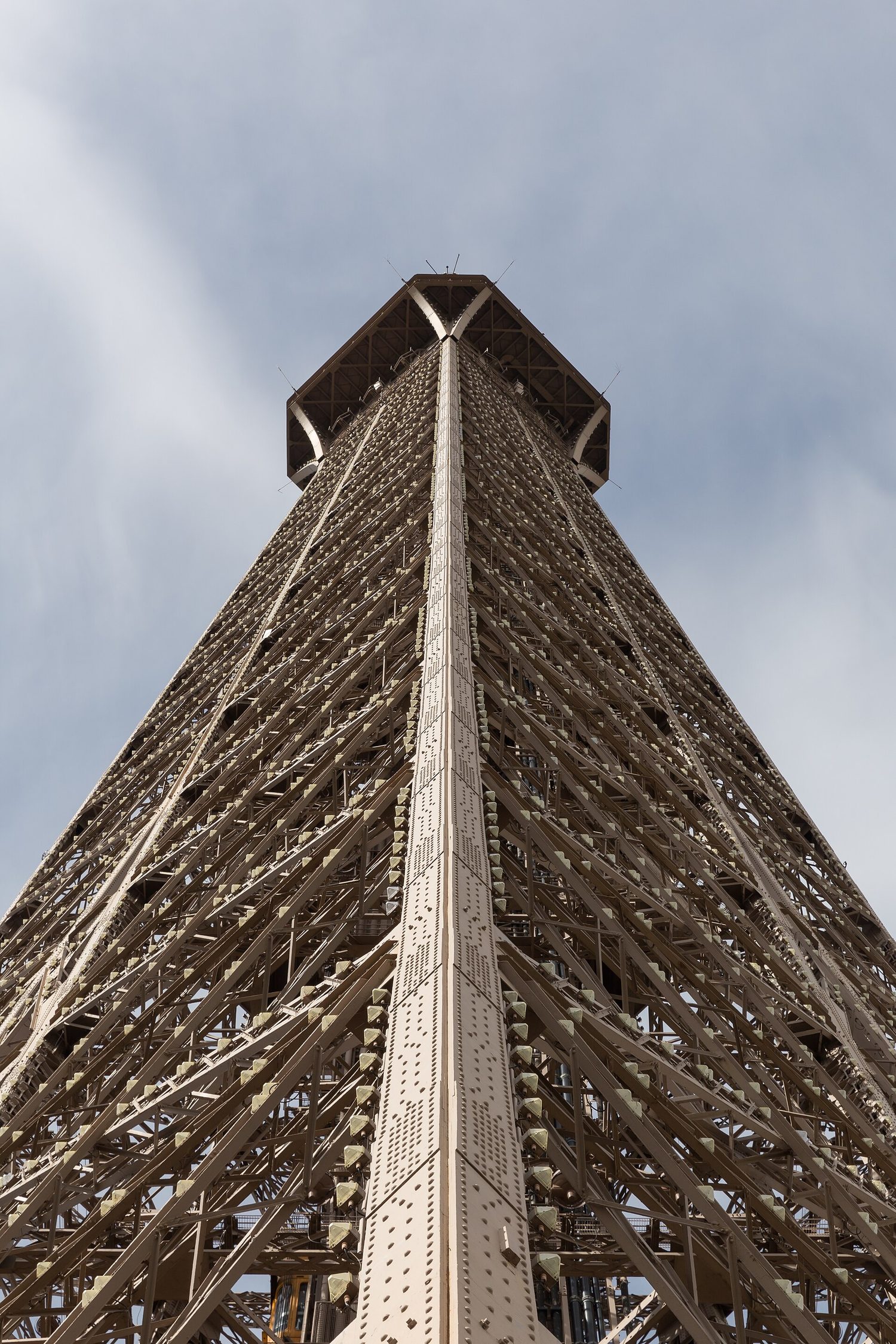
¿Qué tan alta es esa torre? No puedes subirla con una cinta métrica. Pero puedes quedarte en el suelo, caminar cincuenta metros hacia atrás, y medir un ángulo — el ángulo que…
English narration · English + 中文 subtitles burned in · Narración en inglés · Subtítulos en inglés + 中文 quemados en pantalla
English
This handout covers Topic 6, Trigonometry. Parts marked (Extended) are only tested on the Extended papers; everything else is for both levels. Give angle answers to one decimal place.
Español
Este folleto cubre el Tema 6, Trigonometría. Las partes marcadas (Ampliado) solo se examinan en los papeles Ampliados; todo lo demás es para ambos niveles. Da respuestas angulares con una cifra decimal.
6.1
Teorema de Pitágoras
Syllabus
English
Subject content
Notes and examples
Know and use Pythagoras’ theorem.
Español
Contenido temático
Notas y ejemplos
Conocer y aplicar el teorema de Pitágoras.
English
Subject content
Notes and examples
Know and use Pythagoras’ theorem.
Español
Contenido del tema
Notas y ejemplos
Conocer y aplicar el teorema de Pitágoras.
Source: Cambridge International syllabus · Fuente: Plan de estudios Cambridge International
English
Pythagoras: the rearrangement proof
Pythagoras' theorem 勾股定理 links the three sides of a right-angled triangle 直角三角形 (a triangle 三角形 with one $90^{\circ}$ angle). If the longest side (the hypotenuse 斜边, opposite the right angle) is $c$, then
$$a^{2} + b^{2} = c^{2}.$$
Use it to find a missing side.
Worked example. A right-angled triangle has a hypotenuse of $13\text{ cm}$ and one short side of $5\text{ cm}$. Find the other short side.
El teorema de Pitágoras relaciona los tres lados de un triángulo rectángulo (un triángulo con un ángulo $90^{\circ}$). Si el lado más largo (la hipotenusa, opuesto al ángulo recto) es $c$, entonces
$$a^{2} + b^{2} = c^{2}.$$
Use it to find a missing side.
Pitágoras como áreas: los cuadrados en los dos lados más cortos ($9+16$) suman el cuadrado en la hipotenusa ($25$).
Ejemplo resuelto. Un triángulo rectángulo tiene una hipotenusa de $13\text{ cm}$ y un cateto corto de $5\text{ cm}$. Encuentra el otro cateto corto.
Cambie los dos lados cortos y vea $a^2 + b^2 = c^2$ — los cuadrados de los lados realmente suman.
6.2
Trigonometría en triángulos rectángulos
Syllabus
English
Subject content
Notes and examples
1 Know and use the sine, cosine and tangent ratios for acute angles in calculations involving sides and angles of a right-angled triangle.
Angles will be given in degrees and answers should be written in degrees, with decimals correct to one decimal place.
2 Solve problems in two dimensions using Pythagoras’ theorem and trigonometry.
Knowledge of bearings may be required.
Español
Contenido temático
Notas y ejemplos
1 Conocer y utilizar las razones de seno, coseno y tangente para ángulos agudos en cálculos que involucren lados y ángulos de un triángulo rectángulo.
Los ángulos se darán en grados y las respuestas deben escribirse en grados, con decimales correctos hasta una posición decimal.
2 Resolver problemas en dos dimensiones utilizando el teorema de Pitágoras y la trigonometría.
Puede ser necesario conocer los rumbos (acimut).
English
Subject content
Notes and examples
1 Know and use the sine, cosine and tangent ratios for acute angles in calculations involving sides and angles of a right-angled triangle.
Angles will be given in degrees and answers should be written in degrees, with decimals correct to one decimal place.
2 Solve problems in two dimensions using Pythagoras’ theorem and trigonometry.
Knowledge of bearings may be required.
3 Know that the perpendicular distance from a point to a line is the shortest distance to the line.
4 Carry out calculations involving angles of elevation and depression.
Español
Contenido del tema
Notas y ejemplos
1 Conocer y utilizar las razones seno, coseno y tangente para ángulos agudos en cálculos que involucran lados y ángulos de un triángulo rectángulo.
Los ángulos se darán en grados y las respuestas deben escribirse en grados, con decimales correctos hasta un lugar decimal.
2 Resolver problemas en dos dimensiones utilizando el teorema de Pitágoras y la trigonometría.
Puede ser necesario conocer los rumbos (acimutales).
3 Saber que la distancia perpendicular desde un punto a una línea es la distancia más corta a dicha línea.
4 Realizar cálculos que involucren ángulos de elevación y depresión.
Source: Cambridge International syllabus · Fuente: Plan de estudios Cambridge International
English
SOH CAH TOA: the ratio belongs to the angle
Label the sides from the angle you are using: the opposite 对边 (across from the angle), the adjacent 邻边 (next to the angle), and the hypotenuse. The three ratios are the sine 正弦, cosine 余弦 and tangent ratio 正切 (sin, cos, tan):
Etiqueta los lados desde el ángulo que estás utilizando: el opuesto (frente al ángulo), el adyacente (junto al ángulo) y la hipotenusa. Las tres razones son el seno, coseno y tangente (sin, cos, tan):
Recuérdalas como SOH-CAH-TOA. Para encontrar un ángulo, usa la inversa ($\sin^{-1}$, $\cos^{-1}$, $\tan^{-1}$).
Nombre los lados desde el ángulo $\theta$: el opuesto está cruzado desde él, el adyacente junto a él, y la hipotenusa opuesta al ángulo recto (SOH-CAH-TOA).
Ejemplo resuelto (encontrar un lado). En un triángulo rectángulo la hipotenusa es $10\text{ cm}$ y el ángulo es $30^{\circ}$. Encuentre el lado opuesto.
1 Know and use the sine, cosine and tangent ratios for acute angles in calculations involving sides and angles of a right-angled triangle.
Angles will be given in degrees and answers should be written in degrees, with decimals correct to one decimal place.
2 Solve problems in two dimensions using Pythagoras’ theorem and trigonometry.
Knowledge of bearings may be required.
3 Know that the perpendicular distance from a point to a line is the shortest distance to the line.
4 Carry out calculations involving angles of elevation and depression.
Español
Contenido del tema
Notas y ejemplos
1 Conocer y utilizar las razones seno, coseno y tangente para ángulos agudos en cálculos que involucran lados y ángulos de un triángulo rectángulo.
Los ángulos se darán en grados y las respuestas deben escribirse en grados, con decimales correctos hasta un lugar decimal.
2 Resolver problemas en dos dimensiones utilizando el teorema de Pitágoras y la trigonometría.
Puede ser necesario conocer los rumbos (acimutales).
3 Saber que la distancia perpendicular desde un punto a una línea es la distancia más corta a dicha línea.
4 Realizar cálculos que involucren ángulos de elevación y depresión.
Source: Cambridge International syllabus · Fuente: Plan de estudios Cambridge International
English
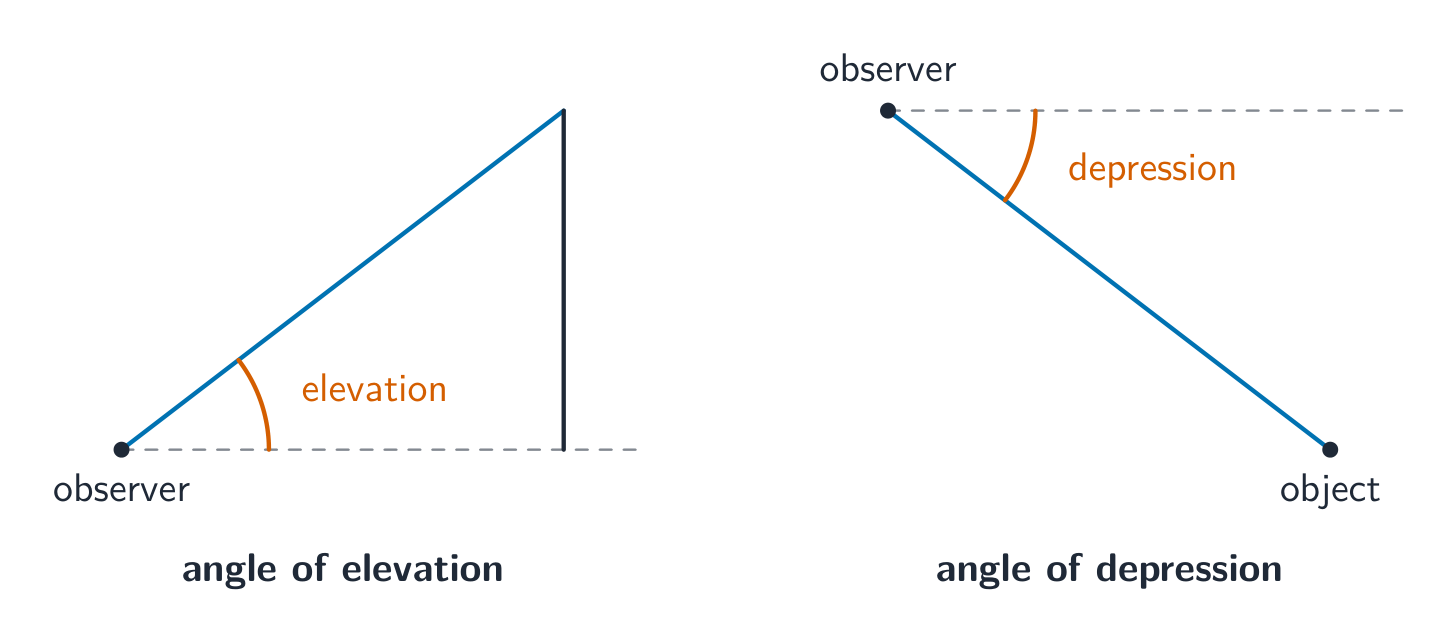
The angle of elevation 仰角 is the angle up from the horizontal to an object above you. The angle of depression 俯角 is the angle down from the horizontal to an object below you. The shortest distance from a point to a line is the perpendicular 垂直 distance.
Worked example. From a point $50\text{ m}$ from the foot of a tower, the angle of elevation to the top is $40^{\circ}$. Find the height of the tower.
Mirar hacia arriba una torre implica un ángulo de elevación.
El ángulo de elevación es el ángulo hacia arriba desde la horizontal hasta un objeto que está encima de ti. El ángulo de depresión es el ángulo hacia abajo desde la horizontal hasta un objeto que está debajo de ti. La distancia más corta desde un punto a una línea es la distancia perpendicular.
El ángulo de elevación mira hacia arriba desde la horizontal; el ángulo de depresión mira hacia abajo.
Ejemplo resuelto. Desde un punto $50\text{ m}$ de la base de una torre, el ángulo de elevación a la cima es $40^{\circ}$. Encuentre la altura de la torre.
Know the exact values of: 1 $\sin x$ and $\cos x$ for $x = 0^\circ, 30^\circ, 45^\circ, 60^\circ$ and $90^\circ$. 2 $\tan x$ for $x = 0^\circ, 30^\circ, 45^\circ$ and $60^\circ$.
Español
Contenido del tema
Notas y ejemplos
Conocer los valores exactos de: 1 $\sin x$ y $\cos x$ para $x = 0^\circ, 30^\circ, 45^\circ, 60^\circ$ y $90^\circ$. 2 $\tan x$ para $x = 0^\circ, 30^\circ, 45^\circ$ y $60^\circ$.
Source: Cambridge International syllabus · Fuente: Plan de estudios Cambridge International
English
You must know these exact values without a calculator.
$x$
$0^{\circ}$
$30^{\circ}$
$45^{\circ}$
$60^{\circ}$
$90^{\circ}$
$\sin x$
$0$
$\tfrac{1}{2}$
$\tfrac{\sqrt{2}}{2}$
$\tfrac{\sqrt{3}}{2}$
$1$
$\cos x$
$1$
$\tfrac{\sqrt{3}}{2}$
$\tfrac{\sqrt{2}}{2}$
$\tfrac{1}{2}$
$0$
$\tan x$
$0$
$\tfrac{1}{\sqrt{3}}$
$1$
$\sqrt{3}$
—
Español
Debes conocer estos valores exactos sin calculadora.
$x$
$0^{\circ}$
$30^{\circ}$
$45^{\circ}$
$60^{\circ}$
$90^{\circ}$
$\sin x$
$0$
$\tfrac{1}{2}$
$\tfrac{\sqrt{2}}{2}$
$\tfrac{\sqrt{3}}{2}$
$1$
$\cos x$
$1$
$\tfrac{\sqrt{3}}{2}$
$\tfrac{\sqrt{2}}{2}$
$\tfrac{1}{2}$
$0$
$\tan x$
$0$
$\tfrac{1}{\sqrt{3}}$
$1$
$\sqrt{3}$
—
Estos dos triángulos especiales son de donde vienen los valores exactos — vale la pena memorizarlos.
6.4
Graphs and trigonometric equations (Extended)
Syllabus
English
Subject content
Notes and examples
1 Recognise, sketch and interpret the following graphs for $0^\circ \leqslant x \leqslant 360^\circ$: • $y = \sin x$ • $y = \cos x$ • $y = \tan x$.
2 Solve trigonometric equations involving $\sin x$, $\cos x$ or $\tan x$, for $0^\circ \leqslant x \leqslant 360^\circ$.
e.g. solve: • $\sin x = \frac{\sqrt{3}}{2}$ for $0^\circ \leqslant x \leqslant 360^\circ$ • $2 \cos x + 1 = 0$ for $0^\circ \leqslant x \leqslant 360^\circ$.
Español
Contenido del tema
Notas y ejemplos
1 Reconocer, dibujar y analizar los siguientes gráficos para $0^\circ \leqslant x \leqslant 360^\circ$: • $y = \sin x$ • $y = \cos x$ • $y = \tan x$.
2 Resolver ecuaciones trigonométricas que involucran $\sin x$, $\cos x$ o $\tan x$, para $0^\circ \leqslant x \leqslant 360^\circ$.
p. ej. resolver: • $\sin x = \frac{\sqrt{3}}{2}$ para $0^\circ \leqslant x \leqslant 360^\circ$ • $2 \cos x + 1 = 0$ para $0^\circ \leqslant x \leqslant 360^\circ$.
Source: Cambridge International syllabus · Fuente: Plan de estudios Cambridge International
English
For $0^{\circ} \leqslant x \leqslant 360^{\circ}$:
$y = \sin x$ is a wave starting at $0$, peaking at $90^{\circ}$, back to $0$ at $180^{\circ}$, down to $-1$ at $270^{\circ}$.
$y = \cos x$ is the same wave but starting at $1$.
$y = \tan x$ rises steeply and repeats every $180^{\circ}$.
A trigonometric equation 三角方程 often has more than one answer in this range. Use the graph (or the symmetry of the wave) to find them all.
Worked example. Solve $\sin x = \tfrac{\sqrt{3}}{2}$ for $0^{\circ} \leqslant x \leqslant 360^{\circ}$.
One answer is $x = 60^{\circ}$. The sine wave is also $\tfrac{\sqrt{3}}{2}$ at $180^{\circ} - 60^{\circ} = 120^{\circ}$. So $x = 60^{\circ}$ or $120^{\circ}$.
Worked example. Solve $2\cos x + 1 = 0$ for $0^{\circ} \leqslant x \leqslant 360^{\circ}$.
$$\cos x = -\tfrac{1}{2} \;\Rightarrow\; x = 120^{\circ} \text{ or } 240^{\circ}.$$
Español
Una noria: un punto en el borde traza una curva sinusoidal mientras gira.
Para $0^{\circ} \leqslant x \leqslant 360^{\circ}$:
$y = \sin x$ es una onda que comienza en $0$, alcanza el pico en $90^{\circ}$, vuelve a $0$ en $180^{\circ}$, baja a $-1$ en $270^{\circ}$.
$y = \cos x$ is the same wave but starting at $1$.
$y = \tan x$ rises steeply and repeats every $180^{\circ}$.
$y=\sin x$ y $y=\cos x$ son ondas suaves entre $-1$ y $1$; el coseno es el seno desplazado a la izquierda por $90^\circ$.
Una ecuación trigonométrica a menudo tiene más de una respuesta en este rango. Use el gráfico (o la simetría de la onda) para encontrarlas todas.
Ejemplo resuelto. Resuelve $\sin x = \tfrac{\sqrt{3}}{2}$ para $0^{\circ} \leqslant x \leqslant 360^{\circ}$.
Una respuesta es $x = 60^{\circ}$. La onda senoidal también es $\tfrac{\sqrt{3}}{2}$ en $180^{\circ} - 60^{\circ} = 120^{\circ}$. Entonces $x = 60^{\circ}$ o $120^{\circ}$.
Ejemplo resuelto. Resuelve $2\cos x + 1 = 0$ para $0^{\circ} \leqslant x \leqslant 360^{\circ}$.
$$\cos x = -\tfrac{1}{2} \;\Rightarrow\; x = 120^{\circ} \text{ or } 240^{\circ}.$$
Explore · Explorar
Gráficos y ecuaciones trigonométricas
(cos θ, sin θ)
A medida que θ gira, sin y cos trazan sus ondas — y se repiten cada 360°.
Use the sine rule 正弦定理 when you have a side and its opposite angle. Use the cosine rule 余弦定理 when you have two sides and the angle between them, or all three sides. With the sine rule, watch for the ambiguous case 两解情况, where an angle could be acute or obtuse.
The area of any triangle is
$$\text{area} = \tfrac{1}{2}ab\sin C.$$
Worked example. A triangle has $b = 7\text{ cm}$, $c = 8\text{ cm}$ and the angle between them $A = 40^{\circ}$. Find side $a$.
En cualquier triángulo, los lados $a$, $b$, $c$ están opuestos a los ángulos $A$, $B$, $C$ de la misma letra.
Utiliza la ley de senos cuando tengas un lado y su ángulo opuesto. Utiliza la ley de cosenos cuando tengas dos lados y el ángulo comprendido entre ellos, o los tres lados. Con la ley de senos, ten cuidado con el caso ambiguo, donde un ángulo podría ser agudo u obtuso.
The area of any triangle is
$$\text{area} = \tfrac{1}{2}ab\sin C.$$
Ejemplo resuelto. Un triángulo tiene $b = 7\text{ cm}$, $c = 8\text{ cm}$ y el ángulo entre ellos $A = 40^{\circ}$. Encuentra el lado $a$.
Dos lados y el ángulo entre ellos determinan el triángulo: la ley del coseno encuentra el tercer lado, la ley del seno los otros ángulos.
Explore · Explorar
Significado de sin y cos
Gira el ángulo en el círculo unitario: el cateto horizontal es cos θ y el cateto vertical es sin θ — las mismas razones que usan las leyes del seno y el coseno.
Carry out calculations and solve problems in three dimensions using Pythagoras' theorem and trigonometry, including calculating the angle between a line and a plane.
Español
Contenido del tema
Notas y ejemplos
Realizar cálculos y resolver problemas en tres dimensiones utilizando el teorema de Pitágoras y la trigonometría, incluyendo el cálculo del ángulo entre una recta y un plano.
Source: Cambridge International syllabus · Fuente: Plan de estudios Cambridge International
English
In three dimensions, find a right-angled triangle inside the solid, then use Pythagoras or trigonometry on it. A common task is the angle between a line and a flat surface (a plane 平面).
Worked example. A box has a base $6\text{ cm}$ by $8\text{ cm}$ and height $5\text{ cm}$. Find the angle between a space diagonal and the base.
First the base diagonal: $\sqrt{6^{2} + 8^{2}} = \sqrt{100} = 10\text{ cm}$. This diagonal and the height form a right-angled triangle, so the angle $\theta$ with the base is
En tres dimensiones, encuentre un triángulo rectángulo dentro del sólido, luego use Pitágoras o trigonometría en él. Una tarea común es el ángulo entre una línea y una superficie plana (un plano).
Ejemplo resuelto. Una caja tiene una base $6\text{ cm}$ por $8\text{ cm}$ y altura $5\text{ cm}$. Encuentre el ángulo entre una diagonal espacial y la base.
Primero la diagonal de la base: $\sqrt{6^{2} + 8^{2}} = \sqrt{100} = 10\text{ cm}$. Esta diagonal y la altura forman un triángulo rectángulo, así que el ángulo $\theta$ con la base es
Pick one and the site follows you — notes, papers, videos and practice all open on it. · Selecciona uno y el sitio te sigue — notas, documentos, videos y práctica se abren en él.
Type to search notes, lessons, code, vocabulary and past-paper questions across every subject. · Escribe para buscar notas, lecciones, código, vocabulario y preguntas de exámenes anteriores en todas las materias.