Mira el cable principal de este puente. Esa curva no es casualidad. Cada cable así cuelga en la misma forma, y una regla corta describe cada punto en…
English narration · English + 中文 subtitles burned in · Narración en inglés · Subtítulos en inglés + 中文 quemados en pantalla
English
This handout covers Topic 2, Algebra and graphs. Parts marked (Extended) are only tested on the Extended papers; everything else is for both levels.
Español
Este folleto cubre el Tema 2, Álgebra y gráficas. Las partes marcadas como (Extended) solo se evalúan en los exámenes extendidos; todo lo demás es para ambos niveles.
2.1
Working with algebra · Trabajando con álgebra
Syllabus
English
Subject content
Notes and examples
1 Know that letters can be used to represent generalised numbers.
2 Substitute numbers into expressions and formulas.
Español
Contenido temático
Notas y ejemplos
1 Saber que las letras pueden usarse para representar números generalizados.
2 Sustituir números en expresiones y fórmulas.
English
Subject content
Notes and examples
1 Know that letters can be used to represent generalised numbers.
2 Substitute numbers into expressions and formulas.
Español
Contenido del tema
Notas y ejemplos
1 Saber que las letras pueden utilizarse para representar números generalizados.
2 Sustituir números en expresiones y fórmulas.
Source: Cambridge International syllabus · Fuente: Plan de estudios Cambridge International
English
In algebra 代数 we use letters to stand for numbers. A letter whose value can change is a variable 变量. To substitute 代入 means to put a number in place of a letter.
Worked example. Find the value of $3x^{2} - 2y$ when $x = 4$ and $y = 5$.
En el álgebra usamos letras para representar números. Una letra cuyo valor puede cambiar es una variable. Sustituir significa poner un número en lugar de una letra.
Ejemplo resuelto. Encuentra el valor de $3x^{2} - 2y$ cuando $x = 4$ y $y = 5$.
5 Completar el cuadrado para expresiones de la forma $ax^2 + bx + c$.
Source: Cambridge International syllabus · Fuente: Plan de estudios Cambridge International
English
A term 项 is a single part of an expression 表达式, such as $5a$ or $-9b$. Like terms 同类项 have exactly the same letters; you may add or subtract them. The number in front of the letter is the coefficient 系数.
Collect like terms: $2a^{2} + 5a^{2} = 7a^{2}$, $3ab - 9ab = -6ab$, $-1 + 4 = 3$. So the answer is
$$7a^{2} - 6ab + 3.$$
To expand 展开 means to multiply out brackets 括号. Multiply every term inside by the term outside; for two brackets, multiply every term in the first by every term in the second.
Un término es una parte individual de una expresión, como $5a$ o $-9b$. Los términos semejantes tienen exactamente las mismas letras; puedes sumarlas o restarlas. El número delante de la letra es el coeficiente.
Expandir un paréntesis con un modelo de áreaReuniendo términos semejantes: sumar términos con la misma letra
Agrupa términos semejantes: $2a^{2} + 5a^{2} = 7a^{2}$, $3ab - 9ab = -6ab$, $-1 + 4 = 3$. Así que la respuesta es
$$7a^{2} - 6ab + 3.$$
Expandir significa multiplicar los paréntesis. Multiplica cada término dentro por el término exterior; para dos paréntesis, multiplica cada término del primero por cada término del segundo.
2 Factorizar y simplificar expresiones racionales.
p. ej. $\frac{x^2 - 2x}{x^2 - 5x + 6}$.
Source: Cambridge International syllabus · Fuente: Plan de estudios Cambridge International
English
An algebraic fraction 分式 has algebra on the top or bottom. Add and subtract using a common denominator; multiply and divide as with ordinary fractions.
Una fracción algebraica tiene álgebra en el numerador o denominador. Suma y resta usando un denominador común; multiplica y divide como con fracciones ordinarias.
1 Understand and use indices (positive, zero and negative).
e.g. $2^x = 32$. Find the value of $x$.
2 Understand and use the rules of indices.
e.g. simplify: • $(5x^3)^2$ • $12a^5 \div 3a^{-2}$ • $6x^7y^4 \times 5x^{-5}y$. Knowledge of logarithms is not required.
Español
Contenido temático
Notas y ejemplos
1 Comprender y usar índices (positivos, cero y negativos).
p. ej. $2^x = 32$. Hallar el valor de $x$.
2 Comprender y usar las reglas de los índices.
p. ej. simplificar: • $(5x^3)^2$ • $12a^5 \div 3a^{-2}$ • $6x^7y^4 \times 5x^{-5}y$. No se requiere conocimiento de logaritmos.
English
Subject content
Notes and examples
1 Understand and use indices (positive, zero, negative and fractional).
e.g. solve: • $32^x = 2$ • $5^{x+1} = 25^x$.
2 Understand and use the rules of indices.
e.g. simplify: • $3x^{-4} \times \frac{2}{3}x^{\frac{1}{2}}$ • $\frac{2}{5}x^{\frac{1}{2}} \div 2x^{-2}$ • $\left(\frac{2x^5}{3}\right)^3$. Knowledge of logarithms is not required.
Español
Contenido del tema
Notas y ejemplos
1 Comprender y usar índices (positivos, cero, negativos y fraccionarios).
p. ej. resolver: • $32^x = 2$ • $5^{x+1} = 25^x$.
2 Comprender y usar las reglas de los índices.
p. ej. simplificar: • $3x^{-4} \times \frac{2}{3}x^{\frac{1}{2}}$ • $\frac{2}{5}x^{\frac{1}{2}} \div 2x^{-2}$ • $\left(\frac{2x^5}{3}\right)^3$. No se requiere conocimiento de logaritmos.
Source: Cambridge International syllabus · Fuente: Plan de estudios Cambridge International
English
The laws of indices 指数 work with letters too: $a^{m} \times a^{n} = a^{m+n}$, $a^{m} \div a^{n} = a^{m-n}$, and $(a^{m})^{n} = a^{mn}$.
3 Resolver ecuaciones lineales simultáneas con dos incógnitas.
4 Despejar la variable principal en fórmulas sencillas.
p. ej., despejar la variable principal en fórmulas donde: • la variable principal aparece solo una vez • no hay potencias ni raíces de la variable principal.
English
Subject content
Notes and examples
1 Construct expressions, equations and formulas.
e.g. write an expression for the product of two consecutive even numbers. Includes constructing simultaneous equations.
4 Solve simultaneous linear equations in two unknowns.
5 Solve simultaneous equations, involving one linear and one non-linear.
With powers no higher than two.
6 Solve quadratic equations by factorisation, completing the square and by use of the quadratic formula.
Includes writing a quadratic expression in completed square form. Candidates may be expected to give solutions in surd form. The quadratic formula is given in the List of formulas.
7 Change the subject of formulas.
e.g. change the subject of a formula where: • the subject appears twice • there is a power or root of the subject.
Español
Contenido temático
Notas y ejemplos
1 Construir expresiones, ecuaciones y fórmulas.
Ej.: escribir una expresión para el producto de dos números pares consecutivos. Incluye la construcción de sistemas de ecuaciones simultáneas.
4 Resolver sistemas de ecuaciones lineales simultáneas con dos incógnitas.
5 Resolver sistemas de ecuaciones simultáneas que involucran una lineal y una no lineal.
Con potencias no superiores a dos.
6 Resolver ecuaciones cuadráticas mediante factorización, completando el cuadrado y utilizando la fórmula general.
Incluye escribir una expresión cuadrática en forma de cuadrado completo. Se puede esperar que los candidatos den soluciones en forma radical. La fórmula general se encuentra en la Lista de fórmulas.
7 Despejar variables en fórmulas.
Ej.: despejar la variable principal en una fórmula donde: • la variable aparece dos veces • existe una potencia o raíz de la variable.
Source: Cambridge International syllabus · Fuente: Plan de estudios Cambridge International
English
Simultaneous equations: where the lines cross
An equation 方程 says two expressions are equal. To solve a linear 一次 equation, do the same operation to both sides until the unknown 未知数 is alone.
To change the subject 公式变形 of a formula means to rearrange it so a chosen letter is alone on one side.
Worked example. Make $r$ the subject of $A = \pi r^{2}$ (Extended, because of the power).
$$r^{2} = \frac{A}{\pi} \;\Rightarrow\; r = \sqrt{\frac{A}{\pi}}.$$
When the letter appears twice (Extended), collect those terms and factorise. To make $x$ the subject of $y = \dfrac{x + 1}{x - 1}$:
$$y(x - 1) = x + 1 \;\Rightarrow\; yx - x = 1 + y \;\Rightarrow\; x(y - 1) = 1 + y \;\Rightarrow\; x = \frac{1 + y}{y - 1}.$$
Español
Ecuaciones simultáneas: donde se cruzan las líneas
Una ecuación dice que dos expresiones son iguales. Para resolver una ecuación lineal, realiza la misma operación en ambos lados hasta que la incógnita esté sola.
Represent and interpret inequalities, including on a number line.
When representing and interpreting inequalities on a number line: • open circles should be used to represent strict inequalities (<, >) • closed circles should be used to represent inclusive inequalities ($\leqslant$, $\geqslant$) e.g. $-3 \leqslant x < 1$
Español
Contenido del tema
Notas y ejemplos
Representar e interpretar desigualdades, incluyendo en una recta numérica.
Al representar e interpretar desigualdades en una recta numérica: • se deben usar círculos abiertos para representar desigualdades estrictas (<, >) • se deben usar círculos cerrados para representar desigualdades inclusivas ($\leqslant$, $\geqslant$) p. ej. $-3 \leqslant x < 1$
English
Subject content
Notes and examples
1 Represent and interpret inequalities, including on a number line.
When representing and interpreting inequalities on a number line: • open circles should be used to represent strict inequalities (<, >) • closed circles should be used to represent inclusive inequalities ($\leqslant$, $\geqslant$). e.g. $-3 \leqslant x < 1$
2 Construct, solve and interpret linear inequalities.
3 Represent and interpret linear inequalities in two variables graphically.
The following conventions should be used: • broken lines should be used to represent strict inequalities (<, >) • solid lines should be used to represent inclusive inequalities ($\leqslant$, $\geqslant$) • shading should be used to represent unwanted regions (unless otherwise directed in the question). e.g. graphs of $x < 1$ and $y \geqslant 1$
4 List inequalities that define a given region.
Linear programming problems are not included.
Español
Contenido del tema
Notas y ejemplos
1 Representar e interpretar desigualdades, incluidas en una recta numérica.
Al representar e interpretar desigualdades en una recta numérica: • se deben usar círculos abiertos para representar desigualdades estrictas (<, >) • se deben usar círculos cerrados para representar desigualdades inclusivas ($\leqslant$, $\geqslant$). p. ej. $-3 \leqslant x < 1$
2 Construir, resolver e interpretar desigualdades lineales.
3 Representar e interpretar gráficamente desigualdades lineales en dos variables.
Se deben seguir las siguientes convenciones: • se deben usar líneas discontinuas para representar desigualdades estrictas (<, >) • se deben usar líneas continuas para representar desigualdades inclusivas ($\leqslant$, $\geqslant$) • se debe sombrear para representar regiones no deseadas (salvo que se indique lo contrario en el enunciado del ejercicio). p. ej. gráficos de $x < 1$ y $y \geqslant 1$
4 Enumerar desigualdades que definan una región dada.
No se incluyen problemas de programación lineal.
Source: Cambridge International syllabus · Fuente: Plan de estudios Cambridge International
English
An inequality 不等式 uses $<$, $>$, $\leqslant$ or $\geqslant$. Solve it like an equation, but reverse the sign if you multiply or divide by a negative number.
On a number line 数轴, use an open circle for $<$ or $>$ (value not included) and a closed circle for $\leqslant$ or $\geqslant$ (value included).
Regions (Extended)
An inequality in two letters describes a region 区域 of the graph. Draw the boundary line (broken for $<$ or $>$, solid for $\leqslant$ or $\geqslant$) and shade the unwanted side. You may also be asked to list the inequalities that define a given region.
Español
Una desigualdad usa $<$, $>$, $\leqslant$ o $\geqslant$. Resuélvela como una ecuación, pero invierte el signo si multiplicas o divides por un número negativo.
En una recta numérica, usa un círculo abierto para $<$ o $>$ (valor no incluido) y un círculo cerrado para $\leqslant$ o $\geqslant$ (valor incluido).
$-\tfrac{1}{3} \leqslant x < 3$: un círculo cerrado incluye el valor final, un círculo abierto lo excluye.
Regiones (Extended)
Una desigualdad en dos letras describe una región de la gráfica. Dibuja la línea límite (rota para $<$ o $>$, sólida para $\leqslant$ o $\geqslant$) y sombre el lado no deseado. También te pueden pedir listar las desigualdades que definen una región dada.
Explore · Explorar
Desigualdades
y = ax + b
Una desigualdad pregunta dónde la línea está por encima o por debajo de un valor.
e.g. write the next two terms in this sequence: 1, 3, 6, 10, 15, ... , ...
2 Recognise patterns in sequences, including the term-to-term rule, and relationships between different sequences.
3 Find and use the $n$th term of the following sequences: (a) linear (b) simple quadratic (c) simple cubic.
e.g. find the $n$th term of 2, 5, 10, 17
Español
Contenido del tema
Notas y ejemplos
1 Continuar una secuencia numérica o patrón dado.
p. ej. escribir los dos términos siguientes en esta secuencia: 1, 3, 6, 10, 15, ... , ...
2 Reconocer patrones en las sucesiones, incluida la regla de término a término, y las relaciones entre diferentes sucesiones.
3 Encontrar y usar el $n$-ésimo término de las siguientes sucesiones: (a) lineales (b) cuadráticas simples (c) cúbicas simples.
p. ej. encontrar el $n$-ésimo término de 2, 5, 10, 17
English
Subject content
Notes and examples
1 Continue a given number sequence or pattern.
Subscript notation may be used, e.g. $T_n$ is the $n$th term of sequence $T$.
2 Recognise patterns in sequences, including the term-to-term rule, and relationships between different sequences.
Includes linear, quadratic, cubic and exponential sequences and simple combinations of these.
3 Find and use the $n$th term of sequences.
Español
Contenido temático
Notas y ejemplos
1 Continuar una secuencia numérica o patrón dado.
Puede utilizarse la notación de subíndices, por ejemplo, $T_n$ es el $n$ término de la secuencia $T$.
2 Reconocer patrones en las secuencias, incluida la regla de paso a paso, y las relaciones entre diferentes secuencias.
Incluye secuencias lineales, cuadráticas, cúbicas y exponenciales, así como combinaciones simples de estas.
3 Encontrar y utilizar el $n$ término de las secuencias.
Source: Cambridge International syllabus · Fuente: Plan de estudios Cambridge International
English
A sequence 数列 is a list of numbers that follow a rule. The term-to-term rule 递推规则 tells you how to get the next term from the one before.
To find the rule for the term in position $n$ (the $n$th term), look at how the terms change.
Linear sequence (the terms go up by the same amount each time). The difference is the multiple of $n$.
Worked example. Find the $n$th term of $2, 5, 8, 11, \dots$
The terms go up by $3$, so start with $3n$. Since $3 \times 1 = 3$ but the first term is $2$, subtract $1$: the $n$th term is $3n - 1$.
Quadratic sequence (the differences themselves change by the same amount). The second difference equals $2 \times$ the coefficient of $n^{2}$.
Worked example. Find the $n$th term of $2, 5, 10, 17, \dots$
First differences are $3, 5, 7$; the second difference is $2$, so the $n^{2}$ part is $1n^{2}$. Subtracting $n^{2}$ ($1, 4, 9, 16$) from the sequence leaves $1, 1, 1, 1$. So the $n$th term is $n^{2} + 1$.
A cubic 三次 sequence such as $1, 8, 27, 64, \dots$ has $n$th term $n^{3}$. An exponential sequence 指数数列 such as $2, 6, 18, 54, \dots$ multiplies by a fixed number each time; here the $n$th term is $2 \times 3^{\,n-1}$.
Español
Brócoli Romanesco: espirales autosimilares forman un patrón numérico natural.
Una secuencia es una lista de números que siguen una regla. La regla de término a término te dice cómo obtener el siguiente término a partir del anterior.
Para encontrar la regla para el término en la posición $n$ (el $n$th término), observa cómo cambian los términos.
Secuencia lineal (los términos aumentan en la misma cantidad cada vez). La diferencia es el múltiplo de $n$.
Ejemplo resuelto. Encuentra el $n$th término de $2, 5, 8, 11, \dots$
Los términos aumentan en $3$, así que comienza con $3n$. Dado que $3 \times 1 = 3$ pero el primer término es $2$, resta $1$: el $n$th término es $3n - 1$.
Secuencia cuadrática (las diferencias mismas cambian en la misma cantidad). La segunda diferencia es igual a $2 \times$ el coeficiente de $n^{2}$.
Ejemplo resuelto. Encuentra el $n$th término de $2, 5, 10, 17, \dots$
Las diferencias primeras son $3, 5, 7$; la diferencia segunda es $2$, por lo que la parte $n^{2}$ es $1n^{2}$. Restando $n^{2}$ ($1, 4, 9, 16$) de la secuencia queda $1, 1, 1, 1$. Así que el término $n$ es $n^{2} + 1$.
Una secuencia cúbica 三次 como $1, 8, 27, 64, \dots$ tiene el término $n$ igual a $n^{3}$. Una secuencia exponencial 指数数列 como $2, 6, 18, 54, \dots$ multiplica por un número fijo cada vez; aquí el término $n$ es $2 \times 3^{\,n-1}$.
Explore · Explorar
Secuencias numéricas
Construya un término de una secuencia aritmética (sumar d) o geométrica (multiplicar por r) paso a paso.
Direct and inverse proportion (Extended) · Proporción directa e inversa (Avanzado)
Syllabus
English
Subject content
Notes and examples
Express direct and inverse proportion in algebraic terms and use this form of expression to find unknown quantities.
Includes linear, square, square root, cube and cube root proportion. Knowledge of proportional symbol ($\propto$) is required.
Español
Contenido del tema
Notas y ejemplos
Expresar la proporcionalidad directa e inversa en términos algebraicos y utilizar esta forma de expresión para encontrar cantidades desconocidas.
Incluye proporcionalidad lineal, al cuadrado, raíz cuadrada, cúbica y raíz cúbica. Se requiere conocimiento del símbolo de proporcionalidad ($\propto$).
Source: Cambridge International syllabus · Fuente: Plan de estudios Cambridge International
English
Two quantities are in direct proportion 正比例 if one is always a fixed multiple of the other: $y \propto x$ means $y = kx$, where $k$ is a constant 常数. They are in inverse proportion 反比例 if one rises as the other falls: $y \propto \dfrac{1}{x}$ means $y = \dfrac{k}{x}$. The symbol $\propto$ is read "is proportional to". You can also have proportion to a square, square root, cube or cube root.
Worked example.$y$ is in direct proportion to $x$, and $y = 12$ when $x = 3$. Find $y$ when $x = 7$.
First find $k$: $12 = k \times 3$, so $k = 4$ and $y = 4x$. Then $y = 4 \times 7 = 28$.
Español
Dos cantidades están en proporción directa 正比例 si una es siempre un múltiplo fijo de la otra: $y \propto x$ significa $y = kx$, donde $k$ es una constante 常数. Están en proporción inversa 反比例 si una aumenta mientras la otra disminuye: $y \propto \dfrac{1}{x}$ significa $y = \dfrac{k}{x}$. El símbolo $\propto$ se lee "es proporcional a". También puede haber proporción al cuadrado, raíz cuadrada, cubo o raíz cúbica.
Ejemplo resuelto.$y$ está en proporción directa con $x$, y es $y = 12$ cuando $x = 3$. Encuentre $y$ cuando $x = 7$.
Primero encuentre $k$: $12 = k \times 3$, así que $k = 4$ y $y = 4x$. Luego $y = 4 \times 7 = 28$.
Explore · Explorar
Proporción inversa
y = a/x
Proporción inversa: cuando x se duplica, y se reduce a la mitad — una curva recíproca con dos asíntotas.
Graphs in practical situations · Gráficas en situaciones prácticas
Syllabus
English
Subject content
Notes and examples
1 Use and interpret graphs in practical situations including travel graphs and conversion graphs.
e.g. interpret the gradient of a straight-line graph as a rate of change.
2 Draw graphs from given data.
e.g. draw a distance–time graph to represent a journey.
Español
Contenido del tema
Notas y ejemplos
1 Usar e interpretar gráficas en situaciones prácticas, incluidas las gráficas de desplazamiento y las gráficas de conversión.
p. ej., interpretar la pendiente de una gráfica lineal como una tasa de cambio.
2 Dibujar gráficas a partir de datos dados.
p. ej., dibujar una gráfica de distancia–tiempo para representar un viaje.
English
Subject content
Notes and examples
1 Use and interpret graphs in practical situations including travel graphs and conversion graphs.
Includes estimation and interpretation of the gradient of a tangent at a point.
2 Draw graphs from given data.
3 Apply the idea of rate of change to simple kinematics involving distance–time and speed–time graphs, acceleration and deceleration.
4 Calculate distance travelled as area under a speed–time graph.
Areas will involve linear sections of the graph only.
Español
Contenido del tema
Notas y ejemplos
1 Usar e interpretar gráficas en situaciones prácticas, incluidas las gráficas de desplazamiento y las gráficas de conversión.
Incluye la estimación e interpretación de la pendiente de una tangente en un punto.
2 Dibujar gráficas a partir de datos dados.
3 Aplicar el concepto de tasa de cambio a cinemática simple que involucra gráficas de distancia–tiempo y velocidad–tiempo, aceleración y desaceleración.
4 Calcular la distancia recorrida como el área bajo una gráfica de velocidad–tiempo.
Las áreas implicarán únicamente secciones lineales de la gráfica.
Source: Cambridge International syllabus · Fuente: Plan de estudios Cambridge International
English
Speed-time graphs: gradient and area
The gradient 斜率 (steepness) of a graph shows a rate of change 变化率.
A travel graph 行程图 (distance–time graph) has gradient equal to speed; a flat part means the object is not moving.
A conversion graph 换算图 is a straight line used to change between two units (for example, miles and kilometres).
Speed–time graphs (Extended)
On a speed–time graph the gradient is the acceleration 加速度 (or deceleration 减速度 if the speed falls), and the area 面积 under the graph is the distance 距离 travelled.
Worked example. A car speeds up from rest to $20\text{ m/s}$ in $8\text{ s}$, then stays at $20\text{ m/s}$ for $12\text{ s}$. Find the acceleration and the total distance.
Acceleration $= \dfrac{20}{8} = 2.5\text{ m/s}^{2}$. The distance is the area: a triangle plus a rectangle,
La pendiente 斜率 (inclinación) de una gráfica muestra una tasa de cambio 变化率.
Una gráfica de viaje 行程图 (gráfica distancia-tiempo) tiene una pendiente igual a la velocidad; una parte plana significa que el objeto no se mueve.
Una gráfica de conversión 换算图 es una línea recta utilizada para cambiar entre dos unidades (por ejemplo, millas y kilómetros).
En una gráfica distancia-tiempo la pendiente es la velocidad; una sección plana significa que el objeto se ha detenido.
Gráficas velocidad-tiempo (Avanzado)
En una gráfica velocidad-tiempo la pendiente es la aceleración 加速度 (o desaceleración 减速度 si la velocidad disminuye), y el área 面积 bajo la gráfica es la distancia 距离 recorrida.
Ejemplo resuelto. Un coche acelera desde el reposo hasta $20\text{ m/s}$ en $8\text{ s}$, luego se mantiene a $20\text{ m/s}$ durante $12\text{ s}$. Encuentre la aceleración y la distancia total.
Aceleración $= \dfrac{20}{8} = 2.5\text{ m/s}^{2}$. La distancia es el área: un triángulo más un rectángulo,
1 Construct tables of values, and draw, recognise and interpret graphs for functions of the following forms: • $ax + b$ • $\pm x^2 + ax + b$ • $\frac{a}{x} \ (x \neq 0)$ where $a$ and $b$ are integer constants.
2 Solve associated equations graphically, including finding and interpreting roots by graphical methods.
e.g. find the intersection of a line and a curve.
Español
Contenido temático
Notas y ejemplos
1 Construir tablas de valores, y dibujar, reconocer e interpretar gráficas para funciones de las siguientes formas: • $ax + b$ • $\pm x^2 + ax + b$ • $\frac{a}{x} \ (x \neq 0)$ donde $a$ y $b$ son constantes enteras.
2 Resolver ecuaciones asociadas gráficamente, incluyendo la localización e interpretación de raíces mediante métodos gráficos.
p. ej. encontrar la intersección entre una recta y una curva.
English
Subject content
Notes and examples
1 Construct tables of values, and draw, recognise and interpret graphs for functions of the following forms: • $a x^n$ (includes sums of no more than three of these) • $a b^x + c$ where $n = -2, -1, -\frac{1}{2}, 0, \frac{1}{2}, 1, 2, 3$; $a$ and $c$ are rational numbers; and $b$ is a positive integer.
2 Solve associated equations graphically, including finding and interpreting roots by graphical methods.
e.g. finding the intersection of a line and a curve.
3 Draw and interpret graphs representing exponential growth and decay problems.
Español
Contenido del tema
Notas y ejemplos
1 Construir tablas de valores, dibujar, reconocer e interpretar gráficas para funciones de las siguientes formas: • $a x^n$ (incluye sumas de no más de tres de estas) • $a b^x + c$ donde $n = -2, -1, -\frac{1}{2}, 0, \frac{1}{2}, 1, 2, 3$; $a$ y $c$ son números racionales; y $b$ es un entero positivo.
2 Resolver ecuaciones asociadas gráficamente, incluyendo la búsqueda e interpretación de raíces mediante métodos gráficos.
p. ej., encontrar la intersección de una recta y una curva.
3 Dibujar e interpretar gráficas que representan problemas de crecimiento y decrecimiento exponencial.
Source: Cambridge International syllabus · Fuente: Plan de estudios Cambridge International
English
To draw a graph, make a table of values 数值表: choose values of $x$, work out $y$, then plot the coordinates 坐标 and join them with a smooth curve.
The points where a graph crosses the $x$-axis (the horizontal axis 坐标轴) are the roots 根 — the solutions of $y = 0$.
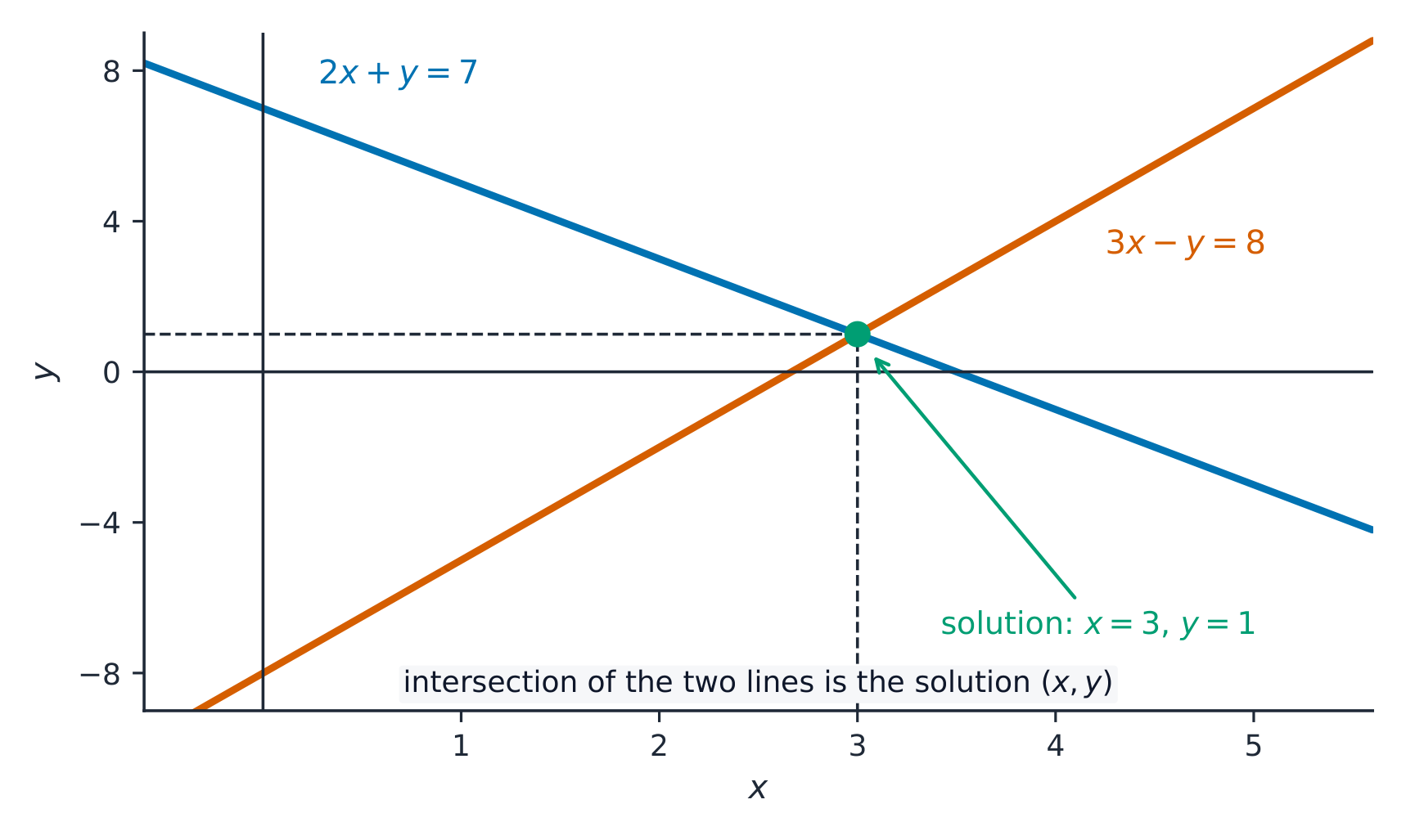
You can solve an equation by reading a graph. The intersection point 交点 of a line and a curve gives the solution of the two equations together.
For exponential growth 指数增长 and exponential decay 指数衰减, the graph of $y = a\,b^{x} + c$ rises (or falls) faster and faster and flattens towards a horizontal line.
Español
Para dibujar una gráfica, haga una tabla de valores 数值表: elija valores de $x$, calcule $y$, luego grafique las coordenadas 坐标 y únalas con una curva suave.
Los puntos donde una gráfica cruza el eje $x$ (el eje horizontal axis 坐标轴) son las raíces 根 — las soluciones de $y = 0$.
Puede resolver una ecuación leyendo una gráfica. El punto de intersección 交点 de una línea y una curva da la solución de las dos ecuaciones juntas.
Para el crecimiento exponencial 指数增长 y el decaimiento exponencial 指数衰减, la gráfica de $y = a\,b^{x} + c$ sube (o baja) cada vez más rápido y se aplana hacia una línea horizontal.
Explore · Explorar
Graficación de una cuadrática
y = ax² + bx + c
Arrastre a, b y c y observe cómo se mueve la parábola — su punto de giro y dónde cruja los ejes.
Recognise, sketch and interpret graphs of the following functions: (a) linear (b) quadratic.
Knowledge of symmetry and roots is required. Knowledge of turning points is not required.
Español
Contenido del tema
Notas y ejemplos
Reconocer, esbozar e interpretar gráficas de las siguientes funciones: (a) lineales (b) cuadráticas.
Se requiere conocimiento de la simetría y de las raíces. No se requiere conocimiento de los puntos de giro.
English
Subject content
Notes and examples
Recognise, sketch and interpret graphs of the following functions: (a) linear (b) quadratic (c) cubic (d) reciprocal (e) exponential.
Functions will be equivalent to: • $ax + by = c$ • $y = ax^2 + bx + c$ • $y = ax^3 + b$ • $y = ax^3 + bx^2 + cx$ • $y = \frac{a}{x} + b$ • $y = ar^x + b$ where $a$, $b$ and $c$ are rational numbers and $r$ is a rational, positive number. Knowledge of turning points, roots and symmetry is required. Knowledge of vertical and horizontal asymptotes is required. Finding turning points of quadratics by completing the square is required.
Español
Contenido del tema
Notas y ejemplos
Reconocer, esbozar e interpretar gráficas de las siguientes funciones: (a) lineal (b) cuadrática (c) cúbica (d) recíproca (e) exponencial.
Las funciones serán equivalentes a: • $ax + by = c$ • $y = ax^2 + bx + c$ • $y = ax^3 + b$ • $y = ax^3 + bx^2 + cx$ • $y = \frac{a}{x} + b$ • $y = ar^x + b$ donde $a$, $b$ y $c$ son números racionales y $r$ es un número racional positivo. Se requiere conocimiento de puntos de inflexión, raíces y simetría. Se requiere conocimiento de asíntotas verticales y horizontales. Se requiere el cálculo de puntos de inflexión de cuadráticas completando el cuadrado.
Source: Cambridge International syllabus · Fuente: Plan de estudios Cambridge International
English
A quick sketch should show the right shape and the key features: where it crosses the axes, any symmetry 对称, and any line the curve gets close to.
Function
Shape
linear, $y = mx + c$
straight line; gradient $m$, $y$-intercept 截距$c$
quadratic, $y = ax^{2} + bx + c$
a parabola 抛物线 (U-shape if $a>0$, $\cap$-shape if $a<0$)
cubic, $y = ax^{3} + bx + c$
an S-shaped curve
reciprocal, $y = \dfrac{a}{x} + b$
two separate curves
exponential, $y = a\,r^{x} + b$
fast growth or decay
For a parabola, completing the square gives the turning point 转折点 (the lowest or highest point). For example $y = (x + 3)^{2} - 8$ has its turning point at $(-3, -8)$.
An asymptote 渐近线 is a line that the curve gets closer and closer to but never touches — for example, the $x$-axis for $y = \dfrac{a}{x}$, or the line $y = b$ for $y = a\,r^{x} + b$.
Español
Un esbozo rápido debe mostrar la forma correcta y las características clave: dónde cruza los ejes, cualquier simetría 对称, y cualquier línea a la que la curva se acerque.
Función
Forma
lineal, $y = mx + c$
línea recta; pendiente $m$, intercepto 截距$y$-eje $c$
cuadrática, $y = ax^{2} + bx + c$
a parábola 抛物线 (forma de U si $a>0$, $\cap$-shape si $a<0$)
cúbica, $y = ax^{3} + bx + c$
una curva en forma de S
recíproca, $y = \dfrac{a}{x} + b$
dos curvas separadas
exponencial, $y = a\,r^{x} + b$
crecimiento o decaimiento rápido
Las formas básicas de las gráficas; conocer cada forma permite hacer un esbozo rápido a partir de la ecuación.
Para una parábola, completar el cuadrado da el punto de giro 转折点 (el punto más bajo o más alto). Por ejemplo, $y = (x + 3)^{2} - 8$ tiene su punto de giro en $(-3, -8)$.
Completar el cuadrado, $y=(x+3)^2-8$, muestra el punto de giro $(-3,-8)$ y la línea de simetría $x=-3$.
Una asíntota 渐近线 es una línea a la que la curva se acerca cada vez más pero nunca toca — por ejemplo, el eje $x$ para $y = \dfrac{a}{x}$, o la línea $y = b$ para $y = a\,r^{x} + b$.
1 Estimate gradients of curves by drawing tangents.
2 Use the derivatives of functions of the form $ax^n$, where $a$ is a rational constant and $n$ is a positive integer or zero, and simple sums of not more than three of these.
$\frac{\mathrm{d}y}{\mathrm{d}x}$ notation will be expected.
3 Apply differentiation to gradients and stationary points (turning points).
4 Discriminate between maxima and minima by any method.
Maximum and minimum points may be identified by: • an accurate sketch • use of the second differential • inspecting the gradient either side of a turning point. Candidates are not expected to identify points of inflection.
Español
Contenido del tema
Notas y ejemplos
1 Estimar las pendientes de curvas trazando tangentes.
2 Utilizar las derivadas de funciones de la forma $ax^n$, donde $a$ es una constante racional y $n$ es un entero positivo o cero, y sumas simples de no más de tres de estas.
Se esperará el uso de la notación $\frac{\mathrm{d}y}{\mathrm{d}x}$.
3 Aplicar la diferenciación a pendientes y puntos estacionarios (puntos de inflexión/turning points).
4 Distinguir entre máximos y mínimos mediante cualquier método. Los puntos de máximo y mínimo pueden identificarse por: • un boceto preciso • el uso de la segunda diferencial • inspeccionando la pendiente a ambos lados de un punto de giro. No se espera que los candidatos identifiquen puntos de inflexión.
Source: Cambridge International syllabus · Fuente: Plan de estudios Cambridge International
English
Differentiation 微分 finds the gradient of a curve at any point. You can estimate it by drawing a tangent 切线 (a line that just touches the curve) and measuring its gradient.
The exact rule: if $y = ax^{n}$, then the derivative 导数 is
The turning point is $(3, -4)$. To decide whether a turning point is a maximum 最大值 or a minimum 最小值, check the sign of the gradient on each side, or use the second derivative (positive means a minimum).
Español
La diferenciación 微 encuentra la pendiente de una curva en cualquier punto. Puede estimarla trazando una tangente 切线 (una línea que solo toca la curva) y midiendo su pendiente.
La pendiente de una curva en un punto es igual a la pendiente de la tangente allí — lo que encuentra la diferenciación.
La regla exacta: si $y = ax^{n}$, entonces la derivada 导数 es
El punto de giro es $(3, -4)$. Para decidir si un punto de giro es un máximo 最大值 o un mínimo 最小值, verifique el signo de la pendiente en cada lado, o use la segunda derivada (positiva significa un mínimo).
Explore · Explorar
Pendiente de una curva
y = ax³ + bx² + cx + d
Mueva el punto: la tangente muestra la pendiente allí, que es lo que encuentra la diferenciación.
2 Understand and find inverse functions $f^{-1}(x)$.
3 Form composite functions as defined by $gf(x) = g(f(x))$.
e.g. $f(x) = \frac{3}{x + 2}$ and $g(x) = (3x + 5)^2$. Find $fg(x)$. Give your answer as a fraction in its simplest form. Candidates are not expected to find the domains and ranges of composite functions. This topic may include mapping diagrams.
Español
Contenido del tema
Notas y ejemplos
1 Comprender funciones, dominio y rango, y utilizar la notación de funciones.
2 Comprender y encontrar funciones inversas $f^{-1}(x)$.
3 Formar funciones compuestas según lo definido por $gf(x) = g(f(x))$.
p. ej. $f(x) = \frac{3}{x + 2}$ y $g(x) = (3x + 5)^2$. Encontrar $fg(x)$. Dar la respuesta como una fracción en su forma más simple. A los candidatos no se les espera que encuentren los dominios y rangos de las funciones compuestas. Este tema puede incluir diagramas de mapeo.
Source: Cambridge International syllabus · Fuente: Plan de estudios Cambridge International
English
A function 函数 turns each input into one output. We write $f(x)$, for example $f(x) = 3x - 5$, so $f(2) = 1$. The set of allowed inputs is the domain 定义域; the set of possible outputs is the range 值域.
The inverse function 反函数$f^{-1}(x)$ undoes the function. To find it, write $y = f(x)$, swap the roles, and make $x$ the subject.
Worked example. Find the inverse of $f(x) = 3x - 5$.
Una función 函数 convierte cada entrada en una salida. Escribimos $f(x)$, por ejemplo $f(x) = 3x - 5$, así que $f(2) = 1$. El conjunto de entradas permitidas es el dominio 定义域; el conjunto de salidas posibles es el rango 值域.
La función inversa 反函数$f^{-1}(x)$ deshace la función. Para encontrarla, escriba $y = f(x)$, intercambie los roles, y haga $x$ el sujeto.
Ejemplo resuelto. Halla la inversa de $f(x) = 3x - 5$.
Pick one and the site follows you — notes, papers, videos and practice all open on it. · Selecciona uno y el sitio te sigue — notas, documentos, videos y práctica se abren en él.
Type to search notes, lessons, code, vocabulary and past-paper questions across every subject. · Escribe para buscar notas, lecciones, código, vocabulario y preguntas de exámenes anteriores en todas las materias.