Skip to content · ⁨الانتقال إلى المحتوى⁩
Subjects · ⁨المواد⁩

AP Chemistry · ⁨AP الكيمياء⁩

Tips

يمتد امتحان AP Chemistry من البنية الذرية والدورية عبر الروابط والهندسة الجزيئية، والقوى بين الجزيئات، والحسابات الكيميائية والمحاليل، والحركية، والديناميكا الحرارية، والاتزان، والأحماض والقواعد، والكهرباء الكيميائية. الخط الفاصل هو الشرح على مستوى الجسيمات: ينتهي تقريباً كل سؤال بـ "اشرح لماذا"، ويجب أن تتحدث الإجابة عن الجسيمات والقوى والطاقة.

فكرتان تحملان أكبر قدر من الدرجات. القوى بين الجزيئات تفسر نقاط الغليان والذوبانية والكروماتوغرافيا. مبدأ لوشاتلييه يفسر كل تحول في الاتزان. ادرس كلاهما بشكل صحيح وستفتح لك جزءاً كبيراً من الورقة الامتحانية.

الحساب بدون وحدات وأرقام ذات دلالة هو إجابة ناقصة.

تتبع الملاحظات الوحدات التسعة لـ CED، لكل منها أمثلة محلولة والعلاقات الواردة في ورقة معادلات الامتحان. توجد过去的 الـ FRQs وإرشادات التصحيح في المكتبة — الأسئلة الطويلة في الكيمياء تستحق شرح السلوك على مستوى الجسيمات، لذا كُتبت الإجابات النموذجية بأسلوب علمي مناسب.

  • 1

    Atomic Structure and Properties · ⁨البنية والخصائص الذرية⁩

    Watch lesson · ⁨شاهد الدرس⁩
    1.1

    Moles and Molar Mass · ⁨المولات والكتلة المولية⁩

    Syllabus · ⁨المنهج⁩
    English

    Learning Objective 1.1.A: Calculate quantities of a substance or its relative number of particles using dimensional analysis and the mole concept.

    • 1.1.A.1 One cannot count particles directly while performing laboratory work. Thus, there must be a connection between the masses of substances reacting and the actual number of particles undergoing chemical changes.
    • 1.1.A.2 Avogadro's number ($N_{\mathrm{A}} = 6.022 \times 10^{23}\ \mathrm{mol}^{-1}$) provides the connection between the number of moles in a pure sample of a substance and the number of constituent particles (or formula units) of that substance.
    • 1.1.A.3 Expressing the mass of an individual atom or molecule in atomic mass units (amu) is useful because the average mass in amu of one particle (atom or molecule) or formula unit of a substance will always be numerically equal to the molar mass of that substance in grams. Thus, there is a quantitative connection between the mass of a substance and the number of particles that the substance contains.
      • Equation: $n = m/M$
    العربية

    هدف التعلم 1.1.A: حساب كميات المادة أو عددها النسوي للجسيمات باستخدام التحليل البعدي ومفهوم المول.

    • 1.1.A.1 لا يمكن عد الجسيمات بشكل مباشر أثناء إجراء العمل المخبري. وبالتالي، يجب أن يكون هناك ارتباط بين كتل المواد المتفاعلة والعدد الفعلي للجسيمات التي تخضع لتغيرات كيميائية.
    • 1.1.A.2 رقم أفوجادرو ($N_{\mathrm{A}} = 6.022 \times 10^{23}\ \mathrm{mol}^{-1}$) يوفّر العلاقة بين عدد المولات في عينة نقية من مادة ما وعدد الجسيمات المكونة (أو الوحدات الصيغية) لهذه المادة.
    • 1.1.A.3 يُعد التعبير عن كتلة ذرة أو جزيء فردي بوحدة الكتلة الذرية (amu) مفيدًا لأن متوسط الكتلة بالـ amu لجسيم واحد (ذرة أو جزيء) أو وحدة صيغة لمادة ما يساوي دائمًا عدديًا الكتلة المولية لهذه المادة بالغرام. وبالتالي، يوجد ارتباط كمي بين كتل المادة وعدد الجسيمات التي تحتوي عليها.
      • المعادلة: $n = m/M$
    Source: College Board AP Course and Exam Description · ⁨المصدر: وصف دورة وامتحان College Board AP⁩

    English

    Because atoms are far too small to count, chemists count in moles 摩尔. One mole is Avogadro's number 阿伏伽德罗常数 of particles, $N_A=6.022\times10^{23}$. The molar mass 摩尔质量 (grams per mole, read off the periodic table) converts between mass and moles:

    $$n=\frac{m}{M}.$$
    Moles are the bridge between the lab (grams you weigh) and the equation (particles that react).

    Worked example. How many moles, and how many molecules, are in $36.0\ \text{g}$ of water ($M=18.0\ \text{g/mol}$)?

    $$n=\frac{m}{M}=\frac{36.0}{18.0}=2.0\ \text{mol},\qquad N=n\,N_A=2.0\times6.022\times10^{23}=1.2\times10^{24}\ \text{molecules}.$$

    العربية

    لأن الذرات صغيرة جداً لعدّها، يحسب الكيميائيون بالـ مولات. المول الواحد هو عدد أفوجادرو من الجسيمات، $N_A=6.022\times10^{23}$. الكتلة المولية (بالجرام لكل مول، تُستخرج من الجدول الدوري) تحول بين الكتلة والمولات:

    $$n=\frac{m}{M}.$$
    المولات هي الجسر بين المختبر (الجرامات التي تزنّها) والمعادلة (الجسيمات التي تتفاعل).

    المول هو المحور: التحويل بين الكتلة، الجسيمات، حجم الغاز، والتركيز
    المول هو المحور: التحويل بين الكتلة، الجسيمات، حجم الغاز، والتركيز

    مثال محلول. كم عدد المولات وعدد الجزيئات في $36.0\ \text{g}$ من الماء ($M=18.0\ \text{g/mol}$)؟

    $$n=\frac{m}{M}=\frac{36.0}{18.0}=2.0\ \text{mol},\qquad N=n\,N_A=2.0\times6.022\times10^{23}=1.2\times10^{24}\ \text{molecules}.$$

    Explore · ⁨استكشف⁩

    Link mass, moles and molar mass · ⁨اربط الكتلة، المولات والكتلة المولية⁩

    Molar mass $M$ is the bridge between the mass you weigh and the number of moles: $m = M \times n$. Because $M$ is fixed for a substance, mass is proportional to moles — double the moles, double the mass. · ⁨الكتلة المولية $M$ هي الجسر بين الكتلة التي تقاس وعدد المولات: $m = M \times n$. نظرًا لأن $M$ ثابتة للمادة، فإن الكتلة تناسب طرديًا عدد المولات — فضعف عدد المولات يؤدي إلى ضعف الكتلة.⁩

    1.2

    Mass Spectra of Elements · ⁨الطيف الكتلي للعناصر⁩

    Syllabus · ⁨المنهج⁩
    English

    Learning Objective 1.2.A: Explain the quantitative relationship between the mass spectrum of an element and the masses of the element's isotopes.

    • 1.2.A.1 The mass spectrum of a sample containing a single element can be used to determine the identity of the isotopes of that element and the relative abundance of each isotope in nature.
    • 1.2.A.2 The average atomic mass of an element can be estimated from the weighted average of the isotopic masses using the mass of each isotope and its relative abundance.
      • Exclusion Statement: Interpreting mass spectra of samples containing multiple elements or peaks arising from species other than singly charged monatomic ions will not be assessed on the AP Exam.
    العربية

    هدف التعلم 1.2.A: شرح العلاقة الكمية بين الطيف الكتوي لعنصر وكتل نظائره.

    • 1.2.A.1 يمكن استخدام الطيف الكتوي لعينة تحتوي على عنصر واحد لتحديد هوية نظائر ذلك العنصر ووفرة كل نظير نسبيًا في الطبيعة.
    • 1.2.A.2 يمكن تقدير الكتلة الذلية المتوسطة لعنصر من خلال المتوسط المرجح لكتل النظائر باستخدام كتلة كل نظير ووفرته النسبية.
      • عبارة الاستثناء: لن يتم تقييم تفسير الأطياف الكتوية لعينات تحتوي على عناصر متعددة أو قمم ناتجة عن أنواع غير أيونات أحادية الذرة ذات شحنة واحدة في امتحان AP.

    Source: College Board AP Course and Exam Description · ⁨المصدر: وصف دورة وامتحان College Board AP⁩

    English
    Mass spectrometry

    A mass spectrometer 质谱仪 separates atoms by mass, giving a mass spectrum 质谱: peaks at each isotope 同位素 (same element, different neutron count) with heights showing their relative abundance 相对丰度. The element's average atomic mass is the abundance-weighted average of its isotope masses.

    Worked example. Chlorine is $75.8\%$ chlorine-35 and $24.2\%$ chlorine-37. Its average atomic mass is

    $$A_r=(35)(0.758)+(37)(0.242)=26.5+8.95=35.5.$$
    The average lies closer to $35$ because that isotope is more abundant – which is why the periodic-table value is $35.5$, not a whole number.

    العربية
    الطيف الكتلي

    يُفرّق مطياف الكتلة الذرات حسب كتلتها، مما يعطي طيفاً كتلياً: قمم عند كل نظير (نفس العنصر، عدد نيوترون مختلف) مع ارتفاعات تُظهر التوافر النسبي. متوسط الكتلة الذرية للعنصر هو المتوسط المرجح بالتوافر لكتل نظيراته.

    الكتلة الذرية النسبية هي المتوسط المرجح بالتوافر للنظائر
    الكتلة الذرية النسبية هي المتوسط المرجح بالتوافر لنظيراته
    طيف كتلة الكلور: نظيران بتوافرات مختلفة
    الطيف الكتلي للكلور: نظيران بتوافرات مختلفة

    مثال محلول. الكلور يتكون من $75.8\%$ كلور-35 و$24.2\%$ كلور-37. متوسطه الذري هو

    $$A_r=(35)(0.758)+(37)(0.242)=26.5+8.95=35.5.$$
    القيمة المتوسطة أقرب إلى $35$ لأن هذا النظير أكثر وفرة – ولهذا السبب قيمة الجدول الدوري هي $35.5$، وليست عدداً صحيحاً.

    Explore · ⁨استكشف⁩

    Explore isotopes — same element, different mass · ⁨استكشف النظائر — نفس العنصر، كتل مختلفة⁩

    Keep the protons fixed but change the neutrons to build the two chlorine isotopes ($^{35}$Cl and $^{37}$Cl). Same element, different mass — exactly the peaks a mass spectrum shows. · ⁨أبقِ البروتونات ثابتة وغير النيوترونات لبناء نظيري الكلور ($^{35}$Cl و$^{37}$Cl). نفس العنصر، كتل مختلفة — تماماً كما تظهر الذروات في طيف الكتلة.⁩

    Vocabulary · ⁨مفردات⁩ Train · ⁨تدريب⁩
    English العربية
    moles/məʊlz/ مولات
    Avogadro's number/ˌævəˈɡædrəʊz ˈnʌmbə/ عدد أفوجادرو
    molar mass/ˈməʊlə mæs/ كتلته المولية
    mass spectrometer/mæs spekˈtrɒmɪtə/ جهاز مطياف الكتلة
    mass spectrum/mæs ˈspektrəm/ طيف الكتلة
    isotope/ˈaɪsətəʊp/ النظائر
    relative abundance/ˈrelətɪv əˈbʌndəns/ الوفرة النسبية
    percent composition/pəˈsent ˌkɒmpəˈzɪʃn/ التركيب المئوي
    1.3

    Elemental Composition of Pure Substances · ⁨التركيب العنصري للمواد الخالصة⁩

    Syllabus · ⁨المنهج⁩
    English

    Learning Objective 1.3.A: Explain the quantitative relationship between the elemental composition by mass and the empirical formula of a pure substance.

    • 1.3.A.1 Some pure substances are composed of individual molecules, while others consist of atoms or ions held together in fixed proportions as described by a formula unit.
    • 1.3.A.2 According to the law of definite proportions, the ratio of the masses of the constituent elements in any pure sample of that compound is always the same.
    • 1.3.A.3 The chemical formula that lists the lowest whole number ratio of atoms of the elements in a compound is the empirical formula.
    العربية

    هدف التعلم 1.3.A: شرح العلاقة الكمية بين التركيب العنصري بالنسبة للكتلة والصيغة الأولية للمادة النقية.

    • 1.3.A.1 تتكون بعض المواد النقية من جزيئات فردية، بينما تتكون أخرى من ذرات أو أيونات مرتبطة معًا بنسب ثابتة كما هو موصوف بواسطة وحدة الصيغة.
    • 1.3.A.2 وفقًا لقانون النسب الثابتة، فإن نسبة كتل العناصر المكونة في أي عينة نقية من ذلك المركب تكون دائمًا نفسها.
    • 1.3.A.3 الصيغة الكيميائية التي تذكر أدنى نسبة أعداد صحيحة لذرات العناصر في المركب تسمى الصيغة الأولية.

    Source: College Board AP Course and Exam Description · ⁨المصدر: وصف دورة وامتحان College Board AP⁩

    English

    The percent composition 百分组成 of a compound is each element's mass fraction. From it you find the empirical formula 实验式 (simplest whole-number ratio of atoms) by converting each element's mass to moles and dividing by the smallest. The molecular formula 分子式 is a whole-number multiple of the empirical formula, found from the molar mass.

    Worked example. A compound is $40.0\%$ C, $6.7\%$ H, and $53.3\%$ O by mass. Assuming $100\ \text{g}$, convert each mass to moles and divide by the smallest:

    $$\text{C}:\frac{40.0}{12}=3.33,\quad \text{H}:\frac{6.7}{1}=6.7,\quad \text{O}:\frac{53.3}{16}=3.33 \;\xrightarrow{\div 3.33}\; 1:2:1,$$
    so the empirical formula is $\text{CH}_2\text{O}$. If the molar mass were $180\ \text{g/mol}$ ($=6\times30$), the molecular formula would be $\text{C}_6\text{H}_{12}\text{O}_6$ – glucose.

    العربية

    التركيب المئوي للمركب هو كسر كتلة كل عنصر. منه تستنتج الصيغة الأولية ( أبسط نسبة أعداد صحيحة للذرات) بتحويل كتلة كل عنصر إلى مولات وقسمتها على الأصغر. الصيغة الجزيئية هي مضاعف صحيح للصيغة الأولية، تُستنتج من الكتلة المولية.

    إيجاد الصيغة الأولية: الكتلة إلى المولات، القسمة على الأصغر، قراءة النسبة
    إيجاد الصيغة الأولية: من الكتلة إلى المولات، قسّم على الأصغر، اقرأ النسبة

    مثال محلول. مركب يتكون من $40.0\%$ C، $6.7\%$ H، و$53.3\%$ O بالكتلة. بافتراض $100\ \text{g}$، حوّل كل كتلة إلى مولات وقسّم على الأصغر:

    $$\text{C}:\frac{40.0}{12}=3.33,\quad \text{H}:\frac{6.7}{1}=6.7,\quad \text{O}:\frac{53.3}{16}=3.33 \;\xrightarrow{\div 3.33}\; 1:2:1,$$
    إذن الصيغة الأولية هي $\text{CH}_2\text{O}$. لو كانت الكتلة المولية $180\ \text{g/mol}$ ($=6\times30$)، لصارت الصيغة الجزيئية $\text{C}_6\text{H}_{12}\text{O}_6$ – الجلوكوز.

    Vocabulary · ⁨مفردات⁩ Train · ⁨تدريب⁩
    English العربية
    empirical formula/emˈpɪrɪkl ˈfɔːmjʊlə/ الصيغة الأولية
    molecular formula/məˈlekjʊlə ˈfɔːmjʊlə/ الصيغة الجزيئية
    mixture/ˈmɪkstʃə/ خليط
    nucleus/ˈnjuːklɪəs/ النواة
    electron configuration/ɪˈlektrɒn kənˌfɪɡjəˈreɪʃn/ التوزيع الإلكتروني
    valence electrons/ˈveɪləns ɪˈlektrɒnz/ إلكترونات التكافؤ
    Photoelectron spectroscopy/ˌfəʊtəʊɪˈlektrɒn spekˈtrɒskəpi/ طيف الإلكترون الضوئي
    Atomic radius/əˈtɒmɪk ˈreɪdɪəs/ نصف قطر الذرة
    Ionization energy/ˌaɪənaɪˈzeɪʃn ˈenədʒi/ طاقة التأين
    1.4

    Composition of Mixtures · ⁨تركيب المخاليط⁩

    Syllabus · ⁨المنهج⁩
    English

    Learning Objective 1.4.A: Explain the quantitative relationship between the elemental composition by mass and the composition of substances in a mixture.

    • 1.4.A.1 Pure substances contain atoms, molecules, or formula units of a single type. Mixtures contain atoms, molecules, or formula units of two or more types, whose relative proportions can vary.
    • 1.4.A.2 Elemental analysis can be used to determine the relative numbers of atoms in a substance and to determine its purity.
    العربية

    هدف التعلم 1.4.A: شرح العلاقة الكمية بين التركيب العنصري بالنسبة للكتلة وتركيب المواد في الخليط.

    • 1.4.A.1 تحتوي المواد النقية على ذرات أو جزيئات أو وحدات صيغة من نوع واحد. أما الخلطات فتحتوي على ذرات أو جزيئات أو وحدات صيغة من نوعين أو أكثر، والتي يمكن أن تتغير نسبها النسبية.
    • 1.4.A.2 يمكن استخدام التحليل العنصري لتحديد الأعداد النسوية للذرات في المادة ولتحديد نقائها.

    Source: College Board AP Course and Exam Description · ⁨المصدر: وصف دورة وامتحان College Board AP⁩

    English

    Unlike a pure compound, a mixture 混合物 has variable composition – its parts keep their own identities. Describe a mixture by the mass or mole fraction of each component; these do not follow a fixed formula. Spectroscopy (like PES or absorption) can measure how much of each component is present.

    العربية

    على عكس المركب النقي، الخليط له تركيب متغير – parts تحافظ على هويتها الخاصة. وصّف الخليط بكسر الكتلة أو المول لكل مكون؛ هذه لا تتبع صيغة ثابتة. يمكن للتحليل الطيفي (مثل PES أو الامتصاص) قياس كمية كل مكون.

    1.5

    Atomic Structure and Electron Configuration · ⁨البنية الذرية والتوزيع الإلكتروني⁩

    Syllabus · ⁨المنهج⁩
    English

    Learning Objective 1.5.A: Represent the ground-state electron configuration of an atom of an element or its ions using the Aufbau principle.

    • 1.5.A.1 The atom is composed of negatively charged electrons and a positively charged nucleus that is made of protons and neutrons.
    • 1.5.A.2 Coulomb's law is used to calculate the force between two charged particles.
      • Equation: $F_{coulombic} \propto \dfrac{q_1 q_2}{r^2}$
    • 1.5.A.3 In atoms and ions, the electrons can be thought of as being in "shells (energy levels)" and "subshells (sublevels)," as described by the ground-state electron configuration. Inner electrons are called core electrons, and outer electrons are called valence electrons. The electron configuration is explained by quantum mechanics, as delineated in the Aufbau principle and exemplified in the periodic table of the elements.
      • Exclusion Statement: The assignment of quantum numbers to electrons in subshells of an atom will not be assessed on the AP Exam.
    • 1.5.A.4 The relative energy required to remove an electron from different subshells of an atom or ion or from the same subshell in different atoms or ions (ionization energy) can be estimated through a qualitative application of Coulomb's law. This energy is related to the distance from the nucleus and the effective (shield) charge of the nucleus.
    العربية

    هدف التعلم 1.5.A: تمثيل التوزيع الإلكتروني لحالة الأساس لذرة عنصر أو أيونه باستخدام مبدأ أوفباو.

    • 1.5.A.1 يتكون الذرة من إلكترونات سالبة الشحنة ونواة موجبة الشحنة تتكون من بروتونات ونيوترونات.
    • 1.5.A.2 يُستخدم قانون كولوم لحساب القوة بين جسيمين مشحونين.
      • المعادلة: $F_{coulombic} \propto \dfrac{q_1 q_2}{r^2}$
    • 1.5.A.3 في الذرات والأيونات، يمكن اعتبار الإلكترونات موجودة في "أغلفة (مستويات طاقة)" و"تفرعات (مستويات فرعية)"، كما هو موضح بالتوزيع الإلكتروني لحالة الأساس. تسمى الإلكترونات الداخلية بالإلكترونات الأساسية، والإلكترونات الخارجية بالإلكترونات التكافؤ. يُفسر التوزيع الإلكتروني بميكانيكا الكم، كما هو محدد في مبدأ أوفباو ومُثّل في الجدول الدوري للعناصر.
      • عبارة الاستثناء: لن يتم تقييم تعيين الأرقام الكمومية للإلكترونات في التفرعات الفرعية للذرة في امتحان AP.
    • 1.5.A.4 يمكن تقدير الطاقة النسوية اللازمة لإزالة إلكترون من التفرعات الفرعية المختلفة للذرة أو الأيون أو من نفس التفرع الفرعي في ذرات أو أيونات مختلفة (طاقة التأين) من خلال تطبيق نوعي لقانون كولوم. ترتبط هذه الطاقة بالمسافة من النواة والشحنة الفعالة (الواقية) للنواة.

    Source: College Board AP Course and Exam Description · ⁨المصدر: وصف دورة وامتحان College Board AP⁩

    English

    An atom is a tiny nucleus 原子核 (protons and neutrons) surrounded by electrons in shells and subshells (s, p, d, f). The electron configuration 电子排布 lists how electrons fill these, lowest energy first (e.g. $1s^2\,2s^2\,2p^6$). The outermost, highest-energy electrons – the valence electrons 价电子 – control chemistry. Coulomb's law explains their energies: electrons closer to, and less shielded from, the nucleus are held more tightly.

    Worked example. Write the electron configuration of sulfur ($Z=16$). Fill subshells in order until $16$ electrons are placed: $1s^2\,2s^2\,2p^6\,3s^2\,3p^4$. The $3s$ and $3p$ electrons (six in total) are the valence electrons, so sulfur tends to gain two electrons to complete its octet.

    العربية

    الذرة نواة صغيرة (بروتونات ونيوترونات) محاطة بإلكترونات في أغلفة وأغلفة فرعية (s, p, d, f). التوزيع الإلكتروني يسرد كيفية امتلاء هذه المستويات، من الأقل طاقة أولاً (مثلاً $1s^2\,2s^2\,2p^6$). الإلكترونات الخارجية ذات الطاقة الأعلى – إلكترونات التكافؤ – تحكم الكيمياء. قانون كولوم يفسر طاقاتها: الإلكترونات الأقرب للنواة والأقل ظلاً منها تمسك بقوة أكبر.

    ذرة: نواة صغيرة من البروتونات والنيوترونات، مع إلكترونات في أغلفة
    ذرة: نواة صغيرة من البروتونات والنيوترونات، مع إلكترونات في أغلفة
    صف من تسعة أوعية تحترق، كل لهب بلون زاهٍ مختلف — قرميدي، برتقالي، أصفر، أخضر، أزرق، بنفسجي
    اختبارات اللهب: كل أيون فلز يعطي لونه الخاص لأن الحرارة تهيج إلكتروناته، وعند عودتها للأسفل تُشع ضوءاً بأطوال موجية محددة

    مثال محلول. اكتب التوزيع الإلكتروني للكبريت ($Z=16$). املأ الأغلفة الفرعية ترتيباً حتى وضع $16$ إلكترونات: $1s^2\,2s^2\,2p^6\,3s^2\,3p^4$. إلكترونات $3s$ و$3p$ (ستة إجمالاً) هي إلكترونات التكافؤ، لذا يميل الكبريت لكسب إلكترونين لإكمال ثنائياته.

    الجدول الدوري ينظم العناصر حسب البنية الذرية — تكوين الإلكترون يفسر الأنماط
    الجدول الدوري ينظم العناصر حسب البنية الذرية – التوزيع الإلكتروني يفسر الأنماط
    Explore · ⁨استكشف⁩

    Explore how electrons fill the shells · ⁨استكشف كيفية امتلاء الإلكترونات للمستويات⁩

    Change the atomic number $Z$ and watch the electrons fill the shells lowest-energy-first (the Aufbau principle 构造原理). The outermost electrons are the valence electrons that drive bonding. · ⁨غيّر العدد الذري $Z$ وراقب كيف تمتلئ المستويات الإلكترونية بدءًا من أدنى مستوى طاقة (مبدأ أوفباو). الإلكترونات الخارجية هي إلكترونات التكافؤ التي تحرك عملية الترابط.⁩

    1.6

    Photoelectron Spectroscopy · ⁨مطيافية الإلكترون الضوئي⁩

    Syllabus · ⁨المنهج⁩
    English

    Learning Objective 1.6.A: Explain the relationship between the photoelectron spectrum of an atom or ion and: i. The ground-state electron configuration of the species. ii. The interactions between the electrons and the nucleus.

    • 1.6.A.1 The energies of the electrons in a given shell can be measured experimentally with photoelectron spectroscopy (PES). The position of each peak in the PES spectrum is related to the energy required to remove an electron from the corresponding subshell, and the relative height of each peak is (ideally) proportional to the number of electrons in that subshell.
    العربية

    هدف التعلم 1.6.A: شرح العلاقة بين الطيف الفوتوالكتروني للذرة أو الأيون و: i. التوزيع الإلكتروني لحالة الأساس للنوع. ii. التفاعلات بين الإلكترونات والنواة.

    • 1.6.A.1 يمكن قياس طاقات الإلكترونات في غلاف معين تجريبياً باستخدام مطيافية الفوتوالكترون (PES). يرتبط موقع كل قمة في طيف PES بالطاقة اللازمة لإزالة إلكترون من التفرع الفرعي المقابل، وترتفع الارتفاع النسوي لكل قمة (مثاليًا) متناسباً مع عدد الإلكترونات في ذلك التفرع الفرعي.

    Source: College Board AP Course and Exam Description · ⁨المصدر: وصف دورة وامتحان College Board AP⁩

    English

    Photoelectron spectroscopy 光电子能谱 (PES) measures the energy needed to remove electrons from each subshell. Each peak is a subshell: its position gives the binding energy (how tightly held) and its height gives the number of electrons in it. PES data let you read an element's electron configuration and confirm shell structure directly.

    العربية

    مطيافية الإلكترون الضوئي (PES) تقيس الطاقة اللازمة لطرد الإلكترونات من كل غلاف فرعي. كل قمة تمثل غلفاً فرعياً: موقعها يعطي طاقة الربط (مدى تماسكها) وارتفاعها يعطي عدد الإلكترونات فيه. بيانات PES تسمح بقراءة التوزيع الإلكتروني للعنصر وتأكيد بنية الغلاف مباشرة.

    طاقات التأين المتتالية تكشف عن البنية المدارية من خلال قفزات كبيرة
    طاقات التأين المتتالية تكشف عن بنية الغلاف عبر قفزات كبيرة
    طيف الفوتوإلكترون للنون: ذروة واحدة لكل فرعي، الارتفاع محدد بعدد الإلكترونات
    الطيف الإلكتروني الضوئي للنيون: قمة لكل غلاف فرعي، الارتفاع محدد بعدد الإلكترونات
    1.7

    Periodic Trends · ⁨الاتجاهات الدورية⁩

    Syllabus · ⁨المنهج⁩
    English

    Learning Objective 1.7.A: Explain the relationship between trends in atomic properties of elements and electronic structure and periodicity.

    • 1.7.A.1 The organization of the periodic table is based on patterns of recurring properties of the elements, which are explained by patterns of ground-state electron configurations and the presence of completely or partially filled shells (and subshells) of electrons in atoms.
      • Exclusion Statement: Writing the electron configuration of elements that are exceptions to the aufbau principle will not be assessed on the AP Exam.
    • 1.7.A.2 Trends in atomic properties within the periodic table (periodicity) can be predicted by the position of the element on the periodic table and qualitatively understood using Coulomb's law, the shell model, and the concepts of shielding and effective nuclear charge. These properties include:
      • i. Ionization energy
      • ii. Atomic and ionic radii
      • iii. Electron affinity
      • iv. Electronegativity.
    • 1.7.A.3 The periodicity (in 1.7.A.2) is useful to predict/estimate values of properties in the absence of data.
    العربية

    هدف التعلم 1.7.A: شرح العلاقة بين اتجاهات الخصائص الذلية للعناصر والبنية الإلكترونية والدورية.

    • 1.7.A.1 يعتمد تنظيم الجدول الدوري على أنماط من الخصائص المتكررة للعناصر، والتي تُفسر بأنماط توزيعات الإلكترونات لحالة الأساس ووجود أغلفة (وتفرعات فرعية) كاملة أو جزئية من الإلكترونات في الذرات.
      • عبارة الاستبعاد: لن يتم تقييم كتابة التوزيع الإلكتروني للعناصر التي تمثل استثناءات لمبدأ أوفباو في امتحان AP.
    • 1.7.A.2 يمكن التنبؤ بالاتجاهات في الخصائص الذرية داخل الجدول الدوري (الدورية) بناءً على موقع العنصر في الجدول الدوري وفهمها بشكل نوعي باستخدام قانون كولوم، ونموذج الغلاف، ومفاهيم الحجب والشحنة النووية الفعالة. تشمل هذه الخصائص:
      • i. طاقة التأين
      • ii. الأقطار الذرية والأيونية
      • iii. إقراب الإلكترون
      • iv. الكهروسالبية.
    • 1.7.A.3 مفيدة الدورية (في 1.7.A.2) للتنبؤ/تقدير قيم الخصائص عند غياب البيانات.

    Source: College Board AP Course and Exam Description · ⁨المصدر: وصف دورة وامتحان College Board AP⁩

    English

    Trends across the periodic table follow from nuclear charge and shielding:

    • Atomic radius 原子半径 decreases across a period (stronger pull) and increases down a group (more shells).
    • Ionization energy 电离能 (energy to remove an electron) increases across, decreases down – opposite to radius.
    • Electronegativity 电负性 (pull on shared electrons) increases across and up, toward fluorine.
    العربية

    الاتجاهات عبر الجدول الدوري تنبع من الشحنة النووية والظل:

    تزداد الكهربية السالبة عبر الدورة وتتناقص على طول المجموعة
    السالبية الكهربائية ترتفع عبر الدورة وتنخفض عبر المجموعة
    • نصف القطر الذري يتناقص عبر الدورة (جذب أقوى) ويزداد نحو الأسفل في المجموعة (مستويات طاقة أكثر).
    • طاقة التأين (الطاقة اللازمة لنزع إلكترون) تزداد عبر الدورة، وتنخفض نحو الأسفل – عكس اتجاه نصف القطر.
    • السالبية الكهربية (الجذب على الإلكترونات المشتركة) تزداد عبر الدورة وباتجاه الأعلى، نحو الفلور.
    الاتجاهات الدورية: كيف يتغير نصف القطر وطاقة التأين والسالبية الكهربية عبر الدورة ونحو الأسفل
    الاتجاهات الدورية: كيف يتغير نصف القطر وطاقة التأين والسالبية الكهربية عبر الدورة ونحو الأسفل
    Explore · ⁨استكشف⁩

    Explore atomic radius across a period · ⁨استكشف نصف القطر الذري عبر دورة⁩

    Step across Period 3 and watch the atomic radius shrink — each added proton raises the effective nuclear charge and pulls the same shell in tighter. · ⁨انتقل عبر الدورة 3 ولاحظ نصف قطر الذرة يتناقص — لأن كل بروتون إضافي يزيد الشحنة النووية الفعالة ويجذب نفس المدار بشكل أكثر إحكامًا.⁩

    Vocabulary · ⁨مفردات⁩ Train · ⁨تدريب⁩
    English العربية
    Electronegativity/ɪˌlektrəʊŋɡəˈtɪvɪti/ السالبية الكهربية
    cations/ˈkætaɪənz/ الكاتيونات
    anions/ˈænaɪənz/ الأنيونات
    ionic compound/aɪˈɒnɪk ˈkɒmpaʊnd/ مركب أيوني
    1.8

    Valence Electrons and Ionic Compounds · ⁨إلكترونات التكافؤ والمركبات الأيونية⁩

    Syllabus · ⁨المنهج⁩
    English

    Learning Objective 1.8.A: Explain the relationship between trends in the reactivity of elements and periodicity.

    • 1.8.A.1 The likelihood that two elements will form a chemical bond is determined by the interactions between the valence electrons and nuclei of elements.
    • 1.8.A.2 Elements in the same column of the periodic table tend to form analogous compounds.
    • 1.8.A.3 Typical charges of atoms in ionic compounds are governed by the number of valence electrons and predicted by their location on the periodic table.
    العربية

    الهدف التعليمي 1.8.A: شرح العلاقة بين اتجاهات تفاعل العناصر والدورية.

    • 1.8.A.1 احتمالية تكون عنصرين لرابطة كيميائية تحددها التفاعلات بين إلكترونات التكافؤ وأنوية العناصر.
    • 1.8.A.2 تميل العناصر في نفس عمود الجدول الدوري لتكوين مركبات مماثلة.
    • 1.8.A.3 تُحكم الشحنات النموذجية للذرات في المركبات الأيونية بعدد إلكترونات التكافؤ وتُتوقع بموقعها في الجدول الدوري.

    Source: College Board AP Course and Exam Description · ⁨المصدر: وصف دورة وامتحان College Board AP⁩

    English

    Atoms gain, lose, or share valence electrons to reach stable configurations. Metals (low ionization energy) lose electrons to form cations 阳离子; nonmetals gain electrons to form anions 阴离子. Oppositely charged ions attract into an ionic compound 离子化合物, whose formula balances the charges to make the whole neutral. For example, aluminium ($3+$) and oxide ($2-$) combine as $\text{Al}_2\text{O}_3$ so the $+6$ and $-6$ cancel.

    العربية

    تكتسب الذرات أو تفقد أو تتشارك إلكترونات التكافؤ للوصول إلى توزيعات مستقرة. تفقد المعادن (ذات طاقة تأين منخفضة) الإلكترونات لتكوين أيونات موجبة (كاتيونات)؛ بينما تكتسب اللافلزات الإلكترونات لتكوين أيونات سالبة (أنيونات). تجذب الأيونات ذات الشحنات المتضادة لتكون مركب أيوني، حيث يوازن صيغته الشحنات لجعل الجزيء متعادلاً. على سبيل المثال، يتحد الألومنيوم ($3+$) وأيون الأكسيد ($2-$) لتكوين $\text{Al}_2\text{O}_3$ بحيث تلغي $+6$ و$-6$ بعضهما البعض.

    Explore · ⁨استكشف⁩

    Watch an ionic bond form by electron transfer · ⁨راقب تكوين الرابطة الأيونية عن طريق نقل الإلكترونات⁩

    A metal gives up its valence electron(s) and a non-metal takes them, so both reach a full shell. The atoms become oppositely charged ions that attract — that electrostatic pull is the ionic bond. · ⁨يعطي المعدن إلكترون(ات) تكافؤه ويتلقاه لا فلز، ليصل كلاهما إلى مستوى ممتلئ. تتحول الذرات إلى أيونات مشحونة بشحنات متعاكسة تنجذب نحو بعضها — هذا السحب الكهروستاتيكي هو الرابطة الأيونية.⁩

    1.8

    Exam tips · ⁨نصائح للامتحان⁩

    English
    • Use the mole as the hub: convert grams↔moles with $n=m/M$ and moles↔particles with Avogadro's number.
    • Relative atomic mass is the abundance-weighted average of the isotopes — it lies closer to the more abundant one, not halfway.
    • For an empirical formula, turn each element's mass into moles and divide by the smallest; scale up to whole numbers.
    • Read periodic trends from nuclear charge and shielding: atomic radius decreases across a period, ionisation energy and electronegativity increase across (and up).
    • Fill electron configurations in energy order; the outer valence electrons control the chemistry.
    العربية
    • استخدم المول كعنصر مركزي: حول الجرامات↔مولات باستخدام $n=m/M$، والمولات↔جسيمات باستخدام عدد أفوجادرو.
    • الكتلة الذرية النسبية هي متوسط موزون بالكثافة الطبيعية للنظائر — وتقع أقرب إلى النظير الأكثر وفرة وليس في المنتصف.
    • للحصول على الصيغة الأولية، حوّل كتلة كل عنصر إلى مول وقسم على أصغر قيمة؛ ثم اضرب في عدد صحيح للحصول على أعداد صحيحة.
    • استنتج الاتجاهات الدورية من الشحنة النووية والتأثير العازل: ينقص نصف القطر الذري عبر الدورة، وتزيد طاقة التأين والسالبية الكهربية عبر الدورة (وباتجاه الأعلى).
    • املأ التوزيع الإلكتروني حسب ترتيب الطاقة؛ وتتحكم إلكترونات التكافؤ الخارجية في الكيمياء.
  • 2

    Compound Structure and Properties · ⁨بنية المركبات وخصائصها⁩

    Watch lesson · ⁨شاهد الدرس⁩
    2.1

    Types of Chemical Bonds · ⁨أنواع الروابط الكيميائية⁩

    Syllabus · ⁨المنهج⁩
    English

    Learning Objective 2.1.A: Explain the relationship between the type of bonding and the properties of the elements participating in the bond.

    • 2.1.A.1 Electronegativity values for the representative elements increase going from left to right across a period and decrease going down a group. These trends can be understood qualitatively through the electronic structure of the atoms, the shell model, and Coulomb's law.
    • 2.1.A.2 Valence electrons shared between atoms of similar electronegativity constitute a nonpolar covalent bond. For example, bonds between carbon and hydrogen are effectively nonpolar even though carbon is slightly more electronegative than hydrogen.
    • 2.1.A.3 Valence electrons shared between atoms of unequal electronegativity constitute a polar covalent bond.
      • i. The atom with a higher electronegativity will develop a partial negative charge relative to the other atom in the bond.
      • ii. In single bonds, greater differences in electronegativity lead to greater bond dipoles.
      • iii. All polar bonds have some ionic character, and the difference between ionic and covalent bonding is not distinct but rather a continuum.
    • 2.1.A.4 The difference in electronegativity is not the only factor in determining if a bond should be designated as ionic or covalent. Generally, bonds between a metal and nonmetal are ionic, and bonds between two nonmetals are covalent. Examination of the properties of a compound is the best way to characterize the type of bonding.
    • 2.1.A.5 In a metallic solid, the valence electrons from the metal atoms are considered to be delocalized and not associated with any individual atom.
    العربية

    الهدف التعليمي 2.1.A: شرح العلاقة بين نوع الرابطة وخصائص العناصر المشاركة فيها.

    • 2.1.A.1 تتزايد قيم الكهروسالبية للعناصر الممثلة من اليسار إلى اليمين عبر الدورة وتنخفض عند النزول في المجموعة. يمكن فهم هذه الاتجاهات نوعياً من خلال البنية الإلكترونية للذرات، ونموذج الغلاف، وقانون كولوم.
    • 2.1.A.2 تشكل إلكترونات التكافؤ المشتركة بين ذرات ذات كهروسالبية متماثلة رابطة تساهمية غير قطبية. على سبيل المثال، الروابط بين الكربون والهيدروجين تعتبر غير قطبية عملياً على الرغم من أن الكربون أكثر كهروسالبية قليلاً من الهيدروجين.
    • 2.1.A.3 تشكل إلكترونات التكافؤ المشتركة بين ذرات ذات كهروسالبية غير متساوية رابطة تساهمية قطبية.
      • i. سيكتسب الذرة ذات الكهروسالبية الأعلى شحنة جزئية سالبة بالنسبة للذرة الأخرى في الرابطة.
      • ii. في الروابط الأحادية، تؤدي الفروقات الأكبر في الكهروسالبية إلى ثنائيات قطب أكبر للرابطة.
      • iii. جميع الروابط القطبية تمتلك بعض الطابع الأيوني، والفرق بين الرابطة الأيونية والتساهمية ليس حاداً بل يمثل استمرارية.
    • 2.1.A.4 الفرق في الكهروسالبية ليس العامل الوحيد لتحديد ما إذا كانت الرابطة يجب تصنيفها كأيونية أو تساهمية. عموماً، تكون الروابط بين فلز ولا فلز أيونية، والروابط بين لا فلزين تساهمية. يُعد فحص خصائص المركب أفضل طريقة لتصنيف نوع الرابطة.
    • 2.1.A.5 في الصلبة المعدنية، تُعتبر إلكترونات التكافؤ من ذرات الفلز موزعة عدم توطين وغير مرتبطة بذرة فردية.

    Source: College Board AP Course and Exam Description · ⁨المصدر: وصف دورة وامتحان College Board AP⁩

    English

    A chemical bond 化学键 is an attraction that holds atoms together. Which type forms depends on the atoms' electronegativities:

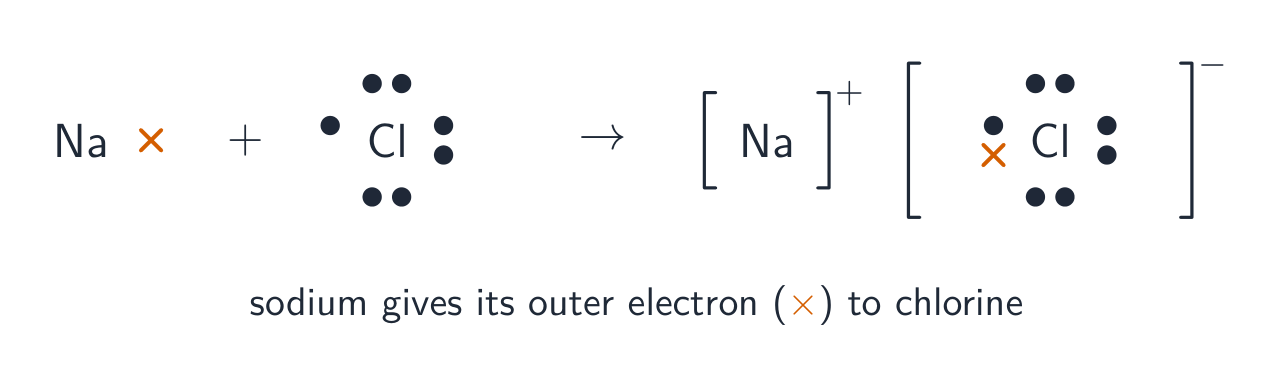
    • Ionic bond 离子键: electrons transfer from a metal to a nonmetal (large electronegativity difference).
    • Covalent bond 共价键: nonmetals share electrons (small difference). A big-but-not-huge difference gives a polar covalent 极性共价 bond.
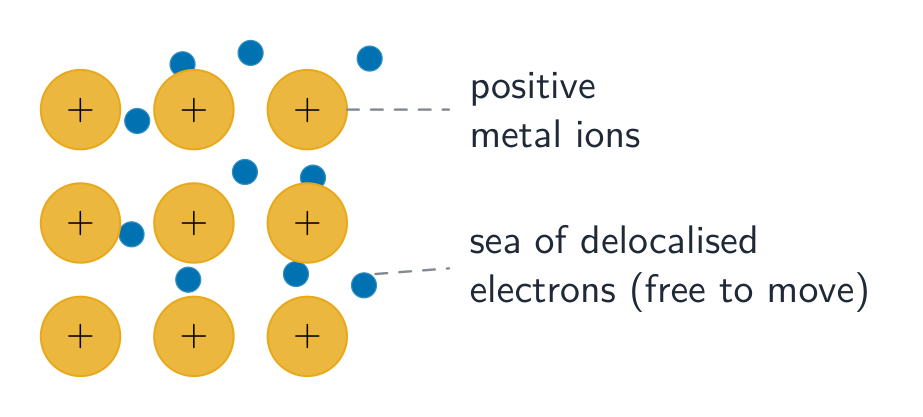
    • Metallic bond 金属键: metal atoms share a "sea" of mobile electrons.
    العربية
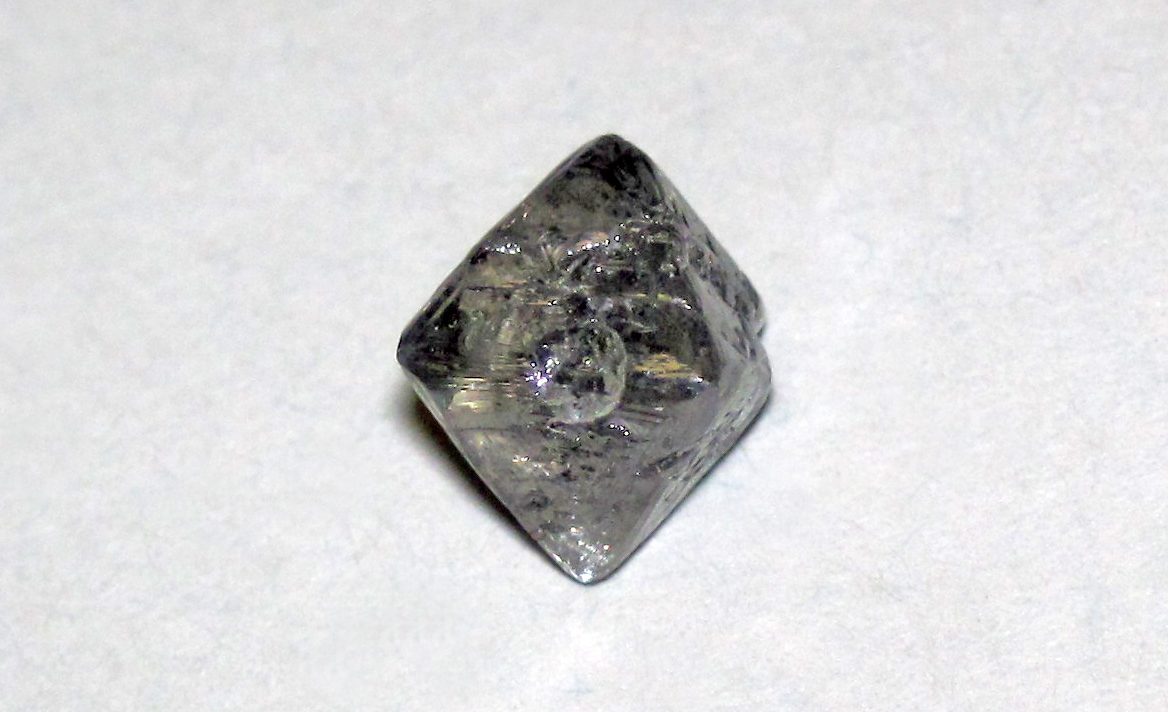
    بلورات كلوريد الصوديوم: تتشكل المواد الصلبة الأيونية شبكة بلورية من الأيونات ذات الشحنات المتضادة
    بلورات كلوريد الصوديوم: تتشكل المواد الصلبة الأيونية شبكة بلورية من الأيونات ذات الشحنات المتضادة

    الرابط الكيميائي هو قوة جذب تمسك الذرات معاً. نوع الرابطة الذي يتشكل يعتمد على سالبية كهربية الذرات:

    الرابطة الأيونية: تنقل ذرة فلزية إلكتروناتها الخارجية إلى لا فلز
    الرابطة الأيونية: تنقل ذرة فلزية إلكتروناتها الخارجية إلى لا فلز
    • الرابطة الأيونية: تنتقل الإلكترونات من فلز إلى لا فلز (اختلاف كبير في السالبية الكهربية).
    • الرابطة التساهمية: تتشارك اللافلزات الإلكترونات (اختلاف صغير). يعطي الاختلاف الكبير ولكن ليس الهائل رابطة تساهمية قطبية.
    • الرابطة الفلزية: تتشارك ذرات الفلز "بحراً" من الإلكترونات الحرة الحركة.
    بلورة ألماس: شبكات تساهمية عملاقة تفسر الصلابة القصوى ونقاط الانصهار العالية
    بلورة ألماس: شبكات تساهمية عملاقة تفسر الصلابة القصوى ونقاط الانصهار العالية
    Explore · ⁨استكشف⁩

    Form an ionic bond by electron transfer · ⁨تكوين رابطة أيونية عن طريق نقل الإلكترونات⁩

    An ionic bond forms when a metal gives electrons to a non-metal, making oppositely charged ions that attract; a covalent bond shares electrons instead. · ⁨تتكون الرابطة الأيونية عندما يعطي معدن إلكترونات لفلز لا فلزي، مكونًا أيونات متعاكسة الشحنة تنجذب؛ بينما الرابطة التساهمية تشارك الإلكترونات بدلاً من ذلك.⁩

    2.2

    Intramolecular Force and Potential Energy · ⁨القوى داخل الجزيئ والطاقة الكامنة⁩

    Syllabus · ⁨المنهج⁩
    English

    Learning Objective 2.2.A: Represent the relationship between potential energy and distance between atoms, based on factors that influence the interaction strength.

    • 2.2.A.1 A graph of potential energy versus the distance between atoms (internuclear distance) is a useful representation for describing the interactions between atoms. Such graphs illustrate both the equilibrium bond length (the separation between atoms at which the potential energy is lowest) and the bond energy (the energy required to separate the atoms).
    • 2.2.A.2 In a covalent bond, the bond length is influenced by both the size of the atom's core and the bond order (i.e., single, double, triple). Bonds with a higher order are shorter and have larger bond energies.
    • 2.2.A.3 Coulomb's law can be used to understand the strength of interactions between cations and anions.
      • i. Because the interaction strength is proportional to the charge on each ion, larger charges lead to stronger interactions.
      • ii. Because the interaction strength increases as the distance between the centers of the ions (nuclei) decreases, smaller ions lead to stronger interactions.
    العربية

    الهدف التعليمي 2.2.A: تمثيل العلاقة بين الطاقة الكامنة والمسافة بين الذرات، بناءً على العوامل المؤثرة في قوة التفاعل.

    • 2.2.A.1 يعد رسم بياني للطاقة الكامنة مقابل المسافة بين الذرات (المسافة النووية الداخلية) تمثيلاً مفيداً لوصف التفاعلات بين الذرات. توضح مثل هذه الرسوم البيانية طول الرابطة المتوازن (الفصل بين الذرات الذي تكون عنده الطاقة الكامنة أدنى) وطاقة الرابطة (الطاقة اللازمة لفصل الذرات).
    • 2.2.A.2 في الرابطة التساهمية، يتأثر طول الرابطة بحجم نواة الذرة ورتبة الرابطة (أي أحادية، مزدوجة، ثلاثية). الروابط ذات الرتبة الأعلى تكون أقصر ولها طاقات رابطة أكبر.
    • 2.2.A.3 يمكن استخدام قانون كولوم لفهم قوة التفاعلات بين الكاتيونات والأنيونات.
      • i. بما أن قوة التفاعل تتناسب طردياً مع شحنة كل أيون، فإن الشحنات الأكبر تؤدي إلى تفاعلات أقوى.
      • ii. بما أن قوة التفاعل تزداد كلما قلّت المسافة بين مراكز الأيونات (الأنوية)، فإن الأيونات الأصغر تؤدي إلى تفاعلات أقوى.

    Source: College Board AP Course and Exam Description · ⁨المصدر: وصف دورة وامتحان College Board AP⁩

    English

    As two atoms approach, a potential energy 势能 curve captures the balance of attraction and repulsion. It dips to a minimum at the bond length 键长 (the stable separation) whose depth is the bond energy 键能. Shorter, stronger bonds sit in deeper, tighter wells; more shared pairs (double, triple bonds) give shorter, stronger bonds.

    العربية

    عند اقترب ذرتان، تلتقط منحنى الطاقة الكامنة توازن التجاذب والتنافر. ينخفض المنحنى لقيمة دنيا عند طول الرابطة (المسافة المستقرة)، وعمق هذا الانخفاض هو طاقة الرابطة. الروابط الأقصر والأقوى تقع في آبار أعمق وأكثر إحكاماً؛ وعدد أكبر من الأزواج المشتركة (روابط ثنائية وثلاثية) ينتج روابط أقصر وأقوى.

    2.3

    Structure of Ionic Solids · ⁨بنية المواد الصلبة الأيونية⁩

    Syllabus · ⁨المنهج⁩
    English

    Learning Objective 2.3.A: Represent an ionic solid with a particulate model that is consistent with Coulomb's law and the properties of the constituent ions.

    • 2.3.A.1 The cations and anions in an ionic crystal are arranged in a systematic, periodic 3-D array that maximizes the attractive forces among cations and anions while minimizing the repulsive forces.
      • Exclusion statement: Knowledge of specific crystal structures is not essential to an understanding of the learning objective and will not be assessed on the AP Exam.
    العربية

    الهدف التعليمي 2.3.A: تمثيل المادة الصلبة الأيونية بنموذج جسيمات يتوافق مع قانون كولوم وخصائص الأيونات المكونة.

    • 2.3.A.1 تتكون الكاتيونات والأنيونات في البلورة الأيونية من مصفوفة منتظمة ودورية 3-D تعظم القوى الجاذبة بين الكاتيونات والأنيون وتقلل القوى الدافعة.
      • عبارة الاستبعاد: معرفة الهياكل البلورية المحددة ليست ضرورية لفهم الهدف التعليمي ولن يتم تقييمها في امتحان AP.

    Source: College Board AP Course and Exam Description · ⁨المصدر: وصف دورة وامتحان College Board AP⁩

    English

    An ionic solid 离子固体 is a repeating 3-D lattice 晶格 of alternating cations and anions, held by strong electrostatic attraction. This explains their high melting points, brittleness, and why they conduct only when molten or dissolved (ions freed to move). The lattice energy rises with larger ion charges and smaller ions, so MgO (both $2+/2-$) melts far higher than NaCl (both $1+/1-$).

    العربية

    الصلب الأيوني هو شبكة 3-D بلورية متكررة من الكاتيونات والأنيونات المتناوبة، ترتبط بجذب كهروستاتيكي قوي. وهذا يفسر نقاط انصهارها العالية، وهششتها، ولماذا توصل الكهرباء فقط عند انصهارها أو ذوبانها (تحرر الأيونات للحركة). تزداد طاقة الشبكة بزيادة شحنة الأيونات وصغرها، لذا فإن MgO (كلاهما $2+/2-$) ينصهر عند درجة حرارة أعلى بكثير من NaCl (كلاهما $1+/1-$).

    تترتب الأيونات في شبكة بلورية عملاقة من الأيونات الموجبة والسالبة المتناوبة
    تترتب الأيونات في شبكة بلورية عملاقة من الأيونات الموجبة والسالبة المتناوبة
    Vocabulary · ⁨مفردات⁩ Train · ⁨تدريب⁩
    English العربية
    lattice/ˈlætɪs/ شبكة
    delocalized/dɪˈlɒkəlaɪzd/ غير موضوعة
    2.4

    Structure of Metals and Alloys · ⁨بنية المعادن والسبائك⁩

    Syllabus · ⁨المنهج⁩
    English

    Learning Objective 2.4.A: Represent a metallic solid and/or alloy using a model to show essential characteristics of the structure and interactions present in the substance.

    • 2.4.A.1 Metallic bonding can be represented as an array of positive metal ions surrounded by delocalized valence electrons (i.e., a "sea of electrons").
    • 2.4.A.2 Interstitial alloys form between atoms of significantly different radii, where the smaller atoms fill the interstitial spaces between the larger atoms (e.g., with steel in which carbon occupies the interstices in iron).
    • 2.4.A.3 Substitutional alloys form between atoms of comparable radius, where one atom substitutes for the other in the lattice. (e.g., in certain brass alloys, other elements, usually zinc, substitute for copper.)
    العربية

    الهدف التعليمي 2.4.A: تمثيل المادة الصلبة المعدنية و/أو السبيكة باستخدام نموذج يوضح الخصائص الأساسية للبنية والتفاعلات الموجودة في المادة.

    • 2.4.A.1 يمكن تمثيل الرابطة المعدنية كمصفوفة من أيونات الفلز الموجوبة محاطة بإلكترونات تكافؤ موزعة عدم توطين (أي "بحر من الإلكترونات").
    • 2.4.A.2 تتشكل السبائك الفراغية بين ذرات ذات نصف قطر مختلف بشكل ملحوظ، حيث تملأ الذرات الأصغر الفراغات البينية بين الذرات الأكبر (مثل الصلب حيث يشغل الكربون الفراغات البينية في الحديد).
    • 2.4.A.3 تتشكل السبائك البديلة بين ذرات ذات نصف قطر مقارب، حيث تحل ذرة محل الأخرى في الشبكة البلورية. (مثل بعض سبائك النحاس الأصفر، حيث تحل عناصر أخرى، عادة الزنك، محل النحاس).

    Source: College Board AP Course and Exam Description · ⁨المصدر: وصف دورة وامتحان College Board AP⁩

    English

    In a metal, cations sit in a lattice bathed in delocalized 离域 electrons, which explains conductivity, malleability, and luster. An alloy 合金 mixes metals: a substitutional alloy swaps in similar-sized atoms; an interstitial alloy (like steel) fits small atoms into the gaps, making it harder.

    العربية

    في الفلز، تقعد الكاتيونات في شبكة محاطة بـإلكترونات غير محلية، مما يفسر التوصيل الكهربائي والمطيلية واللمعان. السبيكة خلط للمعادن: السبيكة البديلة تستبدل ذرات بحجم مشابه؛ أما السبيكة بين الفراغيات (مثل الصلب) فتضع ذرات صغيرة في الفراغات، مما يجعلها أصلب.

    ذرات مختلفة الأحجام في السبائك تمنع انزلاق الطبقات، مما يجعلها أكثر صلابة
    ذرات بأحجام مختلفة في السبيكة تمنع الطبقات من الانزلاق، مما يجعلها أصلب
    الرابطة الفلزية: أيونات موجبة في بحر من الإلكترونات اللامركزية
    الرابطة الفلزية: أيونات موجبة في بحر من الإلكترونات اللامركزية
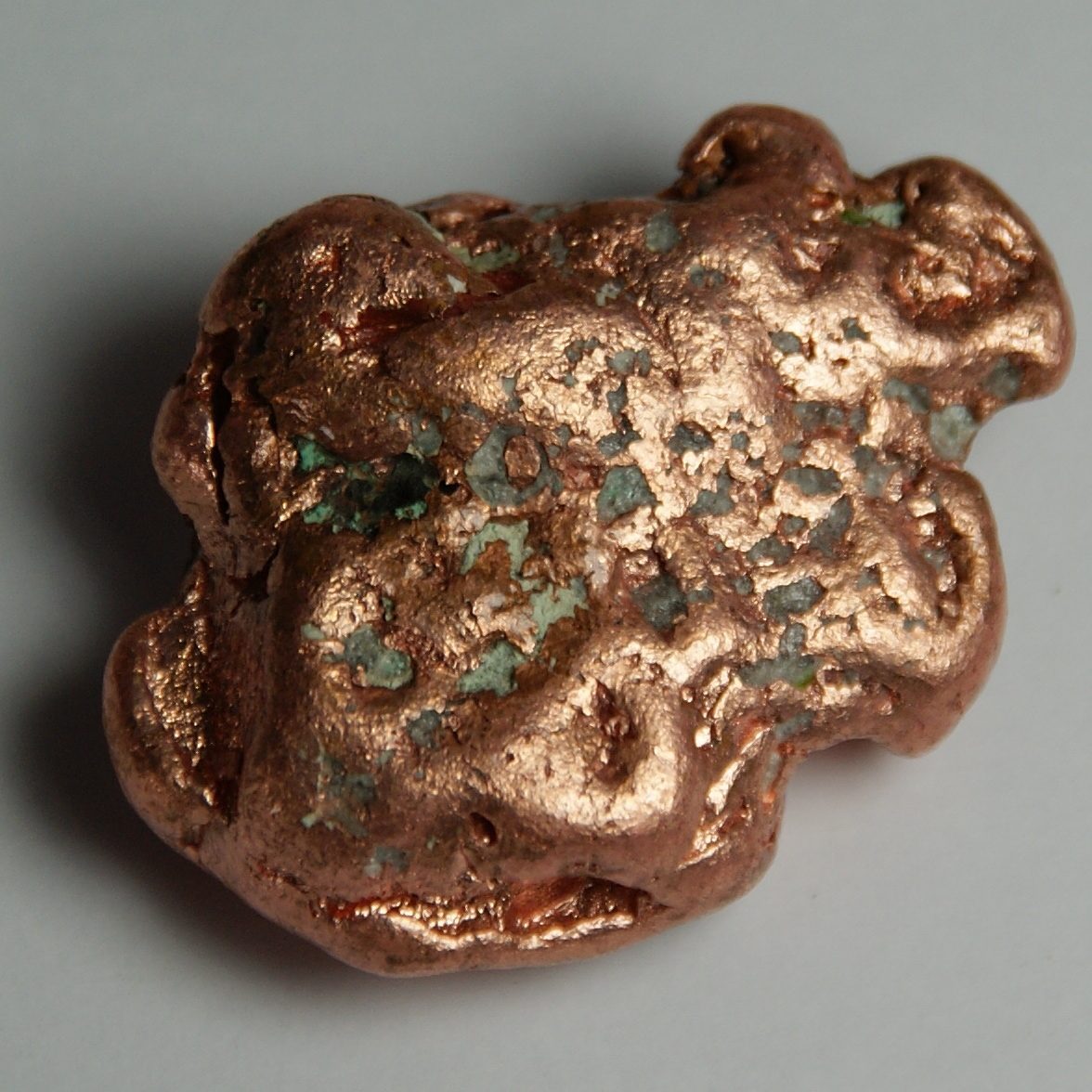
    النحاس الطبيعي: الرابطة الفلزية تعطي صلباً لامعاً ومطليلاً مع إلكترونات غير محلية
    النحاس الطبيعي: الرابطة الفلزية تعطي صلباً لامعاً ومطليلاً مع إلكترونات غير محلية
    Explore · ⁨استكشف⁩

    Slide layers in a metallic lattice · ⁨اسحب الطبقات في الشبكة البلورية المعدنية⁩

    A metal is positive ions in a sea of delocalised electrons. The layers can slide without breaking the bond, so metals are malleable and conduct. · ⁨المعدن عبارة عن أيونات موجبة في بحر من الإلكترونات غير الموضحة. يمكن للطبقات الانزلاق دون كسر الرابطة، لذا المعادن مطيعة وموصلة للكهرباء.⁩

    Vocabulary · ⁨مفردات⁩ Train · ⁨تدريب⁩
    English العربية
    chemical bond/ˈkemɪkl bɒnd/ رابطة كيميائية
    Ionic bond/aɪˈɒnɪk bɒnd/ رابطة أيونية
    Covalent bond/ˈkəʊvələnt bɒnd/ رابطة تساهمية
    polar covalent/ˈpəʊlə ˈkəʊvələnt/ تساهمية قطبية
    Metallic bond/məˈtælɪk bɒnd/ رابطة معدنية
    potential energy/pəˈtenʃl ˈenədʒi/ الطاقة الكامنة
    bond length/bɒnd leŋθ/ طول الرابطة
    bond energy/bɒnd ˈenədʒi/ طاقة الرابطة
    ionic solid/aɪˈɒnɪk ˈsɒlɪd/ صلب أيوني
    alloy/ˈælɔɪ/ السبائك
    Lewis diagram/ˈluːɪs ˈdaɪəɡræm/ مخطط لويس
    lone pairs/ləʊn peəz/ أزواج الإلكترونات الوحيدة
    octet/ɒkˈtet/ ثماني إلكتروني
    resonance/ˈrezənəns/ الرنين
    Formal charge/ˈfɔːml tʃɑːdʒ/ الشكلية الشحنة
    2.5

    Lewis Diagrams · ⁨مخططات لويس⁩

    Syllabus · ⁨المنهج⁩
    English

    Learning Objective 2.5.A: Represent a molecule with a Lewis diagram.

    • 2.5.A.1 Lewis diagrams can be constructed according to an established set of principles.
    العربية

    هدف التعلم 2.5.A: تمثيل جزيء بمخطط لويس.

    • 2.5.A.1 يمكن بناء مخططات لويس وفقاً لمجموعة من المبادئ الراسخة.

    Source: College Board AP Course and Exam Description · ⁨المصدر: وصف دورة وامتحان College Board AP⁩

    English

    A Lewis diagram 路易斯结构 shows valence electrons as bonding pairs and lone pairs 孤对电子, giving most atoms an octet 八隅体 (8 valence electrons; H wants 2). Steps: count total valence electrons, connect atoms with single bonds, complete octets on outer atoms, then form multiple bonds if the central atom is short.

    Worked example. Draw carbon dioxide, $\text{CO}_2$. Total valence electrons $=4+2(6)=16$. Put C in the centre; single bonds to each O use $4$ electrons and leave the outer O atoms short. Completing octets forces two double bonds, $\text{O}=\text{C}=\text{O}$: each O then has two lone pairs, C has none, and all $16$ electrons are placed with every atom at an octet.
    العربية

    مخطط لويس يُظهر إلكترونات التكافؤ كأزواج رابطة وأزواج وحيدة، مما يمنح معظم الذرات ثمانيات (8 إلكترونات تكافؤ؛ الهيدروجين يحتاج 2). الخطوات: احسب مجموع إلكترونات التكافؤ، وصل الذرات بروابط فردية، أكمل الثمانيات للذرات الخارجية، ثم كوّن روابط متعددة إذا كان الذرة المركزية ناقصة.

    تُظهر المخططات النقطية والصليبية الأزواج الرابطة والأزواج الوحيدة في الجزيء
    تُظهر المخططات النقطية والصليبية الأزواج الرابطة والأزواج الوحيدة في الجزيء

    مثال محلل. ارسم ثاني أكسيد الكربون، $\text{CO}_2$. إجمالي إلكترونات التكافؤ $=4+2(6)=16$. ضع C في الوسط؛ الروابط الفردية لكل O تستهلك $4$ إلكترونات وتترك ذرات O الخارجية ناقصة. إكمال الثمانيات يجبر تكوين رابطتين ثنائيتين، $\text{O}=\text{C}=\text{O}$: عندها يكون لكل O زوجان وحيدان، وC ليس لديه أزواج وحيدة، وتم وضع جميع $16$ إلكترونات بحيث تمتلك كل ذرة ثمانية.

    2.6

    Resonance and Formal Charge · ⁨الرنانة والشحنة الرسمية⁩

    Syllabus · ⁨المنهج⁩
    English

    Learning Objective 2.6.A: Represent a molecule with a Lewis diagram that accounts for resonance between equivalent structures or that uses formal charge to select between nonequivalent structures.

    • 2.6.A.1 In cases where more than one equivalent Lewis structure can be constructed, resonance must be included as a refinement to the Lewis structure. In many such cases, this refinement is needed to provide qualitatively accurate predictions of molecular structure and properties.
    • 2.6.A.2 The octet rule and formal charge can be used as criteria for determining which of several possible valid Lewis diagrams provides the best model for predicting molecular structure and properties.
    • 2.6.A.3 As with any model, there are limitations to the use of the Lewis structure model, particularly in cases with an odd number of valence electrons.
    العربية

    هدف التعلم 2.6.A: تمثيل جزيء بمخطط لويس يراعي الرنين بين هياكل مكافئة أو يستخدم الشحنة الرسمية لاختيار بين هياكل غير مكافئة.

    • 2.6.A.1 في الحالات التي يمكن فيها بناء أكثر من هيكل لويس مكافئ، يجب تضمين الرنين كتعديل لهيكل لويس. وفي العديد من هذه الحالات، يكون هذا التعديل ضرورياً لتقديم تنبؤات دقيقة نوعياً لبنية الجزيئات وخصائصها.
    • 2.6.A.2 يمكن استخدام قاعدة الثمانيات والشحنة الرسمية كمعايير لتحديد أي من مخططات لويس الصالحة المتعددة يقدم أفضل نموذج للتنبؤ ببنية الجزيئات وخصائصها.
    • 2.6.A.3 كما هو الحال مع أي نموذج، توجد حدود لاستخدام نموذج هيكل لويس، لا سيما في الحالات التي يحتوي فيها عدد الإلكترونات التكافئية على عدد فردي.

    Source: College Board AP Course and Exam Description · ⁨المصدر: وصف دورة وامتحان College Board AP⁩

    English

    When two or more valid Lewis diagrams differ only in electron placement, the true structure is an average – resonance 共振. Formal charge 形式电荷 (valence electrons minus lone-pair electrons minus half the bonding electrons) picks the best structure: the one with formal charges closest to zero, and any negative charge on the most electronegative atom.

    Worked example. Assign formal charges in the nitrate ion, $\text{NO}_3^{-}$ (one double bond, two single bonds). For N (4 bonds, no lone pairs): $5-0-4=+1$. For the double-bonded O (2 lone pairs): $6-4-2=0$. For each single-bonded O (3 lone pairs): $6-6-1=-1$. The total is $+1+0+(-1)+(-1)=-1$, matching the ion's overall charge – a good check that the structure is drawn correctly. Because the three O atoms are equivalent by resonance, the real ion has three identical bonds.

    العربية

    عندما differ رسمان أو أكثر من مخططات لويس الصالحة في مكان الإلكترونات فقط، فإن البنية الحقيقية هي متوسط – الرنانة. الشحنة الرسمية (إلكترونات التكافؤ ناقص إلكترونات الأزواج الوحيدة ناقص نصف الإلكترونات الرابطة) تختار أفضل بنية: تلك التي تكون فيها الشحنات الرسمية أقرب للصفر، وأن تكون أي شحنة سالبة على أكثر الذرات سالبية كهربية.

    مثال محلول. حدد الشحنات الرسمية في أيون النترات، $\text{NO}_3^{-}$ (رابطة مزدوجة واحدة، رابطتين أحادية). بالنسبة لـ N (4 روابط، لا أزواج حرة): $5-0-4=+1$. بالنسبة للـ O المزدوج الرابطة (2 أزواج حرة): $6-4-2=0$. بالنسبة لكل O أحادي الرابطة (3 أزواج حرة): $6-6-1=-1$. المجموع هو $+1+0+(-1)+(-1)=-1$، مما يطابق الشحنة الكلية لأيون – وهو اختبار جيد للتأكد من رسم البنية بشكل صحيح. وبسبب تكافؤ ذرات الأكسجين الثلاث بالرنين، فإن الأيون الحقيقي يحتوي على ثلاث روابط متماثلة.

    2.7

    VSEPR and Bond Hybridization · ⁨نظرية VSEPR والتهجين⁩

    Syllabus · ⁨المنهج⁩
    English

    Learning Objective 2.7.A: Based on the relationship between Lewis diagrams, VSEPR theory, bond orders, and bond polarities:

    • i. Explain structural properties of molecules.

    • ii. Explain electron properties of molecules.

    • 2.7.A.1 VSEPR theory uses the Coulombic repulsion between electrons as a basis for predicting the arrangement of electron pairs around a central atom.

    • 2.7.A.2 Both Lewis diagrams and VSEPR theory must be used for predicting electronic and structural properties of many covalently bonded molecules and polyatomic ions, including the following:

      • i. Molecular geometry (linear, trigonal planar, tetrahedral, trigonal pyramidal, bent, trigonal bipyramidal, seesaw, T-shaped, octahedral, square pyramidal, square planar)
      • ii. Bond angles
      • iii. Relative bond energies based on bond order
      • iv. Relative bond lengths (multiple bonds, effects of atomic radius)
      • v. Presence of a dipole moment
      • vi. Hybridization of valence orbitals for atoms within a molecule or polyatomic ion
    • 2.7.A.3 The terms "hybridization" and "hybrid atomic orbital" are used to describe the arrangement of electrons around a central atom. When the central atom is $sp$ hybridized, its ideal bond angles are $180°$; for $sp^2$ hybridized atoms the bond angles are $120°$; and for $sp^3$ hybridized atoms the bond angles are $109.5°$.

      • Exclusion statement: An understanding of the derivation and depiction of hybrid orbitals will not be assessed on the AP Exam. The course includes the distinction between sigma and pi bonding, the use of VSEPR to explain the shapes of molecules, and the $sp$, $sp^2$, and $sp^3$ nomenclature.
      • Exclusion statement: Hybridization involving d orbitals will not be assessed on the AP Exam. When an atom has more than four pairs of electrons surrounding the central atom, students are only responsible for the shape of the resulting molecule.
    • 2.7.A.4 Bond formation is associated with overlap between atomic orbitals. In multiple bonds, such overlap leads to the formation of both sigma and pi bonds. The overlap is stronger in sigma than pi bonds, which is reflected in sigma bonds having greater bond energy than pi bonds. The presence of a pi bond also prevents the rotation of the bond and leads to geometric isomers.

      • Exclusion statement: Molecular orbital theory is recommended as a way to provide deeper insight into bonding. However, the AP Exam will neither explicitly assess molecular orbital diagrams, filling of molecular orbitals, nor the distinction between bonding, nonbonding, and antibonding orbitals.
    العربية

    هدف التعلم 2.7.A: بناءً على العلاقة بين مخططات لويس ونظرية VSEPR وترتيب الروابط وقطبية الروابط:

    • أ. شرح الخصائص الهيكلية للجزيئات.

    • ب. شرح الخصائص الإلكترونية للجزيئات.

    • 2.7.A.1 تستخدم نظرية VSEPR التنافر الكولوني بين الإلكترونات كأساس لتوقع ترتيب أزواج الإلكترونات حول الذرة المركزية.

    • 2.7.A.2 يجب استخدام كل من مخططات لويس ونظرية VSEPR للتنبؤ بالخصائص الإلكترونية والهيكلية للعديد من الجزيئات ذات الروابط التساهمية والأيونات متعددة الذرات، بما في ذلك ما يلي:

      • أ. الهندسة الجزيئية (خطية، مثلثة مستوية، رباعية السطوح، مثلثة هرمية، منحنية، مثلثة ثنائية الهرم، مقعد الخيول، الشكل T، ثمانية السطوح، هرمية مربعة، مربعة مستوية)
      • ب. زوايا الروابط
      • ج. طاقات الروابط النسبية بناءً على رتبة الرابطة
      • د. أطوال الروابط النسبية (الروابط المتعددة، تأثير نصف القطر الذري)
      • هـ. وجود عزم ثنائي القطب
      • و. تهجين المدارات التكافئية للذرات داخل الجزيء أو الأيون متعدد الذرات
    • 2.7.A.3 تُستخدم مصطلحات "التهجين" و"المدار الذري المهجن" لوصف توزيع الإلكترونات حول الذرة المركزية. عندما تكون الذرة $sp$ مهجنة، فإن زوايا الروابط المثالية لها هي $180°$؛ بالنسبة للذرات $sp^2$ المهجنة تكون الزوايا $120°$؛ وبالنسبة للذرات $sp^3$ المهجنة تكون الزوايا $109.5°$.

      • عبارة الاستبعاد: لن يتم تقييم فهم اشتقاق وعرض المدارات المهجنة في امتحان AP. يتضمن المقرر التمييز بين الروابط سيجما وبي، واستخدام VSEPR لشرح أشكال الجزيئات، والمصطلحات $sp$، $sp^2$، و$sp^3$.
      • عبارة الاستبعاد: لن يتم تقييم التهجين الذي يتضمن مدارات d في امتحان AP. عندما يكون لدى الذرة أكثر من أربع أزواج من الإلكترونات تحيط بالذرة المركزية، يكون الطلاب مسؤولين فقط عن شكل الجزيء الناتج.
    • 2.7.A.4 يرتبط تكوين الرابطة بالتداخل بين المدارات الذرية. في الروابط المتعددة، يؤدي هذا التداخل إلى تكوين روابط سيجما وبي معاً. يكون التداخل أقوى في روابط سيجما مقارنة بروابط بي، مما ينعكس في أن روابط سيجما تمتلك طاقة رابطة أعلى من روابط بي. يؤدي وجود رابطة بي أيضاً إلى منع دوران الرابطة ويؤدي إلى وجود متصاوغات هندسية.

      • عبارة الاستبعاد: يُوصى بنظرية المدارات الجزيلية كطريقة لتقديم رؤى أعمق في الروابط. ومع ذلك، لن يقيّم امتحان AP صراحةً مخططات المدارات الجزيئية، وملء المدارات الجزيئية، أو التمييز بين المدارات الرابطة وغير الرابطة ومضادة للروابط.

    Source: College Board AP Course and Exam Description · ⁨المصدر: وصف دورة وامتحان College Board AP⁩

    English
    VSEPR: molecular shapes

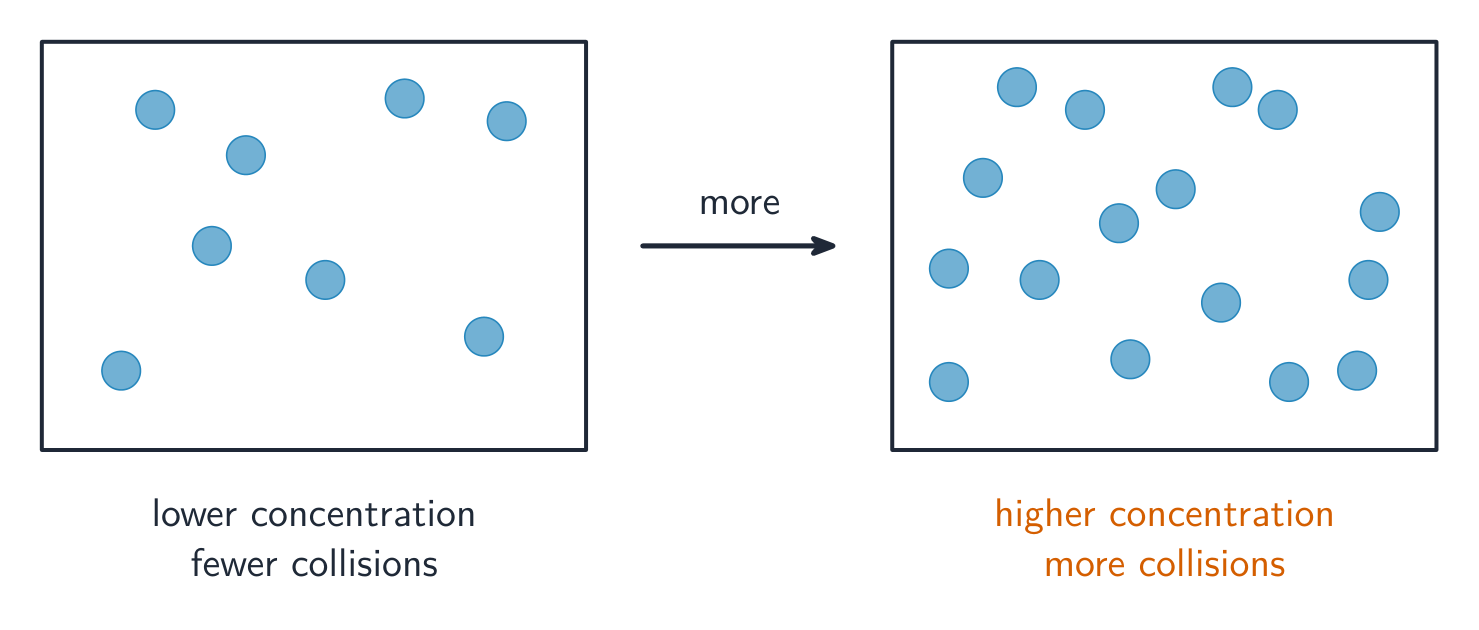
    VSEPR 价层电子对互斥 theory predicts shape: electron pairs (bonds and lone pairs) around a central atom spread out as far apart as possible. Counting electron domains gives the geometry (linear, trigonal planar, tetrahedral, …); lone pairs push bonds closer, bending the shape. Hybridization 杂化 ($sp$, $sp^2$, $sp^3$) describes the mixed orbitals matching that geometry. Molecular shape and bond polarity together decide whether the whole molecule is polar.

    Worked example. Predict the shape of ammonia, $\text{NH}_3$. Nitrogen has $3$ bonding pairs and $1$ lone pair – four electron domains, so the electron geometry is tetrahedral and the hybridization is $sp^3$. The lone pair is invisible in the shape but still pushes the bonds together, so the molecular shape is trigonal pyramidal with a bond angle of about $107^{\circ}$ (a little less than the ideal $109.5^{\circ}$). The three N–H dipoles do not cancel, so the molecule is polar.

    Bonds form when atomic orbitals overlap. Every single bond is one sigma bond σ键 – orbitals overlapping head-on along the line joining the two atoms. A multiple bond adds a pi bond π键, made by $p$ orbitals overlapping sideways above and below that line: a double bond is one sigma + one pi, a triple bond one sigma + two pi. Head-on overlap is more effective, so a sigma bond is stronger (higher bond energy) than a pi bond – which is why a double bond is stronger than a single bond but not twice as strong. A pi bond also locks the two atoms so they cannot rotate about the bond; a C=C double bond therefore has fixed cis and trans forms – geometric isomers 几何异构体 that a freely-rotating single bond could never show.

    Worked example. Count the bonds in ethene, $\text{H}_2\text{C}=\text{CH}_2$. The four C–H bonds are single bonds (one sigma each); the C=C is one sigma plus one pi. So ethene has 5 sigma and 1 pi bond, and that single pi bond is exactly what stops the two $\text{CH}_2$ ends from twisting relative to each other.

    العربية
    VSEPR: الأشكال الجزيئية

    تتنبأ نظرية VSEPR بالشكل: حيث تتباعد أزواج الإلكترونات (الروابط والأزواج الحرة) حول الذرة المركزية لأبعد مسافة ممكنة. يعطي حساب مجالات الإلكترونات الهندسة (خطية، مثلثة مستوية، رباعية السطوح، ...)؛ وتدفيع الأزواج الحرة للروابط يجعلها أقرب، مما يشوه الشكل. يصف التهجين ($sp$، $sp^2$، $sp^3$) المدارات المختلطة التي تطابق تلك الهندسة. تحدد الشكل الجزيئي وقطب الروابط معاً ما إذا كانت الجزيء بأكمله قطبي أم لا.

    التهجين والشكل: tetrahedral sp3، planar sp2، linear sp
    التهجين والشكل: tetrahedral sp3، planar sp2، linear sp
    الأشكال الشائعة لنظرية VSEPR وزوايا الروابط لها
    الأشكال الشائعة لنظرية VSEPR وزوايا الروابط لها

    مثال محلول. تنبأ بشكل الأمونيا، $\text{NH}_3$. يحتوي النيتروجين على $3$ أزواج رابطة و$1$ زوج حر – أربعة مجالات إلكترونية، لذا فإن الهندسة الإلكترونية رباعية السطوح والتهجين هو $sp^3$. الزوج الحر غير مرئي في الشكل لكن لا يزال يدفع الروابط نحو بعضها البعض، لذا فإن الشكل الجزيئي مثلثي هرمي بزوايا رابطة تبلغ حوالي $107^{\circ}$ (أقل قليلاً من الزاوية المثالية $109.5^{\circ}$). أقطاب R–H الثلاثة لا تلغي بعضها البعض، لذا يكون الجزيء قطبيًا.

    تتكون الروابط عندما تتداخل المدارات الذرية. كل رابطة أحادية هي رابطة سيجما σ – مدارات تتداخل رأساً برأس على طول الخط الواصل بين الذرتين. تضيف الرابطة المتعددة رابطة باي π، وهي ناتجة عن مدارات $p$ تتداخل جانبياً فوق وتحت ذلك الخط: الرابطة المزدوجة هي سيجما واحدة + باي واحد، والرابطة الثلاثية سيجما واحدة + باي اثنين. التداخل الرأسي أكثر فعالية، لذا فإن رابطة سيجما أقوى (طاقة رابطة أعلى) من رابطة باي – ولهذا السبب تكون الرابطة المزدقة أقوى من الرابطة الأحادية لكنها ليست ضعف قوتها. كما أن رابطة باي تُثبت الذرتين بحيث لا يمكنهما الدوران حول الرابطة؛ لذلك تمتلك الرابطة C=C المزدوجة أشكال cis و trans ثابتة – وهي متصاوغات هندسية لا يمكن أن تُظهرها رابطة أحادية تدور بحرية.

    مثال محلول. عدد الروابط في الإيثيلين، $\text{H}_2\text{C}=\text{CH}_2$. الروابط الأربعة C–H هي روابط أحادية (سايجما واحدة لكل منها)؛ بينما R=C رابطة سايجما واحدة بالإضافة إلى رابطة باي واحدة. لذا يحتوي الإيثيلين على 5 رابطة سايجما و1 رابطة باي، وهذه الرابطة باي الوحيدة هي بالضبط ما يمنع طرفي $\text{CH}_2$ من الدوران بالنسبة لبعضهما البعض.

    Explore · ⁨استكشف⁩

    Predict molecular shape with VSEPR · ⁨تنبؤ بشكل الجزيئات باستخدام VSEPR⁩

    VSEPR: electron pairs repel and spread as far apart as possible, setting the molecule's shape. Add bonding and lone pairs and watch the geometry change. · ⁨VSEPR: أزواج الإلكترونات تتنافر وتتباعد قدر الإمكان، مما يحدد شكل الجزيء. أضف أزواج الارتباط والأزواج الحرة وراقب تغير الهندسة.⁩

    Vocabulary · ⁨مفردات⁩ Train · ⁨تدريب⁩
    English العربية
    VSEPR/ˈvespə/ VSEPR
    Hybridization/ˌhaɪbrɪdaɪˈzeɪʃn/ الهجينة
    sigma bond/ˈsɪɡmə bɒnd/ رابطة سيجما
    pi bond/paɪ bɒnd/ رابطة باي
    geometric isomers/ˌdʒiːəʊˈmetrɪk ˈaɪsəməz/ النظائر الهندسية
    2.7

    Exam tips · ⁨نصائح للامتحان⁩

    English
    • Decide the bond type from the atoms: ionic (metal + non-metal, electron transfer), covalent (non-metals, sharing), metallic (sea of delocalised electrons).
    • An ionic solid conducts only when molten or dissolved (ions free to move), never as a solid.
    • Draw Lewis structures to satisfy the octet (H wants 2), then use VSEPR — electron pairs spread as far apart as possible — to predict the shape.
    • Lone pairs take up space and push bonds closer, bending the shape (water is bent, ammonia pyramidal).
    • A molecule can have polar bonds yet be non-polar overall if its symmetry makes the dipoles cancel ($\text{CO}_2$).
    • A single bond is 1 sigma bond; a double bond is 1 sigma + 1 pi, a triple bond 1 sigma + 2 pi. Sigma is stronger than pi, and a pi bond blocks rotation, giving cis/trans geometric isomers.
    العربية
    • حدد نوع الرابطة بناءً على الذرات: أيونية (فلز + غير فلز، نقل إلكترون)، تساهمية (غير فلزات، مشاركة)، فلزية (بحر من الإلكترونات غير المحلية).
    • المادة الصلبة الأيونية توصل الكهرباء فقط عندما تكون مذابة أو منصهرة (أيونات حرة الحركة)، ولا توصل كصلبة.
    • ارسم هياكل لويس لتلبية قاعدة الثمانية (H يحتاج 2)، ثم استخدم VSEPR – حيث تتباعد أزواج الإلكترون لأبعد مسافة ممكنة – للتنبؤ بالشكل.
    • تأخذ الأزواج الحرة حيزاً وتدفع الروابط closer، مما يشوه الشكل (الماء منحني، والأمونيا هرمية).
    • قد يكون للجزيء روابط قطبية ولكنه غير قطبي كلياً إذا جعل تناظره الأقطاب تلغي بعضها ($\text{CO}_2$).
    • الرابطة الأحادية هي 1 سيجما؛ الرابطة المزدوجة هي سيجما 1 + باي 1، والرابطة الثلاثية سيجما 1 + باي 2. سيجما أقوى من باي، وتعمل رابطة باي كحاجز للدوران، مما يؤدي إلى ظهور متصاوغات هندسية cis/trans.
  • 3

    Properties of Substances and Mixtures · ⁨خصائص المواد والمخلوطات⁩

    Watch lesson · ⁨شاهد الدرس⁩
    3.1

    Intermolecular and Interparticle Forces

    Syllabus · ⁨المنهج⁩
    English

    Learning Objective 3.1.A: Explain the relationship between the chemical structures of molecules and the relative strength of their intermolecular forces when: i. The molecules are of the same chemical species. ii. The molecules are of two different chemical species.

    • 3.1.A.1 London dispersion forces are a result of the Coulombic interactions between temporary, fluctuating dipoles. London dispersion forces are often the strongest net intermolecular force between large molecules.
      • i. Dispersion forces increase with increasing contact area between molecules and with increasing polarizability of the molecules.
      • ii. The polarizability of a molecule increases with an increasing number of electrons in the molecule and the size of the electron cloud. It is enhanced by the presence of pi bonding.
      • iii. The term "London dispersion forces" should not be used synonymously with the term "van der Waals forces."
    • 3.1.A.2 The dipole moment of a polar molecule leads to additional interactions with other chemical species.
      • i. Dipole-induced dipole interactions are present between a polar and nonpolar molecule. These forces are always attractive. The strength of these forces increases with the magnitude of the dipole of the polar molecule and with the polarizability of the nonpolar molecule.
      • ii. Dipole-dipole interactions are present between polar molecules. The interaction strength depends on the magnitudes of the dipoles and their relative orientation. Interactions between polar molecules are typically greater than those between nonpolar molecules of comparable size because these interactions act in addition to London dispersion forces.
      • iii. Ion-dipole forces of attraction are present between ions and polar molecules. These tend to be stronger than dipole-dipole forces.
    • 3.1.A.3 The relative strength and orientation dependence of dipole-dipole and ion-dipole forces can be understood qualitatively by considering the sign of the partial charges responsible for the molecular dipole moment, and how these partial charges interact with an ion or with an adjacent dipole.
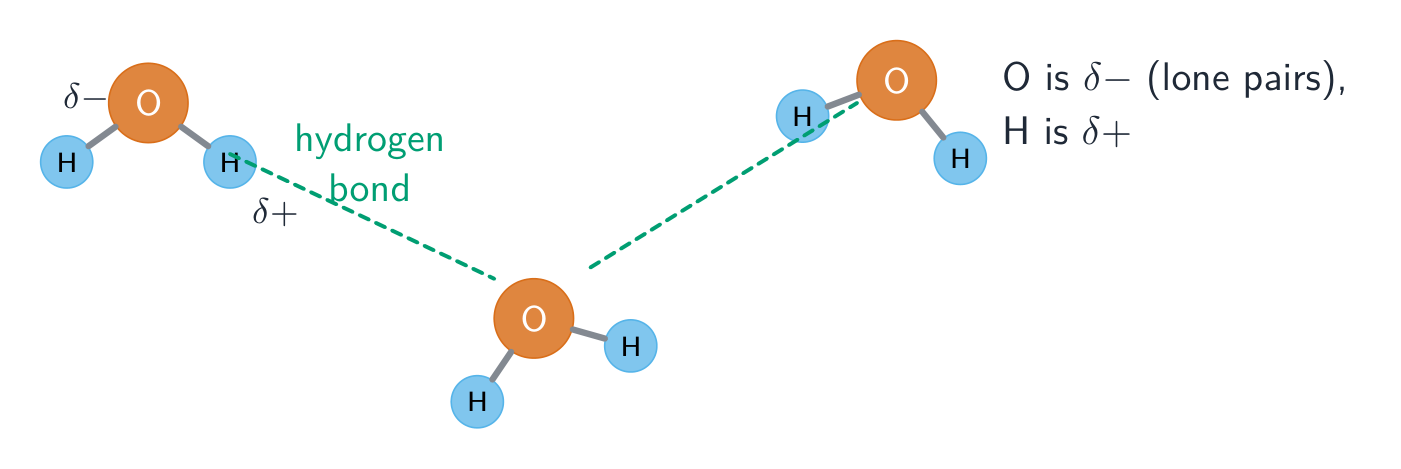
    • 3.1.A.4 Hydrogen bonding is a strong type of intermolecular interaction that exists when hydrogen atoms covalently bonded to the highly electronegative atoms (N, O, and F) are attracted to the negative end of a dipole formed by the electronegative atom (N, O, and F) in a different molecule, or a different part of the same molecule.
    • 3.1.A.5 In large biomolecules, noncovalent interactions may occur between different molecules or between different regions of the same large biomolecule.
    العربية

    هدف التعلم 3.1.A: شرح العلاقة بين الهياكل الكيميائية للجزيئات والقوة النسبية لقوىها بين الجزيئية عندما: أ. تكون الجزيئات من نفس النوع الكيميائي. ب. تكون الجزيئات من نوعين مختلفين من الأنواع الكيميائية.

    • 3.1.A.1 قوى تشتت لندن هي نتيجة تفاعلات كولونية بين ثنائيات الأقطاب المؤقتة والمتقلبة. غالباً ما تكون قوى تشتت لندن أقوى قوة بين جزيئية صافية بين الجزيئات الكبيرة.
      • أ. تزداد قوى التشتت مع زيادة مساحة التلامس بين الجزيئات ومع زيادة قابلية استقطاب الجزيئات.
      • ب. تزداد قابلية استقطاب الجزيء مع زيادة عدد الإلكترونات فيه وحجم سحابة الإلكترونات. وتتعزز بسبب وجود الروابط البي.
      • ج. لا ينبغي استخدام مصطلح "قوى تشتت لندن" مرادفاً لمصطلح "قوات فان دير فالس".
    • 3.1.A.2 يؤدي العزم الثنائي القطب للجزيء القطبي إلى تفاعلات إضافية مع أنواع كيميائية أخرى.
      • أ. تفاعلات ثنائي القطب المحفز بثنائي القطب موجودة بين الجزيء القطبي والجزيء غير القطبي. هذه القوى دائماً تجاذبية. تزداد قوة هذه القوى مع مقدار ثنائي القطب للجزيء القطبي ومع قابلية استقطاب الجزيء غير القطبي.
      • ب. تفاعلات ثنائي القطب-ثنائي القطب موجودة بين الجزيئات القطبية. تعتمد قوة التفاعل على مقداري ثنائيات الأقطاب وتوجههما النسبي. عادة ما تكون التفاعلات بين الجزيئات القطبية أكبر من تلك بين الجزيئات غير القطبية ذات الحجم المقارب لأن هذه التفاعلات تعمل بالإضافة إلى قوى تشتت لندن.
      • ج. قوى التجاذب بين الأيون وثنائي القطب موجودة بين الأيونات والجزيئات القطبية. تميل هذه القوى إلى أن تكون أقوى من قوى ثنائي القطب-ثنائي القطب.
    • 3.1.A.3 يمكن فهم القوة النسبية واعتماد اتجاه قوى ثنائي القطب-ثنائي القطب وثابت الثابت-ثنائي القطب بشكل نوعي من خلال النظر في إشارة الشحنات الجزئية المسؤولة عن عزم ثنائي القطب الجزيئي، وكيفية تفاعل هذه الشحنات الجزئية مع أيون أو مع ثنائي قطب مجاور.
    • 3.1.A.4 الرابطة الهيدروجينية هي نوع قوي من التفاعلات بين الجزيئات وتوجد عندما تنجذب ذرات الهيدروجين المرتبطة تساهمياً بالذرات شديدة الكهروسالبية (N, O, وF) إلى الطرف السالب لثنائي القطب المتكون من الذرة الكهروسالبة (N, O, وF) في جزيء مختلف، أو جزء مختلف من نفس الجزيء.
    • 3.1.A.5 في الجزيئات الحيوية الكبيرة، قد تحدث تفاعلات غير تساهمية بين جزيئات مختلفة أو بين مناطق مختلفة من نفس الجزيء الحيوي الكبير.

    Source: College Board AP Course and Exam Description · ⁨المصدر: وصف دورة وامتحان College Board AP⁩

    Intermolecular forces 分子间作用力 (IMFs) are attractions between molecules – much weaker than bonds, but they set melting/boiling points. From weakest to strongest:

    London dispersion: an instantaneous dipole induces a dipole in a neighbour
    London dispersion: an instantaneous dipole induces a dipole in a neighbour
    Hydrogen bonding: an H on N/O/F is attracted to a lone pair on another molecule
    Hydrogen bonding: an H on N/O/F is attracted to a lone pair on another molecule
    • London dispersion forces 伦敦色散力: present in all molecules; they arise from Coulombic attraction between temporary, fluctuating dipoles, and are stronger for larger, more polarizable electron clouds - often the strongest net force between large molecules.
    • Dipole–dipole 偶极-偶极: between polar molecules. Their strength depends on the size of the dipoles and their relative orientation - a $\delta+$ end lining up with a neighbour's $\delta-$ end attracts, so these act in addition to dispersion and make polar molecules stickier than nonpolar ones of similar size.
    • Hydrogen bonding 氢键: a strong dipole force when H is bonded to N, O, or F.
    • Ion–dipole 离子-偶极: between an ion and a polar molecule (the ion pulls on the oppositely-charged end of the dipole). These are the strongest of the four here (stronger even than hydrogen bonds), and are exactly what lets water dissolve an ionic solid - each $\text{Na}^+$ is surrounded by the $\delta-$ oxygen ends of water molecules.

    The whole ladder is understood qualitatively by looking at the sign of the partial charges: a larger or better-aligned partial charge, or a full ionic charge, gives a stronger attraction. Stronger IMFs mean higher boiling points and lower vapor pressure. This is why water ($18\ \text{g/mol}$, hydrogen-bonded) boils at $100\,{}^{\circ}\text{C}$ while methane ($16\ \text{g/mol}$, dispersion only) boils at $-162\,{}^{\circ}\text{C}$.

    Vocabulary · ⁨مفردات⁩ Train · ⁨تدريب⁩
    English العربية
    Intermolecular forces/ˌɪntəməˈlekjʊlə ˈfɔːsɪz/ قوى بين الجزيئات
    London dispersion forces/ˈlʌndn dɪˈspɜːʃn ˈfɔːsɪz/ قوى لندن للتشتت
    Dipole–dipole/ˈdaɪpəʊl ˈdaɪpəʊl/ ثنائي القطب–ثنائي القطب
    Ion–dipole/ˈaɪɒn ˈdaɪpəʊl/ أيون–ثنائي القطب
    Hydrogen bonding/ˈhaɪdrədʒn ˈbɒndɪŋ/ الرابطة الهيدروجينية
    3.2

    Properties of Solids

    Syllabus · ⁨المنهج⁩
    English

    Learning Objective 3.2.A: Explain the relationship among the macroscopic properties of a substance, the particulate-level structure of the substance, and the interactions between these particles.

    • 3.2.A.1 Many properties of liquids and solids are determined by the strengths and types of intermolecular forces present. Because intermolecular interactions are overcome completely when a substance vaporizes, the vapor pressure and boiling point are directly related to the strength of those interactions. Melting points also tend to correlate with interaction strength, but because the interactions are only rearranged, in melting, the relations can be more subtle.
    • 3.2.A.2 Particulate-level representations, showing multiple interacting chemical species, are a useful means to communicate or understand how intermolecular interactions help to establish macroscopic properties.
    • 3.2.A.3 Due to strong interactions between ions, ionic solids tend to have low vapor pressures, high melting points, and high boiling points. They tend to be brittle due to the repulsion of like charges caused when one layer slides across another layer. They conduct electricity only when the ions are mobile, as when the ionic solid is melted (i.e., in a molten state) or dissolved in water or another solvent.
    • 3.2.A.4 In covalent network solids, the atoms are covalently bonded together into a three-dimensional network (e.g., diamond) or layers of two-dimensional networks (e.g., graphite). These are only formed from nonmetals and metalloids: elemental (e.g., diamond, graphite) or binary compounds (e.g., silicon dioxide and silicon carbide). Due to the strong covalent interactions, covalent solids have high melting points. Three-dimensional network solids are also rigid and hard, because the covalent bond angles are fixed. However, graphite is soft because adjacent layers can slide past each other relatively easily.
    • 3.2.A.5 Molecular solids are composed of distinct, individual units of covalently-bonded molecules attracted to each other through relatively weak intermolecular forces. Molecular solids generally have a low melting point because of the relatively weak intermolecular forces present between the molecules. They do not conduct electricity because their valence electrons are tightly held within the covalent bonds and the lone pairs of each constituent molecule. Molecular solids are sometimes composed of very large molecules or polymers.
    • 3.2.A.6 Metallic solids are good conductors of electricity and heat, due to the presence of free valence electrons. They also tend to be malleable and ductile, due to the ease with which the metal cores can rearrange their structure. In an interstitial alloy, interstitial atoms tend to make the lattice more rigid, decreasing malleability and ductility. Alloys typically retain a sea of mobile electrons and so remain conducting.
    • 3.2.A.7 In large biomolecules or polymers, noncovalent interactions may occur between different molecules or between different regions of the same large biomolecule. The functionality and properties of such molecules depend strongly on the shape of the molecule, which is largely dictated by noncovalent interactions.
    العربية

    هدف التعلم 3.2.A: اشرح العلاقة بين الخواص العظمية للمادة، والبنية على المستوى الجسيمي للمادة، والتفاعلات بين هذه الجسيمات.

    • 3.2.A.1 تُحدد العديد من خواص السوائل والمواد الصلبة بقوى وقوة أنواع القوى بين الجزيئات الموجودة. وبما أن التفاعلات بين الجزيئات تتغلب بالكامل عند تبخر المادة، فإن الضغط البخاري ونقطة الغليان مرتبطة ارتباطاً مباشراً بقوة تلك التفاعلات. تميل نقاط الانصهار أيضاً إلى الارتباط بقوة التفاعل، ولكن بما أن التفاعلات تعيد ترتيب نفسها فقط أثناء الانصهار، فقد تكون العلاقات أكثر دقة.
    • 3.2.A.2 تمثل representations على المستوى الجسيمي، التي تظهر عدة أنواع كيميائية متفاعلة، وسيلة مفيدة للتواصل أو لفهم كيف تساعد التفاعلات بين الجزيئات في إنشاء الخواص العظمية.
    • 3.2.A.3 بسبب التفاعلات القوية بين الأيونات، تميل المواد الصلبة الأيونية إلى أن يكون لها ضغط بخاري منخفض ونقاط انصهار وغليان عالية. تميل إلى أن تكون هشة بسبب تنافر الشحنات المتشابهة الناتجة عن انزلاق أحد الطبقات فوق طبقة أخرى. توصل الكهرباء فقط عندما تكون الأيونات متحركة، كما عندما تنصهر المادة الصلبة الأيونية (أي في الحالة المنصهرة) أو تذوب في الماء أو مذيب آخر.
    • 3.2.A.4 في المواد الصلبة الشبكية التساهمية، ترتبط الذرات تساهمياً معاً لتشكيل شبكة ثلاثية الأبعاد (مثل الألماس) أو طبقات من شبكات ثنائية الأبعاد (مثل الجرافيت). تتشكل هذه المواد فقط من اللافلزات وشبه الفلزات: عناصر (مثل الألماس، الجرافيت) أو مركبات ثنائية (مثل ثاني أكسيد السيليكون وكربيد السيليكون). بسبب التفاعلات التساهمية القوية، تمتلك المواد الصلبة التساهمية نقاط انصهار عالية. المواد الصلبة الشبكية ثلاثية الأبعاد also صلبة وصلبة، لأن زوايا الرابطة التساهمية ثابتة. ومع ذلك، الجرافيت ناعم لأن الطبقات المجاورة يمكن أن تنزلق فوق بعضها البعض بسهولة نسبية.
    • 3.2.A.5 تتكون المواد الصلبة الجزيئية من وحدات منفصلة ومميزة لجزيئات مرتبطة بروابط تساهمية، وتتنافر هذه الوحدات عن بعضها البعض عبر قوى بين جزيئية ضعيفة نسبياً. عادةً ما تكون للمواد الصلبة الجزيئية درجة انصهار منخفضة بسبب القوى البينية للجزيئية الضعيفة النسبية الموجودة بين الجزيئات. لا توصل الكهرباء لأن إلكترونات التكافؤ مرتبطة بقوة داخل الروابط التساهمية وأزواج الإلكترونات الحرة لكل جزيء مكون. أحياناً ما تتكون المواد الصلبة الجزيئية من جزيئات كبيرة جداً أو بوليمرات.
    • 3.2.A.6 تُعد المواد الصلبة المعدنية موصلات جيدة للكهرباء والحرارة، وذلك لوجود إلكترونات تكافؤ حرة. كما تميل إلى أن تكون قابلة للطرق والمطاطة، بسبب سهولة إعادة ترتيب النوى المعدنية لهيكلها. في السبائك الفاصلية، تميل الذرات الفاصلية إلى جعل الشبكة البلورية أكثر صلابة، مما يقلل من القابلية للطرق والمطاطة. تحتفظ السبائك عادةً ببحر من الإلكترونات المتحركة، لذا تظل موصلة للكهرباء.
    • 3.2.A.7 في الجزيئات الحيوية الكبيرة أو البوليمرات، قد تحدث تفاعلات غير تساهمية بين جزيئات مختلفة أو بين مناطق مختلفة من نفس الجزيء الحيوي الكبير. تعتمد وظيفة وخصائص مثل هذه الجزيئات بشكل كبير على شكل الجزيء، والذي تحدده التفاعلات غير التساهمية بشكل رئيسي.

    Source: College Board AP Course and Exam Description · ⁨المصدر: وصف دورة وامتحان College Board AP⁩

    A solid's properties reflect the particles and forces holding it: ionic, covalent-network (a 3D network like diamond, very hard and high-melting; graphite is a layered exception — high-melting but soft, because its 2D layers slide over one another), metallic, and molecular solids (held by weak IMFs, soft, low-melting). Matching a solid's properties to its structure is a common exam task.

    Metallic solids conduct electricity and heat and are malleable 可锻的 and ductile 可延展的, all because their free valence electrons 自由价电子 move easily and let the metal ions slide past one another without breaking the bonding. Solids are also either crystalline 晶体 (particles in a regular, repeating 3-D arrangement) or amorphous 非晶体 (no long-range order, like glass).

    The four solid structures: giant ionic, simple molecular, giant covalent, and metallic
    The four solid structures: giant ionic, simple molecular, giant covalent, and metallic
    Vocabulary · ⁨مفردات⁩ Train · ⁨تدريب⁩
    English العربية
    malleable/ˈmæləbl/ قابل للطرق
    ductile/ˈdʌktaɪl/ مرن (قابل للسحب)
    free valence electrons/friː ˈveɪləns ɪˈlektrɒnz/ إلكترونات التكافؤ الحرة
    crystalline/ˈkrɪstəlaɪn/ بلوري
    amorphous/əˈmɔːfəs/ لا متبلور
    3.3

    Solids, Liquids, and Gases

    Syllabus · ⁨المنهج⁩
    English

    Learning Objective 3.3.A: Represent the differences between solid, liquid, and gas phases using a particulate-level model.

    • 3.3.A.1 Solids can be crystalline, where the particles are arranged in a regular three-dimensional structure, or they can be amorphous, where the particles do not have a regular, orderly arrangement. In both cases, the motion of the individual particles is limited, and the particles do not undergo overall translation with respect to each other. The structure of the solid is influenced by interparticle interactions and the ability of the particles to pack together.
    • 3.3.A.2 The constituent particles in liquids are in close contact with each other, and they are continually moving and colliding. The arrangement and movement of particles are influenced by the nature and strength of the forces (e.g., polarity, hydrogen bonding, and temperature) between the particles.
    • 3.3.A.3 The solid and liquid phases for a particular substance typically have similar molar volume because, in both phases, the constituent particles are in close contact at all times.
    • 3.3.A.4 In the gas phase, the particles are in constant motion. Their frequencies of collision and the average spacing between them are dependent on temperature, pressure, and volume. Because of this constant motion, and minimal effects of forces between particles, a gas has neither a definite volume nor a definite shape.
      • Exclusion Statement: Understanding/interpreting phase diagrams will not be assessed on the AP Exam.
    العربية

    هدف التعلم 3.3.A: تمثيل الفروق بين أطوار الصلب والسائل والغاز باستخدام نموذج مستوى الجسيمات.

    • 3.3.A.1 يمكن أن تكون المواد الصلبة بلورية، حيث تكون الجسيمات مرتبة في هيكل ثلاثي الأبعاد منتظم، أو غير بلورية (لا متبلورة)، حيث لا تمتلك الجسيمات ترتيباً منتظماً ومنظماً. في كلا الحالتين، يكون حركة الجسيمات الفردية محدودة، ولا تخضع الجسيمات لحركة انتقالية كلية بالنسبة لبعضها البعض. يتأثر هيكل المادة الصلبة بالتفاعلات بين الجسيمات وقدرة الجسيمات على التجميع معاً.
    • 3.3.A.2 تكون الجسيمات المكونة للسوائل في تماس مباشر مع بعضها البعض، وهي تتحرك باستمرار وتتصادم. يتأثر ترتيب وحركة الجسيمات بطبيعة وقوة القوى (مثل القطبية، والروابط الهيدروجينية، ودرجة الحرارة) بين الجسيمات.
    • 3.3.A.3 عادةً ما تكون للحالات الصلبة والسائلة لمادة معينة حجم مولاري مشابه، لأنه في كلا الحالتين، تكون الجسيمات المكونة في تماس دائم مع بعضها البعض.
    • 3.3.A.4 في الحالة الغازية، تكون الجسيمات في حركة مستمرة. تعتمد ترددات تصادمها والمسافة المتوسطة بينها على درجة الحرارة والضغط والحجم. وبسبب هذه الحركة المستمرة والتأثيرات minimale لقوى بين الجسيمات، لا يمتلك الغاز حجماً محدداً ولا شكلاً محدداً.
      • عبارة الاستبعاد: لن يتم تقييم فهم/تفسير مخططات الأطوار في امتحان AP.

    Source: College Board AP Course and Exam Description · ⁨المصدر: وصف دورة وامتحان College Board AP⁩

    The three states differ in how tightly particles are held. Rising temperature raises average kinetic energy; when it overcomes the attractions, the substance melts or boils. Gases are mostly empty space, so they are compressible and fill their container.

    Particles are packed in a solid, close but mobile in a liquid, and far apart in a gas
    Particles are packed in a solid, close but mobile in a liquid, and far apart in a gas
    Steam rising from boiling water: gases expand to fill space and obey the ideal gas law at high T and low P
    Steam rising from boiling water: gases expand to fill space and obey the ideal gas law at high T and low P
    Explore · ⁨استكشف⁩

    Melt and boil by adding heat · ⁨انصهر وغلي بإضافة الحرارة⁩

    Temperature sets the average kinetic energy of the particles. Warm a solid and the particles break their fixed pattern (melt), then spread right out (boil). · ⁨تحدد درجة الحرارة متوسط الطاقة الحركية للجسيمات. سخن صلبًا وتتغلب الجسيمات على نمطها الثابت (انصهار)، ثم تتباعد تمامًا (غليان).⁩

    3.4

    The Ideal Gas Law

    Syllabus · ⁨المنهج⁩
    English

    Learning Objective 3.4.A: Explain the relationship between the macroscopic properties of a sample of gas or mixture of gases using the ideal gas law.

    • 3.4.A.1 The macroscopic properties of ideal gases are related through the ideal gas law:
      • EQN: $PV = nRT$.
    • 3.4.A.2 In a sample containing a mixture of ideal gases, the pressure exerted by each component (the partial pressure) is independent of the other components. Therefore, the partial pressure of a gas within the mixture is proportional to its mole fraction ($X$), and the total pressure of the sample is the sum of the partial pressures.
      • EQN: $P_{A} = P_{total} \times X_{A}$, where $X_{A} =$ moles A/total moles;
      • EQN: $P_{total} = P_{A} + P_{B} + P_{C} + \ldots$
    • 3.4.A.3 Graphical representations of the relationships between $P$, $V$, $T$, and $n$ are useful to describe gas behavior.
    العربية

    هدف التعلم 3.4.A: شرح العلاقة بين الخصائص العيانية لعينة من الغاز أو خليط من الغازات باستخدام قانون الغاز المثالي.

    • 3.4.A.1 ترتبط الخصائص العيانية للغازات المثالية من خلال قانون الغاز المثالي:
      • EQN: $PV = nRT$.
    • 3.4.A.2 في عينة تحتوي على خليط من الغازات المثالية، يكون الضغط الذي يمارسه كل مكون (الضغط الجزئي) مستقلاً عن المكونات الأخرى. لذلك، يكون الضغط الجزئي لغاز معين داخل الخليط متناسباً مع كسر المولات الخاص به ($X$)، ويكون الضغط الكلي للعينة هو مجموع الضغوط الجزئية.
      • المعادلة: $P_{A} = P_{total} \times X_{A}$، حيث $X_{A} =$ مولات A / إجمالي المولات;
      • المعادلة: $P_{total} = P_{A} + P_{B} + P_{C} + \ldots$
    • 3.4.A.3 تمثيلات الرسوم البيانية للعلاقات بين $P$، $V$، $T$، و$n$ مفيدة لوصف سلوك الغاز.

    Source: College Board AP Course and Exam Description · ⁨المصدر: وصف دورة وامتحان College Board AP⁩

    An ideal gas obeys

    $$PV=nRT,$$
    linking pressure, volume, moles, and absolute temperature. Use it to find any one quantity from the others, or (holding some constant) to predict how a gas responds to a change.

    An ideal gas is a model of point particles with no forces between them
    An ideal gas is a model of point particles with no forces between them

    Worked example. How many moles of gas fill a $2.0\ \text{L}$ container at $300\ \text{K}$ and $1.5\ \text{atm}$? Using $R=0.0821\ \text{L atm/(mol K)}$,

    $$n=\frac{PV}{RT}=\frac{1.5\times2.0}{0.0821\times300}=0.12\ \text{mol}.$$
    Always use kelvin for $T$ and match the units of $R$ to your pressure and volume.

    Explore · ⁨استكشف⁩

    Compress a gas and watch the pressure · ⁨اضغط على غاز وراقب الضغط⁩

    $PV = nRT$. At fixed temperature, squeezing the gas into a smaller volume packs the molecules closer, so they hit the walls more often and the pressure rises. · ⁨$PV = nRT$. عند درجة حرارة ثابتة، ضغط الغاز في حجم أصغر يقرب الجزيئات من بعضها، فتصطدم بالجدران بشكل متكرر أكثر ويصبح الضغط أعلى.⁩

    3.5

    Kinetic Molecular Theory

    Syllabus · ⁨المنهج⁩
    English

    Learning Objective 3.5.A: Explain the relationship between the motion of particles and the macroscopic properties of gases with: i. The kinetic molecular theory (KMT). ii. A particulate model. iii. A graphical representation.

    • 3.5.A.1 The kinetic molecular theory (KMT) relates the macroscopic properties of gases to motions of the particles in the gas. The Maxwell-Boltzmann distribution describes the distribution of the kinetic energies of particles at a given temperature.
    • 3.5.A.2 All the particles in a sample of matter are in continuous, random motion. The average kinetic energy of a particle is related to its average velocity by the equation:
      • EQN: $KE = \frac{1}{2}\,mv^{2}$.
    • 3.5.A.3 The Kelvin temperature of a sample of matter is proportional to the average kinetic energy of the particles in the sample.
    • 3.5.A.4 The Maxwell-Boltzmann distribution provides a graphical representation of the energies/velocities of particles at a given temperature.
    العربية

    هدف التعلم 3.5.A: شرح العلاقة بين حركة الجسيمات والخصائص العيانية للغازات باستخدام: i. النظرية الحركية الجزيئية (KMT). ii. نموذج الجسيمات. iii. تمثيل بياني.

    • 3.5.A.1 تربط النظرية الحركية الجزيئية (KMT) الخصائص العيانية للغاز بحركة الجسيمات في الغاز. تصف توزيع ماكسويل-بولتزمان توزيع الطاقة الحركية للجسيمات عند درجة حرارة معينة.
    • 3.5.A.2 جميع الجسيمات في عينة من المادة في حركة مستمرة وعشوائية. ترتبط الطاقة الحركية المتوسطة للجسيم بسرعةه المتوسطة من خلال المعادلة:
      • EQN: $KE = \frac{1}{2}\,mv^{2}$.
    • 3.5.A.3 درجة حرارة كلفن لعينة من المادة متناسبة طردياً مع الطاقة الحركية المتوسطة للجسيمات في العينة.
    • 3.5.A.4 يوفر توزيع ماكسويل-بولتزمان تمثيلاً بيانياً لطاقة/سرعات الجسيمات عند درجة حرارة معينة.

    Source: College Board AP Course and Exam Description · ⁨المصدر: وصف دورة وامتحان College Board AP⁩

    Kinetic theory: gas pressure

    Kinetic molecular theory 分子运动论 explains gas behavior: particles are tiny, in constant random motion, with negligible volume and no attractions, and collisions are elastic. Temperature is proportional to average kinetic energy, so at a given temperature lighter molecules move faster (Graham's law of effusion).

    The Maxwell-Boltzmann distribution of molecular speeds shifts right when heated
    The Maxwell-Boltzmann distribution of molecular speeds shifts right when heated
    Explore · ⁨استكشف⁩

    Heat a gas and watch the speed spread · ⁨سخّن غازًا وراقب انتشار السرعة⁩

    Gas molecules have a range of speeds. Raising the temperature shifts the whole distribution to higher speeds and flattens it, so more molecules move fast. · ⁨لجزيئات الغاز نطاق من السرعات. رفع درجة الحرارة يزيح التوزيع بأكمله نحو سرعات أعلى ويخفف حادته، بحيث تتحرك نسبة أكبر من الجزيئات بسرعة.⁩

    Vocabulary · ⁨مفردات⁩ Train · ⁨تدريب⁩
    English العربية
    Kinetic molecular theory/kɪˈnetɪk məˈlekjʊlə ˈθɪəri/ النظرية الحركية الجزيئية
    3.6

    Deviation from the Ideal Gas Law

    Syllabus · ⁨المنهج⁩
    English

    Learning Objective 3.6.A: Explain the relationship among non-ideal behaviors of gases, interparticle forces, and/or volumes.

    • 3.6.A.1 The ideal gas law does not explain the actual behavior of real gases. Deviations from the ideal gas law may result from interparticle attractions among gas molecules, particularly at conditions that are close to those resulting in condensation. Deviations may also arise from particle volumes, particularly at extremely high pressures.
    العربية

    هدف التعلم 3.6.A: شرح العلاقة بين السلوك غير المثالي للغازات، وقوى بين الجسيمات، و/أو الأحجام.

    • 3.6.A.1 لا يفسر قانون الغاز المثالي السلوك الفعلي للغازات الحقيقية. قد تنتج الانحرافات عن قانون الغاز المثالي عن التجاذبات بين الجسيمات بين جزيئات الغاز، خاصة في الظروف القريبة من تلك التي تؤدي إلى التكثف. قد تنشئ الانحرافات أيضاً عن أحجام الجسيمات، خاصة عند ضغوط عالية للغاية.

    Source: College Board AP Course and Exam Description · ⁨المصدر: وصف دورة وامتحان College Board AP⁩

    Real gases deviate from ideal behavior at high pressure and low temperature, where molecules are close enough that their real volume and their attractions matter. Attractions lower the pressure below ideal; molecular volume raises it.

    3.7

    Solutions and Mixtures

    Syllabus · ⁨المنهج⁩
    English

    Learning Objective 3.7.A: Calculate the number of solute particles, volume, or molarity of solutions.

    • 3.7.A.1 Solutions, also sometimes called homogeneous mixtures, can be solids, liquids, or gases. In a solution, the macroscopic properties do not vary throughout the sample. In a heterogeneous mixture, the macroscopic properties depend on location in the mixture.
    • 3.7.A.2 Solution composition can be expressed in a variety of ways; molarity is the most common method used in the laboratory.
      • EQN: $M = n_{solute}/L_{solution}$
    العربية

    هدف التعلم 3.7.A: حساب عدد جسيمات المذاب، أو الحجم، أو المولارية للمحاليل.

    • 3.7.A.1 المحاليل، والتي تسمى أحياناً مخلوطات متجانسة، يمكن أن تكون صلبة أو سائلة أو غازية. في المحلول، لا تتغير الخصائص العيانية عبر العينة بأكملها. في الخليط غير المتجانس، تعتمد الخصائص العيانية على الموقع داخل الخليط.
    • 3.7.A.2 يمكن التعبير عن تركيب المحاليل بعدة طرق مختلفة؛ والتركيز المولاري هو الطريقة الأكثر شيوعًا المستخدمة في المختبر.
      • المعادلة: $M = n_{solute}/L_{solution}$

    Source: College Board AP Course and Exam Description · ⁨المصدر: وصف دورة وامتحان College Board AP⁩

    A solution 溶液 is a homogeneous mixture of a solute 溶质 dissolved in a solvent 溶剂. Concentration is usually molarity 摩尔浓度:

    $$M=\frac{\text{moles of solute}}{\text{liters of solution}}.$$
    Dilution conserves moles: $M_1V_1=M_2V_2$.

    Worked example. What volume of water must you add to $50\ \text{mL}$ of $6.0\ \text{M}$ HCl to make it $2.0\ \text{M}$? The moles of HCl are unchanged, so $M_1V_1=M_2V_2$ gives the final volume $V_2=\dfrac{M_1V_1}{M_2}=\dfrac{6.0\times50}{2.0}=150\ \text{mL}$. You therefore add $150-50=100\ \text{mL}$ of water.

    Vocabulary · ⁨مفردات⁩ Train · ⁨تدريب⁩
    English العربية
    solution/səˈluːʃn/ المحلول
    solute/ˈsɒljuːt/ المذاب
    solvent/ˈsɒlvənt/ المذيب
    molarity/məʊˈlærɪti/ المولارية
    3.8

    Representations of Solutions

    Syllabus · ⁨المنهج⁩
    English

    Learning Objective 3.8.A: Using particulate models for mixtures: i. Represent interactions between components. ii. Represent concentrations of components.

    • 3.8.A.1 Particulate representations of solutions communicate the structure and properties of solutions, by illustration of the relative concentrations of the components in the solution and/or drawings that show interactions among the components.
      • Exclusion Statement: Colligative properties will not be assessed on the AP Exam.
      • Exclusion Statement: Calculations of molality, percent by mass, and percent by volume for solutions will not be assessed on the AP Exam.
    العربية

    هدف التعلم 3.8.A: استخدام النماذج الجسيمية للمخلوطات: i. تمثيل التفاعلات بين المكونات. ii. تمثيل تراكيز المكونات.

    • 3.8.A.1 تقدم التمثيلات الجسيمية للمحاليل معلومات عن بنية وخصائص المحاليل، من خلال توضيح التراكيز النسبية للمكونات في المحلول و/أو رسم يوضح التفاعلات بين المكونات.
      • عبارة الاستبعاد: لن يتم تقييم الخصائص المجمعة في امتحان AP.
      • عبارة الاستبعاد: لن يتم حسابات المولالية والنسبة المئوية الكتلية والنسبة المئوية الحجمية للمحاليل في امتحان AP.

    Source: College Board AP Course and Exam Description · ⁨المصدر: وصف دورة وامتحان College Board AP⁩

    A particulate diagram shows the solute and solvent particles. For an ionic solute, show it fully dissociated into separate ions surrounded by solvent; count particles to reason about concentration and conductivity.

    3.9

    Separation of Solutions and Mixtures

    Syllabus · ⁨المنهج⁩
    English

    Learning Objective 3.9.A: Explain the results of a separation experiment based on intermolecular interactions.

    • 3.9.A.1 The components of a liquid solution cannot be separated by filtration. They can, however, be separated using processes that take advantage of differences in the intermolecular interactions of the components.
      • i. Chromatography (paper, thin-layer, and column) separates chemical species by taking advantage of the differential strength of intermolecular interactions between and among the components of the solution (the mobile phase) and with the surface components of the stationary phase. The resulting chromatogram can be used to infer the relative polarities of components in a mixture.
      • ii. Distillation separates chemical species by taking advantage of the differential strength of intermolecular interactions between and among the components and the effects these interactions have on the vapor pressures of the components in the mixture.
    العربية

    هدف التعلم 3.9.A: شرح نتائج تجربة الفصل بناءً على التفاعلات بين الجزيئات.

    • 3.9.A.1 لا يمكن فصل مكونات المحلول السائل عن طريق الترشيح. ومع ذلك، يمكن فصلها باستخدام عمليات تستفيد من الفروقات في التفاعلات بين الجزيئات للمكونات.
      • i. الكروماتوغرافيا (ورقية، طبقة رقيقة، وأعمدة) تفصل الأنواع الكيميائية من خلال الاستفادة من قوة التفاعلات المتباينة بين وبين مكونات المحلول (الطور المتحرك) ومع مكونات سطح الطور الثابت. يمكن استخدام الكروماتوغرام الناتج لاستنتاج الأقطاب النسبية للمكونات في المخلوط.
      • ii. التقطير يفصل الأنواع الكيميائية من خلال الاستفادة من قوة التفاعلات المتباينة بين وبين المكونات والتأثيرات التي تبينها هذه التفاعلات على ضغوط البخار للمكونات في المخلوط.

    Source: College Board AP Course and Exam Description · ⁨المصدر: وصف دورة وامتحان College Board AP⁩

    Because a mixture's components keep their properties, physical methods separate them: filtration (by particle size), distillation (by boiling point), and chromatography 色谱法 (by how strongly each component sticks to a stationary phase versus moving with a solvent).

    Paper chromatography separates a mixture as the solvent rises up the paper
    Paper chromatography separates a mixture as the solvent rises up the paper
    Vocabulary · ⁨مفردات⁩ Train · ⁨تدريب⁩
    English العربية
    chromatography/krəʊməˈtɒɡrəfi/ الكروماتوجرافيا
    3.10

    Solubility

    Syllabus · ⁨المنهج⁩
    English

    Learning Objective 3.10.A: Explain the relationship between the solubility of ionic and molecular compounds in aqueous and nonaqueous solvents, and the intermolecular interactions between particles.

    • 3.10.A.1 Substances with similar intermolecular interactions tend to be miscible or soluble in one another.
    العربية

    هدف التعلم 3.10.A: اشرح العلاقة بين ذوبانية المركبات الأيونية والجزيئية في المذيبات المائية وغير المائية، والتفاعلات بين الجزيئات.

    • 3.10.A.1 تميل المواد ذات التفاعلات بين الجزيئات المتشابهة إلى أن تكون قابلة للخلط أو قابلة للذوبان في بعضها البعض.

    Source: College Board AP Course and Exam Description · ⁨المصدر: وصف دورة وامتحان College Board AP⁩

    Solubility 溶解度 is how much solute dissolves. "Like dissolves like": polar (and ionic) solutes dissolve in polar solvents; nonpolar in nonpolar. Dissolving happens when solute–solvent attractions are comparable to the attractions being broken.

    A cluster of large, glassy, bright blue crystals of copper sulfate
    Blue copper(II) sulfate crystals grown from solution: a saturated solution left to evaporate deposits its dissolved solid back out as regular crystals
    Vocabulary · ⁨مفردات⁩ Train · ⁨تدريب⁩
    English العربية
    Solubility/ˌsɒljuːˈbɪlɪti/ الذوبانية
    3.11

    Spectroscopy and the Electromagnetic Spectrum

    Syllabus · ⁨المنهج⁩
    English

    Learning Objective 3.11.A: Explain the relationship between a region of the electromagnetic spectrum and the types of molecular or electronic transitions associated with that region.

    • 3.11.A.1 Differences in absorption or emission of photons in different spectral regions are related to the different types of molecular motion or electronic transition:
      • i. Microwave radiation is associated with transitions in molecular rotational levels.
      • ii. Infrared radiation is associated with transitions in molecular vibrational levels.
      • iii. Ultraviolet/visible radiation is associated with transitions in electronic energy levels.
    العربية

    هدف التعلم 3.11.A: اشرح العلاقة بين منطقة من الطيف الكهرومغناطيسية وأنواع الانتقالات الجزيئية أو الإلكترونية المرتبطة بهذه المنطقة.

    • 3.11.A.1 ترتبط الاختلافات في امتصاص أو انبعاث الفوتونات في مناطق طيفية مختلفة بأنواع مختلفة من الحركة الجزيئية أو الانتقالات الإلكترونية:
      • i. يرتبط إشعاع الميكروويو بانتقالات في مستويات الدوران الجزيئي.
      • ii. يرتبط الإشعاع تحت الأحمر بانتقالات في مستويات الاهتزاز الجزيئي.
      • iii. يرتبط الإشعاع فوق البنفسجي/المرئي بانتقالات في مستويات الطاقة الإلكترونية.

    Source: College Board AP Course and Exam Description · ⁨المصدر: وصف دورة وامتحان College Board AP⁩

    Spectroscopy 光谱学 studies how matter absorbs or emits light. Different regions of the electromagnetic spectrum probe different changes: microwaves (rotation), infrared (bond vibrations), ultraviolet–visible (electron transitions). The light absorbed reveals structure.

    Explore · ⁨استكشف⁩

    Scan across the electromagnetic spectrum · ⁨تصفح الطيف الكهرومغناطيسي⁩

    Light is a wave with a range of wavelengths. Shorter wavelength means higher frequency and more energy per photon, from radio waves up to gamma rays. · ⁨الضوء موجة ذات نطاق من الأطوال الموجية. طول موجة أقصر يعني ترددًا أعلى وطاقة أكبر لكل فوتون، من موجات الراديو وصولاً إلى أشعة غاما.⁩

    Vocabulary · ⁨مفردات⁩ Train · ⁨تدريب⁩
    English العربية
    Spectroscopy/spekˈtrɒskəpi/ الطيف الضوئي
    3.12

    Properties of Photons

    Syllabus · ⁨المنهج⁩
    English

    Learning Objective 3.12.A: Explain the properties of an absorbed or emitted photon in relationship to an electronic transition in an atom or molecule.

    • 3.12.A.1 When a photon is absorbed (or emitted) by an atom or molecule, the energy of the species is increased (or decreased) by an amount equal to the energy of the photon.

    • 3.12.A.2 The wavelength of the electromagnetic wave is related to its frequency and the speed of light by the equation:

      • EQN: $c = \lambda\nu$.

      The energy of a photon is related to the frequency of the electromagnetic wave through Planck's equation:

      • EQN: $E = h\nu$.
    العربية

    هدف التعلم 3.12.A: اشرح خصائص فوتون ممتص أو منبعث بالنسبة لانتقال إلكتروني في ذرة أو جزيء.

    • 3.12.A.1 عندما يتم امتصاص (أو انبعاث) فوتون بواسطة ذرة أو جزيء، تزداد (أو تنقص) طاقة النوع بمقدار يساوي طاقة الفوتون.
    • 3.12.A.2 يرتبط طول موجة الموجة الكهرومغناطيسية بترددها وسرعة الضوء بالمعادلة:
      • EQN: $c = \lambda\nu$.

    ترتبط طاقة الفوتون بتردد الموجة الكهرومغناطيسية من خلال معادلة بلانك:

    • EQN: $E = h\nu$.

    Source: College Board AP Course and Exam Description · ⁨المصدر: وصف دورة وامتحان College Board AP⁩

    Light is carried by photons 光子, each with energy $E=h\nu=\dfrac{hc}{\lambda}$. Higher frequency (shorter wavelength) means higher energy. A molecule absorbs a photon only when its energy matches an allowed energy gap.

    Vocabulary · ⁨مفردات⁩ Train · ⁨تدريب⁩
    English العربية
    photons/ˈfəʊtɒnz/ الفوتونات
    3.13

    The Beer-Lambert Law

    Syllabus · ⁨المنهج⁩
    English

    Learning Objective 3.13.A: Explain the amount of light absorbed by a solution of molecules or ions in relationship to the concentration, path length, and molar absorptivity.

    • 3.13.A.1 The Beer-Lambert law relates the absorption of light by a solution to three variables according to the equation:

      • EQN: $A = \varepsilon bc$.

      The molar absorptivity, $\varepsilon$, describes how intensely a chemical species absorbs light of a specific wavelength. The path length, $b$, and concentration, $c$, are proportional to the number of light-absorbing particles in the light path.

    • 3.13.A.2 In most experiments the path length and wavelength of light are held constant. In such cases, the absorbance is proportional only to the concentration of absorbing molecules or ions. The spectrophotometer is typically set to the wavelength of maximum absorbance (optimum wavelength) for the species being analyzed to ensure the maximum sensitivity of measurement.

    العربية

    هدف التعلم 3.13.A: اشرح كمية الضوء الممتصة لمحلول يحتوي على جزيئات أو أيونات بالنسبة للتركيز وطول المسار ومعامل الامتصاص المولي.

    • 3.13.A.1 يربط قانون بير-لامبرت امتصاص الضوء للمحلول بثلاثة متغيرات وفقاً للمعادلة:

      • EQN: $A = \varepsilon bc$.

      معامل الامتصاص المولي، $\varepsilon$، يصف مدى كثافة امتصاص نوع كيميائي لضوء بطول موجة محدد. طول المسار، $b$، والتركيز، $c$، يتناسبان مع عدد الجسيمات الماصة للضوء في مسار الضوء.

    • 3.13.A.2 في معظم التجارب، يُحفظ طول المسار وطول موجة الضوء ثابتين. في مثل هذه الحالات، يكون الامتصاص متناسباً فقط مع تركيز الجزيئات أو الأيونات الماصة. عادةً ما يتم ضبط جهاز قياس الطيف الضوئي عند طول موجة أقصى امتصاص (الطول الموجي الأمثل) للنوع قيد التحليل لضمان أعلى حساسية للقياس.

    Source: College Board AP Course and Exam Description · ⁨المصدر: وصف دورة وامتحان College Board AP⁩

    The Beer–Lambert law 比尔-朗伯定律 relates how much light a solution absorbs to its concentration:

    $$A=\varepsilon\,b\,c,$$
    where $A$ is absorbance, $\varepsilon$ the molar absorptivity, $b$ the path length, and $c$ the concentration. Since $A$ is proportional to $c$, measuring absorbance is a fast way to find an unknown concentration.

    Worked example. A dye has molar absorptivity $\varepsilon=2000\ \text{L/(mol cm)}$; in a $1.0\ \text{cm}$ cell a sample reads absorbance $A=0.40$. Its concentration is $c=\dfrac{A}{\varepsilon b}=\dfrac{0.40}{2000\times1.0}=2.0\times10^{-4}\ \text{M}$. Because $A\propto c$, a solution twice as concentrated would read $A=0.80$ – the basis of a calibration curve.

    Explore · ⁨استكشف⁩

    Link absorbance to concentration · ⁨اربط الامتصاص بالتركيز⁩

    The Beer-Lambert law says absorbance $A = \varepsilon b c$: absorbance is proportional to concentration, so a calibration line lets you read an unknown concentration. · ⁨ينص قانون بير-لامبرت على أن الامتصاص $A = \varepsilon b c$: الامتصاص يتناسب طرديًا مع التركيز، لذا يسمح خط المعايرة بقراءة تركيز مجهول.⁩

    Vocabulary · ⁨مفردات⁩ Train · ⁨تدريب⁩
    English العربية
    Beer–Lambert law/bɪə ˈlæmbət lɔː/ قانون بير-لامبرت
    3.13

    Exam tips

    • Intermolecular forces (dispersion < dipole–dipole < hydrogen bonding) set boiling points — they are much weaker than the bonds inside a molecule.
    • Boiling breaks the forces between molecules, not the covalent bonds within them.
    • Use $PV=nRT$ with temperature in kelvin and $R$ matched to your pressure/volume units.
    • For solutions use molarity $M=\text{mol}/\text{L}$; dilution conserves moles, so $M_1V_1=M_2V_2$.
    • "Like dissolves like" — polar/ionic solutes dissolve in polar solvents, non-polar in non-polar.
  • 4

    Chemical Reactions · ⁨التفاعلات الكيميائية⁩

    Watch lesson · ⁨شاهد الدرس⁩
    4.1

    Recognizing a Chemical Reaction · ⁨التعرف على التفاعل الكيميائي⁩

    Syllabus · ⁨المنهج⁩
    English

    Learning Objective 4.1.A: Identify evidence of chemical and physical changes in matter.

    • 4.1.A.1 A physical change occurs when a substance undergoes a change in properties but not a change in composition. Changes in the phase of a substance (solid, liquid, gas) or formation/separation of mixtures of substances are common physical changes.
    • 4.1.A.2 A chemical change occurs when substances are transformed into new substances, typically with different compositions. Production of heat or light, formation of a gas, formation of a precipitate, and/or color change provide possible evidence that a chemical change has occurred.
    العربية

    هدف التعلم 4.1.A: تحديد أدلة على التغيرات الكيميائية والفيزيائية في المادة.

    • 4.1.A.1 يحدث التغير الفيزيائي عندما تخضع مادة ما لتغير في الخصائص دون تغير في التركيب. تُعد التغيرات في طور المادة (صلب، سائل، غاز) أو تكوين/فصل مخلوطات المواد من التغيرات الفيزيائية الشائعة.
    • 4.1.A.2 يحدث التغير الكيميائي عندما تتحول مواد إلى مواد جديدة، عادةً ما تكون ذات تركيب مختلف. إنتاج الحرارة أو الضوء، وتكوين الغاز، وتكوين الراسب، و/أو تغير اللون قد توفر أدلة محتملة على حدوث تغير كيميائي.

    Source: College Board AP Course and Exam Description · ⁨المصدر: وصف دورة وامتحان College Board AP⁩

    English

    A chemical reaction 化学反应 rearranges atoms into new substances. Signs one has happened: a color change, a gas or precipitate 沉淀 forming, or a temperature change. Atoms are conserved, so an equation must be balanced – the same count of each element on both sides.

    العربية
    احتراق المغنيسيوم: تفاعل كيميائي يعيد ترتيب الذرات ويطلق الطاقة كضوء وحرارة
    احتراق المغنيسيوم: تفاعل كيميائي يعيد ترتيب الذرات ويطلق الطاقة كضوء وحرارة

    التفاعل الكيميائي يعيد ترتيب الذرات لتكوين مواد جديدة. علامات حدوثه: تغير اللون، تكون غاز أو راسب، أو تغير في درجة الحرارة. الذرات محفوظة، لذا يجب أن تكون المعادلة موزونة – نفس عدد كل عنصر في كلا الطرفين.

    4.2

    Net Ionic Equations · ⁨المعادلات الأيونية الصافية⁩

    Syllabus · ⁨المنهج⁩
    English

    Learning Objective 4.2.A: Represent changes in matter with a balanced chemical or net ionic equation: i. For physical changes. ii. For given information about the identity of the reactants and/or product. iii. For ions in a given chemical reaction.

    • 4.2.A.1 All physical and chemical processes can be represented symbolically by balanced equations.
    • 4.2.A.2 Chemical equations represent chemical changes. These changes are the result of a rearrangement of atoms into new combinations; thus, any representation of a chemical change must contain equal numbers of atoms of every element before and after the change occurred. Equations thus demonstrate that mass and charge are conserved in chemical reactions.
    • 4.2.A.3 Balanced molecular, complete ionic, and net ionic equations are differing symbolic forms used to represent a chemical reaction. The form used to represent the reaction depends on the context in which it is to be used.
    العربية

    هدف التعلم 4.2.A: تمثيل التغيرات في المادة بمعادلة كيميائية موزونة أو معادلة أيونات صافية: i. للتغيرات الفيزيائية. ii. لمعلومات معطاة حول هوية المتفاعلات و/أو النواتج. iii. للأيونات في تفاعل كيميائي معطى.

    • 4.2.A.1 يمكن تمثيل جميع العمليات الفيزيائية والكيميائية رمزيًا بواسطة معادلات موزونة.
    • 4.2.A.2 تمثل المعادلات الكيميائية التغيرات الكيميائية. تنتج هذه التغيرات عن إعادة ترتيب الذرات في تركيبات جديدة؛ وبالتالي، يجب أن تحتوي أي تمثيل للتغير الكيميائي على أعداد متساوية من ذرات كل عنصر قبل وبعد حدوث التغير. وهكذا تظهر المعادلات أن الكتلة والشحنة محفوظة في التفاعلات الكيميائية.
    • 4.2.A.3 المعادلات الجزيئية الموزونة، ومعادلات الأيونات الكاملة، ومعادلات الأيونات الصافية هي أشكال رمزية مختلفة تُستخدم لتمثيل تفاعل كيميائي. يعتمد الشكل المستخدم لتمثيل التفاعل على السياق الذي سيتم استخدامه فيه.

    Source: College Board AP Course and Exam Description · ⁨المصدر: وصف دورة وامتحان College Board AP⁩

    English

    For reactions in water, ionic compounds split into ions. A net ionic equation 净离子方程式 shows only the species that actually change, leaving out the spectator ions 旁观离子 that appear unchanged on both sides. It captures the real chemistry (e.g. $\text{Ag}^+ + \text{Cl}^- \rightarrow \text{AgCl}(s)$).

    العربية

    للتفاعلات في الماء، تنحل المركبات الأيونية إلى أيونات. المعادلة الأيونية الصافية تُظهر فقط الأنواع التي تتغير فعلياً، متجاهلةً الأيونات المشاهدة التي تظهر دون تغيير في كلا الطرفين. إنها تلخص الكيمياء الحقيقية (مثل $\text{Ag}^+ + \text{Cl}^- \rightarrow \text{AgCl}(s)$).

    مزج محلولين قد يكون راسبًا غير قابل للذوبان
    مزج محلولين قد يكون راسبًا غير قابل للذوبان
    4.3

    Three Ways to Represent a Reaction · ⁨ثلاث طرق لتمثيل التفاعل⁩

    Syllabus · ⁨المنهج⁩
    English

    Learning Objective 4.3.A: Represent a given chemical reaction or physical process with a consistent particulate model.

    • 4.3.A.1 Balanced chemical equations in their various forms can be translated into symbolic particulate representations.
    العربية

    هدف التعلم 4.3.A: تمثيل تفاعل كيميائي معطى أو عملية فيزيائية بنموذج جسيمات متناسق.

    • 4.3.A.1 يمكن ترجمة المعادلات الكيميائية الموزونة بأشكالها المختلفة إلى تمثيلات جسيمية رمزية.

    Source: College Board AP Course and Exam Description · ⁨المصدر: وصف دورة وامتحان College Board AP⁩

    English

    The same reaction can be shown as a symbolic equation, a particulate drawing (atoms and molecules), and a macroscopic observation (what you see). Moving between these levels – connecting the equation to the particles to the beaker – is a core skill.

    العربية

    يمكن عرض نفس التفاعل كمعادلة رمزية، ورسم جسيمات (ذرات وجزيئات)، وملاحظة ماكروسكوبية (ما تراه). الانتقال بين هذه المستويات – ربط المعادلة بالجسيمات بالبيشر – مهارة جوهرية.

    المعادلة الموزونة تحتوي على نفس عدد كل ذرة في كلا الطرفين
    المعادلة الموزونة تحتوي على نفس عدد كل ذرة في كلا الطرفين
    4.4

    Physical Changes versus Chemical Changes · ⁨التغيرات الفيزيائية مقابل التغيرات الكيميائية⁩

    Syllabus · ⁨المنهج⁩
    English

    Learning Objective 4.4.A: Explain the relationship between macroscopic characteristics and bond interactions for: i. Chemical processes. ii. Physical processes.

    • 4.4.A.1 Processes that involve the breaking and/or formation of chemical bonds are typically classified as chemical processes. Processes that involve only changes in intermolecular interactions, such as phase changes, are typically classified as physical processes.
    • 4.4.A.2 Sometimes physical processes involve the breaking of chemical bonds. For example, plausible arguments could be made for the dissolution of a salt in water, as either a physical or chemical process, involves breaking of ionic bonds, and the formation of ion-dipole interactions between ions and solvent.
    العربية

    هدف التعلم 4.4.A: شرح العلاقة بين الخصائص الظاهرية وتفاعلات الروابط لـ: i. العمليات الكيميائية. ii. العمليات الفيزيائية.

    • 4.4.A.1 تُصنف العمليات التي تتضمن تكسير و/أو تكوين روابط كيميائية عادةً على أنها عمليات كيميائية. أما العمليات التي تتضمن فقط تغييرات في التفاعلات بين الجزيئات، مثل التغيرات الطورية، فتُصنف عادةً على أنها عمليات فيزيائية.
    • 4.4.A.2 أحيانًا تتضمن العمليات الفيزيائية تكسير الروابط الكيميائية. على سبيل المثال، يمكن تقديم حجج معقولة لفصل الملح في الماء، سواء كان عملية فيزيائية أو كيميائية، حيث يتضمن ذلك تكسير الروابط الأيونية، وتكوين تفاعلات أيون- ثنائي القطب بين الأيونات والمذيب.

    Source: College Board AP Course and Exam Description · ⁨المصدر: وصف دورة وامتحان College Board AP⁩

    English

    A physical change 物理变化 alters form but not identity (melting, dissolving); a chemical change 化学变化 makes new substances by breaking and forming bonds. Dissolving salt is physical; the salt is unchanged and recoverable.

    العربية

    التغير الفيزيائي يغير الشكل لكن ليس الهوية (الانصهار، الذوبان)؛ التغير الكيميائي ينتج مواد جديدة بكسر وتكوين روابط. إذابة الملح هي فيزيائية؛ الملح لا يتغير ويمكن استرداده.

    4.5

    Stoichiometry · ⁨الحسابات الستوكيومترية⁩

    Syllabus · ⁨المنهج⁩
    English

    Learning Objective 4.5.A: Explain changes in the amounts of reactants and products based on the balanced reaction equation for a chemical process.

    • 4.5.A.1 Because atoms must be conserved during a chemical process, it is possible to calculate product amounts by using known reactant amounts, or to calculate reactant amounts given known product amounts.
    • 4.5.A.2 Coefficients of balanced chemical equations contain information regarding the proportionality of the amounts of substances involved in the reaction. These values can be used in chemical calculations involving the mole concept.
    • 4.5.A.3 Stoichiometric calculations can be combined with the ideal gas law and calculations involving molarity to quantitatively study gases and solutions.
    العربية

    هدف التعلم 4.5.A: شرح التغيرات في كميات المتفاعلات والنواتج بناءً على معادلة التفاعل الموزونة لعملية كيميائية.

    • 4.5.A.1 نظرًا لأن الذرات يجب أن تحفظ أثناء العملية الكيميائية، فمن الممكن حساب كميات النواتج باستخدام كميات المتفاعلات المعروفة، أو حساب كميات المتفاعلات عند معرفة كميات النواتج.
    • 4.5.A.2 تحتوي معاملات المعادلات الكيميائية الموزونة على معلومات حول التناسب بين كميات المواد المشاركة في التفاعل. يمكن استخدام هذه القيم في الحسابات الكيميائية التي تتضمن مفهوم المول.
    • 4.5.A.3 يمكن دمج الحسابات الستوكيومترية مع قانون الغاز المثالي والحسابات المتعلقة بالتركيز المولاري لدراسة الغازات والمحاليل كمياً.

    Source: College Board AP Course and Exam Description · ⁨المصدر: وصف دورة وامتحان College Board AP⁩

    English

    Stoichiometry 化学计量 uses the balanced equation's mole ratios to relate amounts of reactants and products. The path is always grams → moles → (mole ratio) → moles → grams. The limiting reactant 限量反应物 runs out first and sets the maximum product (the theoretical yield 理论产量); the percent yield compares actual to theoretical.

    Worked example. How much water forms when $4.0\ \text{g}$ of hydrogen burns in excess oxygen? $2\text{H}_2+\text{O}_2\rightarrow2\text{H}_2\text{O}$. Convert to moles, cross the mole ratio ($2:2=1:1$ here), convert back:

    $$n(\text{H}_2)=\frac{4.0}{2.0}=2.0\ \text{mol}\;\Rightarrow\;n(\text{H}_2\text{O})=2.0\ \text{mol}\;\Rightarrow\;m=2.0\times18=36\ \text{g}.$$

    Worked example (limiting reactant). $10.0\ \text{g}$ of N$_2$ reacts with $5.0\ \text{g}$ of H$_2$ ($\text{N}_2+3\text{H}_2\rightarrow2\text{NH}_3$). Which runs out? Moles: $n(\text{N}_2)=10.0/28=0.36$, $n(\text{H}_2)=5.0/2=2.5$. The reaction needs $3$ H$_2$ per N$_2$; you have $2.5/0.36=7.0$, far more than $3$, so N$_2$ is limiting. It makes $2\times0.36=0.72\ \text{mol}$ of ammonia, with hydrogen left over.

    العربية

    الحسابات الستوكيومترية تستخدم نسب المولات من المعادلة الموزونة لربط كميات المتفاعلات والنواتج. المسار دائمًا: جرام → مولات → (نسبة المولات) → مولات → جرام. المتفاعل المحدد ينتهي أولاً ويحدد أقصى ناتج (العائد النظري)؛ العائد النسبي يقارن الفعلي بالنظري.

    المتفاعل المحدد ينتهي أولاً ويحدد كمية الناتج المتكونة
    المتفاعل المحدد ينتهي أولاً ويحدد كمية الناتج المتكونة

    مثال محلول. ما مقدار الماء المتكون عندما يحترق $4.0\ \text{g}$ من الهيدروجين في فائض الأكسجين؟ $2\text{H}_2+\text{O}_2\rightarrow2\text{H}_2\text{O}$. حوّل إلى مولات، عبر نسبة المولات ($2:2=1:1$ هنا)، حوّل مرة أخرى:

    $$n(\text{H}_2)=\frac{4.0}{2.0}=2.0\ \text{mol}\;\Rightarrow\;n(\text{H}_2\text{O})=2.0\ \text{mol}\;\Rightarrow\;m=2.0\times18=36\ \text{g}.$$

    مثال محلول (متفاعل محدود). $10.0\ \text{g}$ من N$_2$ يتفاعل مع $5.0\ \text{g}$ من H$_2$ ($\text{N}_2+3\text{H}_2\rightarrow2\text{NH}_3$). أيهما ينتهي أولاً؟ عدد المولات: $n(\text{N}_2)=10.0/28=0.36$، $n(\text{H}_2)=5.0/2=2.5$. التفاعل يحتاج $3$ H$_2$ لكل N$_2$؛ لديك $2.5/0.36=7.0$، أكثر بكثير من $3$، لذا N$_2$ هو المحدد. ينتج $2\times0.36=0.72\ \text{mol}$ من الأمونيا، مع بقاء هيدروجين زائد.

    Explore · ⁨استكشف⁩

    Scale reactants and products by the mole ratio · ⁨قيّم المتفاعلات والنواتج بناءً على نسبة المولات⁩

    A balanced equation fixes the mole ratio between species. Product amount is proportional to the limiting reactant, scaled by that ratio. · ⁨معادلة موزونة تثبت نسبة المولات بين الأنواع. كمية النواتج تناسب طرديًا المتفاعل المحدد، مضروبة في تلك النسبة.⁩

    4.6

    Introduction to Titration · ⁨مقدمة في المعايرة⁩

    Syllabus · ⁨المنهج⁩
    English

    Learning Objective 4.6.A: Identify the equivalence point in a titration based on the amounts of the titrant and analyte, assuming the titration reaction goes to completion.

    • 4.6.A.1 Titrations may be used to determine the amount of an analyte in solution. The titrant has a known concentration of a species that reacts specifically and quantitatively with the analyte. The equivalence point of the titration occurs when the analyte is totally consumed by the reacting species in the titrant. The equivalence point is often indicated by a change in a property (such as color) that occurs when the equivalence point is reached. This observable event is called the endpoint of the titration.
    العربية

    هدف التعلم 4.6.A: تحديد نقطة التكافؤ في المعايرة بناءً على كميات المحلول المعاير والمحلل، بافتراض أن تفاعل المعايرة يكتمل.

    • 4.6.A.1 يمكن استخدام المعايرة لتحديد كمية المادة المحلولة في المحلول. يحتوي الكاشف على تركيز معروف لنوع يتفاعل بشكل محدد وكمي مع المادة المراد تحليلها. occurs نقطة التكافؤ للمعايرة عندما تُستهلك المادة المراد تحليلها بالكامل بواسطة النوع المتفاعل في الكاشف. غالبًا ما يتم الإشارة إلى نقطة التكافؤ من خلال تغيير في خاصية (مثل اللون) يحدث عند الوصول إليها. يُسمى هذا الحدث القابل للرصد بنقطة النهاية للمعايرة.

    Source: College Board AP Course and Exam Description · ⁨المصدر: وصف دورة وامتحان College Board AP⁩

    English
    An acid–base titration curve

    A titration 滴定 finds an unknown concentration by reacting it with a solution of known concentration until they reach the equivalence point 等当点 (stoichiometrically equal). From the known volume and concentration, use the mole ratio to find the unknown. An indicator or a pH curve signals the endpoint.

    Worked example. $25.0\ \text{mL}$ of hydrochloric acid is exactly neutralized by $30.0\ \text{mL}$ of $0.100\ \text{M}$ NaOH. Find the acid's concentration. The reaction is $1:1$, so the moles match:

    $$n(\text{NaOH})=0.0300\times0.100=3.00\times10^{-3}\ \text{mol}=n(\text{HCl}),\qquad [\text{HCl}]=\frac{3.00\times10^{-3}}{0.0250}=0.120\ \text{M}.$$

    العربية
    منحنى معايرة حمض-قاعدة

    المعايرة تجد تركيزاً مجهولاً بتفاعله مع محلول معلوم التركيز حتى يصلوا إلى نقطة التكافؤ (متساوية ستوكيومترياً). من الحجم والمعلومين والتركيز، استخدم نسبة المولات لإيجاد المجهول. المؤشر أو منحنى الرقم الهيدروجيني يشير إلى نقطة النهاية.

    أجهزة المعايرة: البيريتي يصرف محلولاً معلوماً في دورق مخروطي
    أجهزة المعايرة: البيريتي تعطي محلولاً معلوماً في دورق مخروطي

    مثال محلول. $25.0\ \text{mL}$ من حمض الهيدروكلوريك يُعادل تماماً بواسطة $30.0\ \text{mL}$ من $0.100\ \text{M}$ NaOH. أوجد تركيز الحمض. التفاعل هو $1:1$، لذا تتطابق المولات:

    $$n(\text{NaOH})=0.0300\times0.100=3.00\times10^{-3}\ \text{mol}=n(\text{HCl}),\qquad [\text{HCl}]=\frac{3.00\times10^{-3}}{0.0250}=0.120\ \text{M}.$$

    إعداد المعايرة: أحجام التفاعل من البيريتي تجد تركيز محلول مجهول
    إعداد المعايرة: أحجام التفاعل من البيريتي تجد تركيز محلول مجهول
    Explore · ⁨استكشف⁩

    Titrate an acid and find the equivalence point · ⁨أجرِ معايرة حمض وأوجد نقطة التكافؤ⁩

    Adding base to acid raises the pH slowly, then sharply at the equivalence point where moles of acid and base are equal. The steep jump locates that volume. · ⁨إضافة قاعدة إلى الحمض ترفع الـ pH ببطء، ثم حادًا عند نقطة التكافؤ حيث تكون مولات الحمض والقاعدة متساوية. القفز الحاد يحدد ذلك الحجم.⁩

    Vocabulary · ⁨مفردات⁩ Train · ⁨تدريب⁩
    English العربية
    chemical reaction/ˈkemɪkl rɪˈækʃn/ تفاعل كيميائي
    precipitate/prɪˈsɪpɪteɪt/ راسب
    net ionic equation/net aɪˈɒnɪk ɪˈkweɪʒn/ المعادلة الأيونية الصافية
    spectator ions/spekˈteɪtə ˈaɪɒnz/ أيونات المشاهدة
    physical change/ˈfɪzɪkl tʃeɪndʒ/ تغير فيزيائي
    chemical change/ˈkemɪkl tʃeɪndʒ/ تغير كيميائي
    Stoichiometry/ˌstəʊɪkɪˈɒmətri/ الحسابات الستوكيومترية
    limiting reactant/ˈlɪmɪtɪŋ rɪˈæktənt/ المادة المتفاعلة المحددة
    theoretical yield/θɪəˈretɪkl jiːld/ الناتج النظري
    titration/taɪˈtreɪʃn/ المعايرة
    equivalence point/ɪˈkwɪvələns pɔɪnt/ نقطة التكافؤ
    acid/ˈæsɪd/ حمض
    base/beɪs/ القاعدة
    4.7

    Types of Chemical Reactions · ⁨أنواع التفاعلات الكيميائية⁩

    Syllabus · ⁨المنهج⁩
    English

    Learning Objective 4.7.A: Identify a reaction as acid-base, oxidation-reduction, or precipitation.

    • 4.7.A.1 Acid-base reactions involve transfer of one or more protons ($\text{H}^+$ ions) between chemical species.
    • 4.7.A.2 Oxidation-reduction (redox) reactions involve transfer of one or more electrons between chemical species, as indicated by changes in oxidation numbers of the involved species. Combustion is an important subclass of oxidation-reduction reactions, in which a species reacts with oxygen gas. In the case of hydrocarbons, carbon dioxide and water are products of complete combustion.
    • 4.7.A.3 In a redox reaction, electrons are transferred from the species that is oxidized to the species that is reduced.
      • Exclusion statement: The meaning of the terms "reducing agent" and "oxidizing agent" will not be assessed on the AP Exam.
    • 4.7.A.4 Oxidation numbers may be assigned to each of the atoms in the reactants and products; this is often an effective way to identify the oxidized and reduced species in a redox reaction.
    • 4.7.A.5 Precipitation reactions frequently involve mixing ions in aqueous solution to produce an insoluble or sparingly soluble ionic compound. All sodium, potassium, ammonium, and nitrate salts are soluble in water.
      • Exclusion statement: Rote memorization of "solubility rules" other than those implied in 4.7.A.5 will not be assessed on the AP Exam.
    العربية

    هدف التعلم 4.7.A: تحديد التفاعل كحمض-قاعدة، أو أكسدة-اختزال، أو ترسيب.

    • 4.7.A.1 تفاعلات الحمض والقاعدة تتضمن نقل بروتون واحد أو أكثر ($\text{H}^+$ أيونات) بين الأنواع الكيميائية.
    • 4.7.A.2 تفاعلات الأكسدة-الاختزال (الأكسدة الاختزال) تتضمن نقل إلكترون واحد أو أكثر بين الأنواع الكيميائية، كما هو موضح بتغيرات في أعداد الأكسدة للأنواع المشاركة. الاحتراق هو فرع فرعي مهم لتفاعلات الأكسدة-الاختزال، حيث يتفاعل نوع مع غاز الأكسجين. في حالة الهيدروكربونات، ثاني أكسيد الكربون والماء هي نواتج الاحتراق الكامل.
    • 4.7.A.3 في تفاعل الأكسدة-الاختزال، تنتقل الإلكترونات من النوع الذي تم أكسدته إلى النوع الذي تم اختزاله.
      • عبارة الاستبعاد: لن يتم تقييم معنى مصطلحي "عامل مختزل" و"عامل مؤكسد" في امتحان AP.
    • 4.7.A.4 يمكن تعيين أعداد الأكسدة لكل من الذرات في المتفاعلات والنواتج؛ وغالبًا ما يكون هذا طريقة فعالة لتحديد الأنواع المؤكسدة والمختزلة في تفاعل الأكسدة-الاختزال.
    • 4.7.A.5 تفاعلات الترسيب تنطوي عادةً على خلط الأيونات في محلول مائي لإنتاج مركب أيوني غير قابل للذوبان أو قليل الذوبان. جميع أملاح الصوديوم والبوتاسيوم والأمونيوم والنترات قابلة للذوبان في الماء.
      • عبارة الاستبعاد: الحفظ الصم لـ"قواعد الذوبانية" الأخرى غير تلك المستنتجة من 4.7.A.5 لن يتم تقييمها في امتحان AP.

    Source: College Board AP Course and Exam Description · ⁨المصدر: وصف دورة وامتحان College Board AP⁩

    English

    Common patterns include synthesis (combining), decomposition (breaking apart), combustion (with oxygen, releasing energy), precipitation (forming an insoluble solid), acid–base (proton transfer), and redox (electron transfer). Recognizing the type helps predict the products.

    العربية

    تشمل الأنماط الشائعة البناء (الدمج)، التحلل (التفكك)، الاحتراق (مع الأكسجين، إطلاق الطاقة)، ترسيب (تكون صلب غير قابل للذوبان)، حمض-قاعدة (نقل بروتون)، و أكسدة-اختزال (نقل إلكترونات). التعرف على النوع يساعد في توقع النواتج.

    4.8

    Acid-Base Reactions · ⁨تفاعلات الأحماض والقواعد⁩

    Syllabus · ⁨المنهج⁩
    English

    Learning Objective 4.8.A: Identify species as Brønsted-Lowry acids, bases, and/or conjugate acid-base pairs, based on proton-transfer involving those species.

    • 4.8.A.1 By definition, a Brønsted-Lowry acid is a proton donor and a Brønsted-Lowry base is a proton acceptor.
    • 4.8.A.2 Only in aqueous solutions, water plays an important role in many acid-base reactions, as its molecular structure allows it to accept protons from and donate protons to dissolved species.
    • 4.8.A.3 When an acid or base ionizes in water, the conjugate acid-base pairs can be identified and their relative strengths compared.
      • Exclusion statement: Lewis acid-base concepts will not be assessed on the AP Exam. The emphasis in AP Chemistry is on reactions in aqueous solution.
    العربية

    هدف التعلم 4.8.A: تحديد الأنواع كأحماض وبرونستد-لووري وقواعد وأزواج حمض-قاعدة مترافقة، بناءً على انتقال البروتونات التي تنطوي عليها تلك الأنواع.

    • 4.8.A.1 حسب التعريف، حمض برونستد-لووري هو مانح للبروتونات وقاعدة برونستد-لووري هي مستقبل للبروتونات.
    • 4.8.A.2 فقط في المحاليل المائية، يلعب الماء دورًا مهمًا في العديد من تفاعلات الحمض والقاعدة، لأن بنيته الجزيئية تسمح له باستقبال البروتونات منه ومنح البروتونات للأنواع المذابة.
    • 4.8.A.3 عند تأين حمض أو قاعدة في الماء، يمكن تحديد أزواج الأحماض والقواعد المترافقة ومقارنة قوتها النسبية.
      • عبارة الاستبعاد: مفاهيم أحماض وقواعد لويس لن يتم تقييمها في امتحان AP. التركيز في كيمياء AP هو على التفاعلات في المحلول المائي.

    Source: College Board AP Course and Exam Description · ⁨المصدر: وصف دورة وامتحان College Board AP⁩

    English

    An acid 酸 donates a proton ($\text{H}^+$); a base 碱 accepts one (Brønsted–Lowry). They react to form water and a salt: $\text{H}^+ + \text{OH}^- \rightarrow \text{H}_2\text{O}$. Strong acids and bases dissociate completely; weak ones only partly.

    العربية

    الحمض يمنح بروتوناً ($\text{H}^+$)؛ القاعدة تستقبل واحداً (برونستد-لوري). يتفاعلان لتكوين ماء وملح: $\text{H}^+ + \text{OH}^- \rightarrow \text{H}_2\text{O}$. الأحماض والقواعد القوية تتأين كلياً؛ الضعيفة جزئياً فقط.

    برونستيد-لوري: الحمض يتبرع ببروتون للقاعدة، مكوناً زوجين مترافقين
    برونستيد-لوري: الحمض يتبرع ببروتون للقاعدة، مكوناً زوجين مترافقين
    Explore · ⁨استكشف⁩

    Move along the pH scale · ⁨تحرّك على مقياس الـ pH⁩

    pH measures how acidic or basic a solution is. Each step of 1 pH is a tenfold change in hydrogen-ion concentration; 7 is neutral, below is acidic, above is basic. · ⁨pH يقيس مدى حمضية أو قاعدية المحلول. كل خطوة بمقدار 1 في الـ pH تمثل تغييرًا عشر أضعاف في تركيز أيونات الهيدروجين؛ 7 متعادل، ما أسفله حمضي، وما فوقه قاعدي.⁩

    4.9

    Oxidation-Reduction (Redox) Reactions · ⁨تفاعلات الأكسدة-الاختزال (Redox)⁩

    Syllabus · ⁨المنهج⁩
    English

    Learning Objective 4.9.A: Represent a balanced redox reaction equation using half-reactions.

    • 4.9.A.1 Balanced chemical equations for redox reactions can be constructed from half-reactions.
    العربية

    هدف التعلم 4.9.A: تمثيل معادلة تفاعل أكسدة-اختزال متوازنة باستخدام أنصاف التفاعلات.

    • 4.9.A.1 يمكن بناء المعادلات الكيميائية الموزونة لتفاعلات الأكسدة-الاختزال من أنصاف التفاعلات.

    Source: College Board AP Course and Exam Description · ⁨المصدر: وصف دورة وامتحان College Board AP⁩

    English

    In a redox 氧化还原 reaction, electrons transfer between species. Oxidation 氧化 is loss of electrons (oxidation number rises); reduction 还原 is gain (oxidation number falls). Track changes with oxidation numbers, and remember every oxidation is paired with a reduction – the electrons lost equal the electrons gained.

    Worked example. Find the oxidation number of manganese in permanganate, $\text{KMnO}_4$. Potassium is $+1$ and each oxygen is $-2$ (four of them, $-8$). The whole formula is neutral, so $(+1)+\text{Mn}+(-8)=0$, giving $\text{Mn}=+7$ – its maximum, which is why permanganate is a powerful oxidizing agent (it can only gain electrons).

    العربية

    في تفاعل أكسدة-اختزال، تنتقل الإلكترونات بين الأنواع. الأكسدة هي فقدان الإلكترونات (يرتفع رقم التأكسد)؛ الاختزال هو اكتساب (ينخفض رقم التأكسد). تتبع التغيرات عبر أرقام التأكسد، وتذكر أن كل أكسدة مقترنة باختزال – الإلكترونات المفقودة تساوي المكتسبة.

    الأكسدة-الاختزال هي نقل إلكترونات: العامل المختزل يُأكسد، والعامل المؤكسد يُختزل
    الأكسدة-الاختزال هي نقل إلكترونات: العامل المختزل يُأكسد، والعامل المؤكسد يُختزل

    مثال محلول. أوجد عدد تأكسد المنجنيز في البرمنغنات، $\text{KMnO}_4$. البوتاسيوم هو $+1$ وكل أكسجين هو $-2$ (أربعة منها، $-8$). الصيغة بأكملها متعادلة، لذا $(+1)+\text{Mn}+(-8)=0$، مما يعطي $\text{Mn}=+7$ – وهي القيمة القصوى له، ولهذا السبب يُعد البرمنغنات عامل مؤكسد قوياً (لأنه يمكنه اكتساب الإلكترونات فقط).

    Explore · ⁨استكشف⁩

    Watch electrons transfer in a redox reaction · ⁨راقب انتقال الإلكترونات في تفاعل الأكسدة والاختزال⁩

    In a redox reaction one species is oxidised (loses electrons) and another is reduced (gains them). Follow the electrons move from the metal to the non-metal. · ⁨في تفاعل أكسدة واختزال، يتم أكسدة نوع واحد (يفقد إلكترونات) واختزال نوع آخر (يكتسبها). تابع حركة الإلكترونات من المعدن إلى اللافلز.⁩

    Vocabulary · ⁨مفردات⁩ Train · ⁨تدريب⁩
    English العربية
    redox/rɪˈdɒks/ أكسدة واختزال
    Oxidation/ˌɒksɪˈdeɪʃn/ الأكسدة
    reduction/rɪˈdʌkʃn/ الاختزال
    4.9

    Exam tips · ⁨نصائح للامتحان⁩

    English
    • Balance every equation and work in moles — convert grams→moles, cross the mole ratio, then convert back.
    • Find the limiting reactant by comparing mole ratios; it sets the maximum product (theoretical yield).
    • In redox, remember OIL RIG: oxidation is loss of electrons, reduction is gain; every oxidation is paired with a reduction.
    • For titrations use the balanced ratio to link the known and unknown at the equivalence point.
    • A net ionic equation shows only the species that change; leave out spectator ions.
    العربية
    • موازن كل معادلة واعمل بـ المولات — حول الجرامات→مولات، مر بنسبة المولات، ثم حول مرة أخرى.
    • حدد العامل المحدد بمقارنة نسب المولات؛ فهو يحدد أقصى ناتج (الناتج النظري).
    • في التأكسد والاختزال، تذكر OIL RIG: التأكسد هو فقدان الإلكترونات، الاختزال هو اكتسابها؛ كل تأكسد يقابله اختزال.
    • في المعايرة استخدم النسبة الموزونة لربط المعروف بالمجهول عند نقطة التكافؤ.
    • معادلة الأيونات الصافية تظهر فقط الأنواع التي تتغير؛ اترك أيونات المشاهدة.
  • 5

    Kinetics · ⁨الحركية الكيميائية⁩

    Watch lesson · ⁨شاهد الدرس⁩
    5.1

    How Fast a Reaction Goes · ⁨سرعة التفاعل⁩

    Syllabus · ⁨المنهج⁩
    English

    Learning Objective 5.1.A: Explain the relationship between the rate of a chemical reaction and experimental parameters.

    • 5.1.A.1 The kinetics of a chemical reaction is defined as the rate at which an amount of reactants is converted to products per unit of time.
    • 5.1.A.2 The rates of change of reactant and product concentrations are determined by the stoichiometry in the balanced chemical equation.
    • 5.1.A.3 The rate of a reaction is influenced by reactant concentrations, temperature, surface area, catalysts, and other environmental factors.
    العربية

    هدف التعلم 5.1.A: شرح العلاقة بين سرعة التفاعل الكيميائي والمعلمات التجريبية.

    • 5.1.A.1 حركية التفاعل الكيميائي تُعرف بأنها معدل تحويل كمية من المتفاعلات إلى نواتج لكل وحدة زمنية.
    • 5.1.A.2 تحدد معدلات تغير تراكيز المتفاعلات والنواتج من خلال الستوكيومترية في المعادلة الكيميائية الموزونة.
    • 5.1.A.3 تتأثر سرعة التفاعل بتراكيز المتفاعلات ودرجة الحرارة والمساحة السطحية والعوامل المحفزة وعوامل بيئية أخرى.

    Source: College Board AP Course and Exam Description · ⁨المصدر: وصف دورة وامتحان College Board AP⁩

    English
    The Maxwell–Boltzmann distribution

    Kinetics 动力学 studies reaction rate 反应速率 – how fast reactants become products. Rate is the change in concentration per unit time, and it typically decreases as reactants are used up. Rate rises with higher concentration, higher temperature, greater surface area, and a catalyst.

    العربية
    المحول المحفز: المحفزات تسرع السرعات بتقليل طاقة التنشيط دون أن تُستهلك
    المحول المحفز: المحفزات تسرع السرعات بتقليل طاقة التنشيط دون أن تُستهلك
    توزيع ماكسويل-بولتزمان

    الحركية الكيميائية تدرس سرعة التفاعل – مدى سرعة تحول المتفاعلات إلى نواتج. السرعة هي التغير في التركيز لكل وحدة زمنية، وعادةً ما تنخفض مع استهلاك المتفاعلات. ترتبط السرعة بزيادة التركيز ودرجة الحرارة وسطح التلامس واستخدام عامل محفز.

    جسيمات أكثر في نفس الحجم تتصادم بشكل متكرر، لذا يرتفع المعدل
    جسيمات أكثر في نفس الحجم تتصادم بشكل متكرر، فتزداد السرعة
    حقنة غاز: قياس حجم الغاز عبر الزمن يعطي سرعة التفاعل من الميل
    حقنة غاز: قياس حجم الغاز عبر الزمن يعطي سرعة التفاعل من الميل
    Explore · ⁨استكشف⁩

    Change conditions and watch the rate · ⁨غيّر الظروف وراقب السرعة⁩

    Reaction rate rises with temperature, concentration, and a catalyst — each gives more frequent or more successful collisions. Change each and watch the reaction speed up. · ⁨يزداد سرعة التفاعل مع ارتفاع درجة الحرارة والتركيز وإضافة عامل محفز — حيث يوفر كل منها تصادمات أكثر تكرارًا أو أكثر فعالية. غيّر كل عامل وشاهد التفاعل يسرع.⁩

    Vocabulary · ⁨مفردات⁩ Train · ⁨تدريب⁩
    English العربية
    Kinetics/kɪˈnetɪks/ الحركية الكيميائية
    reaction rate/rɪˈækʃn reɪt/ سرعة التفاعل
    rate law/reɪt lɔː/ قانون السرعة
    rate constant/reɪt ˈkɒnstənt/ ثابت السرعة
    orders/ˈɔːdəz/ رتب
    catalyst/ˈkætəlɪst/ المحفز
    5.2

    Writing the Rate Law · ⁨صياغة قانون السرعة⁩

    Syllabus · ⁨المنهج⁩
    English

    Learning Objective 5.2.A: Represent experimental data with a consistent rate law expression.

    • 5.2.A.1 Experimental methods can be used to monitor the amounts of reactants and/or products of a reaction over time and to determine the rate of the reaction.
    • 5.2.A.2 The rate law expresses the rate of a reaction as proportional to the concentration of each reactant raised to a power.
    • 5.2.A.3 The power of each reactant in the rate law is the order of the reaction with respect to that reactant. The sum of the powers of the reactant concentrations in the rate law is the overall order of the reaction.
    • 5.2.A.4 The proportionality constant in the rate law is called the rate constant. The value of this constant is temperature dependent and the units reflect the overall reaction order.
    • 5.2.A.5 Comparing initial rates of a reaction is a method to determine the order with respect to each reactant.
    العربية

    هدف التعلم 5.2.A: تمثيل البيانات التجريبية بتعبير قانون سرعة متسق.

    • 5.2.A.1 يمكن استخدام الطرق التجريبية لمراقبة كميات المتفاعلات و/أو النواتج لتفاعل ما مع مرور الوقت، ولتحديد معدل التفاعل.
    • 5.2.A.2 تعبر معادلة السرعة عن معدل التفاعل كنسبة طردية لتركيز كل متفاعل مرفوعاً لأس معين.
    • 5.2.A.3 أس كل متفاعل في معادلة السرعة هو رتبة التفاعل بالنسبة لذلك المتفاعل. ومجموع أسات تراكيز المتفاعلات في معادلة السرعة هو الرتبة الكلية للتفاعل.
    • 5.2.A.4 يُسمى ثابت التناسب في معادلة السرعة ثابت السرعة. وقيمة هذا الثابت تعتمد على درجة الحرارة، وتعكس وحداته الرتبة الكلية للتفاعل.
    • 5.2.A.5 مقارنة السرعات الابتدائية للتفاعل هي طريقة لتحديد الرتبة بالنسبة لكل متفاعل.

    Source: College Board AP Course and Exam Description · ⁨المصدر: وصف دورة وامتحان College Board AP⁩

    English

    The rate law 速率方程 relates rate to reactant concentrations:

    $$\text{rate}=k[\text{A}]^m[\text{B}]^n,$$
    where $k$ is the rate constant 速率常数 and $m,n$ are the orders 级数. Orders are found experimentally (not from the balanced coefficients) by seeing how the rate changes when you change one concentration at a time.

    Worked example. In experiments, doubling $[\text{A}]$ makes the rate four times larger, while doubling $[\text{B}]$ leaves the rate unchanged. So the reaction is second order in A ($2^2=4$) and zero order in B, giving $\text{rate}=k[\text{A}]^2$. The overall order is $2+0=2$. Never read the orders off the balanced coefficients – only experiment gives them.

    العربية

    قانون السرعة يربط بين سرعة التفاعل وتركيزات المتفاعلات:

    $$\text{rate}=k[\text{A}]^m[\text{B}]^n,$$
    حيث $k$ هو ثابت السرعة و$m,n$ هي رتب التفاعل. تُحدد رتب التفاعل تجريبيًا (وليس من معاملات المعادلة الموزونة) عن طريق ملاحظة كيف تتغير السرعة عند تغيير تركيز واحد فقط في كل مرة.

    السرعة مقابل التركيز للتفاعلات من الرتبة الصفرية والأولى والثانية
    السرعة مقابل التركيز للتفاعلات من الرتبة الصفرية والأولى والثانية

    مثال محلل. في التجارب، يؤدي مضاعفة $[\text{A}]$ إلى أن تصبح السرعة أربع مرات أكبر، بينما لا يتغير شيء عند مضاعفة $[\text{B}]$. إذن التفاعل من الرتبة الثانية بالنسبة لـ A ($2^2=4$) ومن الرتبة الصفرية بالنسبة لـ B، مما يعطي $\text{rate}=k[\text{A}]^2$. الرتبة الكلية هي $2+0=2$. لا تستنتج رتب التفاعل من معاملات المعادلة الموزونة أبداً – بل只提供ها التجربة وحدها.

    5.3

    Concentration Over Time · ⁨التركيز عبر الزمن⁩

    Syllabus · ⁨المنهج⁩
    English

    Learning Objective 5.3.A: Identify the rate law expression of a chemical reaction using data that show how the concentrations of reaction species change over time.

    • 5.3.A.1 The order of a reaction can be inferred from a graph of concentration of reactant versus time.
    • 5.3.A.2 If a reaction is first order with respect to a reactant being monitored, a plot of the natural log (ln) of the reactant concentration as a function of time will be linear.
    • 5.3.A.3 If a reaction is second order with respect to a reactant being monitored, a plot of the reciprocal of the concentration of that reactant versus time will be linear.
    • 5.3.A.4 The slopes of the concentration versus time data for zeroth, first, and second order reactions can be used to determine the rate constant for the reaction.
      • Zeroth order:
      • Equation: $[\mathrm{A}]_t - [\mathrm{A}]_0 = -kt$
      • First order:
      • Equation: $\ln[\mathrm{A}]_t - \ln[\mathrm{A}]_0 = -kt$
      • Second order:
      • Equation: $1/[\mathrm{A}]_t - 1/[\mathrm{A}]_0 = kt$
    • 5.3.A.5 Half-life is a critical parameter for first order reactions because the half-life is constant and related to the rate constant for the reaction by the equation:
      • Equation: $t_{1/2} = 0.693/k.$
    • 5.3.A.6 Radioactive decay processes provide an important illustration of first order kinetics.
    العربية

    الهدف التعليمي 5.3.A: تحديد صيغة معادلة السرعة لتفاعل كيميائي باستخدام بيانات تظهر كيف تتغير تراكيز أنواع التفاعل مع مرور الزمن.

    • 5.3.A.1 يمكن استنتاج رتبة التفاعل من رسم بياني لتركيز المتفاعل مقابل الزمن.
    • 5.3.A.2 إذا كان التفاعل من الرتبة الأولى بالنسبة لمتفاعل يتم مراقبته، فإن رسم البياني للوغاريتم الطبيعي (ln) لتركيز المتفاعل بدلالة الزمن سيكون خطياً.
    • 5.3.A.3 إذا كان التفاعل من الرتبة الثانية بالنسبة لمتفاعل يتم مراقبته، فإن رسم البياني لمقلوب تركيز ذلك المتفاعل بدلالة الزمن سيكون خطياً.
    • 5.3.A.4 يمكن استخدام ميل بيانات التركيز مقابل الزمن للتفاعلات من الرتبة الصفرية والأولى والثانية لتحديد ثابت السرعة للتفاعل.
      • الرتبة الصفرية:
      • المعادلة: $[\mathrm{A}]_t - [\mathrm{A}]_0 = -kt$
      • الرتبة الأولى:
      • المعادلة: $\ln[\mathrm{A}]_t - \ln[\mathrm{A}]_0 = -kt$
      • الرتبة الثانية:
      • المعادلة: $1/[\mathrm{A}]_t - 1/[\mathrm{A}]_0 = kt$
    • 5.3.A.5 عمر النصف هو معيار حاسم للتفاعلات من الرتبة الأولى لأن عمر النصف ثابت ويرتبط بثابت السرعة للتفاعل بالمعادلة:
      • المعادلة: $t_{1/2} = 0.693/k.$
    • 5.3.A.6 توفر عمليات التحلل الإشعاعي مثالاً مهماً على ديناميكيات الرتبة الأولى.

    Source: College Board AP Course and Exam Description · ⁨المصدر: وصف دورة وامتحان College Board AP⁩

    English

    The integrated rate laws describe how concentration falls with time and give straight-line tests:

    • Zero order: $[\text{A}]$ vs $t$ is linear.
    • First order: $\ln[\text{A}]$ vs $t$ is linear; constant half-life 半衰期.
    • Second order: $\dfrac{1}{[\text{A}]}$ vs $t$ is linear.

    Whichever plot is straight tells you the order and gives $k$ from its slope.

    Worked example. A first-order reaction has rate constant $k=0.030\ \text{s}^{-1}$. Its half-life is

    $$t_{1/2}=\frac{0.693}{k}=\frac{0.693}{0.030}=23\ \text{s},$$
    and, being first order, that half-life stays the same no matter how much reactant remains – so after $46\ \text{s}$ ($2$ half-lives) one quarter is left.

    العربية

    قوانين السرعة المدمجة تصف كيف ينخفض التركيز بمرور الوقت وتقدم اختبارات الخط المستقيم:

    تفاعل من الرتبة الأولى له نصف عمر ثابت
    تفاعل من الرتبة الأولى له نصف عمر ثابت
    • الرتبة الصفرية: الرسم البياني لـ $[\text{A}]$ مقابل $t$ يكون خطيًا.
    • الرتبة الأولى: الرسم البياني لـ $\ln[\text{A}]$ مقابل $t$ يكون خطيًا؛ عمر النصف ثابت.
    • الرتبة الثانية: الرسم البياني لـ $\dfrac{1}{[\text{A}]}$ مقابل $t$ يكون خطيًا.

    أي رسم بياني يظهر كخط مستقيم يخبرك بالرتبة ويعطيك $k$ من خلال ميله.

    مثال محلل. تفاعل من الرتبة الأولى له ثابت سرعة $k=0.030\ \text{s}^{-1}$. عمر النصف له هو

    $$t_{1/2}=\frac{0.693}{k}=\frac{0.693}{0.030}=23\ \text{s},$$
    وبما أنه من الرتبة الأولى، فإن هذا العمر النصف يبقى ثابتًا بغض النظر عن كمية المتفاعل المتبقية – لذا بعد $46\ \text{s}$ ($2$ أعمار نصف)، يتبقى الربع.

    Explore · ⁨استكشف⁩

    Track concentration as a reaction runs · ⁨تتبع التركيز أثناء سير التفاعل⁩

    As reactants are used up the rate slows, so a concentration-time curve is steep at first and flattens out. Raising temperature or adding a catalyst steepens it. · ⁨مع استهلاك المتفاعلات، يقل السرعة، لذا يكون منحنى التركيز-الزمن حادًا في البداية ثم يستوي. رفع درجة الحرارة أو إضافة عامل محفز يزيد من حدة المنحنى.⁩

    Vocabulary · ⁨مفردات⁩ Train · ⁨تدريب⁩
    English العربية
    half-life/hɑːf laɪf/ النصف عمر
    reaction mechanism/rɪˈækʃn ˈmekənɪzəm/ آلية التفاعل
    elementary steps/ˌelɪˈmentəri steps/ الخطوات الأولية
    intermediates/ˌɪntəˈmiːdɪəts/ المركّبات الوسيطة
    5.4

    The Steps a Reaction Really Takes · ⁨الخطوات الفعلية التي يسلكها التفاعل⁩

    Syllabus · ⁨المنهج⁩
    English

    Learning Objective 5.4.A: Represent an elementary reaction as a rate law expression using stoichiometry.

    • 5.4.A.1 The rate law of an elementary reaction can be inferred from the stoichiometry of the particles participating in a collision.
    • 5.4.A.2 Elementary reactions involving the simultaneous collision of three or more particles are rare.
    العربية

    الهدف التعليمي 5.4.A: تمثيل التفاعل الأولي بصيغة معادلة السرعة باستخدام الستوكيومترية.

    • 5.4.A.1 يمكن استنتاج معادلة السرعة للتفاعل الأولي من الستوكيومترية للجسيمات المشاركة في التصادم.
    • 5.4.A.2 التفاعلات الأولية التي تتضمن تصادمًا متزامنًا لثلاثة جسيمات أو أكثر نادرة الحدوث.

    Source: College Board AP Course and Exam Description · ⁨المصدر: وصف دورة وامتحان College Board AP⁩

    English

    A reaction mechanism 反应机理 is the sequence of elementary steps 基元反应 that actually occur. Their molecularity (how many particles collide in a step) sets that step's rate law directly. Species made in one step and used up in a later one are intermediates 中间体.

    العربية

    آلية التفاعل هي تسلسل الخطوات الأولية التي تحدث فعليًا. تحدد الجزيئية (عدد الجسيمات التي تتصادم في الخطوة الواحدة) قانون سرعة تلك الخطوة مباشرة. الأنواع الكيميائية المنتجة في خطوة واحدة والمستهلكة في خطوة لاحقة تسمى المواصفات الوسيطة.

    5.5

    Why Collisions Do or Do Not React · ⁨لماذا تحدث التصادمات أو لا تحدث تفاعلاً⁩

    Syllabus · ⁨المنهج⁩
    English

    Learning Objective 5.5.A: Explain the relationship between the rate of an elementary reaction and the frequency, energy, and orientation of particle collisions.

    • 5.5.A.1 For an elementary reaction to successfully produce products, reactants must successfully collide to initiate bond-breaking and bond-making events.
    • 5.5.A.2 In most reactions, only a small fraction of the collisions leads to a reaction. Successful collisions have both sufficient energy to overcome the activation energy requirements and orientations that allow the bonds to rearrange in the required manner.
    • 5.5.A.3 The Maxwell-Boltzmann distribution curve describes the distribution of particle energies; this distribution can be used to gain a qualitative estimate of the fraction of collisions with sufficient energy to lead to a reaction, and also how that fraction depends on temperature.
    العربية

    الهدف التعليمي 5.5.A: شرح العلاقة بين سرعة التفاعل الأولي وتكرار الطاقة واتجاه تصادم الجسيمات.

    • 5.5.A.1 لكي ينتج التفاعل الأولي نواتج بنجاح، يجب أن تتصادم المتفاعلات بنجاح لبدء أحداث كسر الروابط وتكوينها.
    • 5.5.A.2 في معظم التفاعلات، يؤدي فقط جزء صغير من التصادمات إلى حدوث تفاعل. التصادمات الناجحة تمتلك كلا من طاقة كافية للتغلب على متطلبات طاقة التنشيط واتجاهات تسمح بإعادة ترتيب الروبط بالطريقة المطلوبة.
    • 5.5.A.3 يصف منحنى توزيع ماكسويل-بولتزمان توزيع طاقات الجسيمات؛ يمكن استخدام هذا التوزيع للحصول على تقدير نوعي لكسر التصادمات ذات الطاقة الكافية لإحداث تفاعل، وكيفية اعتماد هذا الكسر على درجة الحرارة.

    Source: College Board AP Course and Exam Description · ⁨المصدر: وصف دورة وامتحان College Board AP⁩

    English
    Collision theory

    Collision theory 碰撞理论: molecules must collide with enough energy (the activation energy 活化能, $E_a$) and the correct orientation to react. Higher temperature means more molecules exceed $E_a$, so the reaction speeds up sharply.

    العربية
    نظرية التصادم

    نظرية التصادم: يجب أن تتصادم الجزيئات بطاقة كافية (طاقة التنشيط، $E_a$) وباتجاه توجيه صحيح لتتفاعل. وارتفاع درجة الحرارة يعني أن عددًا أكبر من الجزيئات يتجاوز $E_a$، مما يسرع التفاعل بشكل حاد.

    التصادم يتفاعل فقط بالاتجاه الصحيح وطاقة كافية
    التصادم يتفاعل فقط بالاتجاه الصحيح وطاقة كافية
    Explore · ⁨استكشف⁩

    Which molecules clear the activation energy · ⁨أي الجزيئات تتجاوز طاقة التنشيط⁩

    Only collisions with energy above the activation energy react. Heating shifts the speed distribution right, so a much larger fraction of molecules can react. · ⁨فقط التصادمات ذات الطاقة الأعلى من طاقة التنشيط تؤدي إلى التفاعل. يُزيح التسخين توزيع السرعات نحو اليمين، مما يعني أن جزءًا أكبر بكثير من الجزيئات يمكنه التفاعل.⁩

    Vocabulary · ⁨مفردات⁩ Train · ⁨تدريب⁩
    English العربية
    Collision theory/kəˈlɪʒn ˈθɪəri/ نظرية التصادم
    activation energy/ˌæktɪˈveɪʃn ˈenədʒi/ طاقة التنشيط
    energy profile/ˈenədʒi ˈprəʊfaɪl/ ملف الطاقة
    transition state/trænˈsɪʃn steɪt/ الحالة الانتقالية
    5.6

    Reading an Energy Profile · ⁨قراءة ملف الطاقة⁩

    Syllabus · ⁨المنهج⁩
    English

    Learning Objective 5.6.A: Represent the activation energy and overall energy change in an elementary reaction using a reaction energy profile.

    • 5.6.A.1 Elementary reactions typically involve the breaking of some bonds and the forming of new ones.
    • 5.6.A.2 The reaction coordinate is the axis along which the complex set of motions involved in rearranging reactants to form products can be plotted.
    • 5.6.A.3 The energy profile gives the energy along the reaction coordinate, which typically proceeds from reactants, through a transition state, to products. The energy difference between the reactants and the transition state is the activation energy for the forward reaction.
    • 5.6.A.4 The rate of an elementary reaction is temperature dependent because the proportion of particle collisions that are energetic enough to reach the transition state varies with temperature. The Arrhenius equation relates the temperature dependence of the rate of an elementary reaction to the activation energy needed by molecular collisions to reach the transition state.
      • Exclusion statement: Calculations involving the Arrhenius equation will not be assessed on the AP Exam.
    العربية

    الهدف التعليمي 5.6.A: تمثيل طاقة التنشيط والتغير الكلي في الطاقة في تفاعل أولي باستخدام ملف طاقة التفاعل.

    • 5.6.A.1 عادة ما تتضمن التفاعلات الأولية كسر بعض الروابط وتكوين روابط جديدة.
    • 5.6.A.2 الإحداثي التفاعلي هو المحور الذي يمكن عليه رسم مجموعة الحركة المعقدة المصاحبة لإعادة ترتيب المتفاعلات لتكوين النواتج.
    • 5.6.A.3 يعطي ملف الطاقة الطاقة على طول الإحداثي التفاعلي، والذي يمر عادة من المتفاعلات، عبر حالة انتقالية، إلى النواتج. الفرق في الطاقة بين المتفاعلات وحالة الانتقال هو طاقة التنشيط للتفاعل الأمامي.
    • 5.6.A.4 سرعة التفاعل الأولي تعتمد على درجة الحرارة لأن نسبة تصادمات الجسيمات التي تكون كافية الطاقة للوصول إلى حالة الانتقالية تتغير مع درجة الحرارة. تربط معادلة أرهنيس dependence درجة الحرارة على سرعة التفاعل الأولي بطاقة التنشيط اللازمة لتصادمات الجزيئات للوصول إلى حالة الانتقال.
      • عبارة الاستبعاد: لن يتم تقييم الحسابات المتعلقة بمعادلة أرهنيس في امتحان AP.

    Source: College Board AP Course and Exam Description · ⁨المصدر: وصف دورة وامتحان College Board AP⁩

    English
    Reaction energy profile

    An energy profile 能量图 plots energy along the reaction path. The peak is the transition state 过渡态; the climb from reactants to the peak is $E_a$; the difference between reactant and product energies is the enthalpy change $\Delta H$ (down for exothermic).

    العربية
    ملف طاقة التفاعل

    يرسم ملف الطاقة الطاقة على طول مسار التفاعل. القمة تمثل حالة الانتقال؛ والارتفاع من المتفاعلات إلى القمة هو $E_a$؛ والفارق بين طاقات المتفاعلات والنواتج هو تغير الإنثالبي $\Delta H$ (ينزل للأسفل في التفاعلات الطاردة للحرارة).

    التفاعلات الطاردة للحرارة تنتهي أقل من المتفاعلات؛ والتفاعلات الممتصة للحرارة تنتهي أعلى
    التفاعلات الطاردة للحرارة تنتهي أقل من المتفاعلات؛ والتفاعلات الممتصة للحرارة تنتهي أعلى
    Explore · ⁨استكشف⁩

    Read activation energy off the profile · ⁨اقرأ طاقة التنشيط من المنحنى⁩

    An energy profile plots energy along the reaction. The hump is the activation energy; the drop from reactants to products is $\Delta H$. A catalyst lowers the hump. · ⁨يُصوّر المنحنى الطاقوي الطاقة على طول التفاعل. يمثل البروز طاقة التنشيط؛ بينما يمثل الانخفاض من المتفاعلات إلى النواتج $\Delta H$. يُقلل العامل المحفز ارتفاع البروز.⁩

    5.7

    The Sequence of Steps · ⁨تسلسل الخطوات⁩

    Syllabus · ⁨المنهج⁩
    English

    Learning Objective 5.7.A: Identify the components of a reaction mechanism.

    • 5.7.A.1 A reaction mechanism consists of a series of elementary reactions, or steps, that occur in sequence. The components may include reactants, intermediates, products, and catalysts.
    • 5.7.A.2 The elementary steps when combined should align with the overall balanced equation of a chemical reaction.
    • 5.7.A.3 A reaction intermediate is produced by some elementary steps and consumed by others, such that it is present only while a reaction is occurring.
    • 5.7.A.4 Experimental detection of a reaction intermediate is a common way to build evidence in support of one reaction mechanism over an alternative mechanism.
      • Exclusion statement: Collection of data pertaining to detection of a reaction intermediate will not be assessed on the AP Exam.
    العربية

    الهدف التعليمي 5.7.A: تحديد مكونات آلية التفاعل.

    • 5.7.A.1 تتكون آلية التفاعل من سلسلة من التفاعلات الأولية، أو الخطوات، التي تحدث بالتتابع. قد تشمل المكونات المتفاعلات والوسطاء والنواتج والمحفزات.
    • 5.7.A.2 عند دمج الخطوات الأولية، يجب أن تتوافق مع المعادلة الموزونة الكلية للتفاعل الكيميائي.
    • 5.7.A.3 يتكون وسط التفاعل من خلال بعض الخطوات الأولية ويُستهلك من خلال أخرى، بحيث يكون موجودًا فقط أثناء حدوث التفاعل.
    • 5.7.A.4 الكشف التجريبي عن وسط التفاعل هو طريقة شائعة لبناء الأدلة الداعمة لآلية تفاعل واحدة بدلاً من آلية بديلة.
      • عبارة الاستبعاد: لن يتم تقييم جمع البيانات المتعلقة بالكشف عن وسط التفاعل في امتحان AP.

    Source: College Board AP Course and Exam Description · ⁨المصدر: وصف دورة وامتحان College Board AP⁩

    English

    In a multi-step mechanism, the steps must add up to the overall balanced equation (intermediates cancel). Each step has its own energy hill; the tallest hill is the slowest step.

    العربية

    في الآلية متعددة الخطوات، يجب أن تجمع الخطوات معًا المعادلة الموزونة الكلية (وتتلاشى الوسيطات). لكل خطوة جبالها الخاصة من الطاقة؛ وأعلى جبل يمثل أبطأ خطوة.

    الخطوة البطيئة ذات الحاجز الأعلى هي المحددة للمعدل
    الخطوة البطيئة ذات الحاجز الأعلى هي المحددة للمعدل
    Vocabulary · ⁨مفردات⁩ Train · ⁨تدريب⁩
    English العربية
    rate-determining step/reɪt dɪˈtɜːmɪnɪŋ step/ الخطوة المحددة للمعدل
    5.8

    Finding the Rate Law From a Mechanism · ⁨إيجاد قانون السرعة من الآلية⁩

    Syllabus · ⁨المنهج⁩
    English

    Learning Objective 5.8.A: Identify the rate law for a reaction from a mechanism in which the first step is rate limiting.

    • 5.8.A.1 For reaction mechanisms in which each elementary step is irreversible, or in which the first step is rate limiting, the rate law of the reaction is set by the molecularity of the slowest elementary step (i.e., the rate-limiting step).
      • Exclusion statement: Collection of data pertaining to detection of a reaction intermediate will not be assessed on the AP Exam.
    العربية

    الهدف التعليمي 5.8.A: تحديد معادلة السرعة لتفاعل من آلية يكون فيها الخطوة الأولى هي المحددة للسرعة.

    • 5.8.A.1 بالنسبة لآليات التفاعل التي تكون فيها كل خطوة جزئية لا عكوسة، أو في الحالات التي تكون فيها الخطوة الأولى هي المحددة للسرعة، يتم تحديد قانون السرعة للتفاعل بناءً على الجزيئية (عدد الجزيئات المشاركة) للخطوة الجزئية الأبطأ (أي الخطوة المحددة للسرعة).
      • عبارة الاستبعاد: لن يتم تقييم جمع البيانات المتعلقة بالكشف عن وسط التفاعل في امتحان AP.

    Source: College Board AP Course and Exam Description · ⁨المصدر: وصف دورة وامتحان College Board AP⁩

    English

    The rate-determining step 决速步骤 is the slowest step; its molecularity gives the overall rate law. A valid mechanism must (1) add to the overall reaction and (2) predict the experimentally observed rate law.

    Worked example. Suppose the slow (rate-determining) step is the bimolecular collision $\text{NO}_2+\text{NO}_2\rightarrow\text{NO}_3+\text{NO}$. Its molecularity gives the rate law directly: $\text{rate}=k[\text{NO}_2]^2$. If experiment shows exactly this, the proposed mechanism is consistent; if experiment gave $\text{rate}=k[\text{NO}_2]$, the mechanism would be wrong.

    العربية

    الخطوة المحددة للمعدل هي أبطأ خطوة؛ وتحدد جزيئية هذا الخطوة قانون السرعة الكلي. ويجب أن تكون الآلة الصالحة (1) تجمع لإعطاء التفاعل الكلي و(2) تتنبأ بقانون السرعة الملاحظ تجريبياً.

    مثال محلول. افترض أن الخطوة البطيئة (المحددة للمعدل) هي تصادم ثنائي الجزيء $\text{NO}_2+\text{NO}_2\rightarrow\text{NO}_3+\text{NO}$. تعطي جزيئيتها قانون السرعة مباشرة: $\text{rate}=k[\text{NO}_2]^2$. إذا أظهرت التجربة هذا بالضبط، تكون الآلية المقترحة متسقة؛ أما إذا أعطت التجربة $\text{rate}=k[\text{NO}_2]$، فإن الآلية ستكون خاطئة.

    5.9

    When the First Step Is Fast · ⁨عندما تكون الخطوة الأولى سريعة⁩

    Syllabus · ⁨المنهج⁩
    English

    Learning Objective 5.9.A: Identify the rate law for a reaction from a mechanism in which the first step is not rate limiting.

    • 5.9.A.1 If the first elementary reaction is not rate limiting, approximations (such as pre-equilibrium) must be made to determine a rate law expression.
    العربية

    هدف التعلم 5.9.A: تحديد قانون السرعة لتفاعل من خلال آلية يكون فيها الخطوة الأولى ليست محددة للسرعة.

    • 5.9.A.1 إذا كانت التفاعل الجزئي الأول ليس هو المحدد للسرعة، يجب إجراء تقديرات (مثل ما قبل التوازن) لتحديد تعبير قانون السرعة.

    Source: College Board AP Course and Exam Description · ⁨المصدر: وصف دورة وامتحان College Board AP⁩

    English

    If a fast step precedes the slow one, an intermediate appears in the slow step's rate law. Use the fast pre-equilibrium to rewrite that intermediate in terms of reactants, so the final rate law contains only measurable species.

    العربية

    إذا سبقت خطوة سريعة الخطوة البطيئة، سيظهر وسيط في قانون سرعة الخطوة البطيئة. استخدم التوازن المسبق السريع لإعادة كتابة ذلك الوسيط بدلالة المتفاعلات، بحيث يحتوي قانون السرعة النهائي فقط على أنواع قابلة للقياس.

    5.10

    Energy Profiles for Many Steps · ⁨ملفات الطاقة للعديد من الخطوات⁩

    Syllabus · ⁨المنهج⁩
    English

    Learning Objective 5.10.A: Represent the activation energy and overall energy change in a multistep reaction with a reaction energy profile.

    • 5.10.A.1 Knowledge of the energetics of each elementary reaction in a mechanism allows for the construction of an energy profile for a multistep reaction.
    العربية

    هدف التعلم 5.10.A: تمثيل طاقة التنشيط والتغير الكلي في الطاقة في تفاعل متعدد الملف باستخدام ملف طاقة التفاعل.

    • 5.10.A.1 معرفة الديناميكا الحرارية لكل تفاعل أولي في الآلية يسمح ببناء ملف طاقة لتفاعل متعدد الخطوات.

    Source: College Board AP Course and Exam Description · ⁨المصدر: وصف دورة وامتحان College Board AP⁩

    English

    A multi-step reaction's profile shows several peaks (one per step) with valleys (intermediates) between them. The highest peak is the rate-determining transition state – it controls the overall rate.

    العربية

    يُظهر منحنى تفاعل متعدد الخطوات عدة قمم (قمة لكل خطوة) مع وديان (متوسطات) بينها. القمة الأعلى تمثل حالة الانتقالية المحددة للسرعة – فهي التي تتحكم في السرعة الإجمالية.

    5.11

    How Catalysts Speed Things Up · ⁨كيف تسرع المحفزات التفاعلات⁩

    Syllabus · ⁨المنهج⁩
    English

    Learning Objective 5.11.A: Explain the relationship between the effect of a catalyst on a reaction and changes in the reaction mechanism.

    • 5.11.A.1 In order for a catalyst to increase the rate of a reaction, the addition of the catalyst must increase the number of effective collisions and/or provide a reaction path with a lower activation energy relative to the original reaction coordinate.
    • 5.11.A.2 In a reaction mechanism containing a catalyst, the net concentration of the catalyst is constant. However, the catalyst will frequently be consumed in the rate-determining step of the reaction, only to be regenerated in a subsequent step in the mechanism.
    • 5.11.A.3 Some catalysts accelerate a reaction by binding to the reactant(s). The reactants are either oriented more favorably or react with lower activation energy. There is often a new reaction intermediate in which the catalyst is bound to the reactant(s). Many enzymes function in this manner.
    • 5.11.A.4 Some catalysts involve covalent bonding between the catalyst and the reactant(s). An example is acid-base catalysis, in which a reactant or intermediate either gains or loses a proton. This introduces a new reaction intermediate and new elementary reactions involving that intermediate.
    • 5.11.A.5 In surface catalysis, a reactant or intermediate binds to, or forms a covalent bond with, the surface. This introduces elementary reactions involving these new bound reaction intermediate(s).
    العربية

    هدف التعلم 5.11.A: شرح العلاقة بين تأثير العامل المحفز على التفاعل والتغيرات في آلية التفاعل.

    • 5.11.A.1 لكي يزيد العامل المحفز من سرعة التفاعل، يجب أن يؤدي إضافة العامل المحفز إلى زيادة عدد التصادمات الفعالة و/أو توفير مسار تفاعل بطاقة تنشيط أقل مقارنة بإحداثيات التفاعل الأصلية.
    • 5.11.A.2 في آلية تفاعل تحتوي على عامل محفز، تكون التركيز الصافي للعامل المحفز ثابتًا. ومع ذلك، غالبًا ما يتم استهلاك العامل المحفز في الخطوة المحددة للسرعة للتفاعل، ليتم إعادة توليده فقط في خطوة لاحقة في الآلية.
    • 5.11.A.3 تسرع بعض العوامل المحفزة التفاعل عن طريق الارتباط بالمتفاعل(ات). يتم توجيه المتفاعلات بشكل أكثر ملاءمة أو تتفاعل بطاقة تنشيط أقل. غالبًا ما يكون هناك وسط تفاعل جديد يرتبط فيه العامل المحفز بالمتفاعل(ات). تعمل العديد من الإنزيمات بهذه الطريقة.
    • 5.11.A.4 بعض العوامل المحفزة تتضمن روابط تساهمية بين العامل المحفز والمتفاعل(ات). مثال على ذلك التحفيز الحمضي-القاعدي، حيث يكتسب أو يفقد المتفاعل أو الوسط بروتونًا. هذا يؤدي إلى وسط تفاعل جديد وتفاعلات أولية جديدة تتضمن ذلك الوسط.
    • 5.11.A.5 في التحفيز السطحي، يرتبط المتفاعل أو الوسط بالسطح أو يشكل رابطة تساهمية معه. هذا يؤدي إلى تفاعلات أولية تتضمن هذه الوسائط الجديدة المرتبطة بالتفاعل.

    Source: College Board AP Course and Exam Description · ⁨المصدر: وصف دورة وامتحان College Board AP⁩

    English

    A catalyst 催化剂 speeds a reaction by providing a new pathway with a lower activation energy, without being consumed. It does not change $\Delta H$ or the equilibrium position – only how fast equilibrium is reached. On an energy profile, a catalyst lowers the peak(s).

    العربية

    المحفز يُسرّع التفاعل عن طريق توفير مسار جديد بـ طاقة تنشيط أقل، دون أن يُستهلك. لا يغير $\Delta H$ أو موضع الاتزان – بل يسرع فقط الوصول إلى الاتزان. على المنحنى الطاقة، يُخفض المحفز القمة(قمم).

    الحافز يوفر مسارًا بطاقة تنشيط أقل؛ التغير الإنثالبي يبقى ثابتًا
    الحافز يوفر مسارًا بطاقة تنشيط أقل؛ التغير الإنثالبي يبقى ثابتًا
    5.11

    Exam tips · ⁨نصائح للامتحان⁩

    English
    • Rate rises with concentration, temperature, surface area, and a catalyst — explain each with collision theory (more, or more energetic, successful collisions).
    • Temperature works mainly by getting more particles above the activation energy, not just more collisions.
    • Reaction orders come from experiment, not the balanced coefficients — see how the rate changes when one concentration is varied.
    • On an energy profile the hill height is the activation energy and the reactant–product gap is $\Delta H$.
    • A catalyst lowers the activation energy (a new pathway) but leaves $\Delta H$ and the equilibrium position unchanged.
    العربية
    • يرتفع معدل التفاعل مع التركيز، درجة الحرارة، مساحة السطح، والمحفز — اشرح كل منها باستخدام نظرية الاصطدامات (اصطدامات أكثر، أو اصطدامات أكثر طاقة ونجاحاً).
    • تعمل درجة الحرارة بشكل رئيسي على جعل عدد أكبر من الجسيمات يتجاوز طاقة التنشيط، وليس مجرد زيادة عدد الاصطدامات.
    • رتب التفاعل تُستخرج من التجربة، لا من معاملات المعادلة الموزونة — راقب كيف يتغير المعدل عند تغيير تركيز واحد.
    • على منحنى الطاقة ارتفاع التلة هو طاقة التنشيط والفارق بين المتفاعلات والنواتج هو $\Delta H$.
    • المحفز يُخفض طاقة التنشيط (مسار جديد) لكن يترك $\Delta H$ وموضع الاتزان دون تغيير.
  • 6

    Thermochemistry · ⁨الكيمياء الحرارية⁩

    Watch lesson · ⁨شاهد الدرس⁩
    6.1

    Endothermic and Exothermic Processes · ⁨العمليات الماصة والطاردة للحرارة⁩

    Syllabus · ⁨المنهج⁩
    English

    Learning Objective 6.1.A: Explain the relationship between experimental observations and energy changes associated with a chemical or physical transformation.

    • 6.1.A.1 Temperature changes in a system indicate energy changes.
    • 6.1.A.2 Energy changes in a system can be described as endothermic and exothermic processes such as the heating or cooling of a substance, phase changes, or chemical transformations.
    • 6.1.A.3 When a chemical reaction occurs, the energy of the system either decreases (exothermic reaction), increases (endothermic reaction), or remains the same. For exothermic reactions, the energy lost by the reacting species (system) is gained by the surroundings, as heat transfer from or work done by the system. Likewise, for endothermic reactions, the system gains energy from the surroundings by heat transfer to or work done on the system.
    • 6.1.A.4 The formation of a solution may be an exothermic or endothermic process, depending on the relative strengths of intermolecular/interparticle interactions before and after the dissolution process.
    العربية

    هدف التعلم 6.1.A: شرح العلاقة بين الملاحظات التجريبية والتغيرات في الطاقة المرتبطة بالتحول الكيميائي أو الفيزيائي.

    • 6.1.A.1 تشير التغيرات في درجة الحرارة إلى وجود تغيرات في الطاقة داخل النظام.
    • 6.1.A.2 يمكن وصف التغيرات في طاقة النظام بأنها عمليات ماصة للحرارة ومحررة لها، مثل تسخين أو تبريد مادة، أو تحولات الطور، أو التحولات الكيميائية.
    • 6.1.A.3 عند حدوث تفاعل كيميائي، تتغير طاقة النظام إما بتناقص (تفاعل محرر للحرارة)، أو بزيادة (تفاعل ماص للحرارة)، أو تبقى ثابتة. بالنسبة للتفاعلات المحررة للحرارة، فإن الطاقة المفقودة بواسطة الأنواع المتفاعلة (النظام) تُكتسب من قبل المحيط، سواء عن طريق انتقال الحرارة أو انجام الشغل بواسطة النظام. وبالمثل، بالنسبة للتفاعلات الماصة للحرارة، يكتسب النظام طاقة من المحيط عن طريق انتقال الحرارة إليه أو انجام شغل عليه.
    • 6.1.A.4 قد تكون عملية تكوين المحلول عملية محررة أو ماصة للحرارة، وذلك اعتماداً على القوى النسبية للتفاعلات بين الجزيئات/الجسيمات قبل وبعد عملية الذوبان.

    Source: College Board AP Course and Exam Description · ⁨المصدر: وصف دورة وامتحان College Board AP⁩

    English

    Thermochemistry 热化学 tracks energy in reactions. A process is exothermic 放热 if it releases energy to the surroundings (feels hot, $\Delta H<0$) and endothermic 吸热 if it absorbs energy (feels cold, $\Delta H>0$). Breaking bonds costs energy; forming bonds releases it – the net decides the sign.

    العربية
    حزمة باردة فورية: العمليات الماصة للحرارة تمتص الحرارة من المحيط
    حزمة باردة فورية: العمليات الماصة للحرارة تمتص الحرارة من المحيط

    الكيمياء الحرارية تتبع الطاقة في التفاعلات. العملية طاردة للحرارة إذا أخرجت طاقة للمحيط (تشعر بالحرارة، $\Delta H<0$) وماصة للحرارة إذا امتصت طاقة (تشعر بالبرودة، $\Delta H>0$). كسر الروابط يتطلب طاقة؛ تكوين الروابط يحررها – الصافي يحدد الإشارة.

    تفاعل طارد للحرارة يسخّن المحيط؛ ماص للحرارة يبرّده
    تفاعل طارد للحرارة يسخّن المحيط؛ ماص للحرارة يبرّده
    Explore · ⁨استكشف⁩

    Compare endothermic and exothermic profiles · ⁨قارن بين المنحنيات الماصة والطاردة للحرارة⁩

    An exothermic reaction releases energy (products lower than reactants, $\Delta H<0$); an endothermic one absorbs it. The hump is the activation energy. · ⁨التفاعل الطارق للحرارة يُطلق الطاقة (النواتج أقل من المتفاعلات، $\Delta H<0$)؛ أما الماص للحرارة فيمتصها. يمثل البروز طاقة التنشيط.⁩

    6.2

    Energy Diagrams · ⁨مخططات الطاقة⁩

    Syllabus · ⁨المنهج⁩
    English

    Learning Objective 6.2.A: Represent a chemical or physical transformation with an energy diagram.

    • 6.2.A.1 A physical or chemical process can be described with an energy diagram that shows the endothermic or exothermic nature of that process.
    العربية

    هدف التعلم 6.2.A: تمثيل تحول كيميائي أو فيزيائي بمخطط طاقة.

    • 6.2.A.1 يمكن وصف عملية فيزيائية أو كيميائية بمخطط طاقة يُظهر الطبيعة الماصة أو المحررة للحرارة لهذه العملية.

    Source: College Board AP Course and Exam Description · ⁨المصدر: وصف دورة وامتحان College Board AP⁩

    English

    An energy diagram plots energy from reactants to products. Reactants above products means exothermic; below means endothermic. The vertical gap between them is the enthalpy change $\Delta H$.

    العربية

    يُخطط مخطط الطاقة الطاقة من المتفاعلات إلى النواتج. إذا كانت المتفاعلات أعلى من النواتج فالعملية طاردة للحرارة؛ وإذا كانت أسفل فالعملية ماصة للحرارة. الفارق الرأسي بينهما هو التغير في الإنثالبي $\Delta H$.

    مخططات الطاقة: نواتج طاردة للحرارة تقع أسفل المتفاعلات، ماصة للحرارة فوقها
    مخططات الطاقة: نواتج طاردة للحرارة تقع أسفل المتفاعلات، ماصة للحرارة فوقها
    6.3

    Heat Transfer and Thermal Equilibrium · ⁨انتقال الحرارة والتوازن الحراري⁩

    Syllabus · ⁨المنهج⁩
    English

    Learning Objective 6.3.A: Explain the relationship between the transfer of thermal energy and molecular collisions.

    • 6.3.A.1 The particles in a warmer body have a greater average kinetic energy than those in a cooler body.
    • 6.3.A.2 Collisions between particles in thermal contact can result in the transfer of energy. This process is called "heat transfer," "heat exchange," or "transfer of energy as heat."
    • 6.3.A.3 Eventually, thermal equilibrium is reached as the particles continue to collide. At thermal equilibrium, the average kinetic energy of both bodies is the same, and hence, their temperatures are the same.
    العربية

    هدف التعلم 6.3.A: شرح العلاقة بين انتقال الطاقة الحرارية وتصادم الجزيئات.

    • 6.3.A.1 تمتلك الجسيمات في الجسم الأكثر دفئاً متوسط طاقة حركية أكبر من تلك الموجودة في الجسم الأكثر برودة.
    • 6.3.A.2 يمكن أن تؤدي التصادمات بين الجسيمات المتلامسة حرارياً إلى انتقال الطاقة. تُسمى هذه العملية "انتقال الحرارة" أو "التبادل الحراري" أو "انتقال الطاقة كحرارة".
    • 6.3.A.3 في النهاية، يتحقق التوازن الحراري مع استمرار تصادم الجسيمات. عند التوازن الحراري، يكون متوسط الطاقة الحركية لكلا الجسمين متساوياً، وبالتالي تكون درجتي حرارتهما متساويتين.

    Source: College Board AP Course and Exam Description · ⁨المصدر: وصف دورة وامتحان College Board AP⁩

    English

    Heat 热量 flows from hot to cold until objects reach thermal equilibrium 热平衡 (equal temperature). Energy is conserved: the heat lost by the hot object equals the heat gained by the cold one.

    العربية

    الحرارة تنتقل من الساخن إلى البارد حتى تصل الأجسام إلى التوازن الحراري (متساوية في درجة الحرارة). الطاقة محفوظة: الحرارة المفقودة للجسم الساخن تساوي الحرارة المكتسبة للجسم البارد.

    6.4

    Heat Capacity and Calorimetry · ⁨السعة الحرارية وقياس الحرارة⁩

    Syllabus · ⁨المنهج⁩
    English

    Learning Objective 6.4.A: Calculate the heat $q$ absorbed or released by a system undergoing heating/cooling based on the amount of the substance, the heat capacity, and the change in temperature.

    • 6.4.A.1 The heating of a cool body by a warmer body is an important form of energy transfer between two systems. The amount of heat transferred between two bodies may be quantified by the heat transfer equation:

      • Equation: $q = mc\Delta T$.

      Calorimetry experiments are used to measure the transfer of heat.

    • 6.4.A.2 The first law of thermodynamics states that energy is conserved in chemical and physical processes.

    • 6.4.A.3 The transfer of a given amount of thermal energy will not produce the same temperature change in equal masses of matter with differing specific heat capacities.

    • 6.4.A.4 Heating a system increases the energy of the system, while cooling a system decreases the energy of the system.

    • 6.4.A.5 The specific heat capacity of a substance and the molar heat capacity are both used in energy calculations.

    • 6.4.A.6 Chemical systems change their energy through three main processes: heating/cooling, phase transitions, and chemical reactions.

    • 6.4.A.7 In calorimetry experiments involving dissolution, temperature changes of the mixture within the calorimeter can be used to determine the direction of energy flow. If the temperature of the mixture increases, thermal energy is released by the dissolution process (exothermic). If the temperature of the mixture decreases, thermal energy is absorbed by the dissolution process (endothermic).

    العربية

    هدف التعلم 6.4.A: حساب كمية الحرارة $q$ الممتصة أو المنطلقة من نظام يخضع للتسخين/التبريد استناداً إلى كمية المادة والسعة الحرارية والتغير في درجة الحرارة.

    • 6.4.A.1 يعد تسخين جسم بارد بجسم أكثر دفئاً شكلاً مهماً من أشكال انتقال الطاقة بين نظامين. يمكن قياس كمية الحرارة المنتقلة بين جسمين باستخدام معادلة انتقال الحرارة:

      • المعادلة: $q = mc\Delta T$.

      تُستخدم تجارب القياس الحراري (الكالوريمتر) لقياس انتقال الحرارة.

    • 6.4.A.2 تنص القانون الأول للديناميكا الحرارية على أن الطاقة محفوظة في العمليات الكيميائية والفيزيائية.

    • 6.4.A.3 لن ينتج انتقال كمية معينة من الطاقة الحرارية نفس التغير في درجة الحرارة في كتل متساوية من المواد ذات السعات الحرارية النوعية المختلفة.

    • 6.4.A.4 يؤدي تسخين النظام إلى زيادة طاقته، بينما يؤدي تبريد النظام إلى انخفاض طاقته.

    • 6.4.A.5 تُستخدم السعة الحرارية النوعية للمادة والسعة الحرارية المولية كلاهما في الحسابات الطاقة.

    • 6.4.A.6 تتغير الأنظمة الكيميائية طاقتها عبر ثلاث عمليات رئيسية: التسخين/التبريد، تحولات الطور، والتفاعلات الكيميائية.

    • 6.4.A.7 في تجارب القياس الحراري involving الذوبان، يمكن استخدام التغيرات في درجة حرارة الخليط داخل الكالوريمتر لتحديد اتجاه تدفق الطاقة. إذا ارتفعت درجة حرارة الخليط، فإن الطاقة الحرارية تُطلقها عملية الذوبان (تفاعل محرر للحرارة). وإذا انخفضت درجة حرارة الخليط، فإن الطاقة الحرارية تمتصها عملية الذوبان (تفاعل ماص للحرارة).

    Source: College Board AP Course and Exam Description · ⁨المصدر: وصف دورة وامتحان College Board AP⁩

    English

    The heat to change a substance's temperature is

    $$q=mc\,\Delta T,$$
    where $c$ is the specific heat 比热容 (energy per gram per degree). Calorimetry 量热法 measures a reaction's heat by tracking the temperature change of surrounding water: the heat the water gains equals the heat the reaction releases.

    Worked example. A reaction in a coffee-cup calorimeter warms $100\ \text{g}$ of water by $8.0\,{}^{\circ}\text{C}$ ($c=4.18\ \text{J/(g}\,{}^{\circ}\text{C)}$). The heat absorbed by the water is

    $$q=mc\,\Delta T=100\times4.18\times8.0=3.3\times10^{3}\ \text{J}.$$
    By energy conservation the reaction released this $3.3\ \text{kJ}$, so it is exothermic ($q_{\text{rxn}}=-3.3\ \text{kJ}$).

    العربية

    الحرارة اللازمة لتغيير درجة حرارة مادة ما هي

    $$q=mc\,\Delta T,$$
    حيث $c$ هي السعة الحرارية النوعية (طاقة لكل جرام لكل درجة). قياس الحرارة يقيس حرارة التفاعل بتتبع تغير درجة حرارة الماء المحيط: الحرارة التي يكتسبها الماء تساوي الحرارة التي يحررها التفاعل.

    قياس الحرارة: قياس التغير في درجة حرارة كتلة معروفة من المحلول
    قياس الحرارة: قياس التغير في درجة حرارة كتلة معروفة من المحلول

    مثال محلول. تفاعل في مسعر كوب قهوة سخّن $100\ \text{g}$ من الماء بمقدار $8.0\,{}^{\circ}\text{C}$ ($c=4.18\ \text{J/(g}\,{}^{\circ}\text{C)}$). الحرارة الممتصة بواسطة الماء هي

    $$q=mc\,\Delta T=100\times4.18\times8.0=3.3\times10^{3}\ \text{J}.$$
    بناءً على حفظ الطاقة، فإن التفاعل أخرج هذا $3.3\ \text{kJ}$، لذا فهو طارد للحرارة ($q_{\text{rxn}}=-3.3\ \text{kJ}$).

    Explore · ⁨استكشف⁩

    Heat different materials · ⁨تسخن مواد مختلفة⁩

    $Q=mc\Delta T$: a high specific heat (like water's) means a lot of energy for a small temperature rise. Compare materials for the same heat input. · ⁨$Q=mc\Delta T$: تعني السعة الحرارية النوعية العالية (مثل الماء) الحاجة لطاقة كبيرة لارتفاع طفيف في درجة الحرارة. قارن المواد عند نفس المدخل الحراري.⁩

    Vocabulary · ⁨مفردات⁩ Train · ⁨تدريب⁩
    English العربية
    Thermochemistry/ˈθɜːməkemɪstri/ الكيمياء الحرارية
    exothermic/eɡzəˈðɜːmɪk/ طارد للحرارة
    endothermic/ˌendəʊˈθɜːmɪk/ ماص للحرارة
    Heat/hiːt/ الحرارة
    thermal equilibrium/ˈθɜːml ˌiːkwɪˈlɪbrɪəm/ التوازن الحراري
    specific heat/spəˈsɪfɪk hiːt/ الحرارة النوعية
    Calorimetry/ˌkælɔːˈrɪmətri/ قياس الحرارة
    phase change/feɪz tʃeɪndʒ/ التغير الطوري
    enthalpy of reaction/enˈθælpi ɒv rɪˈækʃn/ إنثالبي التفاعل
    state function/steɪt ˈfʌŋkʃn/ دالة الحالة
    standard enthalpy of formation/ˈstændəd enˈθælpi ɒv fɔːˈmeɪʃn/ إنثالبي التكوين القياسي
    Hess's law/ˈhesɪz lɔː/ قانون هس
    6.5

    Energy of Phase Changes · ⁨طاقة تغيرات الطور⁩

    Syllabus · ⁨المنهج⁩
    English

    Learning Objective 6.5.A: Explain changes in the heat $q$ absorbed or released by a system undergoing a phase transition based on the amount of the substance in moles and the molar enthalpy of the phase transition.

    • 6.5.A.1 Energy must be transferred to a system to cause a substance to melt (or boil). The energy of the system therefore increases as the system undergoes a solid-to-liquid (or liquid-to-gas) phase transition. Likewise, a system releases energy when it freezes (or condenses). The energy of the system decreases as the system undergoes a liquid-to-solid (or gas-to-liquid) phase transition. The temperature of a pure substance remains constant during a phase change.
    • 6.5.A.2 The energy absorbed during a phase change is equal to the energy released during a complementary phase change in the opposite direction. For example, the molar enthalpy of condensation of a substance is equal to the negative of its molar enthalpy of vaporization. Similarly, the molar enthalpy of fusion can be used to calculate the energy absorbed when melting a substance and the energy released when freezing a substance.
    العربية

    هدف التعلم 6.5.A: شرح التغيرات في كمية الحرارة $q$ الممتصة أو المنطلقة من نظام يخضع لتحول طور استناداً إلى كمية المادة بالمولات والإنثالبي المولي لتحول الطور.

    • 6.5.A.1 يجب نقل الطاقة إلى النظام لإذابة المادة (أو غليها). لذلك تزداد طاقة النظام عندما يخضع لتحول طور من صلب إلى سائل (أو سائل إلى غاز). وبالمثل، يحرر النظام الطاقة عندما يتجمد (أو يتكثف). تقل طاقة النظام عندما يخضع لتحول طور من سائل إلى صلب (أو غاز إلى سائل). تظل درجة حرارة المادة النقية ثابتة أثناء تحول الطور.
    • 6.5.A.2 الطاقة الممتصة خلال تحول الطور تساوي الطاقة المنطلقة خلال تحول الطور المكمل في الاتجاه المعاكس. على سبيل المثال، الإنثالبي المولي للتكاثف لمادة يساوي سالب الإنثالبي المولي للتبخير لنفس المادة. وبالمثل، يمكن استخدام الإنثالبي المولي للانصهار لحساب الطاقة الممتصة عند إذابة المادة والطاقة المنطلقة عند تجمدها.

    Source: College Board AP Course and Exam Description · ⁨المصدر: وصف دورة وامتحان College Board AP⁩

    English

    During a phase change 相变 (melting, boiling) the temperature stays constant while heat goes into breaking intermolecular forces, not raising kinetic energy. The energy needed is $q=n\,\Delta H_{\text{fus}}$ (melting) or $q=n\,\Delta H_{\text{vap}}$ (boiling) – the flat steps on a heating curve.

    العربية

    خلال تغير الطور (ذوبان، غليان) تبقى درجة الحرارة ثابتة بينما تذهب الحرارة لكسر القوى بين الجزيئات، لا لرفع الطاقة الحركية. الطاقة المطلوبة هي $q=n\,\Delta H_{\text{fus}}$ (للذوبان) أو $q=n\,\Delta H_{\text{vap}}$ (للغليان) – وهي الخطوط الأفقية في منحنى التسخين.

    بخار من ماء مغلي: تغيرات الطور تمتص أو تطلق طاقة عند درجة حرارة ثابتة
    بخار من ماء مغلي: تغيرات الطور تمتص أو تطلق طاقة عند درجة حرارة ثابتة
    Explore · ⁨استكشف⁩

    Heat through a phase change · ⁨الحرارة خلال تغير الحالة⁩

    During a phase change the temperature holds flat while energy breaks bonds — the latent heat. Watch the plateaus at melting and boiling. · ⁨أثناء تغير الحالة، تظل درجة الحرارة ثابتة بينما تُستهلك الطاقة لكسر الروابط — وهو الحرارة الكامنة. راقب المستويات الأفقية عند الانصهار والغليان.⁩

    6.6

    Introduction to Enthalpy of Reaction · ⁨مقدمة لإنثالبي التفاعل⁩

    Syllabus · ⁨المنهج⁩
    English

    Learning Objective 6.6.A: Calculate the heat $q$ absorbed or released by a system undergoing a chemical reaction in relationship to the amount of the reacting substance in moles and the molar enthalpy of reaction.

    • 6.6.A.1 The enthalpy change of a reaction gives the amount of heat energy released (for negative values) or absorbed (for positive values) by a chemical reaction at constant pressure.
    • 6.6.A.2 When the products of a reaction are at a different temperature than their surroundings, they exchange energy with the surroundings to reach thermal equilibrium. Thermal energy is transferred to the surroundings as the reactants convert to products in an exothermic reaction. Thermal energy is transferred from the surroundings as the reactants convert to products in an endothermic reaction.
    • 6.6.A.3 The chemical potential energy of the products of a reaction is different from that of the reactants because of the breaking and forming of bonds. The energy difference results in a change in the kinetic energy of the particles, which manifests as a temperature change.
      • Exclusion Statement: The technical distinctions between enthalpy and internal energy will not be assessed on the AP Exam. Most reactions studied at the AP level are carried out at constant pressure, where the enthalpy change of the process is equal to the heat (and by extension, the energy) of reaction.
    العربية

    الهدف التعليمي 6.6.A: حساب الحرارة $q$ الممتصة أو المنطلقة من نظام يخضع لتفاعل كيميائي بالنسبة لكمية المادة المتفاعلة بالمولات والإنثالبي المولاري للتفاعل.

    • 6.6.A.1 يعطي تغير الإنثالبي للتفاعل كمية الطاقة الحرارية المنطلقة (للقوى السالبة) أو الممتصة (للقوى الموجبة) من قبل تفاعل كيميائي عند ضغط ثابت.
    • 6.6.A.2 عندما تكون نواتج التفاعل عند درجة حرارة مختلفة عن محيطها، فإنها تتبادل الطاقة مع المحيط للوصول إلى التوازن الحراري. تنتقل الطاقة الحرارية إلى المحيط أثناء تحول المتفاعلات إلى نواتج في تفاعل طارد للحرارة. وتنتقل الطاقة الحرارية من المحيط أثناء تحول المتفاعلات إلى نواتج في تفاعل ماص للحرارة.
    • 6.6.A.3 طاقة الروابط الكيميائية لنواتج التفاعل تختلف عن تلك للمتفاعلات بسبب كسر وتكوين الروابط. يؤدي فرق الطاقة إلى تغير في الطاقة الحركية للجسيمات، مما يظهر كتغير في درجة الحرارة.
      • عبارة الاستبعاد: لن يتم تقييم الفروق التقنية بين الإنثالبي والطاقة الداخلية في امتحان AP. معظم التفاعلات المدروسة على مستوى AP تُجرى عند ضغط ثابت، حيث يكون تغير الإنثالبي للعملية مساويًا للحرارة (وعلى هذا الأساس، الطاقة) للتفاعل.

    Source: College Board AP Course and Exam Description · ⁨المصدر: وصف دورة وامتحان College Board AP⁩

    English

    The enthalpy of reaction 反应焓 $\Delta H_{\text{rxn}}$ is the heat released or absorbed at constant pressure. Because enthalpy is a state function 状态函数, $\Delta H$ depends only on the initial and final states, not the path taken – the key that makes the next three methods work.

    العربية

    إنثالبي التفاعل $\Delta H_{\text{rxn}}$ هو الحرارة المنطلقة أو الممتصة عند ضغط ثابت. بما أن الإنثالبي دالة حالة، فإن $\Delta H$ يعتمد فقط على الحالة الأولية والنهائية، وليس المسار المتخذ – وهو المفتاح الذي يجعل الطرق الثلاث التالية تعمل.

    6.7

    Bond Enthalpies · ⁨إنثالبي الروابط⁩

    Syllabus · ⁨المنهج⁩
    English

    Learning Objective 6.7.A: Calculate the enthalpy change of a reaction based on the average bond energies of bonds broken and formed in the reaction.

    • 6.7.A.1 During a chemical reaction, bonds are broken and/or formed, and these events change the potential energy of the system.
    • 6.7.A.2 The average energy required to break all of the bonds in the reactant molecules can be estimated by adding up the average bond energies of all the bonds in the reactant molecules. Likewise, the average energy released in forming the bonds in the product molecules can be estimated. If the energy released is greater than the energy required, the reaction is exothermic. If the energy required is greater than the energy released, the reaction is endothermic.
    العربية

    الهدف التعليمي 6.7.A: حساب تغير الإنثالبي للتفاعل بناءً على متوسط طاقات الروابط المكسورة والمكونة في التفاعل.

    • 6.7.A.1 خلال التفاعل الكيميائي، تتم كسر و/أو تكوين الروابط، وتغير هذه الأحداث الطاقة الكامنة للنظام.
    • 6.7.A.2 يمكن تقدير متوسط الطاقة اللازمة لكسر جميع الروابط في جزيئات المتفاعلات عن طريق جمع متوسط طاقات الروابط لجميع الروابط في جزيئات المتفاعلات. وبالمثل، يمكن تقدير متوسط الطاقة المنطلقة في تكوين الروابط في جزيئات النواتج. إذا كانت الطاقة المنطلقة أكبر من الطاقة المطلوبة، فإن التفاعل طارد للحرارة. وإذا كانت الطاقة المطلوبة أكبر من الطاقة المنطلقة، فإن التفاعل ماص للحرارة.

    Source: College Board AP Course and Exam Description · ⁨المصدر: وصف دورة وامتحان College Board AP⁩

    English

    One way to estimate $\Delta H$: sum the energy to break all reactant bonds, then subtract the energy released forming product bonds:

    $$\Delta H \approx \sum (\text{bonds broken}) - \sum (\text{bonds formed}).$$
    This is an approximation, since bond enthalpies are averages.

    Worked example. Estimate $\Delta H$ for $\text{H}_2+\text{Cl}_2\rightarrow2\text{HCl}$ using bond enthalpies H–H $=436$, Cl–Cl $=242$, H–Cl $=431\ \text{kJ/mol}$. Break both reactant bonds ($436+242=678$) and form two H–Cl bonds ($2\times431=862$):

    $$\Delta H\approx 678-862=-184\ \text{kJ},$$
    exothermic, because the strong H–Cl bonds formed release more than the reactant bonds cost.

    العربية

    إحدى طرق تقدير $\Delta H$: اجمع الطاقة اللازمة لـ كسر جميع روابط المتفاعلات، ثم اطرح الطاقة الـمنطلقة عند تكوين روابط النواتج:

    $$\Delta H \approx \sum (\text{bonds broken}) - \sum (\text{bonds formed}).$$
    هذا تقريب، لأن إنثالبي الروابط قيم متوسطة.

    كسر الروابط يستهلك طاقة؛ تكوين الروابط يطلقها
    كسر الروابط يستهلك طاقة؛ تكوين الروابط يطلقها

    مثال محلول. قدّر $\Delta H$ لـ $\text{H}_2+\text{Cl}_2\rightarrow2\text{HCl}$ باستخدام طاقة الرابطة H–H $=436$، Cl–Cl $=242$، H–Cl $=431\ \text{kJ/mol}$. قم بكسر كلتا رابطتي المتفاعلات ($436+242=678$) وتكوين رابطتين H–Cl ($2\times431=862$):

    $$\Delta H\approx 678-862=-184\ \text{kJ},$$
    طارد للحرارة، لأن الروابط القوية H–Cl المُكوّنة تطلق طاقة أكثر مما تكلفه روابط المتفاعلات.

    6.8

    Enthalpy of Formation · ⁨إنثالبي التكوين⁩

    Syllabus · ⁨المنهج⁩
    English

    Learning Objective 6.8.A: Calculate the enthalpy change for a chemical or physical process based on the standard enthalpies of formation.

    • 6.8.A.1 Tables of standard enthalpies of formation can be used to calculate the standard enthalpies of reactions.
      • Equation: $\Delta H^{\circ}_{reaction} = \Sigma \Delta H^{\circ}_{f\ products} - \Sigma \Delta H^{\circ}_{f\ reactants}$
    العربية

    الهدف التعليمي 6.8.A: حساب تغير الإنثالبي لعملية كيميائية أو فيزيائية بناءً على إنثالبيات التكوين القياسية.

    • 6.8.A.1 يمكن استخدام جداول إنثالبيات التكوين القياسية لحساب إنثالبيات التفاعل القياسية.
      • المعادلة: $\Delta H^{\circ}_{reaction} = \Sigma \Delta H^{\circ}_{f\ products} - \Sigma \Delta H^{\circ}_{f\ reactants}$

    Source: College Board AP Course and Exam Description · ⁨المصدر: وصف دورة وامتحان College Board AP⁩

    English

    The standard enthalpy of formation 生成焓 $\Delta H_f^\circ$ is the enthalpy to make one mole of a compound from its elements (zero for an element in its standard state). Then

    $$\Delta H_{\text{rxn}}^\circ = \sum \Delta H_f^\circ(\text{products}) - \sum \Delta H_f^\circ(\text{reactants}).$$

    Worked example. Find $\Delta H_{\text{rxn}}^\circ$ for burning methane, $\text{CH}_4+2\text{O}_2\rightarrow\text{CO}_2+2\text{H}_2\text{O}$, given $\Delta H_f^\circ$: CH$_4=-75$, CO$_2=-394$, H$_2$O$=-286\ \text{kJ/mol}$ (O$_2=0$). Products minus reactants:

    $$\Delta H_{\text{rxn}}^\circ=[-394+2(-286)]-[-75+0]=-966+75=-891\ \text{kJ},$$
    a large release, as expected for a combustion.

    العربية

    إنثالبي التكوين القياسي $\Delta H_f^\circ$ هو الإنثالبي اللازم لتكوين مول واحد من مركب من عناصره (صفر للعنصر في حالته القياسية). ثم

    $$\Delta H_{\text{rxn}}^\circ = \sum \Delta H_f^\circ(\text{products}) - \sum \Delta H_f^\circ(\text{reactants}).$$

    التكوين يُكوّن مركباً من عناصره؛ الاحتراق يحرقه في الأكسجين
    التكوين يُنتج مركباً من عناصره؛ الاحتراق يحرقه في الأكسجين

    مثال محلول. أوجد $\Delta H_{\text{rxn}}^\circ$ لحرق الميثان $\text{CH}_4+2\text{O}_2\rightarrow\text{CO}_2+2\text{H}_2\text{O}$، بمعلومية $\Delta H_f^\circ$: CH$_4=-75$، CO$_2=-394$، H$_2$O$=-286\ \text{kJ/mol}$ (O$_2=0$). النواتج ناقص المتفاعلات:

    $$\Delta H_{\text{rxn}}^\circ=[-394+2(-286)]-[-75+0]=-966+75=-891\ \text{kJ},$$
    إطلاق كبير، كما هو متوقع للاحتراق.

    6.9

    Hess's Law · ⁨قانون هس⁩

    Syllabus · ⁨المنهج⁩
    English

    Learning Objective 6.9.A: Represent a chemical or physical process as a sequence of steps.

    • 6.9.A.1 Many processes can be broken down into a series of steps. Each step in the series has its own energy change.

    Learning Objective 6.9.B: Explain the relationship between the enthalpy of a chemical or physical process and the sum of the enthalpies of the individual steps.

    • 6.9.B.1 Because total energy is conserved (first law of thermodynamics), and each individual reaction in a sequence transfers thermal energy to or from the surroundings, the net thermal energy transferred in the sequence will be equal to the sum of the thermal energy transfers in each of the steps. These thermal energy transfers are the result of potential energy changes among the species in the reaction sequence; thus, at constant pressure, the enthalpy change of the overall process is equal to the sum of the enthalpy changes of the individual steps.
    • 6.9.B.2 The following are essential principles of Hess's law:
      • i. When a reaction is reversed, the enthalpy change stays constant in magnitude but becomes reversed in mathematical sign.
      • ii. When a reaction is multiplied by a factor $c$, the enthalpy change is multiplied by the same factor $c$.
      • iii. When two (or more) reactions are added to obtain an overall reaction, the individual enthalpy changes of each reaction are added to obtain the net enthalpy change of the overall reaction.
      • Exclusion Statement: The concept of state functions will not be assessed on the AP Exam.
    العربية

    الهدف التعليمي 6.9.A: تمثيل عملية كيميائية أو فيزيائية كمسلسل من الخطوات.

    • 6.9.A.1 يمكن تفكيك العديد من العمليات إلى سلسلة من الخطوات. لكل خطوة في السلسلة تغيير طاقتها الخاص.

    الهدف التعليمي 6.9.B: شرح العلاقة بين إنثالبي عملية كيميائية أو فيزيائية ومجموع إنثالبيات الخطوات الفردية.

    • 6.9.B.1 نظرًا لأن الطاقة الكلية محفوظة (القانون الأول للديناميكا الحرارية)، وكل تفاعل فردي في المسلسل ينقل الطاقة الحرارية إلى أو من المحيط، فإن صافي الطاقة الحرارية المنقولة في المسلسل سيكون مساويًا لمجموع انتقالات الطاقة الحرارية في كل من الخطوات. هذه الانتقالات للطاقة الحرارية هي نتيجة لتغيرات الطاقة الكامنة بين الأنواع في مسلسل التفاعل؛ وبالتالي، عند ضغط ثابت، يكون تغير الإنثالبي للعملية الإجمالي مساويًا لمجموع تغيرات الإنثالبي للخطوات الفردية.
    • 6.9.B.2 المبادئ التالية أساسية لقانون هس:
      • i. عند عكس تفاعل، يبقى تغير الإنثالبي ثابتًا من حيث المقدار ولكنه يصبح معكوسًا في الإشارة الرياضية.
      • ii. عند ضرب تفاعل في عامل $c$، يُضرب تغير الإنثالبي في نفس العامل $c$.
      • iii. عند جمع تفاعلين (أو أكثر) للحصول على تفاعل كلي، يتم جمع تغيرات الإنثالبي الفردية لكل تفاعل للحصول على صافي تغير الإنثالبي للتفاعل الكلي.
      • عبارة الاستبعاد: لن يتم تقييم مفهوم دوال الحالة في امتحان AP.

    Source: College Board AP Course and Exam Description · ⁨المصدر: وصف دورة وامتحان College Board AP⁩

    English
    Hess's law: the route does not matter

    Hess's law 盖斯定律: if a reaction is the sum of several steps, its $\Delta H$ is the sum of the steps' $\Delta H$ values. Reverse a step and flip the sign; scale a step and scale its $\Delta H$. This lets you find a hard-to-measure $\Delta H$ by combining known reactions – a frequent exam calculation.

    العربية
    قانون هس: المسار لا يهم

    قانون هس: إذا كان التفاعل مجموع عدة خطوات، فإن $\Delta H$ الخاص به هو مجموع $\Delta H$ هذه الخطوات. عكِّس خطوة وأعد إشارة قيمتها؛ ضاعف خطوة وضاعف $\Delta H$ الخاص بها. هذا يسمح لك بإيجاد $\Delta H$ يصعب قياسه بدمج تفاعلات معروفة – وهو حساب شائع في الامتحانات.

    قانون هس: المسارات المباشرة وغير المباشرة تعطي نفس التغير الكلي في الإنثالبي
    قانون هس: المسارات المباشرة وغير المباشرة تعطي نفس التغير الكلي في الإنثالبي
    6.9

    Exam tips · ⁨نصائح للامتحان⁩

    English
    • An exothermic reaction has $\Delta H<0$ (feels hot); endothermic has $\Delta H>0$ — always give $\Delta H$ a sign and units.
    • In calorimetry use $q=mc\,\Delta T$ with the mass of the water/solution; the reaction releases what the water gains.
    • Bond enthalpies: $\Delta H\approx\sum(\text{bonds broken})-\sum(\text{bonds made})$ — breaking is endothermic, making is exothermic (the classic sign trap).
    • Hess's law: the total $\Delta H$ is the sum of the steps' — reverse a step and flip the sign, scale a step and scale $\Delta H$.
    • During a phase change the temperature stays constant while energy goes into the forces between particles.
    العربية
    • التفاعل الطارد للحرارة له $\Delta H<0$ (يشعر بالحرارة)؛ والماص للحرارة له $\Delta H>0$ — اذكر دائمًا $\Delta H$ الإشارة والوحدات.
    • في القياس الحراري استخدم $q=mc\,\Delta T$ مع كتلة الماء/المحلول؛ التفاعل يحرر ما يكسبه الماء.
    • إنثالبيات الروابط: $\Delta H\approx\sum(\text{bonds broken})-\sum(\text{bonds made})$ — الكسر ماص للحرارة، والتكوين طارد للحرارة (فخ الإشارات الكلاسيكي).
    • قانون هس: $\Delta H$ الكلي هو مجموع الخطوات — عكِّ خطوة وأعد إشارتها، ضاعف خطوة وضاعف $\Delta H$.
    • أثناء التحول الطوري تظل درجة الحرارة ثابتة بينما تنتقل الطاقة إلى القوى بين الجسيمات.
  • 7

    Equilibrium · ⁨التوازن⁩

    Watch lesson · ⁨شاهد الدرس⁩
    7.1

    Introduction to Equilibrium · ⁨مقدمة في الاتزان⁩

    Syllabus · ⁨المنهج⁩
    English

    Learning Objective 7.1.A: Explain the relationship between the occurrence of a reversible chemical or physical process, and the establishment of equilibrium, to experimental observations.

    • 7.1.A.1 Many observable processes are reversible. Examples include evaporation and condensation of water, absorption and desorption of a gas, or dissolution and precipitation of a salt. Some important reversible chemical processes include the transfer of protons in acid-base reactions and the transfer of electrons in redox reactions.
    • 7.1.A.2 When equilibrium is reached, no observable changes occur in the system. Reactants and products are simultaneously present, and the concentrations or partial pressures of all species remain constant.
    • 7.1.A.3 The equilibrium state is dynamic. The forward and reverse processes continue to occur at equal rates, resulting in no net observable change.
    • 7.1.A.4 Graphs of concentration, partial pressure, or rate of reaction versus time for simple chemical reactions can be used to understand the establishment of chemical equilibrium.
    العربية

    الهدف التعليمي 7.1.A: شرح العلاقة بين حدوث عملية كيميائية أو فيزياء عكسية، وإقامة التوازن، مع الملاحظات التجريبية.

    • 7.1.A.1 العديد من العمليات القابلة للملاحظة عكوسة. وتشمل أمثلة ذلك تبخر الماء وتكاثفه، وامتزاز الغاز وتحرره، أو ذوبان الملح وترسبه. ومن العمليات الكيميائية العكوسة الهامة نقل البروتونات في تفاعلات الحمض والقاعدة ونقل الإلكترونات في تفاعلات الأكسدة والاختزال.
    • 7.1.A.2 عندما يتم الوصول إلى التوازن، لا تحدث أي تغييرات ملحوظة في النظام. توجد المتفاعلات والنواتج في نفس الوقت، وتبقى تركيزات أو ضغوط جزئية جميع الأنواع ثابتة.
    • 7.1.A.3 حالة التوازن ديناميكية. تستمر العمليات الأمامية والعكسية بمعدلات متساوية، مما يؤدي إلى عدم وجود تغيير ملحوظ صافي.
    • 7.1.A.4 يمكن استخدام رسوم بيانية للتركيز أو الضغط الجزئي أو معدل التفاعل مقابل الزمن للتفاعلات الكيميائية البسيطة لفهم إقامة التوازن الكيميائي.

    Source: College Board AP Course and Exam Description · ⁨المصدر: وصف دورة وامتحان College Board AP⁩

    English
    Dynamic equilibrium

    A reversible reaction 可逆反应 runs both ways. Chemical equilibrium 化学平衡 is reached when the forward and reverse rates become equal, so concentrations stop changing. Equilibrium is dynamic – both reactions continue, but at matching rates, so nothing appears to change.

    The rates graph above explains why concentrations settle; this next graph shows what the concentrations do – reactants fall and products rise until, once the rates match, both hold constant (they need not be equal).

    العربية
    محاليل كلوريد الكوبالت: تنزاح أنظمة الاتزان عند تغير الظروف (لوشاتيلي)
    محاليل كلوريد الكوبالت: تنزاح أنظمة الاتزان عند تغير الظروف (لوشاتيلي)
    اتزان ديناميكي

    التفاعل العكسي يسير في الاتجاهين. يتحقق الاتزان الكيميائي عندما تصبح معدلات الأمام والخلف متساوية، فتتوقف التركيزات عن التغير. الاتزان ديناميكي — يستمر كلا التفاعلين، لكن بمعدلات متطابقة، فلا يبدو أن هناك تغييرًا.

    التوازن الديناميكي: تصبح معدلات التفاعل الأمامي والعكسي متساوية
    اتزان ديناميكي: تصبح معدلات الأمام والخلف متساوية

    الرسم البياني للمعدلات أعلاه يشرح لماذا تستقر التركيزات؛ الرسم التالي يوضح ماذا تفعل التركيزات — تتناقص المتفاعلات وتزداد النواتج حتى، بمجرد تطابق المعدلات، تثبتان على ثباتهما (لا يشترط أن تكونا متساويتين).

    تركيزات المتفاعلات والنواتج تتغير ثم تثبت بمجرد الوصول إلى التوازن
    تركيزات المتفاعلات والنواتج تتغير، ثم تثبت عند الوصول للاتزان
    Vocabulary · ⁨مفردات⁩ Train · ⁨تدريب⁩
    English العربية
    reversible reaction/rɪˈvɜːsɪbl rɪˈækʃn/ تفاعل عكسي
    Chemical equilibrium/ˈkemɪkl ˌiːkwɪˈlɪbrɪəm/ التوازن الكيميائي
    reaction quotient/rɪˈækʃn ˈkwəʊʃənt/ معامل التفاعل
    equilibrium constant/ˌiːkwɪˈlɪbrɪəm ˈkɒnstənt/ ثابت التوازن
    Le Chatelier's principle/lə ˈtʃeɪtlɪəz ˈprɪnsɪpl/ مبدأ لوشاتليه
    solubility product/ˌsɒljuːˈbɪlɪti ˈprɒdʌkt/ ثابت حاصل الذوبانية
    7.2

    Direction of Reversible Reactions · ⁨اتجاه التفاعلات العكسية⁩

    Syllabus · ⁨المنهج⁩
    English

    Learning Objective 7.2.A: Explain the relationship between the direction in which a reversible reaction proceeds and the relative rates of the forward and reverse reactions.

    • 7.2.A.1 If the rate of the forward reaction is greater than the reverse reaction, then there is a net conversion of reactants to products. If the rate of the reverse reaction is greater than that of the forward reaction, then there is a net conversion of products to reactants. An equilibrium state is reached when these rates are equal.
    العربية

    الهدف التعليمي 7.2.A: شرح العلاقة بين الاتجاه الذي تسير فيه تفاعل عكسي ومعدلات التفاعل الأمامي والعكسي النسبية.

    • 7.2.A.1 إذا كانت معدل التفاعل الأمامي أكبر من التفاعل العكسي، فإن هناك تحولاً صافياً للمتفاعلات إلى نواتج. وإذا كان معدل التفاعل العكسي أكبر من معدل التفاعل الأمامي، فإن هناك تحولاً صافياً للنواتج إلى متفاعلات. يتم الوصول إلى حالة التوازن عندما تتساوى هذه المعدلات.

    Source: College Board AP Course and Exam Description · ⁨المصدر: وصف دورة وامتحان College Board AP⁩

    English

    At equilibrium the amounts of reactants and products are fixed but usually not equal. Whether the mixture favors products or reactants depends on the reaction; you compare the current state to the equilibrium condition to predict which way it shifts.

    العربية

    عند الاتزان تكون كميات المتفاعلات والنواتج ثابتة لكنها عادةً غير متساوية. اعتماد المزيج على النواتج أو المتفاعلات يعتمد على التفاعل؛ تقارن الحالة الحالية بحالة الاتزان للتنبؤ بالاتجاه الذي ينزاح فيه.

    7.3

    The Reaction Quotient and Equilibrium Constant · ⁨معامل تفاعل وثابت الاتزان⁩

    Syllabus · ⁨المنهج⁩
    English

    Learning Objective 7.3.A: Represent the reaction quotient $Q_c$ or $Q_p$, for a reversible reaction, and the corresponding equilibrium expressions $K_c = Q_c$ or $K_p = Q_p$.

    • 7.3.A.1 The reaction quotient $Q_c$ describes the relative concentrations of reaction species at any time. For gas phase reactions, the reaction quotient may instead be written in terms of partial pressures as $Q_p$. The reaction quotient tends toward the equilibrium constant such that at equilibrium $K_c = Q_c$ and $K_p = Q_p$. As examples, for the reaction

      $$a\,\mathrm{A} + b\,\mathrm{B} \rightleftarrows c\,\mathrm{C} + d\,\mathrm{D}$$
      the law of mass action indicates that the equilibrium expression for $(K_c, Q_c)$ is

      • Equation: $K_c = \dfrac{[\mathrm{C}]^c [\mathrm{D}]^d}{[\mathrm{A}]^a [\mathrm{B}]^b}$

      and that for $(K_p, Q_p)$ is

      • Equation: $K_p = \dfrac{(P_\mathrm{C})^c (P_\mathrm{D})^d}{(P_\mathrm{A})^a (P_\mathrm{B})^b}$
      • Exclusion statement: Conversion between $K_c$ and $K_p$ will not be assessed on the AP Exam. Students should be aware of the conceptual differences and pay attention to whether $K_c$ or $K_p$ is used in an exam question.
      • Exclusion statement: Equilibrium calculations on systems where a dissolved species is in equilibrium with that species in the gas phase will not be assessed on the AP Exam.
    • 7.3.A.2 The reaction quotient does not include substances whose concentrations (or partial pressures) are independent of the amount, such as for solids and pure liquids.

    العربية

    الهدف التعليمي 7.3.A: تمثيل خارج قسمة التفاعل $Q_c$ أو $Q_p$، لتفاعل عكسي، والتعبيرات المتناظرة للتوازن $K_c = Q_c$ أو $K_p = Q_p$.

    • 7.3.A.1 يصف خارج قسمة التفاعل $Q_c$ التراكيز النسبية لأنواع التفاعل في أي وقت. بالنسبة لتفاعلات الطور الغازي، يمكن كتابة خارج قسمة التفاعل بدلالة الضغوط الجزئية كـ $Q_p$. يميل خارج قسمة التفاعل نحو ثابت التوازن بحيث يكون عند التوازن $K_c = Q_c$ و$K_p = Q_p$. كمثال، للتفاعل

      $$a\,\mathrm{A} + b\,\mathrm{B} \rightleftarrows c\,\mathrm{C} + d\,\mathrm{D}$$
      يشير قانون الكتلة إلى أن تعبير التوازن لـ $(K_c, Q_c)$ هو

      • المعادلة: $K_c = \dfrac{[\mathrm{C}]^c [\mathrm{D}]^d}{[\mathrm{A}]^a [\mathrm{B}]^b}$

      وأن التعبير لـ $(K_p, Q_p)$ هو

      • المعادلة: $K_p = \dfrac{(P_\mathrm{C})^c (P_\mathrm{D})^d}{(P_\mathrm{A})^a (P_\mathrm{B})^b}$
      • بيان استبعاد: لن يتم تقييم التحويل بين $K_c$ و$K_p$ في امتحان AP. يجب على الطلاب awareness الفروقات المفاهيمية والانتباه إلى ما إذا كان $K_c$ أو $K_p$ مستخدماً في سؤال الامتحان.
      • بيان استبعاد: لن يتم حسابات التوازن في الأنظمة التي يكون فيها نوع مذاب في توازن مع ذلك النوع في الطور الغازي في امتحان AP.
    • 7.3.A.2 لا يتضمن خارج قسمة التفاعل المواد whose concentrations (or partial pressures) are independent of the amount, such as for solids and pure liquids.

    Source: College Board AP Course and Exam Description · ⁨المصدر: وصف دورة وامتحان College Board AP⁩

    English

    The reaction quotient 反应商 $Q$ has the same form as the equilibrium expression but uses current concentrations:

    $$Q=\frac{[\text{products}]}{[\text{reactants}]}\ \text{(each raised to its coefficient)}.$$
    At equilibrium $Q$ equals the equilibrium constant 平衡常数 $K$. Comparing them predicts direction: $Q shifts forward (toward products); $Q>K$ shifts reverse; $Q=K$ means already at equilibrium.

    العربية

    معامل تفاعل $Q$ له نفس صيغة تعبير الاتزان لكنه يستخدم تركيزات لحظية:

    $$Q=\frac{[\text{products}]}{[\text{reactants}]}\ \text{(each raised to its coefficient)}.$$
    عند الاتزان $Q$ يساوي ثابت الاتزان $K$. ومقارنتهما تتنبأ بالاتجاه: $Q ينزاح أماماً (نحو النواتج)؛ $Q>K$ ينزاح عكسياً؛ $Q=K$ يعني أنه بالفعل عند الاتزان.

    7.4

    Calculating the Equilibrium Constant · ⁨حساب ثابت الاتزان⁩

    Syllabus · ⁨المنهج⁩
    English

    Learning Objective 7.4.A: Calculate $K_c$ or $K_p$ based on experimental observations of concentrations or pressures at equilibrium.

    • 7.4.A.1 Equilibrium constants can be determined from experimental measurements of the concentrations or partial pressures of the reactants and products at equilibrium.
    العربية

    الهدف التعليمي 7.4.A: حساب $K_c$ أو $K_p$ بناءً على ملاحظات تجريبية للتراكيز أو الضغوط عند التوازن.

    • 7.4.A.1 يمكن تحديد ثوابت التوازن من القياسات التجريبية لتراكيز أو الضغوط الجزئية للمتفاعلات والنواتج عند التوازن.

    Source: College Board AP Course and Exam Description · ⁨المصدر: وصف دورة وامتحان College Board AP⁩

    English

    Write $K$ from the balanced equation (pure solids and liquids are left out). From equilibrium concentrations (or partial pressures for $K_p$), plug in and compute. $K_c$ uses molarities; $K_p$ uses pressures.

    Worked example. For $\text{N}_2\text{O}_4\rightleftharpoons2\text{NO}_2$, the equilibrium concentrations are $[\text{N}_2\text{O}_4]=0.20\ \text{M}$ and $[\text{NO}_2]=0.10\ \text{M}$. Then

    $$K_c=\frac{[\text{NO}_2]^2}{[\text{N}_2\text{O}_4]}=\frac{(0.10)^2}{0.20}=0.050.$$
    The NO$_2$ coefficient of $2$ becomes the power; N$_2$O$_4$ (coefficient $1$) is just to the first power.

    العربية

    اكتب $K$ من المعادلة الموزونة (استبعد المواد الصلبة والسائلة الخالصة). من تركيزات الاتزان (أو الضغوط الجزئية لـ $K_p$)، عوض وحسب. $K_c$ يستخدم المولارية؛ $K_p$ يستخدم الضغوط.

    مثال محلول. بالنسبة لـ $\text{N}_2\text{O}_4\rightleftharpoons2\text{NO}_2$، تكون تركيزات الاتزان $[\text{N}_2\text{O}_4]=0.20\ \text{M}$ و$[\text{NO}_2]=0.10\ \text{M}$. إذن

    $$K_c=\frac{[\text{NO}_2]^2}{[\text{N}_2\text{O}_4]}=\frac{(0.10)^2}{0.20}=0.050.$$
    معامل NO$_2$ في $2$ يصبح الأس؛ N$_2$O$_4$ (معامل $1$) يكون فقط في الأس الأول.

    7.5

    Magnitude of the Equilibrium Constant · ⁨مقدار ثابت الاتزان⁩

    Syllabus · ⁨المنهج⁩
    English

    Learning Objective 7.5.A: Explain the relationship between very large or very small values of $K$ and the relative concentrations of chemical species at equilibrium.

    • 7.5.A.1 Some equilibrium reactions have very large $K$ values and proceed essentially to completion. Others have very small $K$ values and barely proceed at all.
    العربية

    الهدف التعليمي 7.5.A: شرح العلاقة بين القيم الكبيرة جداً أو الصغيرة جداً لـ $K$ والتراكيز النسبية للأنواع الكيميائية عند التوازن.

    • 7.5.A.1 بعض تفاعلات التوازن لها قيم $K$ كبيرة جداً وتسير عملياً حتى الاكتمال. وأخرى لها قيم $K$ صغيرة جداً ولا تكاد تسير على الإطلاق.

    Source: College Board AP Course and Exam Description · ⁨المصدر: وصف دورة وامتحان College Board AP⁩

    English
    • $K\gg 1$: products strongly favored (reaction nearly complete).
    • $K\ll 1$: reactants favored (little reaction).
    • $K\approx 1$: significant amounts of both.

    The size of $K$ tells you where the equilibrium "sits."

    العربية
    • $K\gg 1$: النواتج مفضلة بشدة (التفاعل شبه مكتمل).
    • $K\ll 1$: المتفاعلات مفضلة (قليل من التفاعل).
    • $K\approx 1$: كميات مهمة من كليهما.

    حجم $K$ يخبرك أين "يقع" الاتزان.

    7.6

    Properties of the Equilibrium Constant · ⁨خصائص ثابت الاتزان⁩

    Syllabus · ⁨المنهج⁩
    English

    Learning Objective 7.6.A: Represent a multistep process with an overall equilibrium expression, using the constituent $K$ expressions for each individual reaction.

    • 7.6.A.1 When a reaction is reversed, $K$ is inverted.
    • 7.6.A.2 When the stoichiometric coefficients of a reaction are multiplied by a factor $c$, $K$ is raised to the power $c$.
    • 7.6.A.3 When reactions are added together, the $K$ of the resulting overall reaction is the product of the $K$'s for the reactions that were summed.
    • 7.6.A.4 Since the expressions for $K$ and $Q$ have identical mathematical forms, all valid algebraic manipulations of $K$ also apply to $Q$.
    العربية

    الهدف التعليمي 7.6.A: تمثيل عملية متعددة الخطوات بتعبير توازن كلي، باستخدام التعبيرات المكونة $K$ لكل تفاعل فردي.

    • 7.6.A.1 عند عكس تفاعل، يتم قلب $K$.
    • 7.6.A.2 عند ضرب المعاملات الستوكيوميترية لتفاعل في عامل $c$، يُرفع $K$ أس $c$.
    • 7.6.A.3 عند جمع التفاعلات معاً، يكون $K$ للتفاعل الكلي الناتج هو حاصل ضرب $K$s للتفاعلات التي تم جمعها.
    • 7.6.A.4 بما أن التعبيرات لـ $K$ و$Q$ لها أشكال رياضية متطابقة، فإن جميع العمليات الجبرية الصالحة لـ $K$ تنطبق أيضاً على $Q$.

    Source: College Board AP Course and Exam Description · ⁨المصدر: وصف دورة وامتحان College Board AP⁩

    English

    $K$ changes in predictable ways: reversing a reaction inverts $K$ ($1/K$); multiplying coefficients by $n$ raises $K$ to the $n$th power; adding reactions multiplies their $K$ values. Only temperature changes the value of $K$ itself.

    العربية

    $K$ يتغير بطرق قابلة للتنبؤ: عكس التفاعل يعكس $K$ ($1/K$)؛ ضرب المعاملات في $n$ يرفع $K$ إلى $n$؛ جمع التفاعلات يضرب قيم $K$ الخاصة بها. فقط درجة الحرارة تغير قيمة $K$ نفسها.

    7.7

    Calculating Equilibrium Concentrations · ⁨حساب تركيزات الاتزان⁩

    Syllabus · ⁨المنهج⁩
    English

    Learning Objective 7.7.A: Identify the concentrations or partial pressures of chemical species at equilibrium based on the initial conditions and the equilibrium constant.

    • 7.7.A.1 The concentrations or partial pressures of species at equilibrium can be predicted given the balanced reaction, initial concentrations, and the appropriate $K$.
    • 7.7.A.2 When $Q < K$, the reaction will proceed with a net consumption of reactants and generation of products. When $Q > K$, the reaction will proceed with a net consumption of products and generation of reactants. When $Q = K$, the system is at dynamic equilibrium; both forward and reverse reactions proceed at the same rate, and the proportion of reactants and products remains constant.
    العربية

    الهدف التعليمي 7.7.A: تحديد التراكيز أو الضغوط الجزئية للأنواع الكيميائية عند التوازن بناءً على الظروف الأولية وثابت التوازن.

    • 7.7.A.1 يمكن التنبؤ بالتراكيز أو الضغوط الجزئية للأنواع عند التوازن给定 المعادلة الموزونة، والتراكيز الأولية، و$K$ المناسب.
    • 7.7.A.2 عندما $Q < K$، ستسير التفاعل مع استهلاك صافي للمواد المتفاعلة وتكوين نواتج. عندما $Q > K$، ستسير التفاعل مع استهلاك صافي للنواتج وتكوين مواد متفاعلة. عندما $Q = K$، يكون النظام في توازن ديناميكي؛ تسير التفاعلات الأمامية والعكسية بنفس المعدل، ويبقى نسبة المواد المتفاعلة والنواتج ثابتة.

    Source: College Board AP Course and Exam Description · ⁨المصدر: وصف دورة وامتحان College Board AP⁩

    English

    Use an ICE table (Initial, Change, Equilibrium): fill in starting amounts, express the change with $x$ using the mole ratios, then substitute into the $K$ expression and solve for $x$. When $K$ is small, the approximation "$x$ is negligible" often simplifies the algebra.

    Worked example. For $\text{H}_2+\text{I}_2\rightleftharpoons2\text{HI}$ with $K_c=50$, start with $0.100\ \text{M}$ each of H$_2$ and I$_2$. The ICE table gives equilibrium $[\text{H}_2]=[\text{I}_2]=0.100-x$ and $[\text{HI}]=2x$. Substitute:

    $$K_c=\frac{(2x)^2}{(0.100-x)^2}=50\;\Rightarrow\;\frac{2x}{0.100-x}=\sqrt{50}=7.07\;\Rightarrow\;x=0.078,$$
    so $[\text{HI}]=2x=0.156\ \text{M}$. Taking the square root of both sides works here because the expression is a perfect square.

    العربية

    استخدم جدول ICE (الأولي، التغير، الاتزان): املأ الكميات الابتدائية، عبّر عن التغير بـ $x$ باستخدام نسب المولات، ثم عوض في تعبير $K$ وحل لإيجاد $x$. عندما يكون $K$ صغيراً، فإن التقريب "$x$ مهمله" غالباً ما يبسط الحسابات الجبرية.

    مثال محلول. بالنسبة لـ $\text{H}_2+\text{I}_2\rightleftharpoons2\text{HI}$ مع $K_c=50$، ابدأ بـ $0.100\ \text{M}$ من H$_2$ وI$_2$. يعطي جدول ICE الاتزان $[\text{H}_2]=[\text{I}_2]=0.100-x$ و$[\text{HI}]=2x$. عوض:

    $$K_c=\frac{(2x)^2}{(0.100-x)^2}=50\;\Rightarrow\;\frac{2x}{0.100-x}=\sqrt{50}=7.07\;\Rightarrow\;x=0.078,$$
    إذن $[\text{HI}]=2x=0.156\ \text{M}$. أخذ الجذر التربيعي للطرفين يعمل هنا لأن التعبير مربع كامل.

    7.8

    Representations of Equilibrium · ⁨تمثيلات الاتزان⁩

    Syllabus · ⁨المنهج⁩
    English

    Learning Objective 7.8.A: Represent a system undergoing a reversible reaction with a particulate model.

    • 7.8.A.1 Particulate representations can be used to describe the relative numbers of reactant and product particles present prior to and at equilibrium, and the value of the equilibrium constant.
    العربية

    هدف التعلم 7.8.A: تمثيل نظام يخضع لتفاعل عكوس باستخدام نموذج جزيئي.

    • 7.8.A.1 يمكن استخدام التمثيلات الجزيئية لوصف الأعداد النسبية لجسيمات المواد المتفاعلة والنواتج الموجودة قبل التوازن وأثناءه، وقيمة ثابت التوازن.

    Source: College Board AP Course and Exam Description · ⁨المصدر: وصف دورة وامتحان College Board AP⁩

    English

    A particulate picture at equilibrium shows a fixed mix of reactant and product particles. Graphs of concentration vs time level off (never reaching zero) once equilibrium is reached – both curves flatten at the same moment.

    العربية

    الصورة الجزيئية عند الاتزان تظهر مزيجاً ثابتاً من جسيمات المتفاعلات والنواتج. بيانات التركيز مقابل الوقت تسطح (دون الوصول للصفر) عند الوصول للاتزان — كلا المنحنيين يستويان في نفس اللحظة.

    7.9

    Introduction to Le Chatelier's Principle · ⁨مقدمة في مبدأ لوشاتيلي⁩

    Syllabus · ⁨المنهج⁩
    English

    Learning Objective 7.9.A: Identify the response of a system at equilibrium to an external stress, using Le Châtelier's principle.

    • 7.9.A.1 Le Châtelier's principle can be used to predict the response of a system to stresses such as addition or removal of a chemical species, change in temperature, change in volume/pressure of a gas-phase system, or dilution of a reaction system.
    • 7.9.A.2 Le Châtelier's principle can be used to predict the effect that a stress will have on experimentally measurable properties such as pH, temperature, and color of a solution.
    العربية

    هدف التعلم 7.9.A: تحديد استجابة نظام عند التوازن لإجهاد خارجي، باستخدام مبدأ لوشاتلييه.

    • 7.9.A.1 يمكن استخدام مبدأ لوشاتلييه للتنبؤ باستجابة النظام للإجهادات مثل إضافة أو إزالة نوع كيميائي، أو تغيير درجة الحرارة، أو تغيير الحجم/الضغط لنظام طور غازي، أو تخفيف نظام التفاعل.
    • 7.9.A.2 يمكن استخدام مبدأ لوشاتلييه للتنبؤ بالتأثير الذي سيحدثه الإجهاد على الخصائص القابلة للقياس تجريبياً مثل الرقم الهيدروجيني (pH) ودرجة الحرارة ولون المحلول.

    Source: College Board AP Course and Exam Description · ⁨المصدر: وصف دورة وامتحان College Board AP⁩

    English
    Le Chatelier's principle

    Le Chatelier's principle 勒沙特列原理: if you disturb a system at equilibrium, it shifts to partly counteract the change. Adding a reactant shifts forward; removing product shifts forward; increasing pressure (by reducing volume) shifts toward the side with fewer gas moles; raising temperature shifts in the endothermic direction.

    العربية
    مبدأ لوشاتلييه

    مبدأ لوشاتيلي: إذا أخللت بنظام عند الاتزان، سينزاح جزئياً لمعاكسة التغيير. إضافة متفاعل تنزحه للأمام؛ إزالة نواتج تنزحه للأمام؛ زيادة الضغط (بتقليل الحجم) تنزحه نحو الجانب ذو عدد أقل من مولات الغازات؛ رفع درجة الحرارة ينزحه في الاتجاه الماص للحرارة.

    مبدأ لوشاتلييه: يتحرك التوازن لمعارضة التغيير الذي طرأ
    مبدأ لوشاتيلي: ينزاح الاتزان لمعاكسة التغيير
    مصنع الأمونيا: التوازنيات الصناعية مثل عملية هابر تُقود بالضغط ودرجة الحرارة والمحفزات
    مصنع للأمونيا: الاتزانات الصناعية مثل عملية هابر تُدفع بالضغط ودرجة الحرارة والمحفزات
    Explore · ⁨استكشف⁩

    Disturb an equilibrium · ⁨اضطراب التوازن⁩

    Le Chatelier's principle: an equilibrium shifts to oppose a change. Add reactant, change pressure or temperature and watch the position of equilibrium move. · ⁨مبدأ لو شاتلييه: يتحرك التوازن لمعارضة التغير. أضف متفاعلاً أو غيّر الضغط أو درجة الحرارة وراقب انتقال موضع التوازن.⁩

    7.10

    The Reaction Quotient and Le Chatelier's Principle · ⁨معامل تفاعل ومبدأ لوشاتيلي⁩

    Syllabus · ⁨المنهج⁩
    English

    Learning Objective 7.10.A: Explain the relationships between $Q$, $K$, and the direction in which a reversible reaction will proceed to reach equilibrium.

    • 7.10.A.1 A disturbance to a system at equilibrium causes $Q$ to differ from $K$, thereby taking the system out of equilibrium. The system responds by bringing $Q$ back into agreement with $K$, thereby establishing a new equilibrium state.
    • 7.10.A.2 Some stresses, such as changes in concentration, cause a change in $Q$ only. A change in temperature causes a change in $K$. In either case, the concentrations or partial pressures of species redistribute to bring $Q$ and $K$ back into equality.
    العربية

    الهدف التعليمي 7.10.A: شرح العلاقات بين $Q$، $K$، والاتجاه الذي سيمضي فيه تفاعل عكسي للوصول إلى التوازن.

    • 7.10.A.1 يؤدي الاضطراب في نظام عند الاتزان إلى اختلاف $Q$ عن $K$، مما يبعد النظام عن حالة الاتزان. يستجيب النظام بإعادة $Q$ لتتوافق مع $K$، مما يرسخ حالة اتزان جديدة.
    • 7.10.A.2 بعض الإجهادات، مثل التغيرات في التركيز، تسبب تغييراً في $Q$ فقط. والتغير في درجة الحرارة يسبب تغييراً في $K$. وفي كلتا الحالتين، تعيد التراكيز أو الضغوط الجزئية للأنواع إعادة توزيعها لإعادة $Q$ و$K$ إلى حالة التساوي.

    Source: College Board AP Course and Exam Description · ⁨المصدر: وصف دورة وامتحان College Board AP⁩

    English

    You can justify every Le Chatelier shift with $Q$ versus $K$: a disturbance changes $Q$, and the system reacts to bring $Q$ back to $K$. This quantitative view backs up the qualitative rule and is the fuller answer on the exam.

    العربية

    يمكنك تبرير كل انزياح لوشاتيلي عبر مقارنة $Q$ بـ $K$: الاضطراب يغير $Q$، ويتفاعل النظام لجلب $Q$ مرة أخرى إلى $K$. هذه الرؤية الكمية تدعم القاعدة النوعية وهي الإجابة الكاملة في الامتحان.

    Explore · ⁨استكشف⁩

    Compare Q with K · ⁨قارن Q مع K⁩

    If the reaction quotient $Q the forward reaction is favoured; $Q>K$ favours the reverse. Perturb the system and watch it move back toward $Q=K$. · ⁨إذا كان معامل التفاعل $Q فإن التفاعل الأمامي مُفضّل؛ و$Q>K$ يُفضّل العكسي. أزعِج النظام وراقبه عودته نحو $Q=K$.⁩

    7.11 7.12

    Introduction to Solubility Equilibria · ⁨مقدمة في توازن الذوبانية⁩

    Syllabus · ⁨المنهج⁩
    English

    Learning Objective 7.11.A: Calculate the solubility of a salt based on the value of $K_{sp}$ for the salt.

    • 7.11.A.1 The dissolution of a salt is a reversible process whose extent can be described by $K_{sp}$, the solubility-product constant.
    • 7.11.A.2 The solubility of a substance can be calculated from the $K_{sp}$ for the dissolution process. This relationship can also be used to predict the relative solubility of different substances.
    • 7.11.A.3 The solubility rules (see 4.7.A.5) can be quantitatively related to $K_{sp}$, in which $K_{sp}$ values $>1$ correspond to soluble salts.
    • 7.11.A.4 The molar solubility of one or more species in a saturated solution can be used to calculate the $K_{sp}$ of a substance.
    العربية

    الهدف التعليمي 7.11.A: حساب ذوبانية ملح بناءً على قيمة $K_{sp}$ للملح.

    • 7.11.A.1 ذوبان الملح عملية عكسية يمكن وصف مدى حدوثها بواسطة $K_{sp}$، وهو ثابت حاصل ضرب الذوبانية.
    • 7.11.A.2 يمكن حساب ذوبانية مادة ما من خلال $K_{sp}$ لعملية الذوبان. ويمكن أيضاً استخدام هذه العلاقة للتنبؤ بالذوبانية النسبية لمواد مختلفة.
    • 7.11.A.3 يمكن ربط قواعد الذوبانية (راجع 4.7.A.5) ارتباطاً كمياً بـ $K_{sp}$، حيث تتوافق قيم $K_{sp}$ $>1$ مع الأملاح القابلة للذوبان.
    • 7.11.A.4 يمكن استخدام الذوبانية المولارية لنوع واحد أو أكثر في محلول مشبع لحساب $K_{sp}$ لمادة ما.
    English

    Learning Objective 7.12.A: Identify the solubility of a salt, and/or the value of $K_{sp}$ for the salt, based on the concentration of a common ion already present in solution.

    • 7.12.A.1 The solubility of a salt is reduced when it is dissolved into a solution that already contains one of the ions present in the salt. The impact of this "common-ion effect" on solubility can be understood qualitatively using Le Châtelier's principle or calculated from the $K_{sp}$ for the dissolution process.
    العربية

    الهدف التعليمي 7.12.A: تحديد ذوبانية ملح و/أو قيمة $K_{sp}$ للملح بناءً على تركيز أيون مشترك موجود بالفعل في المحلول.

    • 7.12.A.1 تقل ذوبانية الملح عند إذابته في محلول يحتوي بالفعل على أحد الأيونات المكونة للملح. يمكن فهم تأثير "تأثير الأيون المشترك" على الذوبانية بشكل نوعي باستخدام مبدأ لوشاتيليه أو حسابه من خلال $K_{sp}$ لعملية الذوبان.

    Source: College Board AP Course and Exam Description · ⁨المصدر: وصف دورة وامتحان College Board AP⁩

    English

    For a slightly soluble salt, the solubility product 溶度积 $K_{sp}$ is the equilibrium constant for its dissolving:

    $$\text{M}_a\text{X}_b(s)\rightleftharpoons a\,\text{M}^{b+}+b\,\text{X}^{a-},\qquad K_{sp}=[\text{M}^{b+}]^a[\text{X}^{a-}]^b.$$
    A smaller $K_{sp}$ means less soluble. The common-ion effect – adding an ion already in the salt – pushes the equilibrium back and lowers solubility.

    Worked example. Silver chloride has $K_{sp}=1.8\times10^{-10}$. If its molar solubility is $s$, then $[\text{Ag}^+]=[\text{Cl}^-]=s$, so $K_{sp}=s^2$ and

    $$s=\sqrt{1.8\times10^{-10}}=1.3\times10^{-5}\ \text{M}.$$
    Adding NaCl (a common ion) would raise $[\text{Cl}^-]$, forcing $s$ down – far less AgCl would dissolve.

    العربية

    بالنسبة لملح ضعيف الذوبان، فإن ثابت حاصل الذوبانية $K_{sp}$ هو ثابت التوازن لتذوقه:

    $$\text{M}_a\text{X}_b(s)\rightleftharpoons a\,\text{M}^{b+}+b\,\text{X}^{a-},\qquad K_{sp}=[\text{M}^{b+}]^a[\text{X}^{a-}]^b.$$
    كلما كان $K_{sp}$ أصغر، كانت الذوبانية أقل. يؤدي تأثير الأيون المشترك – وهو إضافة أيون موجود بالفعل في الملح – إلى إزاحة التوازن عكسياً ويقلل الذوبانية.

    مثال محلول. كلوريد الفضة له $K_{sp}=1.8\times10^{-10}$. إذا كانت ذوبانيته المولارية $s$، فإن $[\text{Ag}^+]=[\text{Cl}^-]=s$، وبالتالي $K_{sp}=s^2$ و

    $$s=\sqrt{1.8\times10^{-10}}=1.3\times10^{-5}\ \text{M}.$$
    إضافة NaCl (أيون مشترك) سترفع $[\text{Cl}^-]$، مما يجبر $s$ على الانخفاض – سيذوب القليل جداً من AgCl.

    7.11 7.12

    Exam tips · ⁨نصائح للامتحان⁩

    English
    • At equilibrium the forward and reverse rates are equal, but the amounts are usually not.
    • Leave pure solids and liquids out of the $K$ expression; a large $K$ favours products, a small $K$ favours reactants.
    • Apply Le Chatelier: add reactant → shift forward; raise pressure → shift toward fewer gas moles; raise temperature → shift in the endothermic direction.
    • A catalyst does not shift the position of equilibrium — it only speeds the approach.
    • Use an ICE table for equilibrium concentrations, and the small-$x$ approximation when $K$ is small.
    العربية
    • عند التوازن تكون معدلات التفاعل الأمامي والعكسي متساوية، لكن الكميات عادة ما لا تكون متساوية.
    • استبعد المواد الصلبة والسائلة النقية من تعبير $K$؛ قيمة كبيرة لـ $K$ تفضل النواتج، وقيمة صغيرة لـ $K$ تفضل المتفاعلات.
    • طبق مبدأ لو شاتلييه: أضف متفاعلاً → يتحرك التفاعل للأمام؛ ارفع الضغط → يتحرك نحو عدد أقل من مولات الغاز؛ ارفع درجة الحرارة → يتحرك في الاتجاه الممتص للحرارة.
    • لا يحرك المحفز موضع التوازن – بل يسرع فقط الوصول إليه.
    • استخدم جدول ICE لتركيزات التوازن، وتقريب صغير-$x$ عندما يكون $K$ صغيراً.
  • 8

    Acids and Bases · ⁨الأحماض والقواعد⁩

    Watch lesson · ⁨شاهد الدرس⁩
    8.1

    Introduction to Acids and Bases · ⁨مقدمة الأحماض والقواعد⁩

    Syllabus · ⁨المنهج⁩
    English

    Learning Objective 8.1.A: Calculate the values of $\mathrm{pH}$ and $\mathrm{pOH}$, based on $K_w$ and the concentration of all species present in a neutral solution of water.

    • 8.1.A.1 The concentrations of hydronium ion and hydroxide ion are often reported as $\mathrm{pH}$ and $\mathrm{pOH}$, respectively.
      • Equation: $\mathrm{pH} = -\log[\mathrm{H_3O^+}]$
      • Equation: $\mathrm{pOH} = -\log[\mathrm{OH^-}]$
      • The terms "hydrogen ion" and "hydronium ion" and the symbols $\mathrm{H^+}(aq)$ and $\mathrm{H_3O^+}(aq)$ are often used interchangeably for the aqueous ion of hydrogen. Hydronium ion and $\mathrm{H_3O^+}(aq)$ are preferred, but $\mathrm{H^+}(aq)$ is also accepted on the AP Exam.
    • 8.1.A.2 Water autoionizes with an equilibrium constant $K_w$.
      • Equation: $K_w = [\mathrm{H_3O^+}][\mathrm{OH^-}] = 1.0 \times 10^{-14}$ at 25°C
    • 8.1.A.3 In pure water, $\mathrm{pH} = \mathrm{pOH}$ is called a neutral solution. At 25°C, $\mathrm{p}K_w = 14.0$ and thus $\mathrm{pH} = \mathrm{pOH} = 7.0$.
      • Equation: $\mathrm{p}K_w = 14 = \mathrm{pH} + \mathrm{pOH}$ at 25°C
    • 8.1.A.4 The value of $K_w$ is temperature dependent, so the pH of pure, neutral water will deviate from 7.0 at temperatures other than 25°C.
    العربية

    هدف التعلم 8.1.A: حساب قيم $\mathrm{pH}$ و$\mathrm{pOH}$، بناءً على $K_w$ وتركيز جميع الأنواع الموجودة في محلول مائي محايد.

    • 8.1.A.1 غالباً ما يتم الإبلاغ عن تركيزات أيونات الهيدرونيوم وهيدروكسيد على شكل $\mathrm{pH}$ و$\mathrm{pOH}$ على التوالي.
      • المعادلة: $\mathrm{pH} = -\log[\mathrm{H_3O^+}]$
      • المعادلة: $\mathrm{pOH} = -\log[\mathrm{OH^-}]$
      • تُستخدم مصطلحات "أيون الهيدروجين" و"أيون الهيدرونيوم" والرموز $\mathrm{H^+}(aq)$ و$\mathrm{H_3O^+}(aq)$ غالباً بشكل مترادف لأيون الهيدروجين المائي. يُفضل أيون الهيدرونيوم و$\mathrm{H_3O^+}(aq)$، لكن $\mathrm{H^+}(aq)$ مقبول أيضاً في امتحان AP.
    • 8.1.A.2 يتأين الماء ذاتياً بثابت توازن $K_w$.
      • المعادلة: $K_w = [\mathrm{H_3O^+}][\mathrm{OH^-}] = 1.0 \times 10^{-14}$ عند 25°C
    • 8.1.A.3 في الماء النقي، يُسمى $\mathrm{pH} = \mathrm{pOH}$ محلولاً محايداً. عند 25°C، $\mathrm{p}K_w = 14.0$ وبالتالي $\mathrm{pH} = \mathrm{pOH} = 7.0$.
      • المعادلة: $\mathrm{p}K_w = 14 = \mathrm{pH} + \mathrm{pOH}$ عند 25°C
    • 8.1.A.4 قيمة $K_w$ تعتمد على درجة الحرارة، لذا سينحرف الرقم الهيدروجيني للماء النقي المحايد عن 7.0 عند درجات حرارة أخرى غير 25°C.

    Source: College Board AP Course and Exam Description · ⁨المصدر: وصف دورة وامتحان College Board AP⁩

    English

    By the Brønsted–Lowry definition, an acid 酸 is a proton ($\text{H}^+$) donor and a base 碱 is a proton acceptor. When an acid donates a proton it becomes its conjugate base 共轭碱; a base gaining a proton becomes its conjugate acid 共轭酸. Water is amphoteric – it can act as either.

    العربية
    ورق الليتموس: مؤشرات الحموضة والقاعدة تغير لونها مع تركيز H⁺ (pH)
    ورقة الكحول: تتغير مؤشرات الحموضة والقاعدة لونها مع تركيز H⁺ (pH)

    وفقاً لتعريف برونستد-لوري، الحامض هو مانح للبروتون ($\text{H}^+$) والقاعدة هي مستقبل للبروتون. عندما يعطي الحامض بروتوناً يصبح قاعدته المرافقة؛ والقاعدة التي تستقبل بروتوناً تصبح حامضها المرافق. الماء متصاوغ – يمكن أن يعمل كأي منهما.

    الحمض القوي منفصل كلياً؛ الحمض الضعيف منفصل جزئياً فقط
    الحمض القوي منفصل كلياً؛ الحمض الضعيف منفصل جزئياً فقط
    شرائط اختبار pH: قوة الحموض والقواعد وتركيزها تحدد قيمة pH التي تقاس
    شرائط اختبار pH: قوة الحموض والقواعد وتركيزها تحدد قيمة pH التي تقاس
    Vocabulary · ⁨مفردات⁩ Train · ⁨تدريب⁩
    English العربية
    acid/ˈæsɪd/ حمض
    base/beɪs/ القاعدة
    conjugate base/ˈkɒndʒuːɡeɪt beɪs/ قاعدته المرافقة
    conjugate acid/ˈkɒndʒuːɡeɪt ˈæsɪd/ حمض مرافق
    autoionization/ˌɔːtəʊˌaɪənaɪˈzeɪʃn/ التأين الذاتي
    hydronium ion/haɪˈdrəʊnɪəm ˈaɪɒn/ أيون الهيدرونيوم
    ion-product constant of water/ˈaɪɒn ˈprɒdʌkt ˈkɒnstənt ɒv ˈwɔːtə/ ثابت حاصل ضرب الأيونات للماء
    neutral/ˈnjuːtrəl/ متعادل
    pH/piː eɪtʃ/ درجة الحموضة (pH)
    strong acid/strɒŋ ˈæsɪd/ حمض قوي
    strong base/strɒŋ beɪs/ قاعدة قوية
    weak acid/wiːk ˈæsɪd/ القاعدة المرافقة
    8.1

    The Autoionization of Water · ⁨تأين الماء ذاتياً⁩

    Syllabus · ⁨المنهج⁩
    English

    Learning Objective 8.1.A: Calculate the values of $\mathrm{pH}$ and $\mathrm{pOH}$, based on $K_w$ and the concentration of all species present in a neutral solution of water.

    • 8.1.A.1 The concentrations of hydronium ion and hydroxide ion are often reported as $\mathrm{pH}$ and $\mathrm{pOH}$, respectively.
      • Equation: $\mathrm{pH} = -\log[\mathrm{H_3O^+}]$
      • Equation: $\mathrm{pOH} = -\log[\mathrm{OH^-}]$
      • The terms "hydrogen ion" and "hydronium ion" and the symbols $\mathrm{H^+}(aq)$ and $\mathrm{H_3O^+}(aq)$ are often used interchangeably for the aqueous ion of hydrogen. Hydronium ion and $\mathrm{H_3O^+}(aq)$ are preferred, but $\mathrm{H^+}(aq)$ is also accepted on the AP Exam.
    • 8.1.A.2 Water autoionizes with an equilibrium constant $K_w$.
      • Equation: $K_w = [\mathrm{H_3O^+}][\mathrm{OH^-}] = 1.0 \times 10^{-14}$ at 25°C
    • 8.1.A.3 In pure water, $\mathrm{pH} = \mathrm{pOH}$ is called a neutral solution. At 25°C, $\mathrm{p}K_w = 14.0$ and thus $\mathrm{pH} = \mathrm{pOH} = 7.0$.
      • Equation: $\mathrm{p}K_w = 14 = \mathrm{pH} + \mathrm{pOH}$ at 25°C
    • 8.1.A.4 The value of $K_w$ is temperature dependent, so the pH of pure, neutral water will deviate from 7.0 at temperatures other than 25°C.
    العربية

    هدف التعلم 8.1.A: حساب قيم $\mathrm{pH}$ و$\mathrm{pOH}$، بناءً على $K_w$ وتركيز جميع الأنواع الموجودة في محلول مائي محايد.

    • 8.1.A.1 غالباً ما يتم الإبلاغ عن تركيزات أيونات الهيدرونيوم وهيدروكسيد على شكل $\mathrm{pH}$ و$\mathrm{pOH}$ على التوالي.
      • المعادلة: $\mathrm{pH} = -\log[\mathrm{H_3O^+}]$
      • المعادلة: $\mathrm{pOH} = -\log[\mathrm{OH^-}]$
      • تُستخدم مصطلحات "أيون الهيدروجين" و"أيون الهيدرونيوم" والرموز $\mathrm{H^+}(aq)$ و$\mathrm{H_3O^+}(aq)$ غالباً بشكل مترادف لأيون الهيدروجين المائي. يُفضل أيون الهيدرونيوم و$\mathrm{H_3O^+}(aq)$، لكن $\mathrm{H^+}(aq)$ مقبول أيضاً في امتحان AP.
    • 8.1.A.2 يتأين الماء ذاتياً بثابت توازن $K_w$.
      • المعادلة: $K_w = [\mathrm{H_3O^+}][\mathrm{OH^-}] = 1.0 \times 10^{-14}$ عند 25°C
    • 8.1.A.3 في الماء النقي، يُسمى $\mathrm{pH} = \mathrm{pOH}$ محلولاً محايداً. عند 25°C، $\mathrm{p}K_w = 14.0$ وبالتالي $\mathrm{pH} = \mathrm{pOH} = 7.0$.
      • المعادلة: $\mathrm{p}K_w = 14 = \mathrm{pH} + \mathrm{pOH}$ عند 25°C
    • 8.1.A.4 قيمة $K_w$ تعتمد على درجة الحرارة، لذا سينحرف الرقم الهيدروجيني للماء النقي المحايد عن 7.0 عند درجات حرارة أخرى غير 25°C.

    Source: College Board AP Course and Exam Description · ⁨المصدر: وصف دورة وامتحان College Board AP⁩

    English

    Even pure water conducts a tiny current, because water molecules react with each other in a reaction called autoionization 自偶电离:

    $$2\text{H}_2\text{O} \rightleftharpoons \text{H}_3\text{O}^+ + \text{OH}^-.$$
    One water molecule passes a proton to another, making a hydronium ion 水合氢离子 ($\text{H}_3\text{O}^+$, the ion we loosely write as $\text{H}^+$) and a hydroxide ion. This equilibrium has its own constant, the ion-product constant of water 水的离子积:
    $$K_w = [\text{H}_3\text{O}^+][\text{OH}^-] = 1.0\times10^{-14}$$
    at 25 °C. Defining $\text{pOH}=-\log[\text{OH}^-]$ and taking $-\log$ of the $K_w$ expression gives the rule the rest of this topic leans on:
    $$\text{pH} + \text{pOH} = \text{p}K_w = 14.0$$
    (again at 25 °C). Know one of pH or pOH and you get the other by subtracting from 14.

    In pure water the two ions form in equal numbers, so $[\text{H}_3\text{O}^+]=[\text{OH}^-]$ and $\text{pH}=\text{pOH}=7.0$. This is what neutral 中性 means. Acidic means $[\text{H}_3\text{O}^+]>[\text{OH}^-]$ (pH below 7); basic is the reverse.

    Worked example. A solution has $[\text{H}_3\text{O}^+]=2.0\times10^{-3}\ \text{M}$. Find $[\text{OH}^-]$. Because $K_w$ always holds in water,

    $$[\text{OH}^-]=\frac{K_w}{[\text{H}_3\text{O}^+]}=\frac{1.0\times10^{-14}}{2.0\times10^{-3}}=5.0\times10^{-12}\ \text{M}.$$
    The hydroxide concentration is far smaller than the hydronium, confirming the solution is acidic.

    $K_w$ is temperature dependent: autoionization is endothermic, so heating water shifts it forward and raises $K_w$. At 50 °C, $K_w>1.0\times10^{-14}$, so neutral water has $\text{pH}=\text{pOH}<7.0$. It is still neutral, because the ion concentrations are still equal – neutral means equal ions, not a pH of exactly 7.

    العربية

    حتى الماء النقي يوصل تياراً صغيراً، لأن جزيئات الماء تتفاعل مع بعضها البعض في تفاعل يسمى التأين الذاتي:

    $$2\text{H}_2\text{O} \rightleftharpoons \text{H}_3\text{O}^+ + \text{OH}^-.$$
    جزيء ماء واحد ينقل بروتوناً إلى آخر، مكوناً أيون الهيدرونيوم ($\text{H}_3\text{O}^+$، الأيون الذي نكتبه بحرف عام $\text{H}^+$) وأيون الهيدروكسيد. هذا التوازن له ثابت خاص به، وهو ثابت حاصل التأين للماء:
    $$K_w = [\text{H}_3\text{O}^+][\text{OH}^-] = 1.0\times10^{-14}$$
    عند 25 °C. بتعريف $\text{pOH}=-\log[\text{OH}^-]$ وأخذ $-\log$ من تعبير $K_w$ نحصل على القاعدة التي يعتمد عليها باقي هذا الموضوع:
    $$\text{pH} + \text{pOH} = \text{p}K_w = 14.0$$
    (مرة أخرى عند 25 °C). معرفة واحدة من pH أو pOH تكفي للحصول على الأخرى بطرحها من 14.

    في الماء النقي يتكون الأيونان بعدد متساوٍ، لذا $[\text{H}_3\text{O}^+]=[\text{OH}^-]$ و$\text{pH}=\text{pOH}=7.0$. وهذا هو معنى التعادل. حمضي يعني $[\text{H}_3\text{O}^+]>[\text{OH}^-]$ (pH أقل من 7)؛ قاعدي هو العكس.

    مثال محلول. محلول له $[\text{H}_3\text{O}^+]=2.0\times10^{-3}\ \text{M}$. أوجد $[\text{OH}^-]$. بما أن $K_w$ تنطبق دائماً في الماء،

    $$[\text{OH}^-]=\frac{K_w}{[\text{H}_3\text{O}^+]}=\frac{1.0\times10^{-14}}{2.0\times10^{-3}}=5.0\times10^{-12}\ \text{M}.$$
    تركيز الهيدروكسيد أقل بكثير من الهيدرونيوم، مما يؤكد أن المحلول حمضي.

    $K_w$ يعتمد على درجة الحرارة: التأين الذاتي ممتص للحرارة، لذا تسخين الماء يحركه للأمام ويرفع $K_w$. عند 50 °C، $K_w>1.0\times10^{-14}$، لذا الماء المتعادل له $\text{pH}=\text{pOH}<7.0$. لا يزال متعادلاً، لأن تركيزات الأيونات لا تزال متساوية – التعادل يعني تساوي الأيونات، وليس بالضرورة pH يساوي 7 تماماً.

    شرائط pH: يتأين الماء ذاتياً لذا الماء النقي له pH 7؛ الحموض والقواعد تحول H+ و OH-
    شرائط pH: يتأين الماء ذاتياً لذا الماء النقي له pH 7؛ الحموض والقواعد تحول H+ و OH-
    8.2

    pH and pOH of Strong Acids and Bases · ⁨pH و pOH للأحماض والقواعد القوية⁩

    Syllabus · ⁨المنهج⁩
    English

    Learning Objective 8.2.A: Calculate $\mathrm{pH}$ and $\mathrm{pOH}$ based on concentrations of all species in a solution of a strong acid or a strong base.

    • 8.2.A.1 Molecules of a strong acid (e.g., $\mathrm{HCl}$, $\mathrm{HBr}$, $\mathrm{HI}$, $\mathrm{HClO_4}$, $\mathrm{H_2SO_4}$, and $\mathrm{HNO_3}$) will completely ionize in aqueous solution to produce hydronium ions and the conjugate base of the acid. As such, the concentration of $\mathrm{H_3O^+}$ in a strong acid solution is equal to the initial concentration of the strong acid, and thus the $\mathrm{pH}$ of the strong acid solution is easily calculated.
    • 8.2.A.2 When dissolved in solution, strong bases (e.g., group I and II hydroxides) completely dissociate to produce hydroxide ions. As such, the concentration of $\mathrm{OH^-}$ in a strong base solution is equal to the initial concentration of a group I hydroxide and double the initial concentration of a group II hydroxide, and thus the $\mathrm{pOH}$ (and $\mathrm{pH}$) of the strong base solution is easily calculated.
    العربية

    هدف التعلم 8.2.A: حساب $\mathrm{pH}$ و$\mathrm{pOH}$ بناءً على تركيزات جميع الأنواع في محلول حمض قوي أو قاعدة قوية.

    • 8.2.A.1 جزيئات الحمض القوي (مثل $\mathrm{HCl}$، $\mathrm{HBr}$، $\mathrm{HI}$، $\mathrm{HClO_4}$، $\mathrm{H_2SO_4}$، و$\mathrm{HNO_3}$) تتأين تماماً في المحلول المائي لإنتاج أيونات الهيدرونيوم والقاعدة المرافقة للحمض. وبذلك، فإن تركيز $\mathrm{H_3O^+}$ في محلول الحمض القوي يساوي التركيز الابتدائي للحمض القوي، وبالتالي يمكن حساب $\mathrm{pH}$ لمحلول الحمض القوي بسهولة.
    • 8.2.A.2 عند إذابة القواعد القوية (مثل هيدريدات المجموعة الأولى والثانية) في المحلول، تنحل كلياً لإنتاج أيونات الهيدروكسيد. وبذلك، فإن تركيز $\mathrm{OH^-}$ في محلول القاعدة القوية يساوي التركيز الابتدائي لهيدريد المجموعة الأولى وي ضعف التركيز الابتدائي لهيدريد المجموعة الثانية، وبالتالي يمكن حساب $\mathrm{pOH}$ (و$\mathrm{pH}$) لمحلول القاعدة القوية بسهولة.

    Source: College Board AP Course and Exam Description · ⁨المصدر: وصف دورة وامتحان College Board AP⁩

    English

    The pH pH值 scale measures acidity: $\text{pH}=-\log[\text{H}^+]$, with $\text{pH}+\text{pOH}=14$ at 25 °C. A strong acid 强酸 or strong base 强碱 dissociates completely, so its ion concentration equals its concentration – read pH directly. Lower pH means more acidic.

    Worked example. Find the pH of $0.010\ \text{M}$ HCl. Because HCl is a strong acid it is fully dissociated, so $[\text{H}^+]=0.010\ \text{M}$ and

    $$\text{pH}=-\log(0.010)=2.0.$$
    For a strong base like $0.010\ \text{M}$ NaOH, $\text{pOH}=2.0$, so $\text{pH}=14-2.0=12.0$.

    العربية

    مقياس pH يقيس الحموضة: $\text{pH}=-\log[\text{H}^+]$، مع $\text{pH}+\text{pOH}=14$ عند 25 °C. الحامض القوي أو القاعدة القوية تتفكك كلياً، لذا يساوي تركيز أيونه تركيزه – اقرأ pH مباشرة. انخفاض pH يعني زيادة الحموضة.

    مقياس pH: pH هو اللوغاريتم السالب لتركيز أيون الهيدروجين
    مقياس pH: pH هو اللوغاريتم السالب لتركيز أيون الهيدروجين

    مثال محلول. أوجد pH لـ $0.010\ \text{M}$ HCl. بما أن HCl حامض قوي فهو يتفكك كلياً، لذا $[\text{H}^+]=0.010\ \text{M}$ و

    $$\text{pH}=-\log(0.010)=2.0.$$
    لأساس قوي مثل $0.010\ \text{M}$ NaOH، $\text{pOH}=2.0$، لذا $\text{pH}=14-2.0=12.0$.

    Explore · ⁨استكشف⁩

    Move along the pH scale · ⁨تحرّك على مقياس الـ pH⁩

    pH measures hydrogen-ion concentration on a log scale: each unit is a tenfold change. Strong acids sit low, strong bases high, 7 is neutral. · ⁨pH يقيز تركيز أيونات الهيدروجين على مقياس لوغاريتمي: كل وحدة تمثل تغييراً بمقدار عشرة أضعاف. الأحماض القوية منخفضة، والقواعد القوية عالية، و7 هو التعادل.⁩

    8.3

    Weak Acid and Base Equilibria · ⁨توازين الأحماض والقواعد الضعيفة⁩

    Syllabus · ⁨المنهج⁩
    English

    Learning Objective 8.3.A: Explain the relationship among $\mathrm{pH}$, $\mathrm{pOH}$, and concentrations of all species in a solution of a monoprotic weak acid or weak base.

    • 8.3.A.1 Weak acids react with water to produce hydronium ions. However, only a small percentage of molecules of a weak acid will ionize in this way. Thus, the concentration of $\mathrm{H_3O^+}$ is much less than the initial concentration of the molecular acid, and the vast majority of the acid molecules remain un-ionized.
    • 8.3.A.2 A solution of a weak acid involves equilibrium between an un-ionized acid and its conjugate base. The equilibrium constant for this reaction is $K_a$, often reported as $\mathrm{p}K_a$. The pH of a weak acid solution can be determined from the initial acid concentration and the $\mathrm{p}K_a$.
      • Equation: $K_a = \dfrac{[\mathrm{H_3O^+}][\mathrm{A^-}]}{[\mathrm{HA}]}$
      • Equation: $\mathrm{p}K_a = -\log K_a$
    • 8.3.A.3 Weak bases react with water to produce hydroxide ions in solution. However, ordinarily just a small percentage of the molecules of a weak base in solution will ionize in this way. Thus, the concentration of $\mathrm{OH^-}$ in the solution does not equal the initial concentration of the base, and the vast majority of the base molecules remain un-ionized.
    • 8.3.A.4 A solution of a weak base involves equilibrium between an un-ionized base and its conjugate acid. The equilibrium constant for this reaction is $K_b$, often reported as $\mathrm{p}K_b$. The $\mathrm{pH}$ of a weak base solution can be determined from the initial base concentration and the $\mathrm{p}K_b$.
      • Equation: $K_b = \dfrac{[\mathrm{OH^-}][\mathrm{HB^+}]}{[\mathrm{B}]}$
      • Equation: $\mathrm{p}K_b = -\log K_b$
    • 8.3.A.5 The percent ionization of a weak acid (or base) can be calculated from its $\mathrm{p}K_a$ ($\mathrm{p}K_b$) and the initial concentration of the acid (base). The percent ionization can also be calculated from the initial concentration of the acid (base) and the equilibrium concentration of any of the species in the equilibrium expression.
    • 8.3.A.6 For any conjugate acid-base pair, the acid ionization constant and base ionization constant are related by $K_w$:
      • Equation: $K_w = K_a \times K_b$
      • Equation: $\mathrm{p}K_w = \mathrm{p}K_a + \mathrm{p}K_b$
    العربية

    هدف التعلم 8.3.A: شرح العلاقة بين $\mathrm{pH}$، $\mathrm{pOH}$، وتركيزات جميع الأنواع في محلول حمض ضعيف أحادي البروتون أو قاعدة ضعيفة.

    • 8.3.A.1 تتفاعل الأحماض الضعيفة مع الماء لإنتاج أيونات الهيدرونيوم. ومع ذلك، فقط نسبة صغيرة جداً من جزيئات الحمض الضعيف ستتأين بهذه الطريقة. وبالتالي، فإن تركيز $\mathrm{H_3O^+}$ أقل بكثير من التركيز الابتدائي للحمض الجزيئي، وتبقى الغالبية العظمى من جزيئات الحمض غير متأينة.
    • 8.3.A.2 يتضمن محلول الحمض الضعيف توازناً بين حمض غير متأين وقاعدته المرافقة. ثابت التوازن لهذا التفاعل هو $K_a$، وغالباً ما يتم الإبلاغ عنه على أنه $\mathrm{p}K_a$. يمكن تحديد الرقم الهيدروجيني لمحلول الحمض الضعيف من التركيز الابتدائي للحمض و$\mathrm{p}K_a$.
      • المعادلة: $K_a = \dfrac{[\mathrm{H_3O^+}][\mathrm{A^-}]}{[\mathrm{HA}]}$
      • المعادلة: $\mathrm{p}K_a = -\log K_a$
    • 8.3.A.3 تتفاعل القواعد الضعيفة مع الماء لإنتاج أيونات الهيدروكسيد في المحلول. ومع ذلك، عادةً ما تتأين فقط نسبة صغيرة جداً من جزيئات القاعدة الضعيفة في المحلول بهذه الطريقة. وبالتالي، فإن تركيز $\mathrm{OH^-}$ في المحلول لا يساوي التركيز الابتدائي للقاعدة، وتبقى الغالبية العظمى من جزيئات القاعدة غير متأينة.
    • 8.3.A.4 محلول قاعدة ضعيفة يتضمن توازناً بين قاعدة غير متأينة وحماضها المرافق. ثابت التوازن لهذا التفاعل هو $K_b$، وغالباً ما يُذكر على شكل $\mathrm{p}K_b$. يمكن تحديد $\mathrm{pH}$ لمحلول قاعدة ضعيفة من التركيز الأولي للقاعدة و$\mathrm{p}K_b$.
      • المعادلة: $K_b = \dfrac{[\mathrm{OH^-}][\mathrm{HB^+}]}{[\mathrm{B}]}$
      • المعادلة: $\mathrm{p}K_b = -\log K_b$
    • 8.3.A.5 يمكن حساب نسبة التأين لمحمض (أو قاعدة) ضعيفة من خلال $\mathrm{p}K_a$ ($\mathrm{p}K_b$) والتركيز الأولي للمحضر (القاعدة). يمكن أيضاً حساب نسبة التأين من التركيز الأولي للمحضر (القاعدة) والتركيز عند التوازن لأي من الأنواع في تعبير التوازن.
    • 8.3.A.6 بالنسبة لأي زوج حمض-قاعدة مترافق، يرتبط ثابت تأين الحمض وثابت تأين القاعدة بالعلاقة $K_w$:
      • المعادلة: $K_w = K_a \times K_b$
      • المعادلة: $\mathrm{p}K_w = \mathrm{p}K_a + \mathrm{p}K_b$

    Source: College Board AP Course and Exam Description · ⁨المصدر: وصف دورة وامتحان College Board AP⁩

    English

    A weak acid 弱酸 only partly dissociates, described by an equilibrium constant $K_a$ (larger $K_a$ = stronger weak acid); a weak base has $K_b$. For any conjugate acid–base pair the two are linked through water, $K_a\times K_b = K_w$, so $\text{p}K_a+\text{p}K_b=14$ – a stronger acid always has a weaker conjugate base. Because dissociation is small, find $[\text{H}^+]$ with an ICE table and the $K_a$ expression, often using the small-$x$ approximation.

    Worked example. Find the pH of $0.10\ \text{M}$ acetic acid, $K_a=1.8\times10^{-5}$. Let $x=[\text{H}^+]$ at equilibrium; the ICE table gives $K_a=\dfrac{x^2}{0.10-x}\approx\dfrac{x^2}{0.10}$ (small-$x$ approximation), so

    $$x=\sqrt{K_a\times0.10}=\sqrt{1.8\times10^{-6}}=1.3\times10^{-3}\ \text{M}\;\Rightarrow\;\text{pH}=-\log(1.3\times10^{-3})=2.9.$$
    The weak acid is far less acidic than a strong acid of the same concentration (which would be pH $1.0$).

    العربية

    الحامض الضعيف يتفكك جزئياً فقط، ويصفه ثابت توازن $K_a$ (أكبر $K_a$ = حامض ضعيف أقوى)؛ والقاعدة الضعيفة لها $K_b$. لأي زوج مرافق حامض-قاعدة يرتبط الاثنان عبر الماء، $K_a\times K_b = K_w$، لذا $\text{p}K_a+\text{p}K_b=14$ – فالحامض الأقوى له دائماً قاعدة مرافقة أضعف. وبما أن التفكك صغير، أوجد $[\text{H}^+]$ باستخدام جدول ICE وتعبير $K_a$، غالباً باستخدام تقريب صغير-$x$.

    مثال محلول. أوجد pH لـ $0.10\ \text{M}$ حمض الخليك، $K_a=1.8\times10^{-5}$. ليكن $x=[\text{H}^+]$ عند التوازن؛ يعطي جدول ICE $K_a=\dfrac{x^2}{0.10-x}\approx\dfrac{x^2}{0.10}$ (تقريب صغير-$x$)، لذا

    $$x=\sqrt{K_a\times0.10}=\sqrt{1.8\times10^{-6}}=1.3\times10^{-3}\ \text{M}\;\Rightarrow\;\text{pH}=-\log(1.3\times10^{-3})=2.9.$$
    الحامض الضعيف أقل حموضاً بكثير من حامض قوي بنفس التركيز (والذي سيكون له pH $1.0$).

    8.4

    Acid-Base Reactions and Buffers · ⁨تفاعلات الأحماض والقواعد والمحاليل المُنظِّمة⁩

    Syllabus · ⁨المنهج⁩
    English

    Learning Objective 8.4.A: Explain the relationship among the concentrations of major species in a mixture of weak and strong acids and bases.

    • 8.4.A.1 When a strong acid and a strong base are mixed, they react quantitatively in a reaction represented by the equation: $\mathrm{H^+}(aq) + \mathrm{OH^-}(aq) \rightarrow \mathrm{H_2O}(l)$. The pH of the resulting solution may be determined from the concentration of excess reagent.
    • 8.4.A.2 When a weak acid and a strong base are mixed, they react quantitatively in a reaction represented by the equation: $\mathrm{HA}(aq) + \mathrm{OH^-}(aq) \rightleftarrows \mathrm{A^-}(aq)\ \mathrm{H_2O}(l)$. If the weak acid is in excess, then a buffer solution is formed, and the $\mathrm{pH}$ can be determined from the Henderson-Hasselbalch (H–H) equation (see 8.9.A.1). If the strong base is in excess, then the $\mathrm{pH}$ can be determined from the moles of excess hydroxide ion and the total volume of solution. If they are equimolar, then the (slightly basic) $\mathrm{pH}$ can be determined from the equilibrium represented by the equation: $\mathrm{A^-}(aq) + \mathrm{H_2O}(l) \rightleftarrows \mathrm{HA}(aq) + \mathrm{OH^-}(aq)$.
    • 8.4.A.3 When a weak base and a strong acid are mixed, they will react quantitatively in a reaction represented by the equation: $\mathrm{B}(aq) + \mathrm{H_3O^+}(aq) \rightleftarrows \mathrm{HB^+}(aq) + \mathrm{H_2O}(l)$. If the weak base is in excess, then a buffer solution is formed, and the $\mathrm{pH}$ can be determined from the H–H equation. If the strong acid is in excess, then the $\mathrm{pH}$ can be determined from the moles of excess hydronium ion and the total volume of solution. If they are equimolar, then the (slightly acidic) $\mathrm{pH}$ can be determined from the equilibrium represented by the equation: $\mathrm{HB^+}(aq) + \mathrm{H_2O}(l) \rightleftarrows \mathrm{B}(aq) + \mathrm{H_3O^+}(aq)$.
    • 8.4.A.4 When a weak acid and a weak base are mixed, they will react to an equilibrium state whose reaction may be represented by the equation: $\mathrm{HA}(aq) + \mathrm{B}(aq) \rightleftarrows \mathrm{A^-}(aq) + \mathrm{HB^+}(aq)$.
    العربية

    هدف التعلم 8.4.A: اشرح العلاقة بين تركيزات الأنواع الرئيسية في خليط من الأحماض والقواعد الضعيفة والقوية.

    • 8.4.A.1 عند خلط حمض قوي وقاعدة قوية، يتفاعلان كميًا في تفاعل يمثله المعادلة: $\mathrm{H^+}(aq) + \mathrm{OH^-}(aq) \rightarrow \mathrm{H_2O}(l)$. يمكن تحديد درجة الحموضة (pH) للمحلول الناتج من تركيز الكاشف الزائد.
    • 8.4.A.2 عند خلط حمض ضعيف وقاعدة قوية، يتفاعلان كميًا في تفاعل يمثله المعادلة: $\mathrm{HA}(aq) + \mathrm{OH^-}(aq) \rightleftarrows \mathrm{A^-}(aq)\ \mathrm{H_2O}(l)$. إذا كان الحمض الضعيف زائداً، تتكون محلول ممتد، ويمكن تحديد $\mathrm{pH}$ من معادلة هندرسون-هاسلبالخ (H–H) (راجع 8.9.A.1). إذا كانت القاعدة القوية زائدة، يمكن تحديد $\mathrm{pH}$ من عدد مولات أيون الهيدروكسيد الزائد والحجم الكلي للمحلول. إذا كانا متساويين مولياً، يمكن تحديد $\mathrm{pH}$ (الذي يكون قلوياً قليلاً) من التوازن الذي تمثله المعادلة: $\mathrm{A^-}(aq) + \mathrm{H_2O}(l) \rightleftarrows \mathrm{HA}(aq) + \mathrm{OH^-}(aq)$.
    • 8.4.A.3 عند خلط قاعدة ضعيفة وحمض قوي، سيتفاعلان كميًا في تفاعل يمثله المعادلة: $\mathrm{B}(aq) + \mathrm{H_3O^+}(aq) \rightleftarrows \mathrm{HB^+}(aq) + \mathrm{H_2O}(l)$. إذا كانت القاعدة الضعيفة زائدة، تتكون محلول ممتد، ويمكن تحديد $\mathrm{pH}$ من معادلة H–H. إذا كان الحمض القوي زائداً، يمكن تحديد $\mathrm{pH}$ من عدد مولات أيون الهيدرونيوم الزائد والحجم الكلي للمحلول. إذا كانا متساويين مولياً، يمكن تحديد $\mathrm{pH}$ (الذي يكون حمضياً قليلاً) من التوازن الذي تمثله المعادلة: $\mathrm{HB^+}(aq) + \mathrm{H_2O}(l) \rightleftarrows \mathrm{B}(aq) + \mathrm{H_3O^+}(aq)$.
    • 8.4.A.4 عند خلط حمض ضعيف وقاعدة ضعيفة، سيتفاعلان حتى الوصول إلى حالة توازن يمكن تمثيل تفاعلها بالمعادلة: $\mathrm{HA}(aq) + \mathrm{B}(aq) \rightleftarrows \mathrm{A^-}(aq) + \mathrm{HB^+}(aq)$.

    Source: College Board AP Course and Exam Description · ⁨المصدر: وصف دورة وامتحان College Board AP⁩

    English

    A buffer 缓冲溶液 resists pH change. It contains a weak acid and its conjugate base (or a weak base and its conjugate acid) in comparable amounts. Added acid is neutralized by the conjugate base, and added base by the weak acid, so pH barely moves.

    العربية

    المحلول المُناظِم يقاوم تغير pH. يحتوي على حامض ضعيف وقاعدة مرافقة له (أو قاعدة ضعيفة وحامض مرافق لها) بنسب مقاربة. يُعادلة الحمض المضاف بواسطة القاعدة المرافقة، والقاعدة المضافة بالحامض الضعيف، لذا لا يتحرك pH إلا قليلاً.

    8.5

    Acid-Base Titrations · ⁨معايرة الأحماض والقواعد⁩

    Syllabus · ⁨المنهج⁩
    English

    Learning Objective 8.5.A: Explain results from the titration of a mono- or polyprotic acid or base solution, in relation to the properties of the solution and its components.

    • 8.5.A.1 An acid-base reaction can be carried out under controlled conditions in a titration. A titration curve, plotting $\mathrm{pH}$ against the volume of titrant added, is useful for summarizing results from a titration.
    • 8.5.A.2 At the equivalence point for titrations of monoprotic acids or bases, the number of moles of titrant added is equal to the number of moles of analyte originally present. This relationship can be used to obtain the concentration of the analyte. This is the case for titrations of strong acids/bases and weak acids/bases.
    • 8.5.A.3 For titrations of weak acids/bases, it is useful to consider the point halfway to the equivalence point, that is, the half-equivalence point. At this point, there are equal concentrations of each species in the conjugate acid-base pair, for example, for a weak acid $[\mathrm{HA}] = [\mathrm{A^-}]$. Because $\mathrm{pH} = \mathrm{p}K_a$ when the conjugate acid and base have equal concentrations, the $\mathrm{p}K_a$ can be determined from the $\mathrm{pH}$ at the half-equivalence point in a titration.
    • 8.5.A.4 At the equivalence point, pH is determined by the major species in solution. Strong acid and strong base titrations result in neutral pH at the equivalence point. However, in titrations of weak acids (weak bases), the conjugate base of the weak acid (conjugate acid of the weak base) is present at the equivalence point and can undergo proton-transfer reactions with the surrounding water, producing basic (acidic) solutions.
    • 8.5.A.5 For polyprotic acids, titration curves can be used to determine the number of acidic protons. In doing so, the major species present at any point along the curve can be identified, along with the $\mathrm{p}K_a$ associated with each proton in a weak polyprotic acid.
      • Exclusion statement: Computation of the concentration of each species present in the titration curve for polyprotic acids will not be assessed on the AP Exam. Such computations for titration of monoprotic acids are within the scope of the course (see 8.4.A.2 and 8.4.A.3), as is qualitative reasoning regarding what species are present in large versus small concentrations at any point in a titration of a polyprotic acid.
    العربية

    هدف التعلم 8.5.A: اشرح نتائج معايرة محلول حمض أو قاعدة أحادية أو متعددة البروتونات، فيما يتعلق بخصائص المحلول ومكوناته.

    • 8.5.A.1 يمكن إجراء تفاعل حمض-قاعدة تحت ظروف مسبوقة في المعايرة. من المفيد استخدام منحنى المعايرة، الذي يرسم $\mathrm{pH}$ مقابل حجم الكاشف المضاف، لتلخيص نتائج المعايرة.
    • 8.5.A.2 عند نقطة التكافؤ لمعايرات الأحماض أو القواعد أحادية البروتون، يكون عدد مولات الكاشف المضاف مساوياً لعدد مولات العينة الأصلية. يمكن استخدام هذه العلاقة للحصول على تركيز العينة. ينطبق هذا على معايرات الأحماض/القواعد القوية والأحماض/القواعد الضعيفة.
    • 8.5.A.3 لمعايرات الأحماض/القواعد الضعيفة، من المفيد النظر في النقطة التي تقع في منتصف الطريق إلى نقطة التكافؤ، أي نقطة نصف التكافؤ. عند هذه النقطة، تكون هناك تركيزات متساوية لكل نوع في الزوج الحمضي-القاعدي المترافق، على سبيل المثال، لحمض ضعيف $[\mathrm{HA}] = [\mathrm{A^-}]$. بما أن $\mathrm{pH} = \mathrm{p}K_a$ عندما يكون للحمض القاعد المترافق تركيزات متساوية، يمكن تحديد $\mathrm{p}K_a$ من $\mathrm{pH}$ عند نقطة نصف التكافؤ في المعايرة.
    • 8.5.A.4 عند نقطة التكافؤ، تُحدد درجة الحموضة (pH) بواسطة الأنواع الرئيسية في المحلول. تؤدي معايرات الأحماض والقواعد القوية إلى pH محايد عند نقطة التكافؤ. ومع ذلك، في معايرات الأحماض الضعيفة (القواعد الضعيفة)، يكون قاعدة الحمض الضعيف (حمض القاعدة المرافق للقاعدة الضعيفة) موجوداً عند نقطة التكافؤ ويمكن أن يخضع لتفاعلات نقل بروتون مع الماء المحيط، مما ينتج عنه محاليل قاعدية (حمضية).
    • 8.5.A.5 للأحماض متعددة البروتونات، يمكن استخدام منحنيات المعايرة لتحديد عدد البروتونات الحمضية. وفي ذلك، يمكن تحديد الأنواع الرئيسية الموجودة في أي نقطة على المنحنى، بالإضافة إلى $\mathrm{p}K_a$ المرتبطة بكل بروتون في حمض متعدد البروتونات ضعيف.
      • عبارة الاستبعاد: لن يتم تقييم حسابات تركيز كل نوع موجود في منحنى المعايرة للأحماض متعددة البروتونات في امتحان AP. مثل هذه الحسابات لمعايرة الأحماض أحادية البروتون تقع ضمن نطاق المقرر (راجع 8.4.A.2 و 8.4.A.3)، وكذلك الاستدلال النوعي فيما يتعلق بالأنواع الموجودة بتركيزات كبيرة مقابل صغيرة في أي نقطة من معايرة حمض متعدد البروتونات.

    Source: College Board AP Course and Exam Description · ⁨المصدر: وصف دورة وامتحان College Board AP⁩

    English
    An acid–base titration curve

    A titration curve 滴定曲线 plots pH as base (or acid) is added. Key points: the equivalence point 等当点 (moles of acid = moles of base – a steep jump), and the half-equivalence point, where $\text{pH}=\text{p}K_a$ (half the weak acid is converted, so a buffer is at its center).

    An acid-base indicator 酸碱指示剂 is itself a weak acid whose protonated and deprotonated forms have different colours, so its colour responds to pH. You pick an indicator whose colour change happens near the titration's equivalence-point pH, so the colour flips just as the reaction completes.

    العربية
    منحنى معايرة حمض-قاعدة

    منحنى المعايرة يرسم pH بينما تُضاف قاعدة (أو حامض). النقاط الرئيسية: نقطة التكافؤ (مولات الحامض = مولات القاعدة – قفزة حادة)، ونقطة نصف التكافؤ، حيث $\text{pH}=\text{p}K_a$ (نصف الحامض الضعيف تم تحويله، لذا يكون المحلول المُنظِم في مركزه).

    مؤشر الحموضة والقاعدة هو نفسه حامض ضعيف لأشكاله المثبتة غير المثبتة ألوان مختلفة، لذا يستجيب لونه لـ pH. تختار مؤشراً يتغير لونه بالقرب من pH نقطة التكافؤ في المعايرة، حتى ينقلب اللون لحظة اكتمال التفاعل.

    منحنى المعايرة يحتوي على قفزة حادة靠近 نقطة التكافؤ
    منحنى المعايرة يحتوي على قفزة حادة靠近 نقطة التكافؤ
    Explore · ⁨استكشف⁩

    Titrate to the equivalence point · ⁨إجراء المعايرة عند نقطة التكافؤ⁩

    A titration curve rises gently, then sharply at the equivalence point where moles of acid and base match. The steep jump pinpoints that volume. · ⁨يرتفع منحنى المعايرة ببطء ثم حاداً عند نقطة التكافؤ حيث تتساوى مولات الحمض والقاعدة. يشير القفز الحاد بدقة إلى هذا الحجم.⁩

    Vocabulary · ⁨مفردات⁩ Train · ⁨تدريب⁩
    English العربية
    titration curve/taɪˈtreɪʃn kɜːv/ منحنى المعايرة
    equivalence point/ɪˈkwɪvələns pɔɪnt/ نقطة التكافؤ
    acid-base indicator/ˈæsɪd beɪs ˈɪndɪkeɪtə/ كاشف الحمض والقاعدة
    Buffer capacity/ˈbʌfə kəˈpæsɪti/ سعة المحلول المنظم
    8.6

    Molecular Structure of Acids and Bases · ⁨البنية الجزيئية للأحماض والقواعد⁩

    Syllabus · ⁨المنهج⁩
    English

    Learning Objective 8.6.A: Explain the relationship between the strength of an acid or base and the structure of the molecule or ion.

    • 8.6.A.1 The protons on a molecule that will participate in acid-base reactions, and the relative strength of these protons, can be inferred from the molecular structure.
      • i. Strong acids (such as $\mathrm{HCl}$, $\mathrm{HBr}$, $\mathrm{HI}$, $\mathrm{HClO_4}$, $\mathrm{H_2SO_4}$, and $\mathrm{HNO_3}$) have very weak conjugate bases that are stabilized by electronegativity, inductive effects, resonance, or some combination thereof.
      • ii. Carboxylic acids are one common class of weak acid.
      • iii. Strong bases (such as group I and II hydroxides) have very weak conjugate acids.
      • iv. Common weak bases include nitrogenous bases such as ammonia as well as carboxylate ions.
      • v. Electronegative elements tend to stabilize the conjugate base relative to the conjugate acid, and so increase acid strength.
    العربية

    هدف التعلم 8.6.A: اشرح العلاقة بين قوة الحمض أو القاعدة وبنية الجزيء أو الأيون.

    • 8.6.A.1 يمكن استنتاج البروتونات في الجزيء التي ستشارك في تفاعلات حمض-قاعدة والقوة النسبية لهذه البروتونات من البنية الجزيئية.
      • i. الأحماض القوية (مثل $\mathrm{HCl}$، $\mathrm{HBr}$، $\mathrm{HI}$، $\mathrm{HClO_4}$، $\mathrm{H_2SO_4}$، و$\mathrm{HNO_3}$) لها قواعد مرافقة ضعيفة جداً يتم استقرارها عن طريق الكهروسلبية، أو التأثير الحثي، أو الرنين، أو مزيج من تلك العوامل.
      • ii. الأحماض الكربوكسيلية هي فئة شائعة من الأحماض الضعيفة.
      • iii. القواعد القوية (مثل هيدرويدات المجموعة الأولى والثانية) لها أحماض مرافقة ضعيفة جداً.
      • iv. تشمل القواعد الضعيفة الشائعة القواعد النيتروجينية مثل الأمونيا وأيونات الكربوكسيلات.
      • v. تميل العناصر الكهربية السالبة إلى استقرار القاعدة المرافقة مقارنةً بالحمض المرافق، وبالتالي زيادة قوة الحمض.

    Source: College Board AP Course and Exam Description · ⁨المصدر: وصف دورة وامتحان College Board AP⁩

    English

    Strength has structural roots. An acid is stronger when its conjugate base is more stable – for example, more electronegative atoms or resonance spreading the negative charge stabilize it. For oxoacids, more oxygen atoms on the central atom means a stronger acid.

    العربية

    قوة الحمض لها جذور بنية. يكون الحمض أقوى عندما تكون قاعدته المرافقة أكثر استقراراً – على سبيل المثال، الذرات الأكثر كهرسلبية أو الرنين الذي يوزع الشحنة السالبة يستقرها. بالنسبة للأحماض الأكسجينية، زيادة عدد ذرات الأكسجين المرتبطة بالذرة المركزية تعني حمضاً أقوى.

    8.7

    pH and pKa · ⁨الأس الهيدروجيني (pH) والأس الكهروحمضي (pKa)⁩

    Syllabus · ⁨المنهج⁩
    Learning ObjectiveEssential Knowledge

    8.7.A
    Explain the relationship between the predominant form of a weak acid or base in solution at a given $\mathrm{pH}$ and the $\mathrm{p}K_a$ of the conjugate acid or the $\mathrm{p}K_b$ of the conjugate base.

    • 8.7.A.1 The protonation state of an acid or base (i.e., the relative concentrations of $\mathrm{HA}$ and $\mathrm{A^-}$) can be predicted by comparing the $\mathrm{pH}$ of a solution to the $\mathrm{p}K_a$ of the acid in that solution. When solution $\mathrm{pH} < \mathrm{acid}\ \mathrm{p}K_a$, the acid form has a higher concentration than the base form. When solution $\mathrm{pH} > \mathrm{acid}\ \mathrm{p}K_a$, the base form has a higher concentration than the acid form.
    • 8.7.A.2 Acid-base indicators are substances that exhibit different properties (such as color) in their protonated versus deprotonated state, making that property respond to the $\mathrm{pH}$ of a solution.
    • 8.7.A.3 To ensure accurate results in a titration experiment, acid-base indicators should be selected that have a $\mathrm{p}K_a$ close to the $\mathrm{pH}$ at the equivalence point.

    Source: College Board AP Course and Exam Description · ⁨المصدر: وصف دورة وامتحان College Board AP⁩

    English

    $\text{p}K_a=-\log K_a$: a smaller $\text{p}K_a$ means a stronger acid. Comparing pH to $\text{p}K_a$ tells you the dominant form: below $\text{p}K_a$ the acid form dominates; above it, the conjugate base form dominates.

    العربية

    $\text{p}K_a=-\log K_a$: يعني أن $\text{p}K_a$ أصغر يعني حمضاً أقوى. مقارنة الـ pH بـ $\text{p}K_a$ تخبرك بالشكل السائد: أسفل $\text{p}K_a$ يهيمن الشكل الحمضي؛ فوقه يهيمن شكل القاعدة المرافقة.

    8.8

    Properties of Buffers · ⁨خصائص المحاليل العازلة⁩

    Syllabus · ⁨المنهج⁩
    English

    Learning Objective 8.8.A: Explain the relationship between the ability of a buffer to stabilize $\mathrm{pH}$ and the reactions that occur when an acid or a base is added to a buffered solution.

    • 8.8.A.1 A buffer solution contains a large concentration of both members in a conjugate acid-base pair. The conjugate acid reacts with added base and the conjugate base reacts with added acid. These reactions are responsible for the ability of a buffer to stabilize $\mathrm{pH}$.
    العربية

    الهدف التعليمي 8.8.A: اشرح العلاقة بين قدرة المحلول المنظم على تثبيت $\mathrm{pH}$ والتفاعلات التي تحدث عند إضافة حمض أو قاعدة إلى محلول منظم.

    • 8.8.A.1 يحتوي المحلول المنظم على تركيز كبير من كلا عضويي زوج الحمض والقاعدة المرافقين. يتفاعل الحمض المرافق مع القاعدة المضافة وتتفاعل القاعدة المرافقة مع الحمض المضاف. هذه التفاعلات مسؤولة عن قدرة المحلول المنظم على تثبيت $\mathrm{pH}$.

    Source: College Board AP Course and Exam Description · ⁨المصدر: وصف دورة وامتحان College Board AP⁩

    English
    How a buffer resists pH change

    A buffer works best when the weak acid and conjugate base concentrations are similar (pH near $\text{p}K_a$). Choose a buffer whose $\text{p}K_a$ is close to the target pH. Diluting a buffer barely changes its pH, because the acid-to-base ratio stays the same.

    العربية
    كيف يقاوم المحلول العازل تغيرات الأس الهيدروجيني

    يعمل المحلول العازل بشكل أفضل عندما تكون تراكيز الحمض الضعيف والقاعدة المرافقة متقاربة (pH قريب من $\text{p}K_a$). اختر محلولاً عازلاً يكون فيه $\text{p}K_a$ قريباً من الـ pH المستهدف. تخفيف المحلول العازل لا يغير his pH تقريباً، لأن نسبة الحمض إلى القاعدة تبقى كما هي.

    المحلول العازل يقاوم تغيرات الأس الهيدروجيني عن طريق امتصاص الحمض أو القاعدة المضافة
    المحلول العازل يقاوم تغيرات الأس الهيدروجيني عن طريق امتصاص الحمض أو القاعدة المضافة
    Vocabulary · ⁨مفردات⁩ Train · ⁨تدريب⁩
    English العربية
    buffer/ˈbʌfə/ منظم
    8.9

    The Henderson-Hasselbalch Equation · ⁨معادلة هندرسون-هاسلبالتش⁩

    Syllabus · ⁨المنهج⁩
    English

    Learning Objective 8.9.A: Identify the $\mathrm{pH}$ of a buffer solution based on the identity and concentrations of the conjugate acid-base pair used to create the buffer.

    • 8.9.A.1 The $\mathrm{pH}$ of the buffer is related to the $\mathrm{p}K_a$ of the acid and the concentration ratio of the conjugate acid-base pair. This relation is a consequence of the equilibrium expression associated with the dissociation of a weak acid, and is described by the Henderson-Hasselbalch equation. Adding small amounts of acid or base to a buffered solution does not significantly change the ratio of $[\mathrm{A^-}]/[\mathrm{HA}]$ and thus does not significantly change the solution $\mathrm{pH}$. The change in $\mathrm{pH}$ on addition of acid or base to a buffered solution is therefore much less than it would have been in the absence of the buffer.
      • Equation: $\mathrm{pH} = \mathrm{p}K_a + \log\dfrac{[\mathrm{A^-}]}{[\mathrm{HA}]}$
      • Exclusion statement: Computation of the change in pH resulting from the addition of an acid or a base to a buffer will not be assessed on the AP Exam.
      • Exclusion statement: Derivation of the Henderson-Hasselbalch equation will not be assessed on the AP Exam.
    العربية

    الهدف التعليمي 8.9.A: حدد $\mathrm{pH}$ المحلول المنظم بناءً على هوية وتركيزات زوج الحمض والقاعدة المرافقين المستخدمين لإنشاء المحلول.

    • 8.9.A.1 يرتبط $\mathrm{pH}$ المحلول المنظم بـ $\mathrm{p}K_a$ الحمض ونسبة تركيز زوج الحمض والقاعدة المرافقين. هذه العلاقة نتيجة للتعبير عن الاتزان المرتبط بتفكك حمض ضعيف، وتُوصف بمعادلة هندرسون-هاسلبالتش. إضافة كميات صغيرة من الحمض أو القاعدة إلى المحلول المنظم لا يغير بشكل كبير نسبة $[\mathrm{A^-}]/[\mathrm{HA}]$ وبالتالي لا يغير بشكل كبير $\mathrm{pH}$ المحلول. لذلك يكون التغير في $\mathrm{pH}$ عند إضافة الحمض أو القاعدة إلى المحلول المنظم أقل بكثير مما كان سيحدث في غياب المحلول المنظم.
      • المعادلة: $\mathrm{pH} = \mathrm{p}K_a + \log\dfrac{[\mathrm{A^-}]}{[\mathrm{HA}]}$
      • بيان الاستبعاد: لن يتم تقييم حساب التغير في الـpH الناتج عن إضافة حمض أو قاعدة إلى محلول ممتد في امتحان AP.
      • بيان الاستبعاد: لن يتم اشتقاق معادلة هندرسون-هاسلبالتش في امتحان AP.

    Source: College Board AP Course and Exam Description · ⁨المصدر: وصف دورة وامتحان College Board AP⁩

    English

    For a buffer, the pH follows from the acid-to-base ratio:

    $$\text{pH}=\text{p}K_a+\log\frac{[\text{A}^-]}{[\text{HA}]}.$$
    When the concentrations are equal, the log is zero and $\text{pH}=\text{p}K_a$. Use it to design a buffer or find its pH quickly.

    Worked example. A buffer holds $0.20\ \text{M}$ acetic acid ($\text{p}K_a=4.74$) and $0.30\ \text{M}$ acetate. Its pH is

    $$\text{pH}=4.74+\log\frac{0.30}{0.20}=4.74+\log(1.5)=4.74+0.18=4.92.$$
    A little more conjugate base than acid pushes the pH just above $\text{p}K_a$, as the equation predicts.

    العربية

    بالنسبة للمحلول العازل، يُستنتج الـ pH من نسبة الحمض إلى القاعدة:

    $$\text{pH}=\text{p}K_a+\log\frac{[\text{A}^-]}{[\text{HA}]}.$$
    عند تساوي التراكيز، يكون اللوغاريتم صفراً وتكون $\text{pH}=\text{p}K_a$. استخدمها لتصميم محلول عازل أو لإيجاد الـ pH الخاص به بسرعة.

    مثال محلل. يحتوي المحلول العازل على $0.20\ \text{M}$ حمض أسيتيك ($\text{p}K_a=4.74$) و$0.30\ \text{M}$ أسيتات. يكون الـ pH الخاص به

    $$\text{pH}=4.74+\log\frac{0.30}{0.20}=4.74+\log(1.5)=4.74+0.18=4.92.$$
    زيادة طفيفة في القاعدة المرافقة عن الحمض تدفع الـ pH قليلاً فوق $\text{p}K_a$، كما تتنبأ المعادلة.

    8.10

    Buffer Capacity · ⁨سعة المحلول العازل⁩

    Syllabus · ⁨المنهج⁩
    English

    Learning Objective 8.10.A: Explain the relationship between the buffer capacity of a solution and the relative concentrations of the conjugate acid and conjugate base components of the solution.

    • 8.10.A.1 Increasing the concentration of the buffer components (while keeping the ratio of these concentrations constant) keeps the $\mathrm{pH}$ of the buffer the same but increases the capacity of the buffer to neutralize added acid or base.
    • 8.10.A.2 When a buffer has more conjugate acid than base, it has a greater buffer capacity for addition of added base than acid. When a buffer has more conjugate base than acid, it has a greater buffer capacity for addition of added acid than base.
    العربية

    هدف التعلم 8.10.A: شرح العلاقة بين سعة المحلول المنظم والتركيزات النسبية لمكونات الحمض المرافق والقاعدة المرافقة في المحلول.

    • 8.10.A.1 زيادة تركيز مكونات المحلول المنظم (مع الحفاظ على نسبة هذه التركيز ثابتة) يحافظ على $\mathrm{pH}$ للمحلول المنظم نفسه لكنه يزيد من قدرة المحلول المنظم على تعويض الحمض أو القاعدة المضافة.
    • 8.10.A.2 عندما يحتوي المحلول المنظم على حمض مرافق أكثر من قاعدة مرافقة، تكون لديه سعة أكبر لمحلول منظم لإضافة القاعدة مقارنة بالحمض. وعندما يحتوي المحلول المنظم على قاعدة مرافقة أكثر من حمض مرافق، تكون لديه سعة أكبر لمحلول منظم لإضافة الحمض مقارنة بالقاعدة.

    Source: College Board AP Course and Exam Description · ⁨المصدر: وصف دورة وامتحان College Board AP⁩

    English

    Buffer capacity 缓冲容量 is how much acid or base a buffer can absorb before its pH changes sharply. It is greatest when the components are concentrated and in roughly equal amounts. Once one component is used up, the buffer fails.

    العربية

    سعة المحلول العازل هي كمية الحمض أو القاعدة التي يمكن للمحلول امتصاصها قبل أن يتغير الـ pH بشكل حاد. تكون أكبر ما يمكن عندما تكون المكونات مركزة وبكميات متقاربة تقريباً. بمجرد استهلاك أحد المكونات، يفشل المحلول العازل.

    8.11

    pH and Solubility · ⁨الأس الهيدروجيني والذوبانية⁩

    Syllabus · ⁨المنهج⁩
    English

    Learning Objective 8.11.A: Identify the qualitative effect of changes in pH on the solubility of a salt.

    • 8.11.A.1 The solubility of a salt is pH sensitive when one of the constituent ions is a weak acid, a weak base, or the hydroxide ion. These effects can be understood qualitatively using Le Châtelier's principle.
      • Exclusion statement: Computations of solubility as a function of pH will not be assessed on the AP Exam.
    العربية

    هدف التعلم 8.11.A: تحديد التأثير النوعي لتغيرات الرقم الهيدروجيني على ذوبانية الملح.

    • 8.11.A.1 تكون ذوبانية الملح حساسة للرقم الهيدروجيني عندما يكون أحد الأيونات المكونة حمضاً ضعيفاً، أو قاعدة ضعيفة، أو أيون هيدروكسيد. يمكن فهم هذه التأثيرات بشكل نوعي باستخدام مبدأ لوشاتلييه.
      • عبارة الاستبعاد: لن يتم تقييم حسابات الذوبانية بدلالة الرقم الهيدروجيني (pH) في امتحان AP.

    Source: College Board AP Course and Exam Description · ⁨المصدر: وصف دورة وامتحان College Board AP⁩

    English

    The solubility of a salt with a basic anion rises in acidic solution: the added $\text{H}^+$ reacts with the anion, removing it from the solubility equilibrium and pulling more solid to dissolve (Le Chatelier applied to $K_{sp}$). So pH can control whether an ionic solid dissolves.

    العربية

    تزداد ذوبانية ملح له أيون قاعدي في المحلول الحمضي: يتفاعل الأيون المضاف $\text{H}^+$ مع الأيون السالب، مما يزيله من توازن الذوبان وي سحب المزيد من المادة الصلبة للذوبان (بتطبيق مبدأ لوشاتلييه على $K_{sp}$). لذا يمكن للـ pH التحكم في ذوبان المادة الصلبة الأيونية.

    8.11

    Exam tips · ⁨نصائح للامتحان⁩

    English
    • Neutral means equal ions, not pH 7. In pure water $[\text{H}_3\text{O}^+]=[\text{OH}^-]$; since $K_w$ rises with temperature, neutral pH drifts below 7 above 25 °C. Use $K_w=[\text{H}_3\text{O}^+][\text{OH}^-]=1.0\times10^{-14}$ (25 °C) to convert between $[\text{OH}^-]$ and $[\text{H}_3\text{O}^+]$.
    • $\text{pH}=-\log[\text{H}^+]$ is logarithmic — each unit is a ten-fold change in $[\text{H}^+]$.
    • A strong acid/base dissociates completely (so $[\text{H}^+]$ = concentration); a weak one only partly, needing $K_a$.
    • A buffer contains a weak acid and its conjugate base together; it resists pH change by mopping up added acid or base.
    • On a titration curve the equivalence point is the steep jump; the half-equivalence point has $\text{pH}=\text{p}K_a$.
    • A smaller $\text{p}K_a$ means a stronger acid.
    العربية
    • المعنى المتعادل يعني تساوي الأيونات، وليس الـ pH يساوي 7. في الماء النقي $[\text{H}_3\text{O}^+]=[\text{OH}^-]$؛ بما أن $K_w$ يرتفع مع درجة الحرارة، فإن الـ pH المتعادل ينزاح تحت 7 فوق 25 °C. استخدم $K_w=[\text{H}_3\text{O}^+][\text{OH}^-]=1.0\times10^{-14}$ (25 °C) للتحويل بين $[\text{OH}^-]$ و$[\text{H}_3\text{O}^+]$.
    • $\text{pH}=-\log[\text{H}^+]$ هو لوغاريتمي – كل وحدة تمثل تغييراً بمقدار عشرة أضعاف في $[\text{H}^+]$.
    • الحمض/القوية القوية تتفكك كلياً (لذلك $[\text{H}^+]$ = التركيز)؛ بينما الضعيفة تتفكك جزئياً فقط، وتتطلب $K_a$.
    • المحلول العازل يحتوي على حمض ضعيف و قاعدته المرافقة معاً؛ ويقاوم تغيرات الـ pH عن طريق امتصاص الحمض أو القاعدة المضافة.
    • على منحنى المعايرة، نقطة التكافؤ هي القفز الحاد؛ نقطة نصف التكافؤ يكون فيها $\text{pH}=\text{p}K_a$.
    • قيمة $\text{p}K_a$ أصغر تعني حمضاً أقوى.
  • 9

    Thermodynamics and Electrochemistry · ⁨الديناميكا الحرارية والكيمياء الكهربائية⁩

    Watch lesson · ⁨شاهد الدرس⁩
    9.1

    Introduction to Entropy · ⁨مقدمة في الإنتروبيا⁩

    Syllabus · ⁨المنهج⁩
    English

    Learning Objective 9.1.A: Identify the sign and relative magnitude of the entropy change associated with chemical or physical processes.

    • 9.1.A.1 Entropy increases when matter becomes more dispersed. For example, the phase change from solid to liquid or from liquid to gas results in a dispersal of matter as the individual particles become freer to move and generally occupy a larger volume. Similarly, for a gas, the entropy increases when there is an increase in volume (at constant temperature), and the gas molecules are able to move within a larger space. For reactions involving gas-phase reactants or products, the entropy generally increases when the total number of moles of gas-phase products is greater than the total number of moles of gas-phase reactants.
    • 9.1.A.2 Entropy increases when energy is dispersed. According to kinetic molecular theory (KMT), the distribution of kinetic energy among the particles of a gas broadens as the temperature increases. As a result, the entropy of the system increases with an increase in temperature.
    العربية

    الهدف التعليمي 9.1.A: حدد الإشارة والمقدار النسبي لتغير الإنتروبي المرتبط بالعمليات الكيميائية أو الفيزيائية.

    • 9.1.A.1 يزداد الإنتروبي عندما تصبح المادة أكثر انتشاراً. على سبيل المثال، يؤدي تغير الطور من الصلب إلى السائل أو من السائل إلى الغاز إلى انتشار المادة حيث تصبح الجسيمات الفردية حرة الحركة بشكل عام وتشغل حجماً أكبر. وبالمثل، بالنسبة للغاز، يزداد الإنتروبي عندما يزيد الحجم (عند درجة حرارة ثابتة)، وتتمكن جزيئات الغاز من التحرك في مساحة أكبر. بالنسبة للتفاعلات التي تتضمن متفاعلات أو نواتج في الحالة الغازية، يزداد الإنتروبي عادةً عندما يكون العدد الكلي لمولات النواتج الغازية أكبر من العدد الكلي لمولات المتفاعلات الغازية.
    • 9.1.A.2 يزداد الإنتروبي عندما ينتشر الطاقة. وفقاً للنظرية الحركية الجزيئية (KMT)، يتسع توزيع الطاقة الحركية بين جسيمات الغاز كلما زادت درجة الحرارة. ونتيجة لذلك، يزداد إنتروبي النظام مع زيادة درجة الحرارة.

    Source: College Board AP Course and Exam Description · ⁨المصدر: وصف دورة وامتحان College Board AP⁩

    English

    Entropy 熵 $S$ measures the dispersal of energy and matter – loosely, the number of ways to arrange a system. Entropy increases when a substance goes solid → liquid → gas, when a solid dissolves, when gas moles increase, or when temperature rises. More disorder means higher entropy.

    العربية
    بطاريات منزلية: الخلايا الكهروكيميائية تحول الطاقة الحرة الكيميائية إلى شغل كهربائي
    بطاريات منزلية: الخلايا الكهروكيميائية تحول الطاقة الحرة الكيميائية إلى شغل كهربائي

    الإنتروبيا $S$ تقيص انتشار الطاقة والمادة – بحرف عام، عدد الطرق لترتيب النظام. تزيد الإنتروبيا عندما تنتقل المادة من صلب → سائل → غاز، أو عند ذوبان الصلب، أو عند زيادة مولات الغاز، أو عند ارتفاع درجة الحرارة. فكلما زاد الفوضى زادت الإنتروبيا.

    يزداد الإنتروبيا من الحالة الصلبة إلى السائلة ثم إلى الغازية
    يزداد الإنتروبيا من الحالة الصلبة إلى السائلة ثم إلى الغازية
    Vocabulary · ⁨مفردات⁩ Train · ⁨تدريب⁩
    English العربية
    Entropy/ˈentrəpi/ الإنتروبيا
    Gibbs free energy/ɡɪbz friː ˈenədʒi/ طاقة جيبس الحرة
    thermodynamically favorable/ˌθɜːməʊdaɪˈnæmɪkli ˈfeɪvərəbl/ مفضل من الناحية الديناميكية الحرارية
    galvanic (voltaic) cell/ɡælˈvænɪk sel/ خلية جلفانية (فولتية)
    9.2

    Absolute Entropy and Entropy Change · ⁨الإنتروبيا المطلقة وتغير الإنتروبيا⁩

    Syllabus · ⁨المنهج⁩
    English

    Learning Objective 9.2.A: Calculate the standard entropy change for a chemical or physical process based on the absolute entropies (standard molar entropies) of the species involved in the process.

    • 9.2.A.1 The entropy change for a process can be calculated from the absolute entropies of the species involved before and after the process occurs.
      • Equation: $\Delta S^{\circ}_{reaction} = \Sigma S^{\circ}_{products} - \Sigma S^{\circ}_{reactants}$
    العربية

    الهدف التعليمي 9.2.A: حساب تغير الإنتروبيا القياسي لعملية كيميائية أو فيزيائية بناءً على الإنتروبيات المطلقة (الإنتروبيات المولية القياسية) للأنواع المشاركة في العملية.

    • 9.2.A.1 يمكن حساب تغير الإنتروبيا لعملية ما من خلال الإنتروبيات المطلقة للأنواع المشاركة قبل وبعد حدوث العملية.
      • المعادلة: $\Delta S^{\circ}_{reaction} = \Sigma S^{\circ}_{products} - \Sigma S^{\circ}_{reactants}$

    Source: College Board AP Course and Exam Description · ⁨المصدر: وصف دورة وامتحان College Board AP⁩

    English

    Every substance has a positive absolute entropy $S^\circ$. For a reaction,

    $$\Delta S^\circ = \sum S^\circ(\text{products}) - \sum S^\circ(\text{reactants}).$$
    Predict its sign from the change in gas moles: making more gas raises entropy ($\Delta S>0$).

    العربية

    لكل مادة إنتروبيا مطلقة موجبة $S^\circ$. بالنسبة لتفاعل ما،

    $$\Delta S^\circ = \sum S^\circ(\text{products}) - \sum S^\circ(\text{reactants}).$$
    تنبأ بـ إشارته من خلال التغير في مولات الغاز: إنتاج المزيد من الغاز يرفع الإنتروبيا ($\Delta S>0$).

    9.3

    Gibbs Free Energy and Thermodynamic Favorability · ⁨طاقة جيبس الحرة والأفضلية الديناميكية الحرارية⁩

    Syllabus · ⁨المنهج⁩
    English

    Learning Objective 9.3.A: Explain whether a physical or chemical process is thermodynamically favored based on an evaluation of $\Delta G^{\circ}$.

    • 9.3.A.1 The Gibbs free energy change for a chemical process in which all the reactants and products are present in a standard state (as pure substances, as solutions of 1.0 M concentration, or as gases at a pressure of 1.0 atm (or 1.0 bar)) is given the symbol $\Delta G^{\circ}$.

    • 9.3.A.2 The standard Gibbs free energy change for a chemical or physical process is a measure of thermodynamic favorability. Historically, the term "spontaneous" has been used to describe processes for which $\Delta G^{\circ} < 0$. The phrase "thermodynamically favored" is preferred instead so that common misunderstandings (equating "spontaneous" with "suddenly" or "without cause") can be avoided. When $\Delta G^{\circ} < 0$ for the process, it is said to be thermodynamically favored.

    • 9.3.A.3 The standard Gibbs free energy change for a physical or chemical process may also be determined from the standard Gibbs free energy of formation of the reactants and products.

      • Equation: $\Delta G^{\circ}_{reaction} = \Sigma \Delta G^{\circ}_{f\ products} - \Sigma \Delta G^{\circ}_{f\ reactants}$
    • 9.3.A.4 In some cases, it is necessary to consider both enthalpy and entropy to determine if a process will be thermodynamically favored. The freezing of water and the dissolution of sodium nitrate are examples of such phenomena.

    • 9.3.A.5 Knowing the values of $\Delta H^{\circ}$ and $\Delta S^{\circ}$ for a process at a given temperature allows $\Delta G^{\circ}$ to be calculated directly.

      • Equation: $\Delta G^{\circ} = \Delta H^{\circ} - T\,\Delta S^{\circ}$
    • 9.3.A.6 In general, the temperature conditions for a process to be thermodynamically favored ($\Delta G^{\circ} < 0$) can be predicted from the signs of $\Delta H^{\circ}$ and $\Delta S^{\circ}$ as shown in the table below:

      $\Delta H^{\circ}$ $\Delta S^{\circ}$ Symbols $\Delta G^{\circ} < 0$, favored at:
      $< 0$ $> 0$ $<\ >$ all $T$
      $> 0$ $< 0$ $>\ <$ no $T$
      $> 0$ $> 0$ $>\ >$ high $T$
      $< 0$ $< 0$ $<\ <$ low $T$

      In cases where $\Delta H^{\circ} < 0$ and $\Delta S^{\circ} > 0$, no calculation of $\Delta G^{\circ}$ is necessary to determine that the process is thermodynamically favored ($\Delta G^{\circ} < 0$). In cases where $\Delta H^{\circ} > 0$ and $\Delta S^{\circ} < 0$, no calculation of $\Delta G^{\circ}$ is necessary to determine that the process is thermodynamically unfavored ($\Delta G^{\circ} > 0$).

    العربية

    الهدف التعليمي 9.3.A: توضيح ما إذا كانت عملية فيزيائية أو كيميائية مفضلة ديناميكيًا حراريًا بناءً على تقييم $\Delta G^{\circ}$.

    • 9.3.A.1 يُرمز لتغير طاقة جيبس الحرة لعملية كيميائية يكون فيها جميع المتفاعلات والنواتج في حالة قياسية (كمواد نقية، أو كمحاليل بتركيز 1.0 M، أو كغازات عند ضغط 1.0 atm (أو 1.0 bar)) بالرمز $\Delta G^{\circ}$.

    • 9.3.A.2 يمثل التغير في الطاقة الحرة لجيبس القياسية لعمل كيميائي أو فيزيائي مقياساً للأنسجام الديناميكي الحراري. تاريخياً، تم استخدام مصطلح "تلقائي" لوصف العمليات التي تكون فيها $\Delta G^{\circ} < 0$. يُفضل عبارة "مُفضلة ديناميكياً حرارياً" لتجنب سوء الفهم الشائع (الربط بين "تلقائي" و"فجأة" أو "بدون سبب"). عندما تكون $\Delta G^{\circ} < 0$ للعملية، يُقال إنها مُفضلة ديناميكياً حرارياً.

    • 9.3.A.3 يمكن أيضًا تحديد تغير طاقة جيبس الحرة القياسي لعملية فيزيائية أو كيميائية من خلال طاقة جيبس الحرة القياسية للتكوين للمتفاعلات والنواتج.

      • المعادلة: $\Delta G^{\circ}_{reaction} = \Sigma \Delta G^{\circ}_{f\ products} - \Sigma \Delta G^{\circ}_{f\ reactants}$
    • 9.3.A.4 في بعض الحالات، يكون من الضروري النظر في كل من الإنثالبي والإنتروبيا لتحديد ما إذا كانت العملية ستكون مفضلة ديناميكيًا حراريًا. تجمد الماء وذوبان نترات الصوديوم هما مثالان على مثل هذه الظواهر.

    • 9.3.A.5 معرفة قيمتي $\Delta H^{\circ}$ و$\Delta S^{\circ}$ لعملية ما عند درجة حرارة معينة تسمح بحساب $\Delta G^{\circ}$ مباشرة.

      • المعادلة: $\Delta G^{\circ} = \Delta H^{\circ} - T\,\Delta S^{\circ}$
    • 9.3.A.6 بشكل عام، يمكن التنبؤ بشروط درجة الحرارة لعملية ما لتكون مفضلة ديناميكيًا حراريًا ($\Delta G^{\circ} < 0$) من خلال إشارات $\Delta H^{\circ}$ و$\Delta S^{\circ}$ كما هو موضح في الجدول أدناه:

      $\Delta H^{\circ}$ $\Delta S^{\circ}$ الرموز $\Delta G^{\circ} < 0$، مفضلة عند:
      $< 0$ $> 0$ $<\ >$ جميع $T$
      $> 0$ $< 0$ $>\ <$ لا $T$
      $> 0$ $> 0$ $>\ >$ مرتفعة $T$
      $< 0$ $< 0$ $<\ <$ منخفضة $T$

    في الحالات التي تكون فيها $\Delta H^{\circ} < 0$ و$\Delta S^{\circ} > 0$، لا حاجة لحساب $\Delta G^{\circ}$ لتحديد أن العملية مفضلة ديناميكيًا حراريًا ($\Delta G^{\circ} < 0$). وفي الحالات التي تكون فيها $\Delta H^{\circ} > 0$ و$\Delta S^{\circ} < 0$، لا حاجة لحساب $\Delta G^{\circ}$ لتحديد أن العملية غير مفضلة ديناميكيًا حراريًا ($\Delta G^{\circ} > 0$).

    Source: College Board AP Course and Exam Description · ⁨المصدر: وصف دورة وامتحان College Board AP⁩

    English

    Gibbs free energy 吉布斯自由能 combines enthalpy and entropy:

    $$\Delta G = \Delta H - T\Delta S.$$
    A process is thermodynamically favorable 热力学有利 when $\Delta G<0$. So exothermic ($\Delta H<0$) and entropy-increasing ($\Delta S>0$) reactions are always favorable; when the two oppose, temperature decides.

    Worked example. A reaction has $\Delta H=+40\ \text{kJ/mol}$ and $\Delta S=+120\ \text{J/(mol K)}$. It is endothermic (unfavorable enthalpy) but entropy-increasing, so it becomes favorable only when hot enough. Setting $\Delta G=\Delta H-T\Delta S<0$ and matching units ($\Delta S=0.120\ \text{kJ}$):

    $$T>\frac{\Delta H}{\Delta S}=\frac{40}{0.120}=333\ \text{K}\;(60\,{}^{\circ}\text{C}).$$

    العربية

    طاقة جيبس الحرة تجمع بين الإنثالبي والإنتروبيا:

    $$\Delta G = \Delta H - T\Delta S.$$
    يكون العملية ديناميكياً حرارية مفضلة عندما $\Delta G<0$. لذلك، التفاعلات الطاردة للحرارة ($\Delta H<0$) ومزداد الإنتروبيا ($\Delta S>0$) دائماً مفضلة؛ وعندما يعارض أحدهما الآخر، درجة الحرارة هي التي تحسم الأمر.

    هل التفاعل مفضل، بناءً على إشارات تغير الإنثالبي والإنتروبيا
    هل التفاعل مفضل، بناءً على إشارات تغير الإنثالبي والإنتروبيا

    مثال محلل. تفاعل لديه $\Delta H=+40\ \text{kJ/mol}$ و$\Delta S=+120\ \text{J/(mol K)}$. هو تفاعل ماص للحرارة (إنثالبي غير مفضل) لكنه يزداد الإنتروبيا، لذا يصبح مفضلاً فقط عندما يكون ساخناً بما يكفي. بضبط $\Delta G=\Delta H-T\Delta S<0$ ومطابقة الوحدات ($\Delta S=0.120\ \text{kJ}$):

    $$T>\frac{\Delta H}{\Delta S}=\frac{40}{0.120}=333\ \text{K}\;(60\,{}^{\circ}\text{C}).$$

    9.4

    Thermodynamic and Kinetic Control · ⁨التحكم الديناميكي الحراري والحركي⁩

    Syllabus · ⁨المنهج⁩
    English

    Learning Objective 9.4.A: Explain, in terms of kinetics, why a thermodynamically favored reaction might not occur at a measurable rate.

    • 9.4.A.1 Many processes that are thermodynamically favored do not occur to any measurable extent, or they occur at extremely slow rates.
    • 9.4.A.2 Processes that are thermodynamically favored, but do not proceed at a measurable rate, are under "kinetic control." High activation energy is a common reason for a process to be under kinetic control. The fact that a process does not proceed at a noticeable rate does not mean that the chemical system is at equilibrium. If a process is known to be thermodynamically favored, and yet does not occur at a measurable rate, it is reasonable to conclude that the process is under kinetic control.
    العربية

    الهدف التعليمي 9.4.A: شرح، من منظور الحركية، لماذا قد لا يحدث تفاعل مفضل ديناميكيًا حراريًا بمعدل قابل للقياس.

    • 9.4.A.1许多在热力学上有利(thermodynamically favored)的过程并不以可测量的程度发生,或者它们以极慢的速率发生。
    • 9.4.A.2 在热力学上有利但不以可测量速率进行的过程处于“动力学控制”(kinetic control)之下。高活化能是过程处于动力学控制的常见原因。一个过程不以明显速率进行并不意味着化学系统处于平衡状态。如果已知一个过程在热力学上有利,却未以可测量速率发生,合理推断该过程处于动力学控制之下。

    Source: College Board AP Course and Exam Description · ⁨المصدر: وصف دورة وامتحان College Board AP⁩

    English

    $\Delta G<0$ says a reaction can happen, not that it will happen fast. A reaction can be thermodynamically favorable yet kinetically slow because of a high activation energy (diamond → graphite). Thermodynamics gives the direction; kinetics gives the speed.

    العربية

    $\Delta G<0$ يقول إن التفاعل يمكن أن يحدث، وليس أنه سيحدث بسرعة. قد يكون التفاعل ديناميكياً حرارياً مفضلاً ولكنه حركياً بطيئاً بسبب طاقة تنشيط عالية (الماس → الغرافيت). الديناميكا الحرارية تعطي الاتجاه؛ الحركية تعطي السرعة.

    9.5

    Free Energy and Equilibrium · ⁨الطاقة الحرة والتوازن⁩

    Syllabus · ⁨المنهج⁩
    English

    Learning Objective 9.5.A: Explain whether a process is thermodynamically favored using the relationships between $K$, $\Delta G^{\circ}$, and $T$.

    • 9.5.A.1 The phrase "thermodynamically favored" ($\Delta G^{\circ} < 0$) means that the products are favored at equilibrium ($K > 1$) under standard conditions.
    • 9.5.A.2 The equilibrium constant is related to free energy by the equations
      • Equation: $K = e^{-\Delta G^{\circ}/RT}$
      • Equation: $\Delta G^{\circ} = -RT \ln K$
    • 9.5.A.3 Connections between $K$ and $\Delta G^{\circ}$ can be made qualitatively through estimation. When $\Delta G^{\circ}$ is near zero, the equilibrium constant will be close to 1. When $\Delta G^{\circ}$ is much larger or much smaller than $RT$, the value of $K$ deviates strongly from 1.
    • 9.5.A.4 Processes with $\Delta G^{\circ} < 0$ favor products (i.e., $K > 1$) and those with $\Delta G^{\circ} > 0$ favor reactants (i.e., $K < 1$).
    العربية

    学习目标 9.5.A: 利用 $K$、$\Delta G^{\circ}$ 和 $T$ 之间的关系解释一个过程是否在热力学上有利。

    • 9.5.A.1 “热力学上有利”(thermodynamically favored)($\Delta G^{\circ} < 0$)一词意味着在标准条件下,平衡时产物占优势($K > 1$)。
    • 9.5.A.2 平衡常数与自由能通过以下方程相关联:
      • المعادلة: $K = e^{-\Delta G^{\circ}/RT}$
      • المعادلة: $\Delta G^{\circ} = -RT \ln K$
    • 9.5.A.3 可以通过估算对 $K$ 和 $\Delta G^{\circ}$ 之间的连接进行定性分析。当 $\Delta G^{\circ}$ 接近零时,平衡常数将接近 1。当 $\Delta G^{\circ}$ 远大于或远小于 $RT$ 时,$K$ 的值将强烈偏离 1。
    • 9.5.A.4 $\Delta G^{\circ} < 0$ 为负的过程有利于产物(即 $K > 1$),而 $\Delta G^{\circ} > 0$ 为正的过程有利于反应物(即 $K < 1$)。

    Source: College Board AP Course and Exam Description · ⁨المصدر: وصف دورة وامتحان College Board AP⁩

    English

    Free energy links to the equilibrium constant:

    $$\Delta G^\circ = -RT\ln K.$$
    So $\Delta G^\circ<0$ gives $K>1$ (products favored), and $\Delta G^\circ>0$ gives $K<1$. At equilibrium $\Delta G=0$.

    العربية

    ترتبط الطاقة الحرة بثابت التوازن:

    $$\Delta G^\circ = -RT\ln K.$$
    لذا $\Delta G^\circ<0$ يعطي $K>1$ (المنتجات مفضلة)، و$\Delta G^\circ>0$ يعطي $K<1$. عند التوازن $\Delta G=0$.

    البطارية تحول الطاقة الحرة لتفاعل أكسدة-اختزال تلقائي إلى شغل كهربائي
    البطارية تحول الطاقة الحرة لتفاعل أكسدة-اختزال تلقائي إلى شغل كهربائي
    9.6

    Free Energy of Dissolution · ⁨طاقة الذوبان الحرة⁩

    Syllabus · ⁨المنهج⁩
    English

    Learning Objective 9.6.A: Explain the relationship between the solubility of a salt and changes in the enthalpy and entropy that occur in the dissolution process.

    • 9.6.A.1 The free energy change ($\Delta G^{\circ}$) for dissolution of a substance reflects a number of factors: the breaking of the intermolecular interactions that hold the solid together, the reorganization of the solvent around the dissolved species, and the interaction of the dissolved species with the solvent. It is possible to estimate the sign and relative magnitude of the enthalpic and entropic contributions to each of these factors. However, making predictions for the total change in free energy of dissolution can be challenging due to the cancellations among the free energies associated with the three factors cited.
    العربية

    学习目标 9.6.A: 解释盐的溶解度与溶解过程中发生的焓变和熵变之间的关系。

    • 9.6.A.1 يعكس التغير في الطاقة الحرة ($\Delta G^{\circ}$) لذوبان مادة عددًا من العوامل: كسر التفاعلات بين الجزيئات التي تربط المادة الصلبة معًا، وإعادة تنظيم المذيب حول الأنواع المذابة، وتفاعل الأنواع المذابة مع المذيب. يمكن تقدير الإشارة والمقدار النسبي للمساهمات الإنثالبية والإنتروبية لكل من هذه العوامل. ومع ذلك، قد يكون إجراء تنبؤات للتغير الكلي في الطاقة الحرة للذوبان أمرًا صعبًا بسبب التعويض المتبادل بين طاقات الحرية المرتبطة بالعوامل الثلاثة المذكورة.

    Source: College Board AP Course and Exam Description · ⁨المصدر: وصف دورة وامتحان College Board AP⁩

    English

    Whether a salt dissolves depends on the free-energy change of dissolving. Dissolving often increases entropy (ordered solid → dispersed ions) but may cost enthalpy; the sign of $\Delta G$ (and thus $K_{sp}$) follows from $\Delta H - T\Delta S$.

    العربية

    يعتمد ذوبان الملح على تغير الطاقة الحرة للذوبان. غالباً ما يزيد الذوبان الإنتروبيا (صلب مرتب → أيونات منتشرة) لكن قد يكلف إنثالبي؛ تتبع إشارة $\Delta G$ (وبالتالي $K_{sp}$) من $\Delta H - T\Delta S$.

    9.7

    Coupled Reactions · ⁨التفاعلات المقترنة⁩

    Syllabus · ⁨المنهج⁩
    English

    Learning Objective 9.7.A: Explain the relationship between external sources of energy or coupled reactions and their ability to drive thermodynamically unfavorable processes.

    • 9.7.A.1 An external source of energy can be used to make a thermodynamically unfavorable process occur. Examples include:
      • 9.7.A.1.i Electrical energy to drive an electrolytic cell or charge a battery.
      • 9.7.A.1.ii Light to drive the overall conversion of carbon dioxide to glucose in photosynthesis.
    • 9.7.A.2 A desired product can be formed by coupling a thermodynamically unfavorable reaction that produces that product to a favorable reaction (e.g., the conversion of $ATP$ to $ADP$ in biological systems). In the coupled system, the individual reactions share one or more common intermediates. The sum of the individual reactions produces an overall reaction that achieves the desired outcome and has $\Delta G^{\circ} < 0$.
    العربية

    الهدف التعليمي 9.7.A: شرح العلاقة بين مصادر الطاقة الخارجية أو التفاعلات المترابقة وقدرتها على دفع العمليات غير المفضلة ديناميكيًا حراريًا.

    • 9.7.A.1 يمكن استخدام مصدر طاقة خارجي لجعل عملية غير مفضلة ديناميكيًا حراريًا تحدث. تشمل الأمثلة ما يلي:
      • 9.7.A.1.i الطاقة الكهربائية لتدفع خلية إلكتروليتية أو شحن بطارية.
      • 9.7.A.1.ii الضوء لدفع التحويل الإجمالي لثاني أكسيد الكربون إلى جلوكوز في عملية البناء الضوئي.
    • 9.7.A.2 يمكن تكوين منتج مطلوب عن طريق ربط تفاعل غير مفضل ديناميكيًا حراريًا ينتج هذا المنتج بتفاعل مفضل (مثل تحويل $ATP$ إلى $ADP$ في الأنظمة البيولوجية). في النظام المترابط، تتشارك التفاعلات الفردية وسيطًا واحدًا أو أكثر. يؤدي مجموع التفاعلات الفردية إلى تفاعل كلي يحقق النتيجة المرجوة وي possessing $\Delta G^{\circ} < 0$.

    Source: College Board AP Course and Exam Description · ⁨المصدر: وصف دورة وامتحان College Board AP⁩

    English

    An unfavorable reaction ($\Delta G>0$) can be driven by coupling it to a favorable one ($\Delta G<0$) that shares a common intermediate, as long as the sum has $\Delta G<0$. This is how cells use ATP to power otherwise unfavorable processes.

    العربية

    يمكن دفع تفاعل غير مفضل ($\Delta G>0$) عن طريق اقترانه بتفاعل مفضل ($\Delta G<0$) يشارك فيه وسيط مشترك، طالما أن المجموع يمتلك $\Delta G<0$. هكذا تستخدم الخلايا ATP لتشغيل عمليات كانت غير مفضلة بدورها.

    9.8

    Galvanic and Electrolytic Cells · ⁨الخلايا الجلفانية والخلايا الإلكتروليتية⁩

    Syllabus · ⁨المنهج⁩
    English

    Learning Objective 9.8.A: Explain the relationship between the physical components of an electrochemical cell and the overall operational principles of the cell.

    • 9.8.A.1 Each component of an electrochemical cell (electrodes, solutions in the half-cells, salt bridge, voltage/current measuring device) plays a specific role in the overall functioning of the cell. The operational characteristics of the cell (galvanic vs. electrolytic, direction of electron flow, reactions occurring in each half-cell, change in electrode mass, evolution of a gas at an electrode, ion flow through the salt bridge) can be described at both the macroscopic and particulate levels.
    • 9.8.A.2 Galvanic, sometimes called voltaic, cells involve a thermodynamically favored reaction, whereas electrolytic cells involve a thermodynamically unfavored reaction. Visual representations of galvanic and electrolytic cells are tools of analysis to identify where half-reactions occur and in what direction current flows.
    • 9.8.A.3 For all electrochemical cells, oxidation occurs at the anode and reduction occurs at the cathode.
      • Exclusion statement: Labeling an electrode as positive or negative will not be assessed on the AP Exam.
    العربية

    الهدف التعليمي 9.8.A: شرح العلاقة بين المكونات المادية للخلية الكهروكيميائية والمبادئ التشغيلية الكلية للخلية.

    • 9.8.A.1 تلعب كل مكون من مكونات الخلية الكهروكيميائية (الأقطاب، المحاليل في أنصاف الخلايا، الجسر الملحي، جهاز قياس الجهد/التيار) دورًا محددًا في الوظيفة الكلية للخلية. يمكن وصف الخصائص التشغيلية للخلية (الجلفانية مقابل الإلكتروليتية، اتجاه تدفق الإلكترونات، التفاعلات التي تحدث في كل نصف خلية، تغير كتلة القطب، تطور غاز عند قطب، تدفق الأيونات عبر الجسر الملحي) على كل من المستوى العياني والجسيماتي.
    • 9.8.A.2 تتضمن الخلايا الجلفانية، والتي تُسمى أحيانًا خلايا فولتية، تفاعلًا مفضلًا ديناميكيًا حراريًا، بينما تتضمن الخلايا الإلكتروليتية تفاعلًا غير مفضل ديناميكيًا حراريًا. تمثل التمثيلات المرئية للخلايا الجلفانية والإلكتروليتية أدوات تحليل لتحديد مكان حدوث أنصاف التفاعلات واتجاه تدفق التيار.
    • 9.8.A.3 بالنسبة لجميع الخلايا الكهروكيميائية، يحدث الأكسدة عند المصعد ويحدث الاختزال عند المهبط.
      • بيان الاستبعاد: لن يتم تقييم وضع علامات على أنها قطب موجب أو سالب في امتحان AP.

    Source: College Board AP Course and Exam Description · ⁨المصدر: وصف دورة وامتحان College Board AP⁩

    English
    The galvanic cell

    Redox reactions can move electrons through a wire:

    • A galvanic (voltaic) cell 原电池 uses a favorable reaction ($\Delta G<0$) to produce electricity – a battery.
    • An electrolytic cell 电解池 uses electricity to force an unfavorable reaction ($\Delta G>0$).

    In both, oxidation happens at the anode 阳极 and reduction at the cathode 阴极.

    العربية
    الخلية الجلفانية

    يمكن لتفاعلات الأكسدة-اختزال نقل الإلكترونات عبر سلك:

    خلية جلفانية مع جسر ملحي وفولتميتر
    خلية جلفانية مع جسر ملحي وفولتميتر
    • الخلية الجلفانية (الفولطية) تستخدم تفاعلاً مواتياً ($\Delta G<0$) لإنتاج الكهرباء – البطارية.
    • الخلية الإلكتروليتية تستخدم الكهرباء لإجبار تفاعل غير مواتٍ ($\Delta G>0$).

    في كلا الحالتين، يحدث الأكسدة عند المصعد والاختزال عند المهبط.

    بطاريات تجارية: الخلايا الجلفانية تحول الطاقة الحرة الكيميائية إلى شغل كهربائي
    بطاريات تجارية: الخلايا الجلفانية تحول الطاقة الحرة الكيميائية إلى شغل كهربائي
    Explore · ⁨استكشف⁩

    Transfer electrons in a cell · ⁨نقل الإلكترونات في الخلية⁩

    In a galvanic cell a spontaneous redox reaction drives electrons through a wire, doing electrical work; oxidation at one electrode, reduction at the other. · ⁨في الخلية الجلفانية، يوجه تفاعل أكسدة-اختزال تلقائي الإلكترونات عبر سلك، مبذولاً عملاً كهربائياً؛ الأكسدة تحدث عند أحد الأقطاب، والاختزال عند الآخر.⁩

    9.9

    Cell Potential and Free Energy · ⁨جهد الخلية والطاقة الحرة⁩

    Syllabus · ⁨المنهج⁩
    English

    Learning Objective 9.9.A: Explain whether an electrochemical cell is thermodynamically favored, based on its standard cell potential and the constituent half-reactions within the cell.

    • 9.9.A.1 Electrochemistry encompasses the study of redox reactions that occur within electrochemical cells. The reactions are either thermodynamically favored (resulting in a positive voltage) or thermodynamically unfavored (resulting in a negative voltage and requiring an externally applied potential for the reaction to proceed).
    • 9.9.A.2 The standard cell potential of electrochemical cells can be calculated by identifying the oxidation and reduction half-reactions and their respective standard reduction potentials.
    • 9.9.A.3 $\Delta G^{\circ}$ (standard Gibbs free energy change) is proportional to the negative of the cell potential for the redox reaction from which it is constructed. Thus, a cell with a positive $E^{\circ}$ involves a thermodynamically favored reaction, and a cell with a negative $E^{\circ}$ involves a thermodynamically unfavored reaction.
      • Equation: $\Delta G^{\circ} = -nFE^{\circ}$
    العربية

    الهدف التعليمي 9.9.A: شرح ما إذا كانت الخلية الكهروكيميائية مفضلة ديناميكيًا حراريًا، بناءً على جهد الخلية القياسي وأنصاف التفاعلات المكونة داخلها.

    • 9.9.A.1 يشمل الكيمياء الكهربية دراسة تفاعلات الأكسدة والاختزال التي تحدث داخل الخلايا الكهروكيميائية. تكون التفاعلات إما مفضلة ديناميكيًا حراريًا (مما يؤدي إلى جهد موجب) أو غير مفضلة ديناميكيًا حراريًا (مما يؤدي إلى جهد سالب ويتطلب جهدًا مطبقًا خارجيًا لاستمرار التفاعل).
    • 9.9.A.2 يمكن حساب جهد الخلية القياسي للخلايا الكهروكيميائية من خلال تحديد أنصاف تفاعلات الأكسدة والاختزال وجهد الاختزال القياسي الخاص بها.
    • 9.9.A.3 $\Delta G^{\circ}$ (التغير في طاقة Gibbs الحرة القياسية) يتناسب طرديًا مع سالب جهد الخلية للتفاعل الذي تم بناؤه منه. وبالتالي، فإن الخلية ذات $E^{\circ}$ موجب تتضمن تفاعلًا مفضلًا ديناميكيًا حراريًا، والخلية ذات $E^{\circ}$ سالب تتضمن تفاعلًا غير مفضل ديناميكيًا حراريًا.
      • المعادلة: $\Delta G^{\circ} = -nFE^{\circ}$

    Source: College Board AP Course and Exam Description · ⁨المصدر: وصف دورة وامتحان College Board AP⁩

    English

    The cell potential 电池电势 $E^\circ_{\text{cell}}$ measures the driving force in volts, found from standard reduction potentials ($E^\circ_{\text{cathode}}-E^\circ_{\text{anode}}$). It links to free energy by

    $$\Delta G^\circ = -nFE^\circ_{\text{cell}},$$
    where $n$ is moles of electrons and $F$ the Faraday constant. A positive $E^\circ_{\text{cell}}$ means a favorable (galvanic) reaction.

    Worked example. A cell pairs a copper cathode ($\text{Cu}^{2+}+2e^-\rightarrow\text{Cu}$, $E^\circ=+0.34\ \text{V}$) with a zinc anode ($\text{Zn}^{2+}+2e^-\rightarrow\text{Zn}$, $E^\circ=-0.76\ \text{V}$). The cell potential is

    $$E^\circ_{\text{cell}}=E^\circ_{\text{cathode}}-E^\circ_{\text{anode}}=0.34-(-0.76)=1.10\ \text{V}.$$
    It is positive, so the reaction is spontaneous and the cell (a Daniell cell) acts as a battery.

    العربية

    يجب أن يكون جهد الخلية $E^\circ_{\text{cell}}$ لقياس القوة الدافعة الكهربائية بالفولت، ويحسب من جهود الاختزال القياسية ($E^\circ_{\text{cathode}}-E^\circ_{\text{anode}}$). يرتبط بالطاقة الحرة بـ

    $$\Delta G^\circ = -nFE^\circ_{\text{cell}},$$
    حيث $n$ هو عدد مولات الإلكترونات و$F$ ثابت فاراداي. يعني جهد الخلية الموجب $E^\circ_{\text{cell}}$ تفاعلاً مواتياً (جلفانياً).

    السلسلة الكهروكيميائية لجهد القطب القياسي
    السلسلة الكهروكيميائية لجهد القطب القياسي

    مثال محلول. تترابط خلية مهبط نحاسي ($\text{Cu}^{2+}+2e^-\rightarrow\text{Cu}$، $E^\circ=+0.34\ \text{V}$) مع مصعد زنك ($\text{Zn}^{2+}+2e^-\rightarrow\text{Zn}$، $E^\circ=-0.76\ \text{V}$). جهد الخلية هو

    $$E^\circ_{\text{cell}}=E^\circ_{\text{cathode}}-E^\circ_{\text{anode}}=0.34-(-0.76)=1.10\ \text{V}.$$
    إنه موجب، لذا التفاعل تلقائي وتعمل الخلية (وهي خلية دانييل) كبطارية.

    Vocabulary · ⁨مفردات⁩ Train · ⁨تدريب⁩
    English العربية
    anode/ˈænəʊd/ القطب الموجب
    cathode/ˈkæθəʊd/ القطب السالب
    cell potential/sel pəˈtenʃl/ جهد الخلية
    Nernst equation/nɜːnst ɪˈkweɪʒn/ معادلة نرنست
    9.10

    Cell Potential Under Nonstandard Conditions · ⁨جهد الخلية تحت ظروف غير قياسية⁩

    Syllabus · ⁨المنهج⁩
    English

    Learning Objective 9.10.A: Explain the relationship between deviations from standard cell conditions and changes in the cell potential.

    • 9.10.A.1 In a real system under nonstandard conditions, the cell potential will vary depending on the concentrations of the active species. The cell potential is a driving force toward equilibrium; the farther the reaction is from equilibrium, the greater the magnitude of the cell potential.

    • 9.10.A.2 Equilibrium arguments such as Le Châtelier's principle do not apply to electrochemical systems, because the systems are not in equilibrium.

    • 9.10.A.3 The standard cell potential $E^{\circ}$ corresponds to the standard conditions of $Q = 1$. As the system approaches equilibrium, the magnitude (i.e., absolute value) of the cell potential decreases, reaching zero at equilibrium (when $Q = K$). Deviations from standard conditions that take the cell further from equilibrium than $Q = 1$ will increase the magnitude of the cell potential relative to $E^{\circ}$. Deviations from standard conditions that take the cell closer to equilibrium than $Q = 1$ will decrease the magnitude of the cell potential relative to $E^{\circ}$. In concentration cells, the direction of spontaneous electron flow can be determined by considering the direction needed to reach equilibrium.

    • 9.10.A.4 Algorithmic calculations using the Nernst equation are insufficient to demonstrate an understanding of electrochemical cells under nonstandard conditions. However, students should qualitatively understand the effects of concentration on cell potential and use conceptual reasoning, including the qualitative use of the Nernst equation:

      • Equation: $E = E^{\circ} - (RT/nF) \ln Q$

      to solve problems.

    العربية

    الهدف التعليمي 9.10.A: اشرح العلاقة بين الانحرافات عن ظروف الخلية القياسية والتغيرات في جهد الخلية.

    • 9.10.A.1 في نظام حقيقي تحت ظروف غير قياسية، سيتفاوت جهد الخلية اعتماداً على تراكيز الأنواع النشطة. جهد الخلية هو دافع نحو التوازن؛ كلما ابتعدت التفاعل عن التوازن، زاد مقدار جهد الخلية.
    • 9.10.A.2 لا تنطبق الحجج المتعلقة بالتوازن مثل مبدأ لوشاتلييه على الأنظمة الكهروكيميائية، لأن الأنظمة ليست في حالة توازن.
    • 9.10.A.3 جهد الخلية القياسي $E^{\circ}$ يقابل الظروف القياسية لـ $Q = 1$. مع اقتراب النظام من الاتزان، تنخفض القيمة المطلقة لجهد الخلية حتى تصل إلى الصفر عند الاتزان (عندما $Q = K$). الانحرافات عن الظروف القياسية التي تبعد الخلية أكثر عن الاتزان من $Q = 1$ ستزيد من قيمة مطلقة لجهد الخلية مقارنة بـ $E^{\circ}$. الانحرافات عن الظروف القياسية التي تقرب الخلية أكثر من الاتزان من $Q = 1$ ستقلل من القيمة المطلقة لجهد الخلية مقارنة بـ $E^{\circ}$. في خلايا التركيز، يمكن تحديد اتجاه تدفق الإلكترونات التلقائي من خلال النظر في الاتجاه اللازم للوصول إلى الاتزان.
    • 9.10.A.4 الحسابات الخوارزمية باستخدام معادلة نرنست غير كافية لإظهار فهم خلايا الكهرباء كيميائية تحت ظروف غير قياسية. ومع ذلك، يجب على الطلاب فهم تأثيرات التركيز على جهد الخلية بشكل نوعي واستخدام الاستنتاج المفاهيمي، بما في ذلك الاستخدام النوعي لمعادلة نرنست:
      • المعادلة: $E = E^{\circ} - (RT/nF) \ln Q$

    لحل المشكلات.

    Source: College Board AP Course and Exam Description · ⁨المصدر: وصف دورة وامتحان College Board AP⁩

    English

    Away from standard conditions, the potential shifts with concentration – the Nernst equation 能斯特方程 (qualitatively): as reactants are consumed, $Q$ rises and $E_{\text{cell}}$ falls, reaching zero at equilibrium (a dead battery). Changing a concentration shifts $E_{\text{cell}}$ the way Le Chatelier predicts.

    العربية

    بعيداً عن الظروف القياسية، يتغير الجهد مع التركيز – معادلة نيرنست (وصفياً): مع استهلاك المتفاعلات، يرتفع $Q$ وينخفض $E_{\text{cell}}$، ليصل إلى الصفر عند الاتزان (بطارية فارغة). تغيير التركيز يحوّل $E_{\text{cell}}$ بطريقة تتوقعها مبدأ shift Le Chatelier.

    9.11

    Electrolysis and Faraday's Law · ⁨التحليل الكهربائي وقانون فاراداي⁩

    Syllabus · ⁨المنهج⁩
    English

    Learning Objective 9.11.A: Calculate the amount of charge flow based on changes in the amounts of reactants and products in an electrochemical cell.

    • 9.11.A.1 Faraday's laws can be used to determine the stoichiometry of the redox reaction occurring in an electrochemical cell with respect to the following:
      • 9.11.A.1.i Number of electrons transferred
      • 9.11.A.1.ii Mass of material deposited on or removed from an electrode (as in electroplating)
      • 9.11.A.1.iii Current
      • 9.11.A.1.iv Time elapsed
      • 9.11.A.1.v Charge of ionic species
      • Equation: $I = q/t$
    العربية

    الهدف التعليمي 9.11.A: احسب كمية تدفق الشحنة بناءً على التغيرات في كميات المتفاعلات والنواتج في خلية كهروكيميائية.

    • 9.11.A.1 يمكن استخدام قوانين فاراداي لتحديد الستوكيوميتريا (النسب المولية) لتفاعل الأكسدة والاختزال الذي يحدث في خلية كهروكيميائية فيما يتعلق بما يلي:
      • 9.11.A.1.i عدد الإلكترونات المنتقلة
      • 9.11.A.1.ii كتلة المادة المترسبة على أو المزالة من أحد الأقطاب (كما في الطلاء الكهربائي)
      • 9.11.A.1.iii التيار الكهربائي
      • 9.11.A.1.iv الزمن المنقضي
      • 9.11.A.1.v شحنة الأنواع الأيونية
      • المعادلة: $I = q/t$

    Source: College Board AP Course and Exam Description · ⁨المصدر: وصف دورة وامتحان College Board AP⁩

    English
    Electrolysis

    In electrolysis 电解, the charge passed determines how much substance is deposited or produced – Faraday's law 法拉第定律. Convert current × time to charge, charge to moles of electrons ($F=96{,}485$ C/mol), then use the half-reaction's electron ratio to get moles (and mass) of product.

    Worked example. A current of $2.0\ \text{A}$ flows for $30\ \text{minutes}$ through copper(II) sulfate ($\text{Cu}^{2+}+2e^-\rightarrow\text{Cu}$). How much copper is deposited? The charge is $Q=It=2.0\times1800=3600\ \text{C}$, giving $3600/96485=0.0373\ \text{mol}$ of electrons. Since each Cu needs $2$ electrons, $0.0187\ \text{mol}$ of Cu forms, a mass of $0.0187\times63.5=1.2\ \text{g}$.

    العربية
    التحليل الكهربائي

    في التحليل الكهربائي، تحدد الشحنة المارة كمية المادة المترسبة أو المنتجة – قانون فاراداي. حوّل التيار × الزمن إلى شحنة، والشحنة إلى مولات إلكترونات ($F=96{,}485$ C/mol)، ثم استخدم نسبة الإلكترون في نصف التفاعل للحصول على مولات (وكافة) المنتج.

    التحليل الكهربائي: أيونات تتحرك نحو الأقطاب وتنفصل
    التحليل الكهربائي: أيونات تتحرك نحو الأقطاب وتتم تفريغها

    مثال محلول. يمر تيار قدره $2.0\ \text{A}$ لمدة $30\ \text{minutes}$ عبر كبريتات النحاس الثنائية ($\text{Cu}^{2+}+2e^-\rightarrow\text{Cu}$). كم مقدار النحاس المترسب؟ الشحنة هي $Q=It=2.0\times1800=3600\ \text{C}$، مما يعطي $3600/96485=0.0373\ \text{mol}$ من الإلكترونات. بما أن كل ذرة Cu تحتاج $2$ إلكترونات، يتكون $0.0187\ \text{mol}$ من Cu، بكتلة قدرها $0.0187\times63.5=1.2\ \text{g}$.

    Explore · ⁨استكشف⁩

    Electrolyse a molten salt · ⁨تحليل ملح مصهور بالكهرباء⁩

    Electrolysis uses current to force a non-spontaneous reaction: positive ions gain electrons at the cathode, negative ions lose them at the anode. Charge sets the amount deposited. · ⁨التحليل الكهربائي يستخدم التيار لإجبار تفاعل غير تلقائي: أيونات موجبة تكتسب إلكترونات عند الكاثود، وأيونات سالبة تفقدها عند الأنود. الشحنة تحدد الكمية المترسبة.⁩

    Vocabulary · ⁨مفردات⁩ Train · ⁨تدريب⁩
    English العربية
    electrolytic cell/ɪˌlektrəˈlɪtɪk sel/ خلية إلكتروليتية
    electrolysis/ɪlekˈtrɒləsɪs/ التحليل الكهربائي
    Faraday's law/ˈfærədeɪz lɔː/ قانون فاراداي
    9.11

    Exam tips · ⁨نصائح للامتحان⁩

    English
    • A process is thermodynamically favourable when $\Delta G<0$; combine enthalpy and entropy with $\Delta G=\Delta H-T\Delta S$ (match units — kJ vs J).
    • Entropy increases solid→liquid→gas and when more gas moles are produced.
    • Favourable does not mean fast — a high activation energy can make a $\Delta G<0$ reaction extremely slow (kinetic control).
    • In electrochemistry a positive $E^\circ_{\text{cell}}=E^\circ_{\text{cathode}}-E^\circ_{\text{anode}}$ means a spontaneous (galvanic) cell; oxidation is at the anode, reduction at the cathode.
    • In electrolysis the charge passed ($Q=It$) fixes the amount deposited (Faraday's law).
    العربية
    • تكون العملية مواتية ديناميكياً حرارياً عندما $\Delta G<0$؛ ادمج الإنثالبي والإنتروبي مع $\Delta G=\Delta H-T\Delta S$ (طابق الوحدات — kJ مقابل J).
    • الإنتروبيا تزداد من صلب→سائل→غاز وعند إنتاج عدد أكبر من مولات الغاز.
    • "ملائم" لا يعني "سريع" — فإن طاقة التنشيط العالية يمكن أن تجعل تفاعلاً $\Delta G<0$ بطيئاً للغاية (تحكم حركي).
    • في الكيمياء الكهربائية، يعني جهد الخلية الموجب $E^\circ_{\text{cell}}=E^\circ_{\text{cathode}}-E^\circ_{\text{anode}}$ خلية تلقائية (جلفانية)؛ الأكسدة عند المصعد، والاختزال عند المهبط.
    • في التحليل الكهربائي، تحدد الشحنة المارة ($Q=It$) الكمية المترسبة (قانون فاراداي).

Log in or create account · ⁨تسجيل الدخول أو إنشاء حساب⁩

IGCSE, A-Level & AP