Skip to content · ⁨الانتقال إلى المحتوى⁩

Natural Selection · ⁨الانتقاء الطبيعي⁩

AP Biology · ⁨AP علم الأحياء⁩ · Topic 7 · ⁨الموضوع 7⁩

Video lesson for this topic · ⁨درس فيديو لهذا الموضوع⁩ Open the video page · ⁨افتح صفحة الفيديو⁩
8:10

الانتقاء الطبيعي

هذه طبق من البكتيريا. كل قرص أبيض يحتوي على مضاد حيوي مختلف — دواء مصنوع لقتلها. انظر إلى الحلقات الشفافة. الحلقة العريضة تعني أن الدواء لا يزال…

English narration · English + 中文 subtitles burned in · ⁨سرد باللغة الإنجليزية · ترجمة مدمجة بالإنجليزية + الصينية⁩

7.1

Introduction to Natural Selection · ⁨مقدمة عن الاختيار الطبيعي⁩

Syllabus · ⁨المنهج⁩
English

Enduring Understanding (BIG IDEA 1 — Evolution): The process of evolution drives the diversity and unity of life.

Learning Objective 7.1.A: Describe the causes of natural selection.

  • 7.1.A.1 Natural selection is a major mechanism of evolution.
  • 7.1.A.2 According to Darwin's theory of natural selection, competition for limited resources results in differential survival. Individuals with more favorable phenotypes are more likely to survive and produce more offspring, thus passing on those favorable traits to subsequent generations.

Learning Objective 7.1.B: Explain how natural selection affects populations.

  • 7.1.B.1 Evolutionary fitness is measured by reproductive success.
  • 7.1.B.2 Biotic and abiotic environments can fluctuate, affecting the rate and direction of evolution. Different genetic variations can be selected in each generation.
العربية

الفهم الدائم (الفكرة الكبرى 1 — التطور): تقود عملية التطور إلى تنوع ووحدة الحياة.

الهدف التعليمي 7.1.A: صف أسباب الاختيار الطبيعي.

  • 7.1.A.1 الاختيار الطبيعي آلية رئيسية للتطور.
  • 7.1.A.2 وفقًا لنظرية داروين للاختيار الطبيعي، يؤدي التنافس على الموارد المحدودة إلى بقاء متمايز. الأفراد الذين لديهم أنماط ظاهرية أكثر ملاءمة هم أكثر احتمالًا للبقاء وإنتاج المزيد من النسل، وبالتالي نقل تلك الصفات المفضلة إلى الأجيال اللاحقة.

الهدف التعليمي 7.1.B: اشرح كيف يؤثر الاختيار الطبيعي على المجموعات.

  • 7.1.B.1 يُقاس اللياقة التطورية بالنجاح التكاثري.
  • 7.1.B.2 يمكن أن تتذبذب البيئات البيولوجية وغير البيولوجية، مما يؤثر على معدل واتجاه التطور. يمكن اختيار اختلافات جينية مختلفة في كل جيل.

Source: College Board AP Course and Exam Description · ⁨المصدر: وصف دورة وامتحان College Board AP⁩

English

Evolution 进化 is a change in the heritable traits of a population over generations. Natural selection 自然选择 is its main driver: individuals vary, some variations are heritable, more offspring are produced than survive, and those with traits better suited to the environment survive and reproduce more. Over time, helpful traits become more common.

العربية

التطور هو تغيير في الصفات القابلة للوراثة لمجموعة سكانية عبر الأجيال. الاختيار الطبيعي هو محركه الرئيسي: الأفراد متنوعون، وبعض التنوعات قابلة للوراثة، يتم إنتاج نسل أكثر مما يبقى على قيد الحياة، والذين لديهم صفات أفضل ملاءمة للبيئة يبقون ويتكاثرون أكثر. مع مرور الوقت، تصبح الصفات المفيدة أكثر شيوعًا.

الانتقاء الطبيعي: الباقون الأكثر تكيفاً، يتكاثرون وينقلون أليلاتهم
الاختيار الطبيعي: الأفضل تكيفًا يبقى ويتكاثر وينقل أليلاته
Vocabulary · ⁨مفردات⁩ Train · ⁨تدريب⁩
English العربية
Evolution/ɪvəˈluːʃn/ التطور
Natural selection/ˈnætʃərəl sɪˈlekʃn/ الانتقاء الطبيعي
7.2

Natural Selection · ⁨الاختيار الطبيعي⁩

Syllabus · ⁨المنهج⁩
English

Enduring Understanding (BIG IDEA 1 — Evolution): The process of evolution drives the diversity and unity of life.

Learning Objective 7.2.A: Describe the importance of phenotypic variation in a population.

  • 7.2.A.1 Natural selection acts on phenotypic variations in populations.
  • 7.2.A.2 Environments change and apply selective pressures to populations.
    • Illustrative examples for 7.2.A.2: Flowering time in relation to global climate change
  • 7.2.A.3 Some phenotypic variations can increase or decrease the fitness of an organism in particular environments.
    • Illustrative examples for 7.2.A.3: Sickle cell anemia; DDT resistance in insects

Learning Objective 7.2.B: Explain how variation in molecules within cells connects to the fitness of an organism.

  • 7.2.B.1 Variation in the number and types of molecules within cells can provide populations a greater ability to survive and reproduce in different environments.
العربية

الفهم الدائم (الفكرة الكبرى 1 — التطور): تقود عملية التطور إلى تنوع ووحدة الحياة.

هدف التعلم 7.2.A: وصف أهمية التباين الظاهري في المجتمع.

  • 7.2.A.1 يعمل الانتقاء الطبيعي على التباينات الظاهرية في المجتمعات.
  • 7.2.A.2 تتغير البيئات وتطبق ضغوطاً انتقائية على المجتمعات.
    • أمثلة توضيحية لـ 7.2.A.2: وقت الإزهار بالنسبة لتغير المناخ العالمي
  • 7.2.A.3 بعض التباينات الظاهرية يمكن أن تزيد أو تقلل من اللياقة الحيوية للكائن الحي في بيئات معينة.
    • أمثلة توضيحية لـ 7.2.A.3: فقر الدم المنجلي؛ مقاومة DDT في الحشرات

هدف التعلم 7.2.B: شرح كيفية ارتباط التباين في الجزيئات داخل الخلايا بلياقة الكائن الحي.

  • 7.2.B.1 يمكن أن يوفر التباين في عدد وأنواع الجزيئات داخل الخلايا للمجتمعات قدرة أكبر على البقاء والتكاثر في بيئات مختلفة.

Source: College Board AP Course and Exam Description · ⁨المصدر: وصف دورة وامتحان College Board AP⁩

English

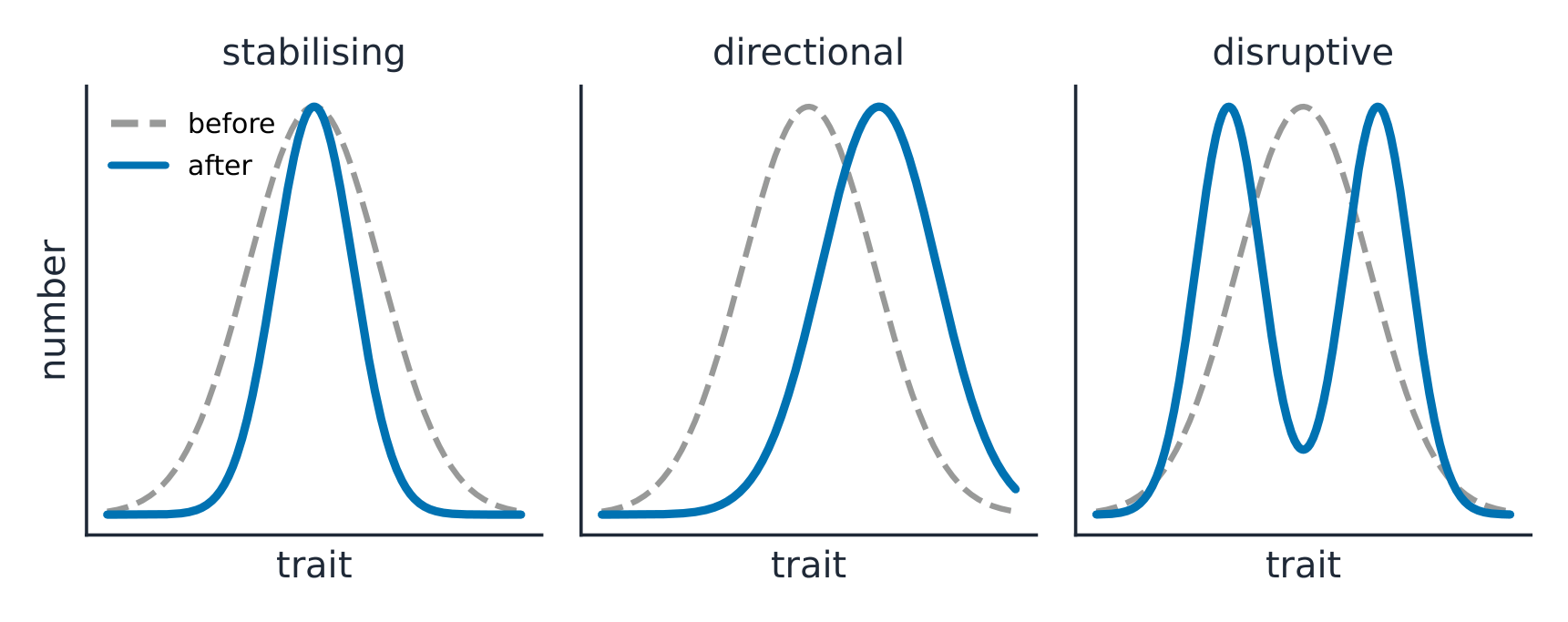
Selection acts on variation 变异. Fitness 适合度 means reproductive success, not strength. Selection comes in modes: directional (favors one extreme), stabilizing (favors the average), and disruptive (favors both extremes). The environment does the "selecting," so a trait that helps in one setting may not in another. Well-suited traits are adaptations 适应.

العربية
شكل العثة المرقطة الداكن (كاربوناريا) — الميلانيزم الصناعي هو دراسة حالة كلاسيكية للانتقاء الطبيعي
عثة الفلفل الشكل الداكن (carbonaria) — الميلانيزم الصناعي هو دراسة حالة كلاسيكية للاختيار الطبيعي

يعمل الاختيار على التنوع. اللياقة تعني النجاح الإنجابي، وليس القوة. يأتي الاختيار بأوضاع: اتجاهي (يفضل طرفًا واحدًا)، ثابت (يفضل المتوسط)، و مفرق (يفضل الطرفين). البيئة تقوم بـ "الاختيار"، لذا فإن الصفة التي تساعد في بيئة معينة قد لا تساعد في أخرى. الصفات الملائمة جيدًا هي تكيفات.

الانتقاء المستقر، الاتجاهي، والمفرق
الانتخاب الثابت، الاتجاهي، والمفرق
Explore · ⁨استكشف⁩

Watch selection shift a population · ⁨شاهد如何选择 يحوّل مجموعة سكانية⁩

Natural selection: individuals better suited to the environment survive and reproduce more, so helpful traits spread. Change the environment and watch the population adapt. · ⁨الانتقاء الطبيعي: الأفراد الأنسب للبيئة يبقون ويتوالدون أكثر، فتنتشر الصفات المفيدة. غيّر البيئة وشاهد المجموعة تتكيف.⁩

7.3

Artificial Selection · ⁨الاصطناعي الاختيار⁩

Syllabus · ⁨المنهج⁩
English

Enduring Understanding (BIG IDEA 1 — Evolution): The process of evolution drives the diversity and unity of life.

Learning Objective 7.3.A: Explain how humans can affect diversity within a population.

  • 7.3.A.1 Through artificial selection, humans affect variation in other species.
العربية

الفهم الدائم (الفكرة الكبرى 1 — التطور): تقود عملية التطور إلى تنوع ووحدة الحياة.

هدف التعلم 7.3.A: شرح كيف يمكن للبشر التأثير على التنوع داخل المجتمع.

  • 7.3.A.1 من خلال الانتقاء الاصطناعي، يؤثر البشر على التباين في أنواع أخرى.

Source: College Board AP Course and Exam Description · ⁨المصدر: وصف دورة وامتحان College Board AP⁩

English

In artificial selection 人工选择, humans – not nature – choose which individuals breed, selecting for desired traits (crops, livestock, dogs). It works the same way as natural selection and, being fast and visible, is strong evidence that selection can reshape populations.

العربية

في الاختيار الاصطناعي، البشر — وليس الطبيعة — يختارون أي الأفراد يتزاوجون، مختارين لصفات مرغوبة (محاصيل، ثروة حيوانية، كلاب). يعمل بنفس طريقة الاختيار الطبيعي، وبكونه سريعًا ومرئيًا، فهو دليل قوي على أن الاختيار يمكن أن يعيد تشكيل المجموعات السكانية.

التربية الانتقائية تجعل السمة المطلوبة أكثر شيوعاً عبر الأجيال
التربية الانتقائية تجعل ميزة مرغوبة أكثر شيوعًا عبر الأجيال
7.4

Population Genetics · ⁨علم جينات السكان⁩

Syllabus · ⁨المنهج⁩
English

Enduring Understanding (BIG IDEA 1 — Evolution): The process of evolution drives the diversity and unity of life.

Learning Objective 7.4.A: Explain how random occurrences affect the genetic makeup of a population.

  • 7.4.A.1 Evolution is also driven by random occurrences.
    • i. Mutation is a random process that adds new genetic variation to a population.
    • ii. Genetic drift is a change in allele frequencies attributable to a nonselective process occurring in small populations.
    • iii. The bottleneck effect is a type of genetic drift that occurs when a population size is reduced to a small number of individuals for at least one generation.
    • iv. The founder effect is a type of genetic drift that occurs when a population is separated from other members of the population. The frequency of genes and traits will shift based on the genes in this new founder population.
    • v. Migration can result in gene flow (the addition or removal of alleles from a population).

Learning Objective 7.4.B: Describe the role of random processes in the evolution of specific populations.

  • 7.4.B.1 Random processes can lead to changes in allele frequencies in a population.
    • i. Mutations result in genetic variation, which provides phenotypes on which natural selection acts.
    • ii. Genetic drift can allow a small population to diverge from other populations of the same species.
    • iii. Gene flow between two populations prevents them from diverging into separate species.

Learning Objective 7.4.C: Describe the change in the genetic makeup of a population over time.

  • 7.4.C.1 Changes in allele frequencies provide evidence for the occurrence of evolution in a population.
العربية

الفهم الدائم (الفكرة الكبرى 1 — التطور): تقود عملية التطور إلى تنوع ووحدة الحياة.

هدف التعلم 7.4.A: شرح كيف تؤثر الأحداث العشوائية على التركيب الجيني للمجتمع.

  • 7.4.A.1 التطور يُدفع أيضاً بواسطة أحداث عشوائية.
    • i. الطفرة عملية عشوائية تضيف تنوعاً جينياً جديداً إلى المجتمع.
    • ii. الانجراف الجيني هو تغير في تكرارات الأليلات يُنسب إلى عملية غير انتقائية تحدث في المجتمعات الصغيرة.
    • iii. تأثير الزقزقة هو نوع من الانجراف الجيني يحدث عندما ينخفض حجم المجتمع إلى عدد قليل من الأفراد لمدة جيل واحد على الأقل.
    • iv. تأثير المؤسس هو نوع من الانجراف الجيني يحدث عندما ينفصل مجتمع عن بقية أفراد النوع. ستتحرك تكرارات الجينات والسمات بناءً على الجينات في هذا المجتمع المؤسس الجديد.
    • v. يمكن أن يؤدي الهجرة إلى تدفق الجينات (إضافة أو إزالة الأليلات من المجتمع).

هدف التعلم 7.4.B: وصف دور العمليات العشوائية في تطور مجتمعات محددة.

  • 7.4.B.1 يمكن أن تؤدي العمليات العشوائية إلى تغييرات في تكرارات الأليلات في المجتمع.
    • i. تؤدي الطفرات إلى تنوع جيني، مما يوفر ظواهر (phenotypes) يعمل عليها الانتقاء الطبيعي.
    • ii. يمكن للانجراف الجيني أن يسمح للمجتمع الصغير بالتباعد عن مجتمعات أخرى من نفس النوع.
    • iii. يمنع تدفق الجينات بين مجتمعين تباعدهما لتكوين أنواع منفصلة.

هدف التعلم 7.4.C: وصف التغير في التركيب الجيني للمجتمع عبر الزمن.

  • 7.4.C.1 توفر التغييرات في تكرارات الأليلات دليلاً على حدوث التطور في المجتمع.

Source: College Board AP Course and Exam Description · ⁨المصدر: وصف دورة وامتحان College Board AP⁩

English

Population genetics 群体遗传学 studies the pool of alleles in a population. Evolution is a change in allele frequencies 等位基因频率 over time. Besides natural selection, allele frequencies change through mutation (new alleles), gene flow 基因流 (migration), and genetic drift 遗传漂变 (random change, strongest in small populations – the bottleneck and founder effects).

العربية

علم جينات السكان يدرس حوض أليلات في مجموعة سكانية. التطور هو تغيير في ترددات الأليلات عبر الزمن. بالإضافة إلى الاختيار الطبيعي، تتغير ترددات الأليلات من خلال الطفرة (أليلات جديدة)، تدفق الجينات (الهجرة)، و الانحراف الجيني (تغير عشوائي، الأقوى في المجموعات الصغيرة – تأثير الرققة المؤثرة وتأثير المؤسس).

عنق الزجاجة السكاني يقلل التنوع الجيني
رققة المجموعة السكانية تقلل التنوع الجيني
7.5

Hardy-Weinberg Equilibrium · ⁨توازن هاردي-واينبرغ⁩

Syllabus · ⁨المنهج⁩
English

Enduring Understanding (BIG IDEA 1 — Evolution): The process of evolution drives the diversity and unity of life.

Learning Objective 7.5.A: Describe the conditions under which allele and genotype frequencies will change in populations.

  • 7.5.A.1 The Hardy–Weinberg Equilibrium is a model for describing and predicting allele frequencies in a non-evolving population. Conditions for a population or an allele to be in Hardy–Weinberg equilibrium are:

    • i. A large population size
    • ii. No migration
    • iii. No new mutations
    • iv. Random mating
    • v. No natural selection

    These conditions are never met, but they provide a valuable null hypothesis.

  • 7.5.A.2 Allele frequencies in a nonevolving population can be calculated from genotype frequencies.

    • Equation: Hardy–Weinberg Equation— $p^2 + 2pq + q^2 = 1$; $p + q = 1$, where: $p$ = frequency of allele 1 in the population; $q$ = frequency of allele 2 in the population
    • Illustrative examples for 7.5.A.2: Graphic analysis of allele frequencies in a population
العربية

الفهم الدائم (الفكرة الكبرى 1 — التطور): تقود عملية التطور إلى تنوع ووحدة الحياة.

هدف التعلم 7.5.A: وصف الظروف التي ستتغير فيها تكرارات الأليلات والجينوتيب في المجتمعات.

  • 7.5.A.1 توازن هاردي-واينبرغ هو نموذج لوصف وتوقع تكرارات الأليلات في مجتمع غير متطور. شروط أن يكون المجتمع أو الأليل في حالة توازن هاردي-واينبرغ هي:

    • i. حجم مجتمع كبير
    • ii. عدم وجود هجرة
    • iii. عدم وجود طفرات جديدة
    • iv. التزاوج العشوائي
    • v. عدم وجود انتقاء طبيعي

    لا تُحقق هذه الشروط أبداً، لكنها توفر فرضية صفرية قيمة.

  • 7.5.A.2 يمكن حساب تكرارات الأليلات في مجتمع غير متطور من تكرارات الجينوتيب.

    • المعادلة: معادلة هاردي-واينبرغ— $p^2 + 2pq + q^2 = 1$; $p + q = 1$، حيث: $p$ = تكرار الأليل 1 في المجتمع؛ $q$ = تكرار الأليل 2 في المجتمع}
    • أمثلة توضيحية لـ 7.5.A.2: التحليل البياني لترددات الأليلات في مجموعة سكانية

Source: College Board AP Course and Exam Description · ⁨المصدر: وصف دورة وامتحان College Board AP⁩

English

The Hardy–Weinberg 哈迪-温伯格 model gives the allele and genotype frequencies expected when a population is not evolving. With allele frequencies $p$ and $q$ ($p+q=1$):

$$p^2 + 2pq + q^2 = 1,$$
where $p^2$ and $q^2$ are the homozygotes and $2pq$ the heterozygotes. It holds only under five conditions (no selection, no mutation, no migration, random mating, large population); when real data differ from the prediction, the population is evolving.

Worked example. In a population, $16\%$ of individuals show the recessive phenotype, so $q^2=0.16$ and $q=\sqrt{0.16}=0.4$. Then $p=1-q=0.6$. The predicted carrier frequency (heterozygotes) is $2pq=2(0.6)(0.4)=0.48$, i.e. $48\%$, and the homozygous dominants are $p^2=0.6^2=0.36$, i.e. $36\%$. As a check, $0.36+0.48+0.16=1$. This is the standard route: recessive phenotype $\to q^2\to q\to p\to$ everything else.

العربية

نموذج هاردي-واينبرغ- يعطي ترددات الأليل والنمط الجيني المتوقعة عندما تكون المجموعة السكانية لا تتطور. مع ترددات الأليل $p$ و $q$ ($p+q=1$):

$$p^2 + 2pq + q^2 = 1,$$
حيث $p^2$ و $q^2$ هم النمطان الجينيون المتجانسان و $2pq$ النمط الجيني المتنوع. ينطبق فقط تحت خمس شروط (لا اختيار، لا طفرة، لا هجرة، تزاوج عشوائي، مجموعة سكانية كبيرة); عندما تختلف البيانات الحقيقية عن التوقع، فإن المجموعة السكانية تتطور.

مثال محلول. في مجتمع ما، $16\%$ من الأفراد يُظهرون النمط الظاهري المتنحي، لذا $q^2=0.16$ و$q=\sqrt{0.16}=0.4$. ثم $p=1-q=0.6$. التردد المتوقع للناقلين (المختلطات) هو $2pq=2(0.6)(0.4)=0.48$، أي $48\%$، والذووا النماذج الظاهرية السائدة المتجانسون هم $p^2=0.6^2=0.36$، أي $36\%$. كتحقق، $0.36+0.48+0.16=1$. هذا هو المسار القياسي: النمط الظاهري المتنحي $\to q^2\to q\to p\to$ كل شيء آخر.

هاردي-واينبرغ: ترددات الأليل p و q تعطي ترددات النمط الجيني p²، 2pq، q² *هاردي-واينبرغ: ترددات الأليل p و q تعطي ترددات النمط الجيني p²، 2pq، q²

Explore · ⁨استكشف⁩

Allele frequencies across a cross · ⁨ترددات الأليلات عبر التزاوج⁩

Hardy-Weinberg predicts genotype frequencies ($p^2+2pq+q^2$) in a population that isn't evolving. A Punnett square shows the same allele combining at the population scale. · ⁨هاردي-واينبرغ يتوقع ترددات الجينات ($p^2+2pq+q^2$) في مجموعة سكانية لا تتطور. يُظهر مربع بانيت نفس تجمع الأليل على مستوى المجموعة.⁩

7.6

Evidence of Evolution · ⁨أدلة التطور⁩

Syllabus · ⁨المنهج⁩
English

Enduring Understanding (BIG IDEA 1 — Evolution): The process of evolution drives the diversity and unity of life.

Learning Objective 7.6.A: Describe the types of data that provide evidence for evolution.

  • 7.6.A.1 Evolution is supported by scientific evidence from many disciplines (geographical, geological, physical, biochemical, and mathematical data).

Learning Objective 7.6.B: Explain how morphological, biochemical, and geological data provide evidence that organisms have changed over time.

  • 7.6.B.1 Molecular, morphological, and genetic evidence from extant and extinct organisms adds to our understanding of evolution.
    • i. Fossils can be dated by a variety of methods. These include 1) the age of the rocks where a fossil is found; 2) the rate of decay of isotopes including carbon-14; and 3) geographical data.
    • ii. Morphological homologies, including vestigial structures, provide evidence of common ancestry.
  • 7.6.B.2 A comparison of DNA nucleotide sequences and protein amino acid sequences provides evidence for evolution and common ancestry.
العربية

الفهم الدائم (الفكرة الكبرى 1 — التطور): تقود عملية التطور إلى تنوع ووحدة الحياة.

هدف التعلم 7.6.A: وصف أنواع البيانات التي تقدم أدلة على التطور.

  • 7.6.A.1 يدعم التطور الأدلة العلمية من مجالات متعددة (بيانات جغرافية، جيولوجية، فيزيائية، كيميائية حيوية، ورياضية).

هدف التعلم 7.6.B: شرح كيف توفر البيانات المورفولوجية والكيميائية الحيوية والجيولوجية دليلاً على أن الكائنات الحية قد تغيرت عبر الزمن.

  • 7.6.B.1 تضيف الأدلة الجزيئية والمورفولوجية والجينية من الكائنات الحية الحالية والمنقرضة إلى فهمنا للتطور.
    • i. يمكن تحديد عمر الحفريات بطرق متنوعة. وتشمل: 1) عمر الصخور التي توجد فيها حفرة؛ 2) معدل تحلل النظائر بما في ذلك الكربون-14؛ و3) البيانات الجغرافية.
    • ii. التشابهات المورفولوجية، بما في ذلك الهياكل المتبقية، توفر دليلاً على النسب المشترك.
  • 7.6.B.2 مقارنة تسلسلات نيوكليوتيدات الحمض النووي وتسلسلات أحماض الأمينية للبروتينات تقدم دليلاً على التطور والنسب المشترك.

Source: College Board AP Course and Exam Description · ⁨المصدر: وصف دورة وامتحان College Board AP⁩

English

Multiple independent lines support evolution: the fossil record 化石记录, homologous structures 同源结构 (shared anatomy from common ancestry), vestigial structures 痕迹器官, shared embryology, and molecular evidence – the near-universal genetic code and matching DNA/protein sequences.

العربية
حفرة أرخايوبتري克斯: ريش بالإضافة إلى ميزات زاحفة — دليل على أصل مشترك
مستحضر الأركيوبتريكس: ريش بالإضافة إلى ملامح زاحفة — دليل على النسب المشترك

تدعم خطوط متعددة ومستقلة فكرة التطور: السجل الأحفوري، الهياكل المتشابهة (تشترك في التشريح بسبب نسب مشترك)، الهياكل المتبقية، علم أجنة مشترك، والأدلة الجزيئية — الشفرة الوراثية شبه العالمية والتسلسلات المتطابقة للحمض النووي/البروتين.

7.7

Common Ancestry · ⁨النسب المشترك⁩

Syllabus · ⁨المنهج⁩
English

Enduring Understanding (BIG IDEA 1 — Evolution): The process of evolution drives the diversity and unity of life.

Learning Objective 7.7.A: Describe structural and functional evidence on cellular and molecular levels that provides evidence for the common ancestry of all eukaryotes.

  • 7.7.A.1 Structural and functional evidence indicates common ancestry of all eukaryotes. This evidence includes:
    • i. Membrane-bound organelles
    • ii. Linear chromosomes
    • iii. Genes that contain introns
العربية

الفهم الدائم (الفكرة الكبرى 1 — التطور): تقود عملية التطور إلى تنوع ووحدة الحياة.

هدف التعلم 7.7.A: وصف الأدلة الهيكلية والوظيفية على المستوى الخلوي والجزيئي التي توفر دليلاً على النسب المشترك لجميع حقيقيات النواة.

  • 7.7.A.1 تشير الأدلة الهيكلية والوظيفية إلى النسب المشترك لجميع حقيقيات النواة. تشمل هذه الأدلة:
    • i. عضيات محاطة بأغشية
    • ii. كروموسومات خطية
    • iii. جينات تحتوي على إنترونات

Source: College Board AP Course and Exam Description · ⁨المصدر: وصف دورة وامتحان College Board AP⁩

English

All life shares a common ancestor 共同祖先, shown by universal features: the same DNA/RNA machinery, the same genetic code, ribosomes, and core metabolic pathways in all organisms. The more features and sequences two species share, the more recently they diverged.

العربية

تشترك جميع الكائنات الحية في نسب مشترك، وهو موضح بالسمات العالمية: نفس آليات الحمض النووي الريبوزي المنزوع الأكسجين/الريبوزي، نفس الشفرة الوراثية، الريبوسومات، والمسارات الأيضية الأساسية في جميع الكائنات. كلما اشتُرك بين نوعين في سمات أكثر وتسلسلات أكثر، كان تباعدهما حديثًا أكثر.

أرخايوبتري克斯: الحفريات الانتقالية تربط المجموعات الرئيسية وتدعم الأصل المشترك
الأركيوبتريكس: المستحضرات الانتقالية تربط المجموعات الرئيسية وتدعم النسب المشترك
7.8

Continuing Evolution · ⁨تطور مستمر⁩

Syllabus · ⁨المنهج⁩
English

Enduring Understanding (BIG IDEA 1 — Evolution): The process of evolution drives the diversity and unity of life.

Learning Objective 7.8.A: Explain how evolution is an ongoing process in all living organisms.

  • 7.8.A.1 All species have evolved and continue to evolve. Examples include:
    • i. Genomic changes over time
    • ii. Continuous change in the fossil record
    • iii. Evolution of resistance to antibiotics, pesticides, herbicides, or chemotherapy drugs
    • iv. Pathogens evolving and causing emergent diseases
العربية

الفهم الدائم (الفكرة الكبرى 1 — التطور): تقود عملية التطور إلى تنوع ووحدة الحياة.

هدف التعلم 7.8.A: شرح كيف أن التطور عملية مستمرة في جميع الكائنات الحية.

  • 7.8.A.1 تطورت جميع الأنواع ولا تزال تتطور. ومن الأمثلة على ذلك:
    • i. التغيرات الجينومية بمرور الوقت
    • ii. التغير المستمر في السجل الأحفوري
    • iii. تطور مقاومة المضادات الحيوية والمبيدات الحشرية ومبيدات الأعشاب أو الأدوية الكيميائية العلاجية
    • iv. تطور مسببات الأمراض وتسببها في أمراض新興ية

Source: College Board AP Course and Exam Description · ⁨المصدر: وصف دورة وامتحان College Board AP⁩

English

Evolution is ongoing and observable: antibiotic-resistant bacteria, pesticide-resistant insects, and rapid changes in fast-breeding species. Because environments keep changing, selection keeps acting – evolution has no endpoint.

العربية
صفيحة حساسية المضادات الحيوية: المناطق الصافية تظهر أي المضادات تقتل البكتيريا
صفيحة حساسية المضادات الحيوية: المناطق الصافية تُظهر أي المضادات تقتل البكتيريا

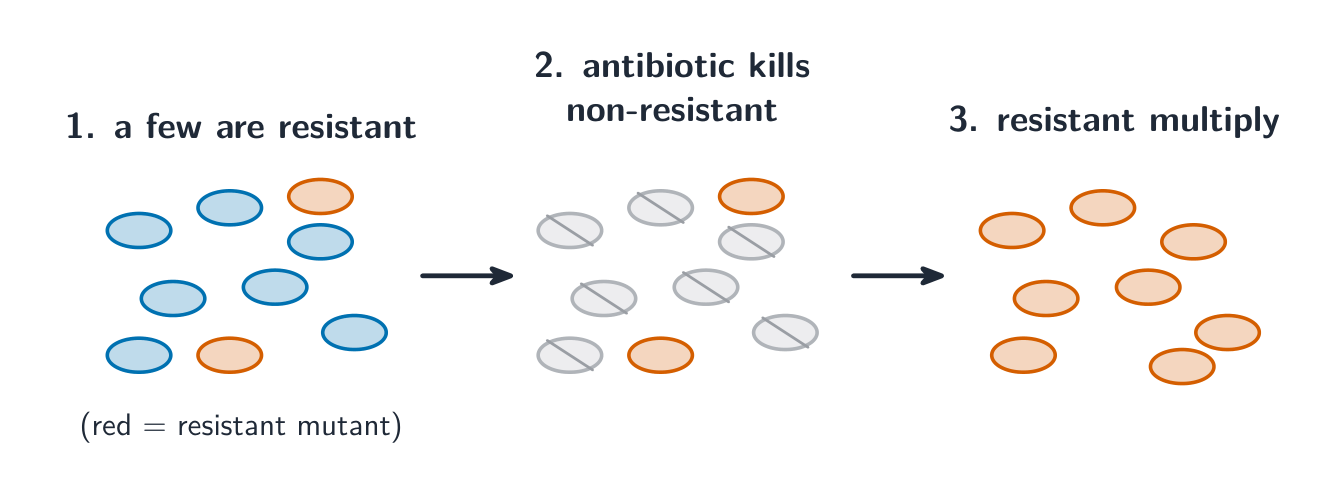
التطور عملية مستمرة وقابلة للملاحظة: بكتيريا مقاومة للمضادات، حشرات مقاومة للمبيدات، وتغيرات سريعة في أنواع ذات تكاثر سريع. نظرًا لأن البيئات تستمر في التغيير، فإن الاختيار الطبيعي يستمر في العمل — لا يوجد لتطور endpoint.

كيف تنتشر مقاومة المضادات الحيوية عبر السكان عن طريق الانتقاء الطبيعي *كيف تنتشر مقاومة المضادات الحيوية عبر المجتمع عن طريق الاختيار الطبيعي

7.9

Phylogeny · ⁨علم السلالات⁩

Syllabus · ⁨المنهج⁩
English

Enduring Understanding (BIG IDEA 1 — Evolution): The process of evolution drives the diversity and unity of life.

Learning Objective 7.9.A: Describe the types of evidence that can be used to infer an evolutionary relationship.

  • 7.9.A.1 Phylogenetic trees and cladograms show hypothetical evolutionary relationships among lineages that can be tested.
  • 7.9.A.2 Phylogenetic trees show the amount of change over time calibrated by fossils or a molecular clock, whereas cladograms do not show time scale or the evolutionary difference between groups.
  • 7.9.A.3 Traits that are either gained or lost during evolution can be used to construct phylogenetic trees and cladograms. The out-group represents the lineage that is least closely related to the remainder of the organisms in the phylogenetic tree or cladogram.
    • i. Shared derived characters can be present in more than one lineage and indicate common ancestry. These are informative for the construction of phylogenetic trees and cladograms.
    • ii. Molecular data typically provide more accurate and reliable evidence than morphological traits in the construction of phylogenetic trees or cladograms.

Learning Objective 7.9.B: Explain how phylogenetic trees and cladograms can be used to infer evolutionary relatedness.

  • 7.9.B.1 Phylogenetic trees and cladograms can be used to illustrate speciation that has occurred. The nodes on a tree represent the most recent common ancestor of any two groups or lineages.
  • 7.9.B.2 Phylogenetic trees and cladograms can be constructed from morphological similarities of living or fossil species and from DNA and protein sequence similarities.
  • 7.9.B.3 Phylogenetic trees and cladograms represent hypotheses that are constantly being revised based on evidence.
العربية

الفهم الدائم (الفكرة الكبرى 1 — التطور): تقود عملية التطور إلى تنوع ووحدة الحياة.

هدف التعلم 7.9.A: وصف أنواع الأدلة التي يمكن استخدامها لاستنتاج علاقة تطورية.

  • 7.9.A.1 تظهر الأشجار الفيلوجينية والشجرة الكلادية علاقات تطورية افتراضية بين السلالات يمكن اختبارها.
  • 7.9.A.2 تُظهر الأشجار الفيلوجينية مقدار التغير عبر الزمن الذي تم ضبطه باستخدام الحفريات أو الساعة الجزيئية، بينما لا تُظهر الشجرة الكلادية مقياساً زمنياً أو الفرق التطوري بين المجموعات.
  • 7.9.A.3 يمكن استخدام الصفات المكتسبة أو المفقودة أثناء التطور لبناء الأشجار الفيلوجينية والشجرة الكلادية. تمثل المجموعة الخارجية السلالة الأقل ارتباطاً بالباقي من الكائنات الحية في الشجرة الفيلوجينية أو الشجرة الكلادية.
    • i. يمكن أن تكون الصفات المشتقة المشتركة موجودة في أكثر من سلالة وتشير إلى النسب المشترك. وهي مفيدة لبناء الأشجار الفيلوجينية والشجرة الكلادية.
    • ii. عادةً ما توفر البيانات الجزيئية دليلاً أكثر دقة وموثوقية من الصفات المورفولوجية في بناء الأشجار الفيلوجينية أو الشجرة الكلادية.

هدف التعلم 7.9.B: شرح كيفية استخدام الأشجار الفيلوجينية والشجرة الكلادية لاستنتاج الارتباط التطوري.

  • 7.9.B.1 يمكن استخدام الأشجار الفيلوجينية والشجرة الكلادية لتوضيح الانتواع الذي حدث. تمثل العقد (العقد) على الشجرة السلف المشترك الأكثر حداثة لأي مجموعتين أو سلالتين.
  • 7.9.B.2 يمكن بناء الأشجار الفيلوجينية والشجرة الكلادية من أوجه التشابه المورفولوجية للأنواع الحية أو الأحفورية ومن أوجه التشابه في تسلسلات الحمض النووي والبروتين.
  • 7.9.B.3 تمثل الأشجار الفيلوجينية والشجرة الكلادية فرضيات يتم تحديثها باستمرار بناءً على الأدلة.

Source: College Board AP Course and Exam Description · ⁨المصدر: وصف دورة وامتحان College Board AP⁩

English

A phylogenetic tree 系统发育树 (cladogram) diagrams evolutionary relationships, with branch points marking common ancestors and shared derived traits grouping related species. Trees are hypotheses, revised as new (especially molecular) data arrive.

العربية

الشجرة الفيلوجينية (الشجرة التصنيفية) توضح العلاقات التطورية، حيث تحدد عقد التفرع الأجداد المشتركين وسمات المشتقة المشتركة التي تجمع بين الأنواع المرتبطة. تُعدّ الأشجار فرضيات، يتم تعديلها مع ورود بيانات جديدة (خاصة الجزيئية).

شجرة الحياة: علم التسلسل يصنف الكائنات حسب النسب المشترك من أصل واحد
شجرة الحياة: يصنف علم السلالات الكائنات بناءً على النسب المشترك من أصل واحد
7.10

Speciation · ⁨نشأة الأنواع⁩

Syllabus · ⁨المنهج⁩
English

Enduring Understanding (BIG IDEA 1 — Evolution): The process of evolution drives the diversity and unity of life.

Learning Objective 7.10.A: Describe the conditions under which new species may arise.

  • 7.10.A.1 Speciation occurs when two populations become reproductively isolated from each other.
  • 7.10.A.2 The biological species concept provides a commonly used definition of a species for sexually reproducing organisms. It states that species can be defined as a group capable of interbreeding and exchanging genetic information to produce viable, fertile offspring.

Learning Objective 7.10.B: Describe the rate of evolution and speciation under different ecological conditions.

  • 7.10.B.1 Punctuated equilibrium is when evolution occurs rapidly after a long period of stasis. Gradualism is when evolution occurs slowly over hundreds of thousands or millions of years.
  • 7.10.B.2 Divergent evolution occurs when adaptation to new habitats results in phenotypic diversification. Speciation rates can be especially rapid during times of adaptive radiation as new habitats become available.
  • 7.10.B.3 Convergent evolution occurs when similar selective pressures result in similar phenotypic adaptations in different populations or species.

Learning Objective 7.10.C: Explain the processes and mechanisms that drive speciation.

  • 7.10.C.1 Sympatric speciation occurs in populations with geographic overlap. Allopatric speciation occurs in populations that are geographically isolated.
  • 7.10.C.2 Various pre-zygotic and post-zygotic mechanisms can maintain reproductive isolation and prevent gene flow between populations.
  • Illustrative examples for 7.10.C: Hawaiian Drosophila; Caribbean Anolis; Apple maggot Rhagoletis
العربية

الفهم الدائم (الفكرة الكبرى 1 — التطور): تقود عملية التطور إلى تنوع ووحدة الحياة.

الهدف التعليمي 7.10.A: صف الظروف التي قد تنشأ فيها أنواع جديدة.

  • 7.10.A.1 يحدث تكوين الأنواع عندما تصبح مجموعتان معزولتين تكاثريًا عن بعضهما البعض.
  • 7.10.A.2 يوفر المفهوم البيولوجي للأنواع تعريفًا شائع الاستخدام للنوع للكائنات التي تتكاثر جنسيًا. ينص على أن الأنواع يمكن تعريفها بأنها مجموعة قادرة على التزاوج وتبادل المعلومات الجينية لإنتاج نسل قابل للحياة ومخصب.

الهدف التعليمي 7.10.B: صف معدل التطور وتكوين الأنواع تحت ظروف بيئية مختلفة.

  • 7.10.B.1 التوازن المنقطع هو عندما يحدث التطور بسرعة بعد فترة طويلة من السكون. التدريجية هي عندما يحدث التطور ببطء على مدى مئات الآلاف أو ملايين السنين.
  • 7.10.B.2 يحدث التطور المتباين عندما تؤدي التكيفات مع موائل جديدة إلى تنوع في النمط الظاهري. يمكن أن تكون معدلات تكوين الأنواع سريعة بشكل خاص خلال فترات الانتشار التكيفي حيث تصبح موائل جديدة متاحة.
  • 7.10.B.3 يحدث التطور المتقارب عندما تؤدي ضغوط اختيار مماثلة إلى تكيفات ظاهرية مماثلة في مجموعات أو أنواع مختلفة.

الهدف التعليمي 7.10.C: اشرح العمليات والآليات التي تقود تكوين الأنواع.

  • 7.10.C.1 يحدث تكوين الأنواع المتماثل في المجموعات ذات التداخل الجغرافي. يحدث تكوين الأنواع المعزول جغرافيًا في المجموعات المعزولة جغرافيًا.
  • 7.10.C.2 يمكن أن تحافظ آليات ما قبل الزيجوت وما بعد الزيجوت المختلفة على العزل التكاثري وتمنع تدفق الجينات بين المجموعات.
  • أمثلة توضيحية لـ 7.10.C: ذبابة الفاكهة الهاواية؛ أنوليس الكاريبي؛ ذبابة التفاح Rhagoletis

Source: College Board AP Course and Exam Description · ⁨المصدر: وصف دورة وامتحان College Board AP⁩

English

Speciation 物种形成 is the origin of new species, usually when populations become reproductively isolated 生殖隔离 and diverge. Allopatric speciation follows a geographic split; sympatric speciation happens without one. Once populations can no longer interbreed, they are separate species.

العربية

نشأة الأنواع هي نشوء أنواع جديدة، عادةً عندما تصبح المجتمعات معزولة تناسلياً وتتباين. تتبع النشأة العزلية انفصالًا جغرافيًا؛ بينما تحدث النشأة المتداخلة بدون ذلك. بمجرد أن لم تعد المجتمعات قادرة على التزاوج، تصبح أنواعًا منفصلة.

تكون الأنواع الجغرافي والمتماثل *النشأة العزلية والنشأة المتداخلة

Vocabulary · ⁨مفردات⁩ Train · ⁨تدريب⁩
English العربية
Speciation/ˌspiːʃɪˈeɪʃn/ تشكّل الأنواع
reproductively isolated/rɪprəˈdʌktɪvli ˈaɪsəleɪtɪd/ معزولة تكاثرياً
diversity/daɪˈvɜːsɪti/ التنوع
endosymbiosis/ˌendəʊˌsɪmbaɪˈəʊsɪs/ التعايش الداخلي
7.11

Variations in Populations · ⁨التباينات في المجتمعات⁩

Syllabus · ⁨المنهج⁩
English

Enduring Understanding (BIG IDEA 4 — Systems Interactions): Biological systems interact, and these systems and their interactions exhibit complex properties.

Learning Objective 7.11.A: Explain how the genetic diversity of a species or population affects its ability to withstand environmental pressures.

  • 7.11.A.1 The level of variation in a population affects population dynamics.
    • i. The ability of a population to respond to changes in the environment is influenced by genetic diversity. Species and populations with little genetic diversity are at risk of decline or extinction.
    • ii. Genetically diverse populations are more resilient to environmental perturbation because they are more likely to contain individuals that can withstand the environmental pressure.
    • iii. Alleles that are adaptive in one environmental condition may be deleterious in another because of different selective pressures.
    • Illustrative examples for 7.11.A.1: California condors; Black-footed ferrets; Prairie chickens; Potato blight; Corn rust; Genetic diversity and selective pressures; Antibiotic resistance in bacteria (not all individuals in a diverse population are susceptible to a disease outbreak)
العربية

فهم دائم (الفكرة الكبرى 4 — تفاعلات الأنظمة): تتفاعل الأنظمة البيولوجية مع بعضها البعض، وتُظهر هذه الأنظمة وتفاعلاتها خصائص معقدة.

الهدف التعليمي 7.11.A: اشرح كيف يؤثر التنوع الجيني للنوع أو المجموعة على قدرته على مقاومة الضغوط البيئية.

  • 7.11.A.1 يؤثر مستوى التباين في المجتمع على ديناميكيات المجتمع.
    • i. تتأثر قدرة المجتمع على الاستجابة لتغيرات البيئة بالتنوع الجيني. الأنواع والمجتمعات ذات التنوع الجيني القليل معرضة لخطر الانحدار أو الانقراض.
    • ii. المجتمعات المتنوعة جينياً أكثر مقاومة للاضطرابات البيئية لأنها أكثر احتمالاً أن تحتوي على أفراد يمكنهم تحمل الضغط البيئي.
    • iii. قد تكون الأليلات الملائمة في ظرف بيئي معين ضارة في ظرف آخر بسبب اختلاف الضغوط الانتقائية.
    • أمثلة توضيحية لـ 7.11.A.1: الغراب النادر (الكوندور) في كاليفورنيا؛ الثعالب السوداء القدمين؛ الدجاج البري؛ مرض تبقع البطاطا؛ صدأ الذرة؛ التنوع الجيني والضغوط الانتقائية؛ مقاومة المضادات الحيوية في البكتيريا (ليس كل الأفراد في المجتمع المتنوع عرضة لوباء مرضي)

Source: College Board AP Course and Exam Description · ⁨المصدر: وصف دورة وامتحان College Board AP⁩

English

Genetic diversity 多样性 helps a population survive change – if conditions shift, some variants may already be suited to them. Low diversity (as in an endangered species) leaves a population vulnerable. Variation arises from mutation and the reshuffling of meiosis and sexual reproduction.

العربية

يساعد التنوع الوراثي المجتمع على البقاء أمام التغيير — إذا تحولت الظروف، قد تكون بعض المتغيرات جاهزة بالفعل للتكيف معها. يقلل التنوع المنخفض (كما في الأنواع المهددة بالانقراض) من قدرة المجتمع على المقاومة. تنشأ التباينات من الطفرات وإعادة ترتيب الانقسام المنصف والتكاثر الجنسي.

التباين المتقطع والمتصل
Vocabulary · ⁨مفردات⁩ Train · ⁨تدريب⁩
English العربية
variation/ˌveərɪˈeɪʃn/ التنوع
Fitness/ˈfɪtnəs/ اللياقة
adaptations/ˌædæpˈteɪʃnz/ التكيفات
artificial selection/ˌɑːtɪˈfɪʃl sɪˈlekʃn/ الانتقاء الاصطناعي
Population genetics/ˌpɒpjʊˈleɪʃn dʒɪˈnetɪks/ علم الوراثة السكانية
allele frequencies/əˈliːl ˈfriːkwənsiz/ ترددات الأليلات
gene flow/dʒiːn fləʊ/ تدفق الجينات
genetic drift/dʒɪˈnetɪk drɪft/ الانحراف الجيني
Hardy–Weinberg/ˈhɑːdi ˈwaɪnbɜːɡ/ هاردي-واينبرغ
fossil record/ˈfɒsl ˈrekɔːd/ السجل الأحفوري
homologous structures/həˈmɒləɡəs ˈstrʌktʃəz/ البنى المتجانسة
vestigial structures/ˈvestɪdʒl ˈstrʌktʃəz/ الهياكل المرممة
common ancestor/ˈkɒmən ˈænsestə/ السلف المشترك
phylogenetic tree/ˌfaɪləʊdʒˈnetɪk triː/ الشجرة التطورية
7.12

Origins of Life on Earth · ⁨أصول الحياة على الأرض⁩

Syllabus · ⁨المنهج⁩
English

Enduring Understanding (BIG IDEA 4 — Systems Interactions): Biological systems interact, and these systems and their interactions exhibit complex properties.

Learning Objective 7.12.A: Describe the scientific evidence that supports models of the origin of life on Earth.

  • 7.12.A.1 The origin of life on Earth is supported by scientific evidence.
    • i. Geological evidence reinforces models of the origin of life on Earth.
    • ii. Earth formed approximately 4.6 billion years ago (bya). The environment was too hostile for life until about 3.9 bya, and the earliest fossil evidence for life dates to 3.5 bya. Taken together, this evidence provides a plausible range of dates for the origin of life.
  • 7.12.A.2 The RNA world hypothesis proposes that RNA could have been the earliest genetic material. There are three assumptions:
    • i. At some point in time, genetic continuity was assured by the replication of RNA.
    • ii. Base-pairing is necessary for replication.
    • iii. Genetically encoded proteins were not involved as catalysts.
العربية

فهم دائم (الفكرة الكبرى 4 — تفاعلات الأنظمة): تتفاعل الأنظمة البيولوجية مع بعضها البعض، وتُظهر هذه الأنظمة وتفاعلاتها خصائص معقدة.

هدف التعلم 7.12.A: وصف الأدلة العلمية التي تدعم نماذج نشأة الحياة على الأرض.

  • 7.12.A.1 تدعم الأدلة العلمية نشأة الحياة على الأرض.
    • i. تعزز الأدلة الجيولوجية نماذج نشأة الحياة على الأرض.
    • ii. تشكلت الأرض قبل حوالي 4.6 مليار سنة (bya). كانت البيئة عدائية للحياة حتى حوالي 3.9 مليار سنة، وتعود أقدم الأدلة الأحفورية للحياة إلى 3.5 مليار سنة. وبشكل مجتمعة، توفر هذه الأدجة نطاقاً معقولاً من التواريخ لنشأة الحياة.
  • 7.12.A.2 تفترض فرضية عالم RNA أن RNA كان قد يكون المادة الوراثية الأولى. هناك ثلاثة افتراضات:
    • i. في مرحلة ما من الزمن، تم ضمان الاستمرارية الوراثية عن طريق تضاعف RNA.
    • ii. ارتباط القواعد ضروري للتضاعف.
    • iii. لم تكن البروتينات المشفرة وراثياً متضمنة كإنزيمات (محفزات).

Source: College Board AP Course and Exam Description · ⁨المصدر: وصف دورة وامتحان College Board AP⁩

English

Evidence suggests early Earth's conditions could form simple organic molecules (the Miller–Urey type experiments), which assembled into polymers, then self-replicating RNA (the "RNA world"), and eventually membrane-bound cells. The first cells were prokaryotes; eukaryotes arose later through endosymbiosis 内共生.

العربية

تشير الأدلة إلى أن ظروف الأرض المبكرة كانت قادرة على تكوين جزيئات عضوية بسيطة (مثل تجارب ميلر-يوراي)، والتي تجمعت لتشكل بوليمرات، ثم حمض نووي ribوزي ذاتي النسخ (RNA) (

الحجر البكترائي: الماطات الميكروبية الطبقاتية هي من أقدم أدلة الحياة على الأرض *الاستروماتوليتات: الطبقات الميكروبية المتراكمة هي من أقدم أدلة الحياة على الأرض

فتحة حرارية مائية: المياه الساخنة الغنية بالمواد الكيميائية قد تكون زودت الأيض المبكر عند نشأة الحياة *فتحة هيدرothermality: الماء الساخن الغني بالمواد الكيميائية قد يكون زود الأيض المبكر عند نشأة الحياة

7.12

Exam tips · ⁨نصائح للامتحان⁩

English
  • State natural selection cleanly: variation → differential survival and reproduction → helpful traits become common.
  • Fitness = reproductive success, not strength or health.
  • Evolution is a change in allele frequencies in a population — individuals do not evolve.
  • Use Hardy–Weinberg ($p^2+2pq+q^2=1$): start from the recessive phenotype $q^2\to q\to p$.
  • Cite independent evidence (fossils, homologous structures, DNA) and explain speciation via reproductive isolation.
العربية
  • عرّف الاختيار الطبيعي بوضوح: تباين ← بقاء وتكاثر متفاوت ← صفات مفيدة تصبح شائعة.
  • اللياقة = النجاح التناسلي، وليس القوة أو الصحة.
  • التطور هو تغيير في ترددات الأليلات في مجتمع — الأفراد لا يتطورون.
  • استخدم هاردي-واينبرغ ($p^2+2pq+q^2=1$): ابدأ من النمط الظاهري المتنحي $q^2\to q\to p$.
  • استشهد بأدلة مستقلة (مستحضرات، هياكل متشابهة، حمض نووي) واشرح نشأة الأنواع عبر العزل التناسلي.

Interactive lessons on this topic · ⁨دروس تفاعلية حول هذا الموضوع⁩

Work through it step by step, with instant-check exercises. · ⁨ا-working عليه خطوة بخطوة، مع تمارين تحقق فوري.⁩

Past Papers · ⁨أوراق الامتحانات السابقة⁩

More topics in AP Biology · ⁨AP علم الأحياء⁩ · ⁨المزيد من المواضيع في AP Biology · ⁨AP علم الأحياء⁩⁩

Log in or create account · ⁨تسجيل الدخول أو إنشاء حساب⁩

IGCSE, A-Level & AP