Skip to content · ⁨Bỏ qua nội dung⁩

Geometric Optics · ⁨Quang học hình học⁩

AP Physics 2 · ⁨AP Vật lý 2⁩ · Topic 13 · ⁨Chủ đề 13⁩

Video lesson for this topic · ⁨Bài học video cho chủ đề này⁩ Open the video page · ⁨Mở trang video⁩
9:32

Quang học hình học

Đặt một chiếc bút chì thẳng vào ly nước, và nó trông như bị gãy. Nhìn vào bát của chiếc thìa sáng bóng, và khuôn mặt bạn bị lật ngược. Không có vật gì bị cong, và không có gì…

English narration · English + 中文 subtitles burned in · ⁨Giọng đọc tiếng Anh · phụ đề tiếng Anh + 中文 được ghi trực tiếp⁩

13.1

Reflection · ⁨Suy ngẫm⁩

Syllabus · ⁨Chương trình⁩
English

Learning Objective 13.1.A: Describe light as a ray.

  • 13.1.A.1 A light ray is a straight line that is perpendicular to the wavefront of a light wave and points in the direction of travel of the wave.
    • 13.1.A.1.i Light rays can be used to determine the behavior of light in geometric optics, where the wave nature of light can be neglected.
    • 13.1.A.1.ii Rays are not sufficient to understand the spreading of light. In interference and diffraction, the wave nature of the light is important.
    • 13.1.A.1.iii A laser is a common source of a single coherent, monochromatic beam of light that can be modeled as a ray. The wave nature of lasers will be considered in Unit 14.
  • 13.1.A.2 Ray diagrams depict the path of light before and after an interaction with matter.

Learning Objective 13.1.B: Describe the reflection of light from a surface.

  • 13.1.B.1 Light that is incident on a surface can be reflected.
  • 13.1.B.2 The law of reflection states that the angle between the incident ray and the normal (the line perpendicular to the surface) is equal to the angle between the reflected ray and the normal.
    • Equation: $\theta_i = \theta_r$
  • 13.1.B.3 Diffuse reflection is the reflection of light from a rough surface and results in light reflected in many different directions, because the line normal to the surface varies over the area over which the light is incident.
  • 13.1.B.4 Specular reflection is the reflection of light from a smooth surface and results in light uniformly reflected from the surface, because the line normal to the surface has an approximately constant direction over the area the light strikes.
Tiếng Việt

Mục tiêu học tập 13.1.A: Mô tả ánh sáng dưới dạng tia sáng.

  • 13.1.A.1 Tia sáng là một đường thẳng vuông góc với mặt sóng của sóng ánh sáng và chỉ theo hướng truyền của sóng.
    • 13.1.A.1.i Tia sáng có thể được sử dụng để xác định hành vi của ánh sáng trong quang học hình học, nơi tính chất sóng của ánh sáng có thể bị bỏ qua.
    • 13.1.A.1.ii Các tia sáng không đủ để giải thích sự lan tỏa của ánh sáng. Trong hiện tượng giao thoa và nhiễu xạ, tính chất sóng của ánh sáng đóng vai trò quan trọng.
    • 13.1.A.1.iii Laser là nguồn phát tia sáng đơn sắc, đồng pha phổ biến, có thể được mô hình hóa như một tia sáng. Tính chất sóng của laser sẽ được xem xét trong Chương 14.
  • 13.1.A.2 Sơ đồ tia biểu diễn đường đi của ánh sáng trước và sau khi tương tác với vật chất.

Mục tiêu học tập 13.1.B: Mô tả sự phản xạ của ánh sáng từ một bề mặt.

  • 13.1.B.1 Ánh sáng tới trên một bề mặt có thể bị phản xạ.
  • 13.1.B.2 Định luật phản xạ phát biểu rằng góc hợp bởi tia tới và pháp tuyến (đường thẳng vuông góc với bề mặt) bằng với góc hợp bởi tia phản xạ và pháp tuyến.
    • Phương trình: $\theta_i = \theta_r$
  • 13.1.B.3 Phản xạ khuếch tán là sự phản xạ ánh sáng từ bề mặt nhám, dẫn đến ánh sáng phản xạ lan tỏa theo nhiều hướng khác nhau, do pháp tuyến của bề mặt thay đổi trên diện tích mà ánh sáng tới chiếu vào.
  • 13.1.B.4 Phản xạ gương là sự phản xạ ánh sáng từ bề mặt nhẵn, dẫn đến ánh sáng phản xạ đều trên bề mặt, do pháp tuyến của bề mặt có hướng xấp xỉ không đổi trên diện tích mà ánh sáng tới chiếu vào.

Source: College Board AP Course and Exam Description · ⁨Nguồn: Mô tả Khóa học và Bài thi College Board AP⁩

English

Geometric optics 几何光学 treats light as straight-line rays. The law of reflection 反射定律: when light bounces off a surface, the angle of incidence 入射角 equals the angle of reflection 反射角, both measured from the normal (the line perpendicular to the surface). Smooth surfaces reflect a clear image; rough surfaces scatter the rays.

Tiếng Việt

Quang học hình học coi ánh sáng là những tia truyền thẳng. Định luật phản xạ: khi ánh sáng bật khỏi bề mặt, góc tới bằng góc phản xạ, cả hai đều được đo từ pháp tuyến (đường thẳng vuông góc với bề mặt). Bề mặt nhẵn phản xạ rõ nét hình ảnh; bề mặt thô xù tán xạ các tia sáng.

The law of reflection: the angle of incidence equals the angle of reflection
Vocabulary · ⁨Từ vựng⁩ Train · ⁨Luyện tập⁩
English Tiếng Việt
Geometric optics/ˌdʒiːəʊˈmetrɪk ˈɒptɪks/ Quang học hình học
law of reflection/lɔː ɒv rɪˈflekʃn/ định luật phản xạ
angle of incidence/ˈæŋɡl ɒv ˈɪnsɪdəns/ góc tới
angle of reflection/ˈæŋɡl ɒv rɪˈflekʃn/ góc phản xạ
concave mirror/kɒnˈkeɪv ˈmɪrə/ Gương cầu lõm
real image/rɪəl ˈɪmɪdʒ/ ảnh thật
convex mirror/kɒnˈveks ˈmɪrə/ Gương cầu lồi
virtual image/ˈvɜːtʃuːəl ˈɪmɪdʒ/ ảnh ảo
Watch lesson · ⁨Xem bài học⁩
13.2

Images Formed by Mirrors · ⁨Ảnh tạo bởi Gương⁩

Syllabus · ⁨Chương trình⁩
English

Learning Objective 13.2.A: Describe the image formed by a mirror.

  • 13.2.A.1 Incident light rays parallel to the principal axis of a concave (converging) mirror will be reflected toward a common location, called the focal point.
  • 13.2.A.2 Incident light rays parallel to the principal axis of a convex (diverging) mirror will be reflected such that they appear to have originated from a common location behind the mirror, called the focal point.
  • 13.2.A.3 The focal point of a plane mirror is an infinite distance from the mirror.
  • 13.2.A.4 The focal point of a spherical mirror may be approximated as a point located on the principal axis of the mirror halfway between the surface of the mirror and the center of the mirror's radius of curvature.
  • 13.2.A.5 A real image is formed by a mirror when light rays emanating from a common point are reflected and then intersect at a common point.
  • 13.2.A.6 A virtual image is formed by a mirror when reflected light rays diverge such that they appear to have originated from a common point.
  • 13.2.A.7 The location of an image depends on the focal length of the mirror and the distance between the object and the surface of the mirror.
    • Equation: $\dfrac{1}{s_i} + \dfrac{1}{s_o} = \dfrac{1}{f}$
    • 13.2.A.7.i The locations of a mirror's focal point, an object near the mirror, and the image of the object formed by the mirror follow sign conventions that are used to determine those locations relative to the mirror itself.
    • 13.2.A.7.ii The distance between the image formed and a plane mirror is equal to the distance between the object and the plane mirror.
  • 13.2.A.8 The magnification of an image formed by a mirror is the ratio of the size of the image produced to the size of the object itself and depends on the locations of the object and image relative to the mirror.
    • Equation: $|M| = \left| \dfrac{h_i}{h_o} \right| = \left| \dfrac{s_i}{s_o} \right|$
  • 13.2.A.9 Ray diagrams can be used to determine the location, type, size, and orientation of images formed by mirrors.
    • 13.2.A.9.i The three principal rays are typically used to find the images formed by mirrors. The principal rays are 1) the ray parallel to the principal axis, 2) the ray that reflects at the center of the mirror where the principal axis intersects the mirror, and 3) the ray that passes through the focal point of the mirror.
    • 13.2.A.9.ii Images formed by a mirror can be upright or inverted, virtual or real, and reduced, enlarged, or the same size as the object.

Boundary statement: AP Physics 2 limits the study of mirrors to plane mirrors, convex spherical mirrors, and concave spherical mirrors.

Tiếng Việt

Mục tiêu học tập 13.2.A: Mô tả ảnh tạo bởi một gương.

  • 13.2.A.1 Các tia sáng tới song song với trục chính của gương cầu lõm (hội tụ) sẽ bị phản xạ về một điểm chung, gọi là tiêu điểm.
  • 13.2.A.2 Các tia sáng tới song song với trục chính của gương cầu lồi (phân kỳ) sẽ bị phản xạ sao cho chúng dường như xuất phát từ một điểm chung phía sau gương, gọi là tiêu điểm.
  • 13.2.A.3 Tiêu điểm của gương phẳng nằm ở vô cực so với gương.
  • 13.2.A.4 Tiêu điểm của gương cầu có thể được xấp xỉ là một điểm nằm trên trục chính của gương, cách đều bề mặt gương và tâm bán kính cong của gương.
  • 13.2.A.5 Ảnh thật được tạo ra bởi gương khi các tia sáng phát ra từ một điểm chung bị phản xạ và sau đó cắt nhau tại một điểm chung.
  • 13.2.A.6 Ảnh ảo được tạo ra bởi gương khi các tia sáng phản xạ phân kỳ sao cho chúng dường như xuất phát từ một điểm chung.
  • 13.2.A.7 Vị trí của ảnh phụ thuộc vào tiêu cự của gương và khoảng cách giữa vật và bề mặt gương.
    • Phương trình: $\dfrac{1}{s_i} + \dfrac{1}{s_o} = \dfrac{1}{f}$
    • 13.2.A.7.i Vị trí của tiêu điểm gương, vật gần gương, và ảnh của vật do gương tạo ra tuân theo các quy ước dấu được sử dụng để xác định vị trí của chúng so với chính gương.
    • 13.2.A.7.ii Khoảng cách từ ảnh tạo ra đến gương phẳng bằng với khoảng cách từ vật đến gương phẳng.
  • 13.2.A.8 Độ phóng đại của ảnh do gương tạo ra là tỷ số giữa kích thước ảnh tạo thành và kích thước thực tế của vật, phụ thuộc vào vị trí của vật và ảnh so với gương.
    • Phương trình: $|M| = \left| \dfrac{h_i}{h_o} \right| = \left| \dfrac{s_i}{s_o} \right|$
  • 13.2.A.9 Sơ đồ tia có thể được sử dụng để xác định vị trí, loại, kích thước và chiều của ảnh tạo bởi gương.
    • 13.2.A.9.i Ba tia chính thường được dùng để tìm ảnh tạo bởi gương. Các tia chính gồm: 1) tia song song với trục chính, 2) tia phản xạ tại tâm gương nơi trục chính cắt gương, và 3) tia đi qua tiêu điểm của gương.
    • 13.2.A.9.ii Ảnh tạo bởi gương có thể đứng, ngược, ảo, thật, thu nhỏ, phóng to hoặc cùng kích thước với vật.

Tuyên bố giới hạn: AP Physics 2 giới hạn việc nghiên cứu gương đối với gương phẳng, gương cầu lồi và gương cầu lõm.

Source: College Board AP Course and Exam Description · ⁨Nguồn: Mô tả Khóa học và Bài thi College Board AP⁩

English

A curved mirror focuses parallel rays at its focal point, a distance $f$ from the mirror. The mirror equation relates object and image distances:

$$\frac{1}{d_o}+\frac{1}{d_i}=\frac{1}{f},\qquad m=-\frac{d_i}{d_o}.$$
A concave mirror 凹面镜 (converging) can form a real image 实像 (rays actually meet, projectable, inverted); a convex mirror 凸面镜 always forms a virtual image 虚像 (rays only appear to meet, upright, reduced). The magnification $m$ gives the image's size and orientation. Sign convention matters: a negative image distance means a virtual image behind the mirror or lens.

Tiếng Việt

Gương cong hội tụ các tia song song tại tiêu điểm, nằm ở khoảng cách $f$ từ gương. Phương trình gương liên hệ khoảng vật và khoảng ảnh:

$$\frac{1}{d_o}+\frac{1}{d_i}=\frac{1}{f},\qquad m=-\frac{d_i}{d_o}.$$
Gương lồi (hội tụ) có thể tạo ảnh thật (các tia thực sự giao nhau, có thể chiếu lên màn, ngược chiều); gương lõm luôn tạo ảnh ảo (các tia chỉ trông như giao nhau, cùng chiều, nhỏ hơn). Độ phóng đại $m$ cho biết kích thước và chiều của ảnh. Quy ước dấu rất quan trọng: khoảng ảnh âm nghĩa là ảnh ảo nằm sau gương hoặc thấu kính.

Explore · ⁨Khám phá⁩

Form an image with a curved mirror · ⁨Tạo ảnh bằng gương cầu⁩

A concave mirror reflects rays through its focus. The object's distance relative to the focal length decides whether the image is real or virtual, enlarged or reduced. · ⁨Gương cầu lõm phản xạ các tia qua tiêu điểm. Khoảng cách của vật so với tiêu cự quyết định ảnh là thật hay ảo, phóng đại hay thu nhỏ.⁩

Watch lesson · ⁨Xem bài học⁩
13.3

Refraction · ⁨Khúc xạ⁩

Syllabus · ⁨Chương trình⁩
English

Learning Objective 13.3.A: Describe the refraction of light between two media.

  • 13.3.A.1 Refraction is the change in direction of a light ray as the ray passes from one medium into another.
  • 13.3.A.2 Refraction is a result of the speed of light changing when light enters a new medium.
  • 13.3.A.3 The index of refraction of a given medium is inversely proportional to the speed of light in the medium.
    • Equation: $n = \dfrac{c}{v}$
  • 13.3.A.4 Snell's law relates the angles of incidence and refraction of a light ray passing from one medium into another to the indices of refraction of the two media.
    • Equation: $n_1 \sin\theta_1 = n_2 \sin\theta_2$
    • 13.3.A.4.i When a light ray travels from a medium with a higher index of refraction into a medium with a lower index of refraction, the ray refracts away from the normal.
    • 13.3.A.4.ii When a light ray travels from a medium with a lower index of refraction into a medium with a higher index of refraction, the ray refracts toward the normal.
    • 13.3.A.4.iii When a light ray is incident along the normal to a surface, the transmitted ray is not refracted.
  • 13.3.A.5 Total internal reflection may occur when light passes from one medium into another medium with a lower index of refraction.
    • 13.3.A.5.i Total internal reflection of light occurs beyond a critical angle of incidence.
      • Derived equation: $\theta_{\text{critical}} = \sin^{-1}\left( \dfrac{n_2}{n_1} \right)$
    • 13.3.A.5.ii For incident rays at the critical angle, the ray refracts at 90 degrees and travels along the surface of the material.
    • 13.3.A.5.iii For incident rays beyond the critical angle, all light is reflected (no light is transmitted into the other medium).
Tiếng Việt

Mục tiêu học tập 13.3.A: Mô tả sự khúc xạ của ánh sáng giữa hai môi trường.

  • 13.3.A.1 Khúc xạ là sự thay đổi hướng của tia sáng khi tia truyền từ môi trường này sang môi trường khác.
  • 13.3.A.2 Khúc xạ là kết quả của việc tốc độ ánh sáng thay đổi khi ánh sáng đi vào một môi trường mới.
  • 13.3.A.3 Chiết suất của một môi trường nhất định tỉ lệ nghịch với tốc độ ánh sáng trong môi trường đó.
    • Phương trình: $n = \dfrac{c}{v}$
  • 13.3.A.4 Định luật Snell liên hệ góc tới và góc khúc xạ của tia sáng truyền từ môi trường này sang môi trường khác với chiết suất của hai môi trường.
    • Phương trình: $n_1 \sin\theta_1 = n_2 \sin\theta_2$
    • 13.3.A.4.i Khi tia sáng truyền từ môi trường có chiết suất lớn hơn sang môi trường có chiết suất nhỏ hơn, tia sáng bị khúc xạ lệch khỏi pháp tuyến.
    • 13.3.A.4.ii Khi tia sáng truyền từ môi trường có chiết suất nhỏ hơn sang môi trường có chiết suất lớn hơn, tia sáng bị khúc xạ lại gần pháp tuyến hơn.
    • 13.3.A.4.iii Khi tia sáng tới dọc theo pháp tuyến của bề mặt, tia truyền qua không bị khúc xạ.
  • 13.3.A.5 Phản xạ toàn phần có thể xảy ra khi ánh sáng truyền từ môi trường này sang môi trường khác có chỉ số khúc xạ thấp hơn.
    • 13.3.A.5.i Phản xạ toàn phần của ánh sáng xảy ra khi góc tới vượt quá góc giới hạn.
      • Phương trình suy ra: $\theta_{\text{critical}} = \sin^{-1}\left( \dfrac{n_2}{n_1} \right)$
    • 13.3.A.5.ii Đối với tia tới tại góc giới hạn, tia khúc xạ có góc khúc xạ 90 độ và truyền dọc theo bề mặt vật liệu.
    • 13.3.A.5.iii Đối với tia tới vượt quá góc giới hạn, toàn bộ ánh sáng bị phản xạ (không có ánh sáng nào truyền vào môi trường kia).

Source: College Board AP Course and Exam Description · ⁨Nguồn: Mô tả Khóa học và Bài thi College Board AP⁩

English

Light bends when it passes between materials because its speed changes – refraction 折射. Each material has an index of refraction 折射率 $n=\dfrac{c}{v}$ (how much it slows light). Snell's law 斯涅尔定律:

$$n_1\sin\theta_1=n_2\sin\theta_2.$$
Light entering a denser medium (larger $n$) bends toward the normal. Beyond a critical angle, light going to a less-dense medium reflects entirely – total internal reflection 全反射, used in fibre optics.

Worked example. A ray in air ($n_1=1.00$) strikes water ($n_2=1.33$) at $40^{\circ}$ to the normal. By Snell's law,

$$\sin\theta_2=\frac{n_1}{n_2}\sin\theta_1=\frac{1.00}{1.33}\sin 40^{\circ}=0.483\;\Rightarrow\;\theta_2=29^{\circ}.$$
The ray bends toward the normal, as expected going into the denser medium.

Worked example (critical angle). For light trying to leave glass ($n=1.50$) for air, total internal reflection begins at the critical angle $\theta_c$ where the refracted ray grazes the surface:

$$\sin\theta_c=\frac{1}{n}=\frac{1}{1.50}=0.667\;\Rightarrow\;\theta_c=42^{\circ}.$$
Any ray hitting the inside surface more steeply than $42^{\circ}$ is trapped – the reason optical fibres carry light for kilometres.

Tiếng Việt

Ánh sáng bị bẻ cong khi truyền qua ranh giới giữa hai môi trường vì tốc độ của nó thay đổi – khúc xạ. Mỗi môi trường có một chỉ số khúc xạ $n=\dfrac{c}{v}$ (đo mức độ làm chậm ánh sáng). Định luật Snell:

$$n_1\sin\theta_1=n_2\sin\theta_2.$$
Ánh sáng đi vào môi trường chiết quang hơn (chỉ số $n$ lớn hơn) sẽ bị bẻ về phía pháp tuyến. Vượt quá góc tới hạn, ánh sáng truyền sang môi trường chiết quang kém sẽ phản xạ hoàn toàn – phản xạ toàn phần, ứng dụng trong cáp quang.

Light refracts, bending towards the normal as it enters glass

Ví dụ minh họa. Một tia sáng trong không khí ($n_1=1.00$) chiếu vào nước ($n_2=1.33$) với góc tới $40^{\circ}$ so với pháp tuyến. Theo định luật Snell,

$$\sin\theta_2=\frac{n_1}{n_2}\sin\theta_1=\frac{1.00}{1.33}\sin 40^{\circ}=0.483\;\Rightarrow\;\theta_2=29^{\circ}.$$
Tia sáng bị bẻ về phía pháp tuyến, đúng như dự kiến khi đi vào môi trường chiết quang hơn.

Ví dụ minh họa (góc tới hạn). Đối với ánh sáng cố gắng thoát ra khỏi thủy tinh ($n=1.50$) sang không khí, phản xạ toàn phần bắt đầu xảy ra ở góc tới hạn $\theta_c$ nơi tia khúc xạ chạy sát bề mặt:

$$\sin\theta_c=\frac{1}{n}=\frac{1}{1.50}=0.667\;\Rightarrow\;\theta_c=42^{\circ}.$$
Bất kỳ tia sáng nào chạm vào bề mặt bên trong với góc lớn hơn $42^{\circ}$ sẽ bị giam giữ – đó là lý do sợi quang có thể dẫn ánh sáng đi hàng kilomet.

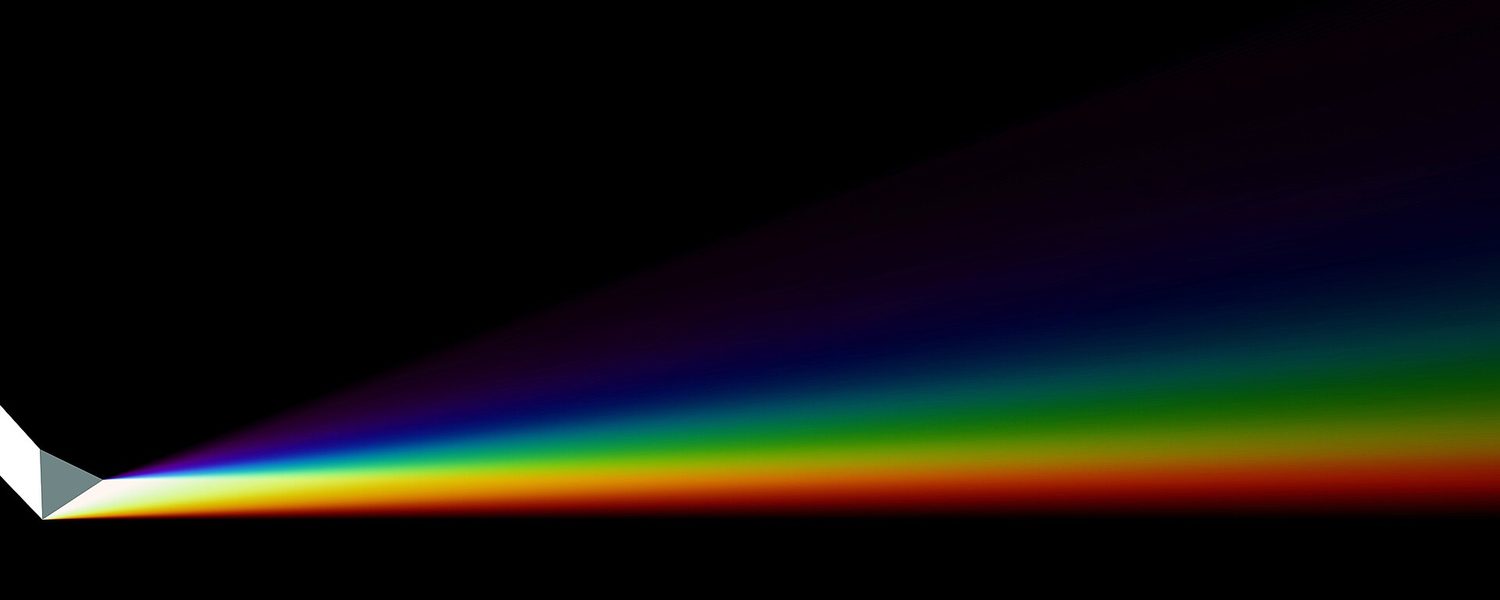
Ánh sáng trắng tách ra thành quang phổ qua lăng kính thủy tinh
Khúc xạ làm bẻ mỗi màu với một góc độ khác nhau, nên lăng kính phân tán ánh sáng trắng thành cầu vồng
Explore · ⁨Khám phá⁩

Bend light as it enters glass · ⁨ khúc xạ ánh sáng khi vào thủy tinh⁩

Light refracts (bends) when it changes speed between media, following Snell's law. The denser the medium, the more it bends toward the normal. · ⁨Ánh sáng khúc xạ (bị lệch) khi thay đổi tốc độ giữa các môi trường, tuân theo định luật Snell. Môi trường càng đặc thì ánh sáng càng lệch về phía pháp tuyến.⁩

Vocabulary · ⁨Từ vựng⁩ Train · ⁨Luyện tập⁩
English Tiếng Việt
refraction/rɪˈfrækʃn/ khúc xạ
index of refraction/ˈɪndeks ɒv rɪˈfrækʃn/ Chiết suất
Snell's law/snelz lɔː/ Định luật Snell
total internal reflection/ˈtəʊtl ɪnˈtɜːnl rɪˈflekʃn/ phản xạ toàn phần
Watch lesson · ⁨Xem bài học⁩
13.4

Images Formed by Lenses · ⁨Ảnh tạo bởi Thấu kính⁩

Syllabus · ⁨Chương trình⁩
English

Learning Objective 13.4.A: Describe the image formed by a lens.

  • 13.4.A.1 Incident light rays parallel to the principal axis of a thin convex (converging) lens will be refracted and converge toward a common location on the transmitted side of the lens, called the focal point.
  • 13.4.A.2 Incident light rays parallel to the principal axis of a thin concave (diverging) lens will be refracted and diverge as if they originated from a focal point on the incident side of the lens.
  • 13.4.A.3 A real image is formed by a lens when light rays originating from a common point are refracted such that they intersect at another common point.
  • 13.4.A.4 A virtual image is formed by a lens when refracted light rays diverge such that they appear to have originated from a common point.
  • 13.4.A.5 For a thin lens, the location of an image depends on the focal length of the lens and the distance between the object and the midline of the lens, as given by the thin-lens equation:
    • Equation: $\dfrac{1}{s_i} + \dfrac{1}{s_o} = \dfrac{1}{f}$
    • 13.4.A.5.i The locations of a lens's focal point, an object, and the image of the object formed by the lens follow sign conventions that are used to determine those locations relative to the lens itself.
    • 13.4.A.5.ii Lenses have a focal point on both sides of the lens that depends on the shape of the respective side of the lens.
  • 13.4.A.6 For a thin lens, the magnification of an image is the ratio of the size of the image produced to the size of the object itself and depends on the locations of the object and image relative to the lens.
    • Equation: $|M| = \left| \dfrac{h_i}{h_o} \right| = \left| \dfrac{s_i}{s_o} \right|$
  • 13.4.A.7 Ray diagrams can be used to determine the location, type, size, and orientation of images formed by lenses.
    • 13.4.A.7.i The three principal rays are typically used to find the images formed by lenses. The principal rays are 1) the ray parallel to the principal axis, 2) the ray that passes through the center of the lens where the principal axis intersects the lens, and 3) the ray that passes through the focal point of the lens.
    • 13.4.A.7.ii Images formed by a lens can be upright or inverted, virtual or real, and reduced, enlarged, or the same size as the object.
Tiếng Việt

Mục tiêu học tập 13.4.A: Mô tả ảnh được tạo bởi một thấu kính.

  • 13.4.A.1 Các tia tới song song với trục chính của thấu kính hội tụ mỏng sẽ bị khúc xạ và hội tụ về một điểm chung ở phía truyền qua của thấu kính, gọi là tiêu điểm.
  • 13.4.A.2 Các tia tới song song với trục chính của thấu kính phân kỳ mỏng sẽ bị khúc xạ và phân kỳ như thể chúng xuất phát từ một tiêu điểm nằm ở phía tới của thấu kính.
  • 13.4.A.3 Ảnh thật được tạo bởi thấu kính khi các tia sáng xuất phát từ một điểm chung bị khúc xạ sao cho chúng cắt nhau tại một điểm chung khác.
  • 13.4.A.4 Ảnh ảo được tạo bởi thấu kính khi các tia khúc xạ phân kỳ sao cho chúng trông như thể xuất phát từ một điểm chung.
  • 13.4.A.5 Đối với thấu kính mỏng, vị trí của ảnh phụ thuộc vào tiêu cự của thấu kính và khoảng cách giữa vật và đường trung tâm của thấu kính, như được cho bởi phương trình thấu kính mỏng:
    • Phương trình: $\dfrac{1}{s_i} + \dfrac{1}{s_o} = \dfrac{1}{f}$
    • 13.4.A.5.i Vị trí của tiêu điểm thấu kính, vật và ảnh của vật do thấu kính tạo ra tuân theo quy ước dấu dùng để xác định các vị trí đó so với bản thân thấu kính.
    • 13.4.A.5.ii Thấu kính có tiêu điểm ở cả hai phía của thấu kính tùy thuộc vào hình dạng của từng mặt tương ứng của thấu kính.
  • 13.4.A.6 Đối với thấu kính mỏng, độ phóng đại của ảnh là tỷ lệ giữa kích thước ảnh tạo thành và kích thước thực tế của vật, phụ thuộc vào vị trí của vật và ảnh so với thấu kính.
    • Phương trình: $|M| = \left| \dfrac{h_i}{h_o} \right| = \left| \dfrac{s_i}{s_o} \right|$
  • 13.4.A.7 Sơ đồ tia có thể được sử dụng để xác định vị trí, loại, kích thước và hướng của các ảnh được tạo bởi thấu kính.
    • 13.4.A.7.i Ba tia chính thường được sử dụng để tìm ảnh tạo bởi thấu kính. Các tia chính gồm: 1) tia song song với trục chính, 2) tia đi qua tâm thấu kính nơi trục chính cắt thấu kính, và 3) tia đi qua tiêu điểm của thấu kính.
    • 13.4.A.7.ii Ảnh tạo bởi thấu kính có thể thẳng đứng hoặc ngược, ảo hoặc thật, và có thể nhỏ hơn, lớn hơn hoặc bằng kích thước vật.

Source: College Board AP Course and Exam Description · ⁨Nguồn: Mô tả Khóa học và Bài thi College Board AP⁩

English
A converging lens forms a real image

A lens bends light through refraction. The thin-lens equation has the same form as the mirror equation:

$$\frac{1}{d_o}+\frac{1}{d_i}=\frac{1}{f},\qquad m=-\frac{d_i}{d_o}.$$
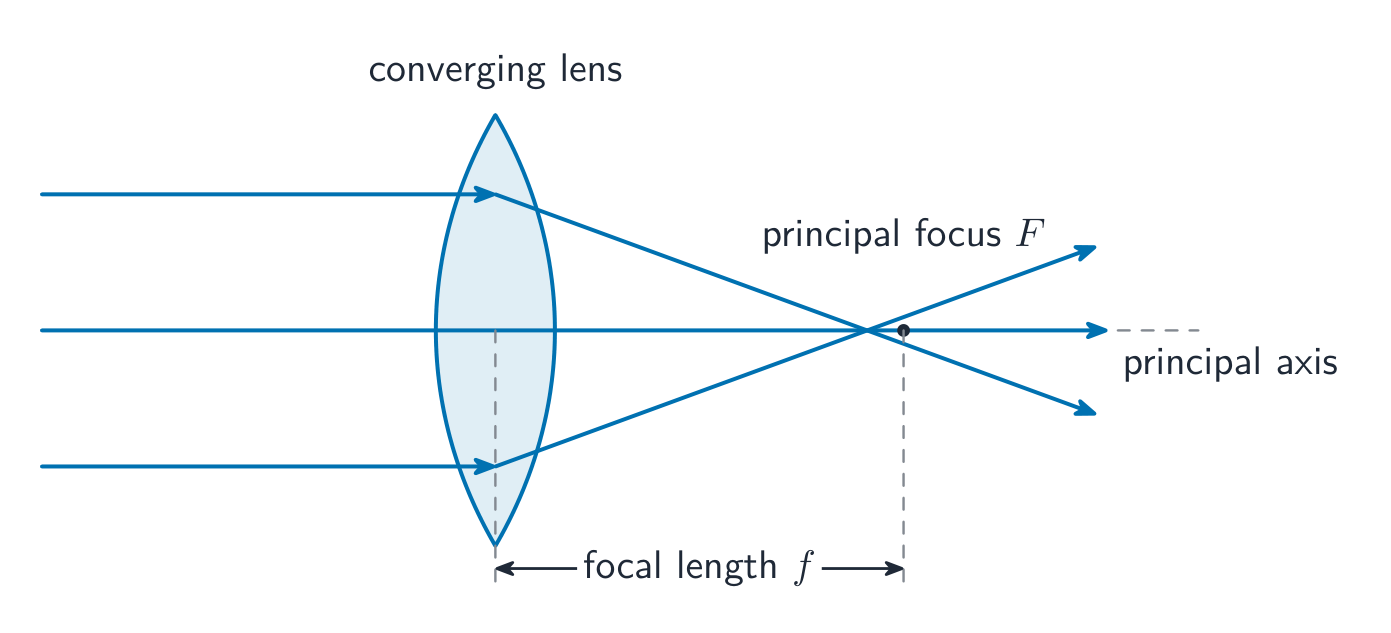
A converging 会聚 (convex) lens can form a real, inverted image or, for a close object, a virtual, upright, enlarged image (a magnifying glass). A diverging 发散 (concave) lens always forms a virtual, upright, reduced image. Ray diagrams locate the image quickly using two easy rays: one parallel to the axis that bends to pass through the far focus, and one straight through the centre of the lens (undeviated).

Worked example. An object sits $30\ \text{cm}$ from a converging lens of focal length $f=10\ \text{cm}$. Find the image. From the thin-lens equation,

$$\frac{1}{d_i}=\frac{1}{f}-\frac{1}{d_o}=\frac{1}{10}-\frac{1}{30}=\frac{2}{30}\;\Rightarrow\;d_i=15\ \text{cm},$$
and the magnification is $m=-d_i/d_o=-15/30=-0.5$. The image is real (positive $d_i$), inverted (negative $m$), and half the object's size – just what a camera lens does.

Tiếng Việt
Thấu hội tụ tạo ảnh thật

Một thấu kính làm khúc xạ ánh sáng. Phương trình thấu kính mỏng có dạng tương tự như phương trình gương:

$$\frac{1}{d_o}+\frac{1}{d_i}=\frac{1}{f},\qquad m=-\frac{d_i}{d_o}.$$
Một thấu hội tụ (lồi) có thể tạo ảnh thật, ngược chiều hoặc, đối với vật gần, tạo ảnh ảo, cùng chiều, phóng to (kính lúp). Một thấu phân kỳ (củi) luôn tạo ảnh ảo, cùng chiều, thu nhỏ. Sơ đồ tia xác định vị trí ảnh nhanh chóng bằng hai tia đơn giản: một tia song song với trục chính bị khúc xạ đi qua tiêu điểm xa, và một tia đi thẳng qua tâm thấu kính (không bị lệch).

Hai tia xác định vị trí ảnh: tia song song rồi đi qua tiêu điểm, và tia đi thẳng qua tâm
Thấu hội tụ tập hợp các tia song song về tiêu điểm chính

Ví dụ giải. Một vật đặt $30\ \text{cm}$ từ một thấu kính hội tụ có tiêu cự $f=10\ \text{cm}$. Tìm ảnh. Từ phương trình thấu kính mỏng,

$$\frac{1}{d_i}=\frac{1}{f}-\frac{1}{d_o}=\frac{1}{10}-\frac{1}{30}=\frac{2}{30}\;\Rightarrow\;d_i=15\ \text{cm},$$
và độ phóng đại là $m=-d_i/d_o=-15/30=-0.5$. Ảnh là ảnh thật (dấu $d_i$ dương), ngược chiều (dấu $m$ âm) và có kích thước bằng một nửa vật – đúng như chức năng của ống kính máy ảnh.

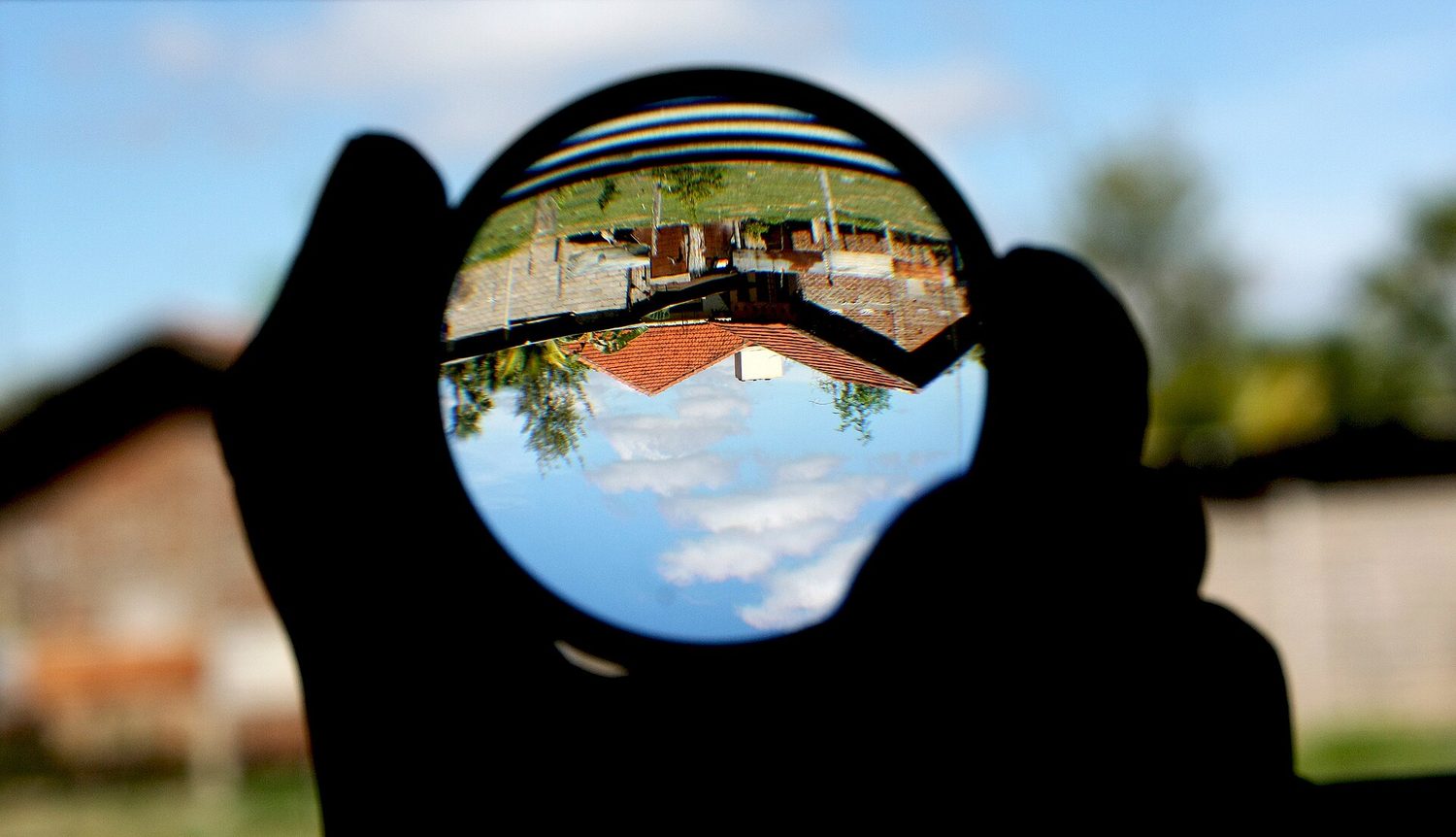
Kính lúp hiển thị ảnh ngược phía sau nó
Thấu kính lồi tạo ảnh thật, ngược chiều của cảnh xa, đúng như sơ đồ tia dự đoán
Explore · ⁨Khám phá⁩

Form an image with a converging lens · ⁨Tạo ảnh bằng thấu kính hội tụ⁩

A converging lens bends parallel rays to its focal point. Move the object and watch the image change from large and inverted to virtual and upright inside the focal length. · ⁨Thấu kính hội tụ bẻ các tia song song về tiêu điểm. Di chuyển vật và quan sát ảnh thay đổi từ lớn và ngược chiều sang ảo và cùng chiều khi nằm trong tiêu cự.⁩

Vocabulary · ⁨Từ vựng⁩ Train · ⁨Luyện tập⁩
English Tiếng Việt
converging/kənˈvɜːdʒɪŋ/ Hội tụ
diverging/daɪˈvɜːdʒɪŋ/ Phân kỳ
Watch lesson · ⁨Xem bài học⁩
13.4

Exam tips · ⁨Mẹo làm bài thi⁩

English
  • Measure all angles from the normal, not the surface.
  • Light entering a denser medium (larger $n$) bends toward the normal; use Snell's law $n_1\sin\theta_1=n_2\sin\theta_2$.
  • Total internal reflection happens only going into a less dense medium, beyond the critical angle ($\sin\theta_c=1/n$).
  • For mirrors and lenses use $\tfrac1{d_o}+\tfrac1{d_i}=\tfrac1f$ and $m=-d_i/d_o$: a positive $d_i$ is a real image, negative is virtual.
  • $n=c/v$, so a bigger index means a slower speed of light in the material.
Tiếng Việt
  • Đo tất cả các góc từ pháp tuyến, không phải từ bề mặt.
  • Ánh sáng đi vào môi trường dày hơn ($n$ lớn hơn) bị khúc xạ về phía pháp tuyến; sử dụng định luật Snell $n_1\sin\theta_1=n_2\sin\theta_2$.
  • Phản xạ toàn phần chỉ xảy ra khi đi vào môi trường mỏng hơn, vượt quá góc tới hạn ($\sin\theta_c=1/n$).
  • Đối với gương và thấu kính dùng $\tfrac1{d_o}+\tfrac1{d_i}=\tfrac1f$ và $m=-d_i/d_o$: $d_i$ dương là ảnh thật, âm là ảnh ảo.
  • $n=c/v$, do đó chỉ số khúc xạ càng lớn thì tốc độ ánh sáng trong vật liệu càng chậm.

Interactive lessons on this topic · ⁨Bài học tương tác về chủ đề này⁩

Work through it step by step, with instant-check exercises. · ⁨Làm theo từng bước, kèm theo bài tập kiểm tra ngay lập tức.⁩

Past Papers · ⁨Đề thi cũ⁩

More topics in AP Physics 2 · ⁨AP Vật lý 2⁩ · ⁨Nhiều chủ đề hơn trong AP Physics 2 · ⁨AP Vật lý 2⁩⁩

Log in or create account · ⁨Đăng nhập hoặc tạo tài khoản⁩

IGCSE, A-Level & AP