| Learning Objective | Essential Knowledge |
|---|---|
14.1.A |
|
Waves, Sound, and Physical Optics
AP Physics 2 · Topic 14
 7:50
Waves, Sound, and Physical Optics
Blow a soap bubble and look closely. The film is thinner than a hair and has no colour of its own, and the light falling on it is plain white light. Yet the…
English narration · English + 中文 subtitles burned in
14.1
Properties of Wave Pulses and Waves

Syllabus
Source: College Board AP Course and Exam Description
A guitar string, a microwave oven, polarized sunglasses and the colours on a soap bubble all work by the same few wave ideas. A wave carries energy from place to place. When two waves meet they simply add. This unit builds from a single pulse on a rope to the bright and dark bands that proved light is a wave.
A wave 波 carries energy through a medium (or space) without carrying the matter along. A single travelling disturbance is a pulse; a repeating disturbance forms a periodic wave. Two types:

- Transverse 横波: oscillations are perpendicular to the wave's travel. Rope particles move; for light it is the electric and magnetic fields that oscillate.
- Longitudinal 纵波: the medium moves along the direction of travel (sound).
A wave pulse 波脉冲 is one single disturbance, such as one flick of a rope. Both pulses and waves move energy, not matter: a cork on a pond bobs up and down as ripples pass, but it does not travel with them. Mechanical waves 机械波 (on strings, in water, sound) need a medium. Electromagnetic waves do not: they cross empty space at $c=3.00\times10^{8}\ \text{m/s}$.
What sets the speed. The medium does. On a string the speed rises with the tension $F_T$ and falls with the linear mass density 线密度 $\mu$ (mass per length):
$$v=\sqrt{\frac{F_T}{\mu}}.$$
A tight, light string carries waves fast. Sound travels faster in warmer air, because the molecules move faster.
Worked example. A string has $\mu=5.0\times10^{-3}\ \text{kg/m}$ and tension $80\ \text{N}$: $v=\sqrt{80/0.0050}=\sqrt{16\,000}=126\ \text{m/s}$. Making the tension four times larger doubles the speed.
Sound as a pressure wave. Sound is a longitudinal mechanical wave. Air molecules crowd together in compressions 密部 (high pressure) and spread apart in rarefactions 疏部 (low pressure). The amplitude of a sound wave is the largest rise (or fall) in pressure from normal air pressure. A larger amplitude sounds louder and carries more energy.
Explore
Transverse or longitudinal
Switch between transverse and longitudinal and watch how the particles move relative to travel.
Vocabulary
Train
| English |
|---|
| wave/weɪv/ |
| Transverse/trænsˈvɜːs/ |
| Longitudinal/ˌlɒŋɡɪˈtjuːdɪnl/ |
| wave pulse |
| mechanical wave |
| linear mass density |
| compression/kəmˈpreʃn/ |
| rarefaction/ˌreərɪˈfækʃn/ |
14.2
Periodic Waves

Syllabus
| Learning Objective | Essential Knowledge |
|---|---|
14.2.A |
|
Source: College Board AP Course and Exam Description
A repeating wave is described by:
- wavelength 波长 $\lambda$ (distance between repeats),
- frequency 频率 $f$ (cycles per second) and period $T=1/f$,
- amplitude 振幅 $A$ (maximum displacement – related to energy),
- wave speed 波速 $v=f\lambda$, set by the medium, not the source.
Worked example. A musical note has frequency $340\ \text{Hz}$ and the speed of sound is $340\ \text{m/s}$. Its wavelength is $\lambda=v/f=340/340=1.0\ \text{m}$. If the same note travels into water (where sound moves at $\approx 1500\ \text{m/s}$) the frequency stays $340\ \text{Hz}$ but the wavelength stretches to $1500/340\approx 4.4\ \text{m}$ – the source sets the frequency, the medium sets the speed and hence the wavelength.
Separate properties. The amplitude does not depend on the period or the frequency: you can pluck the same note softly or loudly. The frequency of a sound sets its pitch 音调 (higher frequency, higher note), and its amplitude sets how loud it is. For waves of the same amplitude, the one with the higher frequency carries more energy.
Two graphs, two equations. A sinusoidal wave can be written two ways. At one fixed place, the displacement changes with time: $y=A\cos\left(\dfrac{2\pi t}{T}\right)$. At one fixed time, the displacement changes along the wave: $y=A\cos\left(\dfrac{2\pi x}{\lambda}\right)$. Read the period $T$ from a displacement-time graph and the wavelength $\lambda$ from a displacement-position graph; check the axis label before reading either.
Explore
Send a periodic wave
A periodic wave carries energy without moving matter. Its speed $v=f\lambda$ links frequency and wavelength; raise the frequency and the wavelength shrinks.
Vocabulary
Train
| English |
|---|
| wavelength/ˈweɪvleŋθ/ |
| frequency/ˈfriːkwənsi/ |
| amplitude/ˈæmplɪtjuːd/ |
| wave speed/weɪv spiːd/ |
| pitch/pɪtʃ/ |
14.3
Boundary Behavior and Polarization

Syllabus
| Learning Objective | Essential Knowledge |
|---|---|
14.3.A |
|
Source: College Board AP Course and Exam Description
At a boundary a wave partly reflects and partly transmits. Reflecting off a denser medium inverts the wave; off a less-dense medium it does not. The exact rule is about speed. A pulse going from a light rope into a heavy rope (where it slows down) reflects inverted. A pulse going from a heavy rope into a light rope (where it speeds up) reflects upright. The transmitted pulse is never inverted, and its frequency never changes at a boundary. Polarization 偏振 applies to transverse waves only: a polarizer passes just one direction of oscillation, which is why polarized sunglasses cut glare. Light that reflects off water or a road is partly polarized (mostly horizontal), so sunglasses that pass only vertical oscillations block most of the glare. Longitudinal waves, such as sound, cannot be polarized: the oscillation is already along the direction of travel.
The effect of a polarizer is measured through intensity 强度 - the average power a wave delivers per unit area over one period, in $\text{W m}^{-2}$. Because a polarizer removes the components of the oscillation that are not aligned with it, it reduces the wave's intensity: unpolarized light passing a single ideal polarizer drops to half its intensity, and a second polarizer at an angle cuts it further. Intensity also falls with distance from a source, since the same power spreads over a larger area.
Vocabulary
Train
| English |
|---|
| Polarization/ˌpəʊləraɪˈzeɪʃn/ |
| intensity/ɪnˈtensɪti/ |
14.4
Electromagnetic Waves

Syllabus
| Learning Objective | Essential Knowledge |
|---|---|
14.4.A |
Boundary statement: AP Physics 2 expects students to know the ordering of the electromagnetic spectrum (including visible light). However, students will not be expected to define exact wavelength ranges within the electromagnetic spectrum. |
Source: College Board AP Course and Exam Description
Electromagnetic waves 电磁波 are oscillating electric and magnetic fields that travel through vacuum at the speed of light $c$, needing no medium. They span the spectrum from radio to gamma rays; higher frequency means shorter wavelength and higher photon energy.
The electric field and the magnetic field are perpendicular to each other and to the direction of travel, so electromagnetic waves are transverse. Far from the source the wavefronts are flat, so they are treated as plane waves 平面波. In order of decreasing wavelength the spectrum runs: radio waves, microwaves, infrared, visible, ultraviolet, X-rays, gamma rays. Visible light runs from red (about $700\ \text{nm}$) through orange, yellow, green and blue to violet (about $400\ \text{nm}$).
Worked example. Wi-Fi uses $f=2.4\ \text{GHz}$: $\lambda=\dfrac{c}{f}=\dfrac{3.00\times10^{8}}{2.4\times10^{9}}=0.125\ \text{m}$, about $12\ \text{cm}$, in the microwave band.
Explore
Explore the spectrum
Slide across the spectrum from radio to gamma and see the wavelength and uses change.
Vocabulary
Train
| English |
|---|
| Electromagnetic waves/ɪˌlektrəʊməɡˈnetɪk weɪvz/ |
| plane wave |
14.5
The Doppler Effect

Syllabus
| Learning Objective | Essential Knowledge |
|---|---|
14.5.A |
Boundary statement: Only qualitative treatments of the Doppler effect are required for AP Physics 2. |
Source: College Board AP Course and Exam Description
The Doppler effect 多普勒效应 is the change in observed frequency when a wave source and observer move relative to each other. Approaching $\Rightarrow$ higher frequency (shorter wavelength); receding $\Rightarrow$ lower frequency. It explains a passing siren's drop in pitch and the redshift of receding galaxies.
The frequency the source actually emits is its rest frequency. The faster the source and observer approach (or separate), the bigger the difference between the observed frequency and the rest frequency. If source and observer move with the same velocity, there is no relative motion and no shift. The wave speed in the medium does not change; only the spacing of the wavefronts does.
Explore
Hear the Doppler shift
When a source moves, waves bunch up ahead (higher frequency) and stretch behind (lower) — the Doppler effect. Speed it up to exaggerate the shift.
Vocabulary
Train
| English |
|---|
| Doppler effect/ˈdɒplə ɪˈfekt/ |
14.6
Wave Interference and Standing Waves
Syllabus
| Learning Objective | Essential Knowledge |
|---|---|
14.6.A |
|
14.6.B |
|
Source: College Board AP Course and Exam Description
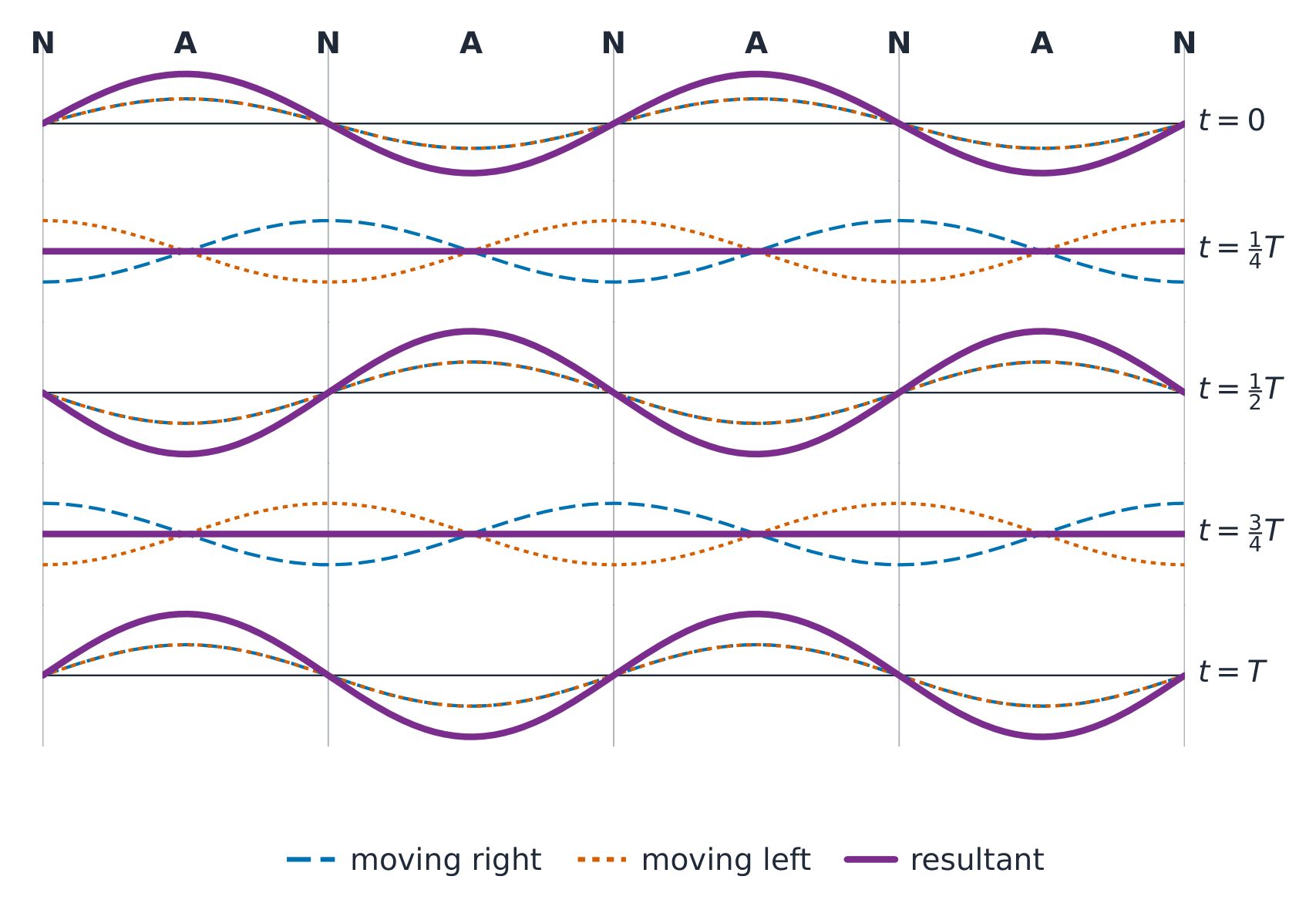
When waves overlap they superpose (add). Two pulses meeting on a rope do not bounce off each other: they pass through each other. While they overlap, the displacement at each point is the sum of the two displacements (superposition 叠加). Afterwards each pulse carries on unchanged. Constructive interference 相长干涉 (crests aligned) gives a bigger wave; destructive interference 相消干涉 (crest on trough) cancels. Two waves of the same frequency and speed, with equal amplitudes and opposite directions, can form a standing wave 驻波 with fixed nodes 波节 (no motion) and antinodes 波腹 (maximum motion) – the basis of resonance on strings and in pipes.
Worked example. A guitar string $0.65\ \text{m}$ long is fixed at both ends. Its fundamental (first harmonic) fits half a wavelength between the ends, so $\lambda=2L=1.30\ \text{m}$. If waves travel along the string at $260\ \text{m/s}$, the note's frequency is $f=v/\lambda=260/1.30=200\ \text{Hz}$. Shortening the string (a fret) raises the pitch.
Standing waves in pipes. Air in a pipe can hold standing sound waves too. An open end is always a displacement antinode; a closed end is always a node. The longest wavelength that fits is the fundamental, or first harmonic 谐波, and each allowed wavelength gives one harmonic:
- string fixed at both ends, or pipe open at both ends: $\lambda_n=\dfrac{2L}{n}$, $f_n=nf_1$ for $n=1,2,3,\dots$
- pipe closed at one end: $\lambda_n=\dfrac{4L}{n}$, $f_n=nf_1$ for odd $n=1,3,5,\dots$ only.
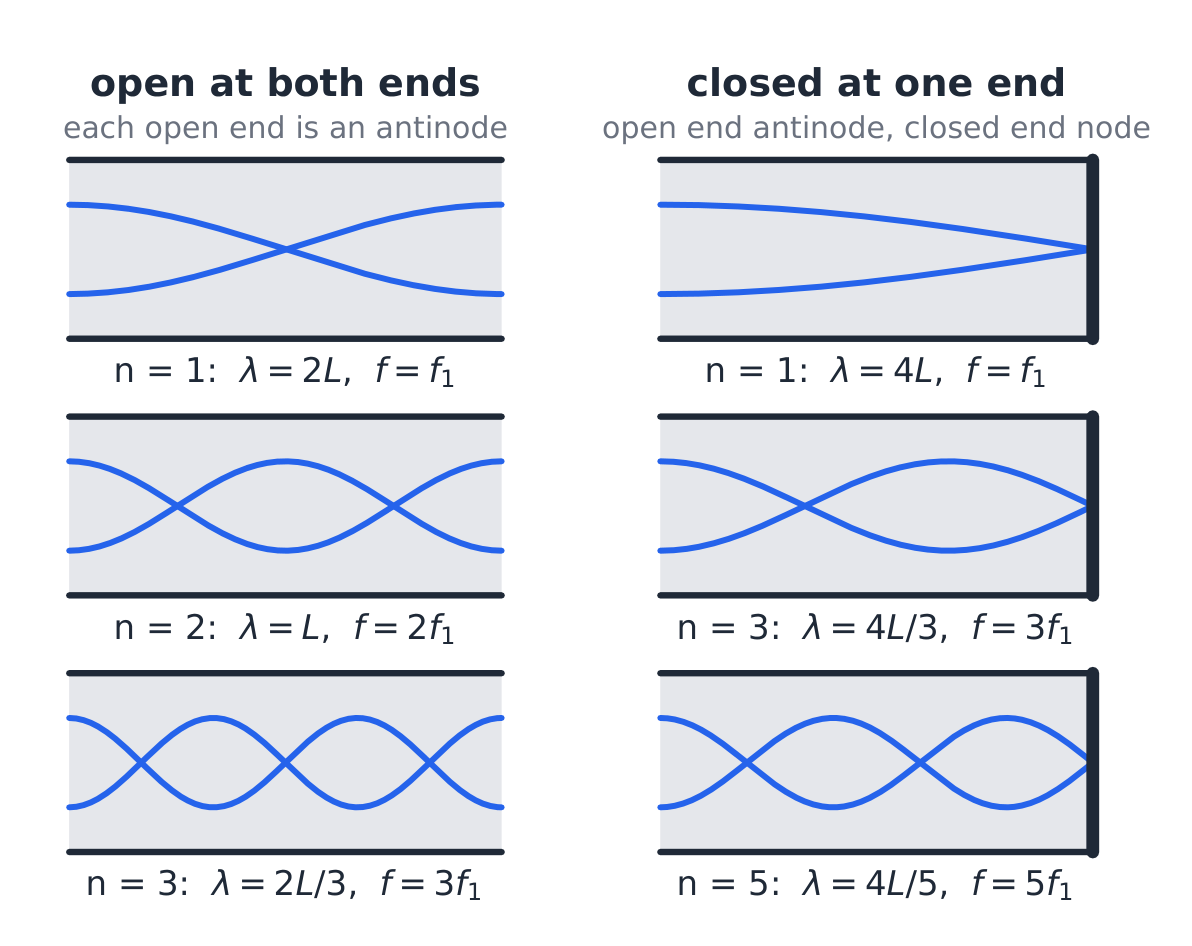
Worked example. A pipe $0.85\ \text{m}$ long is closed at one end; sound travels at $340\ \text{m/s}$. The fundamental has $\lambda=4L=3.4\ \text{m}$, so $f_1=340/3.4=100\ \text{Hz}$. The next possible frequencies are $300\ \text{Hz}$ and $500\ \text{Hz}$: $200\ \text{Hz}$ cannot form, because a closed end must be a node. Open the closed end and $\lambda=2L=1.7\ \text{m}$, so $f_1=200\ \text{Hz}$.
When two waves of slightly different frequency overlap, they drift in and out of step, so the combined sound swells loud and soft in a slow throb called beats 拍. The beat frequency 拍频 is simply the difference of the two frequencies:
$$f_{\text{beat}}=|f_1-f_2|.$$
Two tuning forks of $256\ \text{Hz}$ and $260\ \text{Hz}$ sounded together give $|260-256|=4$ beats each second; a musician tunes an instrument by slowing these beats towards zero against a reference note.
Explore
Set up a standing wave
Two waves travelling opposite ways interfere into a standing wave with fixed nodes and antinodes. Only certain frequencies fit, giving the harmonics.
Vocabulary
Train
| English |
|---|
| superposition/ˌsuːpəpəˈzɪʃn/ |
| Constructive interference/kənˈstrʌktɪv ˌɪntəˈfɪərəns/ |
| destructive interference/dɪˈstrʌktɪv ˌɪntəˈfɪərəns/ |
| standing wave/ˈstændɪŋ weɪv/ |
| nodes/nəʊdz/ |
| antinodes/ˌæntɪˈnəʊdz/ |
| harmonic/hɑːˈmɒnɪk/ |
| beats/biːts/ |
| beat frequency/biːt ˈfriːkwənsi/ |
14.7
Diffraction
Syllabus
| Learning Objective | Essential Knowledge |
|---|---|
14.7.A |
|
Source: College Board AP Course and Exam Description
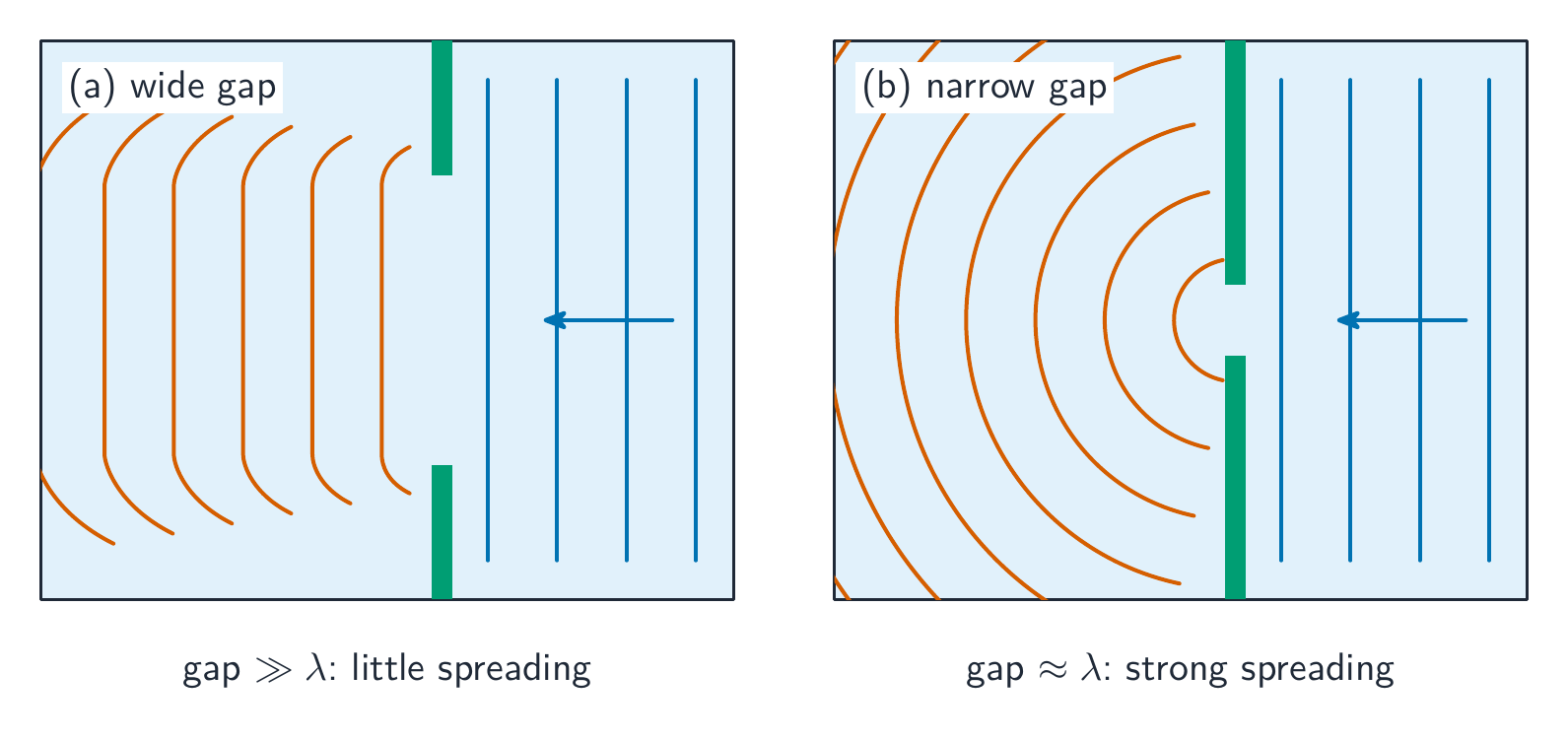
Diffraction 衍射 is the bending and spreading of waves around edges or through openings. The spreading is significant when the opening is comparable to the wavelength – so sound (long wavelength) bends around doorways easily, while light (tiny wavelength) needs a very narrow slit.
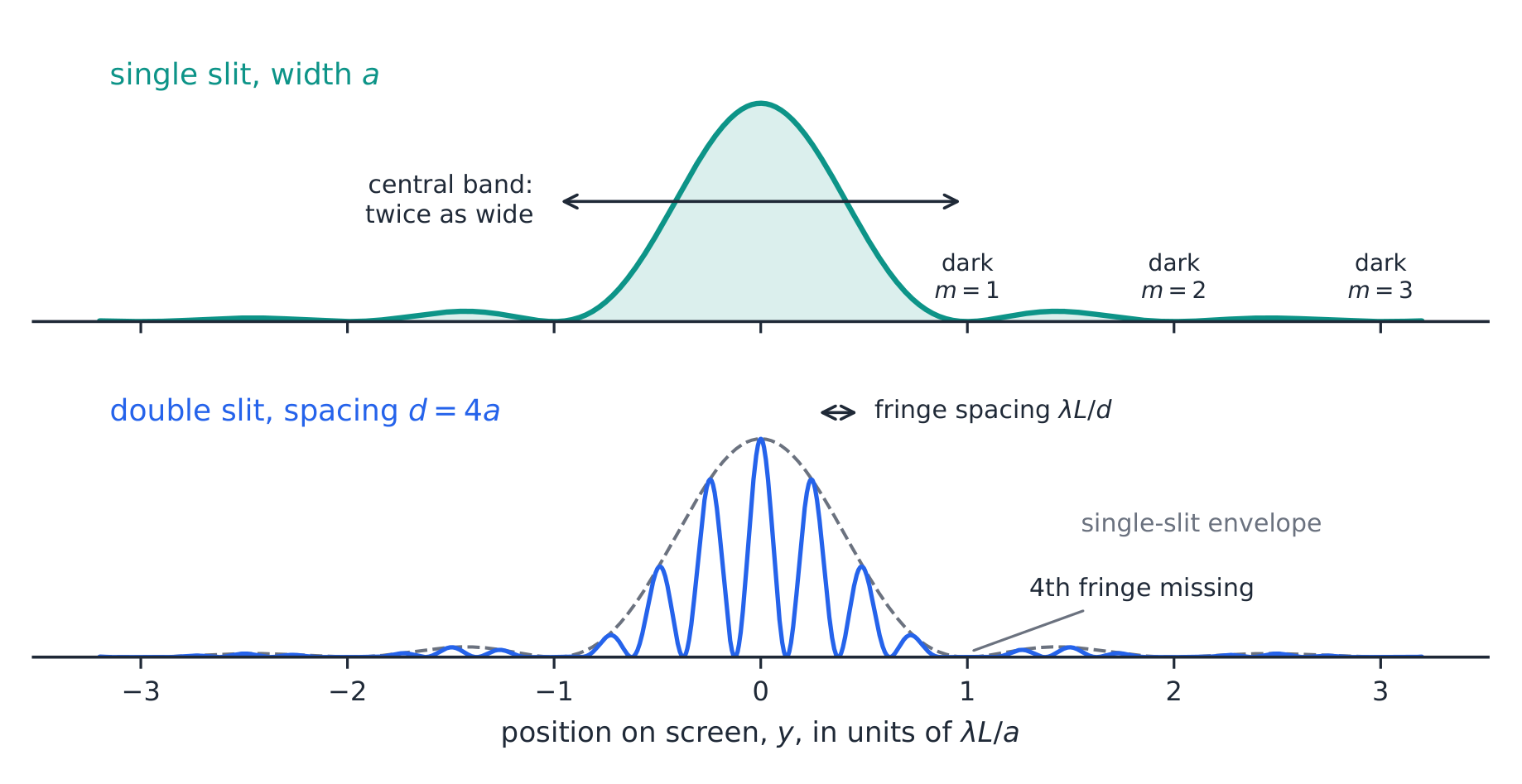
The single slit. Light through one narrow slit of width $a$ still makes bright and dark bands, because waves from different parts of the slit interfere. The path difference between waves from the two edges is $\Delta D=a\sin\theta$. Dark bands appear where
$$a\sin\theta=m\lambda\quad(m=1,2,3,\dots),\qquad y_{\min}\approx\frac{m\lambda L}{a}\ \text{(small angles)}.$$
The central bright band is twice as wide as the others. A narrower slit gives a wider pattern. The pattern also depends on the opening's shape: a round hole gives rings.
Explore
More or less diffraction?
Waves spread most when the gap is comparable to their wavelength. Sort each case.
Vocabulary
Train
| English |
|---|
| Diffraction/dɪˈfrækʃn/ |
14.8
Double-Slit Interference and Diffraction Gratings
Syllabus
| Learning Objective | Essential Knowledge |
|---|---|
14.8.A |
|
Source: College Board AP Course and Exam Description
Coherent 相干 light through two closely spaced slits produces a pattern of bright and dark fringes. Bright fringes occur where the path difference is a whole number of wavelengths:
$$d\sin\theta=m\lambda.$$
A diffraction grating 衍射光栅 has many slits, giving sharp, widely spaced bright lines – useful for separating light into its wavelengths.
For small angles ($\theta<10^{\circ}$), $\sin\theta\approx\tan\theta=y/L$, so the bright fringes sit at
$$y_{\max}\approx\frac{m\lambda L}{d}.$$
They are evenly spaced, $\lambda L/d$ apart. Each slit also diffracts, so the real double-slit pattern is a set of evenly spaced fringes inside the single-slit envelope. The fringes fade away from the centre, and any fringe that lands on a single-slit dark band is missing. Young's double-slit experiment showed this pattern, and it proved that light is a wave.
With white light on a grating, the central maximum ($m=0$) is white, because every colour has zero path difference there. In each higher order the colours spread out into a spectrum, with red (longest wavelength) farthest from the centre.

Worked example. Light of wavelength $600\ \text{nm}$ passes through two slits $0.20\ \text{mm}$ apart. The first bright fringe ($m=1$) sits at
$$\sin\theta=\frac{m\lambda}{d}=\frac{1\times600\times10^{-9}}{0.20\times10^{-3}}=3.0\times10^{-3}\;\Rightarrow\;\theta=0.17^{\circ}.$$
The tiny angle is why the slits must be very close together and the screen far away to see the fringes clearly.
Worked example (red or violet?). A student claims that the first bright band beside the centre is closer to the centre with violet light than with red light. Reason from the path difference, not the formula: at that band the light from one slit travels exactly one wavelength farther than from the other. Violet has the shorter wavelength, so the path difference needed is smaller, and it is reached at a smaller angle, closer to the centre. The claim is correct. The equation agrees: with $\lambda=c/f$, $y_{\max}=\dfrac{mcL}{fd}$, so a higher frequency gives a smaller $y$.
Worked example (slits under water). Put the whole double-slit set-up under water ($n=1.33$). The frequency stays the same, but the light slows to $c/n$, so the wavelength becomes $\lambda/n$. Each fringe needs a smaller path difference, so the fringes move closer together, by the factor $1.33$. A liquid with a larger index squeezes them even closer.

Explore
Superpose two waves
Where two waves arrive in phase they add (bright fringe); out of phase they cancel (dark fringe). That interference makes the double-slit pattern.
Vocabulary
Train
| English |
|---|
| Coherent/kəʊˈhɪərənt/ |
| diffraction grating/dɪˈfrækʃn ˈɡreɪtɪŋ/ |
14.9
Thin-Film Interference
Syllabus
| Learning Objective | Essential Knowledge |
|---|---|
14.9.A |
Boundary statement: Quantitative analysis of thin-film interference is limited to waves that are normal to the incident surface. |
Source: College Board AP Course and Exam Description
Light reflecting off the top and bottom of a thin film 薄膜 (soap bubble, oil slick) interferes with itself. Depending on the film's thickness and a possible half-wavelength phase flip on reflection off a denser medium, particular wavelengths interfere constructively – producing the shifting colours you see.
The phase rules. A reflection off a material with a higher index of refraction flips the wave by $180^{\circ}$ (half a wavelength). A reflection off a lower index causes no flip. Refraction never changes the phase. The ray that goes down and back through a film of thickness $t$ travels an extra $2t$ (at near-normal incidence), and inside the film the wavelength is $\lambda/n_{\text{film}}$.
Worked example (oil on water). An oil film ($n=1.45$) floats on water ($n=1.33$) and looks green ($\lambda=540\ \text{nm}$ in air). The top reflection (air to oil) flips; the bottom reflection (oil to water, a lower index) does not. One flip means the two reflected waves are already half a wavelength out of step, so constructive interference needs
$$2t=\left(m+\tfrac{1}{2}\right)\frac{\lambda}{n_{\text{oil}}}.$$
The thinnest such film ($m=0$) is $t=\dfrac{\lambda}{4n_{\text{oil}}}=\dfrac{540}{4\times1.45}=93\ \text{nm}$. Other colours are reinforced where the oil is a different thickness, which is why an oil slick shows bands of colour.
The same physics is put to work in an antireflection coating 增透膜 on camera lenses, glasses, and solar cells: a thin transparent layer whose two reflected waves interfere destructively, so almost no light reflects and more is transmitted. For ideal non-absorbing materials at normal incidence, complete cancellation at one chosen vacuum wavelength $\lambda_0$ requires a film index $n_f=\sqrt{n_{\text{air}}n_{\text{glass}}}$ and thickness $\lambda_0/(4n_f)$, one quarter of a wavelength inside the film. Other wavelengths and incidence angles can still reflect some light.
Explore
Bright or dark film?
A thin film looks bright or dark depending on how the reflected waves combine. Sort each case.
Vocabulary
Train
| English |
|---|
| thin film/θɪn fɪlm/ |
| antireflection coating/ˌæntɪrɪˈflekʃn ˈkəʊtɪŋ/ |
14.9
Practice
Answer each before reading the answers below.
-
A wave on a string has frequency $50\ \text{Hz}$ and wavelength $0.80\ \text{m}$. Find its speed.
-
A string $0.90\ \text{m}$ long, fixed at both ends, carries waves at $180\ \text{m/s}$. Find the frequency of its fundamental and of its third harmonic.
-
A $440\ \text{Hz}$ tuning fork and a guitar string sound together and give $3$ beats per second. When the string is tightened slightly, the beats speed up to $5$ per second. What was the string's frequency before it was tightened?
-
Light of wavelength $500\ \text{nm}$ falls on a grating with $600$ lines per millimetre. Find the angles of the first-order and second-order bright lines, and the highest order that can be seen.
-
A student says: "A grating with more lines per millimetre squeezes the bright lines closer together." Correct the student.
-
A pipe $0.50\ \text{m}$ long is closed at one end. Sound travels at $340\ \text{m/s}$. Find its fundamental frequency and the next two frequencies it can produce.
-
Light of wavelength $500\ \text{nm}$ falls on two slits $0.25\ \text{mm}$ apart, and the screen is $2.0\ \text{m}$ away. Find the spacing of the bright fringes. What is the spacing if the whole apparatus is put under water ($n=1.33$)?
-
A soap film ($n=1.33$) in air is $100\ \text{nm}$ thick. Which wavelength (in air) is most strongly reflected?
14.9
Answers
-
$v=f\lambda=50\times0.80=40\ \text{m/s}$.
-
$\lambda_1=2L=1.80\ \text{m}$, so $f_1=\dfrac{180}{1.80}=100\ \text{Hz}$. The third harmonic is $3f_1=300\ \text{Hz}$.
-
The string was at $440\pm3=437$ or $443\ \text{Hz}$. Tightening raises its frequency, and the beats got faster, so it moved away from $440\ \text{Hz}$: it was $443\ \text{Hz}$.
-
$d=\dfrac{1}{600}\ \text{mm}=1.67\times10^{-6}\ \text{m}$. First order: $\sin\theta=\dfrac{500\times10^{-9}}{1.67\times10^{-6}}=0.30$, $\theta=17^{\circ}$. Second order: $\sin\theta=0.60$, $\theta=37^{\circ}$. Since $\sin\theta\le1$, $m\le d/\lambda=3.3$, so the third order ($\sin\theta=0.90$, $64^{\circ}$) is the highest.
-
More lines per millimetre means a smaller spacing $d$. From $d\sin\theta=m\lambda$, a smaller $d$ gives a larger $\sin\theta$, so the bright lines spread farther apart (and fewer orders fit).
-
$\lambda_1=4L=2.0\ \text{m}$, so $f_1=170\ \text{Hz}$. Only odd harmonics form: $3f_1=510\ \text{Hz}$ and $5f_1=850\ \text{Hz}$.
-
$\Delta y=\dfrac{\lambda L}{d}=\dfrac{500\times10^{-9}\times2.0}{0.25\times10^{-3}}=4.0\times10^{-3}\ \text{m}=4.0\ \text{mm}$. Under water the wavelength is $500/1.33=376\ \text{nm}$, so the spacing is $4.0/1.33=3.0\ \text{mm}$.
-
Air to soap flips the wave; soap to air does not. One flip, so constructive needs $2t=\left(m+\tfrac12\right)\dfrac{\lambda}{n}$. With $m=0$: $\lambda=4nt=4\times1.33\times100=532\ \text{nm}$, green.
14.9
Exam tips
- Use $v=f\lambda$; the source sets the frequency, and when a wave enters a new medium the frequency stays fixed while the speed and wavelength change.
- When a question says "without manipulating equations", argue from the path difference: a bright band needs a path difference of $m\lambda$, so a shorter wavelength gives bands closer to the centre.
- Distinguish transverse (vibration perpendicular, can be polarised) from longitudinal (vibration along the travel, e.g. sound).
- Constructive interference needs a path difference of a whole number of wavelengths; destructive needs a half-odd number.
- On a string fixed at both ends the fundamental fits half a wavelength ($\lambda=2L$).
- Diffraction is significant only when the gap is comparable to the wavelength — sound bends round doorways, light needs a very narrow slit.
- Beats: two waves of slightly different frequency throb at $f_{\text{beat}}=|f_1-f_2|$ (e.g. two tuning forks; tuning to zero beats).
- An antireflection coating is a quarter-wavelength-thick layer (index between air and glass) whose two reflections cancel, cutting the reflected light.
Common mistakes
- Saying the frequency of a wave changes when it enters a new medium. The frequency is set by the source; the speed and the wavelength change.
- Taking the string length as one wavelength for the fundamental. A string fixed at both ends has $L = \lambda/2$ in its fundamental mode.
- Using the slit width in the double-slit equation. $d\sin\theta = m\lambda$ uses the spacing between the slits.
- Forgetting the unit prefixes in interference: $1\ \text{nm} = 10^{-9}\ \text{m}$, $1\ \text{mm} = 10^{-3}\ \text{m}$.
- Saying a moving source changes the wave's speed. In the Doppler effect the speed in the medium is unchanged; the observed frequency and wavelength change.
- Saying sound can be polarized. Only transverse waves can be polarized; sound in air is longitudinal.
- Giving a pipe closed at one end even harmonics. A closed end must be a node, so only odd multiples of $f_1$ fit.
- In thin films, forgetting the phase flips or using the wavelength in air. Count the flips at the two surfaces first, then use $\lambda/n_{\text{film}}$ inside the film.
- Confusing the single-slit and double-slit formulas. $a\sin\theta=m\lambda$ gives single-slit dark bands; $d\sin\theta=m\lambda$ gives double-slit bright fringes.
Interactive lessons on this topic
Work through it step by step, with instant-check exercises.