| Learning Objective | Essential Knowledge |
|---|---|
12.1.A |
|
12.1.B |
|
12.1.C |
|
Magnetism and Electromagnetism
AP Physics 2 · Topic 12
 9:21
Magnetism and Electromagnetism
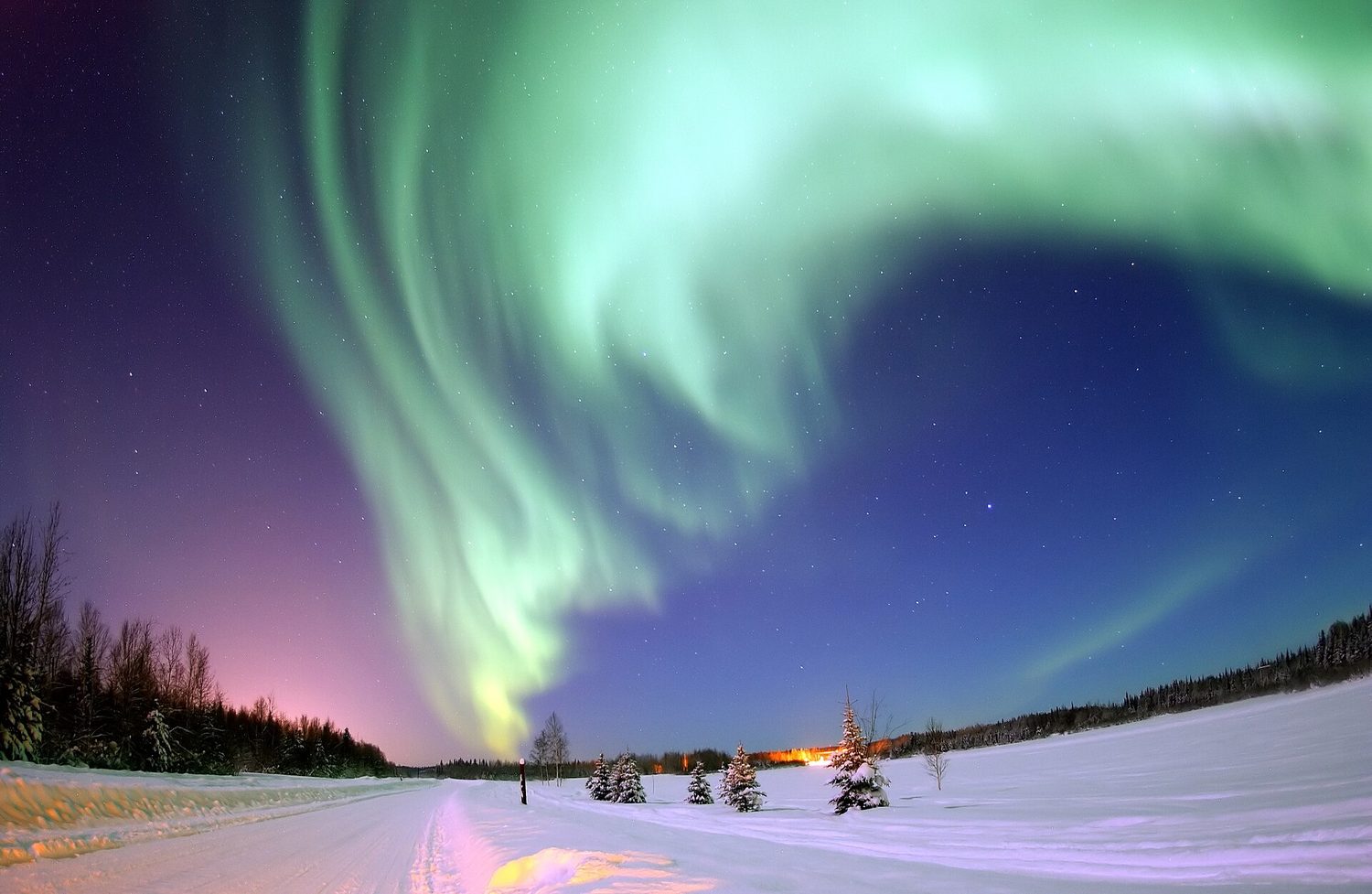
High over the Arctic, the night sky glows green. These curtains of light are not fire. They are charged particles from the Sun, arriving at a million…
English narration · English + 中文 subtitles burned in
12.1
Magnetic Fields
Syllabus
Source: College Board AP Course and Exam Description
Drop a strong magnet down a copper pipe and it falls slowly, as if through honey, though copper is not magnetic. Pull a magnet away from a coil and a current flows that tries to pull it back. This unit explains both, and the rule behind them: magnetism never gives energy away for free.
Different materials respond very differently to a magnetic field, and the course names three. Ferromagnetic 铁磁性 materials (iron, nickel, cobalt) can develop strongly aligned magnetic domains 磁畴 and retain some alignment, so suitable materials can be permanent magnets 永磁体. Paramagnetic 顺磁性 materials (aluminium, titanium) align only weakly and do not stay aligned. Diamagnetic 抗磁性 materials - in fact all materials have some diamagnetism - align weakly opposite the field. This behaviour comes from a material property, the permeability 磁导率: free space has a fixed permeability of free space 真空磁导率 $\mu_0$, while the permeability of matter differs from it and is not even constant for a given material.
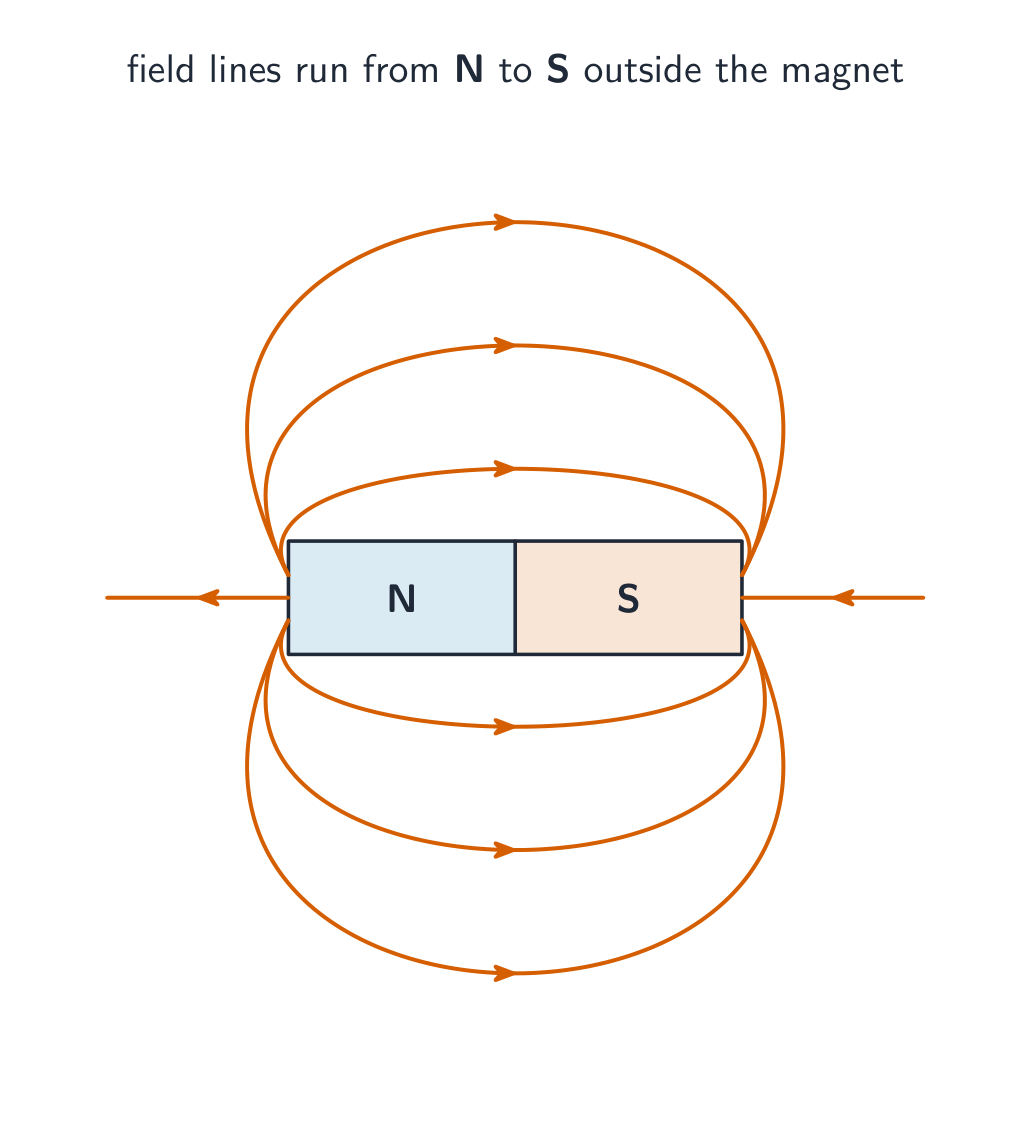
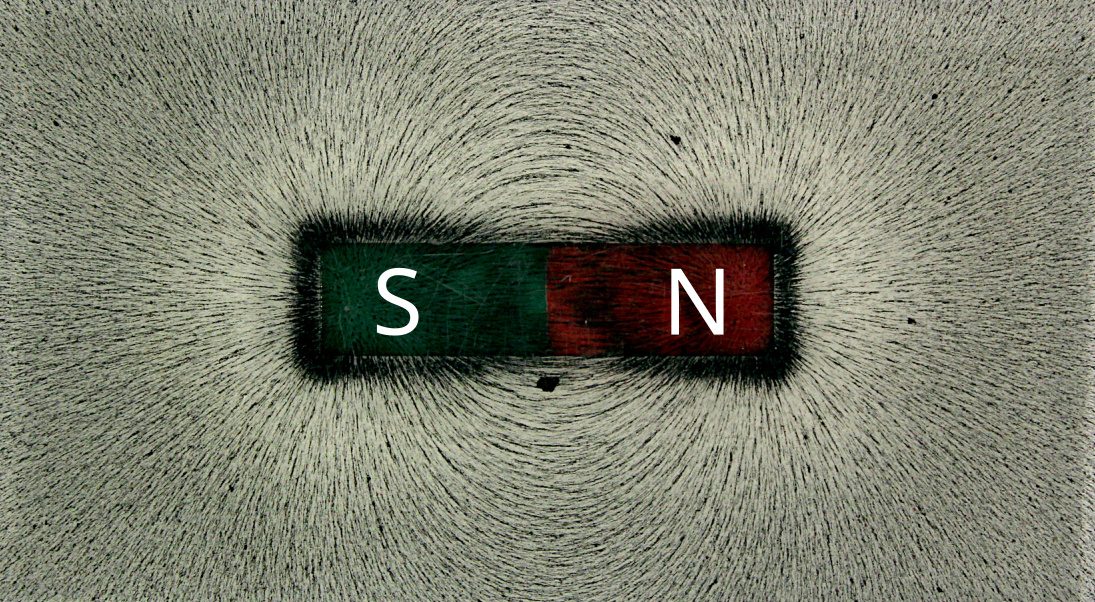
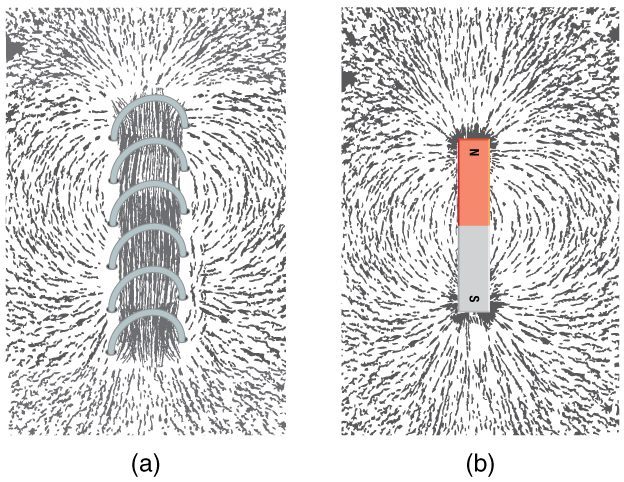
A magnetic field 磁场 $\vec{B}$ surrounds magnets and moving charges. Magnetic field lines 磁感线 run from a magnet's north pole 北极 to its south pole 南极 outside the magnet, and denser lines mean a stronger field. Magnetic poles always come in pairs – cutting a magnet in half makes two smaller magnets, never an isolated pole 磁极.
Where magnetism comes from. Every magnetic field is made by moving charge. In a magnet, the moving charges are the electrons inside the atoms, which behave like tiny current loops: tiny magnetic dipoles 磁偶极子, each with a north and a south pole. A magnet, permanent or induced, is a material in which many of these dipoles line up. That is why a single pole never appears on its own: there are no magnetic "monopoles".
- Field lines form closed loops: outside a bar magnet they go from N to S, and inside it they continue from S back to N.
- Like poles repel; unlike poles attract. The field of a dipole gets weaker with distance.
- A small dipole, such as a compass needle, turns to line up with the field it is in.
- The Earth's field is roughly that of a giant bar magnet. A compass's north pole points to geographic north, so the magnetic pole near geographic north is really a magnetic south pole.
Explore
See a magnet's field lines
Magnetic field lines run from the north pole to the south pole outside the magnet. Where the lines crowd together the field is strongest.
Vocabulary
Train
| English |
|---|
| Ferromagnetic/ˌferəməɡˈnetɪk/ |
| magnetic domains/mæɡˈnetɪk dəˈmeɪnz/ |
| permanent magnets/ˈpɜːmənənt ˈmæɡnɪts/ |
| Paramagnetic/ˌpærəməɡˈnetɪk/ |
| Diamagnetic/ˌdaɪəməɡˈnetɪk/ |
| permeability/ˌpɜːməˈbɪlɪti/ |
| permeability of free space |
| magnetic field/mæɡˈnetɪk fiːld/ |
| Magnetic field lines/mæɡˈnetɪk fiːld laɪnz/ |
| north pole/nɔːθ pəʊl/ |
| south pole/saʊθ pəʊl/ |
| pole/pəʊl/ |
| magnetic dipole/mæɡˈnetɪk ˈdaɪpəʊl/ |
12.2
Magnetism and Moving Charges
Syllabus
| Learning Objective | Essential Knowledge |
|---|---|
12.2.A |
|
12.2.B |
Boundary statement: Quantitative treatment of the magnitude of the magnetic force exerted by a magnetic field on a moving charge is limited to angles of 0, 90, and 180 degrees between the velocity and the magnetic field. Qualitative analysis of other angles is permitted. |
Source: College Board AP Course and Exam Description
A charge moving through a magnetic field feels a magnetic force 磁力:
$$F=|q|vB\sin\theta,$$
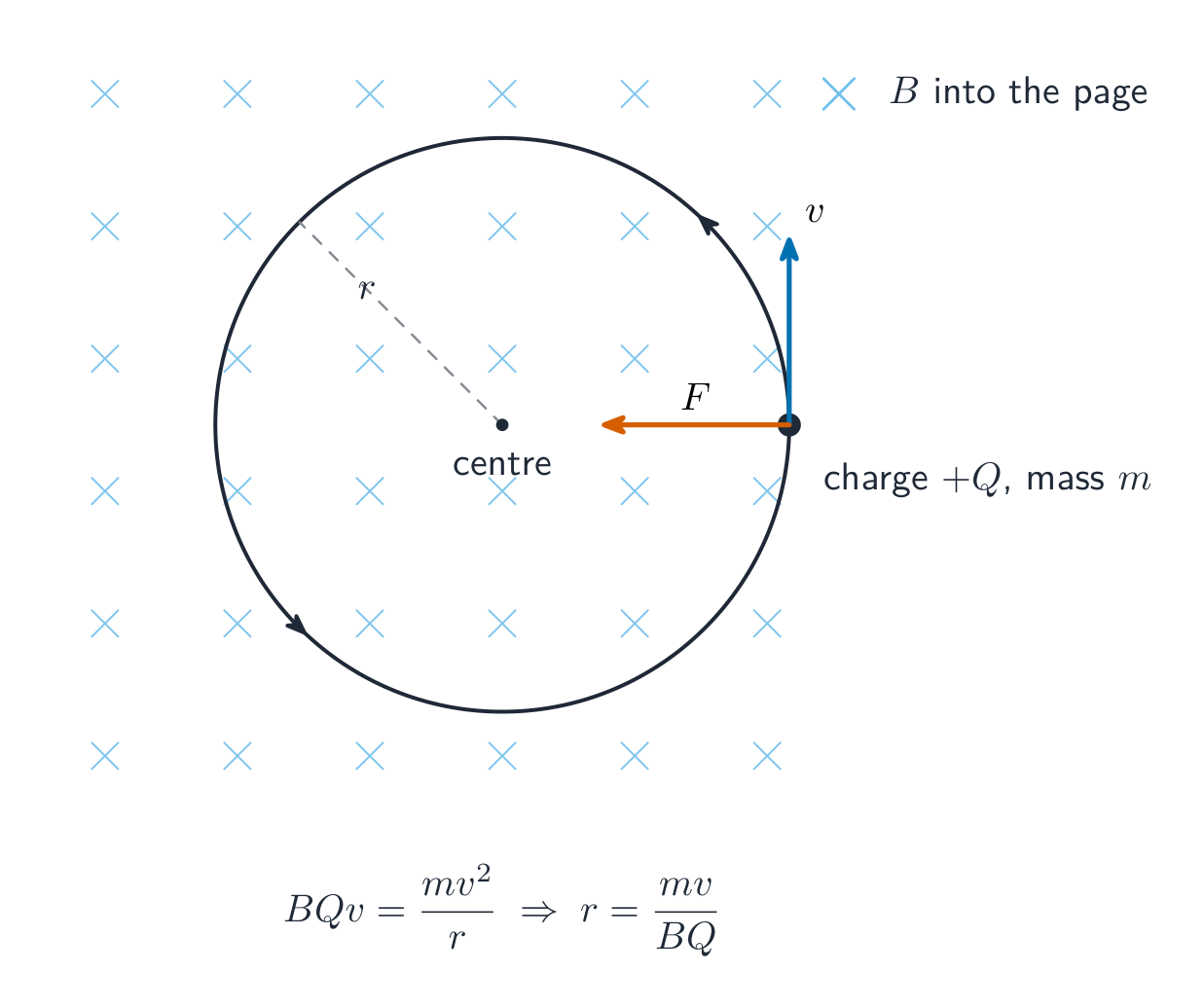
where $\theta$ is the angle between the velocity and the field. The force is perpendicular 垂直 to both $\vec{v}$ and $\vec{B}$ (use the right-hand rule 右手定则 for a positive charge and reverse it for a negative charge), so it changes direction but not speed – a charge moving perpendicular to a uniform magnetic field 匀强磁场 travels in a circle. A stationary 静止的 charge, or one moving parallel 平行 to the field, feels no magnetic force.
A moving charge also makes a magnetic field. At any point, that field is perpendicular to both the charge's velocity and the line from the charge to the point. It is strongest where those two are at right angles, and it is weaker farther away.
Worked example. A proton ($q=1.6\times10^{-19}\ \text{C}$, $m=1.67\times10^{-27}\ \text{kg}$) enters a $0.50\ \text{T}$ field at $2.0\times10^{5}\ \text{m/s}$, at right angles to the field. The magnetic force is
$$F=qvB=1.6\times10^{-19}\times2.0\times10^{5}\times0.50=1.6\times10^{-14}\ \text{N}.$$
This force is the centripetal force 向心力, so it bends the proton into a circle of radius
$$r=\frac{mv}{qB}=\frac{1.67\times10^{-27}\times2.0\times10^{5}}{1.6\times10^{-19}\times0.50}=4.2\times10^{-3}\ \text{m}.$$
Setting $qvB=\dfrac{mv^2}{r}$ and cancelling gives that neat $r=mv/(qB)$ – the principle behind mass spectrometers 质谱仪.
Worked example (two particles, the same voltage). Two particles are accelerated from rest through the same potential difference $|\Delta V|$ and then enter the same field $B$ at right angles. Each gains $K=|q||\Delta V|$, so $v=\sqrt{2|q||\Delta V|/m}$, and
$$r=\frac{mv}{|q|B}=\frac1B\sqrt{\frac{2m|\Delta V|}{|q|}}.$$
A heavier particle with the same charge moves in a larger circle. A positive and a negative particle curve in opposite directions.
Electric and magnetic forces together. In a region with both fields, a charge feels both forces, independently. For a proton moving right through a magnetic field into the page, the magnetic force is up. An electric field pointing down with $E=vB$ makes the forces cancel, so the proton goes straight through. For $v=3.0\times10^5\ \text{m/s}$ and $B=0.030\ \text{T}$: $F_B=qvB=1.4\times10^{-15}\ \text{N}$ and $E=vB=9.0\times10^3\ \text{N/C}$.
This is a velocity selector: only particles with speed $v=E/B$ pass straight through. Faster ones feel a larger magnetic force and curve one way; slower ones are pushed the other way by the electric force. The same balance lets you measure a magnetic field. Between plates a distance $d$ apart with emf $\mathcal E$, $E=\mathcal E/d$; adjust $\mathcal E$ until the particles go straight, then $\mathcal E=B_0d\,v$. Plot $\mathcal E$ against $v$ for several speeds: the slope is $B_0d$.
The Hall effect. In a current-carrying strip placed across a magnetic field, the magnetic force pushes the moving charges toward one edge. Charge builds up there until the electric field it makes balances the magnetic force. The result is a small potential difference across the strip, the Hall voltage, which is how many magnetic field sensors work.
Explore
A field in space
See the magnetic field a magnet creates — the field a moving charge would cut across.
Vocabulary
Train
| English |
|---|
| magnetic force/mæɡˈnetɪk fɔːs/ |
| perpendicular/ˌpɜːpənˈdɪkjʊlə/ |
| right-hand rule/raɪt hænd ruːl/ |
| uniform magnetic field |
| stationary/ˈsteɪʃənəri/ |
| parallel/ˈpærəlel/ |
| centripetal force/senˈtrɪpɪtl fɔːs/ |
| mass spectrometers |
12.3
Magnetism and Current-Carrying Wires
Syllabus
| Learning Objective | Essential Knowledge |
|---|---|
12.3.A |
|
12.3.B |
|
Source: College Board AP Course and Exam Description
Because a current is moving charge, a magnetic field pushes on a current-carrying wire 载流导线:
$$F=BIL\sin\theta.$$
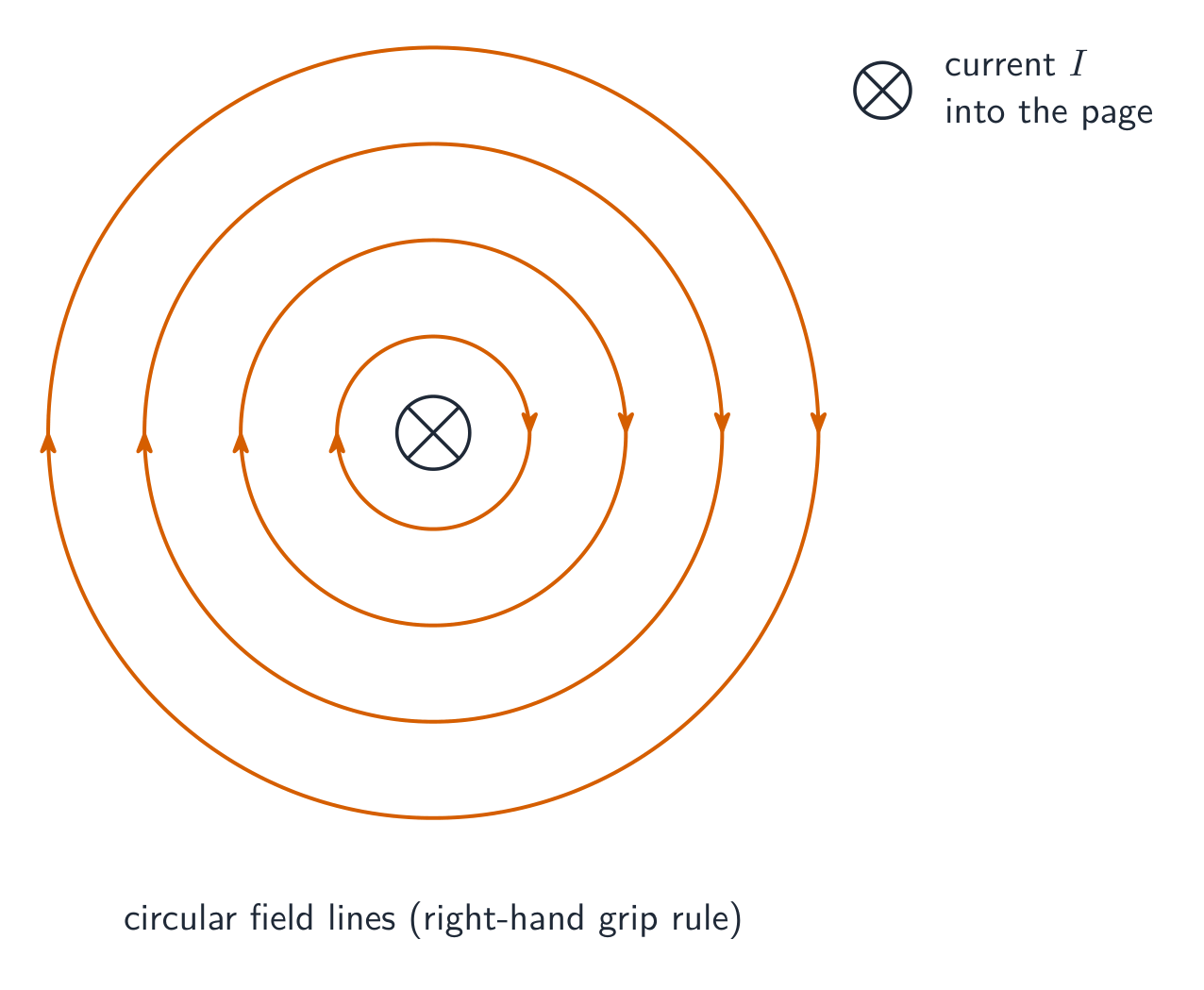
A current also creates its own magnetic field: circular field lines wrap around a straight wire (right-hand rule), and a coil (solenoid 螺线管) makes a field like a bar magnet 条形磁铁. This is how electromagnets 电磁铁 and motors 电动机 work.
Worked example. A $0.30\ \text{m}$ length of wire carries $4.0\ \text{A}$ at right angles to a $0.20\ \text{T}$ field. The force on it is $F=BIL=0.20\times4.0\times0.30=0.24\ \text{N}$ – the push that turns a motor's coil.
Worked example (the field around a wire). A long straight wire carries $10\ \text{A}$. The field $2.0\ \text{cm}$ away is
$$B=\frac{\mu_0 I}{2\pi r}=\frac{(4\pi\times10^{-7})(10)}{2\pi(0.020)}=1.0\times10^{-4}\ \text{T},$$
about twice the Earth's field, which is why a compass 指南针 near a current-carrying wire swings. The field falls off as $1/r$: twice as far away, half as strong.
Around a long straight wire the field lines are circles centered on the wire: the field has no part pointing toward or away from the wire, or along it. Grip the wire with your right thumb along the current; your fingers curl the way the field goes. At the center of a single loop of wire, the field points along the loop's axis. Near several wires, add the fields as vectors.
Parallel wires. Each wire sits in the other's field, so each feels a force. Currents in the same direction attract; opposite currents repel. Since $B\propto I/r$, the force on a length of wire is proportional to the other current and falls off as $1/r$.
Worked example (cancelling the force on a wire). Wire 1 lies along $y=0$ and wire 2 along $y=+d$, each carrying $I$ in the $+x$ direction, so wire 2 pulls wire 1 up. A third wire carrying $2I$, also in $+x$, must pull wire 1 down by the same amount, so it goes below wire 1. Equal forces need $\dfrac{I}{d}=\dfrac{2I}{r_3}$, so $r_3=2d$: wire 3 lies along $y=-2d$.
Worked example (a charge moving steadily near a wire). A negative charge moves at constant velocity parallel to a long wire carrying current $I$, a distance $d$ away, in a region with an electric field $E$. Constant velocity means the forces balance: $|q|E=|q|vB$, with $B=\dfrac{\mu_0I}{2\pi d}$. So $v=\dfrac EB=\dfrac{2\pi dE}{\mu_0I}$.
Explore
Find the force on a current in a field
A current in a magnetic field feels a force $F = BIL$, at right angles to both. Use the left-hand rule; reverse the current or field and the force flips.
Vocabulary
Train
| English |
|---|
| current-carrying wire |
| solenoid/ˈsəʊlənɔɪd/ |
| bar magnet/bɑː ˈmæɡnɪt/ |
| electromagnets/ɪˌlektrəʊˈmæɡnɪts/ |
| motors |
| compass/ˈkʌmpəs/ |
12.4
Electromagnetic Induction and Faraday's Law
Syllabus
| Learning Objective | Essential Knowledge |
|---|---|
12.4.A |
|
Source: College Board AP Course and Exam Description
Changing magnetic flux linkage 磁链 produces an emf 电动势 – electromagnetic induction 电磁感应. A current flows if the conducting circuit is closed. In a uniform field, magnetic flux 磁通量 is $\Phi=BA\cos\theta$, where $\theta$ is measured between the field and the loop's normal 法线. For $N$ turns sharing the same flux, Faraday's law 法拉第定律 gives the average induced emf 感应电动势:
$$\varepsilon_{\text{avg}}=-N\frac{\Delta\Phi}{\Delta t}.$$
The flux changes if the field, the area, or the loop's orientation changes. Lenz's law 楞次定律 (the minus sign) says the induced current 感应电流 produces a magnetic field that opposes the flux change that caused it – the basis of generators 发电机.
Worked example. The magnetic flux through a single loop drops from $0.020\ \text{Wb}$ to $0.008\ \text{Wb}$ in $0.030\ \text{s}$. The average induced emf is
$$\varepsilon=\left|\frac{\Delta\Phi}{\Delta t}\right|=\frac{0.020-0.008}{0.030}=0.40\ \text{V}.$$
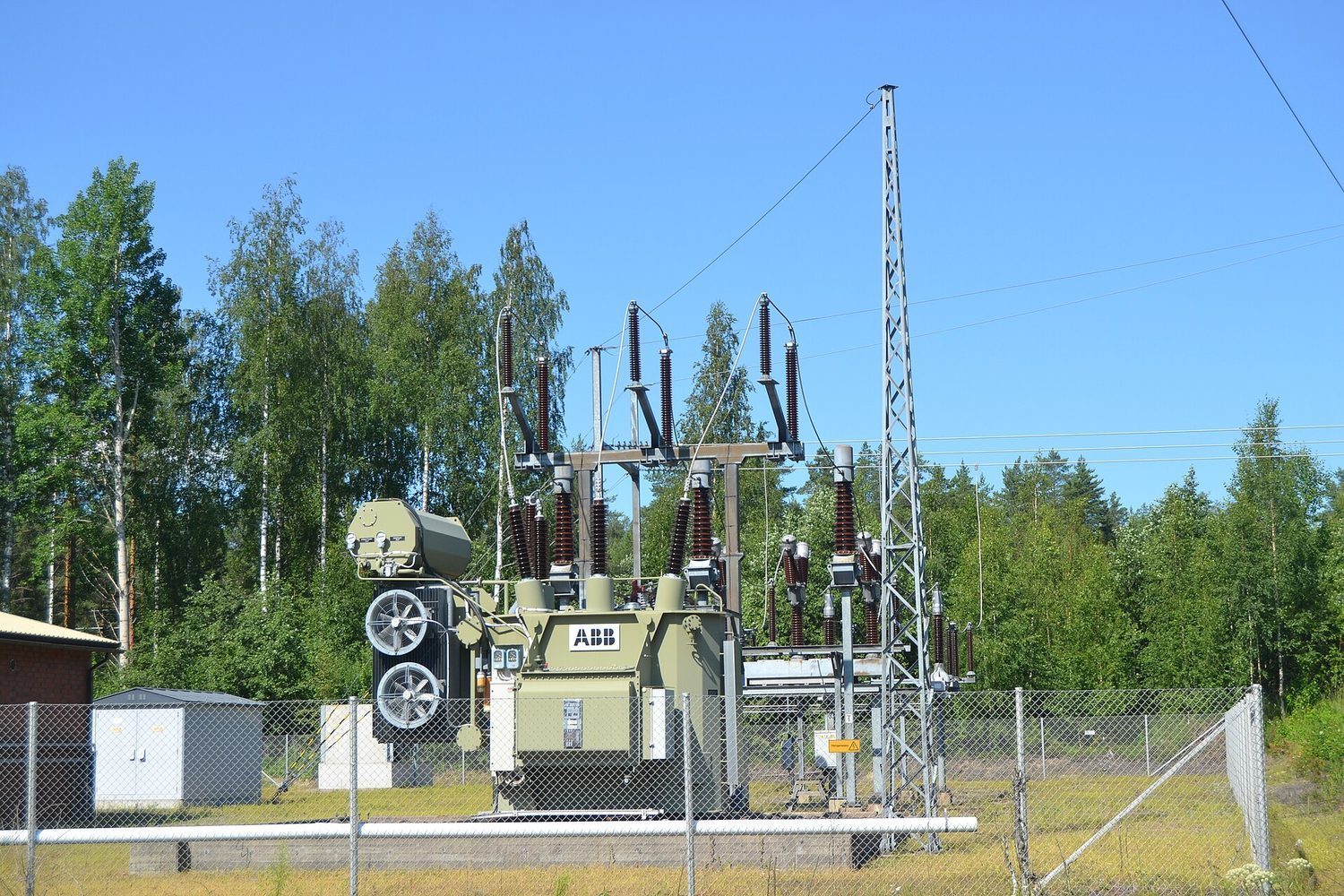
A coil of $N$ turns would give $N$ times this – which is why generators and transformers 变压器 use many-turn coils.
Flux has a sign. The flux uses an area vector, drawn perpendicular to the loop. The flux is positive when the field points the same way as the area vector and negative when it points the opposite way, so a field that reverses makes the flux pass through zero.
Worked example (a coil near a wire). A square coil of side $2L$ lies beside a long straight wire, its near edge $L$ from the wire and its far edge $3L$ away. The wire's field is $3B_0$ at the near edge and $B_0$ at the far edge. Because $B\propto1/r$, the field is $2B_0$ at $r=\tfrac32L$, a quarter of the way across the coil from its near edge. Now the current in the wire is reduced so that the flux through the coil falls from $5.0\times10^{-5}$ to $1.0\times10^{-5}\ \text{T m}^2$ in $2.0\ \text{s}$. The induced emf is $\dfrac{4.0\times10^{-5}}{2.0}=2.0\times10^{-5}\ \text{V}$, and with a resistance of $10\ \Omega$, $I=2.0\times10^{-6}\ \text{A}$.
A bulb connected to a coil next to another coil stays lit only while the current in the other coil keeps changing, because only a changing current makes a changing flux.
Explore
Induce a voltage by moving a magnet
Faraday's law: a changing magnetic flux through a coil induces a voltage. Move the magnet faster and the induced EMF grows; Lenz's law sets its direction to oppose the change.
Vocabulary
Train
| English |
|---|
| flux linkage/flʌks ˈlɪŋkɪdʒ/ |
| emf/emf/ |
| electromagnetic induction/ɪˌlektrəʊməɡˈnetɪk ɪnˈdʌkʃn/ |
| magnetic flux/mæɡˈnetɪk flʌks/ |
| normal/ˈnɔːml/ |
| Faraday's law/ˈfærədeɪz lɔː/ |
| induced emf |
| Lenz's law/ˈlentsɪz lɔː/ |
| induced current/ɪnˈdjuːst ˈkʌrənt/ |
| generators |
| transformers |
12.4
Lenz's law, step by step
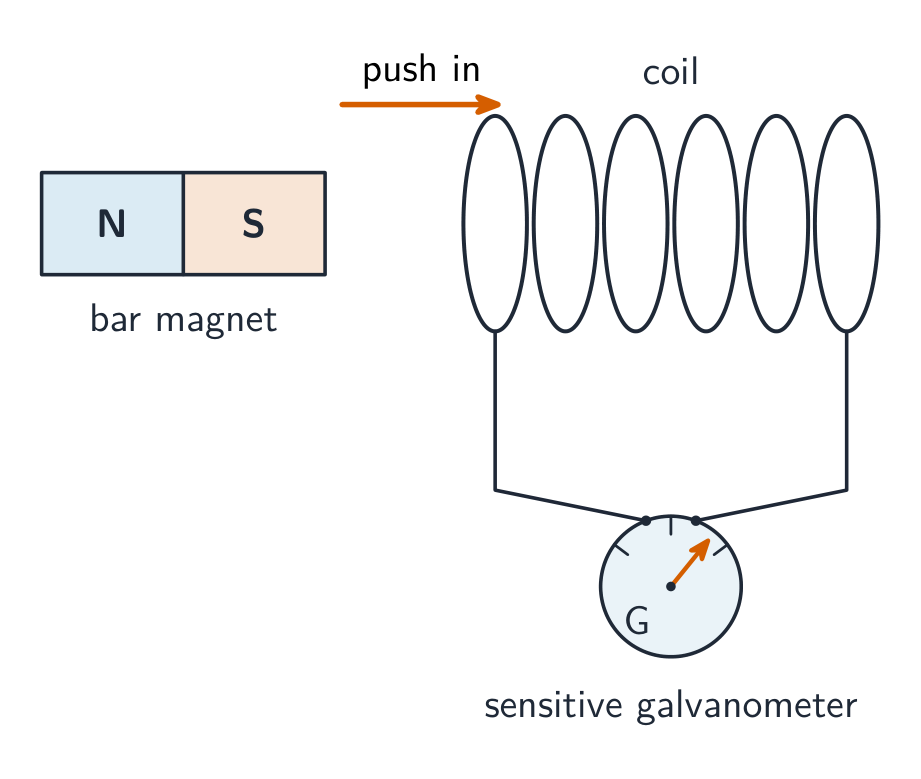
Finding the direction of an induced current is a chain of four questions. Push the north pole of a magnet toward a coil:
- Which way is the flux through the coil? Field lines leave a north pole, so the flux through the coil points away from the magnet.
- Is it increasing or decreasing? Increasing, because the magnet is getting closer.
- What does the induced current do? It makes its own field opposing the change, pointing back toward the magnet.
- So the coil face nearest the magnet becomes a north pole, and it repels the approaching magnet.
You must push to move the magnet in; that work becomes the electrical energy in the coil. If the induced current helped the motion instead, you would get energy for nothing. That is why the falling magnet in the copper pipe is slowed.
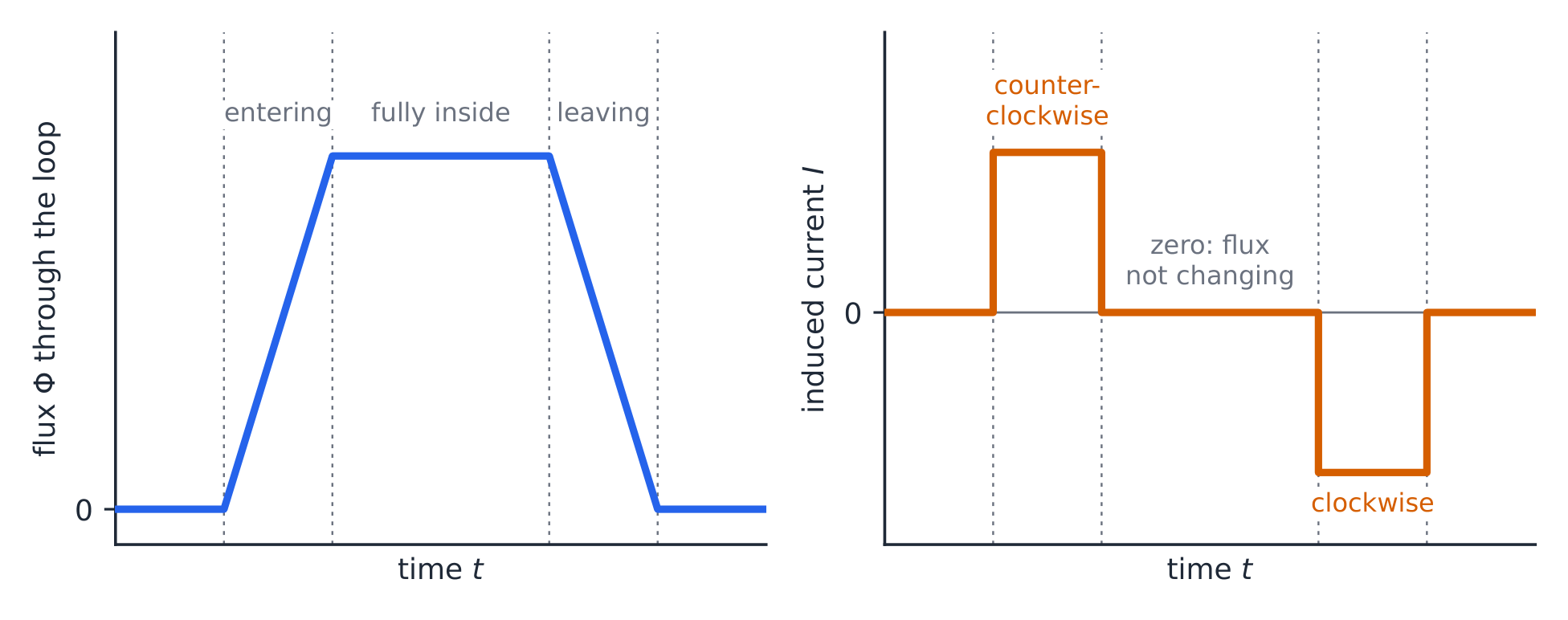
A loop pulled through a field. A rectangular loop is pulled at constant speed into, through and out of a region of uniform field pointing into the page.
- Entering: the inward flux grows at a steady rate, so a constant current flows. It is counterclockwise, making an outward field that opposes the growth.
- Fully inside: the flux is large but not changing, so there is no current.
- Leaving: the inward flux falls at the same rate, so the current has the same size but is clockwise, trying to keep the inward flux.
12.4
Motional emf
A conducting rod 导体棒 of length $L$ sliding at speed $v$ across a field $B$ sweeps out area, so the flux through the circuit changes. This motional emf 动生电动势 is $\varepsilon=BLv$.
Worked example (a rod on rails). A $0.50\ \text{m}$ rod slides at $4.0\ \text{m/s}$ along rails in a $0.20\ \text{T}$ field. The circuit has a resistance of $2.0\ \Omega$.
- $\varepsilon=BLv=(0.20)(0.50)(4.0)=0.40\ \text{V}$, so $I=\varepsilon/R=0.20\ \text{A}$.
- The current in the rod feels a force $F=BIL=(0.20)(0.20)(0.50)=0.020\ \text{N}$, opposing the motion (Lenz again).
- To keep the rod moving steadily you must push with $0.020\ \text{N}$, a power of $Fv=0.080\ \text{W}$. The resistor 电阻器 dissipates 耗散 $I^2R=(0.20)^2(2.0)=0.080\ \text{W}$. The two match: every joule of electrical energy came from your push.
Vocabulary
Train
| English |
|---|
| conducting rod |
| motional emf/ˈməʊʃənl emf/ |
| resistor/rɪˈzɪstə/ |
| dissipates |
12.4
Practice
Answer each before reading the answers below. Electron: $q=1.6\times10^{-19}\ \text{C}$, $m=9.11\times10^{-31}\ \text{kg}$.
- An electron moves at $3.0\times10^6\ \text{m/s}$ at right angles to a $0.010\ \text{T}$ field. Find the force on it and the radius of its circle.
- A $0.40\ \text{m}$ wire carries $3.0\ \text{A}$ at $30°$ to a $0.50\ \text{T}$ field. Find the force on it.
- The flux through each turn of a 50-turn coil falls by $0.0040\ \text{Wb}$ in $0.020\ \text{s}$. Find the average induced emf.
- The north pole of a magnet is pulled away from a coil. What pole forms on the coil face nearest the magnet, and why?
- A student says: "A strong magnet held still inside a coil induces a large current." Correct the student.
12.4
Answers
- $F=qvB=(1.6\times10^{-19})(3.0\times10^6)(0.010)=4.8\times10^{-15}\ \text{N}$. $r=\dfrac{mv}{qB}=\dfrac{(9.11\times10^{-31})(3.0\times10^6)}{(1.6\times10^{-19})(0.010)}=1.7\times10^{-3}\ \text{m}$.
- $F=BIL\sin\theta=(0.50)(3.0)(0.40)\sin30°=0.30\ \text{N}$.
- $\varepsilon=N\dfrac{\Delta\Phi}{\Delta t}=50\times\dfrac{0.0040}{0.020}=10\ \text{V}$.
- A south pole. The flux from the magnet is decreasing, so the induced current tries to keep it: the coil attracts the departing north pole, opposing the change.
- Induction needs a changing flux. A magnet held still gives a constant flux, so the induced emf and current are zero, however strong the magnet.
12.4
Exam tips
- The magnetic force $F=qvB\sin\theta$ is perpendicular to the velocity, so it changes direction (a circle) but not speed; a stationary charge or one moving along the field feels no force.
- Use $F=BIL$ for the force on a current-carrying wire (the motor effect).
- A current creates a magnetic field (circles around a wire; a solenoid acts like a bar magnet).
- Induction needs a changing flux $\Phi=BA$ — a stationary magnet in a coil induces nothing.
- Faraday: $\varepsilon=\Delta\Phi/\Delta t$ (times $N$ turns); Lenz: the induced current opposes the change (energy conservation).
Common mistakes
- Using the right-hand rule for a negative charge without reversing the answer. For an electron, the force is opposite to the direction the rule gives.
- Saying a magnetic force speeds up or slows down a charge. It is always perpendicular to the velocity, so it changes only the direction; it does no work.
- Expecting an emf from a large but steady flux. The induced emf depends on the rate of change of flux, $\varepsilon = -\Delta\Phi_B/\Delta t$.
- Using $B$ alone instead of the flux. $\Phi_B = BA\cos\theta$: the emf also changes if the loop's area or angle changes.
- Reading Lenz's law as "the induced field opposes the field". It opposes the change in flux: if the flux is falling, the induced field points the same way as the original field.
- Forgetting $\sin\theta$ in $F = qvB\sin\theta$ or $F = BIL\sin\theta$. Motion or current parallel to the field feels no force.
- Drawing magnetic field lines that start or stop. They always form closed loops, running from S to N inside a magnet.
- Saying a loop fully inside a strong field has a large current. With constant flux, there is none.
- Saying parallel wires with currents in the same direction repel. They attract.
- Calling the magnetic pole near the geographic North Pole a north pole. It attracts the compass's north end, so it is a magnetic south pole.
Interactive lessons on this topic
Work through it step by step, with instant-check exercises.