| Learning Objective | Essential Knowledge |
|---|---|
9.1.A |
|
9.1.B |
Boundary statement: AP Physics 2 only expects students to perform qualitative and quantitative analysis of collisions in one and two dimensions. Students are not expected to know the functional form of the Maxwell-Boltzmann distribution but are expected to be familiar with how features of the distribution are related to the temperature of the gas. |
Thermodynamics
AP Physics 2 · Topic 9
 8:56
Thermodynamics
Put a hot cup of coffee on a table. It always cools down. It never warms back up by taking heat out of the cool room. Both directions would balance the energy…
English narration · English + 中文 subtitles burned in
9.1
Kinetic Theory of Temperature and Pressure

Syllabus
Source: College Board AP Course and Exam Description
Pump up a bicycle tyre and the pump barrel gets warm. Leave a can of soda in a hot car and it can burst. Both come from the same picture: a gas is a huge crowd of tiny particles, moving fast in every direction, and what we measure as pressure and temperature is the average of all their collisions.
Thermodynamics 热力学 studies heat and energy in large collections of particles. The kinetic theory 分子运动论 explains gas behavior from the random motion of its molecules:
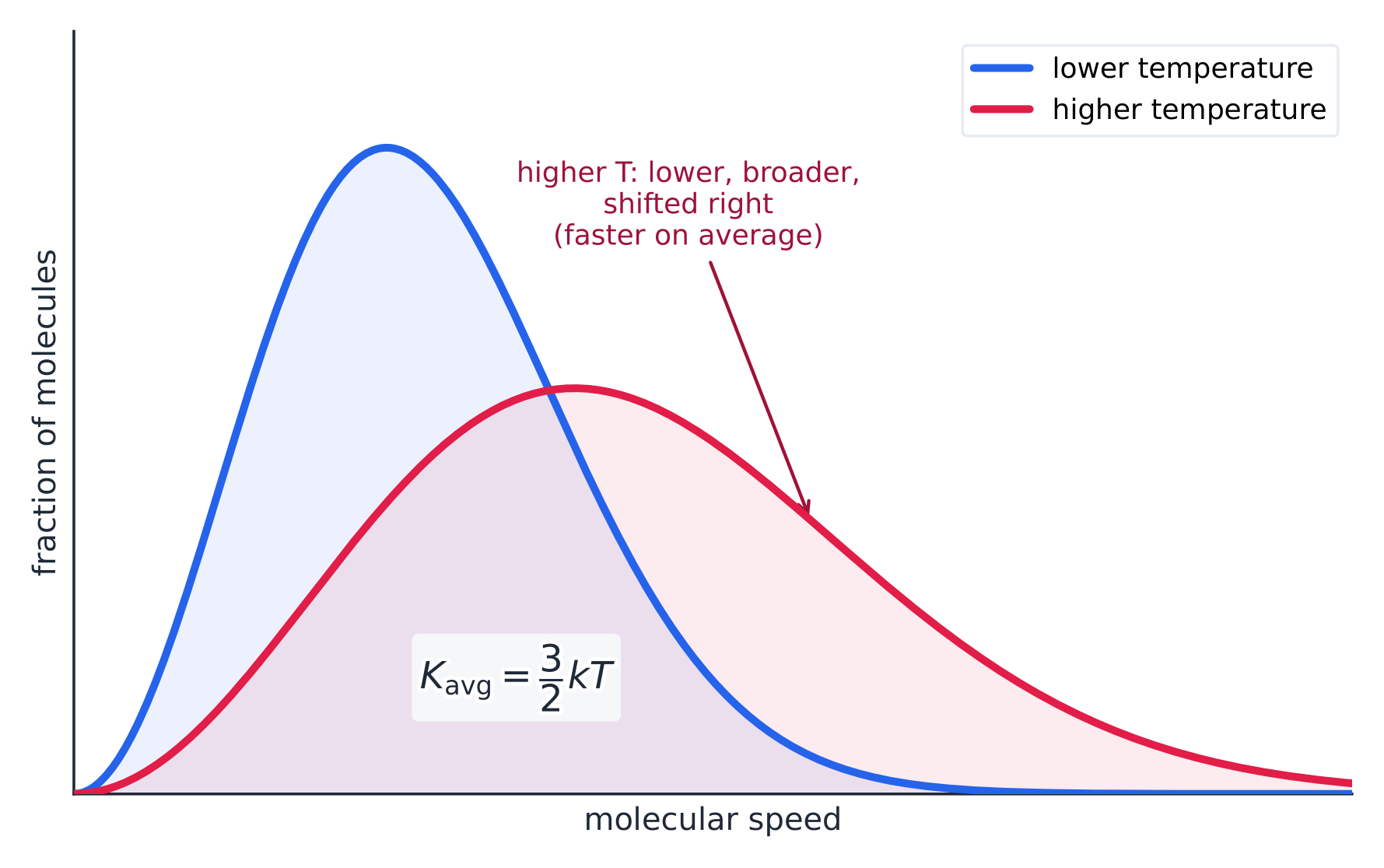
- In the ideal-gas model, absolute Temperature 温度 is proportional to the molecules' average translational kinetic energy: $K_{\text{avg}}=\tfrac{3}{2}k_B T$ (with $T$ in kelvin). Hotter means faster-moving molecules.
- Pressure 压强 comes from molecules colliding with the container walls – more frequent or harder collisions give more pressure.
Worked example. Find the average kinetic energy of a gas molecule at $300\ \text{K}$, using $k_B=1.38\times10^{-23}\ \text{J/K}$:
$$K_{\text{avg}}=\tfrac32 k_B T=1.5\times1.38\times10^{-23}\times300=6.2\times10^{-21}\ \text{J}.$$
It depends only on temperature, not on the type of gas – at the same $T$, light and heavy molecules share the same average kinetic energy (so the light ones move faster).
Pressure from collisions. When a molecule of mass $m$ moving at speed $v$ hits a wall head-on and bounces straight back, its momentum changes by $2mv$. By the impulse–momentum theorem, the wall gives it that impulse, and by Newton's third law the molecule gives the wall an equal and opposite push. Pressure is the sum of the perpendicular parts of all these pushes, per unit area of wall. More molecules, faster molecules, or a smaller box (so each molecule hits the walls more often) all mean more pressure. Pressure exists throughout the gas, not only at the walls: a small surface placed anywhere inside would be hit in the same way.
Root-mean-square speed. The speed that goes with the average kinetic energy is the root-mean-square speed 方均根速率:
$$\tfrac12mv_{\text{rms}}^2=\tfrac32k_BT\;\Rightarrow\;v_{\text{rms}}=\sqrt{\frac{3k_BT}{m}}.$$
For nitrogen molecules ($m=4.65\times10^{-26}\ \text{kg}$) at $300\ \text{K}$, $v_{\text{rms}}=\sqrt{\dfrac{3(1.38\times10^{-23})(300)}{4.65\times10^{-26}}}=517\ \text{m/s}$. Doubling the kelvin temperature multiplies $v_{\text{rms}}$ by $\sqrt2$, not by 2.
Reading the Maxwell–Boltzmann graph. Not all molecules move at the same speed: the graph shows how many move at each speed. When the gas is heated, the peak moves to higher speed and becomes lower and wider. The area under the curve (the number of molecules) stays the same.
Explore
Explore the spread of molecular speeds
Raise the temperature and watch the whole speed distribution shift right and flatten — the particles move faster on average, which is exactly what $\bar K = \tfrac{3}{2} k_B T$ means.
Vocabulary
Train
| English |
|---|
| Thermodynamics/ˌθɜːməʊdaɪˈnæmɪks/ |
| kinetic theory/kɪˈnetɪk ˈθɪəri/ |
| Temperature/ˈtemprɪtʃə/ |
| Pressure/ˈpreʃə/ |
| root-mean-square speed |
9.2
The Ideal Gas Law

Syllabus
| Learning Objective | Essential Knowledge |
|---|---|
9.2.A |
|
Source: College Board AP Course and Exam Description
An ideal gas 理想气体 obeys
$$PV=nRT \qquad(\text{or } PV=Nk_B T),$$
linking pressure $P$, volume $V$, amount ($n$ moles or $N$ molecules), and absolute temperature $T$. Use it to predict how a gas responds when you change one quantity and hold others fixed (e.g. heating at constant volume raises pressure).
The ideal-gas model assumes four things: the molecules move in random directions; their own volume is negligible compared with the container; their collisions are elastic; and the only forces between them act during collisions. Real gases follow it well at low pressure and high temperature, when the molecules are far apart.
Worked example. A sealed rigid container of gas is at $1.0\times10^{5}\ \text{Pa}$ and $300\ \text{K}$. It is heated to $450\ \text{K}$. Because the volume and amount are fixed, $P/T$ is constant:
$$P_2=P_1\frac{T_2}{T_1}=1.0\times10^{5}\times\frac{450}{300}=1.5\times10^{5}\ \text{Pa}.$$
Always convert temperatures to kelvin before using a gas law – using Celsius here would give nonsense.
Finding absolute zero from a graph. Measure the pressure of a fixed amount of gas at constant volume at several temperatures, using an ice–water bath, room-temperature water and hot water. Only trials at the same volume belong on the graph. The points lie on a straight line; extend it back to $P=0$.

The line reaches zero pressure at about $-273\,{}^{\circ}\text{C}$, whatever gas is used. That temperature is absolute zero 绝对零度, $0\ \text{K}$. So pressure and temperature are directly proportional at fixed volume and amount, $P\propto T$, measured in kelvin. "Cold air at the North Pole is at high pressure, so $P$ and $T$ are inversely related" is wrong: the air there sinks, so more air is piled above that spot, and the number of molecules per volume is not fixed.
A gas that may not be ideal. For an ideal gas at constant temperature, $\rho=\dfrac{m}{V}=\dfrac{PM}{RT}$, where $M$ is the molar mass: density is proportional to pressure, a straight line through the origin. If a measured density–pressure graph curves, the gas does not behave ideally over that range.
Explore
Explore squeezing a gas
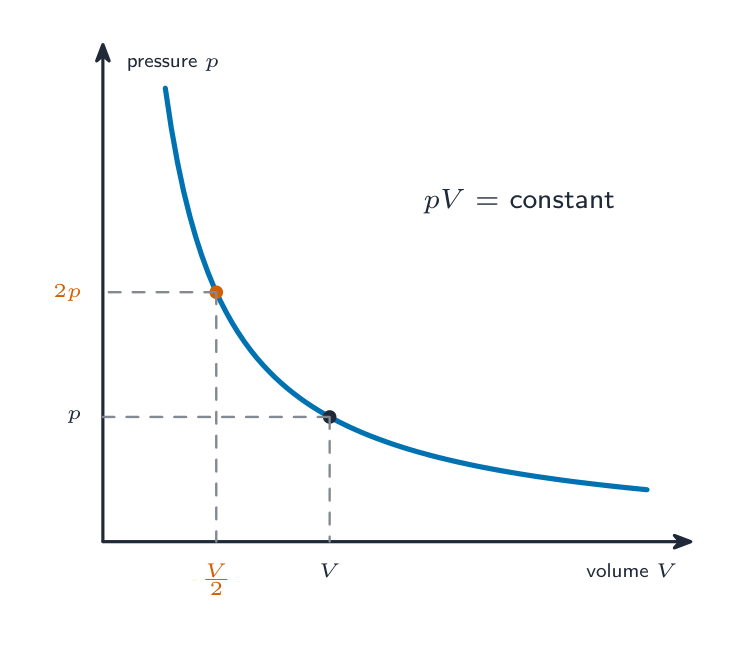
Slide the piston in to shrink the volume. The same particles are crammed into less space, so they hit the walls more often and the pressure climbs — while $PV$ stays constant at fixed temperature.
Vocabulary
Train
| English |
|---|
| ideal gas/aɪˈdɪəl ɡæs/ |
| absolute zero/ˈæbsəluːt ˈzɪərəʊ/ |
9.3
Thermal Energy Transfer and Equilibrium
Syllabus
| Learning Objective | Essential Knowledge |
|---|---|
9.3.A |
|
Source: College Board AP Course and Exam Description
Heat 热量 $Q$ is energy transferred because of a temperature difference; it flows from hot to cold. Two objects in contact reach thermal equilibrium 热平衡 when they share the same temperature, and net heat flow stops. The three transfer methods are conduction 传导, convection 对流, and radiation 辐射.
Two systems are in thermal contact when energy can pass between them by these processes. Heating means energy entering a system this way; cooling means energy leaving it.
Why hot to cold? When fast particles of a hot object collide with slow particles of a cold one, energy is most likely to pass from the faster particle to the slower one. After many collisions, the most probable state, by far, is one where both objects have the same average kinetic energy: the same temperature. Then there is no net energy transfer, which is what thermal equilibrium means. Individual collisions still happen, but they transfer energy equally in both directions.
Worked example (which way does energy flow?). Two samples of the same gas, with the same number of particles, are put in thermal contact. Sample 2 has $PV=400\ \text{J}$ and sample 3 has $PV=100\ \text{J}$. Since $T=\dfrac{PV}{Nk_B}$ and $N$ is the same, sample 2 is at the higher temperature, so energy flows from sample 2 to sample 3 until their temperatures are equal.
Explore
Add heat and watch the temperature
Adding heat usually raises temperature, but during a phase change the temperature holds flat while the energy breaks bonds. Two bodies in contact settle at one temperature — thermal equilibrium.
Vocabulary
Train
| English |
|---|
| Heat/hiːt/ |
| thermal equilibrium/ˈθɜːml ˌiːkwɪˈlɪbrɪəm/ |
| conduction/kənˈdʌkʃn/ |
| convection/kənˈvekʃn/ |
| radiation/ˌreɪdɪˈeɪʃn/ |
9.4
The First Law of Thermodynamics

Syllabus
| Learning Objective | Essential Knowledge |
|---|---|
9.4.A |
|
9.4.B |
|
Source: College Board AP Course and Exam Description
The first law 热力学第一定律 is conservation of energy for a gas:
$$\Delta U = Q + W,$$
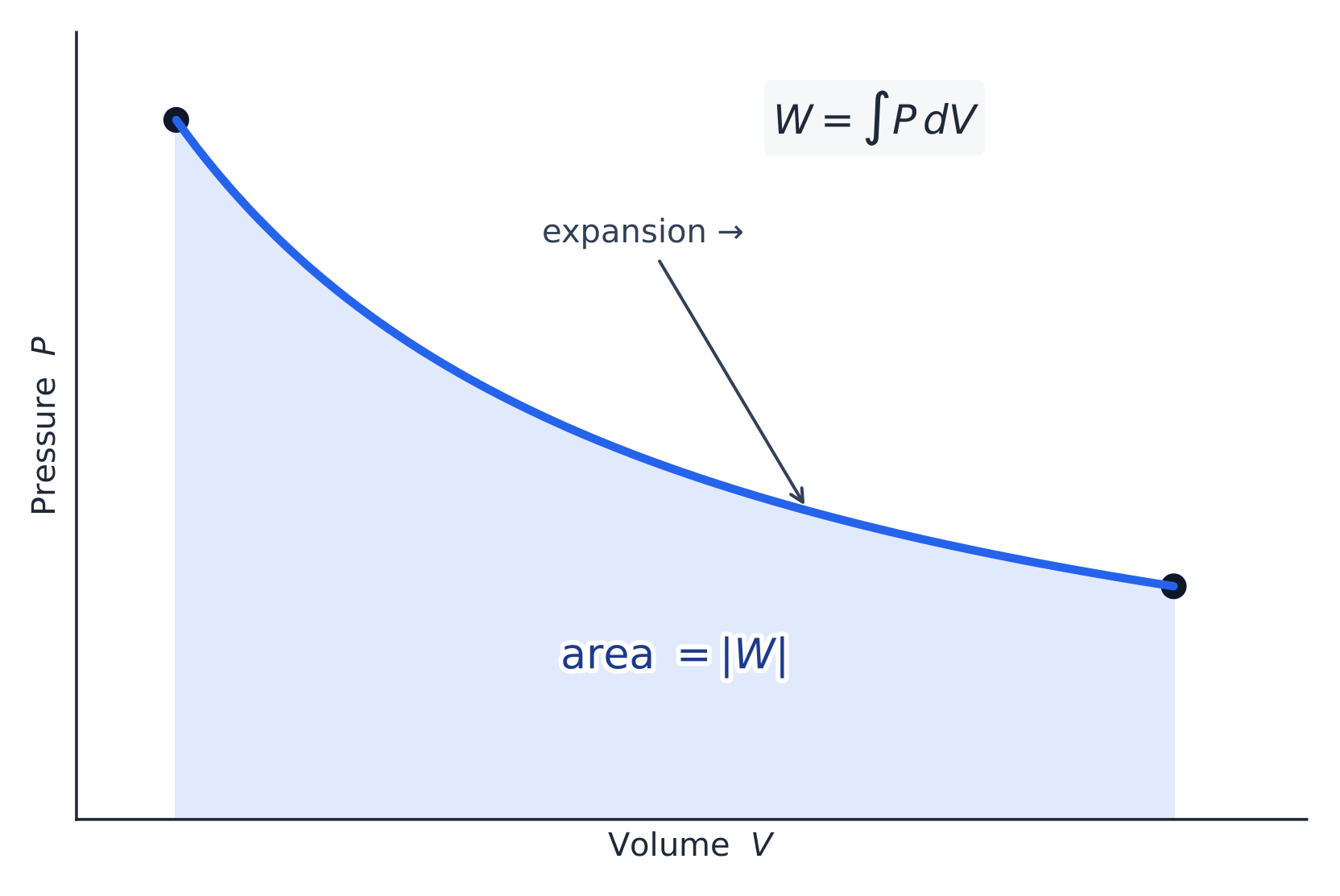
where $\Delta U$ is the change in internal energy 内能 (depending only on temperature for an ideal gas), $Q$ is heat added to the gas, and $W$ is work done on the gas. On a pressure–volume diagram, the work done by the gas is the area under the process curve. Watch signs: compressing a gas does positive work on it.
Internal energy is the total kinetic energy of the particles plus the potential energy of their arrangement. In an ideal gas, the particles do not attract each other, so there is no potential energy: the internal energy is just the kinetic energy of the molecules. For a monatomic ideal gas,
$$U=\tfrac32nRT=\tfrac32PV.$$
So $U$ depends only on temperature. A system can gain internal energy without its center of mass moving at all: a hot brick on a table is not going anywhere.
The work done on a gas by a constant (or average) outside pressure is
$$W=-P\,\Delta V.$$
When the gas expands ($\Delta V>0$), $W$ is negative: the gas does work on its surroundings. An isolated system exchanges no energy with its surroundings, so its total energy is constant. A closed system exchanges energy but not matter, and the first law, $\Delta U=Q+W$, tracks that exchange.
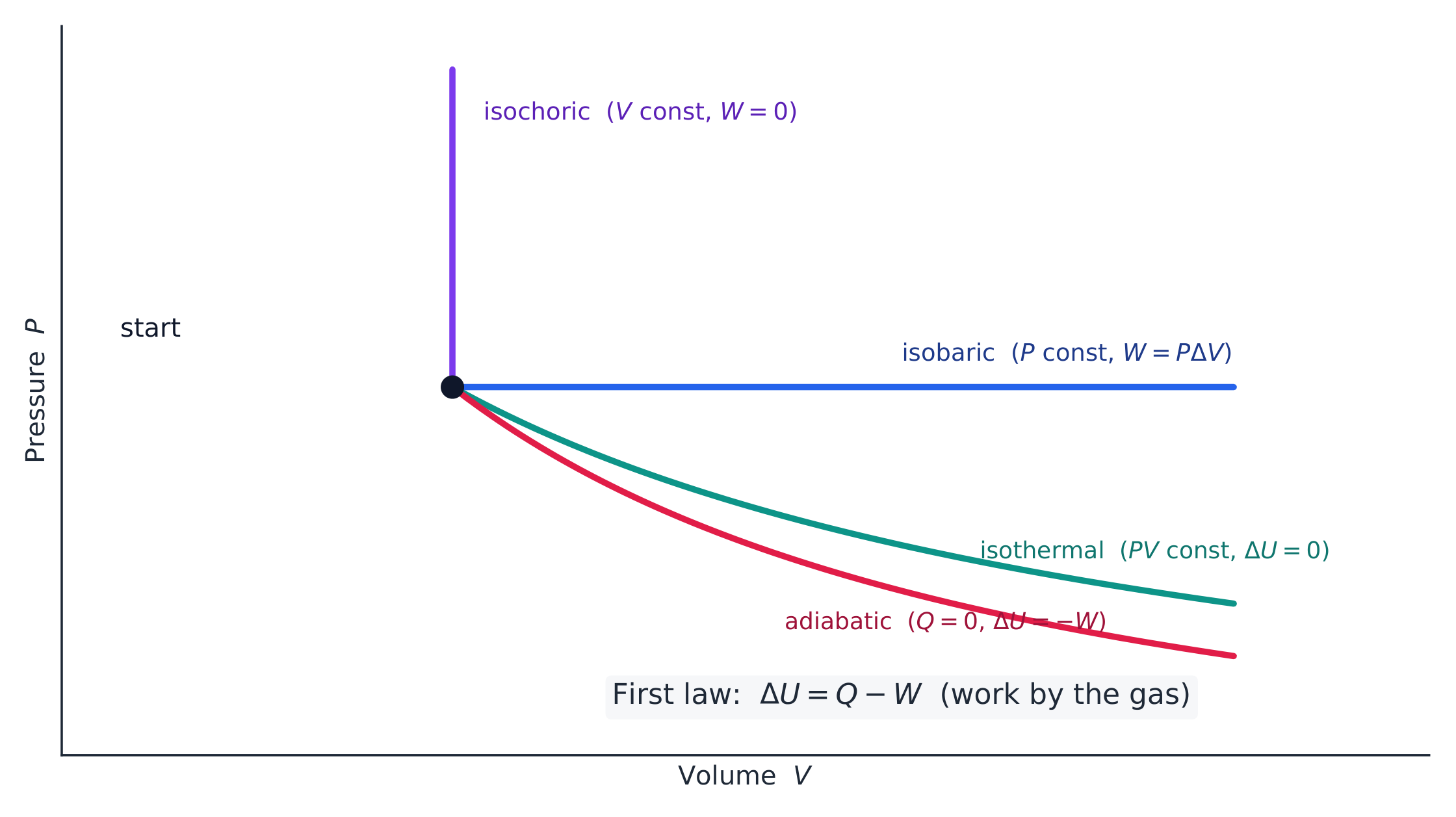
The four special processes.
| Process | What is fixed | Shape on a $PV$ diagram | First law becomes |
|---|---|---|---|
| isovolumetric 等容 | volume | vertical line | $W=0$, so $\Delta U=Q$ |
| isobaric 等压 | pressure | horizontal line | $W=-P\Delta V$ |
| isothermal 等温 | temperature | curve $PV=\text{constant}$ (an isotherm) | $\Delta U=0$, so $Q=-W$ |
| adiabatic 绝热 | no heat flow, $Q=0$ | steeper curve than an isotherm | $\Delta U=W$ |
Lines of constant temperature on a $PV$ diagram are called isotherms 等温线; isotherms farther from the origin are hotter.
Worked example. A gas absorbs $500\ \text{J}$ of heat and, as it expands, does $200\ \text{J}$ of work on its surroundings. Find the change in its internal energy. Work done on the gas is $W=-200\ \text{J}$ (it does work, so it loses that energy):
$$\Delta U=Q+W=500+(-200)=300\ \text{J}.$$
The internal energy rises by $300\ \text{J}$, so the gas ends up hotter. Getting the sign of $W$ right is the whole game in first-law problems.
Worked example (a cycle on a $PV$ diagram). A sample of monatomic ideal gas goes round the cycle A → B → C → D → A shown below.

- A → B (constant pressure, expanding): work done by the gas $= P\Delta V = (2.0\times10^5)(2.0\times10^{-3}) = 400\ \text{J}$, so $W = -400\ \text{J}$.
- B → C and D → A (constant volume): no area under the line, so $W = 0$.
- C → D (constant pressure, compressed): $W = +(1.0\times10^5)(2.0\times10^{-3}) = +200\ \text{J}$ done on the gas.
- Whole cycle: $W_{\text{net}} = -400 + 200 = -200\ \text{J}$, so the gas does a net $200\ \text{J}$ of work, the enclosed area. It returns to A, so $\Delta U = 0$ and $Q_{\text{net}} = \Delta U - W = +200\ \text{J}$: a clockwise cycle takes in heat and gives out work, like an engine.
- Temperatures without numbers for $n$: $T \propto PV$. In joules, $PV$ is $200$ at A, $600$ at B, $300$ at C and $100$ at D, so B is the hottest state and D the coldest.
- Heat in A → B: for a monatomic gas $U = \tfrac32 nRT = \tfrac32 PV$, so $\Delta U = \tfrac32(600 - 200) = 600\ \text{J}$, and $Q = \Delta U - W = 600 - (-400) = 1000\ \text{J}$.
Worked example (a cycle with a slanted side). Two moles of a monatomic ideal gas are held by a piston of area $5.0\times10^{-3}\ \text{m}^2$. State A is $0.040\ \text{m}^3$ at $1.0\times10^5\ \text{Pa}$; A → B expands at constant pressure to $0.10\ \text{m}^3$; B → C cools at constant volume to $0.50\times10^5\ \text{Pa}$; C → A returns along a straight line.
- Force on the piston at A: $F=PA=(1.0\times10^5)(5.0\times10^{-3})=500\ \text{N}$. It comes from the momentum the molecules give the piston each time they bounce off it.
- Temperature at B: $T=\dfrac{PV}{nR}=\dfrac{(1.0\times10^5)(0.10)}{2(8.31)}=600\ \text{K}$. Temperature measures the average kinetic energy of the atoms.
- A → B: $PV$ grows from $4000$ to $10000\ \text{J}$, so the temperature and the internal energy rise.
- Heat along A → B → C: $\Delta U=\tfrac32(P_CV_C-P_AV_A)=\tfrac32(5000-4000)=1500\ \text{J}$. Work on the gas: $-P\Delta V=-(1.0\times10^5)(0.060)=-6000\ \text{J}$ for A → B, and zero for B → C. So $Q=\Delta U-W=1500+6000=7500\ \text{J}$.
- C → A directly: the total kinetic energy of the atoms is the internal energy, so it changes by $-1500\ \text{J}$.
Worked example (a piston with a weight on it). A monatomic gas is sealed under a piston of mass $M$ and area $A$, in a water bath at $T_0$; the gas fills $V_0$. Three forces act on the piston: its weight $Mg$ and the air's push $P_{\text{atm}}A$ down, and the gas's push $PA$ up. In equilibrium, $P=P_{\text{atm}}+\dfrac{Mg}{A}$, and $U=\tfrac32PV_0=\tfrac32\left(P_{\text{atm}}+\dfrac{Mg}A\right)V_0$.
- A block is lowered slowly onto the piston. The bath keeps the temperature at $T_0$, so this is an isothermal compression: on a $PV$ diagram the state moves up and to the left along an isotherm.
- To bring the gas back to $V_0$ at this higher pressure, $PV$ must be larger, so the bath's new temperature must be higher than $T_0$.
Worked example (heating a rigid chamber). A gas in a sealed, rigid chamber is heated. The volume cannot change, so on a $PV$ diagram the process is a vertical line going up. On a graph of $U$ against $V$ it is also a vertical line going up: $U=\tfrac32PV$ rises because $P$ rises at fixed $V$. If the pressure goes from $P$ to $3P$, then $\Delta T=\dfrac{\Delta(PV)}{nR}=\dfrac{2PV}{nR}$.
Explore
Heat, work and internal energy
Let the gas expand against a piston and see energy leave as work while heat flows in.
Vocabulary
Train
| English |
|---|
| first law/fɜːst lɔː/ |
| internal energy/ɪnˈtɜːnl ˈenədʒi/ |
| isovolumetric |
| Isobaric |
| Isothermal/ˌaɪsəˈθɜːml/ |
| Adiabatic/ˌædiəˈbætɪk/ |
| isotherm |
9.5
Specific Heat and Thermal Conductivity

Syllabus
| Learning Objective | Essential Knowledge |
|---|---|
9.5.A |
|
9.5.B |
Boundary statement: AP Physics 2 will model specific heat as independent of temperature. |
Source: College Board AP Course and Exam Description
- Specific heat 比热容 $c$ is the heat needed to raise one kilogram by one degree: $Q=mc\,\Delta T$. A high specific heat (like water's) means a substance resists temperature change.
- Thermal conductivity 热导率 measures how fast heat conducts through a material; the rate of conduction rises with area and temperature difference and falls with thickness.
Worked example. How much heat raises the temperature of $2.0\ \text{kg}$ of water from $20\,{}^{\circ}\text{C}$ to $80\,{}^{\circ}\text{C}$? Water's specific heat is $c=4200\ \text{J/(kg}\,{}^{\circ}\text{C)}$:
$$Q=mc\,\Delta T=2.0\times4200\times(80-20)=5.0\times10^{5}\ \text{J}.$$
Water's large specific heat is why it is used as a coolant and why coastal climates are mild.
Specific heat and thermal conductivity are both intrinsic properties: they belong to the material and depend on how its atoms are arranged and how they interact, not on the size of the sample.
Worked example (same heat, different temperature changes). A hot metal sphere is dropped into a larger mass of cool liquid in an insulated cup; the sphere has the smaller specific heat. The energy the sphere loses equals the energy the liquid gains, $m_Sc_S|\Delta T_S|=m_Lc_L|\Delta T_L|$. The sphere has both the smaller mass and the smaller specific heat, so a given amount of energy changes its temperature more: $|\Delta T_S|>|\Delta T_L|$.
Rate of conduction. Energy flows through a slab of material at a rate
$$\frac{Q}{\Delta t}=\frac{kA\,\Delta T}{L},$$
where $k$ is the thermal conductivity, $A$ the area, $\Delta T$ the temperature difference across the slab and $L$ its thickness. A thicker slab lets less energy through.
Measuring $k$ (a lab). Boiling water keeps the bottom of a plastic slab at $100\,{}^{\circ}\text{C}$, and melting ice keeps its top at $0\,{}^{\circ}\text{C}$. The rate of energy flow is found from how fast the ice melts. Repeat with stacks of 1 to 5 slabs. Since $\dfrac{Q}{\Delta t}=kA\Delta T\cdot\dfrac1L$, plot $\dfrac{Q}{\Delta t}$ against $\dfrac1L$: a straight line with slope $kA\Delta T$. With $A=0.025\ \text{m}^2$ and a slope of $1.0\ \text{J m/s}$, $k=\dfrac{1.0}{(0.025)(100)}=0.40\ \text{W/(m K)}$. One source of error: some energy also flows from the air into the ice, so more ice melts than the slab alone explains, and $k$ comes out too large.
At the microscopic level, particles at the hot face vibrate faster. They collide with their slower neighbours and pass energy along, layer by layer, toward the cold face. This also explains why plastic at room temperature can feel cooler to the touch than wood at the same temperature: if the plastic conducts better, it carries energy away from your hand faster, and your skin senses that rate, not the material's temperature.
Explore
Explore how much energy heats a material
Pick a material, set the mass and temperature rise, and read the energy from $Q = mc\,\Delta T$. Water needs far more energy than the metals to warm by the same amount.
Vocabulary
Train
| English |
|---|
| Specific heat/spəˈsɪfɪk hiːt/ |
| Thermal conductivity/ˈθɜːml kɒndəkˈtɪvɪti/ |
9.6
Entropy and the Second Law of Thermodynamics
Syllabus
| Learning Objective | Essential Knowledge |
|---|---|
9.6.A |
Boundary statement: Only qualitative treatment of the second law of thermodynamics is within the scope of AP Physics 2. |
Source: College Board AP Course and Exam Description
Entropy 熵 measures the disorder, or the number of ways to arrange, a system. The second law 热力学第二定律: the total entropy of an isolated system never decreases – energy naturally spreads out. This sets the direction of processes: heat flows hot→cold on its own, never the reverse, and no cyclic heat engine can convert heat taken from a single reservoir entirely into work without another effect.
Entropy can be pictured as the spreading out of energy: energy that is concentrated in one place tends to spread, and spread-out energy is less available to do work. Four points make the second law precise.
- Entropy is a state function: its value depends only on the current state of the system, not on how the system got there.
- An isolated system moves on its own toward thermodynamic equilibrium, where its entropy is the largest it can be.
- The total entropy of an isolated system stays constant only if every process is reversible; real processes always increase it.
- The entropy of a closed (not isolated) system can decrease, as when a fridge cools its contents. Energy leaves the system, and the entropy of the surroundings rises by more.
Explore
The second law of thermodynamics
Natural processes increase the total entropy. Sort each process.
Vocabulary
Train
| English |
|---|
| Entropy/ˈentrəpi/ |
| second law/ˈsekənd lɔː/ |
9.6
Practice
Answer each before reading the answers below. Take $R=8.31\ \text{J/(mol K)}$.
- A gas at $2.0\times10^{5}\ \text{Pa}$ fills $3.0\times10^{-3}\ \text{m}^3$ at $300\ \text{K}$. How many moles of gas are there?
- The gas in question 1 is heated at constant pressure to $450\ \text{K}$. Find its new volume and the work done by the gas.
- A gas is compressed: $150\ \text{J}$ of work is done on it while it gives out $60\ \text{J}$ of heat. Find the change in its internal energy. Does its temperature rise or fall?
- $0.50\ \text{kg}$ of water at $80\,{}^{\circ}\text{C}$ is mixed with $1.0\ \text{kg}$ of water at $20\,{}^{\circ}\text{C}$ in an insulated flask. Find the final temperature.
- A student says: "Hydrogen and oxygen in the same room are at the same temperature, so their molecules move at the same average speed." Correct the student.
9.6
Answers
- $n=\dfrac{PV}{RT}=\dfrac{(2.0\times10^{5})(3.0\times10^{-3})}{(8.31)(300)}=\dfrac{600}{2493}=0.24\ \text{mol}$.
- At constant $P$, $V\propto T$: $V_2=3.0\times10^{-3}\times\dfrac{450}{300}=4.5\times10^{-3}\ \text{m}^3$. Work by the gas $=P\Delta V=(2.0\times10^{5})(1.5\times10^{-3})=300\ \text{J}$, so $W=-300\ \text{J}$ in $\Delta U=Q+W$.
- $Q=-60\ \text{J}$ and $W=+150\ \text{J}$, so $\Delta U=-60+150=+90\ \text{J}$. The internal energy rises, so the temperature rises.
- Heat lost by the hot water = heat gained by the cold water: $0.50\,c\,(80-T)=1.0\,c\,(T-20)$. Then $40-0.50T=T-20$, so $1.5T=60$ and $T=40\,{}^{\circ}\text{C}$. The $c$ cancels; the final temperature sits nearer the larger mass's start.
- The same temperature means the same average kinetic energy, $\tfrac32k_BT$, not the same speed. A hydrogen molecule has $\tfrac1{16}$ the mass of an oxygen molecule, so $v^2$ must be 16 times larger: hydrogen molecules move about 4 times faster on average.
9.6
Exam tips
- Always convert temperatures to kelvin ($T_{\text{K}}=T_{\text{C}}+273$) before using any gas law.
- In the first law $\Delta U = Q + W$, get the sign of $W$ right: work done on the gas is positive; when the gas expands and does work on its surroundings, $W$ is negative.
- Temperature measures the average kinetic energy of particles, so at the same $T$ lighter molecules move faster.
- On a PV diagram the work done by the gas is the area under the process curve.
- Use $Q=mc\,\Delta T$ for temperature change; the second law fixes the direction — heat flows hot→cold and total entropy never decreases.
Common mistakes
- Using degrees Celsius in $PV = nRT$ or $K_{\text{avg}} = \tfrac32 k_B T$. Temperatures must be in kelvin.
- Getting the sign of $W$ wrong in $\Delta U = Q + W$. In this course $W$ is work done on the gas: positive when the gas is compressed, negative when it expands.
- Saying a gas expanding at constant temperature has no heat flow. $\Delta U = 0$, so $Q = -W$: the gas absorbs exactly as much heat as the work it does.
- Reading work from a $P$–$V$ graph as $P \times V$ at one point. The work is the area under the process curve; along a closed cycle it is the enclosed area.
- Confusing temperature with heat. Temperature measures the average kinetic energy of the molecules; heat is energy transferred because of a temperature difference.
- Mixing trials at different volumes on a pressure–temperature graph. Hold the volume (and amount of gas) fixed, or the points will not lie on one line.
- Saying an ideal gas has potential energy between its molecules. In the model the molecules do not interact except in collisions, so $U$ is all kinetic.
- Saying that at thermal equilibrium the molecules stop exchanging energy. Collisions go on; the net transfer is zero.
- Thinking a material that feels colder is at a lower temperature. It may just conduct energy away from your hand faster.
- Saying entropy can never decrease anywhere. That is true for an isolated system; a closed system's entropy can fall if energy leaves it.
Interactive lessons on this topic
Work through it step by step, with instant-check exercises.