| Learning Objective | Essential Knowledge |
|---|---|
10.1.A |
|
10.1.B |
|
10.1.C |
Boundary statement: AP Physics 2 only expects students to make calculations of the electric force between four or fewer interacting charged objects or systems. The analysis of the resulting electric force from more charges is allowed in situations of high symmetry. |
Electric Force, Field, and Potential
AP Physics 2 · Topic 10
 8:05
Electric Force, Field, and Potential
A thundercloud is a charge factory. Ice crystals crash inside it, and electrons collect at the bottom of the cloud. The ground below turns positive. Nothing…
English narration · English + 中文 subtitles burned in
10.1
Electric Charge and Electric Force

Syllabus
Source: College Board AP Course and Exam Description
Pull off a wool jumper in a dry room and you hear crackles, and your hair stands up. The same invisible push holds every atom together, and it is far stronger than gravity: this unit is about that force, and the fields and energies that come with it.
Electric charge 电荷 is a fundamental property 基本属性 of matter, and it comes in two kinds, positive and negative; like charges 同种电荷 repel 排斥 and opposite charges 异种电荷 attract 吸引. Charge is conserved 守恒 and quantized 量子化 (a multiple of the elementary charge 元电荷 $e$). The force between two point charges 点电荷 is Coulomb's law 库仑定律:
$$F=\frac{k q_1 q_2}{r^2},$$
directed along the line joining them – an inverse-square law 平方反比定律 like gravity, but it can push or pull.
The constant $k$ hides a property of the medium: the permittivity 介电常数. Free space has a fixed permittivity of free space 真空介电常数 $\varepsilon_0$ (with $k = 1/4\pi\varepsilon_0$), while the permittivity of matter differs from $\varepsilon_0$, depending on the material's composition and arrangement - which is why a material between two charges changes the force. Note also that although the electric force is vastly stronger than gravity, gravity dominates at large scales, because large objects are usually electrically neutral 中性 (equal + and −), leaving only gravity to act.
Worked example. Two point charges, $+3.0\ \mu\text{C}$ and $-2.0\ \mu\text{C}$, sit $0.10\ \text{m}$ apart ($k=9.0\times10^{9}$). The force between them is
$$F=\frac{k q_1 q_2}{r^2}=\frac{9.0\times10^{9}\times(3.0\times10^{-6})(2.0\times10^{-6})}{(0.10)^2}=5.4\ \text{N},$$
attractive, because the charges have opposite signs. (Use the magnitudes for the size and decide the direction from the signs.)
A point charge is a model: we treat a charged object as a point when its size is small compared with the distances in the problem. The electron carries charge $-e$ and the proton $+e$, with $e=1.6\times10^{-19}\ \text{C}$, and the neutron carries none. Everyday "contact" forces, such as the normal force and friction, are really electric forces between huge numbers of particles, but there are far too many to track one by one, so we treat them as single forces.
Explore
The field of a charge
Change the charge and see the electric field it creates around itself.
Vocabulary
Train
| English |
|---|
| Electric charge/ɪˈlektrɪk tʃɑːdʒ/ |
| fundamental property/ˌfʌndəˈmentl ˈprɒpəti/ |
| like charges |
| repel/rɪˈpel/ |
| opposite charges |
| attract/əˈtrækt/ |
| conserved/kənˈsɜːvd/ |
| quantized/ˈkwɒntaɪzd/ |
| elementary charge/ˌelɪˈmentəri tʃɑːdʒ/ |
| point charges/pɔɪnt ˈtʃɑːdʒɪz/ |
| Coulomb's law/ˈkuːlɒmz lɔː/ |
| inverse-square law/ɪnˈvɜːs skweə lɔː/ |
| permittivity/ˌpɜːmɪˈtɪvəti/ |
| permittivity of free space/ˌpɜːmɪˈtɪvəti ɒv friː speɪs/ |
| neutral/ˈnjuːtrəl/ |
10.2
The Process of Charging
Syllabus
| Learning Objective | Essential Knowledge |
|---|---|
10.2.A |
|
Source: College Board AP Course and Exam Description
Objects charge by moving electrons. A conductor 导体 lets charge move freely; an insulator 绝缘体 holds it in place. Three methods:
- Friction 摩擦起电: rubbing transfers electrons.
- Conduction 接触起电: touching shares charge.
- Induction 感应起电: a nearby charge rearranges charge in a neutral object, which can then be grounded 接地 to leave it charged.
Polarization. A charged object can attract a neutral one. Bring a negative balloon near a wall: the balloon pushes the electrons in the wall's molecules slightly away, so the near side of the wall becomes slightly positive and the far side slightly negative. This induced charge separation is called electric polarization 极化. The positive side is closer to the balloon, so its attraction is stronger than the repulsion of the farther negative side, and the balloon sticks. How easily a material polarizes is measured by its permittivity: in a conductor, electrons move freely; in an insulator, they can only shift a little within each atom.
Charge is conserved. A system's net charge changes only if charge is transferred to or from its surroundings, almost always by moving electrons. Rubbing a rod with silk does not create charge: electrons move from the rod to the silk, so the rod becomes positive and the silk equally negative.
Grounding connects a charged object to something huge and nearly neutral, usually the Earth. Charge flows until the object is neutral (or, when a charged rod is held nearby, until the object has the opposite charge to the rod).
Worked example (charging by induction). A negative rod is held near a neutral metal sphere, without touching.
- Electrons in the sphere are pushed to the far side; the near side becomes positive.
- With the rod still there, the far side is touched to ground: the pushed electrons flow away into the Earth.
- The ground connection is removed, then the rod is taken away. The sphere is left positive, the opposite sign to the rod, and the charge spreads over its surface.
Explore
Charge an object by rubbing
Rubbing transfers electrons from one surface to another, leaving one positively and one negatively charged. Like charges repel, opposite charges attract.
Vocabulary
Train
| English |
|---|
| conductor/kənˈdʌktə/ |
| insulator/ˈɪnsjuːleɪtə/ |
| Friction/ˈfrɪkʃn/ |
| Conduction/kənˈdʌkʃn/ |
| Induction/ɪnˈdʌkʃn/ |
| grounded |
| electric polarization |
10.3
Electric Fields

Syllabus
| Learning Objective | Essential Knowledge |
|---|---|
10.3.A |
|
10.3.B |
Boundary statement: AP Physics 2 only expects students to make calculations of the electric field resulting from four or fewer charged objects or systems. Analysis of the electric field resulting from more charges is allowed in situations of high symmetry. Students will only be expected to perform qualitative analysis of electric fields within insulators. |
Source: College Board AP Course and Exam Description
An electric field 电场 $\vec{E}$ is the force per unit charge that a small positive test charge 试探电荷 would feel:
$$\vec{E}=\frac{\vec{F}}{q},\qquad E=\frac{kQ}{r^2}\ \text{for a point charge}.$$
Electric field lines 电场线 point away from positive charges and toward negative ones; where they are denser, the field is stronger. A charge in a field feels $\vec{F}=q\vec{E}$.
A test charge must be small enough that it does not disturb the field it is measuring. Two pictures are used. An electric field vector map draws an arrow at many points, its length showing the strength there. A field line diagram is a simpler model: one continuous line traced through the arrows. The net field at a point is the vector sum of the fields from every nearby charge.
Conductors and insulators in equilibrium. When charges have stopped moving:
- In a conductor, any extra charge sits on the outer surface, and the field inside the metal is zero. (If it were not, free electrons would still be moving.) Just outside, the field is perpendicular to the surface.
- In an insulator, charges cannot move freely, so extra charge can stay inside the material as well as on its surface, and the field inside need not be zero.
- Outside any sphere with its charge spread evenly, the field is the same as for a point charge $Q$ at its center: $E=\dfrac{kQ}{r^2}$.
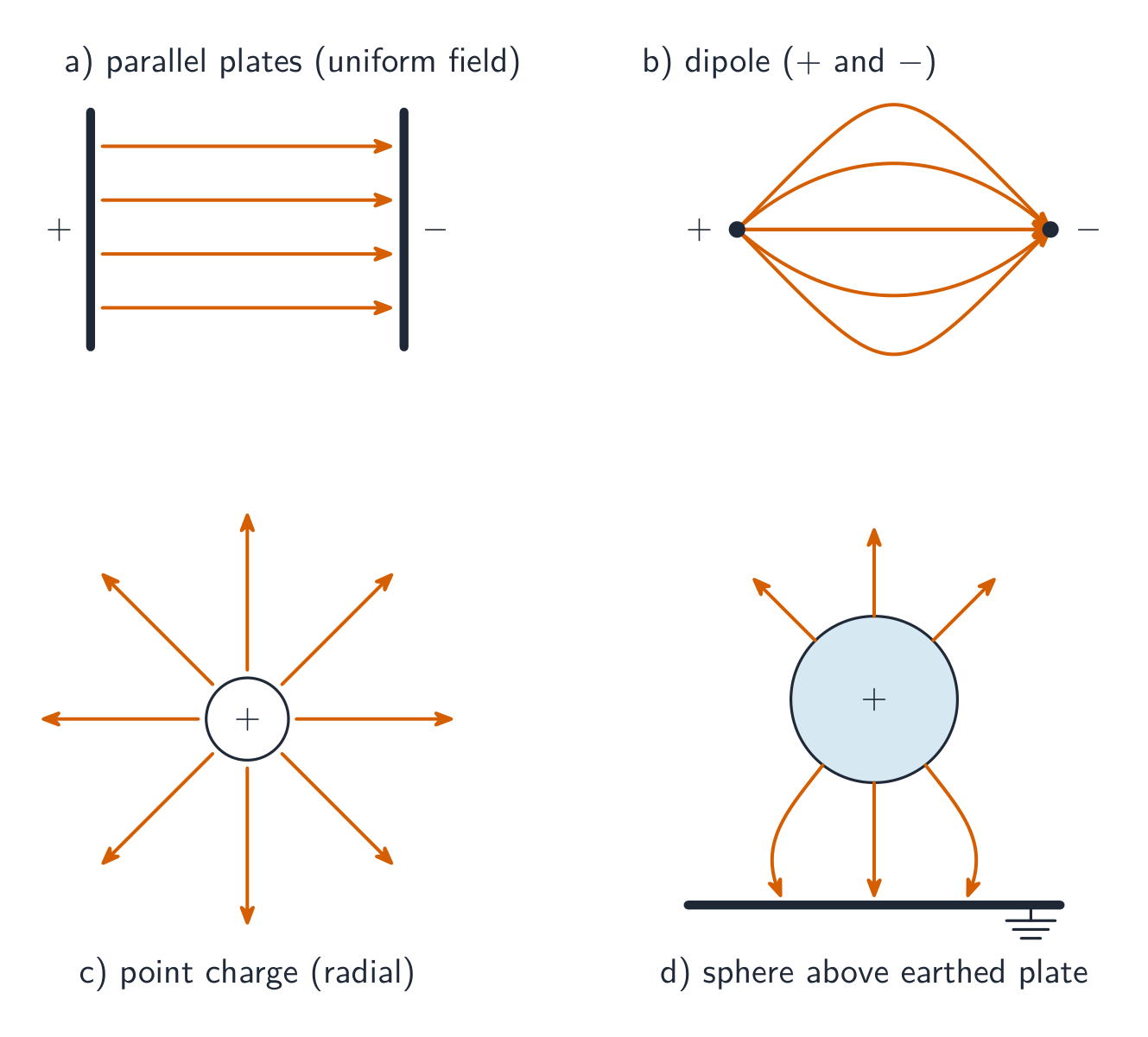
Worked example. Find the electric field $0.20\ \text{m}$ from a $+5.0\ \mu\text{C}$ point charge: $E=\dfrac{kQ}{r^2}=\dfrac{9.0\times10^{9}\times5.0\times10^{-6}}{(0.20)^2}=1.1\times10^{6}\ \text{N/C}$, pointing away from the charge. A $+2\ \text{nC}$ charge placed there would feel $F=q\,E=2\times10^{-9}\times1.1\times10^{6}=2.2\times10^{-3}\ \text{N}$.
Worked example (adding fields). A $+4.0\ \mu\text{C}$ charge sits at $x = 0$ and a $-1.0\ \mu\text{C}$ charge at $x = 0.30\ \text{m}$. Find (a) the field at the midpoint M and (b) the point on the line where the field is zero.
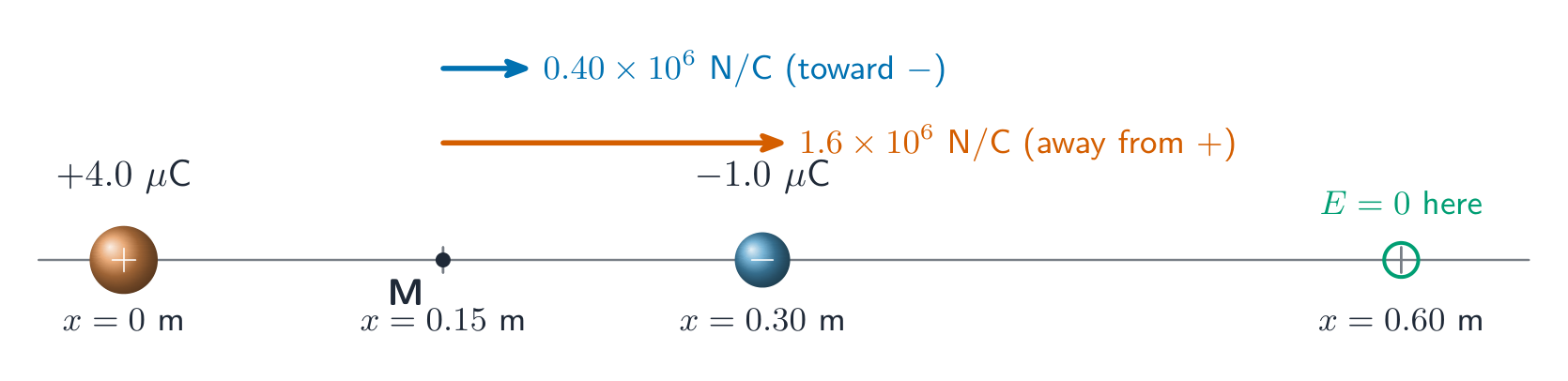
(a) Each charge is $0.15\ \text{m}$ from M.
$$E_+ = \frac{(9.0\times10^9)(4.0\times10^{-6})}{0.15^2} = 1.6\times10^6\ \text{N/C} \qquad E_- = \frac{(9.0\times10^9)(1.0\times10^{-6})}{0.15^2} = 0.40\times10^6\ \text{N/C}$$
The field of the positive charge points away from it ($+x$); the field of the negative charge points toward it, also $+x$. They add: $E = 2.0\times10^6\ \text{N/C}$ in the $+x$ direction.
(b) Between the charges both fields point the same way, so they cannot cancel there. To the left of $x = 0$ the larger charge is always closer, so its field always wins. The zero must be to the right of the smaller charge, at some $x > 0.30\ \text{m}$, where the two fields point in opposite directions:
$$\frac{k(4.0)}{x^2} = \frac{k(1.0)}{(x - 0.30)^2} \;\Rightarrow\; \frac{x}{x - 0.30} = 2 \;\Rightarrow\; x = 0.60\ \text{m}$$
The zero-field point is always nearer the smaller charge, outside the pair when the charges have opposite signs.
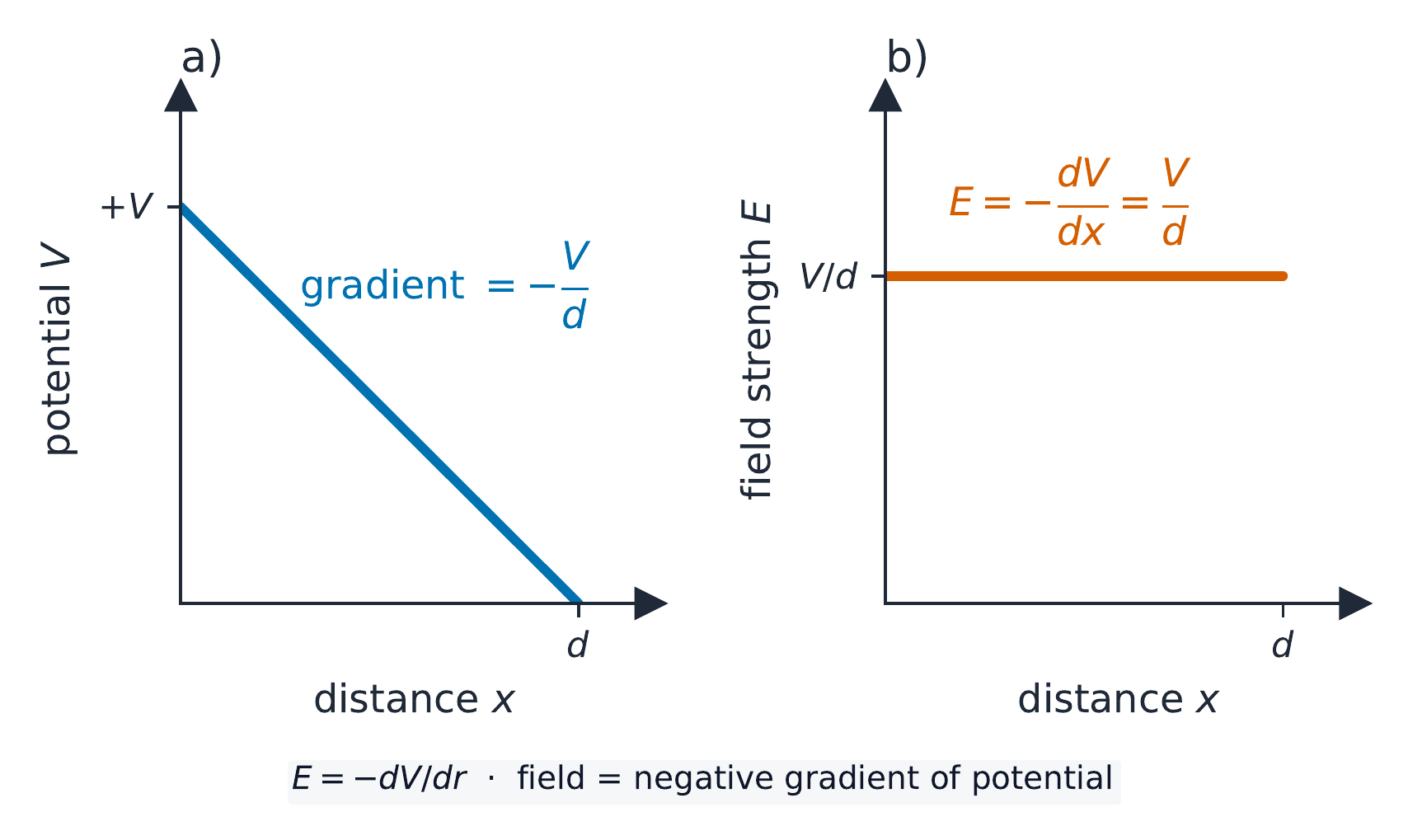
Worked example (uniform field between plates). Two parallel plates 平行板 $0.020\ \text{m}$ apart are held at a potential difference 电势差 of $500\ \text{V}$. The field between them is uniform 均匀的:
$$E = \frac{\Delta V}{d} = \frac{500}{0.020} = 2.5\times10^4\ \text{V/m}$$
An electron between the plates feels $F = qE = (1.6\times10^{-19})(2.5\times10^4) = 4.0\times10^{-15}\ \text{N}$, toward the positive plate, the same anywhere in the gap. (One $\text{V/m}$ is the same as one $\text{N/C}$.)
Explore
Map the field around a charge
An electric field points the way a positive test charge would be pushed: away from a positive charge, toward a negative one. Closer lines mean a stronger field.
Vocabulary
Train
| English |
|---|
| electric field/ɪˈlektrɪk fiːld/ |
| test charge/test tʃɑːdʒ/ |
| Electric field lines |
| parallel plates |
| potential difference/pəˈtenʃl ˈdɪfrəns/ |
| uniform/ˈjuːnɪfɔːm/ |
10.4
Electric Potential Energy
Syllabus
| Learning Objective | Essential Knowledge |
|---|---|
10.4.A |
Boundary statement: As the methods to calculate the electric potential energy due to extended charge distributions exceed the scope of the course, AP Physics 2 only requires that students calculate the electric potential energy of configurations of four or fewer point charges. |
Source: College Board AP Course and Exam Description
Two charges have electric potential energy 电势能 stored in their arrangement:
$$U=\frac{k q_1 q_2}{r}.$$
Like charges pushed together store positive energy; opposite charges have negative energy (bound). Moving a charge changes $U$, and the electric force does work equal to $-\Delta U$.
What $U$ means. The electric potential energy of two point charges is the work an outside force must do to bring them from infinitely far apart (where $U=0$) to their present positions, slowly. For like charges you must push them together, so $U$ is positive; for opposite charges they pull together and you must hold them back, so $U$ is negative. For three or more charges, add $U$ for every pair: three charges have three pairs, four charges have six.
Worked example (bringing in a third charge). Particles A and B, each $+Q$, are fixed at two corners of an equilateral triangle of side $d$. The system's energy is $U_i=\dfrac{kQ^2}{d}$. A third particle is brought from very far away to the third corner.
- If it is $+Q$, two new pairs are added, each $+\dfrac{kQ^2}{d}$, so $U_f=\dfrac{3kQ^2}{d}$: the energy rises, because an outside force had to push it in against the repulsion.
- If it is $-Q$, each new pair is $-\dfrac{kQ^2}{d}$, so $U_f=\dfrac{kQ^2}{d}-\dfrac{2kQ^2}{d}=-\dfrac{kQ^2}{d}$: the energy falls below zero.
On a bar chart, draw the $+Q$ case as a taller final bar and the $-Q$ case as a bar below the axis.
Explore
Energy in the field
See the field a charge builds; moving another charge through it stores or releases energy.
Vocabulary
Train
| English |
|---|
| electric potential energy/ɪˈlektrɪk pəˈtenʃl ˈenədʒi/ |
10.5
Electric Potential

Syllabus
| Learning Objective | Essential Knowledge |
|---|---|
10.5.A |
|
10.5.B |
Boundary statement: As the methods to calculate the electric potential due to extended charges exceed the scope of the course, AP Physics 2 only expects that students calculate the electric potential of configurations of four or fewer particles (or more in situations of high symmetry). |
Source: College Board AP Course and Exam Description
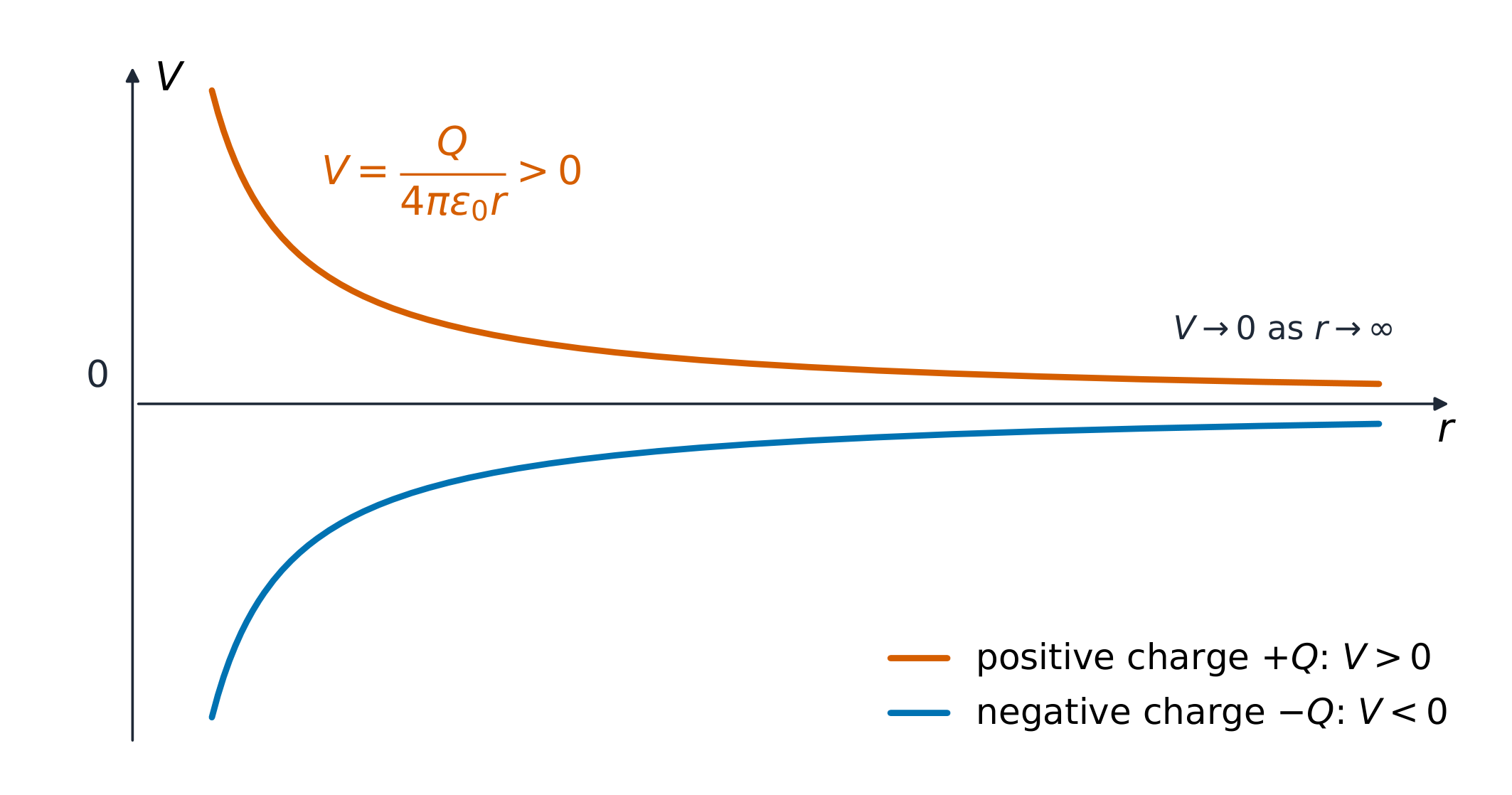
Electric potential 电势 $V$ is the potential energy per unit charge – a scalar field, measured in volts:
$$V=\frac{U}{q}=\frac{kQ}{r}.$$
The potential difference (voltage 电压) between two points is the work per unit charge to move between them: $\Delta V=\dfrac{\Delta U}{q}$, and $U=qV$. Positive charges move from high to low potential on their own. Because potential is a scalar 标量, adding the potentials from several charges is much easier than adding field vectors 矢量.
Worked example. For the two charges in the field example above, the potential at the midpoint M is
$$V = \frac{k(4.0\times10^{-6})}{0.15} + \frac{k(-1.0\times10^{-6})}{0.15} = \frac{(9.0\times10^9)(3.0\times10^{-6})}{0.15} = 1.8\times10^5\ \text{V}.$$
Keep the sign of each charge and add; there are no directions to worry about. The field at M is not zero, but that tells you nothing about $V$: field and potential are different quantities.
Worked example (field zero, or potential zero?). Return to the triangle: $+Q$ at A and at B, and point P at the center, a distance $r$ from each corner. What third charge at the last corner makes the field at P zero, and what makes the potential zero?
- Field. Three equal charges at the corners give three fields of the same size at P, $120°$ apart, and they cancel. So a third charge of $+Q$ makes $E=0$. A student who says $+2Q$ is wrong: that charge's field would be twice as large, and the net field would be $\dfrac{kQ}{r^2}$, pointing away from the third corner.
- Potential. Potential is a scalar: $\dfrac{kQ}{r}+\dfrac{kQ}{r}+\dfrac{kq_3}{r}=0$ needs $q_3=-2Q$. A student who says $-Q$ is wrong: that leaves $V=\dfrac{kQ}{r}$.
The two answers differ because field adds as vectors (directions matter) and potential adds as numbers.
Equipotential lines. Points at the same potential can be joined into equipotential lines 等势线, also called isolines. They are like contour lines on a map, with potential in place of height.
- The field is always perpendicular to the isolines, and it points from higher to lower potential. There is no field component along an isoline, so moving a charge along one takes no work.
- Where isolines are close together, the field is strong. The average field between two points is $E_{\text{avg}}=\dfrac{|\Delta V|}{d}$.
- More isolines around one charge, reaching farther out, mean that charge is larger. Positive values surround a positive charge; negative values surround a negative one.
Worked example (a proton released between the isolines). A proton ($+q$) is released from rest and moves through a potential difference of $20\ \text{V}$, from higher to lower potential. The system's electric potential energy changes by $\Delta U=q\,\Delta V=q(-20\ \text{V})$, a decrease, and the proton gains the same amount of kinetic energy. If the proton moved a distance $d$ through an average field $E_{\text{avg}}$, the work done on it by the field is $W=qE_{\text{avg}}d$, which also equals $20q$.
Gravitational potential around two masses looks the same as electric potential around two charges of the same sign, because both forces fall off as $1/r^2$. The difference: gravity always attracts, so gravitational isolines never show the "repel" pattern of two like charges pushing a test charge away.
A battery produces a potential difference by chemical reactions that push positive and negative charges apart. When two conductors touch, electrons flow between them until both surfaces are at the same potential.
Explore
Field and potential together
See how the field lines relate to the potential that falls off around a charge.
Vocabulary
Train
| English |
|---|
| Electric potential/ɪˈlektrɪk pəˈtenʃl/ |
| voltage/ˈvəʊltɪdʒ/ |
| scalar/ˈskeɪlə/ |
| vectors/ˈvektəz/ |
| equipotential lines |
10.6
Capacitors

Syllabus
| Learning Objective | Essential Knowledge |
|---|---|
10.6.A |
Boundary statement: While other shapes are also able to separate charges, only the analysis and descriptions of parallel-plate capacitors are required for AP Physics 2. Edge effects will be ignored unless explicitly stated otherwise. |
Source: College Board AP Course and Exam Description
A capacitor 电容器 stores charge and energy on two conductors separated by a gap. Its capacitance 电容 relates charge to voltage:
$$C=\frac{Q}{V},$$
and the stored energy is $U=\tfrac{1}{2}CV^2$. Capacitance depends on the plates' geometry 几何形状 and the material between them, not on the charge placed on it.
Worked example. A $100\ \mu\text{F}$ capacitor is charged to $12\ \text{V}$. It holds $Q=CV=100\times10^{-6}\times12=1.2\times10^{-3}\ \text{C}$ of charge and stores $U=\tfrac12 CV^2=\tfrac12\times100\times10^{-6}\times12^2=7.2\times10^{-3}\ \text{J}$ of energy.
The parallel-plate capacitor. Two flat plates of area $A$, a distance $d$ apart, carry equal and opposite charges. Then
$$C=\frac{\kappa\varepsilon_0A}{d},\qquad E=\frac{Q}{\varepsilon_0A}\ \ (\text{in air}).$$
Larger plates hold more charge at the same voltage; plates farther apart hold less. $\kappa$ is the dielectric constant (relative permittivity) of the material between the plates ($\kappa=1$ for a vacuum, about $1$ for air). Between the plates, away from the edges, the field is uniform: the same size and direction everywhere.
- Energy. The energy $\tfrac12QV=\tfrac12CV^2$ is the work an outside force (the battery) did to separate the charges onto the two plates.
- Dielectric. Sliding an insulator between the plates polarizes it. Its induced charges make a field opposite to the plates' field, so for the same charge the voltage falls, and $C=Q/V$ rises by the factor $\kappa$.
Worked example (electrons through two plates). Two plates of area $0.25\ \text{m}^2$, $0.010\ \text{m}$ apart, have holes in their centers. Fast electrons enter through the top plate and are slowed down as they cross toward the bottom one.
- The force on each electron points up, against its motion. An electron's force is opposite to the field, so the field points down: from the top plate to the bottom. The field points from $+$ to $-$, so the bottom plate is negative.
- If the potential difference is $200\ \text{V}$: $E=\dfrac{200}{0.010}=2.0\times10^4\ \text{V/m}$.
- Charge on each plate: $Q=\varepsilon_0AE=(8.85\times10^{-12})(0.25)(2.0\times10^4)=4.4\times10^{-8}\ \text{C}$.
Capacitors in series. Connected in series to a battery, each capacitor holds the same charge $Q$ (the charge that leaves one plate arrives at the next), and the voltages add to the battery's. Two identical capacitors in series have half the capacitance of one. A single replacement with the same $C$ could have half the plate area, or twice the plate spacing.
Worked example (finding an unknown capacitance). A $4.5\ \text{V}$ battery is connected in series with an unknown capacitor $C_U$ and a known capacitor $C_K$, using several different $C_K$. The voltmeter reads $\Delta V_K$ across the known one; the rest, $\Delta V_U=4.5-\Delta V_K$, is across the unknown.
- Same charge on both: $Q=C_K\Delta V_K=C_U\Delta V_U$. With $C_K=200\ \mu\text{F}$ and $\Delta V_K=1.5\ \text{V}$, $Q=3.0\times10^{-4}\ \text{C}$.
- Plot $Q$ (calculated as $C_K\Delta V_K$) on the vertical axis against $\Delta V_U$ on the horizontal: a straight line through the origin with slope $C_U$.
- In parallel, both capacitors would simply have the battery's voltage, $4.5\ \text{V}$, whatever $C_U$ is, so a voltmeter alone would learn nothing about it.
The same idea works for a single capacitor: plot the charge $q$ against $|\Delta V|$, and the slope is $C$.
Explore
Charge and discharge a capacitor
A capacitor stores charge on two plates. It fills and empties exponentially, set by the time constant $\tau = RC$ — bigger $R$ or $C$ means slower charging.
Vocabulary
Train
| English |
|---|
| capacitor/kəˈpæsɪtə/ |
| capacitance/kəˈpæsɪtəns/ |
| geometry/dʒiˈɒmətri/ |
10.7
Conservation of Electric Energy
Syllabus
| Learning Objective | Essential Knowledge |
|---|---|
10.7.A |
|
Source: College Board AP Course and Exam Description
Energy is conserved for charges just as for masses. A charge released in a field converts electric potential energy into kinetic energy 动能:
$$q\,\Delta V=\tfrac{1}{2}mv^2 \quad(\text{gaining speed as it "falls" through a potential difference}).$$
Worked example. An electron ($q=1.6\times10^{-19}\ \text{C}$, $m=9.1\times10^{-31}\ \text{kg}$) is accelerated from rest through a potential difference of $100\ \text{V}$. Its final speed is
$$v=\sqrt{\frac{2q\,\Delta V}{m}}=\sqrt{\frac{2\times1.6\times10^{-19}\times100}{9.1\times10^{-31}}}=5.9\times10^{6}\ \text{m/s}.$$
This is exactly how the electron gun 电子枪 in an old television or an electron microscope works.
Kinetic energy depends on charge, not mass. Accelerated from rest through the same $|\Delta V|$, a particle gains $K=|q|\,|\Delta V|$. A particle with twice the charge gains twice the kinetic energy, whatever its mass; the speed it reaches does depend on the mass.
A charge in a uniform field moves like a projectile. Between parallel plates the force $qE$ is constant, so the acceleration $qE/m$ is constant. A charge that enters moving parallel to the plates keeps its sideways velocity and accelerates steadily toward one plate: its path is a parabola, exactly like a ball thrown horizontally under gravity.
Worked example (an electron orbiting a nucleus). In a simple model of hydrogen, the electron moves in a circle of radius $r$ around the proton. The electric attraction is the centripetal force:
$$\frac{ke^2}{r^2}=\frac{mv^2}{r}\;\Rightarrow\;v=\sqrt{\frac{ke^2}{mr}}.$$
Then $K=\tfrac12mv^2=\dfrac{ke^2}{2r}$ and $U=-\dfrac{ke^2}{r}$, so the total energy is $E=K+U=-\dfrac{ke^2}{2r}$. It is negative, because the electron is bound. When the atom absorbs a photon, the electron moves to a larger $r$: $U$ rises toward zero, $K$ falls, and the total energy rises by the photon's energy.
Explore
Charge gaining or losing kinetic energy
As a charge moves through a field, energy shifts between kinetic and potential. Sort each case.
Vocabulary
Train
| English |
|---|
| kinetic energy/kɪˈnetɪk ˈenədʒi/ |
| electron gun |
10.7
Practice
Answer each before reading the answers below. Take $k=9.0\times10^{9}\ \text{N m}^2/\text{C}^2$ and $e=1.6\times10^{-19}\ \text{C}$.
- Two $+2.0\ \mu\text{C}$ charges are $0.30\ \text{m}$ apart. Find the force between them, and say whether it attracts or repels.
- The distance in question 1 is tripled. Find the new force without starting again.
- Find the electric field $0.50\ \text{m}$ from a $-8.0\ \text{nC}$ point charge, with its direction.
- Two parallel plates $0.010\ \text{m}$ apart have a potential difference of $200\ \text{V}$. Find the field between them, the force on a proton there, and the kinetic energy a proton gains crossing from the positive plate to the negative plate.
- A student says: "At a point where the electric potential is zero, the electric field must be zero too." Correct the student.
10.7
Answers
- $F=\dfrac{kq_1q_2}{r^2}=\dfrac{(9.0\times10^{9})(2.0\times10^{-6})^2}{0.30^2}=0.40\ \text{N}$, repulsive (like charges).
- $F\propto1/r^2$, so tripling $r$ divides $F$ by 9: $0.40/9=0.044\ \text{N}$.
- $E=\dfrac{kQ}{r^2}=\dfrac{(9.0\times10^{9})(8.0\times10^{-9})}{0.50^2}=2.9\times10^{2}\ \text{N/C}$, pointing toward the charge, because it is negative.
- $E=\dfrac{\Delta V}{d}=\dfrac{200}{0.010}=2.0\times10^{4}\ \text{V/m}$. $F=eE=(1.6\times10^{-19})(2.0\times10^{4})=3.2\times10^{-15}\ \text{N}$. Energy gained $=e\,\Delta V=(1.6\times10^{-19})(200)=3.2\times10^{-17}\ \text{J}$.
- Potential and field are different quantities. Midway between equal charges $+q$ and $-q$, the two potentials cancel, so $V=0$. But both fields there point from $+q$ toward $-q$ and add, so $E$ is not zero. The field depends on how fast $V$ changes with position, not on the value of $V$.
10.7
Exam tips
- Coulomb's law and the point-charge field are inverse-square — doubling the separation makes the force (or field) four times smaller.
- Use magnitudes for the size of a force and decide direction from the signs; the field points the way a positive test charge would move.
- Potential ($V$) is a scalar so potentials from several charges simply add; the field ($E$) is a vector and must be added by direction.
- For a charge accelerated through a voltage use energy conservation $qV=\tfrac12 mv^2$.
- Capacitor relations: $C=Q/V$ (capacitance is fixed by geometry) and energy $U=\tfrac12 CV^2$.
Common mistakes
- Adding field magnitudes without thinking about direction. Draw each field at the point first; fields from a $+$ and a $-$ charge point the same way between them.
- Putting the sign of a charge into $E = kQ/r^2$ and then also adding a direction. Use magnitudes for size, then choose the direction from the sign.
- Using $1/r$ for the field or $1/r^2$ for the potential. Field and force go as $1/r^2$; potential and potential energy as $1/r$.
- Saying that where $E = 0$ the potential must be zero (or the reverse). They are independent: at M above, $E \ne 0$ and $V \ne 0$; at the midpoint of two equal opposite charges $V = 0$ but $E \ne 0$.
- Forgetting the micro- prefix: $1\ \mu\text{C} = 10^{-6}\ \text{C}$, $1\ \text{nC} = 10^{-9}\ \text{C}$.
- Thinking capacitance changes when the charge or voltage changes. $C$ is set by the plates and the material between them; $Q$ and $V$ change together.
- Saying a charged object cannot attract a neutral one. It polarizes the neutral object, and the nearer, opposite induced charge wins.
- Saying the field inside a charged metal object is strong. In equilibrium it is zero inside; the extra charge sits on the surface.
- Drawing field arrows along an equipotential line. The field always crosses isolines at right angles.
- Thinking capacitors in series share the same voltage. In series they carry the same charge; in parallel they share the same voltage.
- Counting only some pairs in the potential energy of three or more charges. Every pair contributes one term.
Interactive lessons on this topic
Work through it step by step, with instant-check exercises.