| Learning Objective | Essential Knowledge |
|---|---|
8.1.A |
|
Acids and Bases · กรดและเบส
AP Chemistry · Topic 8 · หัวข้อ 8
 8:24
8:24
กรดและเบส
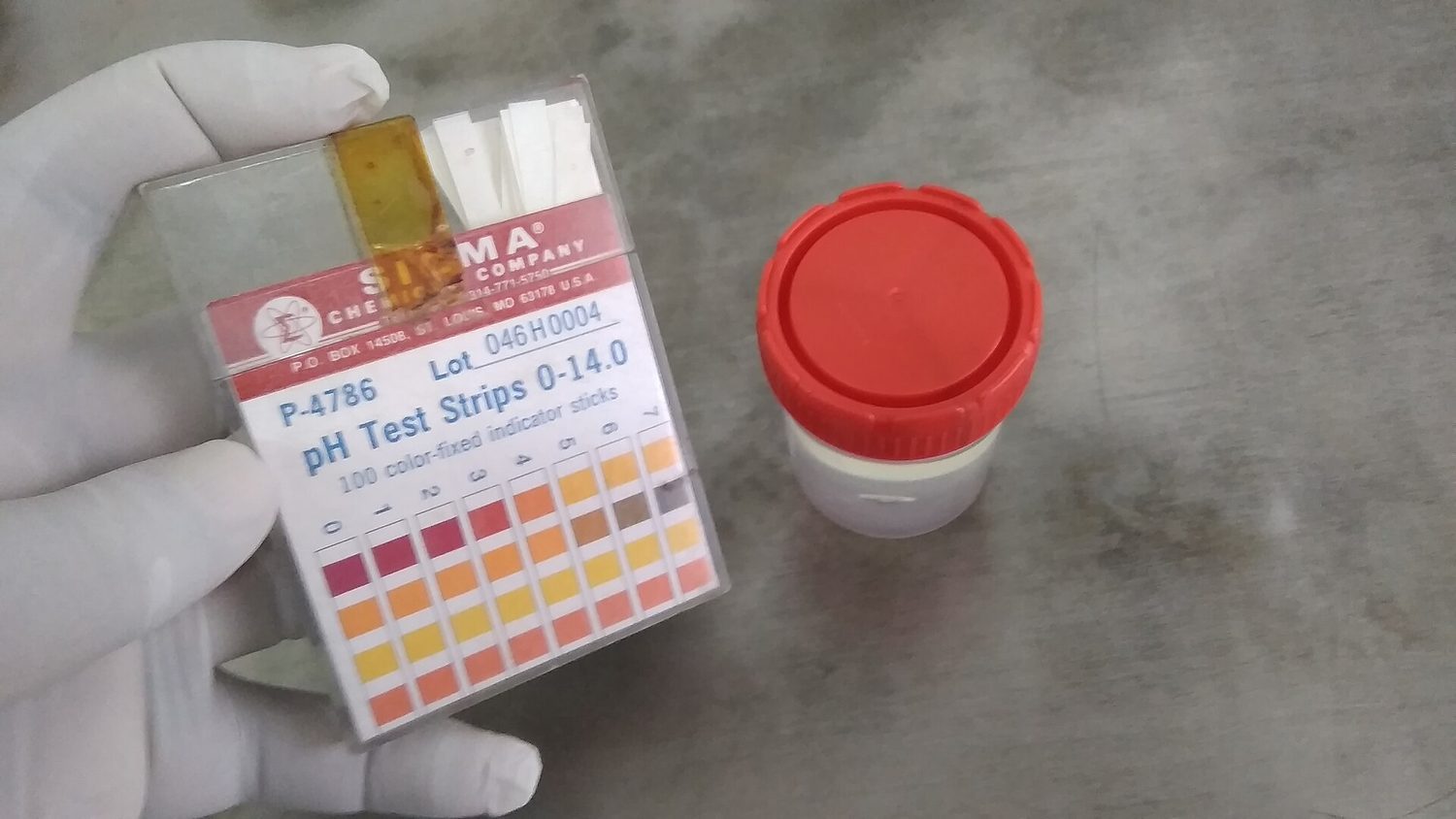
แถบกระดาษสองเส้น — เส้นหนึ่งสีแดง อีกเส้นหนึ่งสีน้ำเงิน จุ่มลงในของเหลวแล้วสีจะเปลี่ยน และสีนั้นบอกคุณว่าของเหลวนั้นเป็นกรดหรือเบส…
English narration · English + 中文 subtitles burned in · การบรรยายภาษาอังกฤษ · คำบรรยายภาษาอังกฤษ + 中文 ลอยตัวบนภาพ
8.1
Introduction to Acids and Bases · บทนำเรื่องกรดและเบส

Syllabus · หลักสูตร
Source: College Board AP Course and Exam Description · แหล่งที่มา: คำอธิบายหลักสูตรและข้อสอบ College Board AP
English
By the Brønsted–Lowry definition, an acid 酸 is a proton ($\text{H}^+$) donor and a base 碱 is a proton acceptor. When an acid donates a proton it becomes its conjugate base 共轭碱; a base gaining a proton becomes its conjugate acid 共轭酸. Water is amphoteric – it can act as either.
ไทย
ตามนิยามของ บรอนสเตด-โลวรี กรด คือผู้ให้โปรตอน ($\text{H}^+$) และ เบส คือผู้รับโปรตอน เมื่อกรดให้โปรตอน它将กลายเป็น เบสคู่ควบ; เบสที่รับโปรตอนจะกลายเป็น กรดคู่ควบ น้ำเป็น แอมฟอเทริก – สามารถทำหน้าที่ได้ทั้งสองแบบ
Vocabulary · คำศัพท์
Train · ฝึกฝน
| English | ไทย |
|---|---|
| acid/ˈæsɪd/ | กรด (acid) |
| base/beɪs/ | ฐาน |
| conjugate base/ˈkɒndʒuːɡeɪt beɪs/ | เบสคู่ควบ |
| conjugate acid/ˈkɒndʒuːɡeɪt ˈæsɪd/ | กรดคอนจูเกต |
| autoionization/ˌɔːtəʊˌaɪənaɪˈzeɪʃn/ | ไอออไนเซชันด้วยตนเอง |
| hydronium ion/haɪˈdrəʊnɪəm ˈaɪɒn/ | ไอออนไฮเดรเนียม |
| ion-product constant of water/ˈaɪɒn ˈprɒdʌkt ˈkɒnstənt ɒv ˈwɔːtə/ | คงที่ผลคูณไอออนของน้ำ |
| neutral/ˈnjuːtrəl/ | เป็นกลาง |
| pH/piː eɪtʃ/ | pH |
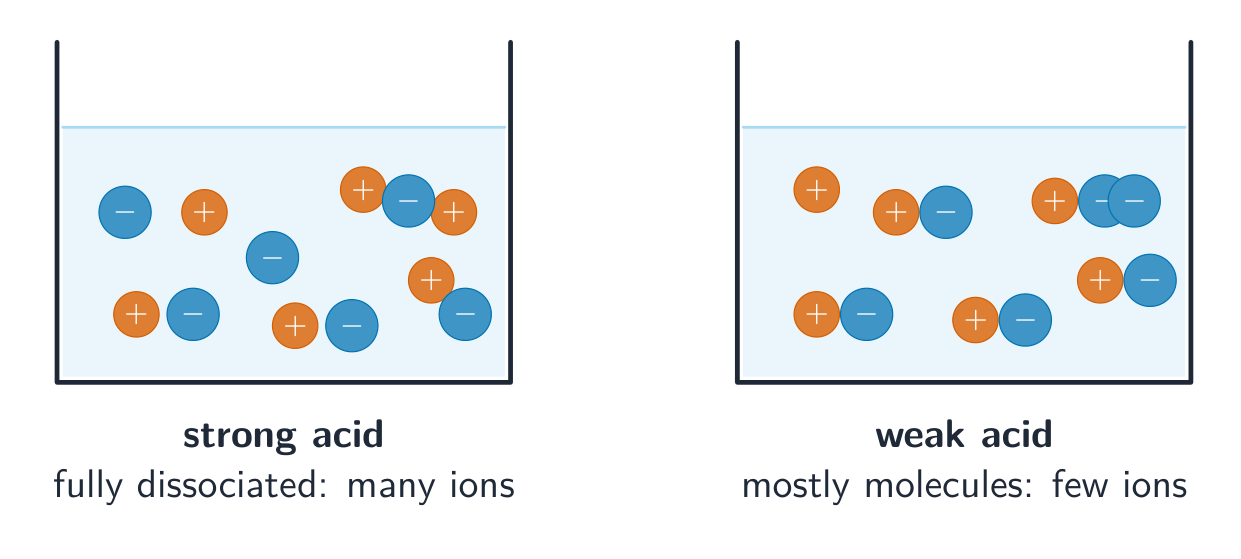
| strong acid/strɒŋ ˈæsɪd/ | กรดแก่ |
| strong base/strɒŋ beɪs/ | เบสแก่ |
| weak acid/wiːk ˈæsɪd/ | กรดอ่อน |
8.1
The Autoionization of Water · การแตกตัวของน้ำด้วยตนเอง

Syllabus · หลักสูตร
| Learning Objective | Essential Knowledge |
|---|---|
8.1.A |
|
Source: College Board AP Course and Exam Description · แหล่งที่มา: คำอธิบายหลักสูตรและข้อสอบ College Board AP
English
Even pure water conducts a tiny current, because water molecules react with each other in a reaction called autoionization 自偶电离:
$$2\text{H}_2\text{O} \rightleftharpoons \text{H}_3\text{O}^+ + \text{OH}^-.$$
One water molecule passes a proton to another, making a hydronium ion 水合氢离子 ($\text{H}_3\text{O}^+$, the ion we loosely write as $\text{H}^+$) and a hydroxide ion. This equilibrium has its own constant, the ion-product constant of water 水的离子积:
$$K_w = [\text{H}_3\text{O}^+][\text{OH}^-] = 1.0\times10^{-14}$$
at 25 °C. Defining $\text{pOH}=-\log[\text{OH}^-]$ and taking $-\log$ of the $K_w$ expression gives the rule the rest of this topic leans on:
$$\text{pH} + \text{pOH} = \text{p}K_w = 14.0$$
(again at 25 °C). Know one of pH or pOH and you get the other by subtracting from 14.
In pure water the two ions form in equal numbers, so $[\text{H}_3\text{O}^+]=[\text{OH}^-]$ and $\text{pH}=\text{pOH}=7.0$. This is what neutral 中性 means. Acidic means $[\text{H}_3\text{O}^+]>[\text{OH}^-]$ (pH below 7); basic is the reverse.
Worked example. A solution has $[\text{H}_3\text{O}^+]=2.0\times10^{-3}\ \text{M}$. Find $[\text{OH}^-]$. Because $K_w$ always holds in water,
$$[\text{OH}^-]=\frac{K_w}{[\text{H}_3\text{O}^+]}=\frac{1.0\times10^{-14}}{2.0\times10^{-3}}=5.0\times10^{-12}\ \text{M}.$$
The hydroxide concentration is far smaller than the hydronium, confirming the solution is acidic.
$K_w$ is temperature dependent: autoionization is endothermic, so heating water shifts it forward and raises $K_w$. At 50 °C, $K_w>1.0\times10^{-14}$, so neutral water has $\text{pH}=\text{pOH}<7.0$. It is still neutral, because the ion concentrations are still equal – neutral means equal ions, not a pH of exactly 7.
ไทย
แม้แต่น้ำบริสุทธิ์ก็นำกระแสไฟฟ้าเล็กน้อยได้ เนื่องจากโมเลกุลของน้ำทำปฏิกิริยากันเองในปฏิกิริยาที่เรียกว่า การแตกตัวของน้ำด้วยตนเอง:
$$2\text{H}_2\text{O} \rightleftharpoons \text{H}_3\text{O}^+ + \text{OH}^-.$$
โมเลกุลน้ำหนึ่งโมเลกุลส่งโปรตอนไปยังอีกโมเลกุลหนึ่ง ทำให้เกิด ไอออนไฮโดรเนียม ($\text{H}_3\text{O}^+$, ไอออนที่เราเขียนย่อๆ ว่า $\text{H}^+$) และไอออนไฮดรอกไซด์ สมดุลนี้จะมีค่าคงที่ของมันเอง ซึ่งเรียกว่า ค่าคงที่ผลคูณไอออนของน้ำ:
$$K_w = [\text{H}_3\text{O}^+][\text{OH}^-] = 1.0\times10^{-14}$$
ที่ 25 °C. กำหนด $\text{pOH}=-\log[\text{OH}^-]$ และนำ $-\log$ ของ $K_w$来表达式得出了该主题其余部分依赖的规则:
$$\text{pH} + \text{pOH} = \text{p}K_w = 14.0$$
(อีกครั้งที่ 25 °C). รู้ค่า pH หรือ pOH ใดค่าหนึ่ง คุณจะได้ค่าอีกค่าหนึ่งโดยการลบออกจาก 14
ในน้ำบริสุทธิ์ ไอออนทั้งสองเกิดขึ้นในจำนวนเท่ากัน ดังนั้น $[\text{H}_3\text{O}^+]=[\text{OH}^-]$ และ $\text{pH}=\text{pOH}=7.0$ นี่คือสิ่งที่ ความเป็นกลาง หมายถึง กรดหมายถึง $[\text{H}_3\text{O}^+]>[\text{OH}^-]$ (pH ต่ำกว่า 7); เบสคือตรงกันข้าม
ตัวอย่างวิธีทำ สารละลายมี $[\text{H}_3\text{O}^+]=2.0\times10^{-3}\ \text{M}$. หา $[\text{OH}^-]$. เพราะ $K_w$ เป็นจริงเสมอในน้ำ,
$$[\text{OH}^-]=\frac{K_w}{[\text{H}_3\text{O}^+]}=\frac{1.0\times10^{-14}}{2.0\times10^{-3}}=5.0\times10^{-12}\ \text{M}.$$
ความเข้มข้นไฮดรอกไซด์น้อยกว่ามากเมื่อเทียบกับไฮโดรเนียม ยืนยันว่าสารละลายนี้เป็นกรด
$K_w$ ขึ้นอยู่กับอุณหภูมิ: การแตกตัวเองเป็นปฏิกิริยารับความร้อน ดังนั้นการเพิ่มอุณหภูมิน้ำจะทำให้สมดุลเลื่อนไปข้างหน้าและทำให้ $K_w$ เพิ่มขึ้น ที่ 50 °C, $K_w>1.0\times10^{-14}$ ดังนั้นน้ำที่เป็นกลางจะมี $\text{pH}=\text{pOH}<7.0$ มันยังคงเป็นกลางอยู่ เพราะความเข้มข้นของไอออนยังเท่ากัน – ความความเป็นกลางหมายถึงไอออนที่เท่ากัน ไม่ใช่ค่า pH เท่ากับ 7 พอดี
8.2
pH and pOH of Strong Acids and Bases · ค่า pH และ pOH ของกรดและเบสแรง

Syllabus · หลักสูตร
English
Learning Objective 8.2.A: Calculate $\mathrm{pH}$ and $\mathrm{pOH}$ based on concentrations of all species in a solution of a strong acid or a strong base.
- 8.2.A.1 Molecules of a strong acid (e.g., $\mathrm{HCl}$, $\mathrm{HBr}$, $\mathrm{HI}$, $\mathrm{HClO_4}$, $\mathrm{H_2SO_4}$, and $\mathrm{HNO_3}$) will completely ionize in aqueous solution to produce hydronium ions and the conjugate base of the acid. As such, the concentration of $\mathrm{H_3O^+}$ in a strong acid solution is equal to the initial concentration of the strong acid, and thus the $\mathrm{pH}$ of the strong acid solution is easily calculated.
- 8.2.A.2 When dissolved in solution, strong bases (e.g., group I and II hydroxides) completely dissociate to produce hydroxide ions. As such, the concentration of $\mathrm{OH^-}$ in a strong base solution is equal to the initial concentration of a group I hydroxide and double the initial concentration of a group II hydroxide, and thus the $\mathrm{pOH}$ (and $\mathrm{pH}$) of the strong base solution is easily calculated.
ไทย
学习目的 8.2.A: 基于强酸或强碱溶液中所有物种的浓度计算$\mathrm{pH}$和$\mathrm{pOH}$。
- 8.2.A.1 โมเลกุลของกรดแรง (เช่น $\mathrm{HCl}$, $\mathrm{HBr}$, $\mathrm{HI}$, $\mathrm{HClO_4}$, $\mathrm{H_2SO_4}$, และ $\mathrm{HNO_3}$) จะแตกตัวเป็นไอออนอย่างสมบูรณ์ในน้ำเพื่อสร้างไฮโดรนิ움ไอออนและเบสคู่ควบของกรด ดังนั้นความเข้มข้นของ $\mathrm{H_3O^+}$ ในสารละลายกรดแรงจึงเท่ากับความเข้มข้นเริ่มต้นของกรดแรง และดังนั้น $\mathrm{pH}$ ของสารละลายกรดแรงจึงคำนวณได้ง่าย
- 8.2.A.2 当溶解在溶液中时,强碱(如第I族和第II族氢氧化物)完全解离产生氢氧根离子。因此,强碱溶液中$\mathrm{OH^-}$的浓度等于第I族氢氧化物的初始浓度和第II族氢氧化物初始浓度的两倍,从而强碱溶液的$\mathrm{pOH}$(以及$\mathrm{pH}$)易于计算。
Source: College Board AP Course and Exam Description · แหล่งที่มา: คำอธิบายหลักสูตรและข้อสอบ College Board AP
English
The pH pH值 scale measures acidity: $\text{pH}=-\log[\text{H}^+]$, with $\text{pH}+\text{pOH}=14$ at 25 °C. A strong acid 强酸 or strong base 强碱 dissociates completely, so its ion concentration equals its concentration – read pH directly. Lower pH means more acidic.
Worked example. Find the pH of $0.010\ \text{M}$ HCl. Because HCl is a strong acid it is fully dissociated, so $[\text{H}^+]=0.010\ \text{M}$ and
$$\text{pH}=-\log(0.010)=2.0.$$
For a strong base like $0.010\ \text{M}$ NaOH, $\text{pOH}=2.0$, so $\text{pH}=14-2.0=12.0$.
ไทย
pH สเกลวัดความเป็นกรด: $\text{pH}=-\log[\text{H}^+]$, โดยมี $\text{pH}+\text{pOH}=14$ ที่ 25 °C. กรดแรง หรือ เบสแรง จะแตกตัว สมบูรณ์, ดังนั้นความเข้มข้นไอออนจึงเท่ากับความเข้มข้นสาร – อ่านค่า pH ได้โดยตรง ค่า pH ต่ำลงหมายความว่ามีความเป็นกรดมากขึ้น
ตัวอย่างวิธีทำ. หา pH ของ $0.010\ \text{M}$ HCl เนื่องจาก HCl เป็นกรดแรงจึงแตกตัวสมบูรณ์ ทำให้ $[\text{H}^+]=0.010\ \text{M}$ และ
$$\text{pH}=-\log(0.010)=2.0.$$
สำหรับเบสแรงอย่าง $0.010\ \text{M}$ NaOH, $\text{pOH}=2.0$, ดังนั้น $\text{pH}=14-2.0=12.0$.
Explore · สำรวจ
Move along the pH scale · เคลื่อนที่ไปตามสเกล pH
pH measures hydrogen-ion concentration on a log scale: each unit is a tenfold change. Strong acids sit low, strong bases high, 7 is neutral. · pH วัดความเข้มข้นของไฮโดรเจนไอออนบนสเกลลอการิทึม: แต่ละหน่วยคือการเปลี่ยนแปลงสิบเท่า กรดแรงมีค่าต่ำ เบสแรงมีค่าสูง, 7 เป็นกลาง
8.3
Weak Acid and Base Equilibria · สมดุลกรดและเบสอ่อน
Syllabus · หลักสูตร
English
Learning Objective 8.3.A: Explain the relationship among $\mathrm{pH}$, $\mathrm{pOH}$, and concentrations of all species in a solution of a monoprotic weak acid or weak base.
- 8.3.A.1 Weak acids react with water to produce hydronium ions. However, only a small percentage of molecules of a weak acid will ionize in this way. Thus, the concentration of $\mathrm{H_3O^+}$ is much less than the initial concentration of the molecular acid, and the vast majority of the acid molecules remain un-ionized.
- 8.3.A.2 A solution of a weak acid involves equilibrium between an un-ionized acid and its conjugate base. The equilibrium constant for this reaction is $K_a$, often reported as $\mathrm{p}K_a$. The pH of a weak acid solution can be determined from the initial acid concentration and the $\mathrm{p}K_a$.
- Equation: $K_a = \dfrac{[\mathrm{H_3O^+}][\mathrm{A^-}]}{[\mathrm{HA}]}$
- Equation: $\mathrm{p}K_a = -\log K_a$
- 8.3.A.3 Weak bases react with water to produce hydroxide ions in solution. However, ordinarily just a small percentage of the molecules of a weak base in solution will ionize in this way. Thus, the concentration of $\mathrm{OH^-}$ in the solution does not equal the initial concentration of the base, and the vast majority of the base molecules remain un-ionized.
- 8.3.A.4 A solution of a weak base involves equilibrium between an un-ionized base and its conjugate acid. The equilibrium constant for this reaction is $K_b$, often reported as $\mathrm{p}K_b$. The $\mathrm{pH}$ of a weak base solution can be determined from the initial base concentration and the $\mathrm{p}K_b$.
- Equation: $K_b = \dfrac{[\mathrm{OH^-}][\mathrm{HB^+}]}{[\mathrm{B}]}$
- Equation: $\mathrm{p}K_b = -\log K_b$
- 8.3.A.5 The percent ionization of a weak acid (or base) can be calculated from its $\mathrm{p}K_a$ ($\mathrm{p}K_b$) and the initial concentration of the acid (base). The percent ionization can also be calculated from the initial concentration of the acid (base) and the equilibrium concentration of any of the species in the equilibrium expression.
- 8.3.A.6 For any conjugate acid-base pair, the acid ionization constant and base ionization constant are related by $K_w$:
- Equation: $K_w = K_a \times K_b$
- Equation: $\mathrm{p}K_w = \mathrm{p}K_a + \mathrm{p}K_b$
ไทย
学习目标 8.3.A: 解释$\mathrm{pH}$、$\mathrm{pOH}$与一元弱酸或弱碱溶液中所有物种浓度之间的关系。
- 8.3.A.1 弱酸与水反应生成水合氢离子。然而,只有很小比例的弱酸分子会以这种方式电离。因此,$\mathrm{H_3O^+}$的浓度远小于分子的初始酸浓度,绝大多数酸分子保持未电离状态。
- 8.3.A.2 弱酸溶液涉及未电离酸与其共轭碱之间的平衡。该反应的平衡常数是$K_a$,通常报告为$\mathrm{p}K_a$。弱酸溶液的pH可以根据初始酸浓度和$\mathrm{p}K_a$确定。
- สมการ: $K_a = \dfrac{[\mathrm{H_3O^+}][\mathrm{A^-}]}{[\mathrm{HA}]}$
- สมการ: $\mathrm{p}K_a = -\log K_a$
- 8.3.A.3 弱碱与水反应在溶液中产生氢氧根离子。然而,通常只有很小比例的溶液中的弱碱分子会以这种方式电离。因此,溶液中的$\mathrm{OH^-}$浓度不等于碱的初始浓度,绝大多数碱分子保持未电离状态。
- 8.3.A.4 การหาค่า pH ของสารละลายเบสอ่อนเกี่ยวข้องกับสมดุลระหว่างเบสที่ไม่แตกตัวและกรดคู่ควบของมัน ค่าคงที่สมดุลสำหรับปฏิกิริยานี้คือ $K_b$ ซึ่งมักรายงานในรูป $\mathrm{p}K_b$ ค่า $\mathrm{pH}$ ของสารละลายเบสอ่อนสามารถคำนวณได้จากความเข้มข้นเริ่มต้นของเบสและความ $\mathrm{p}K_b$
- สมการ: $K_b = \dfrac{[\mathrm{OH^-}][\mathrm{HB^+}]}{[\mathrm{B}]}$
- สมการ: $\mathrm{p}K_b = -\log K_b$
- 8.3.A.5 เปอร์เซ็นต์การแตกตัวของกรดอ่อน (หรือเบส) สามารถคำนวณได้จากค่า $\mathrm{p}K_a$ ($\mathrm{p}K_b$) และความเข้มข้นเริ่มต้นของกรด (เบส) เปอร์เซ็นต์การแตกตัวยังสามารถคำนวณได้จากความเข้มข้นเริ่มต้นของกรด (เบส) และความเข้มข้นที่สมดุลของสปีชีส์ใดๆ ในนิพจน์สมดุล
- 8.3.A.6 สำหรับคู่กรด-เบสคู่ควบ ค่าคงที่การแตกตัวของกรดและค่าคงที่การแตกตัวของเบสจะสัมพันธ์กันโดย $K_w$:
- สมการ: $K_w = K_a \times K_b$
- สมการ: $\mathrm{p}K_w = \mathrm{p}K_a + \mathrm{p}K_b$
Source: College Board AP Course and Exam Description · แหล่งที่มา: คำอธิบายหลักสูตรและข้อสอบ College Board AP
English
A weak acid 弱酸 only partly dissociates, described by an equilibrium constant $K_a$ (larger $K_a$ = stronger weak acid); a weak base has $K_b$. For any conjugate acid–base pair the two are linked through water, $K_a\times K_b = K_w$, so $\text{p}K_a+\text{p}K_b=14$ – a stronger acid always has a weaker conjugate base. Because dissociation is small, find $[\text{H}^+]$ with an ICE table and the $K_a$ expression, often using the small-$x$ approximation.
Worked example. Find the pH of $0.10\ \text{M}$ acetic acid, $K_a=1.8\times10^{-5}$. Let $x=[\text{H}^+]$ at equilibrium; the ICE table gives $K_a=\dfrac{x^2}{0.10-x}\approx\dfrac{x^2}{0.10}$ (small-$x$ approximation), so
$$x=\sqrt{K_a\times0.10}=\sqrt{1.8\times10^{-6}}=1.3\times10^{-3}\ \text{M}\;\Rightarrow\;\text{pH}=-\log(1.3\times10^{-3})=2.9.$$
The weak acid is far less acidic than a strong acid of the same concentration (which would be pH $1.0$).
ไทย
กรดอ่อนจะแตกตัว บางส่วน เท่านั้น อธิบายได้ด้วยค่าคงที่สมดุล $K_a$ (ค่า $K_a$ ที่ใหญ่ขึ้น = กรดอ่อนที่แข็งแรงขึ้น); ฐานอ่อนจะมี $K_b$ สำหรับคู่กรด-เบสที่สัมพันธ์กัน ทั้งสองจะเชื่อมโยงผ่านน้ำ $K_a\times K_b = K_w$ ดังนั้น $\text{p}K_a+\text{p}K_b=14$ – กรดที่แข็งแรงกว่าจะมีเบสที่สัมพันธ์กันอ่อนกว่าเสมอ เนื่องจากมีการแตกตัวน้อย ให้หาค่า $[\text{H}^+]$ โดยใช้ตาราง ICE และสมการ $K_a$ โดยมักใช้การประมาณค่า $x$ ที่น้อย
ตัวอย่างวิธีทำ. หา pH ของ $0.10\ \text{M}$ กรดอะซิติก, $K_a=1.8\times10^{-5}$. กำหนด $x=[\text{H}^+]$ ที่สมดุล ตาราง ICE จะได้ $K_a=\dfrac{x^2}{0.10-x}\approx\dfrac{x^2}{0.10}$ (การประมาณค่า $x$ เล็ก), ดังนั้น
$$x=\sqrt{K_a\times0.10}=\sqrt{1.8\times10^{-6}}=1.3\times10^{-3}\ \text{M}\;\Rightarrow\;\text{pH}=-\log(1.3\times10^{-3})=2.9.$$
กรดอ่อนนี้เป็นกรดได้น้อยกว่ากรดแรงที่มีความเข้มข้นเท่ากันมาก (ซึ่งจะมีค่า pH $1.0$)
8.4
Acid-Base Reactions and Buffers · ปฏิกิริยากรด-เบสและสารบัฟเฟอร์
Syllabus · หลักสูตร
English
Learning Objective 8.4.A: Explain the relationship among the concentrations of major species in a mixture of weak and strong acids and bases.
- 8.4.A.1 When a strong acid and a strong base are mixed, they react quantitatively in a reaction represented by the equation: $\mathrm{H^+}(aq) + \mathrm{OH^-}(aq) \rightarrow \mathrm{H_2O}(l)$. The pH of the resulting solution may be determined from the concentration of excess reagent.
- 8.4.A.2 When a weak acid and a strong base are mixed, they react quantitatively in a reaction represented by the equation: $\mathrm{HA}(aq) + \mathrm{OH^-}(aq) \rightleftarrows \mathrm{A^-}(aq)\ \mathrm{H_2O}(l)$. If the weak acid is in excess, then a buffer solution is formed, and the $\mathrm{pH}$ can be determined from the Henderson-Hasselbalch (H–H) equation (see 8.9.A.1). If the strong base is in excess, then the $\mathrm{pH}$ can be determined from the moles of excess hydroxide ion and the total volume of solution. If they are equimolar, then the (slightly basic) $\mathrm{pH}$ can be determined from the equilibrium represented by the equation: $\mathrm{A^-}(aq) + \mathrm{H_2O}(l) \rightleftarrows \mathrm{HA}(aq) + \mathrm{OH^-}(aq)$.
- 8.4.A.3 When a weak base and a strong acid are mixed, they will react quantitatively in a reaction represented by the equation: $\mathrm{B}(aq) + \mathrm{H_3O^+}(aq) \rightleftarrows \mathrm{HB^+}(aq) + \mathrm{H_2O}(l)$. If the weak base is in excess, then a buffer solution is formed, and the $\mathrm{pH}$ can be determined from the H–H equation. If the strong acid is in excess, then the $\mathrm{pH}$ can be determined from the moles of excess hydronium ion and the total volume of solution. If they are equimolar, then the (slightly acidic) $\mathrm{pH}$ can be determined from the equilibrium represented by the equation: $\mathrm{HB^+}(aq) + \mathrm{H_2O}(l) \rightleftarrows \mathrm{B}(aq) + \mathrm{H_3O^+}(aq)$.
- 8.4.A.4 When a weak acid and a weak base are mixed, they will react to an equilibrium state whose reaction may be represented by the equation: $\mathrm{HA}(aq) + \mathrm{B}(aq) \rightleftarrows \mathrm{A^-}(aq) + \mathrm{HB^+}(aq)$.
ไทย
จุดประสงค์การเรียนรู้ 8.4.A: อธิบายความสัมพันธ์ระหว่างความเข้มข้นของสปีชีส์หลักในสารผสมระหว่างกรดอ่อนและเบสอ่อนกับกรดแรงและเบสแรง
- 8.4.A.1 เมื่อผสมกรดแรงกับเบสแรง จะเกิดปฏิกิริยาตามปริมาณที่แสดงด้วยสมการ: $\mathrm{H^+}(aq) + \mathrm{OH^-}(aq) \rightarrow \mathrm{H_2O}(l)$ ค่า pH ของสารละลายที่เกิดขึ้นสามารถพิจารณาได้จากความเข้มข้นของสารตั้งต้นที่เหลือเกิน
- 8.4.A.2 เมื่อผสมกรดอ่อนกับเบสแรง จะเกิดปฏิกิริยาตามปริมาณที่แสดงด้วยสมการ: $\mathrm{HA}(aq) + \mathrm{OH^-}(aq) \rightleftarrows \mathrm{A^-}(aq)\ \mathrm{H_2O}(l)$ หากกรดอ่อนเหลือเกิน จะเกิดสารละลายบัฟเฟอร์ และค่า $\mathrm{pH}$ สามารถคำนวณได้จากสมการเฮนเดอร์สัน-แฮสเซลดาลช์ (H–H) (ดู 8.9.A.1) หากเบสแรงเหลือเกิน ค่า $\mathrm{pH}$ สามารถคำนวณจากโมลของไอออนไฮดรอกไซด์เหลือเกินและปริมาตรรวมของสารละลาย หากมีจำนวนโมลเท่ากัน ค่า (เป็นเบสเล็กน้อย) $\mathrm{pH}$ สามารถคำนวณได้จากสมดุลที่แสดงด้วยสมการ: $\mathrm{A^-}(aq) + \mathrm{H_2O}(l) \rightleftarrows \mathrm{HA}(aq) + \mathrm{OH^-}(aq)$
- 8.4.A.3 เมื่อผสมเบสอ่อนกับกรดแรง จะเกิดปฏิกิริยาตามปริมาณที่แสดงด้วยสมการ: $\mathrm{B}(aq) + \mathrm{H_3O^+}(aq) \rightleftarrows \mathrm{HB^+}(aq) + \mathrm{H_2O}(l)$ หากเบสอ่อนเหลือเกิน จะเกิดสารละลายบัฟเฟอร์ และค่า $\mathrm{pH}$ สามารถคำนวณได้จากสมการ H–H หากกรดแรงเหลือเกิน ค่า $\mathrm{pH}$ สามารถคำนวณจากโมลของไอออนไฮโดรเนียมเหลือเกินและปริมาตรรวมของสารละลาย หากมีจำนวนโมลเท่ากัน ค่า (เป็นกรดเล็กน้อย) $\mathrm{pH}$ สามารถคำนวณได้จากสมดุลที่แสดงด้วยสมการ: $\mathrm{HB^+}(aq) + \mathrm{H_2O}(l) \rightleftarrows \mathrm{B}(aq) + \mathrm{H_3O^+}(aq)$
- 8.4.A.4 เมื่อผสมกรดอ่อนกับเบสอ่อน จะเกิดปฏิกิริยาไปจนถึงสถานะสมดุลซึ่งสามารถแสดงได้ด้วยสมการ: $\mathrm{HA}(aq) + \mathrm{B}(aq) \rightleftarrows \mathrm{A^-}(aq) + \mathrm{HB^+}(aq)$
Source: College Board AP Course and Exam Description · แหล่งที่มา: คำอธิบายหลักสูตรและข้อสอบ College Board AP
English
A buffer 缓冲溶液 resists pH change. It contains a weak acid and its conjugate base (or a weak base and its conjugate acid) in comparable amounts. Added acid is neutralized by the conjugate base, and added base by the weak acid, so pH barely moves.
ไทย
สารบัฟเฟอร์ ทนต่อการเปลี่ยนแปลงค่า pH มีกรดอ่อน และ เบสคู่ควบของมัน (หรือเบสอ่อนและกรดคู่ควบ) ในปริมาณใกล้เคียงกัน เมื่อเพิ่มกรดจะถูก中和โดยเบสคู่ควบ และเมื่อเพิ่มเบสจะถูก中和โดยกรดอ่อน ทำให้ค่า pH เคลื่อนไหวเล็กน้อย
8.5
Acid-Base Titrations · การไทเทรตกรด-เบส

Syllabus · หลักสูตร
English
Learning Objective 8.5.A: Explain results from the titration of a mono- or polyprotic acid or base solution, in relation to the properties of the solution and its components.
- 8.5.A.1 An acid-base reaction can be carried out under controlled conditions in a titration. A titration curve, plotting $\mathrm{pH}$ against the volume of titrant added, is useful for summarizing results from a titration.
- 8.5.A.2 At the equivalence point for titrations of monoprotic acids or bases, the number of moles of titrant added is equal to the number of moles of analyte originally present. This relationship can be used to obtain the concentration of the analyte. This is the case for titrations of strong acids/bases and weak acids/bases.
- 8.5.A.3 For titrations of weak acids/bases, it is useful to consider the point halfway to the equivalence point, that is, the half-equivalence point. At this point, there are equal concentrations of each species in the conjugate acid-base pair, for example, for a weak acid $[\mathrm{HA}] = [\mathrm{A^-}]$. Because $\mathrm{pH} = \mathrm{p}K_a$ when the conjugate acid and base have equal concentrations, the $\mathrm{p}K_a$ can be determined from the $\mathrm{pH}$ at the half-equivalence point in a titration.
- 8.5.A.4 At the equivalence point, pH is determined by the major species in solution. Strong acid and strong base titrations result in neutral pH at the equivalence point. However, in titrations of weak acids (weak bases), the conjugate base of the weak acid (conjugate acid of the weak base) is present at the equivalence point and can undergo proton-transfer reactions with the surrounding water, producing basic (acidic) solutions.
- 8.5.A.5 For polyprotic acids, titration curves can be used to determine the number of acidic protons. In doing so, the major species present at any point along the curve can be identified, along with the $\mathrm{p}K_a$ associated with each proton in a weak polyprotic acid.
- Exclusion statement: Computation of the concentration of each species present in the titration curve for polyprotic acids will not be assessed on the AP Exam. Such computations for titration of monoprotic acids are within the scope of the course (see 8.4.A.2 and 8.4.A.3), as is qualitative reasoning regarding what species are present in large versus small concentrations at any point in a titration of a polyprotic acid.
ไทย
จุดประสงค์การเรียนรู้ 8.5.A: อธิบายผลการไทเทรตสารละลายกรดหรือเบสแบบโปรตอนเดียวหรือหลายโปรตอน โดยเชื่อมโยงกับคุณสมบัติของสารละลายและองค์ประกอบต่างๆ
- 8.5.A.1 ปฏิกิริยาระหว่างกรดกับเบสสามารถดำเนินการภายใต้เงื่อนไขควบคุมได้ในการไทเทรต กราฟไทเทรตซึ่งพล็อต $\mathrm{pH}$ เทียบกับปริมาตรของสารไทเทรตที่เติมเข้าไป มีประโยชน์ต่อการสรุปผลการไทเทรต
- 8.5.A.2 ที่จุดเสมอส่วนสำหรับการไทเทรตกรดหรือเบสแบบโปรตอนเดียว จำนวนโมลของสารไทเทรตที่เติมเข้าไปจะเท่ากับจำนวนโมลของสารวิเคราะห์ที่มีอยู่เดิม ความสัมพันธ์นี้สามารถใช้หาค่าความเข้มข้นของสารวิเคราะห์ได้ เป็นกรณีของการไทเทรตกรด/เบสแรงและกรด/เบสอ่อน
- 8.5.A.3 สำหรับการไทเทรตกรด/เบสอ่อน จะมีความสำคัญในการพิจารณาจุดกึ่งกลาง menujuจุดเสมอส่วน นั่นคือ จุดกึ่งเสมอส่วน ที่จุดนี้ มีความเข้มข้นเท่ากันของสปีชีส์แต่ละชนิดในคู่กรด-เบสคู่คอนจูเกต เช่น สำหรับกรดอ่อน $[\mathrm{HA}] = [\mathrm{A^-}]$ เนื่องจาก $\mathrm{pH} = \mathrm{p}K_a$ เมื่อกรดและเบสคู่คอนจูเกตมีความเข้มข้นเท่ากัน ค่า $\mathrm{p}K_a$ สามารถคำนวณได้จาก $\mathrm{pH}$ ที่จุดกึ่งเสมอส่วนในการไทเทรต
- 8.5.A.4 ที่จุดเสมอส่วน ค่า pH ถูกกำหนดโดยสปีชีส์หลักในสารละลาย การไทเทรตกรดแรงและเบสแรงให้ค่า pH เป็นกลางที่จุดเสมอส่วน แต่ในการไทเทรตกรดอ่อน (เบสอ่อน) เบสคู่คอนจูเกตของกรดอ่อน (กรดคู่คอนจูเกตของเบสอ่อน) จะมีอยู่ที่จุดเสมอส่วนและสามารถทำปฏิกิริยาถ่ายโอนโปรตอนกับน้ำรอบข้าง ทำให้เกิดสารละลายที่เป็นเบส (กรด)
- 8.5.A.5 สำหรับกรดหลายโปรตอน กราฟไทเทรตสามารถใช้ระบุจำนวนโปรตอนที่เป็นกรดได้ ในการทำเช่นนี้ สามารถระบุสปีชีส์หลักที่มีอยู่ ณ จุดใดๆ บนกราฟ พร้อมด้วย $\mathrm{p}K_a$ ที่เกี่ยวข้องกับโปรตอนแต่ละตัวในกรดหลายโปรตอนอ่อน
- ข้อจำกัด: การคำนวณความเข้มข้นของแต่ละสปีชีส์ที่มีอยู่ในกราฟไทเทรตสำหรับกรดหลายโปรตอนจะไม่ถูกทดสอบในข้อสอบ AP การคำนวณดังกล่าวสำหรับการไทเทรตกรดโปรตอนเดียวอยู่ในขอบเขตของหลักสูตร (ดู 8.4.A.2 และ 8.4.A.3) รวมถึงการให้เหตุผลเชิงคุณภาพเกี่ยวกับสปีชีส์ใดมีอยู่มากหรือน้อย ณ จุดใดๆ ของการไทเทรตกรดหลายโปรตอน
Source: College Board AP Course and Exam Description · แหล่งที่มา: คำอธิบายหลักสูตรและข้อสอบ College Board AP
English
A titration curve 滴定曲线 plots pH as base (or acid) is added. Key points: the equivalence point 等当点 (moles of acid = moles of base – a steep jump), and the half-equivalence point, where $\text{pH}=\text{p}K_a$ (half the weak acid is converted, so a buffer is at its center).
An acid-base indicator 酸碱指示剂 is itself a weak acid whose protonated and deprotonated forms have different colours, so its colour responds to pH. You pick an indicator whose colour change happens near the titration's equivalence-point pH, so the colour flips just as the reaction completes.
ไทย
กราฟการไทเทรตแสดงค่า pH เมื่อเพิ่มเบส (หรือกรด) จุดสำคัญ: จุดเทียบเท่า (โมลของกรด = โมลของเบส – มีการกระโดดสูงชัน) และ จุดครึ่งเทียบเท่า, ที่ $\text{pH}=\text{p}K_a$ (กรดอ่อนถูกเปลี่ยนไปครึ่งหนึ่ง ทำให้สารบัฟเฟอร์อยู่ในจุดกึ่งกลาง)
ตัวบ่งชี้กรด-เบส เป็นกรดอ่อนชนิดหนึ่งที่มีรูปทรงที่มีโปรตอนและไม่มีโปรตอน สีต่างกัน, ดังนั้นสีจึงตอบสนองต่อค่า pH คุณเลือกตัวบ่งชี้whose สีเปลี่ยนใกล้กับค่า pH ที่จุดเทียบเท่าของการไทเทรต เพื่อให้สีเปลี่ยนทันทีเมื่อปฏิกิริยาเสร็จสิ้น
Explore · สำรวจ
Titrate to the equivalence point · ไทเทรตถึงจุดสมมูล
A titration curve rises gently, then sharply at the equivalence point where moles of acid and base match. The steep jump pinpoints that volume. · กราฟไทเทรต เพิ่มขึ้นอย่างช้าๆ แล้วพุ่งขึ้นอย่างรวดเร็วที่ จุดสมมูล ซึ่งโมลของกรดและเบสเท่ากัน จุดกระโดดชันนี้จะระบุปริมาตรนั้นได้อย่างแม่นยำ
Vocabulary · คำศัพท์
Train · ฝึกฝน
| English | ไทย |
|---|---|
| titration curve/taɪˈtreɪʃn kɜːv/ | กราฟการไทเทรต |
| equivalence point/ɪˈkwɪvələns pɔɪnt/ | จุดสมมูล |
| acid-base indicator/ˈæsɪd beɪs ˈɪndɪkeɪtə/ | อินดิเคเตอร์กรด-เบส |
| Buffer capacity/ˈbʌfə kəˈpæsɪti/ | ความจุของบัฟเฟอร์ |
8.6
Molecular Structure of Acids and Bases · โครงสร้างโมเลกุลของกรดและเบส
Syllabus · หลักสูตร
| Learning Objective | Essential Knowledge |
|---|---|
8.6.A |
|
Source: College Board AP Course and Exam Description · แหล่งที่มา: คำอธิบายหลักสูตรและข้อสอบ College Board AP
English
Strength has structural roots. An acid is stronger when its conjugate base is more stable – for example, more electronegative atoms or resonance spreading the negative charge stabilize it. For oxoacids, more oxygen atoms on the central atom means a stronger acid.
ไทย
ความแรงมีรากฐานมาจากโครงสร้าง กรดจะแรงขึ้นเมื่อ เบสคู่ควบมีความเสถียรมากขึ้น – เช่น เมื่อมีอะตอมที่มีประจุลบสูงหรือการกระจายตัวของประจุด้วยเรโซแนนซ์ช่วยทำให้เสถียร สำหรับกรดออกโซ (oxoacids) การมีอะตอมออกซิเจนมากขึ้นบนอะตอมกลางจะทำให้เป็นกรดที่แรงขึ้น
8.7
pH and pKa · ค่า pH และ pKa
Syllabus · หลักสูตร
English
Learning Objective 8.7.A: Explain the relationship between the predominant form of a weak acid or base in solution at a given $\mathrm{pH}$ and the $\mathrm{p}K_a$ of the conjugate acid or the $\mathrm{p}K_b$ of the conjugate base.
- 8.7.A.1 The protonation state of an acid or base (i.e., the relative concentrations of $\mathrm{HA}$ and $\mathrm{A^-}$) can be predicted by comparing the $\mathrm{pH}$ of a solution to the $\mathrm{p}K_a$ of the acid in that solution. When solution $\mathrm{pH} < \mathrm{acid}\ \mathrm{p}K_a$, the acid form has a higher concentration than the base form. When solution $\mathrm{pH} > \mathrm{acid}\ \mathrm{p}K_a$, the base form has a higher concentration than the acid form.
- 8.7.A.2 Acid-base indicators are substances that exhibit different properties (such as color) in their protonated versus deprotonated state, making that property respond to the $\mathrm{pH}$ of a solution.
- 8.7.A.3 To ensure accurate results in a titration experiment, acid-base indicators should be selected that have a $\mathrm{p}K_a$ close to the $\mathrm{pH}$ at the equivalence point.
ไทย
วัตถุประสงค์การเรียนรู้ 8.7.A: อธิบายความสัมพันธ์ระหว่างรูปแบบหลักของกรดอ่อนหรือเบสอ่อนในสารละลายที่ $\mathrm{pH}$ ที่กำหนดไว้ กับ $\mathrm{p}K_a$ ของกรดคู่ควบ หรือ $\mathrm{p}K_b$ ของเบสคู่ควบ
- 8.7.A.1 สถานะการรับโปรตอนของกรดหรือเบส (คือ ความเข้มข้นสัมพัทธ์ของ $\mathrm{HA}$ และ $\mathrm{A^-}$) สามารถทำนายได้โดยการเปรียบเทียบ $\mathrm{pH}$ ของสารละลายกับ $\mathrm{p}K_a$ ของกรดในสารละลายนั้น เมื่อสารละลายมี $\mathrm{pH} < \mathrm{acid}\ \mathrm{p}K_a$ รูปแบบกรดจะมีความเข้มข้นสูงกว่ารูปแบบเบส เมื่อสารละลายมี $\mathrm{pH} > \mathrm{acid}\ \mathrm{p}K_a$ รูปแบบเบสจะมีความเข้มข้นสูงกว่ารูปแบบกรด
- 8.7.A.2 ตัวบ่งชี้กรด-เบสเป็นสารที่แสดงคุณสมบัติที่แตกต่างกัน (เช่น สี) ในสถานะการรับโปรตอนและสถานะการสูญเสียโปรตอน ทำให้คุณสมบัตินั้นตอบสนองต่อการเปลี่ยนแปลง $\mathrm{pH}$ ของสารละลาย
- 8.7.A.3 เพื่อให้ได้ผลลัพธ์ที่แม่นยำในการทดลองไทเทรต ควรเลือกตัวบ่งชี้กรด-เบสที่มี $\mathrm{p}K_a$ ใกล้กับ $\mathrm{pH}$ ที่จุดสมมูล
Source: College Board AP Course and Exam Description · แหล่งที่มา: คำอธิบายหลักสูตรและข้อสอบ College Board AP
English
$\text{p}K_a=-\log K_a$: a smaller $\text{p}K_a$ means a stronger acid. Comparing pH to $\text{p}K_a$ tells you the dominant form: below $\text{p}K_a$ the acid form dominates; above it, the conjugate base form dominates.
ไทย
$\text{p}K_a=-\log K_a$: ค่า $\text{p}K_a$ ที่ น้อยลง บ่งบอกถึงกรดที่ แรงขึ้น การเปรียบเทียบค่า pH กับ $\text{p}K_a$ บอกคุณได้ว่ารูปทรงใดจะโดดเด่นกว่า: ต่ำกว่า $\text{p}K_a$ รูปทรงกรดจะโดดเด่น; สูงกว่านั้น รูปทรงเบสคู่ควบจะโดดเด่น
8.8
Properties of Buffers · คุณสมบัติของสารกันกรดด่าง

Syllabus · หลักสูตร
English
Learning Objective 8.8.A: Explain the relationship between the ability of a buffer to stabilize $\mathrm{pH}$ and the reactions that occur when an acid or a base is added to a buffered solution.
- 8.8.A.1 A buffer solution contains a large concentration of both members in a conjugate acid-base pair. The conjugate acid reacts with added base and the conjugate base reacts with added acid. These reactions are responsible for the ability of a buffer to stabilize $\mathrm{pH}$.
ไทย
วัตถุประสงค์การเรียนรู้ 8.8.A: อธิบายความสัมพันธ์ระหว่างความสามารถของบัฟเฟอร์ในการรักษา $\mathrm{pH}$ ให้คงที่ กับปฏิกิริยาที่เกิดขึ้นเมื่อเติมกรดหรือเบสลงในสารละลายที่มีบัฟเฟอร์
- 8.8.A.1 สารละลายบัฟเฟอร์มีความเข้มข้นสูงของทั้งสองส่วนในคู่กรด-เบสคู่ควบ กรดคู่ควบจะทำปฏิกิริยากับเบสที่ถูกเติมเข้าไป และเบสคู่ควบจะทำปฏิกิริยากับกรดที่ถูกเติมเข้าไป ปฏิกิริยาเหล่านี้เป็นสาเหตุที่ทำให้บัฟเฟอร์สามารถรักษา $\mathrm{pH}$ ให้คงที่ได้
Source: College Board AP Course and Exam Description · แหล่งที่มา: คำอธิบายหลักสูตรและข้อสอบ College Board AP
English
A buffer works best when the weak acid and conjugate base concentrations are similar (pH near $\text{p}K_a$). Choose a buffer whose $\text{p}K_a$ is close to the target pH. Diluting a buffer barely changes its pH, because the acid-to-base ratio stays the same.
ไทย
สารกันกรดด่างทำงานได้ดีที่สุดเมื่อความเข้มข้นของกรดอ่อนและเบสคู่ควบ ใกล้เคียงกัน (ค่า pH ใกล้เคียง $\text{p}K_a$) เลือกสารกันกรดด่างที่มี $\text{p}K_a$ ใกล้เคียงกับค่า pH เป้าหมาย การเจือจางสารกันกรดด่างแทบไม่เปลี่ยนค่า pH เพราะ อัตราส่วน ระหว่างกรดต่อเบสคงเดิม
Vocabulary · คำศัพท์
Train · ฝึกฝน
| English | ไทย |
|---|---|
| buffer/ˈbʌfə/ | buffer |
8.9
The Henderson-Hasselbalch Equation · สมการเฮนเดอร์สัน-เฮซเซลบัลช
Syllabus · หลักสูตร
English
Learning Objective 8.9.A: Identify the $\mathrm{pH}$ of a buffer solution based on the identity and concentrations of the conjugate acid-base pair used to create the buffer.
- 8.9.A.1 The $\mathrm{pH}$ of the buffer is related to the $\mathrm{p}K_a$ of the acid and the concentration ratio of the conjugate acid-base pair. This relation is a consequence of the equilibrium expression associated with the dissociation of a weak acid, and is described by the Henderson-Hasselbalch equation. Adding small amounts of acid or base to a buffered solution does not significantly change the ratio of $[\mathrm{A^-}]/[\mathrm{HA}]$ and thus does not significantly change the solution $\mathrm{pH}$. The change in $\mathrm{pH}$ on addition of acid or base to a buffered solution is therefore much less than it would have been in the absence of the buffer.
- Equation: $\mathrm{pH} = \mathrm{p}K_a + \log\dfrac{[\mathrm{A^-}]}{[\mathrm{HA}]}$
- Exclusion statement: Computation of the change in pH resulting from the addition of an acid or a base to a buffer will not be assessed on the AP Exam.
- Exclusion statement: Derivation of the Henderson-Hasselbalch equation will not be assessed on the AP Exam.
ไทย
วัตถุประสงค์การเรียนรู้ 8.9.A: ระบุ $\mathrm{pH}$ ของสารละลายบัฟเฟอร์โดยพิจารณาจากเอกลักษณ์และความเข้มข้นของคู่กรด-เบสคู่ควบที่ใช้เตรียมบัฟเฟอร์นั้น
- 8.9.A.1 $\mathrm{pH}$ ของบัฟเฟอร์เกี่ยวข้องกับ $\mathrm{p}K_a$ ของกรดและอัตราส่วนความเข้มข้นของคู่กรด-เบสคู่ควบ ความสัมพันธ์นี้เป็นผลมาจากรูปแบบสมดุลที่เกี่ยวข้องกับการแตกตัวของกรดอ่อน และอธิบายได้ด้วยสมการเฮนเดอร์สัน-ฮาazelbalch การเติมกรดหรือเบสในปริมาณเล็กน้อยลงไปในสารละลายบัฟเฟอร์จะไม่เปลี่ยนอัตราส่วนของ $[\mathrm{A^-}]/[\mathrm{HA}]$ อย่างมีนัยสำคัญ จึงไม่ทำให้ $\mathrm{pH}$ ของสารละลายเปลี่ยนแปลงอย่างมาก การเปลี่ยนแปลงของ $\mathrm{pH}$ เมื่อเติมกรดหรือเบสลงในสารละลายบัฟเฟอร์จึงน้อยกว่ามากเมื่อเทียบกับการเปลี่ยนแปลงที่ไม่มีบัฟเฟอร์อยู่
- สมการ: $\mathrm{pH} = \mathrm{p}K_a + \log\dfrac{[\mathrm{A^-}]}{[\mathrm{HA}]}$
- ข้อจำกัด: การคำนวณการเปลี่ยนแปลงค่า pH ที่เกิดจากการเติมกรดหรือเบสลงในบัฟเฟอร์ จะไม่ถูกวัดความรู้ในข้อสอบ AP
- ข้อจำกัด: การพิสูจน์ที่มาของสมการเฮนเดอร์สัน-ฮาazelbalch จะไม่ถูกวัดความรู้ในข้อสอบ AP
Source: College Board AP Course and Exam Description · แหล่งที่มา: คำอธิบายหลักสูตรและข้อสอบ College Board AP
English
For a buffer, the pH follows from the acid-to-base ratio:
$$\text{pH}=\text{p}K_a+\log\frac{[\text{A}^-]}{[\text{HA}]}.$$
When the concentrations are equal, the log is zero and $\text{pH}=\text{p}K_a$. Use it to design a buffer or find its pH quickly.
Worked example. A buffer holds $0.20\ \text{M}$ acetic acid ($\text{p}K_a=4.74$) and $0.30\ \text{M}$ acetate. Its pH is
$$\text{pH}=4.74+\log\frac{0.30}{0.20}=4.74+\log(1.5)=4.74+0.18=4.92.$$
A little more conjugate base than acid pushes the pH just above $\text{p}K_a$, as the equation predicts.
ไทย
สำหรับสารกันกรดด่าง ค่า pH สามารถหาได้จากอัตราส่วนกรดต่อเบส:
$$\text{pH}=\text{p}K_a+\log\frac{[\text{A}^-]}{[\text{HA}]}.$$
เมื่อความเข้มข้นเท่ากัน ลอกaritึมจะเป็นศูนย์และ $\text{pH}=\text{p}K_a$ ใช้สมการนี้ในการออกแบบสารกันกรดด่างหรือหาค่า pH ได้รวดเร็ว
ตัวอย่างฝึกปฏิบัติ. สารกันกรดด่างหนึ่งประกอบด้วย $0.20\ \text{M}$ กรดอะซิติก ($\text{p}K_a=4.74$) และ $0.30\ \text{M}$ อะซิเตต ค่า pH ของมันคือ
$$\text{pH}=4.74+\log\frac{0.30}{0.20}=4.74+\log(1.5)=4.74+0.18=4.92.$$
เมื่อมีเบสคู่ควบมากกว่ากรดเล็กน้อย จะผลักให้ค่า pH สูงขึ้นเหนือ $\text{p}K_a$ เล็กน้อย ตามที่สมการทำนายไว้
8.10
Buffer Capacity · ความจุของสารกันกรดด่าง
Syllabus · หลักสูตร
English
Learning Objective 8.10.A: Explain the relationship between the buffer capacity of a solution and the relative concentrations of the conjugate acid and conjugate base components of the solution.
- 8.10.A.1 Increasing the concentration of the buffer components (while keeping the ratio of these concentrations constant) keeps the $\mathrm{pH}$ of the buffer the same but increases the capacity of the buffer to neutralize added acid or base.
- 8.10.A.2 When a buffer has more conjugate acid than base, it has a greater buffer capacity for addition of added base than acid. When a buffer has more conjugate base than acid, it has a greater buffer capacity for addition of added acid than base.
ไทย
จุดประสงค์การเรียนรู้ 8.10.A: อธิบายความสัมพันธ์ระหว่างความจุบัฟเฟอร์ของสารละลายกับความเข้มข้นสัมพัทธ์ของส่วนประกอบกรดคอนจูเกตและเบสคอนจูเกตของสารละลาย
- 8.10.A.1 การเพิ่มความเข้มข้นขององค์ประกอบบัฟเฟอร์ (โดยรักษาอัตราส่วนของความเข้มข้นเหล่านี้ไว้ให้คงที่) จะทำให้ $\mathrm{pH}$ ของบัฟเฟอร์คงเดิมแต่เพิ่มความสามารถของบัฟเฟอร์ในการเป็นกลางกรดหรือเบสที่ถูกเติมเข้าไป
- 8.10.A.2 เมื่อบัฟเฟอร์มีกรดคอนจูเกตมากกว่าเบส จะมีความจุบัฟเฟอร์สำหรับการเพิ่มเบสมากกว่ากรด เมื่อบัฟเฟอร์มีเบสคอนจูเกตมากกว่ากรด จะมีความจุบัฟเฟอร์สำหรับการเพิ่มกรดมากกว่าเบส
Source: College Board AP Course and Exam Description · แหล่งที่มา: คำอธิบายหลักสูตรและข้อสอบ College Board AP
English
Buffer capacity 缓冲容量 is how much acid or base a buffer can absorb before its pH changes sharply. It is greatest when the components are concentrated and in roughly equal amounts. Once one component is used up, the buffer fails.
ไทย
ความจุของสารกันกรดด่าง คือปริมาณกรดหรือเบสที่สารกันกรดด่างสามารถดูดซับได้ก่อนที่ค่า pH จะเปลี่ยนแปลงอย่างรุนแรง ค่านี้จะมากที่สุดเมื่อส่วนประกอบมีความ เข้มข้น และมีปริมาณ เท่ากัน อย่างประมาณการ เมื่อส่วนประกอบส่วนหนึ่งถูกใช้หมดไป สารกันกรดด่างจะล้มเหลว
8.11
pH and Solubility · ค่า pH และการละลาย
Syllabus · หลักสูตร
| Learning Objective | Essential Knowledge |
|---|---|
8.11.A |
|
Source: College Board AP Course and Exam Description · แหล่งที่มา: คำอธิบายหลักสูตรและข้อสอบ College Board AP
English
The solubility of a salt with a basic anion rises in acidic solution: the added $\text{H}^+$ reacts with the anion, removing it from the solubility equilibrium and pulling more solid to dissolve (Le Chatelier applied to $K_{sp}$). So pH can control whether an ionic solid dissolves.
ไทย
ความละลายของเกลือที่มีไอออนเบสจะ เพิ่มขึ้น ในสารละลายกรด: $\text{H}^+$ ที่เติมเข้าไปจะทำปฏิกิริยากับไอออนนั้น ทำให้ไอออนหายไปจากสมดุลความละลายและดึงให้แข็งตัวละลายเพิ่มเติม (ตามหลักเลอชาเตอลิเออร์ที่ใช้กับ $K_{sp}$) ดังนั้นค่า pH จึงควบคุมได้ว่าแข็งตัวแบบไอออนิกจะละลายหรือไม่
8.11
Exam tips · ข้อแนะนำสำหรับการสอบ
English
- Neutral means equal ions, not pH 7. In pure water $[\text{H}_3\text{O}^+]=[\text{OH}^-]$; since $K_w$ rises with temperature, neutral pH drifts below 7 above 25 °C. Use $K_w=[\text{H}_3\text{O}^+][\text{OH}^-]=1.0\times10^{-14}$ (25 °C) to convert between $[\text{OH}^-]$ and $[\text{H}_3\text{O}^+]$.
- $\text{pH}=-\log[\text{H}^+]$ is logarithmic — each unit is a ten-fold change in $[\text{H}^+]$.
- A strong acid/base dissociates completely (so $[\text{H}^+]$ = concentration); a weak one only partly, needing $K_a$.
- A buffer contains a weak acid and its conjugate base together; it resists pH change by mopping up added acid or base.
- On a titration curve the equivalence point is the steep jump; the half-equivalence point has $\text{pH}=\text{p}K_a$.
- A smaller $\text{p}K_a$ means a stronger acid.
ไทย
- ความเป็นกลางหมายถึงจำนวนไอออนเท่ากัน ไม่ใช่ pH 7. ในน้ำบริสุทธิ์ $[\text{H}_3\text{O}^+]=[\text{OH}^-]$; เนื่องจาก $K_w$ เพิ่มขึ้นตามอุณหภูมิ ค่า pH ที่เป็นกลางจึงลอยต่ำลงต่ำกว่า 7 เมื่อเกิน 25 °C ใช้ $K_w=[\text{H}_3\text{O}^+][\text{OH}^-]=1.0\times10^{-14}$ (25 °C) เพื่อแปลงระหว่าง $[\text{OH}^-]$ และ $[\text{H}_3\text{O}^+]$
- $\text{pH}=-\log[\text{H}^+]$ เป็น ลอการิทึม – แต่ละหน่วยคือการเปลี่ยนแปลงสิบเท่าใน $[\text{H}^+]$
- กรด/เบส แรง แตกตัวสมบูรณ์ (ดังนั้น $[\text{H}^+]$ = ความเข้มข้น); ส่วน อ่อน แตกตัวเพียงบางส่วน ต้องใช้ $K_a$
- สารกันกรดด่าง มีกรดอ่อน และ เบสคู่ควบอยู่ด้วยกัน; มันต้านทานการเปลี่ยนแปลงค่า pHโดยการดูดซับกรดหรือเบสที่เติมเข้าไป
- บนกราฟการไทเทรต จุดสมมูล คือการกระโดดที่ชัน; จุดครึ่งสมมูล จะมี $\text{pH}=\text{p}K_a$
- ค่า $\text{p}K_a$ ที่ต่ำกว่าหมายถึงกรดที่แรงกว่า
Interactive lessons on this topic · บทเรียนเชิงโต้ตอบสำหรับหัวข้อนี้
Work through it step by step, with instant-check exercises. · ทำทีละขั้นตอน พร้อมแบบฝึกหัดตรวจสอบผลทันที
- Introduction to Acids and Bases · แนะนำเรื่องกรดและเบส
- pH and pOH of Strong Acids and Bases · pH และ pOH ของกรดและเบสแรง
- Weak Acid and Base Equilibria · สมดุลกรดและเบสอ่อน
- Acid-Base Reactions and Buffers · ปฏิกิริยาระหว่างกรด-เบสและบัฟเฟอร์
- Acid-Base Titrations · การไทเทรตกรด-เบส
- Molecular Structure of Acids and Bases · โครงสร้างโมเลกุลของกรดและเบส
- pH and pKa · pH และ pKa
- Properties of Buffers · คุณสมบัติของบัฟเฟอร์
- The Henderson-Hasselbalch Equation · สมการเฮนเดอร์สัน-เฮสเซลบาลช
- Buffer Capacity · ความจุของบัฟเฟอร์ (Buffer Capacity)
- pH and Solubility · pH และความละลาย
Past Papers · ข้อสอบย้อนหลัง
More topics in AP Chemistry · หัวข้อเพิ่มเติมใน AP Chemistry
- Atomic Structure and Properties · โครงสร้างและคุณสมบัติของอะตอม
- Compound Structure and Properties · โครงสร้างและคุณสมบัติของสารประกอบ
- Properties of Substances and Mixtures · คุณสมบัติของสารและส่วนผสม
- Chemical Reactions · ปฏิกิริยาเคมี
- Kinetics · จลนศาสตร์ของปฏิกิริยา
- Thermochemistry · เทอร์โมเคมี