Learning Objective 9.1.A: Describe the pressure a gas exerts on its container in terms of atomic motion within that gas.
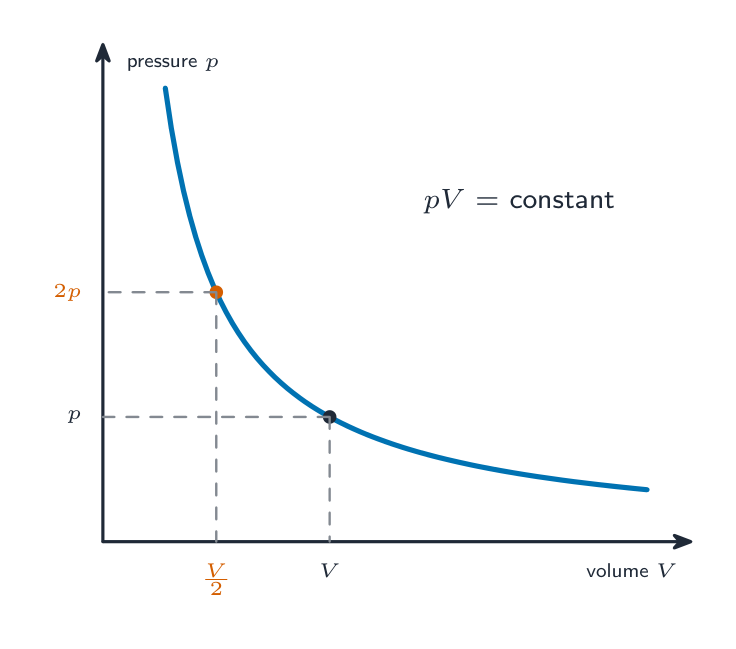
- 9.1.A.1 Atoms in a gas collide with and exert forces on other atoms in the gas and with the container in which the gas is contained.
- 9.1.A.1.i Collisions involving pairs of atoms or an atom and a fixed object can be described and analyzed using conservation of momentum principles.
- 9.1.A.1.ii The pressure exerted by a gas on a surface is the ratio of the sum of the magnitudes of the perpendicular components of the forces exerted by the gas's atoms on the surface to the area of the surface.
- Equation: $P = \dfrac{F_{\perp}}{A}$
- 9.1.A.1.iii Pressure exists throughout the gas itself, not just at the boundary between the gas and the container.
Learning Objective 9.1.B: Describe the temperature of a system in terms of the atomic motion within that system.
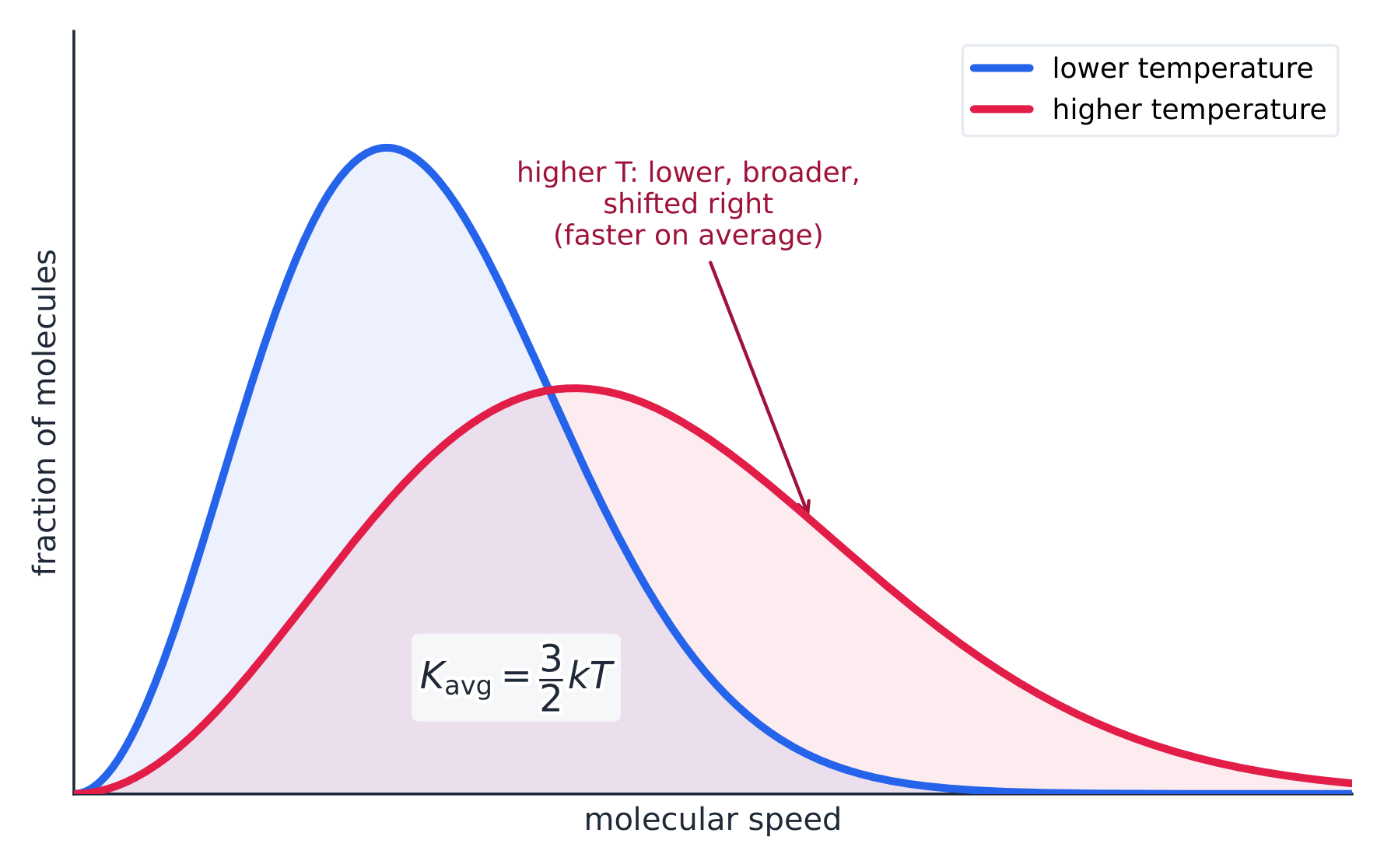
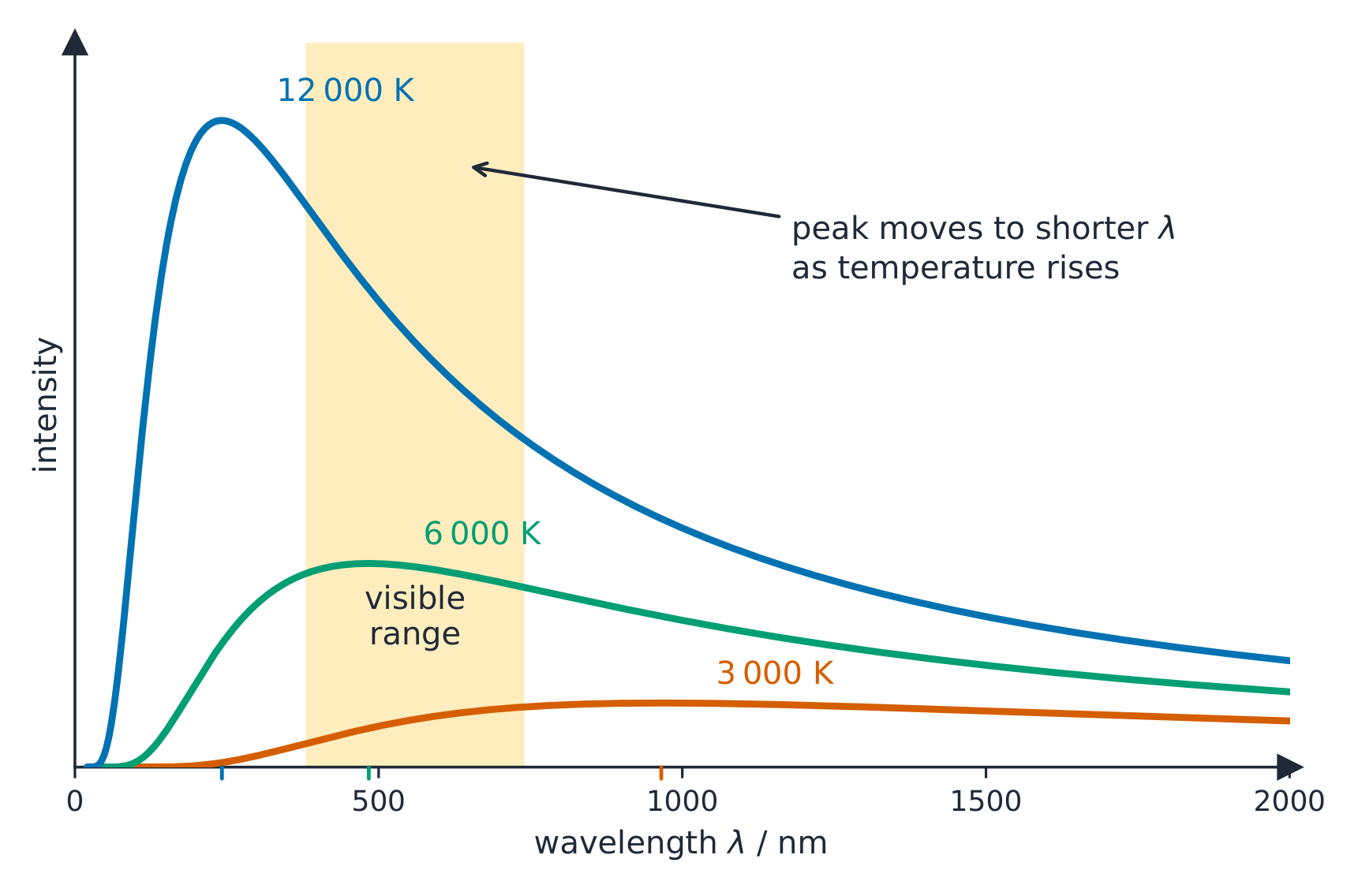
- 9.1.B.1 The temperature of a system is characterized by the average kinetic energy of the atoms within that system.
- 9.1.B.1.i The Maxwell–Boltzmann distribution provides a graphical representation of the energies and speeds of atoms at a given temperature.
- 9.1.B.1.ii The root-mean-square speed corresponding to the average kinetic energy for an ideal gas is related to the temperature of the gas by
- Equation: $K_{\text{avg}} = \dfrac{3}{2} k_B T = \dfrac{1}{2} m v_{\text{rms}}^2$
Boundary statement: AP Physics 2 only expects students to perform qualitative and quantitative analysis of collisions in one and two dimensions. Students are not expected to know the functional form of the Maxwell-Boltzmann distribution but are expected to be familiar with how features of the distribution are related to the temperature of the gas.
Цель обучения 9.1.A: Описать давление, которое газ оказывает на свой контейнер, через движение атомов внутри этого газа.
- 9.1.A.1 Атомы в газе сталкиваются друг с другом, оказывают силы на другие атомы в газе, а также взаимодействуют со стенками контейнера, в котором находится газ.
- 9.1.A.1.i Столкновения пар атомов или атома и неподвижного объекта можно описывать и анализировать с использованием принципов сохранения импульса.
- 9.1.A.1.ii Давление, оказываемое газом на поверхность, равно отношению суммы модулей перпендикулярных составляющих сил, действующих со стороны атомов газа на поверхность, к площади этой поверхности.
- Уравнение: $P = \dfrac{F_{\perp}}{A}$
- 9.1.A.1.iii Давление существует во всем объеме самого газа, а не только на границе между газом и контейнером.
Цель обучения 9.1.B: Описать температуру системы через движение атомов внутри этой системы.
- 9.1.B.1 Температура системы характеризуется средней кинетической энергией атомов, находящихся в этой системе.
- 9.1.B.1.i Распределение Максвелла–Больцмана представляет собой графическое представление энергий и скоростей атомов при заданной температуре.
- 9.1.B.1.ii Среднеквадратичная скорость, соответствующая средней кинетической энергии для идеального газа, связана с температурой газа соотношением
- Уравнение: $K_{\text{avg}} = \dfrac{3}{2} k_B T = \dfrac{1}{2} m v_{\text{rms}}^2$
Граница программы: AP Physics 2 требует от студентов лишь качественного и количественного анализа столкновений в одном и двух измерениях. Студентам не требуется знать функциональную форму распределения Максвелла–Больцмана, но они должны быть знакомы с тем, как особенности распределения связаны с температурой газа.