| Learning Objective | Essential Knowledge |
|---|---|
13.1.A |
|
13.1.B |
|
Geometric Optics
AP Physics 2 · Topic 13
 9:32
Geometric Optics
Put a straight pencil into a glass of water, and it looks broken. Look into the bowl of a shiny spoon, and your face is upside down. Nothing bent, and nothing…
English narration · English + 中文 subtitles burned in
13.1
Reflection

Syllabus
Source: College Board AP Course and Exam Description
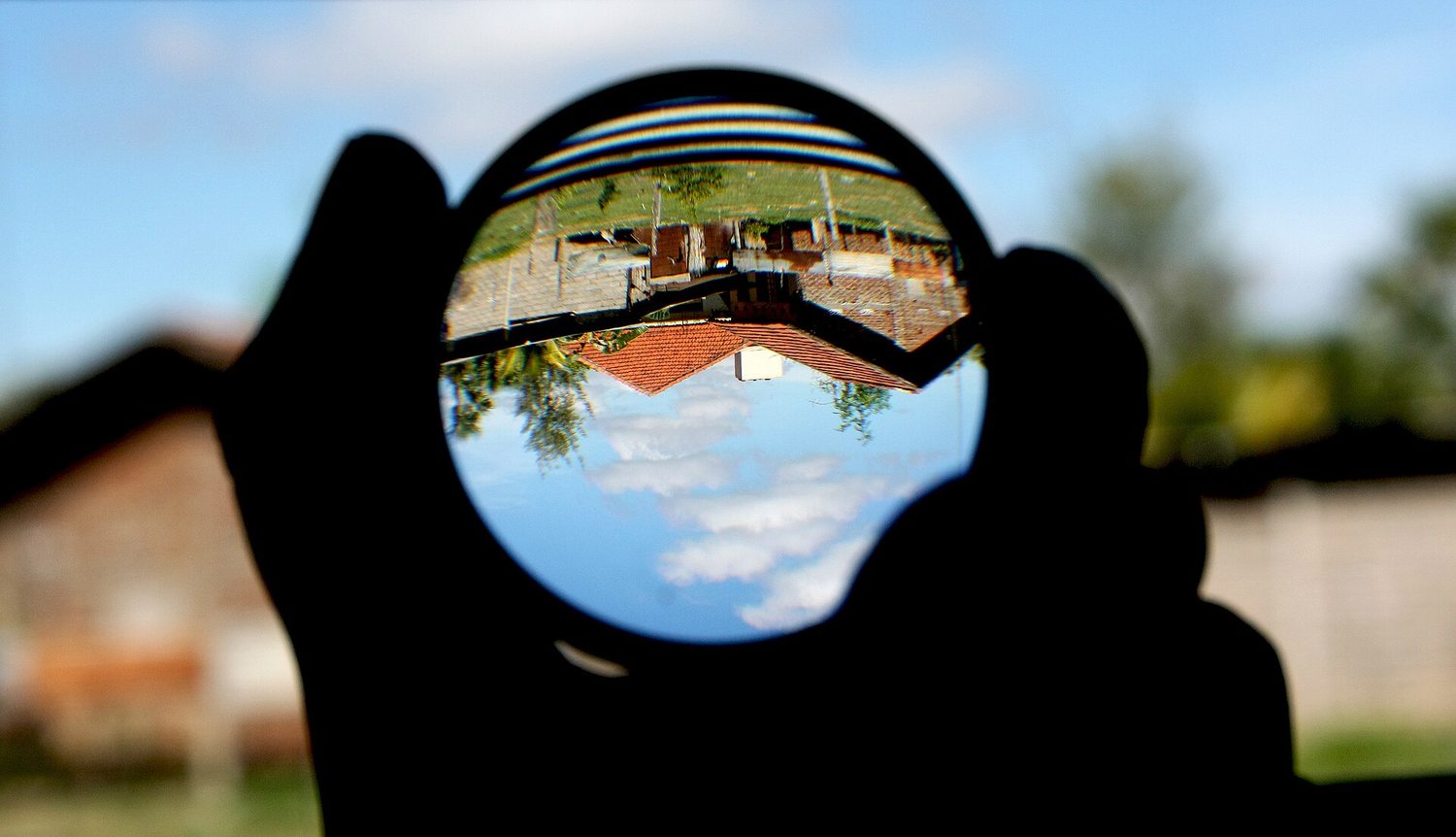
A straw in a glass of water looks bent. A shop's round security mirror shows the whole aisle, but small. A magnifying glass 放大镜 makes print larger, yet moved a little further away, the same lens turns the room upside down. One rule for bending light and one equation explain all of these.
Geometric optics 几何光学 treats light as straight-line rays. The law of reflection 反射定律: when light bounces off a surface, the angle of incidence 入射角 equals the angle of reflection 反射角, both measured from the normal 法线 (the line perpendicular to the surface). Smooth surfaces reflect a clear image; rough surfaces scatter the rays.
What a ray is. A ray is a line drawn perpendicular to the wavefronts 波前 (the crests of the light wave), pointing the way the wave travels. A thin laser beam is a good real-life ray. The ray model works when mirrors, lenses and gaps are much larger than the wavelength. It cannot explain interference or diffraction; those need the wave model of unit 14.
Two kinds of reflection. Every single ray obeys the law of reflection. On a smooth surface such as a mirror, the normals are all parallel, so parallel rays leave parallel: specular reflection 镜面反射, which forms images. On a rough surface such as paper, the normals point in many directions, so parallel rays leave in many directions: diffuse reflection 漫反射. That is why you can read a page from any angle but see no image in it.
The plane mirror. A flat plane mirror 平面镜 forms a virtual, upright image the same size as the object. The image is as far behind the mirror as the object is in front. Parallel rays stay parallel after reflection, so its focal length is infinite: put $f\to\infty$ in the mirror equation and you get $d_i=-d_o$ and $m=+1$.
Explore
The law of reflection
For a mirror, the angle of reflection always equals the angle of incidence - a straight line through the origin.
Vocabulary
Train
| English |
|---|
| magnifying glass/ˈmæɡnɪfaɪɪŋ ɡlæs/ |
| Geometric optics/ˌdʒiːəʊˈmetrɪk ˈɒptɪks/ |
| law of reflection/lɔː ɒv rɪˈflekʃn/ |
| angle of incidence/ˈæŋɡl ɒv ˈɪnsɪdəns/ |
| angle of reflection/ˈæŋɡl ɒv rɪˈflekʃn/ |
| normal/ˈnɔːml/ |
| wavefront/ˈweɪvfrʌnt/ |
| specular reflection/ˈspekjʊlə rɪˈflekʃn/ |
| diffuse reflection/dɪˈfjuːz rɪˈflekʃn/ |
| plane mirror/pleɪn ˈmɪrə/ |
13.2
Images Formed by Mirrors

Syllabus
| Learning Objective | Essential Knowledge |
|---|---|
13.2.A |
Boundary statement: AP Physics 2 limits the study of mirrors to plane mirrors, convex spherical mirrors, and concave spherical mirrors. |
Source: College Board AP Course and Exam Description
For rays near the principal axis 主光轴, a spherical mirror 球面镜 makes parallel rays converge at a real focal point 焦点, or appear to diverge from a virtual focus, a distance $f$ from the mirror. The mirror equation 面镜公式 relates object and image distances:
$$\frac{1}{d_o}+\frac{1}{d_i}=\frac{1}{f},\qquad m=-\frac{d_i}{d_o}.$$
A concave mirror 凹面镜 (converging) can form a real image 实像 (rays actually meet, projectable, inverted 倒立); a convex mirror 凸面镜 always forms a virtual image 虚像 (rays only appear to meet, upright 正立, reduced). The magnification 放大率 $m$ gives the image's size and orientation. For a spherical mirror of radius $R$, the focal point lies halfway between the mirror and its centre of curvature 曲率中心 C:
$$f=\frac{R}{2}.$$
Sign convention 符号规则 matters: with the real-is-positive convention, a negative image distance means a virtual image. It lies behind a mirror, or on the object side of a lens.
Three principal rays. To draw a concave mirror's image, send rays from the top of the object. Any two of these three find the image; the third checks it.
- A ray parallel to the axis reflects through F.
- A ray through F reflects parallel to the axis.
- A ray to the vertex (the centre of the mirror) reflects at an equal angle on the other side of the axis.
For a convex mirror the same rules hold, but F is behind the mirror: ray 1 reflects as if it came from F, and the rays only appear to meet behind the mirror (a virtual image).
Worked example. In the diagram, $f=10\ \text{cm}$ and $d_o=30\ \text{cm}$: $\frac{1}{d_i}=\frac{1}{10}-\frac{1}{30}=\frac{1}{15}$, so $d_i=+15\ \text{cm}$ and $m=-\frac{15}{30}=-0.5$. The rays in the figure cross at exactly that point. An object beyond C always gives an image between F and C: real, inverted and smaller.
Explore
Form an image with a curved mirror
A concave mirror reflects rays through its focus. The object's distance relative to the focal length decides whether the image is real or virtual, enlarged or reduced.
Vocabulary
Train
| English |
|---|
| principal axis/ˈprɪnsɪpl ˈæksɪs/ |
| spherical mirror |
| focal point/ˈfəʊkl pɔɪnt/ |
| mirror equation |
| concave mirror/kɒnˈkeɪv ˈmɪrə/ |
| real image/rɪəl ˈɪmɪdʒ/ |
| inverted/ɪnˈvɜːtɪd/ |
| convex mirror/kɒnˈveks ˈmɪrə/ |
| virtual image/ˈvɜːtʃuːəl ˈɪmɪdʒ/ |
| upright/ˈʌpraɪt/ |
| magnification/ˌmæɡnɪfɪˈkeɪʃn/ |
| centre of curvature |
| sign convention/saɪn kənˈvenʃn/ |
13.3
Refraction

Syllabus
| Learning Objective | Essential Knowledge |
|---|---|
13.3.A |
|
Source: College Board AP Course and Exam Description
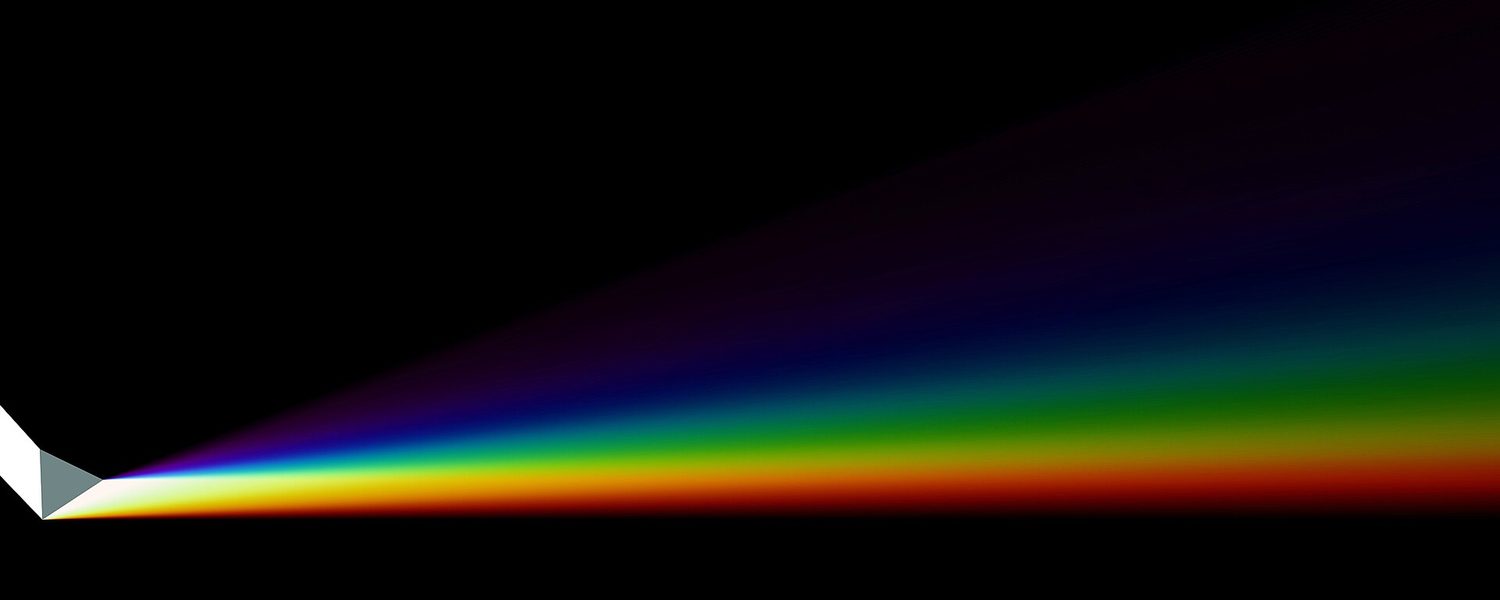
Light bends when it passes between materials because its speed changes – refraction 折射. Each material has an index of refraction 折射率 $n=\dfrac{c}{v}$ (how much it slows light). Snell's law 斯涅尔定律:
$$n_1\sin\theta_1=n_2\sin\theta_2.$$
At oblique incidence, light entering a higher-index medium 介质 bends toward the normal. Beyond the critical angle 临界角, light going from a higher to a lower refractive index reflects entirely – total internal reflection 全反射, used in optical fibres 光纤.
Since $n=c/v$, a larger index means a slower speed. A ray that hits a boundary along the normal ($\theta_1=0$) slows down but does not bend. At exactly the critical angle the refracted ray travels along the surface ($\theta_2=90^{\circ}$).
Partial reflection. At every boundary some light reflects and the rest refracts. So a laser pointed at a glass block makes a bright refracted spot and a weaker reflected spot. If the angle inside the glass passes the critical angle, the refracted spot disappears and the reflected spot gets brighter, because all the light now reflects.
Worked example. A ray in air ($n_1=1.00$) strikes water ($n_2=1.33$) at $40^{\circ}$ to the normal. By Snell's law,
$$\sin\theta_2=\frac{n_1}{n_2}\sin\theta_1=\frac{1.00}{1.33}\sin 40^{\circ}=0.483\;\Rightarrow\;\theta_2=29^{\circ}.$$
The ray bends toward the normal, as expected going into the denser medium.
Worked example (critical angle). For light trying to leave glass ($n=1.50$) for air, total internal reflection begins at the critical angle $\theta_c$ where the refracted ray grazes the surface:
$$\sin\theta_c=\frac{1}{n}=\frac{1}{1.50}=0.667\;\Rightarrow\;\theta_c=42^{\circ}.$$
Any ray hitting the inside surface more steeply than $42^{\circ}$ is trapped – the reason optical fibres carry light for kilometres.
Worked example (parallel layers). Light from air enters a tank where sugar water forms flat layers, with $n$ rising from $1.35$ at the top to $1.45$ at the bottom. It enters at $50^{\circ}$. At every flat boundary $n\sin\theta$ is passed on unchanged, so it stays the same all the way down:
$$n_{\text{air}}\sin 50^{\circ}=n_{\text{bottom}}\sin\theta_{\text{bottom}}\;\Rightarrow\;\sin\theta_{\text{bottom}}=\frac{1.00\times0.766}{1.45}=0.528,\quad\theta_{\text{bottom}}=32^{\circ}.$$
The middle layers do not change the final angle, only the path on the way. The ray bends more toward the normal at each step down, so its path curves.
What changes, and what does not. Entering glass, light slows to $v=c/n$ and its wavelength 波长 shrinks to $\lambda_n=\lambda/n$. The frequency 频率 stays the same: it is set by the source, and the waves cannot pile up at the boundary. So the colour of light, which depends on frequency, does not change inside the glass.
Explore
Bend light as it enters glass
Light refracts (bends) when it changes speed between media, following Snell's law. The denser the medium, the more it bends toward the normal.
Vocabulary
Train
| English |
|---|
| refraction/rɪˈfrækʃn/ |
| index of refraction/ˈɪndeks ɒv rɪˈfrækʃn/ |
| Snell's law/snelz lɔː/ |
| medium/ˈmiːdɪəm/ |
| critical angle/ˈkrɪtɪkl ˈæŋɡl/ |
| total internal reflection/ˈtəʊtl ɪnˈtɜːnl rɪˈflekʃn/ |
| optical fibre/ˈɒptɪkl ˈfaɪbə/ |
| wavelength/ˈweɪvleŋθ/ |
| frequency/ˈfriːkwənsi/ |
13.4
Images Formed by Lenses

Syllabus
| Learning Objective | Essential Knowledge |
|---|---|
13.4.A |
|
Source: College Board AP Course and Exam Description
A lens 透镜 bends light through refraction. The thin-lens equation 薄透镜方程 has the same form as the mirror equation:
$$\frac{1}{d_o}+\frac{1}{d_i}=\frac{1}{f},\qquad m=-\frac{d_i}{d_o}.$$
A converging 会聚 (convex) lens can form a real, inverted image or, for a close object, a virtual, upright, enlarged image (a magnifying glass). A diverging 发散 (concave) lens always forms a virtual, upright, reduced image. Ray diagrams 光路图 locate the image quickly using two easy rays: one parallel to the axis that bends to pass through the far focus, and one straight through the centre of the lens (undeviated 不偏折). A lens has a focal point on each side, at the same distance $f$, because light can pass through it either way.
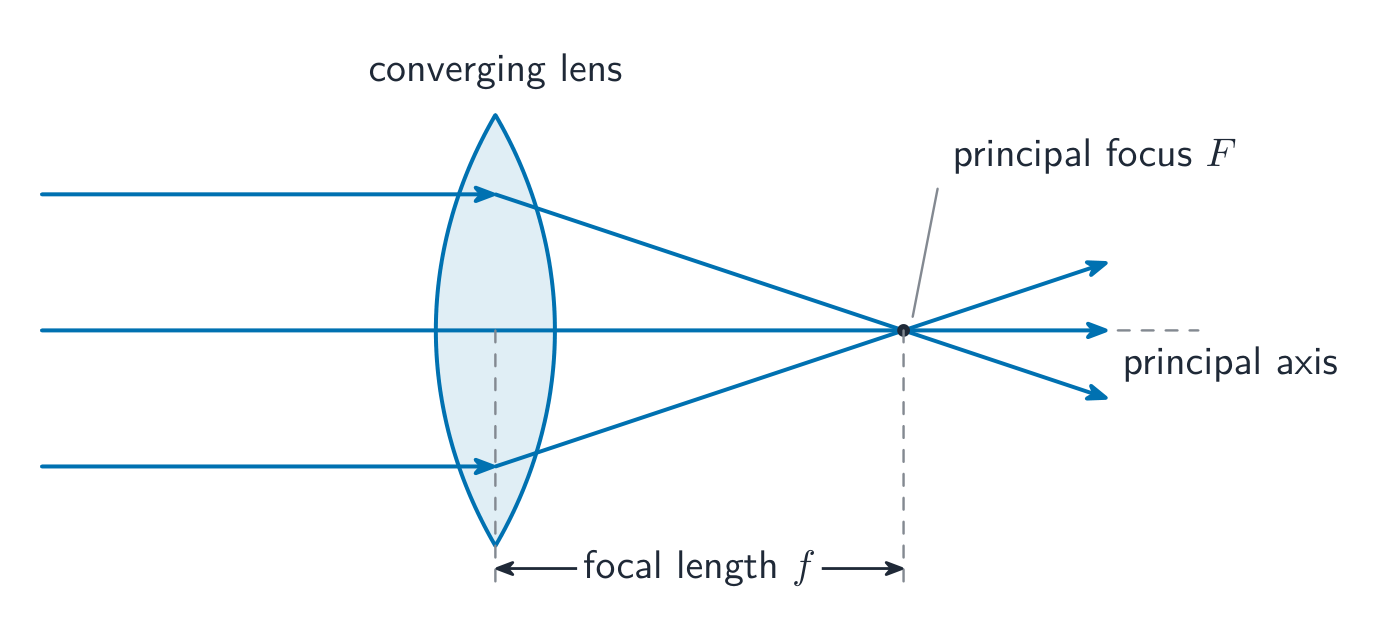
Worked example. An object sits $30\ \text{cm}$ from a converging lens of focal length 焦距 $f=10\ \text{cm}$. Find the image. From the thin-lens equation,
$$\frac{1}{d_i}=\frac{1}{f}-\frac{1}{d_o}=\frac{1}{10}-\frac{1}{30}=\frac{2}{30}\;\Rightarrow\;d_i=15\ \text{cm},$$
and the magnification is $m=-d_i/d_o=-15/30=-0.5$. The image is real (positive $d_i$), inverted (negative $m$), and half the object's size – just what a camera lens does.
Worked example (a lens lab). A student puts a candle $20\ \text{cm}$ from a lens and finds a sharp image on a screen $30\ \text{cm}$ away on the other side.
$$\frac{1}{f}=\frac{1}{20}+\frac{1}{30}=\frac{5}{60}\;\Rightarrow\;f=12\ \text{cm},\qquad m=-\frac{30}{20}=-1.5.$$
The image is real (it is on a screen), inverted and 1.5 times larger. With several measurements, plot $\frac{1}{d_i}$ against $\frac{1}{d_o}$: the points lie on a straight line of gradient $-1$, and both intercepts equal $\frac{1}{f}$.
A lens's surroundings matter. A lens bends light because its index differs from that of the medium around it. Put a glass lens in water and the difference is smaller, so it bends light less: its focal length gets longer, and the image of a distant object forms farther away. Bending depends on the index difference, not just the glass. An air bubble in water is a convex shape with a lower index than its surroundings, so it acts as a diverging lens. A prism bends light more in air than in a liquid, for the same reason.
Explore
Form an image with a converging lens
A converging lens bends parallel rays to its focal point. Move the object and watch the image change from large and inverted to virtual and upright inside the focal length.
Vocabulary
Train
| English |
|---|
| lens/lenz/ |
| thin-lens equation |
| converging/kənˈvɜːdʒɪŋ/ |
| diverging/daɪˈvɜːdʒɪŋ/ |
| ray diagram |
| undeviated |
| focal length/ˈfəʊkl leŋθ/ |
13.4
Signs decide the answer

Every mirror and lens problem uses the same equation, so the signs carry the physics.
| Quantity | Positive | Negative |
|---|---|---|
| $f$ | converging lens, concave mirror | diverging lens, convex mirror |
| $d_i$ | real image (can be projected) | virtual image (cannot be projected) |
| $m$ | upright image | inverted image |
| $\lvert m\rvert$ | $>1$: enlarged | $<1$: reduced |
Worked example (a magnifying glass). An object sits $6.0\ \text{cm}$ from a converging lens with $f=10\ \text{cm}$, inside the focal length.
$$\frac{1}{d_i}=\frac{1}{10}-\frac{1}{6.0}=-\frac{1}{15}\;\Rightarrow\;d_i=-15\ \text{cm},\qquad m=-\frac{-15}{6.0}=+2.5.$$
The image is virtual (negative $d_i$, on the same side as the object), upright and enlarged 2.5 times: a magnifier. Move the object outside $f$ and $d_i$ turns positive: the image becomes real and inverted, as in the camera example above.
Worked example (two mirrors). A concave mirror has $f=+20\ \text{cm}$ and an object $60\ \text{cm}$ away: $\frac{1}{d_i}=\frac{1}{20}-\frac{1}{60}=\frac{1}{30}$, so $d_i=+30\ \text{cm}$ and $m=-0.5$, a real, inverted, half-size image. A convex security mirror has $f=-15\ \text{cm}$ and a shopper $30\ \text{cm}$ away: $\frac{1}{d_i}=-\frac{1}{15}-\frac{1}{30}=-\frac{1}{10}$, so $d_i=-10\ \text{cm}$ and $m=+0.33$. The image is virtual, upright and small, which is why the whole aisle fits in the mirror.
Worked example (a diverging lens). An object stands $24\ \text{cm}$ from a diverging lens with $f = -12\ \text{cm}$.
$$\frac{1}{d_i} = \frac{1}{-12} - \frac{1}{24} = -\frac{3}{24} \;\Rightarrow\; d_i = -8.0\ \text{cm}, \qquad m = -\frac{-8.0}{24} = +0.33.$$
The image is virtual, upright and one-third the size, $8.0\ \text{cm}$ from the lens on the object's side. Whatever the object distance, $d_i$ stays negative and $|d_i| < |f|$: a diverging lens always makes a small, upright, virtual image between the lens and its focal point.
The ray diagram checks the algebra: the image sits a third of the way from the lens to the object, and it is a third of the object's height.
13.4
Practice
Answer each before reading the answers below. Take $c=3.0\times10^8\ \text{m/s}$.
-
Light passes from air into glass ($n=1.5$) at $30°$ to the normal. Find the angle of refraction.
-
Find the speed of light in that glass.
-
Diamond has $n=2.42$. Find its critical angle with air, and explain why diamonds sparkle.
-
An object is $20\ \text{cm}$ from a converging lens with $f=15\ \text{cm}$. Find the image distance and magnification, and describe the image.
-
A student says: "A diverging lens can project an image onto a screen if the object is placed carefully." Correct the student.
-
A plane mirror is fixed to a wall. You stand $1.5\ \text{m}$ in front of it. How far are you from your image, and is the image real or virtual?
-
A concave mirror has radius of curvature $R=40\ \text{cm}$. An object stands $60\ \text{cm}$ away. Find $f$, the image distance and the magnification.
-
A glass lens has $f=20\ \text{cm}$ in air. It is put under water. Will its focal length increase, decrease or stay the same? Explain.
13.4
Answers
-
$\sin\theta_2=\dfrac{1.0}{1.5}\sin30°=0.333$, so $\theta_2=19.5°$, toward the normal.
-
$v=\dfrac{c}{n}=\dfrac{3.0\times10^8}{1.5}=2.0\times10^8\ \text{m/s}$.
-
$\sin\theta_c=\dfrac{1}{2.42}=0.413$, so $\theta_c=24°$. Such a small critical angle means most light that enters is totally internally reflected several times before it escapes, so diamonds flash brightly.
-
$\dfrac{1}{d_i}=\dfrac{1}{15}-\dfrac{1}{20}=\dfrac{1}{60}$, so $d_i=+60\ \text{cm}$ and $m=-3$: real, inverted and three times larger, as in a projector.
-
A diverging lens has negative $f$, so $d_i$ is negative for every real object: the image is always virtual and cannot be formed on a screen.
-
The image is $1.5\ \text{m}$ behind the mirror, so you are $3.0\ \text{m}$ from it. It is virtual: no light actually reaches the point behind the mirror.
-
$f=R/2=20\ \text{cm}$. $\frac{1}{d_i}=\frac{1}{20}-\frac{1}{60}=\frac{2}{60}$, so $d_i=+30\ \text{cm}$ and $m=-0.5$: real, inverted, half size.
-
It increases. Water's index is closer to glass's, so light bends less at each surface and the rays meet farther from the lens.
13.4
Exam tips
- Measure all angles from the normal, not the surface.
- Light entering a denser medium (larger $n$) bends toward the normal; use Snell's law $n_1\sin\theta_1=n_2\sin\theta_2$.
- Total internal reflection happens only going into a less dense medium, beyond the critical angle ($\sin\theta_c=1/n$).
- For mirrors and lenses use $\tfrac1{d_o}+\tfrac1{d_i}=\tfrac1f$ and $m=-d_i/d_o$: a positive $d_i$ is a real image, negative is virtual.
- $n=c/v$, so a bigger index means a slower speed of light in the material.
Common mistakes
- Measuring angles from the surface in Snell's law. Use the angle to the normal; if the question gives the angle to the surface, subtract it from $90^{\circ}$.
- Dropping the minus sign of a diverging lens or convex mirror focal length. Put $f < 0$ into the equation, or the image comes out real.
- Forgetting to invert at the end: $\dfrac{1}{d_i} = \dfrac{2}{30}$ means $d_i = 15\ \text{cm}$, not $0.067\ \text{cm}$.
- Saying the frequency (colour) of light changes in glass. Speed and wavelength drop by the factor $n$; frequency does not change.
- Expecting total internal reflection when light goes from air into glass. It needs light travelling toward a lower index, at more than the critical angle.
- Drawing the ray through the centre of a lens with a bend. It goes straight on; only the parallel ray and the focal ray bend.
- Using a single "$n$" in Snell's law when the lens or prism is in water. The bending depends on both indices; a lens in water has a longer focal length than in air.
- Calling a plane-mirror image real. It is virtual: it sits behind the mirror where no light goes, at the same distance as the object is in front.
Interactive lessons on this topic
Work through it step by step, with instant-check exercises.