Uma planta não pode caçar e não pode se mover. Então ela constrói seu próprio alimento a partir de quase nada: um gás do ar, água do solo e luz. Cada refeição que você…
English narration · English + 中文 subtitles burned in · Narração em inglês · Legendas em inglês + 中文 gravadas
6.1
Photosynthesis · Fotossíntese
Syllabus · Programa
English
Core
Supplement
1 Describe photosynthesis as the process by which plants synthesise carbohydrates from raw materials using energy from light
2 State the word equation for photosynthesis as: carbon dioxide + water $\rightarrow$ glucose + oxygen in the presence of light and chlorophyll
10 State the balanced chemical equation for photosynthesis as: $6\text{CO}_2 + 6\text{H}_2\text{O} \rightarrow \text{C}_6\text{H}_{12}\text{O}_6 + 6\text{O}_2$
3 State that chlorophyll is a green pigment that is found in chloroplasts
4 State that chlorophyll transfers energy from light into energy in chemicals, for the synthesis of carbohydrates
5 Outline the subsequent use and storage of the carbohydrates made in photosynthesis, limited to: (a) starch as an energy store (b) cellulose to build cell walls (c) glucose used in respiration to provide energy (d) sucrose for transport in the phloem (e) nectar to attract insects for pollination
6 Explain the importance of: (a) nitrate ions for making amino acids (b) magnesium ions for making chlorophyll
7 Investigate the need for chlorophyll, light and carbon dioxide for photosynthesis, using appropriate controls
8 Investigate and describe the effects of varying light intensity, carbon dioxide concentration and temperature on the rate of photosynthesis
9 Investigate and describe the effect of light and dark conditions on gas exchange in an aquatic plant using hydrogencarbonate indicator solution
11 Identify and explain the limiting factors of photosynthesis in different environmental conditions
Português
Central
Suplementar
1 Descreva fotossíntese como o processo pelo qual as plantas sintetizam carboidratos a partir de matérias-primas usando energia da luz
2 Afirme a equação verbal para fotossíntese como: dióxido de carbono + água $\rightarrow$ glicose + oxigênio na presença de luz e clorofila
10 Afirme a equação química balanceada para fotossíntese como: $6\text{CO}_2 + 6\text{H}_2\text{O} \rightarrow \text{C}_6\text{H}_{12}\text{O}_6 + 6\text{O}_2$
3 Afirme que a clorofila é um pigmento verde encontrado nos cloroplastos
4 Afirme que a clorofila transfere energia da luz para energia em substâncias químicas, para a síntese de carboidratos
5 Resuma o uso subsequente e armazenamento dos carboidratos produzidos na fotossíntese, limitado a: (a) amido como reserva energética (b) celulose para construir paredes celulares (c) glicose usada na respiração para fornecer energia (d) sacarose para transporte no floema (e) néctar para atrair insetos para polinização
6 Explique a importância de: (a) íons nitrato para fazer aminoácidos (b) íons magnésio para fazer clorofila
7 Investigue a necessidade de clorofila, luz e dióxido de carbono para a fotossíntese, usando controles adequados
8 Investigue e descreva os efeitos de variar a intensidade da luz, concentração de dióxido de carbono e temperatura na taxa de fotossíntese
9 Investigue e descreva o efeito de condições de luz e escuridão na troca gasosa em uma planta aquática usando solução indicadora de bicarbonato
11 Identifique e explique os fatores limitantes da fotossíntese em diferentes condições ambientais
Source: Cambridge International syllabus · Fonte: Programa Cambridge International
English
Photosynthesis: inputs and outputs
Photosynthesis 光合作用 is the process by which plants make carbohydrates 碳水化合物 from simple raw materials 原料, using energy 能量 from light. It is how plants feed themselves.
In words: plants take in carbon dioxide 二氧化碳 and water, and make glucose 葡萄糖 and oxygen 氧气. This reaction can only happen in the light, and only where there is chlorophyll 叶绿素.
Chlorophyll is a green pigment 色素 found in the chloroplasts 叶绿体. It traps light and transfers the energy from light into energy stored in chemicals. That chemical energy is then used to build carbohydrates.
What the plant does with the glucose
Use
What happens
store
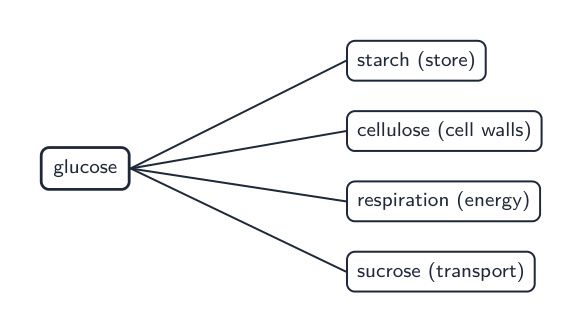
changed to starch 淀粉, an energy store that does not dissolve
build
made into cellulose 纤维素 to build cell walls 细胞壁
release energy
broken down in respiration 呼吸作用 to release energy
transport
changed to sucrose 蔗糖 and moved around the plant in the phloem 韧皮部
attract animals
made into nectar 花蜜 to attract insects 昆虫 for pollination 传粉
Minerals from the soil
Plants also take up mineral ions 离子 from the soil through their roots:
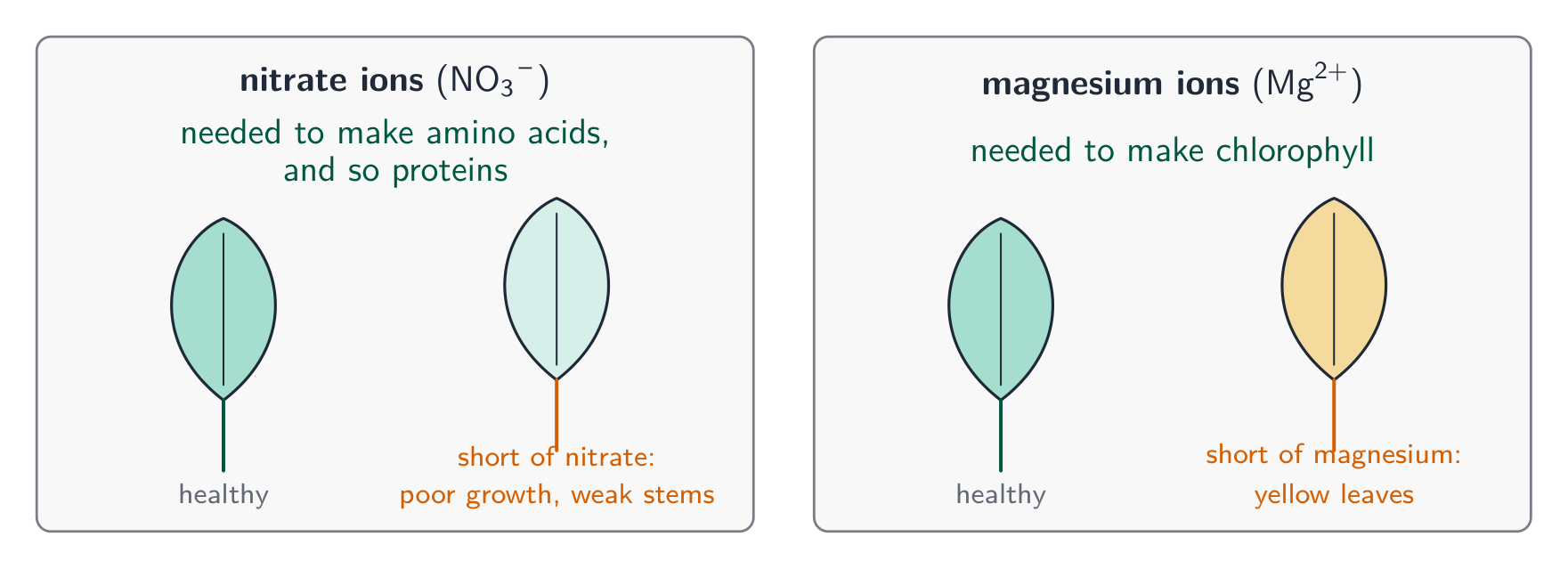
nitrate ions 硝酸根离子 — needed to make amino acids 氨基酸 (and so proteins).
magnesium ions 镁离子 — needed to make chlorophyll.
A plant short of nitrate grows poorly with weak stems; a plant short of magnesium has yellow leaves (it cannot make enough chlorophyll).
The rate of photosynthesis
The rate 速率 of photosynthesis depends on three things:
light intensity 光照强度 — more light gives a faster rate, up to a point.
carbon dioxide concentration 浓度 — more carbon dioxide gives a faster rate.
temperature 温度 — a warmer temperature is faster, until it gets so hot that the enzymes are denatured.
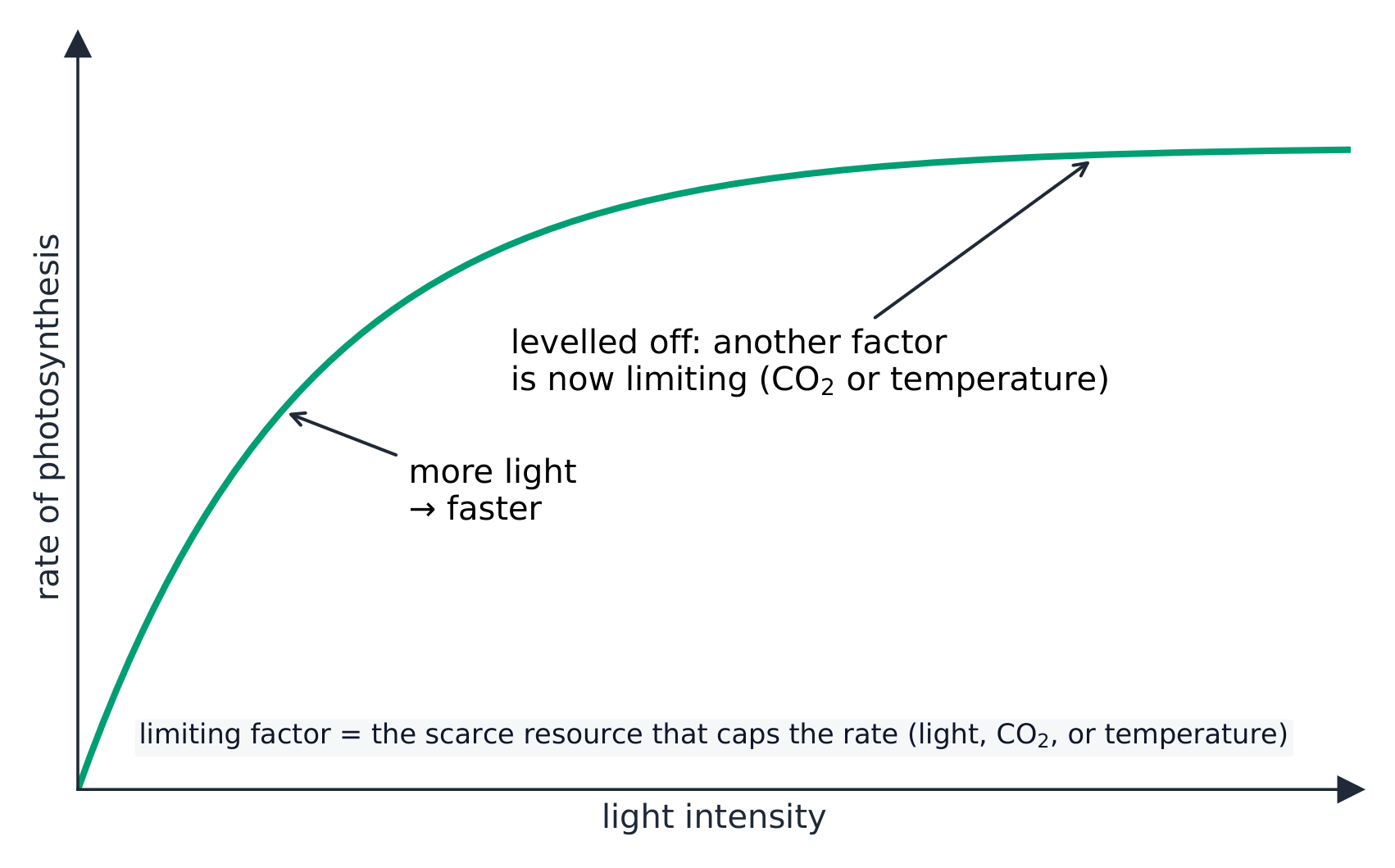
(Supplement) At any moment, the one factor that is in shortest supply holds back the rate. This is called the limiting factor 限制因素. For example, on a dull day light intensity is usually the limiting factor; on a bright day carbon dioxide may be.
Worked example. On a graph of rate against light intensity, the line rises steeply at first and then levels off flat. Which factor is limiting on each part? On the rising part, adding light raises the rate, so light intensity is the limiting factor there. On the flat part, adding more light changes nothing, so light is no longer limiting - something else is, usually carbon dioxide concentration or temperature. The test is always the same: if adding more of a factor speeds the reaction up, that factor was the one holding it back.
Investigating photosynthesis
To show that a plant needs light, chlorophyll and carbon dioxide, you test a leaf for starch after taking one of them away. A control 对照 keeps every other condition the same, so the test is fair. (First leave the plant in the dark to use up its starch.) A leaf with green and white parts shows starch only in the green parts, which have chlorophyll.
You can also watch gas exchange 气体交换 in a water plant using hydrogencarbonate indicator 指示剂, which changes colour as the carbon dioxide level changes. In the light the plant takes in carbon dioxide for photosynthesis; in the dark it gives out carbon dioxide from respiration.
Português
Fotossíntese: entradas e saídasFolhas verdes capturam luz solar para a fotossíntese.
Fotossíntese 光合作用 é o processo pelo qual as plantas produzem carboidratos 碳水化合物 a partir de matérias-primas 原料 simples, utilizando energia 能量 da luz. É como as plantas se alimentam.
Em palavras: as plantas absorvem dióxido de carbono 二氧化碳 e água, e produzem glicose 葡萄糖 e oxigênio 氧气. Esta reação só pode ocorrer na luz e apenas onde há clorofila 叶绿素.
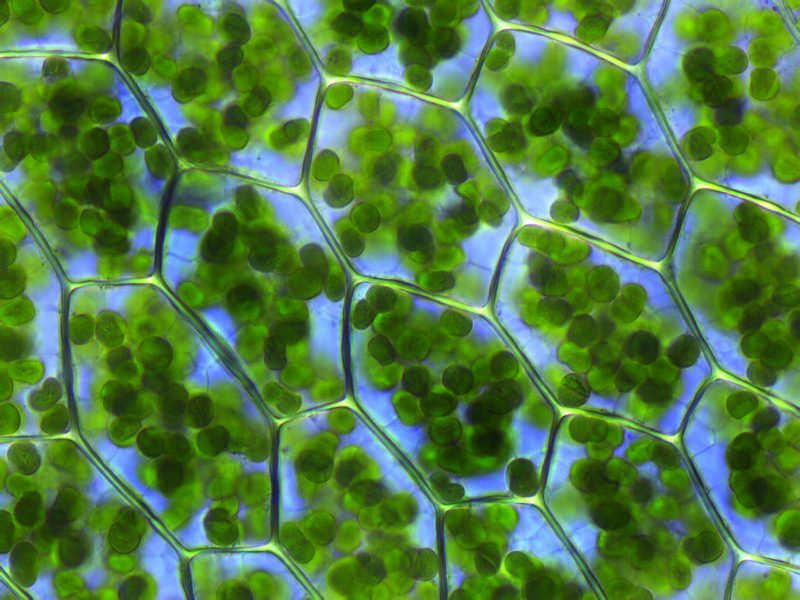
Fotossíntese absorve dióxido de carbono e água e produz glicose e oxigênio, usando luzOs mesmos cloroplastos sob microscópio, empilhados dentro das células de folhas de musgo — o verde é a clorofila
O que a clorofila faz
A clorofila é um pigmento 色素 verde encontrado nos cloroplastos 叶绿体. Ela captura a luz e transfere a energia da luz para a energia armazenada em compostos químicos. Essa energia química é então usada para construir carboidratos.
O que a planta faz com a glicose
Uso
O que acontece
armazenar
transformada em amido 淀粉, um reservatório de energia que não se dissolve
construir
convertida em celulose 纤维素 para formar paredes celulares 细胞壁
liberar energia
decomposta na respiração 呼吸作用 para liberar energia
transportar
transformada em sacarose 蔗糖 e distribuída pela planta no floema 韧皮部
atrair animais
convertida em néctar 花蜜 para atrair insetos 昆虫 para a polinização 传粉
O que uma planta faz com a glicose que produz
Minerais do solo
As plantas também absorvem íons minerais 离子 do solo através de suas raízes:
íons nitrato 硝酸根离子 — necessários para produzir ácidos aminados 氨基酸 (e assim proteínas).
íons magnésio 镁离子 — necessários para produzir clorofila.
Uma planta carente de nitrato cresce mal com caules fracos; uma planta carente de magnésio tem folhas amarelas (não consegue produzir suficiente clorofila).
Uma planta carente de nitrato cresce mal; uma planta carente de magnésio tem folhas amarelas
A taxa de fotossíntese
A taxa 速率 de fotossíntese depende de três coisas:
intensidade luminosa 光照强度 — mais luz resulta em uma taxa mais rápida, até certo ponto.
concentração 浓度 de dióxido de carbono — mais dióxido de carbono resulta em uma taxa mais rápida.
temperatura 温度 — temperaturas mais altas são mais rápidas, até ficarem tão quentes que as enzimas sejam denaturadas.
(Suplemento) Em qualquer momento, o fator que está em menor suprimento limita a taxa. Isso é chamado de fator limitante 限制因素. Por exemplo, em um dia nublado, a intensidade luminosa geralmente é o fator limitante; em um dia ensolarado, pode ser a concentração de dióxido de carbono.
Mais luz acelera a fotossíntese até que outro fator se torne limitante
Exemplo resolvido. Em um gráfico de taxa versus intensidade luminosa, a linha sobe acentuadamente inicialmente e depois se nivela. Qual fator é limitante em cada parte? Na parte ascendente, adicionar luz eleva a taxa, portanto a intensidade luminosa é o fator limitante ali. Na parte plana, adicionar mais luz não muda nada, logo a luz já não é mais limitante — algo mais está, geralmente a concentração de dióxido de carbono ou a temperatura. O teste é sempre o mesmo: se adicionar mais de um fator acelera a reação, esse fator era o que estava a restringindo-a.
Investigando a fotossíntese
Para demonstrar que uma planta precisa de luz, clorofila e dióxido de carbono, testa-se uma folha quanto a amido após remover um desses fatores. Um controle 对照 mantém todas as outras condições iguais, garantindo que o teste seja justo. (Primeiro deixe a planta no escuro para consumir seu amido.) Uma folha com partes verdes e brancas mostra amido apenas nas partes verdes, que possuem clorofila.
Você também pode observar troca gasosa 气体 exchange em uma planta aquática usando indicador 指示剂 de bicarbonato, que muda de cor conforme o nível de dióxido de carbono varia. Na luz, a planta absorve dióxido de carbono para a fotossíntese; no escuro, libera dióxido de carbono devido à respiração.
Explore · Explorar
O que limita a fotossíntese
Mude a luz e o CO₂. O fator mais lento — o fator limitante — determina a taxa.
1 State that most leaves have a large surface area and are thin, and explain how these features are adaptations for photosynthesis
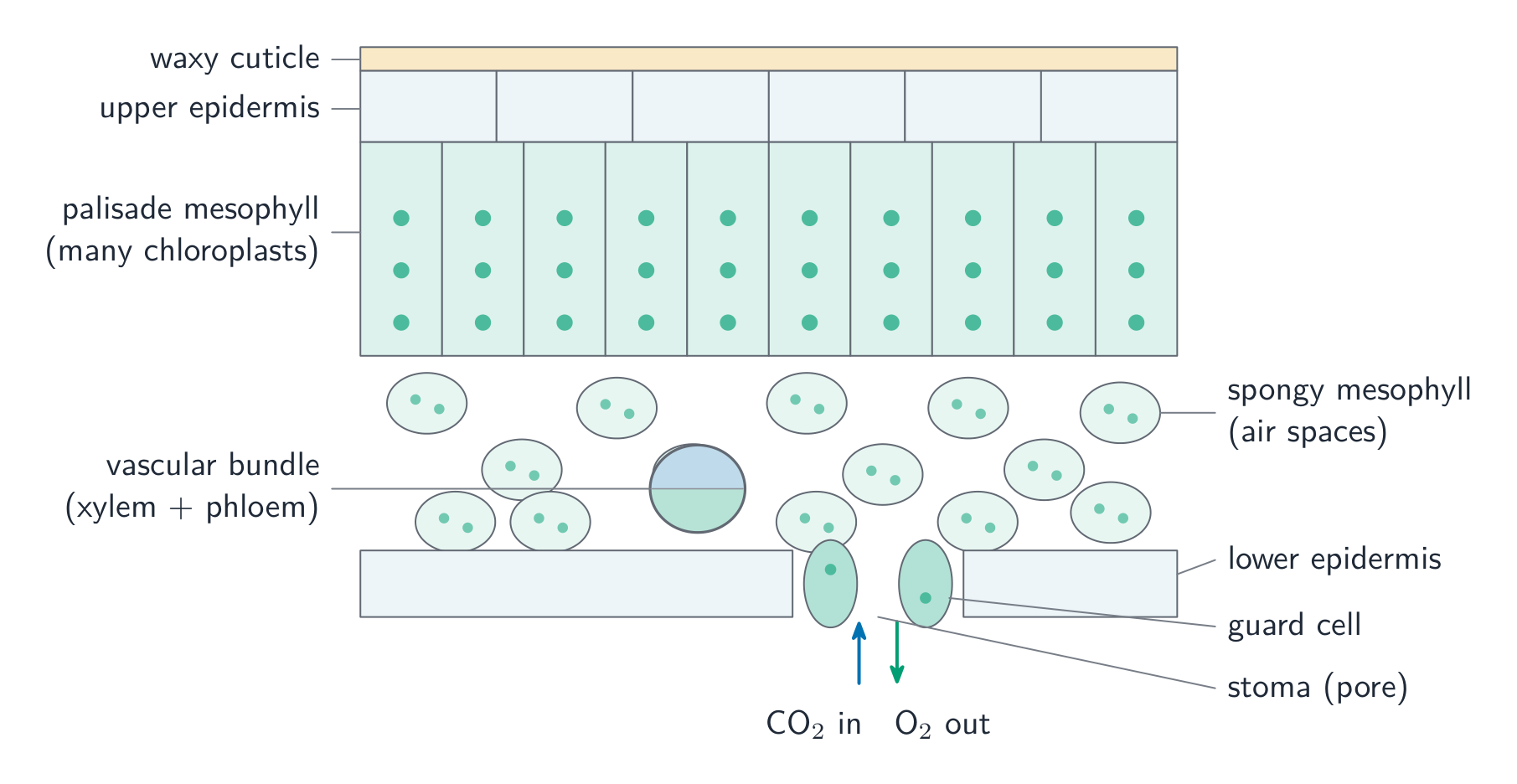
2 Identify in diagrams and images the following structures in the leaf of a dicotyledonous plant: chloroplasts, cuticle, guard cells and stomata, upper and lower epidermis, palisade mesophyll, spongy mesophyll, air spaces, vascular bundles, xylem and phloem
3 Explain how the structures listed in 6.2.2 adapt leaves for photosynthesis
Português
Central
Suplementar
1 Afirme que a maioria das folhas tem uma grande área de superfície e é fina, e explique como essas características são adaptações para a fotossíntese
2 Identifique em diagramas e imagens as seguintes estruturas na folha de uma planta dicotiledônea: cloroplastos, cutícula, células-guarda e estômatos, epiderme superior e inferior, mesofilo paliçádico, parênquima esponjoso, espaços aéreos, feixes vasculares, xilema e floema
3 Explique como as estruturas listadas em 6.2.2 adaptam as folhas para a fotossíntese
Source: Cambridge International syllabus · Fonte: Programa Cambridge International
English
A leaf is well adapted 适应 for photosynthesis. Most leaves are broad, with a large surface area 表面积 to catch plenty of light, and thin, so that gases and light quickly reach all the cells.
The middle of the leaf, the mesophyll 叶肉, is where most photosynthesis happens. These are the main parts of a leaf:
Structure
Job / how it helps photosynthesis
cuticle 角质层
a clear waxy layer on top; it reduces water loss but still lets light through
upper epidermis 表皮
a clear layer of cells with no chloroplasts; it lets light pass to the cells below
palisade mesophyll 栅栏叶肉
tall, column-shaped cells packed with chloroplasts, near the top; they do most of the photosynthesis
spongy mesophyll 海绵叶肉
rounded cells with air spaces 气腔 between them, so gases can move easily
stomata 气孔
tiny holes, mostly on the lower surface, that let carbon dioxide in and oxygen out
guard cells 保卫细胞
a pair of cells around each stoma; they open and close it
lower epidermis
a thin layer that holds the stomata
vascular bundles 维管束
contain xylem 木质部 (brings water to the leaf) and phloem (carries sugars away)
Português
Uma folha está bem adaptada 适应 para a fotossíntese. A maioria das folhas é larga, com grande área de superfície 表面积 para capturar muita luz, e fina, para que gases e luz alcancem rapidamente todas as células.
O centro da folha, o mesofilo 叶肉, é onde ocorre a maior parte da fotossíntese. Estas são as principais partes de uma folha:
Estrutura
Função / como ajuda na fotossíntese
cutícula 角质层
camada cerosa transparente superior; reduz a perda de água mas ainda permite a passagem de luz
epiderme superior 表皮
camada transparente de células sem cloroplastos; permite a passagem de luz para as células abaixo
mesofilo paliçádico 栅栏叶肉
células alongadas em formato de coluna, repletas de cloroplastos, próximas à parte superior; realizam a maior parte da fotossíntese
mesofilo esponjoso 海绵叶肉
células arredondadas com espaços aéreos 气腔 entre elas, facilitando o movimento dos gases
estômatos 气孔
pequenos orifícios, predominantemente na superfície inferior, que permitem a entrada de dióxido de carbono e saída de oxigênio
células-guarda 保卫细胞
par de células ao redor de cada estômata; abrem e fecham-no
epiderme inferior
camada fina que sustenta os estômatos
feixes vasculares 维管束
contêm xilema 木质部 (leva água à folha) e floema (transporta açúcares para fora)
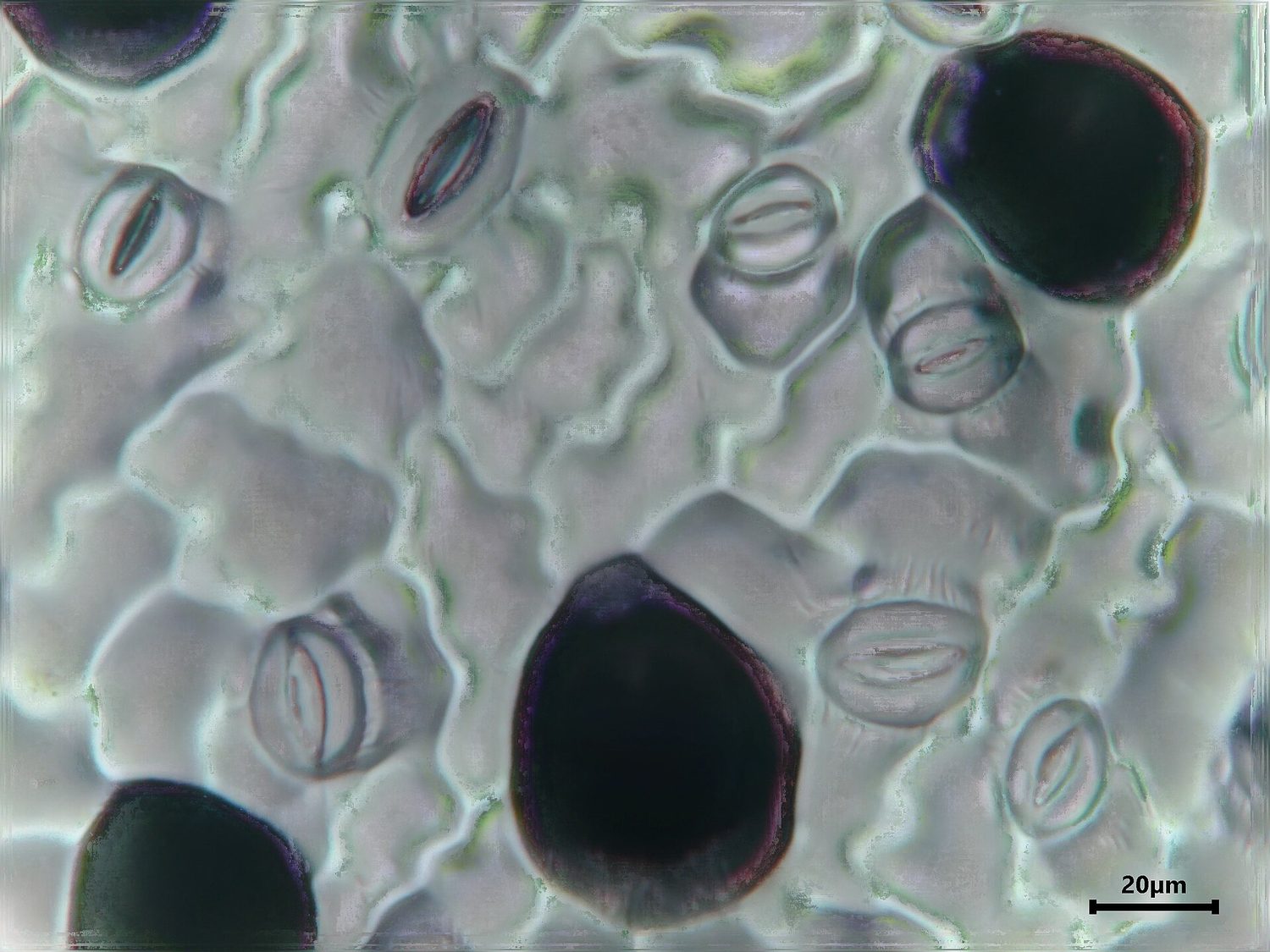
Uma folha em corte transversal: cada tecido é adaptado para fotossíntese e troca gasosaEstômatos reais na superfície inferior de uma folha — cada poro possui duas células-guarda (barra de escala 20 μm)
Explore · Explorar
Dentro de uma folha
Toque em cada camada de uma secção transversal de uma folha para ver como sua estrutura é construída para fotossíntese e troca gasosa.
Learn the word equation exactly: carbon dioxide + water → glucose + oxygen (in light, with chlorophyll).
Chlorophyll is in the chloroplasts; it does not get used up — it transfers light energy.
Link each factor to the rate: more light, more carbon dioxide, warmer (but not too hot) → faster, until a limiting factor stops further increase.
For leaf structure, always link the part to its job: broad and thin to catch light; palisade cells full of chloroplasts; stomata and air spaces for gas exchange.
Aprenda a equação verbal exatamente: dióxido de carbono + água → glicose + oxigênio (na luz, com clorofila).
A clorofila está nos cloroplastos; não é consumida — ela transfere energia luminosa.
Vincule cada fator à taxa: mais luz, mais dióxido de carbono, mais quente (mas não excessivamente) → mais rápido, até que um fator limitante impeça novo aumento.
Para a estrutura da folha, vincule sempre a parte à sua função: folhas largas e finas para capturar luz; células paliçádicas cheias de cloroplastos; estômatos e espaços aéreos para troca gasosa.
Pick one and the site follows you — notes, papers, videos and practice all open on it. · Escolha uma e o site te seguirá — notas, provas, vídeos e prática abrirão nela.
Type to search notes, lessons, code, vocabulary and past-paper questions across every subject. · Digite para pesquisar notas, aulas, código, vocabulário e questões de provas anteriores em todas as disciplinas.